
Maa Durga is not only a goddess from ancient stories. For millions of devotees, she is a living presence, a caring mother who listens in silence and protects without being asked.
In moments of fear, weakness, or confusion, people remember her name and feel a quiet strength rising within. She appears gentle like Parvati, powerful like Durga, and fierce like Kali, yet her heart remains the same.
In Sanatan Dharma, the Divine Mother is not worshipped from a distance. She is loved, trusted, and spoken to like one’s own Maa, because she stands beside her children in every phase of life.
Across centuries, regions, and changing times, devotion to the Divine Mother has never faded. Her forms may differ and her names may change, but her purpose remains constant: to protect dharma, remove fear, and awaken inner strength.
Whether worshipped in grand temples, during vibrant festivals, or in the quiet space of a devotee’s heart, her presence continues to guide and comfort.
Table of Contents
ToggleWho is Maa Durga in Sanatan Dharma?
In Sanatan Dharma, Maa Durga represents Shakti, the divine energy that sustains and moves the universe.
She is not separate from creation but is the force behind it. When balance is disturbed and righteousness is threatened, this divine energy takes form to restore harmony.
Durga is seen as the protector of dharma. Her strength is not driven by anger, but by compassion. Devotees do not fear her power; they trust it. To them, she is a mother who becomes strong when her children are in danger.
Durga, Parvati and Shakti: understanding the divine mother
Many people wonder whether Durga, Parvati, and Shakti are different goddesses. In Sanatan understanding, they are expressions of the same divine reality.
Parvati is the gentle, nurturing form who represents love, patience, and harmony. Durga is the same mother when she rises to protect the universe. Shakti is her formless cosmic energy, the power behind all creation and transformation.
These forms do not contradict one another. They show that the Divine Mother understands every human need, from care and compassion to courage and protection.
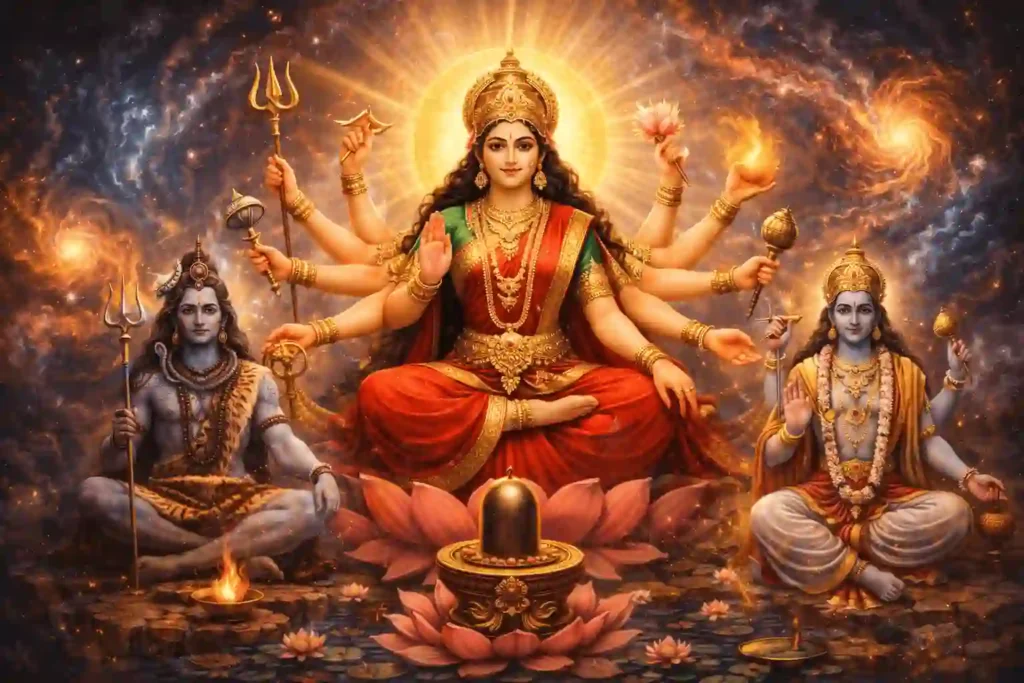
Why the divine mother appears in many forms
Life itself changes with time, and so do human struggles. The Divine Mother appears in different forms because the challenges faced by the world are never the same.
When compassion is needed, she appears gentle. When injustice grows strong, she appears powerful. When ignorance becomes deep, she appears fierce. Each form carries the same love, expressed in a way that restores balance.
The story of Maa Durga and Mahishasura
One of the most well-known stories associated with Maa Durga is the battle with Mahishasura. Blessed with great power, Mahishasura became arrogant and disturbed the balance of the universe. Even the gods were unable to stop him.
From the combined divine energies emerged a powerful form, radiant and fearless. This was Durga. Armed with divine weapons and guided by compassion, she defeated Mahishasura and restored harmony.
The story reminds devotees that ego and injustice, no matter how strong, cannot survive against divine truth.
Navdurga and the nine nights of worship
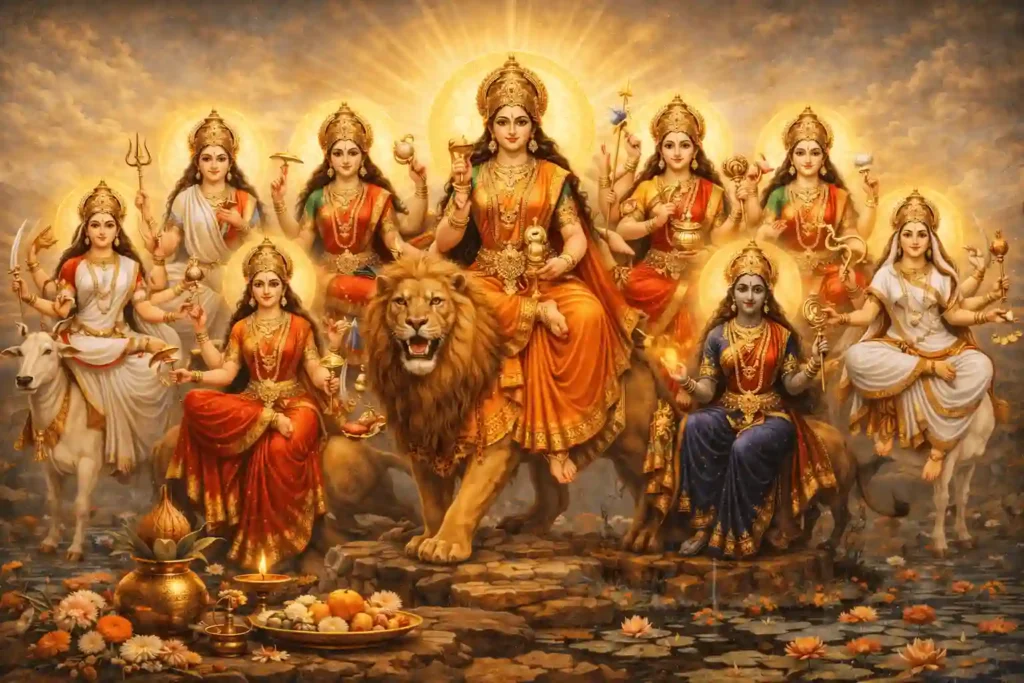
During Navratri, devotees worship the nine sacred forms of the Divine Mother, known as Navdurga.
Each form represents a different spiritual quality, from courage and purity to wisdom and compassion.
The nine nights symbolise an inner journey, where devotees reflect, purify, and reconnect with inner strength.
you can read Navdurga: Nine divine forms of Maa Durga and their Powers
Fierce forms of the Divine Mother and their meaning
Some forms of the Divine Mother appear fierce, such as Kali, Tara, Chamunda, or Bhadrakali. These forms are not meant to frighten devotees, but to remove deep-rooted fear, ignorance, and negativity.
Fierceness here is also compassion. Just as a mother protects her child without hesitation, the Divine Mother becomes powerful to protect truth and righteousness.
you can read Maa Kali: Origin, Story, Meaning, Power and the Truth behine her Fierce form.
The Divine Mother in temples and living traditions
Across India, temples dedicated to the Divine Mother stand as living centres of faith. From ancient Shakti Peethas to regional village shrines, devotees experience her presence as alive and responsive.
In many traditions, the Divine Mother is worshipped as the guardian of land, family, and community. These living practices show how deeply her worship is woven into daily life.
Festivals dedicated to the Divine Mother
Festivals celebrating the Divine Mother are filled with devotion, colour, music, and prayer. Navratri is observed across India in different forms, while Durga Puja in eastern regions brings entire communities together.
These festivals are not only celebrations but moments of collective devotion, where faith is renewed across generations.
How devotees worship the Divine Mother today
In modern times, devotion to the Divine Mother continues in simple and heartfelt ways. Some light a lamp and offer flowers, some chant her names, and some simply speak to her in silence.
For many devotees, worship is not about elaborate rituals, but about trust. In moments of difficulty, they turn to the Divine Mother for comfort and strength.
Is Maa Durga different from Kali or Parvati?
The Divine Mother is one, though her expressions are many. Durga, Kali, and Parvati are not separate beings, but different manifestations of the same Shakti.
Each form responds to a different emotional and spiritual need of the devotee. Sanatan Dharma allows this diversity without conflict.
The spiritual meaning of worshipping the Divine Mother
Worshipping the Divine Mother awakens inner strength and balance. It teaches that softness and courage can exist together, and that surrender does not mean weakness.
Through devotion, fear slowly dissolves and trust takes its place. The Divine Mother becomes a source of inner resilience and peace.
In these ways, the life and worship of the Divine Mother quietly reveal many powerful truths about strength, compassion, balance, and faith.
Conclusion
The Divine Mother has been worshipped for thousands of years, not because of tradition alone, but because her presence continues to be felt.
Known as Durga, Parvati, Kali, or by countless regional names, she remains the same loving force guiding humanity.
In her, devotees find courage when they feel weak and peace when they feel lost. As long as human hearts seek strength and comfort, the Divine Mother will continue to be worshipped with faith and love.
To explore the Divine Mother more deeply, you can read Navdurga: Nine divine forms of Maa Durga and their Powers, which explains her nine sacred manifestations worshipped during Navratri. You may also explore upcoming articles on Maa Kali: Origin, Story, Meaning, Power and the Truth behine her Fierce form, Shakti Peethas, Durga Puja, and regional goddess traditions that show how the Divine Mother lives in different cultures across India.
FAQs
What is the English of Maa Durga?
Maa Durga is usually translated as Goddess Durga or Mother Durga, the divine feminine power in Hinduism.
What is the story of Maa Durga?
Maa Durga was created from divine energies to defeat the demon Mahishasura and restore balance, symbolising the victory of good over evil.
What does Maa Durga mean?
The name Durga means the one who removes difficulties and protects her devotees from danger and fear.
Who is the husband of Durga?
Maa Durga is considered a form of Goddess Parvati, whose husband is Lord Shiva.
Can I name my daughter Durga?
Yes, Durga is a sacred and powerful name, often chosen to bless a daughter with strength, protection, and grace.
Why is Durga so important?
Maa Durga represents divine strength, protection, and compassion, and is worshipped as the protector of dharma and humanity.
What are the 9 forms of Devi?
The nine forms of Devi, known as Navdurga, are Shailaputri, Brahmacharini, Chandraghanta, Kushmanda, Skandamata, Katyayani, Kalaratri, Mahagauri, and Siddhidatri.