Mahashivratri is one of the most sacred festivals in Sanatan Dharma, dedicated to the worship of Lord Shiva. Observed every year on the Krishna Paksha Chaturdashi (fourteenth lunar day) of the month of Phalguna, this auspicious night is marked by fasting (vrat), Shiva Puja, mantra chanting, meditation, and night-long vigil (Jagaran).
Devotees across India and many parts of the world observe the festival with deep faith, seeking Lord Shiva’s blessings for inner peace, wisdom, and spiritual growth.
According to Hindu traditions and scriptures, Mahashivratri is associated with several sacred events, including the divine marriage of Lord Shiva and Goddess Parvati and the manifestation of Shiva as the infinite Jyotirlinga.
For followers of the Kashmir Shaiva tradition, the festival is celebrated as Herath, with unique customs and family rituals that have been preserved for generations.
More than a religious celebration, Mahashivratri is a spiritual journey that encourages self-discipline, inner reflection, and devotion. It reminds us to rise above ignorance, ego, and restlessness, and move towards awareness, stillness, and self-realisation.
In this guide, you will learn the meaning and significance of this sacred day, its date and Panchang details, Puja Vidhi, Vrat rules, mantras, rituals, regional traditions, and practical guidance to observe this sacred festival with devotion and understanding.
Mahashivratri at a Glance
| Quick Facts | Details |
|---|---|
| Festival | Mahashivratri (The Great Night of Lord Shiva) |
| Dedicated To | Lord Shiva |
| Observed On | Krishna Paksha Chaturdashi (Phalguna) |
| Main Observances | Vrat (fasting), Shiva Puja, Abhishekam, Jagaran, Mantra Japa and Meditation |
| Sacred Offerings | Bilva Patra, Water, Milk, Panchamrit, Fruits and Flowers |
| Most Auspicious Time | Nishita Kaal (Midnight Puja) |
| Sacred Mantras | Om Namah Shivaya and Maha Mrityunjaya Mantra |
| Spiritual Significance | Self-discipline, inner purification, devotion and spiritual awakening |
Table of Contents
ToggleWhat Is Mahashivratri and Why Is It Sacred?
Mahashivratri, meaning “the Great Night of Lord Shiva,” is one of the most important festivals dedicated to Lord Shiva in Sanatan Dharma. It is observed every year on Krishna Paksha Chaturdashi (the fourteenth lunar day of the waning moon) in the month of Phalguna.
Devotees observe this sacred night through fasting (vrat), Shiva Puja, mantra chanting, meditation, and night-long vigil (Jagaran) to seek Lord Shiva’s blessings.
Unlike many Hindu festivals that are celebrated with grand festivities and social gatherings, Mahashivratri is centred on inner purification, self-discipline, and spiritual awakening. It is regarded as an ideal time to quiet the mind, deepen devotion, and reflect on one’s inner journey.
According to Hindu scriptures and long-standing traditions, Mahashivratri is associated with several sacred events. One widely accepted tradition celebrates the divine marriage of Lord Shiva and Goddess Parvati, symbolising the union of Shiva (pure consciousness) and Shakti (divine energy).
Another important tradition, described in the Linga Purana, associates this night with the appearance of Lord Shiva as the infinite Jyotirlinga, a boundless pillar of divine light that represents the eternal and limitless nature of the Supreme Reality.
For devotees, the sacredness of Mahashivratri goes beyond rituals. It serves as a reminder to rise above ignorance, ego, attachment, and restlessness, and to cultivate awareness, compassion, inner strength, and spiritual wisdom.
This is why many devotees consider Mahashivratri one of the most auspicious nights of the year for meditation, prayer, mantra japa, and sincere devotion to Lord Shiva.
Why Is Mahashivratri Celebrated?
Mahashivratri is celebrated to honour Lord Shiva and remember the profound spiritual teachings associated with Him.
Unlike many Hindu festivals that commemorate a single historical event, Mahashivratri is linked with several sacred traditions preserved in different scriptures and sampradayas.
Together, these traditions highlight Lord Shiva’s role as the Supreme Yogi, the compassionate protector, and the eternal source of spiritual wisdom.
Some of the most widely accepted traditions associated with Mahashivratri include:
The Divine Marriage of Shiva and Parvati: According to popular Hindu tradition, Mahashivratri marks the sacred union of Lord Shiva and Goddess Parvati, symbolising the harmony of Shiva (pure consciousness) and Shakti (divine energy).
The Appearance of the Infinite Jyotirlinga: The Linga Purana describes Lord Shiva manifesting as an endless pillar of divine light, known as the Jyotirlinga, teaching that the Supreme Reality has neither beginning nor end.
A Night of Spiritual Awakening: Many spiritual traditions regard Mahashivratri as one of the most auspicious nights for meditation, mantra japa, and self-reflection. Devotees believe that sincere worship performed on this night helps purify the mind and strengthen one’s connection with Lord Shiva.
While different traditions emphasise different aspects of the festival, they all point towards the same message: Mahashivratri is an opportunity to overcome ignorance, cultivate inner peace, and move closer to the Divine through devotion, discipline, and self-awareness.
The Story of Mahashivratri
Several sacred stories are associated with Mahashivratri, each highlighting a different aspect of Lord Shiva’s divine nature.
These traditions come from Hindu scriptures and long-standing devotional practices, and together they explain why this night is regarded as one of the holiest occasions in Sanatan Dharma.
1. The Divine Marriage of Shiva and Parvati
According to a widely followed tradition, Mahashivratri marks the divine marriage of Lord Shiva and Goddess Parvati. Their sacred union symbolises the coming together of Shiva, the eternal consciousness, and Shakti, the divine creative energy.
Devotees celebrate this occasion as a reminder that balance, harmony, and spiritual growth arise when these two principles unite.
2. The Infinite Jyotirlinga
Another important tradition, described in the Linga Purana, tells of Lord Shiva appearing as an endless pillar of divine light known as the Jyotirlinga.
When Lord Brahma and Lord Vishnu disagreed about who was supreme, Shiva manifested as a limitless column of light and challenged them to find its beginning and end. Neither could succeed, revealing that the Supreme Reality is infinite and beyond human understanding.
3. A Sacred Night for Spiritual Awakening
Many Shaiva traditions regard Mahashivratri as the night when spiritual energies are especially favourable for meditation, mantra japa, and self-discipline.
For this reason, devotees remain awake in prayer, perform Shiva Puja, chant sacred mantras, and seek Lord Shiva’s blessings for wisdom, inner peace, and liberation.
Although these stories differ in their details, they all convey the same timeless message: Mahashivratri is not merely a festival but an opportunity to overcome ignorance, strengthen devotion, and move closer to the Divine through sincere spiritual practice.
Mahashivratri in Hindu Scriptures
Mahashivratri is mentioned in several Hindu scriptures and has been observed through different Shaiva traditions for centuries.
While each scripture highlights a particular aspect of Lord Shiva, together they emphasise the festival’s spiritual importance and its role in inspiring devotion, self-discipline, and inner transformation.
Some of the important scriptural references include:
| Scripture | Significance |
|---|---|
| Linga Purana | Describes Lord Shiva’s manifestation as the infinite Jyotirlinga, symbolising the eternal and limitless nature of the Supreme Reality. |
| Shiva Purana | Narrates the glory of Lord Shiva, the significance of Shiva worship, fasting, and the spiritual merits of observing Mahashivratri with devotion. |
| Skanda Purana | Highlights the importance of pilgrimage, Shiva temples, and devotional observances connected with Lord Shiva. |
| Padma Purana | Mentions the spiritual benefits of worship, charity, and righteous conduct performed with sincere devotion. |
Although different scriptures and traditions emphasise different aspects of the festival, they all encourage devotees to worship Lord Shiva with faith, purity of heart, and sincere devotion.
Rather than focusing only on rituals, they remind us that the highest offering is a life guided by truth, compassion, self-control, and spiritual awareness.
Mahashivratri 2027 Date, Tithi & Nishita Kaal Timings
Mahashivratri is celebrated every year on Krishna Paksha Chaturdashi (the fourteenth lunar day of the waning moon) in the Hindu month of Phalguna. Since the Hindu calendar follows the lunar cycle, the festival falls on a different date each year in the Gregorian calendar.
Mahashivratri 2027 at a Glance
| Details | Information |
|---|---|
| Festival | Mahashivratri |
| Date | Saturday, 6 March 2027 |
| Tithi | Phalguna Krishna Chaturdashi |
| Most Auspicious Puja Time | Nishita Kaal |
| Nishita Kaal Timings | Approximately 12:07 AM to 12:57 AM (7 March 2027)* |
Note: Nishita Kaal timings may vary slightly depending on your city or location. Always refer to your local Panchang or the timings announced by your nearby Shiva temple before performing the midnight puja.
Why Is Nishita Kaal Important?
Nishita Kaal is the sacred midnight period considered the most auspicious time to worship Lord Shiva on Mahashivratri. During this time, many devotees perform Shiva Abhishekam, offer Bilva Patra, chant Om Namah Shivaya or the Maha Mrityunjaya Mantra, and spend the night in meditation and prayer.
Although Nishita Kaal is regarded as the most sacred period for worship, devotees who are unable to perform the puja at midnight can still offer prayers, perform Abhishekam, chant Shiva mantras, or meditate at other suitable times during the day or night with sincere devotion.
How to Observe Mahashivratri
Mahashivratri is traditionally observed through devotion, self-discipline, and spiritual practices rather than elaborate celebrations. While customs may vary across regions and family traditions, the following observances are widely followed by devotees.
Wake up early and take a bath before beginning the day’s worship.
Observe a vrat (fast) according to your health, age, and family tradition.
Perform Shiva Puja at home or visit a nearby Shiva temple.
Offer Abhishekam to the Shiva Lingam with water, milk, or Panchamrit, along with Bilva Patra, flowers, and fruits.
Chant Shiva mantras such as Om Namah Shivaya or the Maha Mrityunjaya Mantra.
Meditate and practise mantra japa to cultivate inner peace and devotion.
Observe Jagaran, spending the night in prayer, bhajans, scriptural reading, or silent meditation, especially during Nishita Kaal.
Practise kindness, self-control, truthfulness, and compassion, reflecting the spiritual values associated with Lord Shiva.
Not every devotee observes all these practices, and there is no single compulsory method of worship. The true purpose of Mahashivratri is to strengthen one’s devotion to Lord Shiva and use this sacred occasion for inner purification and spiritual growth.
Why Staying Awake on Mahashivratri Is Important
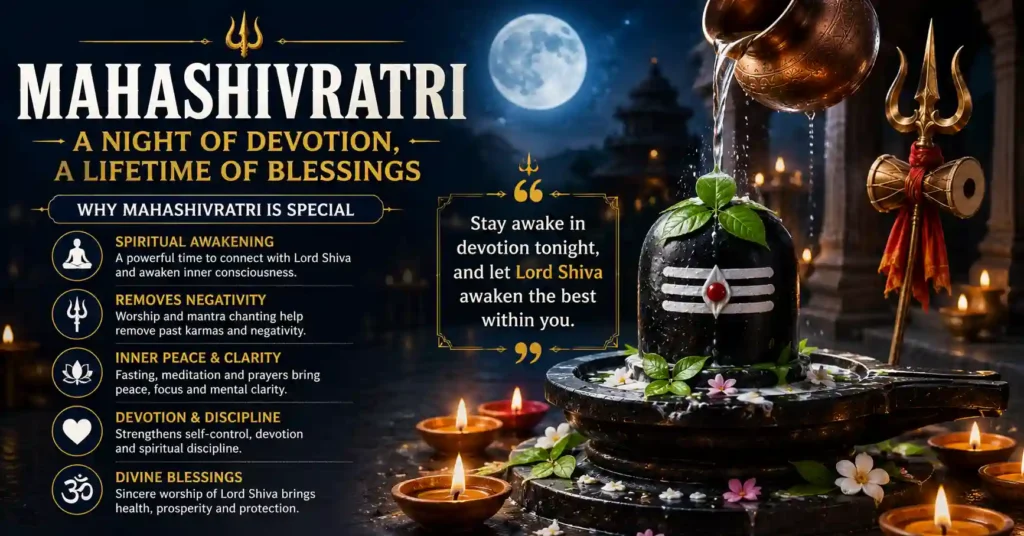
One of the most meaningful observances of Mahashivratri is Jagaran, the tradition of staying awake throughout the night in devotion to Lord Shiva. In Sanatan Dharma, the darkness of the night symbolically represents ignorance, while remaining awake signifies awareness, wisdom, and spiritual awakening.
For devotees, Jagaran is more than simply avoiding sleep. It is an opportunity to spend the night in Shiva Puja, mantra japa, meditation, reading sacred texts, listening to devotional hymns, and quiet self-reflection. The peaceful atmosphere of the night helps many seekers develop greater concentration and inner calm.
According to traditional beliefs, the sacred vibrations of Mahashivratri make it an especially favourable time for spiritual practices. Many devotees believe that sincere worship, meditation, and chanting during this night help purify the mind and strengthen one’s connection with Lord Shiva.
However, staying awake should never become a physical burden. Elderly devotees, children, pregnant women, and those with health concerns may observe Mahashivratri according to their capacity. What truly matters is sincere devotion, mindfulness, and remembrance of Lord Shiva, rather than forcing oneself to remain awake.
Ultimately, the message of Mahashivratri is to remain spiritually awake not only for one night, but throughout life by cultivating awareness, compassion, self-discipline, and inner peace.
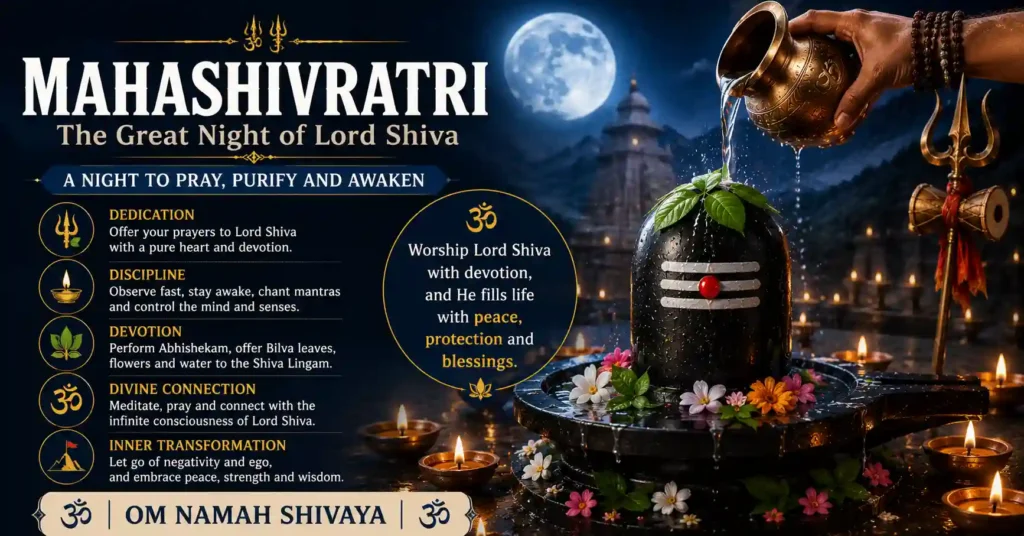
The Spiritual Significance of Mahashivratri
While Mahashivratri is celebrated through fasting, worship, and night-long prayers, its deeper purpose is spiritual transformation. The festival encourages devotees to look beyond external rituals and cultivate qualities that bring lasting inner peace.
From a spiritual perspective, Mahashivratri reminds us to:
Rise above ignorance and move towards wisdom.
Practise self-discipline by controlling desires and negative thoughts.
Develop inner stillness through meditation and mantra japa.
Let go of ego, anger, and attachment, which are seen as obstacles on the spiritual path.
Strengthen devotion to Lord Shiva with sincerity rather than outward display.
In many Shaiva traditions, Lord Shiva represents the still, unchanging consciousness that exists beyond the constant activity of the mind. Mahashivratri invites devotees to experience a glimpse of that inner silence through prayer, meditation, and mindful living.
Ultimately, the festival teaches that true worship is not limited to one sacred night. The values of compassion, truthfulness, humility, and self-awareness can guide our thoughts and actions throughout the year, making Mahashivratri a lifelong source of spiritual inspiration.
Simple Mahashivratri Puja Vidhi at Home
Performing Mahashivratri Puja at home does not require elaborate arrangements. In Sanatan Dharma, Lord Shiva is believed to be Ashutosh, the one who is easily pleased by sincere devotion rather than expensive offerings. A simple puja performed with faith and a pure heart is considered highly meaningful.
Follow these simple steps to perform Mahashivratri Puja at home:
Begin with personal purification. Take a bath early in the morning, wear clean clothes, and prepare a quiet, clean place for worship.
Set up the altar. Place a Shiva Lingam or an image of Lord Shiva on a clean platform. Decorate the altar with flowers and light a diya.
Perform Abhishekam. Offer clean water to the Shiva Lingam. You may also offer milk, curd, honey, ghee, or sugar as Panchamrit Abhishekam, according to your family tradition and capacity.
Offer sacred items. Offer Bilva Patra (Bael leaves), fresh flowers, fruits, sandalwood paste, incense, and seasonal fruits with devotion.
Chant Shiva Mantras. Recite Om Namah Shivaya, the Maha Mrityunjaya Mantra, or other Shiva stotras while meditating on Lord Shiva.
Offer prayers. Conclude the puja with a heartfelt prayer, seeking wisdom, inner peace, good health, and spiritual progress for yourself and your family.
If possible, continue your worship during Nishita Kaal, the most auspicious period of Mahashivratri, through mantra japa, meditation, devotional singing, or silent remembrance of Lord Shiva.
Offerings That Are Dear to Lord Shiva
Lord Shiva is lovingly known as Ashutosh, meaning “the one who is easily pleased.” Unlike worldly rulers, Shiva does not seek lavish offerings or expensive rituals. According to Hindu traditions, sincere devotion, a pure heart, and humility are valued far more than material wealth.
During Mahashivratri, devotees traditionally offer sacred items to the Shiva Lingam as an expression of faith and gratitude.
| Offering | Traditional Significance |
|---|---|
| Water (Jal) | Symbolises purity, cleansing, and devotion. |
| Milk | Represents peace, purity, and a calm mind. |
| Bilva Patra (Bael Leaves) | One of the most sacred offerings to Lord Shiva, symbolising purity, surrender, and devotion. |
| Panchamrit | A sacred mixture of milk, curd, honey, ghee, and sugar offered during Abhishekam. |
| Fresh Flowers | Express love, reverence, and respect. |
| Fruits | Symbolise gratitude and the offering of nature’s gifts. |
| Sandalwood Paste | Represents purity, fragrance, and inner peace. |
| Incense and Diya | Signify the removal of ignorance and the awakening of divine light. |
While these offerings hold symbolic meaning, the spirit behind them is even more important. A simple offering made with faith, humility, and devotion is considered far more meaningful than elaborate rituals performed without sincerity.
Mahashivratri Vrat Rules and Fasting Options
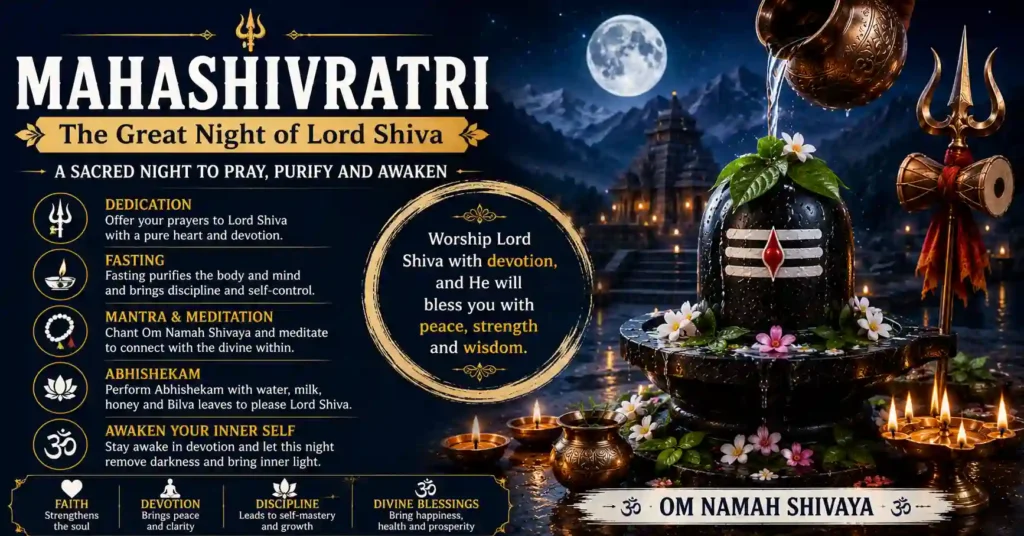
Observing a Mahashivratri Vrat is a cherished spiritual practice for many devotees of Lord Shiva. The purpose of the fast is not merely to abstain from food but to cultivate self-discipline, devotion, and inner purification. The type of fast you observe should be based on your health, age, and personal capacity.
Common Mahashivratri Fasting Options
| Type of Fast | Description |
|---|---|
| Nirjala Vrat | A strict fast observed without food or water throughout the day and night. This should only be undertaken by those who are physically fit and accustomed to fasting. |
| Phalahar Vrat | A fruit-based fast that allows fruits, milk, nuts, and other vrat-approved foods. This is the most commonly observed form of fasting. |
| Light Fast | Some devotees eat one simple sattvic meal during the day or after completing the evening puja, depending on family tradition and health needs. |
Important Vrat Guidelines
Observe the fast with faith, sincerity, and self-control rather than treating it as a ritual obligation.
Spend the day in Shiva Puja, mantra chanting, meditation, reading sacred texts, or listening to devotional hymns.
Avoid anger, harsh speech, negative thoughts, and unnecessary arguments.
Elderly devotees, children, pregnant women, nursing mothers, and people with medical conditions should choose a fasting method that is safe for their health or seek medical advice if required.
If you are unable to observe a complete fast, you can still worship Lord Shiva with devotion, as sincere faith is considered more important than physical austerity.
Ultimately, Mahashivratri teaches that the true spirit of fasting lies in purifying the mind, controlling the senses, and deepening one’s devotion to Lord Shiva, rather than simply avoiding food.
When and How to Break the Mahashivratri Fast (Parana)
The completion of the Mahashivratri Vrat is known as Parana, which traditionally takes place after the observance of the fast and the completion of worship on the following day.
Devotees generally break the fast after offering their final prayers to Lord Shiva and according to the Parana timings mentioned in the local Panchang.
Before breaking the fast, many devotees:
Offer a final prayer to Lord Shiva.
Perform or conclude the morning Shiva Puja.
Distribute prasad among family members or devotees.
Offer food, clothes, or charity to those in need, according to their tradition.
The fast is usually broken with simple sattvic food, such as fruits, milk, or a light meal. Those who observed a strict Nirjala Vrat should break the fast gradually and stay hydrated.
Note: The exact Parana time may vary depending on your location and Panchang. It is always advisable to follow the timings recommended by your local temple or a reliable Panchang.
The spirit of Parana is not merely to end the fast but to complete the observance with gratitude, humility, and prayers for the well-being of all.
Regional Traditions and Temple Celebrations of Mahashivratri
Mahashivratri is celebrated with deep devotion across India, but the rituals and customs vary from region to region. While the forms of worship may differ, the shared purpose remains the same: to honour Lord Shiva through prayer, fasting, meditation, and devotion.
The table below highlights some of the well-known regional traditions associated with Mahashivratri.
| Region / Place | Traditional Observance |
|---|---|
| Varanasi (Uttar Pradesh) | Thousands of devotees visit the Kashi Vishwanath Temple, perform Ganga Snan, offer prayers to Lord Shiva, and participate in night-long Jagaran and devotional singing. |
| Ujjain (Madhya Pradesh) | The Mahakaleshwar Jyotirlinga witnesses special Bhasma Aarti, Abhishekam, Rudrabhishek, and continuous chanting of Shiva mantras throughout the night. |
| Kedarnath (Uttarakhand) | Although the temple remains closed during winter, Mahashivratri is observed with special prayers dedicated to Lord Kedarnath at associated temples and by devotees across the region. |
| Kashmir | Kashmiri Pandits celebrate the festival as Herath, a multi-day observance featuring family rituals, symbolic water vessels, prayers, and traditional offerings. |
| Tamil Nadu | Major Shiva temples such as Arunachaleswarar Temple (Tiruvannamalai) and Kapaleeshwarar Temple (Chennai) remain open throughout the night with Abhishekam, bhajans, and devotional programmes. |
| Karnataka & Andhra Pradesh | Devotees observe fasting, visit Shiva temples, participate in Rudrabhishek, and stay awake throughout the night chanting Shiva mantras. |
Although customs differ across regions and traditions, the essence of Mahashivratri remains unchanged. It is a sacred night dedicated to Lord Shiva, encouraging devotees to cultivate devotion, self-discipline, inner peace, and spiritual awakening.
Mantras and Chants for Mahashivratri
Chanting Shiva mantras is one of the most important spiritual practices on Mahashivratri. Devotees believe that sincere mantra japa helps calm the mind, strengthen devotion, and deepen one’s connection with Lord Shiva.
Some of the most commonly chanted mantras on Mahashivratri are:
| Mantra | Spiritual Significance |
|---|---|
| Om Namah Shivaya | The sacred Panchakshari Mantra dedicated to Lord Shiva. It is chanted for inner peace, spiritual growth, and surrender to the Divine. |
| Maha Mrityunjaya Mantra | A powerful Vedic mantra prayed for healing, protection, courage, and overall well-being. |
| Om Tryambakam Yajamahe… | The opening words of the Maha Mrityunjaya Mantra, often recited during Rudrabhishek and Shiva worship. |
Among these, Om Namah Shivaya is the simplest and most widely recited mantra during Mahashivratri. It is suitable for devotees of all ages and can be chanted during Shiva Puja, meditation, Abhishekam, or while observing Jagaran.
While chanting, focus on devotion rather than speed or the number of repetitions. Even a few heartfelt recitations offered with faith and a peaceful mind are considered spiritually meaningful.
Tip: If you would like to understand the meaning, benefits, and correct method of chanting these mantras, you can explore our detailed guides on Om Namah Shivaya Mantra and the Maha Mrityunjaya Mantra.
Mahashivratri for Families and Children
Mahashivratri is a festival that can be observed by people of all ages. Families often use this sacred occasion to pray together, share stories of Lord Shiva, and introduce children to the values of devotion, compassion, and self-discipline.
Children do not need to observe a strict fast to participate in the celebrations. Instead, they can learn about the festival through simple devotional activities such as:
Lighting a diya under the guidance of elders.
Offering flowers or Bilva Patra to Lord Shiva.
Chanting Om Namah Shivaya together as a family.
Listening to stories about Lord Shiva and Goddess Parvati.
Visiting a nearby Shiva temple, if possible.
Joining in bhajans, aarti, or quiet family prayers.
Parents can encourage children to understand the spiritual meaning of Mahashivratri rather than focusing only on rituals. Simple acts of kindness, truthfulness, gratitude, and respect for others reflect the values that Lord Shiva inspires.
The true spirit of Mahashivratri lies in nurturing devotion with love and understanding. When families celebrate together, the festival becomes a meaningful opportunity to strengthen both spiritual values and family bonds.
Dos and Don'ts on Mahashivratri
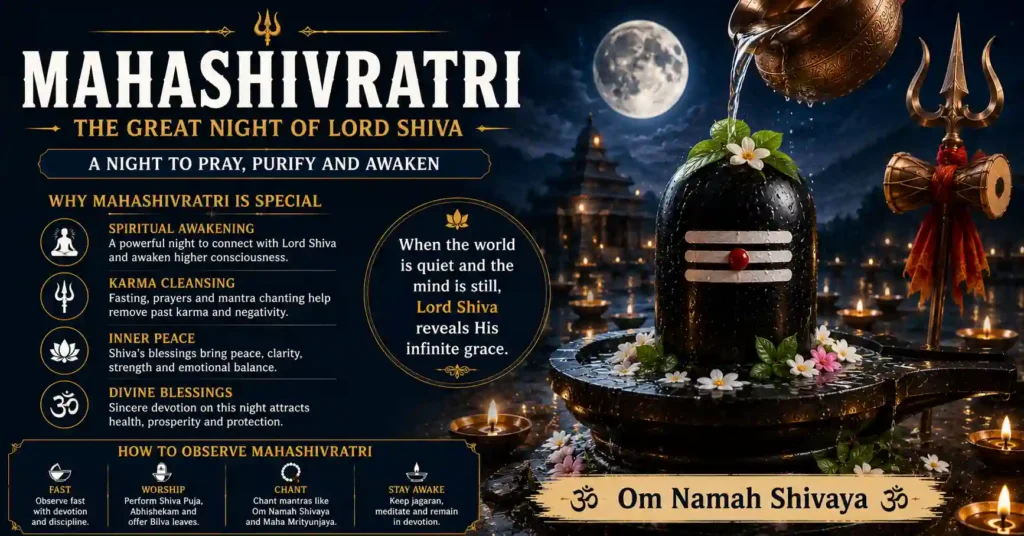
Observing Mahashivratri is not only about fasting and rituals but also about cultivating purity in thoughts, words, and actions. Following these simple practices can help devotees observe the festival with greater devotion and mindfulness.
| Do’s | Don’ts |
|---|---|
| Maintain a peaceful and positive attitude throughout the day. | Avoid anger, harsh speech, and unnecessary arguments. |
| Observe the vrat according to your health and capacity. | Do not force yourself to undertake a strict fast if you are unwell or medically advised against it. |
| Perform Shiva Puja, chant mantras, meditate, or read sacred texts. | Avoid negative thoughts, gossip, and actions that disturb inner peace. |
| Offer Bilva Patra, water, milk, or other traditional offerings with devotion. | Do not treat rituals as mere formalities or perform them without sincerity. |
| Practise compassion, charity, truthfulness, and self-control. | Avoid excessive indulgence, ego, or showing off religious observances. |
| Spend time in prayer, self-reflection, and remembrance of Lord Shiva. | Do not lose sight of the spiritual purpose of the festival by focusing only on external rituals. |
Ultimately, Mahashivratri is a night of inner purification, devotion, and spiritual awakening. While rituals have their own importance, they become truly meaningful when performed with faith, humility, and a sincere desire for self-improvement.
Common Mistakes to Avoid on Mahashivratri
While there is no single compulsory way to observe Mahashivratri, devotees traditionally avoid certain practices that may distract from the festival’s spiritual purpose.
Some common mistakes to avoid include:
Treating the vrat as only a dietary restriction while neglecting prayer, meditation, and self-reflection.
Performing rituals mechanically without understanding their meaning or maintaining sincere devotion.
Becoming angry, impatient, or engaging in arguments during the day.
Observing a strict fast despite medical conditions or physical limitations without proper care.
Focusing on elaborate rituals while forgetting the importance of humility, compassion, and self-discipline.
Believing that expensive offerings are more important than sincere faith and a pure heart.
Mahashivratri is ultimately a festival of inner transformation. Even a simple prayer offered with devotion is considered more meaningful than elaborate rituals performed without faith. The true observance lies in cultivating peace, self-control, and remembrance of Lord Shiva.
Conclusion
Mahashivratri is much more than an annual festival. It is a sacred opportunity to pause, turn inward, and strengthen our connection with Lord Shiva through devotion, self-discipline, prayer, and meditation.
Whether you observe the day by fasting, performing Shiva Puja, chanting sacred mantras, or spending a few quiet moments in reflection, the true essence of Mahashivratri lies in cultivating inner peace, awareness, and spiritual growth.
Every act of sincere devotion, no matter how simple, becomes meaningful when offered with faith and humility. The festival reminds us that the path to transformation begins within, encouraging us to overcome ignorance, ego, and negativity while embracing compassion, wisdom, and self-realisation.
May the blessings of Lord Shiva fill your life with peace, strength, wisdom, and spiritual fulfilment. May this sacred night inspire you to walk the path of truth, compassion, and devotion every day.
Har Har Mahadev!
Suggested Reading
If you would like to deepen your understanding of Lord Shiva, Mahashivratri, and related spiritual practices, explore these carefully curated guides from The Sanatan Tales.
Shiva Mantras: Most Powerful Shiva Mantras, Stotras, and How to Chant
https://thesanatantales.com/shiva-mantras/
Om Namah Shivaya Mantra: Meaning, Benefits, Significance and Chanting Method
https://thesanatantales.com/om-namah-shivaya-mantra/
Maha Mrityunjaya Mantra: Meaning, Benefits and Correct Chanting Method
https://thesanatantales.com/maha-mrityunjaya-mantra/
Shiv Tandav Stotram: Meaning, Full Lyrics, Benefits and How to Chant
https://thesanatantales.com/shiv-tandav-stotram-meaning-lyrics-benefits/
Lingashtakam: Meaning, Benefits and How to Chant (Full Stotram)
https://thesanatantales.com/lingashtakam/
Rudrashtakam: Lyrics with Meaning in Hindi and English, Benefits and How to Chant
https://thesanatantales.com/rudrashtakam/
Kedarnath Temple: History, Significance and Pilgrimage Guide
https://thesanatantales.com/kedarnath-temple/
Mahakaleshwar Temple Ujjain: History, Bhasma Aarti and Visitor Guide
https://thesanatantales.com/mahakaleshwar-temple/
Why There Are Many Deities in Sanatan Dharma
https://thesanatantales.com/why-there-are-many-deities-in-sanatan-dharma/
Maha Shivaratri (Wikipedia)
https://en.wikipedia.org/wiki/Maha_Shivaratri
FAQs
What is Mahashivratri?
Mahashivratri, meaning “The Great Night of Lord Shiva,” is one of the most sacred festivals in Sanatan Dharma. It is observed every year on Krishna Paksha Chaturdashi in the month of Phalguna. Devotees honour Lord Shiva through fasting, Shiva Puja, Abhishekam, mantra chanting, meditation, and night-long vigil (Jagaran). The festival symbolises spiritual awakening, inner purification, and devotion to Lord Shiva.
Why is Mahashivratri celebrated?
Mahashivratri is celebrated to honour Lord Shiva and commemorate several sacred traditions. According to different Hindu scriptures and traditions, it marks the divine marriage of Lord Shiva and Goddess Parvati, the appearance of Shiva as the infinite Jyotirlinga, and an especially auspicious night for meditation and spiritual practices. Together, these traditions make Mahashivratri one of the holiest festivals dedicated to Lord Shiva.
When is Mahashivratri celebrated?
Mahashivratri is celebrated every year on the fourteenth lunar day (Krishna Paksha Chaturdashi) of the Hindu month of Phalguna. Since the Hindu calendar follows the lunar cycle, the date changes every year in the Gregorian calendar. Devotees should refer to the local Panchang for the exact date and puja timings.
Is fasting compulsory on Mahashivratri?
No. Fasting is a respected spiritual practice but is not compulsory. Devotees may observe a Nirjala Vrat, a Phalahar Vrat, or a simple sattvic fast according to their health and family tradition. Those who cannot fast can still worship Lord Shiva through prayer, meditation, mantra chanting, and sincere devotion.
What is the significance of Nishita Kaal on Mahashivratri?
Nishita Kaal is the sacred midnight period of Mahashivratri and is traditionally regarded as the most auspicious time for Shiva worship. Many devotees perform Abhishekam, chant Om Namah Shivaya, meditate, and offer prayers during this time. However, worship performed with sincere devotion at other suitable times is also considered spiritually meaningful.
Can Mahashivratri Puja be performed at home?
Yes. Mahashivratri Puja can be performed at home with devotion and simplicity. A Shiva Lingam or image of Lord Shiva, clean water, Bilva Patra, flowers, fruits, a diya, incense, and heartfelt prayers are sufficient. Lord Shiva is known as Ashutosh, the one who is easily pleased by sincere devotion rather than elaborate rituals.
Which mantra should be chanted on Mahashivratri?
The most widely chanted mantra on Mahashivratri is Om Namah Shivaya, the sacred Panchakshari Mantra dedicated to Lord Shiva. Many devotees also recite the Maha Mrityunjaya Mantra for healing, protection, courage, and spiritual well-being. Chanting with concentration and devotion is considered more important than the number of repetitions.
What is the difference between Shivratri and Mahashivratri?
Shivratri occurs every month on Krishna Paksha Chaturdashi, while Mahashivratri is the annual and most significant Shivratri observed in the month of Phalguna. It is celebrated on a much larger scale with special fasting, night-long worship, temple celebrations, and spiritual observances dedicated to Lord Shiva.
Can children and elderly people observe Mahashivratri?
Yes. Mahashivratri can be observed by people of all ages according to their capacity. Children can participate by offering flowers, chanting simple mantras, listening to stories of Lord Shiva, and joining family prayers. Elderly devotees and those with health concerns may choose a lighter fast or simply worship without fasting.
Can I drink water during the Mahashivratri fast?
This depends on the type of vrat you choose. A Nirjala Vrat is observed without food or water, while many devotees observe a Phalahar Vrat that allows water, milk, fruits, and vrat-approved foods. It is always advisable to follow your family tradition and prioritise your health while observing the fast.
Is it necessary to stay awake throughout Mahashivratri?
Staying awake throughout the night, known as Jagaran, is an important tradition because it symbolises spiritual awareness and devotion. However, those who are unable to remain awake due to age, health, or other responsibilities can still observe Mahashivratri by performing Shiva Puja, chanting mantras, and offering sincere prayers according to their capacity.
Which offerings are considered most dear to Lord Shiva?
Traditional offerings include water, milk, Bilva Patra (Bael leaves), Panchamrit, flowers, fruits, sandalwood paste, incense, and a lit diya. While these offerings have symbolic significance, Hindu traditions emphasise that sincere devotion and a pure heart are more important than expensive or elaborate offerings.
When should the Mahashivratri fast be broken?
The Mahashivratri fast is traditionally concluded with Parana after completing the prescribed worship on the following day, according to the local Panchang. Many devotees offer final prayers to Lord Shiva before breaking the fast with simple sattvic food and prasad.
Is Mahashivratri celebrated only in India?
No. Mahashivratri is celebrated by Hindu communities across the world, including Nepal, Mauritius, Sri Lanka, Indonesia, the United States, the United Kingdom, Canada, Australia, and many other countries. Temples organise special pujas, Abhishekam, bhajans, and cultural programmes to mark the occasion.
What is the spiritual message of Mahashivratri?
The spiritual message of Mahashivratri is to overcome ignorance, ego, and negativity through devotion, self-discipline, meditation, and inner reflection. The festival reminds devotees that true worship is not limited to rituals but is expressed through compassion, truthfulness, humility, and a sincere effort to lead a righteous life under the guidance of Lord Shiva.
Glossary of Important Terms
| Term | Meaning |
|---|---|
| Mahashivratri | The “Great Night of Lord Shiva,” one of the most sacred Hindu festivals dedicated to Lord Shiva. |
| Lord Shiva | One of the principal deities of Sanatan Dharma, worshipped as the Supreme Yogi and the destroyer and transformer within the Trimurti. |
| Krishna Paksha Chaturdashi | The fourteenth lunar day of the waning moon on which Mahashivratri is observed. |
| Phalguna | A month in the Hindu lunar calendar during which Mahashivratri is celebrated. |
| Shiva Puja | The ritual worship of Lord Shiva through prayers, offerings, mantra chanting, and devotion. |
| Shiva Lingam | The sacred symbol of Lord Shiva representing the infinite, formless, and eternal nature of the Divine. |
| Abhishekam | The ritual bathing of the Shiva Lingam with sacred offerings such as water, milk, Panchamrit, and honey. |
| Bilva Patra | The sacred leaves of the Bael tree offered to Lord Shiva as a symbol of purity, surrender, and devotion. |
| Panchamrit | A sacred mixture of milk, curd, honey, ghee, and sugar used during Abhishekam. |
| Vrat | A religious fast observed with devotion, self-discipline, and spiritual intent. |
| Jagaran | The practice of staying awake throughout the night in prayer, meditation, and devotional worship. |
| Nishita Kaal | The sacred midnight period of Mahashivratri considered the most auspicious time for Shiva worship. |
| Mantra Japa | The repeated chanting of a sacred mantra with concentration and devotion. |
| Om Namah Shivaya | The sacred Panchakshari Mantra dedicated to Lord Shiva, chanted for peace, devotion, and spiritual growth. |
| Maha Mrityunjaya Mantra | A powerful Vedic mantra dedicated to Lord Shiva, traditionally recited for healing, protection, and spiritual well-being. |
| Panchakshari Mantra | The five-syllable mantra “Na-Ma-Shi-Va-Ya,” commonly recited as Om Namah Shivaya. |
| Jyotirlinga | A sacred manifestation of Lord Shiva as an infinite pillar of divine light. Twelve Jyotirlingas are especially revered across India. |
| Rudrabhishek | A special form of Shiva worship that includes Abhishekam along with the recitation of Vedic hymns dedicated to Lord Rudra. |
| Herath | The Kashmiri Shaiva celebration of Mahashivratri, observed with unique family traditions and rituals. |
| Parana | The traditional ceremony of concluding a religious fast by breaking it at the prescribed time after completing the worship. |
| Sattvic Food | Pure, simple, and wholesome vegetarian food believed to promote clarity, balance, and spiritual well-being. |
| Shaiva Tradition | A major tradition within Sanatan Dharma that worships Lord Shiva as the Supreme Reality. |
| Shakti | The divine feminine energy or cosmic power, represented by Goddess Parvati and other forms of the Divine Mother. |
| Jyotirlinga | The divine manifestation of Lord Shiva as an endless pillar of light, symbolising the eternal and limitless nature of the Supreme. |
About the Author
Yateendra Chaturvedi is a spiritual writer, researcher, devotee, and the founder of The Sanatan Tales. With over 35 years of professional experience and a lifelong interest in Sanatan Dharma, he writes about Hindu deities, temples, scriptures, festivals, Mahavidyas, sacred stories, rituals, and living traditions that continue to guide and inspire devotees across India.
Drawing from traditional scriptures, regional beliefs, temple traditions, devotional literature, and historical sources, he aims to present authentic, well-researched, and easy-to-understand content for modern readers. His work focuses on preserving spiritual wisdom, explaining sacred traditions, and helping seekers develop a deeper understanding of India’s rich spiritual heritage.
Through The Sanatan Tales, Yateendra strives to make the timeless teachings of Sanatan Dharma simple, meaningful, and relevant for today’s generation while maintaining respect for traditional sources, regional practices, and diverse spiritual perspectives.
Learn More About Yateendra Chaturvedi →
https://thesanatantales.com/about-the-author/
References & Sources
This article is based on Shaiva and Bhairava traditions followed within Sanatan Dharma, traditional beliefs associated with Lord Bhairava, religious narratives, folk traditions, and insights gathered from various spiritual and religious study sources.
Some concepts discussed in this article are also inspired by interpretations found in guru-disciple lineages, temple traditions, and devotional literature.
Note: Beliefs, stories, and methods of worship related to Lord Bhairava may differ across regions, sects, and spiritual traditions. The purpose of this article is not to present any single viewpoint as the absolute truth, but to explain commonly accepted religious and spiritual perspectives in a simple and accessible manner.
Further Reading