The Giddharaj Jatayu Story is one of the most inspiring episodes in the Ramayana and a timeless example of courage, devotion, and selfless sacrifice. Though advanced in age, Jatayu chose to stand against injustice when he witnessed Ravana abducting Maa Sita, placing dharma above his own safety.
The Giddharaj Jatayu Story is remembered not because Jatayu emerged victorious in battle, but because he fearlessly defended what was right. His actions demonstrate that true strength comes from righteousness, compassion, and an unwavering commitment to duty.
In this Giddharaj Jatayu Story, you will discover who Jatayu was, why he confronted Ravana, how his sacrifice became one of the most emotional moments in the Ramayana, and the spiritual lessons that continue to inspire devotees today.
The story of Jatayu protecting Sita and his final meeting with Shri Ram reveals profound teachings about dharma, courage, devotion, and selfless service. It reminds us that even a single act performed for a righteous cause can leave a lasting spiritual legacy.
Table of Contents
ToggleGiddharaj Jatayu Story Snapshot
| Aspect | Details |
|---|---|
| Main Characters | Giddharaj Jatayu, Shri Ram, Maa Sita, Lakshmana, Ravana |
| Source | Valmiki Ramayana (Aranya Kanda), Ramayana Traditions |
| Setting | Dandakaranya Forest during the exile of Shri Ram |
| Theme | Dharma, Courage, Devotion, Sacrifice, Selfless Service |
| Key Lesson | Stand for righteousness even when the odds are against you |
| Famous Event | Jatayu’s battle with Ravana while protecting Sita |
| Spiritual Significance | Demonstrates that devotion is expressed through action and sacrifice |
| Divine Blessing | Shri Ram personally performed Jatayu’s last rites and granted him liberation |
| Secondary Keywords | Jatayu and Ravana, Jatayu Protecting Sita, Jatayu Ramayana Story, Jatayu and Rama |
The Giddharaj Jatayu Story
The Giddharaj Jatayu Story takes place during the exile of Shri Ram, Maa Sita, and Lakshmana in the forests of Dandakaranya. During this period, they encountered many sages, devotees, and noble beings who supported them on their journey.
Among them was Giddharaj Jatayu, the noble king of vultures. He was the son of Aruna, the charioteer of Surya Deva, and the brother of Sampati. Jatayu was also a close friend of King Dasharatha, the father of Shri Ram.
Because of his friendship with Dasharatha, Jatayu held great affection for Shri Ram and his family. When he met Shri Ram in the forest, he promised to help protect Maa Sita whenever needed.
Though advanced in age, Jatayu remained devoted to dharma and always stayed alert to any danger that might threaten the innocent.
One day, a tragic event unfolded in the forest.
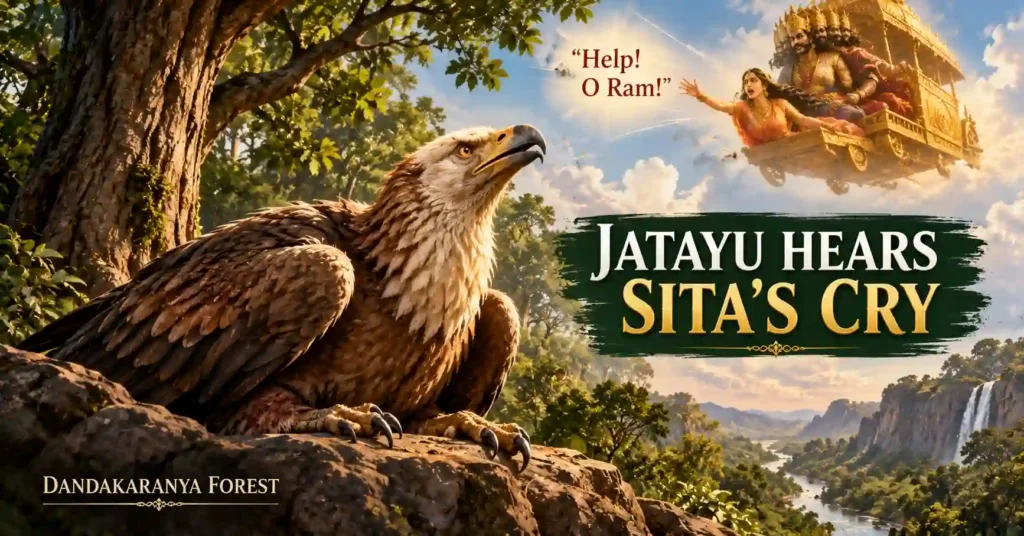
While Shri Ram and Lakshmana were away from their hermitage, Ravana arrived and abducted Maa Sita. Carrying her away in the Pushpaka Vimana, he began his journey toward Lanka.
As Ravana flew across the sky, Maa Sita cried out for help. She called the names of Shri Ram and Lakshmana and prayed that someone would stop her captor.
Her cries echoed through the forest and reached the ears of Giddharaj Jatayu.
The moment Jatayu understood what was happening, he rose into the sky. He saw Ravana carrying away Maa Sita and immediately recognized that a great act of adharma was taking place.
Jatayu fearlessly blocked Ravana’s path and ordered him to release Maa Sita.
He reminded Ravana that abducting another man’s wife was a grave violation of dharma. Jatayu warned him that such an act would ultimately lead to his destruction.
But Ravana ignored the warning.
Seeing no other option, Jatayu protecting Sita became one of the most courageous moments in the Ramayana.
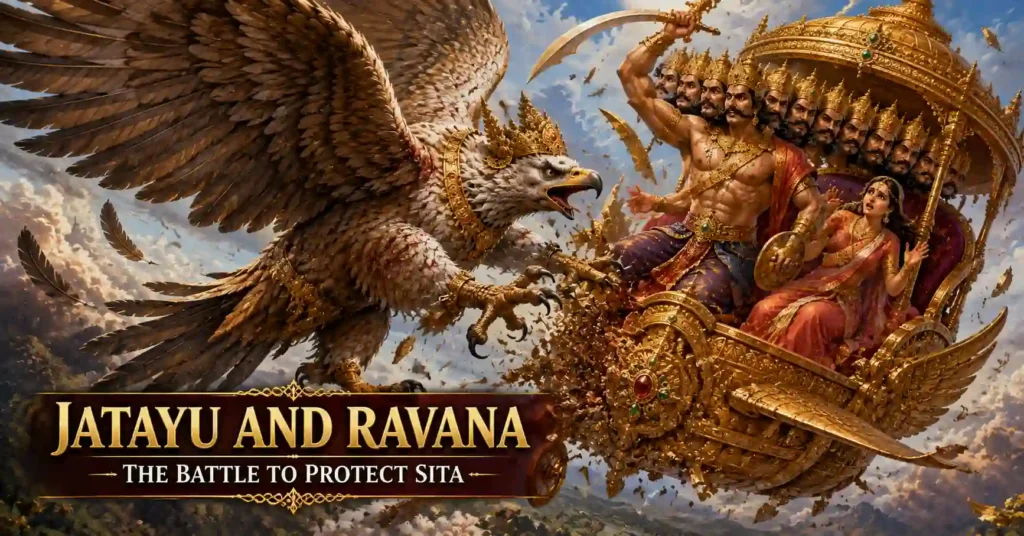
Despite being old and far weaker than the mighty king of Lanka, Jatayu attacked Ravana with extraordinary determination. A fierce battle soon erupted in the sky.
The encounter between Jatayu and Ravana was intense.
Jatayu struck Ravana with his powerful claws and wings. He damaged parts of the Pushpaka Vimana and repeatedly tried to free Maa Sita from Ravana’s grasp.
For a time, the aged king of vultures stood like a guardian of dharma against one of the most powerful rulers in the world.
Maa Sita watched with hope as Jatayu risked everything to save her.
However, Ravana possessed immense strength and powerful weapons. After a long struggle, he drew his sword and attacked Jatayu with great force.
The blow severed Jatayu’s wings and left him critically wounded.
Unable to continue the battle, Jatayu fell from the sky and landed in the forest below.
Although he could not rescue Maa Sita, he had fulfilled his duty by resisting evil and standing for righteousness without fear.
Some time later, Shri Ram and Lakshmana returned and discovered that Sita was missing.
Filled with concern, they searched through the forest, calling her name and looking for any sign of what had happened.
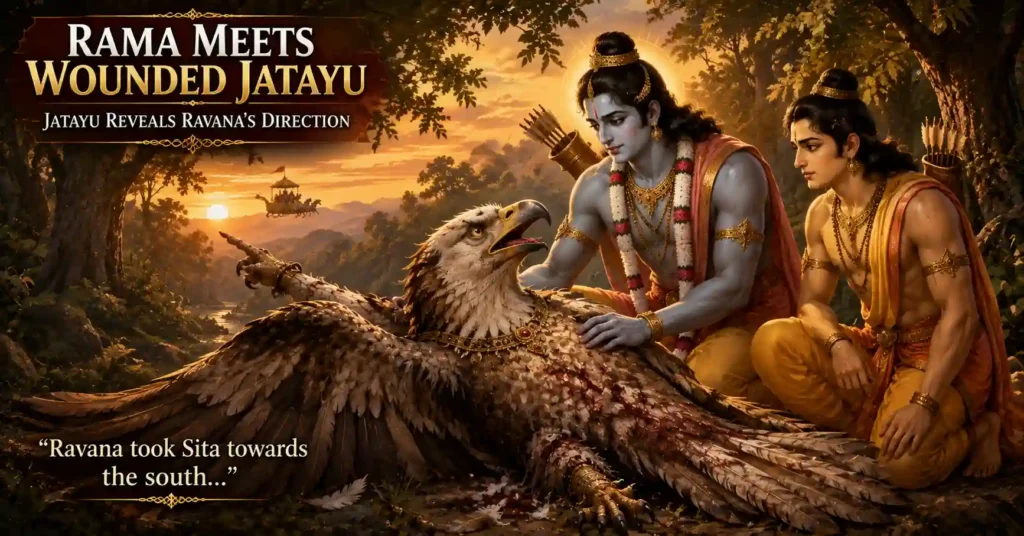
During their search, they eventually found the wounded Jatayu lying on the ground.
At first, Shri Ram wondered whether the bird knew something about Sita’s disappearance. As they approached him, Jatayu slowly opened his eyes and began to speak.
With his remaining strength, he narrated everything that had happened.
He told Shri Ram about Ravana’s abduction of Maa Sita, the battle in the sky, and the direction in which Ravana had taken her.
This moment remains one of the most emotional scenes in the Giddharaj Jatayu Story.
Jatayu spoke without regret or concern for himself. His only wish was to complete his duty and help Shri Ram find Maa Sita.
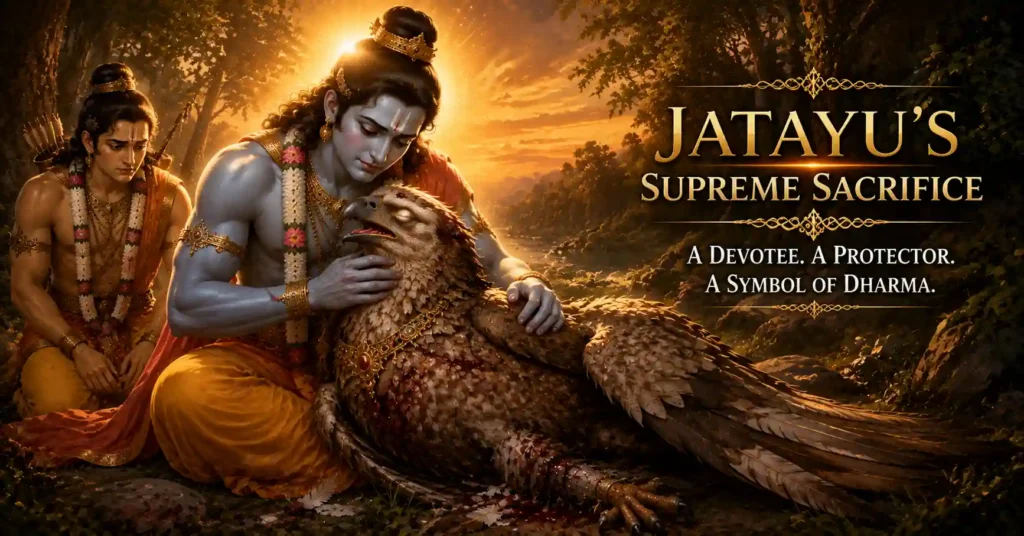
Hearing of Jatayu’s sacrifice, Shri Ram was deeply moved.
The Lord embraced the wounded bird with affection and gratitude. He honored Jatayu not merely as a bird, but as a beloved elder, a loyal friend of Dasharatha, and a true defender of dharma.
After delivering his message, Jatayu peacefully left his mortal body in the presence of Shri Ram.
Shri Ram mourned Jatayu as he would a member of his own family. To honor his sacrifice, he personally performed Jatayu’s last rites, a rare and extraordinary honor in the Ramayana.
This beautiful moment highlights the deep bond between Jatayu and Rama and the respect Shri Ram had for those who dedicated their lives to righteousness.
The Jatayu Ramayana Story continues to inspire devotees because it shows that true greatness is not measured by physical strength, wealth, or victory.
The Giddharaj Jatayu Story teaches that standing for dharma, protecting the innocent, and serving selflessly are among the highest expressions of devotion. Jatayu’s sacrifice remains a timeless example of courage, duty, and unwavering faith in what is right.
What Does the Giddharaj Jatayu Story Teach Us?
The Giddharaj Jatayu Story is much more than an episode from the Ramayana. It is a timeless lesson about courage, duty, devotion, and selfless sacrifice in the service of Dharma.
Even today, the story continues to inspire devotees because its teachings remain relevant in everyday life.
1. Dharma Must Be Protected
When Jatayu saw Ravana abducting Maa Sita, he did not remain silent.
He understood that a grave injustice was taking place and immediately chose to intervene.
The Giddharaj Jatayu Story teaches that protecting Dharma is not only the responsibility of kings and warriors. Every person has a duty to stand against wrongdoing whenever possible.
2. Courage Means Doing What Is Right
Jatayu knew he was old and far weaker than Ravana.
Despite the danger, he chose to fight because remaining silent would have been against his principles.
The story reminds us that true courage is not the absence of fear but the willingness to do what is right even in difficult circumstances.
3. Age Is Not a Barrier to Service
One of the most inspiring aspects of the Jatayu Ramayana Story is that Jatayu was elderly when he confronted Ravana.
Many would have considered themselves too weak or too old to act.
Jatayu showed that dedication to Dharma and selfless service do not depend on age, status, or physical strength.
4. Selfless Service Is a Form of Devotion
The episode of Jatayu Protecting Sita demonstrates that devotion is expressed not only through prayer but also through action.
Jatayu risked his life to protect Maa Sita without expecting recognition or reward.
His example teaches that serving others with sincerity can become an act of devotion.
5. True Greatness Lies in Sacrifice
The battle between Jatayu and Ravana did not end in victory.
Yet Jatayu is remembered and honored because of his willingness to sacrifice everything for a righteous cause.
The story teaches that greatness is measured not only by success but also by the courage to uphold Dharma.
6. Bhagwan Values Sincere Effort
Although Jatayu could not rescue Maa Sita, Shri Ram deeply honored his efforts.
The Lord personally comforted him and performed his final rites.
Why Is the Giddharaj Jatayu Story Important in Sanatan Dharma?
The Giddharaj Jatayu Story holds a special place in Sanatan Dharma because it demonstrates how dharma is expressed through action, sacrifice, and selfless service.
Jatayu is remembered not because he possessed great power or achieved victory, but because he chose righteousness when it mattered most.
His story continues to inspire devotees to place duty above personal comfort and stand for truth even during difficult circumstances.
Jatayu Represents the Ideal of Dharma
One of the central teachings of Sanatan Dharma is the protection of dharma.
When Jatayu witnessed Ravana abducting Maa Sita, he did not remain a silent observer.
Instead, he risked his life to stop an act of injustice.
The Giddharaj Jatayu Story reminds us that dharma is not merely a belief. It is something that must be lived through our actions.
A Powerful Example of Selfless Service
The episode of Jatayu Protecting Sita is often remembered as one of the greatest examples of selfless service in the Ramayana.
Jatayu had nothing to gain from confronting Ravana.
Yet he chose to help because protecting the innocent was the right thing to do.
His sacrifice teaches that true service comes from compassion and a sense of responsibility toward others.
The Story Shows That Devotion Includes Action
Many people associate devotion only with prayer, worship, and rituals.
However, the Jatayu Ramayana Story shows that devotion can also be expressed through courage and righteous action.
Jatayu demonstrated his devotion to Shri Ram by defending Maa Sita even at the cost of his own life.
His actions reveal that faith becomes meaningful when it inspires us to uphold dharma.
Shri Ram’s Respect for Jatayu Carries a Deep Message
One of the most touching moments in the Ramayana occurs when Shri Ram meets the dying Jatayu.
The Lord comforted him, honored his sacrifice, and personally performed his last rites.
This extraordinary act highlights the spiritual significance of Jatayu and Rama and demonstrates that Bhagwan values sincerity and righteous effort above status, wealth, or social position.
Jatayu Is Remembered as a Symbol of Courage
The battle between Jatayu and Ravana was unequal from the beginning.
Jatayu knew he faced a powerful enemy and understood the risks involved.
Yet he chose courage over fear.
For this reason, generations of devotees have looked to Jatayu as a symbol of bravery, integrity, and unwavering commitment to what is right.
His Story Continues to Inspire Devotees Today
Even today, the Giddharaj Jatayu Story remains relevant because the challenges of choosing between convenience and righteousness still exist.
Jatayu’s example encourages us to defend truth, help those in need, and remain faithful to our values regardless of the outcome.
For devotees, his sacrifice serves as a timeless reminder that every act performed in the service of dharma has spiritual value and never goes unnoticed by Bhagwan.
Did You Know?
The Giddharaj Jatayu Story contains several fascinating details that highlight why Jatayu is remembered as one of the most revered characters in the Ramayana.
Jatayu Was the Son of Aruna
According to Hindu tradition, Jatayu was the son of Aruna, the charioteer of Surya Deva.
This made him part of a divine lineage and connected him to several important figures mentioned in Hindu scriptures.
Jatayu Was the Brother of Sampati
Many devotees know Jatayu for his sacrifice, but fewer know that he had an elder brother named Sampati.
Later in the Ramayana, Sampati helped the Vanara army by revealing the location of Lanka and Maa Sita.
Jatayu Was a Close Friend of King Dasharatha
Before the events of the Ramayana, Jatayu shared a close friendship with King Dasharatha.
Because of this bond, he felt a personal responsibility toward Shri Ram and his family.
This relationship adds even greater meaning to the Giddharaj Jatayu Story.
The Battle Between Jatayu and Ravana Happened in the Sky
One of the most dramatic scenes in the Ramayana is the aerial battle between Jatayu and Ravana.
Despite his old age, Jatayu challenged one of the most powerful rulers in the world while Ravana was carrying Maa Sita in the Pushpaka Vimana.
Jatayu Tried to Save Sita Without Expecting Any Reward
The episode of Jatayu Protecting Sita is admired because it was a completely selfless act.
Jatayu did not act for fame, recognition, or personal gain.
He acted simply because protecting the innocent was his duty.
Shri Ram Personally Performed Jatayu’s Last Rites
One of the most sacred moments in the Jatayu Ramayana Story occurs after Jatayu’s final breath.
Shri Ram personally performed his last rites and honored him as a beloved family member.
This rare honor reflects the immense respect the Lord had for Jatayu’s sacrifice and devotion.
Jatayu Is Considered a Symbol of Dharma and Courage
Across India, Jatayu is remembered as a symbol of righteousness, bravery, and selfless service.
His willingness to stand against evil despite certain defeat continues to inspire devotees of all ages.
Jatayu Attained Liberation Through His Devotion
Traditional Ramayana interpretations describe Jatayu’s passing in the presence of Shri Ram as a spiritually significant event.
Many devotees believe that Jatayu attained liberation because of his devotion, sacrifice, and unwavering commitment to dharma.
For this reason, the Giddharaj Jatayu Story remains one of the most beloved examples of courage, devotion, and selfless sacrifice in Sanatan Dharma.
Conclusion
The Giddharaj Jatayu Story is one of the most inspiring examples of courage, sacrifice, and devotion found in the Ramayana. Although Jatayu was elderly and faced a far more powerful opponent, he chose to stand for dharma when Maa Sita needed protection.
The story of Jatayu Protecting Sita reminds us that righteousness is not measured by success or failure. What truly matters is the willingness to act when duty calls.
Through the battle between Jatayu and Ravana, we see that genuine courage comes from a commitment to truth and justice rather than physical strength.
The deep bond between Jatayu and Rama further highlights the spiritual significance of his sacrifice. Shri Ram’s love, gratitude, and respect for Jatayu demonstrate that Bhagwan values sincere effort, devotion, and selfless service above all else.
The Jatayu Ramayana Story continues to inspire devotees because its message remains timeless. It teaches us to defend what is right, help those in need, and remain faithful to our values even when the odds seem impossible.
The Giddharaj Jatayu Story ultimately reminds us that standing for dharma is never in vain. Jatayu may not have defeated Ravana, but his courage, devotion, and selfless sacrifice earned him the eternal respect of Shri Ram and a revered place in the hearts of devotees for generations.
Suggested Reading
If the Giddharaj Jatayu Story inspired you, you may enjoy exploring other sacred stories that highlight devotion, courage, sacrifice, faith, and unwavering commitment to dharma. Like the Giddharaj Jatayu Story, these timeless narratives reveal how selfless actions and sincere devotion can leave a lasting spiritual impact and bring one closer to Bhagwan.
Many devotees are drawn to the Giddharaj Jatayu Story because it demonstrates that true greatness lies not in power or victory, but in standing for righteousness when it matters most. Throughout Sanatan Dharma, many such stories teach that courage, devotion, and selfless service are deeply valued and never go unnoticed by the Divine.
Ram and Shabari Story: A Lesson in Pure Devotion
https://thesanatantales.com/ram-and-shabari-story/
Gajendra Moksha Story: When Surrender Reached Bhagwan Vishnu Before Strength Failed
https://thesanatantales.com/gajendra-moksha-story/
Sudama and Krishna Story: A Tale of True Friendship
https://thesanatantales.com/sudama-and-krishna-story/
Markandeya and Shiva Story: How Devotion Conquered Death
https://thesanatantales.com/markandeya-and-shiva-story/
Meera and Krishna Story: A Tale of Pure Devotion and Divine Love
https://thesanatantales.com/meera-and-krishna-story/
Story of Sati Anasuya: The Divine Test of Devotion and Purity
https://thesanatantales.com/story-of-sati-anasuya/
Spiritual Stories of Sanatan Dharma
https://thesanatantales.com/spiritual-stories-of-sanatan-dharma/
Jatayu (Wikipedia)
https://en.wikipedia.org/wiki/Jatayu
Each of these stories carries a unique spiritual lesson, yet all point toward the same truth found in the Giddharaj Jatayu Story: courage in the service of dharma, selfless sacrifice, and sincere devotion possess immense spiritual value. These timeless teachings continue to inspire devotees to stand for what is right, help those in need, and walk the path of righteousness with faith and determination.
FAQs
Who was Giddharaj Jatayu in the Ramayana?
Giddharaj Jatayu was the noble king of vultures mentioned in the Ramayana. He was the son of Aruna, the charioteer of Surya Deva, and a close friend of King Dasharatha, the father of Shri Ram.
The Giddharaj Jatayu Story describes how he devoted himself to protecting dharma and serving righteousness. Despite his advanced age, he fearlessly confronted Ravana when he saw Maa Sita being abducted.
Jatayu is remembered as a symbol of courage, selfless sacrifice, and unwavering devotion to Shri Ram.
Why did Jatayu fight Ravana?
Jatayu fought Ravana because he witnessed the abduction of Maa Sita and recognized it as a serious act of adharma.
Although he knew Ravana was far more powerful, Jatayu chose to defend what was right rather than remain silent. The episode of Jatayu Protecting Sita is one of the most inspiring moments in the Ramayana.
His actions demonstrate that standing against injustice is an important part of living according to dharma.
What happened during the battle between Jatayu and Ravana?
The battle between Jatayu and Ravana took place in the sky while Ravana was carrying Maa Sita toward Lanka in the Pushpaka Vimana.
Jatayu blocked Ravana’s path, warned him to release Sita, and launched a fierce attack. He fought bravely and even damaged parts of Ravana’s aerial chariot during the encounter.
Eventually, Ravana used his sword to sever Jatayu’s wings, causing the noble bird to fall to the ground with severe injuries.
How did Jatayu help Shri Ram?
After being wounded in battle, Jatayu remained alive long enough to meet Shri Ram and Lakshmana.
When they found him in the forest, Jatayu explained everything that had happened. He informed Shri Ram that Ravana had abducted Maa Sita and revealed the direction in which Ravana had traveled.
This information became an important part of Shri Ram’s search for Sita and remains a significant moment in the Jatayu Ramayana Story.
Why did Shri Ram perform Jatayu's last rites?
After hearing about Jatayu’s sacrifice, Shri Ram was deeply moved by his courage and devotion.
The Lord recognized that Jatayu had risked his life while protecting Maa Sita and upholding dharma. Out of love and respect, Shri Ram personally performed Jatayu’s last rites.
This rare honor highlights the deep spiritual bond between Jatayu and Rama and demonstrates how highly Shri Ram valued selfless service.
What does the Giddharaj Jatayu Story teach us?
The Giddharaj Jatayu Story teaches the importance of courage, duty, sacrifice, and standing for righteousness.
Jatayu knew he might not defeat Ravana, yet he chose to act because protecting the innocent was the right thing to do.
His example reminds us that true strength comes from character, conviction, and devotion rather than physical power.
Is Jatayu considered a devotee of Shri Ram?
Yes, Jatayu is widely regarded as a devoted servant and well-wisher of Shri Ram.
His loyalty to Dasharatha and his willingness to sacrifice himself for Maa Sita demonstrate his deep love and respect for the Lord.
Many devotees view Jatayu as an ideal example of devotion expressed through action rather than words alone.
Why is the Giddharaj Jatayu Story still relevant today?
The Giddharaj Jatayu Story remains relevant because its message extends beyond the events of the Ramayana.
It teaches us to stand against injustice, help those in need, and remain faithful to our values even when doing so is difficult.
Jatayu’s courage, compassion, and commitment to dharma continue to inspire people seeking to live with integrity and purpose.
References & Sources
This article is based on the Valmiki Ramayana, particularly the events described in the Aranya Kanda, where the sacrifice of Giddharaj Jatayu and his encounter with Ravana are narrated.
The article also draws upon traditional Ramayana retellings, devotional teachings, temple discourses, and interpretations preserved within the living traditions of Sanatan Dharma.
Additional context has been informed by teachings related to dharma, selfless service (seva), devotion (bhakti), righteous conduct, and the spiritual significance of Jatayu’s sacrifice as understood in Hindu tradition.
As with many sacred narratives, different regions, lineages, and commentators may emphasize particular details or interpretations while preserving the core message of courage, sacrifice, and unwavering commitment to dharma.
Readers interested in exploring the story further are encouraged to study the Valmiki Ramayana, traditional Ramayana commentaries, and authentic spiritual teachings that discuss the life, sacrifice, and spiritual significance of Giddharaj Jatayu.
Explore More Topics from The Sanatan Tales