
Bhairav is often misunderstood. Many see him only as a fierce deity, a form to fear or approach only in extreme situations. But Bhairav is not fear itself. Bhairav is the force that removes fear by destroying illusion.
In Sanatan Dharma, Bhairav is not only a form of Lord Shiva. He is a tattva, a fundamental principle of awareness that appears when truth is threatened and time demands clarity. Where softness no longer works, Bhairav arrives. Not with anger, but with precision.
For devotees, Bhairav is a protector.
For seekers, he is a gatekeeper.
For tradition, he is the guardian of thresholds, time, and inner honesty.
To understand Bhairav is to understand why Sanatan Dharma never separates compassion from discipline, or love from truth.
Table of Contents
ToggleWhat is Bhairav Tattva in Sanatan Dharma
In Sanatan thought, tattva means an underlying reality or principle, not just a personality or image. Bhairav Tattva represents awakened awareness that stands at the edge of time and fear.
The word Bhairava comes from roots connected to fear and its dissolution. Bhairav does not create fear. He exposes it. When illusion falls away, fear dissolves naturally.
Bhairav Tattva operates at liminal points. These are moments of transition such as birth and death, night and dawn, destruction and renewal, ignorance and insight. That is why Bhairav is associated with crossroads, cremation grounds, doorways, and borders. He stands where certainty breaks.
This is also why Bhairav is never decorative. His presence is functional. He appears only when something must be corrected.
Bhairav and Shiva: the relationship beyond form
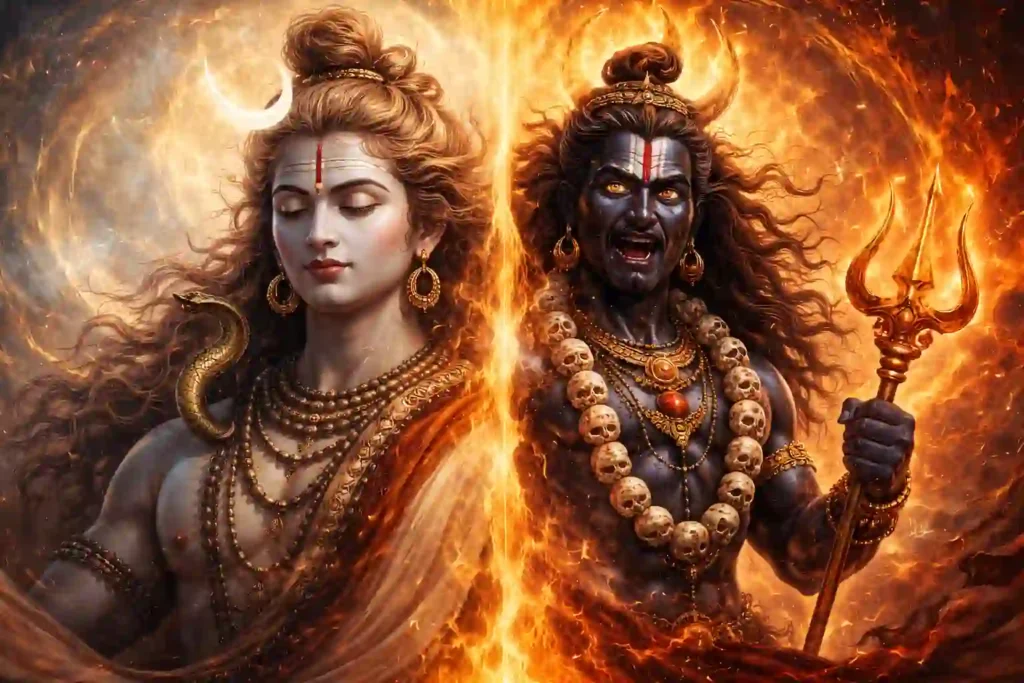
Bhairav is Shiva, yet Bhairav is not Shiva in repose.
Shiva in his meditative form represents stillness, compassion, and transcendence. Bhairav represents that same consciousness when it becomes sharp, immediate, and corrective.
When dharma flows naturally, Shiva remains silent.
When ego hardens and false authority rises, Shiva manifests as Bhairav.
This manifestation is not emotional. It is surgical. Bhairav cuts away what blocks truth, even when that blockage is respected, powerful, or divine in appearance.
That is why Bhairav is feared by ego but trusted by sincere devotees.
Scriptural foundations of Bhairav Tattva
Shiva Purana
The Shiva Purana is a text dedicated to understanding Shiva not only as a deity, but as the supreme consciousness that sustains and dissolves creation. It explains why Shiva manifests in different forms depending on cosmic need.
In this Purana, Bhairav appears during moments when pride, false knowledge, and misuse of authority threaten balance. Bhairav’s role here is corrective, not punitive. His actions restore truth by removing arrogance, even when that arrogance belongs to a creator god.
This shows Bhairav as ethical force, not violent impulse.
Linga Purana
The Linga Purana focuses on the formless aspect of Shiva, symbolised by the Jyotirlinga. It emphasises that ultimate reality cannot be owned, measured, or claimed.
Bhairav emerges in this context as the protector of that truth. When form begins to claim supremacy over the formless, Bhairav intervenes. This Purana helps us understand Bhairav as the guardian of spiritual humility.
Skanda Purana and the Kashi tradition
The Skanda Purana contains extensive sections on sacred geography, especially Kashi. It explains Kashi not as a city, but as a space beyond time, where liberation is accessible even at death.
Here, Bhairav is established as the Kotwal of Kashi. His role is not symbolic policing. He governs who may enter the deeper spiritual current of the city. Without Bhairav’s grace, Kashi remains a location. With it, Kashi becomes a doorway.
Bhairava Tantric tradition
Tantric texts such as the Bhairava Tantras and the Vijnana Bhairava Tantra do not treat Bhairav as an external god alone. They present Bhairav as a state of expanded awareness.
The Vijnana Bhairava Tantra, in particular, is a dialogue where Bhairav teaches Devi methods of entering pure awareness through breath, sound, shock, silence, and intensity. Here, Bhairav is not fearsome. He is the teacher of liberation through immediacy.
This firmly places Bhairav at the heart of inner transformation.
The emergence of Bhairav from the Jyotirlinga
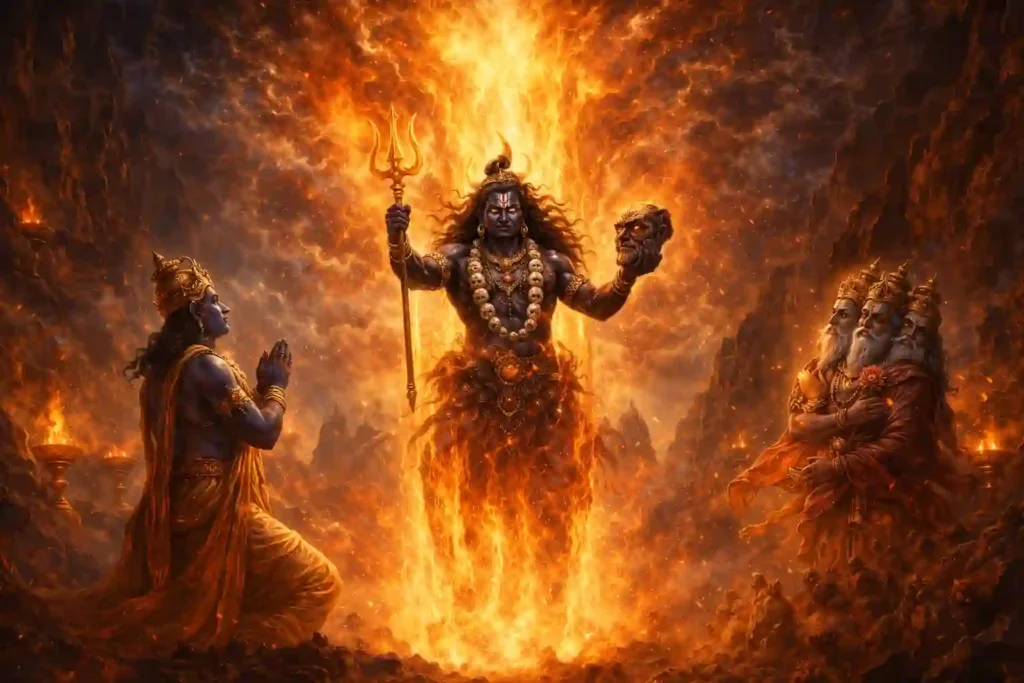
One of the most important narratives comes from the dispute between Brahma and Vishnu. When both argued over supremacy, Shiva appeared as an endless pillar of light. Vishnu accepted his limitation. Brahma did not.
From that pillar emerged Bhairav.
When Bhairav severed Brahma’s fifth head, it was not violence. It was the destruction of false claim and ego. The skull Bhairav carried symbolised the burden of ego, not punishment.
When Bhairav reached Kashi, the skull fell away. Truth restored itself. This moment established Bhairav as the guardian of sacred order and karmic balance.
Bhairav and Kashi: guardian of sacred space
Kashi is described as the city that exists outside ordinary time. Death there is not an ending, but a crossing.
Bhairav governs that crossing.
He ensures that souls, rituals, and seekers are protected from confusion and interference. This is why even today, traditional practice in Kashi acknowledges Bhairav before major rites.
Bhairav does not block liberation. He prepares the seeker for it.
Bhairav and time (Kaal) as a principle
Before Kaal Bhairav appears as a form, kaal must be understood.
Time in Sanatan thought is not neutral. It reveals truth by stripping away illusion. Bhairav governs this revealing force. When devotees say Bhairav changes life suddenly, it is because time accelerates under truth.
Delays dissolve. False structures collapse. What cannot stand honestly is removed.
This is why Bhairav worship often brings rapid, sometimes uncomfortable clarity.
Bhairav in Tantra and Shakti traditions
In Shakta and Tantric paths, Bhairav is indispensable. He is invoked before deeper sadhana begins.
Cremation ground symbolism, night worship, skull imagery, and even substances like alcohol are not indulgences. They are controlled symbols meant to dissolve fear, attachment, and social conditioning.
Bhairav protects the practitioner from imbalance. Without Bhairav, Tantra is considered dangerous. With Bhairav, it becomes grounded.
This acceptance is traditional, not modern invention, but it is always framed within discipline and guidance.
Bhairav in temple worship and living practice
Across India, Bhairav temples share common features:
- Night or twilight worship
- Mustard oil lamps
- Offerings that ground rather than excite
- Feeding dogs as seva
Kalashtami, the eighth lunar day of Krishna Paksha, is especially sacred. Devotees observe restraint, prayer, and silence. Bhairav worship is never loud. It is deliberate.
Regional practices vary, but the core intention remains protection through truth.
Symbols of Bhairav and their inner meaning
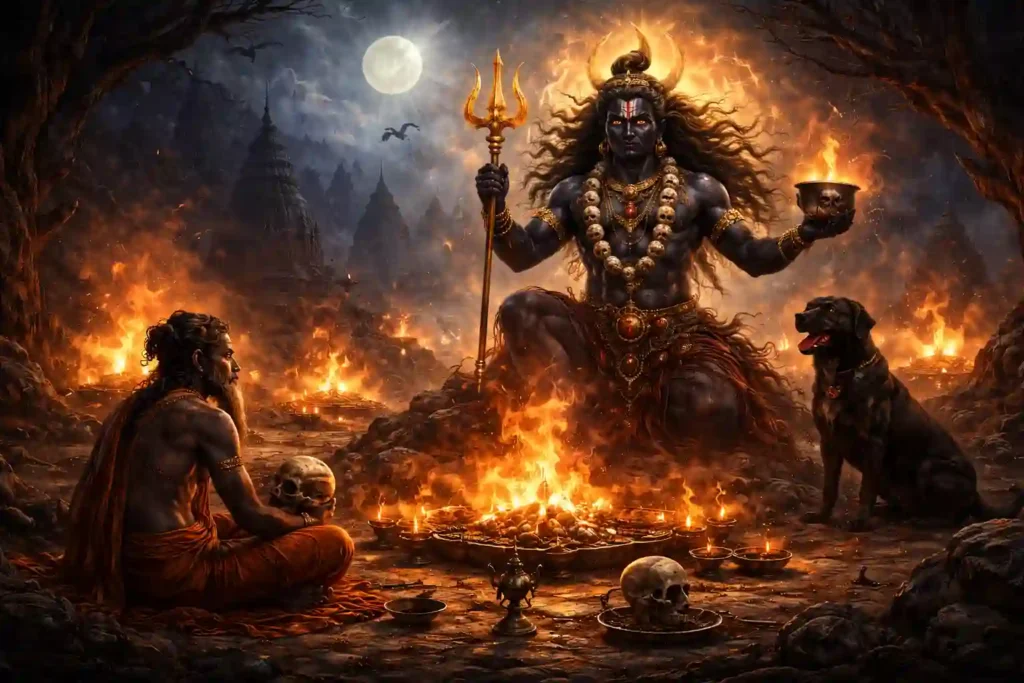
The dog represents alert awareness and loyalty to inner truth.
The skull bowl reminds devotees of impermanence and ego release.
The trident reflects balance of creation, preservation, and dissolution.
Serpents symbolise mastery over instinct and fear.
Minimal clothing reflects freedom from social illusion.
Every symbol teaches detachment without denial.
Ashta Bhairava: guardians of the eight directions
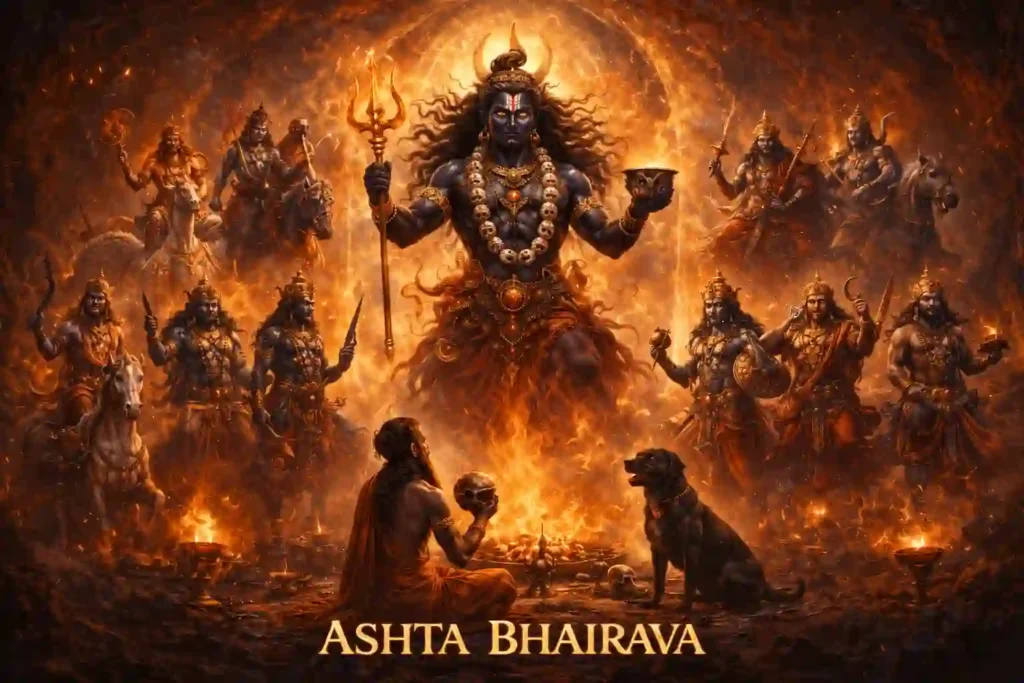
Bhairav manifests as eight directional guardians to protect cosmic order completely. Each direction represents a force that can destabilise consciousness if left unchecked.
Ashta Bhairava ensures balance. Their detailed forms and roles are traditionally taught separately and will be explored in a dedicated article.
Batuk Bhairav and gentler manifestations
Bhairav is not always fierce. Batuk Bhairav appears as a child form, representing innocence protected by power.
This form is widely worshipped in households. It teaches that protection does not require terror. It requires sincerity.
Regional Bhairav traditions and folk continuity
Across villages and regions, Bhairav appears as Bhairavnath, Khandoba-aligned guardians, and local protectors.
These are not deviations. They are adaptations. Bhairav remains relevant by entering lived culture.
Inner transformation through Bhairav upasana
Devotees often report:
- Reduction of irrational fear
- Sudden mental clarity
- Strength during unstable phases
- Honest confrontation with self
Bhairav does not comfort illusion. He strengthens truth.
Who should worship Bhairav
Bhairav is for those who value honesty over image. He does not respond to drama, fear, or blind ritualism.
Householders may worship him gently. Seekers may approach him deeply. But Bhairav is never rushed.
Bhairav as the gateway to deeper Shaiva paths
Traditionally, Bhairav is invoked before advanced Shaiva or Tantric practices. He ensures grounding before expansion.
Without Bhairav, growth becomes unstable. With Bhairav, even destruction becomes grace.
Conclusion
Bhairav Tattva is not about fear, punishment, or darkness. It is about truth that does not negotiate. Bhairav stands where illusion ends and clarity begins.
For those drawn to his presence, Bhairav becomes a lifelong guardian. Not by sheltering from reality, but by preparing the soul to face it fully.
Bhairav Tattva reminds us that truth, when protected by awareness, becomes fearlessness.
Suggested Reading from Sanatan Tales
If this exploration of Bhairav Tattva resonated with you, you may also wish to read about Kaal Bhairav, the guardian of Kashi, and other Bhairav manifestations such as Batuk Bhairav and Ashta Bhairava, where these principles take specific form in temples and living traditions. You can explore related articles on Shiva, Bhairav, and sacred spaces across India on thesanatantales.com.
FAQs
Is Bhairav dangerous?
No. Bhairav is dangerous only to ego and dishonesty.
Is Bhairav only a tantric deity?
No. Tantra recognises Bhairav deeply, but Bhairav belongs to all Shaiva paths.
What is the difference between Bhairav and Kaal Bhairav?
Bhairav is the tattva. Kaal Bhairav is a specific manifestation governing time.
Why are dogs associated with Bhairav?
They symbolise loyalty, protection, and alert awareness.
Can householders worship Bhairav?
Yes, with sincerity and simplicity.