
What is Atma and Paramatma is one of the most important questions in Sanatan Dharma because it helps us understand who we truly are and what reality itself is.
This question arises naturally when a person looks beyond the body, mind, and daily roles and begins to wonder about the deeper truth of existence.
When life’s pleasures feel temporary and suffering feels repetitive, the search for something permanent begins.
Understanding what is Atma and Paramatma changes how one sees life, death, suffering, and liberation, and shifts the focus from outer identity to inner truth.
In Atma in Sanatan Dharma, Atma refers to the individual soul present within every living being.
It is the inner witness that experiences life through the body and mind but is not limited by them.
Paramatma in Sanatan Dharma refers to the supreme, universal soul that exists everywhere and within everything, beyond form, name, and limitation.
The difference between Atma and Paramatma is often explained to remove confusion, especially for beginners, while the Atma and Paramatma relationship helps us understand that they are not truly separate, but connected at the deepest level of reality.
Sanatan wisdom teaches that knowing this relationship is not just philosophical knowledge, but a step toward inner peace and freedom.
Table of Contents
ToggleWhat is Atma in simple words?
Atma is the true self. It is the inner awareness that experiences life through the body and mind but is not limited by them.
The body changes, thoughts come and go, and emotions rise and fall, but Atma remains unchanged.
Atma is eternal. It is not born, and it does not die. It continues even when the body perishes.
What is Paramatma in simple words?
Paramatma is the supreme soul or universal consciousness. It is present everywhere at the same time and exists beyond all forms and names.
While Atma experiences individuality, Paramatma remains infinite and all-pervading.
What is the difference between Atma and Paramatma?
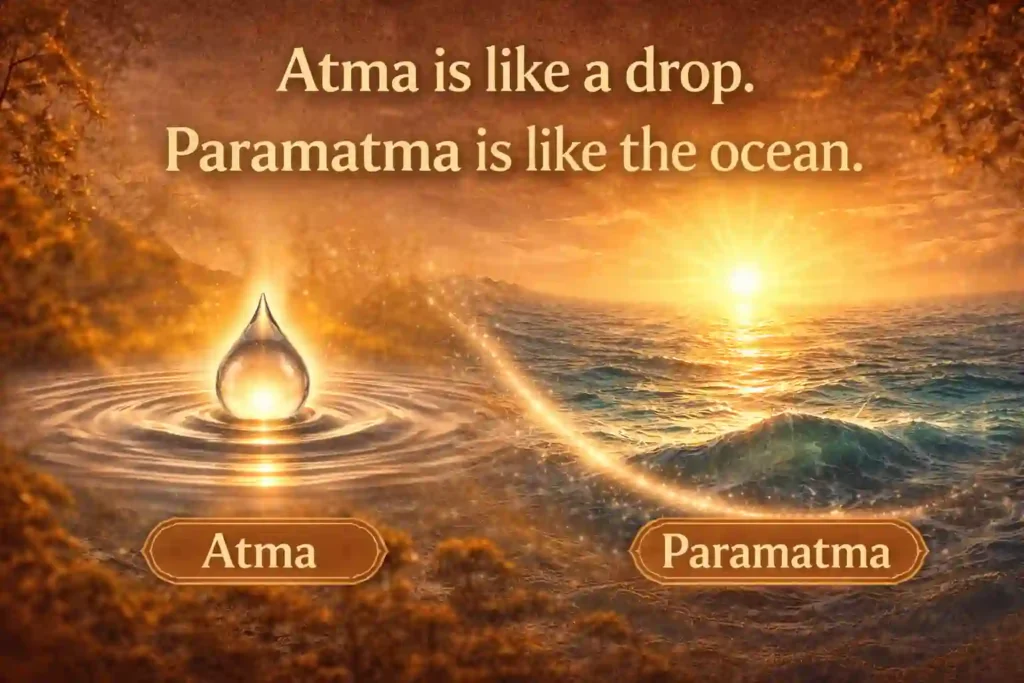
The difference between Atma and Paramatma is not in essence, but in perspective. Atma is like a wave, and Paramatma is like the ocean.
Both are water, yet one appears limited while the other is limitless.
Atma experiences separation due to ignorance. Paramatma remains complete and untouched.
What is the relationship between Atma and Paramatma?
The Atma and Paramatma relationship is one of unity. Sanatan Dharma teaches that Atma is never truly separate from Paramatma. The sense of separation exists only due to ignorance.
When knowledge arises, Atma realizes its oneness with Paramatma.
Is Atma part of Paramatma?
Yes. Atma is often described as a reflection or spark of Paramatma. Though it appears individual, its true nature is divine.
This understanding forms the foundation of non-dual wisdom in Sanatan Dharma.
How does Atma merge with Paramatma?
Atma does not physically merge with Paramatma. The merging happens through realization. When ignorance ends, the false sense of separation dissolves.
This realization leads to Moksha, freedom from rebirth and suffering.
Why is understanding Atma and Paramatma important?
Understanding Atma and Paramatma removes fear of death and reduces attachment. It brings inner peace, compassion, and clarity.
Life shifts from ego-centered living to awareness-centered living.
Conclusion
Understanding what is Atma and Paramatma lies at the heart of Sanatan Dharma.
Atma is the individual soul, Paramatma is the universal soul, and their relationship is one of eternal unity.
When this truth is realized, ignorance fades, fear dissolves, and life is lived with peace, balance, and inner freedom.
Suggested Reading
To deepen this understanding, you may also explore What is Karma according to Sanatan Dharma, What is Moksha and how is it attained, and What is Dharma and why it matters.
Together, these teachings explain action, soul, duty, and liberation as one continuous spiritual vision.
Please visit our website: www.thesanatantales.com for more such interesting and indepth article.