
What is Moksha and how is it attained is one of the deepest and most searched questions in Sanatan Dharma, because it touches the root of human suffering and the longing for lasting peace.
From ancient rishis to modern seekers, this question arises when a person begins to look beyond temporary happiness and asks about the true purpose of life.
Understanding what is Moksha and how is it attained changes how one sees birth, death, success, loss, and even daily struggles.
In Moksha in Sanatan Dharma, Moksha means liberation of the soul from bondage.
It is known as liberation in Hinduism, where the soul is freed from ignorance, attachment, and the endless cycle of birth and death.
Moksha is not about escaping the world or rejecting life. It is about seeing life as it truly is, without illusion.
This is why Moksha is deeply linked with moksha and rebirth, because liberation ends the need for repeated births driven by karma and desire.
The journey toward Moksha is often described as the path to moksha, but this path is not the same for everyone.
Sanatan Dharma does not force one method. Some walk the path through knowledge and self-inquiry, some through devotion and surrender, and some through selfless action.
What unites all paths is inner transformation. Moksha happens when ignorance falls away and the soul realizes its true nature beyond body, mind, and ego.
Table of Contents
ToggleWhat does Moksha really mean in simple words?
Moksha means freedom. It is freedom from suffering, fear, attachment, and ignorance.
It does not mean escaping the world physically. It means understanding the truth of life and the self.
In Moksha, the soul realizes its true nature beyond the body and mind. This realization brings peace that does not depend on situations.
Is Moksha freedom from rebirth?
Yes. Moksha is the end of rebirth. In Sanatan Dharma, rebirth happens because of karma and ignorance. When ignorance ends, karma no longer binds the soul.
This is why Moksha and rebirth are deeply connected. Rebirth continues until knowledge and awareness arise.
Is Moksha only possible after death?
No. Sanatan Dharma teaches that Moksha can be attained while living. Such a person is called a Jivanmukta, one who is liberated while alive.
The body may continue, but attachment and fear fall away. Life is lived with clarity and compassion.
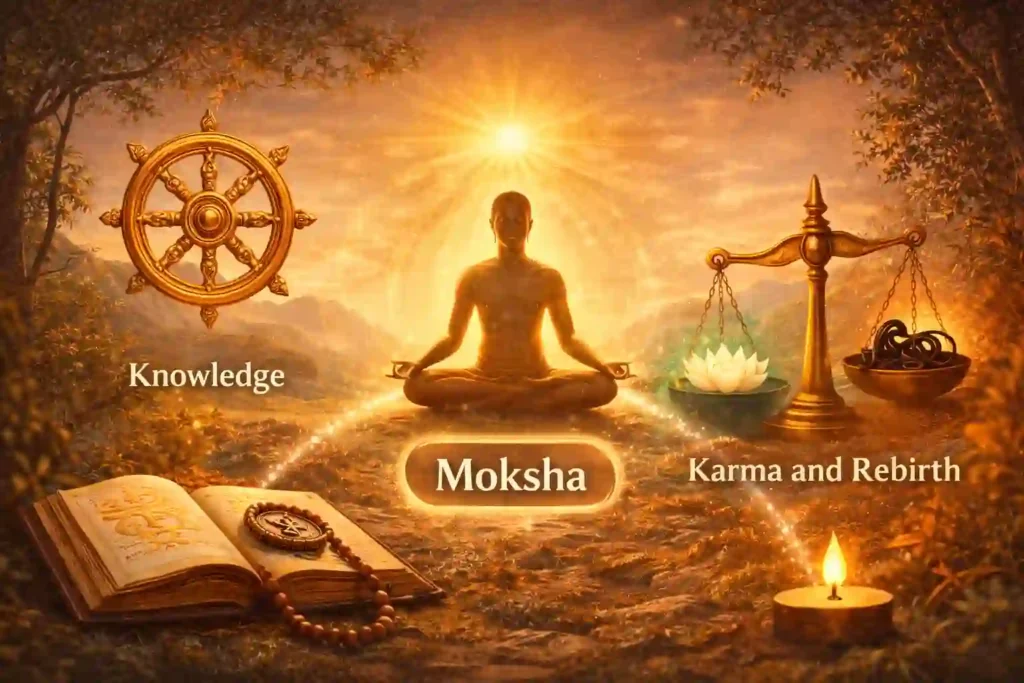
How is Moksha attained according to Sanatan Dharma?
There is no single rigid method. Sanatan Dharma recognizes different paths based on nature and temperament.
Some attain Moksha through knowledge and self-inquiry. Some through devotion and surrender. Some through selfless action without attachment to results. All paths aim at dissolving ego and ignorance.
Does everyone have to renounce the world to attain Moksha?
No. Renunciation is inner, not outer. A householder living honestly and selflessly can also walk the path to Moksha.
What matters is attachment, not activity.
What role does karma play in Moksha?
Karma binds the soul when actions are driven by desire and ego. When actions are done without attachment, karma loses its grip.
This is why conscious action and awareness are essential on the path to Moksha.
Why is Moksha considered the highest goal of life?
Sanatan Dharma speaks of four goals of life: Dharma, Artha, Kama, and Moksha. Moksha stands above all because it ends suffering permanently.
It gives lasting peace, not temporary happiness.
Conclusion
Understanding what is Moksha and how is it attained changes how one looks at life, success, and suffering.
Moksha is not escape, but awakening. It is the freedom that comes from knowing the truth of the self and living without fear, attachment, or ignorance.
Sanatan Dharma reminds us that this freedom is possible for every sincere seeker.
Suggested Reading
To deepen this understanding, you may also explore What is Karma according to Sanatan Dharma, What is Dharma and why it matters, and What is Atma and Paramatma.
Together, these ideas explain action, duty, soul, and liberation as one continuous spiritual journey.
For more such articles please visit our website: www,thesanatantales.com.