Karma is a concept almost everyone wonders about at some point in life. When something good happens, we often call it good karma. When life becomes difficult, we quietly believe it may be the result of our past actions.
Yet, although this ancient principle is widely known, its true meaning is often misunderstood. Some people see it as fate, while others think it is a form of reward or punishment.
In reality, it is neither. It is a universal law of cause and effect that explains how our thoughts, intentions, words, and actions shape the experiences we face. When understood correctly, it brings clarity instead of fear.
This wisdom encourages responsibility, self-awareness, and inner peace. To truly understand this timeless teaching, we must explore it with an open mind, free from fear and blind belief.
In this article, you will learn its meaning, philosophy, different types, and how it works according to Sanatan Dharma. You will also discover what the Bhagavad Gita teaches, how present actions influence the future, and how this eternal principle can help you live with greater awareness, purpose, and peace.
Karma at a Glance
| Aspect | Explanation |
|---|---|
| Meaning | The universal law of action and consequence. |
| Based On | Thoughts, words, intentions, and actions. |
| Main Types | Sanchita, Prarabdha, and Kriyamana (Agami). |
| Main Scripture | Bhagavad Gita |
| Purpose | To encourage righteous living and personal responsibility. |
| Can It Change? | Yes. Present actions influence future experiences. |
| Ultimate Goal | Freedom from attachment and attainment of Moksha. |
Did You Know?
The word Karma comes from the Sanskrit root “Kri”, which means “to do” or “to act.” In Sanatan Dharma, Karma is much more than physical action.
It also includes our thoughts, intentions, words, and every conscious choice we make. This is why inner attitude is considered just as important as outward actions.
Table of Contents
ToggleWhat Is Karma? Meaning in Simple Words
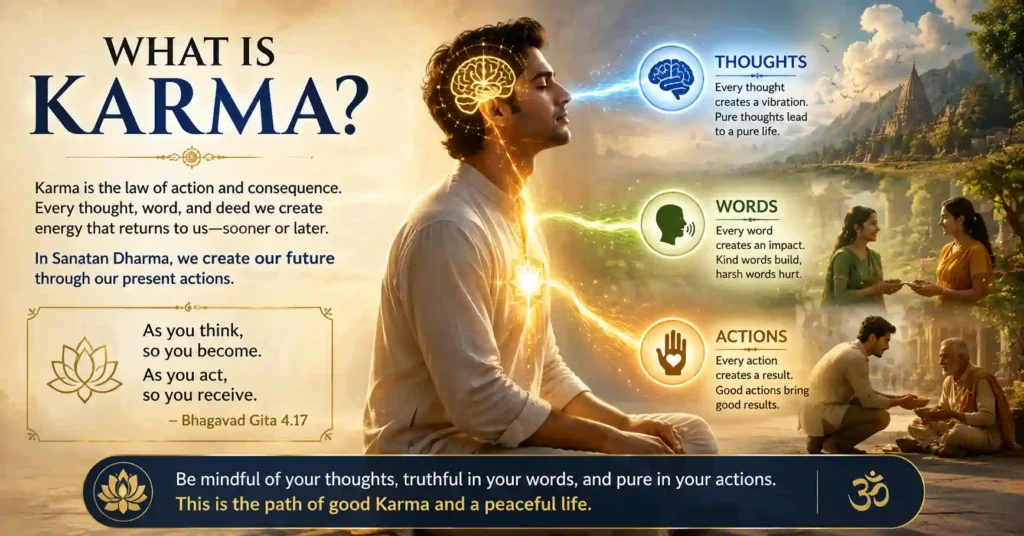
In simple words, Karma means action. However, it is not limited to physical actions alone. According to Sanatan Dharma, it includes everything that begins in the mind and is expressed through our words and deeds.
Every thought we nurture, every word we speak, and every action we perform creates an effect. This is why two people may do the same work yet experience different outcomes. While the action may appear identical, the intention behind it is often different.
The law of cause and effect begins long before a visible action takes place. Our intentions shape our choices, and those choices gradually influence our experiences and future.
Understanding this simple truth helps us see that life is not driven by chance alone. Instead, our present actions, guided by awareness and responsibility, play an important role in shaping what lies ahead.
Karma Is More Than Just Action
Ancient Hindu wisdom beautifully explains this principle through the phrase:
“मनसा वाचा कर्मणा”
“Mānasa Vācā Karmana”
“By mind, by speech, and by action.”
This teaching reminds us that every deed begins long before it becomes visible. Our inner world shapes our outer actions.
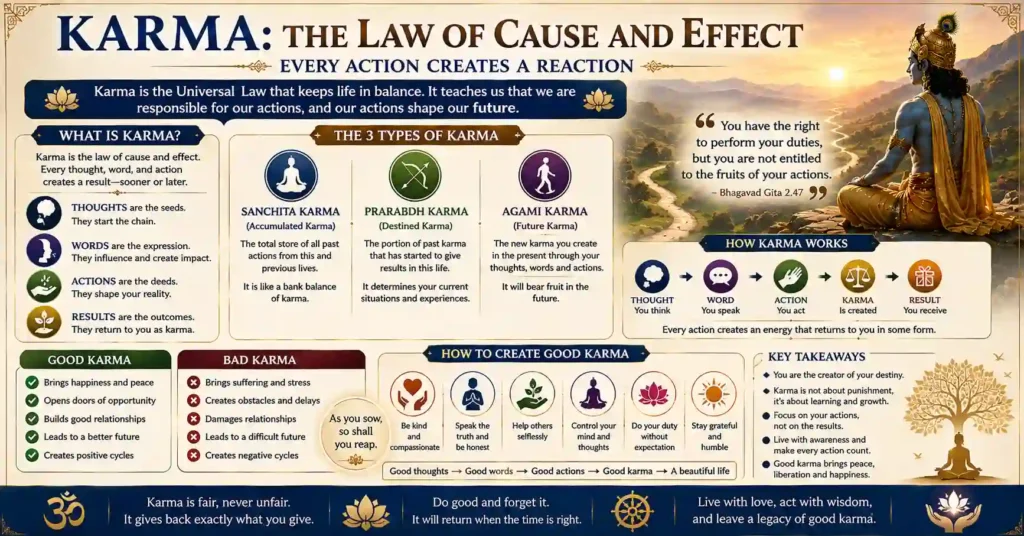
Human actions are formed on three levels:
- Mind (Manasa): The thoughts we repeat, the intentions we hold, and the emotions we nurture.
- Speech (Vacha): The words we speak with kindness, truth, anger, or deception.
- Action (Karmana): The physical deeds we perform through our body.
Not every passing thought creates lasting consequences. However, thoughts that are repeatedly entertained gradually shape our character and influence the choices we make.
Similarly, our words can inspire, heal, hurt, or mislead others. Every action, whether physical, verbal, or mental, leaves an impression on ourselves and the world around us.
Understanding this teaching is not about becoming perfect. It is about becoming more aware of our thoughts, words, and actions, so that we can live with greater wisdom and responsibility.
The Principle of Karma
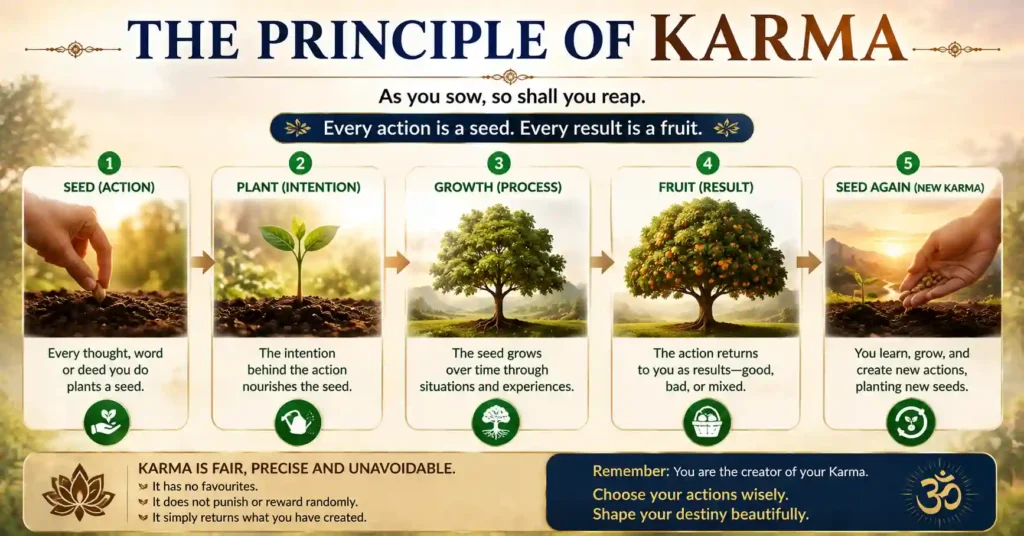
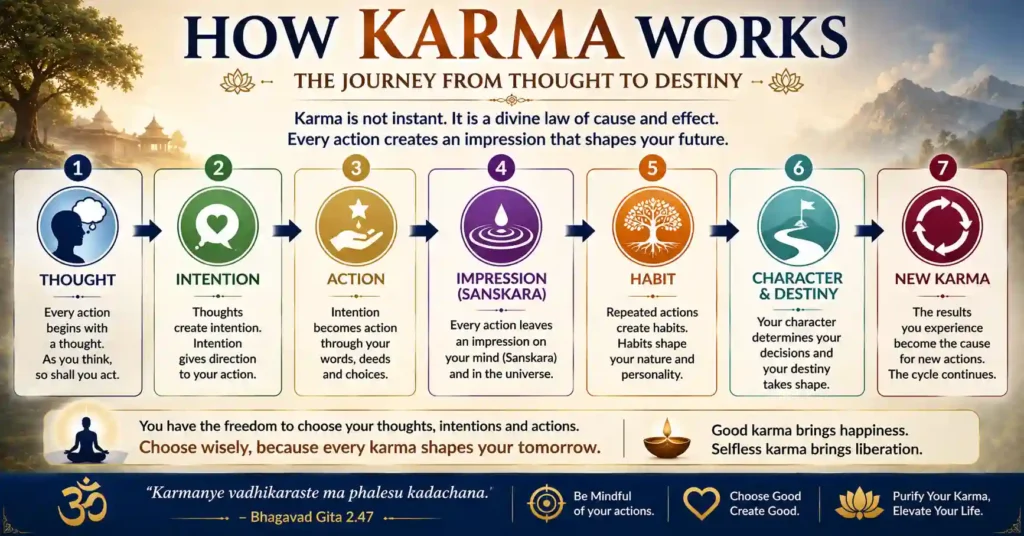
The principle is simple: every action has a consequence. However, those consequences do not always appear immediately. Just as a seed takes time to grow into a tree and bear fruit, the results of our actions unfold according to their own natural timing.
Some actions produce immediate results, while others may take months, years, or even lifetimes to bear fruit. This delay often leads people to question the universal law of cause and effect or assume that life is unfair.
In Sanatan Dharma, every thought, word, and deed leaves an impression. The timing of its result depends on many factors, including intention, circumstances, and the right time for it to unfold. Nothing is lost, and nothing happens without a cause.
Understanding this principle helps us look beyond fear, superstition, and blame. Instead of worrying about when results will appear, it encourages us to focus on performing righteous actions with sincerity and patience.
Types of Karma
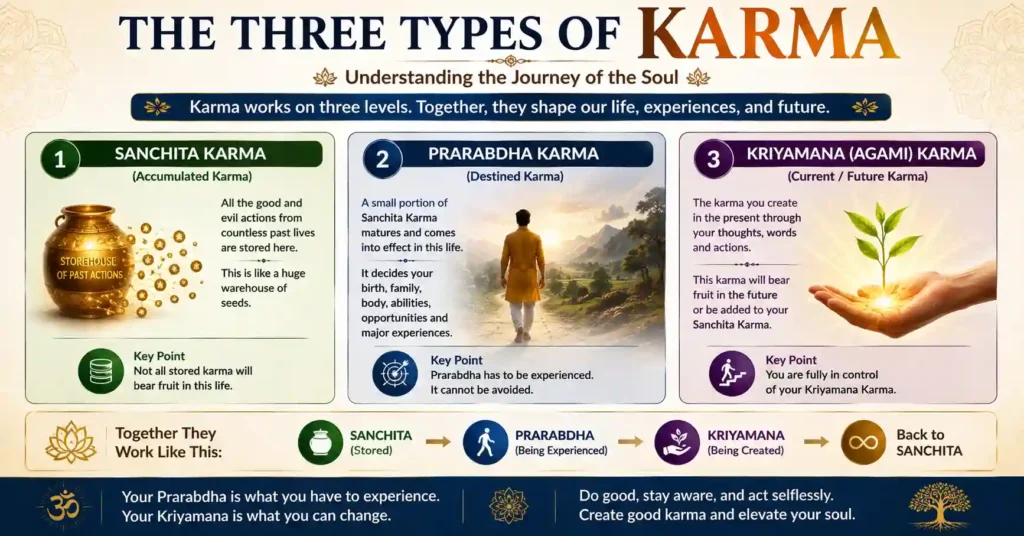
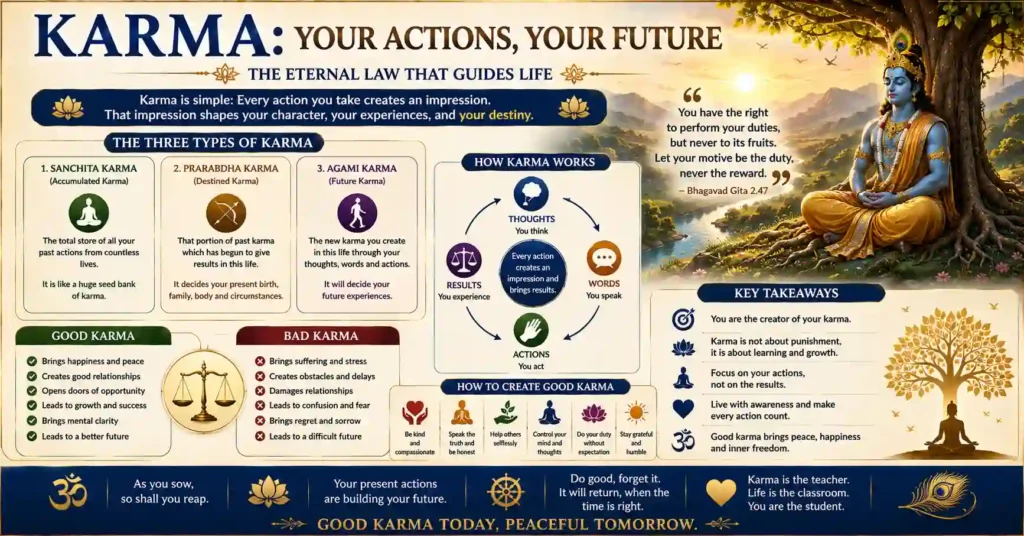
To understand how the law of cause and effect works, it is important to understand the three main types of Karma described in Sanatan Dharma. Each one plays a different role in shaping our life and spiritual journey.
| Type | Meaning | Role in Life |
|---|---|---|
| Sanchita Karma | The accumulated results of actions from previous births and the present life. | A vast storehouse of past actions waiting to bear fruit. |
| Prarabdha Karma | The portion of accumulated actions that has begun to bear fruit in this lifetime. | Determines our birth, family, body, and certain life experiences that cannot easily be changed. |
| Kriyamana (Agami) Karma | The actions we perform in the present moment. | Shapes our future and gradually becomes part of our accumulated actions. |
Sanchita Karma
This is the accumulated storehouse of all actions performed across previous births as well as the present life. Not all of these results are experienced at once. They remain stored until the appropriate time for them to unfold.
Prarabdha Karma
This is the portion of accumulated actions that has already begun to bear fruit in the present life. It influences the circumstances into which we are born, such as our family, physical body, and certain experiences that are beyond our immediate control.
Kriyamana (Agami) Karma
This refers to the actions we perform every day through our thoughts, words, and deeds. Unlike the past, the present is always in our hands. Every conscious choice we make today shapes the experiences we create for tomorrow.
Although some aspects of life are influenced by past actions, Sanatan Dharma teaches that we are never completely bound by them. Through right understanding, righteous conduct, and selfless action, every individual has the opportunity to build a better future.
How Karma Gives Results
Many people wonder why the results of their actions do not appear immediately. The answer is that the law of cause and effect works according to many factors, including time, circumstances, intention, and a person’s readiness to experience the outcome.
Some actions produce immediate results. For example, a harsh word may hurt someone instantly, while an act of kindness can bring immediate joy. Other actions may take months, years, or even lifetimes before their effects become visible.
Just as a seed needs the right soil, water, and time to grow into a tree, the results of our actions also unfold when the right conditions come together. Nothing happens randomly, and nothing is forgotten.
Understanding this principle helps us stop comparing our lives with others. Every individual is experiencing the results of different past actions while creating new ones through present choices. Instead of worrying about when the results will come, Sanatan Dharma encourages us to perform our duties with sincerity, patience, and faith.
Does Past Life Karma Affect This Life?
Yes, according to Sanatan Dharma, actions performed in previous births can influence the present life. However, influence does not mean that everything is fixed. It simply provides the starting point from which each person begins their journey.
For example, two people may be born into similar families or circumstances but make very different choices as they grow. Their awareness, attitude, and present actions shape how their lives unfold.
Past actions may create certain situations, but they do not control every decision we make. The present moment always offers the opportunity to learn, improve, and choose a better path.
This is why Sanatan Dharma teaches that life is not predetermined. While some experiences arise from earlier causes, our future is continuously shaped by the choices we make today through wisdom, responsibility, and righteous living.
Karma and Destiny
Many people believe that destiny controls everything. However, Sanatan Dharma explains that destiny is the result of past actions, while the present is shaped by the choices we make today.
In simple words, destiny is what we receive, while our actions determine what we create next. Some situations may already be unfolding because of earlier causes, but our response to those situations is always in our hands.
This understanding removes the feeling of helplessness. Instead of blaming fate, it encourages us to act with wisdom, patience, and responsibility.
The Bhagavad Gita teaches that we should focus on performing our duty with sincerity rather than worrying about the results. Every righteous action becomes the foundation for a better future and supports our spiritual growth.
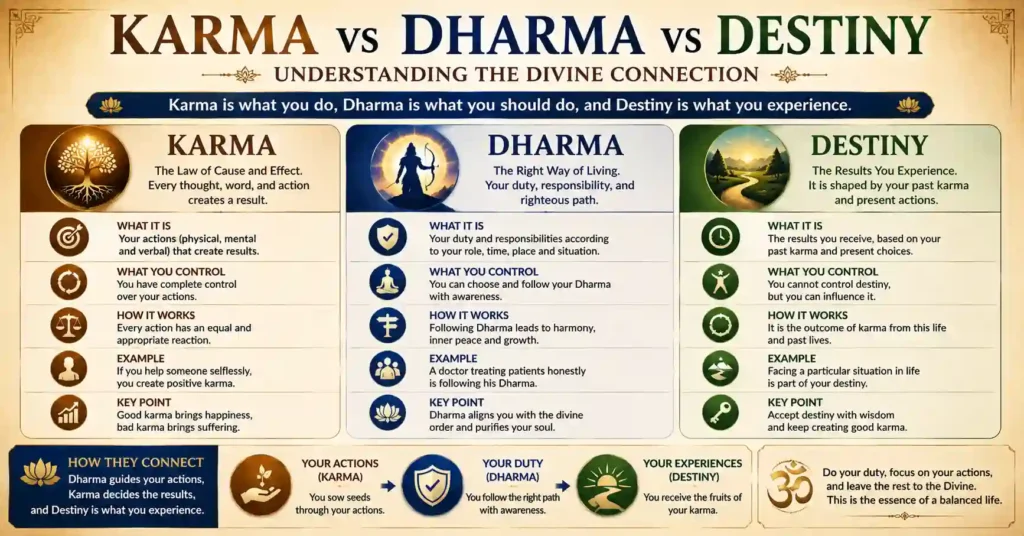
Karma, Dharma and Destiny: A Quick Comparison
| Concept | Meaning | Simple Example |
|---|---|---|
| Karma | The law of action and consequence. | Helping someone in need creates positive impressions and future results. |
| Dharma | One’s righteous duty and moral responsibility. | A teacher educating students honestly and sincerely. |
| Destiny | The outcome of past actions experienced in the present. | Being born into a particular family or circumstance. |
Although these concepts are closely connected, they are not the same. Dharma guides our actions, Karma determines their consequences, and destiny reflects the results of earlier actions already unfolding in our lives.
Common Misconceptions About Karma
Many misunderstand this universal principle because of popular beliefs and incomplete knowledge. Here are some common misconceptions:
| Misconception | Reality in Sanatan Dharma |
|---|---|
| Karma is punishment. | It is the natural law of cause and effect, not divine punishment. |
| Everything is fixed by destiny. | Present choices can influence the future. |
| Only physical actions matter. | Thoughts, words, intentions, and actions all create consequences. |
| Good people never suffer. | Everyone experiences the results of past and present actions at different times. |
| God simply removes all consequences. | Divine grace gives strength, wisdom, and guidance to face life’s challenges. |
Understanding these truths helps us replace fear with responsibility and encourages us to live with greater awareness, compassion, and wisdom.
Can God Change Karma?
This is one of the most common and deeply personal questions in Sanatan Dharma. The scriptures teach that the Divine does not simply erase the results of our actions like a transaction. Instead, divine grace helps us face life’s challenges with greater wisdom and strength.
When a person accepts responsibility, performs righteous actions, and walks the path of Bhakti (devotion), Karma Yoga, or Jnana (knowledge), their inner transformation begins. The same experience that once caused suffering can gradually become a source of wisdom, compassion, and spiritual growth.
Rather than removing every consequence, God’s grace changes the way we experience it. Difficulties that once felt overwhelming can become opportunities for learning, purification, and self-realization.
The Bhagavad Gita reminds us that sincere devotion, faith, and selfless action bring us closer to the Divine. As our awareness grows, we learn to face every situation with courage, peace, and acceptance.
Why Do Good People Also Suffer?
This is one of the most difficult questions people ask. If someone is kind, honest, and compassionate, why do they still face challenges in life?
According to Sanatan Dharma, present goodness does not immediately erase the results of past actions. Some difficulties may arise from Prarabdha Karma, which is the portion of accumulated actions already unfolding in this lifetime.
However, suffering does not have the same effect on everyone. A person with wisdom, faith, and self-awareness often responds to hardships with patience and courage, while another may become discouraged or bitter.
The Bhagavad Gita teaches that challenges can become opportunities for inner growth. When faced with the right attitude, even painful experiences can deepen compassion, strengthen character, and bring us closer to spiritual understanding.
Can Karma Be Changed?
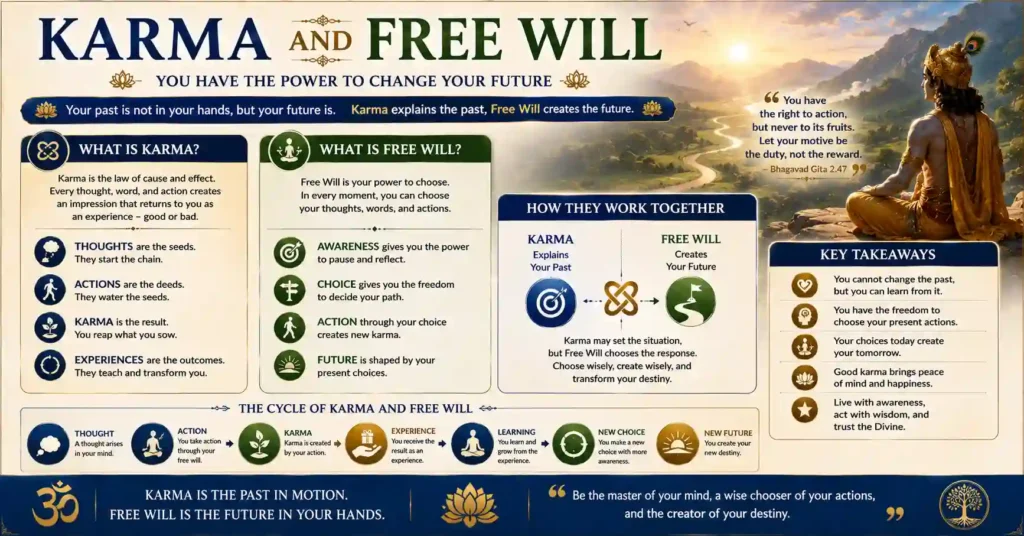
Yes. One of the most empowering teachings of Sanatan Dharma is that our future is not fixed. While we cannot change the past, we can always shape what lies ahead through the choices we make today.
Every thought, word, and action creates new possibilities. Living with awareness, compassion, honesty, and self-discipline gradually transforms our character and influences the direction of our life.
The Bhagavad Gita encourages us to perform our duties with sincerity and without attachment to the results. Such selfless actions purify the mind, strengthen inner wisdom, and support spiritual growth.
No one is permanently bound by past actions. Through right understanding, righteous living, devotion, and continuous self-improvement, every individual has the opportunity to create a brighter future and move closer to inner freedom.
What Does the Bhagavad Gita Say About Karma?
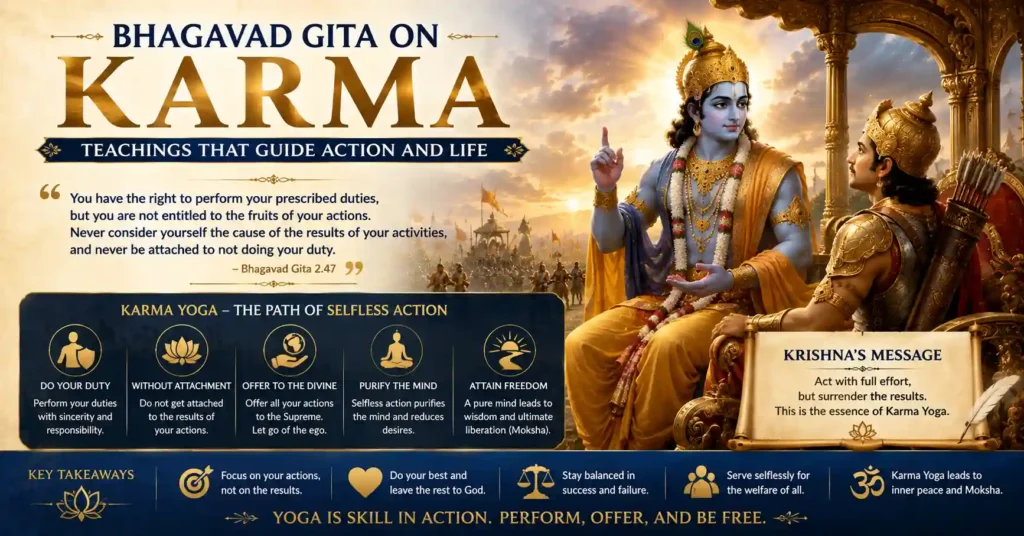
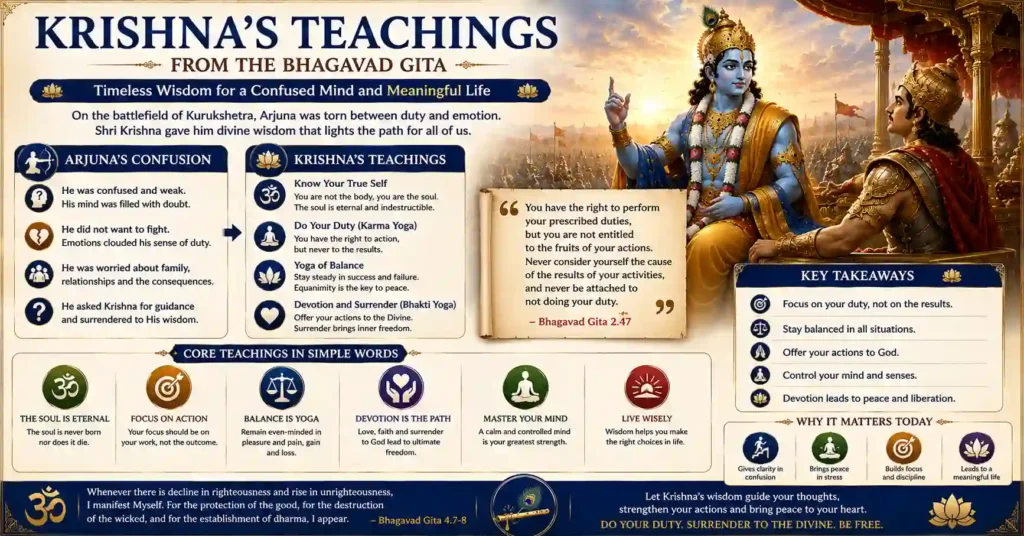
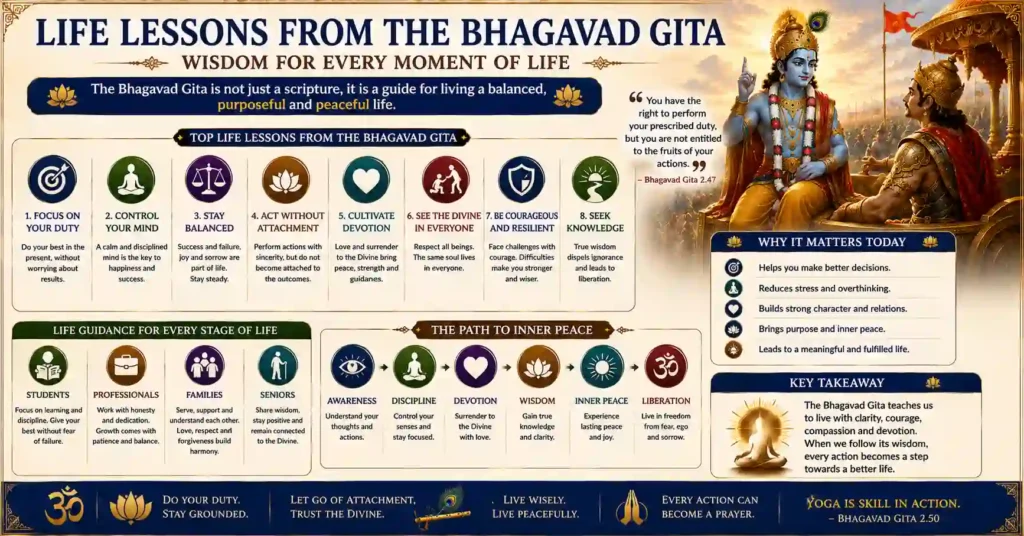
The Bhagavad Gita gives one of the clearest explanations of Karma in Sanatan Dharma. Lord Krishna teaches Arjuna that every person has the right to perform their duty, but should not become attached to the results of their actions.
This teaching is known as Nishkama Karma, or selfless action. It encourages us to work with sincerity, honesty, and dedication while accepting success and failure with the same calmness.
One of the most famous verses from the Bhagavad Gita explains this principle:
“कर्मण्येवाधिकारस्ते मा फलेषु कदाचन।”
“Karmanyevadhikaraste Ma Phaleshu Kadachana.”
“You have the right to perform your duty, but never to the fruits of your actions.”
(Bhagavad Gita 2.47)
This does not mean we should ignore results or stop making efforts. Instead, it teaches us to give our best without allowing success, failure, praise, or criticism to disturb our inner peace.
By following this teaching, our actions become a path to self-improvement, spiritual growth, and ultimately Moksha.
How Bhakti and Knowledge Influence Karma
Bhakti (devotion) softens the ego, while Jnana (spiritual knowledge) removes ignorance. As ego fades and wisdom grows, our attachment to the results of our actions gradually weakens.
Sanatan Dharma teaches that liberation is not achieved through actions alone. It also comes through inner transformation, where the mind becomes free from selfish desires, pride, and attachment.
The Bhagavad Gita explains that when actions are performed with devotion, wisdom, and without expecting personal rewards, they no longer bind the individual in the same way. This is the essence of Karma Yoga and Nishkama Karma.
Through sincere devotion, right knowledge, and selfless service, a person develops inner peace and spiritual maturity. These qualities help purify the mind and guide one toward self-realization and ultimately Moksha.
Karma in Daily and Family Life
The law of cause and effect is not limited to monks, saints, or spiritual seekers. It is present in every aspect of daily life, including our family, work, relationships, and social responsibilities.
Every choice we make, every promise we keep, and every act of kindness or honesty shapes our character. Caring for our parents, supporting our family, serving society, and performing our duties with sincerity are all forms of spiritual practice.
Sanatan Dharma does not teach us to escape from worldly life. Instead, it encourages us to fulfil our responsibilities with integrity, compassion, and a spirit of selfless service.
When everyday duties are performed with the right intention and without selfish attachment, even ordinary actions become a path to inner growth, peace, and spiritual progress.
How to Practice Karma in Everyday Life
Understanding this universal principle is only the first step. The real transformation begins when we apply it in our daily lives through conscious choices and selfless actions.
Here are a few simple ways to practice it every day:
- Think before you act and consider how your choices affect others.
- Speak truthfully and kindly, as words also create lasting impressions.
- Perform your duties sincerely without expecting praise or rewards.
- Help others whenever possible with compassion and humility.
- Accept both success and failure with balance, while continuing to do what is right.
- Reflect on your actions each day and learn from your mistakes instead of blaming others.
These simple habits gradually develop self-awareness, strengthen character, and bring greater peace and purpose to everyday life.
Is Freedom from Karma Possible?
According to Sanatan Dharma, freedom does not mean giving up work or avoiding responsibilities. Instead, it means performing every action without attachment to personal gain or the desire for rewards.
The Bhagavad Gita teaches that when we carry out our duties with sincerity, selflessness, and devotion, our actions no longer create the same binding effect. This path is known as Nishkama Karma, or selfless action.
As attachment, ego, and selfish desires gradually fade, the mind becomes peaceful and free. Such a person continues to perform their duties, but without being controlled by success, failure, praise, or criticism.
This inner freedom is regarded as an important step toward Moksha, the ultimate liberation from the cycle of birth and rebirth. It is achieved through right understanding, selfless action, devotion, and spiritual wisdom.
Karma in Modern Life
The timeless principles of Sanatan Dharma are just as relevant today as they were thousands of years ago. In today’s fast-paced world, every thought, word, and action influences our relationships, career, health, and inner peace.
Living with awareness means making thoughtful choices instead of reacting impulsively. It means speaking with kindness, acting with honesty, and accepting responsibility rather than blaming people or circumstances.
Whether at home, in the workplace, or on social media, every decision leaves an impression. Small acts of compassion, truthfulness, and selfless service gradually shape our character and create a more meaningful life.
This timeless teaching reminds us that life is not simply happening to us. Every choice we make becomes an opportunity to grow, serve others, and move closer to lasting peace and spiritual fulfillment.
Key Takeaways
- Karma is the universal law of action and consequence in Sanatan Dharma.
- Thoughts, words, intentions, and actions all influence our future experiences.
- The three main types are Sanchita, Prarabdha, and Kriyamana (Agami).
- Present choices are more powerful than many people realize and help shape the future.
- The Bhagavad Gita teaches Nishkama Karma, or performing duties without attachment to results.
- Through right understanding, selfless action, devotion, and wisdom, one moves toward Moksha.
Conclusion
Karma is not meant to create fear. It is a timeless principle that encourages us to live with awareness, responsibility, and compassion. Every thought, word, and action shapes not only our future but also our character.
The Bhagavad Gita and the teachings of Sanatan Dharma remind us that while we cannot change the past, we always have the power to choose how we act today. Through righteous living, selfless service, and spiritual wisdom, every moment becomes an opportunity for inner growth.
When we truly understand this universal law, life becomes more meaningful and purposeful. Instead of blaming circumstances, we learn to make conscious choices that lead to lasting peace, spiritual progress, and ultimately, Moksha.
If you wish to deepen your understanding of Sanatan Dharma, explore more articles on The Sanatan Tales and continue your journey into its timeless wisdom.
Suggested Reading
If you found this guide on Karma helpful, you may also enjoy exploring these related topics. Together, these articles explain the deeper philosophy of Sanatan Dharma, including the nature of the soul, duty, detachment, time, the purpose of human life, and the path to spiritual liberation.
Sanatan Dharma Meaning: What Is Sanatan Dharma and Its Core Principles
https://thesanatantales.com/sanatan-dharma-meaning/
Atma and Parmatma: Understanding the Soul and the Supreme
https://thesanatantales.com/atma-and-parmatma/
What Are the Four Purusharthas? A Simple Guide to Dharma, Artha, Kama and Moksha
https://thesanatantales.com/four-purusharthas-dharma-artha-kama-moksha/
Detachment in Hindu Philosophy: The Deep Meaning of Vairagya and Inner Freedom
https://thesanatantales.com/detachment-in-hindu-philosophy/
Kaal in Sanatan Dharma: The Eternal Science of Time, Yugas and Cosmic Cycles
https://thesanatantales.com/kaal-in-sanatan-dharma/
Panchbhoota: The 5 Elements of Life and Their Deep Spiritual Meaning
https://thesanatantales.com/panchbhoota/
Vaitarni Nadi: What Happens After Death and How the Soul Crosses It
https://thesanatantales.com/vaitarni-nadi/
Karma (Wikipedia)
https://en.wikipedia.org/wiki/Karma/
FAQs
What is Karma in simple words?
In simple words, Karma is the universal law of action and consequence. Every thought, word, intention, and action creates an effect that influences our present or future experiences.
According to Sanatan Dharma, it is not a system of reward and punishment. Instead, it is a natural law that encourages us to live with awareness, responsibility, and compassion.
What does Karma mean in Sanatan Dharma?
In Sanatan Dharma, Karma means more than physical action. It includes our thoughts, speech, intentions, and deeds, all of which leave an impression and shape our spiritual journey.
The Bhagavad Gita teaches that while we cannot always control the results of our actions, we can choose to perform our duties with sincerity, selflessness, and devotion.
What are the three types of Karma?
Sanatan Dharma describes three main types of Karma.
Sanchita Karma is the accumulated store of actions from previous births and the present life.
Prarabdha Karma is the portion that is experienced in this lifetime, while Kriyamana (Agami) Karma consists of the actions we perform today that shape our future.
Together, these explain how past, present, and future are connected.
Can Karma be changed?
Yes. One of the central teachings of Sanatan Dharma is that the future is not fixed. Although we cannot change the past, we can always influence what lies ahead through our present choices.
Living with honesty, compassion, self-discipline, and selfless service gradually transforms our character and creates better future experiences.
Does Karma decide destiny?
Destiny and Karma are closely related, but they are not the same.
Destiny reflects the results of earlier actions that are already unfolding, while present choices continue to shape the future. This is why Sanatan Dharma encourages effort rather than helplessness.
Does God punish people through Karma?
No. According to Sanatan Dharma, God does not punish people through Karma.
Instead, the Divine has established a universal law of cause and effect. Divine grace gives us wisdom, courage, and inner strength to face life’s challenges and grow spiritually.
Why do good people also suffer?
Being a good person today does not immediately erase the effects of past actions.
Sanatan Dharma explains that some hardships arise from Prarabdha Karma, which has already begun to bear fruit in this lifetime. However, wisdom, devotion, and the right attitude help transform suffering into spiritual growth.
What does the Bhagavad Gita teach about Karma?
The Bhagavad Gita teaches that we should perform our duties sincerely without becoming attached to the results. This teaching is known as Nishkama Karma, or selfless action.
Lord Krishna explains that such actions purify the mind, strengthen inner peace, and guide a person toward spiritual liberation.
Can good Karma remove bad Karma?
Good actions do not simply erase the effects of earlier actions like cancelling a debt.
However, righteous living, devotion, selfless service, and spiritual wisdom gradually transform a person’s character and influence future experiences in a positive direction.
What is the ultimate goal of Karma?
The ultimate goal is not merely to receive good results but to grow spiritually.
By performing righteous actions without selfish attachment, a person gradually purifies the mind, develops inner peace, and moves toward Moksha, the liberation from the cycle of birth and rebirth.
Glossary of Important Terms
| Term | Meaning |
|---|---|
| Karma | The universal law of action and consequence. Every thought, word, and deed creates an effect. |
| Sanchita Karma | The accumulated results of actions from previous births and the present life. |
| Prarabdha Karma | The portion of accumulated actions that is experienced in the current lifetime. |
| Kriyamana (Agami) Karma | The actions performed in the present that shape future experiences. |
| Dharma | One’s righteous duty and moral way of living according to Sanatan Dharma. |
| Karma Yoga | The path of selfless action performed without attachment to personal rewards. |
| Nishkama Karma | Performing actions without expecting the fruits or results of those actions. |
| Bhakti | Loving devotion and surrender to God, leading to spiritual growth. |
| Jnana | Spiritual knowledge and wisdom that removes ignorance and reveals the true Self. |
| Moksha | Liberation from the cycle of birth and rebirth, considered the ultimate goal of life in Sanatan Dharma. |
| Samsara | The continuous cycle of birth, death, and rebirth governed by one’s actions. |
| Atman | The eternal soul or true Self that exists beyond the physical body. |
| Bhagavad Gita | A sacred Hindu scripture in which Lord Krishna explains duty, selfless action, devotion, and spiritual wisdom to Arjuna. |
| Manasa, Vacha, Karmana | A Sanskrit teaching meaning “by mind, by speech, and by action,” showing that actions begin with thoughts, words, and deeds. |
About the Author
Yateendra Chaturvedi is a spiritual writer, researcher, devotee, and the founder of The Sanatan Tales. With over 35 years of professional experience and a lifelong interest in Sanatan Dharma, he writes about Hindu deities, temples, scriptures, festivals, Mahavidyas, sacred stories, rituals, and living traditions that continue to guide and inspire devotees across India.
Drawing from traditional scriptures, regional beliefs, temple traditions, devotional literature, and historical sources, he aims to present authentic, well-researched, and easy-to-understand content for modern readers. His work focuses on preserving spiritual wisdom, explaining sacred traditions, and helping seekers develop a deeper understanding of India’s rich spiritual heritage.
Through The Sanatan Tales, Yateendra strives to make the timeless teachings of Sanatan Dharma simple, meaningful, and relevant for today’s generation while maintaining respect for traditional sources, regional practices, and diverse spiritual perspectives.
Learn More About Yateendra Chaturvedi →
https://thesanatantales.com/about-the-author/
References & Sources
This article is based on the teachings of Sanatan Dharma, including insights from Hindu scriptures, traditional commentaries, and the rich spiritual heritage preserved through various philosophical schools and guru-disciple traditions. It also draws upon widely accepted religious, cultural, and spiritual knowledge to present the subject in a simple and easy-to-understand manner.
Note: Beliefs, interpretations, and practices may vary across different traditions, sampradayas, and philosophical schools within Sanatan Dharma. The purpose of this article is not to promote any one viewpoint as the absolute truth, but to explain widely accepted spiritual concepts in a respectful, balanced, and accessible way.
Read More Interesting Articles on Sanatan Dharma