Maa Kali is often one of the most misunderstood forms of the Divine Mother. Many people see her fierce eyes, dark form, and garland of skulls and feel fear. Yet devotees who approach her with an open heart often experience something entirely different.
They speak of courage, protection, honesty, and a deep sense of inner freedom. Maa Kali does not appear to frighten her children. She appears to remove fear, ignorance, ego, and the illusions that keep them from truth. Her fierce form is not a symbol of cruelty but of a mother’s determination to protect and awaken those she loves.
In Sanatan Dharma, Maa Kali is not separate from the Divine Mother worshipped as Maa Durga. She is one of her most powerful and transformative manifestations. When protection alone is not enough and deeper darkness must be confronted, the same Divine Mother appears as Kali.
To understand Maa Kali is to look beyond appearances and discover the spiritual meaning hidden within her stories, symbols, power, and fierce form. What seems frightening at first often reveals itself as compassion, truth, and liberation.
Table of Contents
ToggleThe Living Presence of Maa Kali as The Divine Mother
For devotees, Maa Kali is not just a picture, a symbol, or a story from the past. She feels alive, present, and deeply involved in their spiritual journey. Her presence is often experienced as strong, protective, and intensely personal.
Many devotees say that when life pushes them to the edge, when illusions break apart, and when difficult truths can no longer be avoided, Bhagwati Kali feels closest. She does not hide reality, but she also does not abandon those who face it. Instead, she gives them the courage to move through fear and uncertainty.
Unlike forms of the Divine that are often associated with comfort and reassurance, Maa Kali is frequently experienced as a force of transformation. Her grace may not always remove challenges immediately, but devotees believe it helps them discover the strength needed to face them.
This is why many people develop a deeply personal bond with Maa Kali. They see her not only as a goddess to worship but as a living mother who guides, protects, and walks beside them during life’s most difficult moments.
Maa Kali and Maa Durga: Understanding their Relationship
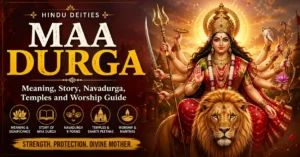
Maa Kali and Maa Durga are not separate divine powers. In Shakta traditions, they are understood as different expressions of the same Divine Mother. The difference lies not in their essence but in the role they perform.
Maa Durga is often seen as the protective and nurturing form who restores balance and protects devotees. Maa Kali appears when deeper transformation is required and when powerful negativity, fear, or ignorance must be removed at its root.
Just as a loving mother may comfort her child in one moment and firmly protect them in another, the Divine Mother reveals different forms according to the needs of creation. For devotees, Durga and Kali are not opposites but complementary expressions of the same infinite Shakti.
The Origin of Maa Kali as a Form of Shakti
The origin of Maa Kali is deeply rooted in ancient Shakta traditions and sacred texts such as the Devi Mahatmya. She is not viewed as a separate goddess but as one of the most powerful manifestations of the Divine Mother, appearing whenever extraordinary spiritual force is required to restore balance.
According to the Devi Mahatmya, powerful demons had created such chaos that even the gods were unable to overcome them. During these cosmic battles, the Divine Mother revealed a fierce form from her own being.
This form came to be known as Kali. Her appearance was not driven by anger alone but by the need to protect creation and remove forces that threatened dharma.
One of the most well-known episodes describes Kali emerging during the battle against powerful asuras whose destructive power continued to grow. Where ordinary strength was no longer enough, the Divine Mother manifested a force capable of confronting darkness without fear.
For devotees, the story carries a deeper meaning. Maa Kali appears whenever ignorance, ego, injustice, or destructive tendencies become deeply rooted. Her origin reminds us that compassion is not always gentle.
Sometimes it appears as fierce courage, decisive action, and the determination to remove suffering at its source.
The Divine Story of Maa Kali’s Appearance
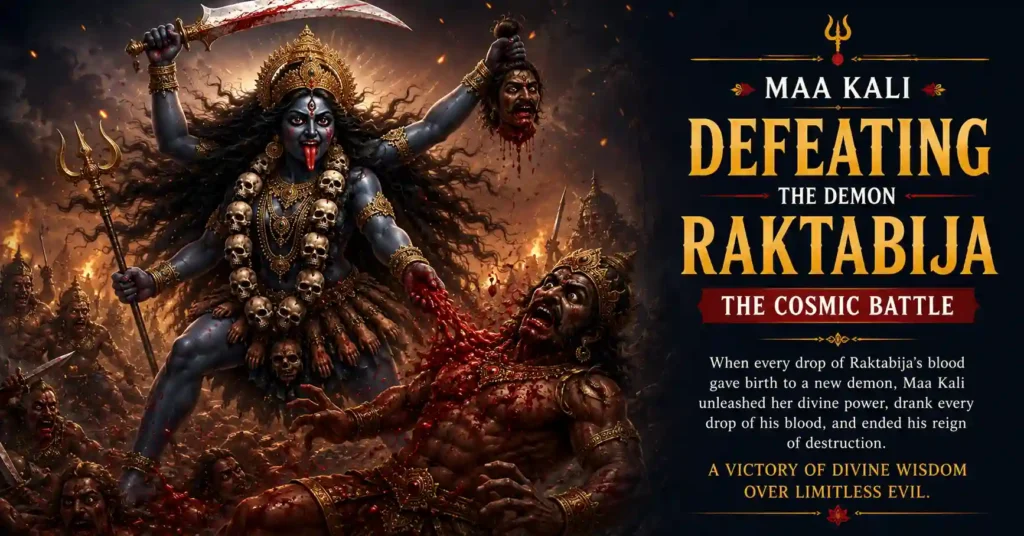
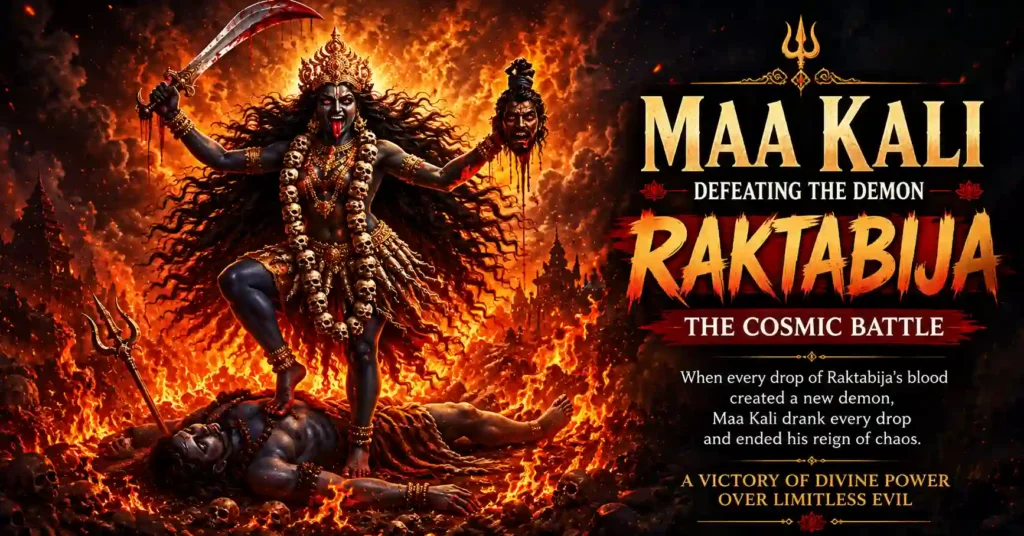
During the battle against the demon Raktabija, Maa Kali appeared to stop a threat that seemed impossible to defeat. Every drop of Raktabija’s blood that touched the ground created another demon, causing the destruction to multiply endlessly.
To end the cycle, Bhagwati Kali drank the blood before it could fall. Through her fierce determination, she prevented the spread of chaos and helped restore balance. This episode became one of the most well-known stories associated with her power and fearlessness.
On a deeper level, the story carries a spiritual message. Just as Raktabija multiplied whenever his blood touched the ground, fear, anger, ego, and unhealthy habits can grow stronger when ignored. Maa Kali represents the courage and wisdom needed to confront these forces at their root before they take control of our lives.
Kali as Time and Transformation
Kali comes from the word Kaal, which means time. Time is the one force that spares nothing. It gradually removes everything that is temporary, whether it is youth, power, possessions, pride, or even the identities we build around ourselves.
In this sense, Maa Kali is not simply a goddess of destruction. She represents the eternal truth that lies beyond constant change. While forms appear and disappear, the deeper reality remains.
For devotees, Kali teaches that suffering often comes from clinging to what cannot last forever. By accepting change instead of resisting it, a person begins to find greater freedom, wisdom, and peace.
Her presence reminds us that transformation is not something to fear but an essential part of spiritual growth.
Why Maa Kali is Dark in Color
Her dark form represents infinity, the formless reality that cannot be limited by shape, color, or human understanding. Darkness here does not symbolize negativity or evil.
Instead, it symbolizes completeness. Just as the vast sky and deep space appear dark while containing countless worlds within them, Maa Kali represents the infinite reality from which all creation emerges and into which it ultimately returns.
Her dark complexion also reminds devotees that the Divine exists beyond all outer distinctions and appearances. In her presence, differences of status, identity, and ego lose their importance. What remains is the eternal truth that connects all beings.
For this reason, devotees do not see her dark form as frightening. They see it as a symbol of the limitless and all-embracing nature of the Divine Mother.
Kali as The First Mahavidya
Among the Ten Mahavidyas, the great wisdom forms of the Divine Mother, Maa Kali is traditionally placed first. This position is deeply symbolic. Before knowledge, beauty, prosperity, or harmony can be fully understood, truth must first be faced.
Devi Kali removes illusions, false identities, and the fears that prevent genuine spiritual growth. She teaches that transformation begins when we stop running from reality and learn to see life as it truly is.
For this reason, many traditions regard her as the doorway to deeper wisdom. Without the courage to face truth, spiritual progress often remains limited to ideas rather than lived experience.
In this way, Maa Kali completes what Maa Durga begins. Durga protects and strengthens the devotee, while Kali guides them toward inner freedom by removing the deeper layers of ignorance and attachment.
Maa Kali and the Tantric tradition
Maa Kali occupies a special place within the Tantric traditions of Sanatan Dharma. While she is widely worshipped through simple devotion, prayer, and temple rituals, she is also one of the central deities of many Shakta and Tantric paths.
In these traditions, Kali is not viewed merely as a goddess who grants worldly blessings. She is seen as a powerful force of spiritual transformation who helps the seeker move beyond fear, ego, attachment, and limited identity. Because of this, many Tantric traditions regard her as a guide toward deeper self-realization and liberation.
Different lineages approach her worship in different ways. Some follow devotional and sattvik forms of practice, while others preserve more specialized Tantric methods that are traditionally learned under the guidance of a qualified guru. These paths developed over centuries and vary across regions and traditions.
For most devotees, however, the heart of Kali worship remains the same. Whether approached through devotion, meditation, mantra, or Tantra, Maa Kali ultimately represents the Divine Mother’s power to transform, awaken, and liberate.
Different Forms of Maa Kali
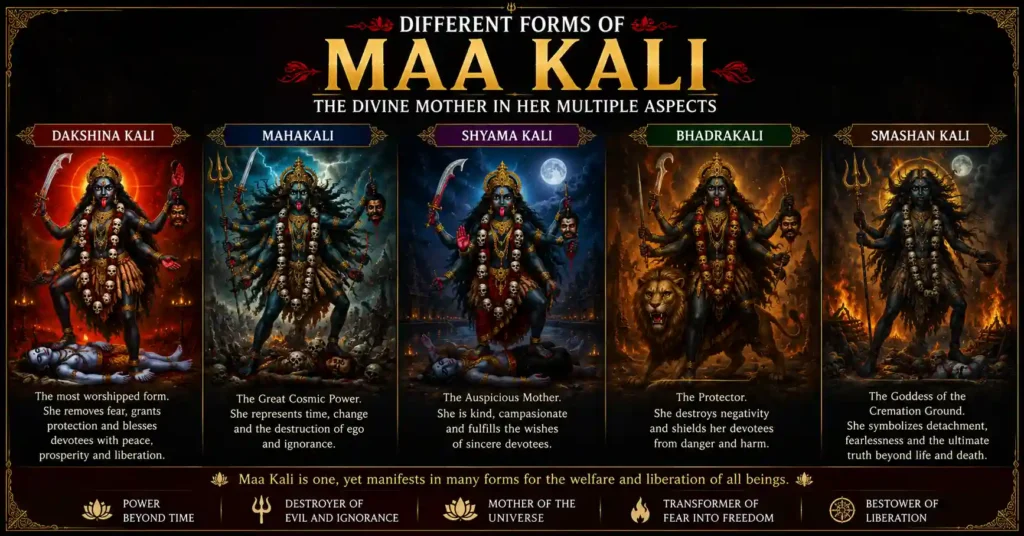
Maa Kali is worshipped in several forms across different traditions of Sanatan Dharma. While the essence remains the same, each form highlights a particular aspect of her power and compassion.
Dakshina Kali is one of the most widely worshipped forms and is associated with grace, protection, and spiritual liberation.
Mahakali represents the vast power of time and cosmic transformation. Bhadra Kali is often worshipped as a protective and benevolent form.
Smashan Kali is associated with deep spiritual renunciation and freedom from fear.
These forms are not separate goddesses. They are different ways devotees experience the same Divine Mother according to their spiritual needs and traditions.
The Symbolism of Kali’s Fierce Form
Every aspect of Maa Kali’s form carries a deeper spiritual meaning. What appears fierce on the surface is filled with symbolism meant to awaken understanding rather than create fear.
Her dark form represents the infinite reality that exists beyond all names, forms, and limitations. Her loose hair symbolizes freedom from social restrictions and the untamed power of nature itself. Her minimal clothing or nakedness represents absolute truth, free from illusion, pretense, and worldly attachments.
The garland of severed heads or skulls is often understood as a symbol of the ego, false identities, and the many limitations that bind human beings. It reminds devotees that spiritual growth requires letting go of what is unreal. Her weapons represent the power to cut through ignorance, fear, attachment, and negativity that prevent inner transformation.
One of the most recognizable features of Maa Kali is her extended tongue. Different traditions interpret it in different ways. Some see it as a symbol of her fierce battle against evil, while others view it as a moment of humility and self-awareness when she realizes she has stepped upon Lord Shiva.
Nothing in her form is meant to glorify violence or inspire fear. Every symbol points toward liberation, truth, courage, and the removal of inner darkness. What appears frightening at first often reveals itself as the compassionate wisdom of a mother determined to awaken her children.
Why Kali Stands on Lord Shiva
One of the most well-known images in Hindu iconography shows Maa Kali standing upon Lord Shiva. At first glance, the image can seem surprising, but it carries profound spiritual meaning.
According to a popular tradition, after defeating powerful demons, Maa Kali’s fierce energy became so intense that she continued her destructive dance across the battlefield. To calm her, Lord Shiva lay in her path.
When Kali unknowingly stepped upon him, she immediately became aware of her actions and stopped. Her extended tongue is often associated with this moment of realization and humility.
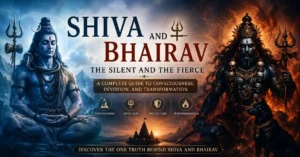
On a deeper level, the image represents the relationship between Shiva and Shakti. Shiva symbolizes pure consciousness, awareness, and stillness.
Kali represents divine energy, movement, and transformation. Without consciousness, energy can become directionless. Without energy, consciousness remains unexpressed.
The image teaches that true balance comes when awareness and energy work together. For many spiritual seekers, it also symbolizes the quieting of the ego and the restoration of inner harmony through the union of wisdom and power.
Maa Kali and Lord Shiva as Cosmic Balance
Shiva without Shakti is often described as pure consciousness without expression, while Shakti without Shiva is energy without direction. Together, they represent the inseparable union of awareness and power that sustains creation.
In many spiritual traditions, Shiva and Shakti are not seen as separate forces but as two aspects of the same reality. Shiva provides stillness, wisdom, and consciousness, while Shakti brings movement, creativity, and transformation. One gives purpose, and the other gives expression.
Their union teaches an important lesson for everyday life. Action becomes meaningful when guided by awareness, and wisdom becomes effective when put into action.
Through the relationship between Shiva and Shakti, devotees learn the value of balance, harmony, and the integration of inner understanding with outward action.
The Deeper Meaning of Maa Kali’s Power
Kali’s power is inner courage. She helps devotees face fear, speak truth, and release attachment.
Her blessings often come as strength during difficult phases, not comfort that keeps us stuck.Maa Kali’s power is often misunderstood as force or destruction. In reality, her greatest power is transformation.
She gives devotees the courage to face fear, speak truth, release unhealthy attachments, and continue moving forward even during difficult phases of life.
Her blessings do not always arrive in the form of comfort or easy solutions. Many devotees experience her grace as inner strength, clarity, resilience, and the ability to face challenges that once seemed overwhelming. Rather than helping people avoid difficulties, she helps them grow through them.
This is why Maa Kali is often associated with fearlessness. She teaches that true strength does not come from controlling the world around us but from overcoming the fears, doubts, and limitations within.
Through her guidance, devotees learn to trust themselves, trust the Divine, and face life with greater honesty and courage.
Why Maa Kali Worship Creates Fear
Fear surrounding Maa Kali often comes from misunderstanding rather than genuine knowledge. Her fierce appearance, association with Tantra, and images connected with cremation grounds can seem intimidating to people who are unfamiliar with their deeper meanings.
Over time, popular culture, films, and sensational stories have further strengthened the idea that Kali worship is something dark or frightening. As a result, many people focus on her outer appearance without understanding the spiritual symbolism behind it.
In reality, Maa Kali worship is centered on truth, surrender, self-transformation, and devotion. The purpose is not to create fear but to overcome it. Her fierce form reminds devotees to face ignorance, ego, and negativity with courage rather than avoid them.
For sincere devotees, Maa Kali is not a source of fear. She is a compassionate mother who protects, guides, and helps her children grow through life’s most difficult lessons.
Is Maa Kali Worship Dangerous
No. Maa Kali worship is not dangerous when approached with sincerity, respect, and a genuine desire for spiritual growth. Like any form of worship in Sanatan Dharma, its purpose is to bring a devotee closer to the Divine, not to create fear or harm.
Misunderstandings often arise because people associate Maa Kali with sensational stories, misunderstood Tantric practices, or her fierce appearance. In reality, millions of devotees worship her through simple prayers, chanting, meditation, and offerings made with devotion.
Worship becomes unhealthy only when driven by ego, greed, manipulation, or the desire to control others. True devotion is based on humility, faith, and self-transformation. Maa Kali responds to sincerity, not display, and to inner honesty rather than outward show.
Is there a Sattvik Way to Worship Maa Kali
Yes. Most devotees worship Maa Kali in a completely sattvik way. Such worship is based on purity, devotion, self-discipline, and a sincere connection with the Divine Mother rather than elaborate rituals.
Simple practices such as lighting a diya, offering flowers or fruits, chanting her name, reading her stotras, and spending a few moments in prayer are considered meaningful forms of worship. Living truthfully, treating others with kindness, and maintaining inner discipline are also seen as offerings to the Divine Mother.
While different traditions may follow different methods of worship, the heart of Kali devotion remains the same. She is not impressed by outward display or complexity. What matters most is sincerity, humility, and an honest desire to grow spiritually.
For many devotees, Maa Kali is first and foremost a loving mother. They believe she accepts genuine faith more readily than perfect rituals and responds to devotion offered with a pure heart.
Simple Home Worship of Maa Kali
Simple home worship of Maa Kali does not require elaborate rituals or special arrangements. Many devotees begin by lighting a diya, offering flowers or fruits, chanting her name, or spending a few quiet moments in prayer and remembrance.
Some people recite Kali mantras, read devotional hymns, or simply sit in silence and speak to her from the heart. Just as a child naturally shares joys, fears, and worries with a loving mother, devotees often approach Maa Kali with the same openness and trust.
What matters most is not the complexity of the ritual but the sincerity behind it. A clean mind, truthful speech, gratitude, and regular remembrance are considered important aspects of devotion. For many devotees, daily worship becomes less about asking for favors and more about building a personal relationship with the Divine Mother.
Maa Kali listens to honesty, not perfection. She responds to genuine devotion offered with faith, humility, and love.
Maa Kali’s Role in Inner Spiritual Growth
On the spiritual path, Maa Kali is often seen as a force of deep transformation. Rather than changing the world around us, she helps change what exists within us. She challenges the fears, attachments, and false identities that prevent genuine growth.
Spiritually, Kali destroys the false self, the part of us that clings to ego, insecurity, pride, and illusion. By removing these limitations, she helps seekers move closer to truth, self-awareness, and inner freedom.
For this reason, devotees often describe her path as intense but deeply liberating. While the process of transformation may not always feel comfortable, it gradually brings greater clarity, courage, and a deeper connection with the Divine.
In the end, Maa Kali’s role is not to take something valuable away from the seeker. It is to remove what stands between the soul and its highest potential.
The Truth Behind Maa Kali’s Fierce Form
Maa Kali is fierce only toward ignorance, ego, injustice, and the forces that keep human beings trapped in suffering. Her intensity is not directed at sincere devotees but at the darkness that prevents them from living in truth and freedom.
For those who approach her with faith, she is often experienced as deeply nurturing, protective, and compassionate. Beneath her fierce appearance is the same Divine Mother who guides, supports, and cares for her children through every stage of life.
Like a mother who firmly pulls her child away from danger, Maa Kali’s actions are rooted in love rather than anger. What appears harsh on the surface is often an expression of protection, transformation, and grace.
This is the deeper truth behind her fierce form. She does not seek to frighten devotees. She seeks to awaken them, strengthen them, and help them move beyond fear toward a life of greater courage, wisdom, and inner freedom.
Maa Kali and Her Beloved Devotee Ramakrishna Paramahamsa
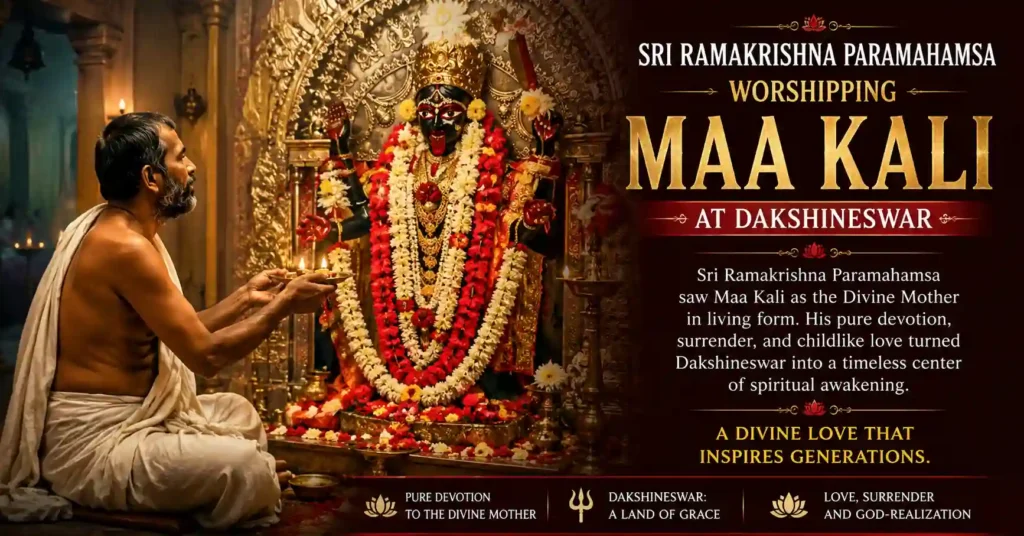
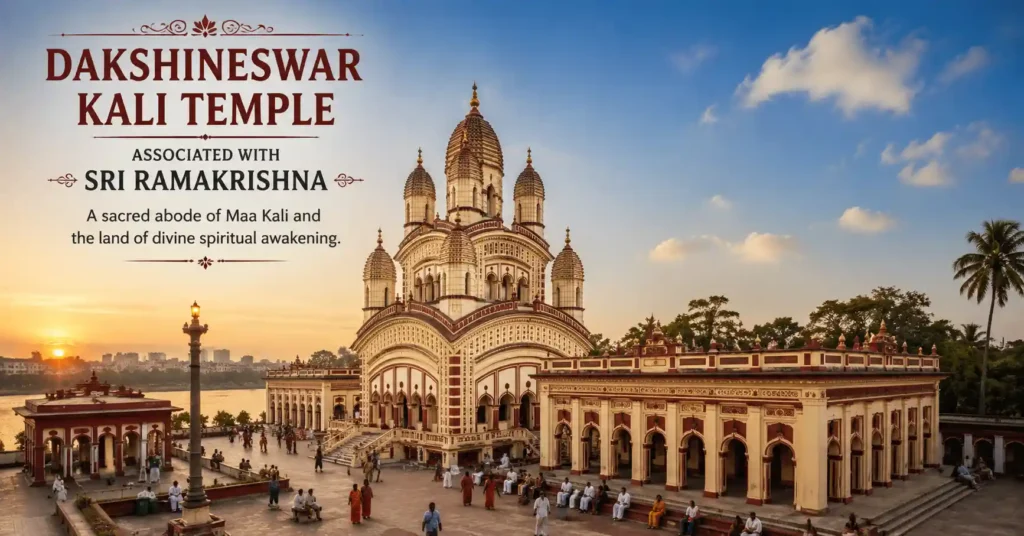
Among the many devotees of Maa Kali, Sri Ramakrishna Paramahamsa remains one of the most beloved. Serving at the Dakshineswar Kali Temple, he developed such deep devotion that he experienced Maa Kali as a living and ever-present mother rather than merely a deity in a shrine.
He prayed to her with complete sincerity, shared his joys and sorrows with her, and surrendered every aspect of his life to her guidance. For Ramakrishna, the Divine Mother was not a distant spiritual concept but a living reality experienced through love and devotion.
His life continues to inspire countless devotees because it shows a different side of Maa Kali. Behind the fierce imagery worshipped in temples stands a compassionate mother who responds to faith, innocence, and complete surrender.
Ramakrishna’s devotion reminds us that Maa Kali is not only power and transformation. She is also tenderness, grace, and a mother’s unconditional love.
Maa Kali in Bengal and Shakta traditions
Few regions are as closely associated with Maa Kali as Bengal. For centuries, Kali worship has been an important part of Bengali spiritual life, devotional practice, and cultural identity.
Temples such as Dakshineswar and Kalighat have become major centers of devotion where countless devotees continue to seek the blessings of the Divine Mother. Saints, poets, mystics, and household devotees have all expressed deep love for Maa Kali through prayer, music, and spiritual practice.
Within the wider Shakta tradition, Kali is revered as the supreme expression of Shakti, the divine energy that creates, sustains, and transforms the universe. This tradition views the Divine Mother not merely as a goddess among many, but as the ultimate reality itself.
Sacrd Temples of Maa Kali
The Dakshineswar Kali Temple stands as a center of deep devotion. Located on the banks of the Ganga, devotees feel a calm yet powerful presence here.
Kalighat is another ancient seat where Kali has been worshipped for centuries. Beyond Dakshineswar and Kalighat, devotees also visit other important Shakta pilgrimage sites associated with the Divine Mother.
Many seekers travel to these sacred places not only for blessings but also to experience the living traditions of Kali worship that have been preserved for generations.
Each temple reflects a different aspect of devotion, from intense spiritual surrender to quiet faith and daily worship, showing how deeply Maa Kali continues to inspire devotees across India.
Important Days and Sacred Timings
Kali Puja, celebrated on the night of Amavasya, is one of the most important festivals dedicated to Maa Kali. It is especially significant in Bengal, where devotees worship the Divine Mother with deep devotion, prayers, lamps, offerings, and all-night remembrance.
The festival often falls on the same night as Deepavali, giving it a special place in the spiritual calendar. While lamps illuminate homes and temples, devotees reflect on the deeper meaning of moving from ignorance to wisdom and from fear to inner strength.
Apart from Kali Puja, many devotees also offer prayers to Maa Kali on Amavasya throughout the year. The stillness of the new moon night is considered particularly suitable for meditation, self-reflection, and remembrance of the Divine Mother.
For many seekers, these sacred times are not only occasions for ritual worship but also opportunities to look inward, release negativity, and strengthen their connection with Maa Kali.
Who Naturally Feels Drawn to Maa Kali
Many devotees believe that people are often drawn to Maa Kali during periods of deep change, inner struggle, or spiritual seeking. Those facing fear, loss, injustice, uncertainty, or major life transitions frequently feel a special connection with her presence and teachings.
Others are drawn to her because they seek truth more than comfort. Maa Kali’s path encourages honesty, courage, and the willingness to confront what lies beneath the surface rather than avoid it. For this reason, seekers undergoing personal transformation often find inspiration in her symbolism.
At the same time, devotion to Maa Kali is not limited to any particular type of person. She does not choose by age, gender, background, or social status. Devotees believe she responds to sincerity, faith, and the genuine desire to grow closer to the Divine.
Many describe the connection as something difficult to explain. Rather than choosing Maa Kali consciously, they feel as though the Divine Mother gradually draws them toward her in her own way and at the right time.
Maa Kali’s Relevance in Modern Life
In today’s fast-moving and often anxious world, the teachings of Maa Kali remain surprisingly relevant. She encourages people to face uncomfortable truths, let go of unhealthy attachments, and develop the courage needed to navigate change and uncertainty.
Many devotees see her as a reminder that true strength is not about becoming hard or emotionally distant. Instead, it comes from facing fears honestly, accepting life’s realities, and continuing to move forward with resilience and faith.
In times of stress, confusion, and emotional struggle, Maa Kali’s symbolism offers a powerful lesson. Growth often begins when fear is faced rather than avoided, and freedom becomes possible when we release what no longer serves us.
For this reason, Maa Kali is not only an ancient goddess worshipped in temples and scriptures. She also remains a timeless guide for inner transformation, helping people discover courage, truth, and emotional freedom in everyday life.
Meeting Maa Kali Beyond Fear
When fear begins to fade, devotion can deepen. Maa Kali then reveals herself not as darkness, but as clarity. Not as destruction, but as freedom.
She is the Divine Mother who removes the chains of fear, ignorance, and attachment so her children can walk their path with greater courage and truth.
Maa Kali does not take away anything that is truly needed. She removes only what limits growth and keeps the heart bound. When her deeper meaning is understood, her fierce form becomes one of the greatest sources of comfort, protection, and inner strength.
Suggested Reading
Maa Kali is part of a vast and profound tradition of Divine Mother worship in Sanatan Dharma. If you would like to explore the many forms of Adi Shakti, the Mahavidyas, and the deeper spiritual paths associated with them, the following articles offer a natural continuation of that journey.
Maa Durga: Forms, Meaning, Mythology, Festivals and Worship in Sanatan Dharma
https://thesanatantales.com/maa-durga-forms-meaning-worship-sanatan-dharma/
Das Mahavidya: Meaning, Origin, 10 Goddesses, Temples and Spiritual Path
https://thesanatantales.com/das-mahavidya/
Maa Tara: Meaning, Story, Benefits and Spiritual Significance
https://thesanatantales.com/maa-tara-meaning-story-benefits/
Maa Lalita Tripura Sundari: Meaning, Significance, Story and the Sacred Sri Vidya Path
https://thesanatantales.com/maa-lalita-tripura-sundari/
Maa Bhuvaneshwari: The Mahavidya Who Holds the Universe
https://thesanatantales.com/maa-bhuvaneshwari/
Maa Bhairavi: The Mahavidya of Fire, Discipline, and Inner Awakening
https://thesanatantales.com/maa-bhairavi/
Maa Chhinnamasta: The Goddess Who Cuts the Ego and Feeds the Universe
https://thesanatantales.com/maa-chhinnamasta/
Maa Dhumavati Mahavidya: Hidden Power, Meaning, Tantra & Worship
https://thesanatantales.com/maa-dhumavati-mahavidya/
Maa Baglamukhi: Origin, Power, Rituals, Temples and the Brahmastra Shakti
https://thesanatantales.com/maa-baglamukhi-origin-puja-temples/
Maa Matangi: The Powerful Ninth Mahavidya and the Tantric Power of Speech
https://thesanatantales.com/maa-matangi-ninth-mahavidya/
Maa Kamalatmika: The Final Mahavidya and the Goddess of Sacred Abundance
https://thesanatantales.com/maa-kamalatmika-tenth-mahavidya/
Kali (Wikipedia)
https://en.wikipedia.org/wiki/Kali
FAQs
Who is Maa Kali in Sanatan Dharma?
Maa Kali is one of the most powerful forms of the Divine Mother in Sanatan Dharma. She represents time, transformation, protection, and liberation. Devotees worship her as the compassionate mother who removes ignorance, fear, and negative tendencies.
Why does Maa Kali have a fierce appearance?
Her fierce form symbolizes the destruction of ego, ignorance, injustice, and illusion. The weapons, skull garland, dark complexion, and extended tongue all carry spiritual meanings connected with transformation and awakening rather than violence.
Why is Maa Kali shown standing on Lord Shiva?
This image symbolizes the relationship between Shiva and Shakti. Shiva represents pure consciousness, while Kali represents divine energy. Together they illustrate the balance between awareness and action that sustains creation.
What is the meaning of Maa Kali's dark complexion?
Her dark form represents the infinite and formless reality that exists beyond all names and forms. Just as space appears dark while containing everything, Maa Kali symbolizes the limitless nature of the Divine.
Is Maa Kali one of the Das Mahavidyas?
Yes. Maa Kali is traditionally regarded as the first of the ten Mahavidyas. In many Shakta traditions, she is seen as the gateway to deeper wisdom, spiritual transformation, and liberation.
What is the connection between Maa Kali and Tantra?
Maa Kali holds a central place in many Tantric traditions of Sanatan Dharma. Different lineages approach her through devotional worship, mantra, meditation, and Tantric practices. The ultimate goal remains spiritual awakening and union with the Divine.
Is Maa Kali worship dangerous?
No. Maa Kali worship is not dangerous when approached with devotion, sincerity, and proper understanding. Millions of devotees worship her through simple prayers, chanting, meditation, and traditional rituals focused on spiritual growth.
Can Maa Kali be worshipped at home?
Yes. Many devotees worship Maa Kali at home by lighting a diya, offering flowers or fruits, chanting her mantras, reading stotras, or simply praying with faith and sincerity.
Why is Sri Ramakrishna associated with Maa Kali?
Sri Ramakrishna Paramahamsa was one of Maa Kali’s most devoted saints. Serving at Dakshineswar Kali Temple, he worshipped her as the living Divine Mother and became one of the most influential spiritual teachers associated with Kali devotion.
Which temple is most famous for Maa Kali worship?
Dakshineswar Kali Temple near Kolkata is among the most famous temples dedicated to Maa Kali. It is closely associated with Sri Ramakrishna Paramahamsa and remains an important pilgrimage destination for devotees.
When is Kali Puja celebrated?
Kali Puja is usually celebrated on the night of Amavasya during the Deepavali period. It is especially important in Bengal, where devotees worship Maa Kali through prayers, offerings, devotional singing, and all-night remembrance.
What does Maa Kali teach modern devotees?
Maa Kali teaches courage, honesty, fearlessness, and inner freedom. Her symbolism encourages people to face difficult truths, overcome fear, and embrace personal transformation with faith and strength.
Glossary of Important Terms
| Term | Meaning |
|---|---|
| Maa Kali | A powerful form of the Divine Mother associated with transformation, protection, and liberation. |
| Shakti | The divine feminine energy that creates, sustains, and transforms the universe. |
| Shakta Tradition | A spiritual tradition within Sanatan Dharma that worships the Divine Mother as the supreme reality. |
| Mahavidya | One of the ten wisdom goddesses representing different aspects of Divine Feminine power. |
| Das Mahavidya | The collective group of ten Mahavidyas, including Kali, Tara, and Tripura Sundari. |
| Adi Shakti | The primordial cosmic energy and source of all forms of the Divine Mother. |
| Kaal | Sanskrit term for time, often associated with change, transformation, and mortality. |
| Mahakali | A cosmic form of Kali representing infinite time and universal transformation. |
| Dakshina Kali | A benevolent and widely worshipped form of Kali associated with grace and liberation. |
| Bhadra Kali | A protective and auspicious form of the Divine Mother. |
| Smashan Kali | A form of Kali associated with detachment, fearlessness, and spiritual transcendence. |
| Tantra | A spiritual path that uses rituals, meditation, mantras, and inner practices for self-realization. |
| Tantra Sadhana | Disciplined spiritual practices followed within Tantric traditions. |
| Sadhana | A dedicated spiritual practice undertaken for inner growth and realization. |
| Mantra | A sacred sound, word, or phrase repeated during worship and meditation. |
| Devi Mahatmya | A revered scripture describing the glory and victories of the Divine Mother. |
| Raktabija | A demon whose blood created more demons, symbolizing multiplying negative tendencies. |
| Asura | A being often representing forces opposed to dharma and spiritual harmony. |
| Dharma | The cosmic order, righteous living, and moral duty. |
| Shiva | The supreme consciousness and divine counterpart of Shakti. |
| Shiva-Shakti | The inseparable union of consciousness (Shiva) and divine energy (Shakti). |
| Consciousness | Pure awareness that exists beyond thoughts, emotions, and physical form. |
| Liberation (Moksha) | Freedom from ignorance, attachment, and the cycle of birth and death. |
| Ego | The limited sense of self that often creates attachment and separation. |
| Amavasya | The new moon day, considered sacred for Kali worship and spiritual reflection. |
| Kali Puja | A major festival dedicated to Maa Kali, especially celebrated in Bengal. |
| Ramakrishna Paramahamsa | A revered saint known for his deep devotion to Maa Kali at Dakshineswar. |
| Dakshineswar Temple | One of the most famous temples dedicated to Maa Kali, located near Kolkata. |
| Kalighat Temple | An ancient and highly revered Shakti shrine associated with Maa Kali. |
| Bhakti | The path of devotion, love, and surrender to the Divine. |
| Guru-Shishya Tradition | The traditional spiritual relationship between teacher and disciple. |
About the Author
Yateendra Chaturvedi is a spiritual writer, researcher, devotee, and the founder of The Sanatan Tales. With over 35 years of professional experience and a lifelong interest in Sanatan Dharma, he writes about Hindu deities, temples, scriptures, festivals, Mahavidyas, sacred stories, rituals, and living traditions that continue to guide and inspire devotees across India.
Drawing from traditional scriptures, regional beliefs, temple traditions, devotional literature, and historical sources, he aims to present authentic, well-researched, and easy-to-understand content for modern readers. His work focuses on preserving spiritual wisdom, explaining sacred traditions, and helping seekers develop a deeper understanding of India’s rich spiritual heritage.
Through The Sanatan Tales, Yateendra strives to make the timeless teachings of Sanatan Dharma simple, meaningful, and relevant for today’s generation while maintaining respect for traditional sources, regional practices, and diverse spiritual perspectives.
Learn More About Yateendra Chaturvedi →
https://thesanatantales.com/about-the-author/
References & Sources
This article is based on beliefs and traditions followed within the Shakta traditions of Sanatan Dharma, traditional knowledge associated with the Dashamahavidya tradition, Shakti worship, Devi sadhana, and insights drawn from various spiritual and religious study sources. Some concepts discussed in this article are also inspired by teachings and interpretations preserved through the guru-disciple tradition.
Note: Beliefs, interpretations, and spiritual practices may vary across different traditions, sects, and paths within Sanatan Dharma. The purpose of this article is not to present any single viewpoint as the absolute truth, but to explain widely accepted religious and spiritual perspectives in a simple and accessible manner
Explore More Fascinating Topics from Sanatan Dharma