Many people hear the word Shakti and immediately think of power, energy, or something mystical. But Shakti in Sanatan Dharma is much more than a force.
She is the living presence that makes life move, breathe, grow, and transform. Without Shakti, nothing exists, not even silence.
Shakti is not far away in the heavens. She flows through nature, through time, through emotions, and through every human experience.
When life feels active, creative, emotional, or intense, Shakti is already present. Sanatan Dharma does not treat Shakti as an abstract idea. It sees her as the Divine energy behind all creation and the guiding force of spiritual growth.
In this article, you will discover the true meaning of Shakti in Sanatan Dharma, her different forms, her relationship with Shiva, the three types of Shakti, her role in everyday life, and how understanding Shakti leads a seeker towards inner transformation and liberation (Moksha).
Quick Facts About Shakti
| Aspect | Details |
|---|---|
| Meaning | Divine energy, power, and the creative force of the universe. |
| Role in Sanatan Dharma | Creates, sustains, and transforms all existence. |
| Associated With | The Divine Mother and the feminine aspect of the Supreme Reality. |
| Works Together With | Shiva, representing pure consciousness. |
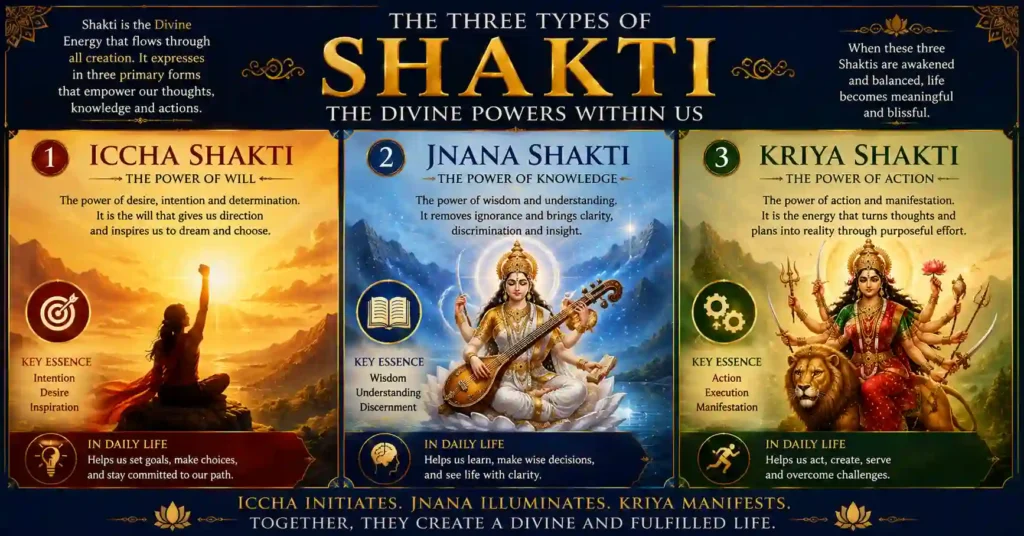
| Main Types | Iccha Shakti (Will), Jnana Shakti (Knowledge), and Kriya Shakti (Action). |
| Ultimate Purpose | To guide the soul towards spiritual growth, self-realization, and Moksha. |
| Present In | Nature, every living being, noble actions, and spiritual practices. |
Table of Contents
ToggleWhat Is Shakti in Sanatan Dharma?
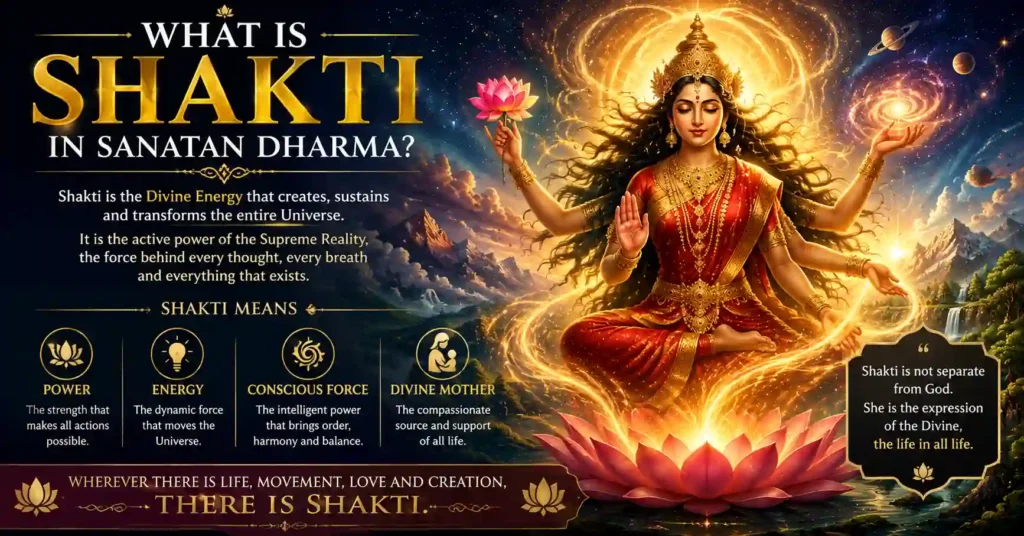
The word Shakti literally means power, energy, ability, or strength. However, Shakti in Sanatan Dharma has a much deeper spiritual meaning. It is the Divine energy that creates, sustains, and transforms the entire universe.
Shakti is the power that turns stillness into movement, thought into action, and potential into reality. She is not separate from creation. She is the living force present in every aspect of existence, from the smallest seed to the vast cosmos.
In simple words, Shakti is:
- The Divine energy behind creation.
- The power that drives growth and transformation.
- The source of knowledge, action, and inner strength.
- The force that sustains all living beings.
- The energy that supports spiritual awakening and self-realization.
Without Shakti, consciousness remains silent and unexpressed. With Shakti, life begins, nature functions, and the universe continues its eternal cycle of creation, preservation, and transformation.
This is why Shakti in Sanatan Dharma is not viewed as blind power or physical strength alone. She is conscious Divine energy, always working in harmony with wisdom, balance, and Dharma.
Understanding the true meaning of Shakti helps us see that Divine energy is not limited to temples or rituals. It is present within every living being, every noble action, every act of compassion, and every step taken towards spiritual growth.
How Do Shakti and Shiva Work Together?
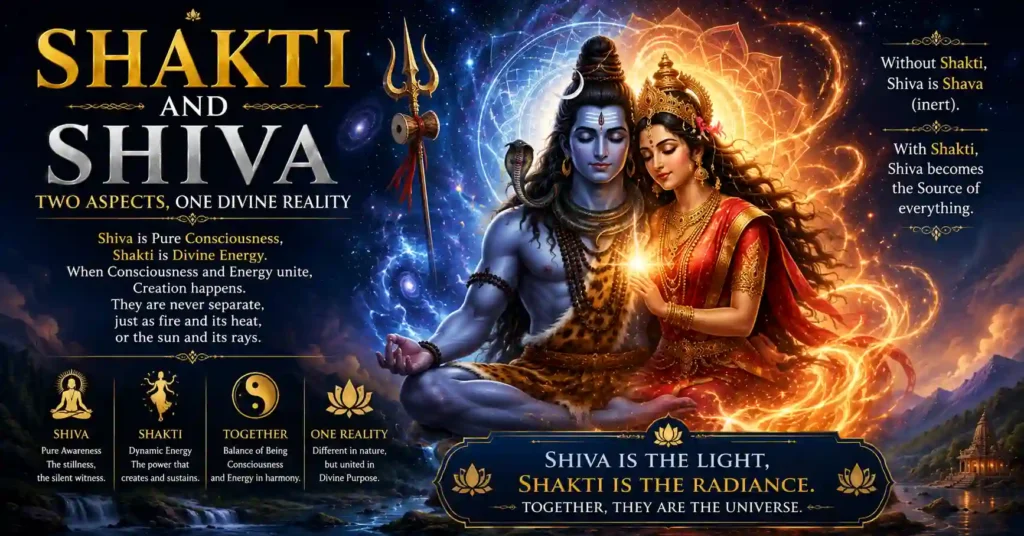
Sanatan Dharma explains that the universe functions through two inseparable principles: Shiva and Shakti. Shiva represents pure consciousness, while Shakti is the Divine energy that gives consciousness the power to create, sustain, and transform.
In simple words:
- Shiva is awareness.
- Shakti is action.
- Shiva is stillness.
- Shakti is movement.
Neither exists independently in the process of creation. Without Shakti, Shiva remains pure, silent consciousness without expression. Without Shiva, Shakti has no guiding awareness or direction.
A simple way to understand this is to think of a lamp and its light. The lamp represents Shiva, while the light that spreads in all directions represents Shakti. One reveals the presence of the other, and together they illuminate the world.
This harmony between Shakti and Shiva teaches that true power must always be guided by wisdom, and true wisdom must express itself through meaningful action. Knowledge without energy cannot bring change, while energy without awareness can create imbalance.
This union is reflected throughout nature. Every act of creation, every cycle of growth, and every transformation in life is possible because consciousness and Divine energy work together in perfect balance.
Understanding this relationship helps us see that Shakti in Sanatan Dharma is not separate from Shiva. They are two aspects of the same Supreme Reality, reminding us that awareness and action must remain united for both spiritual growth and a balanced life.
Did You Know?
According to Sanatan Dharma, Shiva and Shakti are inseparable. Shiva represents pure consciousness, while Shakti is the Divine energy that expresses that consciousness through creation, preservation, and transformation.
Together, they symbolize the complete and eternal nature of the Supreme Reality.
Why Is Shakti Worshipped as the Divine Mother?
In Shakti in Sanatan Dharma, the Divine is often worshipped as the Divine Mother because her relationship with creation is loving, nurturing, protective, and transformative. Just as a mother gives life, cares for her children, guides them, and helps them grow, Shakti sustains and supports the entire universe.
The Divine Mother is not worshipped only because she creates life. She also protects Dharma, removes ignorance, gives wisdom, and inspires courage during difficult times. Her compassion and strength work together to maintain balance in the world.
This is why Shakti appears in many forms according to the needs of creation. For example:
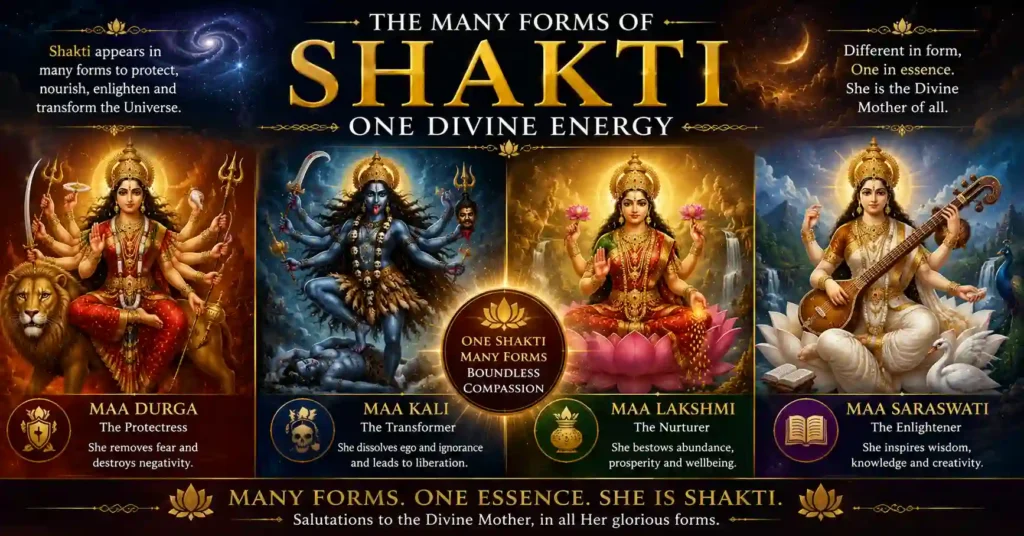
- Maa Durga represents courage, protection, and the victory of Dharma over Adharma.
- Maa Lakshmi symbolizes prosperity, abundance, and well-being.
- Maa Saraswati represents knowledge, wisdom, learning, and the arts.
- Maa Kali symbolizes transformation, the destruction of ego, and liberation from ignorance.
Although these forms have different names and qualities, they are all expressions of the same Divine Shakti. They remind devotees that the Supreme Mother’s grace appears in many ways to guide, protect, nurture, and transform every soul.
This is why Shakti in Sanatan Dharma is never seen as one-dimensional. She is gentle yet powerful, compassionate yet fearless, and nurturing while also upholding justice. Like a loving mother, she gives what is needed for both worldly well-being and spiritual growth.
Understanding the Fierce Yet Compassionate Nature of Shakti
One of the most common misunderstandings about Shakti in Sanatan Dharma is that she represents anger, violence, or destruction. In reality, Shakti destroys only what prevents growth, harmony, and spiritual progress. Her power is directed against ignorance, fear, ego, injustice, and negative tendencies, not against life itself.
Just as a storm clears the sky, a forest fire allows new life to emerge, or a surgeon removes disease to save a patient, Shakti’s fierce actions are meant to restore balance rather than create suffering. What appears as destruction is often the beginning of renewal and transformation.
This is why many forms of the Divine Mother appear powerful or even fearsome. Their purpose is not to spread fear but to protect Dharma, remove obstacles, and help devotees overcome inner weaknesses. Her strength is an expression of compassion, guiding humanity towards truth and righteousness.
In everyday life, this teaching reminds us that true strength is not about domination or anger. Real strength lies in protecting others, standing for justice, overcoming our own weaknesses, and acting with courage guided by wisdom.
Understanding this deeper meaning helps us see that Shakti in Sanatan Dharma is both fierce and compassionate. Like a loving mother, she nurtures when care is needed and acts firmly when protection or transformation becomes necessary. Both expressions arise from the same Divine love.
The Many Forms of Shakti in Sanatan Dharma
Shakti in Sanatan Dharma appears in many forms because life itself presents different challenges and needs. At times we need courage to overcome difficulties. At other times we need wisdom to make the right decisions, compassion to serve others, or inner strength to transform ourselves.
Although these forms may be worshipped through different names and symbols, they all represent the same Divine Shakti. Each form expresses a unique aspect of the Supreme Mother’s infinite power.
| Form of Shakti | Represents | How It Helps Us |
|---|---|---|
| Protective Strength | Courage, protection, and fearlessness | Gives strength to overcome fear, injustice, and challenges. |
| Creative Energy | Creation, growth, and new beginnings | Inspires creativity, positive change, and the ability to build a better life. |
| Inner Wisdom | Knowledge, understanding, and clarity | Helps us make wise decisions and progress on the spiritual path. |
| Transforming Power | Change, purification, and spiritual growth | Removes ignorance, ego, and negative tendencies to support inner transformation. |
These are not separate powers competing with one another. They are different expressions of the same Divine Shakti, responding to the needs of creation and the spiritual journey of every seeker.
Understanding these forms helps us recognize that Shakti in Sanatan Dharma is present not only in temples and sacred images but also in every act of courage, compassion, wisdom, and transformation we experience in daily life.
Key Scriptural Understanding
- The Vedas describe the Divine power that sustains creation and the cosmic order.
- The Upanishads explain that the Supreme Reality is expressed through both consciousness and Divine energy.
- The Bhagavad Gita teaches that the entire universe functions through the Divine power of the Supreme.
- Shakta traditions worship Shakti as the Supreme Divine Mother, the source of creation, preservation, and transformation.
Shakti and the Inner Journey of Spiritual Growth
Shakti in Sanatan Dharma is not experienced only through worship in temples or sacred rituals. She is also present within every human being as willpower, awareness, courage, compassion, and the desire to grow spiritually.
Whenever a person chooses truth over falsehood, hope over fear, or selflessness over selfishness, the presence of Shakti is already awakening within them. Every sincere effort to improve oneself is an expression of Divine energy at work.
The inner journey in Sanatan Dharma is not about escaping the world or rejecting daily responsibilities. It is about learning to use Shakti consciously, allowing wisdom to guide our thoughts, words, and actions instead of being controlled by ego, attachment, or fear.
As awareness grows, Shakti helps transform negative qualities into positive ones. Gradually, anger gives way to patience, fear becomes courage, and selfishness develops into compassion.
As Shakti awakens within, it helps us:
- Develop inner courage during difficult times.
- Strengthen willpower to overcome negative habits.
- Make decisions guided by wisdom and Dharma.
- Deepen self-awareness through prayer and meditation.
- Grow in compassion, patience, and selfless service.
This inner transformation is the true purpose of Shakti in Sanatan Dharma. It helps seekers live with greater balance, clarity, and purpose while moving steadily towards self-realization and spiritual liberation.
How Is Shakti Present in Everyday Life?
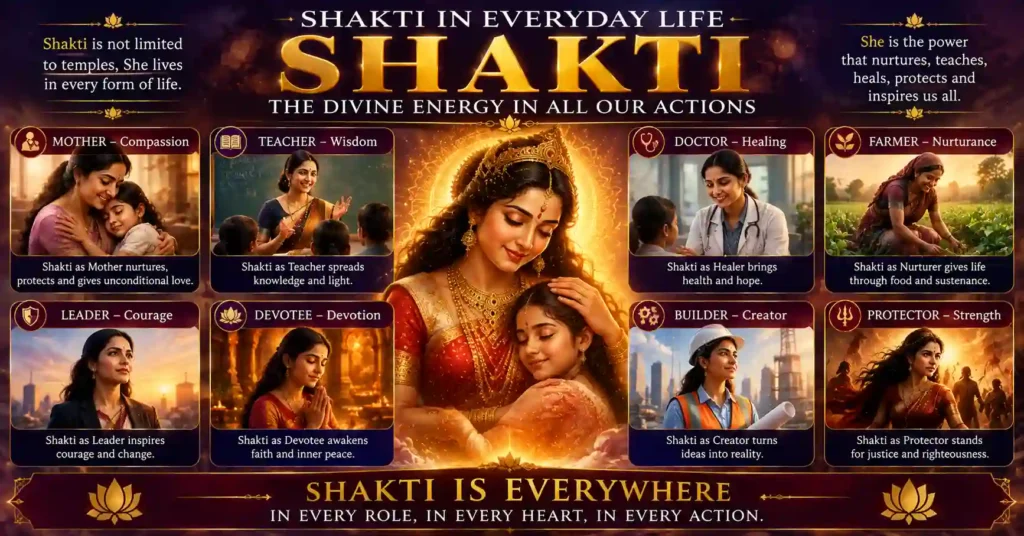
Many people think Shakti in Sanatan Dharma is experienced only during worship or in temples. In reality, Shakti is present in every moment of daily life. Whenever we act with courage, compassion, wisdom, or selfless love, we express the Divine energy working within us.
Shakti is not limited to extraordinary miracles. She is equally present in simple acts of kindness, perseverance, and responsibility that make life meaningful.
We experience Shakti in everyday life when we:
- Speak the truth even when it is difficult.
- Protect and care for our family with love and responsibility.
- Face challenges with courage instead of giving up.
- Help someone in need without expecting anything in return.
- Forgive others and let go of anger or resentment.
- Perform our daily duties with honesty, sincerity, and dedication.
Living with awareness of Shakti means recognizing that every positive thought, noble action, and selfless service is an expression of Divine energy. It encourages us to live with purpose instead of reacting only to fear, ego, or selfish desires.
This understanding transforms ordinary life into a spiritual journey. Every challenge becomes an opportunity to grow, every responsibility becomes an act of Dharma, and every moment becomes a chance to experience Shakti in Sanatan Dharma through our thoughts, words, and actions.
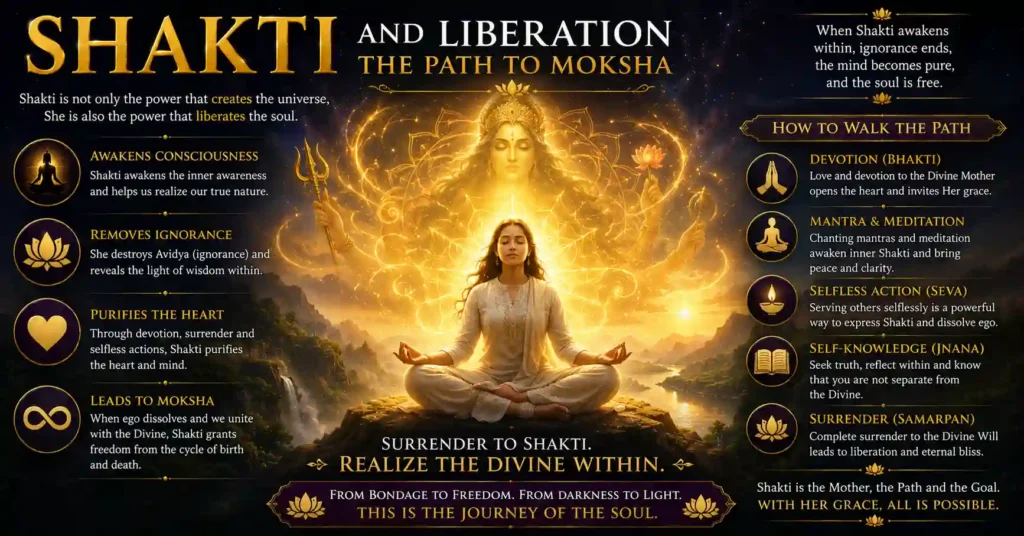
How Does Shakti Lead to Liberation (Moksha)?
In Shakti in Sanatan Dharma, liberation (Moksha) is not attained by rejecting the world or suppressing one’s energy. Instead, it comes from understanding, purifying, and consciously directing Shakti towards spiritual growth.
When our thoughts and actions are driven by ego, fear, attachment, or selfish desires, energy becomes a source of suffering. However, when the same energy is guided by wisdom, Dharma, and self-awareness, it becomes a path to inner freedom.
Sanatan Dharma teaches that Shakti should not be suppressed or misused. Rather, it should be transformed into compassion, selfless service, devotion, and right action. This transformation gradually purifies the mind and brings the seeker closer to self-realization.
The journey towards Moksha through Shakti includes:
- Using energy with wisdom instead of impulse.
- Overcoming ego, fear, and attachment.
- Living according to Dharma and righteous values.
- Practising selfless service, devotion, and meditation.
- Developing inner peace, compassion, and spiritual awareness.
As this understanding deepens, a person continues to fulfil worldly responsibilities but is no longer controlled by greed, anger, or fear. Life becomes balanced, purposeful, and guided by higher consciousness.
Ultimately, Shakti in Sanatan Dharma reminds us that liberation is not found by escaping life. It is attained by transforming our energy into a force of wisdom, love, and spiritual awakening, leading the soul towards lasting peace and Moksha.
Why Is Shakti Still Relevant in Modern Life?
Although the teachings of Shakti in Sanatan Dharma are ancient, they remain deeply relevant in today’s world. Modern life is filled with constant activity, information, and distractions, yet many people still struggle with stress, anxiety, and a lack of inner peace.
The problem is often not a lack of energy but the way our energy is scattered. When the mind is constantly pulled in different directions, it becomes difficult to live with clarity, purpose, and balance. Understanding Shakti helps us direct our energy towards meaningful thoughts, actions, and spiritual growth.
Shakti teaches that true power is not about controlling others or achieving worldly success alone. Real strength is reflected in qualities such as:
- Inner peace during difficult situations.
- Compassion towards others.
- Courage to stand for truth and Dharma.
- Wisdom to make balanced decisions.
- Self-discipline and emotional stability.
- The ability to serve others with humility.
These timeless values help us build stronger relationships, perform our responsibilities sincerely, and face life’s challenges with confidence instead of fear.
In today’s fast-moving world, Shakti in Sanatan Dharma reminds us that lasting happiness comes from balancing outer achievements with inner awareness. When our energy is guided by wisdom, compassion, and Dharma, life becomes more meaningful, peaceful, and spiritually fulfilling.
Common Misconceptions About Shakti
Many people have misunderstandings about Shakti in Sanatan Dharma. Knowing the truth helps us appreciate her deeper spiritual significance.
- Shakti is not only physical strength. She is the Divine energy behind creation, wisdom, compassion, and transformation.
- Shakti is not worshipped only during festivals. Devotees honour Shakti throughout the year through prayer, meditation, selfless service, and righteous living.
- Shakti is not limited to women. Every living being carries Divine energy. Shakti represents the universal power that supports all life.
- Shakti is not separate from the Supreme Reality. In Sanatan Dharma, Shakti and Shiva together represent the complete expression of the Divine.
Understanding these truths helps us move beyond symbolism and experience Shakti as a living presence in everyday life.
Conclusion
Shakti in Sanatan Dharma is not merely a philosophical concept to be understood. She is the Divine energy that brings creation, transformation, wisdom, and spiritual growth into every aspect of life.
When we recognize Shakti within ourselves and in the world around us, we begin to live with greater awareness, courage, compassion, and balance. Every thought guided by wisdom, every selfless action, and every step taken on the path of Dharma becomes an expression of her presence.
Understanding Shakti in Sanatan Dharma reminds us that true power is not found in domination but in inner strength, love, and conscious living. As our awareness deepens, Shakti transforms ordinary life into a meaningful spiritual journey, guiding us steadily towards self-realization, lasting peace, and ultimately Moksha.
A Thought to Remember
“Shakti is not something we seek outside ourselves. It is the Divine energy already present within us, waiting to be expressed through wisdom, compassion, courage, and righteous action.”
Key Takeaways
- Shakti in Sanatan Dharma is the Divine energy that creates, sustains, and transforms the universe.
- Shakti and Shiva are inseparable, representing Divine energy and pure consciousness.
- The Divine Mother appears in many forms to guide, protect, nurture, and transform creation.
- Shakti is present not only in worship but also in courage, compassion, wisdom, and selfless actions.
- Understanding Shakti helps seekers grow spiritually and move towards self-realization and Moksha.
- The teachings of Shakti remain relevant today by helping us live with balance, awareness, and Dharma.
Suggested Reading
Understanding Shakti in Sanatan Dharma becomes even more meaningful when explored alongside other core teachings of Sanatan Dharma. The following articles will help you deepen your understanding of Divine energy, the soul, karma, Dharma, devotion, and the timeless wisdom that leads to self-realization and spiritual liberation.
Atma and Parmatma: Meaning, Relationship and Their Role in Sanatan Dharma
https://thesanatantales.com/atma-and-parmatma/
Why Do Hindus Have So Many Gods? The Truth Behind Many Deities in Sanatan Dharma
https://thesanatantales.com/why-do-hindus-have-so-many-gods/
Karma: Meaning, Types, Philosophy and How It Works in Sanatan Dharma
https://thesanatantales.com/karma-meaning-types-and-how-it-works/
How to Seek Forgiveness for Unintentional Sins in Sanatan Dharma
https://thesanatantales.com/how-to-seek-forgiveness-for-unintentional-sins/
What Is Detachment in Hindu Philosophy? A Powerful Path to Inner Freedom
https://thesanatantales.com/detachment-in-hindu-philosophy/
Kaal in Sanatan Dharma: The Eternal Science of Time, Yugas and Cosmic Cycles
https://thesanatantales.com/kaal-in-sanatan-dharma/
Sanatan Dharma Meaning: What Is Sanatan Dharma and Its Core Principles
https://thesanatantales.com/sanatan-dharma-meaning/
Shakti (Wikipedia)
https://en.wikipedia.org/wiki/Shakti
FAQs
What is Shakti in Sanatan Dharma?
Shakti in Sanatan Dharma is the Divine energy that creates, sustains, and transforms the universe. She is not simply physical power or strength but the conscious force that makes all life and spiritual growth possible.
Shakti is worshipped as the Divine Mother and is understood to be present in nature, every living being, and every positive action. Without Shakti, creation cannot exist because consciousness alone remains inactive until expressed through Divine energy.
What is the relationship between Shakti and Shiva?
Shakti and Shiva are inseparable aspects of the same Supreme Reality. Shiva represents pure consciousness, while Shakti is the Divine energy that allows consciousness to express itself through creation, preservation, and transformation.
Sanatan Dharma teaches that neither is complete without the other. Just as light cannot exist without a source, or movement without energy, Shiva and Shakti together symbolize the perfect balance between awareness and action.
Why is Shakti worshipped as the Divine Mother?
Shakti is worshipped as the Divine Mother because she nurtures, protects, guides, and transforms all creation with unconditional compassion. Like a loving mother, she supports both the physical and spiritual growth of every living being.
The Divine Mother appears in many forms, including Maa Durga, Maa Lakshmi, Maa Saraswati, and Maa Kali. Although each form represents different qualities, they are all expressions of the same Supreme Shakti working for the welfare of the universe.
What are the different forms of Shakti?
Shakti in Sanatan Dharma is expressed through many forms, each representing a unique aspect of Divine energy. Some inspire courage, while others symbolize wisdom, prosperity, protection, or transformation.
At a philosophical level, these forms are not separate powers. They are different expressions of one Divine Shakti, helping devotees according to their spiritual needs and different stages of life.
How can we experience Shakti in everyday life?
Shakti is experienced whenever we act with courage, compassion, honesty, patience, or selfless service. Every noble thought and righteous action reflects the presence of Divine energy working within us.
Sanatan Dharma teaches that Shakti is not limited to temples or rituals. She is present in the love of a mother, the wisdom of a teacher, the dedication of a doctor, the strength of a farmer, and the devotion of every sincere seeker.
How does understanding Shakti help in spiritual growth?
Understanding Shakti in Sanatan Dharma helps us recognize that true power comes from inner balance rather than external control. It encourages us to overcome fear, ego, attachment, and negative habits through awareness and righteous living.
As the mind becomes purer through devotion, meditation, selfless action, and self-inquiry, Shakti gradually transforms ordinary life into a path of spiritual growth and self-realization.
Does Shakti lead to Moksha (liberation)?
Yes. Sanatan Dharma teaches that Shakti plays an essential role in the journey towards Moksha. Liberation is attained when Divine energy is guided by wisdom instead of ego, attachment, or selfish desires.
By living according to Dharma, practising devotion, meditation, and selfless service, a seeker gradually purifies the mind. This inner transformation helps one realize the Supreme Truth and attain lasting peace and spiritual freedom.
Is Shakti relevant in today's modern world?
Absolutely. Although the teachings of Shakti in Sanatan Dharma are ancient, they remain highly relevant today. In a fast-paced world filled with stress and distractions, Shakti reminds us to use our energy with wisdom, compassion, and self-discipline.
Understanding Shakti helps us build inner strength, maintain emotional balance, make responsible decisions, and live with purpose. These timeless principles make the philosophy of Shakti as valuable today as it has always been.
Glossary of Important Terms
| Term | Meaning |
|---|---|
| Shakti | The Divine energy or cosmic power that creates, sustains, and transforms the universe in Sanatan Dharma. |
| Adi Shakti | The Supreme Divine Mother, regarded as the original source of all forms of Shakti and creation. |
| Shiva | Pure consciousness that, together with Shakti, represents the complete and inseparable nature of the Supreme Reality. |
| Divine Mother | A loving and protective form of the Divine worshipped as the source of creation, compassion, wisdom, and strength. |
| Dharma | The righteous way of living that upholds truth, duty, harmony, and moral responsibility. |
| Moksha | Liberation from the cycle of birth and death (Samsara) through self-realization and union with the Supreme. |
| Samsara | The continuous cycle of birth, death, and rebirth experienced by the soul until Moksha is attained. |
| Iccha Shakti | The power of Divine will that inspires intention, purpose, and determination. |
| Jnana Shakti | The power of Divine knowledge, wisdom, and right understanding. |
| Kriya Shakti | The power of Divine action that transforms intentions into meaningful deeds. |
| Bhakti | The path of loving devotion and surrender to the Divine with faith and sincerity. |
| Karma Yoga | The spiritual practice of performing one’s duties selflessly without attachment to the results. |
| Self-Realization | The direct realization that one’s true nature is the eternal Self beyond the body and mind. |
| Consciousness | The eternal awareness represented by Shiva, which becomes active through the power of Shakti. |
| Spiritual Awakening | The gradual process of becoming aware of one’s Divine nature and progressing towards inner transformation and liberation. |
About the Author
Yateendra Chaturvedi is a spiritual writer, researcher, devotee, and the founder of The Sanatan Tales. With over 35 years of professional experience and a lifelong interest in Sanatan Dharma, he writes about Hindu deities, temples, scriptures, festivals, Mahavidyas, sacred stories, rituals, and living traditions that continue to guide and inspire devotees across India.
Drawing from traditional scriptures, regional beliefs, temple traditions, devotional literature, and historical sources, he aims to present authentic, well-researched, and easy-to-understand content for modern readers. His work focuses on preserving spiritual wisdom, explaining sacred traditions, and helping seekers develop a deeper understanding of India’s rich spiritual heritage.
Through The Sanatan Tales, Yateendra strives to make the timeless teachings of Sanatan Dharma simple, meaningful, and relevant for today’s generation while maintaining respect for traditional sources, regional practices, and diverse spiritual perspectives.
Learn More About Yateendra Chaturvedi →
https://thesanatantales.com/about-the-author/
References & Sources
This article is based on widely accepted beliefs, philosophies, and traditions of Sanatan Dharma, along with insights from Hindu scriptures, traditional teachings, and established spiritual study sources. It also reflects concepts that have been preserved and explained through various spiritual traditions and the guru-disciple lineage.
Note: Beliefs, interpretations, and spiritual practices may vary across different traditions, sects, and schools of thought within Sanatan Dharma. This article is intended to present commonly accepted spiritual perspectives in a simple, balanced, and easy-to-understand manner, rather than promote any single interpretation as the only absolute truth.
Read More Interesting Articles on Sanatan Dharma