Maa Tara is one of the most mysterious yet deeply compassionate forms of the Divine Mother. To many people, her name feels intense or unfamiliar at first.
But for those who slowly come to know her, she begins to feel deeply protective, guiding, and truly motherly. She is not a goddess of fear.
She is the mother who helps us cross fear, ignorance, suffering, and inner darkness.
In Sanatan Dharma, she appears when the soul feels stuck, when pain feels heavy, and when ordinary strength no longer feels enough.
Many devotees feel her presence most strongly during difficult transitions in life. She is the mother who holds her child firmly and helps them pass through moments that feel overwhelming.
Her presence may feel intense, but her purpose is always liberation.
Table of Contents
ToggleWho is Tara in Sanatan Dharma?
She is one of the Das Mahavidyas, the great wisdom forms of the Divine Mother. Among them, Tara represents guidance, protection, and the compassionate power that helps the soul move safely through life’s challenges and spiritual struggles.
The word Tara means “the one who helps cross.” Through her grace, devotees are guided across fear, confusion, attachment, suffering, and inner darkness.
She is closely associated with sacred sound, wisdom, compassion, and Vak Shakti, the divine power of speech and expression. Many seekers connect her with mantra, inner transformation, and spiritual knowledge.
While her outer form may appear fierce, her inner nature is deeply nurturing and protective. She is the Mother who guides, protects, and helps devotees move steadily toward wisdom and liberation.
Her Place Among the Mahavidyas
Among the Das Mahavidyas, Tara is traditionally placed after Kali. Where Kali destroys illusion and breaks attachment, Tara guides the seeker through the space that follows. Kali breaks the chains. Tara shows the path forward.
This is why she is often seen as the teacher-mother. After deep transformation, when the ego has been shaken and old certainties have fallen away, she helps the seeker regain balance, clarity, and direction.
Tara is also closely associated with wisdom, mantra, and Vak Shakti. She helps transform spiritual insight into lived understanding and guides the seeker toward deeper awareness.
In this way, Tara Mahavidya becomes the bridge between inner destruction and awakening wisdom.
Maa Tara in Scriptures and Shakta Traditions
Maa Tara is revered across several Shakta and Tantric traditions of Sanatan Dharma. As one of the Das Mahavidyas, she is discussed in Mahavidya literature and is regarded as a profound manifestation of the Divine Mother.
References to the glory of the Divine Mother and her wisdom forms appear in texts such as the Devi Bhagavata Purana, while various Tantric traditions further develop the worship, symbolism, mantras, and spiritual significance of Tara.
Over time, these scriptural and spiritual traditions helped shape the many forms of Tara worship that continue today, from temple devotion and pilgrimage to mantra practice and deeper paths of Shakta sadhana.
Tara in Shakta Traditions
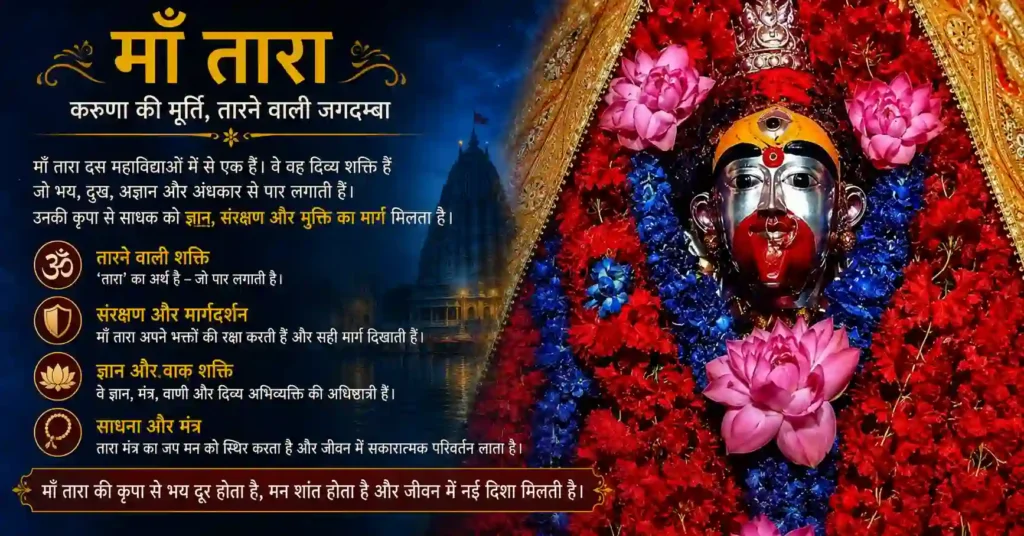
Maa Tara is worshipped in many ways across Shakta traditions. Some devotees approach her through temple worship, offering prayers, flowers, and simple devotion at sacred places such as Tarapith. Others worship her as one of the Das Mahavidyas, focusing on her deeper spiritual and symbolic significance.
For many household devotees, Maa Tara is a compassionate Mother who offers guidance, protection, and strength during difficult phases of life. For seekers following the Mahavidya path, she represents wisdom, mantra, Vak Shakti, and inner transformation.
Though the methods of worship may differ, all these traditions view Maa Tara as the same Divine Mother who guides devotees across fear, confusion, and spiritual darkness.
Maa Tara, Kali and Durga: Understanding the Relationship
Many devotees wonder whether Tara, Kali, and Durga are different goddesses or different forms of the same Divine Mother. In Shakta traditions, they are understood as manifestations of one Shakti expressed in different ways.
Durga is the protective mother who restores balance and protects dharma. Kali represents the fierce power that destroys ego, fear, and illusion. Tara is the compassionate guide who helps the seeker cross suffering, confusion, and spiritual uncertainty.
Their forms may differ, but their purpose is the same: to guide the soul toward freedom, wisdom, and divine realization. This is why devotees often worship Durga, Kali, and Tara as different expressions of one Divine Mother.
The Sacred Story of Her Divine Appearance
One of the most well-known stories associated with Maa Tara is connected with the Samudra Manthan, the churning of the cosmic ocean.
During the churning, a deadly poison known as Halahala emerged and threatened to destroy all creation. To protect the universe, Lord Shiva consumed the poison. Although he held it in his throat, its intense power caused great suffering within him.
At that moment, the Divine Mother appeared in the form of Maa Tara. Filled with compassion, she took Shiva onto her lap and fed him her divine milk, calming the burning effects of the poison and restoring balance.
This image of Tara nurturing Shiva is one of the most important symbols associated with her worship. It reveals her as the compassionate Mother who protects not only her devotees but even the gods themselves.
On a deeper level, the story teaches that when life becomes overwhelming and ordinary strength is no longer enough, divine compassion appears to guide, heal, and carry the seeker forward.
Her Form as Neel Saraswati
In many traditions, Maa Tara is also worshipped as Neel Saraswati, the blue form of divine wisdom.
While Saraswati is associated with learning, knowledge, and clarity, Neel Saraswati represents deeper wisdom that emerges through struggle, transformation, and direct experience.
This form is closely connected with mantra, Vak Shakti, and inner awakening. Many seekers pray to Neel Saraswati for clarity of thought, spiritual understanding, and the ability to express truth with wisdom and compassion.
She especially guides those who question deeply, seek answers beyond the surface, and continue searching when ordinary knowledge no longer satisfies the heart.
It is wisdom born from experience rather than theory, and for this reason many spiritual aspirants feel naturally drawn to her.
Different Forms of Maa Tara
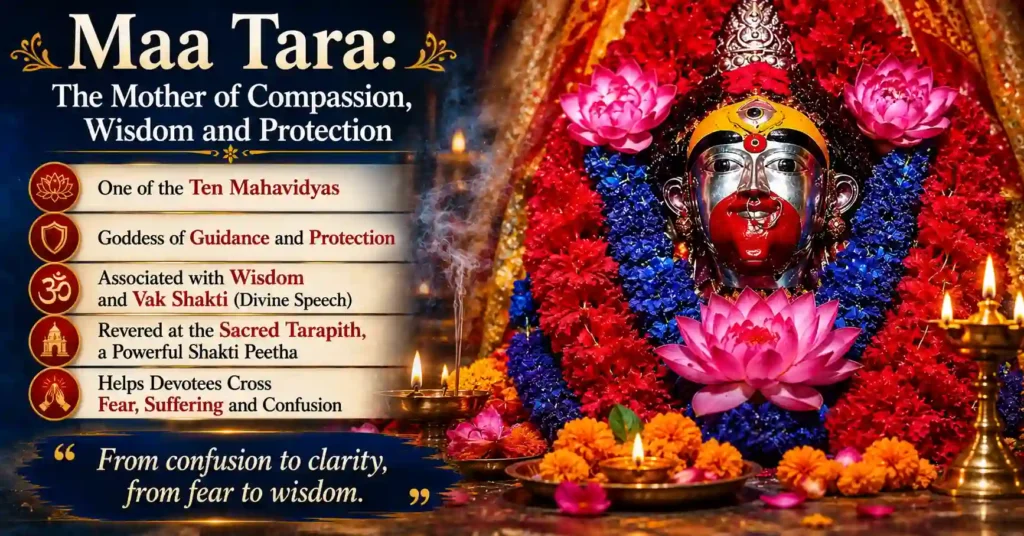
Across different traditions, Maa Tara is worshipped through several forms, each revealing a unique aspect of the Divine Mother.
| Form | Significance |
|---|---|
| Tara | Guidance, protection, and helping devotees cross difficulties. |
| Ugra Tara | Fierce protection and removal of spiritual obstacles. |
| Neel Saraswati | Deep wisdom, knowledge, mantra, and inner awakening. |
| Ekjata | One-pointed focus, discipline, and protection of sacred knowledge. |
Though these forms differ in appearance and symbolism, devotees understand them as manifestations of the same Divine Mother. Each form responds to a different spiritual need while continuing to guide, protect, and uplift the seeker.
Ekjata Devi, The One-Plaited Form
Ekjata Devi is one of the most powerful and lesser-known forms associated with Maa Tara. Her name means “the One-Braided Goddess,” referring to the single braid of hair that symbolizes one-pointed awareness, concentration, and unwavering spiritual focus.
Ekjata represents determination, inner discipline, and the protection of sacred knowledge. In Shakta traditions, she is often associated with seekers who walk intense spiritual paths and need the strength to remain steady through challenges and distractions.
This form reminds devotees that spiritual growth requires patience, commitment, and clarity of purpose. Through her grace, the seeker learns to remain focused on the path while overcoming both inner and outer obstacles.
Tarapith, The Sacred Seat of The Mother
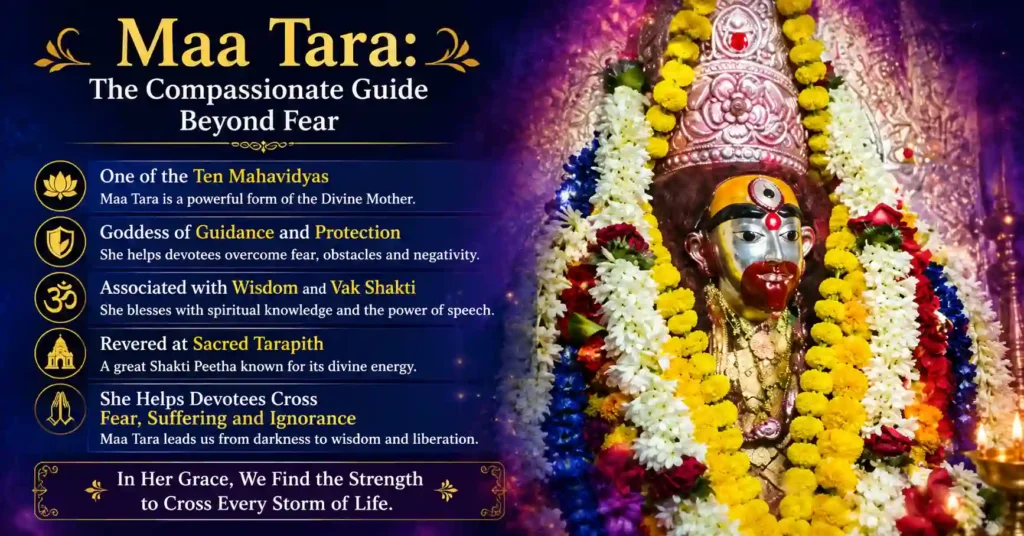
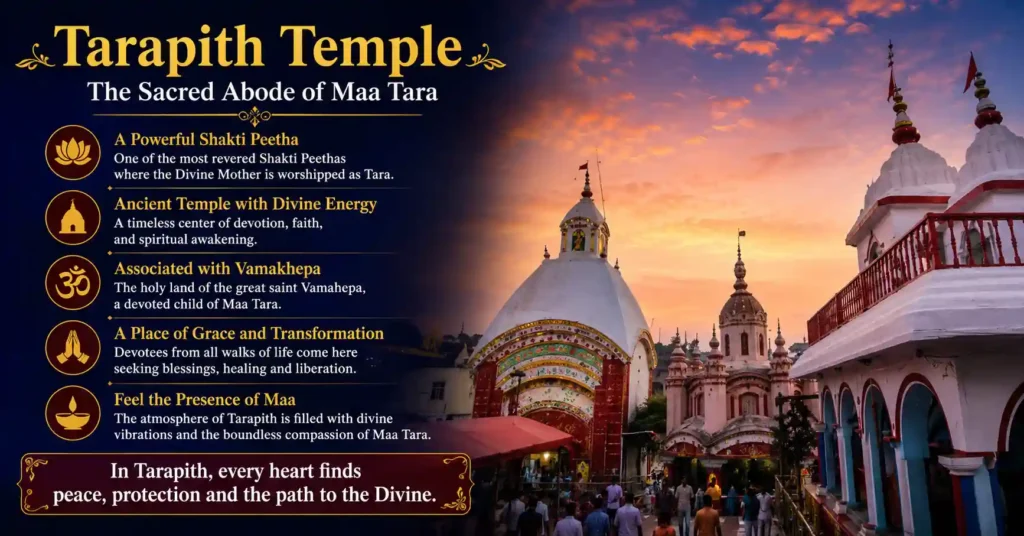
The most important place associated with Maa Tara is Tarapith in West Bengal. Revered as one of the most powerful centres of Shakti worship, it has attracted devotees, saints, and seekers for centuries.
Tarapith is also regarded as a Shakti Peetha and is connected with the sacred story of Maa Sati and Lord Shiva. Because of this, it occupies a special place in the spiritual landscape of Sanatan Dharma.
Unlike temples known for grandeur and architecture, Tarapith is remembered for its living spiritual atmosphere. Many devotees feel a deep personal connection with the Mother and believe that sincere prayers are heard here.
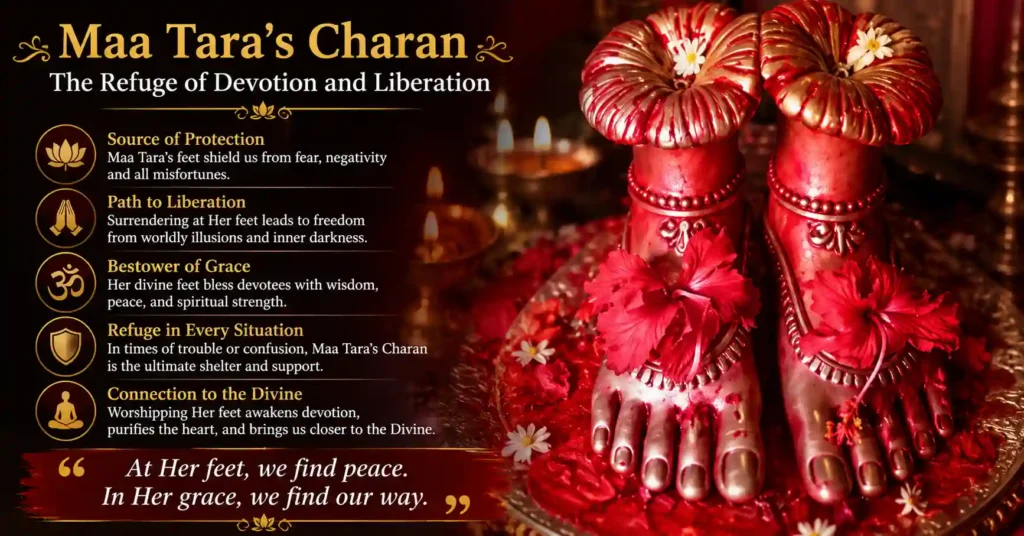
One of the unique features of the temple is its ancient stone form of Maa Tara and the sacred charan associated with her worship. These traditions continue to draw pilgrims seeking guidance, protection, and the blessings of the Divine Mother.
Tarapith Shamshan and the Truth of Impermanence
Near Tarapith lies the shamshan, or cremation ground, which holds immense spiritual significance in Shakta traditions.
In Sanatan Dharma, certain cremation grounds are regarded as sacred because they reveal the truth of impermanence. Tarapith Shamshan is considered one of the most important centres of Shakti worship and has long attracted saints, sadhakas, and spiritual seekers.
It is not a place of fear, but a place of deep reflection. Here, attachment, ego, and worldly identities are confronted directly. Life, death, success, and failure begin to appear in a different light.
For many seekers, the shamshan teaches surrender without words. It reminds us that everything in the world is temporary, while the Divine Mother alone remains constant. This deeper understanding is one reason why generations of Shakta practitioners have been drawn to Tarapith.
Vamakhepa, the Devoted Child of The Mother
One cannot speak of Tarapith without remembering Vamakhepa, the great mystic and devotee of Maa Tara. He lived like a child of the Mother, free, fearless, and completely surrendered to her grace.
He did not see the deity as an idol, but as a living mother. He laughed with her, cried before her, argued with her, and rested in her presence as a child would with its own mother.
Through Vamakhepa, devotees glimpsed the tender and deeply personal side of Maa Tara. His life remains one of the most powerful examples of living devotion associated with Tarapith.
His story reminds us that true bhakti is built not only on ritual, but on trust, surrender, and an intimate relationship with the Divine Mother.
Symbolism and Spiritual Meaning of Maa Tara
Every aspect of Maa Tara’s form carries deeper spiritual meaning. Her blue complexion represents the infinite nature of consciousness and the vastness of divine wisdom. Just as the sky appears endless, her compassion and knowledge have no boundaries.
Her open eyes symbolize constant awareness and readiness to guide devotees. The sword she carries represents the power to cut through ignorance, fear, and illusion. In some forms, the lotus symbolizes purity and spiritual awakening even in difficult circumstances.
Maa Tara is also closely associated with Vak Shakti, the sacred power of speech, mantra, sound, and expression. This connection is especially visible in her form as Neel Saraswati. For this reason, many seekers worship her to deepen mantra practice, spiritual understanding, and inner wisdom.
Though her appearance may seem fierce, every symbol reminds devotees that true transformation comes through wisdom, awareness, and divine compassion.
How to Worship Maa Tara
Maa Tara can be worshipped through simple and sincere devotion. A clean space, a lamp, flowers, water, and a few moments of focused prayer are often enough. The Mother is believed to respond more to sincerity than complexity.
Many devotees worship her on Tuesdays, Fridays, and during special Shakti observances. Reading her names, chanting her mantra, or quietly remembering her presence are all considered meaningful forms of worship.
A commonly used mantra is:
Om Tare Tuttare Ture Svaha
Chanted with devotion, this mantra is believed to bring calmness, courage, clarity, and spiritual guidance.
Prasad and Simple Offerings
Maa Tara does not demand elaborate offerings. Simple prasad offered with devotion is considered enough. Many devotees offer fruits, sweets, rice, coconut, milk preparations, flowers, and water as expressions of gratitude and reverence.
At Tarapith, there is a cherished tradition that prasad is first offered to Vamakhepa, the beloved child of the Mother, and only then presented to Maa Tara. This reflects the deep bond between the saint and the Divine Mother.
More important than the offering itself is the feeling behind it. Devotees believe that sincerity, humility, gratitude, and surrender are the offerings most loved by the Mother.
For many seekers, a quiet prayer, a moment of remembrance, or heartfelt devotion becomes the most meaningful offering of all.
Spiritual Benefits of Maa Tara Worship
Devotees believe that Maa Tara’s worship brings guidance during difficult life transitions, emotional struggles, spiritual confusion, and periods of uncertainty. Her blessings are often experienced as inner strength rather than dramatic external change.
Many seekers feel that her worship gradually develops courage, clarity, patience, and emotional resilience. Those drawn to mantra practice also associate her grace with deeper concentration, spiritual understanding, and connection with sacred sound.
Above all, Maa Tara is remembered as the Mother who helps devotees cross fear and move steadily toward wisdom, trust, and inner peace.
Her relevance in modern life
In today’s restless and uncertain world, her presence feels especially relevant. She supports those who feel lost, overwhelmed, or spiritually exhausted.
Many people feel drawn to her during phases when life feels heavy and direction unclear.
She teaches that strength and compassion can exist together. For seekers walking difficult inner paths, she becomes a steady presence, reminding them that they are never alone.
Conclusion
Maa Tara is the Divine Mother who guides when the path feels unclear. Fierce in appearance yet deeply compassionate in essence, she stands beside seekers during their most difficult inner journeys.
Whether worshipped at the sacred Tarapith temple, remembered through mantra, approached as a Mahavidya, or felt quietly within the heart, she continues to guide devotees from fear toward wisdom, from confusion toward clarity, and from struggle toward inner strength.
Her teachings remind us that true transformation is not achieved through force alone. It also requires compassion, guidance, wisdom, and the courage to keep moving forward.
As devotees explore the wider world of Shakti, they begin to see how Maa Durga protects, Maa Kali transforms, and Maa Tara guides. Together, these forms reveal the many ways the Divine Mother supports the seeker on the path toward spiritual growth and liberation.
Suggested Reading
Maa Tara is one of the ten Mahavidyas, and her worship becomes easier to understand when viewed within the larger tradition of the Divine Mother.
These articles explore the other Mahavidyas, their stories, symbolism, temples, spiritual teachings, and the different paths through which Shakti guides seekers toward wisdom and liberation.
Das Mahavidya: Meaning, Origin, 10 Goddesses, Temples and Spiritual Path
https://thesanatantales.com/das-mahavidya/
Maa Kali: Origin, Story, Meaning, Power and the Truth Behind Her Fierce Form
https://thesanatantales.com/maa-kali-origin-story-meaning-power/
Maa Lalita Tripura Sundari: Meaning, Significance, Story and the Sacred Sri Vidya Path
https://thesanatantales.com/maa-lalita-tripura-sundari-meaning-significance-story/
Maa Bhuvaneshwari: The Mahavidya Who Holds the Universe
https://thesanatantales.com/maa-bhuvaneshwari-the-mahavidya-who-holds-the-universe/
Maa Bhairavi: The Mahavidya of Fire, Discipline, and Inner Awakening
https://thesanatantales.com/maa-bhairavi-mahavidya-fire-discipline-inner-awakening/
Maa Chhinnamasta: The Goddess Who Cuts the Ego and Feeds the Universe
https://thesanatantales.com/maa-chhinnamasta-goddess-who-cuts-the-ego/
Maa Dhumavati Mahavidya: Hidden Power, Meaning, Tantra & Worship
https://thesanatantales.com/maa-dhumavati-mahavidya/
Maa Baglamukhi: Origin, Power, Rituals, Temples and the Brahmastra Shakti
https://thesanatantales.com/maa-baglamukhi-origin-power-rituals-temples/
Maa Matangi: The Powerful Ninth Mahavidya and the Tantric Power of Speech
https://thesanatantales.com/maa-matangi-powerful-ninth-mahavidya/
Maa Kamalatmika: The Final Mahavidya and the Goddess of Sacred Abundance
https://thesanatantales.com/maa-kamalatmika-final-mahavidya-goddess-abundance/
Tara (Mahavidya)
https://en.wikipedia.org/wiki/Tara_(Mahavidya)
FAQs
What is Maa Tara the goddess of?
Maa Tara is the goddess of guidance, protection, wisdom, and compassion. Devotees believe she helps them cross fear, suffering, confusion, and difficult phases of life.
Can Maa Tara be worshipped at home?
Yes, Maa Tara can be worshipped at home with simple devotion, a clean space, a lamp, flowers, and sincere prayer. Many devotees also chant her mantra and remember her throughout the day.
Does Maa Tara fulfill wishes?
Devotees believe Maa Tara responds to sincere prayers and helps guide them toward what is truly beneficial. Her blessings are often experienced as clarity, protection, inner strength, and spiritual growth.
How can I connect with Tara?
You can connect with Maa Tara through prayer, mantra chanting, reading about her life and teachings, visiting sacred places such as Tarapith, and developing a personal relationship with her through devotion.
Why is Maa Tara’s mouth red?
In many traditional depictions, Maa Tara’s red mouth symbolizes divine power, transformation, and the ability to absorb suffering and negativity. It is also associated with her fierce yet compassionate nature.
Is Tara the same as Kali?
Tara and Kali are distinct forms of the Divine Mother, but both are understood as manifestations of the same Shakti. Kali represents transformation and the destruction of illusion, while Tara guides and protects the seeker through that transformation.
Can we keep a Maa Tara photo at home?
Yes, devotees commonly keep Maa Tara’s image or photo at home as a focus for prayer, meditation, and daily remembrance.
What is the significance of Tarapith?
Tarapith is one of the most important centres of Maa Tara worship in India. It is revered as a Shakti Peetha and is known for its living traditions, connection with Vamakhepa, and deep association with Shakta spirituality.
Glossary of Important Terms
| Term | Meaning |
|---|---|
| Maa Tara | The second Mahavidya and a compassionate form of the Divine Mother who guides devotees through fear and suffering. |
| Tara | Sanskrit word meaning “the one who helps cross,” referring to crossing fear, ignorance, and worldly difficulties. |
| Mahavidya | One of the ten great wisdom goddesses representing different aspects of Divine Feminine power. |
| Das Mahavidya | The group of ten Mahavidyas worshipped in Shakta traditions. |
| Shakti | Divine feminine energy that creates, sustains, and transforms the universe. |
| Divine Mother | The supreme feminine aspect of the Divine worshipped as various goddesses in Sanatan Dharma. |
| Shakta Tradition | A branch of Sanatan Dharma that reveres the Divine Mother as the highest reality. |
| Vak Shakti | The divine power of speech, sound, expression, and sacred knowledge. |
| Neel Saraswati | A form of Maa Tara associated with wisdom, mantra, learning, and spiritual awakening. |
| Ugra Tara | A fierce form of Tara worshipped for protection and removal of obstacles. |
| Ekjata | A powerful form of Tara symbolizing one-pointed focus, discipline, and spiritual determination. |
| Tantra | A spiritual tradition that uses mantra, meditation, rituals, and inner practices for self-realization. |
| Tantra Sadhana | Spiritual disciplines and practices followed within Tantric traditions. |
| Sadhana | A dedicated spiritual practice undertaken for personal and spiritual growth. |
| Mantra | A sacred sound, phrase, or chant repeated during worship and meditation. |
| Devi Bhagavata Purana | An important scripture that glorifies the Divine Mother and her various forms. |
| Samudra Manthan | The cosmic churning of the ocean described in Hindu scriptures. |
| Halahala | The deadly poison that emerged during Samudra Manthan. |
| Lord Shiva | The supreme deity who consumed Halahala to protect creation. |
| Liberation (Moksha) | Freedom from ignorance, attachment, and the cycle of birth and death. |
| Wisdom | Spiritual understanding that goes beyond intellectual knowledge. |
| Compassion | The Divine Mother’s nurturing and protective nature toward all beings. |
| Tarapith | The most famous pilgrimage center dedicated to Maa Tara in West Bengal. |
| Shakti Peetha | A sacred pilgrimage site associated with the Divine Mother and Maa Sati. |
| Shamshan | A cremation ground that symbolizes impermanence and spiritual detachment. |
| Impermanence | The spiritual truth that all worldly things are temporary and ever-changing. |
| Vamakhepa | The great saint and devotee of Maa Tara associated with Tarapith. |
| Bhakti | The path of devotion, love, and surrender to the Divine. |
| Charan | The sacred feet or footprints of a deity, revered as symbols of grace and protection. |
| Prasad | Food or offerings blessed and distributed after worship. |
| Awareness | A state of spiritual alertness and conscious understanding. |
| Inner Transformation | The process of overcoming fear, ignorance, ego, and limitations through spiritual growth. |
| Sacred Sound | Divine vibrations expressed through mantras and spiritual chanting. |
| Divine Realization | Direct experience and understanding of the Divine Truth. |
About the Author
Yateendra Chaturvedi is a spiritual writer, researcher, devotee, and the founder of The Sanatan Tales. With over 35 years of professional experience and a lifelong interest in Sanatan Dharma, he writes about Hindu deities, temples, scriptures, festivals, Mahavidyas, sacred stories, rituals, and living traditions that continue to guide and inspire devotees across India.
Drawing from traditional scriptures, regional beliefs, temple traditions, devotional literature, and historical sources, he aims to present authentic, well-researched, and easy-to-understand content for modern readers. His work focuses on preserving spiritual wisdom, explaining sacred traditions, and helping seekers develop a deeper understanding of India’s rich spiritual heritage.
Through The Sanatan Tales, Yateendra strives to make the timeless teachings of Sanatan Dharma simple, meaningful, and relevant for today’s generation while maintaining respect for traditional sources, regional practices, and diverse spiritual perspectives.
Learn More About Yateendra Chaturvedi →
https://thesanatantales.com/about-the-author/
References & Sources
This article is based on beliefs and traditions followed within the Shakta traditions of Sanatan Dharma, traditional knowledge associated with the Dashamahavidya tradition, Shakti worship, Devi sadhana, and insights drawn from various spiritual and religious study sources.
Some concepts discussed in this article are also inspired by teachings and interpretations preserved through the guru-disciple tradition.
Note: Beliefs, interpretations, and spiritual practices may vary across different traditions, sects, and paths within Sanatan Dharma. The purpose of this article is not to present any single viewpoint as the absolute truth, but to explain widely accepted religious and spiritual perspectives in a simple and accessible manner.
Explore More Fascinating Topics from Sanatan Dharma