
There is something deeply silent about Shiva. Not just the absence of sound, but a stillness that feels alive. Many people do not come to Shiva through study or philosophy.
They come through experience, a quiet moment, a pause in life, or a feeling that something within is simply watching without reacting.
This is why Shiva is often described as supreme consciousness. Not merely as a concept, but as a presence that can be felt when the mind becomes calm and awareness grows clear.
For many devotees, this inner experience becomes the beginning of a deeper journey. It starts with Shiva’s stillness but gradually reveals another aspect of the same divine reality, one that is active, protective, and transformative. This is where Bhairav enters.
The relationship between Shiva and Bhairav is not a relationship between two separate deities. It is the experience of the same divine presence expressed in different ways.
Shiva represents inner stillness and awareness, while Bhairav represents the strength, courage, and transformation needed to live that truth.
Understanding Shiva and Bhairav begins not with belief alone, but with experience. It is a journey from silence to strength, from awareness to transformation, and ultimately toward a deeper understanding of oneself.
Table of Contents
ToggleThe Silent Presence of Shiva
Shiva is not merely a deity seated in meditation. He represents a state of being, a state where the mind becomes quiet, restlessness fades, and awareness remains clear.
As explored in Bhagwan Shiv: The Supreme Consciousness, Shiva is not only worshipped externally but also discovered within. Many devotees begin by seeking Shiva outside themselves, only to realize that the deeper connection lies inward.
There is a profound simplicity in Shiva’s form. Free from distraction and excess, he symbolizes the stillness that already exists beneath the noise of everyday life. His presence reminds seekers that peace is not something to be created but something to be uncovered.
For many people, this understanding develops gradually through reflection, prayer, study, or moments of quiet awareness. Over time, Shiva becomes more than an object of worship and begins to feel like a living presence within one’s own experience.
Understanding Shiva and Bhairav begins from this stillness. Without first appreciating Shiva’s nature as awareness and consciousness, the deeper meaning of Bhairav cannot be fully understood.
Who Are Shiva and Bhairav?
Shiva and Bhairav are not two separate divine beings. In Hindu tradition, Bhairav is understood as one of the most powerful manifestations of Lord Shiva.
While Shiva is often experienced as stillness, awareness, and supreme consciousness, Bhairav represents the same consciousness in a protective, transformative, and active form.
Many devotees describe Shiva as the silent witness behind existence, while Bhairav is the force that removes obstacles, destroys illusion, and restores spiritual discipline. The difference is not of identity but of expression.
Just as calm water and a flowing river are different appearances of the same element, Shiva and Bhairav represent different expressions of the same divine reality.
For this reason, devotees often worship Shiva and Bhairav together. Shiva offers peace and inner awareness, while Bhairav provides courage, protection, and the strength needed to walk the spiritual path.
How Bhairav Emerged from Shiva
According to several Shaiva and Puranic traditions, Bhairav emerged from Lord Shiva as a manifestation of divine justice and truth.
One of the most well-known stories describes a moment when Brahma became overcome with pride and claimed supreme authority.
To restore cosmic balance, Shiva manifested Bhairav, who removed Brahma’s fifth head and humbled his ego. Because of this act, Bhairav became associated with truth, discipline, karmic accountability, and the destruction of ignorance.
Beyond the literal story, many spiritual traditions interpret this event symbolically. Brahma’s fifth head represents ego, false knowledge, and attachment to identity, while Bhairav represents the force that removes these obstacles on the path to spiritual awakening.
This is why Bhairav is often seen not as a deity of fear, but as a protector who helps seekers move beyond illusion and closer to truth.
Experiencing Shiva through Mantra and Stotra
For most devotees, the first real experience of Shiva comes through sound. Mantras and stotras are not just words. They carry rhythm, devotion, and a certain vibration that slowly changes the inner state.
When someone chants Shiv Tandav Stotram, the experience is intense. It is not always calm. It feels powerful, almost overwhelming in the beginning. But slowly, it pulls the mind into a deeper space.
On the other hand, Lingashtakam feels softer. It carries a devotional energy. It feels like surrender, like offering yourself without resistance.
Then there is the Maha Mrityunjaya Mantra. Many people turn to it in difficult times. It brings a sense of healing, protection, and quiet strength. Even without fully understanding its meaning, people feel supported by it.
Similarly, Om Namah Shivaya is simple but deeply powerful. It becomes part of daily life for many. Repeating it slowly creates a rhythm, and that rhythm settles the mind.
Stotras like Rudrashtakam (add link) bring both devotion and intensity together. They connect the heart and the mind at the same time.
Even collections like Shiva Mantras help beginners begin their journey. Not everything needs to be mastered. One mantra, repeated with sincerity, is enough.
This is how the experience of Shiva and Bhairav begins, through sound, through repetition, and slowly through inner transformation.
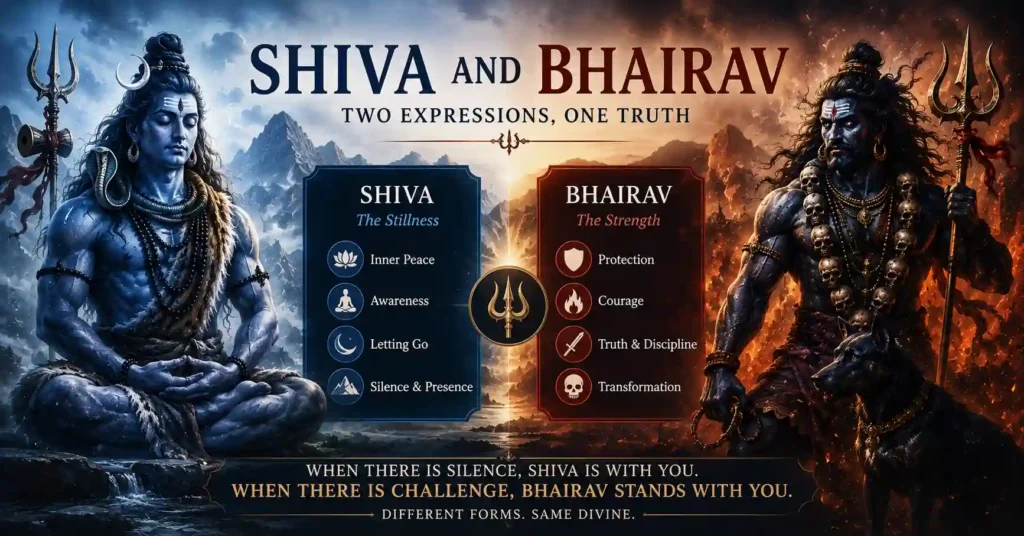
When Shiva and Bhairav Are Understood as One
At some point, every spiritual journey encounters challenges. Life is not always peaceful. There are moments of fear, uncertainty, loss, and inner conflict that require more than silence alone.
In those moments, the same presence experienced as Shiva begins to reveal itself differently. This is where Bhairav enters.
Bhairav is not separate from Shiva but one of Shiva’s most powerful manifestations. If Shiva represents stillness and awareness, Bhairav represents action, protection, and transformation. Both express the same divine reality through different forms.
As explored in Bhairav Tattva: The Fierce Principle of Time, Truth, and Awakening, Bhairav is not a symbol of fear but of freedom from fear. He removes illusion, challenges attachment, and encourages seekers to face truth with courage and clarity.
This shift from Shiva to Bhairav does not require a change in belief. It happens naturally as life unfolds. In times of peace, the mind may be drawn toward Shiva’s stillness. In times of challenge, it often seeks the strength and protection associated with Bhairav.
Understanding Shiva and Bhairav as one helps reveal a deeper truth: spiritual life requires both inner peace and the courage to live it.
Shiva and Bhairav: Understanding the Difference and Unity
Although Shiva and Bhairav are ultimately one, devotees often experience them differently.
Shiva is generally associated with stillness and transcendence, while Bhairav represents action, protection, and transformation. Together, they reveal two complementary aspects of the same divine consciousness.
| Aspect | Shiva | Bhairav |
|---|---|---|
| Primary Nature | Stillness and Awareness | Action and Transformation |
| Symbolism | Supreme Consciousness | Protective Power |
| Expression | Peaceful and Meditative | Fierce and Direct |
| Spiritual Role | Awakening Inner Awareness | Removing Fear and Illusion |
| Devotional Experience | Surrender and Silence | Courage and Discipline |
| Relationship | Source | Manifestation |
Despite these distinctions, Bhairav is never separate from Shiva. He is Shiva expressing himself in a form that actively guides, protects, and transforms the devotee.
The Many Forms of Bhairav and Their Meaning
Bhairav appears in many forms across Shaiva, Shakta, and Tantric traditions. Each form highlights a particular aspect of Shiva’s protective and transformative energy.
While the names and traditions may vary, all Bhairava forms are understood as expressions of the same divine reality.
| Form of Bhairav | Primary Significance |
|---|---|
| Kaal Bhairav | Time, discipline, and karmic order |
| Batuk Bhairav | Protection, simplicity, and accessibility |
| Swarnakarshan Bhairav | Prosperity, harmony, and abundance |
| Ashta Bhairav | Guardianship of the eight directions |
| Bhairav Tattva | Truth, transformation, and spiritual awakening |
Kaal Bhairav
Kaal Bhairav is the most widely worshipped form of Bhairava. He is associated with time, discipline, truth, and protection. Many devotees approach him for courage, clarity, and freedom from fear.
Batuk Bhairav
Batuk Bhairav appears in a youthful and approachable form. Devotees often connect with him for daily protection, guidance, and the removal of obstacles.
Swarnakarshan Bhairav
Swarnakarshan Bhairav is traditionally associated with prosperity and abundance. Spiritually, he also symbolizes balance, alignment, and the proper flow of energy in life.
Ashta Bhairav
The Ashta Bhairav are the eight principal manifestations of Bhairava who guard the eight directions of the universe. Together they symbolize protection, discipline, transformation, and cosmic order.
Though these forms appear different, they ultimately point toward the same truth: the protective and transformative presence of Shiva expressed through Bhairava.
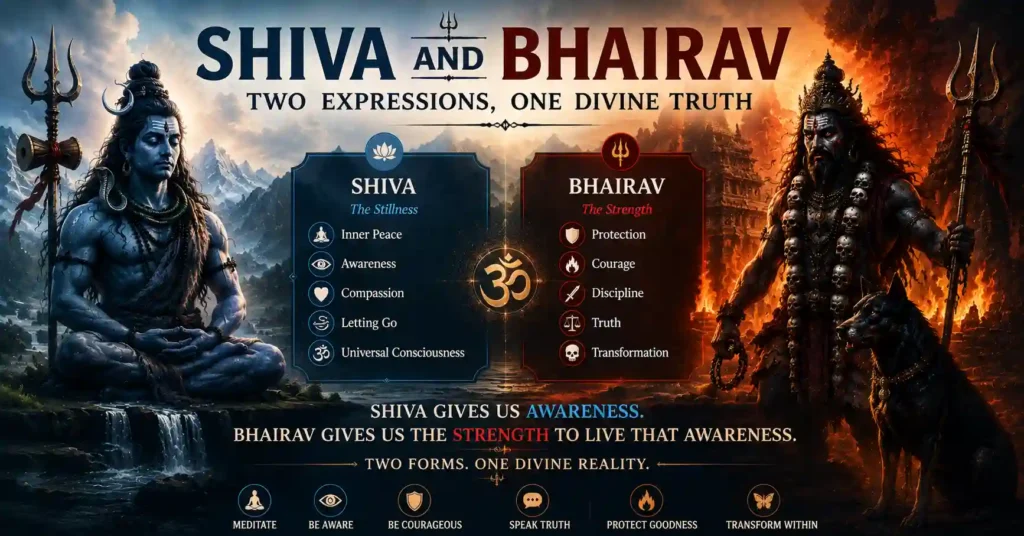
Connecting with Bhairav Through Stotra and Devotio
Like Shiva, Bhairav is often experienced through devotion, remembrance, and sacred sound. For many devotees, chanting becomes a simple yet powerful way to develop a deeper connection with his presence.
The Kaal Bhairav Ashtakam is among the most widely recited hymns dedicated to Bhairav. Devotees value it for its devotional depth and its association with courage, protection, and spiritual discipline. Even beginners are often drawn to its powerful and uplifting nature.
However, connection with Bhairav is not limited to formal recitation. Many devotees feel close to Bhairav through simple acts of devotion such as prayer, temple visits, quiet reflection, or remembering him during difficult moments in life. In Bhairava traditions, sincerity is often considered more important than ritual perfection.
What draws many seekers to Bhairav is the sense of directness associated with his worship. As a protective manifestation of Shiva, Bhairav is often viewed as a guide who helps devotees confront fear, overcome obstacles, and remain grounded in truth.
Over time, the relationship with Bhairav becomes deeply personal. What may begin as a prayer or stotra gradually develops into a source of strength, trust, and inner transformation.
Why Devotees Feel Connected to Shiva and Bhairav
The connection that devotees feel with Shiva and Bhairav is not always based on logic or intellectual understanding. For many, it develops through personal experience, prayer, reflection, and the challenges of everyday life.
Some feel drawn to Shiva because he represents peace, stillness, and inner awareness. Others feel a stronger connection with Bhairav because he symbolizes courage, protection, and the strength to face difficult situations.
In many cases, devotees find comfort in both, turning to Shiva during moments of contemplation and to Bhairav during times that require resilience and determination.
There are moments in life when calm is needed, and there are moments when courage is needed. Shiva represents the space in which awareness grows, while Bhairav represents the power to act with clarity and conviction.
Over time, this relationship becomes deeply personal. It moves beyond reading, rituals, or philosophical ideas and becomes part of how a person understands life, responds to challenges, and grows spiritually.
For many devotees, the journey of Shiva and Bhairav is ultimately a journey inward, one that gradually shapes both the heart and the mind.
The Spiritual Journey from Shiva to Bhairav
Many devotees describe their relationship with Shiva and Bhairav not as a single moment of realization but as a gradual spiritual journey. While each person’s experience is unique, the path often unfolds in a way similar to the following:
| Stage | Experience |
|---|---|
| Seeking | Feeling drawn toward spirituality and self-discovery |
| Shiva | Discovering silence, peace, and inner awareness |
| Reflection | Learning to observe thoughts and emotions without attachment |
| Challenge | Facing fear, uncertainty, and life’s deeper questions |
| Bhairav | Finding courage, discipline, and transformation |
| Integration | Recognizing Shiva and Bhairav as one reality |
| Realization | Living with greater awareness, balance, and inner strength |
For many seekers, Shiva represents the beginning of inner stillness, while Bhairav represents the courage required to live that truth in everyday life. Together, they form a complete spiritual path that balances peace with strength and awareness with action.
Sacred Temples and Pilgrimage of Shiva
While Shiva and Bhairav are often experienced inwardly through meditation, prayer, and devotion, many devotees also deepen this connection through sacred temples and pilgrimages. These places are revered not only for their history but also for the spiritual atmosphere they preserve through centuries of worship.
Mahakaleshwar, Ujjain
Mahakaleshwar is one of the twelve sacred Jyotirlingas and one of the most important centers of Shaiva worship in India. Here, Shiva is worshipped as Mahakaal, the Lord of Time. The famous Bhasma Aarti and the city’s strong Bhairava traditions create a unique spiritual environment where devotees experience both Shiva’s transcendence and Bhairava’s protective presence.
Related Reading:
Mahakaleshwar Jyotirlinga Ujjain: Mahakaal Mandir Darshan, Bhasma Aarti & Mahakaal Lok Guide
Kedarnath Dham
Nestled in the Himalayas, Kedarnath offers a very different experience. Surrounded by mountains and silence, the temple is often associated with introspection, surrender, and inner stillness. For many pilgrims, the journey itself becomes a spiritual practice, strengthening their connection with Shiva.
Related Reading:
Kedarnath Dham Yatra Guide
Sacred pilgrimages remind devotees that spirituality can be experienced in many ways. Some places inspire silence and contemplation, while others awaken strength and transformation. Together, they reflect the complementary qualities of Shiva and Bhairav that continue to guide seekers on the spiritual path.
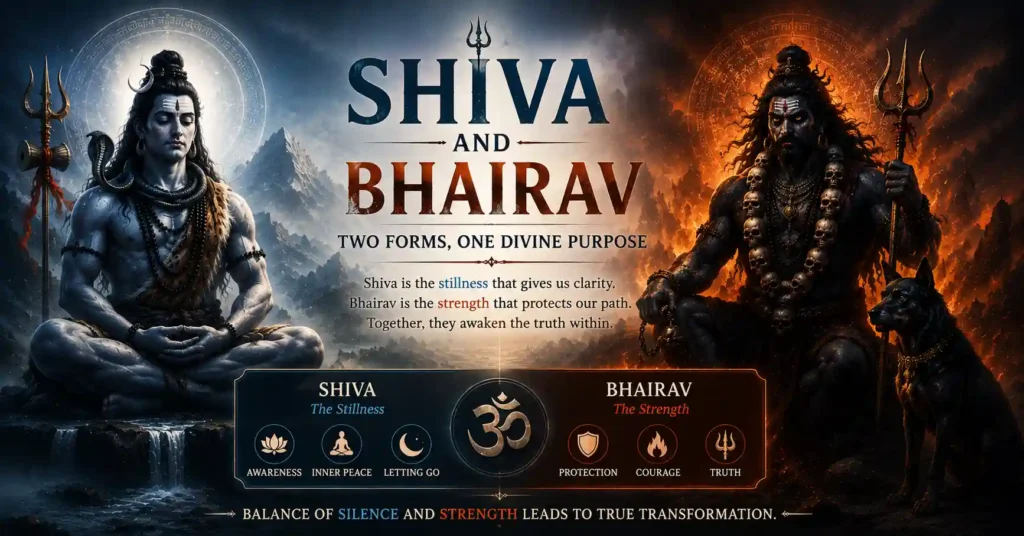
Shiva, Bhairav, and the Sacred City of Kashi
Among all sacred places associated with Shiva and Bhairav, Kashi (Varanasi) holds a unique position. The city is revered as the abode of Lord Vishwanath, one of the most sacred forms of Shiva, while Kala Bhairav is honored as the divine guardian and protector of the city.
In local tradition, Kala Bhairav is known as the Kotwal of Kashi, the spiritual guardian who watches over the sacred city and its devotees. Many pilgrims visit the Kala Bhairav Temple alongside the Kashi Vishwanath Temple, acknowledging both the compassionate presence of Shiva and the protective power of Bhairav.
This relationship beautifully reflects the deeper connection between Shiva and Bhairav. Shiva represents the supreme consciousness that liberates, while Bhairav protects the path that leads toward that realization.
For many devotees, understanding Kashi means understanding both Shiva and Bhairav together.
Living Shiva and Bhairav in Daily Life
Spirituality is not separate from daily life. For many devotees, the teachings of Shiva and Bhairav gradually become part of how they think, act, and respond to the world around them.
Living Shiva can mean cultivating inner stillness amid challenges. It may involve staying calm during difficult situations, observing thoughts without immediately reacting, and creating moments of silence and self-reflection in everyday life.
Living Bhairav can mean facing fear with courage, standing firmly in truth, and maintaining inner discipline when confronted by uncertainty or pressure.
Bhairav reminds devotees that spiritual growth often requires strength, responsibility, and the willingness to confront what is uncomfortable.
These changes are rarely dramatic. More often, they appear as small shifts in awareness and behavior that develop naturally over time. A person becomes a little calmer, a little more truthful, and a little less controlled by fear.
In this way, the path of Shiva and Bhairav is not something distant or separate from life. It unfolds gradually within everyday experiences, shaping both inner awareness and outward action.
Shiva and Bhairav in Sacred Texts and Traditions
The connection between Shiva and Bhairav is preserved across numerous Shaiva, Tantric, and regional traditions.
While Shiva is extensively described in texts such as the Shiva Purana and various Shaiva Agamas, Bhairav appears prominently in Tantric literature and specialized Shaiva traditions.
Important sources associated with Bhairava worship include the Rudrayamala Tantra, Bhairava Tantras, Tantrasara, and several Shaiva scriptures that describe Bhairava as a guardian, protector, and transformative force.
These texts present Bhairava not as a separate deity but as a manifestation of Shiva’s power.
Kashmir Shaivism offers one of the deepest philosophical interpretations of this relationship. In the Vijnana Bhairava Tantra, Bhairava is presented as the highest state of consciousness itself rather than merely a deity.
This understanding emphasizes that Shiva and Bhairava ultimately represent the same supreme reality viewed from different spiritual perspectives.
Because these traditions developed across different regions and lineages, devotees may encounter variations in stories, symbolism, and worship practices.
These differences reflect the richness of Hindu spiritual traditions rather than contradiction.
Shiva and Bhairav in Kashmir Shaivism
Kashmir Shaivism offers one of the most profound interpretations of the relationship between Shiva and Bhairav. Rather than viewing Bhairav merely as a fierce deity, this tradition understands Bhairava as the highest state of consciousness itself.
Texts such as the Vijnana Bhairava Tantra describe Bhairava as the limitless awareness that exists beyond thought, fear, and duality. In this understanding, Shiva and Bhairava are not two separate realities but different ways of describing the same supreme consciousness.
The teachings of Kashmir Shaivism emphasize direct spiritual experience rather than external ritual alone. Through meditation, self-awareness, and inner inquiry, practitioners seek to recognize the Bhairava state already present within themselves.
This philosophical perspective has influenced many later Shaiva and Tantric traditions and continues to shape how Shiva and Bhairav are understood today.
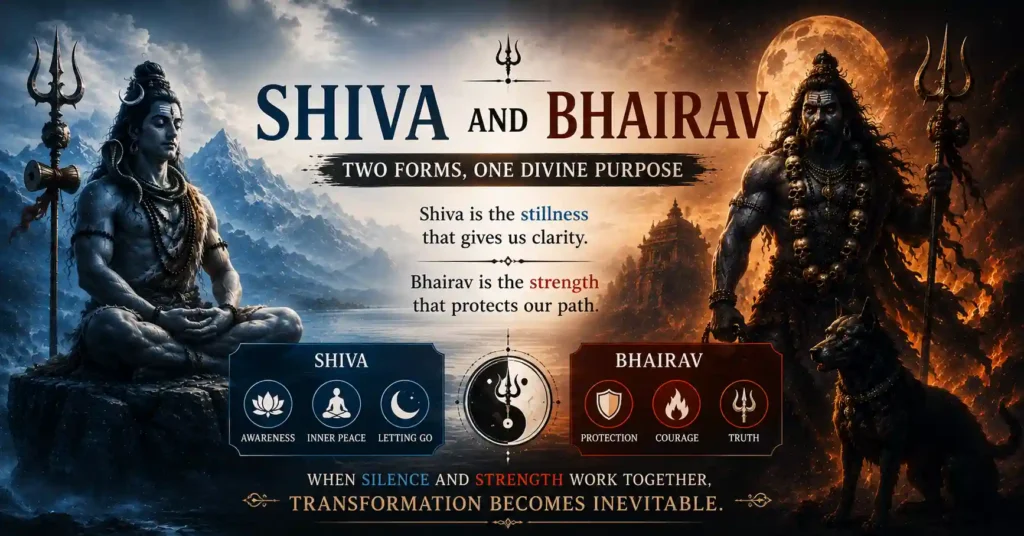
Prefer Reading in Hindi?
Some devotees feel more connected when reading spiritual teachings in Hindi. The words often feel closer, more natural, and more emotionally resonant, allowing the teachings to be experienced in a deeper and more personal way.
If you prefer reading in Hindi, you may enjoy exploring:
कामाख्या और दशमहाविद्या: क्यों माना जाता है इसे महाविद्याओं का आध्यात्मिक हृदय?
जगन्नाथ रथ यात्रा: इतिहास, महत्व, परंपराएं और आध्यात्मिक रहस्य
बटुक भैरव: स्वरूप, कथा, मंत्र, पूजा, साधना और आध्यात्मिक रहस्य
त्रियुगीनारायण मंदिर: जहाँ तीन युगों से जल रही है शिव-पार्वती विवाह की अग्नि
Whether read in Hindi or English, the essence remains the same. The goal is not merely to understand the words, but to experience the wisdom, devotion, and spiritual insight they carry.
Closing Reflection
The journey of Shiva and Bhairav is not about moving from one to another. It is about recognizing two complementary expressions of the same divine reality.
Throughout spiritual traditions, Shiva represents stillness, awareness, and inner peace, while Bhairav represents courage, transformation, and the strength to face truth.
Together, they reveal that spiritual growth requires both silence and action, reflection and discipline.
Sometimes life calls for surrender. Sometimes it calls for courage. Sometimes it asks us to be still, and sometimes it asks us to stand firm. In each of these moments, the same divine presence remains.
As understanding deepens, Shiva and Bhairav are no longer seen as distant concepts or separate forms. They become living principles that guide how we think, act, and respond to life.
And slowly, without force or effort, that presence becomes part of who we are.
Suggested Reading
The relationship between Shiva and Bhairav opens the door to some of the deepest teachings in Sanatan Dharma. While Shiva represents supreme consciousness and inner stillness, Bhairav reveals the transformative, protective, and fearless aspects of that same divine reality.
To explore these teachings in greater depth, the following guides offer additional insights into Shiva, Bhairava traditions, sacred pilgrimage, mantra practice, and spiritual awakening.
Bhagwan Shiv: The Supreme Consciousness Beyond Creation and Destruction
https://thesanatantales.com/bhagwan-shiv/
Bhairav Tattva: Meaning, Symbolism, and the Principle of Truth in Sanatan Dharma
https://thesanatantales.com/bhairav-tattva/
Kaal Bhairav: Story, Significance, Kashi Kotwal, Worship and Spiritual Meaning
https://thesanatantales.com/kaal-bhairav/
Batuk Bhairav: Meaning, Mantra, Puja, Temples, Benefits and Significance
https://thesanatantales.com/batuk-bhairav/
Swarnakarshan Bhairav: Meaning, Mantra, Benefits, Wealth and Spiritual Significance
https://thesanatantales.com/swarnakarshan-bhairav/
Ashta Bhairav: Powerful Guardians of Time, Direction, and Dharma
https://thesanatantales.com/ashta-bhairav/
Mahakaleshwar Jyotirlinga Ujjain: Mahakaal Mandir Darshan, Bhasma Aarti and Mahakaal Lok Guide
https://thesanatantales.com/mahakaleshwar-jyotirlinga-ujjain-guide/
Kedarnath Dham Yatra Guide
https://thesanatantales.com/kedarnath-dham-yatra-2026-guide/
Shiva (Wikipedia)
https://en.wikipedia.org/wiki/Shiva
Bhairava (Wikipedia)
https://en.wikipedia.org/wiki/Bhairava
FAQs
Who are Shiva and Bhairav?
Shiva and Bhairav are not separate deities in Hindu tradition. Bhairav is widely understood as a powerful manifestation of Lord Shiva. While Shiva represents supreme consciousness, stillness, and inner awareness, Bhairav represents protection, transformation, discipline, and the removal of ignorance.
What is the relationship between Shiva and Bhairav?
The relationship between Shiva and Bhairav is one of unity rather than separation. Bhairav is considered an active and protective expression of Shiva’s energy. Many spiritual traditions describe Shiva as the source and Bhairav as one of his transformative manifestations.
Why is Bhairav considered a fierce form of Shiva?
Bhairav is depicted with a fierce appearance because he symbolizes the destruction of fear, ego, illusion, and negative tendencies. His fierce form represents spiritual strength and protection rather than anger or punishment.
Can Shiva and Bhairav be worshipped together?
Yes. Many devotees worship Shiva and Bhairav together. Since Bhairav is a manifestation of Shiva, their worship is often viewed as complementary. Shiva is approached for inner peace and spiritual awareness, while Bhairav is revered for protection, courage, and discipline.
Which mantra is commonly chanted for Shiva and Bhairav?
For Shiva, popular mantras include Om Namah Shivaya and the Maha Mrityunjaya Mantra. For Bhairav, devotees often recite the Kaal Bhairav Ashtakam or traditional Bhairav mantras according to their lineage and practice.
What is the spiritual meaning of Shiva and Bhairav together?
Together, Shiva and Bhairav symbolize the balance between stillness and action, peace and strength, awareness and transformation. Their relationship teaches that spiritual growth requires both inner realization and the courage to face life’s challenges..
Is Bhairav worship only associated with Tantra?
No. Although Bhairav has an important place in Tantric traditions, he is also worshipped in mainstream Shaiva and devotional traditions across India and Nepal. Many devotees worship Bhairav through simple prayers, temple visits, mantras, and acts of devotion.
What is the significance of Kala Bhairav in relation to Shiva?
Kala Bhairav is one of the most widely worshipped forms of Bhairava. He is associated with time, discipline, protection, and karmic order. In places such as Kashi (Varanasi), Kala Bhairav is revered as the sacred guardian of the city and an important manifestation of Shiva.
How do devotees connect with Shiva and Bhairav in daily life?
Many devotees connect with Shiva through meditation, mantra chanting, self-reflection, and inner silence. Bhairav is often remembered through prayers for courage, truthfulness, discipline, and protection. For many practitioners, these teachings become part of daily life rather than limited to ritual worship.
What do Shiva and Bhairav ultimately teach?
Shiva and Bhairav teach that spiritual life involves both awareness and action. Shiva represents the realization of inner consciousness, while Bhairav represents the strength to live that realization with courage, responsibility, and truth.
Glossary of Important Terms
| Term | Meaning |
|---|---|
| Shiva | The Supreme Consciousness and one of the principal deities of Hinduism, representing stillness, awareness, and liberation. |
| Bhairav (Bhairava) | A fierce and protective manifestation of Lord Shiva associated with truth, discipline, transformation, and the removal of ignorance. |
| Lord Shiva | One of the Trimurti in Hinduism, revered as the Supreme Reality in Shaiva tradition and the source of all Bhairava forms. |
| Kaal Bhairav | The principal form of Bhairava associated with time (Kala), karmic justice, protection, and spiritual discipline. |
| Ashta Bhairav | The eight principal manifestations of Bhairava who guard the eight directions and uphold cosmic order. |
| Bhairav Tattva | The philosophical principle of Bhairava representing truth, fearlessness, transformation, and spiritual awakening. |
| Supreme Consciousness | The highest state of pure awareness beyond ego, duality, and material existence, identified with Shiva. |
| Manifestation | A divine form through which the Supreme Reality expresses a particular quality or function. |
| Shaivism (Shaiva Tradition) | A major Hindu tradition centered on the worship of Lord Shiva as the Supreme Being. |
| Shaktism | A Hindu tradition focused on the worship of the Divine Mother (Shakti), often closely linked with Bhairava worship. |
| Tantra | A spiritual tradition that employs mantra, meditation, ritual, and symbolism for self-realization and transformation. |
| Kashmir Shaivism | A philosophical school of Shaivism that teaches Shiva and Bhairava as expressions of one supreme consciousness. |
| Vijnana Bhairava Tantra | A revered text of Kashmir Shaivism containing meditation methods that reveal the nature of supreme consciousness. |
| Shiva Purana | One of the major Hindu Puranas dedicated to Lord Shiva, describing his stories, teachings, and worship. |
| Shaiva Agamas | Sacred scriptures that explain Shaiva philosophy, temple worship, rituals, meditation, and spiritual practice. |
| Rudrayamala Tantra | An important Tantric scripture associated with Bhairava worship and advanced Shaiva practices. |
| Bhairava Tantra | A group of Tantric texts that describe the philosophy, rituals, and worship of Bhairava. |
| Mantra | A sacred sound, word, or phrase repeated during meditation or worship to focus the mind and invoke divine grace. |
| Om Namah Shivaya | One of the most sacred mantras dedicated to Lord Shiva, expressing devotion and surrender. |
| Maha Mrityunjaya Mantra | A powerful Vedic mantra dedicated to Lord Shiva for healing, protection, courage, and spiritual strength. |
| Shiv Tandav Stotram | A celebrated hymn praising Lord Shiva’s cosmic dance and divine power. |
| Lingashtakam | A devotional hymn glorifying the Shiva Linga and expressing surrender to Lord Shiva. |
| Rudrashtakam | A famous Sanskrit hymn praising the greatness and compassion of Lord Shiva. |
| Stotra | A devotional hymn composed in praise of a deity. |
| Jyotirlinga | A sacred shrine where Lord Shiva is worshipped as an infinite pillar of divine light. |
| Mahakaleshwar Jyotirlinga | One of the twelve Jyotirlingas, located in Ujjain and dedicated to Shiva as Mahakaal, the Lord of Time. |
| Kedarnath | One of the holiest Shiva temples and one of the twelve Jyotirlingas, located in the Himalayas. |
| Kashi (Varanasi) | The sacred city of Lord Shiva and one of Hinduism’s most revered pilgrimage destinations. |
| Kotwal of Kashi | A traditional title of Kaal Bhairav, recognizing him as the divine guardian and protector of Varanasi. |
| Dharma | The universal principle of righteousness, duty, and moral order that sustains life and the cosmos. |
| Karma | The law of cause and effect through which actions shape future experiences and spiritual growth. |
| Moksha | Liberation from the cycle of birth and death and realization of one’s true spiritual nature. |
| Sadhana | A disciplined spiritual practice undertaken for inner purification and realization of the Divine. |
| Meditation (Dhyana) | The practice of focusing the mind to cultivate awareness, stillness, and spiritual insight. |
| Awareness | The state of clear, non-judgmental consciousness that lies at the heart of Shiva’s teachings. |
| Transformation | The inner process of overcoming ignorance, fear, ego, and attachment through spiritual practice. |
| Pilgrimage (Yatra) | A sacred journey to holy places undertaken for devotion, purification, and spiritual growth. |
| Brahma | The creator deity in Hinduism whose story with Bhairava symbolizes the removal of pride and ego. |
| Ego (Ahamkara) | The false sense of individual identity that spiritual traditions encourage seekers to transcend. |
About the Author
Yateendra Chaturvedi is a spiritual writer, researcher, devotee, and the founder of The Sanatan Tales. With over 35 years of professional experience and a lifelong interest in Sanatan Dharma, he writes about Hindu deities, temples, scriptures, festivals, Mahavidyas, sacred stories, rituals, and living traditions that continue to guide and inspire devotees across India.
Drawing from traditional scriptures, regional beliefs, temple traditions, devotional literature, and historical sources, he aims to present authentic, well-researched, and easy-to-understand content for modern readers. His work focuses on preserving spiritual wisdom, explaining sacred traditions, and helping seekers develop a deeper understanding of India’s rich spiritual heritage.
Through The Sanatan Tales, Yateendra strives to make the timeless teachings of Sanatan Dharma simple, meaningful, and relevant for today’s generation while maintaining respect for traditional sources, regional practices, and diverse spiritual perspectives.
Learn More About Yateendra Chaturvedi →
https://thesanatantales.com/about-the-author/
References & Sources
This article is based on Shaiva and Bhairava traditions followed within Sanatan Dharma, traditional beliefs associated with Lord Bhairava, religious narratives, folk traditions, and insights gathered from various spiritual and religious study sources.
Some concepts discussed in this article are also inspired by interpretations found in guru-disciple lineages, temple traditions, and devotional literature.
Note: Beliefs, stories, and methods of worship related to Lord Bhairava may differ across regions, sects, and spiritual traditions. The purpose of this article is not to present any single viewpoint as the absolute truth, but to explain commonly accepted religious and spiritual perspectives in a simple and accessible manner.
Explore More Fascinating Topics from Sanatan Dharma