
Most people associate Bhairav with fierce energy, powerful protection, and intense spiritual discipline. That is why many are surprised when they first encounter Batuk Bhairav, a form that appears not as a fearsome guardian, but as a divine child.
Yet behind this gentle form lies one of the most respected and mysterious manifestations of Lord Shiva. Across temples, Bhairava traditions, and household worship, devotees turn to Batuk Bhairav for protection from fear, guidance during difficult times, and strength to overcome unseen obstacles.
Some worship him as a compassionate guardian. Others see him as the protector of sacred spaces and spiritual journeys. In Tantric traditions, he is revered as a powerful force who watches over the path of sadhana itself.
But who exactly is Batuk Bhairav? Why does Shiva appear in this child form? What do scriptures, temple traditions, and devotees say about his worship and significance?
In this article, we will explore the meaning, symbolism, mantras, temples, traditions, and deeper spiritual significance of Batuk Bhairav, from beginner understanding to the insights valued by serious seekers.
Table of Contents
ToggleWho is this child form of Bhairava
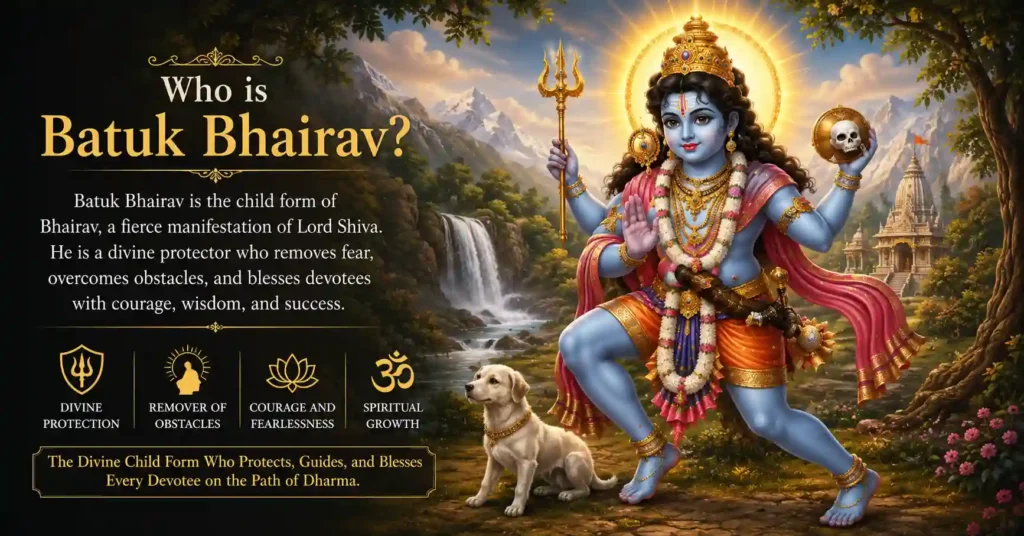
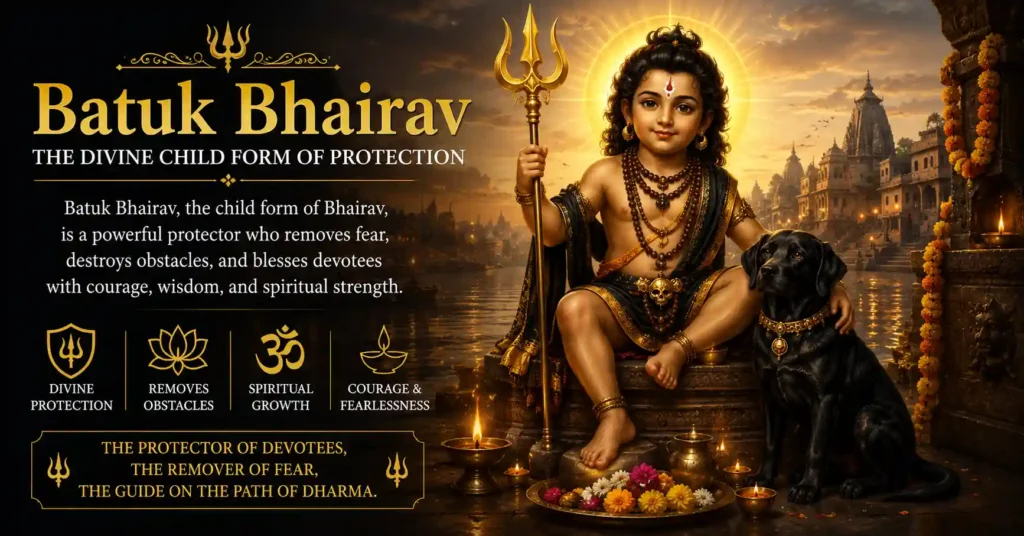
Batuk Bhairav is the child form of Kaal Bhairav, who is himself a powerful manifestation of Lord Shiva.
While Kaal Bhairav is often associated with time, discipline, and fierce protection, Batuk Bhairav expresses the same divine energy through a gentle and approachable form.
Devotees worship Batuk Bhairav for protection, removal of fear, relief from obstacles, and inner stability during difficult phases of life.
He is widely regarded as a compassionate guardian who helps devotees navigate both worldly challenges and spiritual growth.
In many Bhairava traditions, Batuk Bhairav is considered especially suitable for householders because his worship can be performed with simple devotion.
At the same time, Shaiva and Tantric traditions also recognize him as a powerful protector of sacred spaces and spiritual practice.
For this reason, Batuk Bhairav is revered not only as a deity who removes difficulties but also as a guardian who helps devotees walk their path with courage, clarity, and faith.
Meaning, form and symbolism
The word Batuk means child, but this form represents much more than physical age. In Bhairava traditions, the child form symbolizes innocence, purity, fearlessness, and a state of consciousness that remains free from ego and unnecessary complexity.
Batuk Bhairav is also known as Aapaduddharak, meaning “the one who rescues devotees from difficulties and dangers.” For this reason, many devotees turn to him during periods of uncertainty, fear, or sudden obstacles in life.
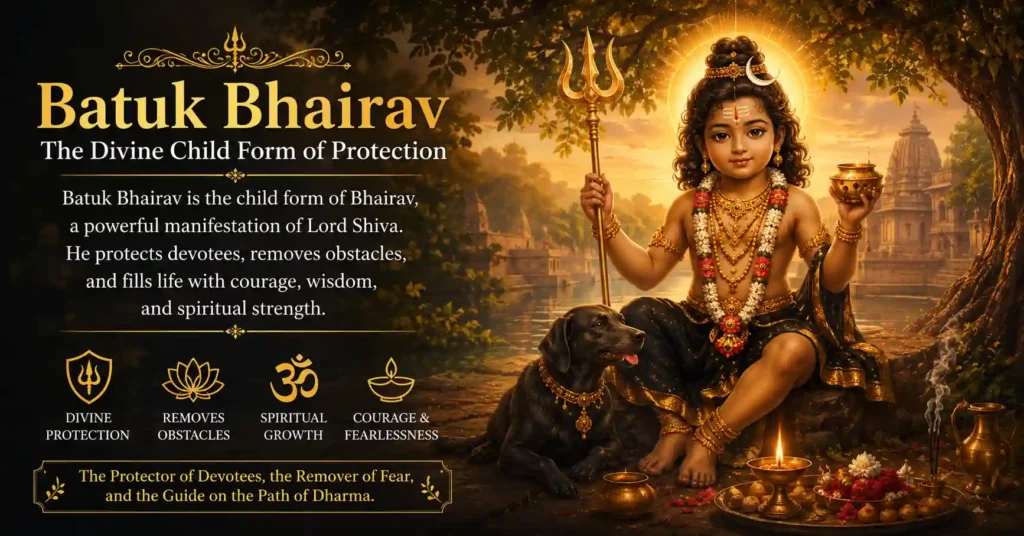
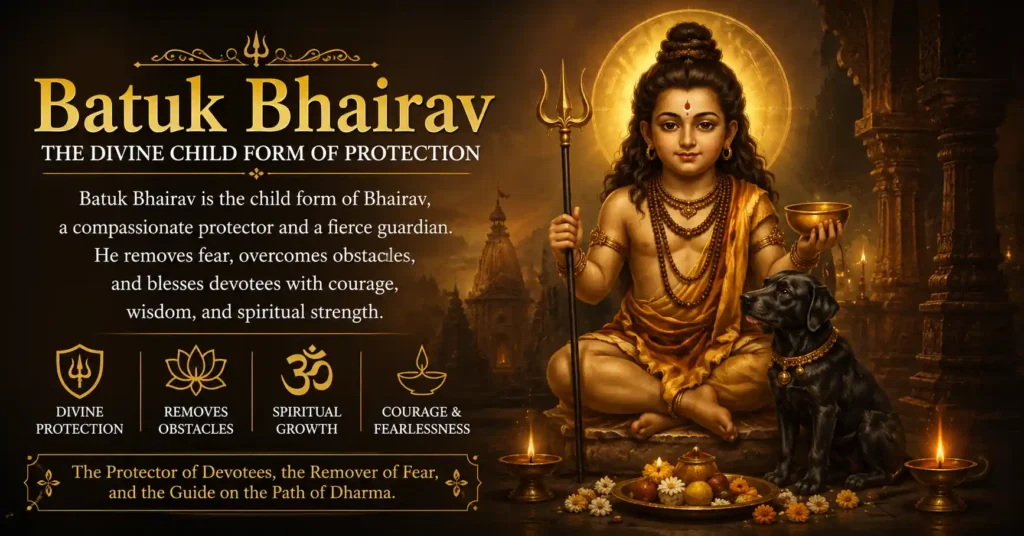
Every aspect of his form carries symbolic meaning. The trishul represents mastery over the physical, mental, and spiritual dimensions of existence.
The dog, traditionally associated with Bhairava, symbolizes loyalty, vigilance, and the ability to remain alert on the spiritual path. The child form reminds devotees that true strength can exist alongside humility, innocence, and compassion.
Together, these symbols present Batuk Bhairav not only as a protector from external challenges but also as a guide who helps devotees cultivate courage, clarity, and inner balance.
The deeper symbolism of the child form
The child form of Batuk Bhairav is not merely a representation of age. In many Shaiva and Bhairava traditions, it symbolizes a state of consciousness that remains pure, fearless, and free from ego.
While the fierce forms of Bhairava represent the power that destroys ignorance, the child form reminds devotees that spiritual strength does not always appear through intensity.
Sometimes the highest protection comes through innocence, simplicity, and complete trust in the Divine.
Many devotees see this form as a reminder that fear begins to lose its grip when the mind becomes uncomplicated.
The child form therefore represents both divine protection and the possibility of returning to a state of inner purity.
For this reason, Batuk Bhairav is often considered one of the most approachable forms of Bhairava for householders and beginners on the spiritual path.
Scriptural and tantric significance
Batuk Bhairav holds an important place not only in devotional worship but also in several Shaiva and Tantric traditions.
While many devotees approach him for protection and the removal of obstacles, spiritual traditions often view him as a guardian who watches over the path of sadhana itself.
References to Bhairava appear in various Bhairava-centered traditions and Tantric texts, including the Rudra Yamala Tantra.
In these traditions, Bhairava is often revered as a Kshetrapal, a guardian of sacred spaces, pilgrimage sites, temples, and spiritual practitioners.
For this reason, many lineages invoke Bhairava before beginning deeper spiritual disciplines.
The belief is not that Bhairava literally grants or denies permission, but that his blessings help remove distractions, fears, and obstacles that can hinder spiritual progress.
This understanding has made Batuk Bhairav an important figure not only for household devotees but also for seekers who view him as a protector, guide, and guardian of the spiritual journey.
In Shaiva, Bhairava, and Tantric traditions
Within the broader Shaiva tradition, Bhairava is understood as a powerful manifestation of Lord Shiva who protects sacred spaces, destroys ignorance, and guides spiritual transformation.
Batuk Bhairav represents this same divine force in a gentler and more accessible form.
In Bhairava traditions, devotees often approach Batuk Bhairav before developing a deeper connection with other forms of Bhairava. His worship is viewed as a doorway to discipline, protection, and spiritual steadiness.
Tantric traditions also give special importance to Batuk Bhairav. Many practitioners invoke Bhairava before beginning advanced spiritual practices because he is regarded as a guardian of sacred knowledge and a protector against obstacles that may arise during sadhana.
Different lineages may emphasize different aspects of Batuk Bhairav, but the common understanding is that he protects the spiritual journey while helping devotees remain grounded and fearless.
Scriptural references and traditions
References to Bhairava appear across several Shaiva and Tantric traditions, although descriptions and forms may vary between texts and lineages.
Batuk Bhairav is particularly associated with traditions connected to the Rudra Yamala Tantra and other Bhairava-centered Tantric texts, where Bhairava is described as both a protector and a guide on the spiritual path.
In the wider Shaiva tradition, Bhairava is also connected with texts such as the Kalika Purana, Shiva Purana traditions, and regional Bhairava worship manuals that developed around important pilgrimage centers like Kashi and Ujjain.
It is important to note that different traditions interpret these references differently. Some emphasize Batuk Bhairav as a distinct child form, while others see him as a compassionate manifestation within the larger Bhairava tradition.
Bhairava as Kshetrapal, the guardian of sacred spaces
One of the most important traditional roles associated with Bhairava is that of Kshetrapal, a guardian and protector of sacred spaces.
The word Kshetrapal literally means “protector of the field” or “guardian of the sacred domain.” In many temples across India, Bhairava is worshipped as the divine guardian who watches over pilgrimage sites, temple precincts, and spiritual practitioners.
This belief is especially strong in Kashi, where Bhairava is regarded as the protector of the holy city. Devotees often seek his blessings before beginning important spiritual practices or visiting sacred shrines.
From a symbolic perspective, the role of Kshetrapal also extends inward. Many devotees interpret Bhairava as the guardian of the inner spiritual journey, protecting the mind from fear, confusion, and distraction.
Origin stories of Batuk Bhairav
Unlike some Hindu deities whose origins are described through a single well-known narrative, Batuk Bhairav is associated with multiple traditions and interpretations.
In many Shaiva traditions, Batuk Bhairav is understood as a compassionate manifestation of Lord Shiva who appeared to make the protective power of Bhairava more accessible to devotees.
The child form is therefore seen as a symbol of divine protection expressed through innocence rather than fear.
Some traditions connect Batuk Bhairav closely with Kashi, where Bhairava is revered as the guardian of the sacred city. In these traditions, Batuk Bhairav is worshipped as a benevolent protector who watches over devotees and pilgrims.
There are also regional and folk narratives that describe Bhairava appearing in child form to defeat forces of chaos or restore balance when other powers were unable to do so.
These stories vary across regions and should be understood as local devotional traditions rather than a single scriptural account.
Together, these traditions highlight a common theme: Batuk Bhairav is seen as a divine protector who combines the power of Bhairava with the accessibility and purity of a child form.
Three forms based on gunas
In several Bhairava traditions, Batuk Bhairav is understood through three broad qualities or gunas that influence both nature and spiritual practice. These forms do not represent different deities but different aspects of the same divine presence.
Traditional Bhairava teachings describe three broad modes through which devotees understand and approach this form.
| Form | Associated Quality | Traditional Understanding |
|---|---|---|
| Sattvik Batuk Bhairav | Peace and wisdom | Supports spiritual growth, clarity, protection, and inner balance |
| Rajasik Batuk Bhairav | Action and achievement | Associated with worldly success, stability, and overcoming obstacles |
| Tamasik Batuk Bhairav | Transformation and protection | Traditionally linked with removing negativity, inner fears, and harmful influences |
The Sattvik form is often worshipped by devotees seeking spiritual growth and a deeper connection with the Divine. The Rajasik form is associated with action, responsibility, and progress in worldly life.
The Tamasik form is traditionally connected with the destruction of negativity and the removal of obstacles on both the worldly and spiritual paths.
Together, these three forms illustrate how Batuk Bhairav is understood as a protector who supports devotees according to their needs, temperament, and stage of life.
Comparing Batuk Bhairav and Kaal Bhairav
One of the most common questions among devotees is whether Batuk Bhairav and Kaal Bhairav are different deities. The answer is no.
Both are forms of Bhairava, a powerful manifestation of Lord Shiva. The difference lies primarily in their symbolism, worship, and how devotees experience their presence.
| Aspect | Batuk Bhairav | Kaal Bhairav |
|---|---|---|
| Form | Divine child form | Fierce and majestic form |
| Nature | Gentle, approachable, protective | Intense, disciplined, transformative |
| Symbolism | Innocence, guidance, protection | Time, karmic justice, spiritual vigilance |
| Worship | Commonly performed at home | Often associated with temples and deeper spiritual disciplines |
| Suitable For | Householders, beginners, daily devotion | Devotees seeking discipline, contemplation, and deeper Bhairava worship |
| Core Purpose | Protection and removal of obstacles | Protection, karmic accountability, and spiritual awakening |
Batuk Bhairav is often worshipped as a compassionate guardian who is easily approachable for householders and beginners. His worship is usually simple and centered on devotion, prayer, and trust.
Kaal Bhairav, on the other hand, is traditionally associated with time (Kaal), discipline, karmic justice, and spiritual vigilance. His iconography is more intense, and many devotees experience his presence as powerful, authoritative, and transformative.
Despite these differences, both forms ultimately serve the same purpose: protecting devotees, removing obstacles, and guiding them on the spiritual path.
Many traditions therefore view Batuk Bhairav as the gentler expression of the same Bhairava principle that appears in a more formidable form as Kaal Bhairav.
Understanding their relationship
Batuk Bhairav and Kaal Bhairav are not separate deities but different expressions of the same Bhairava principle within the Shaiva tradition.
Kaal Bhairav is commonly associated with time, discipline, karmic accountability, and the fierce power that destroys ignorance. His iconography and worship often emphasize authority, vigilance, and spiritual responsibility.
Batuk Bhairav expresses these same divine qualities through a more approachable form. Devotees often experience this form as compassionate, protective, and accessible for daily worship.
Many traditions therefore view Batuk Bhairav as especially suitable for householders and beginners, while Kaal Bhairav is often associated with deeper contemplation on time, mortality, and spiritual discipline.
Both forms ultimately point toward the same underlying reality: Lord Shiva as protector, guide, and destroyer of fear.
Why devotees worship this form
Devotees worship Batuk Bhairav for many reasons. Common motivations include:
Protection from fear and uncertainty
Removal of obstacles in worldly and spiritual life
Relief during difficult phases and major life transitions
Greater mental stability and emotional strength
Protection from negative influences
Guidance during confusion and challenging situations
Growth in courage, resilience, and self-confidence
Traditional belief holds that Batuk Bhairav helps devotees face challenges with greater clarity and steadiness.
For this reason, he is often regarded as a compassionate guardian who watches over devotees during difficult times.
Many devotees also believe that his worship is not only about removing problems but about developing the inner strength, awareness, and resilience needed to navigate life’s challenges while remaining connected to faith and spiritual discipline.
Is this form safe to worship?
Many people feel uncertain about Bhairava worship because they associate Bhairava with fierce imagery, Tantra, or stories of powerful spiritual practices.
This often creates the misconception that Batuk Bhairav is difficult or dangerous to approach.
In reality, Batuk Bhairav is widely regarded as one of the most approachable forms of Bhairava. His child form symbolizes protection, compassion, and closeness to devotees.
For this reason, many householders worship him through simple prayers, mantra chanting, and daily devotion.
Like any form of worship, sincerity and respect are more important than complexity. Simple Batuk Bhairav worship performed with faith and good intention is generally considered safe and suitable for beginners.
Concerns usually arise when people confuse devotional worship with advanced tantric practices, which traditionally require proper guidance and initiation.
Puja vidhi at home
Batuk Bhairav puja can be simple, sincere, and suitable for daily worship at home. A basic puja may include:
Lighting a mustard oil diya
Offering flowers or sweets
Chanting a Batuk Bhairav mantra
Sitting quietly in prayer or remembrance
Offering food to dogs as an act of devotion
Even a few minutes of sincere worship is considered meaningful. The focus is not on elaborate rituals but on devotion, respect, and regular remembrance.
For those who wish to deepen their practice, visiting Bhairav temples, observing Bhairav Ashtami, and maintaining a regular mantra-japa routine are common devotional practices followed in many traditions.
Mantra and its spiritual significance
Mantra is one of the most common ways devotees connect with Batuk Bhairav. In traditional understanding, a mantra is not merely a prayer but a sacred sound that helps focus the mind and strengthen one’s connection with the deity.
A simple mantra often recited by devotees is:
Om Hreem Batukaya Namah
Another widely known mantra is:
Om Hreem Batukaya Aapaduddharanaya Kuru Kuru Batukaya Hreem
The term Aapaduddharanaya refers to the removal of difficulties, dangers, and sudden obstacles. Many devotees chant this mantra during periods of uncertainty, fear, or major life transitions.
Traditional belief holds that regular mantra japa helps cultivate inner steadiness, courage, and trust. While devotional chanting can be practiced by anyone, advanced mantra disciplines involving large numbers of repetitions or specialized rituals are traditionally undertaken with proper guidance.
Kavach and spiritual protection
In many Hindu traditions, a kavach is understood as a spiritual shield created through prayer, mantra, and devotion.
Various Bhairava traditions preserve protective hymns and kavach texts that devotees recite for strength, courage, and divine protection.
The purpose of a kavach is not to create fear of unseen forces but to cultivate a sense of spiritual confidence and faith.
Devotees believe that regular remembrance of Bhairava helps strengthen the mind during difficult circumstances and reduces anxiety about uncertainty.
Different lineages may use different kavach texts, and there is no single universally followed version across all traditions.
Many household devotees focus primarily on simple prayer and mantra chanting while viewing the kavach as an additional devotional practice.
Important days for worship
Certain days and times are traditionally considered especially auspicious for Batuk Bhairav worship.
| Occasion | Traditional Significance |
|---|---|
| Sunday | Commonly observed for protection and blessings |
| Tuesday | Associated with strength, courage, and obstacle removal |
| Bhairav Ashtami | The most important observance dedicated to Bhairava |
| Night-time worship | Considered spiritually significant in many Bhairava traditions |
Among these, Bhairav Ashtami holds special importance and is observed by devotees through prayer, mantra chanting, temple visits, and acts of charity.
Many Bhairava traditions also regard the evening and night hours as spiritually powerful for worship and contemplation. However, Batuk Bhairav can be worshipped at any time of day with sincerity and devotion.
Important temples in India
Several temples across India are associated with Batuk Bhairav and the wider Bhairava tradition. Among them, the following are especially well known.
| Temple | Location | Significance |
|---|---|---|
| Batuk Bhairav Temple | Varanasi, Uttar Pradesh | One of the most important temples dedicated to Batuk Bhairav, known for its Akhand Deep (eternal lamp) |
| Kaal Bhairav Temple | Varanasi, Uttar Pradesh | Revered as the guardian of Kashi and an important pilgrimage site for Bhairava devotees |
| Kaal Bhairav Temple | Ujjain, Madhya Pradesh | Famous for its unique local tradition of offering liquor to Bhairava |
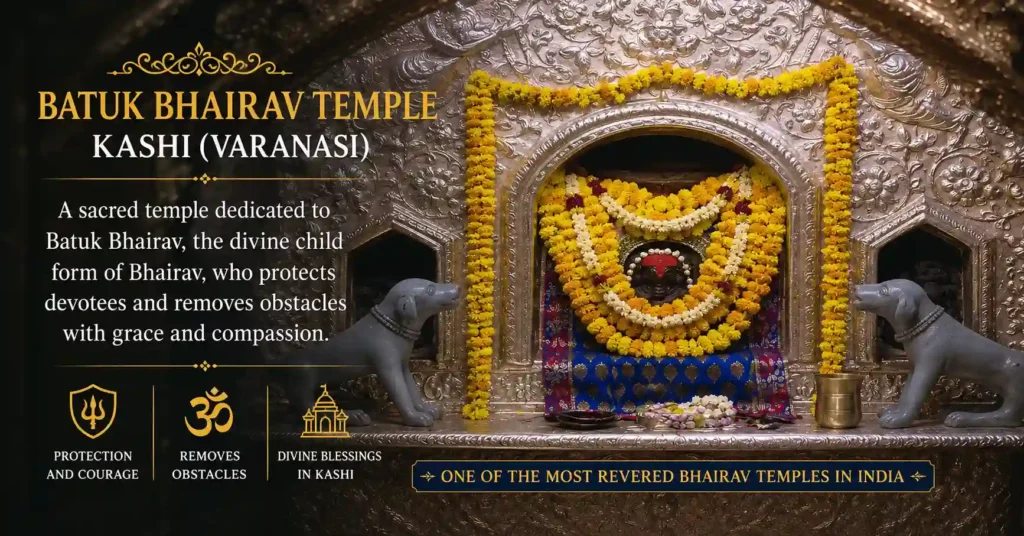
Batuk Bhairav Temple, Varanasi
Located in the Bhelupur area of Varanasi, this temple is among the most prominent shrines dedicated to Batuk Bhairav. Devotees visit seeking protection, removal of obstacles, and blessings for daily life. The temple is especially known for its Akhand Deep, an eternal lamp that has become an important part of local devotion.
Darshan Timings
Timings may change during festivals and special observances, so devotees are advised to confirm locally before planning a visit.
5:00 AM to 1:30 PM
4:30 PM to 9:30 PM
Kaal Bhairav Temple, Varanasi
This temple holds a special place in the spiritual traditions of Kashi. Many devotees regard Kaal Bhairav as the guardian and protector of the sacred city. Pilgrims often visit this temple to seek blessings before undertaking important religious observances or spiritual journeys.
Kaal Bhairav Temple, Ujjain
Located in one of India’s most important Shaiva pilgrimage centers, this temple is known for its distinctive tradition of offering liquor to Bhairava. While this practice forms part of local temple tradition, it is not considered essential for devotion. Across traditions, sincere faith, prayer, and remembrance remain the foundation of Bhairava worship.
In the living traditions of Kashi
Kashi preserves some of the oldest living Bhairava traditions in India. Alongside the famous Kaal Bhairav Temple, the Batuk Bhairav Temple continues to attract devotees seeking protection, relief from obstacles, and spiritual guidance.
Local traditions often regard Batuk Bhairav as a compassionate guardian who is approachable for ordinary householders. Many devotees visit the temple before beginning important journeys, new ventures, or spiritual observances.
Offerings commonly include sweets, flowers, mustard oil lamps, and acts of charity. Feeding dogs, which are traditionally associated with Bhairava, remains an important devotional practice among many devotees.
These customs arise from local temple traditions and living devotional practices rather than from a single universally accepted scriptural source. Practices may therefore vary between regions and lineages.
Regional traditions of Bhairav worship across India
The worship of Bhairava varies considerably across different regions of India, reflecting local history, temple traditions, and devotional customs.
In Kashi, Bhairava is closely associated with the role of guardian and protector of the sacred city. Devotees often seek his blessings before undertaking important religious observances.
In Ujjain, Bhairava worship is influenced by centuries of Shaiva and Tantric traditions. Certain temple rituals found here are unique to local practice and are not necessarily followed elsewhere.
In Bengal and parts of Eastern India, Bhairava is frequently connected with Shakta traditions and is sometimes worshipped alongside forms of the Divine Mother.
Local festivals, rituals, and devotional customs may differ significantly from those found in North India.
These regional variations highlight the diversity of Bhairava worship while preserving the common understanding of Bhairava as a powerful guardian and spiritual protector.
Living traditions of worship today
Batuk Bhairav worship continues to thrive in both temples and homes across India. While scriptures and traditional texts provide an important foundation, much of Bhairava devotion is preserved through living traditions passed from one generation to another.
In many families, devotees light mustard oil lamps, chant Bhairava mantras, and feed dogs as part of their regular devotional practice. Temple traditions often include special observances on Bhairav Ashtami, Sundays, and Tuesdays.
In some regions, Bhairava is primarily worshipped as a protector of villages and sacred spaces, while in others he is approached as a personal guardian who helps devotees navigate life’s uncertainties.
These living traditions demonstrate how Bhairava devotion continues to adapt while remaining rooted in older spiritual traditions.
Offerings to Batuk Bhairav
Common offerings made to Batuk Bhairav include:
Mustard oil lamp
Sweets
Black sesame seeds
Flowers
Incense
Food offered to dogs
Among these, feeding dogs holds special significance because the dog is traditionally associated with Bhairava and is often regarded as his sacred companion.
Many devotees consider feeding and caring for dogs an act of devotion, compassion, and service.
While these offerings are commonly found in Bhairava worship, traditions may vary across regions and temples. Ultimately, devotion, sincerity, and respect are considered more important than the offering itself.
Astrology and traditional remedies
In many devotional and astrological traditions, Batuk Bhairav is worshipped for relief from challenges associated with Rahu, Shani (Saturn), and Kaal Sarp Dosha.
Devotees often seek his blessings during periods of uncertainty, recurring obstacles, fear, or emotional distress.
Common practices associated with these traditions include:
Chanting Batuk Bhairav mantras
Visiting Bhairav temples
Lighting a mustard oil lamp
Feeding dogs as an act of devotion and charity
It is important to note that these associations come primarily from devotional and astrological traditions rather than a single universally accepted scriptural source.
Devotees believe that sincere worship of Batuk Bhairav helps cultivate courage, stability, and resilience, qualities that can help them navigate difficult phases of life with greater confidence and faith.
Yantra and its traditional use
A yantra is a sacred geometric representation used in several Hindu and Tantric traditions as an aid for concentration and worship. Batuk Bhairav Yantra is traditionally associated with protection, stability, and focused spiritual practice.
Devotees who use a yantra generally place it in a clean and respected area of worship.
The yantra is not considered magical in itself. Rather, it serves as a visual focal point that helps direct attention toward the qualities associated with Bhairava, such as awareness, courage, and protection.
Different traditions may prescribe different methods of worship, mantra recitation, or installation. For household worship, many devotees simply keep the yantra respectfully and combine its use with daily prayer and mantra chanting.
Initiation and deeper sadhana
Simple devotion to Batuk Bhairav does not require formal initiation. Many devotees begin their relationship with Bhairava through prayer, mantra chanting, temple visits, and acts of service.
However, in traditional Shaiva and Tantric lineages, more advanced forms of Bhairava sadhana are usually undertaken after receiving diksha, or initiation, from a qualified guru.
Initiation is viewed as a sacred transmission that helps a practitioner approach deeper practices responsibly and with proper guidance.
This distinction is important because devotional worship and advanced ritual practices serve different purposes.
While anyone may respectfully worship Batuk Bhairav, specialized tantric disciplines traditionally remain connected to lineage-based instruction and guidance.
What to avoid in Batuk Bhairav worship
While worshipping Batuk Bhairav, devotees generally avoid:
Approaching worship with fear or superstition
Experimenting with unknown tantric practices
Seeking quick results through shortcuts or rituals
Treating remedies as a substitute for sincere devotion
Undertaking advanced spiritual practices without proper guidance
Batuk Bhairav worship is traditionally rooted in devotion, respect, and inner discipline. Simple practices such as prayer, mantra chanting, and acts of compassion are considered sufficient for most devotees.
Respect for animals, especially dogs, is also emphasized in many Bhairava traditions because the dog is traditionally associated with Bhairava and symbolizes loyalty, vigilance, and protection.
How to begin Batuk Bhairav worship
If you are new to Batuk Bhairav worship, begin with simple and consistent devotion:
Light a mustard oil diya
Chant a Batuk Bhairav mantra 11 times
Sit quietly in prayer or remembrance for a few minutes
Offer flowers or sweets if available
Feed a dog regularly as an act of devotion and compassion
There is no need to begin with complex rituals or elaborate practices. Many devotees start with these simple steps and gradually develop a deeper connection through regular worship, mantra chanting, temple visits, and spiritual discipline.
The most important aspect of Batuk Bhairav worship is sincerity. A small daily practice performed with faith is often considered more valuable than occasional elaborate rituals.
Understanding different traditions and interpretations
When learning about Batuk Bhairav, it is helpful to understand that not all beliefs come from the same source.
Some teachings originate from Shaiva and Tantric scriptures. Others come from temple traditions that have been preserved by generations of priests and devotees.
Regional customs may add their own practices and stories, while modern devotees often interpret Bhairava’s symbolism in ways that relate to contemporary life.
For example, the idea of Bhairava as a guardian of sacred spaces is widely rooted in traditional worship. Certain remedies connected with astrology, however, are more closely associated with later devotional and astrological traditions.
Recognizing these distinctions allows devotees to appreciate the richness of Bhairava worship while understanding that different traditions may emphasize different aspects of his nature.
What this form represents for serious seekers
For many beginners, Batuk Bhairav is a source of protection and relief from obstacles. For serious seekers, however, his symbolism can point toward deeper spiritual lessons.
Bhairava is traditionally associated with fearlessness, awareness, and the dissolution of limiting beliefs. The child form suggests that true spiritual strength is not based on aggression or control but on clarity, innocence, and unwavering trust in the Divine.
Many practitioners view Batuk Bhairav as a reminder to face inner fears rather than avoid them. In this understanding, obstacles are not merely external problems but opportunities for greater self-awareness and transformation.
While advanced tantric practices require proper guidance from a qualified guru, the universal lesson of Batuk Bhairav remains accessible to everyone: cultivate courage, remain sincere, and walk the spiritual path with humility and steadiness.
What Batuk Bhairav changes within you
Devotees often describe the effects of Batuk Bhairav worship as gradual rather than dramatic. The transformation is usually experienced through small but meaningful changes in daily life and inner awareness.
Over time, many devotees feel that fear begins to reduce, the mind becomes calmer, and decision-making becomes clearer. Situations that once created anxiety may feel easier to face with confidence and faith.
From a spiritual perspective, Batuk Bhairav worship is not only about seeking protection from external difficulties. It is also about cultivating courage, discipline, resilience, and trust in the Divine.
In this way, the worship gradually shifts from asking for help to developing the inner strength needed to navigate life’s challenges with greater stability and awareness.
For many devotees, this inner transformation becomes one of the most meaningful blessings associated with Batuk Bhairav.
Conclusion
Batuk Bhairav is more than a deity associated with protection and the removal of obstacles. For many devotees, he represents courage in times of uncertainty, steadiness during life’s challenges, and the reassuring presence of divine guidance.
Whether approached through simple daily prayer, mantra chanting, temple worship, or deeper spiritual practice, Batuk Bhairav is revered as a compassionate guardian who helps devotees face both worldly and spiritual challenges with greater confidence and faith.
His child form reminds us that true strength is not always fierce. Sometimes it appears as quiet protection, inner stability, and unwavering support on the journey of life.
That is why Batuk Bhairav continues to be worshipped by devotees seeking not only protection from difficulties but also clarity, resilience, and a deeper connection with the Divine.
Suggested Reading
If you would like to explore the wider world of Bhairava worship and philosophy, these articles may be helpful:
Ashta Bhairav: Powerful Guardians of Time, Direction, and Dharma
https://thesanatantales.com/ashta-bhairav
Kaal Bhairav: The Fierce Guardian of Time and Truth
https://thesanatantales.com/kaal-bhairav
Swarnakarshan Bhairav: The Hidden Path of Wealth, Stability, and Inner Alignment
https://thesanatantales.com/swarnakarshan-bhairav
Bhairav Tattva: The Fierce Principle of Time, Truth, and Awakening
https://thesanatantales.com/bhairav-tattva
Shiva and Bhairav: Meaning, Connection & Spiritual Path
https://thesanatantales.com/shiva-and-bhairav-guide/
Das Mahavidya: Origin, Stories, Sadhana, Temples, and Living Traditions of the Ten Wisdom Goddesses
https://thesanatantales.com/das-mahavidya
Batuk Bhairav Kashi Temple, Kashi
https://kashi.gov.in/listing-details/batuk-bhairav-temple
FAQs
Who is Batuk Bhairav?
Batuk Bhairav is the child form of Bhairava, a powerful manifestation of Lord Shiva. He is worshipped as a protector who helps devotees overcome fear, obstacles, and uncertainty while guiding them toward greater courage and spiritual stability.
Can anyone worship this form?
Yes. Simple Batuk Bhairav worship can be performed by anyone with sincerity and respect. Many devotees begin with prayer, mantra chanting, lighting a lamp, and visiting Bhairav temples. Advanced tantric practices, however, traditionally require proper guidance from a qualified guru.
Is Batuk Bhairav different from Kaal Bhairav?
Batuk Bhairav and Kaal Bhairav are not separate deities. Both are forms of Bhairava, a manifestation of Lord Shiva. Batuk Bhairav is worshipped in a gentle child form, while Kaal Bhairav is traditionally associated with time, discipline, and karmic justice.
Is this form safe to worship at home?
Yes. Batuk Bhairav is widely regarded as one of the most approachable forms of Bhairava for household worship. Simple devotional practices such as prayer, mantra chanting, and lighting a lamp are commonly performed at home by devotees.
Why do devotees worship him?
Devotees worship Batuk Bhairav for protection, guidance, courage, and inner stability. Many believe that his blessings help them face life’s challenges with greater confidence, faith, and resilience.
Which day is best for Batuk Bhairav worship?
Sunday, Tuesday, and Bhairav Ashtami are commonly considered auspicious for Batuk Bhairav worship. However, devotees may worship him on any day with sincerity and devotion.
What mantra is commonly chanted for Batuk Bhairav?
One of the most widely recited mantras is:
Om Hreem Batukaya Namah
Many devotees chant this mantra during prayer and meditation as an expression of devotion and remembrance.
Why are dogs associated with Batuk Bhairav?
The dog is traditionally regarded as the sacred companion or vehicle of Bhairava. For this reason, feeding and caring for dogs is considered a meaningful act of devotion in many Bhairava traditions.
Can we keep his idol at home?
Yes. Many devotees keep a Batuk Bhairav idol or image in their home shrine and worship him through simple daily prayers, mantra chanting, and offerings made with devotion.
What does this form represent spiritually?
Spiritually, Batuk Bhairav represents protection, fearlessness, awareness, and inner strength. His child form symbolizes purity, humility, and the idea that true spiritual power can exist alongside innocence and compassion.
Glossary of Important Terms
| Term | Meaning |
|---|---|
| Batuk Bhairav | The child form of Bhairava, worshipped as a compassionate protector, remover of obstacles, and guide on the spiritual path. |
| Bhairava | A fierce and protective manifestation of Lord Shiva associated with time, discipline, justice, and spiritual transformation. |
| Kaal Bhairav | The principal form of Bhairava associated with time (Kala), karmic justice, and guardianship of sacred places. |
| Batuk | A Sanskrit word meaning “child” or “young boy,” symbolizing innocence, purity, fearlessness, and simplicity. |
| Aapaduddharak | A title of Batuk Bhairav meaning “the one who rescues devotees from danger, suffering, and obstacles.” |
| Lord Shiva | One of the principal deities of Hinduism, regarded as the Supreme Reality in Shaiva tradition and the source of Bhairava. |
| Shaivism (Shaiva Tradition) | A major Hindu tradition centered on the worship of Lord Shiva and his various manifestations. |
| Bhairava Tradition | A stream within Shaivism that emphasizes the worship of Bhairava as a guardian, protector, and spiritual guide. |
| Tantra | A spiritual tradition that uses mantra, meditation, ritual, and symbolism for inner transformation and realization. |
| Rudra Yamala Tantra | An important Tantric scripture that discusses Bhairava worship and spiritual practices. |
| Kalika Purana | A Hindu scripture associated with Shakti and Bhairava traditions, especially in eastern India. |
| Kshetrapal (Kshetrapala) | The guardian deity of temples, sacred places, pilgrimage sites, and spiritual boundaries. Bhairava is widely worshipped in this role. |
| Kashi (Varanasi) | One of Hinduism’s holiest cities, where Bhairava is revered as the divine guardian and protector. |
| Ujjain | An ancient pilgrimage city closely associated with Mahakal and Bhairava worship. |
| Sadhana | A disciplined spiritual practice undertaken for self-purification, devotion, and realization of the Divine. |
| Guna | The three fundamental qualities of nature: Sattva (purity), Rajas (activity), and Tamas (transformation or inertia). |
| Sattvik Batuk Bhairav | The peaceful aspect associated with wisdom, spiritual growth, clarity, and inner harmony. |
| Rajasik Batuk Bhairav | The active aspect associated with worldly success, determination, and overcoming obstacles. |
| Tamasik Batuk Bhairav | The transformative aspect associated with removing fear, negativity, and harmful influences. |
| Trishul (Trident) | A sacred weapon symbolizing mastery over the physical, mental, and spiritual dimensions of existence. |
| Dog (Shvana) | The sacred companion and vehicle (vahana) of Bhairava, symbolizing loyalty, vigilance, protection, and faithfulness. |
| Vahana | The divine vehicle or mount associated with a deity. |
| Mantra | A sacred sound or phrase repeated in prayer or meditation to focus the mind and invoke divine blessings. |
| Om Hreem Batukaya Namah | One of the most commonly chanted mantras dedicated to Batuk Bhairav. |
| Aapaduddharana Mantra | A traditional Batuk Bhairav mantra recited for protection from danger, fear, and obstacles. |
| Japa | The repeated chanting of a mantra as a form of meditation and spiritual discipline. |
| Kavach | A sacred protective hymn or prayer believed to create spiritual strength and divine protection. |
| Bhairav Ashtami | The most important annual festival dedicated to Lord Bhairava, celebrated with worship, fasting, and temple visits. |
| Diya | A traditional oil lamp lit during Hindu worship as a symbol of light and devotion. |
| Mustard Oil Lamp | A common offering made to Batuk Bhairav during daily worship and temple rituals. |
| Yantra | A sacred geometric diagram used as an aid for meditation, concentration, and worship. |
| Batuk Bhairav Yantra | A sacred yantra representing Batuk Bhairav’s protective and transformative energy. |
| Diksha | Spiritual initiation received from a qualified guru before undertaking advanced spiritual or Tantric practices. |
| Guru | A spiritual teacher who guides disciples on the path of knowledge and realization. |
| Rahu | One of the lunar nodes in Vedic astrology, often associated with illusion, uncertainty, and transformation. |
| Shani (Saturn) | The planetary deity associated with discipline, karma, patience, and life’s lessons in Vedic astrology. |
| Kaal Sarp Dosha | A traditional astrological condition believed by some to influence challenges and life obstacles. |
| Dharma | The universal principle of righteousness, duty, and moral order that sustains life and the cosmos. |
| Karma | The law of cause and effect through which actions influence future experiences and spiritual growth. |
| Moksha | Liberation from the cycle of birth and death and realization of one’s true spiritual nature. |
| Prasad | Blessed food or offerings distributed to devotees after worship. |
| Akhand Deep | An eternal lamp kept continuously burning in a temple as a symbol of uninterrupted divine presence and devotion. |
About the Author
Yateendra Chaturvedi is a spiritual writer, researcher, devotee, and the founder of The Sanatan Tales. With over 35 years of professional experience and a lifelong interest in Sanatan Dharma, he writes about Hindu deities, temples, scriptures, festivals, Mahavidyas, sacred stories, rituals, and living traditions that continue to guide and inspire devotees across India.
Drawing from traditional scriptures, regional beliefs, temple traditions, devotional literature, and historical sources, he aims to present authentic, well-researched, and easy-to-understand content for modern readers. His work focuses on preserving spiritual wisdom, explaining sacred traditions, and helping seekers develop a deeper understanding of India’s rich spiritual heritage.
Through The Sanatan Tales, Yateendra strives to make the timeless teachings of Sanatan Dharma simple, meaningful, and relevant for today’s generation while maintaining respect for traditional sources, regional practices, and diverse spiritual perspectives.
Learn More About Yateendra Chaturvedi →
https://thesanatantales.com/about-the-author/
References & Sources
This article is based on Shaiva and Bhairava traditions followed within Sanatan Dharma, traditional beliefs associated with Lord Bhairava, religious narratives, folk traditions, and insights gathered from various spiritual and religious study sources. Some concepts discussed in this article are also inspired by interpretations found in guru-disciple lineages, temple traditions, and devotional literature.
Note: Beliefs, stories, and methods of worship related to Lord Bhairava may differ across regions, sects, and spiritual traditions. The purpose of this article is not to present any single viewpoint as the absolute truth, but to explain commonly accepted religious and spiritual perspectives in a simple and accessible manner.
Explore More Fascinating Topics from Sanatan Dharma