
There are some forms of Bhairava that are known to almost every devotee. Their temples are crowded, their names are widely chanted, and their stories are familiar.
Then there are forms that remain quietly in the background, known mainly through tradition, personal practice, and the guidance of spiritual lineages. Swarnakarshan Bhairav is one such form.
At first glance, the name seems straightforward. “Swarn” means gold and “Akarshan” means attraction. Naturally, many people assume that this form is connected only with wealth, prosperity, and material success.
Yet traditional understanding points toward something deeper.
Swarnakarshan Bhairav is not merely associated with attracting wealth. He is also connected with stability, preservation, wise decision-making, and the ability to sustain what has been received.
In this sense, prosperity is understood not only as financial gain but as a state of inner and outer balance.
The deeper one explores this form, the clearer it becomes that the real journey is not simply about acquiring more. It is about becoming capable of using, preserving, and growing what life has already placed in one’s hands.
Table of Contents
ToggleWho is Swarnakarshan Bhairav
Swarnakarshan Bhairav is a revered form of Bhairava, a powerful manifestation of Lord Shiva.
While Bhairava is often associated with protection, fearlessness, and the removal of obstacles, this particular form is traditionally connected with prosperity, stability, preservation, and the wise use of resources.
The name itself combines two ideas: Swarn, meaning gold or something precious and enduring, and Akarshan, meaning attraction. For this reason, many devotees approach Swarnakarshan Bhairav seeking blessings related to prosperity and abundance.
However, traditional interpretations emphasize that his blessings extend beyond material wealth to include clarity, discipline, confidence, and the ability to sustain what has been received.
In several Shaiva and Tantric traditions, Swarnakarshan Bhairav is viewed as a form that helps bring balance between spiritual growth and worldly responsibilities.
Rather than encouraging the pursuit of wealth alone, he is often understood as a guardian who teaches stability, right action, and inner alignment.
Meaning, Symbolism and Iconography
The name Swarnakarshan Bhairav carries both a literal and symbolic meaning. The word Swarn means gold, while Akarshan means attraction or drawing something toward oneself.
At a simple level, this has led many devotees to associate this form with prosperity, abundance, and the removal of financial difficulties.
However, traditional interpretations often understand these terms more deeply. Gold is valued not only because it is precious but because it remains stable and resists decay.
In a spiritual sense, it can symbolize purity, clarity, wisdom, and enduring value. Attraction, in this context, is not merely about acquiring wealth but about becoming aligned with the conditions that allow prosperity and stability to flourish naturally.
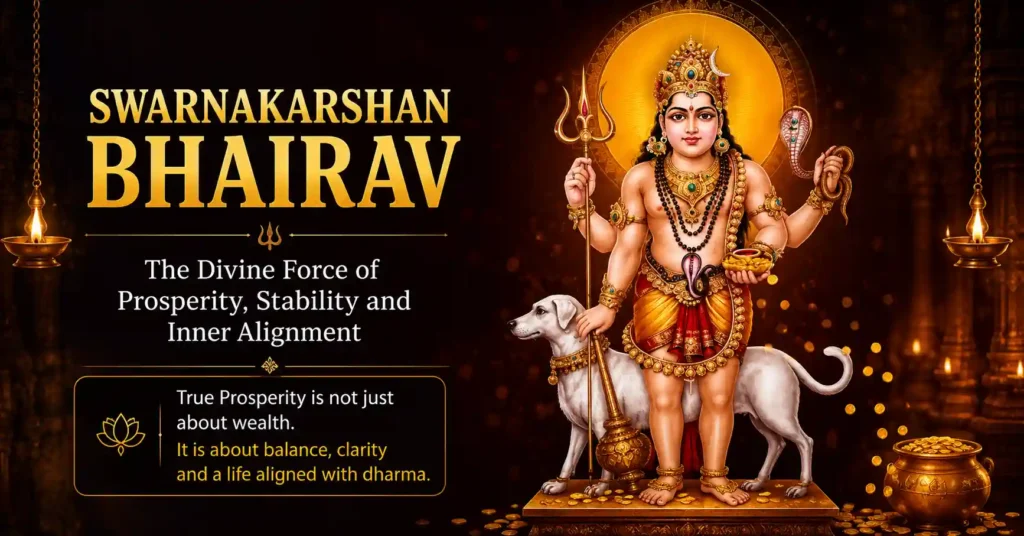
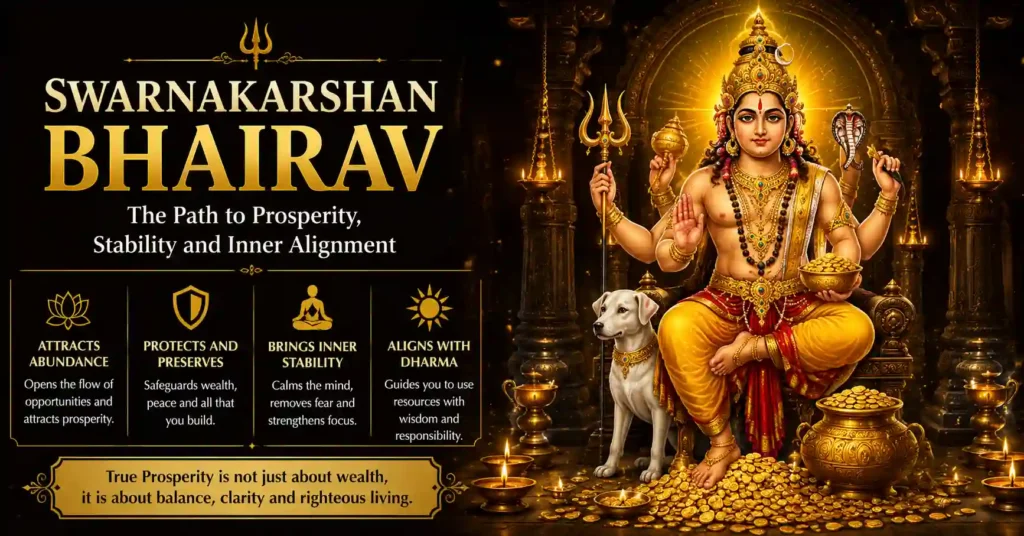
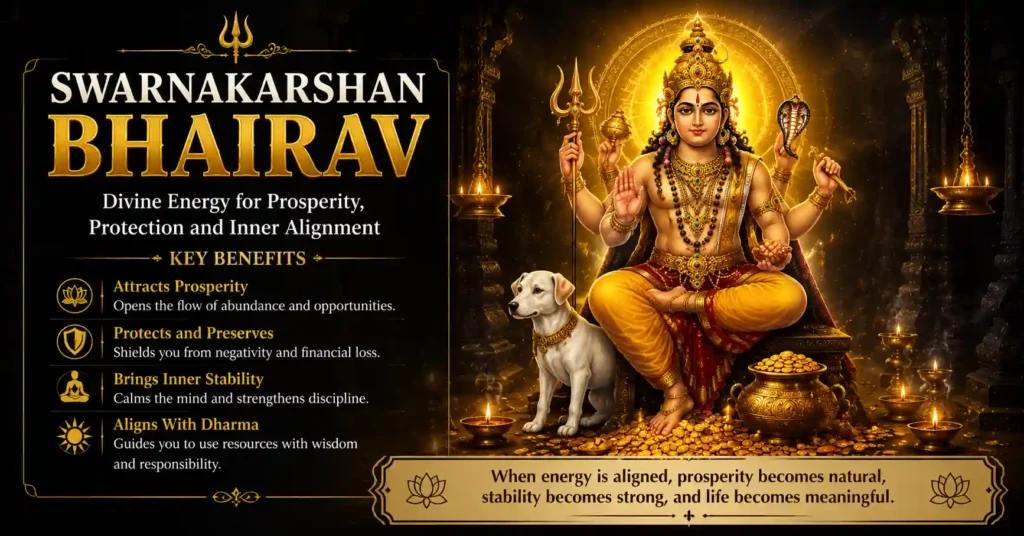
Swarnakarshan Bhairav is often depicted with a radiant golden complexion, seated upon a golden throne, and holding symbols associated with authority, protection, and abundance.
A golden vessel may represent inexhaustible blessings and sustenance, while the trident symbolizes mastery over physical, mental, and spiritual dimensions of life.
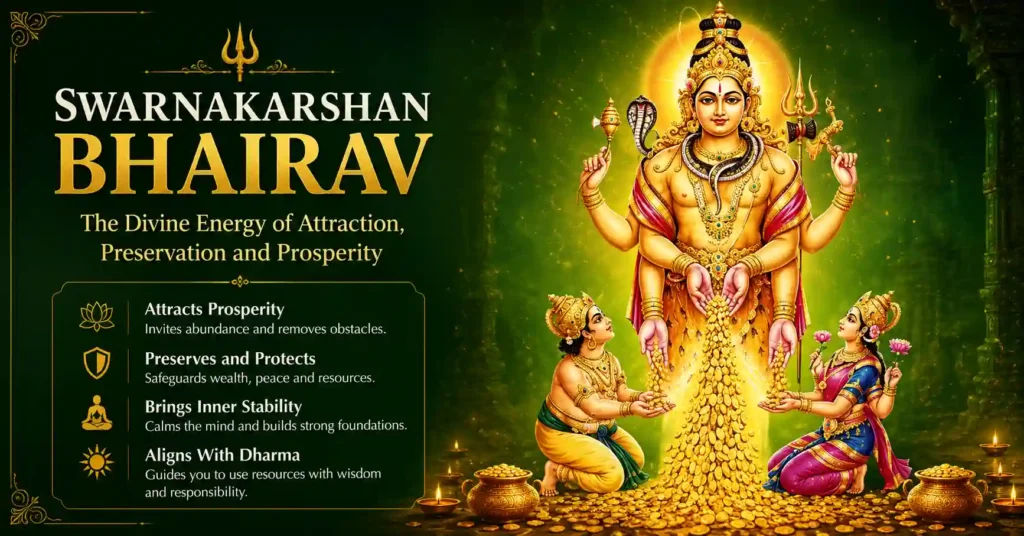
In some traditions, he is depicted alongside Bhairavi, representing the union of stability and dynamic energy, Shiva and Shakti working together.
These symbols suggest that prosperity is not viewed merely as material accumulation. Instead, it is understood as a state where inner clarity, right action, and outer abundance exist in harmony.
The Quiet Presence of Swarnakarshan Bhairav
Swarnakarshan Bhairav is often understood as a specialized form of Bhairava associated with preservation, stability, and responsible prosperity.
While Kaal Bhairav is widely known as the guardian of time, discipline, and spiritual vigilance, this form is traditionally approached through the lens of sustenance and continuity.
Many devotees view Swarnakarshan Bhairav as expressing the same Bhairava principle in a way that emphasizes maintaining balance rather than simply overcoming obstacles.
For this reason, prosperity in this tradition is not viewed merely as acquiring wealth but also as preserving and using it wisely.
In some traditions, Swarnakarshan Bhairav is also referred to as Narayan Bhairav. This title highlights themes of preservation and support that are often associated with sustaining life, resources, and opportunities over time.
This perspective points toward an important teaching: receiving something valuable is only one part of the journey. The ability to protect, preserve, and use it responsibly is equally important.
What “Swarnakarshan” Really Means
The meaning of Swarnakarshan is often understood very literally. Many people assume it simply refers to attracting gold, money, or material wealth. Traditional interpretations, however, often suggest a deeper meaning.
The word Swarn means gold, but symbolically it can also represent purity, value, stability, and something that endures over time. In some spiritual and Tantric traditions, gold is viewed as a symbol of refined consciousness and lasting worth.
Akarshan means attraction or drawing something toward oneself. Here, the idea is not force or pursuit but natural alignment, much like a magnet attracts what resonates with it.
From this perspective, Swarnakarshan Bhairav is not merely associated with acquiring wealth. He is also associated with developing the clarity, discipline, and stability that allow prosperity, opportunity, and well-being to be preserved and used wisely.
This is why many traditions view prosperity not only as what comes into one’s life, but also as the ability to sustain and grow it responsibly.
Why Bhairav is Connected with Wealth at All
At first, it may seem surprising that a form of Bhairava is associated with prosperity and abundance. Traditionally, wealth is more commonly linked with deities such as Maa Lakshmi and Kubera.
The connection becomes easier to understand when prosperity is viewed in a broader sense. Wealth is not only about acquiring resources. It is also about preserving them, using them wisely, and maintaining stability over time.
Many traditional teachings suggest that financial difficulties are not always caused by a lack of opportunity. Fear, confusion, poor judgment, impatience, and instability can also prevent people from making the best use of what they already have.
This is where the symbolism of Bhairava becomes important. Bhairava is associated with clarity, discipline, awareness, and the removal of obstacles. Through these qualities, devotees believe that inner confusion gradually gives way to greater steadiness and better decision-making.
For this reason, Swarnakarshan Bhairav is often understood not merely as a giver of prosperity, but as a force that helps create the conditions through which prosperity can be sustained and used responsibly.
A Story that Carries a Deeper Meaning
Several traditions preserve stories that symbolically connect Swarnakarshan Bhairav with the restoration of prosperity and balance.
One such narrative describes a period in which even Lakshmi and Kubera experienced the loss of wealth and abundance.
Seeking a solution, they turned toward Shiva through prayer and spiritual discipline. Through this process, Swarnakarshan Bhairav appeared and prosperity was restored.
Whether understood literally or symbolically, the deeper message remains the same. The story suggests that abundance is not sustained by possession alone. It depends upon balance, awareness, and alignment.
For many devotees, this teaching is the true significance of the story. Prosperity is not merely something that is acquired. It is something that flourishes when wisdom, discipline, and right action are present.
The Form and Presence of Swarnakarshan Bhairav
Swarnakarshan Bhairav is often described as having a radiant golden appearance. The golden glow is traditionally understood not merely as a physical color but as a symbol of prosperity, preservation, purity, and enduring value.
He is commonly depicted seated upon a golden throne, sometimes beneath the divine Parijata tree, which is associated in Hindu tradition with fulfillment, abundance, and divine blessings.
Several elements of his iconography carry symbolic meaning:
| Symbol | Traditional Meaning |
|---|---|
| Golden complexion | Prosperity, purity, and enduring value |
| Golden throne | Stability, authority, and preservation |
| Golden vessel | Sustained abundance and nourishment |
| Trident (Trishul) | Mastery over physical, mental, and spiritual life |
| Damaru | Creation, rhythm, and cosmic balance |
| Parijata tree | Divine blessings and fulfillment |
In many traditions, Swarnakarshan Bhairav is also depicted alongside Bhairavi. This symbolism reflects the union of Shiva and Shakti, stability and movement, preservation and growth.
Traditional interpretations suggest that prosperity becomes sustainable only when these complementary forces remain in balance.
For this reason, Swarnakarshan Bhairav and Bhairavi are often viewed together as representing both attraction and grounding, abundance and responsibility.
Scriptural and Tantric Significance
Swarnakarshan Bhairav occupies a special place within certain Shaiva and Tantric traditions, where he is revered as a form associated with prosperity, preservation, and the responsible use of power and resources.
References to this form are found primarily within Bhairava-centered worship traditions and later Tantric lineages rather than in the most widely known devotional narratives of Hinduism.
For this reason, knowledge of Swarnakarshan Bhairav has often remained more closely associated with practitioners, temples, and lineage-based teachings than with mainstream worship.
In traditional understanding, prosperity is not viewed merely as the accumulation of wealth. It is also connected with stability, discipline, clarity of judgment, and the ability to preserve what has been earned.
Swarnakarshan Bhairav is therefore revered not only as a bestower of abundance but also as a force that helps remove the inner obstacles that prevent prosperity from being sustained.
Many traditions also regard this form as a protector of sacred knowledge and a guide for those seeking balance between spiritual growth and worldly responsibilities.
This combination of prosperity and spiritual discipline is what gives Swarnakarshan Bhairav a distinctive place within the wider Bhairava tradition.
Some Tantric traditions also associate Swarnakarshan Bhairav with practices connected to Maa Baglamukhi, particularly where themes of protection, victory, stability, and prosperity overlap.
However, the Bhairava associated with Baglamukhi varies across lineages, and there is no single universally accepted identification.
As with many Bhairava traditions, understandings of Swarnakarshan Bhairav may differ between scriptural references, temple traditions, regional practices, and modern devotional interpretations.
While the core themes of prosperity, preservation, and stability remain consistent, specific stories, rituals, and methods of worship may vary across different communities and guru lineages.
In Shaiva and Tantric traditions
Within the broader Shaiva tradition, Bhairava is revered as a powerful manifestation of Lord Shiva who protects sacred spaces, removes obstacles, and guides spiritual transformation.
Swarnakarshan Bhairav expresses these same qualities through a form traditionally associated with prosperity, preservation, and stability.
In devotional practice, many devotees worship this form while seeking support in matters related to livelihood, financial stability, and the responsible management of resources.
However, traditional teachings generally emphasize that prosperity should be accompanied by wisdom, discipline, and ethical conduct.
Tantric traditions often approach Swarnakarshan Bhairav from a wider perspective. Rather than focusing solely on material wealth, they view abundance as the result of harmony between inner awareness and outer action.
In this understanding, prosperity is sustained through clarity, balance, and right living.
Although different lineages may emphasize different aspects of worship, the common theme remains the same: prosperity is most meaningful when it supports both worldly well-being and spiritual growth.
Swarnakarshan Bhairav vs Kaal Bhairav
Many devotees first encounter Swarnakarshan Bhairav after learning about Kaal Bhairav.
While both are forms of Bhairava and manifestations of Lord Shiva, their symbolism, emphasis, and devotional focus are understood somewhat differently across traditions.
| Aspect | Swarnakarshan Bhairav | Kaal Bhairav |
|---|---|---|
| Primary Association | Prosperity, stability, preservation | Time, discipline, karmic accountability |
| Nature | Attracting and sustaining abundance | Removing ignorance and enforcing discipline |
| Symbolism | Wealth, alignment, responsible prosperity | Time, truth, vigilance, transformation |
| Devotional Focus | Stability, livelihood, balanced growth | Protection, courage, spiritual discipline |
| Common Prayer Intent | Prosperity, success, financial stability | Removal of fear, obstacles, and confusion |
| Inner Teaching | Become capable of sustaining abundance | Become free from fear and illusion |
| Relationship | A specialized prosperity-related form of Bhairava | The principal and most widely worshipped Bhairava form |
Despite these differences, the two forms should not be viewed as separate or competing energies.
Many traditions understand Swarnakarshan Bhairav as expressing the same Bhairava principle through the lens of preservation, stability, and responsible prosperity.
In this sense, both forms ultimately guide devotees toward greater clarity, strength, and alignment with dharma.
Why This Path is not Openly Discussed
Many devotees are surprised to discover that Swarnakarshan Bhairav is not as widely known as forms such as Kaal Bhairav, despite his importance in certain traditions.
Dedicated temples for this form are relatively rare, and his worship is often preserved within broader Bhairava traditions, Tantric lineages, and guru-disciple teachings.
In places such as Kashi and Ujjain, Bhairava worship remains vibrant, but Swarnakarshan Bhairav is often invoked within larger ritual and spiritual frameworks rather than through separate public traditions.
The reason is not secrecy for its own sake. Many traditional practices associated with Bhairava worship involve discipline, preparation, and proper understanding.
For this reason, certain methods have historically been transmitted through lineages rather than taught openly.
At the same time, simple devotion, prayer, and mantra chanting remain accessible to everyone.
What is traditionally preserved within lineages are not the devotional aspects, but the more advanced ritual and Tantric practices that require guidance and experience.
Initiation and Deeper Sadhana
Simple devotion to Swarnakarshan Bhairav does not require formal initiation. Many devotees begin through prayer, mantra chanting, meditation, and regular remembrance.
However, in traditional Shaiva and Tantric lineages, more advanced forms of sadhana are usually undertaken after receiving initiation (diksha) from a qualified guru.
Initiation is viewed as a sacred transmission that helps practitioners approach deeper practices responsibly and with proper guidance. These may include advanced mantra disciplines, yantra worship, ritual practices, and lineage-specific methods.
Traditional teachings generally distinguish between devotional worship and formal sadhana. While devotion is open to all sincere seekers, advanced practices are often approached gradually under guidance so that they are understood and performed correctly.
For most devotees, simple and sincere devotion remains a complete and meaningful path in itself. Initiation becomes relevant primarily for those who wish to pursue deeper ritual, mantra, or Tantric disciplines.
Mantra and its Spiritual Significance
Mantra is one of the most common ways devotees connect with Swarnakarshan Bhairav. In traditional understanding, a mantra is not merely a prayer but a sacred sound that helps focus the mind and strengthen one’s connection with the deity.
One commonly recited mantra is:
Om Shreem Swarnakarshan Bhairavaya Namah
Many devotees chant this mantra while seeking clarity, stability, confidence, and a balanced approach toward prosperity and life responsibilities.
Traditional belief holds that regular mantra japa helps cultivate:
- Mental clarity
- Greater focus
- Emotional stability
- Confidence during uncertainty
- A deeper sense of inner alignment
The purpose of mantra practice is not simply to attract wealth. Many traditions emphasize that the deeper benefit lies in developing the mindset, discipline, and awareness required to use opportunities wisely.
While devotional chanting can be practiced by anyone, advanced mantra disciplines involving large numbers of repetitions, specific rituals, or initiatory practices are traditionally undertaken under proper guidance.
Yantra and its Traditional Use
A yantra is a sacred geometric representation used in several Hindu and Tantric traditions as an aid for concentration, meditation, and worship.
Swarnakarshan Bhairav Yantra is traditionally associated with prosperity, stability, protection, and focused intention.
Devotees who use a yantra generally place it in a clean and respected area of worship. It is often used alongside mantra chanting and regular prayer rather than as a standalone practice.
Traditional uses may include:
- Supporting concentration during worship
- Creating a dedicated space for spiritual practice
- Reinforcing devotional focus
- Symbolically invoking prosperity and stability
Different traditions prescribe different methods of worship and installation. For household devotees, respectful placement, regular prayer, and sincere devotion are generally considered sufficient.
How Practice Slowly Becomes Part of You
In the beginning, any form of spiritual practice feels like effort. You sit, chant, try to focus, and wonder whether anything is actually changing.
Over time, however, something subtle begins to happen. The practice no longer feels separate from daily life. It becomes a natural part of the day, much like a quiet conversation that continues in the background.
Some traditions recommend practicing at night when the mind is calm and distractions are fewer. Others prefer the early morning hours. While these timings may be helpful, the deeper teaching is not about choosing the perfect moment. It is about consistency.
Even a few minutes of sincere remembrance each day often has a greater impact than long periods of distracted practice. Many devotees believe that transformation happens gradually, through regular connection, patience, and steady effort rather than dramatic experiences.
Over time, the practice stops feeling like something you do and begins to feel like a natural part of who you are.
The Deeper Layer of Tantra in Swarnakarshan Bhairav
Tantra is often one of the most misunderstood aspects of Hindu spirituality. In many traditional interpretations, tantra does not simply mean something secretive or mysterious. It refers to structured methods that use mantra, ritual, meditation, and symbolic practices to deepen spiritual awareness.
Within some lineages, Swarnakarshan Bhairav worship may include practices such as:
- Yantra for concentration and devotional focus
- Tarpan as a ritual offering
- Nyasa as a method of internalizing mantra through the body
- Advanced mantra disciplines practiced under guidance
These methods are generally considered part of deeper sadhana rather than the starting point of worship.
For most devotees, simple prayer, mantra chanting, meditation, and sincere devotion are more than sufficient. Traditional teachings emphasize that spiritual progress comes through consistency and understanding, not through the complexity of the practice itself.
The Connection with Karma and Planets
In many traditional interpretations, prosperity is influenced not only by effort and opportunity but also by karmic tendencies and patterns of decision-making that develop over time.
For this reason, some devotees associate Swarnakarshan Bhairav with the gradual correction of habits that create instability, confusion, or repeated setbacks.
Astrological traditions often connect this form with Rahu and Shani:
| Planet | Traditional Association |
|---|---|
| Rahu | Desire, ambition, expansion, and uncertainty |
| Shani | Discipline, responsibility, patience, and long-term consequences |
When these influences are believed to be imbalanced, individuals may experience:
- Delays and obstacles
- Poor decision-making
- Financial instability
- Confusion about priorities
- Difficulty maintaining consistency
Devotees believe that regular worship helps cultivate patience, awareness, and steadiness, allowing these challenges to be approached more consciously and responsibly.
Astrology and Traditional Remedies
In some devotional and astrological traditions, Swarnakarshan Bhairav is associated with challenges connected to Rahu and Shani (Saturn), particularly when financial instability, confusion, delays, or repeated setbacks become recurring concerns.
Common practices associated with these traditions include:
- Chanting Swarnakarshan Bhairav mantras
- Lighting a lamp during prayer
- Worship through yantra and devotional practices
- Acts of charity and service
- Regular spiritual discipline
It is important to note that these associations arise primarily from devotional and astrological traditions rather than a single universally accepted scriptural source. Devotees believe that sincere worship helps cultivate patience, clarity, and responsible decision-making during difficult periods of life.
Important Temples and Living Traditions
Unlike Kaal Bhairav, Swarnakarshan Bhairav is not commonly worshipped through large numbers of dedicated temples.
His worship is often preserved within broader Bhairava traditions, Tantric lineages, and specific temple practices rather than through independent public shrines.
Several important Bhairava centers across India maintain traditions connected with prosperity, protection, and preservation that devotees associate with this form.
| Place | Traditional Association |
|---|---|
| Kashi (Varanasi) | Bhairava worship as guardian of sacred spaces and spiritual journeys |
| Ujjain | Ancient Bhairava traditions connected with Shaiva and Tantric practices |
| Tantric lineages across India | Worship through mantra, yantra, and lineage-based practices |
| Bhairava temples in Shakta traditions | Prosperity and protection aspects preserved within broader Bhairava worship |
In many traditions, Swarnakarshan Bhairav is invoked through personal practice, mantra japa, yantra worship, and guidance received from a guru rather than through large-scale public festivals.
This has contributed to the form remaining less widely known while continuing to hold significance among practitioners who follow Bhairava-centered traditions.
The living traditions surrounding Swarnakarshan Bhairav therefore emphasize not only the attraction of prosperity but also discipline, responsibility, and the ability to preserve what has been received.
Traditional understanding of Swarnakarshan Bhairav is often preserved through guru lineages, temple traditions, and practitioner communities rather than through large public institutions.
As a result, methods of worship, mantra usage, and ritual emphasis may vary from one lineage to another. This diversity reflects the living nature of Bhairava worship while maintaining a shared focus on prosperity, stability, protection, and spiritual responsibility.
What Changes When the Connection Deepens
People often look for visible results when they begin any spiritual practice. Yet many traditions suggest that the first changes are usually internal rather than external.
Devotees often describe gradual shifts such as:
- Reduced fear and anxiety
- Greater clarity in decision-making
- Improved patience during uncertainty
- Better control over impulsive actions
- A stronger sense of stability and confidence
- Greater awareness of habits and patterns
These changes may seem subtle at first, but they often influence how a person responds to opportunities, challenges, and responsibilities in everyday life.
For this reason, many devotees believe that Swarnakarshan Bhairav does not work through sudden transformation alone. The process is often described as one of gradual alignment, where inner stability develops first and outer circumstances begin to reflect that change over time.

Where most People go Wrong
One of the most common misunderstandings about Swarnakarshan Bhairav is approaching the path solely for quick financial gain.
Traditional teachings generally caution against treating any spiritual practice as a shortcut to wealth or success. The purpose of worship is not merely to obtain something but to cultivate the qualities needed to use it wisely.
Common mistakes include:
- Seeking only immediate financial results
- Approaching the practice with greed or impatience
- Ignoring self-discipline and personal responsibility
- Focusing only on material outcomes
- Expecting spiritual practice to replace effort and wise action
Many traditions teach that prosperity becomes meaningful only when it is supported by clarity, stability, and right conduct. For this reason, devotees often describe Swarnakarshan Bhairav as a path of alignment and correction rather than a shortcut to abundance.
When the intention shifts from acquiring more to becoming more balanced, disciplined, and aware, the deeper purpose of the practice begins to unfold.
The Real Meaning of Prosperity Here
Prosperity, in the deeper sense, is not limited to money or material possessions. It is a state of greater balance, stability, and alignment in one’s life.
The mind becomes less restless. Decisions are no longer driven primarily by fear, anxiety, or impulsive reactions. There is greater clarity about what truly matters and more patience when facing uncertainty.
From this perspective, prosperity includes many forms of well-being: stability in daily life, responsible use of resources, healthy relationships, meaningful work, and a sense of inner confidence.
Many traditions therefore view wealth as only one aspect of prosperity rather than its sole measure. When clarity, discipline, and stability begin to develop within, a person is often better able to recognize opportunities, make thoughtful decisions, and build a more balanced life.
In this understanding, prosperity is not simply something that is received. It is something that is cultivated, sustained, and used wisely.
What this Form Represents for Serious Seekers
For many devotees, Swarnakarshan Bhairav is associated with prosperity and abundance. For serious seekers, however, the symbolism often points toward something deeper.
In this understanding, wealth is not merely the accumulation of resources but the capacity to use them wisely. Stability is not simply financial security but freedom from constant fear, confusion, and impulsive decision-making.
Many practitioners therefore view Swarnakarshan Bhairav as a reminder that true prosperity begins with inner order. When clarity, discipline, and responsibility develop within, outer life often becomes more balanced as well.
This is why advanced interpretations of this form focus not only on receiving abundance but on becoming capable of sustaining it in a way that supports both worldly life and spiritual growth.
A Final Understanding that Changes Everything
At some point, the question itself begins to change.
Instead of asking, “How can I get more?”, a deeper question arises:
“How can I become capable of receiving, preserving, and using wisely what life has already placed before me?”
This shift in perspective is where many traditions believe the deeper understanding of Swarnakarshan Bhairav begins.
For serious seekers, this form is not merely associated with wealth. It represents readiness, responsibility, stability, and the ability to remain balanced while navigating both success and difficulty.
The focus gradually moves away from acquiring more and toward becoming more aware, disciplined, and aligned. Prosperity is no longer viewed only as possession but as the ability to sustain, protect, and use resources in a meaningful way.
In this sense, Swarnakarshan Bhairav is not simply a deity associated with abundance. He is a reminder that lasting prosperity begins with inner transformation.
Suggested reading
If you would like to explore the wider world of Bhairava worship, prosperity traditions, and Shaiva philosophy, these articles may be helpful:
Batuk Bhairav: The Gentle Protector who Removes Fear and Obstacles
https://thesanatantales.com/batuk-bhairav-removes-fear-obstacles/
Discover the child form of Bhairava who is widely worshipped for protection, courage, and the removal of obstacles.
Kaal Bhairav: The Fierce Guardian of Time and Truth
https://thesanatantales.com/kaal-bhairav/
Explore the powerful Bhairava form associated with time, karmic discipline, and spiritual transformation.
Bhairav Tattva: The Fierce Principle of Time, Truth and Awakening
https://thesanatantales.com/bhairav-tattva/
Understand the deeper philosophy of Bhairava beyond rituals, temples, and forms.
Ashta Bhairav: Powerful Guardians of Time, Direction, and Dharma
https://thesanatantales.com/ashta-bhairav/
Learn about the eight major forms of Bhairava and their role within Shaiva traditions.
Bhagwan Shiv: The Supreme Consciousness
https://thesanatantales.com/bhagwan-shiv-the-supreme-consciousness/
Explore the deeper nature of Lord Shiva from whom all Bhairava forms emerge.
Das Mahavidya: Origin, Stories, Sadhana, Temples, and Living Traditions
https://thesanatantales.com/das-mahavidya/
Discover the ten Mahavidyas and the important role Bhairava plays in many Shakta traditions.
Bhairava (Wikipedia)
https://en.wikipedia.org/wiki/Bhairava
Bhairava is a fierce and protective manifestation of Lord Shiva in Hinduism, especially revered in Shaiva and Tantric traditions. He is worshipped as the guardian of sacred places, the destroyer of fear and ignorance, and the divine protector who guides devotees toward spiritual discipline and liberation.
FAQs
Who is Swarnakarshan Bhairav?
Swarnakarshan Bhairav is a revered form of Bhairava, a manifestation of Lord Shiva traditionally associated with prosperity, stability, preservation, and inner alignment. Many devotees worship him not only for material well-being but also for clarity, discipline, and responsible growth.
What does the name Swarnakarshan Bhairav mean?
The name combines two Sanskrit words: Swarn (gold) and Akarshan (attraction). While it is often interpreted as attracting wealth, many traditions understand it more deeply as attracting stability, abundance, and the ability to preserve and use resources wisely.
Is Swarnakarshan Bhairav different from Kaal Bhairav?
Both are forms of Bhairava and manifestations of Lord Shiva. Kaal Bhairav is commonly associated with time, discipline, and karmic accountability, while Swarnakarshan Bhairav is traditionally connected with prosperity, preservation, and responsible abundance.
Is Swarnakarshan Bhairav worship only for wealth?
No. Although this form is associated with prosperity, traditional teachings emphasize that true prosperity includes stability, wisdom, discipline, confidence, and the ability to manage resources responsibly. Wealth is viewed as one aspect of a balanced life rather than the sole goal.
Can anyone worship Swarnakarshan Bhairav?
Yes. Simple prayer, mantra chanting, meditation, and sincere devotion can be practiced by anyone. More advanced rituals and Tantric practices are traditionally undertaken under the guidance of a qualified guru.
What is the mantra of Swarnakarshan Bhairav?
One commonly recited mantra is:
Om Shreem Swarnakarshan Bhairavaya Namah
Many devotees chant this mantra while seeking clarity, stability, confidence, and a balanced approach toward prosperity and life responsibilities.
What are the benefits of chanting the Swarnakarshan Bhairav mantra?
Devotees believe that regular mantra chanting can help cultivate focus, patience, emotional stability, confidence, and spiritual discipline. Traditional belief also associates the practice with removing obstacles and supporting overall well-being.
What is a Swarnakarshan Bhairav Yantra?
A Swarnakarshan Bhairav Yantra is a sacred geometric symbol used in some devotional and Tantric traditions. It is often worshipped alongside mantra practice as a tool for concentration, prayer, and spiritual focus.
Is Swarnakarshan Bhairav connected with astrology?
In some astrological traditions, Swarnakarshan Bhairav is associated with challenges related to Rahu and Shani. Devotees believe that regular worship helps develop patience, clarity, and steadiness during periods of uncertainty and difficulty.
Does Swarnakarshan Bhairav require initiation (Diksha)?
Simple devotion does not require initiation. However, advanced mantra disciplines, ritual practices, and certain Tantric methods are traditionally practiced after receiving initiation from a qualified guru.
What does Swarnakarshan Bhairav represent for spiritual seekers?
For serious seekers, Swarnakarshan Bhairav represents much more than material prosperity. He symbolizes inner stability, responsible growth, self-discipline, and the ability to remain balanced while navigating both success and challenges.
Are there dedicated temples of Swarnakarshan Bhairav?
Dedicated temples are relatively rare compared to other Bhairava forms. His worship is often preserved within broader Bhairava traditions, temple lineages, and guru-disciple teachings, particularly in places where Shaiva and Tantric traditions remain active.
Glossary of Important Terms
| Term | Meaning |
|---|---|
| Swarnakarshan Bhairav | A revered form of Bhairava associated with prosperity, stability, preservation, wise use of resources, and spiritual balance. |
| Bhairava | A fierce and protective manifestation of Lord Shiva associated with time, protection, discipline, and spiritual transformation. |
| Lord Shiva | One of the principal deities of Hinduism and the Supreme Reality in Shaiva tradition, from whom all Bhairava forms emerge. |
| Swarn | A Sanskrit word meaning “gold,” symbolizing prosperity, purity, stability, and enduring value. |
| Akarshan | A Sanskrit word meaning “attraction” or “drawing toward oneself,” representing natural alignment with abundance and opportunity. |
| Bhairavi | The feminine counterpart of Bhairava, representing Divine Shakti, dynamic energy, and spiritual power. |
| Shaivism (Shaiva Tradition) | A major Hindu tradition centered on the worship of Lord Shiva and his manifestations. |
| Tantra | A spiritual tradition that uses mantra, meditation, ritual, and symbolism for self-transformation and realization. |
| Shakti | Divine cosmic energy or power, personified as the Divine Mother in Hindu traditions. |
| Narayan Bhairav | A traditional title used in some lineages for Swarnakarshan Bhairav, highlighting his role in preservation, stability, and sustenance. |
| Maa Lakshmi | The Hindu goddess of wealth, prosperity, fortune, and abundance. |
| Kubera | The Hindu deity of wealth and the divine treasurer of the gods. |
| Parijata Tree | A celestial wish-fulfilling tree symbolizing divine blessings, fulfillment, and abundance. |
| Trishul (Trident) | A sacred weapon symbolizing mastery over the physical, mental, and spiritual aspects of existence. |
| Damaru | Lord Shiva’s sacred drum representing creation, cosmic rhythm, and the cycle of existence. |
| Kaal Bhairav | The principal form of Bhairava associated with time, karmic justice, discipline, and spiritual vigilance. |
| Dharma | The universal principle of righteousness, duty, and moral order that sustains the universe. |
| Karma | The law of cause and effect through which actions influence future experiences and spiritual progress. |
| Sadhana | A disciplined spiritual practice undertaken for inner growth and realization of the Divine. |
| Diksha | Spiritual initiation received from a qualified guru before undertaking advanced spiritual practices. |
| Guru | A spiritual teacher who guides seekers on the path of knowledge and self-realization. |
| Mantra | A sacred sound or phrase repeated during prayer or meditation to invoke divine blessings and focus the mind. |
| Om Shreem Swarnakarshan Bhairavaya Namah | A traditional mantra dedicated to Swarnakarshan Bhairav for prosperity, stability, and inner clarity. |
| Mantra Japa | The repeated chanting of a sacred mantra as a form of meditation and spiritual discipline. |
| Yantra | A sacred geometric diagram used as a focus for meditation, worship, and spiritual concentration. |
| Swarnakarshan Bhairav Yantra | A sacred yantra associated with prosperity, protection, stability, and devotional focus. |
| Tarpan | A ritual offering made with water or other sacred substances as an act of reverence and gratitude. |
| Nyasa | A Tantric practice of placing mantras symbolically on different parts of the body to internalize divine energy. |
| Rahu | A shadow planet in Vedic astrology associated with desire, ambition, illusion, expansion, and uncertainty. |
| Shani (Saturn) | The planetary deity associated with discipline, patience, karma, responsibility, and long-term growth. |
| Kashi (Varanasi) | One of Hinduism’s holiest cities and an important center of Bhairava worship. |
| Ujjain | An ancient pilgrimage city famous for Mahakaleshwar and long-standing Bhairava traditions. |
| Prosperity (Samriddhi) | In the spiritual sense, a state of balance, stability, responsible abundance, and inner contentment, not merely financial wealth. |
| Preservation | The ability to protect, sustain, and wisely use resources, opportunities, and blessings received in life. |
| Inner Alignment | A state in which thoughts, actions, values, and spiritual purpose remain balanced and harmonious. |
| Abundance | A broader concept that includes material well-being, emotional stability, wisdom, meaningful relationships, and spiritual growth. |
| Lineage (Parampara) | An unbroken tradition of spiritual teachings passed from guru to disciple across generations. |
| Living Tradition | Spiritual practices and teachings preserved through temples, families, gurus, and practitioner communities rather than scripture alone. |
| Responsible Prosperity | A key teaching of Swarnakarshan Bhairav that emphasizes earning, preserving, and using wealth with wisdom, ethics, and discipline. |
| Spiritual Discipline | The consistent practice of devotion, self-control, meditation, and ethical living that supports both worldly and spiritual progress. |
About the Author
Yateendra Chaturvedi is a spiritual writer, researcher, devotee, and the founder of The Sanatan Tales. With over 35 years of professional experience and a lifelong interest in Sanatan Dharma, he writes about Hindu deities, temples, scriptures, festivals, Mahavidyas, sacred stories, rituals, and living traditions that continue to guide and inspire devotees across India.
Drawing from traditional scriptures, regional beliefs, temple traditions, devotional literature, and historical sources, he aims to present authentic, well-researched, and easy-to-understand content for modern readers. His work focuses on preserving spiritual wisdom, explaining sacred traditions, and helping seekers develop a deeper understanding of India’s rich spiritual heritage.
Through The Sanatan Tales, Yateendra strives to make the timeless teachings of Sanatan Dharma simple, meaningful, and relevant for today’s generation while maintaining respect for traditional sources, regional practices, and diverse spiritual perspectives.
Learn More About Yateendra Chaturvedi →
https://thesanatantales.com/about-the-author/
References & Sources
This article is based on Shaiva and Bhairava traditions followed within Sanatan Dharma, traditional beliefs associated with Lord Bhairava, religious narratives, folk traditions, and insights gathered from various spiritual and religious study sources. Some concepts discussed in this article are also inspired by interpretations found in guru-disciple lineages, temple traditions, and devotional literature.
Note: Beliefs, stories, and methods of worship related to Lord Bhairava may differ across regions, sects, and spiritual traditions. The purpose of this article is not to present any single viewpoint as the absolute truth, but to explain commonly accepted religious and spiritual perspectives in a simple and accessible manner.
Explore More Fascinating Topics from Sanatan Dharma




Vanakkam,
Searching and seeking financial security and abundance led me to your website. A wealth of information and guidance i found over here. Will be spending more time here to learn more.
Pranams.
Arun Prakaash
Vanakkam Arun Prakaash Ji. Thank you for your kind words and encouragement. I’m truly glad you found value in Sanatan Tales. May Maa Lakshmi bless you with abundance, wisdom, and peace. Pranams. 🙏