There is something fascinating about the Das Mahavidya tradition.
Some people encounter it through the fierce image of Maa Kali. Others are drawn to the compassion of Maa Tara, the beauty of Tripura Sundari, or the mystery surrounding ancient Tantric practices.
Yet the deeper one explores, the more one discovers that the Mahavidyas are not merely ten goddesses. They are ten windows into the nature of life, consciousness, and spiritual transformation.
In the Shakta tradition of Sanatan Dharma, the Divine Mother is not limited to a single form. She appears in countless ways to guide, protect, awaken, nourish, challenge, and transform her devotees.
The Das Mahavidyas are among the most profound expressions of this truth. Each Mahavidya reveals a different aspect of Shakti, offering wisdom suited to a particular stage of the seeker’s journey.
Some forms teach courage in the face of fear. Some reveal the importance of discipline and self-awareness. Others guide devotees through loss, uncertainty, prosperity, devotion, knowledge, and ultimately liberation.
Together, the ten Mahavidyas form a complete spiritual map that embraces every aspect of human experience.
For beginners, the Mahavidyas may appear mysterious or even intimidating. For devotees, they are beloved forms of the Divine Mother.
For spiritual seekers and practitioners of Tantra, they represent profound pathways of inner awakening. Yet despite their differences, all ten forms share a common purpose: to help the soul move closer to truth.
This is why the Das Mahavidya tradition continues to inspire devotion, contemplation, and spiritual practice across India. It is not merely a collection of myths, rituals, or temples.
It is a living tradition that invites the seeker to encounter the Divine Mother in all her forms and discover the wisdom hidden within every phase of life.
Das Mahavidya at a Glance
Before exploring the deeper philosophy and symbolism of the Mahavidyas, it helps to understand the tradition through a simple overview.
Aspect | Details |
Meaning | Ten Great Wisdom Goddesses |
Tradition | Shakta Tradition of Sanatan Dharma |
Primary Focus | Spiritual transformation through Divine Mother worship |
Total Forms | 10 Mahavidyas |
Central Principle | Different manifestations of Shakti guiding the seeker |
Major Paths | Devotion, Mantra, Tantra, Meditation, Self-Transformation |
Associated Traditions | Shaktism, Tantra, Sri Vidya, Kaula Traditions |
Important Festival | Gupt Navratri |
Spiritual Goal | Self-realisation, liberation, and union with the Divine Mother |
The Das Mahavidya tradition is unique because it embraces every aspect of existence. Some Mahavidyas appear gentle and nurturing, while others appear fierce and challenging. Together, they reveal that the Divine Mother is present not only in beauty, prosperity, and comfort, but also in change, discipline, sacrifice, and transformation.
For this reason, devotees often see the Mahavidyas not as separate goddesses, but as ten expressions of one infinite Shakti guiding the soul through different stages of life and spiritual awakening.
Table of Contents
ToggleWhat Is Das Mahavidya in Simple Terms
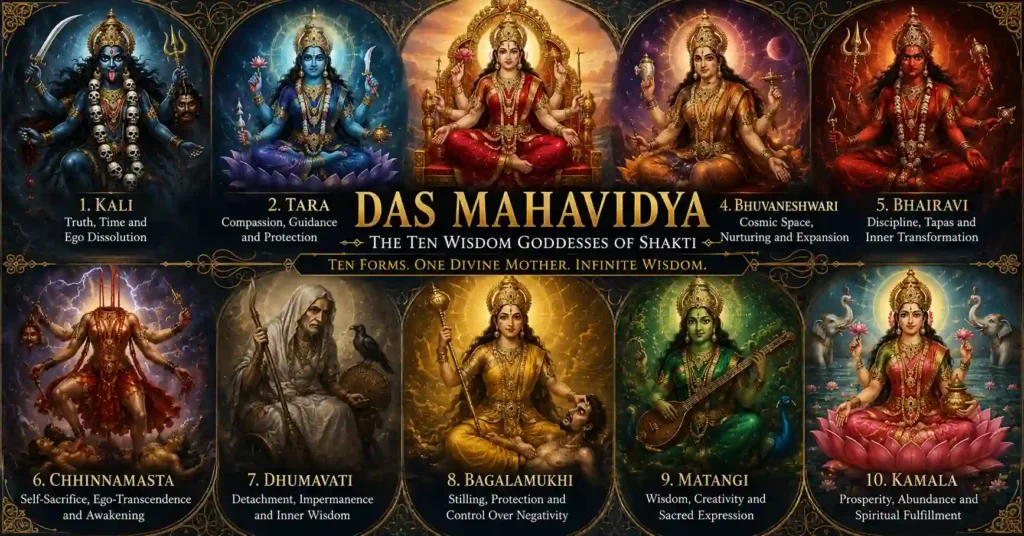
The word Mahavidya comes from two Sanskrit words: Maha meaning “great” and Vidya meaning “wisdom” or “knowledge.” Therefore, Das Mahavidya means “The Ten Great Wisdom Goddesses.”
At a simple level, the Das Mahavidyas are ten divine forms of the Divine Mother worshipped in the Shakta tradition of Sanatan Dharma. Each goddess represents a unique aspect of Shakti and reveals a particular truth about life, consciousness, and spiritual growth.
However, the Mahavidyas are far more than ten separate deities. They are ten expressions of one Divine Mother. Just as sunlight appears in different colours through a prism, the one infinite Shakti manifests through ten distinct forms to guide seekers through different experiences and stages of awakening.
Some Mahavidyas appear gentle and compassionate, while others appear fierce and challenging. Kali teaches the truth of time and transformation. Tara offers protection and guidance. Tripura Sundari reveals harmony and divine beauty.
Dhumavati teaches wisdom through emptiness and detachment. Together, the ten Mahavidyas embrace every aspect of human experience, from birth and desire to loss, knowledge, power, and liberation.
For devotees, the Mahavidyas are beloved forms of the Divine Mother. For seekers, they are gateways to deeper self-understanding. For practitioners of Tantra, they represent profound paths of spiritual transformation.
Yet all of these perspectives point toward the same truth: the Divine Mother appears in many forms, but her purpose is always to guide the soul toward wisdom, freedom, and union with the Divine.
This is why the Das Mahavidya tradition is often described not merely as the worship of ten goddesses, but as a complete spiritual vision of life itself.
Origin of Das Mahavidya
The origin of the Das Mahavidyas is explained through different traditions within Shakta and Tantric philosophy. Some accounts describe their appearance through sacred narratives, while others view them as eternal manifestations of the Divine Mother. Together, these perspectives offer a deeper understanding of the Mahavidya tradition.
Origin Through the Story of Sati and Shiva
One of the most widely known explanations is linked to Maa Sati and Lord Shiva.
According to traditional accounts, Sati wished to attend the yajna organized by her father Daksha. Shiva advised her not to go, knowing that Daksha’s pride and hostility would create conflict. When Shiva remained firm in his decision, Sati revealed her limitless divine power.
It is said that ten powerful forms of the Divine Mother appeared in the ten directions around Shiva. Wherever Shiva turned, he encountered one of these manifestations. These forms later became known as the Das Mahavidyas.
This episode is often understood as a symbolic revelation of Shakti’s infinite nature. Through the ten Mahavidyas, the Divine Mother expressed different dimensions of wisdom, protection, transformation, discipline, compassion, and liberation.
Origin as Eternal Forms of Adi Shakti
Another important understanding comes from broader Shakta philosophy.
In this view, the Mahavidyas were not created at a specific point in time. They are regarded as eternal manifestations of Adi Shakti, the primordial divine energy that underlies all existence. The Divine Mother reveals these forms whenever creation and spiritual evolution require a particular type of guidance.
Each Mahavidya represents a unique aspect of the same supreme consciousness. Kali embodies transformation, Tara offers protection and guidance, Tripura Sundari reveals harmony and beauty, while Dhumavati teaches the wisdom hidden within loss, emptiness, and detachment.
From this perspective, the Mahavidyas are not merely figures from mythology. They are living expressions of divine power that continue to guide seekers on the path of spiritual growth and self-realization.
What Both Traditions Teach
Although these explanations approach the Mahavidyas differently, they ultimately convey the same spiritual truth.
The Das Mahavidyas are complete manifestations of the Divine Mother. Together, they reveal the many ways in which Shakti protects, guides, transforms, awakens, and liberates the soul. Each goddess represents a unique doorway to understanding the infinite nature of divine consciousness.
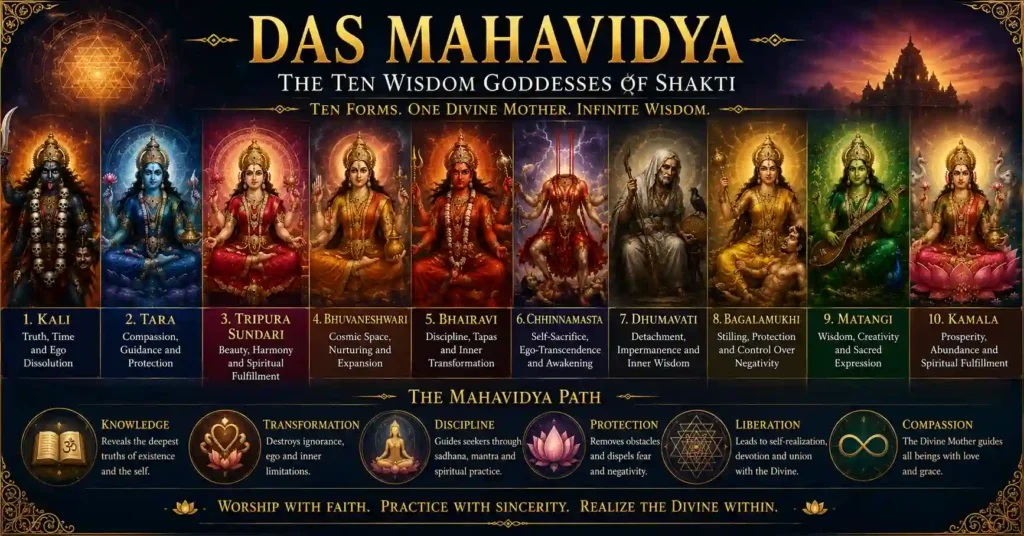
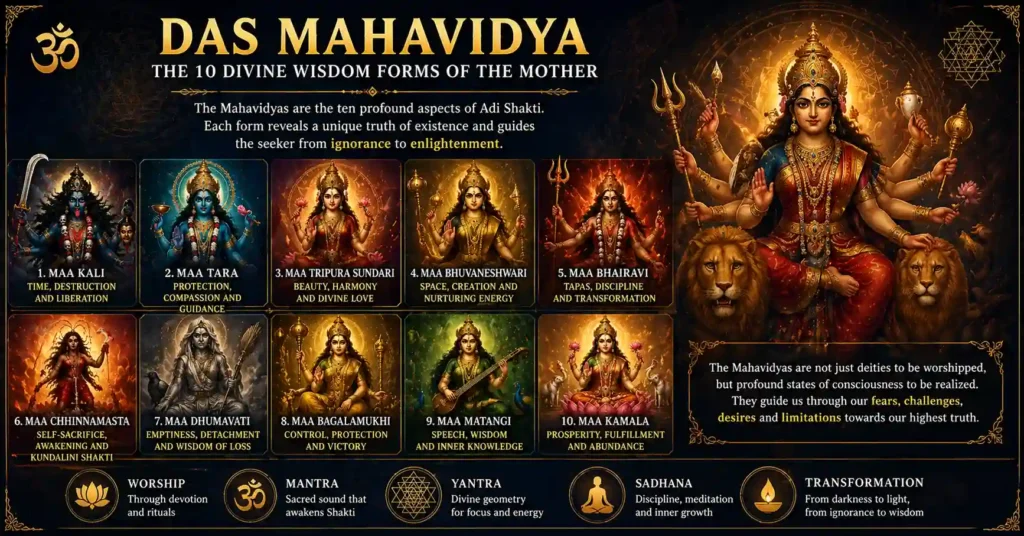
Quick Table: Understanding the Ten Mahavidyas
While each Mahavidya possesses unique symbolism, teachings, and methods of worship, the following table provides a simple overview of their core spiritual significance.
Mahavidya | Represents | Core Teaching |
Kali | Time, transformation, ego dissolution | Freedom comes through truth and surrender |
Tara | Guidance, protection, compassion | Divine grace helps the seeker cross difficulties |
Tripura Sundari | Beauty, harmony, perfection | Balance and wisdom reveal the divine in life |
Bhuvaneshwari | Cosmic space and expansion | True growth begins when consciousness expands |
Bhairavi | Discipline, tapasya, inner fire | Transformation requires sincerity and effort |
Chhinnamasta | Sacrifice and awakening | Spiritual growth demands the surrender of ego |
Dhumavati | Emptiness, detachment, wisdom | Hidden wisdom often emerges through loss and silence |
Bagalamukhi | Protection and restraint | Inner mastery is the foundation of true strength |
Matangi | Speech, knowledge, creativity | Words and wisdom shape both life and consciousness |
Kamala | Prosperity, grace, fulfillment | True abundance includes both outer and inner wealth |
Although the Mahavidyas appear as distinct forms, they are ultimately expressions of one Divine Mother. Each form illuminates a particular aspect of existence, helping seekers navigate different challenges, experiences, and stages of spiritual evolution.
For some devotees, one Mahavidya becomes a lifelong focus of devotion. Others may feel drawn to different forms at different stages of life.
The deeper one studies the Mahavidyas, the clearer it becomes that together they form a complete map of human experience, guiding the soul from ignorance toward wisdom, and from limitation toward liberation.
Mahavidya as an Inner Journey of the Seeker
The Das Mahavidyas can be understood not only as divine forms of worship but also as stages of an inner spiritual journey. While every seeker’s path is unique, the lessons represented by the Mahavidyas often reflect experiences that naturally arise throughout life.
The journey may begin with Kali, who teaches acceptance of change, impermanence, and the limits of ego. During periods of uncertainty, Tara offers guidance and reassurance. As awareness deepens, Tripura Sundari reveals the importance of harmony, beauty, and inner balance.
The path then moves through expansion, discipline, surrender, and detachment. Bhuvaneshwari encourages openness, Bhairavi awakens determination, Chhinnamasta teaches the power of letting go, and Dhumavati uncovers wisdom hidden within silence and loss.
As spiritual maturity develops, Bagalamukhi teaches restraint and self-mastery, while Matangi refines speech, knowledge, and awareness. Kamala completes the journey by revealing a state where worldly life and spiritual understanding exist in harmony.
This should not be viewed as a fixed sequence. Different Mahavidyas may become important at different stages of life, depending on the lessons a person needs to learn. One seeker may feel drawn to Tara, while another finds guidance through Bhairavi, Dhumavati, or Kamala.
Seen in this light, the Mahavidyas are more than ten goddesses. They are ten expressions of Shakti that help the seeker move from ignorance to wisdom, from limitation to growth, and from separation toward a deeper awareness of the Divine.
How Mahavidya Sadhana Happens in Real Life
When people first encounter the Mahavidya tradition, they often assume it is meant only for advanced Tantric practitioners. In reality, the journey usually begins in much simpler ways.
For many devotees, it starts with a natural attraction to a particular form of the Divine Mother. This may express itself through prayer, temple visits, mantra chanting, or reading sacred texts. Over time, this connection deepens into devotion and spiritual understanding.
The Mahavidya path is not limited to formal worship. Each Mahavidya teaches a way of living. Kali encourages courage, Tara inspires trust, Bhairavi strengthens discipline, and Dhumavati teaches acceptance during difficult phases of life. In this sense, everyday experiences themselves can become part of sadhana.
As understanding grows, the seeker’s focus gradually shifts from seeking external results to greater self-awareness. The teachings of the Mahavidyas begin to illuminate one’s fears, attachments, strengths, and opportunities for growth.
Advanced forms of Mahavidya practice do exist within established Tantric traditions and are traditionally pursued under proper guidance. Yet the essence of sadhana remains the same at every level: deepening one’s relationship with Shakti and growing in wisdom, devotion, and inner transformation.
Ultimately, Mahavidya sadhana is a journey of awakening. It helps the seeker recognise the presence of the Divine Mother not only in sacred rituals but also in the experiences and lessons of everyday life.
Simple Rituals and Advanced Practices
The Mahavidya tradition includes a wide range of practices, from simple daily devotion to structured Tantric disciplines. While the methods vary, the goal remains the same: to deepen one’s connection with the Divine Mother and support inner growth.
For many devotees, worship begins with simple acts such as lighting a lamp, offering flowers, chanting a mantra, reading sacred texts, or spending a few moments in prayer. These practices cultivate devotion, gratitude, and spiritual discipline in everyday life.
Mantra japa remains one of the most common forms of Mahavidya worship. Through regular repetition, the mind becomes more focused and the bond with the chosen deity deepens. As devotion matures, seekers may also explore meditation, yantra worship, vrata observances, and festival-based practices.
Sacred periods such as Gupt Navratri, Navratri, and important tithis associated with individual Mahavidyas are often considered especially favourable for worship and reflection.
Within Tantric traditions, advanced practices may include specialised mantras, nyasa, homa, visualisation techniques, and lineage-based methods transmitted through a guru. These disciplines are traditionally approached with preparation, humility, and proper guidance.
The Mahavidya tradition does not measure spiritual progress by the complexity of rituals. Sincerity, devotion, self-discipline, and inner transformation remain more important than elaborate external practices. Whether through simple prayer or deeper sadhana, the essence of the path lies in growing closer to the wisdom and grace of the Divine Mother.
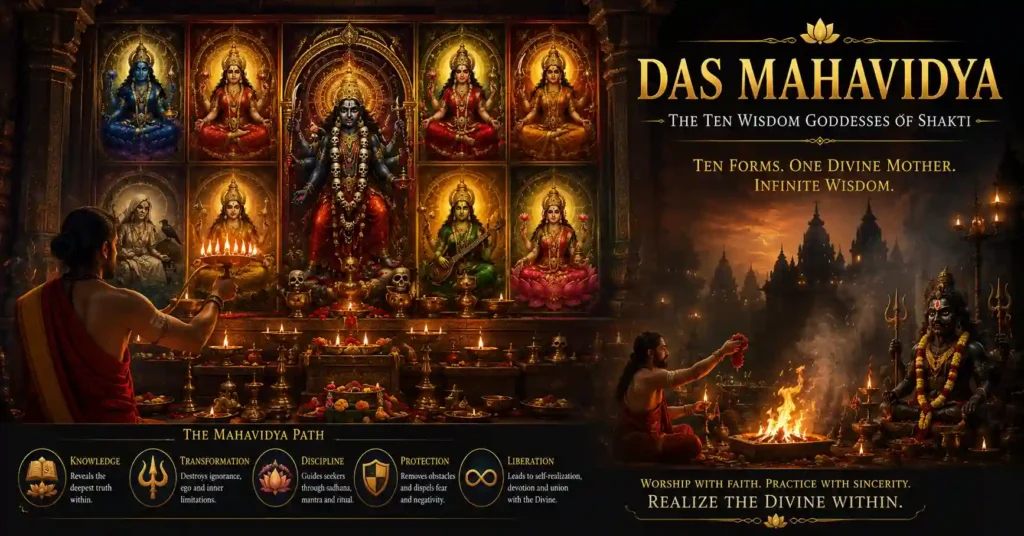
Where Mahavidya Comes From in Tradition
The Das Mahavidya tradition occupies a unique place within Sanatan Dharma because it stands at the meeting point of devotion, philosophy, and Tantra. While many devotees know the Mahavidyas through stories, temples, and personal worship, the tradition itself is rooted in centuries of spiritual practice, sacred texts, and living lineages.
The Mahavidyas are most closely associated with the Shakta tradition, which regards the Divine Mother as the supreme reality underlying all existence. In this view, Shakti is not merely a goddess among many deities but the very power through which creation, preservation, and dissolution occur. The Mahavidyas represent ten profound expressions of this cosmic power.
Many references to the Mahavidyas and related forms of the Divine Mother appear throughout Tantric literature, including texts such as the Tantras, Agamas, and various Shakta scriptures. These traditions developed rich systems of mantra, yantra, meditation, ritual worship, and philosophical inquiry centered on the Divine Feminine.
The Mahavidyas are also connected with broader streams of Hindu spirituality. Devotees often encounter them through the worship of Kali, Durga, Lalita Tripura Sundari, Kamakhya, Tara, and other forms of the Divine Mother that remain deeply woven into India’s living religious traditions.
Within Sri Vidya, Tripura Sundari occupies a central position as the embodiment of supreme beauty, harmony, and consciousness. Within Kaula and other Tantric traditions, forms such as Kali, Tara, Bhairavi, and Chhinnamasta receive special emphasis. Different lineages may highlight different Mahavidyas, yet all recognise them as manifestations of the same Divine Mother.
One of the reasons the Mahavidya tradition continues to thrive is that it has never remained confined to scripture alone. It lives through temples, festivals, gurus, practitioners, family traditions, devotional songs, and personal spiritual experiences. Across generations, devotees have approached the Mahavidyas not merely as theological concepts but as living presences capable of guiding, protecting, and transforming human life.
For advanced seekers, the Mahavidya tradition offers a complete spiritual framework that integrates devotion, knowledge, ritual, meditation, and direct experience. It demonstrates that the Divine Mother can be approached through many paths, yet all ultimately lead toward the same truth: the recognition of Shakti as the source, support, and essence of existence itself.
Role of Tantric Scriptures
The Das Mahavidya tradition is rooted in a rich body of sacred literature that has preserved the worship, philosophy, symbolism, and spiritual practices associated with the Divine Mother for centuries.
Unlike traditions that rely on a single foundational text, the Mahavidyas are understood through scriptures, Tantric teachings, temple traditions, and living spiritual lineages.
References to the Divine Mother in her many forms appear throughout Shakta literature, where Shakti is revered as the supreme reality underlying creation, preservation, and transformation.
Over time, these teachings evolved into spiritual traditions that explored the many dimensions of divine wisdom represented by the Mahavidyas.
The Mahavidya tradition draws from multiple sources rather than a single authority. This diversity has allowed it to remain both deeply philosophical and closely connected to devotional practice.
For devotees, these scriptures provide inspiration and guidance. For seekers, they offer deeper insights into consciousness, spiritual growth, and the path toward self-realization.
Much of the detailed understanding of the Mahavidyas comes from the Tantric tradition. Various Tantras and Shakta scriptures describe the forms, symbolism, mantras, yantras, methods of worship, and spiritual significance of the ten Mahavidyas.
Within these texts, the Mahavidyas are not presented merely as deities who grant blessings. They are described as gateways to higher understanding, with each goddess representing a distinct aspect of reality and consciousness.
Their teachings address fear, desire, attachment, discipline, knowledge, devotion, and liberation, helping seekers navigate different stages of spiritual growth.
Tantric scriptures also emphasize that the Mahavidyas are not separate powers competing with one another. They are manifestations of the same Divine Mother appearing in different forms according to the needs of the seeker and the requirements of spiritual evolution.
Traditional teachings further stress the importance of approaching deeper practices with respect and proper guidance. While devotion to the Mahavidyas is open to all, certain advanced methods have historically been preserved within guru-disciple lineages to ensure they are practiced responsibly.
Today, these sacred texts continue to inspire devotees, scholars, and practitioners alike. They remain living sources of wisdom that point beyond ritual toward the deeper transformation of consciousness.
How Devotees Experience Mahavidya
For many devotees, the journey into the Mahavidya tradition begins not through philosophy or scripture but through an unexpected sense of connection. A person may encounter an image of Kali, hear a mantra of Tara, visit a temple of Tripura Sundari, or read about one of the Mahavidyas and feel naturally drawn toward that form of the Divine Mother.
What begins as curiosity often deepens into devotion, regular prayer, mantra chanting, or a desire to learn more about Shakti. Over time, many devotees feel a special connection with a particular Mahavidya whose qualities resonate with their spiritual needs and life circumstances.
Some experience Kali as a source of courage during times of change. Others find comfort in Tara during uncertainty. Those seeking harmony may feel drawn to Tripura Sundari, while devotees facing challenges that require determination often connect with Bhairavi. The relationship is deeply personal and unfolds differently for each individual.
Many practitioners view the Mahavidyas not as distant mythological figures but as living presences. Through prayer, meditation, sacred texts, or moments of inner clarity, devotees often feel guided, protected, or transformed in ways that strengthen their faith and understanding.
As devotion deepens, the seeker begins to recognise that the qualities represented by the Mahavidyas also exist within. Courage, wisdom, discipline, compassion, surrender, and fulfillment become part of one’s own spiritual growth.
Despite the diversity of experiences, one theme appears throughout the Mahavidya tradition: the sincere devotee feels guided by the Divine Mother according to their needs and stage of life. This personal connection is one of the reasons the Mahavidyas continue to inspire devotion across generations.
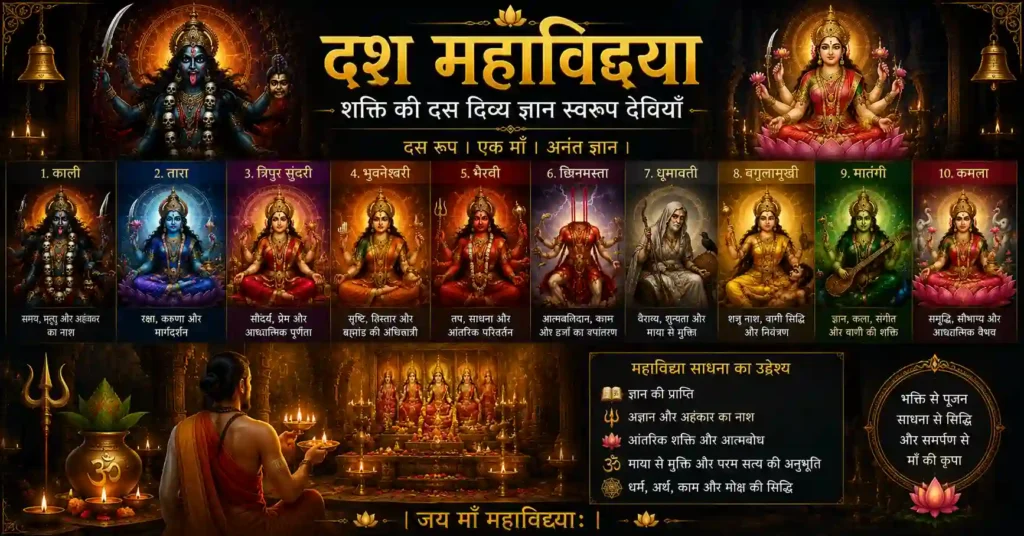
Famous Temples of Das Mahavidya
The Mahavidya tradition is not confined to scriptures and philosophical teachings. It continues to live through sacred temples, pilgrimage sites, festivals, and centuries of devotional practice. Across India and Nepal, devotees visit these temples seeking blessings, guidance, spiritual growth, and a deeper connection with the Divine Mother.
While no single temple represents all ten Mahavidyas completely, several important Shakti centers have become closely associated with different Mahavidya traditions. These sacred places preserve both devotional worship and deeper Tantric practices that have been passed down through generations.
Kamakhya Temple
Located atop Nilachal Hill in Assam, Kamakhya Temple is one of the most important Shakti Peethas in India and a major center of Mahavidya worship. The temple is especially significant within Shakta and Tantric traditions and is often regarded as the spiritual heart of many Mahavidya lineages.
Unlike most temples, Kamakhya does not worship the Divine Mother through a conventional idol. Instead, devotees worship a natural stone formation associated with the creative power of Shakti. Festivals such as Ambubachi Mela attract thousands of pilgrims, practitioners, and seekers from across the country.
For many devotees, Kamakhya represents the living presence of Adi Shakti and remains one of the most revered centers of the Mahavidya tradition.
Tarapith Temple
Tarapith, located in West Bengal, is one of the most important temples dedicated to Maa Tara. It is deeply connected with both devotional worship and Tantric practice and has been associated with great saints such as Bamakhepa.
The temple is known for its powerful spiritual atmosphere and its emphasis on the compassionate aspect of Tara as the Divine Mother who protects and guides her devotees. Pilgrims visit Tarapith seeking blessings, healing, spiritual guidance, and a deeper connection with Maa Tara.
Over the centuries, Tarapith has become one of the most influential centers of Tara worship in India.
Kalighat Temple
Kalighat Temple in Kolkata is among the most famous temples dedicated to Maa Kali. It is one of the revered Shakti Peethas and attracts millions of devotees each year.
For devotees, Kalighat is not merely a place of worship but a living symbol of Kali’s protective and transformative power. The temple has played a central role in preserving Kali devotion and has significantly influenced the spiritual culture of Bengal.
Its importance extends beyond regional boundaries, making it one of the most recognized centers of Shakti worship in the country.
Tripura Sundari Temple
The Tripura Sundari Temple in Tripura is one of the most important centers associated with Maa Tripura Sundari, the Mahavidya who embodies beauty, harmony, and divine perfection.
The temple is counted among the revered Shakti Peethas and attracts devotees from across India. Its traditions reflect the deep connection between Tripura Sundari worship and the broader Sri Vidya lineage, where the Divine Mother is revered as the supreme expression of consciousness and grace.
For many seekers, this temple represents the gentler and more refined dimension of the Mahavidya tradition.
Bagalamukhi Temples and Regional Traditions
Several temples dedicated to Maa Bagalamukhi can be found across India, particularly in regions such as Madhya Pradesh, Himachal Pradesh, and parts of northern India. Among the most well-known are the Bagalamukhi temples of Datia and Bankhandi.
Devotees visit these temples seeking protection, courage, stability, and relief from obstacles. Worship traditions often emphasise prayer, discipline, and surrender to the Divine Mother rather than the pursuit of worldly power alone.
These temples highlight how Mahavidya worship continues to remain a living tradition, adapting to local cultures while preserving its deeper spiritual foundations.
Together, these sacred centers demonstrate the remarkable diversity of the Mahavidya tradition. Whether approached through devotion, pilgrimage, philosophy, or Tantra, each temple offers a unique doorway into the wisdom and presence of the Divine Mother.
Temple Worship, Home Devotion and Tantric Path
The Mahavidya tradition is often associated with Tantra, but it embraces a wide range of spiritual approaches. Devotees connect with Shakti through temple worship, personal devotion, scriptural study, meditation, and lineage-based practices. While these paths may appear different, they share the same goal: a deeper relationship with the Divine Mother.
Temple Worship and Pilgrimage
For many devotees, the journey begins in temples. Sacred sites such as Kamakhya, Tarapith, Kalighat, and Tripura Sundari Temple have served as important centers of worship for centuries. Pilgrims visit these places seeking blessings, guidance, and spiritual inspiration.
Temple rituals, festivals, aarti, and sacred chants create a sense of connection to a living tradition and allow devotees to experience the presence of the Divine Mother within a larger spiritual community.
Home Devotion and Daily Practice
Many devotees connect with the Mahavidyas through simple practices at home. Lighting a lamp, offering flowers, chanting a mantra, or spending a few moments in prayer can become meaningful acts of devotion.
For householders, this path offers an accessible way to cultivate faith, gratitude, and spiritual discipline while building a personal relationship with the Divine Mother.
The Tantric Path
The Mahavidyas also hold an important place within various Tantric traditions. In these lineages, Shakti is approached through specialised methods involving mantra, yantra, meditation, visualisation, and ritual practice.
Traditional Mahavidya Tantra is a disciplined path of inner transformation rather than something mysterious or sensational. Because many of these practices are complex, they have historically been transmitted through qualified gurus and established lineages.
Different Paths, One Divine Mother
Temple worship, home devotion, and Tantric practice are not competing approaches. Each serves a different temperament and stage of spiritual growth.
Some devotees may express their faith through prayer and pilgrimage, while others pursue deeper contemplative disciplines. Whatever the path, the essence remains the same: devotion, sincerity, and a growing awareness of Shakti’s presence in life.
Regional Traditions of Mahavidya Worship
Although the Mahavidyas are worshipped across the Indian subcontinent, their traditions have developed distinct regional expressions shaped by local customs, temple lineages, devotional movements, and Tantric practices. Despite these variations, all ten Mahavidyas are understood as manifestations of the same Shakti.
Bengal and the Living Tradition of Shakti Worship
West Bengal remains one of the most influential centers of Mahavidya devotion. Kali, Tara, Bhairavi, and other forms of Shakti are deeply woven into the religious and cultural life of the region.
Temples such as Kalighat and Tarapith have preserved both devotional and Tantric streams of worship. Through saints, mystics, poets, and household devotees, Bengal continues to nurture a vibrant culture of Shakti worship rooted in personal devotion.
Assam and the Tantric Heritage of Kamakhya
Assam holds a special place in the Mahavidya tradition because of Kamakhya Temple, one of the most revered centers of Shakta Tantra.
The region preserves many traditions connected with pilgrimage, mantra practice, and goddess worship. Kamakhya’s influence extends far beyond Assam and continues to inspire devotees and practitioners throughout India.
Nepal and the Continuity of Shakta Traditions
In Nepal, the worship of Shakti remains deeply embedded in temple traditions, festivals, and local devotional practices. Forms of the Goddess such as Kali and Taleju continue to be revered through traditions that have remained active for centuries.
These practices demonstrate how Mahavidya-related worship has adapted over time while remaining connected to its spiritual roots.
North India and the Worship of Protective Forms
Across northern India, special emphasis is often placed on forms such as Bagalamukhi and Kali. Temples dedicated to these manifestations attract devotees seeking courage, protection, stability, and spiritual guidance.
Local traditions blend temple worship with regional customs, creating unique expressions of Mahavidya devotion that remain accessible to pilgrims and householders alike.
Diversity Within Unity
One of the defining strengths of the Mahavidya tradition is its ability to adapt to different cultures and communities without losing its essential message.
A devotee in Bengal may connect with Kali, a pilgrim in Assam with Kamakhya, and another seeker with Tara, Tripura Sundari, or Bagalamukhi. The forms and practices may vary, but the underlying truth remains the same: all are expressions of one Divine Mother whose wisdom and transformative power transcend regional boundaries.
Why Gupt Navratri Is Important
Among the many sacred periods dedicated to the Divine Mother, Gupt Navratri holds a special place within the Mahavidya tradition. While the more widely known Chaitra and Sharad Navratri are celebrated publicly across India, Gupt Navratri has traditionally been associated with deeper forms of Shakti worship, spiritual discipline, mantra sadhana, and contemplative practice.
The word Gupt means “hidden” or “secret.” This does not imply secrecy in a mysterious sense. Rather, it reflects the inward nature of the observance. During this period, many devotees focus less on public celebration and more on personal prayer, self-reflection, mantra japa, and spiritual growth.
Gupt Navratri is especially significant for devotees of the Mahavidyas because many Shakta and Tantric traditions regard this period as particularly favourable for worshipping the Divine Mother in her deeper and more transformative forms. Seekers often dedicate these nine nights to a chosen Mahavidya, seeking guidance, purification, protection, and inner awakening.
For household devotees, Gupt Navratri can be a time to strengthen faith through simple practices such as daily prayers, reading sacred texts, offering lamps, chanting mantras, and cultivating self-discipline. Even modest acts of devotion performed with sincerity are believed to carry special significance during this period.
For intermediate and advanced practitioners, Gupt Navratri often becomes a dedicated period of intensified sadhana. Many lineages encourage additional mantra repetition, meditation, scriptural study, and observances designed to deepen one’s connection with the Divine Mother. The emphasis, however, remains on devotion and transformation rather than the pursuit of extraordinary experiences.
One of the reasons Gupt Navratri is so closely linked with the Mahavidyas is that it encourages the seeker to turn inward. The Mahavidyas reveal truths about fear, attachment, discipline, wisdom, surrender, and spiritual freedom. These lessons become easier to contemplate when the mind is quiet and attention is directed toward inner growth.
Ultimately, Gupt Navratri serves as a reminder that spiritual transformation often happens in silence. While public festivals celebrate the glory of the Divine Mother outwardly, Gupt Navratri invites devotees to experience her presence within their own hearts.
For this reason, many practitioners regard Gupt Navratri as one of the most spiritually meaningful times of the year for Mahavidya worship and Shakti sadhana.
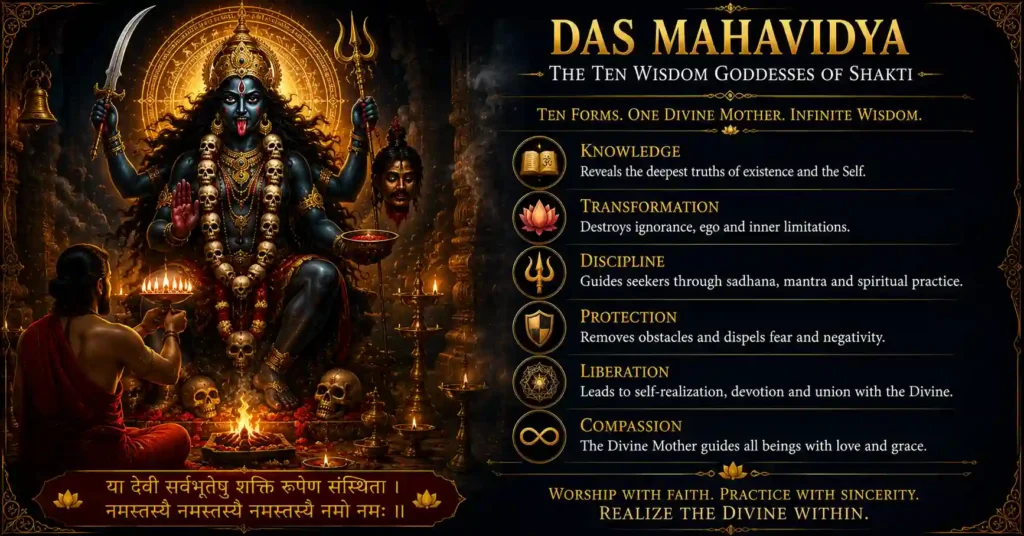
Mahavidya and Sri Vidya: What Is the Difference
Many seekers encounter the terms Mahavidya and Sri Vidya while exploring the worship of the Divine Mother and naturally wonder whether they refer to the same tradition. While the two are closely related and share common roots within Shakta Dharma, they are not identical.
The word Mahavidya refers to the Ten Great Wisdom Goddesses, each representing a unique aspect of Shakti and a distinct pathway of spiritual understanding. The Mahavidya tradition embraces the full spectrum of divine experience, including creation and dissolution, beauty and austerity, prosperity and detachment, compassion and fierce transformation.
Sri Vidya, on the other hand, is a specific spiritual tradition centered primarily on Maa Tripura Sundari, also known as Lalita Mahatripurasundari. It is one of the most refined and influential schools of Shakta worship and places special emphasis on the Sri Chakra, mantra sadhana, meditation, and the recognition of divine consciousness within all existence.
A simple way to understand the relationship is that Sri Vidya may be viewed as one important stream within the wider ocean of Shakta spirituality, while the Mahavidyas represent a broader collection of divine manifestations and teachings. Tripura Sundari, who occupies a central place in Sri Vidya, is also one of the ten Mahavidyas.
The emphasis of the two traditions often differs. Mahavidya worship explores the many dimensions of Shakti through ten distinct forms, each offering unique lessons and methods of transformation. Sri Vidya focuses more specifically on the path of harmony, beauty, divine grace, and the progressive unfolding of consciousness through the worship of Tripura Sundari.
For devotees, there is no contradiction between the two paths. Many practitioners revere both the Mahavidyas and the Sri Vidya tradition. In fact, numerous lineages recognise them as complementary expressions of the Divine Mother’s wisdom.
For intermediate and advanced seekers, the distinction becomes even more meaningful. The Mahavidyas reveal the complete spectrum of spiritual experience, including life’s challenges, disruptions, and transformative phases. Sri Vidya emphasises the recognition of divine order, beauty, and unity underlying all existence.
Ultimately, both traditions lead toward the same goal: the realisation of Shakti as the supreme reality and the awakening of the seeker’s awareness to that truth. The paths may differ in emphasis, but both are illuminated by the grace of the Divine Mother.
Mahavidya, Durga and Navadurga: Understanding the Difference
The Divine Mother is worshipped through many forms across Sanatan Dharma, and this sometimes creates confusion among devotees. A common question is whether the Mahavidyas, Durga, and Navadurga are the same. While they are deeply connected, each tradition highlights a different dimension of Shakti and serves a distinct spiritual purpose.
Durga is one of the most widely worshipped forms of the Divine Mother. She represents divine protection, righteousness, courage, and the victory of dharma over negative forces. Through her stories and symbolism, devotees learn faith, strength, and devotion.
The Navadurga refers to the nine forms of Goddess Durga worshipped during Navratri. Each form represents a specific stage of spiritual growth and is traditionally honoured over nine days. Together, the Navadurga guide the devotee from basic spiritual discipline toward higher awareness and devotion.
The Das Mahavidyas, however, represent a broader and often deeper exploration of divine wisdom. Rather than focusing primarily on protection and victory, the Mahavidyas encompass the full spectrum of spiritual experience. They address transformation, knowledge, beauty, sacrifice, discipline, prosperity, detachment, and liberation. Some forms appear gentle, while others challenge the seeker’s assumptions and attachments in profound ways.
Another important distinction lies in emphasis. Durga and the Navadurga are commonly approached through devotional worship, festivals, and public celebration. The Mahavidyas are also worshipped devotionally, but many of their traditions include deeper philosophical and Tantric dimensions that explore the nature of consciousness, reality, and spiritual transformation.
Despite these differences, they should not be viewed as separate or competing traditions. The Divine Mother is one, while her forms are many. Durga, Navadurga, Kali, Tara, Tripura Sundari, and the other Mahavidyas all emerge from the same supreme Shakti.
For devotees, the differences are often less important than the shared truth they reveal. Each form of the Divine Mother responds according to the needs of the seeker. Some may feel drawn to Durga’s protective presence, others to the transformative wisdom of Kali, the compassion of Tara, or the grace of Tripura Sundari.
Ultimately, the Mahavidyas, Durga, and Navadurga are different expressions of the same Divine Mother, each illuminating a unique pathway toward spiritual growth, devotion, and self-realisation.
Bhairava and the Mahavidya Tradition
In many Shakta and Tantric traditions, the Mahavidyas are not worshipped in isolation. Alongside the Divine Mother, there is often the presence of Bhairava, who represents the Shiva aspect of consciousness. Understanding this relationship helps reveal some of the deeper foundations of Mahavidya philosophy and practice.
The Mahavidyas are expressions of Shakti, the dynamic power that creates, sustains, transforms, and liberates. Bhairava represents pure awareness, the unchanging consciousness that supports and witnesses all manifestation. Together, they reflect one of the central principles of Sanatan Dharma: Shakti and Shiva are inseparable.
Many Tantric texts and lineages associate each Mahavidya with a corresponding Bhairava. The exact associations can vary across traditions, but the underlying teaching remains consistent. Divine energy and divine consciousness function together. Transformation is complete only when power is guided by awareness and awareness is expressed through power.
This relationship can be understood in several ways. For devotees, Bhairava is often viewed as a guardian and protector of the Divine Mother’s sacred path. For practitioners, he represents discipline, fearlessness, and the clarity required to navigate deeper forms of sadhana. For advanced seekers, Bhairava symbolises the witnessing consciousness that remains present behind all experiences.
The connection becomes especially important in Tantric traditions. While the Mahavidyas represent various dimensions of spiritual transformation, Bhairava provides stability, grounding, and awareness. This is one reason why many traditional lineages emphasise both Shiva and Shakti rather than treating them as separate realities.
The relationship is also deeply symbolic. Kali and Bhairava, Tara and Bhairava, Bhairavi and Bhairava, Tripura Sundari and Kameshvara, all point toward the same truth: divine consciousness and divine power cannot be separated. One is incomplete without the other.
For intermediate and advanced seekers, this teaching offers a profound insight into the Mahavidya path. The goal is not merely to accumulate spiritual experiences or powers. The goal is to awaken to the unity of consciousness and energy, Shiva and Shakti, awareness and transformation.
Seen in this light, Bhairava is not a secondary figure within the Mahavidya tradition. He is an essential reminder that every movement of Shakti ultimately arises from and returns to the limitless consciousness that Sanatan Dharma identifies as Shiva.
Which Mahavidya Should You Connect With as a Beginner
One of the most common questions newcomers ask is which Mahavidya they should worship first. The answer differs for each person because the Divine Mother reaches devotees through different forms according to their temperament, circumstances, and spiritual needs.
Many people feel naturally drawn toward a particular Mahavidya through a temple visit, a sacred story, a mantra, an image, or an unexplainable sense of connection. Traditional teachings often regard this attraction as meaningful, suggesting that the Divine Mother guides each seeker toward the lessons they need most.
For beginners, it is usually helpful to approach the Mahavidyas through devotion and understanding rather than complexity. Learning about their stories, symbolism, prayers, and teachings creates a strong foundation for spiritual growth.
Mahavidya | Beginners Often Connect For |
Kali | Courage, transformation, overcoming fear |
Tara | Protection, guidance, emotional support |
Tripura Sundari | Harmony, devotion, inner balance |
Bhuvaneshwari | Peace, stability, emotional expansion |
Bhairavi | Discipline, focus, spiritual commitment |
Chhinnamasta | Deep transformation and self-awareness |
Dhumavati | Wisdom during difficult life phases |
Bagalamukhi | Protection and overcoming obstacles |
Matangi | Knowledge, creativity, communication |
Kamala | Prosperity, gratitude, fulfillment |
For many beginners, Kali, Tara, Tripura Sundari, Bhuvaneshwari, and Kamala are often the most accessible starting points. However, there is no fixed rule. Some seekers feel a strong connection with Bhairavi, Dhumavati, Chhinnamasta, or Bagalamukhi from the very beginning.
Rather than asking which Mahavidya is the most powerful, it may be more meaningful to ask: Which form of the Divine Mother is helping me grow right now? The answer often marks the beginning of a deeper spiritual relationship.
The Mahavidyas are not competing deities but different expressions of the same Shakti. Whichever form inspires devotion, wisdom, and transformation can become a doorway into the larger world of Mahavidya worship.
Is the Das Mahavidya Path for Everyone?
The Mahavidya tradition is often surrounded by mystery. Fierce imagery, references to Tantra, and stories of advanced practices can create the impression that it is meant only for ascetics or experienced practitioners. In reality, the tradition is far more inclusive.
At its heart, the Mahavidya path is a relationship with the Divine Mother. Anyone who approaches with sincerity, respect, and devotion can learn from the wisdom of the Mahavidyas. Their teachings on courage, compassion, discipline, surrender, balance, and self-awareness remain relevant to people from all walks of life.
For most devotees, the journey begins through simple practices such as prayer, temple visits, mantra chanting, scriptural study, and daily devotion. One does not need to become a Tantric practitioner to benefit from the guidance of the Mahavidyas.
At the same time, certain aspects of the tradition belong to specialised lineages and advanced forms of sadhana. Specific mantras, rituals, and contemplative methods have traditionally been transmitted through qualified gurus, preserving their purpose and integrity.
Perhaps the most important thing to remember is that the Mahavidyas meet seekers where they are. A simple prayer offered with faith can be just as meaningful as a complex ritual performed within a lineage. What matters most is sincerity, devotion, and the willingness to grow.
For this reason, the Das Mahavidya path is not limited to any particular group. It offers guidance to anyone seeking a deeper connection with Shakti, greater self-understanding, and spiritual growth.
Benefits of Das Mahavidya Worship
The purpose of Mahavidya worship is not merely to seek blessings for specific desires. At its deepest level, it transforms the seeker’s relationship with life, consciousness, and the Divine Mother. Its benefits extend beyond ritual practice and gradually influence the way one thinks, feels, and responds to the world.
Spiritual Benefits
Through devotion, prayer, mantra, meditation, and self-reflection, many practitioners develop greater clarity, self-awareness, and a deeper connection with Shakti. Over time, this often leads to a stronger sense of purpose and spiritual understanding.
Emotional Strength and Inner Growth
Each Mahavidya addresses different aspects of human experience. Kali teaches courage, Tara offers reassurance, Bhairavi strengthens determination, and Dhumavati reveals wisdom during difficult phases of life.
Regular worship can help cultivate patience, resilience, acceptance, and emotional balance. The teachings of the Mahavidyas also encourage seekers to examine fears, attachments, and limiting beliefs, leading to greater confidence, maturity, and self-discipline.
Protection and Balance
Several Mahavidyas, especially Kali, Tara, and Bagalamukhi, are associated with protection and fearlessness. The deeper benefit, however, lies in developing the inner strength and faith needed to face life’s challenges with courage and composure.
At the same time, forms such as Tripura Sundari, Bhuvaneshwari, and Kamala remind devotees that spiritual growth and worldly responsibilities can exist in harmony. Their teachings encourage a balanced approach to both material and spiritual life.
The Greatest Benefit
Ultimately, the greatest benefit of Mahavidya worship is transformation. The Divine Mother guides the seeker from fear toward courage, from confusion toward clarity, and from limitation toward greater awareness.
For this reason, devotees often regard the Mahavidyas not only as goddesses who grant blessings but also as compassionate guides who help lead the soul toward wisdom, awakening, and spiritual fulfillment.
Common Misunderstandings About Das Mahavidya
The Mahavidya tradition is one of the most profound streams of Shakta Dharma, yet it is often misunderstood. Much of this confusion arises from unfamiliar imagery, incomplete information, and misconceptions about Tantra. Understanding these misconceptions helps seekers approach the tradition with greater clarity and respect.
The Mahavidyas Are Only Fierce Goddesses
One of the most common misconceptions is that the Mahavidyas are exclusively fierce forms of the Divine Mother. While Kali, Bhairavi, Chhinnamasta, and Dhumavati appear intense, others such as Tara, Tripura Sundari, Bhuvaneshwari, Matangi, and Kamala embody compassion, beauty, wisdom, harmony, and grace.
Together, the Mahavidyas represent the full spectrum of life, wisdom, and spiritual experience.
Mahavidya Worship Is Only for Tantrics
Many people believe that the Mahavidyas can only be approached through advanced Tantric practices. While Tantra forms an important part of the tradition, devotional worship, prayer, mantra chanting, scriptural study, and temple visits have always been central to Mahavidya devotion.
Countless devotees worship the Divine Mother through simple faith and sincere devotion without engaging in specialised Tantric disciplines.
The Mahavidyas Are Separate and Competing Deities
Another misunderstanding is that each Mahavidya represents an independent power unrelated to the others. Traditional teachings consistently emphasise that all ten Mahavidyas are manifestations of one Divine Mother.
Their forms, symbolism, and teachings may differ, but their source remains the same: the infinite Shakti that pervades all existence.
Tantra Is About Power and the Supernatural
Popular culture often portrays Tantra as a path focused on occult powers, unusual rituals, or supernatural experiences. Traditional Mahavidya Tantra presents a very different picture.
Its primary purpose is spiritual transformation, self-knowledge, discipline, and the realisation of divine consciousness. Any extraordinary experiences are considered secondary to genuine spiritual growth.
Fierce Imagery Represents Violence
Some people are uncomfortable with images of Kali, Chhinnamasta, Bhairavi, or other fierce forms because they interpret them literally. In reality, much of the imagery is symbolic.
Weapons often represent the destruction of ignorance. Severed heads symbolise the removal of ego. Cremation grounds remind seekers of impermanence. What appears frightening on the surface often conveys profound spiritual teachings beneath.
The Mahavidyas Are Only Relevant to Ancient Times
The Mahavidyas are sometimes viewed as figures belonging solely to mythology or medieval Tantra. Yet their teachings remain deeply relevant today.
Fear, uncertainty, attachment, ambition, loss, creativity, discipline, prosperity, and the search for meaning continue to shape human life. The Mahavidyas address these experiences in ways that remain timeless and universal.
Understanding Beyond Appearances
The Mahavidya tradition invites seekers to look beyond surface impressions. What initially appears mysterious or intimidating often reveals profound wisdom when approached with patience, humility, and sincere study.
For many devotees, the Mahavidyas are not distant divine figures but compassionate guides whose teachings continue to illuminate life, consciousness, and spiritual growth.
Living the Wisdom of the Mahavidyas
The true purpose of the Mahavidya tradition is not simply to learn about ten goddesses or perform rituals. Its deeper aim is to transform the way a person lives, thinks, and responds to life. The wisdom of the Mahavidyas becomes most meaningful when it moves beyond temples and scriptures into everyday experience.
Each Mahavidya represents qualities that remain relevant in every stage of life. Kali teaches courage during change, Tara inspires trust during uncertainty, Tripura Sundari reveals the value of harmony, Bhairavi encourages discipline, and Dhumavati teaches acceptance during difficult times.
These lessons are not limited to spiritual practice. They appear in relationships, work, family responsibilities, personal challenges, and moments of self-reflection. Living the Mahavidya path often begins with simple actions such as speaking truthfully, acting with compassion, practicing patience, using words wisely, and expressing gratitude.
Over time, worship becomes more than a ritual. The teachings of the Mahavidyas begin to shape daily choices, attitudes, and ways of understanding the world. Every challenge becomes an opportunity to apply a deeper spiritual lesson.
In this way, the Mahavidya tradition becomes a lifelong journey of awareness and growth. The ten Mahavidyas guide the seeker through life’s many experiences, helping transform ordinary moments into opportunities for wisdom, devotion, and inner awakening.
Conclusion: A Deeper Transformation
The Das Mahavidyas are far more than a collection of ten goddesses. They represent a complete spiritual vision that embraces every dimension of life, from creation and beauty to loss, discipline, wisdom, and liberation. Through their diverse forms, the Divine Mother reveals that every experience, whether joyful or challenging, can become a pathway to deeper understanding.
For devotees, the Mahavidyas offer guidance, protection, and a personal relationship with the Divine Mother. For seekers, they provide profound insights into the nature of consciousness and spiritual growth. For practitioners of Shakta and Tantric traditions, they reveal some of the most sophisticated teachings found within Sanatan Dharma.
Each Mahavidya illuminates a different aspect of the human journey. Kali teaches courage in the face of change. Tara offers guidance through uncertainty. Tripura Sundari reveals harmony and grace. Bhairavi awakens discipline. Dhumavati uncovers wisdom within emptiness. Kamala reminds us that true abundance includes both material well-being and spiritual fulfillment.
Yet despite their differences, all ten Mahavidyas point toward the same truth. The Divine Mother is one. Her forms are many, but her purpose remains unchanged: to guide the soul from ignorance toward wisdom, from fear toward freedom, and from separation toward union with the Divine.
This is why the Mahavidya tradition continues to inspire devotees, scholars, and seekers across generations. It is not merely a system of worship or a collection of ancient teachings. It is a living path of transformation that invites each person to encounter the Divine Mother in the many experiences of life and discover the wisdom hidden within them.
To walk the Mahavidya path is ultimately to recognise that every stage of life, every challenge, every blessing, and every moment of awakening can become an expression of Shakti’s grace. In that recognition, devotion deepens, understanding expands, and the journey toward the Divine begins to unfold in its fullest form.
Suggested Reading
The Das Mahavidyas open the door to one of the deepest streams of Sanatan Dharma, but each Mahavidya carries her own stories, temples, symbolism, spiritual teachings, and devotional traditions. If you would like to explore further, these guides will help you understand each form of the Divine Mother in greater depth.
Maa Kali: The First Mahavidya and the Power of Transformation
https://thesanatantales.com/maa-kali-origin-story-meaning-power/Maa Tara: The Compassionate Guide Across Difficulties
https://thesanatantales.com/maa-tara-meaning-story-benefits/Maa Tripura Sundari: Divine Beauty, Sri Vidya and Spiritual Harmony
https://thesanatantales.com/maa-lalita-tripura-sundari/Maa Bhuvaneshwari: The Queen of the Universe and Cosmic Consciousness
https://thesanatantales.com/maa-bhuvaneshwari/Maa Bhairavi: Discipline, Tapasya and the Fire of Awakening
https://thesanatantales.com/maa-bhairavi/Maa Chhinnamasta: The Mystery of Sacrifice and Self-Transcendence
https://thesanatantales.com/maa-chhinnamasta/Maa Dhumavati: Wisdom Hidden Within Emptiness
https://thesanatantales.com/maa-dhumavati-mahavidya/Maa Bagalamukhi: Protection, Stillness and Inner Mastery
https://thesanatantales.com/maa-baglamukhi-origin-puja-temples/Maa Matangi: Sacred Speech, Knowledge and Creative Wisdom
https://thesanatantales.com/maa-matangi-ninth-mahavidya/Maa Kamala: Prosperity, Gratitude and Spiritual Fulfillment
https://thesanatantales.com/maa-kamalatmika-tenth-mahavidya/Gupt Navratri and the Worship of the Mahavidyas
https://thesanatantales.com/gupta-navratri-january-2026/Mahavidya and Srividya: Understanding the Two Sacred Paths of the Divine Mother
https://thesanatantales.com/mahavidya-and-srividya/Mahavidya: The Ten Wisdom Goddesses of Shakti (Wikipedia)
https://en.wikipedia.org/wiki/Mahavidya
Every form of the Divine Mother reveals a different lesson, yet all ultimately point toward the same truth. The deeper we explore these traditions, the more we begin to see how Shakti guides, transforms, protects, and awakens the soul through every stage of life.
FAQs on Das Mahavidya
What does Das Mahavidya mean?
Das Mahavidya means “Ten Great Wisdom Goddesses.” The term comes from the Sanskrit words Dasa (ten), Maha (great), and Vidya (wisdom or knowledge).
Together, the ten Mahavidyas represent different expressions of the Divine Mother and reveal profound spiritual truths about life, consciousness, and liberation.
Who are the 10 Mahavidyas?
The ten Mahavidyas are Kali, Tara, Tripura Sundari, Bhuvaneshwari, Bhairavi, Chhinnamasta, Dhumavati, Bagalamukhi, Matangi, and Kamala. Each goddess embodies a unique aspect of Shakti and offers a distinct path of spiritual understanding.
Are the Mahavidyas different from Durga?
The Mahavidyas and Durga are not separate divine powers. Both are manifestations of the Divine Mother. However, the Mahavidyas represent ten specialised forms that reveal deeper aspects of wisdom, transformation, consciousness, and spiritual awakening.
Which Mahavidya is most powerful?
Traditional teachings do not place one Mahavidya above another. Each represents a complete manifestation of Shakti and serves a unique purpose. The most meaningful Mahavidya for a devotee is often the one with whom they feel the deepest spiritual connection.
Can beginners worship the Mahavidyas?
Yes. Beginners can approach the Mahavidyas through prayer, devotion, temple visits, mantra chanting, and scriptural study. Simple and sincere worship is often considered the best starting point before exploring more advanced practices.
Is Mahavidya worship only for Tantric practitioners?
No. While the Mahavidyas have important connections with Tantra, countless devotees worship them through traditional devotional practices. Temple worship, mantra chanting, reading sacred texts, and personal prayer are all recognised paths within the Mahavidya tradition.
Which Mahavidya is best for protection?
Many devotees associate Kali, Tara, and Bagalamukhi with protection. However, each Mahavidya offers guidance and support according to the seeker’s needs. Protection in the Mahavidya tradition is often understood as both external support and inner spiritual strength.
What is the connection between the Mahavidyas and Bhairava?
In many Shakta and Tantric traditions, each Mahavidya is associated with a corresponding Bhairava. This relationship symbolises the unity of Shakti and Shiva, divine energy and divine consciousness, which together form the foundation of spiritual transformation.
Why is Gupt Navratri important for Mahavidya worship?
Gupt Navratri is traditionally regarded as a highly auspicious period for Shakti worship, mantra sadhana, and spiritual discipline. Many devotees and practitioners dedicate this time to the worship of the Mahavidyas and deeper forms of inner practice.
What is the difference between Mahavidya and Sri Vidya?
Mahavidya refers to the ten wisdom goddesses collectively, while Sri Vidya is a specific spiritual tradition centered primarily on Maa Tripura Sundari and the Sri Chakra. Both belong to the broader Shakta tradition and ultimately lead toward the worship of the Divine Mother.
Are the Mahavidyas worshipped in temples?
Yes. Several important temples are associated with Mahavidya traditions, including Kamakhya Temple, Tarapith, Kalighat, Tripura Sundari Temple, and various Bagalamukhi temples. These sacred sites continue to attract devotees and seekers from across the world.
Do I need a guru to worship the Mahavidyas?
Simple devotional worship can be practiced without formal initiation. However, advanced mantra sadhana, Tantric practices, and lineage-based disciplines are traditionally undertaken under the guidance of a qualified guru.
Which Mahavidya should a beginner connect with first?
There is no universal rule. Many beginners naturally feel drawn toward Kali, Tara, Tripura Sundari, Bhuvaneshwari, or Kamala. The most suitable Mahavidya is often the one that inspires genuine devotion, faith, and spiritual growth.
What is the spiritual goal of the Mahavidya path?
The ultimate goal of the Mahavidya tradition is self-realisation and union with the Divine. Through the wisdom of the Divine Mother, the seeker gradually moves from ignorance toward knowledge, from fear toward freedom, and from separation toward spiritual awakening.
Is Das Mahavidya relevant in modern life?
Yes. The teachings of the Mahavidyas address timeless human experiences such as fear, change, loss, discipline, knowledge, creativity, prosperity, and self-discovery. Their wisdom remains deeply relevant for modern seekers navigating both worldly responsibilities and spiritual growth.
Glossary of Important Terms
| Term | Meaning |
|---|---|
| Das Mahavidya | The Ten Great Wisdom Goddesses of the Shakta tradition. |
| Mahavidya | A Sanskrit term meaning “Great Wisdom” or “Great Knowledge.” |
| Shakti | Divine feminine energy and cosmic power. |
| Adi Shakti | The primordial and supreme form of the Divine Mother. |
| Shakta Tradition | A branch of Sanatan Dharma focused on the worship of the Divine Mother. |
| Tantra | A spiritual tradition that uses rituals, mantras, meditation, and symbolism for spiritual transformation. |
| Sadhana | A disciplined spiritual practice undertaken for growth and realization. |
| Bhakti | Loving devotion toward the Divine. |
| Mantra | A sacred sound, word, or phrase repeated during worship and meditation. |
| Yantra | A sacred geometric diagram used in meditation and worship. |
| Tapasya | Spiritual discipline, austerity, and focused effort. |
| Liberation (Moksha) | Freedom from the cycle of birth and death. |
| Consciousness | The fundamental awareness underlying all existence. |
| Ego | The sense of individual identity that can limit spiritual growth. |
| Shakti Peetha | A sacred shrine associated with the Divine Mother. |
| Gupt Navratri | A spiritually significant Navratri dedicated to deeper forms of Shakti worship. |
| Sri Vidya | A sacred tradition centered on Maa Tripura Sundari and the Sri Chakra. |
| Sri Chakra | A sacred geometric symbol representing the cosmos and divine consciousness. |
| Kaula Tradition | An important Tantric lineage within Shaktism. |
| Bhairava | A form of Shiva associated with awareness, protection, and spiritual discipline. |
| Kali | First Mahavidya representing time, transformation, and ego dissolution. |
| Tara | Second Mahavidya representing guidance, compassion, and divine protection. |
| Tripura Sundari | Mahavidya representing beauty, harmony, and spiritual perfection. |
| Bhuvaneshwari | Mahavidya representing cosmic space, expansion, and universal motherhood. |
| Bhairavi | Mahavidya representing discipline, tapasya, and inner fire. |
| Chhinnamasta | Mahavidya representing sacrifice, self-transcendence, and awakening. |
| Dhumavati | Mahavidya representing detachment, emptiness, and wisdom. |
| Bagalamukhi | Mahavidya associated with protection and control of negative forces. |
| Matangi | Mahavidya representing speech, creativity, knowledge, and wisdom. |
| Kamala | Mahavidya representing prosperity, abundance, and spiritual fulfillment. |
| Sati | Divine Mother whose story is closely linked to the origin of the Mahavidyas. |
| Shiva | Supreme deity whose relationship with Shakti forms a key principle in Tantra. |
| Daksha Yajna | The sacrificial ceremony associated with the Sati-Shiva narrative. |
| Divine Mother | The supreme feminine aspect of the Divine in Shakta traditions. |
| Self-Realisation | Direct understanding of one’s true spiritual nature. |
| Spiritual Awakening | The process of realizing deeper spiritual truths. |
| Devotee | A person who worships and follows a spiritual path with devotion. |
| Pilgrimage | A sacred journey to holy temples and spiritual sites. |
| Kamakhya Temple | One of the most important Shakti Peethas and Mahavidya centers in Assam. |
| Tarapith | Famous temple dedicated to Maa Tara in West Bengal. |
| Kalighat Temple | Renowned temple dedicated to Maa Kali in Kolkata. |
| Tripura Sundari Temple | Important Shakti Peetha associated with Maa Tripura Sundari. |
| Ambubachi Mela | Major festival celebrated at Kamakhya Temple. |
| Guru-Disciple Lineage | Traditional method of transmitting spiritual knowledge and practices. |
| Divine Consciousness | The supreme spiritual reality underlying creation. |
| Inner Transformation | Spiritual growth through self-awareness, wisdom, and devotion. |
About the Author
Yateendra Chaturvedi is a spiritual writer, researcher, devotee, and the founder of The Sanatan Tales. With over 35 years of professional experience and a lifelong interest in Sanatan Dharma, he writes about Hindu deities, temples, scriptures, festivals, Mahavidyas, sacred stories, rituals, and living traditions that continue to guide and inspire devotees across India.
Drawing from traditional scriptures, regional beliefs, temple traditions, devotional literature, and historical sources, he aims to present authentic, well-researched, and easy-to-understand content for modern readers. His work focuses on preserving spiritual wisdom, explaining sacred traditions, and helping seekers develop a deeper understanding of India’s rich spiritual heritage.
Through The Sanatan Tales, Yateendra strives to make the timeless teachings of Sanatan Dharma simple, meaningful, and relevant for today’s generation while maintaining respect for traditional sources, regional practices, and diverse spiritual perspectives.
Learn More About Yateendra Chaturvedi →
https://thesanatantales.com/about-the-author/
References & Sources
This article is based on beliefs and traditions followed within the Shakta traditions of Sanatan Dharma, traditional knowledge associated with the Dashamahavidya tradition, Shakti worship, Devi sadhana, and insights drawn from various spiritual and religious study sources. Some concepts discussed in this article are also inspired by teachings and interpretations preserved through the guru-disciple tradition.
Note: Beliefs, interpretations, and spiritual practices may vary across different traditions, sects, and paths within Sanatan Dharma. The purpose of this article is not to present any single viewpoint as the absolute truth, but to explain widely accepted religious and spiritual perspectives in a simple and accessible manner.
Explore More Fascinating Topics from Sanatan Dharma