Maa Baglamukhi is one of the ten Mahavidyas, the great wisdom forms of the Divine Mother in the Shakta tradition.
She is revered as the embodiment of Stambhana Shakti, the power that restrains, immobilizes, and neutralizes destructive forces before they can cause harm.
Devotees approach Maa Baglamukhi during court cases, false accusations, hostile opposition, black magic fears, and periods of intense mental or emotional turmoil.
Unlike fierce forms that destroy negativity through direct confrontation, her power works by stopping harmful forces at their source and preventing them from gaining momentum.
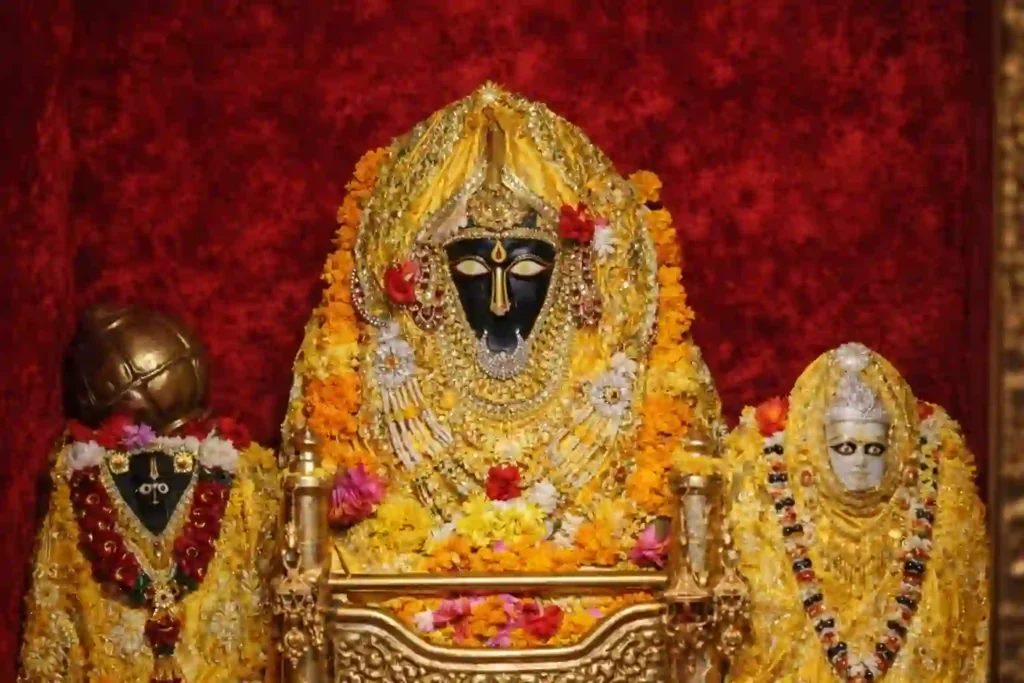
She is also known as Pitambara Devi, the Goddess clothed in yellow. In her tradition, yellow symbolizes stability, protection, discipline, and controlled spiritual power.
This symbolism is reflected throughout her worship, from turmeric offerings and yellow garments to the sacred rituals performed in her honor.
Table of Contents
ToggleMaa Baglamukhi's Place Among the Mahavidyas
Maa Baglamukhi is traditionally recognized as the eighth Mahavidya among the ten great wisdom forms of the Divine Mother. Within the Mahavidya tradition, she represents Stambhana Shakti, the divine power that restrains, immobilizes, and neutralizes harmful forces before they can create further damage.
While some Mahavidyas transform through time, fierce destruction, sacred knowledge, or transcendence, Maa Baglamukhi transforms through stillness.
Her power does not merely defeat negativity. It stops its movement, silences its influence, and removes its ability to act effectively.
For this reason, her worship has long attracted rulers, warriors, judges, tantric practitioners, and seekers facing intense external challenges or inner turmoil.
To her devotees, she is not only a protector against hostile forces but also a guide toward self-control, mental steadiness, and spiritual discipline.
Why Maa Baglamukhi Is the Eighth Mahavidya
In the traditional sequence of the Das Mahavidyas, Maa Baglamukhi appears after Maa Dhumavati and before Maa Matangi.
While different lineages explain the order in different ways, many Shakta traditions see this placement as deeply symbolic.
Maa Dhumavati represents emptiness, disappointment, and the collapse of worldly illusions. After that stage comes Baglamukhi, the power that stops the restless forces still operating within the seeker.
She freezes harmful speech, uncontrolled thoughts, and destructive impulses before they can create further karma.
Only after this inner stillness is established does the seeker move toward the refined wisdom and sacred expression associated with Maa Matangi.
In this way, Maa Baglamukhi represents a crucial turning point where chaos is brought under control and spiritual discipline begins to mature.
The True Meaning of the Name Baglamukhi
The name Baglamukhi has been interpreted in several ways within traditional Sanskrit and Tantric literature. One commonly accepted explanation connects the word Bagala to Valga, meaning a bridle used to control and restrain a horse.
Spiritually, this symbolism points to the power of restraining harmful speech, uncontrolled impulses, and destructive intentions.
Another traditional interpretation associates her with the crane, a bird known for its remarkable stillness and concentration. A crane can remain motionless for long periods before acting with precision.
This image reflects one of Maa Baglamukhi’s central qualities, the ability to stop movement, create stillness, and bring restless forces under control.
The name Mukhi means “faced” or “having the form of.” Together, Baglamukhi represents the divine power that arrests negativity, restrains harmful influences, and restores balance through disciplined control rather than uncontrolled force.
The classical and scripturally recognized name is Maa Baglamukhi. Regional pronunciations such as Bagala Devi, Bagalamukhi, and Bagula Devi are also found in different parts of India, but all refer to the same
Iconography and Symbolism of Maa Baglamukhi
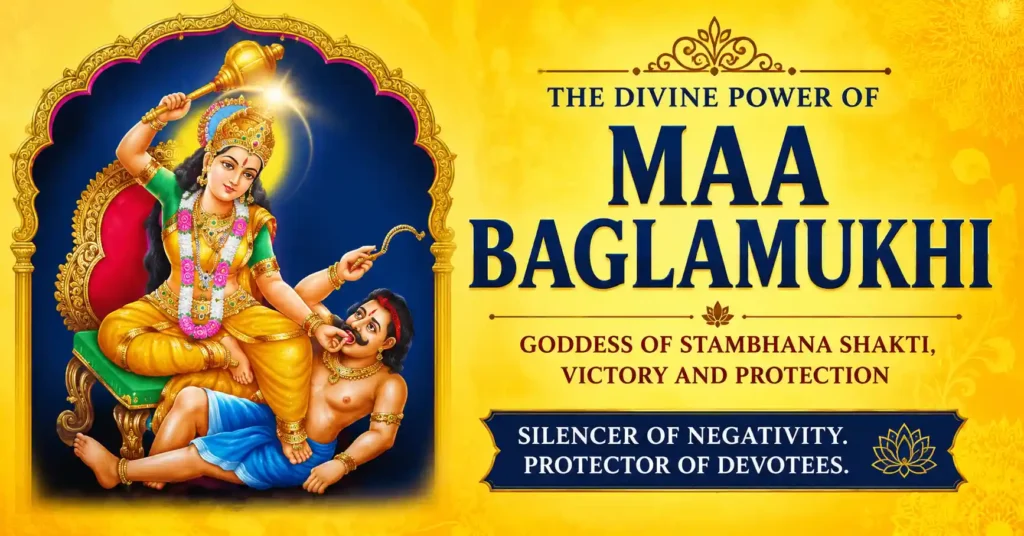
Maa Baglamukhi is traditionally depicted with a radiant golden complexion and dressed in yellow garments, reflecting her identity as Pitambara Devi, the Goddess clothed in yellow.
In her iconography, every element carries symbolic meaning rather than serving as mere decoration.
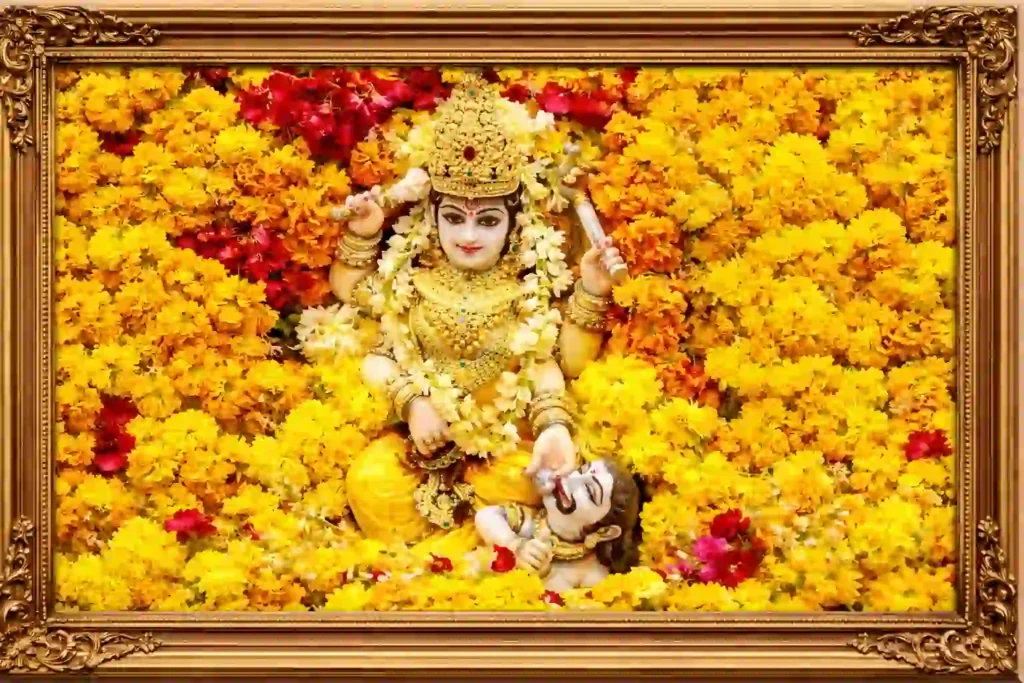
In one hand, she grasps the tongue of the demon Madanasura, while in the other she holds a club. This image is among the most recognizable representations in the Mahavidya tradition and conveys the essence of her divine power.
The tongue symbolizes false speech, lies, gossip, manipulation, harmful words, and the misuse of spiritual or worldly influence. The club represents authority, restraint, and the power to bring destructive forces under control.
Together, these symbols illustrate that Maa Baglamukhi does not seek to destroy existence itself. Instead, she neutralizes the ability of negativity to act, speak, or create further harm.
For devotees, this imagery also carries an inner spiritual message. The Goddess teaches restraint over speech, control over impulses, and mastery over the restless tendencies of the mind.
Her power targets harmful action at its source, transforming chaos into stillness and discipline.
The Spiritual Meaning of Seizing the Tongue
One of the most striking images of Maa Baglamukhi is her grasping the tongue of the demon while holding a club. At first glance, this may appear to be a scene of punishment, but traditional symbolism gives it a deeper meaning.
The tongue represents speech, desire, impulse, and the tendency of the mind to create suffering through careless words and reactions.
Much of human conflict begins through speech before it manifests as action. By seizing the tongue, the Goddess stops negativity at its source.
For spiritual seekers, this image is also a reminder to observe the power of words. Truthful speech, restraint, and silence are considered forms of worship in the Baglamukhi tradition.
Her iconography teaches that mastery over speech eventually leads to mastery over the mind itself.
The Origin of Maa Baglamukhi From Haridra Sarovar
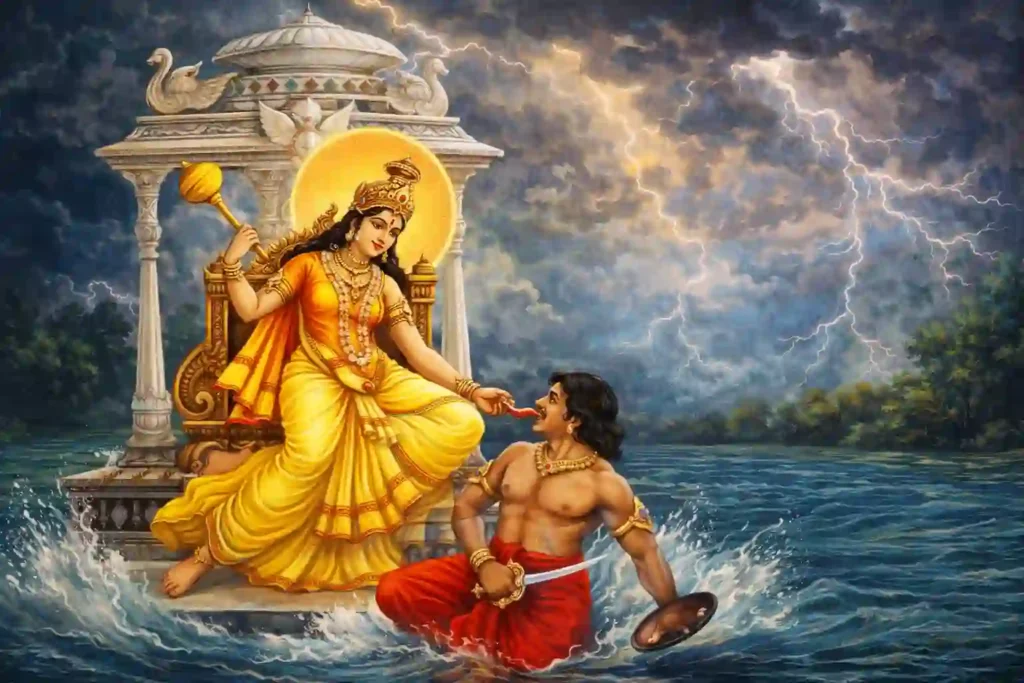
According to traditional Shakta narratives, a great cosmic storm arose during the Satya Yuga and threatened to disturb the balance of creation.
As the forces of chaos intensified, Lord Vishnu is said to have performed deep penance on the banks of Haridra Sarovar, the sacred lake associated with turmeric and golden radiance.
From the golden waters of this divine lake emerged Maa Baglamukhi, the embodiment of Stambhana Shakti.
The moment she appeared, the destructive storm was brought to a halt. This story reflects one of her most important qualities, the power to stop harmful forces before they can cause further damage.
This traditional account also explains why yellow occupies such a central place in her worship. Turmeric, yellow flowers, yellow garments, and yellow offerings are not merely ritual preferences.
They symbolize the stabilizing and restraining power of the Goddess. Unlike energies associated with uncontrolled destruction, Maa Baglamukhi represents disciplined force, balance, and the restoration of order.
For devotees, yellow signifies clarity, steadiness, protection, and focused spiritual strength. This symbolism is so deeply connected to her identity that she is widely known as Pitambara Devi, the Goddess clothed in yellow.
Through this sacred color, her worship continually reminds seekers of the importance of stability, self-control, and inner discipline.
The Legend of Madanasura and Vak Siddhi
According to a well-known tradition associated with Maa Baglamukhi, the demon Madanasura obtained the boon of Vak Siddhi, a power through which whatever he spoke would immediately come true.
Although such abilities are considered spiritually significant when used responsibly, Madanasura misused his gift and began creating fear, disorder, and suffering through his words.
As his influence grew, the balance of the world was threatened. To stop this misuse of power, Maa Baglamukhi appeared and seized his tongue, preventing him from causing further harm.
This act became one of the defining symbols of her divine role as the force that restrains destructive speech, harmful intentions, and negative influences before they can spread.
Traditional accounts further state that before losing his power, Madanasura prayed to the Goddess and requested that his memory remain connected with her worship.
For this reason, some depictions of Maa Baglamukhi continue to show the subdued demon in her presence.
His appearance is not a mark of honor or victory, but a symbolic reminder that uncontrolled power, ego, and harmful speech remain completely restrained under the authority of the Divine Mother.
Scriptural References to Maa Baglamukhi
Maa Baglamukhi is primarily revered within the Shakta and Tantric traditions. References to her worship are found in various Mahavidya traditions and Tantric texts where she is described as the embodiment of Stambhana Shakti, the power that restrains and immobilizes destructive forces.
Different lineages preserve different textual traditions, and not all sources present her in exactly the same way.
Because much of her worship developed through living Tantric traditions, temple practices, oral teachings, and guru lineages remain important alongside written texts.
For this reason, devotees often encounter a combination of scriptural teachings, regional traditions, and lineage-based practices when studying Maa Baglamukhi. Understanding these distinctions helps create a more balanced view of her worship.
Why Maa Baglamukhi Is Called Brahmastra Roopini
In Hindu tradition, the Brahmastra is regarded as one of the most powerful celestial weapons, associated with absolute precision and decisive effect.
It symbolizes a force that, once released, fulfills its purpose without deviation. Because of this symbolism, Maa Baglamukhi is often honored as Brahmastra Roopini, the embodiment of an unstoppable and decisive divine power.
The comparison does not mean that the Goddess functions as a weapon in a literal sense. Rather, it highlights the effectiveness of her Stambhana Shakti, the power that restrains, neutralizes, and brings harmful forces under control.
Devotees believe that when her grace operates, negativity loses its ability to continue causing damage.
This understanding also explains why traditional Baglamukhi sadhana is approached with seriousness and discipline.
Her worship is not viewed as a casual practice for worldly gain alone. Instead, it is regarded as a sacred path that requires sincerity, self-control, and a clear intention aligned with dharma.
Connections With Ramayana and Mahabharata Traditions
Various regional and temple traditions connect Maa Baglamukhi with important events described in the Ramayana and Mahabharata.
According to some traditional beliefs, Lord Rama invoked divine protective forces associated with the Goddess to counter the destructive powers of Ravana during the battle in Lanka.
Similarly, certain Mahabharata traditions hold that Lord Krishna advised the Pandavas to seek blessings connected with Stambhana Shakti before the Kurukshetra war.
These accounts are widely preserved in oral traditions, temple narratives, and local devotional literature.
However, devotees should note that such stories are generally regarded as traditional beliefs rather than explicit descriptions found in the primary texts of the Ramayana or Mahabharata.
One of the places where these traditions remain especially popular is the Baglamukhi Temple at Nalkheda in Madhya Pradesh.
Local temple traditions continue to preserve memories of Pandava worship and associate the site with ancient practices connected to the Goddess.
Such traditions form an important part of the living heritage of Maa Baglamukhi worship, even when they differ from direct scriptural accounts.
The Deeper Meaning of Stambhana Shakti
Stambhana Shakti is the central power associated with Maa Baglamukhi and forms the foundation of her worship.
The word stambhana means to stop, restrain, immobilize, or bring something under control. In the Baglamukhi tradition, this power is understood as the ability to halt destructive forces before they can create further harm.
On the outer level, devotees believe this energy can help neutralize hostility, false accusations, harmful speech, legal conflicts, black magic fears, and aggressive actions.
This protective aspect is one of the main reasons people turn to Maa Baglamukhi during difficult and uncertain periods of life.
On the inner level, however, the meaning of Stambhana Shakti becomes much deeper. It refers to the stilling of the restless mind, uncontrolled emotions, impulsive reactions, fear, anger, and the constant stream of distracting thoughts that disturb inner peace.
In this sense, the Goddess helps the seeker gain mastery over the forces operating within.
For advanced devotees and spiritual practitioners, this inner dimension is often considered more important than victory over external obstacles.
When mental agitation becomes quiet and reactive tendencies lose their power, silence itself becomes a form of transformation.
Through this deeper understanding of Stambhana Shakti, Maa Baglamukhi is seen not only as a protector from external threats but also as a guide toward inner discipline, stability, and spiritual awakening.
Maa Baglamukhi and Vak Shakti
In Sanatan tradition, speech is not viewed as a simple human ability. It is considered a sacred force known as Vak Shakti, the power through which thoughts become words and words influence reality.
The story of Madanasura reflects the importance of this principle. His misuse of speech became a source of destruction, while Maa Baglamukhi restored balance by bringing that power under control. This is why many devotees pray to her not only for protection but also for wisdom in speech.
On a deeper level, her worship encourages seekers to use language responsibly. Truthfulness, restraint, clarity, and silence are regarded as expressions of higher spiritual discipline. Through Vak Shakti, Maa Baglamukhi teaches that words can either create bondage or become instruments of liberation.
Traditional spiritual teachings describe speech as operating at multiple levels, from subtle thought to spoken words. For this reason, Vak Shakti is not limited to what a person says aloud. It also includes intention, mental dialogue, and the energy behind communication. Maa Baglamukhi’s power reminds devotees that controlling speech begins with controlling thought. When inner agitation becomes quiet, speech naturally becomes truthful, measured, and beneficial.
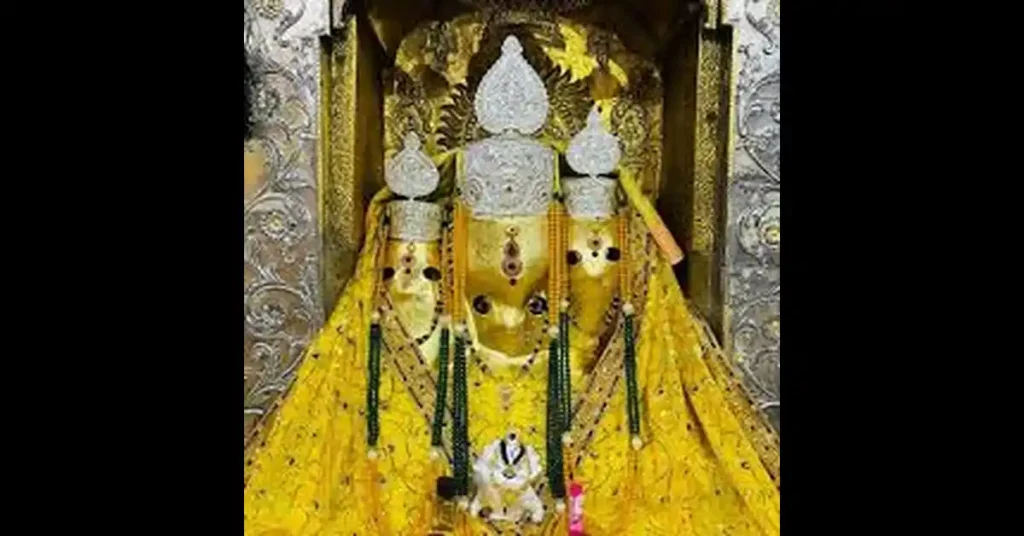
The Traditional Tantric Framework of Maa Baglamukhi Worship
Maa Baglamukhi is traditionally classified among the Ugra Mahavidyas, the powerful and transformative forms of the Divine Mother.
While her worship is associated with protection, restraint, and spiritual discipline, traditional teachings emphasize that her practices should be approached with respect, responsibility, and proper guidance.
Her tantric worship is recognized within established Shakta traditions but is also highly regulated.
Many lineages consider specific periods such as Amavasya, Tuesdays, and Thursdays especially suitable for worship, mantra japa, and spiritual observances connected with the Goddess.
Certain advanced practices are traditionally performed at night under the guidance of a qualified guru.
Silence, self-control, mental discipline, purity of intention, and sattvic conduct are regarded as essential foundations of Baglamukhi sadhana.
Traditional teachers consistently stress that her worship is not a form of folk magic or a shortcut to power. Rather, it is a structured spiritual discipline preserved through guru lineages, sacred texts, and living traditions.
For most devotees, simple prayer, mantra japa, temple worship, and sincere devotion are considered both safe and spiritually beneficial ways to connect with Maa Baglamukhi’s grace.
Traditional Puja Vidhi of Maa Baglamukhi
Traditional Baglamukhi puja is known for its discipline, simplicity, and symbolic use of yellow. The focus is not on elaborate decoration but on concentration, purity of intention, and devotion to the Goddess.
Many devotees begin by wearing clean yellow clothing and sitting on a yellow cloth while facing east or north, directions traditionally associated with spiritual practice.
The worship space usually includes an image or yantra of Maa Baglamukhi placed on a yellow cloth or base. In some traditions, a turmeric swastika or a simple mandala made from chana dal is used instead of an idol.
Offerings commonly include yellow flowers, bananas, lemons, turmeric, yellow rice, and besan ladoos, all of which reflect the Goddess’s association with stability, protection, and focused spiritual power.
Before mantra japa begins, a ghee lamp is lit as an offering of light and devotion. Many practitioners also use a haldi mala for chanting and maintain a calm, disciplined atmosphere throughout the worship.
Special worship is often performed during Chaitra Navaratri and Sharad Navaratri, which are considered particularly auspicious periods for Devi worship.
During these sacred days, devotees may increase their mantra chanting, visit temples, observe dietary discipline, perform charitable acts, and dedicate more time to prayer and self-reflection.
While Maa Baglamukhi can be worshipped throughout the year, Navaratri is regarded as a powerful time to deepen one’s spiritual connection with the Divine Mother.
Mantra Japa and Sankalpa Discipline
In the Baglamukhi tradition, mantra chanting begins with a clear and sincere sankalpa, a conscious statement of intention. Traditional teachings emphasize that this intention should be calm, dharmic, and free from anger, revenge, or the desire to harm others.
The quality of the seeker’s mindset is considered just as important as the mantra itself.
Mantra japa is commonly performed using a haldi mala, which reflects the Goddess’s deep association with turmeric and the color yellow.
Many devotees undertake daily chanting as part of their spiritual practice, while more intensive forms of sadhana may involve larger numbers of repetitions under proper guidance.
Traditional practices often mention 1.25 lakh mantra repetitions as a significant milestone in disciplined mantra worship.
After completing the chanting, practitioners are encouraged to sit quietly for a few moments in silence and contemplation.
This period of stillness allows the mind to settle and helps the devotee absorb the spiritual focus cultivated during the practice.
In many traditions, this silent awareness is considered an important part of the overall discipline, reinforcing the deeper teachings of restraint, stability, and inner control associated with Maa Baglamukhi.
Baglamukhi Mool Mantra
One of the most widely recited mantras dedicated to Maa Baglamukhi is the Baglamukhi Mool Mantra. Devotees chant this mantra to seek protection, inner strength, mental clarity, and the grace of the Goddess during challenging situations.
In traditional understanding, the mantra invokes her Stambhana Shakti, the divine power that restrains harmful influences and restores balance.
ॐ ह्रीं बगलामुखी सर्व दुष्टानाम
वाचं मुखं पदं स्तम्भय
जिव्हां कीलय बुद्धिं विनाशय
ह्रीं ॐ स्वाहा ॥
The mantra is traditionally interpreted as a prayer to Maa Baglamukhi to restrain harmful speech, silence negative influences, and neutralize destructive intentions.
While many devotees recite it for protection from external obstacles, spiritual teachers often emphasize its deeper purpose of controlling one’s own negative tendencies, impulsive reactions, and restless thoughts.
As with all sacred mantras, sincerity, discipline, and devotion are considered more important than the number of repetitions.
Many devotees chant the mantra daily as part of their spiritual practice, while advanced forms of mantra sadhana are traditionally undertaken under the guidance of a qualified guru.
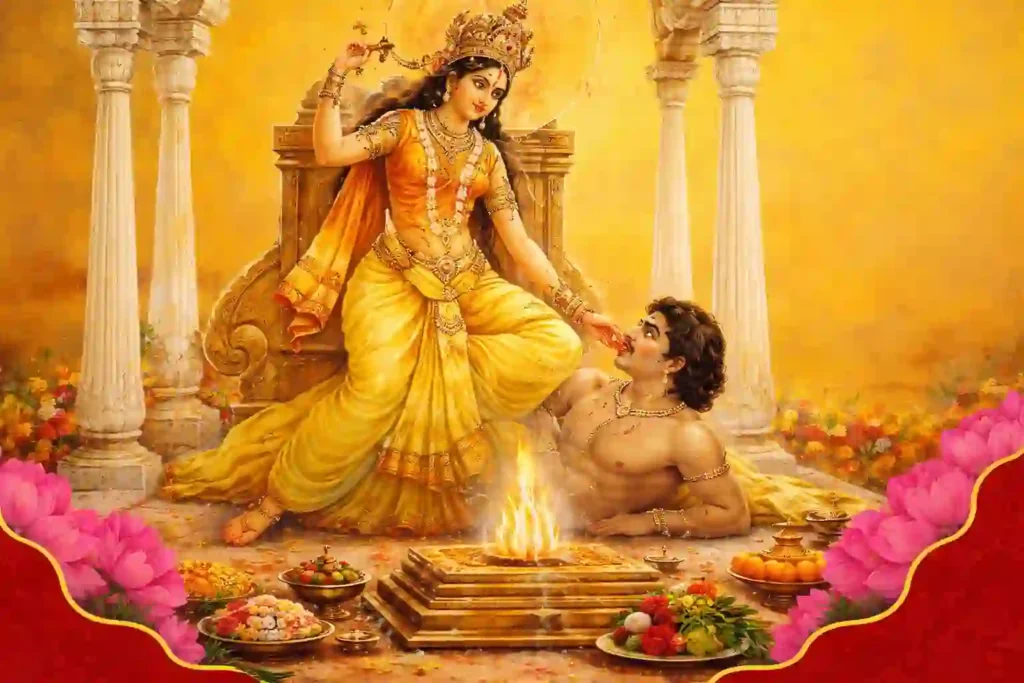
Meaning of the Hreem Bija
The bija mantra “Hreem” occupies a central place in the worship of Maa Baglamukhi and many other forms of the Divine Mother. Traditional teachers often describe it as a seed sound that combines spiritual power, protection, wisdom, and transformation.
While complete esoteric interpretations are traditionally taught through initiation, devotees commonly understand Hreem as a vibration that helps purify the mind and connect the seeker with the divine presence of Shakti. It is both a protective and transformative mantra.
In Baglamukhi worship, Hreem is associated with the Goddess’s ability to stop harmful influences while awakening inner strength and clarity. For this reason, the bija remains one of the most important elements of her mantra tradition.
Havan Rituals and Their Spiritual Purpose
Havan, also known as homa, occupies an important place in many Baglamukhi traditions. It is generally performed after mantra japa and is believed to strengthen the spiritual intention of the practice through offerings made into the sacred fire.
In traditional understanding, the havan serves as an act of devotion, purification, and focused prayer rather than a ritual performed for display.
Different materials are used according to the purpose of the worship. Haldi havan is commonly associated with protection, peace, clarity, and the blessings of Maa Baglamukhi.
Yellow mustard seeds are also used in certain traditions and are symbolically connected with overcoming obstacles, harmful speech, and adversarial situations.
Some tantric traditions mention mirchi havan for exceptionally difficult circumstances involving severe hostility, intense negativity, or other serious challenges.
However, such practices are traditionally considered advanced rituals and are not recommended for casual performance.
They are usually undertaken only under proper guidance and within established spiritual traditions.
For most devotees, simple prayer, mantra chanting, and devotional worship remain the primary and most accessible ways of seeking the grace of Maa Baglamukhi.
Major Temples and Living Peethas of Maa Baglamukhi
Several temples across India are closely associated with Maa Baglamukhi and continue to serve as important centers of worship, pilgrimage, and spiritual practice. Each temple preserves its own traditions while reflecting the broader Shakta understanding of the Goddess.
Pitambara Peeth, Datia (Madhya Pradesh) is among the most famous Baglamukhi shrines in India. Devotees from across the country visit this sacred site seeking blessings for protection, justice, and the resolution of difficult obstacles. The temple has long been associated with spiritual discipline and the worship of Maa Baglamukhi as Pitambara Devi.
Baglamukhi Temple, Nalkheda (Madhya Pradesh) is regarded as one of the oldest and most significant centers of Baglamukhi worship. Local traditions connect the temple with ancient tantric practices, and it remains an important destination for devotees seeking the blessings of the Goddess during challenging periods of life.
Baglamukhi Temple, Bankhandi (Himachal Pradesh) is another respected pilgrimage site. Temple traditions associate the shrine with ancient worship practices and special rituals performed in honor of the Goddess. It continues to attract devotees from across northern India.
Kamakhya Temple (Assam), one of the most important Shakta centers in the country, is deeply connected with the Mahavidya tradition. While dedicated primarily to Maa Kamakhya, the temple’s spiritual framework includes the worship of the Mahavidyas, including Maa Baglamukhi, within the broader Tantric tradition.
Regional Traditions of Maa Baglamukhi Worship
The worship of Maa Baglamukhi takes different forms across various regions of India, reflecting the diversity of local traditions while preserving the core principles of her worship.
These regional expressions add depth to the living tradition of the Goddess and demonstrate how devotion adapts to local cultural and spiritual contexts.
In Madhya Pradesh, particularly around Datia and Nalkheda, Maa Baglamukhi is widely associated with protection, legal matters, and traditional tantric practices.
In Himachal Pradesh, temple traditions often place greater emphasis on devotional worship, prayer, and community participation.
In Assam, her worship is commonly understood within the broader framework of Shakta Tantra associated with Kamakhya and the Mahavidya tradition.
Although rituals, customs, and local beliefs may vary from one region to another, the central understanding remains consistent.
Devotees revere Maa Baglamukhi as the divine force that restrains negativity, protects dharma, and restores balance during times of conflict, uncertainty, and spiritual challenge.
Planetary Associations in Maa Baglamukhi Tradition
Some Tantric and Jyotish traditions symbolically associate Maa Baglamukhi with the energies of Mars and Saturn. While there is no universally accepted astrological rule linking her exclusively to these planets, such associations are often used to help explain the nature of her spiritual power.
Mars traditionally represents force, action, confrontation, and the energy required to face challenges. Saturn, on the other hand, is associated with discipline, restraint, patience, karma, and control.
In symbolic terms, Maa Baglamukhi brings these qualities into balance. Her power does not operate through uncontrolled aggression, nor through passive delay. Instead, she restrains harmful momentum, neutralizes negativity, and restores order through disciplined strength.
This symbolic interpretation helps explain why many devotees turn to Maa Baglamukhi during periods of conflict, legal disputes, intense opposition, or karmic pressure.
Rather than seeking destruction, her worship is traditionally understood as a way of bringing disruptive forces under control and creating the stability needed for right action and spiritual growth.
Vahana Ambiguity in Maa Baglamukhi Worship
Unlike Maa Durga, who is traditionally associated with the lion, or Maa Kali, whose iconography is widely standardized across many traditions, Maa Baglamukhi does not have a universally accepted vahana.
This unique feature reflects the diversity of traditions that have developed around her worship over centuries.
Some regional depictions associate the Goddess with crane symbolism, while others portray her alongside a lion or do not include a vahana at all.
These variations are found in different temples, artistic traditions, and lineage-based interpretations. Rather than being contradictory, they reflect the richness and diversity of Baglamukhi worship across India.
Many devotees and scholars view the absence of a universally recognized vahana as symbolically significant. Maa Baglamukhi’s power is not primarily expressed through movement, conquest, or outward action. Instead,
it operates through restraint, stillness, and immobilization. Her Stambhana Shakti works by bringing harmful forces to a halt rather than pursuing or overpowering them through speed or aggression.
For this reason, different iconographic traditions continue to coexist without conflict, each highlighting a particular aspect of the Goddess while preserving the central understanding of her role as the divine force of restraint and control.
Baglamukhi Yantra and Its Placement at Home
The Baglamukhi Yantra is regarded as a sacred geometric representation of the Goddess’s spiritual power. Many devotees keep the yantra in their homes or prayer spaces as a symbol of protection, stability, and focused spiritual energy.
Traditional practices often recommend placing the yantra in the north-east direction of the home or within a dedicated worship area.
Some devotees also place it near the entrance as a symbolic reminder of divine protection. However, local customs and guidance from spiritual teachers may vary.
To maintain a devotional connection with the yantra, devotees commonly light a lamp, offer prayers, and recite Maa Baglamukhi’s mantra on a regular basis.
Chanting 108 repetitions of the mantra is a widely followed practice, although sincere devotion is considered more important than numbers alone.
Within traditional belief, the yantra is associated with protection from negativity, mental clarity, inner stability, and thoughtful decision-making.
For many devotees, it serves not only as a ritual object but also as a reminder of the discipline, restraint, and spiritual focus that Maa Baglamukhi represents.
The Esoteric Meaning of Maa Baglamukhi's Power
Beyond ritual worship and protection-oriented practices, Maa Baglamukhi holds a profound place in the spiritual and contemplative traditions of Sanatan Dharma.
At this deeper level, she represents the power of complete stillness, the ability to bring the restless movements of the mind under control and reveal the silence that exists beneath them.
Her Stambhana Shakti is not limited to restraining external negativity. It also operates within the seeker’s inner world by slowing impulsive reactions, quieting mental agitation, and weakening the influence of ego-driven patterns.
Through this lens, the Goddess becomes a symbol of inner mastery rather than merely external protection.
In yogic philosophy, spiritual growth is often linked to the calming of mental fluctuations, known as vrittis.
Maa Baglamukhi’s energy is traditionally understood as supporting this process of inner stillness, allowing awareness to become more stable, focused, and self-aware. As distractions lose their hold, the seeker gains greater clarity and presence.
This deeper understanding explains why many advanced practitioners and contemplative seekers hold Maa Baglamukhi in high regard.
Even when outward worship is not part of their practice, they recognize her as a powerful symbol of restraint, silence, and the transformative stillness that lies at the heart of spiritual realization.
Dhyana and Contemplation of Maa Baglamukhi
Traditional meditation on Maa Baglamukhi centers on her radiant golden form seated in divine stillness.
Devotees visualize the Goddess adorned in yellow garments and ornaments, surrounded by a luminous golden aura that symbolizes stability, protection, wisdom, and spiritual authority.
This form is not merely an object of devotion but a symbol of the inner stillness she helps awaken within the seeker.
During meditation, practitioners contemplate her power to silence mental turbulence, calm emotional disturbances, and dissolve fear. The purpose of this practice extends beyond overcoming external obstacles.
It encourages the development of inner steadiness, self-control, clarity of thought, and a deeper connection with one’s spiritual nature.
Many devotees regard this contemplative dimension as one of the highest aspects of Baglamukhi worship. As the mind gradually becomes quieter and less reactive, the seeker begins to experience the deeper meaning of her Stambhana Shakti.
At this level, restraint is no longer viewed as force or suppression, but as a state of profound inner silence, awareness, and spiritual balance.
Internal Enemies and the Higher Purpose of Sadhana
Popular understanding of Maa Baglamukhi often focuses on protection from external enemies and obstacles.
However, traditional spiritual teachings place even greater importance on the inner transformation that arises through her worship. In higher sadhana, the real adversaries are not outside the seeker but within.
Lust, anger, greed, fear, attachment, pride, and ego are regarded as the forces that create suffering and keep the mind restless.
These inner tendencies influence thoughts, words, and actions, often becoming the root cause of conflict and dissatisfaction. Spiritual progress begins when these forces are recognized and brought under control.
Maa Baglamukhi’s Stambhana Shakti is understood as the power that arrests the momentum of these destructive tendencies.
Rather than suppressing emotions through force, her energy helps the seeker become aware of them, reduce their influence, and prevent them from controlling behavior and decision-making.
For this reason, many advanced practitioners consider inner victory to be the highest expression of her grace.
Success over external challenges may bring temporary relief, but mastery over one’s own mind leads to lasting stability, wisdom, and spiritual growth.
In this deeper understanding, Maa Baglamukhi becomes not only a protector from outer difficulties but also a guide toward self-mastery and inner freedom.
Who Should Avoid Advanced Baglamukhi Sadhana
Maa Baglamukhi’s worship is open to all devotees through prayer, mantra japa, and sincere devotion. However, traditional teachings advise caution when it comes to advanced tantric forms of Baglamukhi sadhana.
Such practices are regarded as powerful spiritual disciplines and are traditionally undertaken only under proper guidance.
Those who approach the Goddess with anger, revenge, ego, or the desire to harm others are generally advised to refrain from advanced practices.
The purpose of her worship is not the pursuit of personal domination or hostility but the restoration of balance, self-control, and alignment with dharma.
Beginners, emotionally vulnerable individuals, and those unfamiliar with traditional spiritual disciplines are usually encouraged to focus on simple forms of worship such as mantra chanting, prayer, temple visits, and devotional practices.
These methods allow devotees to develop a respectful relationship with the Goddess while avoiding unnecessary confusion or misunderstanding.
This caution should not be viewed as fear-based teaching. Rather, it reflects a long-standing tradition of responsibility and spiritual maturity.
Like many advanced paths within Sanatan Dharma, Baglamukhi sadhana is considered most beneficial when approached with humility, discipline, proper understanding, and guidance from a qualified teacher.
Why Devotees Turn to Maa Baglamukhi in Difficult Times
Maa Baglamukhi is not traditionally worshipped as a deity of comfort or worldly ease. Devotees usually turn to her during periods of intense challenge, uncertainty, conflict, or spiritual struggle when they seek strength, protection, and the ability to overcome forces that seem beyond their control.
In the language of devotion, she is often described as both a shield and a weapon. The shield symbolizes her protective grace, which helps devotees face obstacles with courage and steadiness.
The weapon symbolizes her power to restrain negativity, neutralize harmful influences, and restore balance when circumstances become difficult.
Traditional teachings emphasize that the attitude of the seeker matters greatly. Those who approach Maa Baglamukhi with sincerity, humility, and surrender seek her blessings for protection, wisdom, and inner stability.
At the same time, her traditions remind devotees that spiritual power should never become a source of ego, pride, or domination over others.
For this reason, many devotees view Maa Baglamukhi not only as a protector from external difficulties but also as a guide who teaches discipline, self-control, and the responsible use of power.
Through her grace, challenges become opportunities for growth, resilience, and deeper spiritual understanding.
The Deeper Message of Maa Baglamukhi
Maa Baglamukhi is often approached for protection, victory, and the removal of obstacles, but her deeper teaching goes far beyond overcoming external difficulties. At the heart of her worship lies the power of restraint, the ability to stop harmful forces, calm inner turmoil, and regain control over one’s thoughts, words, and actions.
Her symbolism reminds devotees that true strength is not always expressed through force. Sometimes the greatest power lies in stillness, discipline, and the ability to prevent negativity from gaining momentum. This is why her Stambhana Shakti is respected not only by devotees seeking protection but also by spiritual seekers pursuing inner transformation.
Whether worshipped through prayer, mantra japa, temple visits, or quiet contemplation, Maa Baglamukhi continues to inspire faith as the Divine Mother who brings stability amidst chaos. For her devotees, she is both a protector from external challenges and a guide toward greater self-mastery, clarity, and spiritual balance.
Suggested Reading
Maa Baglamukhi is one of the ten Mahavidyas, and her story becomes even more meaningful when viewed within the larger journey of the Divine Mother.
Each Mahavidya reveals a unique aspect of spiritual wisdom, transformation, and awakening. If you would like to explore the complete Mahavidya tradition, these articles may help deepen your understanding.
Das Mahavidya: The Ten Wisdom Goddesses of Sanatan Dharma
https://thesanatantales.com/das-mahavidya-the-ten-wisdom-goddesses-of-sanatan-dharma/Maa Kali: The Goddess Beyond Time and Death
https://thesanatantales.com/maa-kali/Maa Tara: The Compassionate Savior and Divine Guide
https://thesanatantales.com/maa-tara/Maa Tripura Sundari: The Goddess of Beauty, Consciousness and Bliss
https://thesanatantales.com/maa-tripura-sundari/Maa Bhuvaneshwari: The Cosmic Mother of Infinite Space
https://thesanatantales.com/maa-bhuvaneshwari/Maa Chhinnamasta: The Mystery of Self-Sacrifice and Awakening
https://thesanatantales.com/maa-chhinnamasta/Maa Bhairavi: The Goddess of Discipline, Power and Transformation
https://thesanatantales.com/maa-bhairavi/Maa Dhumavati: The Wisdom Hidden in Emptiness and Loss
https://thesanatantales.com/maa-dhumavati/Maa Matangi: The Goddess of Sacred Speech and Inner Wisdom
https://thesanatantales.com/maa-matangi/Maa Kamalatmika: The Lotus Goddess of Prosperity and Spiritual Abundance
https://thesanatantales.com/maa-kamalatmika/
Bagalamukhi (Wikipedia)
https://en.wikipedia.org/wiki/Bagalamukhi
FAQs
Who Is Maa Baglamukhi?
Maa Baglamukhi is one of the ten Mahavidyas, the great wisdom forms of the Divine Mother in the Shakta tradition. She is revered as the embodiment of Stambhana Shakti, the divine power that restrains, immobilizes, and neutralizes harmful forces.
Devotees worship her for protection, inner strength, mental stability, and the ability to overcome challenging situations. Beyond her role as a protector, she is also regarded as a guide who helps seekers cultivate self-control, clarity, and spiritual discipline.
What is Maa Baglamukhi famous for?
Maa Baglamukhi is best known for her association with Stambhana Shakti, the divine power of restraint and immobilization. Devotees worship her for protection, inner strength, mental stability, and the ability to overcome difficult situations. In spiritual teachings, her power is understood as both external protection and inner self-control.
Why is Maa Baglamukhi called Pitambara Devi?
Maa Baglamukhi is called Pitambara Devi because yellow plays a central role in her worship and symbolism. The color is associated with clarity, stability, discipline, and focused spiritual energy. This connection is reflected in the use of turmeric, yellow flowers, yellow garments, and yellow offerings during her worship.
Why does Maa Baglamukhi hold the demon's tongue?
The image of Maa Baglamukhi holding the tongue of a demon symbolizes the restraint of harmful speech, negativity, and destructive influences. On a deeper level, it represents control over impulsive thoughts, uncontrolled emotions, and the misuse of power. This symbolism is one of the most important teachings associated with the Goddess.
Which mantra is most commonly associated with Maa Baglamukhi?
The Baglamukhi Mool Mantra is the most widely recited mantra dedicated to the Goddess. Devotees chant it as a form of prayer for protection, spiritual strength, mental clarity, and inner stability. Traditional teachings recommend chanting with sincerity and discipline rather than focusing only on the number of repetitions.
Can beginners worship Maa Baglamukhi?
Yes. Beginners can worship Maa Baglamukhi through simple prayer, mantra japa, reading her stories, and visiting temples. Traditional teachings generally advise that advanced tantric practices should only be undertaken with proper guidance from a qualified guru. For most devotees, devotional worship is considered both safe and spiritually beneficial.
Which are the most important temples of Maa Baglamukhi?
Some of the most well-known temples associated with Maa Baglamukhi include Pitambara Peeth in Datia, Baglamukhi Temple in Nalkheda, Baglamukhi Temple in Bankhandi, and the broader Shakta traditions connected with Kamakhya in Assam. Each of these places preserves unique traditions related to the worship of the Goddess.
What is the spiritual meaning of Maa Baglamukhi's worship?
Beyond protection from external obstacles, Maa Baglamukhi’s worship emphasizes self-control, restraint, and inner transformation. Her teachings encourage devotees to overcome anger, fear, ego, and impulsive behavior. Many spiritual seekers view her as a guide toward mental stillness, clarity, and disciplined living.
Is Maa Baglamukhi worship connected with Tantra?
Yes. Maa Baglamukhi is an important deity within several Shakta and Tantric traditions. However, Tantra is a broad spiritual tradition that includes philosophy, meditation, mantra, ritual, and disciplined practice. Most devotees worship Maa Baglamukhi through prayer, mantra chanting, and temple worship without engaging in advanced tantric rituals.
What does Stambhana Shakti mean?
Stambhana Shakti refers to the power of restraint, stillness, and immobilization associated with Maa Baglamukhi. In traditional understanding, it can refer to stopping harmful influences externally as well as calming negative thoughts, emotional reactions, and mental restlessness internally. This concept lies at the heart of her worship.
Can Maa Baglamukhi be worshipped at home?
Yes. Many devotees worship Maa Baglamukhi at home through daily prayers, mantra chanting, lighting a lamp, and maintaining a dedicated space for devotion. Simple and sincere worship is traditionally considered more important than elaborate rituals, especially for beginners.
Glossary of Important Terms
| Term | Meaning |
|---|---|
| Maa Baglamukhi | The eighth Mahavidya, revered as the goddess who restrains and neutralizes harmful forces. |
| Mahavidya | One of the ten great wisdom goddesses in the Shakta tradition. |
| Dash Mahavidya | The group of ten divine wisdom forms of the Divine Mother. |
| Shakta Tradition | A Hindu tradition focused on the worship of Shakti, the Divine Feminine. |
| Shakti | Divine cosmic energy and power manifested through the Goddess. |
| Stambhana Shakti | The power to stop, restrain, immobilize, or neutralize harmful forces. |
| Pitambara Devi | A title of Maa Baglamukhi meaning “The Goddess Clothed in Yellow.” |
| Baglamukhi | A Sanskrit name associated with restraint, control, and stillness. |
| Valga | A Sanskrit term meaning “bridle,” symbolizing control and restraint. |
| Mukhi | A Sanskrit word meaning “faced” or “having the form of.” |
| Madanasura | The demon subdued by Maa Baglamukhi, symbolizing harmful speech and misuse of power. |
| Vak Siddhi | A mystical power where spoken words manifest into reality. |
| Vak Shakti | The sacred power of speech and communication. |
| Haridra Sarovar | The sacred turmeric lake from which Maa Baglamukhi is believed to have emerged. |
| Satya Yuga | The first and most virtuous age in Hindu cosmology. |
| Brahmastra Roopini | A title meaning the embodiment of the divine Brahmastra-like power. |
| Brahmastra | The most powerful celestial weapon described in Hindu scriptures. |
| Tantra | A spiritual tradition using rituals, mantras, meditation, and sacred symbolism. |
| Tantric Worship | Structured spiritual practices rooted in Tantric traditions. |
| Sadhana | Disciplined spiritual practice aimed at self-transformation. |
| Guru | A spiritual teacher who guides seekers on the path of knowledge. |
| Mantra Japa | Repetitive chanting of a sacred mantra. |
| Sankalpa | A sincere spiritual intention or vow made before worship or meditation. |
| Mool Mantra | The principal mantra associated with a deity. |
| Bija Mantra | A seed syllable believed to contain concentrated spiritual energy. |
| Hreem | The primary seed mantra associated with Maa Baglamukhi and Divine Mother worship. |
| Yantra | A sacred geometric diagram used for meditation and worship. |
| Havan (Homa) | A sacred fire ritual performed with offerings and mantras. |
| Haldi Mala | A rosary made from turmeric beads used for mantra chanting. |
| Amavasya | The new moon day, considered spiritually significant for worship. |
| Navaratri | A nine-night festival dedicated to the Divine Mother. |
| Dharma | Righteous duty, moral order, and spiritual responsibility. |
| Vrittis | Mental fluctuations or restless thought patterns in yogic philosophy. |
| Dhyana | Meditation or focused contemplation. |
| Ugra Mahavidya | A powerful and transformative form of the Divine Mother. |
| Pitambara Peeth | A famous Baglamukhi temple and spiritual center in Datia, Madhya Pradesh. |
| Nalkheda Temple | One of the most important ancient Baglamukhi temples in Madhya Pradesh. |
| Bankhandi Temple | A well-known Baglamukhi pilgrimage site in Himachal Pradesh. |
| Kamakhya Temple | A major Shakti Peetha and center of Tantric worship in Assam. |
| Jyotish | The traditional Hindu system of astrology. |
| Mars (Mangal) | A planet symbolizing action, courage, and confrontation in Vedic astrology. |
| Saturn (Shani) | A planet associated with discipline, karma, patience, and restraint. |
| Vahana | The symbolic vehicle or mount of a deity. |
| Crane Symbolism | Represents stillness, focus, patience, and precise action in Baglamukhi traditions. |
| Self-Mastery | Control over thoughts, emotions, speech, and actions. |
| Inner Stillness | A state of mental calmness and spiritual stability cultivated through practice. |
| Spiritual Discipline | Consistent practices that develop self-control, awareness, and spiritual growth. |
| Divine Mother | The supreme feminine aspect of the Divine worshipped in Shakta traditions. |
About the Author
Yateendra Chaturvedi is a spiritual writer, researcher, devotee, and the founder of The Sanatan Tales. With over 35 years of professional experience and a lifelong interest in Sanatan Dharma, he writes about Hindu deities, temples, scriptures, festivals, Mahavidyas, sacred stories, rituals, and living traditions that continue to guide and inspire devotees across India.
Drawing from traditional scriptures, regional beliefs, temple traditions, devotional literature, and historical sources, he aims to present authentic, well-researched, and easy-to-understand content for modern readers. His work focuses on preserving spiritual wisdom, explaining sacred traditions, and helping seekers develop a deeper understanding of India’s rich spiritual heritage.
Through The Sanatan Tales, Yateendra strives to make the timeless teachings of Sanatan Dharma simple, meaningful, and relevant for today’s generation while maintaining respect for traditional sources, regional practices, and diverse spiritual perspectives.
Learn More About Yateendra Chaturvedi →
https://thesanatantales.com/about-the-author/
References & Sources
This article is based on beliefs and traditions followed within the Shakta traditions of Sanatan Dharma, traditional knowledge associated with the Dashamahavidya tradition, Shakti worship, Devi sadhana, and insights drawn from various spiritual and religious study sources.
Some concepts discussed in this article are also inspired by teachings and interpretations preserved through the guru-disciple tradition.
Note: Beliefs, interpretations, and spiritual practices may vary across different traditions, sects, and paths within Sanatan Dharma. The purpose of this article is not to present any single viewpoint as the absolute truth, but to explain widely accepted religious and spiritual perspectives in a simple and accessible manner.
Explore More Fascinating Topics from Sanatan Dharma