Maa Bhairavi is not a gentle presence that comforts the mind. She is the heat that awakens it. Among the ten Mahavidyas, Maa Bhairavi stands as the force of tapas, discipline, and controlled power.
She appears fierce, even terrifying, yet her purpose is deeply maternal. She burns what is false so that truth can stand without weakness.
In Shakta tradition, Maa Bhairavi is revered as the fifth Mahavidya, representing the transformative power of Shakti that burns away ignorance, weakness, and spiritual complacency.
In the Mahavidya journey, she appears after Maa Bhuvaneshwari. Where Bhuvaneshwari creates space and order, Bhairavi fills that space with intensity and direction.
She represents the fire that purifies consciousness, not through kindness alone, but through strength, restraint, and awakening awareness.
Table of Contents
ToggleMeaning and Essence of the Name Bhairavi
The name Bhairavi is traditionally associated with a fierce, awe-inspiring, and transformative form of the Divine Mother. Her intensity is not meant to frighten devotees. Instead, it symbolizes the power that destroys ignorance, complacency, and spiritual weakness.
Maa Bhairavi inspires reverence because she stands beyond comfort and illusion. She reminds seekers that genuine spiritual growth requires discipline, courage, and the willingness to face inner limitations with honesty.
At the same time, she is also known as Shubhankari, the giver of auspiciousness, revealing her compassionate and protective nature toward those who approach her with sincerity and devotion.
Maa Bhairavi in Shakta Doctrine and Mahavidya Tradition
Maa Bhairavi is counted as the fifth Mahavidya among the ten forms of the Divine Mother. In Shakta philosophy, she represents the fiery and transformative power of Shakti that governs discipline, effort, purification, and spiritual awakening.
Unlike forms of the Goddess that primarily nurture, guide, or harmonize, Maa Bhairavi emphasizes inner strength and determined practice.
She is often associated with the force that removes weakness, complacency, and hesitation, encouraging the seeker to move forward with courage and commitment.
Tripura Bhairavi and Tripura Sundari are closely connected yet express different dimensions of the Divine Mother. Tripura Sundari embodies beauty, harmony, and supreme order, while Bhairavi represents the intensity and disciplined energy required to protect and sustain that order.
One gently attracts consciousness toward truth, while the other strengthens the seeker to live that truth through effort and transformation.
Maa Bhairavi in Shakta Scriptures
Maa Bhairavi is revered in several Shakta and Tantric traditions as a manifestation of the Divine Mother’s transformative power. She is honoured within the Mahavidya tradition, where each Mahavidya represents a distinct aspect of Shakti and spiritual realization.
References to Bhairavi and her fierce transformative nature appear across Shakta literature and Tantric traditions. Different lineages describe her through varying symbolic and theological frameworks, yet they consistently associate her with tapas, discipline, purification, and awakened awareness.
In many Mahavidya traditions, she is understood as the force that strengthens the seeker after the realization of divine beauty, wisdom, and cosmic order.
Shakta teachings present Maa Bhairavi not as a destructive power for its own sake, but as the Divine Mother who burns away ignorance, weakness, and spiritual complacency so that higher awareness can emerge.
This understanding remains central to both devotional and contemplative approaches to her worship.
Iconography and Symbolic Form of Maa Bhairavi
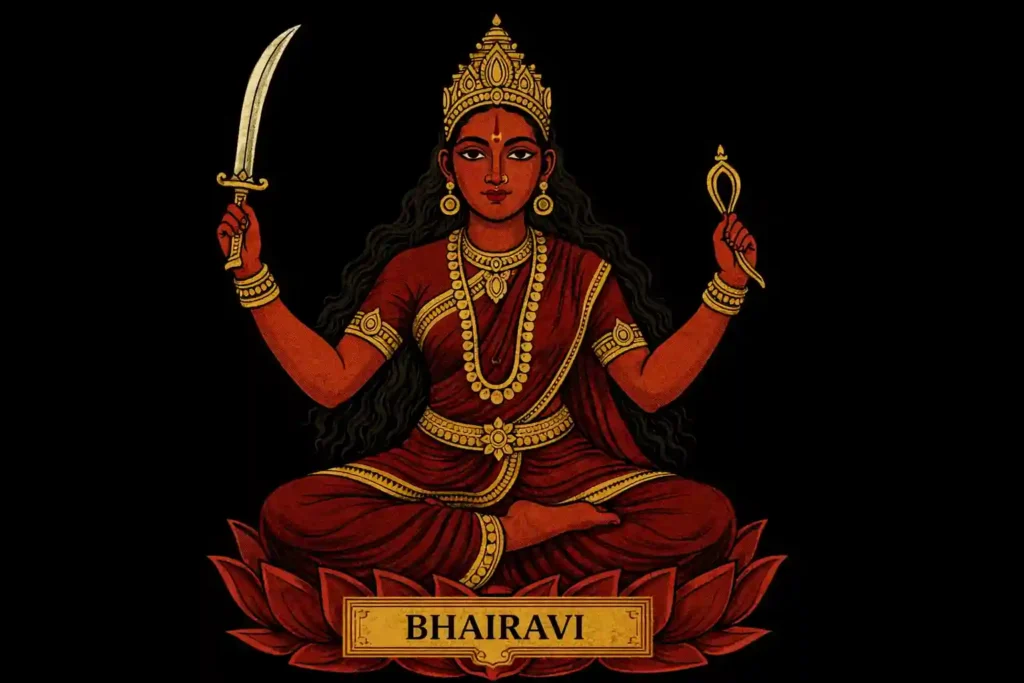
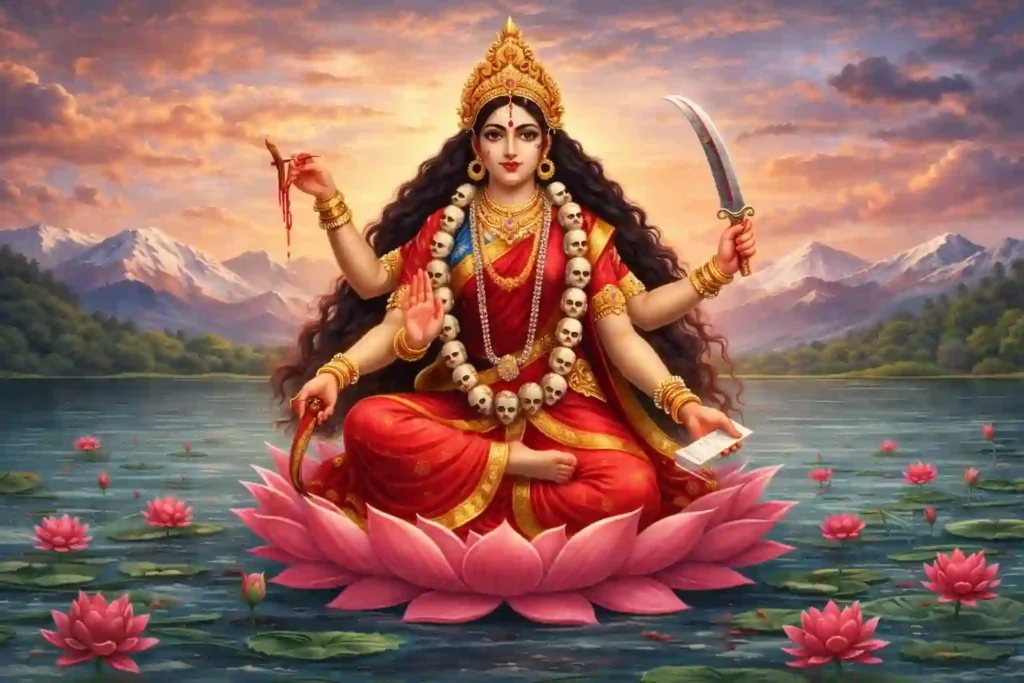
Traditional meditation verses describe Maa Bhairavi as wearing red garments, symbolizing spiritual energy, determination, and the fire of tapas.
She is often depicted with three eyes, representing expanded awareness that transcends ordinary perception and encompasses past, present, and future. A crescent moon may adorn her head, linking her to Shiva, time, and the cyclical nature of existence.
In some depictions, Maa Bhairavi wears a garland of skulls or severed heads. These do not symbolize cruelty but the removal of ego, ignorance, and false identity.
Her loosened hair represents the untamed and dynamic power of Shakti, while her weapons such as the trident, sword, noose, or bow symbolize discipline, protection, and the ability to remove obstacles from the seeker’s path.
The symbolism of Maa Bhairavi’s form reflects the process of inner transformation. Her fiery appearance reminds devotees that spiritual growth requires courage, self-discipline, and the willingness to confront personal limitations.
Together, these symbols portray Maa Bhairavi as the Divine Mother who transforms weakness into strength, confusion into clarity, and ignorance into wisdom.
Maa Bhairavi as the Fire of Tapas
One of the most important ways of understanding Maa Bhairavi is through the concept of tapas, the inner heat generated by sincere spiritual effort.
In Sanatan traditions, tapas does not simply mean physical austerity. It refers to the discipline, focus, and perseverance that gradually purify the mind and strengthen character.
Maa Bhairavi is often viewed as the embodiment of this sacred fire. Her presence reminds devotees that genuine transformation requires effort, patience, and the courage to confront personal limitations. In this way, her worship becomes a path of inner refinement rather than external display.
Maa Bhairavi and Kundalini Awakening
Many tantric traditions associate Maa Bhairavi with the disciplined awakening of inner spiritual energy. While teachings on Kundalini vary across lineages, Bhairavi is often understood as the force that helps transform scattered energy into focused awareness.
Rather than emphasizing sudden mystical experiences, traditional teachings connect her with steady effort, self-control, and inner purification.
For this reason, devotees often view Maa Bhairavi as a guide who strengthens the seeker during periods of spiritual growth, helping cultivate clarity, determination, and resilience on the path.
Maa Bhairavi and Her Tantric Dimension
In several tantric traditions, Maa Bhairavi is revered as a powerful manifestation of transformative Shakti. She is associated with discipline, spiritual intensity, and the inner fire that supports higher states of awareness. Because of this, her worship occupies an important place within many Shakta and Tantric lineages.
Certain traditions also connect Maa Bhairavi with Yogini and Bhairava traditions, where she is viewed as a guiding force behind various forms of spiritual transformation. These teachings are often symbolic as well as ritualistic, expressing the balance between dynamic Shakti and divine consciousness.
For this reason, Bhairavi sadhana has traditionally been approached with respect, discipline, and proper guidance. While household devotees may worship her through prayer, mantra japa, and simple devotion, advanced tantric practices are generally undertaken only under the guidance of a qualified guru.
Legend and Inner Meaning of Her Fierce Nature
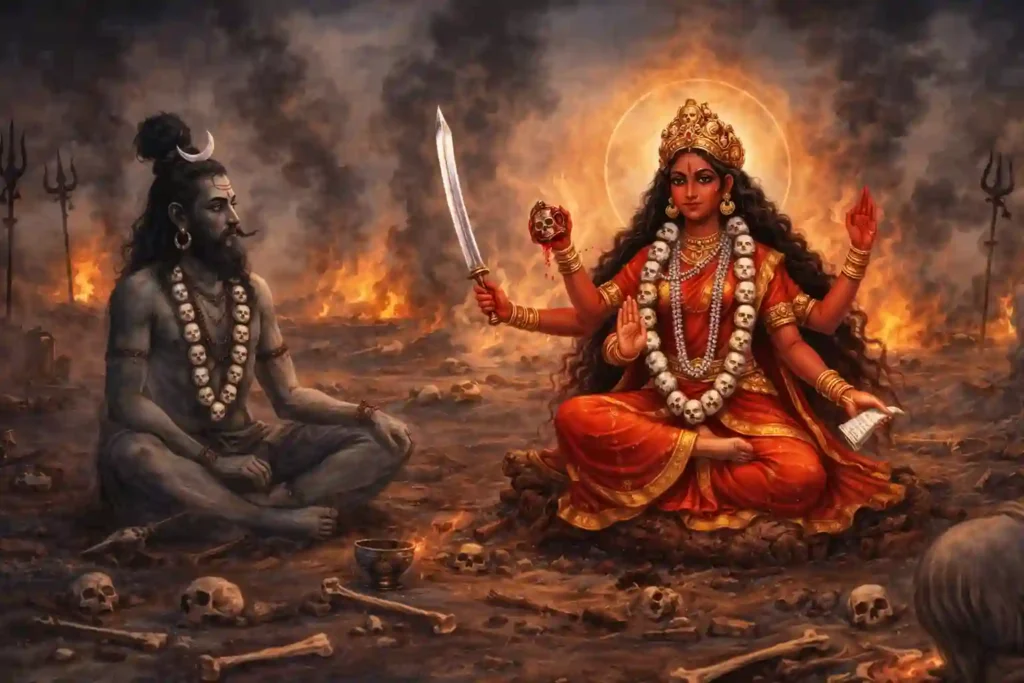
A well-known tantric symbolism depicts Bhairava and Bhairavi in a cremation-ground setting. Rather than celebrating death, this imagery reminds seekers of the temporary nature of the body, possessions, and worldly attachments. It teaches that spiritual freedom begins when one accepts impermanence instead of fearing it.
Within this symbolism, Maa Bhairavi represents the courage to face difficult truths and move beyond illusion.
Her presence encourages the seeker to develop clarity, detachment, and inner strength, recognizing that lasting wisdom arises not from avoiding life’s realities but from understanding them deeply.
Maa Bhairavi Mantra and Its Traditional Understanding
Maa Bhairavi mantra is traditionally associated with inner discipline, courage, and spiritual purification.
Devotees chant her mantra to cultivate focus, determination, and a deeper connection with the transformative power of the Divine Mother. For this reason, her mantra is generally approached with sincerity, regularity, and respect.
One widely known mantra of Maa Bhairavi is:
ॐ ह्रीं भैरव्यै नमः
Om Hreem Bhairavyai Namah
This mantra is commonly used for daily japa and inner strengthening. Many devotees chant it with calm attention and devotional intent, regarding it as a means of cultivating steadiness, self-discipline, and spiritual awareness.
In tantric traditions, longer and more specialized mantras of Maa Bhairavi are practiced through initiation and guidance from a guru. These practices are traditionally associated with deeper forms of sadhana and are not generally undertaken without proper instruction.
Teachers often describe Bhairavi mantra as a path of gradual inner transformation that strengthens character, focus, and commitment to spiritual growth.
The Spiritual Meaning of Hreem in Bhairavi Worship
Among the sacred sounds associated with Maa Bhairavi, Hreem holds special significance in many Shakta traditions. It is often regarded as a bija mantra connected with the Divine Mother and her transformative power.
Devotees understand Hreem as a reminder of the presence of Shakti within both the universe and the individual seeker.
While deeper interpretations are traditionally learned through a guru and lineage, many practitioners regard this sacred syllable as a bridge between personal consciousness and the awakening power of the Goddess.
Puja Vidhi of Maa Bhairavi: Household and Tantric Paths
Simple Household Puja Vidhi
Maa Bhairavi worship at home is traditionally simple and focused. A clean worship space, a lighted lamp, red flowers, incense, and simple offerings such as fruits are generally considered sufficient. Devotees sit quietly, remember the Goddess, and chant her mantra with sincerity and attention.
Many practitioners prefer to worship at a regular time each day, as consistency is valued in Bhairavi devotion. After japa, a few moments of silence and self-reflection are often considered an important part of the practice, helping the devotee absorb the spirit of the worship.
Tantric Approach to Maa Bhairavi Worship
In tantric traditions, Maa Bhairavi is often worshipped as a manifestation of transformative Shakti and the fire of spiritual awakening. Such practices may include mantra, yantra, mudra, and other lineage-based disciplines that are traditionally learned from a qualified teacher.
Some traditions use cremation-ground symbolism as a reminder of impermanence and detachment rather than as an external ritual. These practices are intended to deepen awareness and overcome fear, attachment, and limiting tendencies. Because tantric worship involves specific methods and disciplines, it is generally undertaken only under proper guidance.
Maa Bhairavi Yantra and Yogini Tradition
The Bhairavi Yantra is regarded in many traditions as a sacred geometric representation of focused Shakti and spiritual transformation.
Devotees use the yantra as an aid for concentration, meditation, and mantra practice, viewing it as a symbol of the Goddess’s presence and power.
Certain tantric traditions also associate Maa Bhairavi with Yogini lineages and teachings that emphasize inner discipline, spiritual awakening, and the balanced expression of Shakti.
These traditions highlight that Bhairavi represents directed spiritual power, guiding the seeker toward clarity, self-mastery, and higher awareness rather than uncontrolled force.
Meditating on Maa Bhairavi
Many devotees meditate on Maa Bhairavi by contemplating her radiant red form, which symbolizes spiritual fire, strength, and awakened awareness.
Her three eyes represent expanded perception, while her calm yet powerful presence inspires courage, discipline, and unwavering focus.
Meditation on Maa Bhairavi is not intended to create fear. Instead, it encourages the seeker to face distractions, weaknesses, and inner limitations with honesty and determination.
Through regular contemplation, devotees seek steadiness of mind, clarity of purpose, and a deeper connection with the transformative power of the Divine Mother.
Temples of Maa Bhairavi and Living Traditions
Maa Bhairavi is worshipped across India in multiple forms, sometimes independently and sometimes as part of larger Shakti or Bhairava traditions. Her temples reflect both her transformative power and her role as a guardian of spiritual and moral order.
One of the most well-known shrines associated with Maa Bhairavi is the Bhairavi Temple near the Kamakhya complex in Assam. Here, she is worshipped as a powerful manifestation of Shakti closely connected with the region’s long-standing tantric traditions.
In Varanasi, Maa Bhairavi is honoured within Bhairava and Shakta traditions that have flourished around Kashi for centuries. Her presence is often associated with spiritual discipline, devotion, and inner transformation.
In Himachal Pradesh and Uttarakhand, Maa Bhairavi appears in regional forms as a mountain goddess connected with local traditions and sacred landscapes. These shrines emphasize her role as a protector and guide for communities and pilgrims.
Across parts of Odisha, Bengal, and Bihar, Bhairavi is worshipped within Shakti peeths and tantric centers, where mantra, yantra, and contemplative forms of worship often receive greater emphasis than elaborate external rituals.
In many folk traditions, Maa Bhairavi is revered as a guardian mother who stands beside those facing hardship and injustice. These living traditions reveal not only her fierce aspect but also her compassionate presence in the daily lives of devotees.
Temple Worship and Regional Practices
Temple worship of Maa Bhairavi varies according to the traditions and customs followed at each shrine. In many temples, devotees offer red flowers, sindoor, lamps, and prayers while seeking strength, protection, and spiritual guidance.
Some temples follow primarily Shakta forms of worship, while others incorporate both Vedic and tantric elements.
Certain temples observe special rituals on auspicious lunar days, festivals, and devotional gatherings dedicated to the Goddess.
The specific practices may differ from region to region, reflecting the diversity of India’s Shakta traditions. For this reason, devotees are encouraged to respectfully follow the customs and practices observed at the temple they visit.
Benefits of Maa Bhairavi Worship
Devotees worship Maa Bhairavi to cultivate courage, clarity, and steadfastness in daily life. Her blessings are traditionally associated with overcoming fear, indecision, and self-imposed limitations, helping seekers approach challenges with greater confidence and determination.
Many devotees believe that regular worship gradually strengthens inner resilience and spiritual maturity. Rather than offering quick solutions, Maa Bhairavi’s path encourages patience, commitment, and a deeper awareness of one’s thoughts, actions, and responsibilities.
Who Should Worship Maa Bhairavi
Maa Bhairavi is suitable for sincere seekers who value inner growth, self-awareness, and spiritual discipline. Beginners may approach her through simple devotion, prayer, and mantra japa, while gradually deepening their understanding of her teachings.
Advanced tantric forms of worship are traditionally practiced under the guidance of a qualified guru.
For most devotees, a path of sincere devotion, regular practice, and respectful remembrance is considered more than sufficient to cultivate a meaningful connection with Maa Bhairavi.
The Inner Meaning of Bhairavi Sadhana
Beyond rituals and external worship, Bhairavi sadhana is often understood as a journey of inner discipline and transformation.
Her teachings encourage seekers to cultivate sincerity, restraint, perseverance, and the courage to confront their own limitations.
Many practitioners view Maa Bhairavi as the force that pushes the seeker beyond comfort and complacency. In this sense, her fierce appearance becomes symbolic of the challenges that must be faced on the path to self-knowledge.
Through devotion, self-reflection, and disciplined practice, the seeker gradually transforms fear into strength, distraction into focus, and effort into wisdom.
Conclusion
Conclusion
Maa Bhairavi reminds us that spiritual growth requires more than devotion alone. It also calls for courage, discipline, and the willingness to face our limitations with honesty.
Her fierce appearance is not a symbol of anger but of the transformative power that burns away ignorance and strengthens the seeker from within.
Through her worship, devotees learn that true strength is not domination but self-mastery, and true progress comes through steady effort and inner clarity.
In this way, Maa Bhairavi stands as a guiding force for those who seek wisdom, resilience, and lasting spiritual transformation.
Suggested Reading
If you would like to explore the wider Mahavidya tradition and understand how different forms of the Divine Mother guide seekers through transformation, wisdom, protection, and spiritual awakening, the following articles may be helpful.
Das Mahavidya: Meaning, Origin, 10 Goddesses, Temples and Spiritual Path
https://thesanatantales.com/das-mahavidya/
Maa Kali: The Goddess Who Destroys Fear and Ignorance
https://thesanatantales.com/maa-kali/
Maa Tara: The Goddess Who Guides Through Darkness
https://thesanatantales.com/maa-tara/
Maa Bhuvaneshwari: The Mahavidya Who Holds the Universe
https://thesanatantales.com/maa-bhuvaneshwari/
Maa Lalita Tripura Sundari: The Goddess of Beauty and Supreme Consciousness
https://thesanatantales.com/maa-lalita-tripura-sundari/
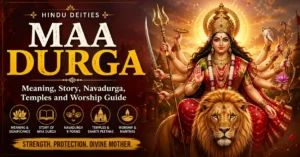
Maa Durga: Meaning, Story, Forms, Navadurga, Temples and Worship
https://thesanatantales.com/maa-durga/
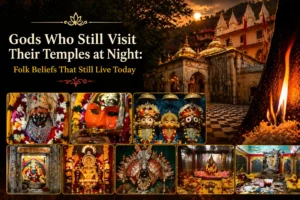
Gods Who Still Visit Their Temples at Night: Folk Beliefs That Still Live Today
https://thesanatantales.com/gods-visit-temples-at-night/
Bhairavi (Wikipedia)
https://en.wikipedia.org/wiki/Bhairavi
FAQs
Who is the goddess Bhairavi?
Goddess Bhairavi is the fifth Mahavidya in the Shakta tradition. She represents spiritual discipline, inner fire, courage, and the transformative power of Shakti that helps seekers overcome ignorance and weakness.
Is Bhairavi a Form of Parvati?
Many traditions regard Maa Bhairavi as a manifestation of Adi Shakti, the Supreme Divine Mother. Since Parvati is also understood as a form of Shakti, Bhairavi may be viewed as one of her powerful and transformative expressions within the Mahavidya tradition.
Why Is Maa Bhairavi Called the Fifth Mahavidya?
Maa Bhairavi is traditionally counted as the fifth Mahavidya because she represents the stage where spiritual understanding is strengthened through discipline, tapas, and inner transformation. She embodies the determination required to turn knowledge into lived spiritual practice.
What Is the Power of Bhairavi?
Maa Bhairavi is associated with purification, self-discipline, fearlessness, and spiritual awakening. Devotees believe her blessings help strengthen determination, remove inner obstacles, and encourage steady spiritual growth.
Are Bhairavi and Kali the Same?
Maa Bhairavi and Maa Kali are closely related but distinct Mahavidyas. Kali is often associated with transcending time, ego, and illusion, while Bhairavi represents discipline, tapas, and the inner fire that supports transformation.
What Is the Color of Bhairavi Devi?
Red is the color most commonly associated with Maa Bhairavi. It symbolizes spiritual energy, tapas, determination, transformation, and the active power of Shakti.
Who Is the Husband of Goddess Bhairavi?
In many Shakta and Tantric traditions, Maa Bhairavi is associated with Bhairava, a fierce form of Lord Shiva. Together they symbolize the union of Shakti and consciousness, feminine and masculine divine energies.
Who Worships Bhairavi?
Maa Bhairavi is worshipped by household devotees, spiritual seekers, Shakta practitioners, and followers of certain tantric traditions. Her worship is especially valued by those seeking inner strength, discipline, and spiritual maturity.
Can Beginners Worship Maa Bhairavi?
Yes. Beginners can worship Maa Bhairavi through simple prayer, mantra japa, and sincere devotion. Traditional teachings encourage household devotees to focus on regular worship and spiritual discipline rather than advanced tantric practices.
What Is the Vahana of Bhairavi?
Unlike some Hindu deities, Maa Bhairavi is not universally associated with a single vahana across all traditions. Different regional and tantric traditions may depict her with varying symbolic associations, while many forms focus primarily on her spiritual symbolism rather than a specific vehicle.
Glossary of Important Terms
| Term | Meaning / Brief Description |
|---|---|
| Maa Bhairavi | The fifth Mahavidya, representing spiritual discipline, inner fire, and transformation. |
| Mahavidya | One of the ten great wisdom goddesses of the Shakta tradition. |
| Shakti | The divine feminine energy that powers creation and transformation. |
| Shakta Tradition | A spiritual tradition that worships the Divine Mother as the supreme reality. |
| Tapas | Spiritual discipline, austerity, and the inner heat generated through sincere effort. |
| Sadhana | A dedicated spiritual practice undertaken for self-realization and growth. |
| Tripura Bhairavi | A prominent form of Bhairavi associated with discipline, purification, and spiritual power. |
| Tripura Sundari | A Mahavidya representing beauty, harmony, and supreme consciousness. |
| Bhuvaneshwari | The fourth Mahavidya, symbolizing cosmic space, order, and universal motherhood. |
| Kundalini | The dormant spiritual energy believed to reside within every individual. |
| Kundalini Awakening | The process of activating and elevating spiritual energy toward higher consciousness. |
| Tantra | A spiritual path that uses rituals, mantras, meditation, and sacred symbolism for transformation. |
| Bhairava | A fierce form of Shiva associated with protection, wisdom, and transcendence. |
| Yogini | Divine feminine powers or spiritual beings connected with Shakti traditions. |
| Mantra | A sacred sound, word, or phrase repeated during worship and meditation. |
| Bija Mantra | A seed syllable believed to contain concentrated spiritual power. |
| Hreem (Hrim) | A sacred bija mantra associated with the Divine Mother and transformative energy. |
| Japa | The repetitive chanting of a mantra with devotion and concentration. |
| Yantra | A sacred geometric diagram used for meditation and spiritual focus. |
| Bhairavi Yantra | A yantra dedicated to Maa Bhairavi, used in worship and contemplation. |
| Puja Vidhi | The traditional method or procedure of worship. |
| Guru | A spiritual teacher who guides seekers on the path of knowledge and realization. |
| Cremation Ground Symbolism | Tantric imagery symbolizing impermanence, detachment, and transcendence of fear. |
| Vairagya | Detachment from worldly attachments and desires. |
| Consciousness | Awareness that forms the basis of spiritual realization. |
| Purification | The process of removing ignorance, negativity, and inner limitations. |
| Seeker (Sadhaka) | A person engaged in spiritual practice and self-transformation. |
| Third Eye | A symbol of higher awareness and spiritual insight. |
| Crescent Moon | A symbol of time, cycles, and the connection between Shakti and Shiva. |
| Garland of Skulls | Symbolizes the destruction of ego, ignorance, and false identities. |
| Trident (Trishula) | A sacred weapon representing divine power, discipline, and spiritual mastery. |
| Kamakhya Temple | A major Shakti pilgrimage center in Assam closely associated with tantric traditions. |
| Shakti Peetha | A sacred site dedicated to the worship of the Divine Mother. |
| Shubhankari | A name of Bhairavi meaning “the giver of auspiciousness and welfare.” |
| Spiritual Awakening | The process of realizing higher truth and expanded awareness. |
| Inner Transformation | The gradual change from ignorance and weakness toward wisdom and strength. |
| Self-Mastery | Control over one’s thoughts, emotions, and actions through discipline and awareness. |
About the Author
Yateendra Chaturvedi is a spiritual writer, researcher, devotee, and the founder of The Sanatan Tales. With over 35 years of professional experience and a lifelong interest in Sanatan Dharma, he writes about Hindu deities, temples, scriptures, festivals, Mahavidyas, sacred stories, rituals, and living traditions that continue to guide and inspire devotees across India.
Drawing from traditional scriptures, regional beliefs, temple traditions, devotional literature, and historical sources, he aims to present authentic, well-researched, and easy-to-understand content for modern readers. His work focuses on preserving spiritual wisdom, explaining sacred traditions, and helping seekers develop a deeper understanding of India’s rich spiritual heritage.
Through The Sanatan Tales, Yateendra strives to make the timeless teachings of Sanatan Dharma simple, meaningful, and relevant for today’s generation while maintaining respect for traditional sources, regional practices, and diverse spiritual perspectives.
Learn More About Yateendra Chaturvedi →
https://thesanatantales.com/about-the-author/
References & Sources
This article is based on beliefs and traditions followed within the Shakta traditions of Sanatan Dharma, traditional knowledge associated with the Dashamahavidya tradition, Shakti worship, Devi sadhana, and insights drawn from various spiritual and religious study sources.
Some concepts discussed in this article are also inspired by teachings and interpretations preserved through the guru-disciple tradition.
Note: Beliefs, interpretations, and spiritual practices may vary across different traditions, sects, and paths within Sanatan Dharma. The purpose of this article is not to present any single viewpoint as the absolute truth, but to explain widely accepted religious and spiritual perspectives in a simple and accessible manner.
Explore More Fascinating Topics from Sanatan Dharma