There are moments in life when everything feels heavy without a clear reason. The mind becomes restless, situations feel uncertain, and even small worries begin to feel overwhelming.
In such times, many people naturally remember Maa Durga. It does not come from habit or planning. It rises quietly from somewhere deeper within, like a child calling out to its mother.
You may not know the correct mantra. You may not have a perfect ritual setup. Still, simply remembering her name often brings comfort, courage, and a feeling that you are not facing life’s struggles alone.
This is what makes Maa Durga special. She is not only worshipped in temples or during festivals. For countless devotees, she is a living presence, a source of strength during difficult times and a compassionate mother who listens even when words fall short.
In Sanatan Dharma, Maa Durga is revered as Shakti, the divine energy that sustains creation, protects dharma, and drives transformation. Through her many forms, stories, and traditions, she reminds devotees that strength and compassion can exist together.
For many, Maa Durga is not a distant goddess but a personal guide whose presence is felt in prayer, devotion, and everyday life. This deep connection has kept her worship alive across generations and made her one of the most beloved forms of the Divine Mother.
In this guide, we will explore the meaning of Maa Durga, her story, sacred forms, Navadurga, temples, festivals, worship traditions, and the spiritual significance that continues to inspire millions of devotees today.
Table of Contents
ToggleMaa Durga Meaning and Significance
The word “Durga” is often understood as the one who helps devotees overcome difficulties and obstacles. In simple terms, Maa Durga is the Divine Mother who gives strength during life’s challenges.
In Sanatan Dharma, she is revered as Shakti, the divine energy that sustains creation, preserves balance, and drives transformation. Many traditions also worship her as Adi Shakti, the primordial cosmic power behind all existence.
Yet beyond philosophy and scripture, Maa Durga feels deeply personal to millions of devotees. She is powerful enough to destroy negativity and injustice, yet compassionate enough to comfort like a mother.
This balance between strength and compassion is what makes Maa Durga one of the most beloved forms of the Divine Mother.
Durga, Parvati, Kali and Adi Shakti: understanding the relationship
One of the most common questions among devotees is whether Durga, Parvati, Kali, and Adi Shakti are different goddesses or different forms of the same divine reality. In most Sanatan traditions, they are understood as expressions of one Divine Mother.
Adi Shakti is considered the primordial cosmic energy from which creation emerges. She is the source of all forms of the Divine Feminine. Parvati represents her gentle, nurturing, and family-oriented aspect.
Durga is the same Divine Mother when she rises to protect dharma and restore balance. Kali represents her fierce and transformative power that destroys fear, ego, and ignorance.
Although their stories, forms, and methods of worship may differ, devotees ultimately see them as manifestations of the same divine presence.
Just as one mother may express love, discipline, protection, and guidance in different situations, the Divine Mother appears in different forms according to the needs of the world and the spiritual needs of her devotees.
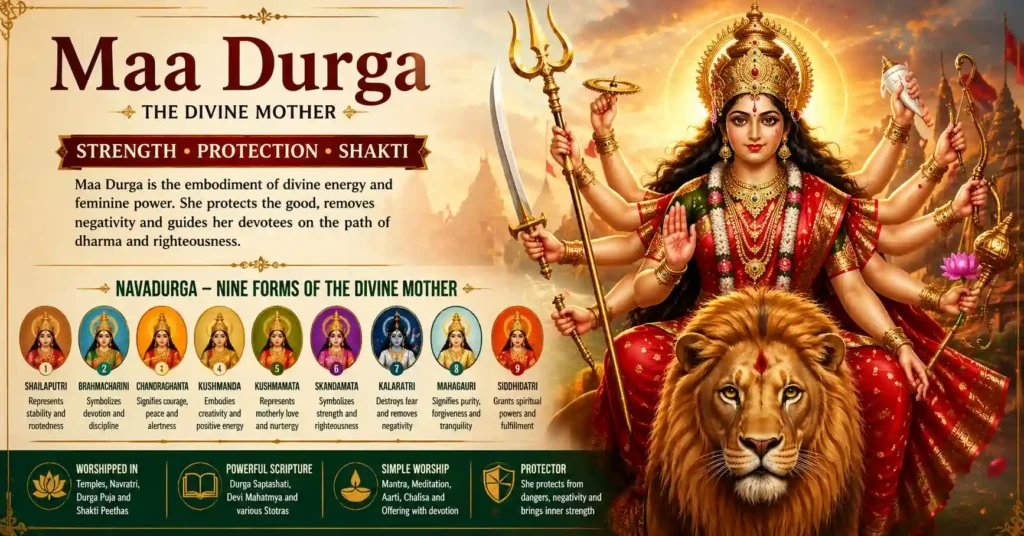
Story of Maa Durga and Mahishasura
The story of Maa Durga and Mahishasura is one of the most important narratives in Devi worship.
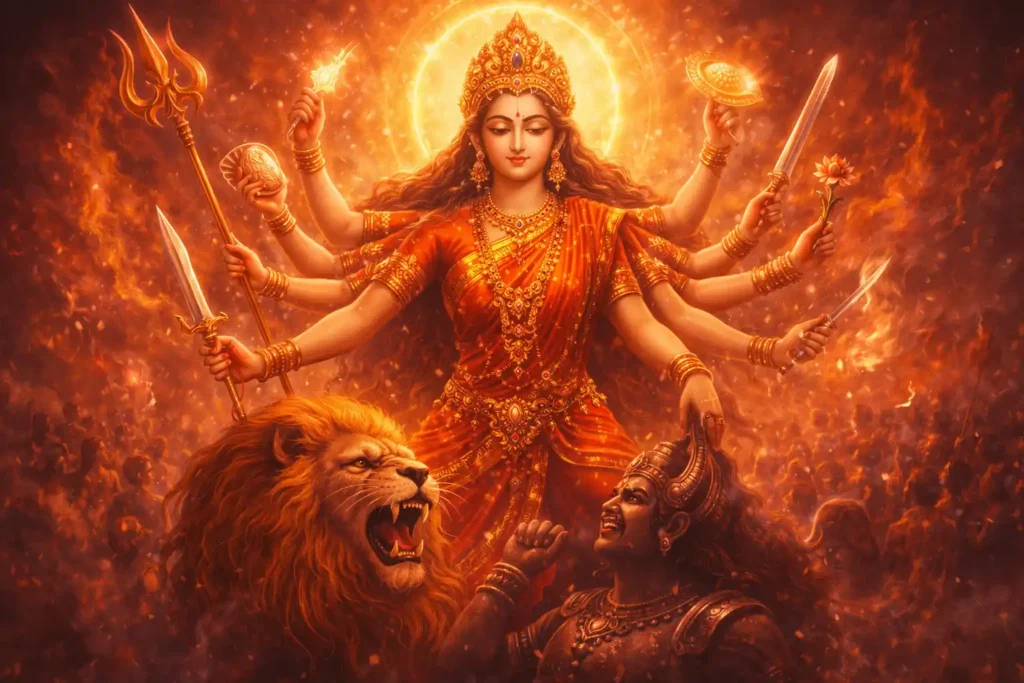
Mahishasura was a powerful demon who received a boon that no man or god could kill him. Over time, he became arrogant and began disturbing the balance of the world. Unable to defeat him, the gods combined their divine energies, from which Maa Durga emerged.
Each deity offered her a divine weapon. Shiva gave the trishul, Vishnu the chakra, and Indra his thunderbolt. Mounted on a lion, Maa Durga fought Mahishasura for nine days and nights before defeating him on the tenth day.
This victory is celebrated as Vijayadashami, while the nine days of the battle are observed as Navratri.
Beyond the literal story, Mahishasura symbolizes ego, ignorance, and negativity within us. Maa Durga represents the inner strength that helps us overcome these obstacles and restore balance in our lives
Scriptural Origins of Maa Durga
While devotion to Maa Durga exists across many traditions, her most famous scriptural narrative appears in the Devi Mahatmya, a sacred section of the Markandeya Purana.
This text presents the Divine Mother as the supreme power behind creation and describes how she manifests in different forms to defeat forces that threaten cosmic balance. Among its many stories, the victory of Maa Durga over Mahishasura remains the most celebrated.
For devotees, the Devi Mahatmya is more than a collection of sacred stories. It teaches the victory of wisdom over ignorance, courage over fear, and divine grace over arrogance. Even today, its verses are widely recited during Navratri and other forms of Devi worship.
Maa Durga is also praised in scriptures such as the Devi Bhagavata Purana and the Kalika Purana. These texts further explore the nature of Shakti, describe various forms of the Divine Mother, and have shaped many traditions of Devi worship that continue across India today.
Symbolism and Iconography of Maa Durga
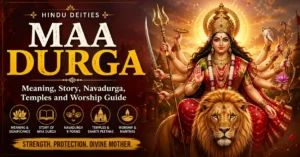
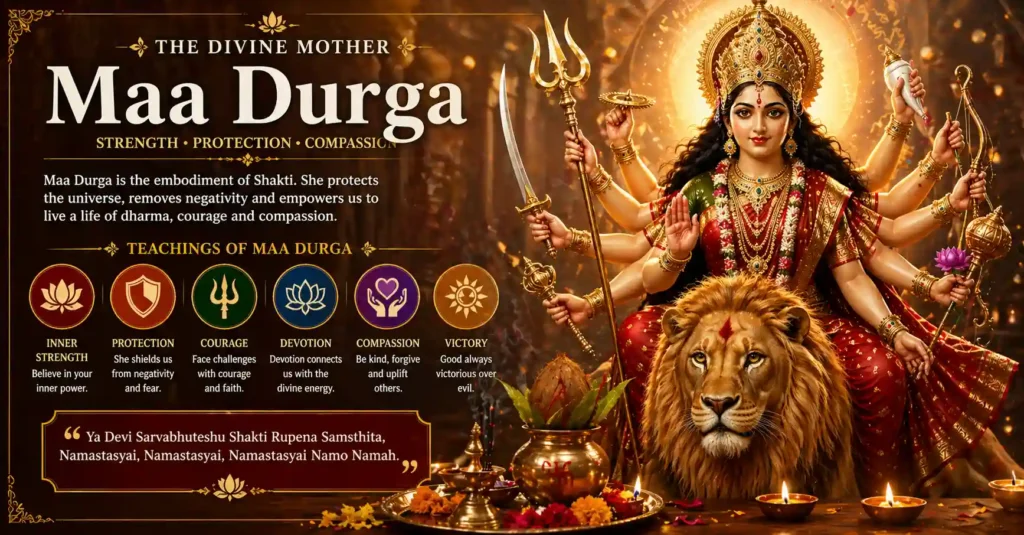
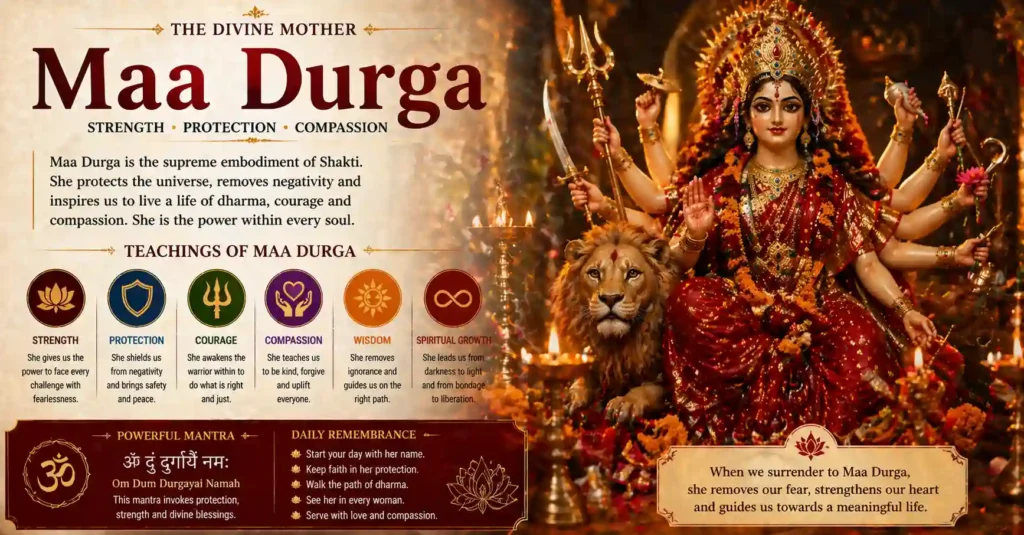
Maa Durga’s form is filled with symbolism, and each element carries a deeper spiritual meaning.
Her lion represents courage, strength, and mastery over fear. It teaches that true power is not about force alone but about controlling and directing that power wisely.
Her multiple arms symbolize the many responsibilities and challenges of life, reminding devotees that strength comes from balance and awareness.
Each weapon she carries also has significance. The trishul represents mastery over mind, body, and ego. The chakra symbolizes time and the cycle of life, while the sword represents wisdom and the ability to cut through ignorance and confusion.
Her red attire reflects energy, action, and vitality, while her calm expression represents inner peace even in the midst of struggle. Together, these symbols show that strength and compassion, action and wisdom, can exist side by side.
For devotees, Maa Durga’s form is not merely an image of worship but a reminder of the qualities needed to face life with courage, balance, and faith.
Navadurga: Nine Forms of Maa Durga
| Form of Navadurga | Spiritual Significance |
|---|---|
| Shailaputri | Grounding, stability, and connection with nature |
| Brahmacharini | Discipline, dedication, and spiritual focus |
| Chandraghanta | Courage, readiness, and protection |
| Kushmanda | Creative energy and vitality |
| Skandamata | Nurturing, motherhood, and compassion |
| Katyayani | Strength, determination, and righteous action |
| Kalaratri | Facing fear and overcoming darkness |
| Mahagauri | Purity, peace, and inner calm |
| Siddhidatri | Spiritual fulfillment and divine blessings |
Together, these nine forms represent a complete journey of inner transformation, guiding devotees from self-discipline and courage to wisdom, purity, and spiritual fulfillment.
For a detailed explanation of each form, read: Navadurga: Nine Divine Forms of Maa Durga and Their Spiritual Powers.
Major Forms of Maa Durga Beyond Navadurga
While the Navadurga forms are especially worshipped during Navratri, the Divine Mother is also revered through many other forms across Sanatan Dharma.
| Form | Significance |
|---|---|
| Mahishasura Mardini | Represents the victorious goddess who defeats negativity, arrogance, and evil. |
| Jagadamba | Worshipped as the universal mother who nurtures, protects, and cares for all beings. |
| Chandika | A powerful warrior form who destroys evil and restores cosmic balance. |
| Bhadrakali | Symbolizes fierce protection and the removal of harmful influences. |
| Katyayani | Represents courage, determination, strength, and righteous action. |
Maa Durga Temples and Shakti Peethas
Maa Durga is worshipped across India through countless temples, sacred shrines, and Shakti Peethas. While each place has its own traditions and local customs, all are united by devotion to the Divine Mother.
Shakti Peethas hold a special place in Devi worship. According to sacred tradition, these sites are connected with the story of Maa Sati and Lord Shiva and are regarded among the holiest centres of Shakti worship. For centuries, devotees have visited them seeking blessings, strength, healing, and spiritual connection.
Some of the most well-known centres of Devi worship include:
| Sacred Site | Significance |
|---|---|
| Vaishno Devi | One of the most visited pilgrimage sites dedicated to the Divine Mother. |
| Kamakhya Temple | A major Shakti Peetha associated with feminine energy and Shakta traditions. |
| Kalighat Temple | An important centre of Kali worship in Kolkata. |
| JwalaJi Temple | Revered for its eternal sacred flames and Devi traditions. |
You can also explore detailed guides to Maa Sharda Maihar, Pavagadh, Saptashrungi, Ambaji, Vindhyavasini Devi, and Mahalaxmi Temple, along with our complete guide to the Shakti Peethas and their significance.
You can explore detailed temple guides here:
https://thesanatantales.com/maa-sharda-maihar-divine-shakti-peeth/
https://thesanatantales.com/pavagadh-temple-gujarat-shakti-peeth-guide/
https://thesanatantales.com/maa-saptashrungi-story-darshan-guide/
https://thesanatantales.com/ambaji-temple-banaskantha-guide/
https://thesanatantales.com/vindhyavasini-devi-temple-darshan-guide/
https://thesanatantales.com/mahalaxmi-temple-kolhapur-guide/
To understand the full concept:
https://thesanatantales.com/shakti-peethas-sacred-places-maa-sati/
These sacred places are more than temples. For countless devotees, they are spaces of faith, surrender, protection, and a living connection with the Divine Mother.
Regional Forms of Maa Durga across India
Maa Durga is worshipped in many forms across India, and each region has its own unique traditions and ways of experiencing the Divine Mother. While the essence remains the same, the names, rituals, and local customs vary beautifully from place to place.
From Bengal’s grand Durga Puja and Himachal Pradesh’s living Devi traditions to the Amman worship of South India, each form reflects a unique connection with Shakti and local culture.
To explore these regional forms and traditions in greater detail, read our complete guide to the regional forms of Maa Durga across India.
https://thesanatantales.com/regional-forms-of-maa-durga/
Types of Navratri and Their Importance
Navratri is not a single festival. It is observed multiple times during the year, and each Navratri carries its own spiritual significance.
| Navratri | Significance |
|---|---|
| Chaitra Navratri | Celebrated in spring and associated with new beginnings, renewal, and fresh starts. |
| Sharad Navratri | The most widely observed Navratri, commemorating Maa Durga’s victory over Mahishasura through worship, fasting, and celebration. |
| Gupt Navratri | Focused on deeper spiritual practices, meditation, and inner sadhana. |
While the traditions may differ, each Navratri offers devotees a unique opportunity to connect with Maa Durga and reflect on their spiritual journey.
Durga Puja and Ambubachi Mela
Durga Puja is one of the most widely celebrated festivals dedicated to Maa Durga, especially in West Bengal and eastern India. More than a religious event, it is a cultural and emotional celebration that brings communities together.
During the festival, beautifully crafted idols of Maa Durga are installed in elaborate pandals, and devotees gather for prayers, music, and celebrations. At its heart, Durga Puja symbolizes the victory of good over evil and reminds devotees that negativity can always be overcome through courage, faith, and righteousness.
The final day, known as Visarjan, is deeply emotional. As the idol is immersed in water, devotees bid farewell to the Divine Mother while believing that her blessings and presence remain with them.
Another important festival associated with Shakti worship is the Ambubachi Mela at the Kamakhya Temple. Unlike the public celebrations of Durga Puja, Ambubachi reflects a more inward and spiritual aspect of Devi worship.
During this period, the temple remains closed for a few days, symbolizing the natural cycle of feminine energy. The festival highlights themes of creation, fertility, and the sacred nature of the Divine Feminine.
Together, Durga Puja and Ambubachi Mela show two complementary dimensions of Shakti worship, one celebrating devotion through community and joy, and the other emphasizing the deeper mysteries of feminine spiritual power.
How to worship Maa Durga at Home
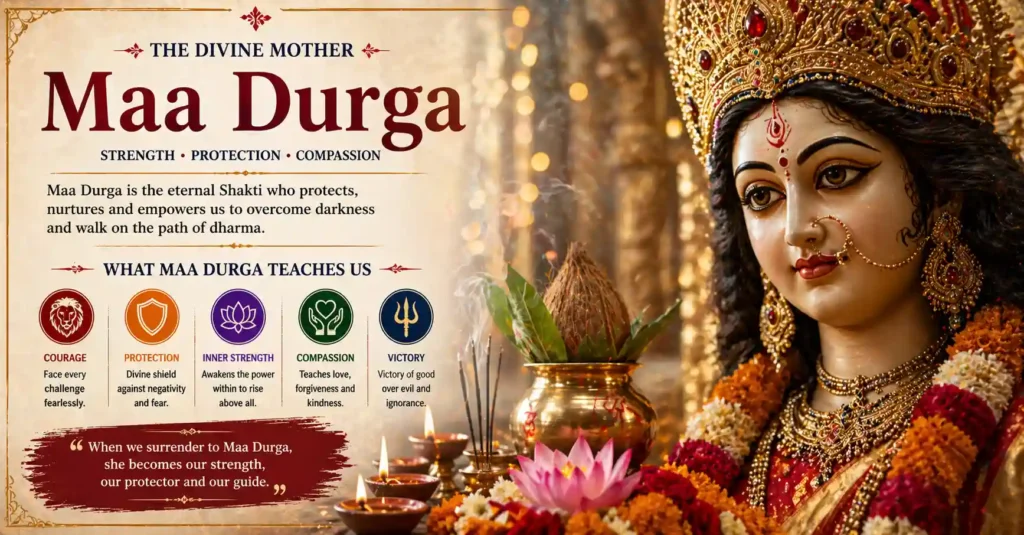
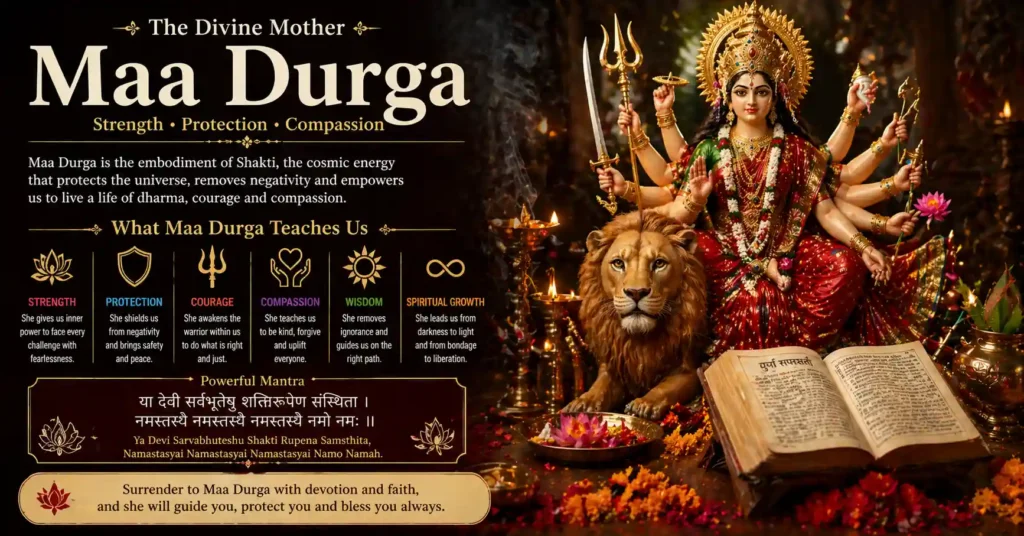
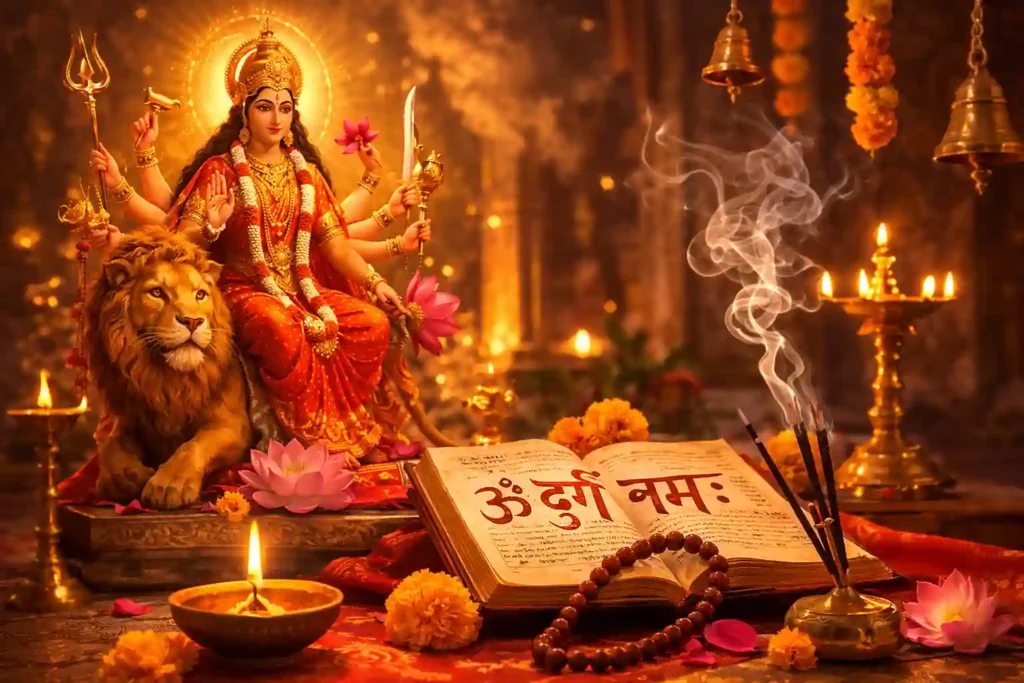
Worship of Maa Durga does not need to be complicated. A simple diya, a few flowers, and a sincere heart are often enough. Sitting quietly and remembering the Divine Mother with devotion is itself a form of worship.
One of the most widely chanted mantras is “Om Dum Durgaye Namah.” The sound Dum is traditionally associated with the protective energy of Shakti and is recited by devotees seeking strength, courage, and divine protection.
If you wish to deepen your practice, you can also explore:
- Durga Beej Mantra
https://thesanatantales.com/durga-beej-mantra - Navarna Mantra
https://thesanatantales.com/navarna-mantra - Durga Chalisa
https://thesanatantales.com/durga-chalisa - Aarti of Maa Ambe
https://thesanatantales.com/aarti-of-maa-ambe/ - Kalash in Sanatan Dharma: Meaning and Significance
https://thesanatantales.com/kalash-in-sanatan-dharma-arth-aur-mahatva/
Durga Saptashati and Spiritual Protection
Durga Saptashati is one of the most revered texts dedicated to Maa Durga. It contains sacred narratives that describe the Divine Mother’s victories over various forms of negativity and her role as the protector of dharma.
For many devotees, reciting or listening to the Durga Saptashati is not merely a ritual but a spiritual practice that brings courage, faith, and inner strength. It is especially recited during Navratri and other periods of Devi worship.
To explore this tradition further, you can read:
- Durga Saptashati
https://thesanatantales.com/durga-saptashati/ - Devi Kavach
https://thesanatantales.com/devi-kavach/ - Argala Stotra
https://thesanatantales.com/argala-stotra/ - Siddha Kunjika Stotram
https://thesanatantales.com/siddha-kunjika-stotram/
Maa Durga as Protector from Negativity
Maa Durga protects not only from external dangers but also from the inner struggles that people face every day.
Fear, anxiety, self-doubt, and negative thought patterns can often become greater challenges than the situations themselves. Even when problems seem manageable, the mind can create confusion and emotional pressure.
For many devotees, remembering Maa Durga brings a sense of strength and reassurance. The mind gradually becomes calmer, thoughts become clearer, and fear begins to lose its hold.
In Sanatan Dharma, Maa Durga is known as Mahishasura Mardini, the destroyer of Mahishasura. Beyond the story itself, this symbolizes the victory over inner negativity, ego, ignorance, and fear.
Many devotees experience this protection through prayer, chanting, or quiet remembrance. It is not always about removing difficulties, but about gaining the courage and clarity needed to face them.
Kumari Puja and Living Shakti
Kumari Puja reminds devotees that Shakti is not confined to temples, idols, or sacred texts. It is present in living form all around us.
In this tradition, young girls are worshipped as embodiments of the Divine Mother. The practice reflects the belief that divinity can be experienced through life itself and not only through ritual worship.
A young girl symbolizes purity, innocence, and untapped potential. By honouring her, devotees express reverence for the presence of Maa Durga in all forms of life.
Kumari Puja also carries a deeper spiritual message. Respect for women is not only a social value but an expression of respect for Shakti itself. The tradition reminds devotees that the Divine Mother is not distant. Her presence can be recognised in the people and world around us.
To understand this tradition in greater detail, you can explore our guide to Kumari Puja and its significance during Navratri.
https://thesanatantales.com/kumari-puja-in-navratri-guide
Feminine Energy and Modern Relevance
Maa Durga represents strength in its many forms. It is not limited to physical power but includes patience, resilience, compassion, and the ability to remain steady during difficult times.
In today’s world, strength is often associated with control or dominance. Maa Durga offers a different perspective. She teaches that true strength comes from inner balance, self-awareness, and the courage to face challenges without losing compassion.
For many women, she serves as a source of inspiration and empowerment. At the same time, her worship reminds society of the importance of respecting and honouring feminine energy in all its forms.
Maa Durga shows that strength and compassion are not opposites. They can exist together and become a source of harmony, wisdom, and positive change.
Mantras and Deeper Practice
In the Sanatan tradition, mantras are sacred sound vibrations that help focus the mind and deepen spiritual awareness. When repeated with devotion, they gradually create a sense of calm, clarity, and inner balance.
A simple mantra such as “Om Dum Durgaye Namah” is enough to begin. Many devotees chant it to seek strength, protection, and a deeper connection with Maa Durga.
With regular practice, mantra chanting becomes more than a ritual. It becomes a source of inner stability, resilience, and spiritual growth.
To explore more Durga mantras, stotras, and devotional practices, you can read our complete guide to Durga Mantras and the Gayatri Mantra.
https://thesanatantales.com/ultimate-guide-powerful-durga-mantras-stotras-aarti/
https://thesanatantales.com/gayatri-mantra-7-divine-benefits/
Connection with Mahavidya
In Shakta traditions, the Mahavidyas are regarded as deeper manifestations of the Divine Mother. While Maa Durga is widely worshipped as a protective and compassionate form of Shakti, the Mahavidyas reveal her more profound aspects connected with wisdom, transformation, time, knowledge, and spiritual awakening.
Forms such as Kali and Tara are often understood as expressions of the same divine energy worshipped as Maa Durga. Together, they help devotees understand the many dimensions of the Divine Feminine.
To explore these forms in detail, you can read our complete guide to the Das Mahavidya and the individual articles dedicated to each Mahavidya.
Maa Durga in Daily Life
Whenever you rise again after falling, that strength is Maa Durga.
Her presence is not limited to temples or festivals. It can be felt in everyday life. When you face fear with courage, remain calm during difficulties, or continue moving forward despite challenges, that is her energy working within you.
For many devotees, this connection is nurtured through simple daily practices such as lighting a diya, offering flowers, preparing prasad, chanting her name, or observing vrat during Navratri and other sacred occasions. These acts may appear small, but they help keep devotion alive in daily life.
Devotion is not only about rituals. It is also about how we live, how we treat others, and how we carry strength, compassion, and faith through life’s journey.
Conclusion
Maa Durga is not just a goddess worshipped during festivals. Her presence can be felt in everyday life.
Sometimes she appears as strength when you feel weak. Sometimes she appears as calmness when your mind is restless. And sometimes she appears as courage when you are afraid to move forward.
Over time, devotion to Maa Durga becomes less about asking for things and more about recognizing her presence within.
You begin to realize that the divine strength you pray to is also the strength that helps you rise after setbacks, face challenges, and keep moving forward.
That is her true blessing. Not only protection from the outside world, but the strength and resilience that grow from within.
FAQs about Maa Durga
Who is Maa Durga in Sanatan Dharma?
In Sanatan Dharma, Maa Durga is revered as the Divine Mother and the embodiment of Shakti, the cosmic energy that sustains creation, preserves balance, and drives transformation. She is worshipped as a protector of dharma, a destroyer of negativity, and a source of strength, courage, and compassion for devotees. Through her many forms, she guides, protects, and inspires spiritual growth.
Why is Maa Durga worshipped during Navratri?
Maa Durga is worshipped during Navratri to honor her victory over Mahishasura and the triumph of good over evil. The nine days of Navratri are dedicated to different forms of the Divine Mother, allowing devotees to seek strength, protection, wisdom, and spiritual growth.
What are the nine forms of Maa Durga?
The nine forms of Maa Durga, known as Navadurga, are Shailaputri, Brahmacharini, Chandraghanta, Kushmanda, Skandamata, Katyayani, Kalaratri, Mahagauri, and Siddhidatri. Each form represents a unique spiritual quality and is worshipped on a specific day of Navratri.
How can I worship Maa Durga at home?
Maa Durga can be worshipped at home through simple practices such as lighting a lamp, offering flowers, chanting her mantras, reading sacred texts, or praying with devotion. Sincerity and faith are considered more important than elaborate rituals.
What is Durga Saptashati?
Durga Saptashati, also known as Devi Mahatmya, is a sacred text dedicated to the Divine Mother. It contains stories of Maa Durga’s victories over various forms of evil and is widely recited for spiritual strength, protection, and devotion, especially during Navratri.
Is Maa Durga and Parvati the same?
In most Sanatan traditions, Maa Durga and Parvati are understood as different manifestations of the same Divine Mother. Parvati represents her gentle and nurturing aspect, while Durga represents her protective and warrior aspect.
Is Kali a form of Maa Durga?
Kali is generally regarded as a powerful manifestation of the Divine Mother and is closely connected with Durga in Shakta traditions. Both represent different expressions of the same divine energy.
What is Adi Shakti?
Adi Shakti refers to the primordial divine energy that existed before creation. Many traditions consider Maa Durga to be one of the principal manifestations of this supreme cosmic power.
Why does Maa Durga ride a lion?
The lion symbolizes courage, strength, and mastery over fear. By riding the lion, Maa Durga demonstrates control over powerful forces and teaches devotees the importance of inner courage.
What is Mahishasura Mardini?
Mahishasura Mardini is one of the most celebrated forms of Maa Durga. The name means “the destroyer of Mahishasura” and symbolizes the victory of righteousness over negativity.
Which scripture tells the story of Maa Durga?
The most famous stories of Maa Durga are found in the Devi Mahatmya, a sacred section of the Markandeya Purana that is widely recited during Navratri and other Devi festivals.
What are Shakti Peethas?
Shakti Peethas are sacred pilgrimage sites dedicated to the Divine Mother. They are among the most important centres of goddess worship in Sanatan Dharma.
Which mantra is most popular for Maa Durga?
One of the most widely chanted mantras is “Om Dum Durgaye Namah.” Devotees recite it to seek protection, strength, and blessings from the Divine Mother.
Can Maa Durga be worshipped at home?
Yes. Maa Durga can be worshipped through simple prayers, chanting, offering flowers, lighting a lamp, or remembering her with devotion and sincerity.
Why is Navratri celebrated?
Navratri celebrates the Divine Mother in her various forms and commemorates the victory of Maa Durga over Mahishasura. It is a time of devotion, reflection, prayer, and spiritual renewal.
Glossary of Important Terms
| Term | Meaning |
|---|---|
| Maa Durga | The Divine Mother worshipped as the embodiment of Shakti, who protects dharma, removes negativity, and grants strength and compassion. |
| Durga | A Sanskrit name meaning “the one who removes difficulties” or “the invincible one who protects devotees from suffering and evil.” |
| Shakti | The divine cosmic energy that sustains creation, preservation, and transformation in the universe. |
| Adi Shakti | The primordial and supreme form of the Divine Mother from whom all goddesses originate. |
| Parvati | The gentle and nurturing form of the Divine Mother, consort of Lord Shiva, and one of the principal manifestations of Shakti. |
| Kali | A fierce form of the Divine Mother who symbolizes the destruction of ego, fear, ignorance, and negative forces. |
| Mahishasura | A buffalo demon defeated by Maa Durga, symbolizing the victory of righteousness over ego, ignorance, and evil. |
| Mahishasura Mardini | A celebrated title of Maa Durga meaning “the Slayer of Mahishasura.” |
| Dharma | The universal principle of righteousness, duty, justice, and moral order that sustains the universe. |
| Devi Mahatmya | A sacred scripture from the Markandeya Purana that narrates the glory and victories of the Divine Mother. |
| Markandeya Purana | One of the eighteen major Puranas, containing the revered Devi Mahatmya. |
| Devi Bhagavata Purana | A major Shakta scripture that describes the Divine Mother as the Supreme Reality. |
| Kalika Purana | An important Hindu scripture focused on Goddess worship, especially Shakti traditions in eastern India. |
| Navadurga | The nine sacred forms of Maa Durga worshipped during Navratri, each representing a stage of spiritual growth. |
| Shailaputri | The first form of Navadurga representing stability, grounding, and devotion. |
| Brahmacharini | The second form of Navadurga symbolizing discipline, penance, and spiritual dedication. |
| Chandraghanta | The third form of Navadurga representing courage, protection, and readiness. |
| Kushmanda | The fourth form of Navadurga associated with creative energy and vitality. |
| Skandamata | The fifth form of Navadurga symbolizing motherhood, compassion, and nurturing love. |
| Katyayani | The sixth form of Navadurga representing strength, determination, and righteous action. |
| Kalaratri | The seventh form of Navadurga who removes fear, darkness, and ignorance. |
| Mahagauri | The eighth form of Navadurga symbolizing purity, peace, forgiveness, and inner calm. |
| Siddhidatri | The ninth form of Navadurga who grants spiritual powers, wisdom, and divine blessings. |
| Jagadamba | A title meaning “Mother of the Universe,” emphasizing the nurturing nature of the Divine Mother. |
| Chandika | A fierce warrior form of the Goddess who destroys evil and restores cosmic balance. |
| Bhadrakali | A protective and powerful manifestation of the Divine Mother associated with courage and divine justice. |
| Navratri | The nine-night Hindu festival dedicated to the worship of the Divine Mother in her various forms. |
| Chaitra Navratri | The spring Navratri celebrated as a festival of renewal, devotion, and new beginnings. |
| Sharad Navratri | The most widely celebrated Navratri, commemorating Maa Durga’s victory over Mahishasura. |
| Gupt Navratri | A Navratri observed mainly for meditation, mantra practice, and deeper spiritual sadhana. |
| Vijayadashami (Dussehra) | The festival celebrating Maa Durga’s victory over Mahishasura and the triumph of good over evil. |
| Durga Puja | A grand festival, especially in eastern India, celebrating the Divine Mother through worship, rituals, and cultural festivities. |
| Ambubachi Mela | A major festival at Kamakhya Temple celebrating the creative power and sacred feminine energy of Shakti. |
| Shakti Peetha | A sacred pilgrimage site associated with Goddess Sati and revered as a powerful center of Divine Mother worship. |
| Vaishno Devi | One of the most visited pilgrimage sites dedicated to the Divine Mother in Jammu and Kashmir. |
| Kamakhya Temple | A renowned Shakti Peetha in Assam associated with feminine energy and Tantric traditions. |
| Kalighat Temple | One of the most important temples dedicated to Goddess Kali in Kolkata. |
| Jwala Ji Temple | A famous Shakti Peetha known for its eternal sacred flames representing the Divine Mother. |
| Kumari Puja | A ritual in which young girls are worshipped as living manifestations of the Divine Mother. |
| Durga Saptashati | Another name for the Devi Mahatmya, widely recited for protection, courage, and spiritual strength. |
| Devi Kavach | A sacred hymn from the Durga Saptashati believed to invoke the Goddess’s divine protection. |
| Argala Stotra | A devotional hymn praising Maa Durga and seeking her blessings for success and protection. |
| Siddha Kunjika Stotram | A revered hymn in Shakta tradition believed to unlock the spiritual power of the Durga Saptashati. |
| Om Dum Durgaye Namah | One of the most popular mantras dedicated to Maa Durga, chanted for protection, courage, and inner strength. |
| Beej Mantra | A sacred seed syllable that represents the essence of a deity’s divine energy. |
| Prasad | Blessed food or offerings distributed to devotees after worship. |
| Diya | A traditional oil lamp lit during worship as a symbol of divine light and devotion. |
| Vrat | A sacred fast or religious observance performed with devotion and spiritual discipline. |
| Mahavidya | The ten great wisdom goddesses in Shakta tradition, representing different aspects of the Divine Mother. |
| Sadhana | A disciplined spiritual practice undertaken for self-purification and realization of the Divine. |
About the Author
Yateendra Chaturvedi is a spiritual writer, researcher, devotee, and the founder of The Sanatan Tales. With over 35 years of professional experience and a lifelong interest in Sanatan Dharma, he writes about Hindu deities, temples, scriptures, festivals, Mahavidyas, sacred stories, rituals, and living traditions that continue to guide and inspire devotees across India.
Drawing from traditional scriptures, regional beliefs, temple traditions, devotional literature, and historical sources, he aims to present authentic, well-researched, and easy-to-understand content for modern readers. His work focuses on preserving spiritual wisdom, explaining sacred traditions, and helping seekers develop a deeper understanding of India’s rich spiritual heritage.
Through The Sanatan Tales, Yateendra strives to make the timeless teachings of Sanatan Dharma simple, meaningful, and relevant for today’s generation while maintaining respect for traditional sources, regional practices, and diverse spiritual perspectives.
Learn More About Yateendra Chaturvedi →
https://thesanatantales.com/about-the-author/
References & Sources
This article is based on beliefs and traditions followed within the Shakta traditions of Sanatan Dharma, traditional knowledge associated with the Dashamahavidya tradition, Shakti worship, Devi sadhana, and insights drawn from various spiritual and religious study sources. Some concepts discussed in this article are also inspired by teachings and interpretations preserved through the guru-disciple tradition.
Note: Beliefs, interpretations, and spiritual practices may vary across different traditions, sects, and paths within Sanatan Dharma. The purpose of this article is not to present any single viewpoint as the absolute truth, but to explain widely accepted religious and spiritual perspectives in a simple and accessible manner.
Explore More Fascinating Topics from Sanatan Dharma