Devi Kavach is one of the most revered protection hymns dedicated to Maa Durga and forms an important part of the Durga Saptashati (Devi Mahatmyam). The word Kavach means “armor” or “protective shield,” and the Devi Kavach invokes the blessings of the Divine Mother in her various forms to protect devotees physically, mentally, emotionally, and spiritually.
For centuries, devotees have recited the Devi Kavach before reading the Durga Saptashati, especially during Navratri and other sacred occasions. It is traditionally believed to create a divine shield around the devotee and strengthen faith, courage, devotion, and inner resilience through the grace of Maa Durga.
In this article, you will discover the complete Devi Kavach lyrics, English pronunciation, verse-by-verse meaning, spiritual significance, benefits of chanting, proper chanting method, daily life relevance, and answers to frequently asked questions. Whether you are a beginner or a regular devotee, this guide will help you understand and recite the Devi Kavach with greater awareness and devotion.
Devi Kavach At a Glance
| Aspect | Details |
|---|---|
| Text Name | Devi Kavach |
| Also Known As | Durga Kavach, Devi Kavacham |
| Scriptural Source | Durga Saptashati (Devi Mahatmyam) from the Markandeya Purana |
| Dedicated To | Maa Durga and Her Various Divine Forms |
| Meaning of Kavach | Divine Armor or Spiritual Protective Shield |
| Language | Sanskrit |
| Type of Text | Protection Hymn (Kavach) |
| Main Purpose | Seeking divine protection, blessings, courage, and spiritual strength |
| Associated Tradition | Shaktism (Worship of the Divine Mother) |
| Traditionally Recited Before | Durga Saptashati (Chandi Path) |
| Best Time to Chant | Morning, During Navratri, Before Durga Saptashati Recitation |
| Primary Deity | Goddess Durga (Adi Shakti) |
| Key Theme | Divine protection through the grace of Maa Durga |
| Benefits Traditionally Associated | Protection, confidence, devotion, peace of mind, and spiritual growth |
| Suitable For | Beginners and Experienced Devotees |
| Popular During | Navratri, Durga Puja, Chaitra Navratri, Sharad Navratri |
| Related Texts | Argala Stotram, Kilaka Stotram, Durga Saptashati, Siddha Kunjika Stotram, Devi Mahatmyam |
| Focus Keyword | Devi Kava |
Table of Contents
ToggleWhat Is Devi Kavach?
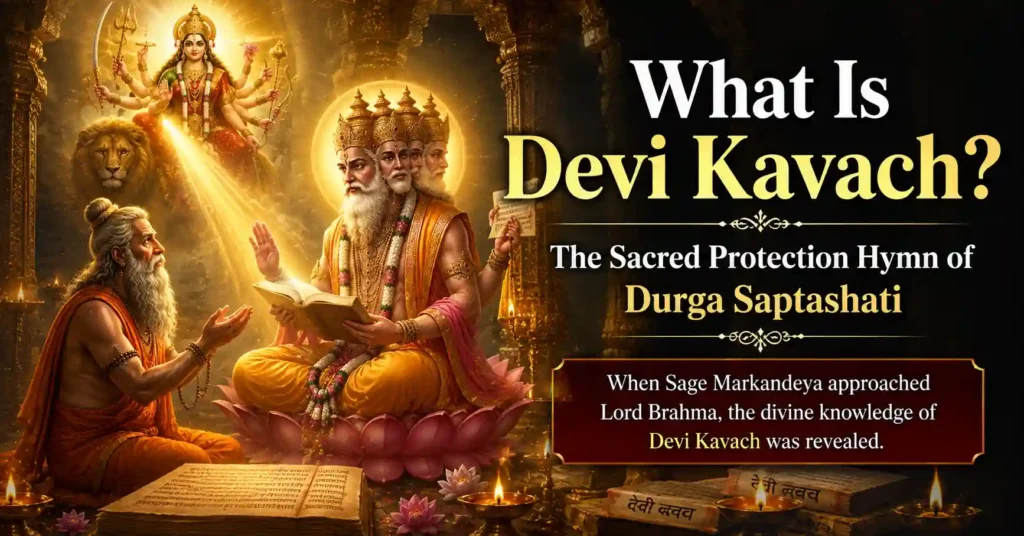
The Devi Kavach is a sacred protection hymn dedicated to Maa Durga and her many divine forms. It is one of the most important sections of the Durga Saptashati (Devi Mahatmyam) and is traditionally recited before reading the main text. The word Kavach means “armor” or “protective shield,” symbolizing divine protection granted by the Goddess.
In the Devi Kavach, various forms of the Divine Mother are invoked to protect different parts of the body, mind, and life. The hymn describes how the Goddess safeguards devotees from fear, negativity, obstacles, and spiritual challenges through her grace and power.
Unlike a physical shield, the Devi Kavach represents spiritual protection. It reminds devotees that the Divine Mother is present in every direction and every aspect of existence, offering guidance, strength, and support throughout life’s journey.
The Devi Kavach holds a special place in Shakta tradition and is widely recited during Navratri, Durga Puja, Chandi Path, and other forms of Devi worship. Many devotees chant it daily as part of their spiritual practice to cultivate faith, confidence, devotion, and inner peace.
Beyond its protective symbolism, the Devi Kavach teaches a deeper spiritual truth: when one surrenders to the Divine Mother with sincerity and devotion, her presence becomes a source of strength, wisdom, and courage in both worldly and spiritual life.
Origin and Scriptural Significance of Devi Kavach
The Devi Kavach originates from the Durga Saptashati, also known as the Devi Mahatmyam, a revered scripture found within the Markandeya Purana. The Durga Saptashati consists of 700 verses that glorify the Divine Mother and describe her victories over powerful demonic forces that symbolize ignorance, ego, and negativity.
Traditionally, the Devi Kavach is recited before the main chapters of the Durga Saptashati. Along with the Argala Stotram and Kilaka Stotram, it forms an important preparatory section that helps devotees approach the sacred text with devotion, concentration, and spiritual readiness.
The term Kavach means “armor” or “protective shield.” In this context, the Devi Kavach is viewed as a spiritual armor that invokes the blessings of Maa Durga in her various forms. The hymn describes how different manifestations of the Goddess protect different parts of the devotee’s body, mind, and life.
According to tradition, the sage Markandeya narrated the teachings of the Devi Mahatmyam, while the Devi Kavach is presented through a dialogue involving sages seeking knowledge about the Divine Mother’s protective power. This highlights the importance of divine protection as an essential aspect of spiritual practice.
The hymn invokes several forms of the Goddess, including Brahmani, Maheshwari, Kaumari, Vaishnavi, Varahi, Narasimhi, Aindri, Chamunda, and Mahalakshmi. Together, these forms represent the all-encompassing power of Adi Shakti, the supreme feminine energy that sustains and protects the universe.
The scriptural significance of the Devi Kavach extends beyond physical protection. It teaches that true security comes from faith, devotion, self-discipline, and surrender to the Divine Mother. For this reason, many devotees recite the Devi Kavach during Navratri, Durga Puja, Chandi Path, and daily worship as a way to seek both spiritual strength and divine grace.
Today, the Devi Kavach remains one of the most widely recited protection prayers in the Shakta tradition. Its enduring popularity reflects the deep belief that Maa Durga’s blessings can help devotees navigate life’s challenges with courage, wisdom, and unwavering faith.
Full Devi Kavach for Continuous Reading
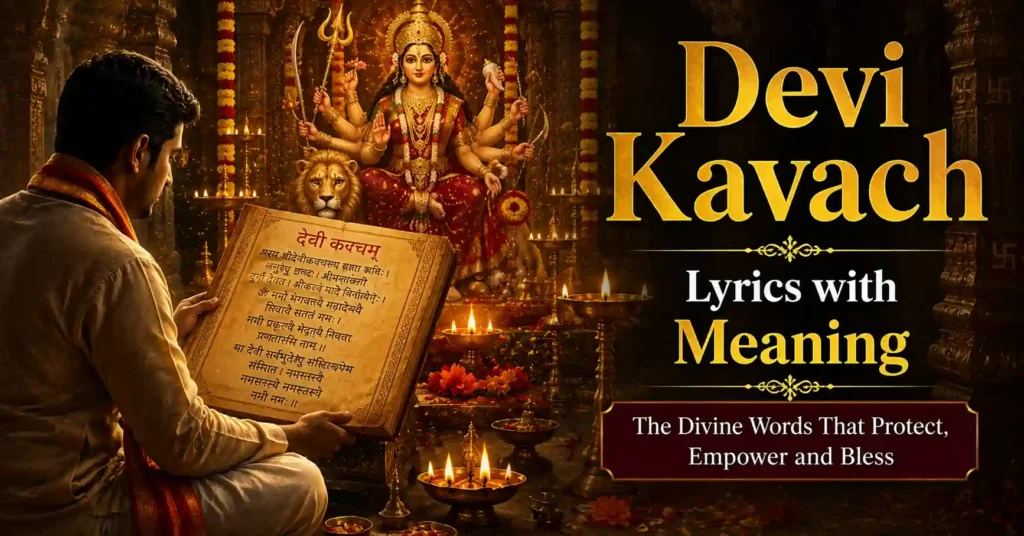
The Devi Kavach is traditionally recited before the main chapters of the Durga Saptashati (Devi Mahatmyam). This sacred hymn invokes the protective power of Maa Durga in her various forms and is revered as a spiritual armor for devotees.
Below is the complete Devi Kavach Sanskrit text for recitation and study. Many devotees chant the Devi Kavach daily, during Navratri, or before reading the Durga Saptashati to seek divine protection, courage, and blessings from the Divine Mother.
ॐ नमश्चण्डिकायै॥
मार्कण्डेय उवाच
यद्गुह्यं परमं लोके सर्वरक्षाकरं नृणाम् ।
यन्न कस्यचिदाख्यातं तन्मे ब्रूहि पितामह ॥ १ ॥
ब्रह्मोवाच
अस्ति गुह्यतमं विप्र सर्वभूतोपकारकम् ।
देव्यास्तु कवचं पुण्यं तच्छृणुश्व महामुने ॥ २ ॥
प्रथमं शैलपुत्रीति द्वितीयं ब्रह्मचारिणी ।
तृतीयं चन्द्रघण्टेति कूष्माण्डेति चतुर्थकम् ॥ ३ ॥
पञ्चमं स्कन्दमातेति षष्ठं कात्यायनीति च ।
सप्तमं कालरात्रिश्च महागौरीति चाष्टमम् ॥ ४ ॥
नवमं सिद्धिदात्री च नवदुर्गाः प्रकीर्तिताः ।
उक्तान्येतानि नामानि ब्रह्मणैव महात्मना ॥ ५ ॥
अग्निना दह्यमानस्तु शत्रुमध्ये गतो रणे ।
विषमे दुर्गमे चैव भयार्ताः शरणं गताः ॥ ६ ॥
न तेषां जायते किञ्चित् अशुभं रणसङ्कटे ।
नापदं तस्य पश्यामि शोकदुःखभयं न हि ॥ ७ ॥
यैस्तु भक्त्या स्मृता नूनं तेषां सिद्धि: प्रजायते ।
प्रेतसंस्था तु चामुण्डा वाराही महिषासना ॥ ८ ॥
ऐन्द्री गजसमारुढ़ा वैष्णवी गरुडासना ।
माहेश्वरी वृषारुढ़ा कौमारी शिखिवाहना ॥ ९ ॥
ब्राह्मी हंससमारुढ़ा सर्वाभरणभूषिता ।
नानाभरणशोभाढ्या नानारत्नोपशोभिताः ॥ १०॥
दृश्यन्ते रथमारुढ़ा देव्यः क्रोधसमाकुलाः ।
शङ्खं चक्रं गदां शक्तिं हलं च मुसलायुधम् ॥ ११ ॥
खेटकं तोमरं चैव परशुं पाशमेव च ।
कुन्तायुधं त्रिशूलं च शार्ङ्गमायुधमुत्तमम् ॥ १२॥
दैत्यानां देहनाशाय भक्तानामभयाय च ।
धारयन्त्यायुधानीत्थं देवानां च हिताय वै ॥ १३ ॥
महाबले महोत्साहे महाभयविनाशिनि ।
त्राहि मां देवि दुष्प्रेक्ष्ये शत्रूणां भयवर्धिनि ॥ १४ ॥
प्राच्यां रक्षतु मामैन्द्री आग्नेय्यामग्निदेवता ।
दक्षिणेऽवतु वाराही नैर्ऋत्यां खड्गधारिणी ॥ १५ ॥
प्रतीच्यां वारुणी रक्षेत् वायव्यां मृगवाहिनी ।
उदीच्यां रक्ष कौबेरी ईशान्यां शूलधारिणी ॥ १६ ॥
ऊर्ध्वं ब्रह्माणि मे रक्षेत् अधस्ताद् वैष्णवी तथा ।
एवं दश दिशो रक्षेत् चामुण्डा शववाहना ॥ १७ ॥
जया मे चाग्रतः स्तातु विजया स्तातु पृष्ठतः ।
अजिता वामपार्श्वे तु दक्षिणे चापराजिता ॥ १८ ॥
शिखां मेऽद्योतिनी रक्षेत् उमा मूर्ध्नि व्यवस्थिता ।
मालाधरी ललाटे च भ्रुवौ रक्षेद्-यशस्विनी ॥ १९ ॥
त्रिनेत्रा च भ्रुवोर्मध्ये यमघण्टा च नासिके ।
शङ्खिनी चक्षुषोर्मध्ये श्रोत्रयोर्द्वारवासिनी ॥ २० ॥
कपोलौ कालिका रक्षेत्कर्णमूले तु शांकरी ।
नासिकायां सुगन्धा च उत्तरोष्ठे च चर्चिका ॥ २१ ॥
अधरे चामृतकला जिह्वायां च सरस्वती ।
दन्तान् रक्षतु कौमारी कण्ठ मध्येतु चण्डिका ॥ २२ ॥
घण्टिकां चित्रघण्टा च महामाया च तालुके ।
कामाक्षी चिबुकं रक्षेत् वाचं मे सर्वमङ्गला ॥ २३ ॥
ग्रीवायां भद्रकाली च पृष्ठवंशे धनुर्धरी ।
नीलग्रीवा बहिःकण्ठे नलिकां नलकूबरी ॥ २४ ॥
खड्ग्धारिन्यु भौ स्कन्धो बाहू मे वज्रधारिणी ।
हस्तयोर्दण्डिनी रक्षेत् अम्बिका चाङ्गुलीस्त्था ॥ २५ ॥
नखाञ्छूलेश्वरी रक्षेत्कुक्षौ रक्षेन्नलेश्वरी ।
स्तनौ रक्षेन्महालक्ष्मीर्मनः शोकविनाशिनी ॥ २६ ॥
हृदयं ललिता देवी उदरं शूलधारिणी ।
नाभौ च कामिनी रक्षेत् गुह्यं गुह्येश्वरी तथा ॥ २७ ॥
कट्यां भगवती रक्षेज्जानुनी विन्ध्यवासिनी ।
भूतनाथा च मेद्रं मे ऊरू महिषवाहिनी ॥ २८ ॥
जङ्घे महाबला प्रोक्ता सर्वकामप्रदायिनी ।
गुल्फयोर्नारसिंही च पादौ चामिततैजसी ॥ २९ ॥
पादाङ्गुलीः श्रीर्मे रक्षेत् पादाधस्तलवासिनी ।
नखान् दंष्ट्राकराली च केशांश्चैवोर्ध्वकेशिनी ॥ ३० ॥
रोमकूपेषु कौबेरी त्वचं वागीश्वरी तथा ।
रक्तमज्जावसामांसानि अस्थिमेदांसि पार्वती ॥ ३१ ॥
अन्त्राणि कालरात्रिश्च पित्तं च मुकुटेश्वरी ।
पद्मावती पद्मकोशे कफे चूड़ामणिस्तथा ॥ ३२ ॥
ज्वालामुखी नखज्वाला अभेद्या सर्वसन्धिषु ।
शुक्रं ब्रह्माणि मे रक्षेत् छाया छत्रेश्वरी तथा ॥ ३३ ॥
अहंकारं मनो बुद्धिं रक्ष मे धर्मचारिणी ।
प्राणापानौ तथा व्यानं समानोदानमेव च ॥ ३४ ॥
यशः कीर्तिं च लक्ष्मीञ्च सदा रक्षतु वैष्णवी ।
गोत्रमिन्द्राणि मे रक्षेत् पशून् मे रक्ष चण्डिके ॥ ३५ ॥
पुत्रान् रक्षेन्महालक्ष्मीर्भार्यां रक्षतु भैरवी ।
मार्गं क्षेमकरी रक्षेद्विजया सर्वतः स्थिता ॥ ३६ ॥
रक्षाहीनं तु यत्स्थानं वर्जितं कवचेन तु ।
तत्सर्वं रक्ष मे देवि जयन्ती पापनाशिनी ॥ ३७ ॥
पदमेकं न गच्छेत्तु यदीच्छेच्छुभमात्मनः ।
कवचेनावृतो नित्यं यत्र यत्राधिगच्छति ॥ ३८ ॥
तत्र तत्रार्थलाभश्च विजयः सार्वकामिकः ।
यं यं कामयते कामं तं तं प्राप्नोति निश्चितम् ॥ ३९ ॥
परमैश्वर्यमतुलं प्राप्स्यते भूतले पुमान् ।
निर्भयो जायते मर्त्यः संग्रामेष्वपराजितः ॥ ४० ॥
त्रैलोक्ये तु भवेत्पूज्यः कवचेनावृतः पुमान् ।
इदं तु देव्याः कवचं देवानामपि दुर्लभम् ॥ ४१ ॥
यः पठेत्प्रयतो नित्यं त्रिसन्ध्यं श्रद्धयान्वितः ।
दैवी कला भवेत्तस्य त्रैलोक्येऽपराजितः ॥ ४२ ॥
जीवेद्वर्षशतं साग्रमपमृत्युविवर्जितः ।
नश्यन्ति व्याधयः सर्वे लूताविस्फोटकादयः ॥ ४३ ॥
स्थावरं जङ्गमं वापि कृत्रिमं चापि यद्विषम् ।
आभिचाराणि सर्वाणि मन्त्रयन्त्राणि भूतले ॥ ४४ ॥
भूचराः खेचराश्चैव जलजाश्चोपदेशिकाः ।
सहजाः कुलजा मालाः शाकिनी डाकिनी तथा ॥ ४५ ॥
अन्तरिक्षचरा घोरा डाकिन्यश्च महाबलाः ।
ग्रहभूतपिशाचाश्च यक्षगन्धर्वराक्षसाः ॥ ४६ ॥
ब्रह्मराक्षसवेतालाः कूष्माण्डा भैरवादयः ।
नश्यन्ति दर्शनात्तस्य कवचे हृदि संस्थिते ॥ ४७ ॥
मानोन्नतिर्भवेद्राज्ञस्तेजोवृद्धिकरं परम् ।
यशसा वर्धते सोऽपि कीर्तिमण्डितभूतले ॥ ४८ ॥
जपेत्सप्तशतीं चण्डीं कृत्वा तु कवचं पुरा ।
यावद्भूमण्डलं धत्ते सशैलवनकाननम् ॥ ४९ ॥
तावत्तिष्ठति मेदिन्यां संततिः पुत्रपौत्रिकी ।
देहान्ते परमं स्थानं यत्सुरैरपि दुर्लभम् ॥ ५० ॥
प्राप्नोति पुरुषो नित्यं महामाया प्रसादतः ॥
Durga Kavach Meaning (Verse-by-Verse)
The Devi Kavach was originally composed in Sanskrit. For devotees who are not familiar with reading Devanagari script, the English pronunciation below can help in learning and chanting the hymn correctly. While perfect pronunciation develops with practice, sincere devotion remains the most important aspect of reciting the Devi Kavach.
Verse 1
Sanskrit Verse
यद्गुह्यं परमं लोके सर्वरक्षाकरं नृणाम् ।
यन्न कस्यचिदाख्यातं तन्मे ब्रूहि पितामह ॥ १ ॥
Pronunciation
Yad Guhyam Paramam Loke Sarva Rakshakaram Nrinam।
Yan Na Kasyachid Akhyatam Tan Me Bruhi Pitamaha॥ 1॥
Line-by-Line Hindi Meaning
यद्गुह्यं परमं लोके सर्वरक्षाकरं नृणाम्।
हे पितामह, संसार में जो सबसे गुप्त और सभी मनुष्यों की रक्षा करने वाला ज्ञान है।
यन्न कस्यचिदाख्यातं तन्मे ब्रूहि पितामह॥
जो किसी को नहीं बताया गया है, कृपया वह मुझे बताइए।
Line-by-Line English Meaning
Yad Guhyam Paramam Loke Sarva Rakshakaram Nrinam.
O Grandfather Brahma, tell me the supreme secret that protects all human beings.
Yan Na Kasyachid Akhyatam Tan Me Bruhi Pitamaha.
Please reveal that sacred knowledge which has not been openly disclosed to others.
Full Verse Meaning
Sage Markandeya respectfully asks Lord Brahma to reveal the highest secret that grants protection and welfare to humanity.
Spiritual Essence
True spiritual wisdom begins with humility and a sincere desire to learn from divine sources.
Verse 2
Sanskrit Verse
अस्ति गुह्यतमं विप्र सर्वभूतोपकारकम् ।
देव्यास्तु कवचं पुण्यं तच्छृणुश्व महामुने ॥ २ ॥
Pronunciation
Asti Guhyatamam Vipra Sarva Bhutopakaarakam।
Devyastu Kavacham Punyam Tacchrinushva Mahamune॥ 2॥
Line-by-Line Hindi Meaning
अस्ति गुह्यतमं विप्र सर्वभूतोपकारकम्।
हे विप्र, एक अत्यंत गुप्त और सभी प्राणियों के कल्याण का साधन है।
देव्यास्तु कवचं पुण्यं तच्छृणुश्व महामुने॥
वह देवी का पवित्र कवच है। हे महामुनि, उसे ध्यानपूर्वक सुनो।
Line-by-Line English Meaning
Asti Guhyatamam Vipra Sarva Bhutopakaarakam.
O sage, there exists a most secret teaching that benefits all beings.
Devyastu Kavacham Punyam Tacchrinushva Mahamune.
It is the sacred Devi Kavach. Listen to it carefully, O great sage.
Full Verse Meaning
Lord Brahma introduces the Devi Kavach as a highly sacred and beneficial hymn that offers protection and spiritual upliftment.
Spiritual Essence
Divine teachings are meant not only for personal growth but also for the welfare of all beings.
Verse 3
Sanskrit Verse
प्रथमं शैलपुत्रीति द्वितीयं ब्रह्मचारिणी ।
तृतीयं चन्द्रघण्टेति कूष्माण्डेति चतुर्थकम् ॥ ३ ॥
Pronunciation
Prathamam Shailaputriti Dvitiyam Brahmacharini।
Tritiyam Chandraghanteti Kushmandeti Chaturthakam॥ 3॥
Line-by-Line Hindi Meaning
प्रथमं शैलपुत्रीति द्वितीयं ब्रह्मचारिणी।
पहला रूप शैलपुत्री और दूसरा रूप ब्रह्मचारिणी है।
तृतीयं चन्द्रघण्टेति कूष्माण्डेति चतुर्थकम्॥
तीसरा रूप चन्द्रघण्टा और चौथा रूप कूष्माण्डा है।
Line-by-Line English Meaning
Prathamam Shailaputriti Dvitiyam Brahmacharini.
The first form is Shailaputri and the second is Brahmacharini.
Tritiyam Chandraghanteti Kushmandeti Chaturthakam.
The third form is Chandraghanta and the fourth is Kushmanda.
Full Verse Meaning
The verse begins listing the Navadurga, the nine sacred forms of Goddess Durga worshipped during Navratri.
Spiritual Essence
The Divine Mother manifests in many forms to guide devotees through different stages of spiritual growth.
Verse 4
Sanskrit Verse
पञ्चमं स्कन्दमातेति षष्ठं कात्यायनीति च ।
सप्तमं कालरात्रिश्च महागौरीति चाष्टमम् ॥ ४ ॥
Pronunciation
Panchamam Skandamateti Shashtham Katyayaniti Cha।
Saptamam Kalaratrishcha Mahagauriti Chashtamam॥ 4॥
Line-by-Line Hindi Meaning
पञ्चमं स्कन्दमातेति षष्ठं कात्यायनीति च।
पाँचवाँ रूप स्कन्दमाता और छठा रूप कात्यायनी है।
सप्तमं कालरात्रिश्च महागौरीति चाष्टमम्॥
सातवाँ रूप कालरात्रि और आठवाँ रूप महागौरी है।
Line-by-Line English Meaning
Panchamam Skandamateti Shashtham Katyayaniti Cha.
The fifth form is Skandamata and the sixth is Katyayani.
Saptamam Kalaratrishcha Mahagauriti Chashtamam.
The seventh form is Kalaratri and the eighth is Mahagauri.
Full Verse Meaning
The hymn continues describing the sacred forms of Navadurga, each representing a unique aspect of divine power and grace.
Spiritual Essence
Every form of the Goddess teaches a different virtue, from courage and purity to wisdom and transformation.
Verse 5
Sanskrit Verse
नवमं सिद्धिदात्री च नवदुर्गाः प्रकीर्तिताः ।
उक्तान्येतानि नामानि ब्रह्मणैव महात्मना ॥ ५ ॥
Pronunciation
Navamam Siddhidatri Cha Navadurgaah Prakirtitaah।
Uktanyetani Namani Brahmanaiva Mahatmana॥ 5॥
Line-by-Line Hindi Meaning
नवमं सिद्धिदात्री च नवदुर्गाः प्रकीर्तिताः।
नौवाँ रूप सिद्धिदात्री है। इन सभी को नवदुर्गा कहा जाता है।
उक्तान्येतानि नामानि ब्रह्मणैव महात्मना॥
इन नामों का वर्णन स्वयं महान ब्रह्मा ने किया है।
Line-by-Line English Meaning
Navamam Siddhidatri Cha Navadurgaah Prakirtitaah.
The ninth form is Siddhidatri. Together these forms are known as the Navadurga.
Uktanyetani Namani Brahmanaiva Mahatmana.
These sacred names have been proclaimed by the great Lord Brahma.
Full Verse Meaning
The nine forms of Durga are completed with Siddhidatri, the bestower of spiritual attainments and blessings.
Spiritual Essence
The Navadurga symbolize the complete journey of devotion, strength, wisdom, and spiritual realization.
Verse 6
Sanskrit Verse
अग्निना दह्यमानस्तु शत्रुमध्ये गतो रणे ।
विषमे दुर्गमे चैव भयार्ताः शरणं गताः ॥ ६ ॥
Pronunciation
Agnina Dahyamanastu Shatrumadhye Gato Rane।
Vishame Durgame Chaiva Bhayartah Sharanam Gatah॥ 6॥
Line-by-Line Hindi Meaning
अग्निना दह्यमानस्तु शत्रुमध्ये गतो रणे।
जो अग्नि, संकट या युद्ध में शत्रुओं से घिर जाए।
विषमे दुर्गमे चैव भयार्ताः शरणं गताः॥
या कठिन परिस्थितियों और भय के समय देवी की शरण में आए।
Line-by-Line English Meaning
Agnina Dahyamanastu Shatrumadhye Gato Rane.
One who is surrounded by dangers, enemies, or severe hardships.
Vishame Durgame Chaiva Bhayartah Sharanam Gatah.
And seeks refuge in the Goddess during fearful and difficult situations.
Full Verse Meaning
The verse describes devotees who turn to Maa Durga for protection during times of danger, fear, and adversity.
Spiritual Essence
Faith in the Divine Mother provides courage and hope even during life’s most challenging moments.
Verse 7
Sanskrit Verse
न तेषां जायते किञ्चित् अशुभं रणसङ्कटे ।
नापदं तस्य पश्यामि शोकदुःखभयं न हि ॥ ७ ॥
Pronunciation
Na Tesham Jayate Kinchit Ashubham Rana Sankate।
Naapadam Tasya Pashyami Shoka Dukha Bhayam Na Hi॥ 7॥
Line-by-Line Hindi Meaning
न तेषां जायते किञ्चित् अशुभं रणसङ्कटे।
ऐसे भक्तों को संकट या संघर्ष में कोई बड़ा अनिष्ट नहीं होता।
नापदं तस्य पश्यामि शोकदुःखभयं न हि॥
उन्हें शोक, दुःख और भय से भी रक्षा प्राप्त होती है।
Line-by-Line English Meaning
Na Tesham Jayate Kinchit Ashubham Rana Sankate.
No serious misfortune befalls those devotees in times of conflict and crisis.
Naapadam Tasya Pashyami Shoka Dukha Bhayam Na Hi.
They are protected from sorrow, suffering, and fear through divine grace.
Full Verse Meaning
Those who sincerely seek the protection of the Goddess are believed to receive strength and support during difficult situations.
Spiritual Essence
Divine protection does not remove every challenge but gives the strength to overcome them.
Verse 8
Sanskrit Verse
यैस्तु भक्त्या स्मृता नूनं तेषां सिद्धिः प्रजायते ।
प्रेतसंस्था तु चामुण्डा वाराही महिषासना ॥ ८ ॥
Pronunciation
Yaistu Bhaktya Smrita Nunam Tesham Siddhih Prajayate।
Pretasanstha Tu Chamunda Varahi Mahishasana॥ 8॥
Line-by-Line Hindi Meaning
यैस्तु भक्त्या स्मृता नूनं तेषां सिद्धिः प्रजायते।
जो भक्त श्रद्धा और भक्ति से देवी का स्मरण करते हैं, उन्हें सफलता और सिद्धि प्राप्त होती है।
प्रेतसंस्था तु चामुण्डा वाराही महिषासना॥
चामुण्डा प्रेत पर विराजमान हैं और वाराही महिष पर आरूढ़ हैं।
Line-by-Line English Meaning
Yaistu Bhaktya Smrita Nunam Tesham Siddhih Prajayate.
Those who remember the Goddess with devotion attain success and spiritual accomplishments.
Pretasanstha Tu Chamunda Varahi Mahishasana.
Chamunda is depicted seated upon a corpse, while Varahi rides a buffalo.
Full Verse Meaning
The verse praises devotion to the Goddess and introduces some of her powerful forms that protect devotees.
Spiritual Essence
Sincere devotion awakens divine grace and inner transformation.
Verse 9
Sanskrit Verse
ऐन्द्री गजसमारूढा वैष्णवी गरुडासना ।
माहेश्वरी वृषारूढा कौमारी शिखिवाहना ॥ ९ ॥
Pronunciation
Aindri Gaja Samarudha Vaishnavi Garudasana।
Maheshwari Vrisharudha Kaumari Shikhivahana॥ 9॥
Line-by-Line Hindi Meaning
ऐन्द्री गजसमारूढा वैष्णवी गरुडासना।
ऐन्द्री हाथी पर और वैष्णवी गरुड़ पर विराजमान हैं।
माहेश्वरी वृषारूढा कौमारी शिखिवाहना॥
माहेश्वरी बैल पर तथा कौमारी मोर पर आरूढ़ हैं।
Line-by-Line English Meaning
Aindri Gaja Samarudha Vaishnavi Garudasana.
Aindri rides an elephant and Vaishnavi is seated upon Garuda.
Maheshwari Vrisharudha Kaumari Shikhivahana.
Maheshwari rides a bull and Kaumari rides a peacock.
Full Verse Meaning
The verse describes divine manifestations of the Goddess and their symbolic vehicles.
Spiritual Essence
The many forms of Shakti reveal that divine power operates through countless expressions in creation.
Verse 10
Sanskrit Verse
ब्राह्मी हंससमारूढा सर्वाभरणभूषिता ।
नानाभरणशोभाढ्या नानारत्नोपशोभिताः ॥ १० ॥
Pronunciation
Brahmi Hamsa Samarudha Sarvabharana Bhushita।
Nanabharana Shobhadhya Nanaratnopashobhitaah॥ 10॥
Line-by-Line Hindi Meaning
ब्राह्मी हंससमारूढा सर्वाभरणभूषिता।
ब्राह्मी हंस पर विराजमान हैं और दिव्य आभूषणों से अलंकृत हैं।
नानाभरणशोभाढ्या नानारत्नोपशोभिताः॥
वे अनेक आभूषणों और रत्नों से सुशोभित दिखाई देती हैं।
Line-by-Line English Meaning
Brahmi Hamsa Samarudha Sarvabharana Bhushita.
Brahmi rides a swan and is adorned with beautiful divine ornaments.
Nanabharana Shobhadhya Nanaratnopashobhitaah.
She shines with various ornaments and precious jewels.
Full Verse Meaning
The verse highlights the divine beauty, purity, and majesty of the Goddess in her Brahmi form.
Spiritual Essence
The external splendor of the Goddess symbolizes the inner brilliance of wisdom, purity, and divine consciousness.
Verse 11
Sanskrit Verse
दृश्यन्ते रथमारूढा देव्यः क्रोधसमाकुलाः ।
शङ्खं चक्रं गदां शक्तिं हलं च मुसलायुधम् ॥ ११ ॥
Pronunciation
Drishyante Rathamarudha Devyah Krodha Samakulah।
Shankham Chakram Gadam Shaktim Halam Cha Musalayudham॥ 11॥
Line-by-Line Hindi Meaning
दृश्यन्ते रथमारूढा देव्यः क्रोधसमाकुलाः।
देवियाँ रथों पर आरूढ़ होकर धर्म की रक्षा के लिए क्रोधयुक्त रूप में दिखाई देती हैं।
शङ्खं चक्रं गदां शक्तिं हलं च मुसलायुधम्॥
वे शंख, चक्र, गदा, शक्ति, हल और मुसल जैसे दिव्य अस्त्र धारण करती हैं।
Line-by-Line English Meaning
Drishyante Rathamarudha Devyah Krodha Samakulah.
The Goddesses appear mounted on chariots, filled with righteous anger against evil.
Shankham Chakram Gadam Shaktim Halam Cha Musalayudham.
They carry divine weapons such as the conch, discus, mace, spear, plough, and pestle.
Full Verse Meaning
This verse portrays the powerful forms of the Divine Mother prepared to destroy negativity and protect righteousness.
Spiritual Essence
Divine power becomes active whenever dharma needs protection and injustice must be confronted.
Verse 12
Sanskrit Verse
खेटकं तोमरं चैव परशुं पाशमेव च ।
कुन्तायुधं त्रिशूलं च शार्ङ्गमायुधमुत्तमम् ॥ १२ ॥
Pronunciation
Khetakam Tomaram Chaiva Parashum Pashameva Cha।
Kuntayudham Trishulam Cha Sharngamayudham Uttamam॥ 12॥
Line-by-Line Hindi Meaning
खेटकं तोमरं चैव परशुं पाशमेव च।
देवियाँ ढाल, भाला, परशु और पाश धारण करती हैं।
कुन्तायुधं त्रिशूलं च शार्ङ्गमायुधमुत्तमम्॥
वे त्रिशूल, कुन्त तथा अन्य श्रेष्ठ दिव्य अस्त्र भी धारण करती हैं।
Line-by-Line English Meaning
Khetakam Tomaram Chaiva Parashum Pashameva Cha.
The Goddesses hold shields, spears, axes, and nooses.
Kuntayudham Trishulam Cha Sharngamayudham Uttamam.
They also carry tridents, lances, and other powerful celestial weapons.
Full Verse Meaning
The verse continues describing the divine weapons of the Goddess, each symbolizing a specific spiritual power.
Spiritual Essence
The Goddess destroys ignorance, fear, attachment, and negativity using the weapons of divine wisdom and strength.
Verse 13
Sanskrit Verse
दैत्यानां देहनाशाय भक्तानामभयाय च ।
धारयन्त्यायुधानीत्थं देवानां च हिताय वै ॥ १३ ॥
Pronunciation
Daityanam Dehanashaya Bhaktanam Abhayaya Cha।
Dharayantyayudhanittham Devanam Cha Hitaya Vai॥ 13॥
Line-by-Line Hindi Meaning
दैत्यानां देहनाशाय भक्तानामभयाय च।
ये अस्त्र दैत्यों के विनाश और भक्तों को निर्भय बनाने के लिए हैं।
धारयन्त्यायुधानीत्थं देवानां च हिताय वै॥
देवताओं और संसार के कल्याण के लिए देवियाँ इन्हें धारण करती हैं।
Line-by-Line English Meaning
Daityanam Dehanashaya Bhaktanam Abhayaya Cha.
These weapons destroy demonic forces and grant fearlessness to devotees.
Dharayantyayudhanittham Devanam Cha Hitaya Vai.
The Goddesses wield them for the welfare of the gods and the world.
Full Verse Meaning
The Divine Mother uses her powers not for destruction alone but for protecting devotees and restoring harmony.
Spiritual Essence
Divine strength always serves a higher purpose: the protection of goodness and the welfare of all beings.
Verse 14
Sanskrit Verse
महाबले महोत्साहे महाभयविनाशिनि ।
त्राहि मां देवि दुष्प्रेक्ष्ये शत्रूणां भयवर्धिनि ॥ १४ ॥
Pronunciation
Mahabale Mahotsahe Mahabhaya Vinashini।
Trahi Mam Devi Dushprekshye Shatrunam Bhayavardhini॥ 14॥
Line-by-Line Hindi Meaning
महाबले महोत्साहे महाभयविनाशिनि।
हे महान शक्ति और उत्साह से युक्त देवी, आप बड़े-बड़े भय का नाश करती हैं।
त्राहि मां देवि दुष्प्रेक्ष्ये शत्रूणां भयवर्धिनि॥
हे देवी, मेरी रक्षा कीजिए। आप शत्रुओं के लिए भय का कारण हैं।
Line-by-Line English Meaning
Mahabale Mahotsahe Mahabhaya Vinashini.
O Goddess of immense strength and energy, destroyer of great fears.
Trahi Mam Devi Dushprekshye Shatrunam Bhayavardhini.
Protect me, O Devi, for you inspire fear in the hearts of evil forces.
Full Verse Meaning
The devotee directly prays to the Goddess for protection, acknowledging her unmatched power and courage.
Spiritual Essence
Faith in the Divine Mother helps devotees face challenges with confidence and inner strength.
Verse 15
Sanskrit Verse
प्राच्यां रक्षतु मामैन्द्री आग्नेय्यामग्निदेवता ।
दक्षिणेऽवतु वाराही नैर्ऋत्यां खड्गधारिणी ॥ १५ ॥
Pronunciation
Prachyam Rakshatu Mam Aindri Agneyyam Agnidevata।
Dakshine Avatu Varahi Nairrityam Khadgadharini॥ 15॥
Line-by-Line Hindi Meaning
प्राच्यां रक्षतु मामैन्द्री आग्नेय्यामग्निदेवता।
पूर्व दिशा में ऐन्द्री और आग्नेय दिशा में अग्निदेवता मेरी रक्षा करें।
दक्षिणेऽवतु वाराही नैर्ऋत्यां खड्गधारिणी॥
दक्षिण दिशा में वाराही और नैऋत्य दिशा में खड्गधारिणी मेरी रक्षा करें।
Line-by-Line English Meaning
Prachyam Rakshatu Mam Aindri Agneyyam Agnidevata.
May Aindri protect me in the east and the fire deity in the southeast.
Dakshine Avatu Varahi Nairrityam Khadgadharini.
May Varahi guard me in the south and Khadgadharini in the southwest.
Full Verse Meaning
The hymn begins invoking divine protection from different directions through various forms of the Goddess.
Spiritual Essence
The Divine Mother’s protection extends to every direction and every aspect of life.
Verse 16
Sanskrit Verse
प्रतीच्यां वारुणी रक्षेत् वायव्यां मृगवाहिनी ।
उदीच्यां रक्ष कौबेरी ईशान्यां शूलधारिणी ॥ १६ ॥
Pronunciation
Pratichyam Varuni Rakshet Vayavyam Mrigavahini।
Udichyam Raksha Kauberi Ishanyam Shuladharini॥ 16॥
Line-by-Line Hindi Meaning
प्रतीच्यां वारुणी रक्षेत् वायव्यां मृगवाहिनी।
पश्चिम दिशा में वारुणी और वायव्य दिशा में मृगवाहिनी रक्षा करें।
उदीच्यां रक्ष कौबेरी ईशान्यां शूलधारिणी॥
उत्तर दिशा में कौबेरी और ईशान दिशा में शूलधारिणी रक्षा करें।
Line-by-Line English Meaning
Pratichyam Varuni Rakshet Vayavyam Mrigavahini.
May Varuni protect me in the west and Mrigavahini in the northwest.
Udichyam Raksha Kauberi Ishanyam Shuladharini.
May Kauberi protect me in the north and Shuladharini in the northeast.
Full Verse Meaning
Different manifestations of the Goddess are invoked to guard all directions around the devotee.
Spiritual Essence
Divine protection is complete and all-encompassing, leaving no area unguarded.
Verse 17
Sanskrit Verse
ऊर्ध्वं ब्रह्माणि मे रक्षेत् अधस्ताद् वैष्णवी तथा ।
एवं दश दिशो रक्षेत् चामुण्डा शववाहना ॥ १७ ॥
Pronunciation
Urdhvam Brahmani Me Rakshet Adhastad Vaishnavi Tatha।
Evam Dasha Disho Rakshet Chamunda Shavavahana॥ 17॥
Line-by-Line Hindi Meaning
ऊर्ध्वं ब्रह्माणि मे रक्षेत् अधस्ताद् वैष्णवी तथा।
ऊपर ब्राह्मी और नीचे वैष्णवी मेरी रक्षा करें।
एवं दश दिशो रक्षेत् चामुण्डा शववाहना॥
इस प्रकार चामुण्डा सभी दस दिशाओं में रक्षा करें।
Line-by-Line English Meaning
Urdhvam Brahmani Me Rakshet Adhastad Vaishnavi Tatha.
May Brahmani protect me above and Vaishnavi protect me below.
Evam Dasha Disho Rakshet Chamunda Shavavahana.
May Chamunda protect me in all ten directions.
Full Verse Meaning
The devotee seeks complete protection from above, below, and all directions through the grace of the Goddess.
Spiritual Essence
The Divine Mother surrounds devotees with a shield of protection wherever they may be.
Verse 18
Sanskrit Verse
जया मे चाग्रतः स्तातु विजया स्तातु पृष्ठतः ।
अजिता वामपार्श्वे तु दक्षिणे चापराजिता ॥ १८ ॥
Pronunciation
Jaya Me Chagratah Statu Vijaya Statu Prishthatah।
Ajita Vamaparshve Tu Dakshine Chaparajita॥ 18॥
Line-by-Line Hindi Meaning
जया मे चाग्रतः स्तातु विजया स्तातु पृष्ठतः।
जया मेरे आगे और विजया मेरे पीछे रक्षा करें।
अजिता वामपार्श्वे तु दक्षिणे चापराजिता॥
अजिता बाईं ओर और अपराजिता दाईं ओर रक्षा करें।
Line-by-Line English Meaning
Jaya Me Chagratah Statu Vijaya Statu Prishthatah.
May Jaya stand before me and Vijaya protect me from behind.
Ajita Vamaparshve Tu Dakshine Chaparajita.
May Ajita guard my left side and Aparajita my right side.
Full Verse Meaning
The devotee invokes victorious forms of the Goddess to provide protection from every side.
Spiritual Essence
Victory over fear and obstacles comes through divine support and unwavering faith.
Verse 19
Sanskrit Verse
शिखां मेऽद्योतिनी रक्षेत् उमा मूर्ध्नि व्यवस्थिता ।
मालाधरी ललाटे च भ्रुवौ रक्षेद्यशस्विनी ॥ १९ ॥
Pronunciation
Shikham Me Dyotini Rakshet Uma Murdhni Vyavasthita।
Maladhari Lalate Cha Bhruvau Rakshed Yashasvini॥ 19॥
Line-by-Line Hindi Meaning
शिखां मेऽद्योतिनी रक्षेत् उमा मूर्ध्नि व्यवस्थिता।
अद्योतिनी मेरी शिखा की और उमा मेरे मस्तक की रक्षा करें।
मालाधरी ललाटे च भ्रुवौ रक्षेद्यशस्विनी॥
मालाधरी मेरे ललाट की और यशस्विनी मेरी भौंहों की रक्षा करें।
Line-by-Line English Meaning
Shikham Me Dyotini Rakshet Uma Murdhni Vyavasthita.
May Dyotini protect my crown and Uma guard my head.
Maladhari Lalate Cha Bhruvau Rakshed Yashasvini.
May Maladhari protect my forehead and Yashasvini my eyebrows.
Full Verse Meaning
The hymn now invokes different forms of the Goddess to protect specific parts of the body.
Spiritual Essence
Every part of the body is regarded as sacred and worthy of divine protection.
Verse 20
Sanskrit Verse
त्रिनेत्रा च भ्रुवोर्मध्ये यमघण्टा च नासिके ।
शङ्खिनी चक्षुषोर्मध्ये श्रोत्रयोर्द्वारवासिनी ॥ २० ॥
Pronunciation
Trinetra Cha Bhruvormadhye Yamaghanta Cha Nasike।
Shankhini Chakshushormadhye Shrotrayor Dvaravasini॥ 20॥
Line-by-Line Hindi Meaning
त्रिनेत्रा च भ्रुवोर्मध्ये यमघण्टा च नासिके।
त्रिनेत्रा मेरी भौंहों के मध्य और यमघण्टा मेरी नासिका की रक्षा करें।
शङ्खिनी चक्षुषोर्मध्ये श्रोत्रयोर्द्वारवासिनी॥
शंखिनी मेरी आँखों की और द्वारवासिनी मेरे कानों की रक्षा करें।
Line-by-Line English Meaning
Trinetra Cha Bhruvormadhye Yamaghanta Cha Nasike.
May Trinetra protect the space between my eyebrows and Yamaghanta guard my nose.
Shankhini Chakshushormadhye Shrotrayor Dvaravasini.
May Shankhini protect my eyes and Dvaravasini my ears.
Full Verse Meaning
The Goddess is invoked to protect the senses and subtle centers associated with awareness and perception.
Spiritual Essence
When the senses are guided by divine wisdom, they become instruments of spiritual growth rather than distraction.
Verse 21
Sanskrit Verse
कपोलौ कालिका रक्षेत्कर्णमूले तु शांकरी ।
नासिकायां सुगन्धा च उत्तरोष्ठे च चर्चिका ॥ २१ ॥
Pronunciation
Kapolau Kalika Rakshet Karnamule Tu Shankari।
Nasikayam Sugandha Cha Uttaroshṭhe Cha Charchika॥ 21॥
Line-by-Line Hindi Meaning
कपोलौ कालिका रक्षेत्कर्णमूले तु शांकरी।
कालिका मेरे गालों की और शांकरी मेरे कानों के मूल भाग की रक्षा करें।
नासिकायां सुगन्धा च उत्तरोष्ठे च चर्चिका॥
सुगन्धा मेरी नासिका की और चर्चिका मेरे ऊपरी होंठ की रक्षा करें।
Line-by-Line English Meaning
Kapolau Kalika Rakshet Karnamule Tu Shankari.
May Kalika protect my cheeks and Shankari guard the roots of my ears.
Nasikayam Sugandha Cha Uttaroshṭhe Cha Charchika.
May Sugandha protect my nose and Charchika my upper lip.
Full Verse Meaning
The devotee invokes different forms of the Goddess to protect facial features and sensory organs.
Spiritual Essence
Every part of the body is considered sacred and worthy of divine care and protection.
Verse 22
Sanskrit Verse
अधरे चामृतकला जिह्वायां च सरस्वती ।
दन्तान् रक्षतु कौमारी कण्ठमध्येतु चण्डिका ॥ २२ ॥
Pronunciation
Adhare Chamritakala Jihvayam Cha Sarasvati।
Dantan Rakshatu Kaumari Kantha Madhye Tu Chandika॥ 22॥
Line-by-Line Hindi Meaning
अधरे चामृतकला जिह्वायां च सरस्वती।
अमृतकला मेरे निचले होंठ की और सरस्वती मेरी जिह्वा की रक्षा करें।
दन्तान् रक्षतु कौमारी कण्ठमध्येतु चण्डिका॥
कौमारी मेरे दाँतों की और चण्डिका मेरे कण्ठ की रक्षा करें।
Line-by-Line English Meaning
Adhare Chamritakala Jihvayam Cha Sarasvati.
May Amritakala protect my lower lip and Saraswati guard my tongue.
Dantan Rakshatu Kaumari Kantha Madhye Tu Chandika.
May Kaumari protect my teeth and Chandika my throat.
Full Verse Meaning
The Goddess is invoked to bless speech, communication, wisdom, and expression.
Spiritual Essence
Pure speech and truthful words are important aspects of spiritual discipline.
Verse 23
Sanskrit Verse
घण्टिकां चित्रघण्टा च महामाया च तालुके ।
कामाक्षी चिबुकं रक्षेत् वाचं मे सर्वमङ्गला ॥ २३ ॥
Pronunciation
Ghantikam Chitraghanta Cha Mahamaya Cha Taluke।
Kamakshi Chibukam Rakshet Vacham Me Sarvamangala॥ 23॥
Line-by-Line Hindi Meaning
घण्टिकां चित्रघण्टा च महामाया च तालुके।
चित्रघण्टा मेरी घण्टी (कंठ के भाग) की और महामाया मेरे तालु की रक्षा करें।
कामाक्षी चिबुकं रक्षेत् वाचं मे सर्वमङ्गला॥
कामाक्षी मेरी ठोड़ी की और सर्वमंगला मेरी वाणी की रक्षा करें।
Line-by-Line English Meaning
Ghantikam Chitraghanta Cha Mahamaya Cha Taluke.
May Chitraghanta protect my throat region and Mahamaya my palate.
Kamakshi Chibukam Rakshet Vacham Me Sarvamangala.
May Kamakshi protect my chin and Sarvamangala bless my speech.
Full Verse Meaning
The verse emphasizes divine protection over speech, expression, and communication.
Spiritual Essence
Words have the power to heal or harm. Divine guidance helps devotees use speech wisely.
Verse 24
Sanskrit Verse
ग्रीवायां भद्रकाली च पृष्ठवंशे धनुर्धरी ।
नीलग्रीवा बहिःकण्ठे नलिकां नलकूबरी ॥ २४ ॥
Pronunciation
Grivayam Bhadrakali Cha Prishthavamshe Dhanurdhari।
Nilagriva Bahihkanthe Nalikam Nalakubari॥ 24॥
Line-by-Line Hindi Meaning
ग्रीवायां भद्रकाली च पृष्ठवंशे धनुर्धरी।
भद्रकाली मेरी गर्दन की और धनुर्धरी मेरी रीढ़ की रक्षा करें।
नीलग्रीवा बहिःकण्ठे नलिकां नलकूबरी॥
नीलग्रीवा बाहरी कण्ठ की और नलकूबरी श्वास नलिकाओं की रक्षा करें।
Line-by-Line English Meaning
Grivayam Bhadrakali Cha Prishthavamshe Dhanurdhari.
May Bhadrakali protect my neck and Dhanurdhari guard my spine.
Nilagriva Bahihkanthe Nalikam Nalakubari.
May Nilagriva protect my outer throat and Nalakubari my air passages.
Full Verse Meaning
The devotee seeks protection for vital parts of the body connected with strength and life.
Spiritual Essence
The Divine Mother’s protection is believed to extend to both physical and subtle aspects of existence.
Verse 25
Sanskrit Verse
खड्गधारिण्युभौ स्कन्धौ बाहू मे वज्रधारिणी ।
हस्तयोर्दण्डिनी रक्षेदम्बिका चाङ्गुलीषु च ॥ २५ ॥
Pronunciation
Khadgadharinyubhau Skandhau Bahu Me Vajradharini।
Hastayor Dandini Rakshed Ambika Changulishu Cha॥ 25॥
Line-by-Line Hindi Meaning
खड्गधारिण्युभौ स्कन्धौ बाहू मे वज्रधारिणी।
खड्गधारिणी मेरे दोनों कंधों की और वज्रधारिणी मेरी भुजाओं की रक्षा करें।
हस्तयोर्दण्डिनी रक्षेदम्बिका चाङ्गुलीषु च॥
दण्डिनी मेरे हाथों की और अम्बिका मेरी अंगुलियों की रक्षा करें।
Line-by-Line English Meaning
Khadgadharinyubhau Skandhau Bahu Me Vajradharini.
May Khadgadharini protect my shoulders and Vajradharini guard my arms.
Hastayor Dandini Rakshed Ambika Changulishu Cha.
May Dandini protect my hands and Ambika my fingers.
Full Verse Meaning
The verse seeks divine protection for the limbs used in action and service.
Spiritual Essence
Our actions should be guided by dharma, wisdom, and devotion.
Verse 26
Sanskrit Verse
नखाञ्छूलेश्वरी रक्षेत्कुक्षौ रक्षेन्नलेश्वरी ।
स्तनौ रक्षेन्महालक्ष्मीर्मनः शोकविनाशिनी ॥ २६ ॥
Pronunciation
Nakhan Chuleshwari Rakshet Kukshau Rakshet Naleshwari।
Stanau Rakshet Mahalakshmir Manah Shoka Vinashini॥ 26॥
Line-by-Line Hindi Meaning
नखाञ्छूलेश्वरी रक्षेत्कुक्षौ रक्षेन्नलेश्वरी।
शूलेश्वरी मेरे नखों की और नलेश्वरी मेरे उदर भाग की रक्षा करें।
स्तनौ रक्षेन्महालक्ष्मीर्मनः शोकविनाशिनी॥
महालक्ष्मी मेरे वक्षस्थल की तथा शोकविनाशिनी मेरे मन की रक्षा करें।
Line-by-Line English Meaning
Nakhan Chuleshwari Rakshet Kukshau Rakshet Naleshwari.
May Shuleshwari protect my nails and Naleshwari guard my abdomen.
Stanau Rakshet Mahalakshmir Manah Shoka Vinashini.
May Mahalakshmi protect my chest and Shoka Vinashini my mind.
Full Verse Meaning
The Goddess is invoked to safeguard both the body and the emotional well-being of the devotee.
Spiritual Essence
Divine grace helps remove sorrow and brings inner peace and balance.
Verse 27
Sanskrit Verse
हृदयं ललिता देवी उदरं शूलधारिणी ।
नाभौ च कामिनी रक्षेद्गुह्यं गुह्येश्वरी तथा ॥ २७ ॥
Pronunciation
Hridayam Lalita Devi Udaram Shuladharini।
Nabhau Cha Kamini Rakshed Guhyam Guhyeshwari Tatha॥ 27॥
Line-by-Line Hindi Meaning
हृदयं ललिता देवी उदरं शूलधारिणी।
ललिता देवी मेरे हृदय की और शूलधारिणी मेरे उदर की रक्षा करें।
नाभौ च कामिनी रक्षेद्गुह्यं गुह्येश्वरी तथा॥
कामिनी मेरी नाभि की और गुह्येश्वरी गुप्त अंगों की रक्षा करें।
Line-by-Line English Meaning
Hridayam Lalita Devi Udaram Shuladharini.
May Lalita Devi protect my heart and Shuladharini guard my stomach.
Nabhau Cha Kamini Rakshed Guhyam Guhyeshwari Tatha.
May Kamini protect my navel and Guhyeshwari my private parts.
Full Verse Meaning
The devotee seeks protection for vital centers of life, energy, and emotional well-being.
Spiritual Essence
The heart is the seat of devotion, and divine protection nurtures spiritual growth from within.
Verse 28
Sanskrit Verse
कट्यां भगवती रक्षेज्जानुनी विन्ध्यवासिनी ।
भूतनाथा च मेढ्रं मे ऊरू महिषवाहिनी ॥ २८ ॥
Pronunciation
Katyam Bhagavati Rakshej Januni Vindhyavasini।
Bhutanatha Cha Medhram Me Uru Mahishavahini॥ 28॥
Line-by-Line Hindi Meaning
कट्यां भगवती रक्षेज्जानुनी विन्ध्यवासिनी।
भगवती मेरी कमर की और विन्ध्यवासिनी मेरे घुटनों की रक्षा करें।
भूतनाथा च मेढ्रं मे ऊरू महिषवाहिनी॥
भूतनाथा मेरे गुप्त भाग की और महिषवाहिनी मेरी जाँघों की रक्षा करें।
Line-by-Line English Meaning
Katyam Bhagavati Rakshej Januni Vindhyavasini.
May Bhagavati protect my waist and Vindhyavasini my knees.
Bhutanatha Cha Medhram Me Uru Mahishavahini.
May Bhutanatha guard my private organs and Mahishavahini my thighs.
Full Verse Meaning
The verse continues invoking divine protection for the lower parts of the body.
Spiritual Essence
The Goddess supports devotees in every aspect of life, from physical well-being to spiritual progress.
Verse 29
Sanskrit Verse
जङ्घे महाबला प्रोक्ता सर्वकामप्रदायिनी ।
गुल्फयोर्नारसिंही च पादौ चामिततेजसी ॥ २९ ॥
Pronunciation
Janghe Mahabala Prokta Sarvakama Pradayini।
Gulphayor Narasimhi Cha Padau Chamitatejasi॥ 29॥
Line-by-Line Hindi Meaning
जङ्घे महाबला प्रोक्ता सर्वकामप्रदायिनी।
महाबला मेरी पिंडलियों की रक्षा करें और सभी शुभ इच्छाओं को पूर्ण करें।
गुल्फयोर्नारसिंही च पादौ चामिततेजसी॥
नारसिंही मेरे टखनों की और अमिततेजसी मेरे पैरों की रक्षा करें।
Line-by-Line English Meaning
Janghe Mahabala Prokta Sarvakama Pradayini.
May Mahabala protect my calves and grant worthy aspirations.
Gulphayor Narasimhi Cha Padau Chamitatejasi.
May Narasimhi protect my ankles and Amitatejasi my feet.
Full Verse Meaning
The devotee invokes the Goddess to protect the legs and feet that support life’s journey.
Spiritual Essence
Walking the path of dharma requires strength, perseverance, and divine guidance.
Verse 30
Sanskrit Verse
पादाङ्गुलीः श्रीर्मे रक्षेत् पादाधस्तलवासिनी ।
नखान् दंष्ट्राकराली च केशांश्चैवोर्ध्वकेशिनी ॥ ३० ॥
Pronunciation
Padangulih Shrir Me Rakshet Padadhastalavasini।
Nakhan Damshtrakarali Cha Keshansh Chaivordhvakeshini॥ 30॥
Line-by-Line Hindi Meaning
पादाङ्गुलीः श्रीर्मे रक्षेत् पादाधस्तलवासिनी।
श्री मेरे पैर की अंगुलियों की और पादाधस्तलवासिनी तलवों की रक्षा करें।
नखान् दंष्ट्राकराली च केशांश्चैवोर्ध्वकेशिनी॥
दंष्ट्राकराली मेरे नखों की और ऊर्ध्वकेशिनी मेरे केशों की रक्षा करें।
Line-by-Line English Meaning
Padangulih Shrir Me Rakshet Padadhastalavasini.
May Shri protect my toes and Padadhastalavasini guard the soles of my feet.
Nakhan Damshtrakarali Cha Keshansh Chaivordhvakeshini.
May Damshtrakarali protect my nails and Urdhvakeshini my hair.
Full Verse Meaning
The hymn completes the protection of the physical body by invoking the Goddess for even the smallest parts.
Spiritual Essence
Nothing is too small for divine care. The Devi Kavach teaches that the Divine Mother’s protection encompasses the whole being.
Verse 31
Sanskrit Verse
रोमकूपेषु कौबेरी त्वचं वागीश्वरी तथा ।
रक्तमज्जावसामांसान्यस्थिमेदांसि पार्वती ॥ ३१ ॥
Pronunciation
Romakupeṣu Kauberi Tvacham Vagishwari Tatha।
Rakta Majja Vasa Mamsani Asthi Medamsi Parvati॥ 31॥
Line-by-Line Hindi Meaning
रोमकूपेषु कौबेरी त्वचं वागीश्वरी तथा।
कौबेरी मेरे रोमकूपों की और वागीश्वरी मेरी त्वचा की रक्षा करें।
रक्तमज्जावसामांसान्यस्थिमेदांसि पार्वती॥
पार्वती मेरे रक्त, मज्जा, वसा, मांस, अस्थियों और मेद की रक्षा करें।
Line-by-Line English Meaning
Romakupeṣu Kauberi Tvacham Vagishwari Tatha.
May Kauberi protect my hair follicles and Vagishwari guard my skin.
Rakta Majja Vasa Mamsani Asthi Medamsi Parvati.
May Parvati protect my blood, marrow, fat, flesh, bones, and bodily tissues.
Full Verse Meaning
The devotee seeks the Goddess’s protection for the body’s internal structures and life-sustaining elements.
Spiritual Essence
The Divine Mother’s care extends beyond what is visible, protecting both the outer and inner aspects of life.
Verse 32
Sanskrit Verse
अन्त्राणि कालरात्रिश्च पित्तं च मुकुटेश्वरी ।
पद्मावती पद्मकोशे कफे चूडामणिस्तथा ॥ ३२ ॥
Pronunciation
Antrani Kalaratrishcha Pittam Cha Mukuteshwari।
Padmavati Padmakoshe Kaphe Chudamanis Tatha॥ 32॥
Line-by-Line Hindi Meaning
अन्त्राणि कालरात्रिश्च पित्तं च मुकुटेश्वरी।
कालरात्रि मेरी आंतों की और मुकुटेश्वरी मेरे पित्त की रक्षा करें।
पद्मावती पद्मकोशे कफे चूडामणिस्तथा॥
पद्मावती शरीर के आंतरिक केंद्रों की और चूडामणि कफ की रक्षा करें।
Line-by-Line English Meaning
Antrani Kalaratrishcha Pittam Cha Mukuteshwari.
May Kalaratri protect my intestines and Mukuteshwari guard my bile.
Padmavati Padmakoshe Kaphe Chudamanis Tatha.
May Padmavati protect the inner lotus-like centers of the body and Chudamani guard bodily fluids.
Full Verse Meaning
The verse invokes divine protection for vital internal systems that maintain health and balance.
Spiritual Essence
The Goddess sustains harmony within the body just as she maintains balance throughout the universe.
Verse 33
Sanskrit Verse
ज्वालामुखी नखज्वाला अभेद्या सर्वसन्धिषु ।
शुक्रं ब्रह्माणि मे रक्षेच्छाया छत्रेश्वरी तथा ॥ ३३ ॥
Pronunciation
Jwalamukhi Nakhajwala Abhedya Sarvasandhishu।
Shukram Brahmani Me Rakshech Chhaya Chatreshwari Tatha॥ 33॥
Line-by-Line Hindi Meaning
ज्वालामुखी नखज्वाला अभेद्या सर्वसन्धिषु।
ज्वालामुखी और नखज्वाला मेरे सभी जोड़ों और संधियों की रक्षा करें।
शुक्रं ब्रह्माणि मे रक्षेच्छाया छत्रेश्वरी तथा॥
ब्रह्माणी मेरे शुक्र तत्व की और छत्रेश्वरी मेरी छाया की रक्षा करें।
Line-by-Line English Meaning
Jwalamukhi Nakhajwala Abhedya Sarvasandhishu.
May Jwalamukhi and Nakhajwala protect all my joints and connecting points.
Shukram Brahmani Me Rakshech Chhaya Chatreshwari Tatha.
May Brahmani protect my vital essence and Chatreshwari guard my shadow and subtle presence.
Full Verse Meaning
The devotee prays for protection of both physical vitality and subtle energies.
Spiritual Essence
Human life depends on both visible and invisible forces, all of which are sustained by divine grace.
Verse 34
Sanskrit Verse
अहंकारं मनो बुद्धिं रक्ष मे धर्मचारिणि ।
प्राणापानौ तथा व्यानं समानोदानमेव च ॥ ३४ ॥
Pronunciation
Ahamkaram Mano Buddhim Raksha Me Dharmacharini।
Pranapanau Tatha Vyanam Samanodanameva Cha॥ 34॥
Line-by-Line Hindi Meaning
अहंकारं मनो बुद्धिं रक्ष मे धर्मचारिणि।
हे धर्मचारिणी देवी, मेरे अहंकार, मन और बुद्धि की रक्षा करें।
प्राणापानौ तथा व्यानं समानोदानमेव च॥
मेरे प्राण, अपान, व्यान, समान और उदान वायु की भी रक्षा करें।
Line-by-Line English Meaning
Ahamkaram Mano Buddhim Raksha Me Dharmacharini.
O Dharmacharini, protect my ego, mind, and intellect.
Pranapanau Tatha Vyanam Samanodanameva Cha.
Protect my vital energies known as Prana, Apana, Vyana, Samana, and Udana.
Full Verse Meaning
The prayer now shifts from physical protection to safeguarding the mind, intellect, ego, and life force.
Spiritual Essence
True protection includes purity of thought, clarity of intellect, and balance of inner energies.
Verse 35
Sanskrit Verse
यशः कीर्तिं च लक्ष्मीं च सदा रक्षतु वैष्णवी ।
गोत्रमिन्द्राणि मे रक्षेत्पशून् मे रक्ष चण्डिके ॥ ३५ ॥
Pronunciation
Yashah Kirtim Cha Lakshmim Cha Sada Rakshatu Vaishnavi।
Gotram Indrani Me Rakshet Pashun Me Raksha Chandike॥ 35॥
Line-by-Line Hindi Meaning
यशः कीर्तिं च लक्ष्मीं च सदा रक्षतु वैष्णवी।
वैष्णवी मेरे यश, कीर्ति और समृद्धि की रक्षा करें।
गोत्रमिन्द्राणि मे रक्षेत्पशून् मे रक्ष चण्डिके॥
इन्द्राणी मेरे कुल की और चण्डिका मेरे पशुधन तथा संसाधनों की रक्षा करें।
Line-by-Line English Meaning
Yashah Kirtim Cha Lakshmim Cha Sada Rakshatu Vaishnavi.
May Vaishnavi always protect my reputation, honor, and prosperity.
Gotram Indrani Me Rakshet Pashun Me Raksha Chandike.
May Indrani protect my lineage and Chandika safeguard my resources and possessions.
Full Verse Meaning
The devotee seeks blessings for family welfare, prosperity, and a good reputation.
Spiritual Essence
Material well-being becomes meaningful when guided by dharma and divine values.
Verse 36
Sanskrit Verse
पुत्रान् रक्षेन्महालक्ष्मीर्भार्यां रक्षतु भैरवी ।
मार्गं क्षेमकरी रक्षेद्विजया सर्वतः स्थिता ॥ ३६ ॥
Pronunciation
Putran Rakshen Mahalakshmir Bharyam Rakshatu Bhairavi।
Margam Kshemakari Rakshed Vijaya Sarvatah Sthita॥ 36॥
Line-by-Line Hindi Meaning
पुत्रान् रक्षेन्महालक्ष्मीर्भार्यां रक्षतु भैरवी।
महालक्ष्मी मेरी संतानों की और भैरवी मेरी पत्नी या परिवार की रक्षा करें।
मार्गं क्षेमकरी रक्षेद्विजया सर्वतः स्थिता॥
क्षेमकरी मेरे मार्ग की और विजया चारों ओर से मेरी रक्षा करें।
Line-by-Line English Meaning
Putran Rakshen Mahalakshmir Bharyam Rakshatu Bhairavi.
May Mahalakshmi protect my children and Bhairavi safeguard my family.
Margam Kshemakari Rakshed Vijaya Sarvatah Sthita.
May Kshemakari protect my path and Vijaya guard me from all directions.
Full Verse Meaning
The verse extends divine protection to family members and life’s journeys.
Spiritual Essence
The Goddess’s blessings are sought not only for oneself but also for loved ones and future endeavors.
Verse 37
Sanskrit Verse
रक्षाहीनं तु यत्स्थानं वर्जितं कवचेन तु ।
तत्सर्वं रक्ष मे देवि जयन्ती पापनाशिनी ॥ ३७ ॥
Pronunciation
Rakshahinam Tu Yat Sthanam Varjitam Kavachena Tu।
Tat Sarvam Raksha Me Devi Jayanti Papanashini॥ 37॥
Line-by-Line Hindi Meaning
रक्षाहीनं तु यत्स्थानं वर्जितं कवचेन तु।
यदि कोई स्थान इस कवच में वर्णित सुरक्षा से छूट गया हो।
तत्सर्वं रक्ष मे देवि जयन्ती पापनाशिनी॥
हे पापनाशिनी जयन्ती देवी, उसकी भी रक्षा कीजिए।
Line-by-Line English Meaning
Rakshahinam Tu Yat Sthanam Varjitam Kavachena Tu.
If any place or aspect has been left unprotected in this Kavach.
Tat Sarvam Raksha Me Devi Jayanti Papanashini.
O Jayanti Devi, destroyer of sins, kindly protect it as well.
Full Verse Meaning
The devotee humbly asks the Goddess to cover anything that may have been unintentionally omitted.
Spiritual Essence
Divine protection is complete and compassionate, extending beyond human limitations.
Verse 38
Sanskrit Verse
पदमेकं न गच्छेत्तु यदीच्छेच्छुभमात्मनः ।
कवचेनावृतो नित्यं यत्र यत्राधिगच्छति ॥ ३८ ॥
Pronunciation
Padamekam Na Gachchhet Tu Yadicchhech Chubham Atmanah।
Kavachenavrito Nityam Yatra Yatradhigachchhati॥ 38॥
Line-by-Line Hindi Meaning
पदमेकं न गच्छेत्तु यदीच्छेच्छुभमात्मनः।
जो अपने कल्याण की इच्छा रखता है, उसे इस कवच को स्मरण किए बिना आगे नहीं बढ़ना चाहिए।
कवचेनावृतो नित्यं यत्र यत्राधिगच्छति॥
जो व्यक्ति कवच से आच्छादित होकर चलता है, वह जहाँ भी जाता है सुरक्षित रहता है।
Line-by-Line English Meaning
Padamekam Na Gachchhet Tu Yadicchhech Chubham Atmanah.
One who desires well-being should not proceed without remembering this protective armor.
Kavachenavrito Nityam Yatra Yatradhigachchhati.
Protected by the Kavach, the devotee remains guarded wherever he goes.
Full Verse Meaning
The verse emphasizes the value of keeping divine remembrance alive throughout daily life.
Spiritual Essence
The greatest protection comes from maintaining a constant connection with the Divine Mother.
Verse 39
Sanskrit Verse
तत्र तत्रार्थलाभश्च विजयः सार्वकामिकः ।
यं यं कामयते कामं तं तं प्राप्नोति निश्चितम् ॥ ३९ ॥
Pronunciation
Tatra Tatrarthalabhashcha Vijayah Sarvakamikah।
Yam Yam Kamayate Kamam Tam Tam Prapnoti Nishchitam॥ 39॥
Line-by-Line Hindi Meaning
तत्र तत्रार्थलाभश्च विजयः सार्वकामिकः।
ऐसे भक्त को उचित लाभ और सफलता प्राप्त होती है।
यं यं कामयते कामं तं तं प्राप्नोति निश्चितम्॥
वह धर्मसम्मत इच्छाओं की पूर्ति भी प्राप्त करता है।
Line-by-Line English Meaning
Tatra Tatrarthalabhashcha Vijayah Sarvakamikah.
Such a devotee attains success, beneficial results, and victory.
Yam Yam Kamayate Kamam Tam Tam Prapnoti Nishchitam.
Righteous desires are fulfilled through divine grace.
Full Verse Meaning
The hymn states that sincere devotion to the Goddess can help devotees achieve worthy goals and success.
Spiritual Essence
When desires are aligned with dharma, they are more likely to lead to lasting fulfillment.
Verse 40
Sanskrit Verse
परमैश्वर्यमतुलं प्राप्स्यते भूतले पुमान् ।
निर्भयो जायते मर्त्यः संग्रामेष्वपराजितः ॥ ४० ॥
Pronunciation
Paramaishvaryam Atulam Prapsyate Bhutale Puman।
Nirbhayo Jayate Martyah Sangrameshv Aparajitah॥ 40॥
Line-by-Line Hindi Meaning
परमैश्वर्यमतुलं प्राप्स्यते भूतले पुमान्।
मनुष्य अतुलनीय ऐश्वर्य और समृद्धि प्राप्त कर सकता है।
निर्भयो जायते मर्त्यः संग्रामेष्वपराजितः॥
वह निर्भय बनता है और जीवन के संघर्षों में अडिग रहता है।
Line-by-Line English Meaning
Paramaishvaryam Atulam Prapsyate Bhutale Puman.
A person may attain incomparable prosperity and blessings in life.
Nirbhayo Jayate Martyah Sangrameshv Aparajitah.
The devotee becomes fearless and remains resilient in life’s battles.
Full Verse Meaning
This verse highlights the transformative power of faith in the Divine Mother, which brings courage, confidence, and spiritual strength.
Spiritual Essence
The greatest victory is not over external enemies but over fear, doubt, and inner weakness.
Verse 41
Sanskrit Verse
त्रैलोक्ये तु भवेत्पूज्यः कवचेनावृतः पुमान् ।
इदं तु देव्याः कवचं देवानामपि दुर्लभम् ॥ ४१ ॥
Pronunciation
Trailokye Tu Bhavet Pujyah Kavachenavritah Puman।
Idam Tu Devyah Kavacham Devanam Api Durlabham॥ 41॥
Line-by-Line Hindi Meaning
त्रैलोक्ये तु भवेत्पूज्यः कवचेनावृतः पुमान्।
जो व्यक्ति इस कवच से संरक्षित रहता है, वह तीनों लोकों में सम्मान प्राप्त करता है।
इदं तु देव्याः कवचं देवानामपि दुर्लभम्॥
यह देवी का कवच अत्यंत पवित्र है और देवताओं के लिए भी दुर्लभ माना गया है।
Line-by-Line English Meaning
Trailokye Tu Bhavet Pujyah Kavachenavritah Puman.
A person protected by this Kavach becomes worthy of respect in all three worlds.
Idam Tu Devyah Kavacham Devanam Api Durlabham.
This sacred armor of the Goddess is considered rare even among the gods.
Full Verse Meaning
The verse glorifies the greatness of the Devi Kavach and highlights its sacred status within the spiritual tradition.
Spiritual Essence
Divine grace elevates a person’s character, making them worthy of respect through virtue and devotion.
Verse 42
Sanskrit Verse
यः पठेत्प्रयतो नित्यं त्रिसन्ध्यं श्रद्धयान्वितः ।
दैवी कला भवेत्तस्य त्रैलोक्येऽपराजितः ॥ ४२ ॥
Pronunciation
Yah Pathet Prayato Nityam Trisandhyam Shraddhayanvitah।
Daivi Kala Bhavet Tasya Trailokye Aparajitah॥ 42॥
Line-by-Line Hindi Meaning
यः पठेत्प्रयतो नित्यं त्रिसन्ध्यं श्रद्धयान्वितः।
जो व्यक्ति श्रद्धा के साथ प्रतिदिन तीनों संध्याओं में इसका पाठ करता है।
दैवी कला भवेत्तस्य त्रैलोक्येऽपराजितः॥
उसमें दिव्य शक्ति प्रकट होती है और वह आध्यात्मिक रूप से अजेय बनता है।
Line-by-Line English Meaning
Yah Pathet Prayato Nityam Trisandhyam Shraddhayanvitah.
One who recites it daily with devotion during the three junctions of the day.
Daivi Kala Bhavet Tasya Trailokye Aparajitah.
Such a devotee becomes blessed with divine power and inner strength.
Full Verse Meaning
Regular and sincere recitation of the Devi Kavach is traditionally believed to strengthen spiritual resolve and devotion.
Spiritual Essence
Consistency in spiritual practice helps cultivate faith, discipline, and inner transformation.
Verse 43
Sanskrit Verse
जीवेद्वर्षशतं साग्रमपमृत्युविवर्जितः ।
नश्यन्ति व्याधयः सर्वे लूताविस्फोटकादयः ॥ ४३ ॥
Pronunciation
Jived Varsha Shatam Sagram Apamrityu Vivarjitah।
Nashyanti Vyadhayah Sarve Lutavisphotakadayaḥ॥ 43॥
Line-by-Line Hindi Meaning
जीवेद्वर्षशतं साग्रमपमृत्युविवर्जितः।
ऐसा भक्त दीर्घायु और अकाल मृत्यु के भय से मुक्त रहने का आशीर्वाद प्राप्त करता है।
नश्यन्ति व्याधयः सर्वे लूताविस्फोटकादयः॥
विभिन्न प्रकार के रोग और कष्ट दूर होने की मान्यता है।
Line-by-Line English Meaning
Jived Varsha Shatam Sagram Apamrityu Vivarjitah.
The devotee is traditionally blessed with longevity and protection from untimely death.
Nashyanti Vyadhayah Sarve Lutavisphotakadayaḥ.
Various illnesses and afflictions are believed to diminish through divine grace.
Full Verse Meaning
The verse describes traditional beliefs regarding the protective and beneficial effects of sincere devotion to the Goddess.
Spiritual Essence
Faith brings courage and hope, helping devotees face life’s uncertainties with confidence.
Verse 44
Sanskrit Verse
स्थावरं जङ्गमं वापि कृत्रिमं चापि यद्विषम् ।
आभिचाराणि सर्वाणि मन्त्रयन्त्राणि भूतले ॥ ४४ ॥
Pronunciation
Sthavaram Jangamam Vapi Kritrimam Chapi Yad Visham।
Abhicharani Sarvani Mantra Yantrani Bhutale॥ 44॥
Line-by-Line Hindi Meaning
स्थावरं जङ्गमं वापि कृत्रिमं चापि यद्विषम्।
स्थावर, जंगम या कृत्रिम किसी भी प्रकार के विष से रक्षा की बात कही गई है।
आभिचाराणि सर्वाणि मन्त्रयन्त्राणि भूतले॥
विभिन्न नकारात्मक प्रभावों और दुष्प्रयोगों से भी सुरक्षा का उल्लेख है।
Line-by-Line English Meaning
Sthavaram Jangamam Vapi Kritrimam Chapi Yad Visham.
Protection is described from natural, moving, or artificial sources of harm.
Abhicharani Sarvani Mantra Yantrani Bhutale.
The hymn also speaks of protection from negative influences and harmful practices.
Full Verse Meaning
The verse symbolically expresses the Goddess’s ability to protect devotees from various external dangers and negative forces.
Spiritual Essence
Divine remembrance helps cultivate courage and resilience in the face of fear and uncertainty.
Verse 45
Sanskrit Verse
भूचराः खेचराश्चैव जलजाश्चोपदेशिकाः ।
सहजाः कुलजा मालाः शाकिनी डाकिनी तथा ॥ ४५ ॥
Pronunciation
Bhucharah Khecharashchaiva Jalajashchopadeshikah।
Sahajah Kulaja Malah Shakini Dakini Tatha॥ 45॥
Line-by-Line Hindi Meaning
भूचराः खेचराश्चैव जलजाश्चोपदेशिकाः।
भूमि, आकाश और जल से संबंधित विभिन्न प्रकार की बाधाओं का उल्लेख किया गया है।
सहजाः कुलजा मालाः शाकिनी डाकिनी तथा॥
अन्य सूक्ष्म या अदृश्य नकारात्मक शक्तियों का भी वर्णन किया गया है।
Line-by-Line English Meaning
Bhucharah Khecharashchaiva Jalajashchopadeshikah.
The verse mentions obstacles arising from land, air, and water.
Sahajah Kulaja Malah Shakini Dakini Tatha.
It also refers to subtle negative influences described in traditional literature.
Full Verse Meaning
The hymn emphasizes comprehensive divine protection from seen and unseen challenges.
Spiritual Essence
Faith in the Divine Mother helps devotees remain steady even when facing unknown difficulties.
Verse 46
Sanskrit Verse
अन्तरिक्षचरा घोरा डाकिन्यश्च महाबलाः ।
ग्रहभूतपिशाचाश्च यक्षगन्धर्वराक्षसाः ॥ ४६ ॥
Pronunciation
Antarikshachara Ghora Dakinyashcha Mahabalah।
Graha Bhuta Pishachashcha Yaksha Gandharva Rakshasah॥ 46॥
Line-by-Line Hindi Meaning
अन्तरिक्षचरा घोरा डाकिन्यश्च महाबलाः।
अंतरिक्ष में विचरण करने वाली शक्तियों और अन्य भयानक बाधाओं का वर्णन है।
ग्रहभूतपिशाचाश्च यक्षगन्धर्वराक्षसाः॥
ग्रह, भूत, पिशाच, यक्ष, गंधर्व और राक्षस आदि का भी उल्लेख किया गया है।
Line-by-Line English Meaning
Antarikshachara Ghora Dakinyashcha Mahabalah.
The verse mentions powerful and fearsome forces described in traditional texts.
Graha Bhuta Pishachashcha Yaksha Gandharva Rakshasah.
It includes references to various supernatural beings known in Hindu mythology.
Full Verse Meaning
These references symbolize different forms of obstacles, fears, and challenges that may affect human life.
Spiritual Essence
The Goddess is viewed as a source of protection from both external threats and inner fears.
Verse 47
Sanskrit Verse
ब्रह्मराक्षसवेतालाः कूष्माण्डा भैरवादयः ।
नश्यन्ति दर्शनात्तस्य कवचे हृदि संस्थिते ॥ ४७ ॥
Pronunciation
Brahmarakshasa Vetalah Kushmanda Bhairavadayah।
Nashyanti Darshanat Tasya Kavache Hridi Samsthite॥ 47॥
Line-by-Line Hindi Meaning
ब्रह्मराक्षसवेतालाः कूष्माण्डा भैरवादयः।
विभिन्न प्रकार की बाधाओं और भयावह शक्तियों का उल्लेख किया गया है।
नश्यन्ति दर्शनात्तस्य कवचे हृदि संस्थिते॥
जिसके हृदय में देवी कवच स्थापित हो, उसके लिए ये प्रभाव निष्प्रभावी हो जाते हैं।
Line-by-Line English Meaning
Brahmarakshasa Vetalah Kushmanda Bhairavadayah.
Various negative entities and harmful influences are mentioned symbolically.
Nashyanti Darshanat Tasya Kavache Hridi Samsthite.
They lose their power before one who holds the Devi Kavach firmly in the heart.
Full Verse Meaning
The verse teaches that devotion and faith in the Goddess help overcome fear and negativity.
Spiritual Essence
A heart filled with divine remembrance becomes stronger than fear.
Verse 48
Sanskrit Verse
मानोन्नतिर्भवेद्राज्ञस्तेजोवृद्धिकरं परम् ।
यशसा वर्धते सोऽपि कीर्तिमण्डितभूतले ॥ ४८ ॥
Pronunciation
Manonnatir Bhaved Rajnas Tejo Vriddhikaram Param।
Yashasa Vardhate So’pi Kirtimandita Bhutale॥ 48॥
Line-by-Line Hindi Meaning
मानोन्नतिर्भवेद्राज्ञस्तेजोवृद्धिकरं परम्।
इससे सम्मान, प्रतिष्ठा और तेज में वृद्धि होने की बात कही गई है।
यशसा वर्धते सोऽपि कीर्तिमण्डितभूतले॥
व्यक्ति की कीर्ति और सद्गुणों की ख्याति भी बढ़ती है।
Line-by-Line English Meaning
Manonnatir Bhaved Rajnas Tejo Vriddhikaram Param.
The devotee is believed to gain honor, dignity, and spiritual radiance.
Yashasa Vardhate So’pi Kirtimandita Bhutale.
Good reputation and recognition for virtuous qualities increase.
Full Verse Meaning
The verse highlights the positive transformation that devotion can bring to a person’s character and life.
Spiritual Essence
True honor comes from righteous conduct and divine values.
Verse 49
Sanskrit Verse
जपेत्सप्तशतीं चण्डीं कृत्वा तु कवचं पुरा ।
यावद्भूमण्डलं धत्ते सशैलवनकाननम् ॥ ४९ ॥
Pronunciation
Japet Saptashatim Chandim Kritva Tu Kavacham Pura।
Yavad Bhumandalam Dhatte Sashaila Vanakananam॥ 49॥
Line-by-Line Hindi Meaning
जपेत्सप्तशतीं चण्डीं कृत्वा तु कवचं पुरा।
दुर्गा सप्तशती के पाठ से पहले देवी कवच का पाठ करने की परंपरा बताई गई है।
यावद्भूमण्डलं धत्ते सशैलवनकाननम्॥
जब तक यह पृथ्वी पर्वतों और वनों सहित विद्यमान है, तब तक इसका महत्व बना रहेगा।
Line-by-Line English Meaning
Japet Saptashatim Chandim Kritva Tu Kavacham Pura.
Traditionally, the Devi Kavach is recited before chanting the Durga Saptashati.
Yavad Bhumandalam Dhatte Sashaila Vanakananam.
Its significance is said to endure as long as the earth itself exists.
Full Verse Meaning
This verse emphasizes the traditional role of the Devi Kavach as a preparatory prayer before the Durga Saptashati.
Spiritual Essence
Preparation and devotion help create the right mindset for deeper spiritual practice.
Verse 50
Sanskrit Verse
तावत्तिष्ठति मेदिन्यां संततिः पुत्रपौत्रिकी ।
देहान्ते परमं स्थानं यत्सुरैरपि दुर्लभम् ॥ ५० ॥
प्राप्नोति पुरुषो नित्यं महामाया प्रसादतः ॥
Pronunciation
Tavattishthati Medinyam Santatih Putra Pautriki।
Dehante Paramam Sthanam Yat Surair Api Durlabham॥ 50॥
Prapnoti Purusho Nityam Mahamaya Prasadatah।
Line-by-Line Hindi Meaning
तावत्तिष्ठति मेदिन्यां संततिः पुत्रपौत्रिकी।
भक्त को परिवार और वंश की समृद्धि का आशीर्वाद प्राप्त होने की मान्यता है।
देहान्ते परमं स्थानं यत्सुरैरपि दुर्लभम्॥
जीवन के अंत में वह उच्च आध्यात्मिक अवस्था प्राप्त कर सकता है, जो देवताओं के लिए भी दुर्लभ कही गई है।
प्राप्नोति पुरुषो नित्यं महामाया प्रसादतः।
यह सब महामाया की कृपा और अनुग्रह से संभव होता है।
Line-by-Line English Meaning
Tavattishthati Medinyam Santatih Putra Pautriki.
The devotee is traditionally blessed with family continuity and prosperity.
Dehante Paramam Sthanam Yat Surair Api Durlabham.
At the end of life, one may attain a supreme spiritual state that is considered rare even for the gods.
Prapnoti Purusho Nityam Mahamaya Prasadatah.
All these blessings are attained through the grace of Mahamaya, the Divine Mother.
Full Verse Meaning
The concluding verse states that through the blessings of Maa Durga, devotees receive both worldly welfare and spiritual upliftment. Ultimately, the grace of Mahamaya guides the soul toward the highest spiritual goal.
Spiritual Essence
The Devi Kavach teaches that the Divine Mother’s protection is not limited to this life alone. Her grace supports devotees on their journey toward spiritual fulfillment, liberation, and eternal peace.
What Does "रक्षाहीनं तु यत्स्थानं वर्जितं कवचेन तु" Mean?
Among all the verses of the Devi Kavach, this verse holds a special place because it expresses complete surrender to the Divine Mother. It appears near the end of the prayer and beautifully reflects the devotee’s humility, trust, and faith in Maa Durga’s protection.
Sanskrit Verse
रक्षाहीनं तु यत्स्थानं वर्जितं कवचेन तु ।
तत्सर्वं रक्ष मे देवि जयन्ती पापनाशिनी ॥ ३७ ॥
Pronunciation
Rakshahinam Tu Yat Sthanam Varjitam Kavachena Tu।
Tat Sarvam Raksha Me Devi Jayanti Papanashini॥
Literal Meaning
रक्षाहीनं तु यत्स्थानं वर्जितं कवचेन तु।
If there is any place, aspect, or part that has been left unprotected by this Kavach,
तत्सर्वं रक्ष मे देवि जयन्ती पापनाशिनी॥
O Devi Jayanti, destroyer of sins, please protect all of it as well.
Symbolic Meaning
On the surface, the verse asks Maa Durga to protect any body part that may have been unintentionally omitted from the Devi Kavach. However, its deeper meaning goes beyond physical protection.
It acknowledges that human beings are imperfect and cannot foresee every danger, weakness, or challenge. The devotee therefore places complete trust in the Divine Mother and asks for her all-encompassing protection.
Spiritual Interpretation
This verse teaches an important principle of Sanatan Dharma: surrender to divine grace. Even after reciting the entire Devi Kavach, the devotee does not rely solely on personal effort.
Instead, they recognize that true protection ultimately comes from the compassion and blessings of Maa Durga.
The verse reflects humility rather than fear. It reminds devotees that spiritual growth begins when one accepts personal limitations and seeks divine guidance.
Practical Relevance in Daily Life
This teaching remains highly relevant today. In daily life, people try to plan carefully, solve problems, and protect themselves from difficulties.
Yet no one can control every situation. This verse encourages devotees to:
Do their best with sincerity.
Follow dharma and righteous actions.
Trust the Divine Mother for what lies beyond their control.
Face uncertainty with faith instead of anxiety.
Remember that divine grace supports every sincere effort.
Why This Verse Is So Popular
Many devotees consider this one of the most powerful verses of the Devi Kavach because it captures the essence of devotion in a single prayer.
It combines:
Humility
Faith
Surrender
Trust in Maa Durga
Acceptance of divine protection
For this reason, devotees often remember this verse even outside formal recitation of the Devi Kavach, especially during challenging times.
Spiritual Essence
The heart of this verse is simple yet profound:
Human effort is important, but divine grace completes what human effort cannot.
By chanting this verse, devotees express complete faith that Maa Durga protects them not only from visible dangers but also from unseen challenges on their spiritual journey.
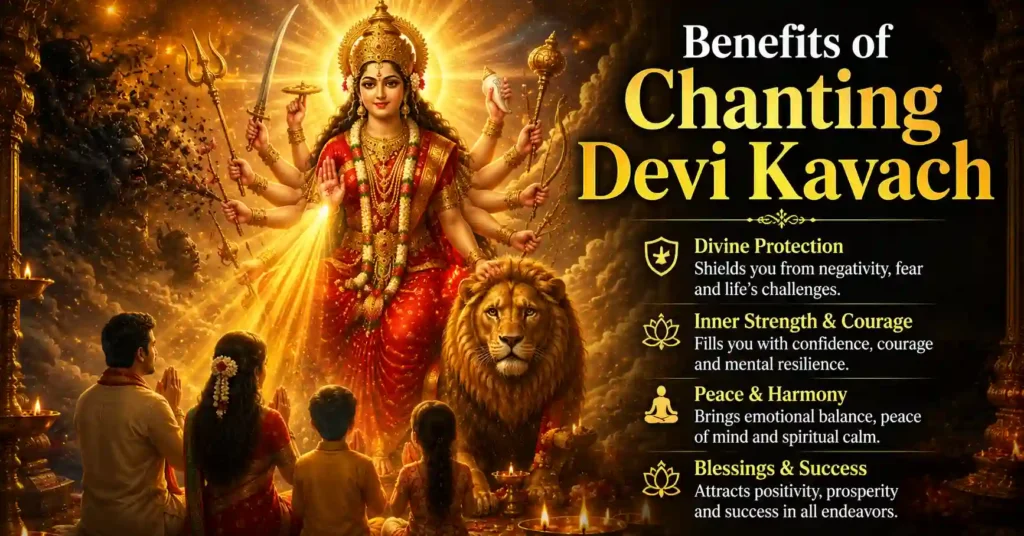
Benefits of Chanting Devi Kavach
The Devi Kavach is one of the most revered prayers from the Durga Saptashati. Traditionally, devotees recite the Devi Kavach to seek the blessings, protection, and guidance of Maa Durga in all aspects of life.
While spiritual texts describe many benefits, these are understood as matters of faith and devotion rather than guaranteed outcomes.
Spiritual Benefits
Regular recitation of the Devi Kavach helps devotees develop a deeper connection with Maa Durga.
The prayer reminds devotees that the Divine Mother is present in every aspect of life and offers constant spiritual support.
Many practitioners believe that chanting the Devi Kavach strengthens faith, devotion, and surrender to divine grace.
Mental Benefits
The rhythmic recitation of the Devi Kavach can help calm the mind and improve concentration.
Focusing on the sacred verses often encourages mindfulness and reduces mental distractions.
Many devotees find that daily chanting creates a sense of inner stability during stressful periods.
Emotional Benefits
The protective nature of the Devi Kavach provides emotional comfort to many devotees.
Remembering Maa Durga during difficult times can inspire courage, hope, and confidence.
The prayer also encourages trust in divine guidance, helping devotees face challenges with a positive mindset.
Traditional Benefits
According to the Durga Saptashati, the Devi Kavach is traditionally associated with divine protection from obstacles, fears, and negative influences.
It is commonly recited before reading the Durga Saptashati, Argala Stotra, and Keelaka Stotra.
Many devotees especially chant it during Navratri, Durga Puja, and other forms of Devi worship.
Protection and Fearlessness
One of the central themes of the Devi Kavach is spiritual protection.
The hymn invokes various forms of Maa Durga to guard different parts of the body, mind, and life.
This symbolism helps devotees cultivate a sense of security and fearlessness through faith.
Benefits for Daily Spiritual Practice
The Devi Kavach encourages regular remembrance of the Divine Mother throughout the day.
Its teachings inspire devotees to remain mindful, disciplined, and aligned with dharmic values.
Many practitioners include the Devi Kavach in their morning prayers as a way to begin the day with devotion and positivity.
Benefits During Navratri
The Devi Kavach holds special importance during Sharadiya Navratri and Chaitra Navratri.
Devotees often recite it before performing Durga Saptashati Parayan or other forms of Devi worship.
It is believed to help create a spiritually uplifting atmosphere and deepen the experience of Navratri sadhana.
Spiritual Essence
The greatest benefit of the Devi Kavach is not merely protection from external difficulties but the development of inner strength, faith, and devotion.
Through regular chanting, devotees seek to cultivate courage, purity of thought, and unwavering trust in Maa Durga’s divine presence.
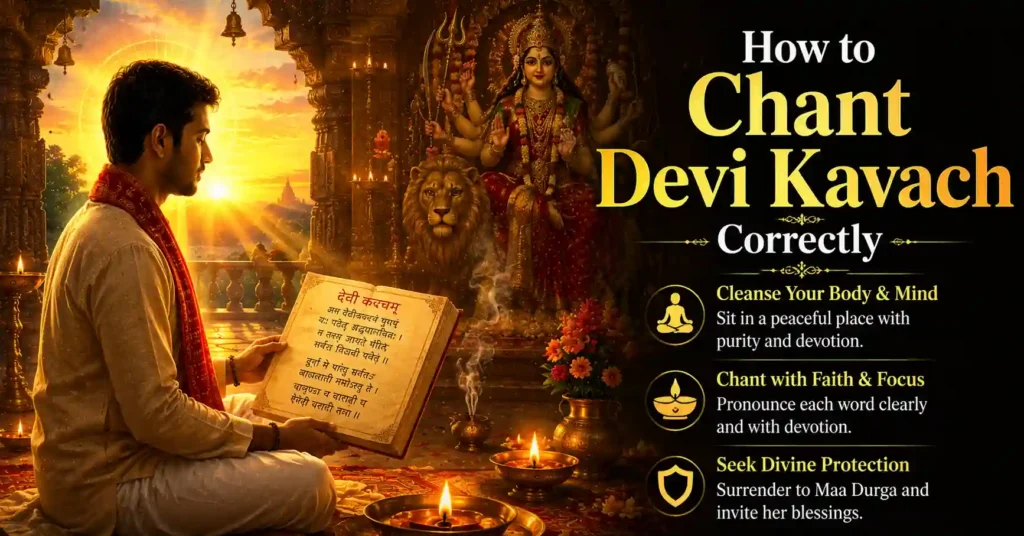
How to Chant Devi Kavach Correctly
The Devi Kavach is traditionally recited before the Argala Stotra, Keelaka Stotra, and the chapters of the Durga Saptashati. However, it can also be chanted independently as a daily prayer dedicated to Maa Durga.
The most important requirement is devotion, sincerity, and respect toward the Divine Mother.
Best Time to Chant Devi Kavach
Many devotees prefer chanting the Devi Kavach during Brahma Muhurta or in the early morning after bathing.
It is also commonly recited during the evening prayer period and before Durga worship.
During Navratri, the Devi Kavach is often included in daily sadhana and Durga Saptashati recitation.
Preparations Before Chanting
Before beginning the Devi Kavach, devotees traditionally:
Take a bath and wear clean clothes.
Sit in a quiet and clean place.
Face east or north if possible.
Light a diya or incense before Maa Durga’s image or murti.
Calm the mind through a short prayer or meditation.
These preparations help create a devotional atmosphere and improve concentration.
Traditional Method of Chanting
A common traditional sequence is:
Invocation and prayer to Maa Durga.
Devi Kavach.
Argala Stotra.
Keelaka Stotra.
Durga Saptashati recitation.
Final prayers and gratitude.
For daily worship, many devotees chant only the Devi Kavach if they do not have time for the complete Durga Saptashati.
Chanting Rules for Beginners
Beginners should not worry about achieving perfect pronunciation immediately.
It is better to chant slowly with attention and devotion than to rush through the verses.
With regular practice, pronunciation and familiarity naturally improve over time.
Can Beginners Chant Devi Kavach?
Yes, beginners can chant the Devi Kavach.
There is no requirement to be a Sanskrit scholar before starting.
Reading the English pronunciation and understanding the meaning of the verses can make the practice more meaningful and accessible.
Should You Understand the Meaning?
Understanding the meaning of the Devi Kavach is highly beneficial.
The hymn is not merely a collection of verses but a prayer expressing faith in the Divine Mother’s protection and guidance.
When devotees understand the symbolism and teachings, the recitation often becomes more heartfelt and transformative.
Is Devi Kavach Chanting Mandatory Before Durga Saptashati?
Traditionally, the Devi Kavach is recited before reading the Durga Saptashati.
Along with the Argala Stotra and Keelaka Stotra, it forms part of the customary sequence followed by many devotees.
However, those who wish to chant only the Devi Kavach may do so as an independent devotional practice.
Spiritual Essence
The true power of the Devi Kavach lies not only in correct pronunciation but also in devotion, faith, and regular practice.
A sincere heart, respectful attitude, and remembrance of Maa Durga are considered more important than ritual perfection.
Devi Kavach in Daily Life
Although the Devi Kavach is a sacred hymn from the Durga Saptashati, its teachings extend far beyond formal worship. The prayer reminds devotees that Maa Durga’s protection is not limited to temples or festivals but can be remembered throughout daily life.
The symbolism of the Devi Kavach encourages devotees to cultivate faith, courage, discipline, and devotion in every situation.
Finding Inner Strength During Difficult Times
Life often brings challenges, uncertainty, and moments of fear.
The Devi Kavach teaches devotees to remember the Divine Mother during such times and draw strength from her presence.
Many devotees recite the prayer when facing important decisions, personal struggles, or emotional difficulties.
Developing Courage and Fearlessness
One of the central messages of the Devi Kavach is protection through divine grace.
By remembering Maa Durga regularly, devotees seek to overcome fear, self-doubt, and negativity.
This attitude can help build confidence and resilience in everyday life.
Practicing Mindfulness Through Devotion
The verses of the Devi Kavach encourage awareness of both the body and mind.
As devotees invoke different forms of the Goddess for protection, they become more mindful of their thoughts, actions, and spiritual well-being.
This mindfulness can support a more balanced and purposeful life.
Strengthening Family and Relationships
Several verses of the Devi Kavach pray for the welfare of family members, children, and loved ones.
This reminds devotees to care for their relationships with compassion, patience, and responsibility.
The prayer reinforces the importance of family values within Sanatan Dharma.
Living According to Dharma
The Devi Kavach is not only about seeking protection but also about living righteously.
Its teachings encourage honesty, self-discipline, humility, and respect for others.
By following these values, devotees align their actions with dharma in daily life.
Bringing Spirituality Into Everyday Activities
Devotion does not have to be limited to formal rituals.
Many devotees remember Maa Durga while working, studying, traveling, or performing household duties.
This simple remembrance helps transform ordinary activities into acts of spiritual awareness.
Relevance During Navratri and Beyond
The Devi Kavach is especially popular during Navratri, but its message remains relevant throughout the year.
Its emphasis on divine protection, faith, and inner strength can support devotees in every season of life.
Regular reflection on its teachings can help maintain a deeper connection with Maa Durga.
Spiritual Essence
The true lesson of the Devi Kavach is that divine protection begins with faith, devotion, and righteous living.
By remembering Maa Durga in daily life, devotees seek not only safety and blessings but also wisdom, courage, and spiritual growth.
Did You Know? Interesting Facts About Devi Kavach
- The Devi Kavach is the first section traditionally recited before the Durga Saptashati, followed by the Argala Stotra and Keelaka Stotra.
- The word “Kavach” means armor or protective shield. In this context, the Devi Kavach is viewed as a spiritual armor created through devotion to Maa Durga.
- The Devi Kavach appears in the Markandeya Purana as part of the sacred Durga Saptashati, also known as the Devi Mahatmyam or Chandi Path.
- The hymn begins with a dialogue between Sage Markandeya and Lord Brahma, where Brahma reveals this sacred protection prayer.
- One of the unique features of the Devi Kavach is that it invokes different forms of the Divine Mother to protect specific parts of the body, mind, and life.
- The Navadurga forms of Maa Durga, including Shailaputri, Brahmacharini, Chandraghanta, Kushmanda, Skandamata, Katyayani, Kalaratri, Mahagauri, and Siddhidatri, are mentioned in the opening verses.
- During Sharadiya Navratri and Chaitra Navratri, many devotees include the Devi Kavach in their daily worship and Durga Saptashati recitation.
- The Devi Kavach does not focus only on physical protection. It also seeks protection for the mind, intellect, ego, life force, family, reputation, and spiritual well-being.
- The famous verse “रक्षाहीनं तु यत्स्थानं वर्जितं कवचेन तु” is often regarded as the heart of the prayer because it expresses complete surrender to Maa Durga’s grace.
- Many traditional practitioners chant the Devi Kavach before starting important spiritual practices because it is believed to create a protective and devotional mindset.
- The hymn repeatedly emphasizes that true protection comes not only from rituals but also from faith, devotion, humility, and righteous living.
- Although written in Sanskrit centuries ago, the teachings of the Devi Kavach continue to inspire devotees seeking courage, inner strength, and a deeper connection with the Divine Mother.
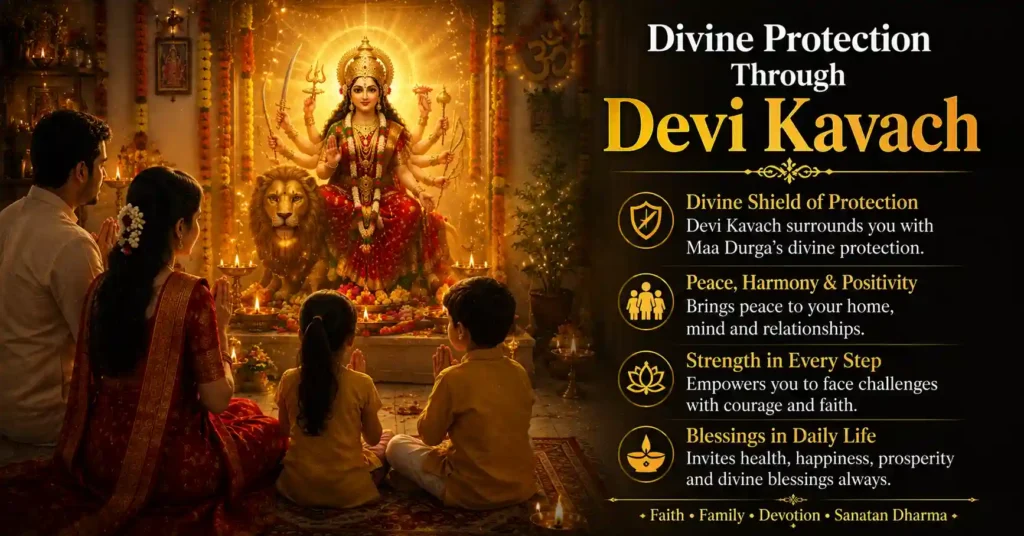
Conclusion
The Devi Kavach is one of the most sacred and widely recited prayers from the Durga Saptashati. Dedicated to Maa Durga, this powerful hymn invokes her various divine forms and seeks protection for the body, mind, family, and spiritual life.
Through this article, we explored the Devi Kavach meaning, its scriptural origin, English pronunciation, verse-by-verse explanation, spiritual symbolism, benefits, and proper chanting method. We also examined how the teachings of the Devi Kavach can be applied in daily life to cultivate courage, devotion, and inner strength.
More than a protection prayer, the Devi Kavach is a reminder that the Divine Mother is always present to guide and support her devotees. Its verses encourage faith, surrender, righteous living, and trust in divine grace.
Whether recited during Navratri, before reading the Durga Saptashati, or as part of daily worship, the Devi Kavach continues to inspire countless devotees on their spiritual journey.
May Maa Durga bless you with wisdom, fearlessness, protection, and unwavering devotion.
Suggested Reading
The Devi Kavach is one of the most important prayers of the Durga Saptashati and is traditionally recited before the Argala Stotra and Keelaka Stotra. It serves as a sacred protection hymn dedicated to Maa Durga and forms an essential part of Devi worship.
Exploring related scriptures, mantras, and devotional texts can help devotees gain a deeper understanding of the Devi Kavach, the worship of the Divine Mother, Navratri traditions, and the spiritual teachings of Shakta philosophy.
Argala Stotram Lyrics with Meaning and Spiritual Significance
https://thesanatantales.com/argala-stotram-lyrics-meaning/
Durga Chalisa Lyrics with English Pronunciation and Meaning
https://thesanatantales.com/durga-chalisa-lyrics-meaning/
Durga Beej Mantra: Simple Meaning, Benefits and How to Chant
https://thesanatantales.com/durga-beej-mantra-meaning/
What Is Durga Saptashati? Meaning, Story and Why It Is Read in Navratri
https://thesanatantales.com/durga-saptashati-meaning-navratri/
Navarna Mantra Meaning, Benefits, Chanting Rules and How to Chant
https://thesanatantales.com/navarna-mantra/
Aarti of Maa Ambe: Lyrics, Meaning, Benefits and How to Perform
https://thesanatantales.com/aarti-of-maa-ambe/
Siddha Kunjika Stotram: The Sacred Key That Unlocks the Full Power of Durga Saptashati
https://thesanatantales.com/siddha-kunjika-stotram/
Gayatri Mantra: 7 Divine Benefits and Spiritual Power
https://thesanatantales.com/gayatri-mantra-meaning-benefits/
Durga Saptashati
https://en.wikipedia.org/wiki/Devi_Mahatmya
Durga Chalisa
https://en.wikipedia.org/wiki/Durga_Chalisa
FAQs
1. What is Devi Kavach and why is it important in Durga Saptashati?
The Devi Kavach is a sacred protection hymn found in the Durga Saptashati, a revered scripture dedicated to Maa Durga. The word “Kavach” means armor or protective shield, symbolizing divine protection through devotion.
Traditionally, the Devi Kavach is recited before the Argala Stotra, Keelaka Stotra, and the main chapters of the Durga Saptashati. It invokes various forms of the Divine Mother to protect different aspects of a devotee’s life.
Beyond protection, the Devi Kavach teaches faith, surrender, courage, and trust in divine grace. This is why it remains one of the most widely recited prayers in Shakta tradition.
2. What are the benefits of chanting Devi Kavach daily?
Many devotees chant the Devi Kavach daily to strengthen their connection with Maa Durga and seek her blessings. The hymn is traditionally associated with spiritual protection, inner strength, and mental peace.
Regular recitation can encourage discipline, mindfulness, and devotion. The verses remind devotees that divine guidance is always available during life’s challenges.
According to traditional belief, the Devi Kavach helps cultivate courage, confidence, and faith. While it should not be viewed as a guaranteed solution to problems, many devotees find comfort and inspiration through consistent chanting and remembrance of the Divine Mother.
3. Can beginners chant Devi Kavach?
Yes, beginners can chant the Devi Kavach. There is no requirement to be an expert in Sanskrit before starting this sacred prayer.
Many devotees begin by reading the English pronunciation and learning the meaning of the verses gradually. Understanding the message behind the hymn often makes the practice more meaningful and enjoyable.
Beginners should focus on sincerity rather than perfection. Even if pronunciation is not flawless, chanting with devotion and respect is considered more important. Over time, regular practice naturally improves familiarity with the text and its spiritual teachings.
4. Is it necessary to understand the meaning of Devi Kavach while chanting?
While many devotees chant the Devi Kavach purely as a devotional practice, understanding its meaning can deepen the experience significantly.
The hymn is more than a collection of Sanskrit verses. It contains teachings about divine protection, surrender, courage, and spiritual awareness. When devotees understand what they are reciting, the connection with Maa Durga often becomes more personal.
Learning the meaning also helps readers appreciate the symbolism of the various forms of the Goddess mentioned throughout the prayer. For this reason, studying the meaning alongside chanting is highly recommended.
5. When is the best time to chant Devi Kavach?
The Devi Kavach can be chanted at any time with devotion and a focused mind. However, many devotees prefer early morning during Brahma Muhurta or after completing their daily prayers.
It is also commonly recited before reading the Durga Saptashati. During Navratri, the Devi Kavach becomes an important part of daily worship for many practitioners.
The most important factor is consistency rather than timing. A regular daily practice, even if brief, often helps devotees build a deeper spiritual connection and maintain devotional discipline.
6. Is Devi Kavach only for protection from negative energies?
No. Although the Devi Kavach is often described as a protection prayer, its meaning extends far beyond protection from external negativity.
The hymn repeatedly asks Maa Durga to safeguard the body, mind, intellect, life force, family, reputation, and spiritual well-being. It also encourages devotees to cultivate courage, self-discipline, and faith.
In this sense, the Devi Kavach can be viewed as a prayer for holistic spiritual growth. It teaches that true protection includes inner strength, wisdom, righteous conduct, and trust in the Divine Mother.
7. Why is Devi Kavach recited before Durga Saptashati?
According to tradition, the Devi Kavach serves as a preparatory prayer before the recitation of the Durga Saptashati. It is usually followed by the Argala Stotra and Keelaka Stotra.
This sequence is believed to help devotees enter a devotional and focused state of mind before studying the main scripture. The Devi Kavach invokes the blessings and protection of Maa Durga before the deeper spiritual teachings of the Durga Saptashati are explored.
Because of this traditional role, many practitioners consider it an essential part of Chandi Path and Navratri worship.
8. Can Devi Kavach be chanted during Navratri?
Yes, Navratri is one of the most popular times for chanting the Devi Kavach. During both Sharadiya Navratri and Chaitra Navratri, devotees often include it in their daily prayers and Durga Saptashati recitation.
The hymn mentions the Navadurga forms of the Goddess and celebrates her protective and compassionate nature. This makes it especially meaningful during the nine sacred nights dedicated to Maa Durga.
Many devotees believe that chanting the Devi Kavach during Navratri helps deepen devotion, strengthen spiritual discipline, and enhance the overall worship experience.
9. What does the word "Kavach" mean in Devi Kavach?
The Sanskrit word “Kavach” literally means armor, shield, or protective covering. In the context of the Devi Kavach, it refers to spiritual protection received through the grace of Maa Durga.
The hymn symbolically places the devotee under the protection of various forms of the Divine Mother. Different verses assign specific forms of Devi to guard different parts of the body and life.
The deeper meaning of the Kavach is not merely physical safety. It represents faith, divine guidance, inner strength, and the protective power of devotion throughout one’s spiritual journey.
10. Can Devi Kavach be chanted as a standalone prayer?
Yes, the Devi Kavach can be chanted independently even if a devotee is not performing the complete Durga Saptashati recitation.
Many people include it in their daily worship because of its profound spiritual message and devotional value. It is often recited as a morning prayer, during Navratri, or before important activities.
When chanted as a standalone prayer, the Devi Kavach continues to serve as a reminder of Maa Durga’s presence, protection, and guidance. Its teachings encourage devotees to live with faith, courage, humility, and devotion in everyday life.
Share Your Devotion
Have you ever recited the Devi Kavach during Navratri, daily worship, or before reading the Durga Saptashati?
Do you have a favorite verse from the Devi Kavach, a personal experience with Maa Durga’s blessings, or a spiritual insight that this sacred prayer has brought into your life?
We would love to hear from you.
Share your thoughts, experiences, or questions in the comments below and join fellow devotees in celebrating the divine protection, compassion, and grace of Maa Durga.
Jai Mata Di! 🙏
May the blessings of Maa Durga guide, protect, and inspire you on your spiritual journey.
References & Sources
The information presented in this article on the Devi Kavach has been compiled from traditional Hindu scriptures, respected devotional sources, and scholarly references related to Maa Durga, the Durga Saptashati, and Shakta traditions.
Primary Scriptures
Durga Saptashati (Devi Mahatmyam / Chandi Path), Markandeya Purana
Markandeya Purana
Traditional Navratri and Shakta worship texts
Disclaimer
The Devi Kavach is a sacred devotional hymn rooted in the Hindu spiritual tradition. Interpretations, benefits, and spiritual significance may vary across different lineages, teachers, and schools of thought.
This article is intended for educational and devotional purposes and should not be considered a substitute for guidance from a qualified spiritual teacher or traditional scripture study.
Explore More Topics from The Sanatan Tales