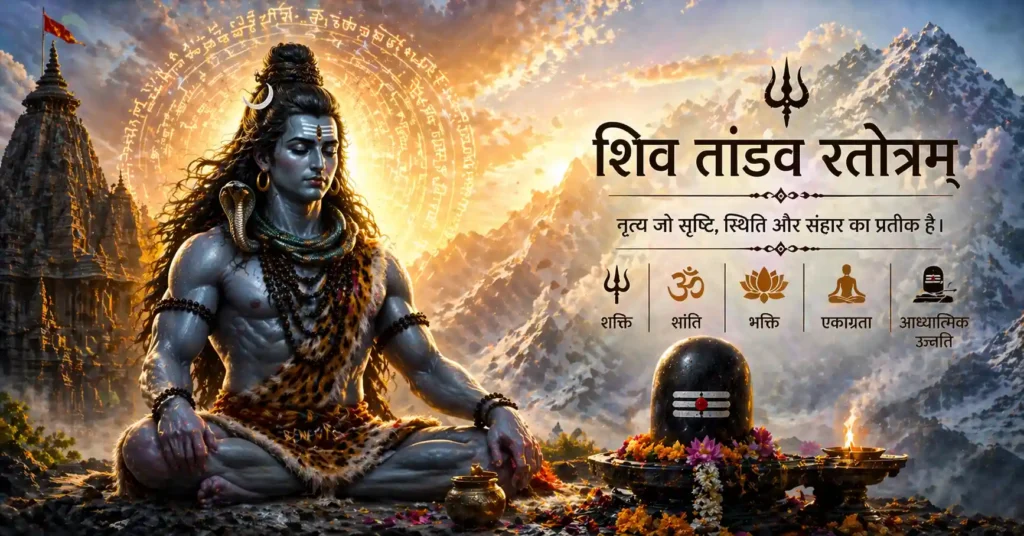
The Shiv Tandav Stotram is one of the most powerful and mesmerizing hymns dedicated to Lord Shiva. Known for its rhythmic flow, vivid imagery, and deep devotion, the Shiv Tandav Stotram describes Shiva’s cosmic dance, known as the Tandava, which symbolizes creation, preservation, and transformation. Traditionally, the hymn is attributed to Ravana, the king of Lanka and a devoted worshipper of Mahadev.
For centuries, devotees have recited the Shiv Tandav Stotram to express devotion, seek inner strength, and connect with the divine energy of Lord Shiva. Its powerful Sanskrit verses, combined with profound spiritual symbolism, continue to inspire Shiva devotees around the world.
In this article, you will discover the complete Shiv Tandav Stotram lyrics, its verse-by-verse meaning, the story behind its composition, spiritual symbolism, traditional benefits, the best time to chant it, and practical guidance for beginners.
Do you want to read in Hindi
Shiv Tandav Stotram at a Glance
| Aspect | Details |
|---|---|
| Dedicated To | Lord Shiva (Mahadev) |
| Deity Name | Shiva, Mahadev, Nataraja |
| Traditional Author | Ravana (King of Lanka) |
| Type | Stotram |
| Total Verses | 15 Verses (including Phalashruti) |
| Main Theme | Devotion, Surrender, Cosmic Dance, Divine Power |
| Language | Sanskrit |
| Best Time to Chant | Early Morning, Pradosh, Mondays, Mahashivratri |
| Suitable For | Beginners, Devotees, Spiritual Seekers |
| Associated Tradition | Shaivism |
| Famous For | Describing Shiva’s Tandava and divine form |
| Commonly Chanted During | Shravan Month, Mahashivratri, Pradosh Vrat |
The Shiv Tandav Stotram is especially known for its powerful rhythm and poetic structure. Many scholars and devotees consider it one of the most celebrated Shiva hymns in the Shaiva tradition
Table of Contents
ToggleWhat Is Shiv Tandav Stotram?
The Shiv Tandav Stotram is a Sanskrit hymn that glorifies Lord Shiva in his dynamic and awe-inspiring form. The word Stotram means a hymn of praise, while Tandava refers to Shiva’s cosmic dance. Together, the title can be understood as a hymn celebrating the divine dance of Mahadev.
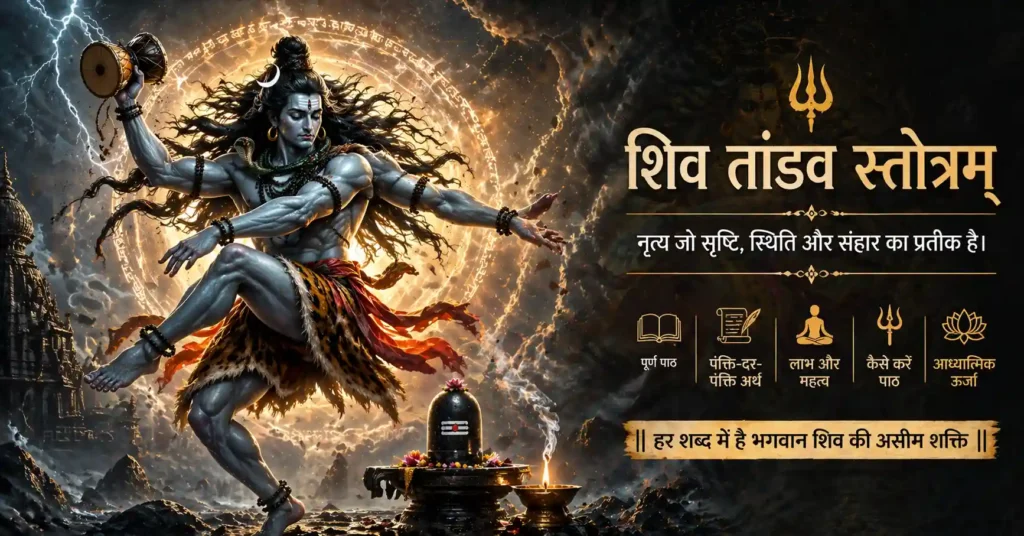
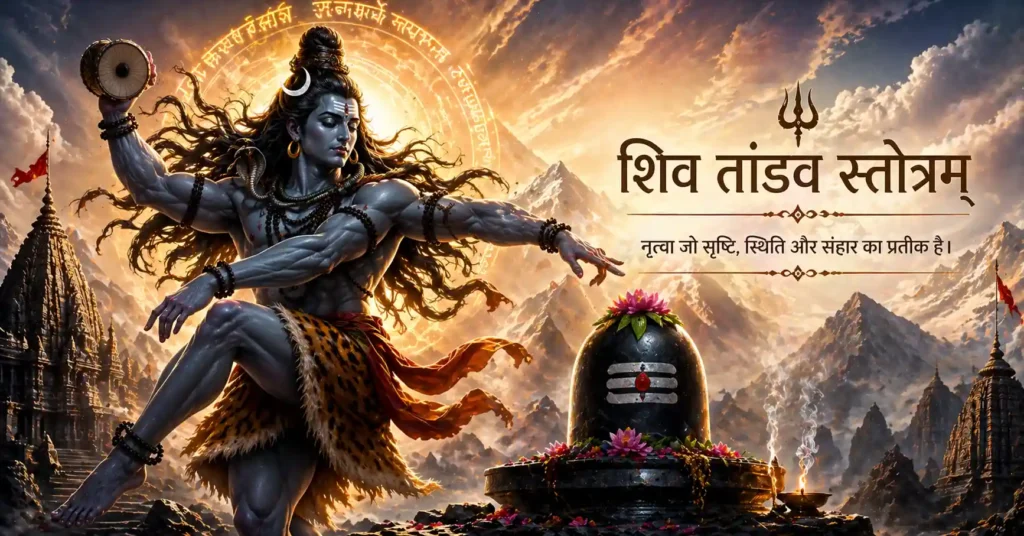
Unlike many devotional hymns that focus primarily on prayer, the Shiv Tandav Stotram vividly portrays Shiva’s appearance, power, symbols, and cosmic role. Its verses describe the flowing Ganga in Shiva’s matted locks, the crescent moon on his forehead, the serpents around his neck, and the powerful sound of the damaru.
The stotram holds a special place in Shiva worship because it combines devotion, philosophy, poetry, and spiritual symbolism in a single composition. Even today, it is recited by devotees during daily worship, Mahashivratri, Shravan month, and other occasions associated with Lord Shiva.
Who Wrote Shiv Tandav Stotram?
According to traditional belief, the Shiv Tandav Stotram was composed by Ravana, the legendary king of Lanka. Although Ravana is widely known as the antagonist of the Ramayana, he is also remembered as a great scholar, musician, and devoted worshipper of Lord Shiva.
A popular story states that Ravana once attempted to lift Mount Kailash, the sacred abode of Shiva. To humble him, Lord Shiva pressed the mountain down with his toe, trapping Ravana beneath it. Realizing his mistake, Ravana offered heartfelt prayers and sang hymns praising Mahadev. It is traditionally believed that the verses of the Shiv Tandav Stotram emerged from this intense devotion and surrender.
This story highlights an important spiritual message. In many Shaiva traditions, the hymn is seen as an example of how sincere devotion can transform pride into surrender and bring a devotee closer to the divine.
Why Do Devotees Chant Shiv Tandav Stotram?
Many devotees chant the Shiv Tandav Stotram because it helps them feel a deeper connection with Lord Shiva. The hymn is filled with devotion, reverence, and vivid descriptions of Mahadev’s divine form.
Some people recite it during daily worship, while others chant it during Mahashivratri, Shravan month, or Pradosh observances. Its powerful rhythm and energetic verses make it one of the most memorable Shiva stotras.
Devotees also appreciate the spiritual themes found throughout the hymn. The verses speak about surrender, inner strength, detachment, divine grace, and the cosmic nature of existence. These timeless themes continue to resonate with modern readers and spiritual seekers.
Many people feel that chanting the Shiv Tandav Stotram creates a sense of focus, devotion, and reverence. While individual experiences differ, the hymn remains one of the most beloved Shiva prayers in the Hindu tradition.
Shiv Tandav Stotram Full Lyrics in Sanskrit
The Shiv Tandav Stotram is traditionally composed in Sanskrit and is admired for its powerful rhythm, poetic beauty, and vivid description of Lord Shiva’s cosmic dance.
Many devotees prefer reciting the original Sanskrit text because its sound and cadence closely reflect the energy of Shiva’s Tandava. The hymn is also known for its complex Sanskrit meter, which creates a drum-like flow that resembles the beat of Shiva’s damaru.
Below is the complete Shiv Tandav Stotram lyrics in Sanskrit.
जटाटवी गलज्जल प्रवाह पावितस्थले
गलेऽवलम्ब्य लम्बितां भुजङ्गतुङ्गमालिकाम्।
डमड्डमड्डमड्डमन्निनादवड्डमर्वयं
चकार चण्डताण्डवं तनोतु नः शिवः शिवम्॥
जटाकटाह सम्भ्रम भ्रमन्निलिम्प निर्झरी
विलोलवीचिवल्लरी विराजमान मूर्धनि।
धगद्धगद्धगज्ज्वलल्ललाटपट्टपावके
किशोरचन्द्रशेखरे रतिः प्रतिक्षणं मम॥
धराधरेन्द्रनन्दिनी विलासबन्धुबन्धुर
स्फुरद्दिगन्तसन्तति प्रमोदमानमानसे।
कृपाकटाक्षधोरणी निरुद्धदुर्धरापदि
क्वचिद्दिगम्बरे मनो विनोदमेतु वस्तुनि॥
जटाभुजङ्गपिङ्गल स्फुरत्फणामणिप्रभा
कदम्बकुङ्कुमद्रवप्रलिप्तदिग्वधूमुखे।
मदान्धसिन्धुरस्फुरत्त्वगुत्तरीयमेदुरे
मनो विनोदमद्भुतं बिभर्तु भूतभर्तरि॥
सहस्रलोचन प्रभृत्यशेषलेखशेखर
प्रसूनधूलिधोरणी विधूसराङ्घ्रिपीठभूः।
भुजङ्गराजमालया निबद्धजाटजूटकः
श्रियै चिराय जायतां चकोरबन्धुशेखरः॥
ललाटचत्वरज्वलद्धनञ्जयस्फुलिङ्गभा
निपीतपञ्चसायकं नमन्निलिम्पनायकम्।
सुधामयूखलेखया विराजमानशेखरं
महाकपालिसम्पदे शिरोजटालमस्तु नः॥
करालभालपट्टिकाधगद्धगद्धगज्ज्वल
द्धनञ्जयाधरीकृतप्रचण्डपञ्चसायके।
धराधरेन्द्रनन्दिनी कुचाग्रचित्रपत्रक
प्रकल्पनैकशिल्पिनि त्रिलोचने रतिर्मम॥
नवीनमेघमण्डली निरुद्धदुर्धरस्फुरत्
कुहूनिशीथिनीतमः प्रबन्धबद्धकन्धरः।
निलिम्पनिर्झरीधरस्तनोतु कृत्तिसिन्धुरः
कलानिधानबन्धुरः श्रियं जगद्धुरंधरः॥
प्रफुल्लनीलपङ्कजप्रपञ्चकालिमप्रभा
वलम्बिकण्ठकन्दली रुचिप्रबद्धकन्धरम्।
स्मरच्छिदं पुरच्छिदं भवच्छिदं मखच्छिदं
गजच्छिदांधकच्छिदं तमन्तकच्छिदं भजे॥
अखर्वसर्वमङ्गलाकलाकदम्बमञ्जरी
रसप्रवाहमाधुरी विजृम्भणामधुव्रतम्।
स्मरान्तकं पुरान्तकं भवान्तकं मखान्तकं
गजान्तकांधकान्तकं तमन्तकान्तकं भजे॥
जयत्वदभ्रविभ्रमभ्रमद्भुजङ्गमस्पुरत्
धगद्धगद्धगज्ज्वलल्ललाटपट्टपावके।
धिमिद्धिमिद्धिमिध्वनन्मृदङ्गतुङ्गमङ्गल
ध्वनिक्रमप्रवर्तितप्रचण्डताण्डवः शिवः॥
दृषद्विचित्रतल्पयोर्भुजङ्गमौक्तिकस्रजोर्
गरिष्ठरत्नलोष्टयोः सुहृद्विपक्षपक्षयोः।
तृणारविन्दचक्षुषोः प्रजामहीमहेंद्रयोः
समं प्रवर्तयन्मनः कदा सदाशिवं भजे॥
कदा निलिम्पनिर्झरीनिकुञ्जकोटरे वसन्
विमुक्तदुर्मतिः सदा शिरःस्थमञ्जलिं वहन्।
विमुक्तलोललोचनोल्ललामभाललग्नकः
शिवेति मन्त्रमुच्चरन् कदा सुखी भवाम्यहम्॥
इमं हि नित्यमेवमुक्तमुत्तमोत्तमं स्तवं
पठन्स्मरन्ब्रुवन्नरो विशुद्धिमेति संततम्।
हरे गुरौ सुभक्तिमाशु याति नान्यथा गतिं
विमोहनं हि देहिनां सुशङ्करस्य चिंतनम्॥
पूजावसानसमये दशवक्त्रगीतं
यः शम्भुपूजनपरं पठति प्रदोषे।
तस्य स्थिरां रथगजेन्द्रतुरङ्गयुक्तां
लक्ष्मीं सदैव सुमुखीं प्रददाति शम्भुः॥
Shiv Tandav Stotram Line-by-Line Translation and Meaning
For readers who are not familiar with Devanagari script, a Roman transliteration can make the Shiv Tandav Stotram easier to read and chant. While correct pronunciation is helpful, devotion and sincerity are considered more important than perfection in most devotional traditions.
The Shiv Tandav Stotram is much more than a poetic description of Lord Shiva’s appearance. Every verse contains profound spiritual symbolism related to devotion, surrender, divine power, cosmic consciousness, and the eternal rhythm of creation and dissolution.
As you read the verse-by-verse meaning, you will notice recurring symbols such as the Ganga, the crescent moon, the serpent garland, the sacred fire, and the damaru. Together, these images reveal different aspects of Mahadev’s divine nature.
Verse 1
Sanskrit Verse
जटाटवीगलज्जलप्रवाहपावितस्थले
गलेऽवलम्ब्य लम्बितां भुजङ्गतुङ्गमालिकाम्।
डमड्डमड्डमड्डमन्निनादवड्डमर्वयं
चकार चण्डताण्डवं तनोतु नः शिवः शिवम्॥ १॥
Transliteration
Jatatavi-galajjala-pravaha-pavita-sthale
Gale’valambya lambitam bhujanga-tunga-malikam
Damad damad damad daman ninada-vadya-marvayam
Chakara chanda-tandavam tanotu nah Shivah Shivam
Line-by-Line Meaning
Jatatavi-galajjala-pravaha-pavita-sthale
The sacred Ganga flowing from Shiva’s matted locks sanctifies everything around.
Gale’valambya lambitam bhujanga-tunga-malikam
A magnificent garland of mighty serpents adorns His neck.
Damad damad damad daman ninada-vadya-marvayam
The resonating sound of His damaru reverberates throughout the universe.
Chakara chanda-tandavam tanotu nah Shivah Shivam
May Lord Shiva, performing His fierce cosmic dance, bless us with auspiciousness.
Full Verse Meaning
This verse presents a magnificent image of Lord Shiva in His divine and dynamic form. The sacred Ganga flows from His matted locks, powerful serpents adorn His neck, and the rhythmic sound of the damaru echoes across the universe.
As Shiva performs His mighty Tandava, the devotee offers a prayer for blessings, protection, and spiritual well-being. The verse celebrates Shiva as the source of both immense power and supreme auspiciousness.
Devotional Essence
This verse symbolizes Lord Shiva’s purity, strength, and cosmic energy. The Ganga represents spiritual purification, the serpents symbolize fearlessness and mastery over worldly fears, and the damaru represents the primordial sound from which creation unfolds.
Shiva’s Tandava reminds devotees that the universe is constantly moving through cycles of creation, preservation, and transformation. By remembering Shiva, one learns to accept change as a sacred part of life’s journey.
Verse 2
Sanskrit Verse
जटाकटाहसम्भ्रमभ्रमन्निलिम्पनिर्झरी
विलोलवीचिवल्लरीविराजमानमूर्धनि।
धगद्धगद्धगज्ज्वलल्ललाटपट्टपावके
किशोरचन्द्रशेखरे रतिः प्रतिक्षणं मम॥ २॥
Transliteration
Jata-kataha-sambhrama-bhraman-nilimpa-nirjhari
Vilola-vichi-vallari-virajamana-murdhani
Dhagad-dhagad-dhagaj-jvala-lalata-patta-pavake
Kishora-chandra-shekhare ratih pratikshanam mama
Line-by-Line Meaning
Jata-kataha-sambhrama-bhraman-nilimpa-nirjhari
The celestial Ganga rushes and swirls through Shiva’s matted locks.
Vilola-vichi-vallari-virajamana-murdhani
Its dancing waves beautifully adorn His divine head.
Dhagad-dhagad-dhagaj-jvala-lalata-patta-pavake
A blazing fire shines brilliantly upon His forehead.
Kishora-chandra-shekhare ratih pratikshanam mama
May my heart remain devoted every moment to Shiva, who wears the young crescent moon.
Full Verse Meaning
This verse glorifies Lord Shiva’s radiant and awe-inspiring appearance. The swiftly flowing Ganga, the crescent moon resting on His head, and the blazing fire on His forehead together reveal His divine magnificence.
The devotee expresses a heartfelt desire to remain constantly absorbed in the remembrance of Chandrashekhara Shiva, whose presence embodies both power and serenity.
Devotional Essence
The verse beautifully portrays the balance that exists within Lord Shiva. The cooling moon and sacred Ganga symbolize peace, compassion, and grace, while the fire on His forehead represents transformation and spiritual awakening.
It reminds devotees that true spiritual growth comes from balancing inner calm with the courage to overcome ignorance and limitations.
Verse 3
Sanskrit Verse
धराधरेन्द्रनन्दिनीविलासबन्धुबन्धुर
स्फुरद्दिगन्तसन्ततिप्रमोदमानमानसे।
कृपाकटाक्षधोरणीनिरुद्धदुर्धरापदि
क्वचिद्दिगम्बरे मनो विनोदमेतु वस्तुनि॥ ३॥
Transliteration
Dharadharendra-nandini-vilasa-bandhu-bandhura
Sphurad-diganta-santati-pramoda-mana-manase
Kripa-kataksha-dhorani-niruddha-durdharapadi
Kvachid-digambare mano vinodametu vastuni
Line-by-Line Meaning
Dharadharendra-nandini-vilasa-bandhu-bandhura
Lord Shiva appears charming as He delights in the company of Goddess Parvati, the daughter of the King of Mountains.
Sphurad-diganta-santati-pramoda-mana-manase
His joyful consciousness radiates happiness throughout all directions.
Kripa-kataksha-dhorani-niruddha-durdharapadi
His compassionate glance removes even the most difficult troubles and obstacles.
Kvachid-digambare mano vinodametu vastuni
May my mind find lasting joy and peace in that divine Digambara form of Shiva.
Full Verse Meaning
This verse praises Lord Shiva’s compassionate and blissful nature. Seated with Goddess Parvati, He radiates divine joy that spreads throughout the universe.
His merciful glance protects devotees from suffering and adversity. The devotee prays that the mind may become absorbed in Shiva alone and experience the inner peace that comes from divine connection.
Devotional Essence
The verse highlights Shiva as both the Supreme Lord and the loving companion of Shakti. His presence symbolizes harmony, compassion, and spiritual fulfillment.
It teaches that lasting happiness is not found in external achievements but in developing a deep and loving relationship with the Divine.
Verse 4
Sanskrit Verse
जटाभुजङ्गपिङ्गलस्फुरत्फणामणिप्रभा
कदम्बकुङ्कुमद्रवप्रलिप्तदिग्वधूमुखे।
मदान्धसिन्धुरस्फुरत्त्वगुत्तरीयमेदुरे
मनो विनोदमद्भुतं बिभर्तु भूतभर्तरि॥ ४॥
Transliteration
Jata-bhujanga-pingala-sphurat-phana-mani-prabha
Kadamba-kunkuma-drava-pralipta-digvadhu-mukhe
Madandha-sindhura-sphurat-tvag-uttariya-medure
Mano vinodam-adbhutam bibhartu bhuta-bhartari
Line-by-Line Meaning
Jata-bhujanga-pingala-sphurat-phana-mani-prabha
The radiant jewels on the hoods of the tawny serpents in Shiva’s matted locks shine brilliantly.
Kadamba-kunkuma-drava-pralipta-digvadhu-mukhe
The celestial directions appear adorned with the beauty of sacred saffron.
Madandha-sindhura-sphurat-tvag-uttariya-medure
His majestic form radiates the strength and grandeur of a mighty elephant.
Mano vinodam-adbhutam bibhartu bhuta-bhartari
May this wondrous form of Shiva, the sustainer of all beings, fill my heart with joy and peace.
Full Verse Meaning
This verse celebrates the extraordinary beauty and majesty of Lord Shiva. The shining serpent jewels, the divine glow spread across the directions, and His majestic presence create a breathtaking vision of the Lord.
The devotee prays that contemplating this divine form may bring inner happiness, spiritual inspiration, and a deeper connection with Shiva.
Devotional Essence
The verse teaches that divine beauty is not merely physical but spiritual in nature. Every aspect of Shiva’s appearance carries deeper symbolism and sacred meaning.
Meditating on His form helps devotees rise above worldly distractions and develop devotion, wonder, and inner stillness.
Verse 5
Sanskrit Verse
सहस्रलोचनप्रभृत्यशेषलेखशेखर
प्रसूनधूलिधोरणीविधूसराङ्घ्रिपीठभूः।
भुजङ्गराजमालया निबद्धजाटजूटकः
श्रियै चिराय जायतां चकोरबन्धुशेखरः॥ ५॥
Transliteration
Sahasra-lochana-prabhritya-shesha-lekha-shekhara
Prasuna-dhuli-dhorani-vidhusaranghri-pithabhuh
Bhujanga-raja-malaya nibaddha-jata-jutakah
Shriyai chiraya jayatam chakora-bandhu-shekharah
Line-by-Line Meaning
Sahasra-lochana-prabhritya-shesha-lekha-shekhara
Even mighty deities such as Indra and other celestial beings bow before Lord Shiva.
Prasuna-dhuli-dhorani-vidhusaranghri-pithabhuh
His feet are covered with the sacred dust of flowers offered in devotion.
Bhujanga-raja-malaya nibaddha-jata-jutakah
His matted locks are beautifully adorned with the king of serpents.
Shriyai chiraya jayatam chakora-bandhu-shekharah
May the moon-crested Lord Shiva bless us with lasting prosperity and well-being.
Full Verse Meaning
This verse describes the supreme status of Lord Shiva, before whom even the greatest gods offer their reverence. His feet are worshipped with flowers, and His divine form is adorned with celestial symbols such as the serpent king and the crescent moon.
The devotee prays for enduring prosperity, grace, and spiritual fortune through the blessings of Lord Shiva.
Devotional Essence
The verse reminds us that true greatness is accompanied by humility and devotion. Even the gods bow before Shiva because He represents the highest reality beyond all worldly power and status.
By surrendering at Shiva’s feet with sincerity and faith, devotees seek not only material well-being but also spiritual abundance and divine grace.
Verse 6
Sanskrit Verse
ललाटचत्वरज्वलद्धनञ्जयस्फुलिङ्गभा
निपीतपञ्चसायकं नमन्निलिम्पनायकम्।
सुधामयूखलेखया विराजमानशेखरं
महाकपालिसम्पदेशिरोजटालमस्तु नः॥ ६॥
Transliteration
Lalata-chatvara-jvalad-dhananjaya-sphulingabha
Nipita-pancha-sayakam namannilimpa-nayakam
Sudha-mayukha-lekhaya virajamana-shekharam
Mahakapali-sampade shiro-jatalam-astu nah
Line-by-Line Meaning
Lalata-chatvara-jvalad-dhananjaya-sphulingabha
Sparks blaze fiercely from the sacred fire shining on Shiva’s forehead.
Nipita-pancha-sayakam namannilimpa-nayakam
He consumed and destroyed Kamadeva, the god of desire, and is revered by the celestial beings.
Sudha-mayukha-lekhaya virajamana-shekharam
The cooling rays of the crescent moon beautifully adorn His head.
Mahakapali-sampade shiro-jatalam-astu nah
May Shiva’s sacred matted locks bless us with divine strength and spiritual prosperity.
Full Verse Meaning
This verse glorifies Lord Shiva’s extraordinary power and spiritual majesty. The blazing fire of His third eye symbolizes His ability to burn away desire, ignorance, and illusion. At the same time, the soothing crescent moon resting on His head represents peace, wisdom, and compassion.
The devotee prays that Shiva’s divine presence may bestow strength, purity, and spiritual blessings upon all who remember Him with devotion.
Devotional Essence
This verse teaches that spiritual growth requires both discipline and grace. Shiva destroys harmful desires and attachments, yet He also nurtures devotees with compassion and wisdom.
The fire and moon together remind us that true transformation happens when strength is balanced with inner peace.
Verse 7
Sanskrit Verse
करालभालपट्टिकाधगद्धगद्धगज्ज्वल
द्धनञ्जयाधरीकृतप्रचण्डपञ्चसायके।
धराधरेन्द्रनन्दिनीकुचाग्रचित्रपत्रक
प्रकल्पनैकशिल्पिनि त्रिलोचने रतिर्मम॥ ७॥
Transliteration
Karala-bhala-pattika-dhagad-dhagad-dhagajjvala
Dhananjaya-dharikrita-prachanda-pancha-sayake
Dharadharendra-nandini-kuchagra-chitra-patraka
Prakalpanaika-shilpini trilochane ratir mama
Line-by-Line Meaning
Karala-bhala-pattika-dhagad-dhagad-dhagajjvala
The terrifying fire on Shiva’s forehead blazes with tremendous intensity.
Dhananjaya-dharikrita-prachanda-pancha-sayake
He destroyed the mighty Kamadeva and conquered the forces of desire.
Dharadharendra-nandini-kuchagra-chitra-patraka
His divine beauty shines alongside Goddess Parvati, the daughter of the Himalayas.
Prakalpanaika-shilpini trilochane ratir mama
May my devotion remain forever fixed on the three-eyed Lord Shiva.
Full Verse Meaning
This verse praises Shiva as the conqueror of desire and the embodiment of divine beauty. His blazing third eye represents supreme spiritual power, while His union with Parvati reflects divine harmony and completeness.
The devotee expresses a longing for unwavering devotion and asks that the mind remain constantly absorbed in the contemplation of the three-eyed Lord.
Devotional Essence
The verse reminds devotees that spiritual progress comes through mastery over desires and attachment. Shiva’s destruction of Kamadeva symbolizes victory over impulses that distract us from higher truth.
At the same time, His relationship with Parvati teaches that divine love and spiritual discipline can exist together in perfect balance.
Verse 8
Sanskrit Verse
नवीनमेघमण्डलीनिरुद्धदुर्धरस्फुरत्
कुहूनिशीथिनीतमःप्रबन्धबद्धकन्धरः।
निलिम्पनिर्झरीधरस्तनोतु कृत्तिसिन्धुरः
कलानिधानबन्धुरः श्रियं जगद्धुरंधरः॥ ८॥
Transliteration
Naveena-megha-mandali-niruddha-durdhara-sphurat
Kuhu-nishithini-tamah-prabandha-baddha-kandharah
Nilimpa-nirjhari-dharas tanotu kritti-sindhurah
Kala-nidhana-bandhurah shriyam jagad-dhurandharah
Line-by-Line Meaning
Naveena-megha-mandali-niruddha-durdhara-sphurat
Lord Shiva’s form appears deep and majestic like newly formed rain clouds.
Kuhu-nishithini-tamah-prabandha-baddha-kandharah
Dark serpents encircle His neck like the darkness of a moonless night.
Nilimpa-nirjhari-dharas tanotu kritti-sindhurah
The bearer of the celestial Ganga showers blessings upon His devotees.
Kala-nidhana-bandhurah shriyam jagad-dhurandharah
The sustainer of the universe and treasure of all arts grants prosperity and well-being.
Full Verse Meaning
This verse paints a majestic image of Lord Shiva’s mysterious and awe-inspiring form. His dark and powerful appearance reflects the vastness of the cosmos, while the sacred Ganga flowing from His locks symbolizes divine grace descending into the world.
The devotee seeks blessings from Shiva, who supports and sustains the entire universe through His infinite power and compassion.
Devotional Essence
The verse teaches that beneath the mystery and grandeur of the universe lies the presence of the Divine. Shiva’s form reminds us that what may appear fearsome or unknown often contains deep spiritual wisdom.
Trusting in Shiva’s guidance helps devotees navigate life’s uncertainties with faith and courage.
Verse 9
Sanskrit Verse
प्रफुल्लनीलपङ्कजप्रपञ्चकालिमप्रभा
वलम्बिकण्ठकन्दलीरुचिप्रबद्धकन्धरम्।
स्मरच्छिदं पुरच्छिदं भवच्छिदं मखच्छिदं
गजच्छिदान्धकच्छिदं तमन्तकच्छिदं भजे॥ ९॥
Transliteration
Praphulla-neela-pankaja-prapancha-kalima-prabha
Valambi-kantha-kandali-ruchi-prabaddha-kandharam
Smarachchidam purachchidam bhavachchidam makhachchidam
Gajachchidam andhakachchidam tam antakachchidam bhaje
Line-by-Line Meaning
Praphulla-neela-pankaja-prapancha-kalima-prabha
His radiance resembles the beauty of a fully blossomed blue lotus.
Valambi-kantha-kandali-ruchi-prabaddha-kandharam
His neck shines with extraordinary grace and splendor.
Smarachchidam purachchidam bhavachchidam makhachchidam
He destroys desire, pride, worldly bondage, and false ego.
Gajachchidam andhakachchidam tam antakachchidam bhaje
He destroys ignorance, darkness, and even the fear of death.
Full Verse Meaning
This verse glorifies Shiva as the destroyer of all forms of bondage that prevent spiritual liberation. He removes desire, pride, ignorance, ego, and attachment, allowing devotees to move closer to truth and self-realization.
The devotee bows to Shiva as the liberator who helps souls transcend suffering and attain spiritual freedom.
Devotional Essence
The verse reminds us that the greatest obstacles are often internal rather than external. Desire, ego, anger, and ignorance create suffering and keep the mind trapped in cycles of attachment.
By surrendering to Shiva and following the path of wisdom, devotees gradually overcome these limitations and move toward inner freedom.
Verse 10
Sanskrit Verse
अखर्वसर्वमङ्गलाकलाकदम्बमञ्जरी
रसप्रवाहमाधुरीविजृम्भणामधुव्रतम्।
स्मरान्तकं पुरान्तकं भवान्तकं मखान्तकं
गजान्तकान्धकान्तकं तमन्तकान्तकं भजे॥ १०॥
Transliteration
Akharva-sarva-mangala-kala-kadamba-manjari
Rasa-pravaha-madhuri-vijrimbhana-madhu-vratam
Smarantakam purantakam bhavantakam makhantakam
Gajantakandhakantakam tam antakantakam bhaje
Line-by-Line Meaning
Akharva-sarva-mangala-kala-kadamba-manjari
Lord Shiva is the source of all auspiciousness, beauty, and divine arts.
Rasa-pravaha-madhuri-vijrimbhana-madhu-vratam
His presence spreads sweetness, bliss, and spiritual joy.
Smarantakam purantakam bhavantakam makhantakam
He destroys desire, pride, worldly suffering, and ego-driven actions.
Gajantakandhakantakam tam antakantakam bhaje
He destroys ignorance, darkness, and even death itself.
Full Verse Meaning
This verse celebrates Lord Shiva as the embodiment of auspiciousness, spiritual beauty, and divine bliss. While He is known as the destroyer of ignorance and ego, He is also the source of joy, wisdom, and inner fulfillment.
The devotee worships Shiva as the Lord who removes all obstacles to spiritual awakening and fills life with divine grace.
Devotional Essence
The verse teaches that Shiva’s role as a destroyer is ultimately compassionate. He destroys only those things that prevent spiritual growth, such as ignorance, attachment, and ego.
By removing these obstacles, Shiva opens the path to wisdom, peace, and lasting happiness. His grace transforms the devotee’s life from within and leads the soul toward liberation.
Verse 11
Sanskrit Verse
जयत्वदभ्रविभ्रमभ्रमद्भुजङ्गमस्पुरत्
धगद्धगद्धगज्ज्वलल्ललाटपट्टपावके।
धिमिद्धिमिद्धिमिध्वनन्मृदङ्गतुङ्गमङ्गल
ध्वनिक्रमप्रवर्तितप्रचण्डताण्डवः शिवः॥ ११॥
Transliteration
Jayatva-dabhra-vibhrama-bhramad-bhujanga-masphurat
Dhagad-dhagad-dhagaj-jvala-lalata-patta-pavake
Dhimid-dhimid-dhimi-dhvanan-mridanga-tunga-mangala
Dhvani-krama-pravartita-prachanda-tandavah Shivah
Line-by-Line Meaning
Jayatva-dabhra-vibhrama-bhramad-bhujanga-masphurat
Victory to Lord Shiva, whose serpents move gracefully around His divine form.
Dhagad-dhagad-dhagaj-jvala-lalata-patta-pavake
The blazing fire on His forehead shines with immense brilliance.
Dhimid-dhimid-dhimi-dhvanan-mridanga-tunga-mangala
The auspicious sounds of celestial drums resound throughout the universe.
Dhvani-krama-pravartita-prachanda-tandavah Shivah
To those rhythms, Lord Shiva performs His powerful and magnificent Tandava dance.
Full Verse Meaning
This verse vividly describes the grandeur of Shiva’s cosmic dance. The movement of serpents, the blazing fire of the third eye, and the rhythmic sound of sacred drums together create a divine scene filled with energy and power.
The entire universe appears to move in harmony with Shiva’s Tandava, reflecting His role as the cosmic force behind creation, preservation, and transformation.
Devotional Essence
This verse reminds devotees that the universe itself follows a divine rhythm. Shiva’s Tandava is not merely a dance but a symbol of cosmic order and spiritual awakening.
When devotees align themselves with this divine rhythm through devotion and self-awareness, they experience greater harmony in life.
Verse 12
Sanskrit Verse
दृषद्विचित्रतल्पयोर्भुजङ्गमौक्तिकस्रजोर्
गरिष्ठरत्नलोष्टयोः सुहृद्विपक्षपक्षयोः।
तृणारविन्दचक्षुषोः प्रजामहीमहेन्द्रयोः
समं प्रवर्तयन्मनः कदा सदाशिवं भजे॥ १२॥
Transliteration
Drishad-vichitra-talpayor-bhujanga-mauktika-srajor
Garishta-ratna-loshtayoh suhrid-vipaksha-pakshayoh
Trina-aravinda-chakshushoh praja-mahi-mahendrayoh
Samam pravartayan-manah kada Sadashivam bhaje
Line-by-Line Meaning
Drishad-vichitra-talpayor-bhujanga-mauktika-srajor
To Shiva, a stone bed and a bed adorned with pearls are the same.
Garishta-ratna-loshtayoh suhrid-vipaksha-pakshayoh
He sees precious jewels and ordinary stones, friends and enemies, with equal vision.
Trina-aravinda-chakshushoh praja-mahi-mahendrayoh
For Him, ordinary people and mighty rulers are equally important.
Samam pravartayan-manah kada Sadashivam bhaje
When will my mind attain such perfect balance and worship Sadashiva?
Full Verse Meaning
This verse praises Shiva’s state of complete equanimity. He remains unaffected by wealth or poverty, praise or criticism, friendship or hostility, and treats all beings with equal vision.
The devotee longs to develop the same spiritual balance and freedom from attachment that Lord Shiva embodies.
Devotional Essence
One of the highest teachings of Sanatan Dharma is samatva or equanimity. This verse presents Shiva as the perfect example of a being who has risen above dualities and worldly distinctions.
It inspires devotees to cultivate inner balance and treat all situations with wisdom, humility, and fairness.
Verse 13
Sanskrit Verse
कदा निलिम्पनिर्झरीनिकुञ्जकोटरे वसन्
विमुक्तदुर्मतिः सदा शिरःस्थमञ्जलिं वहन्।
विमुक्तलोललोचनोल्ललामभाललग्नकः
शिवेति मन्त्रमुच्चरन् कदा सुखी भवाम्यहम्॥ १३॥
Transliteration
Kada nilimpa-nirjhari-nikunja-kotare vasan
Vimukta-durmatih sada shirahstha-manjalim vahan
Vimukta-lola-lochana-ullalama-bhala-lagnakah
Shiveti mantram-uccharan kada sukhi bhavamyaham
Line-by-Line Meaning
Kada nilimpa-nirjhari-nikunja-kotare vasan
When will I dwell peacefully near the sacred streams of the celestial Ganga?
Vimukta-durmatih sada shirahstha-manjalim vahan
When will I become free from negative thoughts and remain devoted in prayer?
Vimukta-lola-lochana-ullalama-bhala-lagnakah
When will my restless mind and wandering senses become steady and focused?
Shiveti mantram-uccharan kada sukhi bhavamyaham
When will I find true happiness by constantly chanting the name of Shiva?
Full Verse Meaning
In this deeply personal verse, the devotee expresses a longing for spiritual peace and liberation. The desire is not for worldly success but for a life centered on devotion, simplicity, and remembrance of Lord Shiva.
The devotee yearns to be free from distractions and experience lasting joy through constant meditation on Shiva’s name.
Devotional Essence
This verse reflects the sincere prayer of every spiritual seeker. It reminds us that true happiness does not come from external achievements but from inner peace and connection with the Divine.
The repeated remembrance of Shiva becomes a path toward contentment, clarity, and spiritual fulfillment.
Verse 14
Sanskrit Verse
इमं हि नित्यमेवमुक्तमुत्तमोत्तमं स्तवं
पठन्स्मरन्ब्रुवन्नरो विशुद्धिमेति संततम्।
हरे गुरौ सुभक्तिमाशु याति नान्यथा गतिं
विमोहनं हि देहिनां सुशङ्करस्य चिंतनम्॥ १४॥
Transliteration
Imam hi nityam-evamuktam-uttamottamam stavam
Pathan smaran bruvannaro vishuddhim-eti santatam
Hare gurau subhaktim-ashu yati nanyatha gatim
Vimohanam hi dehinam Su-Shankarasya chintanam
Line-by-Line Meaning
Imam hi nityam-evamuktam-uttamottamam stavam
Whoever regularly recites this supreme hymn,
Pathan smaran bruvannaro vishuddhim-eti santatam
Becomes increasingly purified in thought, speech, and action.
Hare gurau subhaktim-ashu yati nanyatha gatim
Such a person quickly develops deep devotion toward Lord Shiva and the Guru.
Vimohanam hi dehinam Su-Shankarasya chintanam
Meditating upon Shiva helps remove attachment, confusion, and delusion.
Full Verse Meaning
This verse explains the spiritual value of regularly reciting the Shiv Tandav Stotram. It states that sincere remembrance and chanting gradually purify the mind and strengthen devotion toward both the Divine and one’s spiritual teacher.
The verse emphasizes that contemplation of Lord Shiva helps free individuals from ignorance and worldly delusion.
Devotional Essence
The true benefit of chanting the Shiv Tandav Stotram is inner transformation. Regular recitation cultivates devotion, self-discipline, clarity, and spiritual awareness.
The verse encourages devotees to approach the stotram not merely as a hymn but as a powerful tool for spiritual growth.
Verse 15 (Phalashruti)
Sanskrit Verse
पूजावसानसमये दशवक्त्रगीतं
यः शम्भुपूजनपरं पठति प्रदोषे।
तस्य स्थिरां रथगजेन्द्रतुरङ्गयुक्तां
लक्ष्मीं सदैव सुमुखीं प्रददाति शम्भुः॥ १५॥
Transliteration
Puja-avasana-samaye Dashavaktra-geetam
Yah Shambhu-pujana-param pathati pradoshe
Tasya sthiram ratha-gajendra-turanga-yuktam
Lakshmim sadaiva sumukhim pradadati Shambhuh
Line-by-Line Meaning
Puja-avasana-samaye Dashavaktra-geetam
This hymn, composed by Ravana, may be recited at the conclusion of worship.
Yah Shambhu-pujana-param pathati pradoshe
Whoever recites it with devotion during Pradosh or after worship of Lord Shiva,
Tasya sthiram ratha-gajendra-turanga-yuktam
Receives stability, success, prosperity, and favorable circumstances in life.
Lakshmim sadaiva sumukhim pradadati Shambhuh
Lord Shiva blesses such a devotee with well-being, abundance, and divine grace.
Full Verse Meaning
The Phalashruti describes the traditional benefits associated with reciting the Shiv Tandav Stotram. It states that those who chant it with devotion, especially during Pradosh Kaal or after Shiva Puja, receive Lord Shiva’s blessings and protection.
The verse highlights spiritual and material prosperity as expressions of divine grace received through sincere devotion.
Devotional Essence
This concluding verse reminds devotees that the greatest blessing of the Shiv Tandav Stotram is not merely worldly success but a deeper connection with Lord Shiva.
When chanted with faith, humility, and devotion, the stotram becomes a means of spiritual upliftment, inner strength, and divine remembrance.
Understanding the Deeper Meaning of Shiv Tandav Stotram
At first glance, the Shiv Tandav Stotram appears to be a powerful hymn describing Lord Shiva’s fierce cosmic dance. However, its deeper meaning goes far beyond poetic praise. The stotram presents profound spiritual truths about life, transformation, devotion, and the nature of the universe.
One of the central messages of the Shiv Tandav Stotram is that change is a natural part of existence. Shiva’s Tandava is not merely a dance of destruction. It represents the continuous cycle of creation, preservation, dissolution, and renewal that governs all life.
The stotram also teaches that true spiritual growth begins when a person rises above fear, ego, and attachment. Throughout the verses, Lord Shiva is portrayed as the one who destroys ignorance, pride, and limiting desires that prevent inner awakening.
Another deeper theme of the Shiv Tandav Stotram is the balance between opposing forces. Shiva carries the cooling Ganga and the blazing third eye. He is both an ascetic and a compassionate protector. This symbolism reminds us that wisdom comes from balancing strength with compassion and power with humility.
The hymn repeatedly highlights Shiva’s complete freedom from worldly distinctions. Whether it is wealth or poverty, praise or criticism, friend or enemy, Shiva remains established in perfect equanimity. This teaches devotees the importance of inner balance and spiritual maturity.
The Shiv Tandav Stotram also emphasizes devotion as a path to transformation. The verses are not merely descriptions of Shiva’s appearance. They express deep love, surrender, and longing for divine connection. Through devotion, the mind gradually becomes purified and focused on higher truths.
On a philosophical level, the stotram presents Shiva as the ultimate reality that exists beyond birth, death, and change. While the outer world constantly transforms, Shiva represents the eternal consciousness that remains unchanged.
For many devotees, the deeper meaning of the Shiv Tandav Stotram lies in its ability to inspire courage during difficult times. The hymn reminds us that destruction is often the beginning of renewal, and every ending can become the foundation for a new beginning.
Ultimately, the Shiv Tandav Stotram is not only a devotional composition but also a spiritual guide. It encourages devotees to embrace change, overcome inner limitations, cultivate devotion, and move closer to self-realization through the grace of Lord Shiva.
Spiritual Symbolism Hidden in Shiv Tandav Stotram
The Shiv Tandav Stotram is filled with powerful spiritual symbols that reveal deeper truths about life, consciousness, and the path to self-realization. These symbols are not merely poetic descriptions of Lord Shiva’s appearance. Each one carries profound philosophical and spiritual significance.
The Symbolism of Ganga in Shiva’s Hair
One of the most striking images in the Shiv Tandav Stotram is the sacred Ganga flowing through Lord Shiva’s matted locks.
Spiritually, Ganga represents divine wisdom, purity, and grace. Her descent from heaven symbolizes higher consciousness entering the human world. By holding Ganga in His hair, Shiva demonstrates His ability to channel immense spiritual power for the benefit of all beings.
For devotees, this symbolizes the purification of the mind and the flow of divine knowledge into everyday life.
The Meaning of the Serpents Around Shiva’s Neck
The serpents adorning Shiva’s body are among the most recognizable symbols in Hindu tradition.
Snakes often represent fear, desire, ego, and hidden energies. By wearing serpents as ornaments, Lord Shiva shows complete mastery over these forces rather than being controlled by them.
The serpent also symbolizes awakened spiritual energy and the power of transformation. It reminds devotees to overcome fear and gain control over their lower impulses.
Why Lord Shiva Carries the Crescent Moon
The crescent moon resting on Shiva’s head symbolizes time, rhythm, and emotional balance.
The moon constantly waxes and wanes, representing the changing nature of life. By wearing it on His head, Shiva demonstrates His transcendence over time and change.
This symbol teaches devotees to remain steady even when circumstances fluctuate.
The Significance of Shiva’s Third Eye
The third eye is one of the most powerful symbols mentioned throughout the Shiv Tandav Stotram.
It represents higher awareness, spiritual insight, and the ability to see beyond appearances. According to tradition, Shiva opened His third eye and reduced Kamadeva, the god of desire, to ashes.
Spiritually, this symbolizes the destruction of ignorance and the awakening of inner wisdom.
The Spiritual Meaning of the Damaru
The sound of Shiva’s damaru echoes repeatedly throughout the Shiv Tandav Stotram.
The damaru represents the primordial vibration from which creation emerges. In many traditions, it symbolizes the cosmic sound that gives rise to the universe.
Its rhythmic beat reminds devotees that all existence follows a divine order and rhythm.
What Shiva’s Tandava Dance Represents
The Tandava is far more than a physical dance.
It symbolizes the eternal cycle of creation, preservation, transformation, and dissolution. Every movement of Shiva’s cosmic dance reflects the dynamic nature of existence.
The Shiv Tandav Stotram celebrates this divine dance as the force that keeps the universe in balance and motion.
Why Shiva Is Called Digambara
In the stotram, Lord Shiva is described as Digambara, meaning “clothed in the directions.”
This symbolizes complete freedom from material attachment, social status, and worldly identity. Shiva needs no external possessions because He is fully established in the highest truth.
The symbol encourages devotees to focus on inner wealth rather than external appearances.
The Deeper Meaning of Fire in Shiv Tandav Stotram
The blazing fire on Shiva’s forehead appears repeatedly in the hymn.
This fire represents spiritual transformation and the destruction of ignorance. Just as fire burns impurities, divine wisdom burns away false beliefs, ego, and attachment.
It reminds devotees that growth often requires letting go of what no longer serves their spiritual journey.
What the Union of Shiva and Parvati Symbolizes
Several verses refer to Lord Shiva’s relationship with Goddess Parvati.
Their union symbolizes the harmony of Shiva and Shakti, consciousness and energy, stillness and action. Together they represent the completeness of existence.
This symbolism teaches that spiritual life involves balancing wisdom with compassion and inner awareness with outer action.
How These Symbols Relate to Our Spiritual Journey
The spiritual symbols hidden in the Shiv Tandav Stotram are not meant only for philosophical reflection. They also offer practical guidance for daily life.
The Ganga teaches purity. The serpents teach mastery over fear. The third eye teaches wisdom. The moon teaches balance. The damaru teaches harmony with the rhythm of life.
Together, these symbols transform the Shiv Tandav Stotram from a devotional hymn into a profound spiritual guide. They remind devotees that the ultimate purpose of spiritual practice is inner transformation, self-realization, and union with the Divine.
What Makes Shiv Tandav Stotram So Powerful?
The Shiv Tandav Stotram is regarded as one of the most powerful hymns dedicated to Lord Shiva. For centuries, devotees, saints, and spiritual seekers have recited it with deep reverence because of its intense devotion, poetic beauty, and profound spiritual depth.
One reason the Shiv Tandav Stotram is so powerful is the devotion with which it was composed. According to tradition, Ravana sang this hymn in praise of Lord Shiva with complete surrender and unwavering faith. That intense devotion can still be felt in every verse.
The stotram does not merely praise Lord Shiva’s appearance. It glorifies His cosmic nature, divine power, and role as the force behind creation, transformation, and dissolution. This gives the hymn a unique spiritual depth that resonates with devotees across generations.
Another reason devotees feel connected to the Shiv Tandav Stotram is its powerful rhythm and sound. The repeated syllables and dynamic flow mirror the energy of Shiva’s cosmic dance.
Even those who do not fully understand Sanskrit often describe feeling inspired, energized, or spiritually uplifted while listening to or chanting it.
The hymn also presents Lord Shiva in multiple dimensions. He is fierce yet compassionate, powerful yet detached, and destructive yet benevolent. This balanced portrayal helps devotees understand the deeper nature of divinity.
Many spiritual seekers are drawn to the Shiv Tandav Stotram because it speaks about overcoming fear, ego, ignorance, and attachment. Its verses encourage inner strength and remind devotees that transformation is an essential part of spiritual growth.
The imagery used throughout the stotram further adds to its impact. References to the Ganga, the third eye, the damaru, the crescent moon, and Shiva’s Tandava create vivid spiritual symbolism that inspires contemplation and devotion.
The Shiv Tandav Stotram also remains powerful because its message is timeless. While composed centuries ago, its teachings about change, self-mastery, devotion, and spiritual awakening continue to remain relevant in modern life.
For many devotees, the true power of the Shiv Tandav Stotram lies not in any miraculous outcome but in the inner transformation it inspires. Regular recitation can help cultivate focus, devotion, courage, humility, and a deeper connection with Lord Shiva.
Ultimately, the Shiv Tandav Stotram endures as one of the most beloved Shiva stotras because it combines devotion, philosophy, symbolism, and spiritual insight into a single extraordinary hymn.
Benefits of Chanting Shiv Tandav Stotram
For centuries, devotees have recited the Shiv Tandav Stotram to express their devotion to Lord Shiva and deepen their spiritual connection. While individual experiences may vary, the benefits described below are based on traditional beliefs, devotional practices, and spiritual observations.
Spiritual Benefits of Shiv Tandav Stotram
One of the most valued benefits of chanting the Shiv Tandav Stotram is a stronger connection with Lord Shiva.
The powerful verses encourage devotion, surrender, and remembrance of the Divine. Regular chanting can help devotees feel closer to Shiva and develop a deeper appreciation for His teachings.
The stotram also inspires spiritual reflection. Its verses remind devotees of the temporary nature of the material world and encourage them to focus on higher truths.
Many spiritual seekers believe that reciting the Shiv Tandav Stotram helps cultivate inner purity, self-discipline, and spiritual awareness.
Mental and Emotional Benefits of Shiv Tandav Stotram
The rhythmic flow of the Shiv Tandav Stotram can have a calming and focusing effect on the mind.
Many devotees find that listening to or chanting the stotram helps them feel more centered during stressful or emotionally challenging times.
The hymn’s themes of courage, transformation, and overcoming fear can also provide emotional strength and inspiration.
Regular recitation may encourage a more positive mindset by helping devotees focus on devotion, gratitude, and inner resilience.
Daily Life Benefits of Shiv Tandav Stotram
The teachings embedded within the Shiv Tandav Stotram can influence everyday life in meaningful ways.
Its emphasis on balance, self-control, humility, and detachment encourages qualities that can improve decision-making and relationships.
Many devotees also use the stotram as part of their daily spiritual routine to create a sense of consistency, discipline, and mindfulness.
For some, chanting the Shiv Tandav Stotram becomes a source of motivation and strength when facing life’s uncertainties and challenges.
A Traditional Devotional Perspective
According to traditional Hindu belief, sincere recitation of the Shiv Tandav Stotram invokes Lord Shiva’s blessings and grace.
Many devotees associate the stotram with protection, spiritual growth, courage, and inner transformation.
However, these benefits are understood as devotional and spiritual experiences rather than guaranteed outcomes. The true value of the Shiv Tandav Stotram lies in the devotion, faith, and self-reflection it inspires within the devotee.
How to Chant Shiv Tandav Stotram
The Shiv Tandav Stotram can be chanted as part of daily worship, during special Shiva festivals, or whenever you wish to remember Lord Shiva with devotion. While there are traditional practices associated with its recitation, sincerity and faith are considered more important than strict ritual perfection.
Prepare Yourself with a Calm Mind
Before chanting the Shiv Tandav Stotram, try to sit in a clean and peaceful place.
Taking a few moments to calm the mind and focus on Lord Shiva can make the recitation more meaningful and devotional.
Offer a Simple Prayer to Lord Shiva
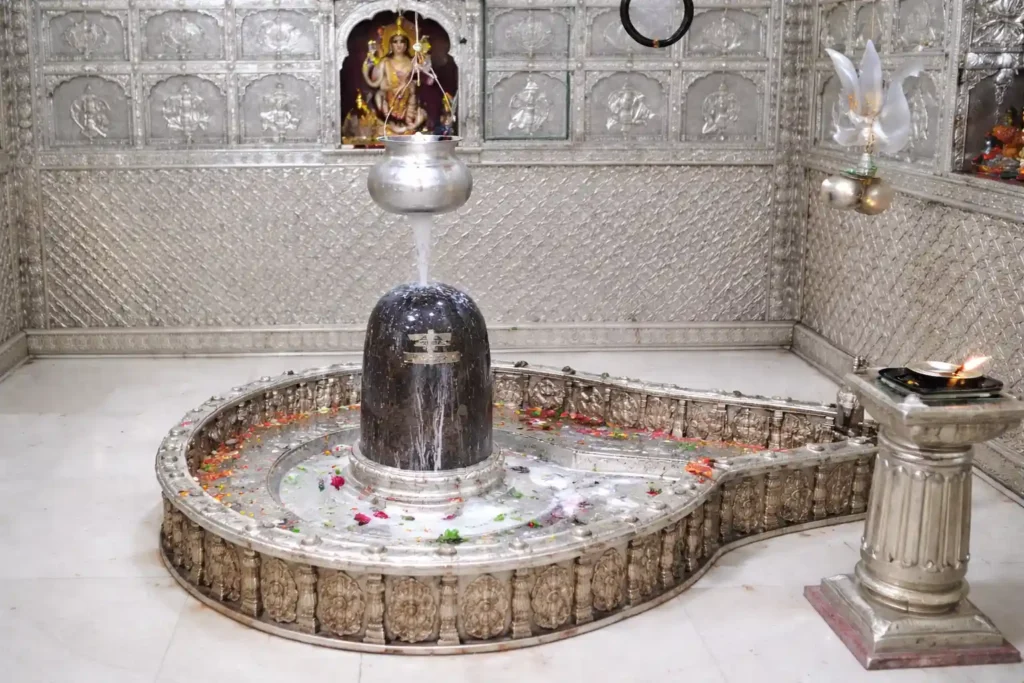
Many devotees begin by offering a simple prayer, lighting a diya, or offering water, flowers, or bilva leaves to a Shiva Lingam.
However, elaborate rituals are not necessary. A sincere prayer from the heart is equally valuable.
Chant with Attention and Devotion
The Shiv Tandav Stotram is known for its powerful rhythm and energetic flow.
While chanting, focus on the meaning of the verses and the divine qualities of Lord Shiva rather than reciting mechanically.
Even if you cannot chant perfectly, devotion and concentration remain the most important aspects.
Start Slowly if You Are New
Beginners do not need to memorize the entire Shiv Tandav Stotram immediately.
You can begin by reading the lyrics while listening to the stotram or by learning a few verses at a time.
With regular practice, pronunciation and confidence naturally improve.
Listening Is Also a Form of Devotion
If chanting the full hymn feels difficult, listening to the Shiv Tandav Stotram with attention and reverence can also be spiritually uplifting.
Many devotees listen to it during meditation, prayer, or quiet reflection on Lord Shiva.
Focus on Meaning Rather Than Perfection
Some people worry about pronunciation mistakes while chanting Sanskrit verses.
While learning correct pronunciation is beneficial, traditional teachings emphasize that sincere devotion matters more than flawless recitation.
A pure heart and genuine faith are considered more important than perfection.
Make It Part of Your Spiritual Routine
Many devotees include the Shiv Tandav Stotram in their daily spiritual practice.
Regular chanting, even for a few minutes, can help cultivate discipline, devotion, and a deeper connection with Lord Shiva over time.
There Are No Rigid Rules
The Shiv Tandav Stotram is ultimately an expression of devotion.
Whether you chant it in the morning, evening, before puja, after meditation, or simply listen to it with faith, the most important element is sincere remembrance of Lord Shiva.
Best Time to Chant Shiv Tandav Stotram
The Shiv Tandav Stotram can be chanted at any time with devotion. Lord Shiva is believed to be easily pleased by sincere prayer, and there is no strict requirement that limits when the stotram may be recited.
However, certain times and occasions are traditionally considered especially auspicious for chanting the Shiv Tandav Stotram.
Early Morning During Brahma Muhurta
Many devotees prefer chanting the Shiv Tandav Stotram during Brahma Muhurta, the sacred period before sunrise.
This time is traditionally associated with spiritual practices because the mind is calm, focused, and less distracted by daily activities.
Chanting during these peaceful hours can help create a devotional and positive start to the day.
During Daily Shiva Worship
The Shiv Tandav Stotram can be recited before or after your regular Shiva Puja.
Many devotees include it as part of their daily worship routine along with mantras such as “Om Namah Shivaya” and offerings of water, flowers, or bilva leaves.
Monday, the Day Dedicated to Lord Shiva
Monday is traditionally regarded as the most auspicious weekday for Shiva worship.
Many devotees chant the Shiv Tandav Stotram on Mondays to express their devotion and seek Lord Shiva’s blessings.
Some also observe fasting and spend extra time in prayer on this day.
During Pradosh Kaal
Pradosh Kaal, the period around sunset on Trayodashi Tithi, holds special significance in Shiva worship.
The Phalashruti of the Shiv Tandav Stotram specifically mentions reciting the hymn during Pradosh as a devotional practice.
Many Shiva temples conduct special prayers and rituals during this sacred time.
During Maha Shivaratri
Maha Shivaratri is one of the most important festivals dedicated to Lord Shiva.
Chanting the Shiv Tandav Stotram during Maha Shivaratri is a popular practice among devotees around the world.
Its powerful verses beautifully complement the spirit of worship, meditation, and devotion associated with the festival.
During Shravan Month
The holy month of Shravan is considered especially sacred for Shiva devotees.
Many people increase their spiritual practices during this period and regularly recite the Shiv Tandav Stotram as part of their devotion.
Temples and homes often resonate with Shiva chants throughout the month.
During Times of Reflection and Prayer
You do not need to wait for a special festival or auspicious day to chant the Shiv Tandav Stotram.
Many devotees turn to the stotram during moments of reflection, gratitude, challenge, or spiritual seeking.
Its verses can provide inspiration, strength, and a sense of connection with Lord Shiva whenever needed.
The Most Important Time Is When Your Heart Is Ready
While traditional timings can enhance devotional practice, the most important factor is sincerity.
Whether you chant the Shiv Tandav Stotram in the morning, evening, during a festival, or as part of personal prayer, genuine devotion and remembrance of Lord Shiva are what truly matter.
Can Beginners Chant Shiv Tandav Stotram?
Absolutely. The Shiv Tandav Stotram can be chanted by beginners as well as experienced devotees. While its Sanskrit verses may appear complex at first, many people begin their journey with this powerful hymn by learning it gradually and focusing on devotion rather than perfection.
You Do Not Need Perfect Pronunciation
Many beginners worry about making mistakes while chanting the Shiv Tandav Stotram. While correct pronunciation is helpful, sincere devotion is considered far more important. Most devotees improve naturally through regular practice, listening, and familiarity with the verses over time.
Start with a Few Verses at a Time
There is no need to learn the entire Shiv Tandav Stotram at once. Begin with one or two verses, understand their meaning, and gradually add more as you become comfortable. This simple approach makes learning the stotram easier and more enjoyable.
Understanding the Meaning Enhances the Experience
The Shiv Tandav Stotram is filled with profound spiritual symbolism and devotional wisdom. Understanding the meaning of the verses helps devotees connect more deeply with Lord Shiva. It also makes chanting more meaningful and inspiring.
Listening Is Also Beneficial
If chanting feels difficult initially, listening to the Shiv Tandav Stotram is also a valuable practice. Many devotees begin by listening regularly before learning the verses themselves. Over time, the rhythm and pronunciation become familiar naturally.
Do Not Be Intimidated by Its Powerful Style
The energetic rhythm and poetic language of the Shiv Tandav Stotram can seem challenging at first. However, the hymn is meant for all devotees, not just advanced practitioners. Faith, sincerity, and devotion matter far more than experience.
Consistency Matters More Than Length
A few minutes of daily practice can be more beneficial than occasional long recitations. Regularly reading, listening to, or chanting the Shiv Tandav Stotram helps build devotion and spiritual discipline. Small, consistent efforts often bring lasting results.
Every Devotee Starts Somewhere
No one learns the Shiv Tandav Stotram overnight. Every devotee begins with a first verse and gradually progresses with patience and practice. Approach the hymn with sincerity, and its spiritual wisdom will unfold naturally over time.
Common Doubts About Shiv Tandav Stotram
Can Women Chant Shiv Tandav Stotram?
Yes. There is no widely accepted scriptural restriction preventing women from chanting the Shiv Tandav Stotram. Devotion and sincerity are considered more important than gender.
Can I Listen to Shiv Tandav Stotram Instead of Chanting It?
Yes. Listening to the Shiv Tandav Stotram with devotion is also a meaningful practice. Many devotees begin by listening before learning to chant it themselves.
What If My Pronunciation Is Not Perfect?
Perfect pronunciation is not required to begin. While correct recitation is beneficial, sincere devotion and regular practice are considered more important.
How Many Times Should I Chant Shiv Tandav Stotram?
There is no fixed rule. Many devotees chant the Shiv Tandav Stotram once daily, while others recite it on Mondays, Pradosh, or special Shiva festivals.
Can Shiv Tandav Stotram Be Chanted Every Day?
Yes. The Shiv Tandav Stotram can be chanted daily as part of regular worship and remembrance of Lord Shiva.
Can Children Chant Shiv Tandav Stotram?
Yes. Children can learn and chant the Shiv Tandav Stotram gradually. Many families introduce Shiva stotras from a young age.
Do I Need Special Rituals Before Chanting?
No elaborate ritual is necessary. A clean place, a calm mind, and devotion to Lord Shiva are generally considered sufficient.
Is It Necessary to Understand the Meaning?
No. However, understanding the meaning of the Shiv Tandav Stotram can help devotees connect more deeply with its spiritual teachings.
Conclusion
The Shiv Tandav Stotram is one of the most powerful hymns dedicated to Lord Shiva. Through its vivid imagery, spiritual symbolism, and devotional depth, it celebrates Shiva’s cosmic dance and timeless wisdom.
Whether you chant the Shiv Tandav Stotram, listen to it, or reflect on its meaning, it can help deepen your connection with Mahadev and inspire inner growth.
If you are new to the Shiv Tandav Stotram, start with a few verses and learn gradually. Sincere devotion and consistency matter far more than perfect pronunciation.
Did You Know?
According to tradition, the Shiv Tandav Stotram was composed by Ravana, the king of Lanka and a devoted follower of Lord Shiva.
Legend says that after Lord Shiva trapped Ravana beneath Mount Kailash, Ravana sang the Shiv Tandav Stotram in praise of Mahadev. Pleased by his devotion, Lord Shiva blessed him.
This story highlights a key message of the Shiv Tandav Stotram: sincere devotion and surrender are valued more than power or pride.
Suggested Reading
If you enjoyed learning about the Shiv Tandav Stotram and Lord Shiva’s deeper spiritual symbolism, you may also enjoy these related articles. They explore Shiva devotion, sacred stotras, spiritual philosophy, temples, and important traditions of Sanatan Dharma in a simple and meaningful way.
Rudrashtakam: Lyrics with Meaning
in Hindi and English, Benefits and How to Chant
https://thesanatantales.com/rudrashtakam-lyrics-with-meaning-hindi-english/
Lingashtakam Meaning, Benefits
& How to Chant (Full Stotram)
https://thesanatantales.com/lingashtakam-meaning-benefits/
Maha Mrityunjaya Mantra: Meaning,
Benefits and How to Chant
https://thesanatantales.com/maha-mrityunjaya-mantra/
Argala Stotra: Lyrics, Meaning,
Benefits, and How to Chant
https://thesanatantales.com/argala-stotra/
Durga Chalisa Lyrics with English
Pronunciation and Hindi Meaning
https://thesanatantales.com/durga-chalisa-lyrics-meaning/
Devi Kavach Meaning: Durga Saptashati
Protection Prayer with English Pronunciation
https://thesanatantales.com/devi-kavach-meaning/
Kamakhya Temple: The Mystery of the Shakti Peetha and Its Connection to Bhairava
https://thesanatantales.com/maa-kamakhya-mandir-rahasya-mahatva/
Shiv Tandav Stotram
https://en.wikipedia.org/wiki/Shiva_Tandava_Stotra (en.wikipedia.org)
FAQs
What is the meaning of Shiv Tandav Stotram?
The Shiv Tandav Stotram is a powerful Sanskrit hymn that praises Lord Shiva in His cosmic dancing form known as Tandava. The word Tandava refers to Shiva’s divine dance, while Stotram means a hymn of praise. Traditionally, the composition is attributed to Ravana, a devoted worshipper of Lord Shiva.
Beyond its poetic beauty, the Shiv Tandav Stotram carries deep spiritual teachings. It speaks about creation, transformation, destruction of ignorance, mastery over ego, and the eternal nature of divine consciousness.
For devotees, the hymn is not only a prayer but also a reminder that change is a natural part of life and that spiritual growth comes through devotion, wisdom, and inner transformation.
Who wrote Shiv Tandav Stotram and why?
According to Hindu tradition, the Shiv Tandav Stotram was composed by Ravana, the king of Lanka and a great devotee of Lord Shiva. The popular legend states that Ravana attempted to lift Mount Kailash, the abode of Shiva. When Lord Shiva pressed the mountain down, Ravana became trapped beneath it.
To seek forgiveness and express his devotion, Ravana sang this powerful hymn praising Shiva’s glory, cosmic dance, and divine attributes. Pleased by his devotion, Lord Shiva eventually blessed him and granted him boons.
Whether viewed as history, tradition, or symbolism, the story highlights an important lesson: sincere devotion can transform pride into humility and bring a devotee closer to the Divine.
What are the benefits of chanting Shiv Tandav Stotram?
According to traditional belief, chanting the Shiv Tandav Stotram helps deepen devotion toward Lord Shiva and encourages spiritual growth. Many devotees recite it to cultivate focus, inner strength, discipline, and a stronger connection with Mahadev.
The rhythmic verses and powerful imagery often help calm the mind and inspire courage during challenging times. Many people find that regular chanting creates a sense of spiritual grounding and emotional balance.
However, these benefits should be understood as devotional and spiritual experiences rather than guaranteed outcomes. The greatest benefit of the Shiv Tandav Stotram is often considered the inner transformation, self-reflection, and devotion it inspires in the heart of the devotee.
Can Shiv Tandav Stotram be chanted daily?
Yes, the Shiv Tandav Stotram can be chanted daily. There is no traditional restriction limiting its recitation to specific days or occasions. Many devotees include it in their morning or evening worship as a regular part of their spiritual practice.
Daily chanting helps create consistency in devotion and keeps the mind connected to the teachings and symbolism of Lord Shiva. Even if someone cannot recite the complete stotram every day, reading a few verses or listening to it with devotion can be meaningful.
The key is regularity and sincerity. A short daily practice performed with faith is often considered more beneficial than occasional recitation without focus or devotion.
What is the best time to chant Shiv Tandav Stotram?
The Shiv Tandav Stotram may be chanted at any time, but certain periods are traditionally considered especially auspicious. Many devotees prefer Brahma Muhurta before sunrise, while others chant it during morning or evening Shiva worship.
Mondays, Pradosh Kaal, Maha Shivaratri, and the sacred month of Shravan are particularly popular times for reciting the stotram. The Phalashruti also mentions chanting it during Pradosh after worship of Lord Shiva.
That said, spiritual traditions generally emphasize devotion over timing. The best time to chant the Shiv Tandav Stotram is whenever you can do so with concentration, reverence, and a sincere remembrance of Lord Shiva.
Can beginners chant Shiv Tandav Stotram?
Absolutely. The Shiv Tandav Stotram is suitable for beginners as well as experienced devotees. Although its Sanskrit pronunciation may seem challenging at first, many people begin by learning a few verses and gradually progress over time.
Beginners can start by reading the transliteration, listening to recitations, and studying the meaning of the verses. Understanding the symbolism and message often makes the learning process easier and more rewarding.
Most spiritual traditions emphasize that devotion is more important than perfection. A sincere effort to connect with Lord Shiva carries greater value than flawless pronunciation. With patience and regular practice, beginners can become comfortable chanting the entire Shiv Tandav Stotram.
Is it necessary to understand the meaning of Shiv Tandav Stotram before chanting?
No, it is not necessary to understand every verse before chanting the Shiv Tandav Stotram. Many devotees begin by reciting or listening to the hymn because they feel drawn to its rhythm, energy, and devotional atmosphere.
However, understanding the meaning can significantly deepen the experience. The stotram contains profound teachings about transformation, detachment, divine consciousness, and spiritual awakening.
When devotees learn the meaning behind symbols such as the Ganga, the third eye, the damaru, and Shiva’s Tandava, the hymn becomes much more than a recitation. It becomes a source of spiritual reflection and personal growth.
Can I listen to Shiv Tandav Stotram instead of chanting it?
Yes. Listening to the Shiv Tandav Stotram with attention and devotion is also considered a meaningful spiritual practice. Many devotees listen to it during meditation, prayer, travel, or moments of quiet reflection.
The powerful rhythm and sacred verses often create a devotional atmosphere that helps focus the mind on Lord Shiva. Listening regularly can also help beginners become familiar with pronunciation and the flow of the hymn.
While chanting actively engages the devotee in the practice, listening with faith and concentration is also a valid way to connect with the spiritual essence of the Shiv Tandav Stotram and deepen one’s devotion to Mahadev.
References & Sources
This article on the Shiv Tandav Stotram is based on traditional Hindu scriptures, Shaivite traditions, Sanskrit stotra literature, and widely accepted devotional interpretations.
Primary Sources
- Shiv Tandav Stotram (Traditional Sanskrit Text)
- Shaivite Commentaries and Oral Traditions
- Puranic References Related to Lord Shiva and Ravana
- Hindu Devotional Literature
Disclaimer
The benefits of chanting the Shiv Tandav Stotram are based on traditional beliefs and devotional practices. They should be understood as spiritual observations rather than guaranteed outcomes.
This article is intended for educational and devotional purposes, helping readers understand the meaning, symbolism, and significance of the Shiv Tandav Stotram within Sanatan Dharma.
Explore More Topics from The Sanatan Tales