Maa Lalita Tripura Sundari is worshipped as one of the most exalted forms of Adi Shakti in Sanatan Dharma. She is not only the goddess of beauty, grace, and compassion, but also the supreme consciousness from which all creation emerges.
At the heart of the Sri Vidya tradition, Maa Lalita Tripura Sundari represents the perfect balance of power and tenderness, wisdom and devotion. She is revered as the Divine Mother who guides seekers toward both worldly harmony and spiritual realization.
Unlike fierce or renunciatory forms of the Goddess, Maa Lalita embodies fullness and completeness. Her presence feels nurturing, sovereign, and deeply reassuring.
Her worship does not begin with fear or austerity. It begins with love, harmony, inner awareness, and the recognition of the divine presence within all life.
Table of Contents
ToggleWho is Maa Lalita Tripura Sundari
Maa Lalita Tripura Sundari is the supreme goddess of the Sri Vidya tradition and one of the most revered forms of Adi Shakti in Sanatan Dharma. The word Lalita means playful, graceful, and effortless, while Tripura Sundari means “the most beautiful one of the three worlds” or the three levels of existence: physical, subtle, and causal.
She is not limited to a single form or image. In Sri Vidya philosophy, Maa Lalita is understood as the supreme consciousness that expresses itself as beauty, harmony, wisdom, and creation. Many Shakta traditions regard her as Adi Parashakti, the primordial divine energy from whom all other forms of the Divine Mother emerge.
Devotees worship Maa Lalita as both a compassionate mother and the highest reality behind the universe. For this reason, she occupies a unique place in the Shakta tradition, where devotion to her is seen as a path toward inner balance, spiritual wisdom, and ultimately self-realization.
Meaning and Symbolism of Tripura Sundari
Tripura Sundari symbolizes beauty, balance, and completeness. Her beauty is not limited to physical appearance. It represents the perfect harmony of wisdom, compassion, power, and inner awareness. This is why devotees see her as the embodiment of both divine grace and spiritual perfection.
The name Tripura refers to the three worlds as well as the three states of human experience: waking, dreaming, and deep sleep. Maa Lalita is believed to govern all these states while also transcending them as pure consciousness. Her symbolism reminds seekers that the divine is present in every aspect of existence.
One of the most profound teachings associated with Maa Lalita Tripura Sundari is that spiritual realization does not require rejecting the world. Instead, it comes from understanding life deeply and recognizing the sacred presence within it. This is why her worship feels gentle, fulfilling, and inwardly transformative.
Symbolism of Maa Lalita's Four Divine Weapons
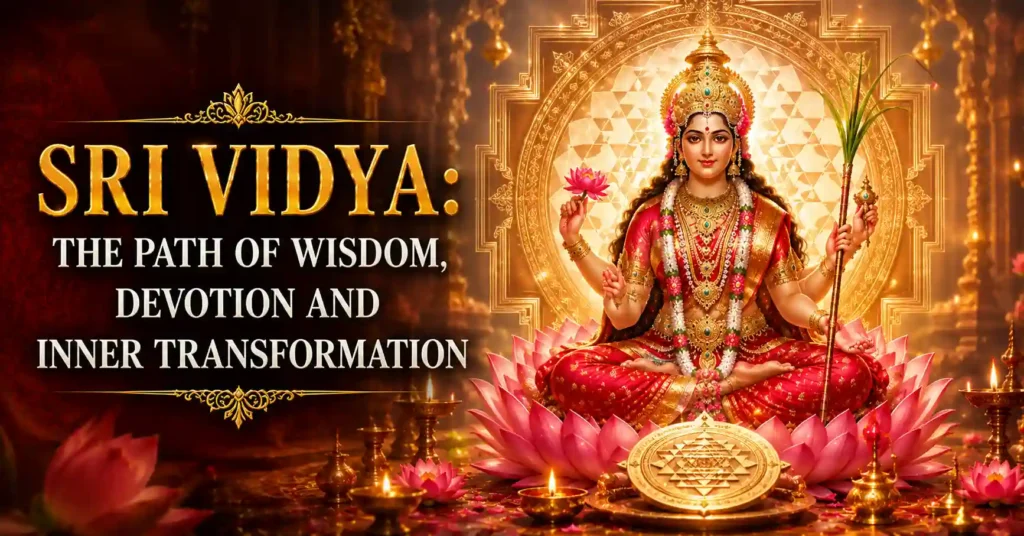
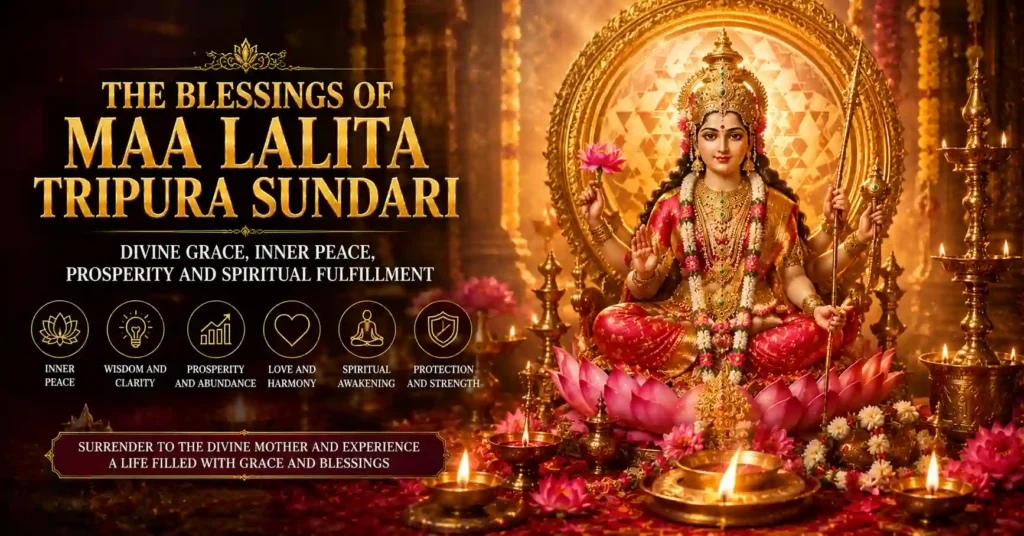
The iconography of Maa Lalita Tripura Sundari carries deep spiritual meaning. She is often depicted holding a sugarcane bow, five flower arrows, a noose, and a goad.
The sugarcane bow symbolizes the mind, while the five flower arrows represent the five senses through which we experience the world. The noose signifies love, attachment, and the power that draws devotees toward the Divine Mother.
The goad represents guidance, discipline, and the force that removes ignorance and directs the seeker toward spiritual growth.
Together, these four symbols teach that true transformation comes not through force, but through mastery of the mind, senses, and inner awareness.
Story of Maa Lalita in Sanatan tradition
The most celebrated story of Maa Lalita Tripura Sundari appears in the Lalitopakhyana, a sacred narrative found within the Brahmanda Purana.
This text describes her as the supreme Divine Mother who manifests whenever cosmic balance is disturbed and spiritual harmony is threatened.
At the heart of this tradition is the story of Bhandasura, a powerful demon whose rise brought suffering to the worlds and challenged the gods themselves. Unable to overcome him, the gods turned to the Divine Mother for help.
The events that followed became one of the most important and revered narratives in the Sri Vidya tradition, carrying both mythological and spiritual significance.
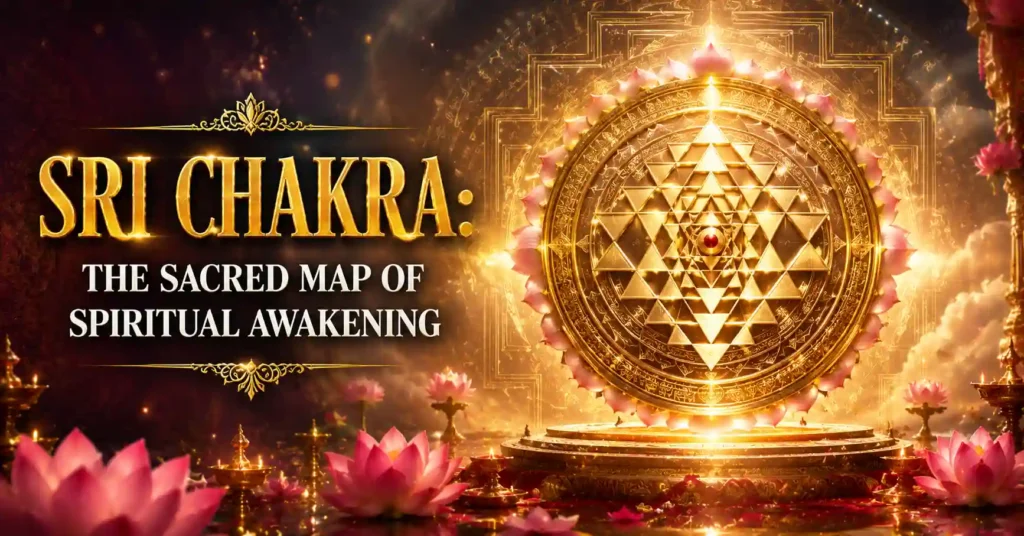
The Battle with Bhandasura and the Deeper Symbolism
According to the Lalitopakhyana, Bhandasura was born from the ashes of Kama Deva after Shiva reduced him to ashes with the fire of his third eye.
Through intense austerities and spiritual power, Bhandasura gained immense strength and eventually began disturbing the balance of the universe. The gods found themselves unable to defeat him and sought refuge in the Divine Mother.
In response, Maa Lalita Tripura Sundari manifested in her radiant form and appeared seated upon the divine Sri Chakra. Surrounded by celestial attendants, divine energies, and a vast spiritual army, she led the forces of righteousness against Bhandasura and his followers. After a great cosmic battle, she destroyed the demon and restored harmony to creation.
Beyond its mythological setting, this story carries a profound spiritual message. Many teachers interpret Bhandasura as a symbol of ego, ignorance, attachment, and the misuse of power.
Maa Lalita’s victory represents the triumph of wisdom, awareness, and divine grace over these inner obstacles. Her celestial army symbolizes the qualities that support spiritual growth, including devotion, discipline, discrimination, and self-awareness.
For devotees, the battle is not only a sacred legend but also a reminder that true transformation begins within. When ego and ignorance are overcome, harmony naturally returns, allowing the seeker’s inner consciousness to reflect the beauty and completeness represented by Maa Lalita Tripura Sundari.
Lalita Sahasranama and its Spiritual Meaning
Lalita Sahasranama is one of the most revered hymns in Sanatan Dharma and holds a central place in the worship of Maa Lalita Tripura Sundari.
Found within the Brahmanda Purana, it consists of a thousand sacred names that describe different aspects of the Divine Mother, revealing profound truths about consciousness, creation, compassion, and spiritual realization.
Unlike prayers that focus primarily on removing difficulties, Lalita Sahasranama is often viewed as a path of inner refinement. Devotees believe that regular recitation gradually calms the mind, deepens devotion, and expands spiritual understanding. Each name is regarded as a meditation on a particular quality of the Divine Mother.
For followers of Sri Vidya, Lalita Sahasranama is much more than a hymn. It is a spiritual guide that helps transform devotion into wisdom and brings the seeker closer to the presence of Maa Lalita Tripura Sundari.
Sri Yantra and Maa Lalita’s Divine Presence
Sri Yantra, also known as Sri Chakra, is one of the most sacred symbols in the Sri Vidya tradition and is regarded as the visual form of Maa Lalita Tripura Sundari herself.
It is composed of interlocking triangles, lotus circles, and sacred geometric patterns that symbolize the entire universe as well as the inner journey of spiritual awakening.
At the center of the Sri Yantra lies the bindu, the point of ultimate stillness and unity. In Sri Vidya philosophy, Maa Lalita is believed to reside in this bindu as pure consciousness, beyond all duality and limitation.
The movement from the outer layers of the Sri Chakra toward the central bindu represents the seeker’s journey from worldly awareness to spiritual realization.
For devotees, meditation on the Sri Yantra is not simply the contemplation of a geometric design. It is a sacred practice that encourages balance, harmony, self-awareness, and a deeper connection with the Divine Mother.
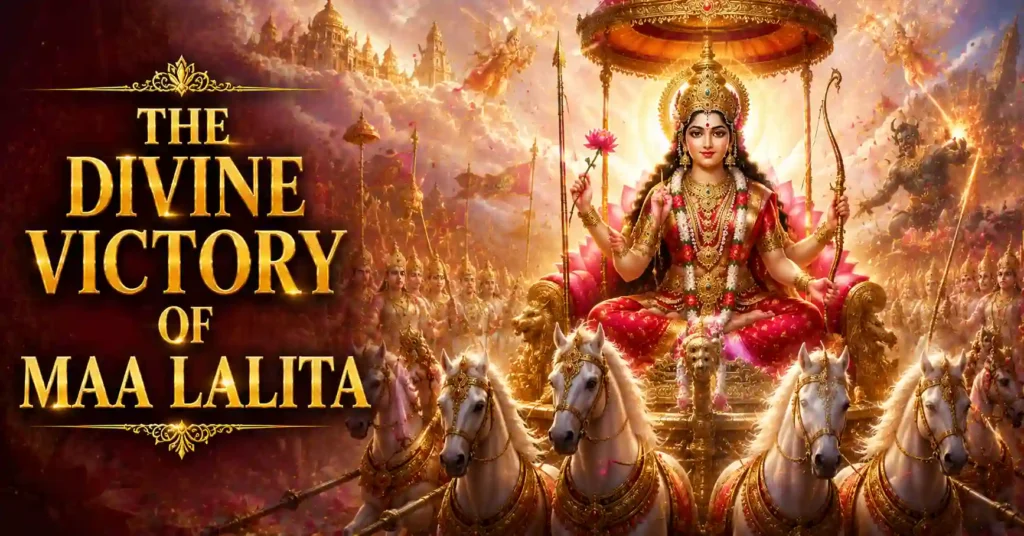
Understanding Sri Chakra and the Navavarana
Sri Chakra, also known as Sri Yantra, is considered the sacred geometric representation of Maa Lalita Tripura Sundari. The terms Sri Chakra and Sri Yantra are often used interchangeably, though Sri Chakra traditionally refers to the complete sacred diagram while Sri Yantra commonly refers to its visual geometric form.
It consists of interlocking triangles, lotus circles, and enclosures that symbolize the entire universe as well as the inner journey of spiritual awakening.
Traditional Sri Vidya teachings describe nine sacred enclosures known as the Navavarana. These represent progressive stages of spiritual realization. As the seeker moves inward through these symbolic layers, awareness gradually shifts from the external world toward the central bindu, the point where all duality dissolves.
For devotees, the Sri Chakra is not merely a diagram. It is understood as a living expression of the Divine Mother herself and a map of the soul’s journey toward union with the supreme consciousness.
Sri Vidya Sadhana Explained Simply
Sri Vidya is often misunderstood as secret or difficult. In reality, it is one of the most refined spiritual traditions within the Shakta path. It teaches seekers to recognize the divine presence in every aspect of life, including the body, mind, emotions, and the world around them.
Sri Vidya sadhana begins with devotion and gradually deepens through mantra japa, meditation, worship of the Sri Chakra, self-discipline, and ethical living. Maa Lalita Tripura Sundari is both the central deity and the ultimate goal of this path, guiding devotees toward greater wisdom, inner harmony, and spiritual realization.
For householders, Sri Vidya is not a path of renunciation. It teaches that worldly responsibilities and spiritual growth can exist together. Through balanced living, devotion, and self-awareness, everyday life itself becomes part of the spiritual journey.
Panchadashi Mantra and the Heart of Sri Vidya
Among the many sacred practices associated with Sri Vidya, the Panchadashi Mantra holds a special place. This fifteen-syllable mantra is traditionally regarded as one of the most important mantras dedicated to Maa Lalita Tripura Sundari and occupies a central position within the Sri Vidya tradition.
Because Sri Vidya follows a lineage-based path, the Panchadashi Mantra is generally received through proper initiation from a qualified guru. For this reason, traditional texts and teachers discuss its significance openly while preserving the mantra itself within the framework of initiation and guidance.
Devotees believe that the Panchadashi Mantra helps purify the mind, deepen devotion, and strengthen awareness of the Divine Mother’s presence. In Sri Vidya philosophy, it is regarded not merely as a sacred sound but as a spiritual means of drawing closer to Maa Lalita Tripura Sundari and progressing toward inner realization.
Difference between Kali, Tara and Lalita
Kali, Tara, and Lalita are among the most revered forms of the Divine Mother, each representing a distinct aspect of spiritual transformation. Kali symbolizes the destruction of ego, attachment, and limitation.
Tara is the compassionate guide who helps seekers cross fear, uncertainty, and ignorance. Lalita represents the state of harmony, fulfillment, and spiritual completeness that emerges after inner transformation.
These forms are not seen as opposing forces but as complementary expressions of the same Divine Mother. In many spiritual interpretations, they reflect different stages of the seeker’s journey. Kali removes obstacles, Tara guides and protects, and Lalita reveals the beauty and fullness of awakened consciousness.
For this reason, Maa Lalita Tripura Sundari is often described as the crown of the Mahavidya tradition, representing the highest state of balance where wisdom, devotion, beauty, and divine awareness exist in perfect harmony.
Why Maa Lalita is Called Shodashi Mahavidya
Within the Das Mahavidya tradition, Maa Lalita Tripura Sundari is often identified with Shodashi, the third Mahavidya. The name Shodashi means “the sixteen-year-old goddess,” symbolizing eternal fullness, beauty, and spiritual perfection rather than physical age.
While Kali represents transcendence beyond time and Tara guides seekers across fear and uncertainty, Shodashi represents the state of complete spiritual fulfillment. In many Shakta traditions, she is regarded as the most refined expression of divine consciousness, where power and beauty exist in perfect balance.
Because of this, devotees often view Maa Lalita Tripura Sundari as the crown jewel of the Mahavidya tradition, representing the highest state of harmony between devotion, wisdom, and inner realization.
Major Temples of Maa Lalita Tripura Sundari in India
Temples dedicated to Maa Lalita Tripura Sundari can be found across India, particularly in regions with strong Shakta and Sri Vidya traditions.
Some important centers of worship include the Tripura Sundari Temple in Udaipur, Tripura, one of the most revered Shakti Peethas in India, as well as Sri Vidya centers and temples dedicated to Rajarajeshwari and Lalita Tripura Sundari across Tamil Nadu, Karnataka, Andhra Pradesh, and Telangana.
These sacred places continue to preserve ancient traditions of mantra, yantra, and devotional worship.
Although temple traditions vary from region to region, many emphasize worship through mantra, yantra, and meditative devotion rather than elaborate public display.
In some places, devotees focus on Lalita Sahasranama recitation, while in others Sri Chakra worship forms the heart of daily rituals.
Pilgrims often describe these temples as places of serenity and inward reflection. The emphasis is usually on spiritual refinement and devotion rather than seeking material rewards alone.
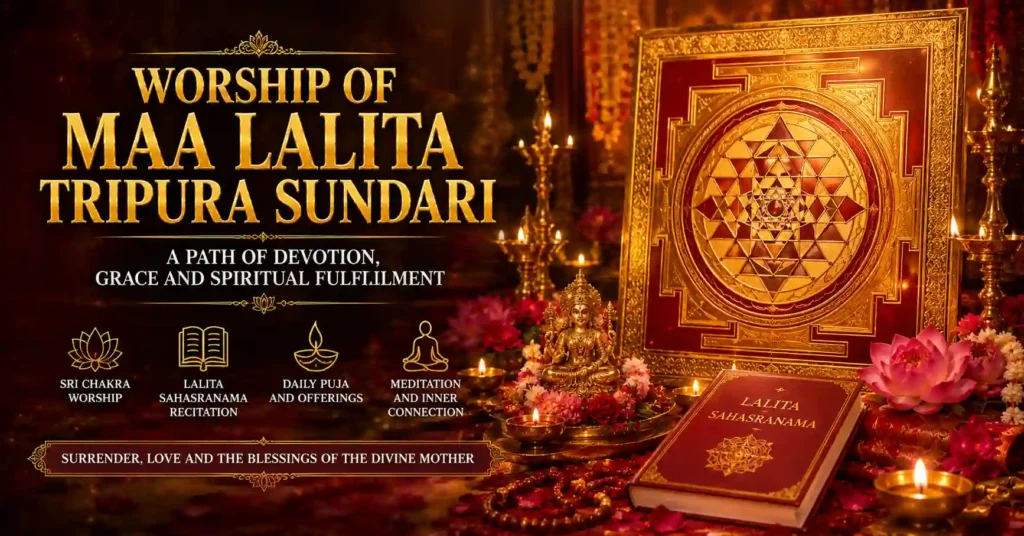
Living Traditions of Sri Vidya Worship
For many devotees, the worship of Maa Lalita Tripura Sundari is not limited to temples or special occasions. Daily remembrance through Lalita Sahasranama, meditation on the Sri Chakra, simple prayers, and devotional chanting forms an important part of their spiritual life.
In traditional Sri Vidya households, Friday worship, Navaratri observances, and special recitations dedicated to the Divine Mother remain cherished practices. While advanced rituals may require guidance from a guru, simple devotion and sincere remembrance are considered accessible to everyone.
Many devotees describe this path as gentle yet transformative. Rather than seeking dramatic experiences, they often speak of greater inner peace, clarity, emotional balance, and a deeper sense of connection with the Divine Mother.
This living tradition continues to flourish across India, preserving a path that combines devotion, wisdom, discipline, and inner transformation.
How Devotees Experience Maa Lalita’s Worship
Devotees of Maa Lalita Tripura Sundari often describe her presence as gentle, soothing, and deeply reassuring. Rather than dramatic experiences, her worship is associated with emotional balance, inner confidence, clarity of thought, and a growing sense of harmony in daily life.
Many believe that regular remembrance of the Divine Mother gradually changes how they respond to challenges and relationships. Fear begins to lessen, awareness deepens, and devotion arises naturally from the heart rather than from obligation or ritual alone.
This quiet inner transformation is regarded by many devotees as one of the greatest blessings of Maa Lalita Tripura Sundari, reflecting her role as both a compassionate mother and a guide on the path of spiritual growth.
Why Maa Lalita is Worshipped as Supreme Shakti
Maa Lalita is worshipped as supreme Shakti because she represents the complete expression of divine consciousness in the Sri Vidya tradition. In her, devotees see power without aggression, beauty without attachment, wisdom without pride, and authority without ego.
Shakta traditions regard her as the source from which all forms of the Divine Mother emerge and ultimately return. For this reason, she is often viewed not simply as a goddess among many, but as the supreme reality that sustains creation, preservation, and transformation.
Her teachings do not reject the world or encourage withdrawal from life. Instead, they show how spiritual wisdom can bring greater harmony, balance, and awareness into everyday living. This is why Maa Lalita Tripura Sundari continues to be revered as one of the highest expressions of Adi Shakti.
Scriptural Tradition and Regional Beliefs
The understanding of Maa Lalita Tripura Sundari varies across traditions. Scriptural sources such as the Brahmanda Purana and Sri Vidya texts present her as the supreme form of divine consciousness and the central deity of Sri Chakra worship.
Regional traditions may emphasize different aspects of her personality, local legends, or temple-specific practices. Some communities focus on her role as a compassionate mother, while others emphasize her identity as the supreme cosmic power.
Recognizing these differences helps devotees appreciate the richness of Sanatan Dharma. Scripture, temple traditions, and regional practices often complement one another while preserving the same underlying reverence for the Divine Mother.
Conclusion: Maa Lalita as The Path of Inner Fullness
Maa Lalita Tripura Sundari is not worshipped to escape life, but to understand it more deeply. As the central deity of Sri Vidya and one of the most revered forms of Adi Shakti, she represents the union of beauty, wisdom, compassion, and divine awareness. Her path begins with devotion and gradually leads the seeker toward inner harmony and spiritual realization.
In today’s restless world, Maa Lalita Tripura Sundari offers balance rather than withdrawal. Through her teachings and worship, devotion slowly matures into awareness, and everyday life itself begins to feel sacred.
If you wish to explore further, you may read our guides on Sri Vidya sadhana, Lalita Sahasranama, Sri Chakra symbolism, and other forms of Shakti on thesanatantales.com. Together, these articles offer a deeper understanding of the rich spiritual tradition associated with Maa Lalita Tripura Sundari.
Suggested Reading
Maa Lalita Tripura Sundari stands at the heart of the Sri Vidya tradition and is deeply connected with the Das Mahavidya, Shakta philosophy, and the worship of the Divine Mother in her many forms. To deepen your understanding of these sacred traditions, you may also explore the following articles:
Das Mahavidya: Meaning, Origin, 10 Goddesses, Temples and Spiritual Path
https://thesanatantales.com/das-mahavidya/
Maa Kali: Origin, Story, Meaning, Power and the Truth Behind Her Fierce Form
https://thesanatantales.com/maa-kali-origin-story-meaning-power/
Maa Tara: Meaning, Story, Benefits and Spiritual Significance
https://thesanatantales.com/maa-tara-meaning-story-benefits/
Maa Bhuvaneshwari: The Mahavidya Who Holds the Universe
https://thesanatantales.com/maa-bhuvaneshwari/
Maa Bhairavi: The Mahavidya of Fire, Discipline, and Inner Awakening
https://thesanatantales.com/maa-bhairavi/
Maa Chhinnamasta: The Goddess Who Cuts the Ego and Feeds the Universe
https://thesanatantales.com/maa-chhinnamasta/
Maa Dhumavati Mahavidya: Hidden Power, Meaning, Tantra & Worship
https://thesanatantales.com/maa-dhumavati-mahavidya/
Maa Baglamukhi: Origin, Power, Rituals, Temples and the Brahmastra Shakti
https://thesanatantales.com/maa-baglamukhi-origin-puja-temples/
Maa Matangi: The Powerful Ninth Mahavidya and the Tantric Power of Speech
https://thesanatantales.com/maa-matangi-ninth-mahavidya/
Maa Kamalatmika: The Final Mahavidya and the Goddess of Sacred Abundance
https://thesanatantales.com/maa-kamalatmika-tenth-mahavidya/
Tripura Sundari (Wikipedia)
https://en.wikipedia.org/wiki/Tripura_Sundari
FAQs
Is Maa Lalita and Tripura Sundari the same?
Yes. Lalita is her name, while Tripura Sundari refers to her nature as the Divine Mother who transcends and governs the three worlds and all states of existence.
Is Maa Lalita part of the Das Mahavidya?
Yes. In many Shakta traditions, Maa Lalita Tripura Sundari is identified with Shodashi, the third Mahavidya. She represents spiritual perfection, beauty, wisdom, and divine fullness.
Why is Maa Lalita called Tripura Sundari?
The name Tripura Sundari means “the most beautiful one of the three worlds.” It also symbolizes the Divine Mother who transcends the physical, subtle, and causal realms of existence.
Can beginners worship Maa Lalita Tripura Sundari?
Yes. Simple prayers, devotional chanting, and the recitation of Lalita Sahasranama are widely practiced by devotees. More advanced Sri Vidya practices traditionally require guidance from a qualified guru.
Can householders worship Maa Lalita Tripura Sundari?
Yes. Sri Vidya has a long tradition among householders. The path teaches that spiritual growth and worldly responsibilities can exist together in a balanced and harmonious way.
Is Sri Vidya sadhana dangerous or secret?
Sri Vidya is a respected spiritual tradition, not something dangerous. While certain advanced practices are traditionally taught through initiation, devotion to Maa Lalita, prayer, and Lalita Sahasranama are accessible to sincere devotees.
Can beginners chant Lalita Sahasranama?
Yes. Many devotees recite Lalita Sahasranama regularly as part of their daily worship. It is regarded as a powerful hymn that deepens devotion and spiritual understanding.
What is the connection between Maa Lalita and Sri Chakra?
Sri Chakra, also known as Sri Yantra, is considered the sacred geometric representation of Maa Lalita Tripura Sundari. It symbolizes both the universe and the soul’s journey toward spiritual realization.
Which scripture describes Maa Lalita Tripura Sundari?
The most famous account of Maa Lalita appears in the Lalitopakhyana, a sacred narrative found within the Brahmanda Purana.
Why is Maa Lalita worshipped as supreme Shakti?
Many Shakta traditions regard Maa Lalita Tripura Sundari as the complete expression of Adi Shakti. She embodies wisdom, compassion, beauty, power, and the supreme consciousness that sustains the universe.
Glossary of Important Terms
| Term | Meaning |
|---|---|
| Maa Lalita Tripura Sundari | A supreme form of Adi Shakti and the central goddess of the Sri Vidya tradition. |
| Lalita | Sanskrit word meaning graceful, playful, and effortless Divine Mother. |
| Tripura Sundari | “The Beauty of the Three Worlds,” representing supreme beauty, wisdom, and consciousness. |
| Adi Shakti | The primordial divine feminine energy from which all creation emerges. |
| Adi Parashakti | The highest and ultimate form of Divine Mother worshipped as the source of all goddesses. |
| Sri Vidya | A sacred Shakta spiritual tradition centered on the worship of Maa Lalita Tripura Sundari. |
| Shakta Tradition | A branch of Sanatan Dharma that worships the Divine Mother as the Supreme Reality. |
| Mahavidya | One of the ten great wisdom goddesses representing different aspects of Divine Feminine power. |
| Das Mahavidya | The collective group of ten Mahavidyas in Shakta traditions. |
| Shodashi | The third Mahavidya, identified with Maa Lalita Tripura Sundari, symbolizing perfection and fullness. |
| Sri Chakra | The sacred geometric diagram representing Maa Lalita and the structure of the universe. |
| Sri Yantra | Another name for Sri Chakra, used in meditation and worship within Sri Vidya. |
| Navavarana | The nine sacred enclosures of the Sri Chakra representing stages of spiritual realization. |
| Bindu | The central point of the Sri Chakra symbolizing ultimate unity and pure consciousness. |
| Lalita Sahasranama | A revered hymn containing one thousand names of Maa Lalita Tripura Sundari. |
| Lalitopakhyana | A sacred narrative in the Brahmanda Purana describing Maa Lalita’s divine exploits. |
| Brahmanda Purana | An important Hindu scripture containing the Lalitopakhyana and Lalita Sahasranama. |
| Bhandasura | A demon defeated by Maa Lalita, symbolizing ego, ignorance, and spiritual obstacles. |
| Kama Deva | The god of love whose ashes are linked to the birth of Bhandasura. |
| Consciousness | Pure awareness that exists beyond mind, body, and emotions. |
| Self-Realization | Direct experience of one’s true spiritual nature. |
| Spiritual Awakening | The process of becoming aware of higher spiritual truths. |
| Panchadashi Mantra | The sacred fifteen-syllable mantra at the heart of the Sri Vidya tradition. |
| Mantra Japa | The spiritual practice of repeating a sacred mantra with devotion and concentration. |
| Guru | A spiritual teacher who guides seekers on the path of realization. |
| Initiation (Diksha) | The formal transmission of spiritual teachings or mantras from a guru. |
| Sugarcane Bow | One of Maa Lalita’s weapons representing the human mind. |
| Five Flower Arrows | Symbols of the five senses and their influence on perception. |
| Noose (Pasha) | Symbolizes attraction, divine love, and the power that draws devotees toward the Divine. |
| Goad (Ankusha) | Represents spiritual discipline, guidance, and the removal of ignorance. |
| Divine Grace | The compassionate blessing of the Divine Mother that supports spiritual growth. |
| Harmony | A central teaching of Maa Lalita representing balance in spiritual and worldly life. |
| Shakti | The divine feminine energy that creates, sustains, and transforms the universe. |
| Divine Mother | The supreme feminine aspect of the Divine worshipped in various forms. |
| Rajarajeshwari | A royal and sovereign form of the Divine Mother often identified with Maa Lalita. |
| Shakti Peetha | A sacred pilgrimage site associated with the Divine Mother. |
| Devotion (Bhakti) | Loving worship and surrender to the Divine. |
| Spiritual Fulfillment | A state of inner completeness, contentment, and divine awareness. |
| Cosmic Balance | The harmony of creation maintained through divine wisdom and power. |
About the Author
Yateendra Chaturvedi is a spiritual writer, researcher, devotee, and the founder of The Sanatan Tales. With over 35 years of professional experience and a lifelong interest in Sanatan Dharma, he writes about Hindu deities, temples, scriptures, festivals, Mahavidyas, sacred stories, rituals, and living traditions that continue to guide and inspire devotees across India.
Drawing from traditional scriptures, regional beliefs, temple traditions, devotional literature, and historical sources, he aims to present authentic, well-researched, and easy-to-understand content for modern readers. His work focuses on preserving spiritual wisdom, explaining sacred traditions, and helping seekers develop a deeper understanding of India’s rich spiritual heritage.
Through The Sanatan Tales, Yateendra strives to make the timeless teachings of Sanatan Dharma simple, meaningful, and relevant for today’s generation while maintaining respect for traditional sources, regional practices, and diverse spiritual perspectives.
Learn More About Yateendra Chaturvedi →
https://thesanatantales.com/about-the-author/
References & Sources
This article is based on beliefs and traditions followed within the Shakta traditions of Sanatan Dharma, traditional knowledge associated with the Dashamahavidya tradition, Shakti worship, Devi sadhana, and insights drawn from various spiritual and religious study sources.
Some concepts discussed in this article are also inspired by teachings and interpretations preserved through the guru-disciple tradition.
Note: Beliefs, interpretations, and spiritual practices may vary across different traditions, sects, and paths within Sanatan Dharma. The purpose of this article is not to present any single viewpoint as the absolute truth, but to explain widely accepted religious and spiritual perspectives in a simple and accessible manner.
Explore More Fascinating Topics from Sanatan Dharma