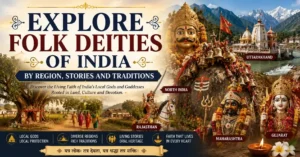
Folk Deities of India are living gods and goddesses deeply connected to the land, local communities, and centuries-old traditions. Worshipped in villages, forests, hills, sacred groves, and family shrines, these regional deities represent the everyday spiritual life of Sanatan Dharma and continue to inspire devotion across the country.
Unlike classical Puranic deities whose stories are preserved in scriptures, Folk Deities of India are remembered through oral traditions, folk songs, local legends, village customs, and annual festivals. Often known as Gram Devta, Lok Devta, or village deities, they are not separate from Sanatan Dharma but are living expressions of faith rooted in local culture and community life.
This pillar guide explains the meaning, characteristics, and importance of folk deities, how they differ from classical Hindu gods, and their connection with Shiva, Shakti, Vishnu, nature worship, and regional traditions. It also explores how these guardian deities continue to protect communities, preserve cultural heritage, and keep India’s living spiritual traditions alive.
Along the way, you’ll discover representative examples from different parts of India and understand why Folk Deities of India remain an essential part of the country’s spiritual and cultural identity.
Quick Facts: Folk Deities of India
| Aspect | Details |
|---|---|
| Meaning | Local and regional gods and goddesses worshipped by specific communities across India. |
| Also Known As | Gram Devta, Gram Devi, Lok Devta, Gramadevata, Desa Devata, Village Deities |
| Primary Role | Protection of villages, families, crops, forests, livestock, and local communities |
| Associated With | Sanatan Dharma, regional traditions, oral heritage, nature worship |
| Common Places of Worship | Village shrines, sacred groves, temples, forests, hills, riverbanks, family shrines |
| Major Forms | Village guardian deities, Kul Devta/Kul Devi, hero deities, nature deities, regional manifestations of Shiva, Shakti, and Vishnu |
| Main Festivals | Jatras, Melas, village fairs, seasonal festivals, community celebrations |
| Examples | Khandoba, Khatu Shyam Baba, Nanda Devi, Golu Devta, Ayyanar, Karuppasamy |
| Significance | Preserves regional culture, oral traditions, community identity, and living expressions of Sanatan Dharma |
Table of Contents
ToggleTypes of Folk Deities in India
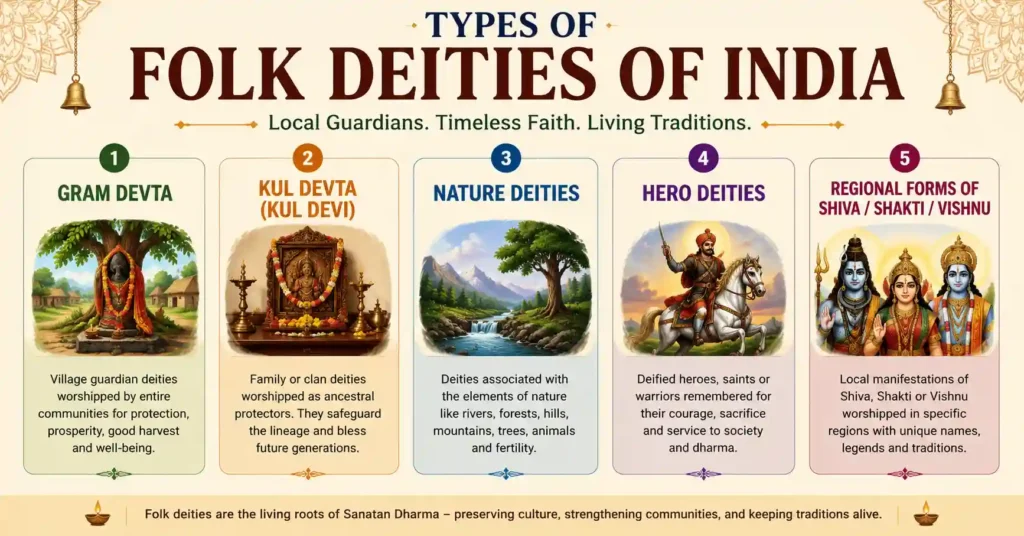
Not all Folk Deities of India serve the same purpose. Across different regions, communities worship different kinds of local gods and goddesses based on their history, geography, occupations, and cultural traditions. While the names and rituals may vary, most folk deities can be grouped into a few broad categories.
- Village Guardian Deities (Gram Devta / Gram Devi): Protect villages, crops, livestock, water sources, and the well-being of the community.
- Kul Devta and Kul Devi: Ancestral family deities worshipped by specific clans or lineages for blessings, protection, and continuity of family traditions.
- Nature Deities: Sacred rivers, mountains, forests, trees, springs, and other natural sites revered as divine protectors or manifestations of sacred power.
- Hero Deities: Historical warriors, saints, kings, or local heroes who came to be worshipped for their courage, sacrifice, or service to society.
- Regional Manifestations of Hindu Deities: Local forms of Shiva, Shakti, Vishnu, Bhairava, or other Hindu gods that have developed unique regional traditions while remaining part of Sanatan Dharma.
Although these categories often overlap, they demonstrate the remarkable diversity of Folk Deities of India and explain why local traditions differ from one region to another while sharing common spiritual values.
What Are Folk Deities of India?
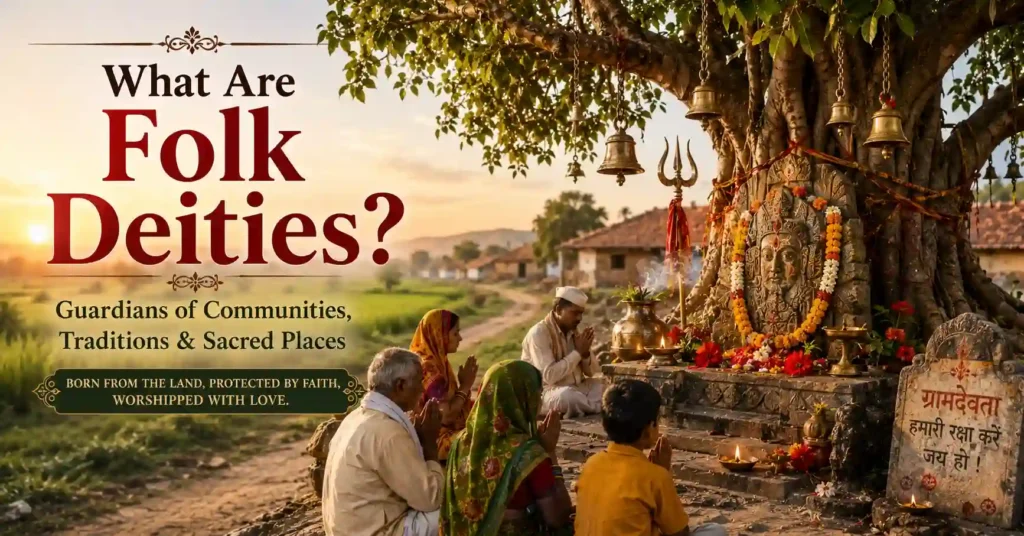
Folk Deities of India are local gods and goddesses worshipped by specific villages, regions, communities, or families. Often known as Gram Devta, Gramadevata, Lok Devta, or Desa Devata, they are regarded as protectors who safeguard people, land, livestock, forests, rivers, and local traditions.
Unlike deities whose stories are primarily preserved in scriptures, many folk gods and goddesses are remembered through oral traditions, folk songs, legends, village festivals, and rituals passed down from one generation to the next. Their stories continue to live in the collective memory of the communities that worship them.
These deities take many forms. Some are revered as heroic ancestors, village guardians, nature spirits, warrior protectors, or compassionate mother goddesses. Others are worshipped as local manifestations of Shiva, Shakti, Vishnu, or other Hindu deities, reflecting the inclusive nature of Sanatan Dharma.
The worship of folk deities is closely connected with everyday life. Devotees seek their blessings for good harvests, protection from natural calamities, family well-being, justice, health, rainfall, and the prosperity of the entire community. Annual jatras, village fairs, vows, and traditional ceremonies strengthen this sacred bond between the deity and the people.
Although many Folk Deities of India have no written scriptures, their traditions have survived for centuries through faith, lived experiences, and community participation. This living heritage continues to preserve India’s regional cultures while enriching the broader spiritual traditions of Sanatan Dharma.
How Folk Deities of India Differ from Classical Hindu Gods
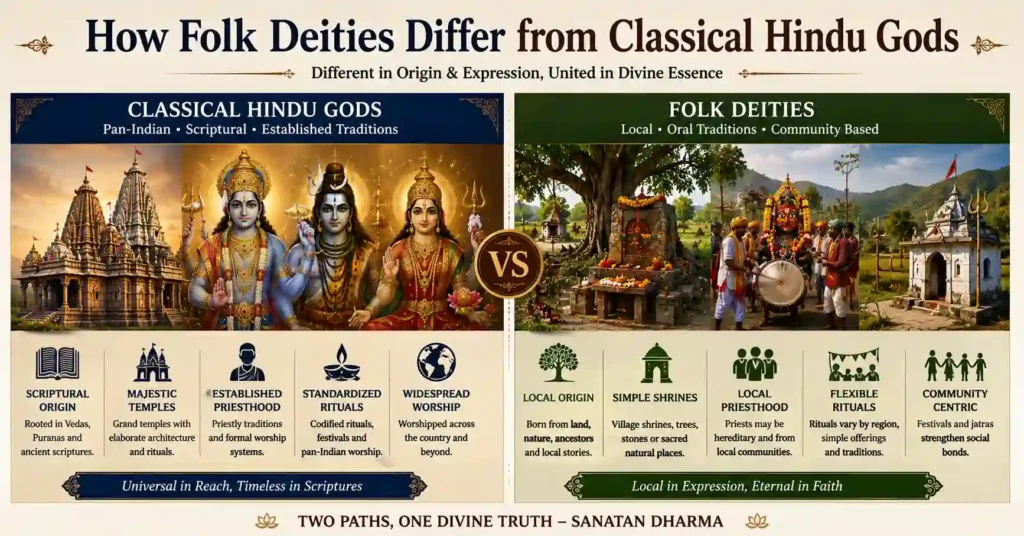
The difference between Folk Deities of India and classical Hindu gods is not one of importance but of origin, scope, and tradition. Both are integral to Sanatan Dharma and have evolved together over centuries, serving different spiritual and cultural needs.
| Aspect | Folk Deities of India | Classical Hindu Gods |
|---|---|---|
| Origin | Rooted in local history, oral traditions, and community beliefs | Described primarily in the Vedas, Puranas, Itihasas, and other Hindu scriptures |
| Scope of Worship | Worshipped mainly by specific villages, regions, clans, or communities | Revered across India and by Hindus worldwide |
| Places of Worship | Village shrines, sacred groves, hilltops, forests, family temples, and local sanctuaries | Established temples, pilgrimage centres, and sacred sites |
| Mode of Worship | Community-led rituals, vows, folk songs, jatras, melas, and seasonal festivals | Temple rituals, pujas, yajnas, festivals, and scriptural traditions |
| Primary Role | Protection of villages, families, crops, livestock, justice, and local well-being | Spiritual guidance, dharma, liberation (moksha), and universal cosmic functions |
| Tradition | Preserved through oral traditions, local customs, and community practices | Preserved through sacred scriptures, philosophical texts, and established religious traditions |
| Relationship with Sanatan Dharma | Local expressions of Sanatan Dharma that complement mainstream Hindu worship | Universal deities forming the core of Hindu philosophy and worship |
Classical deities such as Shiva, Vishnu, Devi, Ganesha, and Hanuman are worshipped across India. Their stories are preserved in sacred texts like the Vedas, Puranas, Ramayana, and Mahabharata, and their temples often follow established rituals and priestly traditions.
In contrast, folk gods and goddesses arise from the history, geography, and collective memory of a particular village, region, or community. A sacred hill, ancient tree, riverbank, battlefield, or forest may become the abode of a revered Gram Devta or guardian deity whose worship reflects local beliefs and traditions.
Their forms of worship are equally distinctive. Rituals are often simple and community-led, with offerings, vows, annual jatras, village fairs, and seasonal festivals playing a central role. In many regions, hereditary priests or respected community elders conduct these ceremonies, preserving customs that have been passed down for generations.
Over time, some Folk Deities of India become identified with major Hindu deities such as Shiva, Shakti, or Vishnu, while others continue to be worshipped primarily within their local communities. This natural blending reflects the inclusive and evolving character of Sanatan Dharma.
Rather than existing in opposition, classical and folk traditions complement one another. Together, they demonstrate how Sanatan Dharma embraces both universal spiritual ideals and deeply rooted local expressions of faith, allowing diverse traditions to flourish while remaining connected to a shared spiritual heritage.
Folk Deities as Protectors of Land and Community
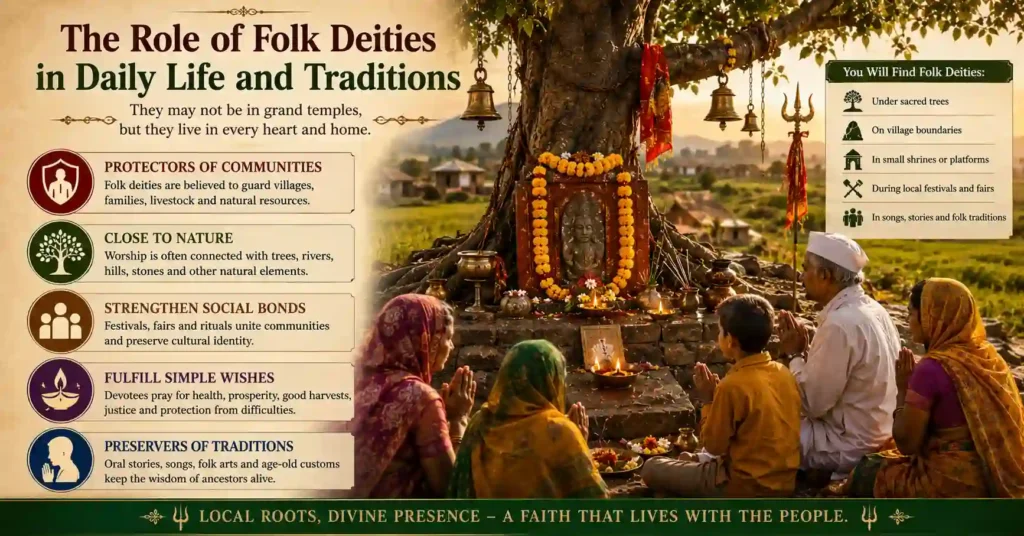
One of the most important roles of folk deities is to protect the land and the people who live on it. Across India, villages worship local guardian deities believed to safeguard fields, forests, rivers, livestock, and sacred spaces. This close bond with the local landscape makes their presence deeply personal and immediate.
Devotees seek the blessings of these folk gods and goddesses for timely rainfall, abundant harvests, safe childbirth, protection from disease, justice in disputes, and the overall well-being of the community. Their worship reflects everyday concerns rather than distant spiritual ideals, making them an integral part of village life.
Many Folk Deities of India are also closely associated with specific communities and occupations. Farmers, shepherds, fishermen, artisans, tribal groups, and pastoral communities often revere guardian deities who symbolize their shared history, livelihoods, and cultural identity.
These deities do more than offer protection. They preserve social harmony by bringing people together through annual jatras, village fairs, seasonal festivals, and community rituals. Such gatherings strengthen relationships, reinforce shared traditions, and pass local beliefs from one generation to the next.
In this way, Folk Deities of India continue to serve not only as divine protectors but also as custodians of regional culture, collective memory, and community life. Their worship reflects the living traditions that have sustained Sanatan Dharma across diverse landscapes for centuries.
Oral Traditions: How Folk Deities Live Through Stories
Unlike many religious traditions preserved primarily in written scriptures, the stories of Folk Deities of India have been passed down through oral traditions for generations. Village elders, bards, priests, folk singers, and storytellers have played a vital role in preserving these sacred narratives through memory and performance.
Devotional songs, kirtans, ballads, legends, seasonal plays, and community storytelling bring these deities to life. Each generation retells the stories in its own way, allowing local traditions to grow while preserving their spiritual essence.
This living tradition gives folk worship remarkable flexibility. As communities evolve, new events, customs, and local experiences become woven into existing legends. In this way, folk gods and goddesses remain relevant to changing times without losing their cultural roots.
Oral traditions also preserve ritual knowledge. Songs teach prayers, legends explain the origin of sacred places, and annual jatras, village fairs, and festivals help communities remember their guardian deities and pass their customs to younger generations.
This continuous cycle of storytelling, worship, and celebration has enabled Folk Deities of India to survive for centuries without relying on written texts. It reflects one of the greatest strengths of Sanatan Dharma—its ability to preserve sacred knowledge through living traditions, community participation, and shared cultural memory.
How Folk Deities Are Integrated into Sanatan Dharma
The traditions of folk deities and classical Hindu worship have never existed in isolation. Over centuries, they have influenced and enriched one another, allowing local traditions to become an integral part of the broader spiritual landscape of Sanatan Dharma.
Many local gods and goddesses are revered as manifestations, forms, or guardian aspects of Shiva, Shakti, Vishnu, or other Hindu deities. This understanding enables communities to preserve their regional customs while remaining connected to the wider beliefs and philosophies of Hinduism.
For example, some village guardian deities are identified with Bhairava, while regional warrior deities such as Khandoba are widely regarded as forms of Shiva. Likewise, many village goddesses are worshipped as local manifestations of Durga, Parvati, or the Divine Mother, blending regional devotion with established Hindu traditions.
This process of integration has taken place naturally through temples, festivals, pilgrimages, oral traditions, and shared rituals. Rather than replacing local beliefs, Sanatan Dharma embraces them, allowing regional traditions to flourish alongside pan-Indian forms of worship.
This harmonious relationship is one of the greatest strengths of Sanatan Dharma. It preserves the unique identity of local communities while uniting them within a shared spiritual and cultural heritage.
Frequently Asked Misconceptions About Folk Deities
Folk deities are sometimes misunderstood as being separate from or outside Sanatan Dharma. In reality, they have long been an integral part of India’s spiritual traditions, preserving local expressions of faith while remaining connected to the broader Hindu worldview.
Another common misconception is that folk deities belong only to rural communities. Although many traditions originated in villages, millions of devotees living in towns and cities continue to worship their Kul Devta, Kul Devi, or village guardian deity, especially during festivals and family ceremonies.
It is also incorrect to assume that folk worship is less important than temple worship. In Sanatan Dharma, both local traditions and pan-Indian forms of worship coexist harmoniously, reflecting the religion’s inclusive nature and respect for regional diversity.
Examples of Folk Deities of India Across Different Regions
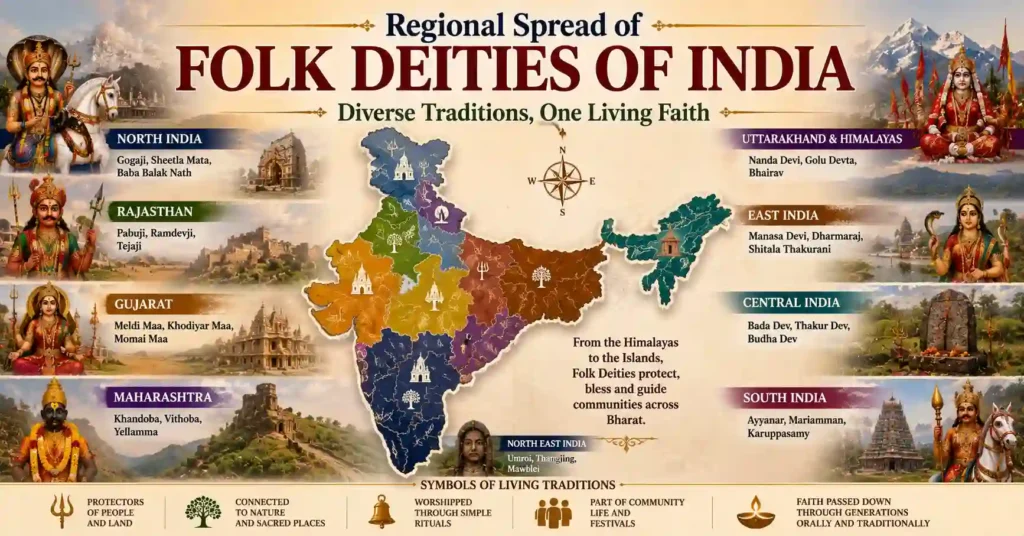
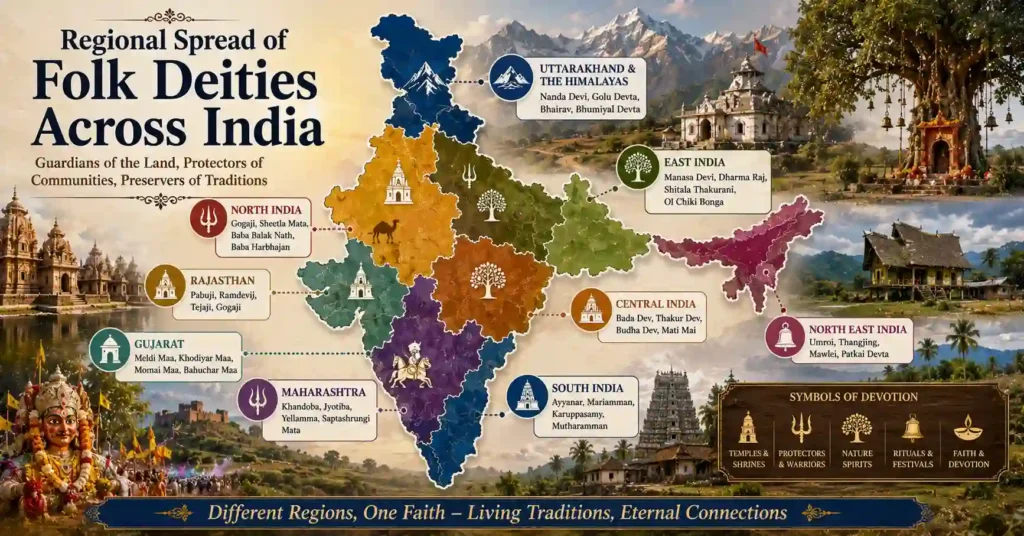
Folk Deities of India are found in every region of the country, reflecting the geography, history, occupations, and cultural traditions of local communities. While their forms of worship differ from place to place, they all serve as living symbols of faith, protection, and regional identity. The examples below offer a glimpse into this rich diversity, with each deity explored in greater detail in dedicated articles.
- Khandoba (Maharashtra & Karnataka): Revered as a warrior deity and a form of Shiva, Khandoba is worshipped as the protector of farmers, pastoral communities, and villages. His temples, especially at Jejuri, attract millions of devotees.
- Khatu Shyam Baba (Rajasthan): Worshipped as an embodiment of sacrifice and compassion, Khatu Shyam Baba inspires deep devotion through pilgrimage, bhajans, and the famous annual Falgun fair.
- Nanda Devi (Uttarakhand): Regarded as the divine daughter of the Himalayas, Nanda Devi is honoured as a protector of the mountains, families, and regional culture. The Nanda Devi Raj Jat Yatra is among the most significant pilgrimages in the Himalayan region.
- Golu Devta (Uttarakhand): Known as the God of Justice, Golu Devta is approached by devotees seeking truth and fair judgment. Thousands of written petitions offered at his temples reflect the enduring faith of his followers.
- Ayyanar and Karuppasamy (Tamil Nadu): These village guardian deities are traditionally worshipped at the boundaries of villages, where they are believed to protect communities, agricultural lands, and travellers from harm.
These examples illustrate the remarkable diversity of Folk Deities of India. Every region has its own guardian deities, sacred legends, rituals, festivals, and community traditions, together forming one of the richest expressions of Sanatan Dharma’s living heritage.
Did You Know?
India is home to thousands of Folk Deities, many of whom have been worshipped continuously for centuries through oral traditions, village festivals, community rituals, and family customs rather than written scriptures. This remarkable diversity makes folk worship one of the oldest and most enduring living traditions within Sanatan Dharma.
Where Are Folk Deities Worshipped in India?
The worship of Folk Deities of India extends across almost every state and region of the country. Although the names, rituals, and traditions vary, nearly every community has local guardian deities who are deeply connected with its history, geography, and way of life.
In the Himalayan region, mountain goddesses and guardian deities such as Nanda Devi and Golu Devta are closely associated with villages, forests, and sacred peaks. In western India, deities like Khandoba are revered by farming and pastoral communities, while Rajasthan is known for powerful folk traditions centred around Khatu Shyam Baba, Gogaji, and Tejaji.
Across South India, village guardian deities such as Ayyanar, Karuppasamy, and numerous Gram Devatas protect village boundaries, agricultural lands, and local communities. Eastern and Central India also preserve rich traditions of tribal, village, and nature deities worshipped through local festivals and seasonal rituals.
This widespread presence shows that Folk Deities of India are not limited to one language, caste, or region. Together, they form a living network of local traditions that enrich the spiritual diversity of Sanatan Dharma.
Jatras, Melas, and Festivals in Folk Traditions
Jatras, melas, and annual festivals are among the most vibrant expressions of folk worship in India. These celebrations bring entire communities together to honour their guardian deities, fulfil vows, seek blessings, and strengthen the spiritual bond between the people and their local gods and goddesses.
During these festivals, villages come alive with religious processions, devotional singing, folk dances, traditional theatre, and ceremonial offerings. These events are not only acts of worship but also occasions for preserving local legends, customs, and oral traditions that have been passed down through generations.
Many jatras and village fairs coincide with the agricultural calendar, seasonal changes, or important religious occasions. They serve as opportunities for communities to pray for good harvests, rainfall, health, prosperity, and protection while renewing their shared faith and cultural identity.
These gatherings also have an important social and economic role. Pilgrims, traders, artisans, and performers travel from nearby regions, creating spaces for cultural exchange, local commerce, and community interaction. Over time, some village festivals grow into major pilgrimage centres, extending the influence of local deities far beyond their original communities.
Through these living traditions, festivals continue to preserve the worship of Folk Deities of India, ensuring that their stories, rituals, and community values remain vibrant across generations.
The Cultural Importance of Folk Deities in India
Beyond their religious significance, Folk Deities of India play an important role in preserving the cultural identity of local communities. Their stories, festivals, songs, dances, and rituals reflect the history, values, and collective memory of the regions where they are worshipped.
Many traditional art forms, folk music, oral epics, village theatre, and community celebrations have evolved around these deities. Annual festivals provide opportunities for people to pass on customs, local legends, and spiritual values to younger generations, ensuring that these traditions continue to thrive.
Folk deities also foster a strong sense of belonging. By bringing families and communities together in shared acts of worship, they strengthen social harmony, preserve regional heritage, and celebrate India’s remarkable cultural diversity within the broader framework of Sanatan Dharma.
Why Folk Deities Remain Relevant Today
Despite rapid urbanisation and changing lifestyles, the worship of folk deities continues to thrive across India. People turn to these local gods and goddesses because they are regarded as compassionate guardians who remain closely connected with the everyday lives of their devotees.
Many seek their blessings for protection, justice, good health, safe childbirth, abundant harvests, family well-being, and relief during difficult times. This deep personal connection makes folk worship feel immediate, accessible, and rooted in lived experience.
Unlike elaborate temple rituals, the worship of many folk deities is simple and community-oriented. Offerings, vows, local ceremonies, and annual festivals allow people from all backgrounds to participate, strengthening both faith and social bonds.
For many families, these deities are also revered as Kul Devta or Kul Devi, preserving ancestral traditions across generations. Even those who have migrated to towns and cities often return to their native villages during festivals or remember their family deity during important life events and moments of prayer.
In a world shaped by migration and modernisation, folk traditions continue to provide a sense of identity, belonging, and cultural continuity. This enduring devotion shows that the worship of Folk Deities of India remains a living and meaningful part of Sanatan Dharma rather than merely a tradition of the past.
Common Symbols and Places of Worship of Folk Deities
Unlike many large temple traditions, the places of worship associated with Folk Deities of India are often simple and closely connected with nature and village life. Devotees worship these deities in village shrines, sacred groves, hilltops, forests, riverbanks, ancient trees, boundary stones, and family temples that have been revered for generations.
Many folk shrines feature symbolic objects rather than elaborate idols. Stones, wooden posts, tridents (Trishul), sacred trees, terracotta horses, bells, lamps, and local emblems are commonly regarded as representations of the deity’s presence. In some traditions, the shrine itself is considered sacred even without a formal image.
These places of worship reflect the close relationship between local communities, nature, and the divine. They also demonstrate how spirituality in Sanatan Dharma flourishes not only in grand temples but also in the everyday landscapes where people live, work, and worship.
Folk Deities as Living Expressions of Sanatan Dharma
Rather than viewing folk traditions as separate from mainstream Hindu worship, it is more accurate to see them as living expressions of Sanatan Dharma. They preserve local customs, regional identities, and spiritual practices while remaining deeply connected to the broader Hindu tradition.
Folk Deities of India remind us that faith is not sustained only through scriptures and grand temples. It also lives in village shrines, sacred groves, rivers, mountains, annual festivals, family traditions, and the collective memory of communities that have preserved these beliefs for generations.
From guardian village deities and ancestral protectors to regional forms of Shiva, Shakti, and Vishnu, these traditions reflect the remarkable diversity and inclusiveness of Sanatan Dharma. They demonstrate how universal spiritual values can flourish alongside local customs without losing their authenticity.
As India continues to modernise, the worship of folk deities remains a powerful link between the past and the present. Their stories, rituals, and festivals continue to inspire devotion, preserve cultural heritage, and remind us that the living spirit of Sanatan Dharma is found not only in sacred texts but also in the everyday lives of its people.
Conclusion
Folk Deities of India are not relics of the past. They remain living, evolving traditions that continue to shape the spiritual, cultural, and social life of communities across the country.
They remind us that Sanatan Dharma is sustained not only through sacred scriptures and grand temples but also through village shrines, regional customs, oral traditions, and the everyday devotion of ordinary people.
By understanding these local gods and goddesses, we gain a deeper appreciation of India’s spiritual diversity and the many ways faith is woven into daily life. Their stories, festivals, and rituals continue to preserve cultural heritage while keeping ancient traditions alive for future generations.
Suggested Reading
If you enjoyed learning about Folk Deities of India, you may also like exploring these revered regional deities, sacred traditions, and living folk beliefs from different parts of India. Each article offers a deeper understanding of the unique legends, temples, festivals, and devotional practices that enrich the diverse spiritual heritage of Sanatan Dharma.
Khandoba: Story, Jejuri Temple, Jatra and Worship
https://thesanantales.com/khandoba-god-jejuri-temple-story/
Khatu Shyam Baba: Story, Temple, Festivals and Significance
https://thesanantales.com/khatu-shyam-baba-darshan-guide-2026/
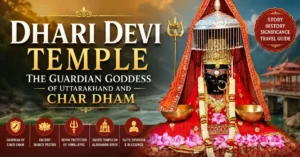
Dhari Devi Temple: Story, History and Char Dham Significance
https://thesanatantales.com/dhari-devi-temple/
Nanda Devi: Story, Folk Beliefs, Raj Jat Yatra and Worship
https://thesanantales.com/nanda-devi-the-beloved-folk-goddess-of-uttarakhand/
Golu Devta: The God of Justice in Uttarakhand
https://thesanantales.com/goludevta-folk-god-of-justice/
Himalayan Folk Deities: Gods of the Hills and Sacred Traditions
https://thesanantales.com/himalayan-folk-deities/
Gramadevata (Wikipedia)
FAQs
What are Folk Deities of India?
Folk Deities of India are local or regional gods and goddesses worshipped by specific villages, communities, clans, or regions. They are revered as protectors, healers, guardians of nature, and keepers of local traditions. Unlike pan-Indian deities, their worship is closely connected with the history, culture, and daily life of the communities that honour them.
How are folk deities different from classical Hindu gods?
Classical Hindu deities such as Shiva, Vishnu, and Devi are primarily described in sacred scriptures like the Vedas, Puranas, and Itihasas. Folk deities, on the other hand, are often remembered through oral traditions, local legends, and community customs.
Despite these differences, the two traditions are not separate. Many folk deities are regarded as regional manifestations, companions, or forms of major Hindu deities, making them an integral part of Sanatan Dharma.
What is a Gram Devta?
A Gram Devta is the guardian deity of a village. Devotees believe the deity protects the village, its people, crops, livestock, water sources, and surrounding lands from harm.
Most villages in India traditionally have a Gram Devta or Gram Devi, and annual festivals, prayers, and community rituals are organised to seek their blessings for peace, prosperity, and good harvests.
Why are Folk Deities of India still worshipped today?
People continue to worship folk deities because they represent a close and personal relationship with the divine. Devotees seek their blessings for protection, justice, health, fertility, successful harvests, and family well-being.
Even families who have migrated to cities often continue to honour their village or ancestral deity during festivals, weddings, and other important life events, keeping these traditions alive across generations.
Are folk deities part of Sanatan Dharma?
Yes. Folk deities are widely regarded as an important part of Sanatan Dharma. They reflect the diversity of Hindu traditions while sharing the same spiritual values of devotion, dharma, gratitude, and reverence for nature.
Many regional deities are worshipped alongside Shiva, Vishnu, Shakti, Ganesha, and other Hindu gods, demonstrating how local traditions have naturally become part of the broader Hindu religious landscape.
Which are some famous Folk Deities of India?
India has thousands of regional and village deities. Some of the best-known examples include Khandoba in Maharashtra and Karnataka, Khatu Shyam Baba in Rajasthan, Nanda Devi and Golu Devta in Uttarakhand, Ayyanar and Karuppasamy in Tamil Nadu, and numerous Gram Devtas worshipped across different states.
Each deity has its own legends, temples, festivals, and rituals that reflect the unique culture of the communities that worship them.
How are folk deities worshipped?
The worship of folk deities varies across regions and communities. Devotees may offer flowers, coconuts, fruits, lamps, incense, or traditional local offerings, while many villages celebrate annual jatras, melas, and processions in honour of their guardian deity.
Music, folk dances, storytelling, and community feasts are also important parts of these celebrations, helping preserve local traditions and strengthen social bonds.
Why are folk deities important in Indian culture?
Folk deities preserve India’s regional traditions, oral histories, and cultural heritage. They strengthen community identity, encourage collective worship, and keep ancient customs alive through festivals, rituals, and local storytelling.
Their continued worship demonstrates how spirituality in India extends beyond scriptures and grand temples into the everyday lives of people, making folk traditions an enduring expression of Sanatan Dharma.
Glossary of Important Terms
| Term | Meaning |
|---|---|
| Folk Deities | Local or regional gods and goddesses worshipped by specific communities as protectors, guardians, and benefactors. |
| Gram Devta | The guardian deity of a village, believed to protect its people, crops, livestock, and surrounding lands. |
| Gram Devi | A village guardian goddess worshipped for protection, prosperity, fertility, and the well-being of the community. |
| Lok Devta | A folk deity revered through local traditions, oral legends, and community worship rather than primarily through classical scriptures. |
| Kul Devta / Kul Devi | The ancestral family deity worshipped by a particular clan or lineage across generations for blessings and protection. |
| Regional Deity | A god or goddess whose worship is closely associated with a specific region, state, or cultural community in India. |
| Guardian Deity | A divine protector believed to safeguard villages, forests, mountains, rivers, travellers, or particular communities. |
| Jatra | A traditional religious procession or annual festival held in honour of a local deity, often featuring rituals, music, dance, and fairs. |
| Mela | A large religious gathering or fair where devotees come together for worship, pilgrimage, trade, and cultural celebrations. |
| Oral Tradition | The preservation and transmission of sacred stories, legends, songs, and customs through spoken word across generations. |
| Sacred Grove | A forest or natural site regarded as holy because it is dedicated to a local deity or protected by long-standing spiritual traditions. |
| Sanatan Dharma | The eternal spiritual tradition of Hinduism that embraces diverse philosophies, rituals, scriptures, and forms of worship. |
| Shakti | The divine feminine power worshipped as the Supreme Goddess and expressed through many regional and folk goddesses. |
| Prasad | Food or other offerings first presented to a deity and then distributed among devotees as a sacred blessing. |
| Pilgrimage (Yatra) | A sacred journey undertaken by devotees to visit temples, shrines, or holy places associated with a deity. |
About the Author
Yateendra Chaturvedi is a spiritual writer, researcher, devotee, and the founder of The Sanatan Tales. With over 35 years of professional experience and a lifelong interest in Sanatan Dharma, he writes about Hindu deities, temples, scriptures, festivals, Mahavidyas, sacred stories, rituals, and living traditions that continue to guide and inspire devotees across India.
Drawing from traditional scriptures, regional beliefs, temple traditions, devotional literature, and historical sources, he aims to present authentic, well-researched, and easy-to-understand content for modern readers. His work focuses on preserving spiritual wisdom, explaining sacred traditions, and helping seekers develop a deeper understanding of India’s rich spiritual heritage.
Through The Sanatan Tales, Yateendra strives to make the timeless teachings of Sanatan Dharma simple, meaningful, and relevant for today’s generation while maintaining respect for traditional sources, regional practices, and diverse spiritual perspectives.
Learn More About Yateendra Chaturvedi →
https://thesanatantales.com/about-the-author/
References & Sources
This article is based on beliefs and traditions followed within various regional and folk traditions of Sanatan Dharma, traditional knowledge preserved through local customs, oral traditions, temple practices, community worship, and insights drawn from religious, historical, and cultural study sources. Some concepts discussed in this article are also inspired by teachings and interpretations preserved through the guru-disciple tradition.
Note: Beliefs, customs, rituals, and interpretations may vary across different regions, communities, sects, and traditions within Sanatan Dharma. The purpose of this article is not to present any single viewpoint as the absolute truth, but to explain widely accepted religious, cultural, and spiritual perspectives in a simple, balanced, and accessible manner.
Explore More Fascinating Topics from Sanatan Dharma