
Across Gujarat, devotion to the Divine Mother appears in many beautiful forms. Among the most loved goddesses of the region is Khodiyar Maa. For millions of devotees, she is not just a temple deity but a compassionate mother who protects families and guides them through life’s challenges.
The story of the goddess comes from the living folk traditions of the Saurashtra region of Gujarat, where devotion to village goddesses has been part of daily life for centuries. Over time, her fame spread across Gujarat and even beyond the state.
Today, temples dedicated to the goddess attract thousands of devotees seeking blessings for protection, health, prosperity, and family welfare.
Many communities worship Khodiyar Maa as their Kuldevi, the protective goddess of their lineage. Her stories are remembered through temple rituals, folk songs, festivals, and family traditions that continue to keep her devotion alive.
Khodiyar Maa is also lovingly called Khodal Maa by many devotees, especially in Gujarat. This name is widely used in connection with the famous Khodaldham Temple and in the devotional traditions of the Patidar community.
In this article, you’ll discover the story and history of Khodiyar Maa, the legends associated with her miracles, the significance of her sacred temples, her role as the Kuldevi of many communities, major festivals and worship traditions, and the enduring spiritual legacy that continues to inspire devotees across Gujarat and beyond.
Whether you are a devotee, a pilgrim planning a temple visit, or simply curious about Gujarat’s rich spiritual heritage, this guide brings together the story, history, temples, festivals, miracles, and cultural significance of Khodiyar Maa in one place.
Khodiyar Maa at a Glance
| Aspect | Details |
|---|---|
| Other Names | Khodal Maa, Khodiyar Mata |
| Region of Worship | Gujarat and parts of Rajasthan |
| Form | Revered as a manifestation of Adi Shakti (according to devotional tradition) |
| Sacred Vehicle (Vahana) | Crocodile |
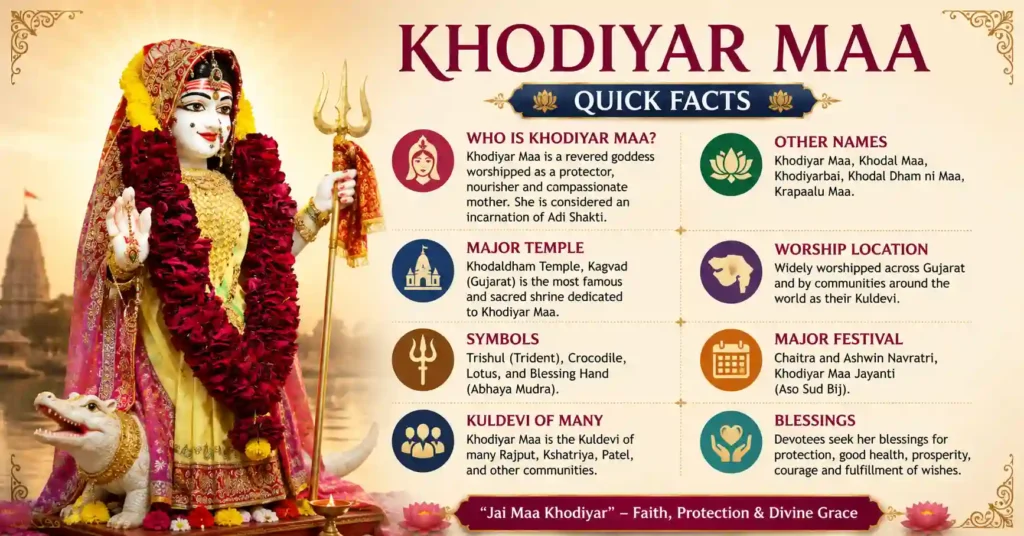
| Major Temples | Matel, Rajpara, Khodaldham (Kagvad), Galdhara |
| Main Festival | Khodiyar Jayanti (Magha Shukla Ashtami), Navratri |
| Revered As | Kuldevi and Gram Devi by many communities |
| Primary Communities | Charan, Rajput, Patidar, Bharvad, Brahmin, Bania |
| Symbolizes | Courage, Compassion, Protection and Divine Grace |
Table of Contents
ToggleWho is Khodiyar Maa
Khodiyar Maa is a revered folk goddess worshipped primarily in Gujarat and parts of Rajasthan. She is lovingly known as Khodal Maa and is regarded as a compassionate protector who blesses her devotees with courage, prosperity, and family well-being.
Devotees worship her as a powerful manifestation of Adi Shakti, the divine feminine energy that nurtures, protects, and upholds dharma. In many regional traditions, she is revered as a guardian who comes to the aid of those who pray with faith.
Her worship is deeply rooted in the Charan community, where the earliest oral traditions and legends associated with the goddess are believed to have originated. Over the centuries, her devotion spread across Gujarat through royal patronage, temple traditions, and community worship.
Today, Khodiyar Maa is revered by many communities, including Rajputs, Patidars, Bharvads, Brahmins, Banias, and farming families. For countless devotees, she is their Kuldevi, the guardian deity who watches over their lineage and preserves family traditions.
Many families seek her blessings before important milestones such as marriages, the birth of a child, entering a new home, or beginning a new venture. Her temples continue to attract devotees who pray for protection, good health, prosperity, and success.
Because of this enduring bond with everyday life, Khodiyar Mata is not seen merely as a historical or folk deity but as a living Divine Mother whose grace continues to inspire faith across generations.
The Birth and Origin of Khodiyar Maa
According to regional tradition, the story of Khodiyar Maa begins many centuries ago in the Saurashtra region of Gujarat. While the exact historical period is uncertain, her legend has been preserved through the oral traditions of the Charan community and local temple customs.
Her father, Mamadji Charan, was a devoted follower of Lord Shiva. It is believed that he and his wife prayed for many years, seeking the blessing of children through sincere devotion and penance.
According to folk tradition, their prayers pleased Lord Shiva and Nagdev, the serpent deity. As a divine blessing, the couple was blessed with seven daughters and one son, a story that remains central to the legends surrounding the goddess.
Among these daughters was Janbai, who later came to be revered as Khodiyar Maa. Many regional traditions also describe her as one of the seven divine sisters, each remembered in local folklore and worshipped at shrines across different parts of Gujarat.
Devotees believe that Janbai was a manifestation of Adi Shakti, who took human birth to protect the righteous, relieve suffering, and spread compassion. Her life is remembered not only for miraculous events but also for her courage, humility, and unwavering devotion.
Even as a child, Janbai is said to have displayed exceptional kindness, fearlessness, and spiritual strength, qualities that later became the foundation of her worship as one of Gujarat’s most beloved folk goddesses.
The Miracle That Revealed Khodiyar Maa
One of the most cherished legends explains how Janbai came to be revered as Khodiyar Maa. According to regional tradition, this miraculous event revealed her divine nature and established her as a compassionate protector of devotees.
The legend says that her brother Mehrak (Merakhia) was bitten by a poisonous snake. As the venom spread rapidly, the family feared that his life could not be saved.
Determined to rescue her brother, Janbai journeyed to Nagaloka, the mystical realm of the serpent deities, to obtain the divine nectar believed to cure the deadly poison. Her unwavering faith and courage became central to this sacred narrative.
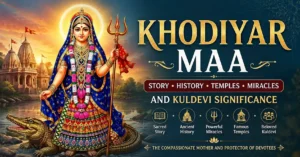
According to the tradition, the serpent gods granted her the nectar. During her return journey, she crossed the waters riding a crocodile, which later became the sacred vahana (vehicle) associated with Khodiyar Maa and remains one of her most recognizable symbols.
The legend further says that Janbai injured her leg during the difficult journey and began walking with a slight limp. This gave rise to the name Khodiyar, which is traditionally understood to mean “the one who limps.”
After restoring her brother’s life, people recognized her extraordinary divine power. From that time onward, devotees began worshipping Janbai as Khodiyar Maa, believing her to be a manifestation of Adi Shakti who protects her devotees with compassion, courage, and grace.
Did You Know?
Many devotees believe that Khodiyar Maa appeared riding a crocodile (magar), making it one of the most distinctive vahanas associated with a Hindu goddess.
Across Gujarat, she is worshipped not only as a compassionate protector but also as the Kuldevi of numerous families, and her temples continue to attract millions of devotees every year during Navratri and Khodiyar Jayanti.
The Sacred Symbol of Khodiyar Maa
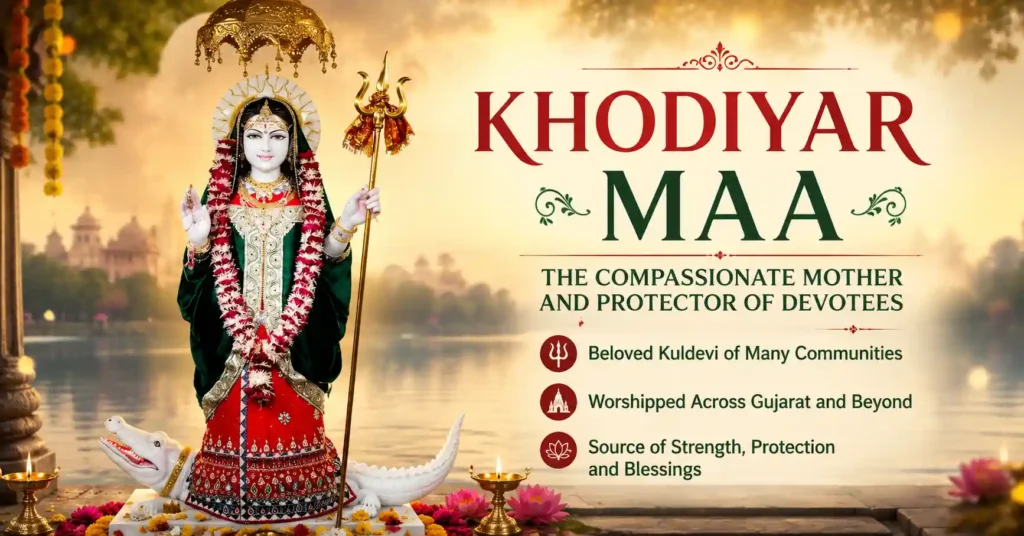
In most depictions and temple idols, Khodiyar Maa is shown standing on or riding a crocodile, her sacred vahana (vehicle). This unique symbol distinguishes her from many other forms of the Divine Mother worshipped across India.
According to regional tradition, the crocodile is linked to the miraculous journey during which the goddess crossed the waters to obtain the divine nectar that saved her brother’s life. Since then, it has remained an inseparable part of her iconography.
Devotees believe the crocodile symbolizes courage, fearlessness, and mastery over danger. It also represents Khodiyar Maa’s power to protect her devotees from difficulties and guide them safely through the uncertainties of life.
Many temples dedicated to the goddess are situated near lakes, ponds, rivers, and stepwells, reflecting her long-standing association with water in the folk traditions of Gujarat. These sacred water bodies are often regarded as symbols of purification, life, and divine grace.
For devotees, the crocodile is not merely a sacred vehicle but a reminder that with faith in the Divine Mother, even the greatest obstacles can be overcome.
Meaning of the Name Khodiyar
The name Khodiyar is traditionally believed to come from a Gujarati word associated with a limp or uneven walk. This explanation is preserved in the regional folklore and devotional traditions surrounding the goddess.
According to the popular legend, Janbai injured her leg while returning from Nagaloka after obtaining the divine nectar to save her brother. As a result, she began walking with a slight limp, and people lovingly started calling her Khodiyar.
Over time, this name became a sacred symbol of her courage, compassion, and selfless sacrifice. Rather than being seen as a mark of weakness, devotees regard it as a reminder of the hardships she willingly endured to protect her family.
Today, millions of devotees lovingly worship her as Khodiyar Maa or Khodal Maa, remembering her as the compassionate Divine Mother who protects her children and responds to sincere prayers with grace and blessings.
Royal Patronage and the Spread of Khodiyar Maa Worship
The worship of Khodiyar Maa gradually spread across Gujarat through the devotion of local communities, temple traditions, and the patronage of regional rulers. Over the centuries, she became one of the most widely revered folk goddesses of the state.
According to historical tradition, a ruler of the Gohil Rajput dynasty experienced a divine vision of Khodiyar Mata. Deeply inspired by this spiritual experience, he built a temple in her honour and accepted her as the Kuldevi of the royal family.
The royal family’s devotion greatly increased the prominence of the goddess. Their patronage encouraged the construction of temples, supported religious festivals, and helped spread her worship to many parts of Gujarat.
As her fame grew, Khodiyar Maa came to be worshipped not only by the Gohil Rajputs but also by Patidars, Charans, Bharvads, Brahmins, Banias, and many other communities. Today, her temples can be found in countless villages, towns, and cities across Gujarat, where devotees continue to seek her blessings for protection, prosperity, and family well-being.
Famous Khodiyar Maa Temples in Gujarat
Several temples dedicated to Khodiyar Maa are spread across Gujarat, each holding deep religious and cultural significance. These sacred shrines attract devotees throughout the year, especially during Navratri, Khodiyar Jayanti, and other important festivals.
| Temple | Location | Significance |
|---|---|---|
| Matel Khodiyar Temple | Near Wankaner, Morbi district | Regarded as one of the oldest and most revered temples of Khodiyar Maa. Thousands of devotees visit this shrine every year. |
| Rajpara Khodiyar Temple | Bhavnagar district | An important pilgrimage site closely associated with the early traditions of the goddess and visited by devotees seeking her blessings. |
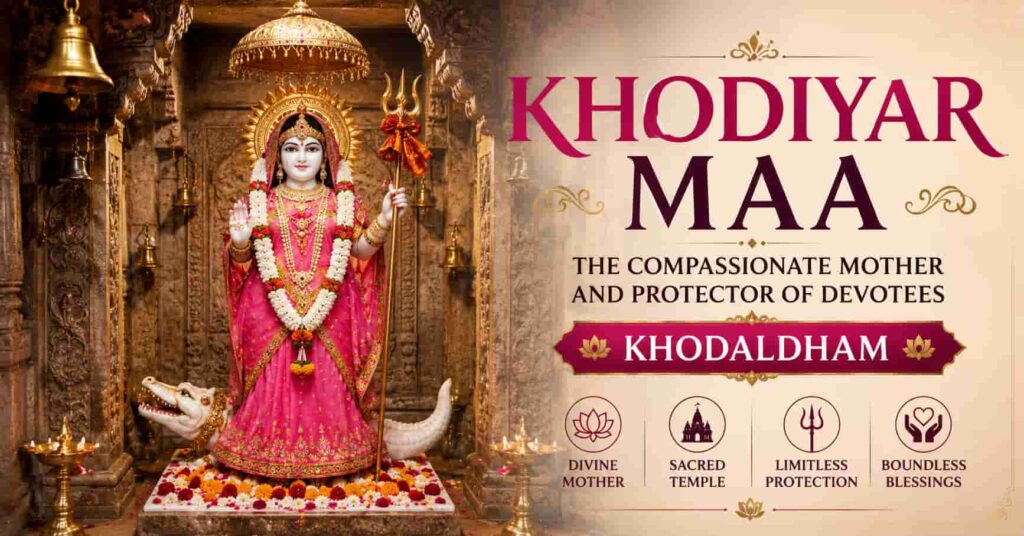
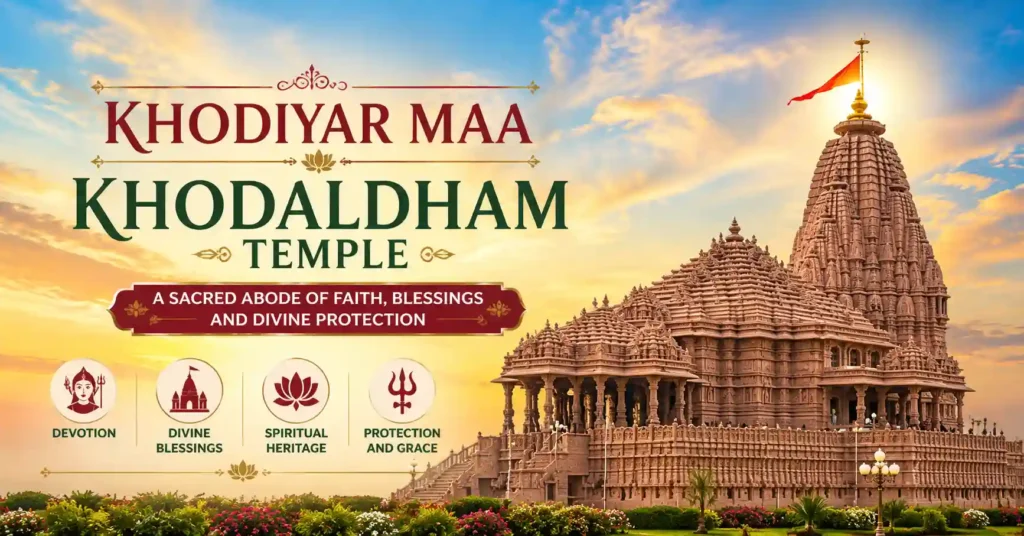
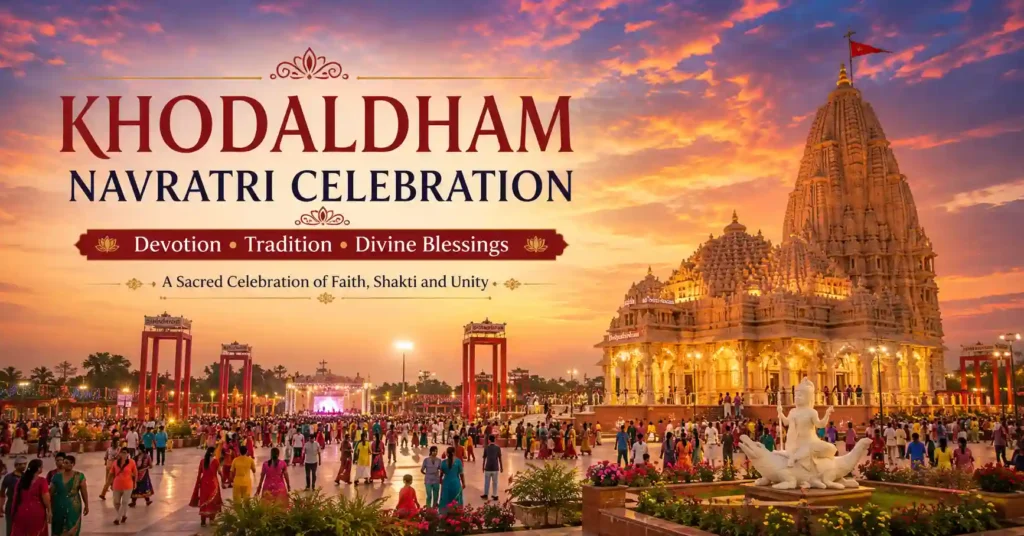
| Khodaldham Temple | Kagvad, Rajkot district | A magnificent modern temple complex that has become one of Gujarat’s leading spiritual and pilgrimage centers dedicated to Khodiyar Maa. |
| Galdhara Khodiyar Temple | Bhavnagar district | A sacred shrine associated with the worship of the goddess, where devotees pray for protection, family well-being, and prosperity. |
Although several temples are dedicated to Khodiyar Maa across Gujarat, Matel, Rajpara, and Khodaldham are among the most visited pilgrimage centres. Each temple has its own history, traditions, and annual celebrations, reflecting the widespread devotion to the goddess throughout the state.
Together, these temples preserve the rich devotional heritage of Khodiyar Maa and reflect the enduring faith of millions of devotees. They continue to serve as important centers of worship, cultural traditions, and community gatherings across Gujarat.
Did You Know?
Khodaldham Temple at Kagvad is one of the largest temple complexes dedicated to Khodiyar Maa and has emerged as a major spiritual and social center, attracting devotees from across India.
Is Matel Khodiyar Maa Temple a Shakti Peeth?
Because the Matel Khodiyar Maa Temple is one of Gujarat’s most prominent shrines dedicated to the goddess, many devotees wonder whether it is one of the 51 Shakti Peethas mentioned in Hindu tradition.
According to traditional Shakti Peeth lists found in Hindu scriptures and pilgrimage traditions, Matel Khodiyar Maa Temple is not recognized as one of the classical Shakti Peethas. Instead, it is revered as one of Gujarat’s most important temples dedicated to Khodiyar Maa, whom devotees worship as a powerful manifestation of Adi Shakti.
Its spiritual importance comes from centuries of devotion, regional traditions, and the deep faith of millions of devotees rather than its inclusion in the classical Shakti Peeth tradition. For devotees across Gujarat and beyond, the temple remains one of the most sacred places to seek the blessings of Khodiyar Maa.
Communities That Worship Khodiyar Maa
Although the worship of Khodiyar Maa is believed to have originated within the Charan community, her devotion gradually spread across Gujarat and neighboring regions. Today, she is revered by people from many communities, reflecting her universal appeal as a compassionate guardian and protector.
Today, Khodiyar Maa is especially worshipped by:
- Charan
- Rajput
- Patidar
- Bharvad
- Brahmin
- Bania (Vaishya)
For many of these communities, Khodiyar Maa is revered as their Kuldevi, the guardian deity of the family lineage. Devotees believe she protects their home, preserves family traditions, and blesses future generations with peace, prosperity, and well-being.
It is a long-standing tradition for families to seek her blessings before important milestones such as marriages, housewarming ceremonies (Griha Pravesh), the birth of a child, starting a new business, or undertaking significant journeys. Many devotees also visit her temples to offer prayers in gratitude after their wishes are fulfilled.
This enduring tradition has helped keep the devotion to Khodiyar Mata alive across generations, making her one of the most beloved folk goddesses of Gujarat.
Why is Khodiyar Maa Worshipped as a Kuldevi?
For many families in Gujarat, Khodiyar Maa is more than a revered goddess. She is worshipped as their Kuldevi, the ancestral family deity who is believed to protect future generations and guide them through every stage of life.
According to family traditions, devotees seek the blessings of Khodiyar Maa before important occasions such as marriages, childbirth, housewarming ceremonies, the start of a new business, and long journeys. Many families also visit her temple regularly as an expression of gratitude for her continued protection.
The tradition of worshipping Khodiyar Maa as a Kuldevi has been passed down through generations. It strengthens family bonds, preserves ancestral customs, and reminds devotees of their spiritual heritage and responsibility to uphold the values of faith, compassion, and righteousness.
How is Khodiyar Maa Worshipped?
The worship of Khodiyar Maa is simple, devotional, and centered on faith. While rituals may vary from one family or temple to another, devotees believe that sincere prayers and devotion are more important than elaborate ceremonies.
Common offerings made to the goddess include:
- Coconut
- Fresh flowers
- Sweets (Prasad)
- Red chunri (sacred cloth)
- Lighting oil lamps (deepam)
Many devotees visit Khodiyar Maa temples on Tuesday and Sunday, which are widely regarded as auspicious days for her worship. During Navratri, Khodiyar Jayanti, and other religious occasions, temples witness large gatherings of devotees offering prayers, bhajans, and special pujas.
Many families also perform Kuldevi Puja before important life events such as marriages, Griha Pravesh (housewarming), the birth of a child, or the beginning of a new venture. Devotees seek the blessings of Khodiyar Mata for protection, prosperity, good health, and harmony within the family.
Festivals Celebrated in Honor of Khodiyar Maa
The two most important festivals associated with Khodiyar Maa are Navratri and Khodiyar Jayanti. Both occasions are celebrated with great devotion across Gujarat, especially at the goddess’s major temples, where thousands of devotees gather to seek her blessings.
Navratri Celebrations
During the nine sacred nights of Navratri, temples dedicated to Khodiyar Maa are beautifully decorated with lights, flowers, and colorful decorations. Devotees participate in:
- Special pujas and aartis
- Garba and devotional dances
- Bhajans and kirtans
- Temple fairs (melas) and community gatherings
Major temples such as Matel, Rajpara, and Khodaldham welcome thousands of pilgrims during this festive period, creating an atmosphere of devotion and celebration.
Khodiyar Jayanti
Khodiyar Jayanti is observed on Magha Shukla Ashtami and is traditionally believed to commemorate the divine appearance of Khodiyar Maa. It is one of the most significant annual festivals dedicated to the goddess.
On this auspicious day, temples organize special pujas, aartis, abhishek, devotional singing, and bhajan-kirtan. Many devotees observe fasts, offer prasad, and seek the blessings of the Divine Mother for health, prosperity, and family well-being.
Large religious fairs are held at renowned temples such as Matel, Rajpara, and Khodaldham, while villages across Saurashtra and other parts of Gujarat organize local melas featuring devotional music, Garba, cultural performances, and community meals (Mahaprasad).
These festivals not only strengthen devotion to Khodiyar Mata but also help preserve Gujarat’s rich spiritual and cultural traditions for future generations.
Cultural Significance of Khodiyar Maa
The devotion to Khodiyar Maa is deeply woven into the cultural and spiritual heritage of Gujarat. Beyond temple worship, her stories, songs, and traditions continue to shape the religious life of countless families and communities.
Her legacy is preserved through:
- Traditional folk songs
- Garba performances during Navratri
- Devotional bhajans and kirtans
- Temple fairs (melas) and religious gatherings
- Oral storytelling passed down through generations
In many villages, Khodiyar Maa is also revered as a Gram Devi, the guardian goddess believed to protect the land, its people, livestock, and crops. Devotees pray to her for safety, prosperity, timely rainfall, and the well-being of the entire community.
These living traditions have helped preserve the devotion to Khodiyar Mata for centuries, making her not only a revered Kuldevi but also an enduring symbol of Gujarat’s rich folk heritage, faith, and community spirit.
Khodiyar Maa in Gujarat's Folk Tradition
Unlike many deities whose worship is centered primarily on the Puranas, Khodiyar Maa holds a special place in Gujarat’s living folk tradition. Her stories have been preserved for generations through oral narratives, devotional songs, folk literature, and local customs that continue to inspire millions of devotees.
Across villages and towns in Gujarat, devotees invoke Khodiyar Maa’s blessings during important family occasions such as weddings, childbirth, housewarming ceremonies, and the beginning of new ventures. Many families regard her not only as their Kuldevi but also as a compassionate guardian who protects both people and livestock.
The devotion to Khodiyar Maa extends beyond temple worship. Community fairs, bhajan gatherings, Garba during Navratri, and annual festivals dedicated to the goddess help preserve Gujarat’s rich spiritual and cultural heritage. These traditions continue to strengthen the bond between faith, family, and community across generations.
Miracles and Devotees' Faith in Khodiyar Maa
The devotion to Khodiyar Maa is closely associated with countless stories of divine grace and miraculous intervention. Across Gujarat and beyond, devotees lovingly share personal experiences that they believe reflect the goddess’s compassion and protective presence.
According to the faith of her devotees, Khodiyar Maa is believed to answer sincere prayers by offering protection during accidents, strength in times of hardship, recovery from illness, and guidance through life’s challenges.
These experiences are often shared within families and communities as expressions of gratitude. They have been passed down through generations and continue to inspire faith in the Divine Mother.
While these stories are matters of personal belief and cannot be independently verified, they form an important part of the living tradition surrounding Khodiyar Maa. They reflect the deep spiritual bond that devotees feel with the goddess.
For many devotees, these accounts strengthen their devotion and encourage them to seek the blessings of Khodiyar Mata with faith, humility, and gratitude.
For devotees, these accounts are expressions of deep faith and personal spiritual experience. While such miracles are matters of individual belief and cannot be independently verified, they continue to inspire devotion and strengthen the bond between Khodiyar Maa and her followers across generations.
Spiritual Significance of Khodiyar Maa
The story of Khodiyar Maa carries a profound spiritual message that continues to inspire devotees across generations. Her life reminds believers that true strength lies in courage, compassion, selfless service, and unwavering faith.
According to devotional tradition, her journey to save her brother symbolizes the willingness to overcome every obstacle for the well-being of loved ones. It reflects the ideals of sacrifice, determination, and unconditional love.
Devotees revere Khodiyar Maa as a compassionate Divine Mother who protects her children during times of hardship. They believe her blessings bring strength, hope, and guidance when facing life’s challenges.
For many people, Khodiyar Mata represents the divine power of Shakti that protects life, upholds dharma, and leads devotees on the path of faith, devotion, and righteousness.
A Note on Tradition and Belief
The story of Khodiyar Maa is rooted in Gujarat’s rich devotional traditions, oral history, and community beliefs. While many devotees accept these accounts as sacred, some aspects are preserved through folklore and have been passed down across generations rather than through historical documentation.
This article respectfully presents these traditions to help readers understand the cultural, spiritual, and religious significance of Khodiyar Maa within the broader heritage of Sanatan Dharma.
Conclusion
Even today, the devotion to Khodiyar Maa remains deeply rooted across Gujarat and neighboring regions. Her temples continue to welcome thousands of devotees who seek her blessings for protection, prosperity, good health, and inner peace.
From the inspiring legend of saving her brother to becoming the revered Kuldevi of many communities, Khodiyar Maa symbolizes courage, compassion, and unwavering faith. Her story continues to be preserved through temples, festivals, folk traditions, and the heartfelt devotion of millions.
For countless devotees, Khodiyar Mata is not only a beloved folk goddess but also a compassionate Divine Mother who protects her children and guides them through life’s joys and challenges. Her enduring legacy continues to inspire faith and devotion across generations.
Suggested Reading
If you enjoyed learning about Khodiyar Maa, you may also like these articles exploring other revered goddesses, temples, and folk deities of Sanatan Dharma:
Dhari Devi: The Guardian Goddess of Uttarakhand and Char Dham
https://thesanantales.com/dhari-devi-temple/Nanda Devi: Story, Folk Beliefs, Raj Jat Yatra and Worship in Uttarakhand
https://thesanatantales.com/nanda-devi-story-raj-jat-yatra-worship/Goludevta: Story, Temples and the Folk God of Justice in Uttarakhand
https://thesanantales.com/goludevta-folk-god-of-justice/Khandoba: Story, Jejuri Temple, Festivals and Worship
https://thesanantales.com/khandoba-god-jejuri-temple-story/Pavagadh Temple Gujarat: Shakti Peeth, Maa Mahakali Darshan, History, Steps & Ropeway Guide
https://thesanantales.com/pavagadh-temple-gujarat/Ambaji Temple Gujarat: History, Darshan, Shakti Peeth & Travel Guide
https://thesanantales.com/ambaji-temple-gujarat/Khatu Shyam Baba: Story, Darshan, Temple Timings, Falgun Mela & Travel Guide
https://thesanatantales.com/khatu-shyam-baba/- Khodiyar Maa (Wikipedia)
https://en.wikipedia.org/wiki/Khodiyar - Khodiyar Mandir, Bhavnagar (Gujarat Tourism)
https://gujarattourism.com/saurashtra/bhavnagar/khodiyar-mandir.html
These articles explore the rich spiritual traditions of Sanatan Dharma, from revered Shakti Peethas and guardian goddesses to beloved folk deities and sacred pilgrimage destinations across India.
FAQs
Who is Khodiyar Maa
Khodiyar Maa is a revered folk goddess primarily worshipped in Gujarat and parts of Rajasthan. Devotees believe she is a manifestation of Adi Shakti, the Divine Mother, who protects her devotees and blesses them with courage, prosperity, and family well-being.
She is especially revered as the Kuldevi of many communities, including the Charans, Rajputs, Patidars, Bharvads, Brahmins, and Banias. Her worship continues through temples, festivals, and family traditions across Gujarat.
Why is Khodiyar Maa associated with a crocodile?
According to regional tradition, Khodiyar Maa rode a crocodile while returning from Nagaloka with the divine nectar that saved her brother’s life. Since then, the crocodile has been regarded as her sacred vahana (vehicle).
For devotees, the crocodile symbolizes courage, divine protection, and the power to overcome fear and adversity through faith in the Divine Mother.
Why is she called Khodiyar Maa?
According to popular folklore, the name Khodiyar is associated with a slight limp. It is believed that the goddess injured her leg during her divine journey to save her brother, after which people lovingly began calling her Khodiyar.
Over time, the name became sacred and came to symbolize her compassion, sacrifice, and unwavering determination to protect her devotees.
Which are the most famous Khodiyar Maa temples in Gujarat?
Some of the most prominent temples dedicated to Khodiyar Maa include Matel Khodiyar Temple, Rajpara Khodiyar Temple, Khodaldham Temple in Kagvad, and Galdhara Khodiyar Temple.
These temples attract thousands of devotees throughout the year, especially during Navratri and Khodiyar Jayanti, making them important pilgrimage destinations in Gujarat.
Which communities worship Khodiyar Maa?
Although the worship of Khodiyar Maa is believed to have originated within the Charan community, her devotion gradually spread to many other communities over the centuries.
Today, she is revered by Rajputs, Patidars, Bharvads, Brahmins, Banias, and many other devotees who worship her as their Kuldevi and family guardian.
When is Khodiyar Jayanti celebrated?
Khodiyar Jayanti is celebrated every year on Magha Shukla Ashtami according to the Hindu lunar calendar. Devotees believe this auspicious day marks the divine appearance of the goddess.
Temples organize special pujas, aartis, bhajans, and religious fairs, while thousands of devotees gather for darshan and community celebrations.
How do devotees worship Khodiyar Maa?
Devotees worship Khodiyar Maa by offering coconuts, flowers, sweets, red chunri, and lighting oil lamps. Many visit her temples on Tuesday and Sunday, which are widely considered auspicious for her worship.
Families also perform Kuldevi Puja before marriages, housewarming ceremonies, starting a new business, or other important milestones to seek her blessings.
What does Khodiyar Maa symbolize?
For devotees, Khodiyar Maa symbolizes courage, compassion, protection, and selfless sacrifice. Her life and legends inspire faith, resilience, and devotion to the Divine Mother.
She is also regarded as a guardian goddess who protects families, guides devotees during difficult times, and upholds the values of dharma, love, and service.
Glossary of Important Terms
| Term | Meaning |
|---|---|
| Adi Shakti | The supreme divine feminine power in Sanatan Dharma. Khodiyar Maa is revered by many devotees as a manifestation of Adi Shakti. |
| Kuldevi | A family’s ancestral guardian goddess worshipped across generations for protection, prosperity, and spiritual guidance. Khodiyar Maa is the Kuldevi of many communities in Gujarat. |
| Charan Community | A traditional community of Gujarat and Rajasthan known for preserving devotional literature, oral traditions, and folk history. According to tradition, Khodiyar Maa was born into a Charan family. |
| Nagaloka | The mystical realm of the Nagas (serpent deities) in Hindu tradition. According to legend, divine nectar was brought from Nagaloka to restore Khodiyar Maa’s brother to life. |
| Crocodile (Magar) Vahana | The sacred vehicle of Khodiyar Maa, symbolizing strength, fearlessness, protection, and mastery over natural forces. |
| Navratri | A nine-night Hindu festival dedicated to the Divine Mother. Khodiyar Maa temples celebrate it with special prayers, bhajans, Garba, and devotional gatherings. |
| Khodiyar Jayanti | The annual festival celebrating the birth of Khodiyar Maa, observed on Magha Shukla Ashtami with prayers, temple fairs, and community feasts. |
| Garba | A traditional devotional folk dance of Gujarat performed during Navratri in honor of the Divine Mother. |
| Bhajan | A devotional song sung in praise of a deity. Bhajans dedicated to Khodiyar Maa are an important part of festivals and temple worship. |
| Prasad | Food or other offerings first presented to the deity during worship and then distributed among devotees as a sacred blessing. |
| Darshan | The sacred act of seeing and offering prayers before a deity in a temple to receive divine blessings. |
| Shakti | The divine feminine energy representing power, protection, and creation. Khodiyar Maa is worshipped as an embodiment of this sacred energy. |
| Gram Devi | A village guardian goddess believed to protect the local community, its people, crops, and livestock. In many regions of Gujarat, Khodiyar Maa is also worshipped as a Gram Devi. |
| Mela | A traditional religious fair organized at temples during important festivals, attracting devotees for worship and cultural celebrations. |
| Saurashtra | A culturally significant region of Gujarat where the worship of Khodiyar Maa is especially widespread and many of her prominent temples are located. |
About the Author
Yateendra Chaturvedi is a spiritual writer, researcher, devotee, and the founder of The Sanatan Tales. With over 35 years of professional experience and a lifelong interest in Sanatan Dharma, he writes about Hindu deities, temples, scriptures, festivals, Mahavidyas, sacred stories, rituals, and living traditions that continue to guide and inspire devotees across India.
Drawing from traditional scriptures, regional beliefs, temple traditions, devotional literature, and historical sources, he aims to present authentic, well-researched, and easy-to-understand content for modern readers. His work focuses on preserving spiritual wisdom, explaining sacred traditions, and helping seekers develop a deeper understanding of India’s rich spiritual heritage.
Through The Sanatan Tales, Yateendra strives to make the timeless teachings of Sanatan Dharma simple, meaningful, and relevant for today’s generation while maintaining respect for traditional sources, regional practices, and diverse spiritual perspectives.
Learn More About Yateendra Chaturvedi →
https://thesanatantales.com/about-the-author/
References & Sources
This article is based on regional devotional traditions associated with Khodiyar Maa, traditional knowledge preserved through Gujarat’s folk heritage, temple customs, oral narratives, devotional literature, and various spiritual and cultural study sources.
It also draws upon information available from temple authorities, historical references, and publicly accessible religious resources where appropriate.
Note: The stories, beliefs, and worship practices related to Khodiyar Maa may vary across different communities, regions, and family traditions. Many accounts have been preserved through oral tradition and local folklore rather than historical records.
The purpose of this article is not to present any single viewpoint as the absolute truth, but to explain widely accepted religious, cultural, and devotional perspectives in a simple, respectful, and accessible manner.
Explore More Fascinating Topics from Sanatan Dharma
Maa khodal
Maa ખોડલ નો viedio vairal