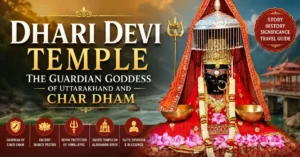
There are some places where you don’t just go for darshan. You feel something even before you reach. Dhari Devi Temple in Uttarakhand is one such sacred shrine, peacefully situated on the banks of the Alaknanda River amidst the majestic Himalayas.
It is one of the most revered temples in the Garhwal region and an important stop for many pilgrims undertaking the Char Dham Yatra.
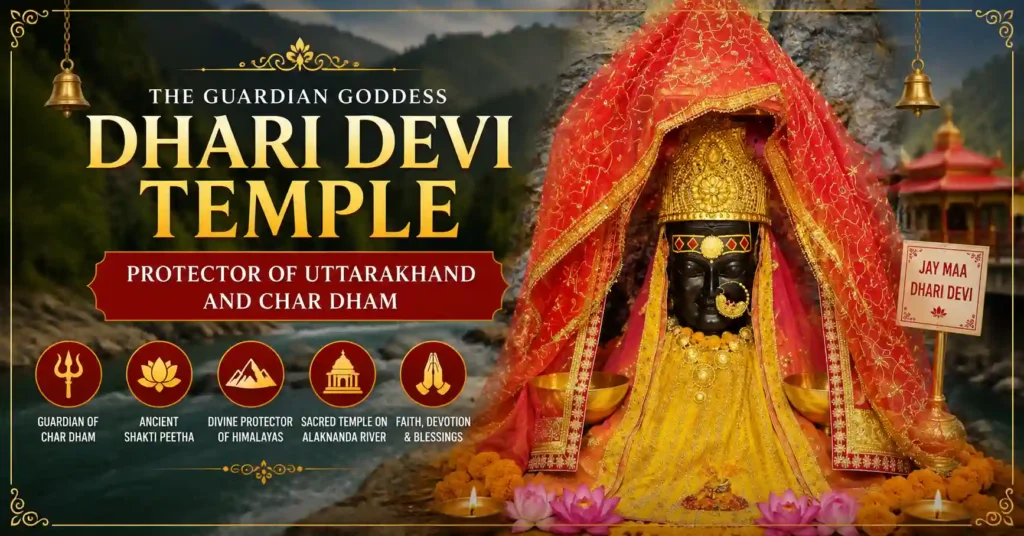
For countless devotees, Dhari Devi is not just a goddess. Worshipped as a powerful form of Maa Kali, she is revered as the Guardian Goddess of Char Dham, protecting the sacred Himalayan pilgrimage routes and watching over the people of Uttarakhand.
But who is Dhari Devi, and why has her temple inspired such deep faith for generations? In this article, you’ll discover the story of Dhari Devi, the history of Dhari Devi Temple, its unique traditions, connection with Char Dham, and the beliefs that continue to draw thousands of devotees every year.
Table of Contents
ToggleWho Is Dhari Devi?
Dhari Devi is a revered form of Maa Kali, worshipped as the guardian goddess of Uttarakhand.
| Attribute | Details |
|---|---|
| Deity | Maa Dhari Devi (a revered form of Goddess Kali) |
| Also Known As | Guardian Goddess of Uttarakhand and Char Dham |
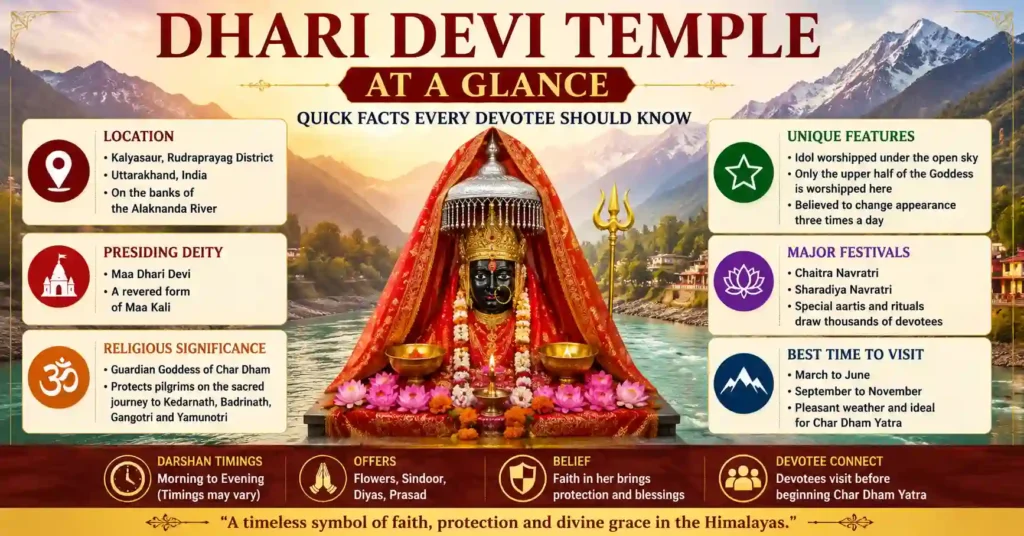
| Temple Location | Kalyasaur, Rudraprayag District, Uttarakhand, India |
| Situated On | Banks of the Alaknanda River |
| Religious Tradition | Shaktism (Shakta Tradition) |
| Significance | Believed to protect Uttarakhand and the Char Dham pilgrimage routes |
| Unique Feature | The temple enshrines only the upper half of the Goddess’s idol, while the lower half is traditionally worshipped at Kalimath |
| Major Festivals | Chaitra Navratri and Sharad Navratri |
| Daily Worship | Morning and Evening Aarti, Darshan, and Special Pujas |
| Best Time to Visit | March to June and September to November |
| Nearest Town | Srinagar Garhwal |
| Nearest Railway Station | Rishikesh Railway Station |
| Nearest Airport | Jolly Grant Airport, Dehradun |
| Ideal For | Pilgrims, devotees, Char Dham Yatra travelers, and spiritual seekers |
Did You Know?
Did you know that Dhari Devi Temple is believed to be protected by the Goddess herself? According to local traditions, Dhari Devi is revered as the Guardian Goddess of Uttarakhand and the protector of the Char Dham Yatra.
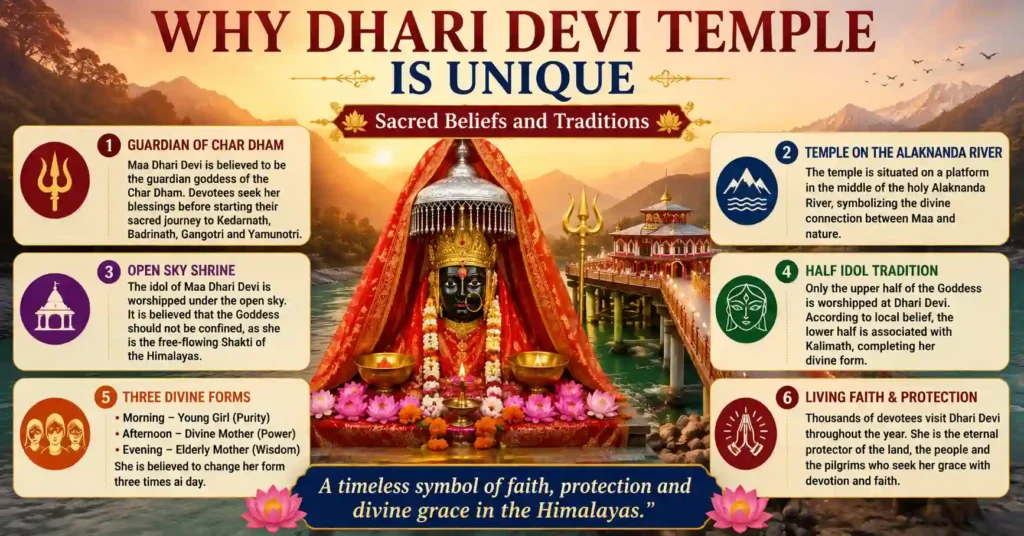
Devotees also believe that the Goddess appears in three different forms throughout the day, as a young girl (Kumari) in the morning, a youthful woman (Yuvati) in the afternoon, and an elderly mother (Vriddha Mata) in the evening.
Another unique tradition holds that only the upper half of her idol is worshipped at Dhari Devi Temple, while the lower half is traditionally worshipped at Kalimath, making this one of the most distinctive Goddess shrines in Uttarakhand.
Who Is Dhari Devi?
Dhari Devi is a revered form of Maa Kali and is worshipped as the Guardian Goddess of Uttarakhand. For centuries, devotees have believed that she protects the sacred Himalayan region, especially the pilgrimage routes leading to Kedarnath, Badrinath, Gangotri, and Yamunotri, collectively known as the Char Dham.
Although Dhari Devi is deeply connected with local traditions in the Garhwal region, her significance extends far beyond Uttarakhand. Thousands of pilgrims visit her temple every year to seek blessings for protection, safe travel, courage, and spiritual strength before beginning the Char Dham Yatra.
According to temple traditions and local beliefs, Dhari Devi is not only a powerful protector but also a divine force who maintains harmony between nature and human life. Her temple on the banks of the Alaknanda River has become a symbol of unwavering faith, where devotees experience both the serenity of the Himalayas and the presence of the Divine Mother.
Today, Dhari Devi continues to be one of the most revered Himalayan goddesses, inspiring generations of devotees with her grace, protection, and enduring spiritual presence.
Why Is Dhari Devi Called the Guardian Goddess of Char Dham?
Dhari Devi is widely revered as the Guardian Goddess of Char Dham. According to long-standing local traditions and the faith of devotees, she protects the sacred Himalayan pilgrimage routes leading to Kedarnath, Badrinath, Gangotri, and Yamunotri.
For generations, pilgrims have offered prayers to Dhari Devi before beginning the Char Dham Yatra, seeking her blessings for a safe, successful, and spiritually fulfilling journey. Many believe that her divine presence safeguards not only the pilgrims but also the mountains, rivers, and sacred land of Uttarakhand.
This deep spiritual connection has made Dhari Devi an inseparable part of the Char Dham pilgrimage. Even today, countless devotees visit Dhari Devi Temple to seek the Goddess’s protection before continuing their journey to the Himalayan shrines.
Note: The belief that Dhari Devi is the guardian of the Char Dham is based on long-standing local traditions and the faith of devotees, rather than on a specific scriptural reference.
The Story and Origin of Dhari Devi
The story of Dhari Devi has been preserved through generations in the oral traditions and temple beliefs of Uttarakhand. While historical records about the temple’s early origins are limited, devotees have long cherished a sacred legend that explains how the Goddess came to reside on the banks of the Alaknanda River.
According to local tradition, a devastating flood once swept through the Alaknanda River, carrying with it the upper half of a divine idol. The idol eventually came to rest on a large rock near the village of Kalyasaur. That night, the Goddess is believed to have appeared in the dream of a local villager and instructed that she be worshipped at the very place where the idol had stopped.
Honouring the divine command, the villagers established a shrine at the site. Over time, this humble place of worship evolved into the revered Dhari Devi Temple, which today attracts thousands of devotees from across India, especially those undertaking the Char Dham Yatra.
Another long-standing tradition holds that the lower half of the Goddess’s idol is worshipped at Kalimath Temple, while the upper half remains enshrined at Dhari Devi Temple. Together, these two sacred shrines are believed by devotees to represent the complete divine form of the Goddess.
For centuries, the story of Dhari Devi has remained an integral part of Uttarakhand’s spiritual heritage. More than a legend, it continues to strengthen the faith of devotees, who regard the Goddess as a compassionate protector watching over the Himalayas and the sacred Char Dham pilgrimage.
Why Is Only the Upper Half of Dhari Devi Worshipped?
One of the most fascinating aspects of Dhari Devi is that only the upper half of the Goddess’s idol is worshipped at Dhari Devi Temple. This unique tradition has been followed for generations and continues to inspire deep devotion among pilgrims.
According to local traditions, the upper half of the divine idol was discovered on a rock in the Alaknanda River near Kalyasaur and was consecrated at its present location. It is believed that the lower half of the Goddess is worshipped at Kalimath Temple, another revered Shakti shrine in Uttarakhand. Together, these two sacred temples are regarded by devotees as representing the complete divine form of the Goddess.
For devotees, this tradition symbolizes that Shakti is present in many forms and sacred places, yet remains one divine power. Visiting both shrines is considered spiritually significant by many pilgrims, especially those undertaking the Char Dham Yatra or exploring the Shakti Peeths of Uttarakhand.
Although different versions of this tradition exist, the belief continues to be an integral part of the living spiritual heritage of the Garhwal Himalayas and strengthens the deep faith associated with Dhari Devi.
The Three Divine Forms of Dhari Devi Throughout the Day
One of the most unique traditions associated with Dhari Devi is the belief that the Goddess manifests in three different forms during the course of a day. This long-standing temple tradition reflects her eternal power and the many aspects of the Divine Mother.
In the morning, devotees believe that Dhari Devi appears in the form of a young girl (Kumari), symbolizing purity, innocence, and new beginnings. This form represents hope, divine grace, and the nurturing energy of the Goddess.
By afternoon, the Goddess is believed to manifest as a young woman (Yuvati), representing strength, courage, and the active power of Shakti. During this time, devotees offer prayers seeking protection, success, and the strength to overcome life’s challenges.
In the evening, Dhari Devi is traditionally worshipped as an elderly woman (Vriddha Mata), symbolizing wisdom, compassion, and spiritual fulfillment. This form reminds devotees of the Goddess’s role as a loving guide who blesses them with peace, knowledge, and inner strength.
This beautiful tradition highlights the belief that the Divine Mother accompanies her devotees through every stage of life. It also reflects the timeless nature of Dhari Devi, who is worshipped as both a compassionate mother and the powerful guardian of the Himalayan region.
Where Is Dhari Devi Temple and Why Is It So Unique?
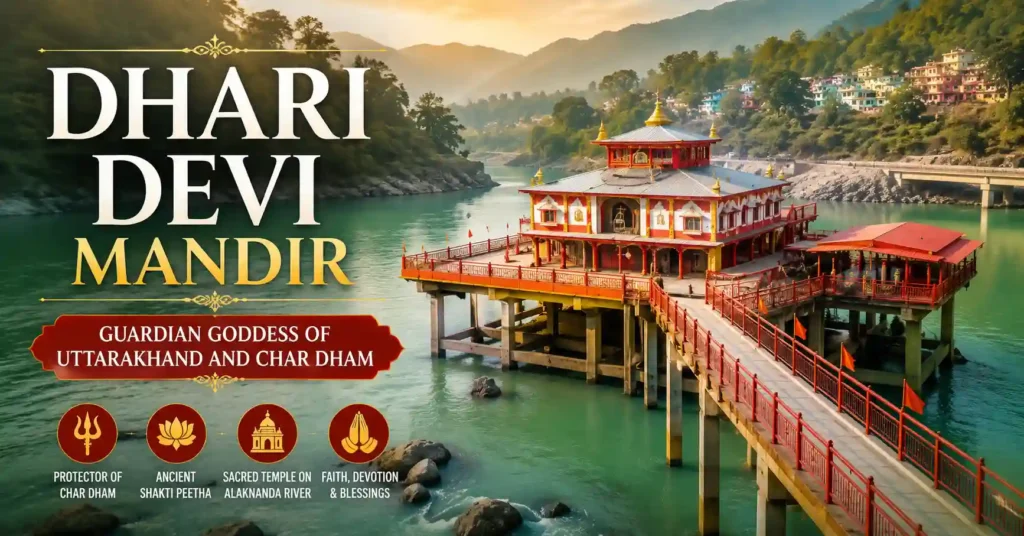
Dhari Devi Temple is located at Kalyasaur in the Rudraprayag district of Uttarakhand, between Srinagar and Rudraprayag. The temple stands on a rocky platform above the sacred Alaknanda River, surrounded by the serene beauty of the Garhwal Himalayas.
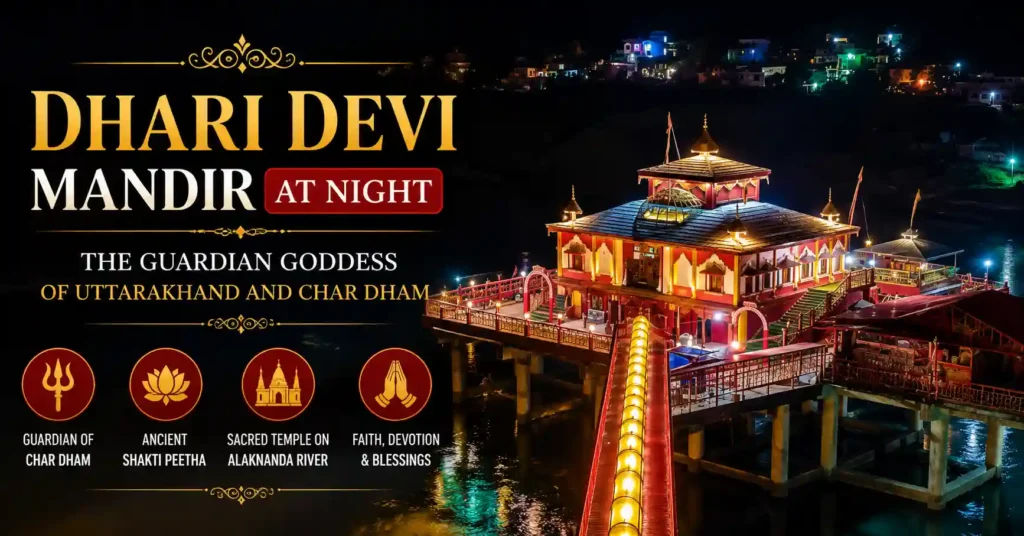
What makes this temple truly unique is its location. Unlike most temples built on hills or within towns, Dhari Devi Temple is situated in the middle of the flowing river. Its peaceful setting amidst the Himalayas creates a rare combination of natural beauty and spiritual tranquility, making it one of the most distinctive temples in Uttarakhand.
Reaching the temple is a memorable experience. Pilgrims walk down a flight of steps and cross a pedestrian bridge before entering the shrine. The sound of the Alaknanda River, the fresh mountain air, and the peaceful surroundings create an atmosphere of devotion that leaves a lasting impression on visitors.
Spiritual Significance of Dhari Devi
For devotees, Dhari Devi is much more than a revered deity. She is worshipped as the Divine Mother who offers protection, strength, and guidance during life’s challenges. Many people pray to her for courage, family well-being, and success before undertaking important journeys.
The Goddess is especially revered by pilgrims travelling to the Char Dham, who seek her blessings for a safe and spiritually fulfilling pilgrimage. Her temple has become a place where devotees offer prayers with faith, believing that the Goddess watches over those who seek her refuge.
Surrounded by the peaceful flow of the Alaknanda River and the Himalayan landscape, Dhari Devi Temple provides an atmosphere of devotion and inner peace. Whether visiting for darshan or quiet prayer, devotees leave with a sense of hope, gratitude, and a deeper connection with the Divine.
Festivals and Rituals at Dhari Devi Temple
Dhari Devi Temple is a vibrant centre of worship throughout the year, where daily prayers and special festivals are celebrated with great devotion. Devotees visit the temple to offer flowers, coconuts, incense, and prayers, seeking the blessings of the Goddess for protection, prosperity, and spiritual well-being.
The temple witnesses its largest gatherings during Chaitra Navratri and Sharad Navratri, when thousands of devotees from Uttarakhand and across India come for darshan. These nine-day festivals are marked by special pujas, devotional singing, and a deeply spiritual atmosphere.
Daily aarti and regular rituals are performed by the temple priests, allowing devotees to participate in the traditional worship of Dhari Devi. Whether visiting during a major festival or on an ordinary day, the temple offers a peaceful and deeply devotional experience.
Temple Timings, Aarti, and Best Time to Visit
| Information | Details |
|---|---|
| Temple Timings | Generally open from 6:00 AM to 7:00 PM (Timings may vary on festivals and special occasions.) |
| Morning Aarti | Performed in the morning as part of the daily worship rituals. |
| Evening Aarti | Performed before the temple closes in the evening. |
| Best Time to Visit | March to June and September to November offer pleasant weather and comfortable travel conditions. |
| Char Dham Season | The temple receives a large number of pilgrims during the Char Dham Yatra season. |
| Monsoon Advisory | Travel during the monsoon (July–August) should be planned carefully due to heavy rainfall and possible landslides in the Himalayan region. |
Note: Temple timings and aarti schedules may change on festivals and special occasions. It is advisable to confirm the latest timings before planning your visit.
How to Reach Dhari Devi Temple
Located in the Rudraprayag district of Uttarakhand, Dhari Devi Temple is easily accessible by road and is a popular stop for pilgrims travelling to the Char Dham.
Distance from Major Cities
| City | Approximate Distance |
|---|---|
| Rishikesh | 135 km |
| Haridwar | 155 km |
| Dehradun | 170 km |
| Srinagar (Garhwal) | 15 km |
| Rudraprayag | 35 km |
| Kedarnath (via Gaurikund) | 95 km |
| Badrinath | 150 km |
Travel Options
| Mode | Details |
|---|---|
| By Road | Dhari Devi Temple is well connected by road. Regular buses, shared jeeps, and taxis operate from Rishikesh, Haridwar, Srinagar (Garhwal), and Rudraprayag. |
| By Rail | The nearest major railway stations are Rishikesh and Haridwar, both offering good connectivity to major Indian cities. |
| By Air | The nearest airport is Jolly Grant Airport, Dehradun, about 170 km away. Taxis and buses are available from the airport. |
Local Transport
After reaching Kalyasaur, visitors can park their vehicles and walk a short distance to the temple. A flight of steps and a pedestrian bridge lead to the shrine, making the final stretch of the journey both scenic and spiritually uplifting.
Google Map of Dhari Devi Temple
Planning your visit is easier with the official Google Maps location of Dhari Devi Temple. The temple is located near Kalyasaur in Rudraprayag district, Uttarakhand, on the banks of the sacred Alaknanda River between Srinagar Garhwal and Rudraprayag. You can use the map below for accurate directions, estimated travel time, and nearby facilities before starting your journey.
Nearby Places to Visit Near Dhari Devi Temple
A visit to Dhari Devi Temple can easily be combined with several other sacred and scenic destinations in Uttarakhand. Many pilgrims include these places in their itinerary while travelling on the Char Dham route.
| Place | Approximate Distance | Why Visit |
|---|---|---|
| Kalimath Temple | 55 km | A revered Shakti temple where, according to local tradition, the lower half of the Goddess is worshipped. |
| Rudraprayag | 35 km | Sacred confluence of the Alaknanda and Mandakini rivers, associated with Lord Shiva. |
| Srinagar (Garhwal) | 15 km | A historic town offering accommodation, dining, and shopping facilities. |
| Devprayag | 70 km | The holy confluence of the Alaknanda and Bhagirathi rivers, where the Ganga is believed to originate. |
| Koteshwar Mahadev Temple | 38 km | An ancient cave temple dedicated to Lord Shiva, located near Rudraprayag. |
This section gives readers practical travel suggestions while naturally connecting Dhari Devi Temple with other important spiritual destinations in Uttarakhand.
Interesting Facts About Dhari Devi
- Dhari Devi is widely revered as the Guardian Goddess of the Char Dham, and many pilgrims seek her blessings before beginning their sacred journey.
- The temple is uniquely situated on a platform above the Alaknanda River, making it one of the most distinctive temples in Uttarakhand.
- According to local tradition, only the upper half of the Goddess’s idol is worshipped at Dhari Devi Temple, while the lower half is believed to be enshrined at Kalimath Temple.
- Temple traditions believe that Dhari Devi manifests in three different forms during the day: a young girl in the morning, a young woman in the afternoon, and an elderly woman in the evening.
- Thousands of devotees visit the temple every year, especially during Navratri and the Char Dham Yatra season.
- The temple is surrounded by the breathtaking landscapes of the Garhwal Himalayas, offering devotees both spiritual peace and scenic beauty.
Conclusion
Dhari Devi is more than a revered goddess of Uttarakhand. She is a living symbol of faith, protection, and the enduring spiritual traditions of the Himalayas. From her sacred connection with the Char Dham Yatra to the unique traditions surrounding her temple on the banks of the Alaknanda River, every aspect of her worship reflects the deep devotion of generations of pilgrims.
Whether you visit Dhari Devi Temple to seek blessings before embarking on the Char Dham pilgrimage or simply to experience the serenity of this sacred shrine, the Goddess continues to inspire countless devotees with her divine grace and compassionate presence.
May Dhari Devi bless you with protection, strength, wisdom, and a safe spiritual journey, guiding your path with her eternal grace. 🙏
Suggested Reading
Continue exploring the rich spiritual heritage of Sanatan Dharma with these related articles:
Nanda Devi: The Beloved Goddess of Kumaon and Garhwal
https://thesanatantales.com/nanda-devi-story-history-festival
Goludevta: The Folk God of Justice in Uttarakhand
https://thesanatantales.com/goludevta-folk-god-of-justice/
Khodiyar Maa: Story, History, Temples, Miracles and the Beloved Kuldevi of Gujarat
https://thesanatantales.com/khodiyar-maa/
Powerful Bhairav Worship in North Indian Villages as Kshetrapal & Gram Devta
https://thesanatantales.com/bhairav-worship-in-north-indian-villages/
Sapta Puri: The Seven Sacred Cities of Sanatan Dharma
https://thesanatantales.com/sapta-puri/
Folk Deities of Uttarakhand and Himachal: Gods of Hills and Forests
https://thesanatantales.com/folk-deities-of-uttarakhand-and-himachal/
Dhari Devi (Wikipedia)
https://en.wikipedia.org/wiki/Dhari_Devi
FAQs
Who is Dhari Devi?
Dhari Devi is a revered form of Goddess Kali and is worshipped as the guardian deity of Uttarakhand. According to local traditions, she protects the sacred Himalayan region and watches over pilgrims traveling to the Char Dham shrines of Kedarnath, Badrinath, Gangotri, and Yamunotri.
Devotees believe that seeking her blessings before beginning the Char Dham Yatra brings protection, courage, and a safe pilgrimage. Thousands of pilgrims visit the temple each year to offer prayers and seek the Goddess’s divine grace.
Beyond her religious significance, Dhari Devi represents the deep spiritual heritage and living traditions of the Garhwal Himalayas, making her one of the most revered deities in Uttarakhand.
Where is Dhari Devi Temple located?
Dhari Devi Temple is situated near Kalyasaur in the Rudraprayag district of Uttarakhand. The temple stands on a platform above the Alaknanda River, approximately midway between Srinagar Garhwal and Rudraprayag on National Highway 7.
Its unique riverside location, surrounded by the majestic Himalayan landscape, makes it one of the most picturesque temples in the region.
Thousands of devotees stop here every year before continuing their journey to the Char Dham pilgrimage sites, making the temple an important spiritual landmark.
Why is Dhari Devi known as the Guardian Goddess of Char Dham?
According to long-standing traditions in Uttarakhand, Dhari Devi is regarded as the divine protector of the Char Dham pilgrimage. Pilgrims believe that her blessings safeguard those traveling through the challenging Himalayan routes to Kedarnath, Badrinath, Gangotri, and Yamunotri.
For generations, devotees have offered prayers at Dhari Devi Temple before beginning their sacred journey. This practice reflects the deep faith associated with the Goddess and her role as the protector of pilgrims.
Although this belief is rooted in local traditions and oral history rather than a single scriptural source, it remains an integral part of the Char Dham pilgrimage.
Why is only the upper half of Dhari Devi worshipped at the temple?
One of the most distinctive features of Dhari Devi Temple is that only the upper half of the Goddess’s idol is enshrined there. According to local beliefs, the lower half of the idol is worshipped at Kalimath, another revered Shakti shrine in Uttarakhand.
Devotees consider both temples spiritually connected, believing that together they represent the complete divine form of the Goddess.
This unique tradition has been preserved for generations and continues to inspire devotion among pilgrims visiting both sacred shrines.
What are the temple timings and daily Aarti schedule?
Dhari Devi Temple generally opens early in the morning and remains accessible until evening. The exact timings may vary slightly depending on the season and the temple administration.
Daily worship includes morning and evening Aarti, when priests perform traditional rituals accompanied by devotional chants and prayers.
Many visitors prefer to attend the Aarti, as it offers a peaceful and spiritually uplifting experience in the serene surroundings of the Alaknanda River.
Which festivals are celebrated at Dhari Devi Temple?
Dhari Devi Temple celebrates several Hindu festivals throughout the year, with Chaitra Navratri and Sharad Navratri being the most important. During these festivals, the temple is beautifully decorated, and special prayers and rituals are performed.
Thousands of devotees gather to participate in the celebrations and seek the blessings of the Goddess.
Apart from these major festivals, daily worship and regular religious ceremonies continue throughout the year, making the temple an active center of devotion.
When is the best time to visit Dhari Devi Temple?
The best time to visit Dhari Devi Temple is between March and June and again from September to November, when the weather is pleasant and travel conditions are generally favorable.
Many pilgrims also visit during the Char Dham Yatra season to seek the blessings of the Goddess before continuing their pilgrimage.
If you plan to visit during the monsoon months, it is advisable to check the weather and road conditions in advance, as heavy rainfall can occasionally affect travel in the Himalayan region.
Can Dhari Devi Temple be visited during the Char Dham Yatra?
Yes. Visiting Dhari Devi Temple before beginning the Char Dham Yatra is a long-standing tradition followed by many pilgrims.
Since the temple lies on a major route leading toward Kedarnath and Badrinath, it serves as an important spiritual stop where devotees seek the blessings of the Goddess.
According to local belief, offering prayers at Dhari Devi Temple before the pilgrimage invokes her divine protection, making the journey safer and spiritually more meaningful.
Glossary of Important Terms
| Term | Meaning |
|---|---|
| Dhari Devi | A revered form of Goddess Kali worshipped as the guardian deity of Uttarakhand and the protector of the Char Dham pilgrimage, according to local traditions. |
| Char Dham Yatra | The sacred pilgrimage to the four Himalayan shrines of Kedarnath, Badrinath, Gangotri, and Yamunotri, regarded as one of the holiest journeys in Sanatan Dharma. |
| Shakti | The divine feminine energy in Sanatan Dharma, worshipped as the supreme cosmic power and manifested through various forms of the Goddess. |
| Shakti Peetha | A sacred shrine dedicated to the Divine Mother. These temples hold immense spiritual significance in the Shakta tradition. |
| Alaknanda River | One of the two primary headstreams of the Ganga River. Dhari Devi Temple is located on its banks in Uttarakhand. |
| Garhwal Himalayas | The Himalayan region of Uttarakhand known for its ancient temples, sacred rivers, and important pilgrimage destinations. |
| Kalimath | A revered Shakti shrine in Uttarakhand where, according to local beliefs, the lower half of Dhari Devi’s idol is worshipped. |
| Kalyasaur | A village in the Rudraprayag district of Uttarakhand where the Dhari Devi Temple is situated. |
| Rudraprayag | A sacred district of Uttarakhand where the Alaknanda and Mandakini rivers meet. It is also home to the famous Dhari Devi Temple. |
| Navratri | A nine-night Hindu festival dedicated to the worship of the Divine Mother. Chaitra Navratri and Sharad Navratri are the major festivals celebrated at Dhari Devi Temple. |
| Aarti | A devotional Hindu ritual in which lighted lamps are offered to the deity while hymns and prayers are sung. |
| Darshan | The sacred act of seeing and receiving blessings from a deity in a temple, considered an important part of Hindu worship. |
About the Author
Yateendra Chaturvedi is a spiritual writer, researcher, devotee, and the founder of The Sanatan Tales. With over 35 years of professional experience and a lifelong interest in Sanatan Dharma, he writes about Hindu deities, temples, scriptures, festivals, Mahavidyas, sacred stories, rituals, and living traditions that continue to guide and inspire devotees across India.
Drawing from traditional scriptures, regional beliefs, temple traditions, devotional literature, and historical sources, he aims to present authentic, well-researched, and easy-to-understand content for modern readers. His work focuses on preserving spiritual wisdom, explaining sacred traditions, and helping seekers develop a deeper understanding of India’s rich spiritual heritage.
Through The Sanatan Tales, Yateendra strives to make the timeless teachings of Sanatan Dharma simple, meaningful, and relevant for today’s generation while maintaining respect for traditional sources, regional practices, and diverse spiritual perspectives.
Learn More About Yateendra Chaturvedi →
https://thesanatantales.com/about-the-author/
References & Sources
This article is based on beliefs and traditions followed within Sanatan Dharma, local religious customs, temple traditions, devotional practices, and information drawn from traditional knowledge, spiritual literature, and various religious study sources. It also reflects oral traditions and cultural heritage that have been preserved by devotees and local communities over generations.
Note: Beliefs, interpretations, and religious practices may vary across different regions, traditions, sects, and lineages within Sanatan Dharma. The purpose of this article is not to present any single viewpoint as the absolute truth, but to explain widely accepted religious and cultural perspectives in a simple, respectful, and accessible manner.
Explore More Fascinating Topics from Sanatan Dharma