
Among the Das Mahavidyas, Maa Dhumavati stands apart in a way that makes many devotees uneasy. She does not promise comfort, beauty, or abundance.
She arrives when everything familiar has already fallen away. Loss, silence, hunger, old age, failure, isolation, and emptiness are her domain. Yet within these very states, she hides one of the deepest truths of Sanatan Dharma.
Often described as the Goddess of Emptiness, Detachment and Liberation, Maa Dhumavati represents the wisdom that emerges when worldly attachments lose their power and the soul begins seeking something beyond temporary fulfillment.
Maa Dhumavati is the seventh Mahavidya, worshipped not for worldly success but for liberation. She represents the moment when desire ends, when hope collapses, and when the soul stands alone before reality.
Serious seekers understand that this stage is unavoidable on the path of wisdom. That is why her worship has always remained limited, secretive, and demanding.
To understand Maa Dhumavati is to understand what remains when nothing else survives.
Table of Contents
ToggleMaa Dhumavati in the Dash Mahavidya Tradition
In the Dash Mahavidya path, each goddess reveals a specific stage of inner awakening. Maa Dhumavati appears after intense purification and before the stilling power of higher realization. She represents the aftermath, not the battle.
Unlike Maa Kali or Maa Bhairavi, who actively destroy illusion, Maa Dhumavati presides over what is left once illusion has already collapsed.
She does not fight ignorance. She reveals the emptiness that remains when false identities, desires, and attachments begin to lose their hold on the mind.
Her presence signals a stage of spiritual exhaustion where the seeker no longer runs after pleasure, fear, status, or recognition. Old motivations lose their power, yet the final state of wisdom has not fully dawned.
In this sense, Maa Dhumavati Mahavidya is not about action but about the stillness that follows inner collapse.
Her traditional position between Maa Bhairavi and Maa Bagalamukhi is deeply symbolic. Bhairavi burns impurities through spiritual fire. Dhumavati reveals the silent void that follows that burning.
Only after passing through this experience of emptiness does the seeker become ready for the deeper inner stillness represented by Bagalamukhi.
She is not invoked for wealth, marriage, fame, or victory. She is approached by those who are tired of pretending and ready to face truth without decoration.
Through her, the seeker learns that spiritual growth is not only about gaining wisdom but also about letting go of everything that prevents wisdom from appearing.
Maa Dhumavati’s Place in the Mahavidya Journey
The Dash Mahavidyas are often understood as stages of spiritual awakening rather than ten separate goddesses. Each Mahavidya reveals a different aspect of consciousness and guides the seeker through a particular inner transformation.
Maa Dhumavati appears after the intense purification associated with Maa Bhairavi and before the stilling power of Maa Bagalamukhi.
This position is deeply symbolic. Bhairavi burns impurities through spiritual fire, while Dhumavati reveals what remains after that burning is complete.
She represents the stage where worldly ambitions, identities, attachments, and expectations begin to lose their hold.
The seeker may experience emptiness, uncertainty, loneliness, or a sense of standing between two worlds. In many traditions, this is considered a necessary phase of spiritual maturity.
Only after passing through this inner void does the seeker become ready for the deeper states represented by the later Mahavidyas.
In this way, Maa Dhumavati is not an interruption in the journey but an essential bridge between purification and transcendence.
Why Maa Dhumavati Has No Consort
Maa Dhumavati is the only Mahavidya shown without a consort. This is not a social statement. It is a metaphysical one.
In Tantra, Shiva represents consciousness and Shakti represents energy. Creation exists when both operate together. Dhumavati appears after dissolution, when creation has ended.
Shiva has withdrawn, leaving behind pure Shakti in a state of smoke, silence, and suspension.
This is why she is called the widow goddess, not as a sign of weakness, but as a symbol of absolute independence. She does not sustain life, nor does she decorate it. She remains when nothing else functions.
Some traditions describe her as Shakti without Shiva. Others call her the power of post-creation. Both point toward the same truth: Maa Dhumavati exists beyond relationship, beyond roles, beyond continuity.
At a deeper level, her widowhood symbolizes freedom from dependence on external identities. In ordinary life, people define themselves through relationships, possessions, achievements, and social roles.
Maa Dhumavati stands beyond all such definitions. She represents a state where consciousness no longer seeks completion through anything outside itself.
For this reason, many Shakta traditions view her as a powerful symbol of non-attachment.
She teaches that spiritual freedom begins when the seeker stops searching for fulfillment in temporary forms and turns inward toward the eternal reality that remains unchanged.
Origin Stories of Maa Dhumavati
Two major origin narratives are associated with Maa Dhumavati in Tantric traditions. Like many Mahavidya stories, these accounts are not always meant to be read as literal historical events. They are symbolic teachings that reveal deeper spiritual truths.
One tradition connects Maa Dhumavati with the story of Sati during Daksha’s yajna. After being insulted by her father, Sati immolated herself in yogic fire. Some Tantric interpretations describe Dhumavati as emerging from the smoke that remained after this act.
In this understanding, she embodies grief, loss, dissolution, and the silent emptiness that follows destruction. What survives after form is consumed becomes her domain.
Another well-known legend describes Sati becoming overwhelmed by hunger and swallowing Lord Shiva. When Shiva emerged from her body, he declared that she would assume the form of a widow.
While this story may appear harsh on the surface, Tantric traditions interpret it symbolically rather than literally.
Hunger in this narrative represents the endless emptiness that drives creation itself. Swallowing Shiva symbolizes the absorption of consciousness into primordial energy.
The widow form represents a state beyond worldly relationships, where all familiar structures have dissolved into the unmanifest.
Both stories point toward the same spiritual principle. Maa Dhumavati is not born from prosperity, celebration, or creation.
She emerges from dissolution. She appears when forms break down, attachments lose their meaning, and the seeker is forced to confront reality without distraction.
For this reason, many Shakta traditions view her not as a goddess of misfortune, but as the wisdom hidden within loss.
What appears frightening on the surface becomes a doorway to deeper understanding when seen through the lens of spiritual awakening.
Outer Form and Iconography of Maa Dhumavati
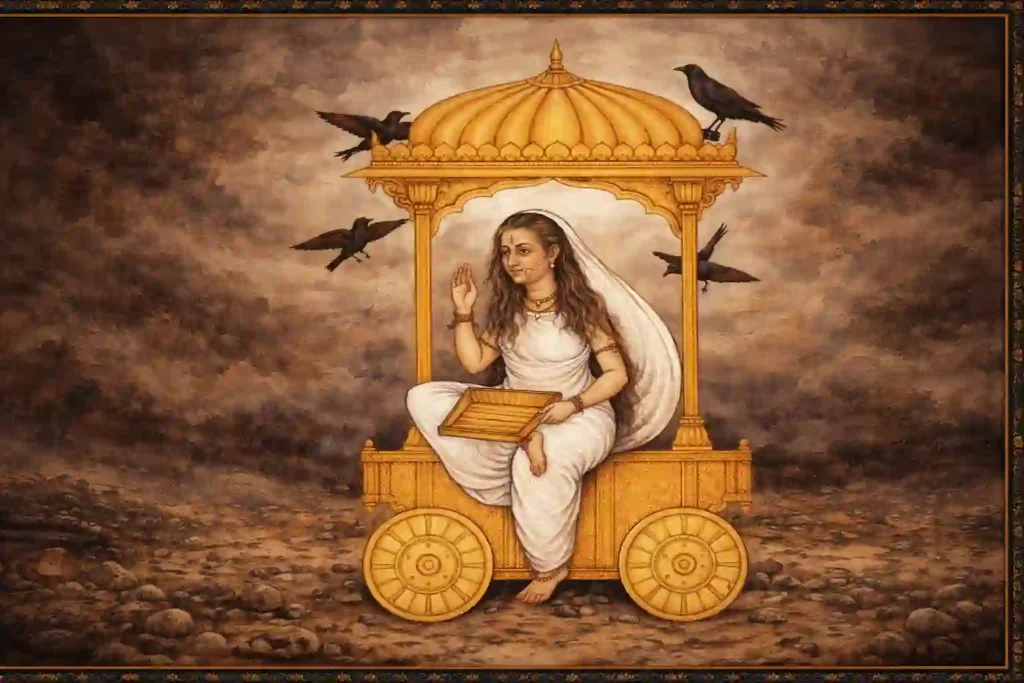
Maa Dhumavati is intentionally depicted in a form that challenges ordinary expectations of divinity. Unlike many Hindu goddesses who are shown as youthful, radiant, and beautifully adorned, Dhumavati appears old, thin, and weary.
Her complexion is often described as pale, smoky, or ash-like. Her hair is disheveled, her face wrinkled, and her expression serious or sorrowful.
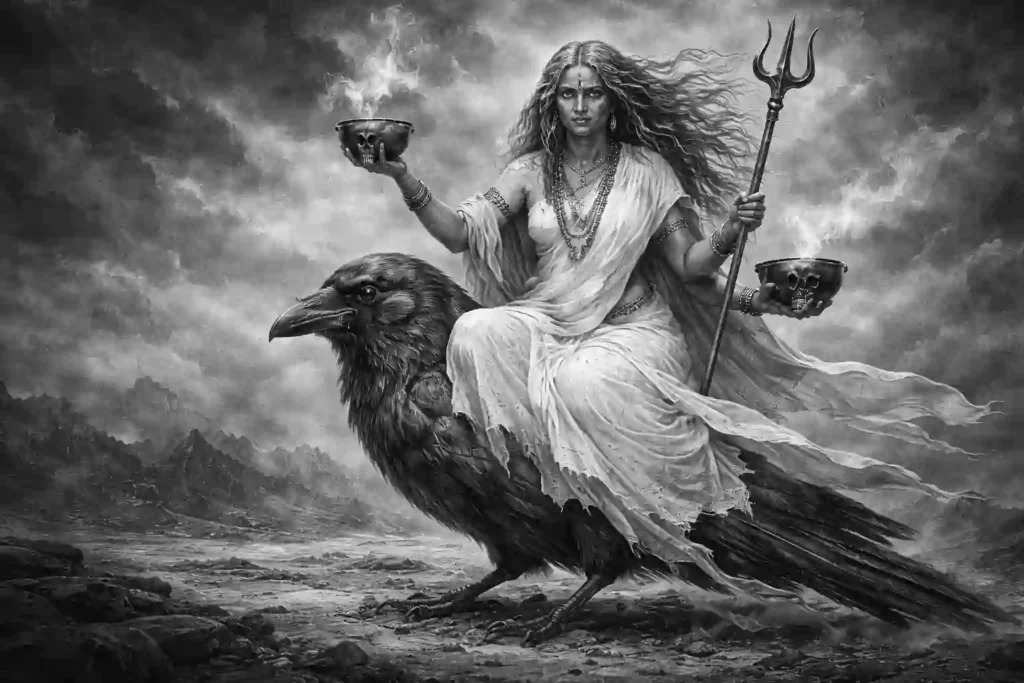
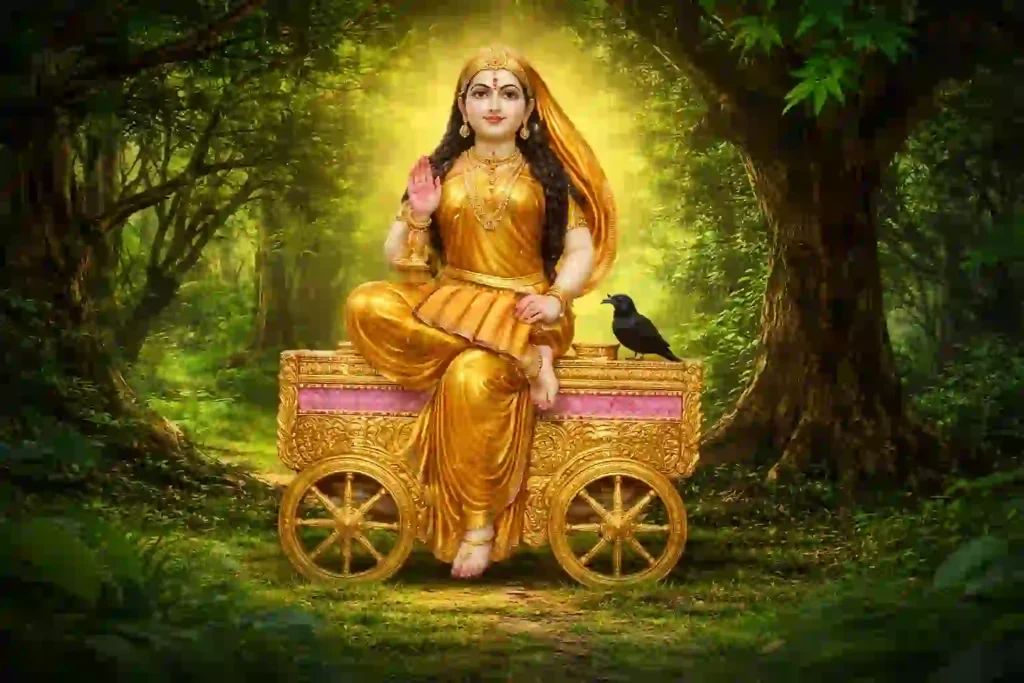
She wears simple widow garments, usually without ornaments, jewelry, or signs of prosperity. In many depictions, she holds a winnowing basket and rides a crow or a chariot without horses.
Every element of her appearance carries symbolic meaning rather than serving as decoration.
Her form deliberately rejects the qualities that people commonly associate with success, beauty, and worldly fulfillment.
Through this appearance, she teaches that spiritual truth is not dependent upon youth, wealth, status, or external attractiveness.
The image of old age reminds seekers of the impermanent nature of physical existence. Her widow form points toward independence from worldly attachments and social identities.
Her unadorned appearance reflects a reality stripped of illusion, where nothing remains except what is essential.
For many devotees, her iconography serves as a direct confrontation with the fears people often avoid, including aging, loss, loneliness, and uncertainty.
Rather than hiding these realities, Maa Dhumavati brings them into view and transforms them into opportunities for wisdom.
Nothing in her form invites desire. This is deliberate. In her presence, the mind finds no comfortable illusion to cling to. Her appearance teaches that truth does not always arrive dressed as comfort, beauty, or reward.
Sometimes it arrives as a mirror reflecting everything the seeker must learn to accept and transcend.
Inner Meaning of Her Sacred Symbols
Every symbol associated with Maa Dhumavati carries layered spiritual meaning. Her iconography is not decorative. It is designed to teach the seeker about impermanence, discernment, and detachment.
Smoke is one of her most important symbols. It exists between visibility and invisibility, revealing that something has already been consumed while obscuring what comes next.
Spiritually, it represents the state where illusion has begun to dissolve but complete realization has not yet appeared.
The winnowing basket symbolizes viveka, the power of spiritual discrimination. Just as grain is separated from husk, Maa Dhumavati helps the seeker distinguish the eternal from the temporary and the essential from the unnecessary.
The crow is associated with ancestors, death, survival, and liminal spaces. In Dhumavati worship, it represents the ability to endure when familiar structures collapse and to find wisdom in what others reject or overlook.
Her horseless chariot reflects a state where worldly ambitions no longer drive the soul. What appears as stagnation from the outside becomes inner stillness and freedom from restless desire.
Her widowhood is one of her most misunderstood symbols. Spiritually, it represents complete independence from external identities, relationships, and supports. She stands alone because she points toward a reality beyond dependence and duality.
Her old age symbolizes the wisdom that emerges when worldly fascination has been exhausted. Her hunger reflects the inability of temporary things to satisfy the deeper longing of the soul.
Her unattractive appearance challenges attachment to beauty, status, and social approval, reminding seekers that truth is not measured by outward appearance.
Together, these symbols reveal the deeper purpose of Maa Dhumavati. She strips away illusions, exposes impermanence, and guides the seeker toward a state where inner freedom no longer depends on the changing conditions of life.
Maa Dhumavati and the Philosophy of Shunya
Maa Dhumavati embodies shunya, the void. This void is not emptiness in the ordinary sense. In Sanatan philosophy, shunya is fullness without form, the silent source from which creation emerges and into which it eventually returns.
Dhumavati represents the interval between these cycles. She is associated with Mahapralaya, the great cosmic dissolution, when names, forms, worlds, and even time itself return to an unmanifest state. In this sense, she symbolizes the stillness that exists before creation begins again.
She is also linked with yoganidra, the cosmic state in which consciousness rests without thought or activity. This is not unconsciousness but pure awareness without an object of focus.
For spiritual seekers, this cosmic principle has a deeply personal meaning. Just as the universe periodically dissolves into stillness, individuals also pass through phases where old identities, beliefs, desires, and attachments begin to fall away. Maa Dhumavati presides over this process of inner dissolution.
Encountering Dhumavati means learning to remain present when familiar supports disappear and nothing seems to respond. Through this experience, she prepares the seeker for deeper wisdom, non-attachment, and spiritual realization.
Connection with Older Vedic and Folk Deities
Maa Dhumavati carries traits associated with several older deities and symbolic figures found in Hindu traditions.
Nirriti, a Vedic goddess, was linked with decay, disorder, misfortune, and the breakdown of cosmic order. Jyestha represented decline, old age, conflict, and the less desirable aspects of worldly life. Alakshmi was associated with poverty, scarcity, and the absence of prosperity.
Many scholars and Shakta traditions see echoes of these figures in Maa Dhumavati because she also embraces realities that society often fears or avoids. Old age, loss, disappointment, isolation, and impermanence all appear within her symbolism.
However, an important difference exists. Nirriti, Jyestha, and Alakshmi are generally associated with inauspicious conditions themselves, while Maa Dhumavati transforms these conditions into a path of wisdom.
She does not merely represent suffering. She reveals the spiritual lessons hidden within suffering.
Some regional and folk traditions also preserve forms of elderly, solitary, or protective mother goddesses who guard boundaries, cremation grounds, remote places, or periods of transition.
Although these figures are not always identified directly with Dhumavati, they reflect similar themes of liminality, survival, and transformation.
For this reason, many practitioners view Maa Dhumavati as a bridge between ancient Vedic concepts, folk traditions, and later Tantric philosophy.
What earlier traditions often regarded as misfortune or decline becomes, in her worship, a doorway to detachment, self-knowledge, and liberation.
Who Traditionally Worships Maa Dhumavati
Her worship has traditionally been considered more restricted than that of most other forms of the Divine Mother.
Sanyasis, renunciates, widows, and advanced Tantric practitioners have often been drawn to Maa Dhumavati because her symbolism centers on detachment, impermanence, and freedom from worldly identity.
Those already moving away from social ambitions and material attachments naturally find resonance with her teachings.
Many Tantric lineages advise caution regarding intensive home worship of Maa Dhumavati, especially for those seeking worldly prosperity, relationships, or material success.
Her energy is traditionally understood as inward-turning, encouraging renunciation, reflection, and non-attachment rather than external achievement.
However, these restrictions are not universal. Practices vary widely across regions, temples, and spiritual lineages. In places such as Kashi, Maa Dhumavati is worshipped openly as a protective mother, and householders visit her temple without fear.
Devotees often seek her blessings during periods of loss, uncertainty, illness, or spiritual difficulty.
This diversity reflects an important feature of Sanatan Dharma. Textual traditions may emphasize one aspect of a deity, while living temple traditions may highlight another.
As a result, Maa Dhumavati can be viewed both as a profound Tantric Mahavidya and as a compassionate guardian who helps devotees navigate life’s most challenging phases.
Tantric Worship and Accepted Practices
Maa Dhumavati Tantra is traditionally regarded as one of the more austere and inward-focused streams of Mahavidya worship. Unlike forms of devotion centered on prosperity, protection, or worldly blessings, her sadhana emphasizes detachment, self-confrontation, and spiritual maturity.
Worship is often performed during the night, especially on Amavasya, Saturdays, or other spiritually significant periods associated with introspection.
Silence plays an important role in many traditions. Solitude is frequently preferred because her path encourages the seeker to face inner fears, attachments, and uncertainties without distraction.
Cremation grounds are sometimes associated with Maa Dhumavati because they symbolize impermanence and the inevitable dissolution of worldly identities.
In Tantric symbolism, such places remind practitioners to look beyond appearances and confront the temporary nature of all forms.
Certain lineages also preserve Vamachara practices connected with Maa Dhumavati. These traditions are highly specialized and transmitted under the guidance of qualified teachers.
Their purpose is not indulgence or rebellion but the transcendence of fear, aversion, and dualistic thinking. Without proper initiation and guidance, such practices are neither recommended nor understood correctly.
At its deepest level, Maa Dhumavati Tantra is not about acquiring power. It is about learning to remain steady when familiar comforts disappear. Fear is not avoided in her worship. It is faced, understood, and ultimately transcended.
Offerings Offered to Maa Dhumavati
Unlike many forms of the Divine Mother, Maa Dhumavati is not traditionally associated with elaborate decorations, luxurious offerings, or expressions of prosperity. Her worship reflects simplicity, austerity, and detachment.
Common offerings include black sesame seeds, mustard oil lamps, dry coconut, and simple food prepared without extravagance. These offerings symbolize humility, restraint, and the acceptance of life’s harsher realities rather than the pursuit of comfort and abundance.
In many traditions, the value of the offering lies less in its material worth and more in the attitude of the devotee. Maa Dhumavati is often approached through sincerity, silence, reflection, and inner surrender rather than outward display.
Certain Tantric lineages also preserve specialized offerings involving substances such as meat, liquor, bhang, or cigarettes. These practices belong to specific traditions and are symbolic in nature, often connected with confronting social conditioning, impurity, fear, and duality. They should never be imitated casually or practiced outside proper guidance.
The deeper meaning behind her offerings is consistent with her overall symbolism. They reflect a life stripped of excess, where the seeker learns to find truth beyond comfort, pleasure, and worldly attachment.
Mantras of Maa Dhumavati
The most commonly known mantra associated with Maa Dhumavati is:
ॐ धूं धूं धूमावती देव्यै स्वाहा॥
In this mantra, the bija syllable धूं (Dhum) is traditionally associated with the energy of dissolution, detachment, and the removal of illusion. Devotees believe that the mantra helps bring clarity during periods of confusion, stagnation, grief, or inner uncertainty.
The mantra is not traditionally approached as a tool for material gain. Instead, it is connected with self-reflection, non-attachment, and the gradual dissolution of limiting patterns within the mind.
Many practitioners regard it as a mantra that encourages spiritual maturity rather than worldly achievement.
Maa Dhumavati is also associated with Gayatri and Tantric mantras found in various Shakta traditions. These mantras focus on understanding the deeper wisdom hidden within impermanence, loss, and transformation.
Traditionally, a distinction is made between simple devotional remembrance and formal mantra sadhana.
While devotees may respectfully remember Maa Dhumavati through prayer, contemplation, or basic mantra recitation, intensive mantra practice is generally undertaken under the guidance of a qualified guru.
This is because her worship is considered spiritually demanding and deeply transformative.
The ultimate purpose of her mantra is not merely to remove obstacles but to help the seeker develop the clarity, detachment, and inner strength needed to face reality without fear.
Maa Dhumavati and Astrology
Astrologically, Maa Dhumavati is most commonly associated with Ketu, the shadow planet linked with detachment, isolation, spiritual awakening, and the dissolution of worldly attachments.
Ketu often brings experiences that force a person to look beyond material success and external identity.
Periods influenced by Ketu can involve uncertainty, separation, unexpected losses, inner questioning, or a growing sense that ordinary achievements no longer provide lasting satisfaction. These themes closely mirror the symbolism of Maa Dhumavati.
For this reason, some traditions view her as a guiding force during difficult Ketu periods. Her worship is believed to help seekers navigate confusion, loneliness, and major life transitions with greater clarity and acceptance.
Rather than removing every challenge, she helps reveal the deeper purpose hidden within those experiences.
Unlike many astrological remedies that focus on attracting prosperity or success, Maa Dhumavati is approached for wisdom, discernment, and spiritual growth. Her grace is often described as clarity rather than comfort, understanding rather than immediate relief.
Many practitioners therefore see the connection between Ketu and Maa Dhumavati not merely as an astrological remedy but as a reminder that some of life’s most transformative lessons arise through detachment, introspection, and inner awakening.
Temples and Regional Traditions
Dedicated temples to Maa Dhumavati are rare compared to those of other Mahavidyas.
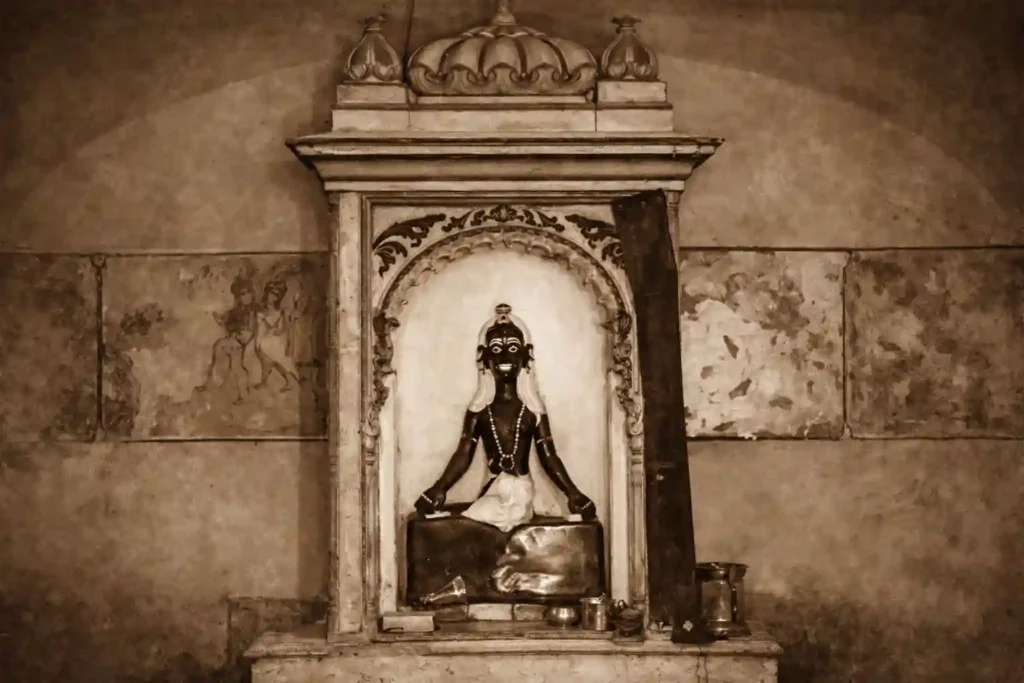
In Varanasi, she is worshipped as a protective mother rather than a frightening or inauspicious deity. Devotees visit her temple seeking strength during periods of loss, uncertainty, illness, and spiritual difficulty.
Married couples also visit her shrine, reflecting how living temple traditions can differ from strict textual interpretations.
At Pitambara Peeth in Datia, Maa Dhumavati is worshipped within a more traditional Tantric framework. Certain customs associated with the temple emphasize her solitary and renunciatory nature, highlighting the respect and caution traditionally linked with her worship.
In places such as Rajrappa and Kamakhya, she appears within broader Shakta and Mahavidya traditions, where advanced practitioners quietly revere her as a goddess of spiritual transformation and inner wisdom.
Dedicated temples to Maa Dhumavati remain relatively uncommon, which makes the surviving shrines associated with her particularly significant within the Mahavidya tradition.
These regional differences reveal an important aspect of Sanatan Dharma. While some Tantric lineages emphasize Maa Dhumavati’s connection with detachment, renunciation, and advanced sadhana, many local devotees approach her as a compassionate guardian who helps them navigate suffering and major life transitions.
For this reason, Maa Dhumavati is not viewed solely as a goddess of loss. Across temple traditions,
she is often understood as the wisdom hidden within loss, the strength hidden within hardship, and the guidance that appears when familiar sources of support begin to disappear.
Dhumavati Jayanti and Sacred Timings
Dhumavati Jayanti is traditionally observed on Jyeshtha Shukla Ashtami and is considered one of the most important days associated with Maa Dhumavati.
Devotees and practitioners regard this tithi as especially suitable for prayer, contemplation, and understanding her deeper spiritual teachings.
Apart from Dhumavati Jayanti, Amavasya nights are also considered significant because they reflect her association with silence, inwardness, and the dissolution of external distractions.
Saturdays and the periods of Gupt Navratri are similarly regarded as favorable for worship, particularly within Mahavidya and Shakta traditions.
Observances vary across regions and lineages. Some devotees perform simple prayers, light mustard oil lamps, offer black sesame seeds, and spend time in quiet reflection.
More traditional practitioners may undertake mantra japa, meditation, or fire rituals under proper guidance.
Fire rituals using black sesame are sometimes performed as symbolic acts of purification and release.
In many traditions, they represent the burning of karmic burdens, limiting patterns, and spiritual stagnation rather than the pursuit of material gains.
More than any specific ritual, the spirit of these observances lies in introspection. The sacred timings associated with Maa Dhumavati encourage seekers to look beyond external achievement and reflect upon impermanence, detachment, and inner wisdom.
Maa Dhumavati and Gupt Navratri sadhana
Gupt Navratri is one of the rare periods where the worship of Maa Dhumavati naturally fits. Unlike Chaitra or Sharad Navratri, Gupt Navratri is inward and quiet, focused on Mahavidya sadhana rather than public rituals.
This hidden nature reflects Maa Dhumavati’s own energy of silence, withdrawal, and dissolution.
During Gupt Navratri, seekers turn toward Mahavidyas that guide the mind beyond desire and form. Maa Dhumavati is approached not for fulfilment, but for clarity during stagnation, loss, or inner emptiness.
Her worship during this time is traditionally linked with night hours, reduced speech, and silent reflection.
In many Tantric traditions, her Gupt Navratri sadhana is kept simple. Mustard oil lamps, black sesame offerings, and quiet meditation are preferred over elaborate puja.
The focus remains on stillness and surrender rather than ritual display. Maa Dhumavati Gupt Navratri worship is not advised for beginners seeking quick results.
Her sadhana can deepen isolation and inner confrontation, and is traditionally recommended only for those drawn toward renunciation or guided practice.
For others, Gupt Navratri may simply be a time to understand her wisdom rather than invoke her energy directly.
What Maa Dhumavati Teaches During Loss and Isolation
Many devotees feel drawn to Maa Dhumavati during periods of grief, disappointment, loneliness, or major life transitions.
While most forms of the Divine Mother are approached during times of celebration and growth, Dhumavati is often encountered when life seems uncertain or empty.
Her wisdom does not immediately remove suffering. Instead, she teaches the seeker how to remain present within it.
She reveals that loss can become a teacher, silence can become a form of guidance, and isolation can create space for deeper self-understanding.
In spiritual life, there are periods when prayers seem unanswered, relationships change, plans fail, or familiar identities begin to dissolve.
Dhumavati represents the hidden grace operating within such experiences. She reminds the seeker that not every blessing arrives in a pleasing form.
For many practitioners, her greatest teaching is that inner strength is discovered not when life provides certainty, but when certainty disappears and awareness remains.
Spiritual Transformation Through Maa Dhumavati
Maa Dhumavati does not uplift. She empties.
Her path is one of radical unbecoming. Titles, roles, desires, and hopes fall away. What remains is resilience and truth.
She grants strength during depression, grief, and isolation. Many devotees feel her presence during the darkest phases of life, often without calling her. Her blessings are silent and lasting.
For this reason, many traditions associate Maa Dhumavati with vairagya, the deep detachment that arises from genuine understanding rather than disappointment. Her path is not rejection of the world but freedom from dependence upon it.
She gradually teaches non-attachment by revealing the temporary nature of all experiences. What begins as loss eventually becomes wisdom. What appears as emptiness gradually reveals itself as inner fullness.
Because of this, advanced seekers often regard Maa Dhumavati as a goddess connected with moksha. She strips away the illusions that bind consciousness to endless craving and directs attention toward the timeless reality beyond change.
Who Should Avoid Her Worship
While Maa Dhumavati is revered as a form of the Divine Mother, many traditions advise caution regarding intensive worship and advanced sadhana associated with her.
Beginners without guidance may find her symbolism difficult to understand because her path emphasizes detachment, impermanence, and inner confrontation rather than comfort or external blessings.
Those seeking quick results, material gains, or immediate solutions are generally encouraged to approach other forms of the Divine Mother whose worship aligns more closely with those aspirations.
Some lineages also recommend that householders approach her worship thoughtfully, particularly when engaging in formal Tantric practices.
This is not because Maa Dhumavati is harmful, but because her energy is traditionally associated with renunciation, introspection, and freedom from attachment rather than worldly fulfillment.
People drawn to her solely out of fear, curiosity, or fascination with the unusual aspects of Tantra may also misunderstand her deeper purpose. Maa Dhumavati is not worshipped for spectacle or mystery.
Her teachings require sincerity, patience, and a willingness to face uncomfortable truths about life and the self.
At the same time, respectful devotion, prayer, learning about her symbolism, and visiting her temples are not generally restricted.
The caution found in many traditions relates primarily to advanced spiritual practices rather than simple reverence.
Maa Dhumavati responds to surrender, self-honesty, and spiritual maturity rather than ambition, fear, or the pursuit of power.
Maa Dhumavati in the Mahavidya Journey
In the Mahavidya cycle, Maa Dhumavati prepares the seeker for deeper realization and final wisdom.
She stands between destruction and transcendence, representing the stage where old identities, desires, and attachments have begun to dissolve, but complete liberation has not yet been attained.
Her role within the Mahavidya journey is unique. Earlier forms may destroy illusion, challenge the ego, or transform consciousness through intense experiences.
Dhumavati reveals what remains after these processes have unfolded. She teaches the seeker how to live without dependence on external validation, worldly achievement, or constant fulfillment.
This stage is often uncomfortable because it requires confronting emptiness, uncertainty, and the impermanent nature of all things.
Yet many traditions regard it as an essential step toward spiritual maturity. Without passing through this inner void, true detachment cannot arise.
For this reason, Maa Dhumavati is closely associated with vairagya and the wisdom that emerges when the soul stops seeking lasting satisfaction in temporary experiences.
She teaches that freedom begins not when life gives everything we desire, but when our peace no longer depends upon those desires being fulfilled.
In the Mahavidya path, Dhumavati ultimately prepares the seeker for the higher states of stillness, transcendence, and liberation that follow. What appears as loss on the surface becomes a doorway to inner freedom and spiritual awakening.
Conclusion
Maa Dhumavati is not a goddess one approaches in comfort. She appears when illusions burn away and silence fills the space they once occupied.
Unlike forms of the Divine Mother associated with prosperity, beauty, or worldly fulfillment, Maa Dhumavati teaches through absence, impermanence, and inner stillness. Her wisdom is found not in what is gained, but in what is released.
In her smoky presence, the seeker learns to sit with loss without running, to remain steady without reward, and to trust the void as divine. What initially appears as emptiness gradually reveals itself as freedom from dependence, fear, and attachment.
She is feared only by those who still cling. For those ready to release everything false, Maa Dhumavati becomes the wisdom hidden within loss, the strength hidden within solitude, and the quiet doorway to liberation.
Suggested Reading
Maa Dhumavati is one part of the profound Dash Mahavidya tradition. Each Mahavidya reveals a unique aspect of the Divine Mother and guides seekers through different stages of spiritual awakening. If you would like to explore the wider Mahavidya journey, the following articles may help deepen your understanding.
Das Mahavidya: From Kali to Kamala, The Journey Within
https://thesanatantales.com/das-mahavidya/Maa Kali: The First Mahavidya of Time, Transformation and Liberation
https://thesanatantales.com/maa-kali-origin-story-meaning-power/Maa Tara: The Compassionate Savior and Second Mahavidya
https://thesanatantales.com/maa-tara-mahavidya/Maa Tripura Sundari: The Goddess of Beauty, Consciousness and Divine Harmony
https://thesanatantales.com/maa-tripura-sundari-mahavidya/Maa Bhuvaneshwari: The Cosmic Queen of Space and Creation
https://thesanatantales.com/maa-bhuvaneshwari-mahavidya/Maa Bhairavi: The Fierce Mahavidya of Discipline and Spiritual Fire
https://thesanatantales.com/maa-bhairavi-mahavidya/Maa Chhinnamasta: The Mahavidya of Self-Sacrifice and Awakening
https://thesanatantales.com/maa-chhinnamasta-mahavidya/Maa Bagalamukhi: The Goddess Who Stills Negativity and Illusion
https://thesanatantales.com/maa-bagalamukhi-mahavidya/Maa Matangi: The Mahavidya of Wisdom, Speech and Inner Knowledge
https://thesanatantales.com/maa-matangi-mahavidya/Maa Kamala: The Lotus Goddess of Prosperity and Spiritual Abundance
https://thesanatantales.com/maa-kamala-mahavidya/
Dhumavati (Wikipedia)
https://en.wikipedia.org/wiki/Dhumavati
FAQs
Who is Maa Dhumavati in the Dash Mahavidya tradition?
Maa Dhumavati is the seventh Mahavidya in the Dash Mahavidya tradition. She represents emptiness, detachment, dissolution, and the wisdom that emerges after worldly attachments lose their power.
Unlike other Mahavidyas associated with creation, protection, or transformation, she embodies the spiritual lessons hidden within loss, silence, and impermanence.
Why is Maa Dhumavati called the widow goddess?
Maa Dhumavati is depicted without a consort and is therefore known as the widow goddess. In Tantric philosophy, this symbolism does not represent weakness or misfortune. Instead, it reflects complete independence, non-attachment, and a state beyond worldly relationships and identities.
What does Maa Dhumavati symbolize?
Maa Dhumavati symbolizes the void, detachment, old age, impermanence, and spiritual maturity. Her teachings encourage seekers to look beyond external appearances and discover the deeper truth that remains when desires, expectations, and illusions begin to dissolve.
Why is Maa Dhumavati associated with loss and suffering?
Maa Dhumavati is associated with experiences such as loss, loneliness, disappointment, and uncertainty because these experiences often force individuals to confront deeper truths about life. In Shakta traditions, she is not viewed as the cause of suffering but as the wisdom hidden within it.
Is Maa Dhumavati connected with moksha?
Yes. Many Tantric and Shakta traditions associate Maa Dhumavati with moksha because she teaches vairagya, or spiritual detachment. By helping seekers move beyond attachment to temporary experiences, she prepares them for higher states of realization and liberation.
Why is Maa Dhumavati linked with Ketu?
Maa Dhumavati is commonly associated with Ketu because both symbolize detachment, spiritual awakening, and the dissolution of worldly attachments. During challenging Ketu periods, devotees may turn to her teachings for clarity, acceptance, and inner strength.
Can householders worship Maa Dhumavati?
Practices vary among traditions. While some Tantric lineages recommend caution regarding advanced Dhumavati sadhana, many householders respectfully worship her in temples and through simple devotional practices. In places such as Varanasi, she is revered as a compassionate protective mother by people from all walks of life.
What does Maa Dhumavati teach spiritual seekers?
Maa Dhumavati teaches that true freedom arises when peace no longer depends on external circumstances. Through her symbolism of emptiness, detachment, and dissolution, she guides seekers toward self-knowledge, inner stability, and liberation.
Glossary of Important Terms
| Term | Meaning |
|---|---|
| Maa Dhumavati | The seventh Mahavidya, representing emptiness, detachment, loss, and spiritual wisdom. |
| Dash Mahavidya | The ten great wisdom goddesses of Shakta Tantra, each representing a stage of spiritual awakening. |
| Mahavidya | A form of Divine Mother embodying higher spiritual knowledge and transformation. |
| Shakti | Divine feminine energy that powers creation, preservation, and dissolution. |
| Shiva | Supreme consciousness, often paired with Shakti in Tantric philosophy. |
| Tantra | A spiritual tradition that uses rituals, mantras, meditation, and symbolism for transformation and liberation. |
| Shunya | The spiritual concept of the void or emptiness from which creation emerges and returns. |
| Moksha | Liberation from the cycle of birth and death. |
| Vairagya | Deep detachment from worldly desires and attachments. |
| Viveka | Spiritual discrimination; the ability to distinguish truth from illusion. |
| Mahapralaya | The great cosmic dissolution when all creation returns to the unmanifest state. |
| Yoganidra | A cosmic state of deep awareness and stillness beyond ordinary consciousness. |
| Sadhana | A disciplined spiritual practice undertaken for inner growth and realization. |
| Mantra | A sacred sound, syllable, or phrase repeated for spiritual purposes. |
| Bija Mantra | A seed syllable containing concentrated spiritual energy. |
| Dhum | The seed sound associated with Maa Dhumavati, symbolizing dissolution and detachment. |
| Amavasya | The new moon day, considered significant for spiritual practices and introspection. |
| Gupt Navratri | A lesser-known Navratri focused on Tantric and Mahavidya worship. |
| Japa | Repetition of a mantra as a spiritual practice. |
| Homa (Havan) | A sacred fire ritual performed with offerings and mantras. |
| Ketu | A shadow planet in Vedic astrology associated with detachment, karma, and spiritual awakening. |
| Sanyasi | A renunciate who has given up worldly life in pursuit of spiritual realization. |
| Shakta Tradition | A Hindu tradition centered on the worship of the Divine Mother (Shakti). |
| Vamachara | A specialized Tantric path that seeks transcendence through confronting social and psychological limitations. |
| Winnowing Basket | A symbol of discernment, separating truth from illusion. |
| Crow | A sacred symbol associated with ancestors, wisdom, survival, and transition. |
| Nirriti | An ancient Vedic goddess associated with decay, disorder, and dissolution. |
| Jyestha | A goddess linked with decline, misfortune, and old age in Hindu tradition. |
| Alakshmi | The counterpart of Lakshmi, associated with poverty and scarcity. |
| Daksha Yajna | The sacrificial ritual connected with the story of Sati’s self-immolation. |
| Sati | The first consort of Shiva whose stories are closely connected with many Mahavidya traditions. |
| Pitambara Peeth | A renowned Shakta and Tantric pilgrimage center in Datia, Madhya Pradesh. |
| Kamakhya | One of the most important Shakti Peethas and a major center of Tantra in Assam. |
| Rajrappa | A famous Shakti shrine associated with Tantric worship traditions. |
| Dhumavati Jayanti | The sacred observance dedicated to Maa Dhumavati, celebrated on Jyeshtha Shukla Ashtami. |
| Detachment | Freedom from dependence on worldly possessions, relationships, and outcomes. |
| Impermanence | The spiritual understanding that all worldly things are temporary and changing. |
| Liberation | The state of spiritual freedom beyond suffering, attachment, and rebirth. |
About the Author
Yateendra Chaturvedi is a spiritual writer, researcher, devotee, and the founder of The Sanatan Tales. With over 35 years of professional experience and a lifelong interest in Sanatan Dharma, he writes about Hindu deities, temples, scriptures, festivals, Mahavidyas, sacred stories, rituals, and living traditions that continue to guide and inspire devotees across India.
Drawing from traditional scriptures, regional beliefs, temple traditions, devotional literature, and historical sources, he aims to present authentic, well-researched, and easy-to-understand content for modern readers. His work focuses on preserving spiritual wisdom, explaining sacred traditions, and helping seekers develop a deeper understanding of India’s rich spiritual heritage.
Through The Sanatan Tales, Yateendra strives to make the timeless teachings of Sanatan Dharma simple, meaningful, and relevant for today’s generation while maintaining respect for traditional sources, regional practices, and diverse spiritual perspectives.
Learn More About Yateendra Chaturvedi →
https://thesanatantales.com/about-the-author/
References & Sources
This article is based on beliefs and traditions followed within the Shakta traditions of Sanatan Dharma, traditional knowledge associated with the Dashamahavidya tradition, Shakti worship, Devi sadhana, and insights drawn from various spiritual and religious study sources. Some concepts discussed in this article are also inspired by teachings and interpretations preserved through the guru-disciple tradition.
Note: Beliefs, interpretations, and spiritual practices may vary across different traditions, sects, and paths within Sanatan Dharma. The purpose of this article is not to present any single viewpoint as the absolute truth, but to explain widely accepted religious and spiritual perspectives in a simple and accessible manner.
Explore More Fascinating Topics from Sanatan Dharma
Simply beautiful. A clear and fabulous perspective on the most misunderstood Mahavidya. Thank you.
Thank you so much, Ritu ji. 🙏 Your kind words truly mean a lot. I’m happy that the article helped shed light on Maa Dhumavati’s profound spiritual significance. May Maa Dhumavati bless you with wisdom, inner strength, and peace.
Looking forward to seeing you again on Sanatan Tales.