Life has a way of testing us when we least expect it. A sudden setback, family conflict, health concern, financial pressure, or uncertainty about the future can leave us feeling anxious, overwhelmed, and emotionally drained. During such moments, many people search for ways to stay calm during difficult times, yet finding practical guidance is not always easy.
We are often told to “stay calm,” but few people explain how to do it when the mind is racing and emotions feel out of control. In challenging situations, advice alone is rarely enough. What we need is a deeper source of strength that helps us respond with clarity rather than react with fear.
This is where the wisdom of Sanatan Dharma can help. Its teachings do not promise a life free from problems. Instead, they show us how to stay calm during difficult times by developing awareness, acceptance, faith, and inner resilience. When the mind becomes steady, even life’s greatest challenges become easier to navigate.
In this article, you will learn spiritual ways to remain peaceful during challenges, understand why difficult situations affect us so deeply, and discover practical teachings from Sanatan Dharma that can help you build lasting inner calm. Most importantly, you will learn how to stay calm during difficult times without suppressing your emotions or losing hope when life feels uncertain.
Stay Calm During Difficult Times At a Glance
| Aspect | Key Insight |
|---|---|
| Main Challenge | Stress, fear, uncertainty, and emotional overwhelm during difficult situations. |
| Root Cause | The mind becomes trapped in worry, fear, and the need to control outcomes. |
| Sanatan Dharma View | Peace comes from awareness, acceptance, faith, and right action rather than external control. |
| First Step | Pause, breathe consciously, and return your attention to the present moment. |
| Power of Breath | Slow, mindful breathing helps calm the mind and reduce emotional reactivity. |
| Role of Acceptance | Accepting what cannot be controlled reduces resistance and inner tension. |
| Bhagavad Gita Teaching | Focus on sincere effort and duty without becoming attached to results. |
| Importance of Surrender | Trusting the Divine helps release anxiety and the burden of control. |
| Mantra Practice | Repeating a sacred mantra helps steady the mind during stressful moments. |
| Witness Consciousness | Observing thoughts and emotions without identifying with them creates inner stability. |
| Daily Spiritual Practices | Prayer, meditation, mantra japa, self-reflection, and satsang strengthen inner calm. |
| When Overwhelmed | Stop trying to solve everything at once and focus on the present moment. |
| Long-Term Benefit | Greater resilience, emotional balance, spiritual maturity, and lasting inner peace. |
| Key Takeaway | Learning to stay calm during difficult times is not about avoiding challenges but meeting them with awareness, faith, and inner strength. |
Table of Contents
ToggleWhy We Lose Our Calm During Difficult Times
Most of the time, it is not the situation itself that disturbs us. It is the way the mind responds to it. Learning to stay calm during difficult times begins with understanding this simple truth.
When something unexpected happens, the mind often rushes ahead. It creates fears, assumptions, and worst-case scenarios that may never happen. A single problem can quickly become a chain of anxious thoughts.
You may notice this in everyday life. A delay feels like failure. A small setback feels much bigger than it really is. Gradually, the mind becomes trapped in worry about the future instead of focusing on the present moment.
According to Sanatan Dharma, inner peace becomes difficult when we become completely identified with our thoughts and emotions. Instead of observing them, we get carried away by them.
This is why awareness is so important. When we learn to observe our thoughts without reacting immediately, the mind begins to settle. We become less controlled by fear and more connected to our inner strength.
Before we can truly stay calm during difficult times, we must first understand what is disturbing our calm in the first place.
How to Stay Calm in Difficult Situations Through Awareness
The first step to stay calm during difficult times is simple, yet surprisingly powerful.
Take a Pause.
When something difficult happens, the mind immediately wants to react. It wants to judge, worry, fix the problem, or defend itself. Before doing any of that, take a moment to pause.
Notice what is happening within you. Observe your breath, your emotions, and any tension in your body. There is no need to change anything right away. Simply become aware of what is present.
This small act creates space between you and your reaction. In that space, clarity begins to emerge.
Instead of being carried away by thoughts and emotions, you become aware of them. Awareness may not remove the challenge, but it helps you respond with greater wisdom and emotional balance.
In Sanatan Dharma, awareness is considered the foundation of inner peace. The more present you become, the less power fear and anxiety have over your mind.
If you want to stay calm during difficult times, the journey often begins here. Not by changing what is happening outside, but by becoming more aware of what is happening within.
How Conscious Breathing Helps You Stay Calm During Difficult Times
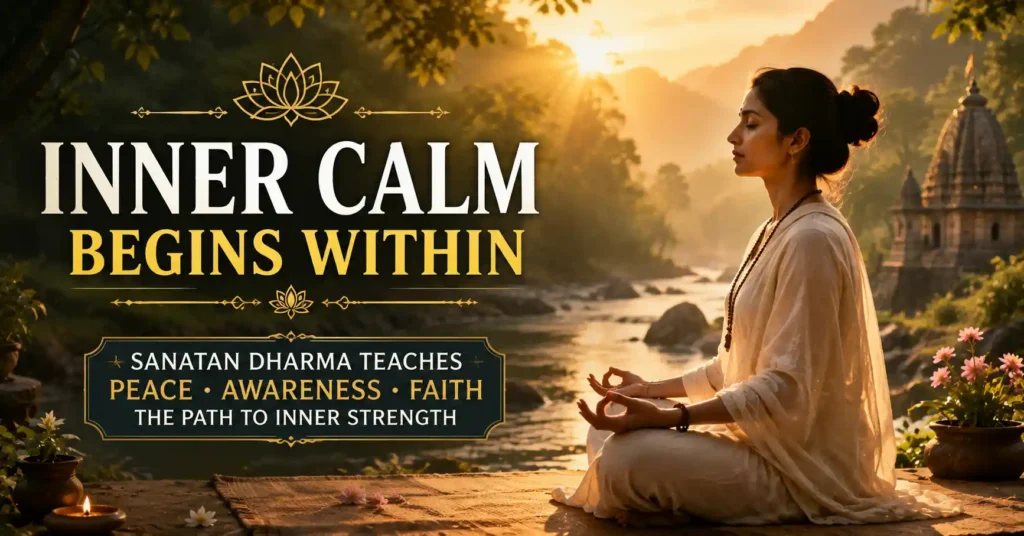
Your breath is always with you, yet it is often the first thing we forget during stressful moments. Learning to stay calm during difficult times can sometimes begin with something as simple as paying attention to your breathing.
When the mind becomes restless, the breath often becomes quick and shallow. We may not even notice it happening. But the moment we slow down and focus on the breath, something within begins to settle.
Try pausing for a moment. Take a slow breath in and gently breathe out. There is no need to force anything. Simply breathe with awareness and allow your attention to rest on the present moment.
Even a minute or two of conscious breathing can create a noticeable shift. The mind may not become completely silent, but it often becomes less reactive and more balanced.
In yogic traditions, the breath is seen as a bridge between the body and consciousness. As the breath becomes steadier, the mind often follows. This is why many spiritual practices begin with breath awareness.
When life feels overwhelming, returning to the breath can be one of the simplest spiritual ways to stay calm during difficult times and reconnect with inner peace.
How Relaxing the Body Helps You Stay Calm During Difficult Times
Sometimes, calmness does not begin with the mind. It begins with the body. Learning to stay calm during difficult times often starts by noticing how stress affects us physically.
When we feel anxious or overwhelmed, the body reacts quickly. The shoulders become tense, the jaw tightens, and muscles throughout the body prepare for struggle, often without us realizing it.
In such moments, simply becoming aware of this tension can make a difference. Relaxing your shoulders, unclenching your jaw, or taking a short mindful walk can help release built-up stress.
The body and mind are deeply connected. When the body begins to relax, the mind often becomes calmer as well. This is why practices such as gentle stretching, yoga, and mindful movement have been valued in spiritual traditions for centuries.
Many people search for peace through their thoughts alone. Yet sometimes the simplest way to stay calm during difficult times is to begin with the body. A relaxed body can become the doorway to a quieter mind and greater emotional balance.
Accepting What You Cannot Control
One of the biggest reasons we lose our calm is the desire to control everything around us. Learning to stay calm during difficult times becomes easier when we recognize this tendency.
We want situations to unfold in a certain way. We want people to behave as we expect. When life does not match those expectations, frustration, disappointment, and anxiety begin to grow.
Yet there is a simple truth that many of us spend years learning:
Not everything is within our control.
And that is not a problem. It is simply part of life.
Much of our suffering comes not from what is happening, but from our resistance to what is happening. The moment we stop fighting reality, the mind begins to relax.
Acceptance does not mean giving up or becoming passive. It means focusing your energy on what you can do, while letting go of what you cannot change.
This wisdom lies at the heart of emotional balance and spiritual maturity. When we stop carrying the burden of controlling every outcome, life feels lighter and more manageable.
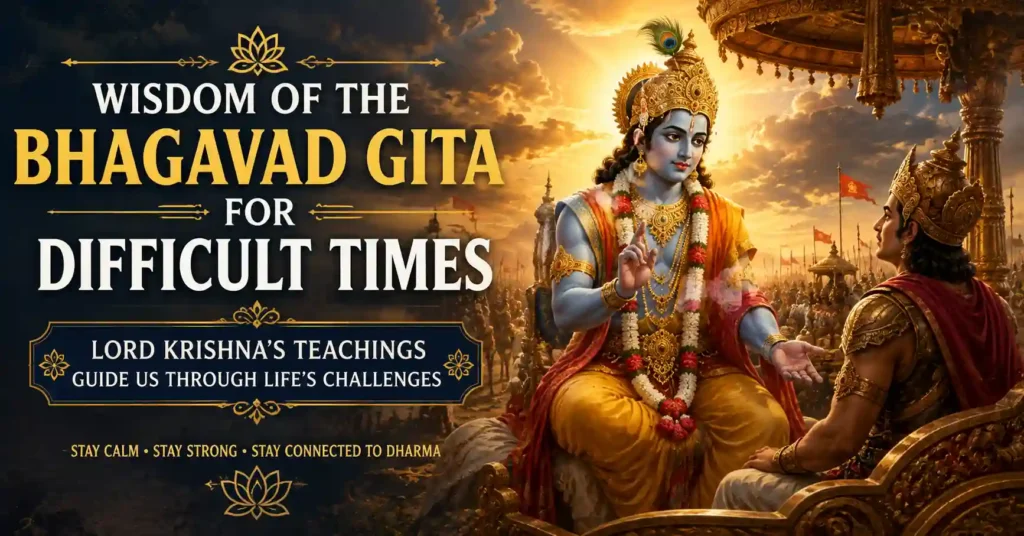
The same teaching is beautifully reflected in the Bhagavad Gita. Lord Krishna advises Arjuna to focus on sincere action rather than becoming attached to results.
Much of our stress comes from trying to control outcomes that are not fully in our hands. When we do our best and learn to let go of the rest, it becomes easier to stay calm during difficult times and move forward with greater peace and trust.
Did You Know?
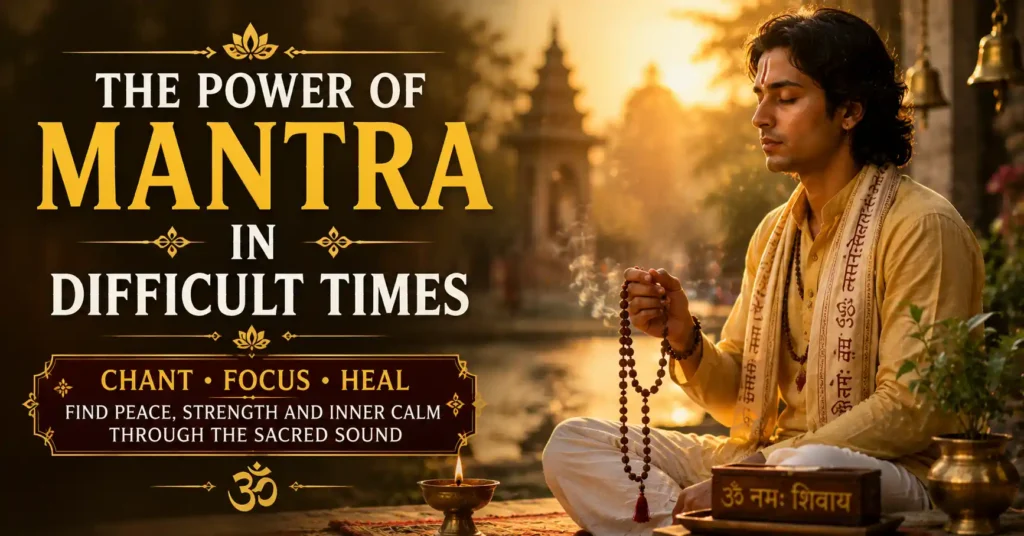
The Bhagavad Gita was taught by Lord Krishna to Arjuna on a battlefield, not in a peaceful forest or temple.
This powerful setting reminds us that spiritual wisdom is meant to help us remain calm, balanced, and clear-minded even in the middle of life’s most difficult situations.
Remember That Difficult Times Do Not Last Forever
When we face challenges, the mind often convinces us that the situation will last forever. During such moments, it can feel impossible to stay calm during difficult times.
A stressful day feels endless. A painful experience feels permanent. In those moments, it becomes difficult to imagine life feeling different again.
But if you look back at your own journey, you may notice something important. Every challenge, worry, and difficult phase that once felt overwhelming eventually changed.
Life is always moving. Seasons come and go. Situations that once occupied your entire mind slowly become part of the past.
This moment is no different.
Remembering this does not solve the problem immediately, but it brings perspective. The burden feels a little lighter, and the mind finds more space to breathe.
In Sanatan Dharma, change is seen as a natural part of life. Understanding this truth can help us stay calm during difficult times with greater patience, faith, and inner strength.
The Power of Surrender in Difficult Times
Surrender is one of the most misunderstood ideas in spiritual life.
Many people think it means giving up or becoming passive. But true surrender is not weakness. It is trust.
It is the quiet understanding that you have done what you can, and that not everything needs to be carried by you alone.
When life feels overwhelming, surrender can help you stay calm during difficult times by releasing the burden of trying to control every outcome.
You may silently say to yourself, “I am doing my best. The rest, I leave to the Divine.”
Whether your heart turns toward Shiva, Krishna, Rama, Devi, or simply a higher presence, this attitude of trust often brings a sense of relief and emotional balance.
Life may not change immediately, but something within begins to soften. The constant need to control every result starts to fade, and the mind feels lighter.
This is why surrender has always been an important part of the spiritual path. Sometimes the deepest way to stay calm during difficult times is not through control, but through trust, faith, and acceptance.
Using Mantra as a Grounding Anchor
There are moments when the mind feels so scattered that it becomes difficult to stay calm during difficult times through thinking alone.
In such moments, a simple mantra can offer support and stability.
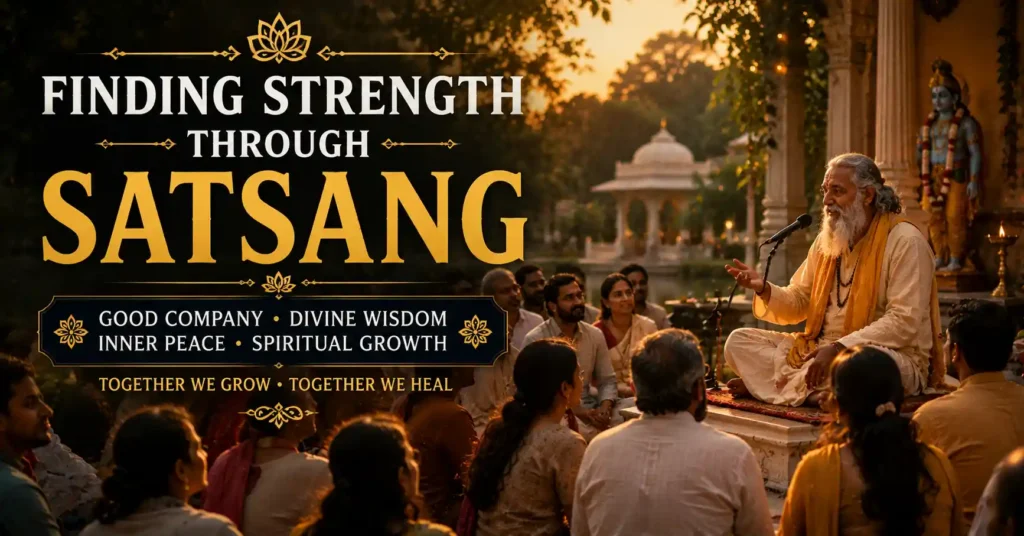
Many people find comfort in softly repeating sacred names such as Om Namah Shivaya, Shri Ram Jai Ram, or simply Ram. The words may be simple, but their steady repetition helps quiet the constant noise of the mind.
There is no need to worry about perfect pronunciation or complicated rules. What matters most is the feeling of presence that develops as your attention gently returns to the mantra.
A mantra works like an anchor in moving water. When thoughts are pulling in different directions, it gives the mind something steady to return to again and again.
In Sanatan Dharma, mantra japa has been practiced for centuries as a way to cultivate inner peace, devotion, and mental clarity. Regular practice can help you stay calm during difficult times and remain emotionally balanced even when life feels uncertain.
Over time, a mantra often becomes more than a technique. It becomes a quiet companion during challenging moments, helping the heart feel calmer, stronger, and more connected to the Divine.
Accepting Your Emotions Without Being Controlled by Them
Many of us are taught to hide difficult emotions or push them away as quickly as possible. We believe that staying strong means not feeling fear, sadness, anger, or disappointment.
But emotions rarely disappear when they are ignored. More often, they remain beneath the surface and continue creating inner tension.
When a difficult feeling arises, it can help to simply acknowledge it. You might quietly say to yourself, “This is what I am feeling right now.” There is no need to judge it or rush to make it go away.
Not every emotion needs an immediate solution. Sometimes it simply needs to be seen, understood, and accepted.
From a spiritual perspective, calmness does not come from controlling every emotion. It comes from learning to observe emotions without becoming completely identified with them.
In Sanatan Dharma, this awareness helps us remain centered even when strong emotions arise. The more gently we hold our feelings, the easier it becomes to stay calm during difficult times without suppressing what we genuinely feel.
True inner peace comes not from avoiding emotions, but from allowing them to pass through us with awareness, patience, and compassion.
Discovering the Witness Within
Even in the middle of stress, fear, or confusion, there is a part of you that remains untouched by what is happening. Connecting with this deeper awareness can help you stay calm during difficult times.
You may have noticed moments when you become aware of your thoughts instead of being completely carried away by them. In those moments, something within is simply watching.
Thoughts come and go. Emotions rise and fall. Situations change from one day to the next. Yet there is an awareness behind all these experiences that remains quietly present.
The spiritual traditions of Sanatan Dharma often describe this as the witness consciousness or Sakshi Bhava. It does not react, panic, or struggle. It simply observes.
The more we learn to rest in this awareness, the less power temporary situations have over us. A deeper sense of peace begins to emerge, not because life has become perfect, but because we are no longer completely identified with every thought and emotion.
This silent observer is not something that needs to be created. It is already within you. As you begin to recognize it, it becomes easier to stay calm during difficult times with greater clarity, balance, and inner strength.
What to Do When You Feel Overwhelmed
There are times when life feels so overwhelming that it becomes difficult to think clearly. The mind races, emotions take over, and it becomes harder to stay calm during difficult times.
In such moments, the goal is not to solve everything at once. The first step is simply to return to the present moment.
Pause for a moment and take a few slow breaths. Then gently bring your attention to what is around you. Notice a few things you can see, a few sounds you can hear, and the feeling of your body where you are sitting or standing.
This simple practice helps shift attention away from fearful thoughts and back to what is real right now. It creates a sense of grounding when the mind feels scattered.
The situation may not change immediately, but your relationship with it often does. The mind becomes quieter, emotions feel less overwhelming, and a sense of balance begins to return.
When practiced regularly, this simple habit can help you stay calm during difficult times and respond to challenges with greater awareness and inner stability.
Simple Daily Practices to Stay Calm During Difficult Times
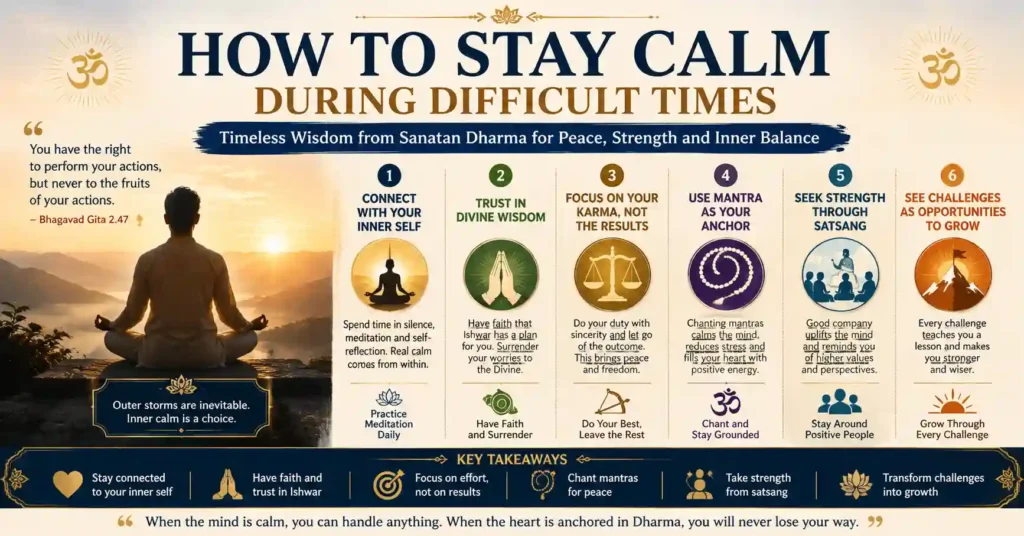
Learning to stay calm during difficult times rarely happens in a single moment. More often, it is built quietly through small daily practices that strengthen the mind and heart.
Simple spiritual habits may not seem powerful at first. Sitting quietly for a few minutes, lighting a diya, chanting a familiar mantra, or reading a few lines from the Bhagavad Gita can feel like very small acts.
Yet over time, these practices begin to create a deeper inner foundation. They nurture emotional balance, strengthen faith, and help you remain centered during life’s challenges.
This is why daily spiritual practice is not just about rituals. It is about developing a connection with your inner peace and spiritual strength.
Slowly, almost without noticing, you begin to carry that calmness with you. And when challenges arise, it becomes easier to stay calm during difficult times because the foundation of peace has already been growing within.
When Nothing Seems to Help, Choose Stillness
There will be moments when none of your usual methods seem to help. During such times, it may feel impossible to stay calm during difficult times.
The breath feels unsettled. Thoughts continue to race. Emotions feel heavier than usual, and even simple spiritual practices seem difficult.
In those moments, there is no need to force anything.
Just sit quietly.
Allow the mind to be as it is. Allow the emotions to be as they are. For a few moments, let go of the need to fix, change, or understand everything.
This simple willingness to remain present can be deeply healing. Sometimes inner peace returns not through effort, but through acceptance.
Slowly, often without realizing it, the intensity of the inner storm begins to fade. What once felt overwhelming starts to soften on its own.
In Sanatan Dharma, silence is not seen as emptiness. Beneath the noise of the mind lies awareness, presence, and quiet strength. Learning to rest in that stillness can help you stay calm during difficult times even when answers are not immediately available.
Can Difficult Situations Become Opportunities for Spiritual Growth?
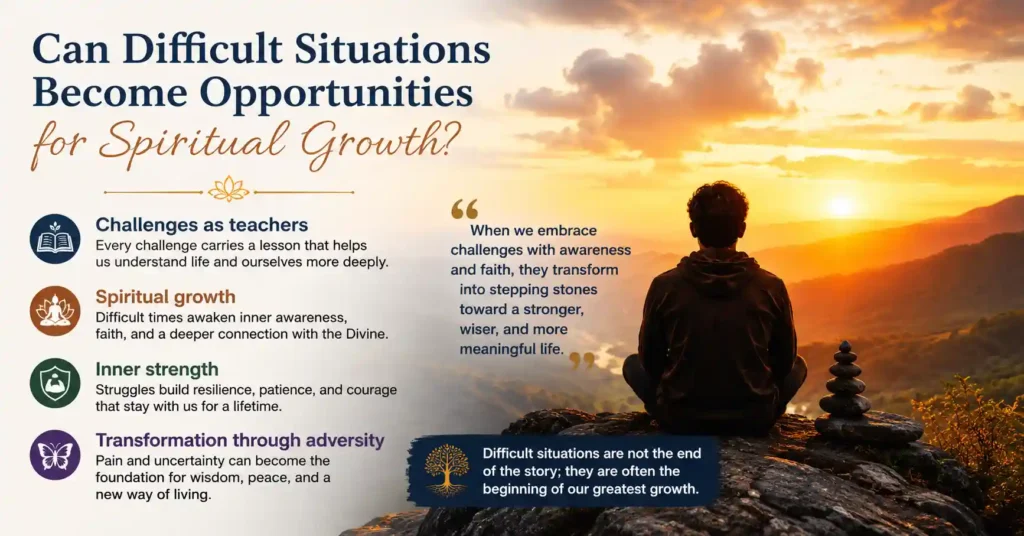
Difficult situations are rarely pleasant, but they often become some of life’s greatest teachers. Many people discover their deepest growth not during comfortable times, but during periods of uncertainty, loss, struggle, or change.
Challenges have a way of revealing what is happening within us. They bring hidden fears, attachments, expectations, and emotional patterns to the surface, giving us an opportunity to understand ourselves more honestly.
This is one reason difficult experiences can become spiritually valuable. They encourage self-reflection, humility, patience, and a deeper search for meaning beyond temporary circumstances.
In Sanatan Dharma, challenges are not always viewed as obstacles to spiritual progress. Often, they are seen as opportunities to develop inner strength, wisdom, faith, and greater awareness.
When we learn to stay calm during difficult times, we begin responding to challenges more consciously rather than reacting from fear or frustration. This shift gradually transforms difficulties into opportunities for growth.
Over time, many people look back and realize that the experiences they once wished to avoid helped them become stronger, wiser, and more connected to their spiritual path.
While no one seeks hardship, every challenge carries the potential to deepen self-understanding and bring us closer to lasting inner peace.
Conclusion
Learning to stay calm during difficult times is not about becoming perfect.
There will still be days when you feel overwhelmed. There will be moments when worry returns, emotions feel heavy, or life seems harder than expected. That is not a failure. It is simply part of being human.
Yet something begins to change through the journey.
You may still face the same challenges, but they no longer affect you in the same way. You recover more quickly, respond with greater awareness, and trust life more deeply than before.
This inner calm does not appear overnight. It grows quietly through awareness, patience, prayer, self-reflection, and daily spiritual practice.
Over time, you do not simply learn to stay calm during difficult times. You begin to develop a quiet strength that remains present even when life feels uncertain.
In Sanatan Dharma, true peace is not found by controlling every situation. It arises from learning to remain centered, trusting the Divine, and staying connected to your inner self.
And perhaps that is one of the most beautiful signs of spiritual growth: not a life without challenges, but the ability to meet those challenges with greater peace, wisdom, and resilience.
Key Takeaways
- Staying calm during difficult times begins with understanding that it is often our reaction, not the situation itself, that creates suffering.
- Awareness is the foundation of inner peace. Observing thoughts and emotions without immediately reacting to them helps create clarity and balance.
- Conscious breathing is one of the simplest and most effective ways to calm a restless mind and return to the present moment.
- Accepting what cannot be controlled reduces stress and helps us focus our energy on what truly matters.
- The Bhagavad Gita teaches us to perform our duties sincerely without becoming attached to outcomes.
- Surrender is not weakness. It is the strength to trust the Divine while continuing to do your best.
- Mantra chanting can steady the mind and provide comfort during stressful or uncertain periods.
- Witness consciousness (Sakshi Bhava) helps us observe thoughts and emotions without becoming overwhelmed by them.
- Daily spiritual practices such as prayer, meditation, self-reflection, and satsang gradually build emotional resilience and inner calm.
- Learning to stay calm during difficult times is not about avoiding challenges. It is about meeting them with awareness, faith, patience, and inner strength.
Suggested reading
If this article resonated with you and you are looking for more ways to stay calm during difficult times, you may also enjoy exploring these reflections on inner peace, awareness, spiritual growth, and everyday spiritual living.
Each article explores a different aspect of the inner journey and can help deepen your understanding of calmness, trust, self-awareness, and the spiritual strength needed to navigate life’s challenges with greater peace.
These articles offer additional spiritual insights that can help you stay calm during difficult times, strengthen inner resilience, and navigate challenges with greater clarity and faith.
Silence Is Not Empty, It Is Full of Awareness
https://thesanatantales.com/silence-and-awareness-connection/
Why Spiritual Awakening Feels Lonely
https://thesanatantales.com/why-spiritual-awakening-feels-lonely/
Ego in Spiritual Life: Signs, Meaning and How to Reduce It
https://thesanatantales.com/ego-in-spiritual-life/
Spiritual Awakening: Meaning and Signs Beginners Often Experience
https://thesanatantales.com/spiritual-awakening/
Is Intention More Important than Ritual? A Sanatan Dharma Reflection
https://thesanatantales.com/is-intention-more-important-than-ritual/
Daily Mudra for Calm Mind, Energy and Better Digestion
https://thesanatantales.com/daily-mudras-for-calm-energy-digestion/
Living in the Present Moment: A Simple Path to Inner Peace
https://thesanatantales.com/living-in-the-present-moment/
How Can I Stay Calm in Difficult Situations? (Quora)
https://www.quora.com/How-can-I-stay-calm-in-difficult-situations
FAQs
How can I stay calm during difficult times according to Sanatan Dharma?
Sanatan Dharma teaches that inner calm comes from awareness, acceptance, faith, and self-discipline rather than from controlling external circumstances.
Practices such as prayer, mantra chanting, meditation, self-reflection, and studying spiritual wisdom help create emotional balance and mental clarity.
The goal is not to avoid challenges but to respond to them with greater awareness, patience, and trust in the Divine.
Why do I struggle to remain calm during stressful situations?
Most people become overwhelmed not because of the situation itself, but because of the thoughts, fears, and assumptions that arise around it.
The mind often imagines worst-case scenarios and becomes trapped in worry about the future.
Learning to observe these thoughts without immediately reacting to them can help reduce anxiety and create a greater sense of inner peace.
Can spirituality really help during difficult times?
Yes. Spirituality provides an inner foundation that helps you face challenges with greater strength and resilience.
While it may not remove life’s problems, it changes how you experience them. Spiritual practices help calm the mind, strengthen faith, and create a sense of connection to something greater than yourself.
Over time, this inner stability makes it easier to navigate difficult situations with confidence and hope.
What is the fastest way to stay calm during difficult times?
One of the simplest methods is to pause and focus on your breathing.
Taking a few slow, conscious breaths helps calm the nervous system and brings attention back to the present moment.
This may not solve the problem immediately, but it often reduces mental overwhelm and helps you respond more clearly rather than react impulsively.
How does the Bhagavad Gita help during challenging situations?
The Bhagavad Gita teaches that peace comes from focusing on sincere effort rather than becoming attached to outcomes.
Lord Krishna encourages Arjuna to perform his duty with dedication while accepting that results are not always within his control.
This wisdom helps reduce anxiety, build trust, and develop the emotional balance needed to face uncertainty.
What role does mantra chanting play in creating inner calm?
Mantra chanting helps focus the mind and reduce mental restlessness.
When a mantra is repeated with devotion and awareness, attention gradually shifts away from fear, worry, and scattered thoughts.
Many people find that regular mantra practice creates a sense of stability, comfort, and spiritual connection during difficult phases of life.
Can difficult situations become opportunities for spiritual growth?
Yes. Many spiritual traditions teach that challenges often become powerful teachers.
Difficult experiences encourage self-reflection, patience, surrender, and a deeper understanding of life.
Although such periods can be uncomfortable, they often help people develop greater wisdom, resilience, and inner strength than they had before.
What should I do when I feel completely overwhelmed?
When everything feels overwhelming, avoid trying to solve every problem at once.
Pause, take a few slow breaths, and bring your attention back to the present moment. Focus on what you can do right now instead of worrying about everything at once.
Even a few moments of stillness can help quiet the mind and restore a sense of balance.
How do daily spiritual practices help me stay calm during difficult times?
Daily practices such as prayer, meditation, mantra chanting, reading spiritual texts, or spending time in silence gradually strengthen inner stability.
These habits create a foundation of peace that remains available even during stressful periods.
Over time, they help you remain centered, emotionally balanced, and better equipped to handle life’s challenges.
Is it normal to feel anxious even while following a spiritual path?
Yes. Spiritual growth does not mean becoming free from all emotions or difficulties.
Everyone experiences fear, sadness, uncertainty, and stress at different times. The difference is that spiritual practice teaches us how to relate to these experiences with greater awareness and compassion.
Progress is not measured by never feeling anxious. It is measured by how gently and wisely we learn to respond when difficult emotions arise.
Glossary of Important Terms
| Term | Meaning |
|---|---|
| Awareness | The ability to observe your thoughts, emotions, and actions without immediately reacting to them. |
| Acceptance | A willingness to acknowledge reality as it is instead of resisting what cannot be changed. |
| Inner Peace | A state of mental and emotional calm that remains steady even during challenging situations. |
| Sanatan Dharma | The eternal spiritual tradition of India that emphasizes righteous living, self-realization, and harmony with the Divine. |
| Bhagavad Gita | A sacred Hindu scripture in which Lord Krishna teaches spiritual wisdom, duty, self-mastery, and inner peace. |
| Karma Yoga | The path of selfless action that encourages performing one’s duties without attachment to results. |
| Dharma | One’s righteous duty, moral responsibility, and way of living in alignment with truth and spiritual values. |
| Mantra | A sacred word, phrase, or sound repeated to focus the mind and deepen spiritual awareness. |
| Mantra Japa | The practice of repeatedly chanting or mentally repeating a mantra with devotion and concentration. |
| Meditation | A spiritual practice that helps quiet the mind, increase awareness, and cultivate inner peace. |
| Surrender | Trusting the Divine and letting go of the need to control every outcome while continuing to do one’s best. |
| Faith (Shraddha) | Deep trust in spiritual principles, the Divine, and the unfolding journey of life. |
| Witness Consciousness (Sakshi Bhava) | The ability to observe thoughts and emotions without becoming completely identified with them. |
| Self-Reflection | The practice of honestly examining your thoughts, emotions, actions, and life experiences. |
| Spiritual Growth | The gradual process of developing greater awareness, wisdom, compassion, and connection with the Divine. |
| Satsang | Spending time with spiritually minded people or listening to teachings that inspire spiritual growth and inner peace. |
| Divine | A term used to describe God, the Supreme Reality, or a higher spiritual presence. |
| Resilience | The ability to recover from difficulties and move forward with strength, balance, and hope. |
| Mindfulness | Paying full attention to the present moment with awareness and without judgment. |
| Inner St |
About the Author
Yateendra Chaturvedi is a spiritual writer, researcher, devotee, and the founder of The Sanatan Tales. With over 35 years of professional experience and a lifelong interest in Sanatan Dharma, he writes about Hindu deities, temples, scriptures, festivals, Mahavidyas, sacred stories, rituals, and living traditions that continue to guide and inspire devotees across India.
Drawing from traditional scriptures, regional beliefs, temple traditions, devotional literature, and historical sources, he aims to present authentic, well-researched, and easy-to-understand content for modern readers. His work focuses on preserving spiritual wisdom, explaining sacred traditions, and helping seekers develop a deeper understanding of India’s rich spiritual heritage.
Through The Sanatan Tales, Yateendra strives to make the timeless teachings of Sanatan Dharma simple, meaningful, and relevant for today’s generation while maintaining respect for traditional sources, regional practices, and diverse spiritual perspectives.
Learn More About Yateendra Chaturvedi →
https://thesanatantales.com/about-the-author/
References & Sources
This article is based on the spiritual principles, teachings, and practices associated with Sanatan Dharma. It draws upon insights from Hindu scriptures, yogic traditions, devotional practices, meditation techniques, and widely accepted spiritual teachings that emphasize inner peace, self-awareness, faith, and personal growth.
Note: Spiritual experiences, beliefs, and practices may vary across different traditions, sampradayas, regions, and individual paths within Sanatan Dharma. The purpose of this article is not to present any single viewpoint as the absolute truth, but to share commonly accepted spiritual perspectives in a simple, practical, and reader-friendly manner. Sanatan Dharma recognizes multiple paths to inner growth, including devotion, selfless action, meditation, self-inquiry, and spiritual discipline.
Explore More Fascinating Topics from Sanatan Dharma