
In today’s fast-moving world, many people seek inner peace but struggle to find it amid stress, uncertainty, and constant distractions. External success, comfort, and achievements may bring temporary satisfaction, yet lasting contentment often remains out of reach. This raises an important question: what is inner peace, and why does it seem so difficult to maintain?
From the perspective of Sanatan Dharma, true inner peace is not merely the absence of problems. It is a state of emotional balance, mental clarity, and inner stability that remains steady even when circumstances change. It arises from self-awareness, right understanding, and a deeper connection with one’s true nature.
In this article, you will discover the meaning of inner peace, why the human mind often becomes restless, and how spiritual wisdom can help cultivate calmness and stability. You will also explore insights from the Bhagavad Gita, the concept of Sthitaprajna, and practical ways to develop a balanced mind in everyday life.
Whether you are facing challenges, seeking peace of mind, or simply wishing to understand this timeless teaching, the wisdom of Sanatan Dharma offers valuable guidance for living with greater harmony, resilience, and purpose.
Inner Peace at a Glance
| Aspect | Key Insight |
|---|---|
| Meaning of Inner Peace | A state of emotional balance, mental clarity, and inner stability that remains steady despite life’s ups and downs. |
| What It Is Not | It does not mean avoiding problems, suppressing emotions, or living without challenges. |
| Why It Matters | It helps reduce stress, improve decision-making, strengthen relationships, and support overall well-being. |
| Main Cause of Disturbance | Overthinking, attachment to outcomes, unrealistic expectations, fear, and constant mental distractions. |
| Role of Thoughts | Thoughts influence emotions, but not every thought deserves attention or belief. |
| Importance of Acceptance | Accepting reality as it is helps reduce resistance, emotional suffering, and mental agitation. |
| Sanatan Dharma’s View | Lasting peace comes from self-awareness, spiritual wisdom, devotion, and connection with the Divine. |
| Bhagavad Gita Teaching | Focus on sincere action while reducing attachment to success and failure. |
| Ideal State | Sthitaprajna, a person of steady wisdom who remains balanced in all situations. |
| Qualities That Support It | Self-awareness, patience, gratitude, acceptance, emotional resilience, and spiritual reflection. |
| Daily Practices | Prayer, meditation, mindful breathing, gratitude, chanting, self-reflection, and spending time in nature. |
| Common Obstacles | Overthinking, suppressed emotions, attachment, perfectionism, excessive expectations, and constant stimulation. |
| Signs of Growing Inner Peace | Less reactivity, greater clarity, improved relationships, emotional maturity, and a more balanced mind. |
| Long-Term Benefit | Greater contentment, inner strength, resilience, and the ability to remain steady during life’s challenges. |
| Core Message | Inner peace is not found by controlling every circumstance but by cultivating harmony within. |
Table of Contents
ToggleWhat Does Inner Peace Really Mean?
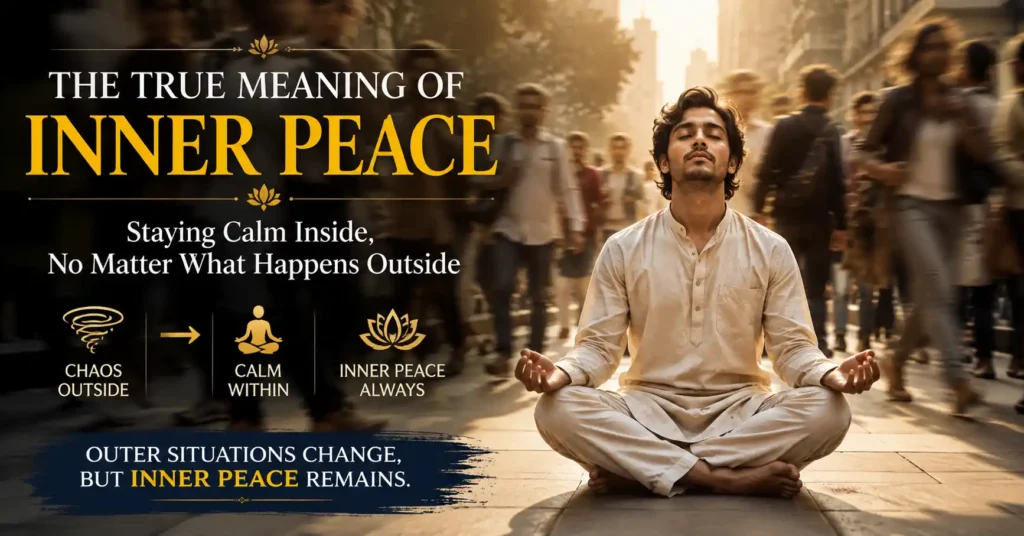
Many people think inner peace means having no problems in life. In reality, it has little to do with external circumstances and everything to do with how we respond to them.
People who possess emotional balance still face stress, disappointment, criticism, uncertainty, and difficult situations. The difference is that they do not allow every event to control their thoughts, emotions, or actions.
True inner peace is not about suppressing feelings or pretending that challenges do not exist. It is the ability to remain centered and aware even when life becomes difficult. Instead of reacting impulsively, a person develops the capacity to pause, reflect, and respond with greater understanding.
When something upsetting happens, anger may seek expression, fear may imagine the worst, and frustration may demand immediate action. A balanced mind creates space between the event and the response. In that space, awareness replaces impulse and wisdom guides action.
Over time, this leads to greater mental clarity, emotional resilience, and inner stability. Challenges may still arise, but they no longer disturb the mind in the same way. This is why inner peace is not a sign of weakness. It is a quiet strength that helps a person remain steady amid the changing circumstances of life.
Why the Mind Struggles to Maintain Inner Peace
If inner peace is so valuable, why do so many people struggle to experience it consistently?
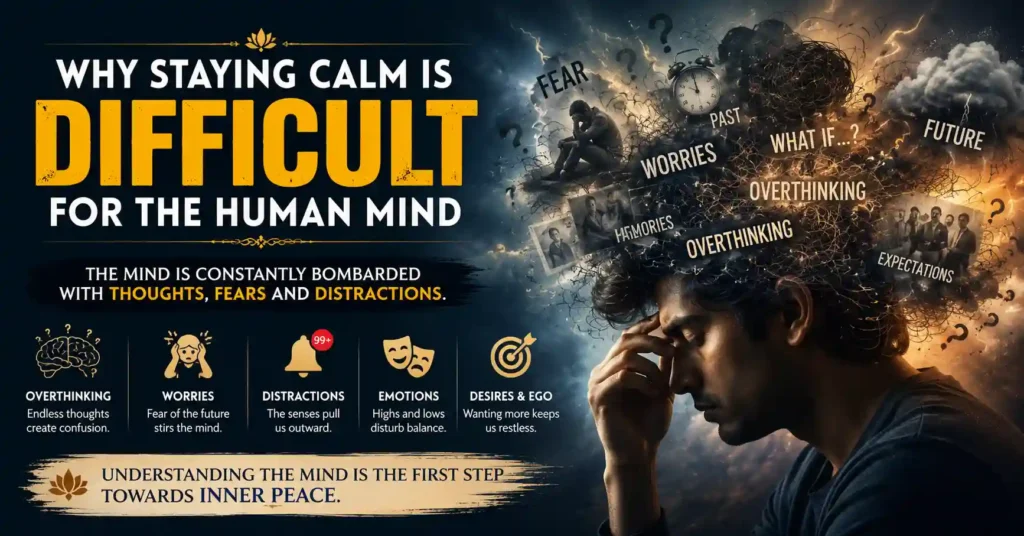
The human mind is naturally drawn toward potential problems and uncertainties. In earlier times, this tendency helped people recognize danger and survive. Today, the same habit often creates unnecessary stress, anxiety, and mental agitation.
A delayed message may lead to assumptions. A disagreement may continue replaying in the mind long after it has ended. A small mistake can trigger self-doubt and harsh self-criticism. Often, the situation itself is not the problem. The mind’s interpretation of it creates additional suffering.
Instead of remaining rooted in the present, the mind frequently moves between memories of the past and concerns about the future. This constant movement weakens emotional balance and makes it difficult to experience lasting calmness.
As thoughts become scattered, mental clarity begins to fade. Worries, expectations, and imagined outcomes consume attention, leaving little room for contentment or inner stability.
Understanding this tendency is an important step toward inner peace. When we recognize how the mind operates, we become better able to observe our thoughts without being controlled by them.
How Emotions Affect the Mind and Body
Have you ever noticed how quickly the body changes when you feel angry, anxious, or emotionally overwhelmed?
The heart begins to beat faster, muscles become tense, and thoughts start moving rapidly. These reactions occur because the mind and body are deeply connected.
When a person feels threatened, stressed, or emotionally disturbed, the body activates a natural survival response. Stress hormones prepare us to react quickly. While this response can be helpful during real danger, it is often triggered by everyday situations such as workplace pressure, family disagreements, financial concerns, or criticism.
Common signs include:
- Faster breathing
- Increased heart rate
- Tightness in the body
- Racing thoughts
- Strong emotional reactions
These reactions are not signs of weakness. They are natural responses that arise when the mind perceives a challenge or threat.
Developing inner peace does not mean preventing emotions from appearing. Emotions are a natural part of human experience. The real transformation begins when we become aware of them before they take control of our thoughts and actions.
The moment awareness arises, a space is created between the trigger and the reaction. In that space, emotional balance, self-mastery, and wiser choices become possible. Over time, this awareness helps cultivate greater mental clarity and inner stability, even during difficult circumstances.
Signs That Your Inner Peace Is Being Disturbed
Inner peace is rarely disturbed by a single event. More often, it fades gradually through small reactions, unresolved worries, and repeated mental distractions that accumulate throughout the day.
A little frustration, a lingering disappointment, or constant concern about things beyond our control can slowly create inner restlessness. Over time, the mind begins to feel burdened even when no major problem is present.
Some common signs include:
- Constant overthinking
- Feeling irritated more easily than usual
- Mental exhaustion even after resting
- Difficulty focusing
- Becoming defensive during conversations
- Worrying about things beyond your control
- Reacting impulsively
- Feeling restless even during moments of silence
These signs often indicate that emotional balance and mental clarity are being affected. If ignored, they can gradually increase stress, reduce self-awareness, and make everyday challenges feel more overwhelming.
Recognizing these signals early is important. The sooner we become aware of them, the easier it becomes to restore inner peace, regain inner stability, and respond to life with greater wisdom and self-control.
The Role of Thoughts in Inner Peace
One of the most important discoveries on the path to inner peace is that not every thought deserves our attention.
The mind is constantly active. Some thoughts help us learn, solve problems, and make wise decisions. Others arise from fear, worry, assumptions, expectations, or imagined situations that may never happen.
The difficulty begins when we treat every thought as truth. A small concern can grow into hours of overthinking. A minor mistake can occupy the mind far longer than necessary and disturb emotional balance.
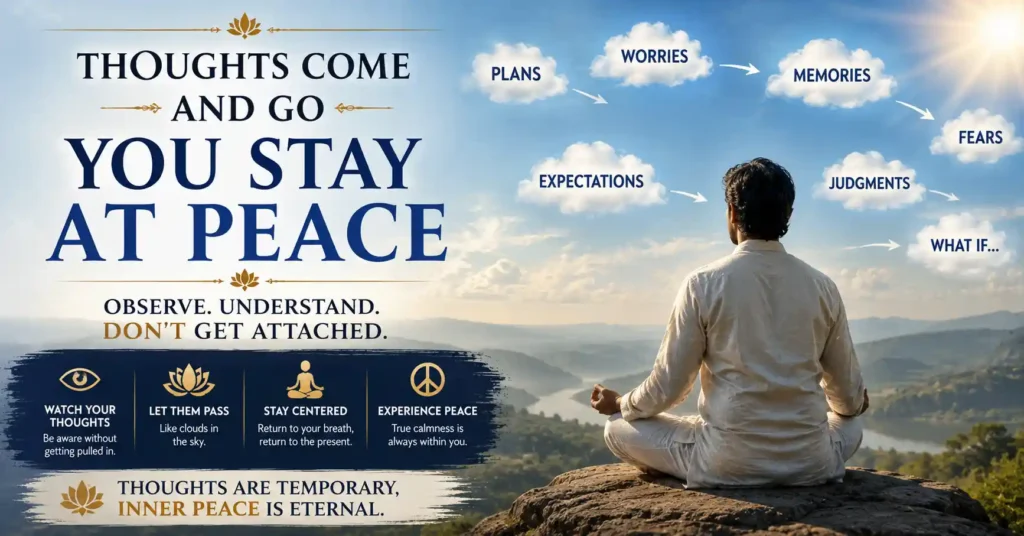
Developing inner peace does not require stopping thoughts. The mind will naturally continue to think. What matters is learning to observe thoughts without becoming attached to each one.
With practice, we begin to see that thoughts are temporary. They appear, remain for a while, and then pass away. Like clouds moving across the sky, they do not define who we are unless we hold on to them.
This shift in awareness creates greater mental clarity and inner stability. Instead of being carried away by every mental reaction, we learn to witness thoughts with greater understanding and self-awareness.
Many thoughts pull attention toward memories of the past or concerns about the future. A balanced mind grows stronger when attention gently returns to the present moment. The more present we become, the less influence unnecessary worries have over our emotional well-being.
Over time, this simple practice nurtures a deeper sense of inner peace, allowing the mind to become lighter, calmer, and more resilient in everyday life.
The Mind-Body Connection and Inner Peace
Many people try to find inner peace by controlling their thoughts. However, the mind and body are deeply connected, and sometimes the path to a calmer mind begins with caring for the body.
When we feel stressed, breathing often becomes shallow, muscles tighten, and the body remains in a state of tension. As physical discomfort increases, mental agitation often follows.
This close relationship explains why simple physical actions can influence our emotional state. A slow, conscious breath, a relaxed posture, or a few moments of stillness can gently signal safety to the nervous system.
Gradually, the body begins to relax, and the mind often becomes quieter as well. Mental clarity is easier to experience when the body is not carrying excessive tension.
Activities such as mindful breathing, a peaceful walk, gentle stretching, or sitting quietly for a few minutes can help restore a sense of balance. These practices are not merely physical exercises. They create conditions that support emotional resilience, self-awareness, and greater inner stability.
Understanding the connection between mind and body reminds us that inner peace is not separate from daily experience. When both work in harmony, it becomes easier to respond to life’s challenges with calmness, clarity, and wisdom.
Inner Peace in Relationships and Difficult Conversations
Few situations test inner peace as quickly as conflict and misunderstanding.
When someone criticizes us, disagrees with us, or says something hurtful, the immediate impulse is often to defend ourselves, prove our point, or react emotionally. In such moments, the mind becomes focused on winning the argument rather than understanding the situation.
Many conflicts grow larger because both people react before they truly listen. Strong emotions take control, and meaningful communication becomes difficult.
A balanced mind approaches disagreements differently. Instead of responding instantly, it creates space for reflection. Taking a moment to pause, listen carefully, and allow emotions to settle often leads to wiser responses and better outcomes.
This does not mean remaining silent or accepting everything without question. Healthy communication sometimes requires expressing disagreement. The difference lies in how we communicate. Words spoken with awareness and emotional maturity are more likely to build understanding than words driven by anger or frustration.
Relationships become stronger when we learn to respond with patience, empathy, and self-control. These qualities help reduce unnecessary conflict and support lasting harmony.
Maintaining inner peace during difficult conversations is not always easy, but it is one of the clearest signs of emotional resilience and spiritual growth. Often, a thoughtful response can prevent misunderstandings that a quick reaction would only deepen.
Maintaining Inner Peace During Stressful Times
Modern life can often feel fast-paced and demanding. Responsibilities increase, expectations grow, and there are times when multiple challenges seem to arrive at once.
During such moments, the mind tends to jump from one concern to another. It tries to solve every problem at the same time, creating confusion, mental fatigue, and unnecessary pressure.
One of the greatest obstacles to inner peace is the habit of carrying tomorrow’s worries into today. When attention becomes scattered across countless possibilities, emotional balance becomes difficult to maintain.
A helpful approach is to return to the present moment and focus on what can be done right now. Instead of becoming overwhelmed by the entire journey, bring attention to the next meaningful step.
When the mind begins racing in different directions, pause and ask yourself, “What is the most useful thing I can do at this moment?” This simple question often restores mental clarity and reduces unnecessary stress.
Over time, this practice strengthens inner stability and helps us respond to challenges with greater confidence and wisdom. Life may remain uncertain, but a steady mind is better equipped to navigate uncertainty without losing inner peace.
The Connection Between Acceptance and Inner Peace
Life does not always unfold according to our expectations. Good people face difficulties, sincere efforts do not always bring immediate results, and unexpected challenges can appear without warning.
During such moments, it is easy to lose inner peace and become overwhelmed by frustration, disappointment, or self-doubt. The mind begins questioning why things happened differently than expected.
This is where acceptance becomes important. Acceptance does not mean approving of a situation, giving up, or refusing to act. It simply means acknowledging reality as it is before deciding how to respond.
A large part of human suffering comes from resisting what has already happened. The mind continues arguing with the past, wishing circumstances were different. Yet no amount of resistance can change what has already occurred.
When acceptance begins, this inner struggle gradually softens. Mental energy that was once spent on resistance becomes available for understanding, growth, and constructive action.
From a spiritual perspective, acceptance helps cultivate emotional resilience, mental clarity, and inner stability. It allows us to face life’s challenges with greater wisdom rather than becoming trapped in anger, blame, or regret.
As acceptance deepens, we discover that inner peace does not depend on perfect circumstances. It grows when we learn to meet reality with patience, understanding, and a balanced mind.

How Attachment Disturbs Inner Peace
One of the most common causes of mental unrest is attachment. In Sanatan Dharma, attachment does not simply mean caring about people, goals, or possessions. It refers to becoming so emotionally dependent on them that our peace depends entirely on how they behave or what happens to them.
We become attached to desired outcomes, personal expectations, relationships, success, status, comfort, and even specific ideas about how life should unfold. When reality does not match these expectations, disappointment, frustration, and anxiety often arise.
The problem is not having goals or responsibilities. The problem begins when our happiness becomes completely tied to achieving a particular result. The more tightly the mind clings to an outcome, the more vulnerable it becomes to fear, worry, and emotional disturbance.
This is why attachment is frequently discussed in the Bhagavad Gita. Lord Krishna teaches that while action is necessary, excessive attachment to results can disturb mental balance and take away inner peace.
Detachment does not mean becoming indifferent or uncaring. It means participating fully in life while maintaining the wisdom to accept that not everything is within our control.
As attachment gradually decreases, the mind becomes lighter and more flexible. We learn to appreciate life’s experiences without being completely defined by them. This creates greater emotional resilience, acceptance, and a deeper sense of inner peace.
Inner Peace in Sanatan Dharma
Sanatan Dharma offers a profound understanding of inner peace that goes beyond temporary happiness or external success.
According to this wisdom, lasting contentment cannot be found solely through achievements, possessions, recognition, or favorable circumstances. These experiences may bring joy for a time, but their effects are often temporary because they depend on conditions that constantly change.
True inner peace arises from a deeper understanding of our nature and our relationship with the Divine. It develops when we stop seeking fulfillment only in the external world and begin cultivating stability within.
Sanatan teachings remind us that our value is not determined by success or failure, praise or criticism, gain or loss. A person who understands this truth is less likely to be disturbed by the changing situations of life.
For some, this connection grows through prayer and devotion. For others, it develops through meditation, chanting, seva, self-reflection, or remembrance of Bhagavan.
These spiritual practices serve as anchors during difficult times. They help cultivate emotional balance, strengthen faith, and bring the mind back to what is truly important.
Over time, spiritual wisdom helps us discover that inner peace is not something we must chase. It is a natural state that becomes clearer when the mind is less distracted by fear, attachment, and constant external demands.
Bhagavad Gita's Wisdom on Inner Peace
When seeking guidance on inner peace, few spiritual texts offer insights as profound and timeless as the Bhagavad Gita.
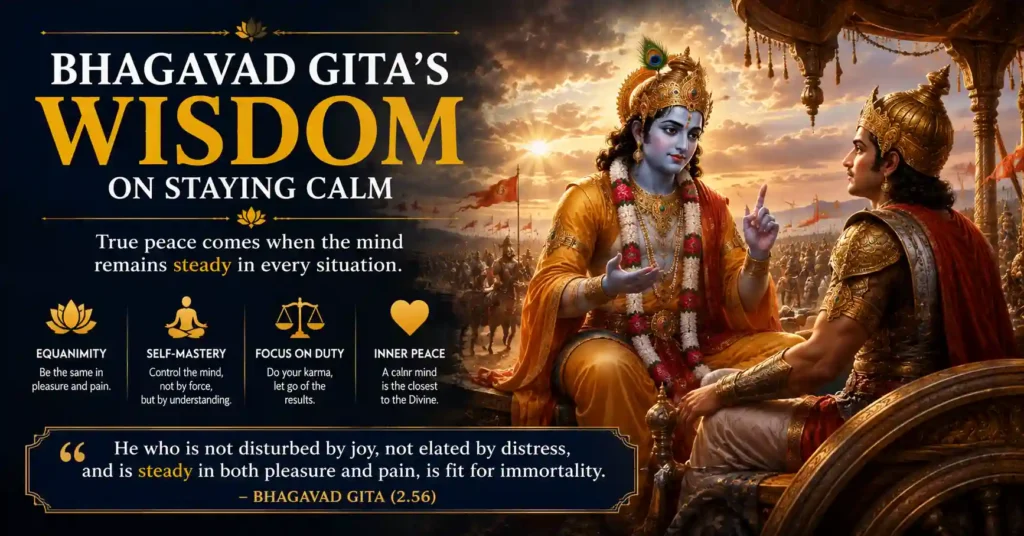
One of its most important teachings is to focus on righteous action rather than becoming consumed by results. Much of human anxiety arises from trying to control outcomes that are never entirely within our hands.
Lord Krishna advises Arjuna to perform his duty with sincerity while remaining free from excessive attachment to success or failure. This teaching does not encourage indifference or carelessness. Instead, it teaches self-mastery and freedom from constant worry about future results.
When the mind becomes overly attached to outcomes, fear, disappointment, and uncertainty naturally increase. A person may perform well yet remain restless because their happiness depends entirely on external circumstances.
The Bhagavad Gita offers a different path. It encourages dedicated effort combined with inner detachment. Such an approach allows a person to act with commitment while maintaining emotional balance regardless of the outcome.
As this wisdom is practiced, mental clarity improves, decisions become more thoughtful, and emotional resilience grows stronger. Gradually, a deeper sense of inner peace begins to emerge.
Even today, these teachings remain highly relevant for anyone seeking peace of mind, inner stability, and a more balanced approach to life’s challenges.
Karma Yoga and Inner Peace
One of the most practical teachings of the Bhagavad Gita is Karma Yoga, often described as the path of selfless action.
Karma Yoga teaches that we should perform our duties sincerely and responsibly without becoming excessively attached to the results. While we have control over our actions, we do not have complete control over every outcome.
Many people lose inner peace because they constantly worry about success, failure, recognition, or the opinions of others. The mind becomes trapped in expectations and anxiety about the future.
Karma Yoga offers a different perspective. It encourages us to focus on doing our best in the present moment while accepting that results will unfold according to many factors beyond our control.
This does not mean becoming passive or careless. In fact, Karma Yoga encourages wholehearted effort. The difference is that action is performed with dedication rather than fear, attachment, or constant mental pressure.
When we begin to practice this attitude, the mind becomes lighter. Stress caused by excessive expectations gradually decreases, and emotional balance becomes easier to maintain.
From the perspective of Sanatan Dharma, inner peace grows when action is combined with awareness, responsibility, and detachment from outcomes. This is one of the reasons Karma Yoga remains a timeless guide for living with greater clarity, resilience, and peace of mind.
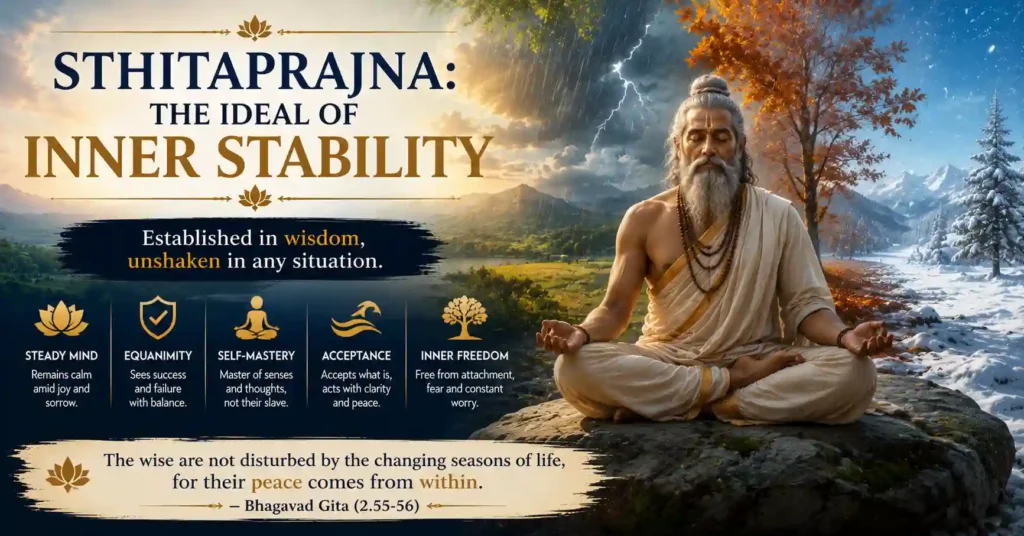
Sthitaprajna: The Ideal of Inner Stability
The Bhagavad Gita presents a profound ideal known as the Sthitaprajna, a person whose wisdom remains steady amid the changing circumstances of life.
Such a person experiences success and failure, praise and criticism, gain and loss, happiness and sorrow, yet does not allow these experiences to disturb their inner balance. Their peace does not depend entirely on external conditions.
When success comes, they do not become arrogant. When difficulties arise, they do not lose themselves in despair. They experience emotions like everyone else, but they possess the self-awareness to respond wisely rather than react impulsively.
The Sthitaprajna understands that all experiences are temporary. Because of this understanding, they remain grounded even when life moves through periods of uncertainty and change.
This ideal is closely connected with inner peace. A steady mind is not free from challenges, but it is free from being constantly controlled by them. Such stability allows a person to act with clarity, patience, and emotional maturity.
While becoming a Sthitaprajna may seem like a distant goal, every act of self-reflection, every moment of awareness, and every conscious choice made with wisdom helps move us closer to that state of inner stability.
In this sense, inner peace is not achieved in a single moment. It is gradually cultivated through understanding, self-mastery, and consistent spiritual growth.
Did You Know?
The Bhagavad Gita describes the ideal of Sthitaprajna, a person whose wisdom remains steady during success and failure, praise and criticism, happiness and sorrow.
Rather than being controlled by changing circumstances, such a person remains balanced through self-awareness, inner stability, and spiritual understanding.
This timeless teaching is considered one of the highest expressions of inner peace in Sanatan Dharma.
Why Inner Peace Requires Emotional Resilience
Many people assume that inner peace is a sign of softness or passivity. In reality, maintaining a steady mind during difficult times often requires tremendous inner strength.
It is easy to feel peaceful when circumstances are favorable. The true test comes when life brings setbacks, uncertainty, criticism, or loss. During such moments, emotional resilience helps us move forward without losing hope or becoming overwhelmed by negative emotions.
Resilience does not mean ignoring pain or pretending everything is fine. It is the ability to face challenges with courage, learn from difficult experiences, and continue acting with wisdom despite adversity.
Several qualities help strengthen this resilience over time:
- Self-awareness
- Patience
- Acceptance
- Gratitude
- Spiritual reflection
- Healthy daily habits
These qualities rarely develop overnight. They grow gradually through experience, reflection, and conscious effort.
As emotional resilience becomes stronger, it supports greater mental clarity, emotional balance, and inner stability. This creates a solid foundation for inner peace, allowing a person to remain grounded even when life becomes unpredictable.
In this way, lasting peace is not the absence of challenges. It is the strength to remain centered while moving through them.
Simple Daily Practices That Support Inner Peace
Inner peace rarely appears suddenly. More often, it develops gradually through small choices and daily practices that bring greater awareness and balance to life.
A few quiet moments before the day begins, a peaceful walk without distractions, a moment of gratitude, or a simple prayer before sleep may seem ordinary. Yet these small actions can slowly transform the atmosphere of the mind.
Some practices that support emotional balance and mental well-being include:
- Spending a few quiet minutes with yourself each day
- Reducing unnecessary scrolling and mental noise
- Practicing gratitude for small blessings
- Spending time in nature whenever possible
- Remembering the Divine through prayer, chanting, or reflection
- Taking breaks from constant stimulation and busyness
These practices help create space between us and the constant demands of modern life. They encourage self-awareness, reduce mental clutter, and bring attention back to what truly matters.
Many people searching for inner peace expect a complicated solution. In reality, lasting change often begins with simple actions repeated consistently over time.
As these practices become part of daily life, they gradually strengthen mental clarity, emotional resilience, and inner stability. What begins as a small effort can eventually grow into a deeper sense of harmony and contentment.
A Simple Reflection Practice for Inner Peace
There are times when the mind feels crowded with worries, expectations, and emotions. During such moments, even a few minutes of conscious awareness can help restore perspective.
When you feel overwhelmed, set aside five quiet minutes for reflection and stillness.
- First minute: Focus gently on your breathing.
- Second minute: Relax your shoulders, jaw, and any part of the body holding tension.
- Third minute: Observe your thoughts without judging or resisting them.
- Fourth minute: Bring to mind something for which you feel grateful.
- Fifth minute: Sit quietly and remain fully present.
This brief practice encourages self-awareness and creates a pause in the constant flow of mental activity. Instead of becoming absorbed in every worry, you learn to observe your experience with greater clarity.
While it may not solve every challenge immediately, it can help restore emotional balance, strengthen mental clarity, and support a deeper sense of inner peace.
Over time, even a few minutes of mindful reflection can become a valuable tool for maintaining inner stability amid the demands of daily life.

Common Obstacles to Inner Peace
Many people sincerely seek inner peace, yet certain habits and misunderstandings can make the journey more difficult than it needs to be.
One common mistake is trying to suppress emotions instead of understanding them. Ignoring anger, sadness, disappointment, or frustration does not make these feelings disappear. More often, they remain beneath the surface and return later with greater intensity.
Another obstacle is expecting immediate transformation. A balanced mind is not developed overnight. Emotional maturity, self-awareness, and inner stability grow gradually through patience, reflection, and experience.
Some people also struggle because they try to avoid every difficult situation. Others place unrealistic expectations on themselves and believe they should never experience negative emotions.
In reality, emotions are a natural part of human life. The goal is not to eliminate them but to understand them without becoming controlled by them.
From a spiritual perspective, attachment, excessive expectations, and the constant desire to control every outcome can also disturb mental peace. The more tightly the mind clings to how life should unfold, the more easily it becomes disappointed when reality differs from those expectations.
True inner peace develops when awareness becomes stronger than reaction. As understanding deepens, emotions continue to arise, but they no longer dominate our thoughts, words, and actions in the same way.
What Changes When You Develop Inner Peace?
One of the most surprising aspects of inner peace is that the external world may remain largely unchanged.
Responsibilities still exist. Challenges still arise. Unexpected situations continue to appear. What changes is your relationship with those experiences and the way you respond to them.
As inner stability grows, you spend less energy worrying about things beyond your control. Situations that once triggered immediate reactions begin to receive more thoughtful and balanced responses.
Mental clarity improves because the mind is no longer consumed by constant fear, overthinking, or emotional turbulence. Decisions become more deliberate, and relationships often benefit from greater patience, understanding, and emotional maturity.
Over time, emotional balance stops feeling like a skill that must be practiced every moment. It gradually becomes a natural part of your character and outlook on life.
This is one of the greatest gifts of inner peace. It does not remove life’s uncertainties or challenges, but it helps you move through them with greater confidence, wisdom, and resilience.
A peaceful mind is not one that never faces storms. It is one that has learned how to remain steady while the storms pass.
Conclusion
Inner peace does not mean becoming emotionless or escaping the challenges of life. It is the ability to face those challenges with awareness, balance, and inner strength instead of being completely overwhelmed by them.
There will be days when peace comes naturally and days when the mind feels restless. There will be moments of wisdom and moments when emotions take control. Such experiences are part of being human and part of the journey of growth.
The path to inner peace is not about perfection. It is a gradual process of returning to awareness, again and again. Each time you pause before reacting, choose understanding over anger, or focus on what truly matters, you strengthen your capacity for emotional balance and self-mastery.
Through self-awareness, emotional resilience, spiritual wisdom, and consistent reflection, the mind gradually becomes steadier. What once felt difficult begins to feel natural, and clarity starts replacing confusion and unnecessary worry.
Over time, you may discover an important truth taught by Sanatan Dharma: the peace we seek is not found in changing every circumstance around us. It emerges when we cultivate harmony within ourselves.
Ultimately, inner peace is not a destination to be reached. It is a way of living that allows us to move through life’s uncertainties with greater stability, wisdom, and contentment.
Key Takeaways
- Inner peace is not the absence of problems. It is the ability to remain emotionally balanced and mentally steady despite life’s challenges.
- The mind often loses peace through overthinking, attachment, fear, unrealistic expectations, and constant worry about the future.
- Not every thought deserves attention. Learning to observe thoughts without becoming attached to them is an important step toward mental clarity.
- Emotions are a natural part of life. The goal is not to suppress them but to respond with awareness rather than impulsive reactions.
- Acceptance helps reduce inner conflict. When we stop resisting reality, emotional resilience and inner stability begin to grow.
- Sanatan Dharma teaches that lasting peace comes from self-awareness, spiritual wisdom, devotion, and a deeper connection with the Divine.
- The Bhagavad Gita encourages sincere action without excessive attachment to success or failure, helping cultivate peace of mind and emotional balance.
- The ideal of Sthitaprajna reminds us that true wisdom lies in remaining steady during both favorable and difficult circumstances.
- Simple daily practices such as gratitude, prayer, meditation, self-reflection, and mindful awareness can gradually strengthen inner peace.
- Inner peace is not a destination reached in a single moment. It is a lifelong journey of awareness, understanding, and spiritual growth.
Suggested Reading
The journey toward inner peace is deeply connected with self-awareness, emotional resilience, spiritual wisdom, and a better understanding of the mind. If you wish to explore these topics further, the following articles from Sanatan Tales offer deeper insights and practical guidance for spiritual growth.
Ahankara: Ego in Spiritual Life, Meaning, Signs and How to Overcome It
https://thesanatantales.com/ahankara-ego-in-spiritual-life/
Spiritual Loneliness: Why Spiritual Awakening Feels Lonely and Quiet Inside
https://thesanatantales.com/why-spiritual-awakening-feels-lonely-and-quiet-inside/
Silence and Awareness: How Inner Silence Deepens Self-Awareness
https://thesanatantales.com/silence-and-awareness/
Panchbhoota in Sanatan Dharma: Five Elements, Meaning, Spiritual Significance and Daily Life
https://thesanatantales.com/panchbhoota-in-sanatan-dharma/
Spiritual Restlessness: Causes, Meaning, and Why the Mind Feels Restless Even After Prayer
https://thesanatantales.com/spiritual-restlessness/
How to Stay Calm During Difficult Times: Spiritual Wisdom from Sanatan Dharma
https://thesanatantales.com/how-to-stay-calm-during-difficult-times/
Feeling Spiritually Lost? What to Do According to Sanatan Dharma
https://thesanatantales.com/feeling-spiritually-lost/
FAQs
What is inner peace according to Sanatan Dharma?
In Sanatan Dharma, inner peace is a state of mental clarity, emotional balance, and spiritual stability that does not depend entirely on external circumstances.
It does not mean living without problems or difficulties. Instead, it means developing the wisdom to remain steady even when life becomes challenging.
Sanatan teachings explain that lasting peace arises from self-awareness, right understanding, devotion, and a deeper connection with the Divine. As attachment, fear, and excessive expectations decrease, the mind naturally becomes calmer and more balanced.
Why is it so difficult to maintain inner peace?
The human mind constantly moves between memories of the past and worries about the future. It also becomes attached to expectations, outcomes, and circumstances that are often beyond our control.
As a result, stress, frustration, and overthinking can easily disturb our emotional balance.
Maintaining inner peace becomes easier when we learn to observe our thoughts, accept reality as it is, and focus on what can be done in the present moment rather than worrying about every possible outcome.
Can inner peace exist even during difficult times?
Yes. In fact, the true value of inner peace becomes most visible during difficult situations.
Peace does not require perfect circumstances. Challenges, losses, disappointments, and uncertainty are part of life.
A person with inner stability still experiences these situations but responds differently. Instead of becoming completely overwhelmed, they face difficulties with greater patience, emotional resilience, and clarity.
This is why inner peace is often described as a form of inner strength rather than a temporary feeling.
What is the difference between inner peace and happiness?
Happiness is often connected to pleasant experiences, achievements, relationships, or favorable situations.
Because these circumstances change, happiness may also rise and fall.
Inner peace, however, is deeper and more stable. It is the ability to remain balanced regardless of whether life is currently pleasant or challenging.
A person may not feel happy every moment, yet still experience a sense of calmness, acceptance, and contentment within.
How does the Bhagavad Gita help cultivate inner peace?
The Bhagavad Gita teaches that much of human suffering comes from attachment, fear, and excessive concern about outcomes.
Lord Krishna advises performing one’s duties sincerely while letting go of constant anxiety about success or failure.
This teaching encourages emotional balance and freedom from unnecessary mental agitation.
As we focus on effort rather than trying to control every result, the mind becomes lighter, clearer, and more peaceful.
What is Sthitaprajna in the Bhagavad Gita?
A Sthitaprajna is a person of steady wisdom described in the Bhagavad Gita.
Such a person remains balanced during success and failure, praise and criticism, happiness and sorrow.
This does not mean they stop experiencing emotions. Rather, they develop enough self-awareness and inner stability to avoid being controlled by every emotional reaction.
The ideal of Sthitaprajna represents one of the highest expressions of inner peace in Sanatan philosophy.
What are the biggest obstacles to inner peace?
Several habits can disturb peace of mind and emotional balance.
Common obstacles include:
- Constant overthinking
- Attachment to outcomes
- Unrealistic expectations
- Fear of uncertainty
- Suppressed emotions
- Excessive comparison with others
- Lack of self-awareness
- Constant mental stimulation and distraction
Recognizing these obstacles is often the first step toward overcoming them.
How can I develop inner peace in daily life?
Developing inner peace is usually a gradual process rather than a sudden transformation.
Simple practices such as self-reflection, gratitude, prayer, meditation, mindful breathing, and spending time in nature can help create greater awareness and balance.
Equally important is learning to respond thoughtfully rather than reacting impulsively to every situation.
Over time, these small efforts strengthen emotional resilience, mental clarity, and inner stability.
Does inner peace mean avoiding emotions?
No. Inner peace does not mean becoming emotionless.
Anger, sadness, disappointment, fear, and joy are all natural parts of human experience.
The goal is not to eliminate emotions but to understand them without allowing them to completely control our thoughts, words, and actions.
A peaceful mind still experiences emotions, but it responds to them with greater awareness and wisdom.
Can prayer and devotion help bring inner peace?
Yes. For many people, prayer and devotion provide a powerful source of comfort, strength, and stability.
Remembering the Divine through prayer, chanting, japa, kirtan, or simple reflection helps shift attention away from fear and worry.
These practices strengthen faith, deepen spiritual awareness, and create a sense of connection with something greater than personal struggles.
Over time, devotion can become a strong foundation for lasting inner peace and emotional balance.
Glossary of Important Terms
| Term | Meaning |
|---|---|
| Inner Peace | A state of emotional balance, mental clarity, and inner stability that remains steady despite life’s changing circumstances. |
| Sanatan Dharma | The eternal spiritual tradition of India that teaches righteous living, self-realization, and harmony with the Divine. |
| Emotional Resilience | The ability to recover from setbacks, adapt to challenges, and remain hopeful during difficult situations. |
| Self-Awareness | The ability to observe one’s thoughts, emotions, habits, and reactions with honesty and understanding. |
| Mental Clarity | A calm and focused state of mind that helps a person think clearly and make wise decisions. |
| Inner Stability | The capacity to remain emotionally balanced and steady regardless of external events or circumstances. |
| Acceptance | A willingness to acknowledge reality as it is before deciding how to respond, rather than resisting what has already happened. |
| Attachment | Excessive emotional dependence on people, outcomes, possessions, or expectations that can disturb peace of mind. |
| Equanimity | A balanced state of mind that remains steady during success and failure, pleasure and pain, or praise and criticism. |
| Mindfulness | The practice of paying attention to the present moment with awareness and without judgment. |
| Gratitude | The habit of appreciating life’s blessings, which helps cultivate contentment and emotional well-being. |
| Spiritual Wisdom | A deeper understanding of life, the self, and the Divine gained through reflection, experience, and spiritual teachings. |
| Bhagavad Gita | One of the most important scriptures of Sanatan Dharma, containing Lord Krishna’s teachings on duty, wisdom, devotion, and inner peace. |
| Karma Yoga | The path of selfless action taught in the Bhagavad Gita, where duties are performed without attachment to results. |
| Sthitaprajna | A person of steady wisdom who remains balanced during success and failure, happiness and sorrow, as described in the Bhagavad Gita. |
| Seva | Selfless service performed without expecting personal gain, considered an important spiritual practice in Sanatan Dharma. |
| Meditation | A practice of focused awareness that helps calm the mind and deepen self-understanding. |
| Chanting (Japa) | The repeated recitation of a divine name, mantra, or prayer to cultivate devotion, concentration, and peace. |
| Divine | The Supreme Reality, God, or higher spiritual presence that guides and sustains all existence. |
| Contentment | A state of inner satisfaction that arises from gratitude, acceptance, and freedom from excessive desires. |
| Peace of Mind | A feeli |
About the Author
Yateendra Chaturvedi is a spiritual writer, researcher, devotee, and the founder of The Sanatan Tales. With over 35 years of professional experience and a lifelong interest in Sanatan Dharma, he writes about Hindu deities, temples, scriptures, festivals, Mahavidyas, sacred stories, rituals, and living traditions that continue to guide and inspire devotees across India.
Drawing from traditional scriptures, regional beliefs, temple traditions, devotional literature, and historical sources, he aims to present authentic, well-researched, and easy-to-understand content for modern readers. His work focuses on preserving spiritual wisdom, explaining sacred traditions, and helping seekers develop a deeper understanding of India’s rich spiritual heritage.
Through The Sanatan Tales, Yateendra strives to make the timeless teachings of Sanatan Dharma simple, meaningful, and relevant for today’s generation while maintaining respect for traditional sources, regional practices, and diverse spiritual perspectives.
Learn More About Yateendra Chaturvedi →
https://thesanatantales.com/about-the-author/
References & Sources
This article is based on the principles, teachings, and philosophical insights of Sanatan Dharma. The content draws from traditional Hindu wisdom, spiritual literature, devotional practices, yogic teachings, and widely accepted concepts related to self-awareness, inner peace, emotional balance, and spiritual growth.
It also reflects ideas that have been preserved and shared through generations by spiritual teachers, practitioners, cultural traditions, and the broader heritage of Sanatan thought.
Note: Interpretations, practices, and perspectives may vary across different traditions, sampradayas, regions, and individual spiritual paths within Sanatan Dharma. The purpose of this article is not to present any single viewpoint as the only truth, but to share commonly understood spiritual concepts in a simple, practical, and reader-friendly manner. Sanatan Dharma recognizes diverse paths of devotion, knowledge, meditation, selfless action, and self-discovery, allowing individuals to progress according to their own nature and understanding.
Explore More Fascinating Topics from Sanatan Dharma