
Life becomes difficult when we hold on too tightly to people, expectations, past experiences, or outcomes that are beyond our control. Many emotional struggles arise not only from what happens to us, but from our inability to release what no longer serves our growth.
This is where letting go in Sanatan Dharma offers a profound spiritual perspective. Rather than encouraging indifference or withdrawal from life, it teaches how to live with awareness, acceptance, and inner strength while fulfilling our responsibilities.
In today’s fast-paced world, people often feel burdened by relationship conflicts, career pressures, social comparison, fear of failure, and constant overthinking. The desire to control every situation can create stress, disappointment, and emotional exhaustion. The wisdom of letting go in Sanatan Dharma helps us understand that lasting peace comes not from controlling life, but from changing our relationship with it.
The teachings of the Bhagavad Gita, along with broader Sanatan wisdom, remind us that attachment to results, possessions, and expectations often becomes a source of suffering. By learning to release this attachment, we create space for greater clarity, emotional balance, and spiritual growth.
The practice of letting go in Sanatan Dharma is not about giving up on goals, relationships, or duties. It is about letting go of unnecessary fear, ego, resentment, and the need to control everything. When practiced with understanding, it helps us experience greater inner freedom while remaining fully engaged in life.
In this article, you will learn the spiritual meaning of letting go, why attachment creates suffering, what Sanatan Dharma teaches about inner freedom, and simple ways to cultivate peace, acceptance, and emotional balance in daily life.
Letting Go in Sanatan Dharma at a Glance
| Aspect | Key Insight |
|---|---|
| Topic | Letting Go in Sanatan Dharma: Finding Peace Beyond Attachment |
| Meaning | Releasing unhealthy attachment while continuing to perform duties sincerely. |
| Core Purpose | To reduce inner suffering and cultivate peace, clarity, and emotional balance. |
| What It Is Not | Giving up on life, suppressing emotions, or abandoning responsibilities. |
| Main Cause of Suffering | Excessive attachment to people, outcomes, expectations, and control. |
| Role of Maya | Creates the illusion that temporary things are permanent and controllable. |
| Role of Ego (Ahamkara) | Strengthens attachment through the need for validation, control, and identity. |
| Bhagavad Gita Teaching | Focus on sincere action without becoming attached to results. |
| Spiritual Foundation | The Atman remains peaceful and untouched by changing experiences. |
| Benefits of Letting Go | Greater peace, emotional resilience, clarity, acceptance, and inner freedom. |
| In Relationships | Loving without possessiveness, unrealistic expectations, or emotional dependence. |
| After Loss or Heartbreak | Releasing suffering gradually through acceptance, patience, and self-compassion. |
| Signs of Excessive Attachment | Overthinking, anxiety, fear of uncertainty, resentment, and emotional exhaustion. |
| Daily Practices | Meditation, prayer, self-awareness, acceptance, journaling, and mindful living. |
| Spiritual Surrender | Trusting divine wisdom while continuing to do one’s best. |
| Ultimate Outcome | Inner stillness, spiritual maturity, and freedom from unnecessary emotional burden. |
Table of Contents
ToggleWhat Does Letting Go in Sanatan Dharma Really Mean?
In Sanatan Dharma, letting go in Sanatan Dharma means releasing inner attachment while continuing to perform one’s duties with sincerity and awareness. It does not mean abandoning relationships, work, dreams, or responsibilities. Instead, it means reducing unhealthy emotional dependence on people, possessions, and outcomes.
Many people mistakenly believe that letting go means giving up or becoming emotionally distant. Sanatan teachings do not encourage withdrawal from life. They encourage participation in life with wisdom, balance, and a calmer state of mind.
Life is constantly changing, yet the human mind often tries to make things permanent. We cling to expectations, identities, emotional wounds, fears, and desired outcomes. When reality changes, this attachment can create disappointment, anxiety, and inner conflict.
Sanatan wisdom reminds us that everything in the material world is temporary. Situations change, emotions change, relationships evolve, and both success and failure eventually pass. Understanding this truth helps cultivate acceptance and emotional maturity.
This is why letting go in Sanatan Dharma is regarded as wisdom rather than weakness. It allows a person to remain engaged in life without becoming trapped by fear, resentment, or constant worry. By gradually releasing attachment, one develops greater inner freedom, emotional balance, and peace of mind.
The Spiritual Foundation of Letting Go in Sanatan Dharma
Sanatan Dharma teaches that our true nature is the Atman, the eternal self that remains peaceful and untouched by temporary experiences. While the body ages and the mind constantly changes, the Atman remains steady, pure, and unchanged.
Most suffering arises when the mind becomes attached to fear, desires, expectations, memories, and emotional reactions. The soul quietly observes these experiences, while the mind constantly reacts to them.
When people completely identify themselves with every thought and emotion, they often become trapped in cycles of worry, disappointment, and emotional pain. However, spiritual awareness gradually reveals that thoughts and feelings are temporary. They arise, stay for a while, and then pass away.
Just as waves appear and disappear on the surface of the ocean, emotions come and go in the mind. Beneath those changing waves, the deeper self remains calm and undisturbed.
This understanding forms the spiritual foundation of letting go in Sanatan Dharma. As awareness deepens, a person learns to observe experiences without becoming overwhelmed by them. Over time, this brings greater emotional balance, inner stability, and lasting peace.
Why Holding On Creates Suffering
Most suffering does not arise only from external events. Much of it comes from what we continue to hold within ourselves long after the event has passed.
People replay old conversations, cling to past disappointments, carry emotional wounds, or remain attached to expectations that were never fulfilled. Others constantly worry about the future because they fear uncertainty and the loss of control.
This mental attachment creates emotional heaviness. The wisdom of letting go in Sanatan Dharma teaches that inner freedom begins when we gradually release excessive attachment to people, outcomes, and past experiences.
Sanatan Dharma explains that attachment often transforms natural human experiences into lasting suffering:
- Love becomes fear of loss
- Effort becomes anxiety about results
- Care becomes emotional dependence
- Responsibility becomes burden
- Desire becomes restlessness
When the mind grips too tightly, even positive experiences can become sources of worry and distress.
Many people feel emotionally exhausted not because life is unbearable, but because their mind is constantly holding on. Learning to release this grip does not remove life’s challenges, but it changes how we experience them. This shift creates greater emotional balance, acceptance, and peace of mind.
How Maya Strengthens Attachment
In Sanatan Dharma, Maya refers to the illusion that temporary things are permanent and fully controllable. Under its influence, people become deeply attached to the changing aspects of life and begin seeking lasting happiness in things that cannot remain unchanged forever.
The human mind often becomes attached to:
- Identity
- Status
- Possessions
- Relationships
- Praise
- Success
- External Validation
Maya creates the belief that happiness depends entirely on controlling outer circumstances. However, life is constantly changing, and this struggle for control often gives rise to fear, disappointment, and suffering.
As spiritual understanding deepens, people gradually realise that lasting peace cannot depend solely on temporary situations, achievements, or the opinions of others. This awareness weakens attachment and nurtures greater inner freedom.
This is why letting go in Sanatan Dharma is closely connected with understanding Maya and recognising the temporary nature of worldly experiences.
Why Letting Go Feels So Difficult
Letting go may sound simple in theory, but emotionally it can be one of the most difficult things a person experiences.
Many people hold on because they fear that letting go means forgetting someone they loved or dismissing something that once mattered deeply. Others continue carrying emotional pain because it has become part of their identity. Some even mistake attachment for love and believe that releasing attachment means caring less.
The ego naturally seeks certainty, control, validation, and emotional security. It resists change and fears the unknown. Whenever life unfolds differently from our expectations, the ego reacts with anxiety, frustration, or disappointment.
This is why people often struggle to let go of:
- Past Relationships
- Hurtful Memories
- Fear of Failure
- Emotional Expectations
- Desire for Control
- Guilt and Regret
- Need for Approval
Sanatan Dharma does not teach emotional suppression or indifference. Instead, it encourages awareness, acceptance, and inner balance. By observing emotions without becoming trapped by them, a person gradually develops the strength to release unhealthy attachment while still caring deeply and living fully.
How Ego Creates Emotional Suffering
In Sanatan Dharma, ego (Ahamkara) does not simply mean pride or arrogance. It also refers to the false sense of identity that makes a person believe they are defined by their achievements, possessions, opinions, roles, and personal experiences.
The ego constantly seeks:
- Validation
- Recognition
- Certainty
- Emotional Control
- Superiority
- Attachment to Personal Identity
This creates inner tension because life rarely unfolds exactly according to personal expectations. People, situations, and circumstances change, but the ego continually resists those changes.
When the ego becomes too dominant:
- Criticism Feels Unbearable
- Rejection Feels Destructive
- Uncertainty Creates Anxiety
- Attachment Becomes Intense
As a result, even small setbacks can create disproportionate emotional suffering. The stronger the attachment to a particular identity, outcome, or expectation, the harder it becomes to accept change.
Spiritual growth gradually softens this inner rigidity. Through self-awareness, humility, and spiritual reflection, people begin to see that their true worth does not depend on constant approval, success, or control. This understanding makes it easier to release attachment and experience greater emotional balance.
What Does the Bhagavad Gita Teach About Letting Go?
The Bhagavad Gita repeatedly teaches the importance of acting sincerely without becoming emotionally attached to outcomes. This teaching forms the heart of Karma Yoga, one of the most practical spiritual paths in Sanatan Dharma.
One of its deepest lessons is simple yet powerful: perform your duties with dedication, but do not allow your happiness, peace, or self-worth to depend entirely on success or failure.
As the Bhagavad Gita says:
“You have the right to perform your actions, but not to the fruits of your actions.”
— Bhagavad Gita 2.47
This teaching is often misunderstood. The Gita does not promote passivity, laziness, or indifference. Arjuna was never told to abandon action. Instead, Lord Krishna taught him how to act with courage and commitment without becoming emotionally overwhelmed by the results.
When people become excessively attached to outcomes, they often experience fear, anxiety, frustration, anger, and disappointment. The mind becomes unstable because its peace depends on circumstances that are not always within its control.
The Bhagavad Gita encourages:
- Sincere Effort
- Emotional Balance
- Acceptance of Change
- Trust in the Larger Flow of Life
By focusing on right action rather than constant worry about results, a person develops greater inner stability and peace of mind. This is one of the most practical examples of letting go in Sanatan Dharma.
For this reason, spiritual surrender is not seen as weakness or defeat. It is the strength to do one’s best while accepting that not everything can be controlled.
Did You Know?
The Bhagavad Gita teaches that true freedom does not come from controlling every outcome, but from performing one’s duties sincerely without becoming attached to the results.
This timeless principle of Karma Yoga remains one of the most practical lessons on emotional peace and inner balance in Sanatan Dharma.
Letting Go Does Not Mean Giving Up
A common misunderstanding is that letting go means becoming emotionally detached from life. However, Sanatan wisdom teaches the opposite. Letting go is not about caring less. It is about caring without becoming consumed by attachment, fear, or the need to control everything.
You still:
- Love
- Work
- Care Deeply
- Give Your Best
The difference is internal.
You stop forcing life to obey your expectations. You stop trying to control every outcome and every reaction from others. Instead, you learn to act with sincerity while accepting that some things are beyond your control.
This shift does not reduce effort or commitment. Rather, it removes unnecessary mental pressure. You continue fulfilling your responsibilities, but your peace of mind no longer depends entirely on achieving a specific result.
True letting go in Sanatan Dharma removes emotional heaviness from effort. It allows action without inner panic, care without emotional dependence, and commitment without constant anxiety. This creates greater emotional balance, resilience, and inner freedom.
Acceptance Is Not Passive Resignation
Another common misunderstanding is that acceptance means weakness, surrendering to circumstances, or giving up on life. Sanatan Dharma teaches none of these.
Acceptance does not mean becoming passive or ignoring problems. It simply means reducing unnecessary inner resistance to reality. When we stop fighting what has already happened, we gain the clarity needed to respond wisely.
You can still:
- Improve Your Life
- Solve Problems
- Protect Yourself
- Work Toward Goals
- Speak Truthfully
The difference lies in your inner state. Instead of being driven by fear, anger, frustration, or emotional turmoil, you begin acting with greater awareness and balance.
This approach does not weaken action. In many cases, it strengthens it. A calm and clear mind makes better decisions than a mind overwhelmed by anxiety or resentment.
By practicing acceptance, people learn to respond to life’s challenges with wisdom rather than emotional reactivity. This creates greater clarity, resilience, and inner peace while remaining fully engaged in life.

Detachment Is Not Emotional Distance
Many people confuse detachment with emotional distance. They assume that becoming detached means caring less, withdrawing from relationships, or suppressing emotions.
Sanatan Dharma teaches something very different. Real detachment does not mean emotional numbness or a lack of compassion. It means remaining emotionally balanced without becoming consumed by fear, obsession, possessiveness, or unhealthy attachment.
A detached person can still:
- Love Deeply
- Support Others
- Show Compassion
- Perform Responsibilities Sincerely
The difference is that their inner peace does not completely depend on other people, situations, or outcomes. They care deeply, but they do not allow attachment to control their emotional well-being.
This understanding is closely connected to letting go in Sanatan Dharma. As attachment weakens, a person becomes more capable of loving with wisdom rather than fear and caring without becoming emotionally overwhelmed.
Detachment is inner steadiness, not emotional emptiness. It allows people to remain compassionate, responsible, and engaged in life while maintaining emotional balance and peace of mind.
Why Letting Go Matters More Than Ever Today
The wisdom of letting go feels especially important today because modern life constantly encourages deeper forms of attachment and mental dependence.
People often become attached to:
- Social Media Validation
- Public Image
- Career Success
- Comparison With Others
- Relationship Expectations
- Future Planning
- Constant Productivity
As a result, the mind rarely finds true rest.
Many people silently carry emotional pressure every day while appearing perfectly normal from the outside. Overthinking, anxiety, emotional burnout, and fear of failure gradually become part of daily life.
Constant attachment and the need to control every outcome can also affect emotional balance, relationships, peace of mind, and overall well-being. The more the mind depends on external circumstances for happiness, the more vulnerable it becomes to disappointment and stress.
Sanatan Dharma offers a different perspective. It reminds us that lasting peace cannot come solely from controlling the outer world. Real stability develops when we learn to respond to change with awareness, acceptance, and inner balance.
Inner stillness begins when the mind stops fighting every uncertainty. This is one reason why letting go in Sanatan Dharma feels especially relevant in today’s fast-paced and highly connected world. By releasing excessive attachment, people can cultivate greater clarity, emotional resilience, and inner freedom.
The Illusion of Control and Why It Creates Suffering
One of the biggest causes of mental suffering is the belief that we can control every outcome in life. While planning and effort are important, problems arise when the mind expects life to unfold exactly as desired.
People often try to control:
- The Future
- Other People’s Behavior
- Emotional Responses
- Success
- Relationships
- The Timing of Life
However, reality continues to change despite human plans and expectations. Unexpected events, delays, losses, and disappointments are a natural part of life.
When things do not happen according to our wishes, excessive attachment to control can create fear, frustration, anxiety, and emotional exhaustion. The mind becomes trapped in a constant struggle against uncertainty.
Sanatan Dharma teaches that sincere effort is necessary, but excessive control creates suffering. We are responsible for our actions, not for controlling every result that follows.
This understanding lies at the heart of letting go in Sanatan Dharma. Life becomes lighter when people learn to act with sincerity while accepting uncertainty with patience, trust, and maturity. Instead of fighting every change, they learn to respond with greater wisdom and emotional balance.
How Letting Go Brings Inner Freedom
When the mind gradually releases excessive attachment, life begins to feel lighter and more peaceful. Energy that was once spent on constant worry, fear, and emotional struggle becomes available for greater clarity and self-awareness.
Decisions become clearer because fear loses its grip. Emotions settle more quickly, and relationships often improve as expectations become more balanced. Even difficult situations become easier to face with patience and maturity.
This inner freedom is usually quiet rather than dramatic. It often reveals itself through small but meaningful changes:
- You Become Less Disturbed by Praise and Criticism
- You Stop Reacting to Everything Immediately
- You Trust Life a Little More
- You Feel Less Emotionally Trapped
- You Develop Greater Emotional Balance
Over time, these changes create a deeper sense of stability. Challenges may still arise, but they no longer control your inner state in the same way.
This calm inner strength is one of the deepest gifts of letting go in Sanatan Dharma. It does not remove life’s responsibilities or difficulties. Instead, it helps people face them with greater wisdom, resilience, and peace of mind.
Sometimes inner peace returns quietly, like still water settling after a disturbance. The mind gradually becomes softer, calmer, and less restless from within.
Letting Go in Relationships
Many people experience deep emotional suffering because they hold expectations from others too tightly. While expectations are natural, excessive attachment to how people should behave often becomes a source of disappointment.
We may expect others to always understand us, remain emotionally available, agree with our views, or never change. However, relationships naturally evolve as people grow, face challenges, and move through different stages of life.
Letting go in Sanatan Dharma does not mean loving less or becoming emotionally distant. In relationships, it means releasing excessive control, possessiveness, and unrealistic expectations while continuing to care with sincerity and compassion.
When attachment becomes excessive:
- Love Turns Into Fear
- Care Turns Into Emotional Pressure
- Closeness Turns Into Dependence
Sanatan wisdom teaches that healthy relationships flourish through understanding, trust, patience, acceptance, and mutual respect. When people stop trying to control every interaction, relationships often become more peaceful and authentic.
Sometimes inner peace returns when we stop forcing others to become what we expect them to be. By accepting people as they are while maintaining healthy boundaries, we create space for deeper connection, emotional balance, and genuine love.
Can Householders Practice Letting Go?
A common misconception is that letting go is only meant for monks, renunciates, or people living a spiritual life away from society. Sanatan Dharma teaches otherwise.
Householders can practice letting go in Sanatan Dharma while caring for their family, pursuing goals, earning a livelihood, and fulfilling daily responsibilities. The practice is not about leaving the world. It is about reducing excessive attachment, fear, and emotional dependence.
A person can work hard, love deeply, and serve sincerely while remaining inwardly balanced. This practical approach is one reason the teachings of the Bhagavad Gita remain relevant for everyday life.
Letting Go After Loss and Heartbreak
Sometimes letting go becomes necessary after emotional loss, betrayal, heartbreak, grief, or major life changes. These experiences can leave deep emotional wounds that are difficult to release.
Sanatan Dharma never asks people to suppress sadness or pretend that pain does not exist. Spiritual growth is not emotional denial. Acknowledging grief and allowing emotions to be felt is often an important part of healing.
Instead, Sanatan wisdom encourages gentle acceptance, prayer, patience, self-reflection, and inner understanding. Healing cannot always be rushed. Some wounds require time to soften and some lessons reveal themselves gradually.
Letting go in Sanatan Dharma after loss does not mean forgetting someone or acting as if they never mattered. It means slowly releasing the suffering created by resistance, guilt, anger, resentment, or attachment to what can no longer be changed.
Over time, healing often unfolds through:
- Awareness
- Patience
- Spiritual Reflection
- Prayer
- Self-Compassion
As acceptance grows, the mind gradually stops fighting the past. While memories may remain, they no longer carry the same emotional weight. This allows space for peace, emotional balance, and renewed strength to emerge.
Signs That You May Be Holding On Too Tightly
Sometimes people do not realise how much emotional weight they are carrying. Attachment often develops gradually and can become so familiar that it feels normal.
Some common signs include:
- Constant Overthinking
- Fear of Losing Control
- Replaying Old Memories Repeatedly
- Emotional Exhaustion
- Difficulty Accepting Change
- Obsessive Worrying
- Strong Fear of Uncertainty
- Holding Resentment for Years
- Feeling Mentally Restless All the Time
These signs do not necessarily mean something is wrong with you. They often indicate that the mind is holding on to unresolved fears, expectations, disappointments, or emotional attachments.
Over time, this mental burden can affect peace of mind, relationships, decision-making, and emotional well-being. The longer the mind resists change, the heavier this burden can become.
Awareness is the first step toward emotional release. Before anything can be healed or transformed, it must first be recognised honestly.
This is why letting go in Sanatan Dharma begins with self-awareness rather than self-judgment. By gently observing our thoughts, emotions, and attachments, we create the possibility for greater freedom, acceptance, and inner peace.
Practical Ways to Practice Letting Go in Daily Life
Letting go is rarely a single moment of transformation. In most cases, it develops gradually through awareness, patience, and consistent practice. Practicing letting go in Sanatan Dharma does not require withdrawing from life. It begins with small daily shifts in perspective and emotional balance.
1. Observe Your Thoughts
Pay attention to moments when the mind is clinging to fear, control, resentment, or past experiences. Simply observing these patterns without immediately reacting to them creates greater self-awareness.
2. Practice Acceptance
Some situations cannot be changed immediately. Acceptance does not mean approving of every situation. It means acknowledging reality as it is before deciding how to respond wisely.
3. Reduce the Need for Control
Not every outcome can be perfectly managed. Learning to release excessive control helps reduce anxiety and creates greater emotional flexibility.
4. Spend Time in Silence
Quiet moments allow the mind to slow down and settle. Even a few minutes of silence each day can reduce mental restlessness and improve inner clarity.
5. Practice Meditation
Meditation helps people observe thoughts and emotions without becoming controlled by them. Over time, the mind becomes less driven by fear, overthinking, and emotional attachment. Even a few minutes of mantra meditation or mindful breathing can cultivate greater inner stillness.
6. Chant Mantras or Pray
Prayer and mantra chanting can calm the mind and soften emotional heaviness. They also help shift attention away from worry and toward trust, surrender, and spiritual connection.
7. Focus on Effort Rather Than Results
One of the central teachings of Karma Yoga is to perform your duties sincerely without becoming overly attached to outcomes. This mindset brings greater peace and emotional balance.
8. Journal Your Emotions Honestly
Writing down thoughts and feelings can help release emotional burden and bring hidden attachments into awareness.
9. Trust the Process of Healing
Healing is rarely instant. Some attachments loosen quickly, while others take time. Patience, self-compassion, prayer, and life experience all play a role in the journey.
Sanatan Dharma does not demand emotional perfection. It encourages steady growth in awareness, acceptance, and inner freedom. Through consistent practice, letting go in Sanatan Dharma gradually becomes a natural way of living rather than a single spiritual exercise.
The Role of Spiritual Surrender in Letting Go
Spiritual surrender does not mean weakness, helplessness, or abandoning responsibility. In Sanatan Dharma, surrender means trusting that life unfolds according to a larger divine order that extends beyond personal understanding.
Many people remain mentally exhausted because they feel responsible for controlling every outcome, every relationship, and every future possibility. When reality unfolds differently from their expectations, frustration and anxiety often follow.
Spiritual surrender encourages a different approach. It teaches people to act sincerely while recognising that not everything can be controlled.
Spiritual surrender involves:
- Doing Your Best Sincerely
- Accepting Uncertainty
- Trusting Divine Wisdom
- Reducing Ego-Driven Control
This attitude gradually reduces the mental burden created by constant worry and excessive attachment to results. Instead of fighting every uncertainty, the mind learns to remain steady amidst change.
Over time, trust begins to replace fear. Faith replaces constant anxiety about the future. This creates greater inner peace and emotional balance even during difficult circumstances.
At its core, letting go in Sanatan Dharma is deeply connected with trust, surrender, and inner stillness. It is not about losing control of life, but about finding the wisdom to stop carrying burdens that were never meant to be controlled in the first place.
Letting Go as a Sign of Spiritual Maturity
Spiritual growth in Sanatan Dharma is not about becoming superior to others or appearing more spiritual. It is about gradually releasing the inner burdens that create suffering and disturb peace of mind.
As spiritual understanding deepens, people slowly learn to let go of:
- Ego
- Fear
- Excessive Attachment
- Rigid Expectations
- Need for Control
As these burdens begin to lighten, greater clarity, wisdom, and emotional balance naturally emerge. The mind becomes less reactive and more capable of responding to life with patience and understanding.
A spiritually mature person does not become emotionally distant from life. Instead, they become more compassionate, balanced, and inwardly peaceful. They continue to love, serve, and fulfill their responsibilities, but without being overwhelmed by constant attachment and fear.
In many ways, spiritual maturity and letting go in Sanatan Dharma develop together. The more a person grows spiritually, the easier it becomes to release unnecessary emotional burdens.
Just as a tree naturally releases old leaves when they are no longer needed, life often asks us to release thoughts, expectations, and attachments that no longer support our well-being.
Emotional release is one of the quiet signs of spiritual maturity. It reflects a growing ability to trust life, accept change, and remain anchored in inner peace despite external circumstances.
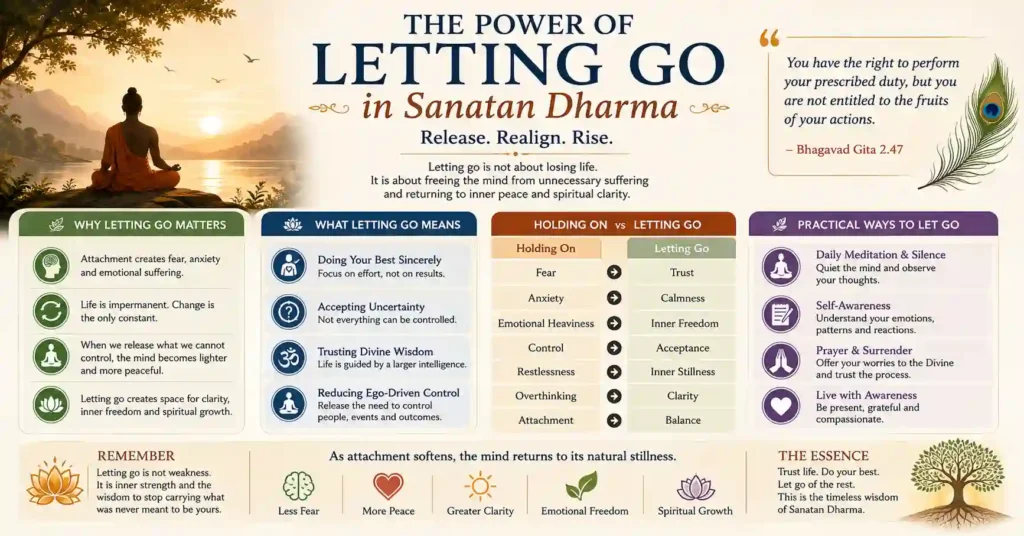
Holding On vs Letting Go: A Simple Comparison
The difference between holding on and letting go is often not visible from the outside. In both cases, a person may continue working, loving, and fulfilling responsibilities. The real change happens within the mind.
The table below highlights how emotional attachment can create suffering, while the practice of letting go in Sanatan Dharma gradually brings greater peace, balance, and inner freedom.
| Holding On | Letting Go |
|---|---|
| Fear | Trust |
| Anxiety | Calmness |
| Emotional Heaviness | Inner Freedom |
| Control | Acceptance |
| Restlessness | Inner Stillness |
| Overthinking | Clarity |
| Attachment | Balance |
These shifts do not happen overnight. They develop gradually through awareness, acceptance, spiritual practice, and life experience. Each small step toward releasing unnecessary attachment helps create greater emotional balance and peace of mind.
This transformation reflects the essence of letting go in Sanatan Dharma. By moving from fear to trust and from attachment to balance, people discover a quieter, deeper form of inner freedom that remains steady even as life continues to change.
Conclusion
The essence of letting go in Sanatan Dharma is not giving up on life but releasing unnecessary attachment. By loosening our grip on fear, expectations, and the need for control, we create space for greater peace, clarity, and emotional balance.
As attachment gradually softens, the mind becomes calmer and more resilient. This quiet inner freedom is not weakness. It is one of the deepest expressions of spiritual strength and wisdom in Sanatan Dharma.
Key Takeaways
- Letting go in Sanatan Dharma means releasing unhealthy attachment, not abandoning responsibilities.
- Most suffering arises from excessive attachment to people, outcomes, expectations, and control.
- The Bhagavad Gita teaches sincere action without becoming emotionally dependent on results.
- Understanding Maya helps us recognize the temporary nature of worldly experiences.
- Excessive ego and the need for control often create anxiety, fear, and emotional unrest.
- Healthy detachment allows people to love, care, and serve without becoming emotionally overwhelmed.
- Acceptance is not weakness. It is the ability to face reality with clarity and balance.
- Practices such as meditation, prayer, self-awareness, and spiritual surrender help cultivate inner freedom.
- Letting go is a gradual journey that develops through patience, understanding, and consistent practice.
- True inner peace emerges when trust becomes stronger than fear.
Suggested reading
If you wish to explore more spiritual ideas related to inner peace, emotional balance, and Sanatan wisdom, you may also enjoy reading these articles from thesanatantales.com.
What Is Dharma and Its Real Meaning in Sanatan Dharma
https://thesanatantales.com/what-is-dharma-in-sanatan-dharma/
What is Moksha and how is it attained?
https://thesanatantales.com/what-is-moksha/
What Is Spiritual Awakening in Sanatan Dharma?
https://thesanatantales.com/spiritual-awakening-in-sanatan-dharma/
Why Do I Feel Empty Even After Having Everything?
https://thesanatantales.com/feeling-empty-sanatan-perspective/
What Is Maya in Sanatan Dharma?
https://thesanatantales.com/what-is-maya-in-sanatan-dharma/
FAQs
What does letting go in Sanatan Dharma mean?
Letting go in Sanatan Dharma means releasing unhealthy attachment to people, outcomes, expectations, and past experiences while continuing to perform one’s duties sincerely. It does not mean abandoning responsibilities or becoming indifferent to life.
The goal is to reduce inner suffering caused by excessive attachment and develop greater peace, balance, and spiritual awareness.
Is letting go in Sanatan Dharma the same as detachment?
Not exactly. While the two concepts are closely related, they are not always identical.
Letting go is the process of releasing attachment, fear, resentment, or the need for control. Detachment is the state of inner balance that gradually develops through that process.
A detached person can still love, care, and fulfill responsibilities. The difference is that their happiness does not completely depend on external circumstances.
Why does attachment create suffering according to Sanatan Dharma?
Sanatan Dharma teaches that suffering often arises when people expect temporary things to provide permanent happiness.
When the mind becomes excessively attached to relationships, possessions, success, or expectations, it begins to fear loss and change. This creates anxiety, disappointment, frustration, and emotional unrest.
By understanding the temporary nature of life, people can develop greater acceptance and inner freedom.
What does the Bhagavad Gita teach about letting go?
The Bhagavad Gita teaches that people should perform their duties sincerely without becoming overly attached to the results of their actions.
Lord Krishna advises Arjuna to focus on right action rather than constant worry about success or failure. This teaching forms the foundation of Karma Yoga.
The Gita explains that attachment to outcomes often creates fear, anger, and mental disturbance, while balanced action leads to greater peace and stability.
Can a householder practice letting go in Sanatan Dharma?
Yes. Sanatan Dharma does not reserve spiritual wisdom only for monks or renunciates.
A householder can practice letting go while managing family responsibilities, career goals, and social commitments. The practice involves reducing excessive attachment and emotional dependence, not abandoning worldly duties.
In fact, learning to live with balance amidst daily life is an important part of spiritual growth.
How can I start practicing letting go in daily life?
The process usually begins with self-awareness.
Simple practices such as observing your thoughts, accepting what cannot be immediately changed, spending time in silence, meditation, prayer, and focusing on effort rather than results can gradually reduce attachment.
The key is consistency. Small daily changes often create deeper transformation than sudden emotional decisions.
Does letting go mean forgetting someone after loss or heartbreak?
No. Letting go does not mean forgetting people or pretending that they never mattered.
It means gradually releasing the emotional suffering created by resistance, guilt, anger, resentment, or attachment to what can no longer be changed.
Memories may remain, but they no longer carry the same emotional burden. Over time, acceptance allows healing and inner peace to emerge.
How does letting go in Sanatan Dharma help with stress and overthinking?
Many forms of stress arise from trying to control situations that are uncertain or beyond our influence.
Letting go in Sanatan Dharma helps people recognise the difference between sincere effort and excessive control. As attachment to outcomes weakens, the mind becomes calmer and less reactive.
This often leads to greater clarity, emotional balance, and peace of mind even during challenging situations.
Is spiritual surrender a form of weakness?
No. In Sanatan Dharma, spiritual surrender is considered a sign of inner strength.
Surrender does not mean becoming passive or helpless. It means doing your best while accepting that not everything can be controlled.
This attitude reduces mental strain and helps develop trust, resilience, and emotional stability in the face of life’s uncertainties.
What is the ultimate benefit of letting go in Sanatan Dharma?
The deepest benefit is inner freedom.
As attachment gradually softens, fear, anxiety, resentment, and emotional dependence begin to lose their hold on the mind. This creates greater peace, clarity, compassion, and spiritual maturity.
Over time, letting go in Sanatan Dharma helps a person live with wisdom, balance, and a deeper connection to their true inner nature.
Glossary of Important Terms
| Term | Meaning |
|---|---|
| Sanatan Dharma | The eternal spiritual tradition of India that teaches righteous living, self-realization, and harmony with the divine order. |
| Atman | The true self or soul that remains eternal, peaceful, and unchanged beyond the body and mind. |
| Maya | The illusion that makes temporary things appear permanent and causes attachment to the material world. |
| Attachment | Excessive emotional dependence on people, possessions, outcomes, or expectations that often leads to suffering. |
| Detachment | Maintaining emotional balance and inner stability without becoming controlled by attachment or possessiveness. |
| Ahamkara (Ego) | The false sense of identity that makes a person identify excessively with the body, status, achievements, and personal desires. |
| Karma Yoga | The spiritual path of performing one’s duties sincerely without becoming attached to the results. |
| Spiritual Surrender | Trusting the divine order of life while continuing to act responsibly and sincerely. |
| Acceptance | Acknowledging reality as it is without unnecessary inner resistance, while still taking appropriate action when needed. |
| Inner Freedom | A state of mental and emotional peace that arises when attachment, fear, and excessive control begin to weaken. |
| Emotional Balance | The ability to remain calm, steady, and thoughtful during both pleasant and difficult situations. |
| Self-Awareness | The practice of observing one’s thoughts, emotions, and reactions without immediate judgment or impulsive response. |
| Compassion | The ability to understand and respond to the suffering of oneself and others with kindness and empathy. |
| Inner Stillness | A quiet and peaceful state of mind that is not constantly disturbed by fear, worry, or emotional turbulence. |
| Spiritual Maturity | The gradual development of wisdom, emotional balance, humility, and inner peace through spiritual growth. |
About the Author
Yateendra Chaturvedi is a spiritual writer, researcher, devotee, and the founder of The Sanatan Tales. With over 35 years of professional experience and a lifelong interest in Sanatan Dharma, he writes about Hindu deities, temples, scriptures, festivals, Mahavidyas, sacred stories, rituals, and living traditions that continue to guide and inspire devotees across India.
Drawing from traditional scriptures, regional beliefs, temple traditions, devotional literature, and historical sources, he aims to present authentic, well-researched, and easy-to-understand content for modern readers. His work focuses on preserving spiritual wisdom, explaining sacred traditions, and helping seekers develop a deeper understanding of India’s rich spiritual heritage.
Through The Sanatan Tales, Yateendra strives to make the timeless teachings of Sanatan Dharma simple, meaningful, and relevant for today’s generation while maintaining respect for traditional sources, regional practices, and diverse spiritual perspectives.
Learn More About Yateendra Chaturvedi →
https://thesanatantales.com/about-the-author/
References & Sources
This article is based on teachings, principles, and spiritual insights associated with Sanatan Dharma, including concepts found in Hindu scriptures, traditional philosophical teachings, yogic wisdom, devotional traditions, and widely accepted spiritual practices. It also draws upon the timeless guidance preserved through saints, teachers, spiritual communities, and the living traditions that have passed Sanatan knowledge from one generation to the next.
Note: Interpretations, practices, and spiritual approaches may vary across different sampradayas, traditions, regions, and individual paths within Sanatan Dharma. The purpose of this article is not to present any single viewpoint as the only truth, but to share commonly accepted spiritual perspectives in a simple, practical, and reader-friendly manner. Sanatan Dharma embraces diverse paths of self-discovery, devotion, knowledge, meditation, righteous living, and inner transformation.
Explore More Fascinating Topics from Sanatan Dharma