
Maya is one of the most important concepts in Hindu philosophy. It helps explain why people often mistake the temporary for the permanent and become deeply attached to a constantly changing world. Understanding this teaching offers valuable insight into reality, perception, attachment, and spiritual growth.
In Hindu thought, Maya is often described as the power that makes the material world appear to be the ultimate truth. As a result, people may identify strongly with the body, possessions, social roles, desires, and emotions while overlooking their deeper spiritual nature. This does not mean the world is unreal, but that it is not the complete reality.
The concept is discussed throughout the Upanishads, Bhagavad Gita, and Vedanta traditions. It is closely connected with ideas such as Brahman, Atman, Avidya (ignorance), self-realization, and Moksha, making it central to the Hindu understanding of existence.
In this guide, you will learn:
- The meaning of Maya and its role in Hindu philosophy
- Whether Maya is the same as illusion
- The relationship between Maya and Brahman
- How attachment and ignorance shape human experience
- Practical ways to recognize and move beyond Maya
- Why this ancient teaching remains relevant today
By exploring Maya, we gain a deeper understanding of how Hindu philosophy views reality, self-knowledge, and liberation. Far from being an abstract idea, it offers practical guidance for overcoming attachment, reducing suffering, and cultivating lasting wisdom and inner freedom.
Maya At a Glance
| Key Fact | Explanation |
|---|---|
| What is Maya? | Maya is the power that makes the temporary world appear as the ultimate reality. |
| Maya Meaning | The meaning of Maya is often described as illusion, appearance, or the cosmic veil that hides the truth. |
| Is the World Unreal? | No. Maya does not mean the world is completely unreal. It means the world is temporary and constantly changing. |
| Role in Hindu Philosophy | Maya in Hindu philosophy helps explain attachment, ignorance, and the difference between appearance and reality. |
| Connection with Brahman | Maya veils Brahman, the ultimate reality, making it difficult to perceive the truth directly. |
| How Maya Affects Life | Maya creates attachment to the body, ego, possessions, desires, and social identity. |
| Mentioned in Scriptures? | Yes. Maya is discussed in the Upanishads, Bhagavad Gita, and Vedanta traditions. |
| How to Go Beyond Maya | Knowledge, devotion, meditation, self-inquiry, and right action help reduce the influence of Maya. |
| Ultimate Goal | Understanding Maya supports spiritual awakening and helps lead toward Moksha, or liberation. |
Table of Contents
ToggleWhat Is Maya?
Maya is a fundamental concept in Hindu philosophy that explains why people often mistake the temporary world for ultimate reality. It is the power that causes individuals to identify with the body, mind, emotions, and possessions while overlooking their deeper spiritual nature.
This teaching does not suggest that the world is completely false or nonexistent. Instead, it emphasizes that everything in the material realm is constantly changing and therefore cannot be the eternal truth.
As a result, people become attached to wealth, status, relationships, achievements, and personal identity. Such attachments can give rise to desire, fear, disappointment, and suffering when circumstances inevitably change.
Many Hindu traditions explain that this cosmic veil conceals the reality of Brahman, the ultimate and unchanging truth. As long as a person remains influenced by Avidya (ignorance), they tend to focus on appearances rather than the deeper reality behind them.
The concept is discussed throughout the Upanishads, Bhagavad Gita, and Vedanta philosophy. These teachings describe how the One reality appears as a diverse world of names, forms, and experiences.
Understanding the meaning of Maya is an important step in spiritual growth. It encourages self-inquiry, reduces attachment, and helps individuals develop a clearer understanding of themselves and the nature of existence.
By exploring this concept, we begin to recognize that not everything that appears permanent truly is. This insight forms the foundation for self-knowledge, wisdom, and the pursuit of Moksha (liberation).

What Is the Meaning of Maya?
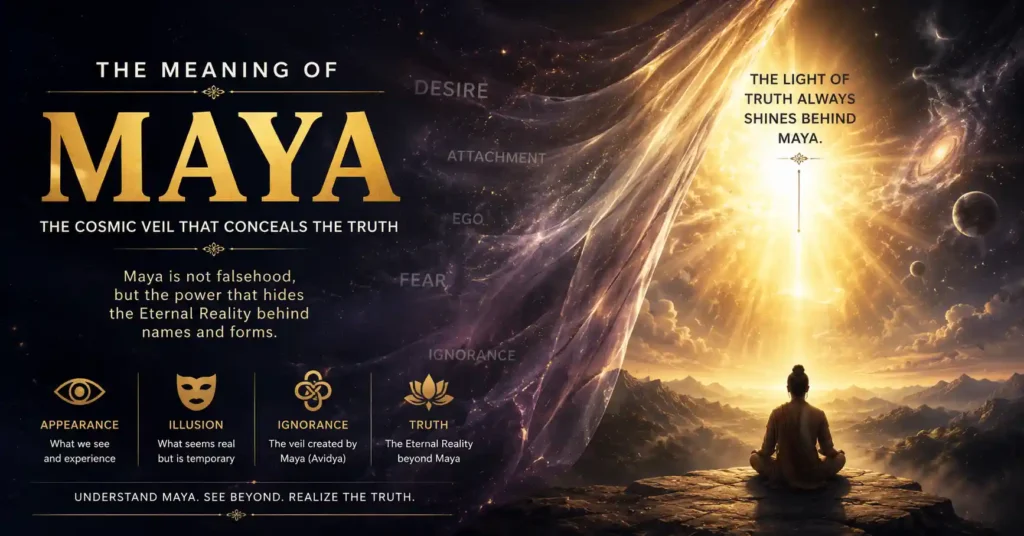
The meaning of Maya has been explored for centuries in Hindu philosophy, especially within the Upanishads and Vedanta traditions. The term is often translated as illusion, appearance, or the power that makes things seem different from their true nature.
In a spiritual context, it refers to the force that conceals ultimate reality and draws attention toward the ever-changing world of names, forms, and experiences. As a result, people often become absorbed in external life while overlooking their deeper spiritual identity.
However, this concept does not imply complete falsehood. The world exists and can be experienced, but it is not eternal. The misunderstanding arises when temporary things are treated as permanent and external identities are mistaken for the true Self.
Many teachers explain the idea through everyday examples. People may become deeply attached to wealth, status, beauty, or recognition, believing these will bring lasting fulfillment. When those conditions change, dissatisfaction and suffering often follow.
In Vedanta, this teaching is closely linked with Avidya (ignorance). As long as ignorance remains, perception is limited to appearances. With spiritual knowledge, a deeper understanding of reality gradually emerges.
The deeper significance goes beyond ordinary illusion. It refers to the cosmic power that veils truth, creates a sense of separation, and makes the One reality appear as the diverse world we experience.
Understanding this principle helps explain why Hindu philosophy places such importance on self-knowledge, wisdom, and spiritual awakening. It encourages us to look beyond appearances and seek the unchanging truth behind a constantly changing world.
Is Maya Mentioned in Hindu Scriptures?
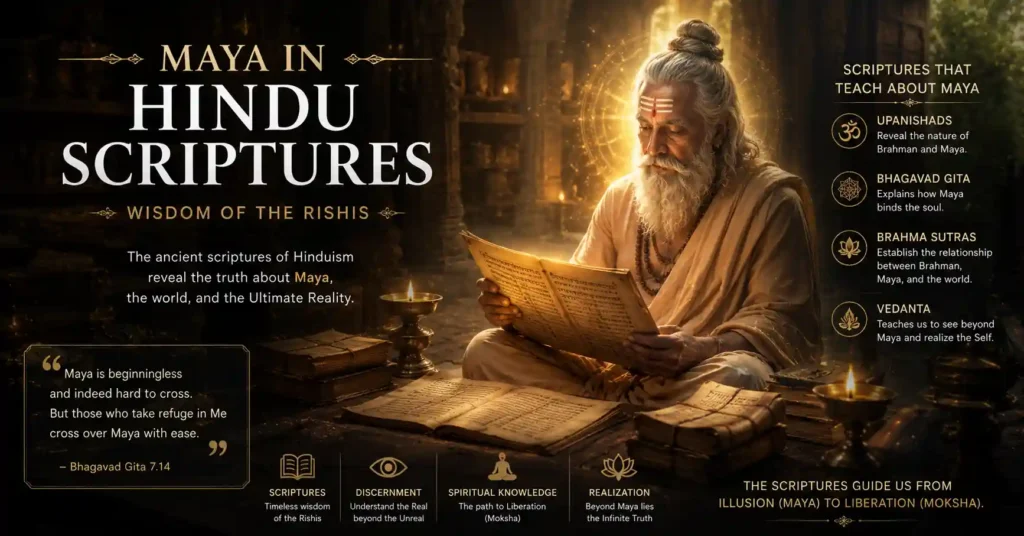
Yes, Maya is discussed in several important Hindu scriptures and philosophical traditions. The concept plays a central role in explaining the relationship between appearance and reality, as well as the journey toward self-realization.
The Upanishads explore the nature of existence and teach that Brahman is the ultimate truth. They explain that ordinary perception is often shaped by ignorance and misunderstanding, laying the foundation for later teachings on this concept.
The Bhagavad Gita also refers to the divine power that can make it difficult for individuals to recognize eternal truth. Lord Krishna explains that attachment to worldly desires often prevents people from seeing beyond the changing nature of material existence.
In Vedanta philosophy, particularly Advaita Vedanta, this cosmic power is described as the force through which the One reality appears as a world of countless names and forms. Spiritual knowledge is seen as the means of removing ignorance and revealing the underlying unity of existence.
The teachings of Adi Shankaracharya further expanded this understanding. His writings explain how ignorance creates the perception of separation and how wisdom leads to the realization of ultimate reality.
The presence of this teaching throughout the Upanishads, Bhagavad Gita, and Vedanta traditions shows that it is far more than a minor philosophical idea. It serves as a foundational principle for understanding human experience, spiritual ignorance, and the path toward Moksha (liberation).
Is Maya the Same as Illusion?
Maya is often translated as illusion, but the two terms are not exactly the same. While illusion captures part of the idea, the concept in Hindu philosophy is broader and more profound.
An ordinary illusion occurs when something is perceived incorrectly. A classic example is mistaking a rope for a snake in dim light. Once the truth becomes clear, the misunderstanding disappears.
In Hindu thought, the issue goes beyond misperceiving a single object. The deeper misunderstanding involves the nature of reality itself. People often assume that the changing world is permanent and that the body, mind, and ego represent their true identity.
This is why many teachers use illusion as a comparison rather than a complete definition. The concept refers to the cosmic power that veils ultimate reality and encourages attachment to temporary experiences.
As a result, individuals may seek lasting happiness through wealth, status, possessions, or external achievements. Although these can provide temporary satisfaction, they cannot offer permanent fulfillment because they are constantly changing.
Understanding this distinction helps clarify the meaning of Maya. It is not about denying the existence of the world but about recognizing that appearances do not always reveal the complete truth.
For this reason, Hindu philosophy teaches that spiritual knowledge, self-inquiry, and wisdom help a person see beyond appearances and discover the deeper reality that remains unchanged beneath the changing world.
Does Maya Mean the World Is Unreal?
No, Maya does not mean that the world is completely unreal or nonexistent. This is one of the most common misunderstandings of the concept.
In Hindu philosophy, the world is real as an experience. People live, work, build relationships, and interact with the world every day. At the same time, everything within it is constantly changing and therefore cannot be considered eternal.
This teaching emphasizes that what is temporary should not be mistaken for ultimate reality. The body, possessions, emotions, achievements, and circumstances all change over time.
Many Vedanta teachers explain that the world is neither absolutely real nor absolutely unreal. It exists and can be experienced, but it does not possess the same permanent nature as Brahman, the ultimate and unchanging reality.
This perspective helps explain the relationship between appearance and truth. The issue is not the existence of the world itself but the tendency to focus only on external forms while overlooking the deeper reality behind them.
For example, people may believe that wealth, status, or success can provide lasting happiness. While these things have value, they are temporary and cannot remain unchanged forever.
Understanding this principle encourages a balanced outlook. It allows individuals to participate fully in life while remembering that lasting peace and fulfillment come from something deeper than changing circumstances.
Rather than teaching that the world is unreal, this philosophy teaches that the world is temporary, while the ultimate truth remains eternal and unchanging.
How Does Maya Affect Human Life?
Maya influences how people perceive themselves, others, and the world around them. It encourages identification with the body, mind, emotions, possessions, and social roles, making these temporary aspects of life appear more important than they truly are.
As a result, many individuals become deeply attached to wealth, success, relationships, reputation, and personal achievements. While these things have value, difficulties arise when they become the primary source of happiness and security.
One of the most significant effects of this teaching is the strengthening of the ego. People often define themselves through their profession, status, appearance, or public image rather than through their deeper spiritual identity.
It also contributes to fear and anxiety. When attachment grows toward things that are constantly changing, concern about losing them naturally follows. This can lead to stress, insecurity, and emotional suffering.
Another common effect is the endless cycle of desire. Achieving one goal frequently leads to the pursuit of another, creating the belief that lasting fulfillment lies just beyond the next success, possession, or accomplishment.
The influence of illusion and attachment can be seen in everyday life. Many people spend years chasing external achievements only to realize that inner peace cannot be obtained through material gains alone.
This does not mean worldly responsibilities should be abandoned. Hindu philosophy encourages individuals to fulfill their duties while remaining aware of the temporary nature of external circumstances.
Understanding how this force shapes human experience helps develop greater self-awareness. It encourages people to look beyond attachment, reduce unnecessary suffering, and cultivate a deeper connection with truth, wisdom, and lasting contentment.

Is Maya Considered Negative or Evil?
No, Maya is not considered evil or inherently negative in Hindu philosophy. It is often described as a cosmic power that makes worldly experience possible and allows living beings to interact with the material world.
Without this power, human beings would not experience relationships, responsibilities, learning, growth, or the countless experiences that shape life. In this sense, it plays an essential role in the functioning of creation.
The challenge arises when people become completely absorbed in appearances and lose sight of the deeper reality behind them. This can lead to attachment, ignorance, and suffering, not because the force itself is harmful, but because its nature is misunderstood.
In Hindu philosophy, the issue is not the world itself but the tendency to treat temporary things as permanent truths. When wealth, status, possessions, or personal identity become the sole focus of life, dissatisfaction and confusion often follow.
Many spiritual traditions view this concept as a teacher rather than an obstacle. Through life’s changing experiences, individuals gradually recognize the limits of material fulfillment and begin seeking deeper meaning and truth.
The relationship between Brahman and this cosmic veil is also important. While it conceals ultimate reality, it can also inspire the spiritual search that leads toward self-knowledge, wisdom, and liberation.
For this reason, Hindu philosophy generally regards it as neither good nor evil. It is a natural aspect of existence that helps explain human experience, spiritual ignorance, and the journey toward higher understanding.
Understanding this principle encourages balance. Rather than rejecting the world, it teaches people to engage with life while remaining aware of the deeper reality that exists beyond temporary appearances.
What Is the Relationship Between Maya and Brahman?
The relationship between Maya and Brahman is one of the most important ideas in Hindu philosophy, especially within Vedanta. Understanding this relationship helps explain the difference between ultimate reality and the world of changing appearances.
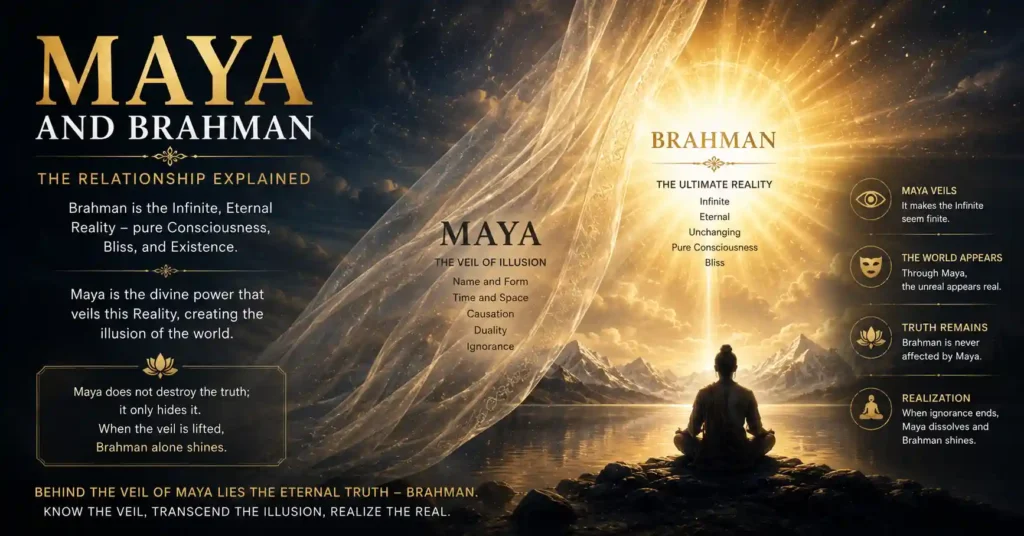
Brahman is described as the eternal, infinite, and unchanging reality that exists beyond time, space, and form. It is regarded as the ultimate truth underlying all existence.
Maya, by contrast, is the cosmic power that veils this truth and causes the One reality to appear as a diverse world of names, forms, and experiences. Because of this veil, people perceive separation and diversity where there is ultimately unity.
Many Vedanta teachers explain that Brahman itself never changes. What changes is human perception. Under the influence of Avidya (ignorance), individuals identify with the body, mind, and ego rather than recognizing their deeper spiritual nature.
A common example is that of clouds covering the sun. The clouds may hide the sun from view, but they do not affect the sun itself. In the same way, this cosmic veil obscures awareness of ultimate reality without altering it in any way.
This teaching explains that human beings experience life through a limited perception of reality. Through spiritual knowledge, self-inquiry, and wisdom, that limitation gradually begins to fade.
As understanding deepens, attachment and ignorance weaken, making the underlying truth easier to recognize. This realization is considered an important step on the path toward self-realization and Moksha (liberation).
Understanding the relationship between these two concepts helps explain why Hindu philosophy places such importance on self-knowledge. The goal is not to reject the world, but to see beyond appearances and recognize the eternal truth that has always existed beneath them.
How Can One Go Beyond Maya?
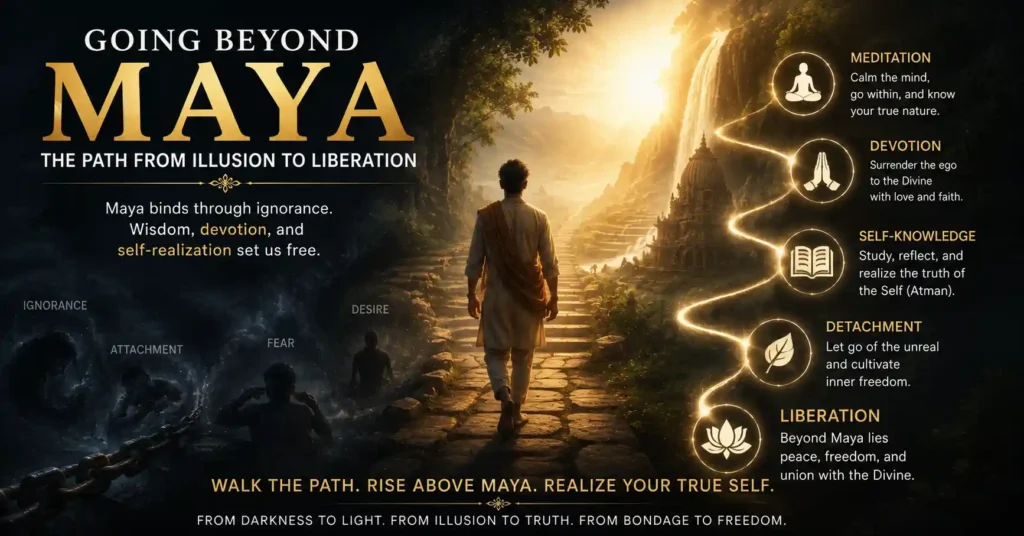
Going beyond Maya is a central goal in many Hindu spiritual traditions. The aim is not to reject the world but to understand it correctly and recognize the deeper reality that exists beyond changing appearances.
One of the primary approaches is Jnana Yoga, the path of knowledge. Through study, reflection, and self-inquiry, a person gradually learns to distinguish between the temporary and the eternal. This process helps reduce Avidya (ignorance) and cultivate spiritual wisdom.
Bhakti Yoga, the path of devotion, offers another powerful means of transcending illusion. Through prayer, worship, mantra chanting, and surrender to the Divine, the mind becomes less absorbed in ego and worldly distractions.
Karma Yoga emphasizes selfless action without attachment to results. By performing one’s duties with sincerity and the right attitude, a person can gradually overcome selfish desires and develop inner balance.
Meditation also plays an important role in spiritual growth. Regular practice helps quiet the mind, increase self-awareness, and reduce identification with passing thoughts and emotions. Over time, it can reveal a deeper sense of peace and clarity.
Many spiritual teachers highlight the value of self-inquiry. Reflecting on questions such as “Who am I?” encourages individuals to look beyond external identities and discover their true nature.
This journey is usually gradual rather than sudden. As knowledge, devotion, and awareness deepen, attachment weakens and the nature of reality becomes easier to understand.
Ultimately, transcending Maya does not mean abandoning worldly life. It means living with greater wisdom, recognizing the temporary nature of external circumstances while remaining connected to the eternal truth within.
How Can We Recognize Maya in Everyday Life?
Many people think of Maya as an abstract philosophical idea, but its influence can be observed in everyday life. It often appears whenever temporary things are treated as the source of lasting happiness, identity, or security.
Common examples include:
- Attachment to wealth and the belief that money alone can provide lasting fulfillment.
- Seeking status and recognition as the primary measure of self-worth.
- Identifying with the ego, including appearance, achievements, roles, or personal opinions.
- Pursuing endless desires, where one accomplishment quickly gives way to another.
- Fear of loss related to possessions, relationships, success, or reputation.
- Constant comparison with others, leading to dissatisfaction and inner restlessness.
- Dependence on external validation, where happiness depends heavily on approval from others.
- Mistaking temporary circumstances for permanent realities, despite the changing nature of life.
These patterns do not mean that wealth, success, or relationships are wrong. The issue arises when they become the sole foundation of happiness and identity.
Recognizing such tendencies helps develop greater self-awareness. It encourages people to enjoy life’s experiences while remaining mindful of their temporary nature.
This understanding allows individuals to navigate change with greater balance, reduce unnecessary suffering, and cultivate a deeper connection with truth, inner peace, and spiritual growth.

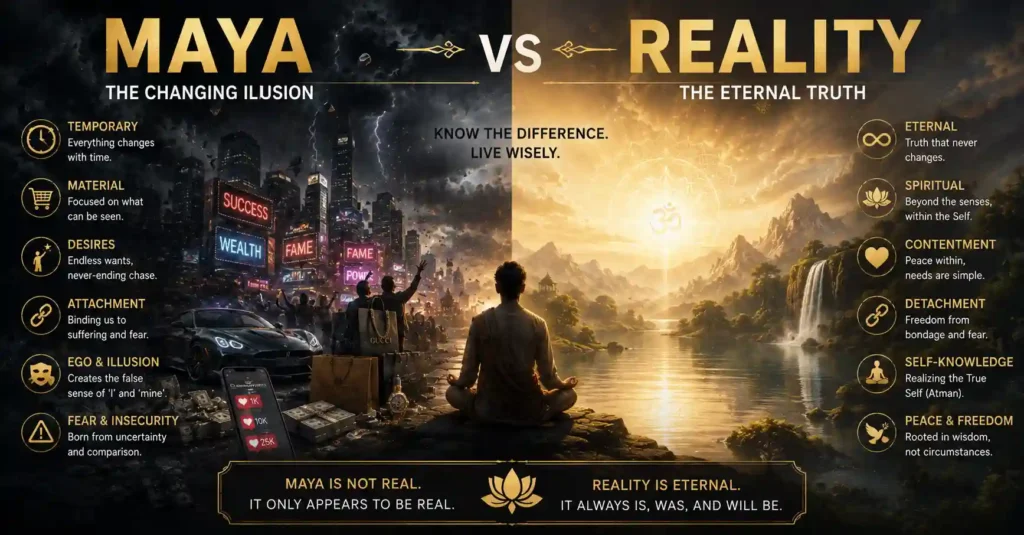
Maya vs Reality: What Is the Difference?
Understanding the difference between Maya and reality is essential in Hindu philosophy. Maya refers to the changing world of appearances, while reality refers to the eternal truth that remains unchanged behind those appearances.
The world experienced through the senses has practical value and serves an important role in daily life. However, it is temporary and constantly changing. Ultimate reality, by contrast, is permanent and independent of time, place, or circumstances.
Quick Comparison
| Maya | Reality |
|---|---|
| Temporary and changing | Eternal and unchanging |
| Based on appearances | Based on truth |
| Associated with attachment | Associated with freedom |
| Creates confusion and ignorance | Brings wisdom and clarity |
| Connected with the material world | Connected with Brahman |
| Focused on ego and identity | Focused on the true Self |
| Leads to fear of loss | Leads to inner peace |
This comparison does not suggest that the world should be rejected. Rather, Hindu philosophy teaches that temporary experiences should not be mistaken for the ultimate truth.
As spiritual understanding deepens, a person learns to participate fully in life while recognizing that lasting peace comes from a deeper source than external circumstances.
Recognizing the difference between appearance and reality helps cultivate wisdom, reduce attachment, and support the journey toward self-realization and Moksha (liberation).
Why Is Understanding Maya Important in Daily Life?
Understanding Maya is valuable not only for spiritual study but also for everyday life. The concept helps explain why people often experience stress, disappointment, fear, and dissatisfaction even after achieving many of their goals.
One of the key teachings of Hindu philosophy is that external circumstances are constantly changing. Recognizing this truth can help individuals remain more balanced during both success and failure.
Understanding this principle can help a person:
- Develop a healthier relationship with wealth, status, and possessions.
- Reduce excessive attachment to outcomes and expectations.
- Become less affected by praise and criticism.
- Handle change with greater acceptance and resilience.
- Cultivate inner peace instead of relying solely on external achievements.
- Make decisions with greater clarity and self-awareness.
This teaching also encourages self-reflection. By examining desires, fears, and attachments, people can better understand the causes of emotional struggles and respond to them more wisely.
Another practical benefit is a broader perspective on life. When challenges are viewed through the lens of impermanence, they often feel less overwhelming and easier to navigate.
The deeper purpose of understanding the meaning of Maya is not to withdraw from life but to engage with it more consciously. It teaches people to appreciate the world without becoming completely dependent on it for happiness and fulfillment.
For this reason, the concept remains highly relevant today. Its insights offer practical guidance for living with greater wisdom, balance, resilience, and inner freedom in a constantly changing world.
Common Misconceptions About Maya
The concept of Maya is often misunderstood. Because it deals with perception, reality, and spiritual knowledge, many people develop incorrect assumptions about what this teaching actually means in Hindu philosophy.
Maya Does Not Mean the World Is Completely Unreal
A common misconception is that this concept teaches the world does not exist.
Hindu philosophy generally teaches that the world exists and can be experienced. The key point is that it is temporary and constantly changing, not the ultimate reality.
Maya Is Not the Same as Ordinary Illusion
Many people assume it simply means seeing something incorrectly.
While illusion is one aspect of the idea, the concept refers to a deeper misunderstanding of reality, where temporary things are mistaken for permanent truths.
Maya Is Not Evil
Some people view it as a negative force that should be feared or avoided.
In reality, it is often described as a cosmic power that makes worldly experience possible. The challenge arises when people become completely attached to what is temporary and lose sight of deeper truth.
Maya Does Not Require Rejecting the World
Another misconception is that understanding this teaching requires abandoning family life, work, or responsibilities.
Hindu traditions generally encourage people to fulfill their duties while maintaining awareness of the changing nature of worldly experiences.
Maya Affects More Than Ordinary People
Some believe that only non-spiritual individuals are influenced by attachment and ignorance.
However, Hindu scriptures repeatedly emphasize that ego, desire, and attachment can affect anyone. This is why self-awareness and spiritual practice remain important for all seekers.
Going Beyond Maya Does Not Mean Escaping Life
Many people assume spiritual growth requires withdrawing from society or avoiding worldly involvement.
Instead, the goal is to live with greater wisdom, balance, and awareness while engaging responsibly with the world and its responsibilities.
Understanding these misconceptions helps clarify the true meaning of Maya. Rather than promoting pessimism or rejection of life, this teaching encourages deeper insight into reality, attachment, self-knowledge, and spiritual growth.
Conclusion
Maya is one of the most profound concepts in Hindu philosophy. It explains why people often mistake the temporary for the permanent and become deeply attached to things that are constantly changing.
The meaning of Maya extends far beyond ordinary illusion. It refers to the power that veils ultimate reality and leads individuals to identify primarily with the body, mind, ego, and material experiences while overlooking their deeper spiritual nature.
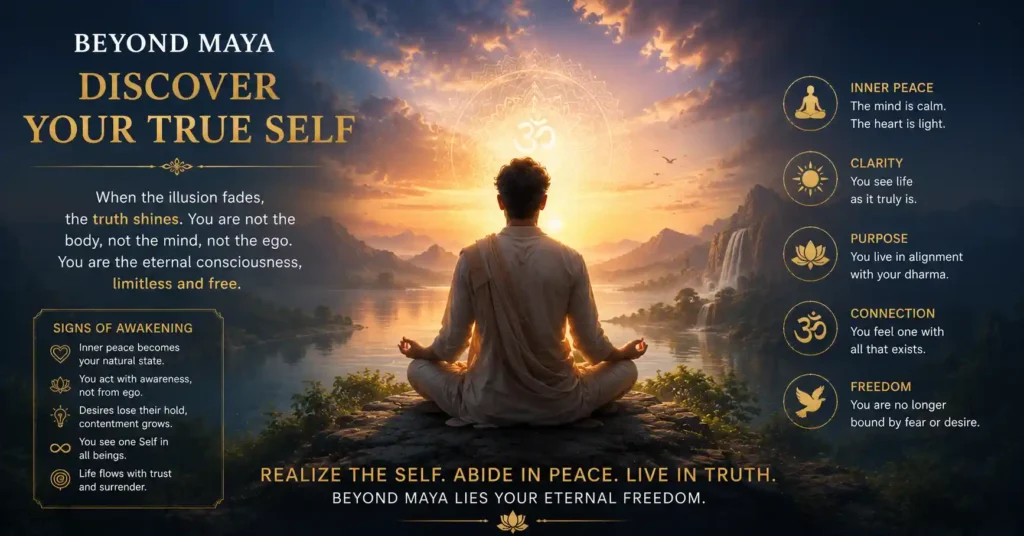
Understanding this teaching helps us view life from a broader perspective. It encourages self-awareness, reduces unhealthy attachment, and reminds us that lasting peace cannot be found through external circumstances alone.
The relationship between Maya and Brahman teaches that beneath the changing world lies an eternal and unchanging reality. Through knowledge, devotion, meditation, and right action, individuals can gradually move beyond limited perception and gain a clearer understanding of truth.
In modern life, these teachings remain highly relevant. They help people navigate success and failure, manage desires and fears, and cultivate greater balance in a world marked by constant change.
Ultimately, understanding Maya is not about rejecting the world. It is about living with greater wisdom, recognizing the difference between appearances and reality, and progressing toward deeper self-knowledge, spiritual growth, and inner freedom.
Key Takeaways
- Maya is the cosmic power that makes the changing world appear as the ultimate reality.
- This concept helps explain why people become attached to the body, possessions, relationships, achievements, and social identities.
- It does not teach that the world is nonexistent. Rather, it teaches that temporary experiences are often mistaken for eternal truth.
- Hindu scriptures such as the Upanishads, Bhagavad Gita, and Vedanta traditions describe it as a veil that conceals the deeper reality of Brahman.
- Attachment, ego, desire, fear, and ignorance are some of the common ways this influence shapes human experience.
- Hindu philosophy generally does not regard Maya as evil. It is a natural aspect of creation and worldly existence.
- Jnana Yoga, Bhakti Yoga, Karma Yoga, meditation, and self-inquiry are traditional paths for transcending illusion and gaining spiritual insight.
- Understanding this teaching can help develop greater wisdom, inner peace, resilience, and a balanced approach to life.
- The ultimate goal is not to reject the world but to see beyond appearances and recognize the eternal reality that underlies all existence.
FAQs
What Is Maya?
Maya is a key concept in Hindu philosophy that explains why people often mistake temporary things for lasting reality. It influences how we perceive ourselves, others, and the world around us.
This teaching does not say that the world is unreal. Instead, it explains that the body, possessions, emotions, and social identities are constantly changing and should not be mistaken for eternal truth.
Hindu philosophy teaches that Brahman is the ultimate and unchanging reality, while Maya acts as a veil that limits human perception. As a result, people often identify more with external experiences than with their deeper spiritual nature.
This helps explain attachment to wealth, status, relationships, and achievements. When these change or disappear, disappointment and suffering often follow.
Understanding the meaning of Maya encourages self-awareness, wisdom, and spiritual growth. It helps people distinguish between what is temporary and what is eternal, leading to greater balance, clarity, and inner peace.
What Does Maya Mean in Hindu Philosophy?
The meaning of Maya is often explained as illusion, appearance, or the power that conceals ultimate truth. However, these translations capture only part of its deeper philosophical significance.
This concept refers to the tendency to focus on external appearances while overlooking the deeper reality behind them. As a result, people become absorbed in the changing aspects of life and forget their spiritual nature.
In Vedanta philosophy, it is described as the force through which the One reality appears as a diverse world of forms, identities, and experiences. This creates the perception of separation where there is ultimately unity.
It also helps explain why people seek lasting happiness in temporary things. While worldly experiences have value, they cannot provide permanent fulfillment because they are constantly changing.
Understanding this teaching reveals why Hindu philosophy places such importance on self-knowledge, spiritual inquiry, and the search for truth.
Is Maya the Same as Illusion?
Maya is often translated as illusion, but the two terms are not exactly the same. Illusion is one aspect of the concept, but its meaning is much broader.
An ordinary illusion occurs when something is perceived incorrectly. In Hindu philosophy, the deeper issue is misunderstanding the nature of reality itself.
This teaching explains why people often treat temporary things as permanent and identify strongly with the body, mind, and ego. Such identification can lead to attachment, desire, and suffering.
The world experienced through the senses is not completely false. Rather, it is incomplete when viewed without awareness of the deeper reality behind it.
For this reason, many spiritual teachers describe Maya as a veil over truth rather than a simple illusion. It helps explain the limits of human perception and the importance of spiritual knowledge in understanding reality more clearly.
Does Maya Mean the World Is Unreal?
No, Maya does not mean that the world is unreal or nonexistent. This is one of the most common misunderstandings of the concept.
Hindu philosophy teaches that the world exists and can be experienced. People live, work, build relationships, and fulfill responsibilities within it.
However, everything in the material world is constantly changing. This teaching highlights that temporary experiences should not be mistaken for eternal reality.
Many Vedanta traditions explain that the world is relatively real because it can be experienced, but it does not possess the same unchanging nature as Brahman, the ultimate reality.
Understanding this distinction helps people appreciate the world without becoming completely attached to it. It encourages a balanced approach to life while remembering that lasting peace comes from recognizing a deeper and more enduring truth.
How Does Maya Affect Human Life?
Maya affects human life by shaping how people think, feel, and perceive reality. It influences the way individuals understand themselves and their place in the world.
One of its strongest effects is identification with the body, mind, social roles, and possessions. As a result, many people define themselves through temporary external factors rather than their deeper spiritual nature.
It also contributes to attachment. When happiness becomes dependent on wealth, relationships, success, or recognition, fear of loss naturally follows. This can lead to anxiety, disappointment, and emotional suffering.
Another effect is the endless pursuit of desires. Achieving one goal often creates the urge for another, making lasting satisfaction seem just out of reach.
Understanding how this influence operates helps develop greater self-awareness. It allows people to recognize attachments, reduce unnecessary suffering, and approach life with greater wisdom, balance, and inner peace.
Suggested Reading
If learning about Maya has deepened your interest in Sanatan Dharma, you may also enjoy exploring related spiritual concepts and teachings. Understanding this concept becomes even more meaningful when viewed alongside topics such as devotion, surrender, ultimate reality, sacred time, and the soul’s journey toward liberation.
These teachings help place Maya in Hindu philosophy within the broader framework of self-realization, spiritual growth, and the pursuit of truth.
What Is Rudraksha? Meaning, Types and Spiritual Benefits
https://thesanatantales.com/what-is-rudraksha/
What Is Sharanagati? Understanding Surrender in Hindu Philosophy
https://thesanatantales.com/what-is-sharanagati/
What Is Bhakti? Meaning, Types, Importance, and Understanding in Sanatan Dharma
https://thesanatantales.com/what-is-bhakti/
What Is Brahman? Meaning, Nature and Spiritual Significance in Hinduism
https://thesanatantales.com/what-is-brahman/
Brahma Muhurta: Meaning, Time, Benefits and Spiritual Significance
https://thesanatantales.com/brahma-muhurta-meaning/
What Is Samsara? Meaning, Karma, and the Cycle of Rebirth
https://thesanatantales.com/what-is-samsara/
What Is Nishit Kaal? Meaning, Time, Importance and Spiritual Significance
https://thesanatantales.com/what-is-nishit-kaal/
What Is Maya (Illusion)? (Quora)
https://www.quora.com/What-is-Maya-illusion-according-to-Sanatana-Dharma
By exploring these topics, you can develop a deeper understanding of Maya, its role in Hindu philosophy, and its connection to the wider teachings of Sanatan Dharma.
References & Sources
This article is based on teachings and philosophical concepts found within Sanatan Dharma, particularly those related to Maya, Brahman, Atman, spiritual ignorance (Avidya), self-realization, and liberation (Moksha). It draws upon insights preserved in Hindu scriptures, including the Upanishads, Bhagavad Gita, Vedanta philosophy, and traditional commentaries that explore the nature of reality and human perception.
The article also reflects interpretations and explanations passed down through spiritual teachers, philosophical traditions, devotional communities, and the guru-disciple lineage that has helped preserve and transmit Sanatan wisdom across generations. Concepts have been presented in a simplified and practical manner to make them accessible to modern readers while remaining rooted in traditional teachings.
Note: Interpretations of Maya may vary among different schools of Hindu philosophy, including Advaita Vedanta, Vishishtadvaita, Dvaita, and other traditions. The purpose of this article is not to promote any single philosophical viewpoint as the definitive interpretation, but to present commonly accepted perspectives in a clear, balanced, and reader-friendly way. Sanatan Dharma embraces diverse approaches to understanding reality through knowledge, devotion, meditation, self-inquiry, and spiritual practice.
Explore More Topics from The Sanatan Tales