There are moments in life when the heart longs for something deeper than success, possessions, or temporary happiness. Even when everything seems fine on the surface, many people still feel a quiet desire for meaning, peace, and a genuine connection with something greater than themselves.
At such times, a natural question may arise: what is Bhakti, and why has it been cherished by countless devotees throughout the history of Sanatan Dharma?
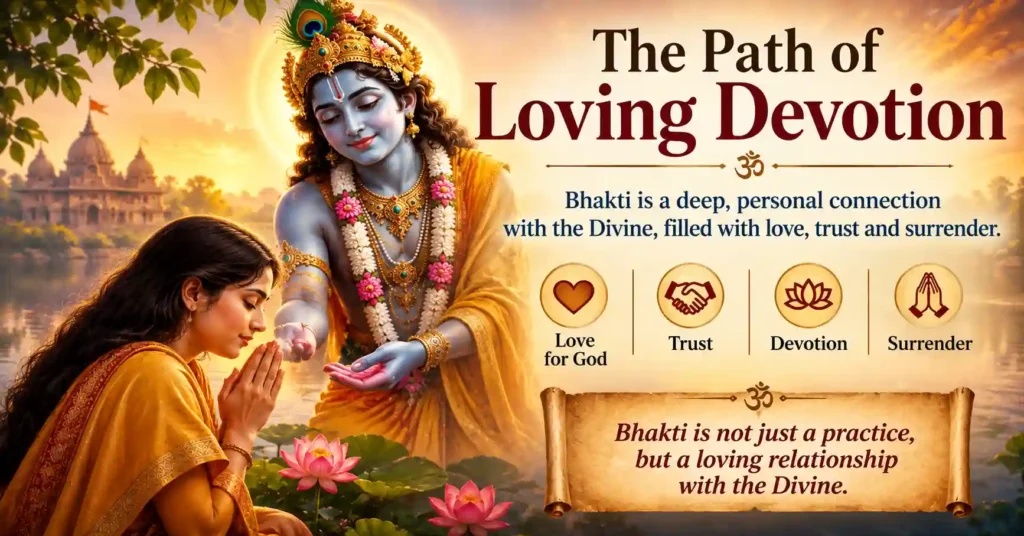
In simple terms, what is Bhakti can be understood as a path of loving devotion toward the Divine. It is not limited to rituals, ceremonies, or religious practices. Bhakti is a heartfelt relationship built on love, trust, faith, remembrance, and surrender.
One of the reasons what is Bhakti remains such an important question today is that this path is open to everyone. It does not depend on age, education, social status, or spiritual knowledge. Anyone can begin the journey of devotion with sincerity and an open heart.
In Sanatan Dharma, Bhakti is considered one of the most accessible and powerful ways to grow spiritually. Through devotion, a person gradually develops inner peace, reduces the burden of ego, and strengthens their connection with the Divine.
In this article, you will learn the meaning of Bhakti, its origins, scriptural foundations, different types of Bhakti, the role of Bhakti Yoga, the relationship between Bhakti and surrender, its spiritual and practical benefits, and simple ways to practice Bhakti in daily life. Whether you are completely new to the subject or looking to deepen your understanding, this guide will help you understand what is Bhakti in Sanatan Dharma in a simple and beginner-friendly way.
Bhakti At a Glance
| Topic | Quick Answer |
|---|---|
| What is Bhakti? | Bhakti is loving devotion and a heartfelt connection with the Divine. |
| Meaning of Bhakti | The word Bhakti comes from the Sanskrit root Bhaj, meaning to share, participate, serve, or adore. |
| Main Goal | To develop love, faith, surrender, and closeness to God. |
| Mentioned In | Bhagavad Gita, Bhagavata Purana, Narada Bhakti Sutras, and other Hindu scriptures. |
| Who Can Practice Bhakti? | Anyone, regardless of age, background, knowledge, or spiritual experience. |
| Main Path | Bhakti Yoga, the path of devotion in Sanatan Dharma. |
| Key Benefit | Bhakti helps cultivate inner peace, spiritual growth, faith, and emotional strength. |
Bhakti is one of the most accessible spiritual paths in Sanatan Dharma because it focuses on love rather than intellectual knowledge or complex practices. Whether expressed through prayer, chanting, service, remembrance, or surrender, Bhakti helps create a deeper relationship with the Divine.
Understanding what is Bhakti is not only about learning a religious concept. It is about discovering a path that can bring greater peace, purpose, and devotion into everyday life.
Table of Contents
ToggleWhat Is Bhakti?
To understand what is Bhakti, it is important to look beyond the idea of religion or ritual. In Sanatan Dharma, Bhakti is a path of loving devotion toward the Divine. It is the sincere feeling of love, trust, reverence, and connection that a devotee develops for God.
The word Bhakti is often translated as devotion, but its meaning goes much deeper. It is not merely about performing worship or reciting prayers. Bhakti is a relationship with the Divine that comes from the heart rather than from obligation or fear.
When people ask what is Bhakti in Sanatan Dharma, they are often seeking to understand how devotion can become a spiritual path. Bhakti teaches that a person can draw closer to God through love, remembrance, prayer, service, chanting, and surrender.
Unlike paths that emphasize philosophical study or strict spiritual discipline, Bhakti focuses on cultivating a personal connection with the Divine. This is why it is considered one of the most accessible paths in Hinduism.
A person practicing Bhakti may worship Lord Krishna, Lord Rama, Lord Shiva, Maa Durga, or any form of the Divine they feel connected to. The form may differ, but the essence remains the same: loving devotion and faith.
Bhakti is not measured by the number of rituals performed or the amount of religious knowledge one possesses. It is measured by sincerity, humility, and the depth of one’s devotion.
In simple words, what is Bhakti can be understood as the path of divine love. It is a way of living that gradually transforms the heart, strengthens faith, and helps a person experience a deeper connection with the Divine presence in everyday life.
What Is the Origin of Bhakti?
To fully understand what is Bhakti, it helps to explore where the concept comes from and how it developed within Sanatan Dharma.
The word Bhakti comes from the Sanskrit root Bhaj, which means “to share,” “to participate,” “to serve,” or “to adore.” Over time, this word came to represent a loving relationship between a devotee and the Divine.
The roots of Bhakti can be traced back to the Vedic period, where hymns and prayers expressed reverence, gratitude, and devotion toward various deities. While the word Bhakti was not always used in the same way it is today, the spirit of devotion was already present.
As Hindu philosophy evolved, the idea of personal devotion became more prominent in texts such as the Upanishads, Bhagavad Gita, and Puranas. These scriptures emphasized that sincere devotion could help a person grow spiritually and move closer to the Divine.
The path of Bhakti became especially influential through the Bhakti Movement, which spread across different parts of India between the 7th and 17th centuries. Saints and devotees taught that love for God was open to everyone, regardless of caste, social status, gender, or education.
Great saints such as Mirabai, Tulsidas, Surdas, Andal, Namdev, Tukaram, Chaitanya Mahaprabhu, and many others inspired millions through their devotional songs, poetry, and teachings.
Their message was simple yet powerful: a sincere heart filled with devotion is more important than external status or intellectual achievement.
Today, when people ask what is Bhakti in Sanatan Dharma, they are exploring a tradition that has evolved over thousands of years. Although its expressions may vary, the essence of Bhakti has remained unchanged: cultivating love, faith, and devotion toward the Divine.
Is Bhakti Mentioned in Hindu Scriptures?
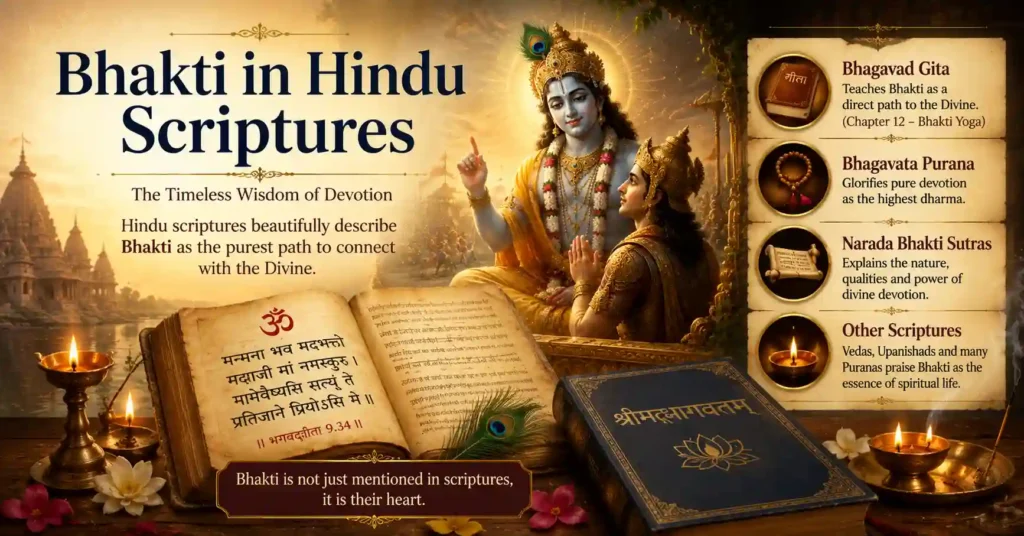
Yes, Bhakti is deeply rooted in Hindu scriptures and has been an important part of Sanatan Dharma for thousands of years. Many sacred texts explain the value of devotion and describe it as a powerful path to spiritual growth and Divine realization.
One of the most important sources for understanding what is Bhakti is the Bhagavad Gita. In several chapters, Lord Krishna explains that sincere devotion can help a person develop a close relationship with the Divine.
In Chapter 12 (Bhakti Yoga), Krishna describes the qualities of a true devotee and explains why the path of devotion is dear to Him. This chapter is often regarded as one of the clearest teachings on Bhakti in Hinduism.
The Bhagavad Gita 9.22 also highlights the importance of devotion, teaching that those who worship the Divine with unwavering faith receive Divine guidance and protection.
The Bhagavata Purana is another major scripture associated with Bhakti. It contains numerous stories of great devotees such as Prahlada, Dhruva, Ambarisha, and the Gopis of Vrindavan, illustrating the transformative power of pure devotion.
The Narada Bhakti Sutras provide a dedicated philosophical explanation of Bhakti. These teachings describe Bhakti as the highest form of divine love and explain how devotion can become a direct path to spiritual fulfillment.
Many other scriptures, including the Ramayana, Vishnu Purana, and various devotional texts, also emphasize the importance of faith, surrender, remembrance, and love for God.
These scriptural teachings show that Bhakti in Sanatan Dharma is not merely an emotional practice. It is a respected spiritual path supported by sacred texts, saints, and centuries of devotional tradition.
For this reason, when people ask what is Bhakti in Hinduism, the answer is not based only on belief or tradition. It is deeply supported by some of the most revered scriptures in Sanatan Dharma.
What Does the Bhagavad Gita Teach About Bhakti?
To fully understand what is Bhakti, it is important to see how Lord Krishna explains devotion in the Bhagavad Gita, one of the most revered scriptures of Sanatan Dharma.
The Bhagavad Gita does not present Bhakti as merely a ritual or religious practice. Instead, it describes devotion as a direct and powerful way to develop a relationship with the Divine through love, faith, remembrance, and surrender. Chapter 12 of the Gita is known as Bhakti Yoga, the Yoga of Devotion, and is entirely dedicated to this path.
When Arjuna asks which path is superior, Lord Krishna explains that those who fix their minds on Him with unwavering faith and devotion are considered highly accomplished in yoga. Krishna emphasizes sincere devotion rather than external qualifications or social status.
A Famous Verse on Bhakti
Bhagavad Gita 9.26
“Whoever offers Me with devotion a leaf, a flower, a fruit, or water, I accept that loving offering from the pure-hearted devotee.”
This teaching highlights a beautiful truth. God does not look at the material value of an offering. What truly matters is the devotion, sincerity, and love behind it.
The Bhagavad Gita also teaches that Bhakti is accessible to everyone. A devotee does not need extraordinary knowledge, wealth, or spiritual achievements. A sincere heart filled with faith is enough to begin the journey of devotion.
Another important teaching is that Bhakti should not be limited to moments of worship alone. Krishna encourages devotees to remember Him, dedicate their actions to Him, and keep their minds connected with the Divine throughout daily life.
The final verses of Chapter 12 describe the qualities of an ideal devotee. Such a person is compassionate, humble, free from excessive ego, forgiving, self-controlled, and devoted to the welfare of others. These qualities show that true Bhakti transforms both spiritual life and character.
Understanding these teachings helps answer an important aspect of what is Bhakti in Sanatan Dharma. According to the Bhagavad Gita, Bhakti is not simply worship. It is a path of loving devotion that brings a person closer to the Divine while cultivating peace, faith, humility, and spiritual growth.
Why Is Bhakti Considered So Powerful?
When people ask what is Bhakti, they are often drawn to the remarkable impact that devotion can have on a person’s life. Bhakti is considered powerful because it transforms the heart as well as the mind.
Unlike paths that rely mainly on intellectual study or complex spiritual practices, Bhakti works through love, faith, and a personal connection with the Divine. It allows spiritual growth to happen naturally through devotion.
One reason Bhakti in Sanatan Dharma is so powerful is that it helps reduce ego. As devotion deepens, a person gradually becomes less focused on pride, control, and self-centered desires.
Bhakti also helps cultivate trust during difficult times. Instead of feeling alone when facing challenges, a devotee develops faith that the Divine is guiding and supporting them.
Another strength of Bhakti is its accessibility. A person does not need extensive scriptural knowledge, advanced meditation skills, or strict ascetic practices to begin. Anyone can practice devotion regardless of age, background, or circumstances.
The path of Bhakti Yoga also brings emotional balance. Through prayer, chanting, remembrance, and surrender, many people experience greater peace, hope, and resilience in daily life.
Bhakti has the power to transform ordinary actions into spiritual practices. Activities such as singing devotional songs, serving others, reading sacred texts, or remembering God can become expressions of devotion.
The Bhagavad Gita teaches that sincere devotion helps a person develop a deeper relationship with the Divine. Over time, this relationship becomes a source of inner strength, comfort, and spiritual fulfillment.
Many saints and devotees throughout history have described Bhakti as powerful because it softens the heart while strengthening character. It encourages humility without weakness and faith without blind dependence.
In simple terms, what is Bhakti if not a path of divine love? Its power lies in its ability to bring peace during uncertainty, devotion during struggle, and a sense of connection that remains steady through the changing circumstances of life.
Is Bhakti Only About Rituals and Prayers?
One of the most common misunderstandings about what is Bhakti is that it is only about performing rituals, visiting temples, or reciting prayers. While these practices can support devotion, they are not the essence of Bhakti.
At its core, Bhakti in Sanatan Dharma is about developing a sincere and loving relationship with the Divine. Rituals are simply tools that can help nurture that connection. Without devotion and sincerity, even elaborate rituals may become mechanical.
A person may perform daily worship, chant mantras, or participate in religious ceremonies. These practices can strengthen Bhakti when they are done with faith, gratitude, and devotion.
At the same time, someone with a genuine love for God can practice Bhakti even without elaborate rituals. A simple prayer, heartfelt remembrance, or quiet conversation with the Divine can also be an expression of devotion.
The Bhagavad Gita teaches that God values sincerity more than external display. What matters most is the devotion behind an action, not its complexity or scale.
Bhakti can be expressed in many ways. Some people connect through chanting devotional songs, while others through meditation, selfless service, reading sacred texts, or helping those in need.
Even everyday actions can become acts of Bhakti when performed with gratitude and offered to the Divine. In this way, devotion extends beyond temples and rituals into daily life.
Understanding what is Bhakti in Hinduism helps us see that devotion is not confined to specific practices. It is a state of the heart that can be experienced anywhere and at any time.
Rituals and prayers can support the path of Bhakti Yoga, but they are not mandatory requirements. The true foundation of Bhakti is love, faith, remembrance, and a genuine desire to connect with the Divine.
What Is the Relationship Between Bhakti and Sharanagati?
To fully understand what is Bhakti, it is helpful to understand its close connection with Sharanagati, which means surrender to the Divine.
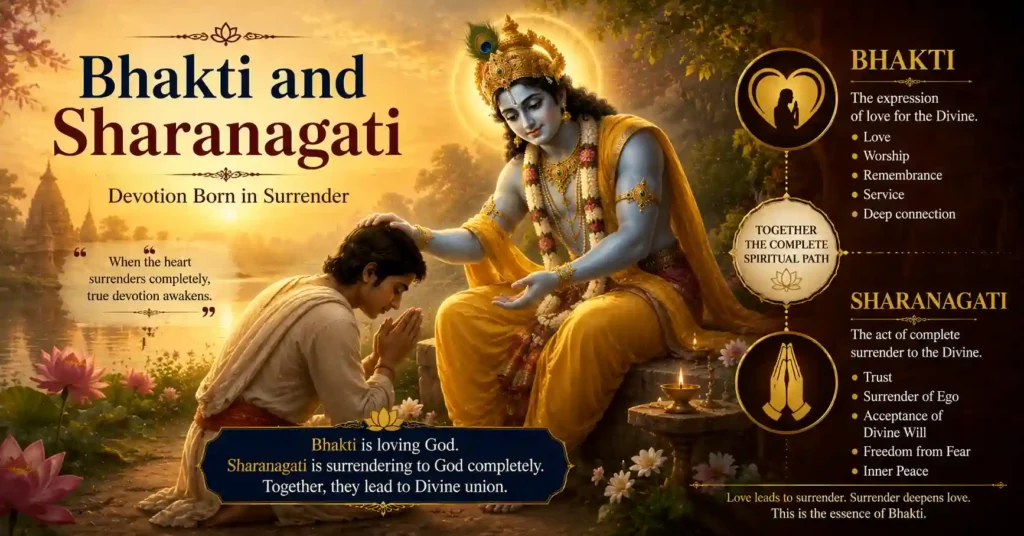
Although Bhakti and Sharanagati are related, they are not exactly the same. Bhakti refers to loving devotion toward God, while Sharanagati refers to complete trust and surrender to the Divine will.
In simple terms, Bhakti is the love that draws a person closer to God, and Sharanagati is the willingness to place one’s faith in God completely. One often leads naturally to the other.
As devotion deepens, a devotee begins to develop greater trust in the Divine. This trust gradually reduces fear, anxiety, and the constant need to control every outcome. Such trust is the foundation of Sharanagati.
Similarly, surrender strengthens Bhakti. When a person lets go of excessive attachment and places faith in the Divine, their devotion often becomes more sincere and heartfelt.
Many saints and spiritual teachers have described Bhakti and Sharanagati as two complementary aspects of the same spiritual journey. Devotion creates love for God, while surrender allows that love to mature into complete faith.
The Bhagavad Gita repeatedly encourages both devotion and surrender. Lord Krishna teaches Arjuna to remember Him with love, perform his duties sincerely, and ultimately take refuge in the Divine.
In many Bhakti traditions, especially within Vaishnavism, Sharanagati is considered a natural expression of true devotion. A devotee who genuinely loves God gradually learns to trust Divine wisdom and guidance.
Understanding the relationship between Bhakti and Sharanagati helps answer a deeper aspect of what is Bhakti in Sanatan Dharma. Bhakti is not only about expressing love for God. It is also about developing the trust and surrender that allow that love to transform one’s life.
In this way, Bhakti and Sharanagati work together. Devotion brings the heart closer to the Divine, and surrender helps that connection grow stronger, deeper, and more meaningful.
Can Anyone Follow the Path of Bhakti?
One of the most beautiful aspects of Bhakti in Sanatan Dharma is that it is open to everyone. Unlike some spiritual paths that may require extensive study, strict discipline, or years of practice, Bhakti begins with a sincere heart and a genuine desire to connect with the Divine.
When people ask what is Bhakti, they often wonder whether devotion is only meant for monks, saints, or deeply religious individuals. Hindu scriptures and devotional traditions make it clear that Bhakti is available to all.
A child can express Bhakti through simple prayers. A student can practice devotion through gratitude and remembrance. A householder can cultivate Bhakti while fulfilling daily responsibilities, and an elderly person can deepen devotion through worship and spiritual reflection.
Bhakti does not depend on caste, social status, wealth, education, or background. Throughout history, many revered saints came from different regions and walks of life, showing that devotion is not limited to any particular group.
The Bhagavad Gita teaches that sincere devotion is more important than external qualifications. What matters is the purity of one’s intention and the love offered to the Divine.
A person may worship Lord Krishna, Lord Rama, Lord Shiva, Maa Durga, Lord Ganesha, or any form of the Divine they feel drawn to. The path may differ, but the essence of Bhakti remains the same.
Even those who are new to spirituality can begin practicing Bhakti. There is no requirement to understand complex philosophy before starting. Devotion often grows gradually through prayer, chanting, reading sacred texts, or simply remembering God with love.
Many people begin the path of Bhakti Yoga during difficult periods of life. Challenges, uncertainty, or a search for deeper meaning often inspire a person to seek comfort and guidance through devotion.
Understanding what is Bhakti in Hinduism helps us see that devotion is not reserved for a select few. It is a universal path that welcomes anyone who wishes to cultivate faith, love, and a deeper connection with the Divine.
This openness is one reason why Bhakti has remained one of the most beloved and widely practiced spiritual paths in Sanatan Dharma for centuries.
What Are the Different Types of Bhakti?
To better understand what is Bhakti, it is helpful to know that devotion can be expressed in different ways. People have different personalities and spiritual inclinations, so Sanatan Dharma recognizes multiple forms of devotion.
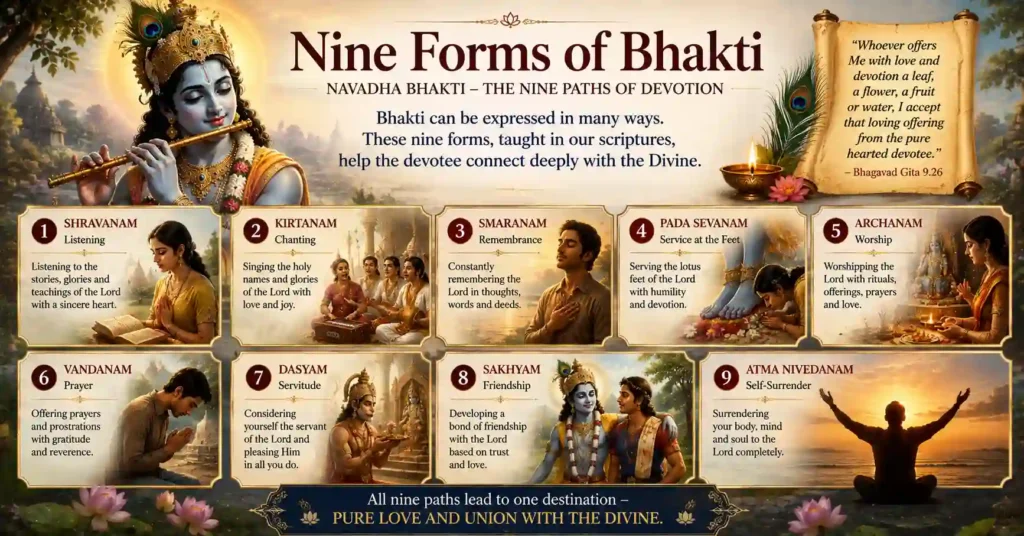
One of the most well-known teachings is Navadha Bhakti, which means the nine forms of Bhakti. These forms were described in scriptures such as the Bhagavata Purana and provide different ways to cultivate a deeper connection with the Divine.
1. Shravanam (Listening)
Shravanam means listening to stories, teachings, and glories of the Divine. Hearing sacred scriptures, devotional discourses, and spiritual wisdom is considered a powerful form of Bhakti.
2. Kirtanam (Chanting)
Kirtanam involves singing or chanting the names and praises of God. Bhajans, kirtans, and devotional songs help fill the mind with remembrance and devotion.
3. Smaranam (Remembering)
Smaranam means constantly remembering the Divine. A devotee keeps God in their thoughts throughout daily life, whether working, resting, or facing challenges.
4. Pada Sevanam (Service)
Pada Sevanam refers to serving the Divine with humility and devotion. It can also include serving temples, sacred places, or activities dedicated to spiritual growth.
5. Archanam (Worship)
Archanam is the practice of offering prayers, flowers, lamps, or other forms of worship to the Divine. It helps express love, gratitude, and reverence.
6. Vandanam (Offering Respect)
Vandanam means offering respect through prayers, prostrations, and expressions of gratitude. It cultivates humility and devotion.
7. Dasyam (Servitude)
Dasyam is the attitude of serving God as a loyal servant. Lord Hanuman’s devotion to Lord Rama is often considered a classic example of this form of Bhakti.
8. Sakhyam (Friendship)
Sakhyam involves developing a personal relationship with the Divine as a trusted friend. Arjuna’s relationship with Lord Krishna is often cited as an example.
9. Atma Nivedanam (Complete Surrender)
Atma Nivedanam means offering oneself completely to the Divine. It represents the highest form of devotion, where faith, love, and surrender become one.
Although these are known as the nine forms of Bhakti, not everyone follows all of them. A person may naturally feel drawn to one or more forms depending on their temperament and spiritual journey.
Understanding the types of Bhakti helps answer an important part of what is Bhakti in Sanatan Dharma. Devotion is not limited to a single practice. It can be expressed through listening, chanting, service, worship, remembrance, friendship, or surrender, all leading toward a deeper connection with the Divine.
Examples of Bhakti in Hindu Traditions
To better understand what is Bhakti, it helps to look at the lives of great devotees whose faith, love, and surrender continue to inspire millions. These examples show that Bhakti is not merely a concept discussed in scriptures. It is a living tradition expressed through devotion in different ways.
Prahlada and His Devotion to Lord Vishnu
Prahlada is one of the most celebrated devotees in Hindu traditions. Despite facing severe opposition from his father, King Hiranyakashipu, he remained steadfast in his devotion to Lord Vishnu.
Even during persecution and danger, Prahlada never abandoned his faith. His story teaches that true Bhakti remains firm regardless of external circumstances and is rooted in unwavering trust in the Divine.
Hanuman and His Devotion to Lord Rama
Lord Hanuman is regarded as the ideal example of Dasya Bhakti, the devotion of a servant toward the Divine.
Every action of Hanuman was dedicated to serving Lord Rama. His strength, courage, humility, and selfless service arose from pure devotion. Hanuman demonstrates that Bhakti is not only expressed through prayer but also through dedicated service and complete loyalty to God.
Meera Bai and Her Devotion to Lord Krishna
Meera Bai, the renowned saint-poet of India, dedicated her entire life to Lord Krishna.
Despite social challenges and personal hardships, her devotion never wavered. Through her bhajans and poetry, Meera expressed deep love, longing, and surrender to Krishna. Her life illustrates how Bhakti can transform devotion into a constant experience of Divine companionship.
The Gopis of Vrindavan and Their Love for Krishna
The Gopis of Vrindavan are often regarded as among the highest examples of devotional love in Bhakti traditions.
Their love for Lord Krishna was free from selfish desires and worldly expectations. The Bhagavata tradition presents their devotion as a symbol of complete absorption in the Divine, where every thought and action is centered on God.
Andal and Her Devotion to Lord Vishnu
Andal is one of the most revered saints of the Sri Vaishnava tradition. From a young age, she expressed profound love and devotion toward Lord Vishnu.
Her devotional hymns, especially the Tiruppavai, continue to be recited by devotees today. Andal’s life demonstrates how Bhakti can be expressed through prayer, poetry, worship, and complete dedication to the Divine.
What These Great Bhaktas Teach Us
Although these devotees lived in different places and times, they shared one common quality: sincere and unwavering devotion.
Prahlada teaches faith, Hanuman teaches selfless service, Meera Bai teaches Divine love, the Gopis teach complete absorption in God, and Andal teaches wholehearted dedication.
Their lives help us understand what is Bhakti in Sanatan Dharma. Bhakti is not limited to one form, one practice, or one personality. It can be expressed through faith, love, service, remembrance, surrender, and an unbreakable connection with the Divine.
What Is Bhakti Yoga?
When exploring what is Bhakti, it is impossible to ignore the importance of Bhakti Yoga, one of the most respected spiritual paths in Sanatan Dharma.
The word Yoga means union or connection. Therefore, Bhakti Yoga is the path of connecting with the Divine through love, devotion, faith, and surrender.
Among the various spiritual paths described in Hindu philosophy, Bhakti Yoga is often considered the most accessible because it focuses on the heart rather than intellectual study or strict ascetic practices.
In the Bhagavad Gita, Lord Krishna repeatedly emphasizes devotion as a powerful means of reaching the Divine. He teaches that sincere love, faith, and remembrance can bring a person closer to God regardless of their background or circumstances.
Unlike Karma Yoga, which focuses on selfless action, and Jnana Yoga, which emphasizes spiritual knowledge and inquiry, Bhakti Yoga centers on developing a personal relationship with the Divine.
| Spiritual Path | Primary Focus |
|---|---|
| Bhakti Yoga | Devotion and love for God |
| Karma Yoga | Selfless action and duty |
| Jnana Yoga | Knowledge and wisdom |
| Raja Yoga | Meditation and mental discipline |
This does not mean one path is superior to another. In fact, many spiritual seekers naturally combine elements of multiple paths. However, Bhakti Yoga is often regarded as the most natural path for those who feel drawn to devotion.
The practice of Bhakti Yoga can take many forms. A devotee may chant the Divine name, sing bhajans, perform worship, read sacred scriptures, engage in selfless service, or simply remember God throughout the day.
One of the unique strengths of Bhakti Yoga is that ordinary activities can become spiritual practices when performed with devotion. Even simple acts done with love and offered to the Divine can strengthen one’s spiritual connection.
Many saints throughout Indian history, including Mirabai, Tulsidas, Surdas, Chaitanya Mahaprabhu, and Tukaram, are remembered as great practitioners of Bhakti Yoga. Their lives demonstrate how devotion can transform the human heart.
Understanding what is Bhakti Yoga helps answer a deeper aspect of what is Bhakti in Sanatan Dharma. Bhakti is the feeling of devotion, while Bhakti Yoga is the spiritual path that helps nurture and deepen that devotion until it becomes a way of life.
What Are the Spiritual Benefits of Bhakti?
One of the main reasons people seek to understand what is Bhakti is because of the profound spiritual transformation that devotion can bring. Bhakti is not merely a religious practice. It is a path that gradually changes the heart, mind, and inner life of a person.
As devotion deepens, a devotee begins to feel a stronger connection with the Divine. This connection often becomes a source of comfort, guidance, and spiritual strength during both joyful and difficult times.
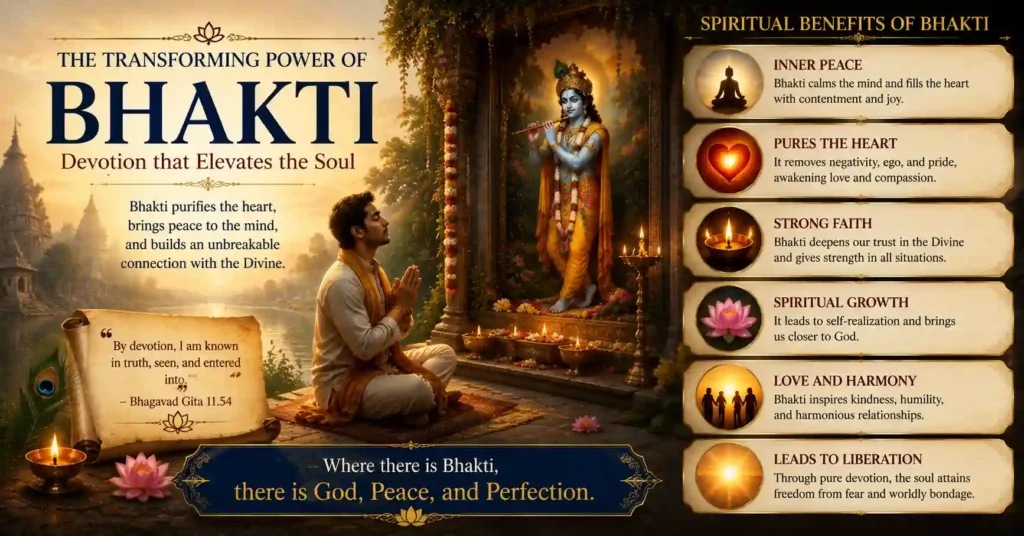
One of the greatest spiritual benefits of Bhakti in Sanatan Dharma is the cultivation of inner peace. When the mind is constantly focused on worries, desires, and expectations, it becomes restless. Bhakti helps redirect attention toward faith, gratitude, and remembrance of God.
Devotion also helps reduce ego. A devotee gradually learns humility by recognizing that life is supported by a higher power. This does not make a person weak. Instead, it creates a balanced sense of confidence and surrender.
Another important benefit is the development of faith. Through prayer, worship, chanting, and remembrance, many devotees experience a deeper trust in Divine wisdom and guidance.
Bhakti also encourages qualities such as compassion, kindness, patience, forgiveness, and gratitude. These qualities support both spiritual growth and personal well-being.
Many saints have taught that devotion purifies the heart. As negative tendencies such as anger, jealousy, pride, and excessive attachment begin to weaken, the mind becomes more receptive to spiritual wisdom.
The path of Bhakti Yoga also helps cultivate constant remembrance of the Divine. Over time, devotion becomes more than a practice. It becomes a natural part of everyday life.
According to Hindu scriptures, sincere Bhakti can ultimately lead a person toward spiritual realization and a closer experience of the Divine presence.
Understanding what is Bhakti therefore involves more than learning a definition. It involves recognizing how devotion can transform a person’s inner world through faith, love, humility, and spiritual growth.
What Are the Practical Benefits of Bhakti?
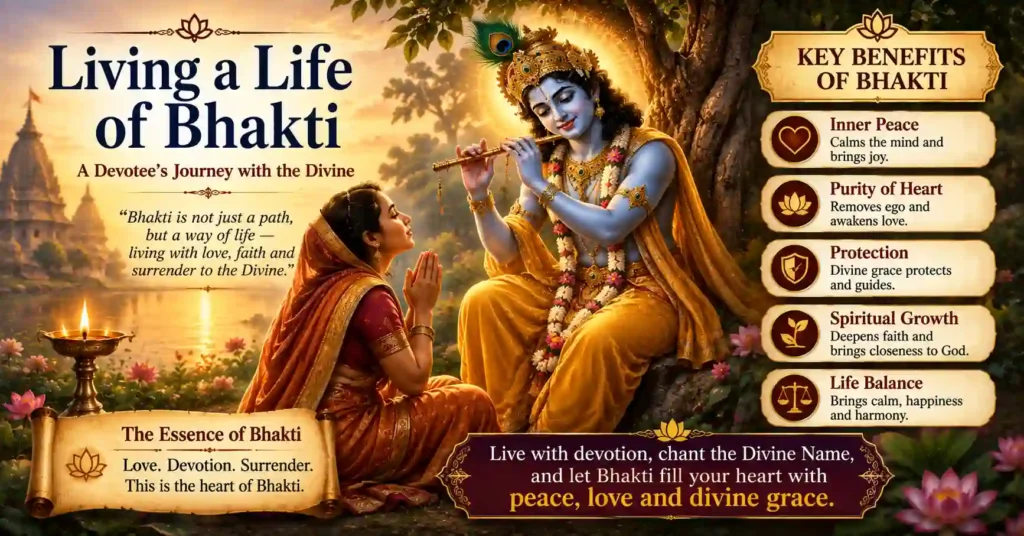
While many people explore what is Bhakti for spiritual reasons, the path of devotion also offers several practical benefits in everyday life. The teachings of Bhakti are not limited to temples or religious practices. They can positively influence how a person thinks, feels, and responds to life’s challenges.
One of the most noticeable benefits of Bhakti in Sanatan Dharma is reduced stress and anxiety. When a person learns to place trust in the Divine, they often feel less burdened by the need to control every situation.
Bhakti also helps develop emotional resilience. Difficult circumstances do not disappear, but devotion can provide the strength and faith needed to face them with greater calmness and patience.
Another practical benefit is a more positive outlook on life. Regular prayer, gratitude, and remembrance of God encourage a mindset focused on hope rather than fear.
The path of Bhakti Yoga can also improve relationships. As qualities such as compassion, humility, forgiveness, and kindness grow, interactions with family, friends, and others often become more harmonious.
Bhakti encourages gratitude for both blessings and challenges. This attitude can help reduce dissatisfaction and promote greater contentment in daily life.
Many devotees find that devotion improves mental focus and emotional balance. Practices such as chanting, prayer, and reading sacred texts can create moments of peace amid a busy lifestyle.
Bhakti also provides a sense of purpose. Instead of feeling disconnected or lost, a devotee develops a deeper understanding of life’s spiritual dimension and their relationship with the Divine.
Another important benefit is the feeling of inner support. During times of uncertainty, devotion can offer comfort and reassurance, helping a person feel less alone.
Understanding what is Bhakti therefore involves recognizing that devotion is not only a spiritual path. It is also a practical way of cultivating peace, resilience, gratitude, and emotional well-being while navigating the challenges of everyday life.
How Does Bhakti Change a Person's Life?
When a person truly understands what is Bhakti and begins practicing it sincerely, the transformation often starts from within. The outer circumstances of life may not change immediately, but the way a person experiences those circumstances begins to change.
One of the first changes many devotees notice is a greater sense of inner peace. The mind becomes less restless because it is no longer constantly driven by fear, comparison, or excessive expectations.
As Bhakti in Sanatan Dharma deepens, a person often develops a stronger sense of faith and trust. Instead of feeling overwhelmed by uncertainty, they learn to face life’s challenges with patience and confidence.
Bhakti also helps soften the heart. Feelings such as anger, resentment, jealousy, and pride gradually lose their hold as devotion grows. In their place, qualities like compassion, humility, gratitude, and kindness become stronger.
Another important change is the reduction of loneliness. Through prayer, remembrance, and devotion, many devotees experience a sense of Divine companionship that brings comfort and emotional strength.
The path of Bhakti Yoga also encourages a healthier perspective on success and failure. A devotee continues to work sincerely but becomes less attached to outcomes, leading to greater emotional balance.
Relationships often improve as well. When a person becomes more patient, forgiving, and understanding, family and social interactions tend to become more harmonious.
Over time, Bhakti can bring a deeper sense of purpose. Daily activities no longer feel disconnected from spiritual life. Instead, work, service, worship, and personal responsibilities become opportunities to express devotion.
Many saints have described Bhakti as a process of inner transformation rather than external achievement. The goal is not to become someone different, but to uncover qualities such as love, faith, and devotion that already exist within.
Ultimately, what is Bhakti if not a path that changes the way we relate to ourselves, others, and the Divine? Through steady devotion, a person often becomes calmer, stronger, more compassionate, and more spiritually grounded in everyday life.
How Can a Beginner Start Practicing Bhakti?
Many people who learn what is Bhakti naturally wonder how they can begin practicing it in their daily lives. The good news is that Bhakti does not require special qualifications, complex rituals, or years of spiritual training. It begins with sincerity and a willingness to connect with the Divine.
The first step is to set aside a few quiet moments each day for remembrance and devotion. Even five to ten minutes of sincere prayer or reflection can help strengthen your spiritual connection.
One simple way to practice Bhakti in Sanatan Dharma is through prayer. Speak to the Divine with honesty and humility, just as you would speak to a trusted friend, guide, or loved one.
Many beginners also find chanting helpful. Repeating the name of a chosen deity or chanting simple mantras can calm the mind and nurture devotion.
Reading sacred texts such as the Bhagavad Gita, Ramayana, or devotional stories of saints can deepen your understanding of Bhakti and inspire spiritual growth.
Listening to bhajans, kirtans, and devotional music is another effective way to cultivate devotion. These practices help keep the mind focused on the Divine and create a sense of inner peace.
Acts of kindness and selfless service can also become expressions of Bhakti Yoga. Helping others with a spirit of compassion and gratitude is considered a meaningful form of devotion.
As your practice develops, try to remember the Divine throughout the day. This may include offering gratitude before meals, remembering God during difficult moments, or silently repeating a sacred name while performing daily tasks.
Beginners should avoid worrying about perfection. Bhakti is not measured by the number of rituals performed or the amount of time spent in worship. What matters most is the sincerity of the heart.
Understanding what is Bhakti ultimately means understanding that devotion is a journey rather than a destination. Small and consistent acts of faith, remembrance, and love can gradually deepen one’s connection with the Divine and make Bhakti a natural part of everyday life.
Common Myths About Bhakti
Many misconceptions exist about what is Bhakti, causing some people to overlook this powerful spiritual path. Understanding these myths can help create a clearer picture of what Bhakti truly represents in Sanatan Dharma.
Myth 1: Bhakti Is Only for Elderly People
Many people believe devotion is something to pursue only after retirement or later in life.
In reality, Bhakti in Sanatan Dharma is open to people of all ages. Children, students, householders, and spiritual seekers can all practice devotion according to their circumstances.
Myth 2: Bhakti Means Blind Faith
Some assume that Bhakti requires a person to stop thinking critically and simply believe without understanding.
True Bhakti is not blind faith. It is devotion supported by trust, personal experience, reflection, and spiritual understanding. Hindu scriptures encourage both faith and wisdom.
Myth 3: Bhakti Is Only About Rituals
Many people associate Bhakti exclusively with temple visits, worship ceremonies, and religious rituals.
While rituals can support devotion, they are not the essence of Bhakti. Love, remembrance, gratitude, prayer, and surrender are equally important expressions of devotion.
Myth 4: Bhakti Is for People Who Lack Knowledge
Some believe that only those who cannot follow philosophical paths choose devotion.
Hindu scriptures present Bhakti Yoga, Jnana Yoga, and Karma Yoga as valid spiritual paths. Many great saints and scholars combined deep knowledge with profound devotion.
Myth 5: Bhakti Requires Renouncing the World
Another common misconception is that a devotee must leave family life and worldly responsibilities.
In reality, many devotees practice Bhakti while fulfilling their duties as parents, professionals, students, and householders. Devotion can be integrated into everyday life.
Myth 6: Bhakti Is Emotional Weakness
Some people think devotion makes a person overly emotional or dependent.
In fact, Bhakti often develops inner strength, resilience, patience, and emotional balance. Many devotees find that their faith helps them face life’s challenges with greater courage.
Myth 7: There Is Only One Correct Way to Practice Bhakti
People sometimes assume that everyone must follow the same method of devotion.
Sanatan Dharma recognizes many forms of Bhakti. Some people connect through prayer, others through chanting, service, scripture study, meditation, or surrender. The path can vary, but the goal remains the same.
Understanding these myths helps clarify what is Bhakti in Hinduism. Bhakti is not blind belief, ritualism, or withdrawal from life. It is a path of love, devotion, faith, and spiritual growth that can be practiced by anyone with sincerity and an open heart.
Conclusion
After exploring what is Bhakti, it becomes clear that Bhakti is much more than a religious practice or a set of rituals. In Sanatan Dharma, it is a path of loving devotion that helps a person build a deeper relationship with the Divine through faith, remembrance, service, and surrender.
The beauty of Bhakti in Sanatan Dharma lies in its simplicity. It does not require extraordinary knowledge, complex practices, or a perfect life. It asks only for sincerity, love, and a willingness to open the heart to the Divine.
Whether expressed through prayer, chanting, worship, selfless service, or daily remembrance, Bhakti allows spiritual growth to become a natural part of everyday life. It helps cultivate inner peace, humility, gratitude, and trust while providing strength during life’s challenges.
The teachings of Bhakti Yoga remind us that devotion is not limited to temples or sacred places. It can be practiced wherever we are and whatever stage of life we may be in.
Ultimately, understanding what is Bhakti is about understanding the power of divine love. As devotion deepens, a person gradually experiences a stronger connection with the Divine, greater emotional balance, and a sense of purpose that extends beyond temporary circumstances.
For countless devotees throughout history, Bhakti has been a path to peace, transformation, and spiritual fulfillment. Its message remains timeless: when the heart turns toward the Divine with love and sincerity, every moment of life can become an expression of devotion.
Key Takeaways
- What is Bhakti? Bhakti is the path of loving devotion and a heartfelt connection with the Divine in Sanatan Dharma.
- The meaning of Bhakti goes beyond rituals and worship. It involves love, faith, trust, remembrance, and surrender.
- Bhakti is open to everyone regardless of age, background, education, or spiritual experience.
- Hindu scriptures such as the Bhagavad Gita, Bhagavata Purana, and Narada Bhakti Sutras emphasize the importance of Bhakti as a spiritual path.
- The nine forms of Bhakti (Navadha Bhakti) provide different ways to express devotion, including listening, chanting, remembrance, service, worship, friendship, and surrender.
- Bhakti Yoga is the path of devotion that helps a person develop a deeper relationship with the Divine through love and faith.
- One of the most important benefits of Bhakti is inner peace. Devotion helps reduce ego, anxiety, and excessive attachment to outcomes.
- Bhakti and Sharanagati are closely connected. Devotion naturally leads to trust and surrender, while surrender deepens devotion.
- Bhakti can be practiced through prayer, chanting, reading scriptures, selfless service, gratitude, and remembering God throughout daily life.
- Understanding what is Bhakti in Sanatan Dharma is not only about learning a spiritual concept. It is about cultivating a way of life centered on devotion, compassion, faith, and Divine connection.
FAQs
What is Bhakti in simple words?
Bhakti is loving devotion toward the Divine. It is a spiritual path in Sanatan Dharma that focuses on developing a heartfelt relationship with God through faith, love, prayer, remembrance, and surrender.
When people ask what is Bhakti, the simplest answer is that it is devotion expressed from the heart. Bhakti is not limited to rituals or religious practices. It is the feeling of connecting with the Divine through sincerity, trust, and gratitude.
A person can practice Bhakti through prayer, chanting, worship, service, reading scriptures, or simply remembering God during daily life.
What is the meaning of Bhakti in Sanatan Dharma?
The meaning of Bhakti comes from the Sanskrit root Bhaj, which means to share, serve, participate, or adore. In Sanatan Dharma, Bhakti refers to loving devotion toward the Divine.
Bhakti is considered one of the most accessible spiritual paths because it does not depend on social status, education, or spiritual expertise. It is based on the sincere love and devotion a person develops for God.
The goal of Bhakti is to strengthen one’s connection with the Divine while cultivating qualities such as faith, humility, compassion, and inner peace.
What is Bhakti Yoga?
Bhakti Yoga is the path of spiritual growth through devotion. It is one of the major yogic paths described in Hindu philosophy, alongside Karma Yoga, Jnana Yoga, and Raja Yoga.
Bhakti Yoga focuses on building a personal relationship with the Divine through prayer, chanting, worship, remembrance, service, and surrender.
The Bhagavad Gita describes Bhakti Yoga as a powerful path because it allows people to connect with God through love and devotion rather than through intellectual study alone. Many devotees find it to be one of the most natural and emotionally fulfilling spiritual practices.
What are the different types of Bhakti?
The most well-known classification is Navadha Bhakti, which describes the nine forms of devotion.
These include listening to Divine teachings (Shravanam), chanting God’s names (Kirtanam), remembering God (Smaranam), service (Pada Sevanam), worship (Archanam), offering respect (Vandanam), serving God as a devotee (Dasyam), friendship with the Divine (Sakhyam), and complete surrender (Atma Nivedanam).
A person does not need to practice all nine forms. Most devotees naturally connect with one or more forms depending on their temperament and spiritual journey.
Can anyone practice Bhakti?
Yes. One of the unique qualities of Bhakti in Sanatan Dharma is that it is open to everyone.
Bhakti does not require special qualifications, advanced knowledge, or strict spiritual discipline. Children, students, householders, working professionals, and elderly people can all practice devotion in their own way.
What matters most is sincerity. Even small acts of prayer, gratitude, remembrance, or service can become expressions of Bhakti when performed with a devoted heart.
Is Bhakti only about rituals and prayers?
No. Rituals and prayers can support devotion, but they are not the essence of Bhakti.
True Bhakti is about developing love, faith, trust, and a personal connection with the Divine. A person may perform elaborate rituals without devotion, while another may express deep Bhakti through a simple prayer or heartfelt remembrance of God.
Sanatan Dharma teaches that sincerity and devotion are more important than the complexity of external practices.
What is the relationship between Bhakti and Sharanagati?
Bhakti and Sharanagati are closely connected but not identical.
Bhakti means loving devotion toward God, while Sharanagati means complete surrender to the Divine will. As devotion grows, trust in God often becomes stronger, naturally leading to surrender.
Similarly, surrender can deepen devotion by helping a person let go of excessive attachment and develop greater faith. For this reason, many spiritual traditions view Bhakti and Sharanagati as complementary aspects of the same spiritual journey.
What are the spiritual benefits of Bhakti?
The spiritual benefits of Bhakti include inner peace, stronger faith, humility, gratitude, compassion, and a deeper connection with the Divine.
Through regular devotion, many people experience reduced ego, greater emotional balance, and increased spiritual awareness. Bhakti also encourages constant remembrance of God, which helps keep the mind focused on higher values and spiritual growth.
According to Hindu scriptures, sincere devotion can ultimately help a person move closer to spiritual realization and Divine grace.
What are the practical benefits of Bhakti?
In addition to spiritual growth, Bhakti offers many practical benefits in everyday life.
Devotion can help reduce stress, strengthen emotional resilience, improve relationships, and create a more positive outlook on life. Practices such as prayer, chanting, gratitude, and remembrance often help people remain calm during difficult situations.
Many devotees also find that Bhakti provides a sense of comfort, purpose, and inner support that helps them navigate life’s challenges with greater confidence.
How can a beginner start practicing Bhakti?
A beginner can start practicing Bhakti by dedicating a few minutes each day to prayer, remembrance, or reflection.
Reading sacred texts such as the Bhagavad Gita, listening to bhajans, chanting a Divine name, or expressing gratitude are all simple ways to begin. Acts of kindness and selfless service can also become forms of devotion.
The most important thing is consistency and sincerity. Bhakti grows gradually, and even small daily efforts can help develop a deeper connection with the Divine over time.
Suggested Reading
If you found this guide on what is Bhakti helpful, you may also enjoy exploring these related topics. These articles can help you deepen your understanding of devotion, spiritual growth, and key concepts of Sanatan Dharma.
Learning what is Bhakti often leads to other important questions about karma, dharma, surrender, and liberation. The following articles are excellent next reads on your spiritual journey.
What Is Sharanagati? Meaning, Importance, and Understanding in Hindu Philosophy
https://thesanatantales.com/what-is-sharanagati/
What Is Rudraksh? Meaning, Types, and Spiritual Benefits
https://thesanatantales.com/what-is-rudrakshas/
Brahma Muhurta: Meaning, Time, Benefits and Spiritual Significance
https://thesanatantales.com/brahma-muhurta-meaning-time-significance/
What Is Moksha and How Is It Attained?
https://thesanatantales.com/what-is-moksha-and-how-is-it-attained/
What Is Dharma and Why Is It Important?
https://thesanatantales.com/what-is-dharma-and-why-is-it-important/
What Is Maya in Hindu Philosophy?
https://thesanatantales.com/what-is-maya/
Bhakti (Wikipedia)
https://en.wikipedia.org/wiki/Bhakti
This collection will help you build a stronger understanding of what is Bhakti in Sanatan Dharma and how devotion connects with other important spiritual teachings within Hindu philosophy.
References & Sources
This article is based on the teachings of Sanatan Dharma, traditional interpretations of Bhakti Yoga, devotional literature, and widely accepted spiritual concepts found in Hindu scriptures. The explanations draw inspiration from the Bhagavad Gita, Bhagavata Purana, Narada Bhakti Sutras, Ramayana, and the rich devotional traditions preserved by saints, acharyas, and spiritual teachers across generations.
The article also reflects insights from various Bhakti traditions that emphasize devotion, faith, remembrance of God, selfless service, and surrender as important aspects of spiritual growth.
Note: Interpretations, practices, and expressions of Bhakti may vary among different sampradayas, traditions, and spiritual paths within Sanatan Dharma. The purpose of this article is not to present any single viewpoint as the absolute truth, but to explain widely accepted teachings about Bhakti in a simple, respectful, and beginner-friendly manner.
Latest from The Sanatan Tales