What is Samsara? This is one of the most important questions in Hindu philosophy because it helps explain the deeper purpose of life, death, and spiritual growth. In Sanatan Dharma, Samsara refers to the continuous cycle of birth, death, and rebirth through which the soul journeys over many lifetimes.
Understanding what is Samsara helps us see that life is not limited to a single birth. Every action, thought, and intention creates karma, and karma influences future experiences and future births. This ongoing relationship between karma and rebirth forms the foundation of Samsara in Hinduism.
The concept of Samsara also explains why people experience different circumstances, challenges, talents, and opportunities in life. According to Hindu philosophy, the soul continues moving through the cycle of rebirth until it gains true knowledge of its divine nature and attains Moksha, or liberation.
However, what is Samsara is not only about rebirth after death. It also reflects the repeated patterns of attachment, desire, and suffering that people experience within a single lifetime. By understanding these patterns, a person can begin moving toward greater awareness and inner freedom.
In this article, you will learn what is Samsara, how the cycle of rebirth works, the role of karma and rebirth, the connection between Samsara and Moksha, and why this concept remains central to Hindu philosophy and spiritual life today.
What Is Samsara? At a Glance
| Aspect | Explanation |
|---|---|
| Meaning | Samsara is the cycle of birth, death, and rebirth in Hindu philosophy. |
| Sanskrit Origin | The word Samsara means “continuous flow” or “wandering through existence.” |
| Driven By | Karma, desires, attachment, and ignorance of the true Self. |
| Main Purpose | To help the soul learn, grow, and evolve spiritually. |
| Opposite Of | Moksha, which is liberation from Samsara. |
| Related Concepts | Karma, Reincarnation, Atman, Dharma, Moksha. |
| Ultimate Goal | Freedom from the cycle of rebirth through self-realization. |
Table of Contents
ToggleWhat Is Samsara in Hindu Philosophy?
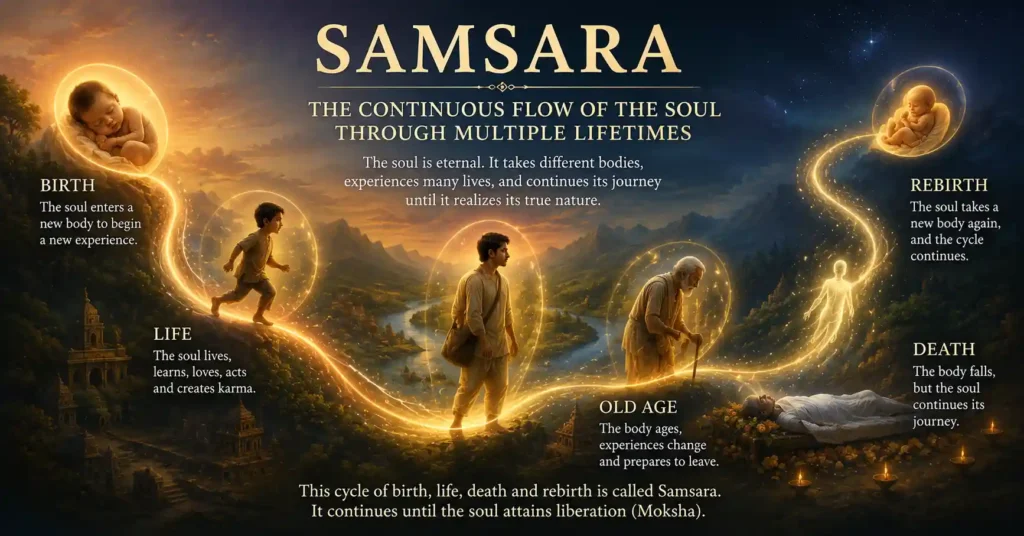
What is Samsara in Hindu philosophy? Samsara is the continuous cycle of birth, death, and rebirth through which the soul journeys until it attains liberation. It is one of the central concepts of Samsara in Hinduism and helps explain the nature of human existence.
The word Samsara comes from the Sanskrit root meaning “to wander” or “to flow continuously.” It describes the soul’s ongoing movement through different lifetimes and experiences.
According to Hindu philosophy, the true Self, or Atman, is eternal. While the body is born and dies, the soul continues its journey and takes new forms based on accumulated karma.
The cycle of rebirth is not viewed as random. Each birth provides opportunities for learning, spiritual growth, and the resolution of karmic consequences from previous lives.
Understanding what is Samsara helps us see life as part of a larger spiritual journey. Rather than being a single lifetime, existence is viewed as a continuous process that ultimately leads toward self-realization and Moksha.
How Does the Cycle of Rebirth Work in Samsara?
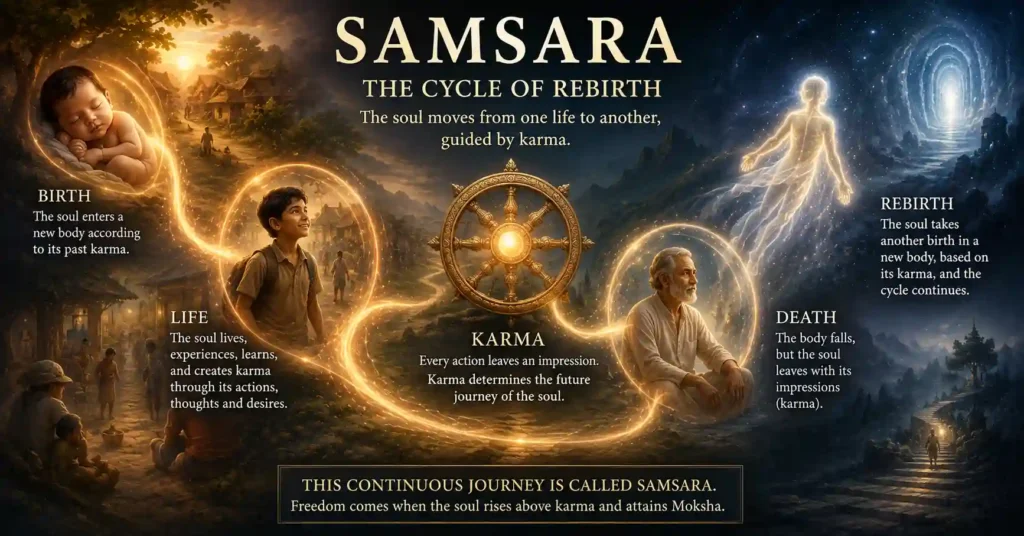
The cycle of rebirth in Samsara is guided by karma. According to Hindu philosophy, every action, thought, and intention creates impressions that influence future experiences.
When the physical body dies, the soul does not end. It carries its accumulated karma and unresolved desires into another birth. This process of karma and rebirth continues across many lifetimes.
The circumstances of each birth are shaped by past actions. However, Hindu teachings do not view this as punishment or reward. Instead, it is a natural law that helps the soul learn and evolve.
As long as attachment, desire, and ignorance remain, the soul continues moving through Samsara in Hinduism. Each lifetime provides opportunities for growth, self-discovery, and spiritual progress.
The ultimate purpose of the cycle of rebirth is not endless repetition. It is to help the soul gain wisdom and eventually realize its true nature. When this realization occurs, the cycle comes to an end through Moksha.
Why Is Samsara Associated With Suffering?
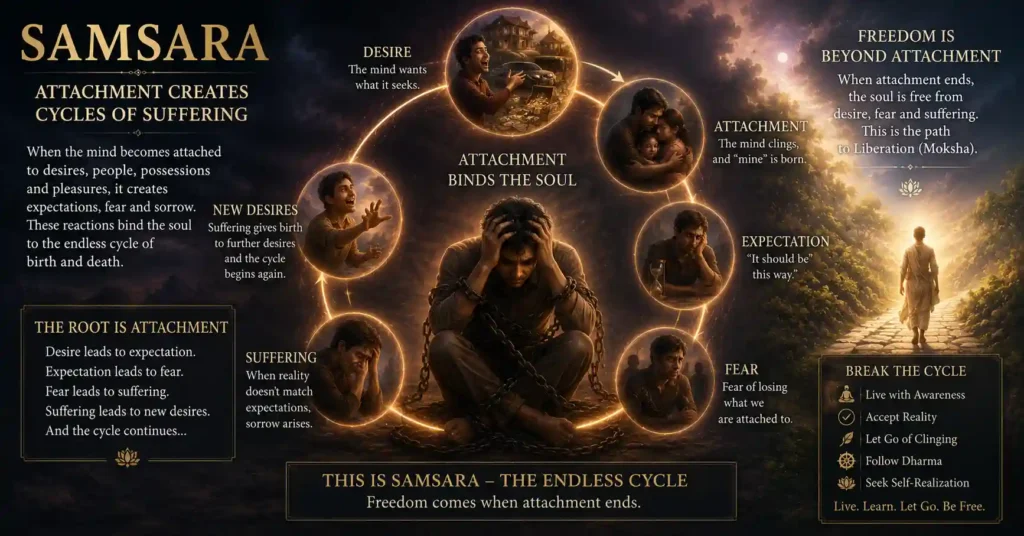
Samsara is often associated with suffering because life in the material world includes change, loss, uncertainty, and unfulfilled desires. These experiences can create emotional pain when a person becomes deeply attached to temporary things.
According to Hindu philosophy, the main cause of suffering is not the world itself but ignorance of our true nature. When people identify only with the body, possessions, or social status, they become trapped in cycles of fear, craving, and disappointment.
Desire and attachment play a major role in keeping the soul bound to Samsara in Hinduism. The more a person seeks lasting happiness in temporary experiences, the more dissatisfaction arises when those experiences change or end.
Understanding what is Samsara helps explain why similar emotional patterns often repeat throughout life. Anger, greed, attachment, and ego can create recurring cycles of suffering until they are understood and transformed.
However, Hindu teachings do not view Samsara as meaningless. The challenges of life can become opportunities for learning, spiritual growth, and self-realization. Through wisdom, devotion, and right action, a person can gradually move toward freedom from the cycle of rebirth.
What Role Does Karma Play in Samsara?
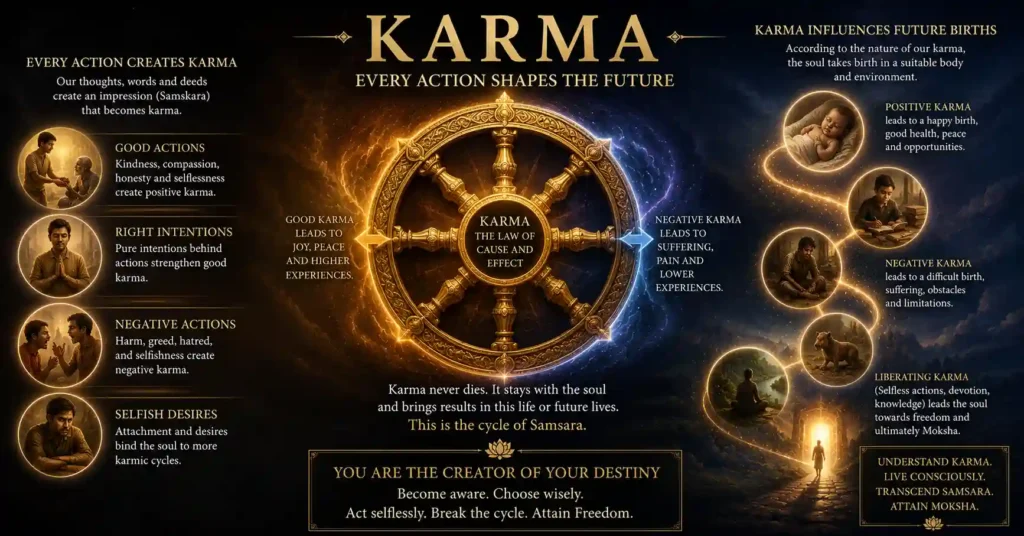
Karma is one of the key forces that keeps the soul moving through Samsara. In Hindu philosophy, karma refers to the law of cause and effect, where every action, thought, and intention produces a corresponding result.
The connection between karma and rebirth explains why different individuals experience different circumstances in life. The soul carries the effects of past actions from one lifetime to another, shaping future experiences and opportunities.
Karma is not viewed as a system of reward and punishment. Instead, it is a natural law that helps maintain balance and supports the soul’s spiritual growth. Every experience offers a chance to learn, evolve, and develop greater awareness.
Good actions can create positive results, while harmful actions can create challenges. However, both positive and negative karma can keep the soul connected to the cycle of rebirth if attachment to the results remains.
Understanding the relationship between karma and what is Samsara helps explain why Hindu philosophy emphasizes selfless action, right conduct, and personal responsibility. By acting without selfish attachment and developing wisdom, a person gradually reduces karmic bondage.
As spiritual understanding deepens, karma loses its power to bind the soul. This eventually leads toward Moksha, the ultimate freedom from Samsara in Hinduism.
Does the Soul Remember Past Lives in Samsara?
One common question people ask when learning what is Samsara is whether the soul remembers its previous births. According to Hindu philosophy, most people do not consciously remember their past lives.
The soul carries impressions from earlier experiences, known as samskaras, but these memories are usually not available to the conscious mind. This allows each new life to be experienced without the burden of remembering countless previous births.
Although specific memories may be forgotten, past actions can still influence a person’s tendencies, interests, fears, talents, and natural inclinations. These impressions are believed to travel with the soul through the cycle of rebirth.
Some Hindu texts and spiritual traditions mention that highly advanced yogis or realized beings may gain awareness of past lives through deep meditation and spiritual practice. However, such experiences are considered rare.
The purpose of Samsara in Hinduism is not to remember every previous life but to learn from the karmic lessons they create. What matters most is how a person uses the present life for spiritual growth and self-realization.
Understanding this aspect of karma and rebirth encourages people to focus less on past-life curiosity and more on living with awareness, wisdom, and responsibility in the present moment.
How Is Samsara Different From Moksha?
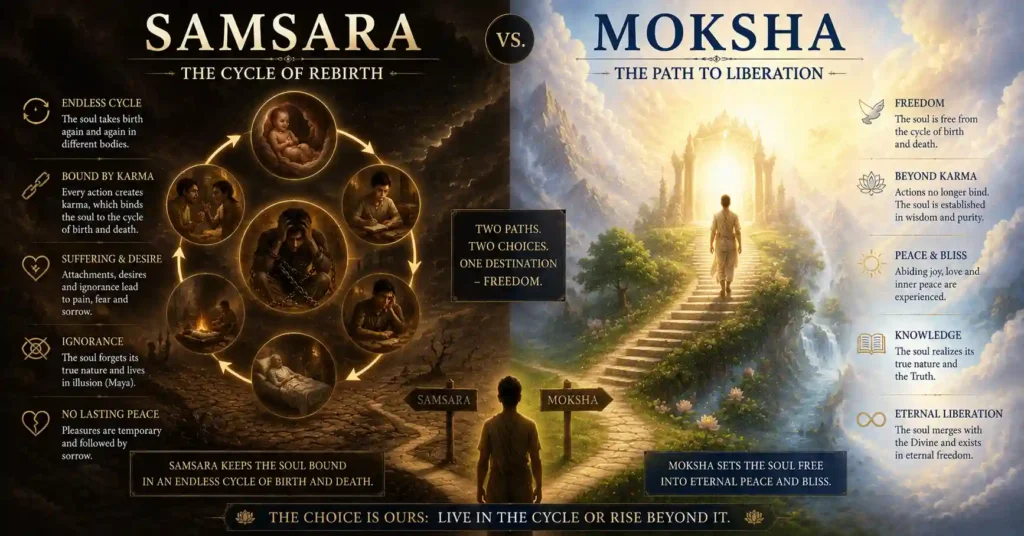
To understand what is Samsara, it is important to understand how it differs from Moksha. These two concepts represent opposite stages of the soul’s spiritual journey in Hindu philosophy.
Samsara is the continuous cycle of birth, death, and rebirth. As long as the soul remains influenced by karma, attachment, desire, and ignorance, it continues moving through the cycle of rebirth.
Moksha, on the other hand, is liberation from this cycle. It is the state in which the soul realizes its true nature and is no longer bound by karma or the need for future births.
In Samsara in Hinduism, happiness and suffering come and go because all worldly experiences are temporary. Moksha represents lasting peace, freedom, and union with the ultimate reality.
The goal of many Hindu spiritual paths, including Bhakti Yoga, Karma Yoga, and Jnana Yoga, is to help the individual move from Samsara toward Moksha. These paths reduce ignorance and help the seeker realize the eternal Self.
Understanding the difference between Samsara and Moksha shows that the purpose of life is not merely to experience repeated births. The deeper goal is spiritual awakening and freedom from the limitations of the material world.
Quick Comparison
| Samsara | Moksha |
|---|---|
| Cycle of birth, death, and rebirth | Freedom from the cycle of rebirth |
| Governed by karma | Beyond karma |
| Involves attachment and desire | Freedom from attachment |
| Temporary experiences | Lasting spiritual freedom |
| Continued rebirth | No further rebirth |
| Spiritual learning process | Completion of the spiritual journey |
Is Samsara Mentioned in Hindu Scriptures?
Yes, the concept of Samsara in Hinduism is deeply rooted in Hindu scriptures and has been discussed for thousands of years. The ideas of birth, death, rebirth, karma, and liberation appear throughout the Upanishads, the Bhagavad Gita, and other sacred texts.
The Upanishads explain that the soul continues its journey after death according to its knowledge, actions, and desires. These texts describe how individuals remain connected to the cycle of rebirth until they realize their true spiritual nature.
The Bhagavad Gita also discusses karma and rebirth in detail. Lord Krishna teaches that just as a person changes worn-out clothes for new ones, the soul leaves one body and takes another. This teaching helps explain why the soul is considered eternal even though physical bodies are temporary.
The Katha Upanishad explores the nature of life, death, and the destiny of the soul. Through the dialogue between Nachiketa and Yama, the text highlights the importance of self-knowledge in overcoming Samsara.
Similarly, the Brihadaranyaka Upanishad and Chandogya Upanishad explain how actions influence future births and how liberation is attained through spiritual wisdom.
These scriptural teachings show that what is Samsara is not merely a philosophical theory. It is a foundational concept that helps explain human existence, the law of karma, and the soul’s journey toward Moksha.
Key Scriptures That Mention Samsara
| Scripture | Connection to Samsara |
|---|---|
| Bhagavad Gita | Explains the eternal nature of the soul and the process of rebirth. |
| Katha Upanishad | Discusses death, rebirth, and liberation through self-knowledge. |
| Brihadaranyaka Upanishad | Explains karma, rebirth, and the soul’s journey. |
| Chandogya Upanishad | Describes how actions influence future births and spiritual progress. |
| Mundaka Upanishad | Teaches the path from worldly existence to liberation. |
This scriptural foundation is one reason why understanding what is Samsara remains essential to Hindu philosophy and spiritual practice.
How Can One Attain Freedom From Samsara?
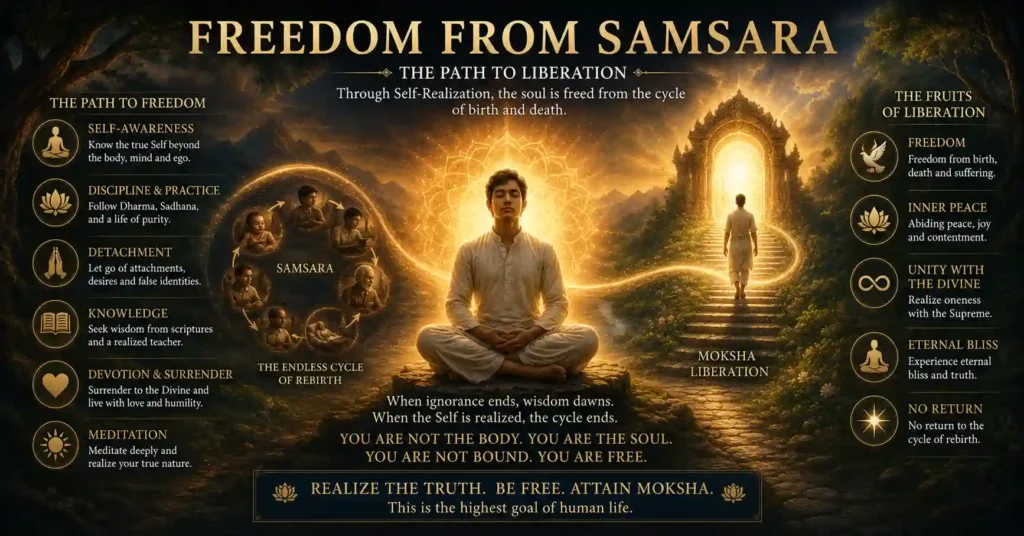
According to Hindu philosophy, freedom from Samsara is attained through spiritual awakening and self-realization. The goal is not simply to escape the world but to understand one’s true nature beyond the body, mind, and ego.
The root cause of bondage in Samsara in Hinduism is ignorance of the Self. When a person realizes that the Atman is eternal and divine, the attachment that fuels the cycle of rebirth begins to dissolve.
Different spiritual paths can help a seeker move toward liberation. Jnana Yoga emphasizes knowledge and self-inquiry, Bhakti Yoga focuses on devotion to God, and Karma Yoga teaches selfless action without attachment to results.
Meditation, prayer, ethical living, and study of sacred scriptures also play an important role. These practices help purify the mind and reduce the desires that keep the soul bound to karma and rebirth.
Freedom from Samsara does not happen through external achievements alone. It comes through inner transformation, wisdom, and a deeper understanding of reality.
When all karmic bondage is exhausted and true self-realization arises, the soul attains Moksha. This is the ultimate freedom from the cycle of rebirth and the highest goal of spiritual life in Hindu philosophy.
Why Is Understanding What Is Samsara Important in Life?
Understanding what is Samsara helps people see life from a broader spiritual perspective. Instead of viewing life as a series of random events, Hindu philosophy teaches that every experience has meaning and can contribute to spiritual growth.
The concept of Samsara in Hinduism encourages personal responsibility. By understanding the connection between actions and consequences, individuals become more mindful of their thoughts, choices, and behavior.
Knowledge of the cycle of rebirth can also reduce the fear of death. The soul is seen as eternal, continuing its journey through different lifetimes while learning important lessons along the way.
Understanding karma and rebirth helps explain why people experience different circumstances in life. Rather than creating helplessness, this understanding encourages self-improvement, compassion, and wise decision-making.
The teachings on Samsara also remind us that worldly possessions, achievements, and relationships are temporary. This perspective can help reduce excessive attachment and bring greater inner balance.
Ultimately, learning what is Samsara inspires a person to look beyond temporary experiences and focus on self-realization, spiritual growth, and the pursuit of Moksha. In this way, the concept remains highly relevant to everyday life as well as the deeper spiritual journey.
What Are Common Misconceptions About Samsara?
Many people misunderstand what is Samsara because the concept is often simplified or confused with other spiritual ideas. Understanding these misconceptions can provide a clearer picture of Samsara in Hinduism and its deeper meaning.
Samsara Is Not a Punishment
One common misconception is that Samsara is a punishment for past actions. Hindu philosophy does not describe the cycle of rebirth as a system of punishment or reward.
Instead, Samsara is a natural process through which the soul learns, grows, and evolves through experience. Each birth provides opportunities for spiritual development and self-understanding.
Samsara Is Not the Same as Reincarnation
Many people use the terms interchangeably, but they are not identical. Reincarnation refers to the process of taking a new birth after death.
Samsara refers to the entire cycle of birth, death, rebirth, karma, attachment, and spiritual evolution. Reincarnation is one part of the larger process of Samsara.
Samsara Is Not Only About Future Lives
When learning what is Samsara, people often focus only on rebirth after death. However, Hindu teachings also describe Samsara as the repeating patterns of attachment, desire, fear, and suffering that occur within a single lifetime.
These recurring emotional and mental cycles can keep a person trapped even before physical rebirth becomes relevant.
Good Karma Alone Does Not End Samsara
Another misconception is that performing good deeds automatically leads to liberation. Good karma creates positive results and favorable circumstances.
However, even good karma can keep a person connected to the cycle of rebirth if attachment to the results remains. Freedom comes through wisdom, self-realization, and freedom from attachment.
Samsara Is Not a Pessimistic Teaching
Some people assume that Samsara presents life as meaningless suffering. In reality, Hindu philosophy views life as a valuable opportunity for spiritual growth, self-discovery, and movement toward Moksha.
The purpose of understanding karma and rebirth is not to become discouraged but to recognize the possibility of inner transformation and liberation.
By understanding these misconceptions, readers gain a more accurate understanding of what is Samsara, the role of karma and rebirth, and the soul’s journey toward liberation.
What Is the Deeper Philosophical Meaning of Samsara?
Beyond the idea of rebirth, what is Samsara also points to a deeper philosophical truth about human existence. Hindu philosophy teaches that the root of Samsara is not merely physical birth and death but ignorance of our true nature.
People often identify themselves with the body, mind, emotions, possessions, and social roles. This mistaken identity creates attachment, desire, fear, and ego. As long as these attachments remain, the soul continues moving through Samsara in Hinduism.
From a philosophical perspective, the cycle of rebirth reflects the soul’s ongoing search for lasting happiness in temporary experiences. However, since all worldly experiences are subject to change, they cannot provide permanent fulfillment.
The ultimate purpose of understanding what is Samsara is to recognize the difference between the temporary and the eternal. Hindu teachings explain that the Atman, or true Self, is beyond birth and death and is never affected by the changing conditions of life.
This realization gradually weakens the forces that sustain karma and rebirth. As wisdom deepens, attachment decreases, and the soul moves closer to Moksha, the state of complete freedom.
In this way, Samsara is not merely a cycle to escape. It is also a spiritual journey that guides the soul toward self-realization, inner freedom, and union with ultimate reality.
Conclusion
What is Samsara? It is the continuous cycle of birth, death, and rebirth that forms a central part of Hindu philosophy. Guided by karma, the soul moves through different lifetimes, learning lessons and gaining experiences that contribute to its spiritual growth.
Understanding what is Samsara helps us see life from a broader perspective. The challenges, opportunities, and relationships we encounter can all become part of the soul’s journey toward greater wisdom and self-awareness.
The teachings of Samsara in Hinduism do not encourage fear of rebirth. Instead, they explain that every experience has meaning and that spiritual progress is always possible through right understanding and action.
Ultimately, the purpose of understanding the cycle of rebirth is not simply to learn about future lives. It is to recognize the deeper goal of self-realization and the possibility of attaining Moksha, the freedom that lies beyond Samsara.
Key Takeaways
What is Samsara? Samsara is the continuous cycle of birth, death, and rebirth described in Hindu philosophy.
The soul moves through the cycle of rebirth based on karma, desires, and past impressions.
Karma and rebirth are closely connected, as actions influence future experiences and future births.
Samsara continues until the soul realizes its true nature and attains Moksha.
Hindu scriptures such as the Bhagavad Gita and Upanishads discuss Samsara in Hinduism and the path to liberation.
Attachment, desire, and ignorance are the primary forces that keep the soul bound to Samsara.
Spiritual practices such as devotion, selfless action, meditation, and self-inquiry help reduce karmic bondage.
Understanding what is Samsara encourages personal responsibility, spiritual growth, and self-realization.
Moksha is the ultimate freedom from the cycle of rebirth and the highest goal of spiritual life.
The deeper purpose of Samsara is to guide the soul toward wisdom, liberation, and lasting inner freedom.
FAQs
What is Samsara in Hinduism?
Samsara in Hinduism is the continuous cycle of birth, death, and rebirth through which the soul journeys across many lifetimes. According to Hindu philosophy, the soul is eternal, but it takes different bodies as it experiences the results of past actions and continues its spiritual evolution.
The concept of what is Samsara helps explain why life is viewed as an ongoing journey rather than a single event. Each birth provides new opportunities to learn, grow, and move closer to self-realization.
The ultimate goal is not to remain in Samsara forever but to attain Moksha, which is liberation from the cycle of rebirth and realization of one’s true spiritual nature.
What causes Samsara?
Samsara is sustained by karma, desires, attachment, and ignorance of the true Self. Every action, thought, and intention creates karmic impressions that influence future experiences and future births.
As long as a person remains attached to worldly desires and identifies only with the body and mind, the soul continues moving through Samsara in Hinduism. These attachments create the conditions for further rebirth.
Hindu teachings explain that ignorance of one’s eternal nature is the root cause of Samsara. When true knowledge arises, the forces that sustain the cycle gradually lose their power.
Is Samsara the same as reincarnation?
No. Although the terms are often used together, they do not mean exactly the same thing.
Reincarnation refers to the process by which the soul takes a new body after death. Samsara is the broader concept that includes birth, death, rebirth, karma, attachment, suffering, learning, and spiritual growth.
In simple terms, reincarnation is one part of Samsara, while Samsara refers to the entire journey of the soul through repeated lifetimes.
How does karma affect Samsara?
The relationship between karma and rebirth is central to understanding Samsara. Karma means action and the consequences that arise from those actions.
Every choice a person makes creates effects that may be experienced in the present life or future lives. These karmic influences help shape circumstances, relationships, opportunities, and challenges.
However, karma is not a system of punishment or reward. Hindu philosophy views it as a natural law of cause and effect that helps the soul learn valuable lessons and progress spiritually.
Can Samsara end?
Yes. Hindu philosophy teaches that Samsara can come to an end through Moksha, or liberation.
Moksha is attained when a person realizes the true nature of the Self and becomes free from ignorance, attachment, and karmic bondage. At this stage, the soul no longer needs to participate in the cycle of rebirth.
Different spiritual paths, including Bhakti Yoga, Karma Yoga, and Jnana Yoga, are considered ways to move toward this state of freedom.
Why is understanding what is Samsara important?
Understanding what is Samsara helps people see life from a broader perspective. It provides a framework for understanding suffering, personal growth, karma, and the purpose of human existence.
This understanding can encourage greater responsibility for one’s actions and help reduce fear of change, loss, and death. It also reminds individuals that spiritual growth is a gradual process that unfolds over time.
For many seekers, learning about Samsara becomes the first step toward exploring deeper teachings about the soul, karma, and liberation.
Do all Hindu traditions believe in Samsara?
Yes. The concept of Samsara in Hinduism is accepted across the major Hindu traditions, although different schools explain it in different ways.
Vedanta, Yoga, Vaishnavism, Shaivism, and other traditions all recognize the cycle of birth and rebirth. They may differ in their interpretation of liberation or the methods used to attain it, but the basic principle of Samsara remains common.
This shared understanding makes Samsara one of the foundational concepts of Hindu philosophy.
What is the ultimate goal beyond Samsara?
The ultimate goal beyond Samsara is Moksha. Moksha is the state of complete spiritual freedom in which the soul is no longer bound by karma or rebirth.
In this state, the individual realizes the eternal Self and experiences lasting peace, wisdom, and freedom. Different Hindu traditions describe this realization in different ways, but all view it as the highest goal of spiritual life.
Understanding the relationship between what is Samsara and Moksha helps explain why liberation is considered the culmination of the soul’s journey.
Does everyone experience Samsara?
According to Hindu philosophy, all embodied beings participate in Samsara. This includes humans and other forms of life that are subject to birth, growth, change, and death.
The soul continues moving through the cycle of rebirth until it gains the wisdom necessary for liberation. Each lifetime contributes to the soul’s spiritual development and understanding.
While the journey may differ for each individual, the ultimate destination remains the same: freedom from Samsara through self-realization.
Which Hindu scriptures explain Samsara?
Many Hindu scriptures discuss what is Samsara, karma, rebirth, and liberation.
The Bhagavad Gita explains the eternal nature of the soul and how it moves from one body to another. The Katha Upanishad explores life, death, and the path to self-knowledge.
The Brihadaranyaka Upanishad and Chandogya Upanishad also discuss karma and rebirth and explain how actions influence future births. Together, these texts provide the scriptural foundation for understanding Samsara and the soul’s journey toward Moksha.
Suggested Reading
If you enjoyed learning what is Samsara, exploring related concepts can help you develop a deeper understanding of Hindu philosophy and the soul’s spiritual journey. Many teachings connected to what is Samsara also explain karma, devotion, self-realization, and liberation from the cycle of rebirth.
The concept of what is Samsara becomes easier to understand when studied alongside subjects such as Bhakti, Brahman, surrender, and sacred spiritual practices. Together, these teachings provide a broader picture of spiritual growth, inner transformation, and the path toward Moksha.
What Is Rudraksha? Meaning, Types and Spiritual Benefits
https://thesanatantales.com/what-is-rudrakshas/
What Is Sharanagati? Understanding Surrender in Hindu Philosophy
https://thesanatantales.com/what-is-sharanagati/
What Is Bhakti? Meaning, Types, Importance, and Understanding in Sanatan Dharma
https://thesanatantales.com/what-is-bhakti/
What Is Brahman? Meaning, Nature and Spiritual Significance in Hinduism
https://thesanatantales.com/what-is-brahman/
Brahma Muhurta: Meaning, Time, Benefits and Spiritual Significance
https://thesanatantales.com/brahma-muhurta-meaning-time-significance/
Saṃsāra
https://en.wikipedia.org/wiki/Sa%E1%B9%83s%C4%81ra
These guides complement the teachings on Samsara in Hinduism, karma and rebirth, and the soul’s search for lasting freedom beyond the cycle of rebirth.
References & Sources
This article is based on teachings, concepts, and philosophical principles associated with Sanatan Dharma, including insights found in Hindu scriptures, traditional spiritual knowledge, Vedantic teachings, and widely accepted interpretations of karma, rebirth, Moksha, and the nature of the soul.
The discussion of what is Samsara, the cycle of rebirth, and the relationship between karma and rebirth reflects ideas preserved through sacred texts, spiritual traditions, teacher-disciple lineages, and generations of Hindu philosophical thought.
Note: Beliefs, interpretations, and explanations may vary across different Hindu traditions, sampradayas, philosophical schools, regions, and individual spiritual paths. The purpose of this article is not to present any single interpretation as the absolute truth, but to offer a simple, balanced, and reader-friendly introduction to commonly accepted perspectives on Samsara in Hinduism. Sanatan Dharma embraces multiple paths of knowledge, devotion, meditation, self-inquiry, and spiritual practice, all of which may explain these concepts in their own unique way.
Explore More Topics from Sanatan Dharma