
Dharma is one of the most important concepts in Sanatan Dharma, yet it is often misunderstood as simply religion, rules, or duty. In reality, it refers to the principles that uphold truth, harmony, righteousness, and balance in both individual life and society.
Its meaning goes far beyond rituals or beliefs. This timeless teaching guides how a person thinks, acts, makes decisions, and fulfills responsibilities according to their nature and circumstances. When practiced with understanding, it supports ethical living, inner stability, and spiritual growth.
Ancient Hindu scriptures describe this principle as the foundation that sustains the world and helps individuals lead a meaningful life. It influences relationships, work, personal conduct, and the journey toward self-realization.
In this article, you will learn its meaning, origin, scriptural basis, different types, importance in daily life, common misconceptions, and deeper philosophical insights. By the end, you will have a clear understanding of why this teaching remains central to the Hindu way of life.
At a Glance
| Aspect | Summary |
|---|---|
| Meaning | That which upholds, sustains, and supports life, truth, and harmony. |
| Sanskrit Root | Derived from Dhri, meaning “to hold,” “support,” or “sustain.” |
| Purpose | Guides righteous living, ethical conduct, and responsible action. |
| Scriptural Sources | Vedas, Upanishads, Bhagavad Gita, Ramayana, Mahabharata, and traditional law texts. |
| Types | Includes the eternal path, personal duty, universal virtues, and life-stage responsibilities. |
| Relation to Karma | Karma is action, while these principles help determine the right course of action. |
| Importance | Promotes personal growth, social harmony, and spiritual progress. |
| Ultimate Goal | Helps align life with truth and prepares the seeker for liberation (Moksha). |
Table of Contents
ToggleWhat Is Dharma?
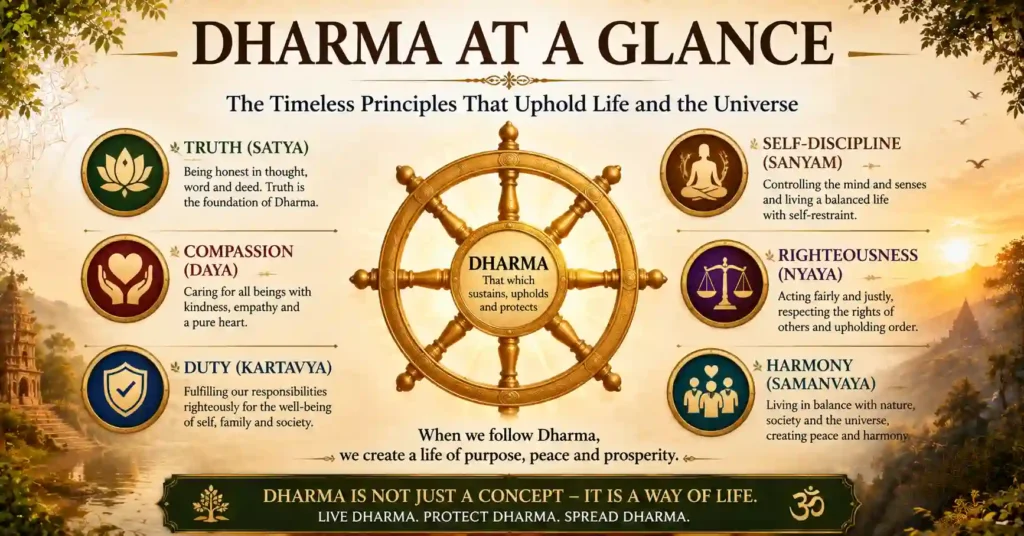
Dharma is the principle that upholds truth, harmony, righteousness, and order in life. In Sanatan Dharma, it refers to living in alignment with one’s responsibilities, values, and higher purpose.
It is often translated as duty, righteousness, or moral law, but its meaning extends far beyond these definitions. It provides guidance on how a person should think, speak, and act while maintaining balance within themselves and with the world around them.
Unlike rules that apply equally to everyone, this principle recognizes that responsibilities vary according to a person’s role and circumstances. What is expected of a teacher may differ from the duties of a parent, student, leader, or spiritual seeker. Yet values such as honesty, compassion, self-discipline, and respect for truth remain important for all.
It is not limited to religious rituals or external practices. Instead, it influences everyday choices, relationships, work, and personal conduct. Living according to these principles helps cultivate integrity, responsibility, and inner peace.
In simple terms, Dharma can be understood as the right way of living that supports both individual well-being and the greater good. It serves as a guide for ethical decision-making and harmonious living.
What Is the Meaning of Dharma?
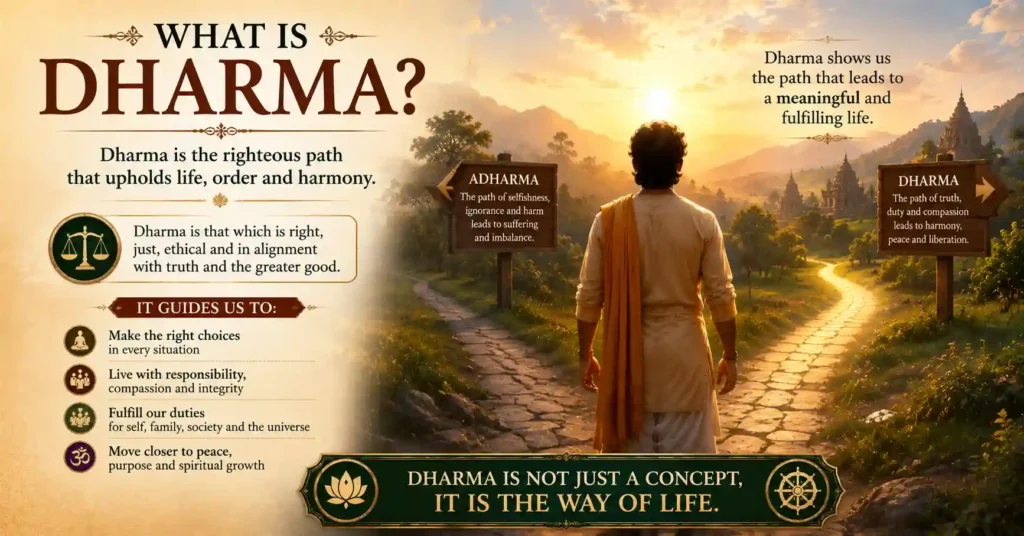
The word Dharma comes from the Sanskrit root Dhri (धृ), which means “to hold,” “to support,” or “to sustain.” Because of this origin, it is often understood as the principle that upholds order, harmony, and balance in life and the universe.
Its meaning extends far beyond religion or ritual practices. In Sanatan Dharma, it refers to the values, responsibilities, and ethical principles that guide individuals toward righteous living.
Depending on the context, it can be understood as duty, righteousness, moral responsibility, virtue, justice, or the proper way of living. While these meanings vary slightly, they all point toward living in alignment with truth and maintaining harmony within oneself and society.
Hindu philosophy teaches that just as natural laws sustain the physical world, these guiding principles sustain human life by providing direction for thoughts, actions, and decisions. They help individuals understand what is right, appropriate, and beneficial in different situations.
Its application is not identical for every person. A student’s responsibilities may differ from those of a parent, teacher, leader, or spiritual seeker. However, values such as honesty, compassion, self-discipline, and respect for truth remain important for everyone.
In simple terms, Dharma can be described as the path of right living that supports personal growth, social harmony, and spiritual progress. It serves as a foundation for a meaningful life and remains one of the central teachings of Sanatan Dharma.
Is Dharma Mentioned in Hindu Scriptures?
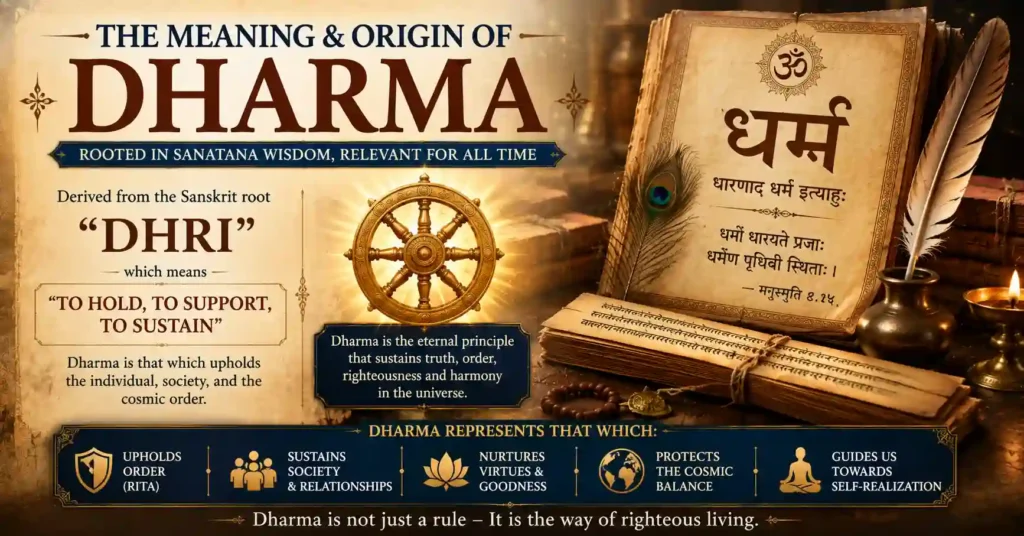
Yes, Dharma is one of the most frequently discussed concepts in Hindu scriptures and forms a central pillar of Sanatan Dharma. The idea appears throughout the Vedas, Upanishads, Bhagavad Gita, Ramayana, Mahabharata, and Dharma Shastras, where it is presented as the foundation of righteous living and social harmony.
The Vedas describe it as the principle that sustains cosmic order and maintains balance in the universe. They emphasize living in alignment with truth, duty, and the natural laws that govern existence.
The Upanishads explore this concept from a deeper philosophical perspective. They connect it with self-knowledge, ethical conduct, and the pursuit of higher truth. These texts teach that a meaningful life requires both outer responsibility and inner spiritual growth.
The Bhagavad Gita contains some of the most well-known teachings on the subject. Lord Krishna instructs Arjuna to perform his duty with sincerity and without attachment to results. The Gita presents righteous action as a guide for making difficult decisions and fulfilling responsibilities with wisdom.
The Ramayana and Mahabharata illustrate these principles through the lives of their characters. Figures such as Lord Rama, Yudhishthira, and Bhishma are often remembered for the challenges they faced while trying to uphold righteousness under difficult circumstances.
The Dharma Shastras, including texts such as the Manusmriti, provide detailed discussions on duties, ethics, social responsibilities, and proper conduct. While some instructions reflect the historical context in which they were written, their broader emphasis on responsibility and moral living continues to be studied today.
Its presence across Hindu scriptures shows that this teaching is far more than a religious idea. It serves as a guiding principle for personal conduct, social order, and spiritual progress throughout the Sanatan tradition.
What Are the Different Types of Dharma?
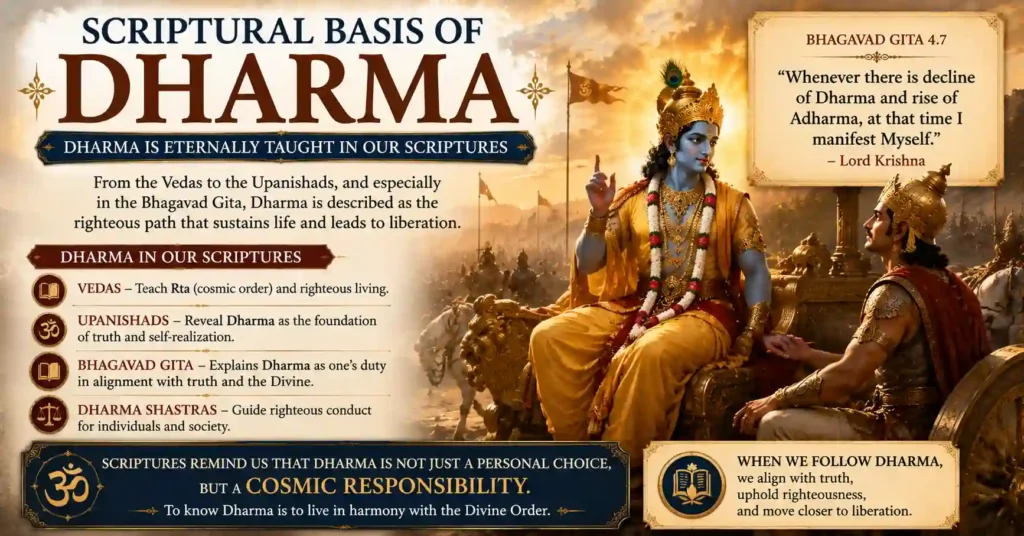
Hindu scriptures describe different classifications of righteous living to help people understand their responsibilities in various situations. While the core principles of truth, righteousness, and ethical conduct remain the same, their application can differ based on a person’s nature, role, and stage of life.
Sanatana Dharma
This term refers to the eternal and universal principles that apply to all human beings. Values such as truthfulness, compassion, non-violence, self-control, and respect for others are considered part of this timeless tradition.
These principles remain relevant regardless of place, culture, or historical period.
Swadharma
This refers to an individual’s personal duty and responsibility. It is based on one’s nature, abilities, circumstances, and role in life.
For example, the responsibilities of a parent, teacher, student, leader, or spiritual seeker may differ. The Bhagavad Gita teaches that following one’s own path is better than imitating the path of another person.
Sadharana Dharma
This category consists of moral values and ethical duties that are expected from everyone. These include honesty, kindness, patience, forgiveness, humility, and integrity.
Such virtues help create harmony in both personal life and society.
Varnashrama Dharma
This classification refers to responsibilities associated with a person’s role in society (Varna) and stage of life (Ashrama). Traditionally, Hindu texts describe four life stages: student, householder, retired life, and renunciation.
Each stage brings its own duties and opportunities for personal and spiritual growth.
Raja Dharma
This relates to the responsibilities of rulers, leaders, and those entrusted with authority. It emphasizes justice, fairness, protection of society, and decision-making guided by the welfare of others rather than personal interests.
Understanding these different forms helps explain that Hindu philosophy does not prescribe a single set of rules for everyone. Instead, it offers guidance that adapts to different responsibilities while remaining rooted in truth, duty, and righteous living.
Why Is Dharma Important?
Dharma plays a vital role in both individual life and society. It provides a framework for making ethical decisions, fulfilling responsibilities, and living in harmony with others. Without such guidance, people can easily become driven by selfish desires, confusion, or short-term interests.
One of the primary reasons it is important is that it helps maintain balance. Just as natural laws sustain the physical world, righteous conduct helps sustain families, communities, and social order. When people act with honesty, compassion, and responsibility, trust and harmony naturally grow.
These principles also provide clarity during difficult situations. Life often presents choices where the right path is not immediately obvious. By considering duty, ethics, and the welfare of others, individuals can make decisions with greater wisdom and confidence.
From a spiritual perspective, they support inner growth. They encourage self-discipline, integrity, and awareness while helping reduce actions that create suffering for oneself and others. In this way, they serve as a foundation for higher spiritual development.
The Bhagavad Gita repeatedly emphasizes the importance of performing one’s duty with sincerity and without attachment to personal gain. Such actions not only benefit society but also contribute to personal peace and character development.
In today’s fast-changing world, these teachings remain as relevant as ever. They offer timeless guidance for living responsibly, building meaningful relationships, and leading a life rooted in truth and purpose.
Does Dharma Mean Religion?
One of the most common misunderstandings is that Dharma simply means religion. While religion can be a part of it, the two concepts are not identical.
In modern usage, religion is often understood as a system of beliefs, rituals, practices, or worship associated with a particular faith tradition. Dharma, however, has a much broader meaning. It includes duty, righteousness, moral responsibility, ethical conduct, and the principles that sustain harmony in life.
A person may follow religious rituals, but these teachings are reflected in how they treat others, fulfill responsibilities, make decisions, and live according to truth. They are as much about character and conduct as they are about spiritual practice.
For example, being honest, keeping one’s promises, helping those in need, respecting parents, and acting fairly are all expressions of righteous living. These actions remain important regardless of religious identity or external practices.
This broader understanding explains why Sanatan Dharma is often translated as the “eternal way of living” rather than simply a religion. It provides guidance for every aspect of life, from personal behavior and social responsibilities to spiritual growth and self-realization.
Understanding this distinction helps clarify why the concept occupies such a central place in Hindu philosophy. It is not limited to what a person believes but extends to how they live and interact with the world around them.
Does Dharma Change from Person to Person?
Yes, the application of Dharma can vary from person to person because people have different responsibilities, abilities, circumstances, and stages of life. Hindu philosophy recognizes that what is right in one situation may not always be appropriate in another.
For example, the duties of a student differ from those of a parent, teacher, leader, or spiritual seeker. Each role carries its own responsibilities, and fulfilling them sincerely is considered an important part of righteous living.
This does not mean that these principles are completely relative or based on personal preference. Certain values such as truthfulness, compassion, self-control, fairness, and respect for others are considered universal and apply to everyone.
The concept of Swadharma, or one’s own duty, helps explain this idea. It teaches that individuals should act according to their nature and responsibilities rather than trying to imitate the path of someone else.
The Bhagavad Gita emphasizes that performing one’s own duty, even imperfectly, is better than performing another person’s duty perfectly. This teaching highlights the importance of understanding one’s unique role in life.
By recognizing both universal values and individual responsibilities, Hindu philosophy presents Dharma as a practical guide that adapts to different situations while remaining rooted in truth, righteousness, and ethical conduct.
What Is Swadharma?
Swadharma means one’s own duty or personal responsibility. It refers to the path that is most appropriate for an individual based on their nature, abilities, circumstances, and role in life.
The concept teaches that each person has unique responsibilities. A student’s duty differs from that of a parent, teacher, leader, or spiritual seeker. Fulfilling these responsibilities sincerely is considered an important part of righteous living.
The Bhagavad Gita gives special importance to Swadharma. Lord Krishna advises Arjuna to perform his own duty rather than avoid it out of fear or confusion. This teaching highlights the value of acting according to one’s rightful responsibilities, even when the path is difficult.
It is not about social status or personal preference. Instead, it encourages individuals to understand what is expected of them in a particular situation and carry out those responsibilities with honesty, dedication, and integrity.
Following one’s own path also helps prevent constant comparison with others. Rather than imitating someone else’s life or responsibilities, it encourages self-awareness and acceptance of one’s unique role.
Understanding Swadharma makes the broader teaching more practical and personal. It reminds us that ethical living is not about following a single formula but about fulfilling our responsibilities in a way that supports both personal growth and the well-being of others.
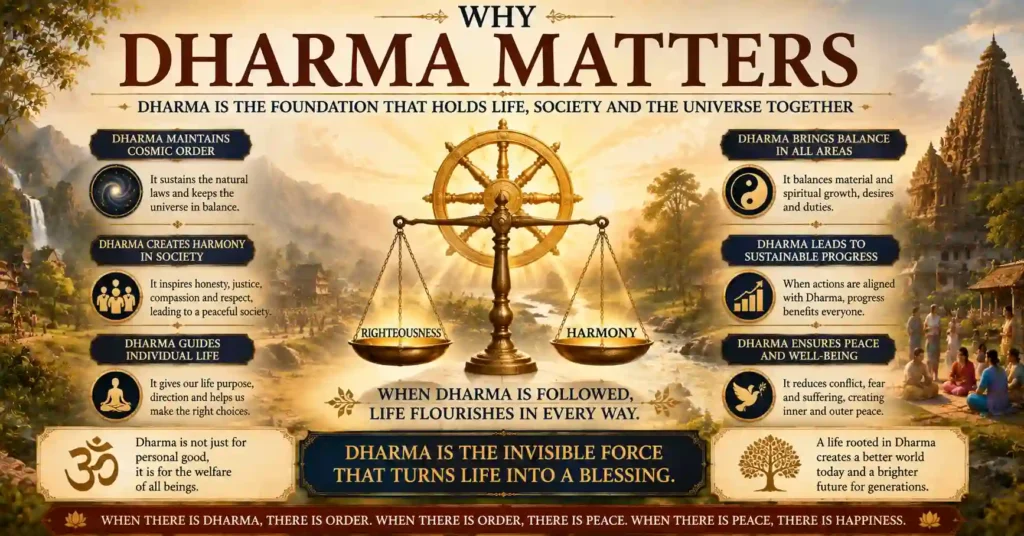
What Is the Relationship Between Dharma and Karma?
Dharma and Karma are closely connected concepts in Hindu philosophy. While Karma refers to actions and their consequences, Dharma helps determine whether those actions are right, ethical, and aligned with one’s responsibilities.
In simple terms, Karma is what we do, while Dharma guides how we should act. Every thought, word, and deed creates Karma, but these guiding principles serve as a moral compass that helps ensure actions contribute to personal growth and the well-being of others.
For example, two people may perform the same action, yet their intentions, responsibilities, and circumstances may differ. Understanding what is right in a particular situation helps a person choose the most appropriate course of action.
The Bhagavad Gita teaches that individuals should perform their duties sincerely without becoming attached to the results. This approach combines righteous conduct and action by encouraging responsibility while accepting outcomes with balance and wisdom.
When actions are guided by honesty, compassion, and responsibility, they are more likely to create positive effects. Conversely, actions driven by greed, selfishness, or harmful intentions can lead to suffering and imbalance.
Understanding the relationship between Dharma and Karma helps explain why Hindu philosophy places equal importance on both action and ethical conduct. Together, they provide a practical framework for living responsibly, making wise decisions, and progressing on the path of spiritual growth.
What Happens When Dharma Is Ignored?
When Dharma is ignored, imbalance gradually develops in both personal life and society. Decisions become driven by selfish desires, anger, greed, or short-term gain rather than by truth, responsibility, and ethical principles.
On an individual level, neglecting righteous conduct can lead to confusion, inner conflict, and dissatisfaction. A person may achieve temporary success yet still experience stress, guilt, or a lack of deeper fulfillment when actions are not aligned with their values.
The effects can also be seen in relationships. When honesty, trust, respect, and responsibility are ignored, misunderstandings and conflicts often increase. Families, communities, and workplaces function best when people act with integrity and consideration for others.
Hindu scriptures frequently illustrate the consequences of abandoning the righteous path. In the Mahabharata, personal ambition, greed, and the misuse of power contribute to widespread suffering and conflict. These stories highlight the importance of ethical choices and responsible action.
The impact extends beyond individuals. When fairness, justice, and moral responsibility decline, social harmony becomes difficult to maintain. Corruption, exploitation, and division often arise when personal interests are placed above the common good.
The purpose of these teachings is not to create fear but to encourage awareness. By understanding the consequences of actions and their impact on ourselves and others, we can make wiser choices and contribute to a more balanced and meaningful life.
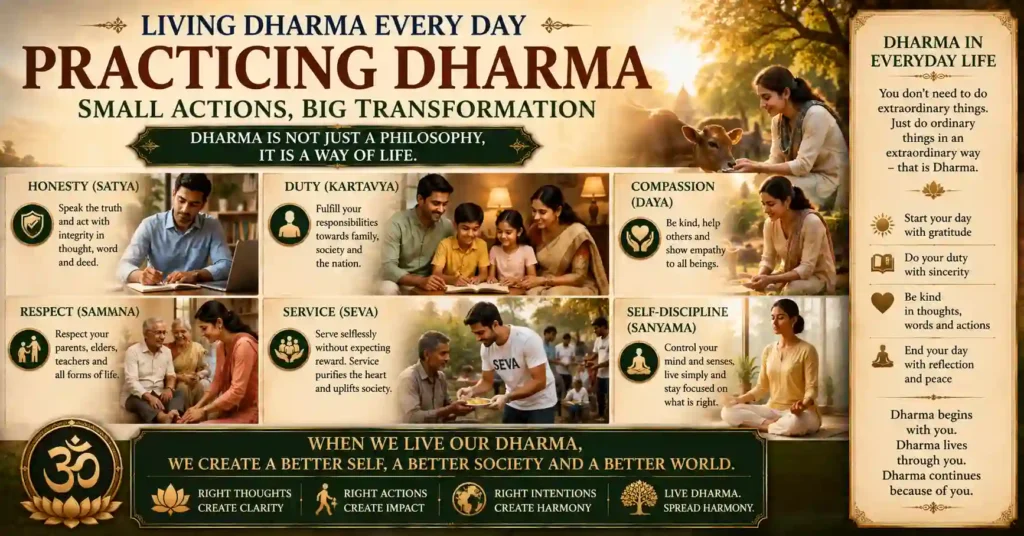
How Can We Follow Dharma in Daily Life?
Following Dharma does not require extraordinary knowledge or complex rituals. It begins with making conscious choices that reflect honesty, responsibility, compassion, and respect for others in everyday situations.
One of the simplest ways to practice these principles is by fulfilling one’s duties sincerely. Whether as a student, parent, professional, friend, or community member, carrying out responsibilities with integrity helps create harmony in both personal and social life.
Truthfulness is another important aspect of righteous living. Speaking honestly, keeping promises, and acting with transparency build trust and strengthen relationships. At the same time, truth should be expressed with kindness and consideration.
Practicing self-control also plays a significant role. Managing anger, greed, jealousy, and excessive desires helps prevent actions that may harm oneself or others. Hindu teachings emphasize that inner discipline is essential for ethical and spiritual growth.
Compassion and service are equally important. Helping those in need, showing respect to others, and contributing positively to society are practical expressions of these values. Small acts of kindness often reflect righteous conduct as much as larger actions.
Regular self-reflection can help individuals stay aligned with their values. Before making important decisions, asking whether an action is truthful, fair, and beneficial can provide useful guidance.
In daily life, Dharma is less about following rigid rules and more about living with awareness, responsibility, and a commitment to what is right. Through consistent practice, it becomes a natural guide for making wise choices and building a meaningful life.
Dharma vs Religion: What Is the Difference?
Many people use the terms Dharma and religion interchangeably, but they are not exactly the same. While religion often refers to a particular system of beliefs, worship, and practices, Dharma has a broader meaning that includes duty, ethics, righteous conduct, and the principles that sustain life.
Religion is often associated with faith, rituals, ceremonies, and devotion. This teaching includes these aspects but also extends to everyday responsibilities, moral choices, relationships, and personal conduct.
A person expresses these values not only through worship but also through honesty, compassion, self-discipline, fairness, and service to others. They are reflected in how one lives, not just in what one believes.
Quick Comparison
| Dharma | Religion |
|---|---|
| Focuses on righteous living and responsibility | Focuses primarily on beliefs and worship practices |
| Guides personal conduct and ethical decisions | Often emphasizes faith, traditions, and rituals |
| Applies to every aspect of life | Usually associated with religious identity |
| Includes duties, values, and moral principles | Includes doctrines, ceremonies, and forms of worship |
| Encourages harmony with self, society, and the universe | Provides a framework for spiritual belief and practice |
This comparison does not mean that the two are opposed to one another. In Sanatan Dharma, spiritual practices, devotion, and rituals are often seen as ways of supporting a righteous and balanced life.
Understanding the difference helps clarify why Dharma is considered a complete way of living. It encompasses not only spiritual beliefs but also the values and responsibilities that guide daily actions and decisions.
Why Is Understanding Dharma Important Today?
The teachings of Dharma remain highly relevant in the modern world. Although society has changed significantly over time, people still face questions about responsibility, ethics, relationships, purpose, and how to make the right choices in difficult situations.
Modern life often moves at a fast pace and is filled with distractions, competition, and constant pressure. In such an environment, these principles provide a stable foundation for making decisions based on truth, integrity, and long-term well-being rather than temporary impulses.
Understanding this wisdom can help a person:
Make ethical decisions with greater confidence.
Balance personal goals with responsibilities.
Build stronger and healthier relationships.
Develop self-discipline and emotional maturity.
Navigate success and failure with greater wisdom.
Live with a clearer sense of purpose and direction.
The concept also encourages individuals to think beyond personal gain. It reminds us that our actions affect family, society, and the wider world. Acting responsibly and considering the welfare of others helps create a more harmonious and compassionate community.
Another reason these teachings remain important today is that they promote inner balance. Many people seek happiness through external achievements alone, yet lasting peace often comes from living in alignment with one’s values and responsibilities.
By applying these principles in daily life, individuals can respond more thoughtfully to challenges, reduce unnecessary conflict, and cultivate a life rooted in meaning, character, and spiritual growth.
Common Misconceptions About Dharma
Because Dharma is a broad and deeply layered concept, it is often misunderstood. Clarifying these misconceptions can help develop a more accurate understanding of its role in Hindu philosophy and daily life.
It Is Not the Same as Religion
Many people assume that Dharma simply means religion. In reality, it includes duty, ethical conduct, responsibility, and righteous living. Religious practices may support these values, but the concept itself is much broader.
It Is Not a Fixed Set of Rules
Another common misconception is that it consists of rigid rules that apply equally to everyone. Hindu philosophy recognizes that responsibilities vary according to a person’s role, circumstances, and stage of life.
It Does Not Mean Blind Obedience
Following this path does not require accepting every tradition or instruction without thought. Instead, it encourages wisdom, self-reflection, and ethical decision-making based on truth and responsibility.
It Is Not Limited to Monks or Spiritual Seekers
Some people believe that these teachings apply only to saints, monks, or highly spiritual individuals. In reality, they are relevant to everyone, including students, parents, professionals, leaders, and householders.
It Is Not About Perfection
Living according to these principles does not mean never making mistakes. It is a continuous effort to act with integrity, learn from experience, and make choices that support personal growth and the well-being of others.
It Does Not Require Rejecting Worldly Life
Hindu teachings generally do not ask people to abandon family, work, or social responsibilities. Instead, they encourage fulfilling these responsibilities in a balanced and ethical manner.
Understanding these misconceptions helps reveal Dharma as a practical guide for everyday living rather than a narrow religious or philosophical concept. It is a path of conscious action, responsibility, and alignment with truth.
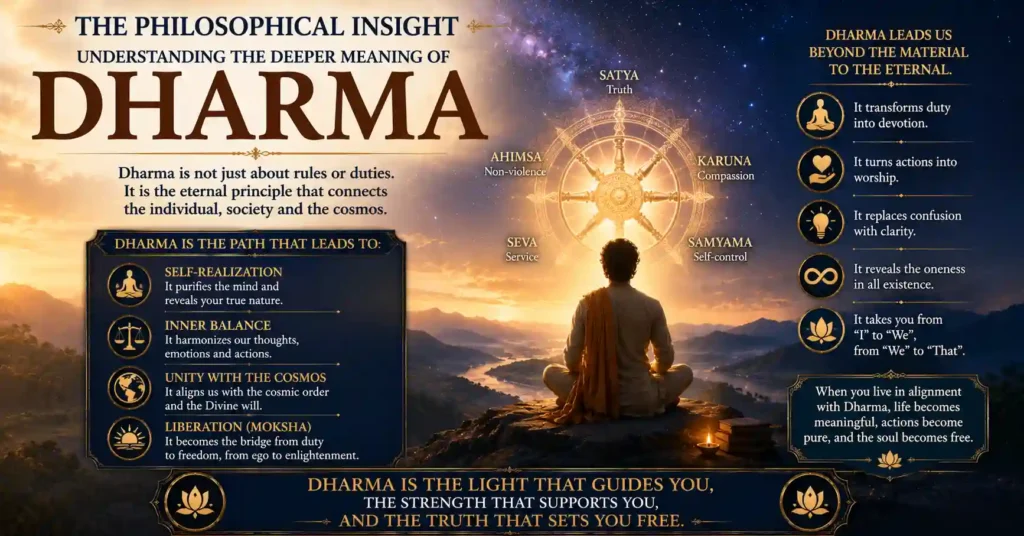
Philosophical Insight: Dharma and the Purpose of Life
In Hindu philosophy, Dharma is more than a system of duties or ethical guidelines. It is closely connected to the deeper purpose of human life and the journey of spiritual growth.
The traditional framework of life in Sanatan Dharma is often explained through the four Purusharthas: Dharma (righteous living), Artha (prosperity), Kama (desires), and Moksha (liberation). Among these, righteous living serves as the foundation that guides the pursuit of the other goals in a balanced and ethical manner.
Without these guiding principles, the pursuit of wealth or personal desires can become driven by selfishness and attachment. When guided by truth and responsibility, however, these pursuits contribute to individual well-being and social harmony.
From a spiritual perspective, this path helps purify the mind and cultivate qualities such as truthfulness, compassion, self-discipline, and selflessness. These qualities prepare a person for deeper self-inquiry and spiritual understanding.
The Bhagavad Gita teaches that performing one’s duty with sincerity and without attachment to results can become a path to inner growth. Through such actions, individuals gradually move beyond ego-centered motivations and develop greater wisdom.
Ultimately, Dharma is not merely about following external rules. It is about aligning one’s thoughts, actions, and intentions with truth. By living in accordance with these principles, a person creates the conditions for inner peace, self-realization, and progress toward Moksha, the ultimate goal of spiritual freedom.
Conclusion
Dharma is one of the foundational concepts of Sanatan Dharma and serves as a guide for living a life rooted in truth, responsibility, and harmony. Far more than a religious idea, it influences how individuals think, act, make decisions, and fulfill their responsibilities in everyday life.
From its meaning and scriptural basis to its different forms and practical application, this timeless teaching provides a framework for ethical living and spiritual growth. It helps individuals navigate challenges with wisdom, maintain balance in relationships, and contribute positively to society.
These principles remain relevant across all stages of life. Whether a person is pursuing education, building a family, leading others, or seeking spiritual understanding, they offer guidance for making choices that support both personal well-being and the greater good.
Ultimately, this path is not about perfection but about striving to live with integrity, compassion, and awareness. By understanding and applying these teachings, individuals can cultivate a more meaningful, balanced, and purposeful life.
Key Takeaways
- This principle upholds truth, righteousness, harmony, and moral order in life.
- The word comes from the Sanskrit root Dhri, meaning “to sustain” or “to support.”
- Hindu scriptures such as the Vedas, Upanishads, Bhagavad Gita, Ramayana, and Mahabharata discuss these teachings extensively.
- Important classifications include the eternal path, personal duty, universal virtues, life-stage responsibilities, and duties of leadership.
- It is broader than religion and includes duty, ethical conduct, responsibility, and righteous living.
- Personal responsibility varies according to a person’s nature, role, and circumstances.
- It works closely with Karma, helping guide actions toward what is right and beneficial.
- Ignoring these values can create imbalance, conflict, and suffering in both personal life and society.
- Practicing honesty, compassion, self-discipline, and responsibility are important ways to apply these teachings in daily life.
- Understanding these principles helps individuals live with greater purpose, integrity, and spiritual awareness.
FAQs
What is Dharma in simple words?
In simple terms, Dharma means living in a way that is right, responsible, and aligned with truth. It guides a person’s actions, decisions, and conduct in daily life.
It is often described as the principle that sustains harmony within individuals, society, and the universe. Rather than being limited to religious practices, it influences how people fulfill their responsibilities and interact with others.
A simple way to understand this teaching is as a path of ethical living that helps create balance, purpose, and inner peace.
What is the main purpose of Dharma?
The primary purpose of righteous living is to maintain order, harmony, and well-being in both personal and social life. It helps individuals understand their responsibilities, make ethical decisions, and act in ways that support the greater good.
These guiding principles also promote spiritual growth by encouraging qualities such as honesty, compassion, self-discipline, and selflessness. Such values help create a balanced life while strengthening character and inner awareness.
By following this path, a person can lead a more meaningful and purposeful life while contributing positively to society and progressing toward personal and spiritual growth.
What is the difference between Dharma and Karma?
Dharma and Karma are closely related but have different meanings.
While Karma refers to actions and their consequences, righteous living provides the moral and ethical framework that guides those actions.
In simple terms, these principles help determine what is right to do, while Karma reflects the results of the choices a person makes. Together, they influence personal growth, character development, and life experiences.
What are the different types of Dharma?
Hindu philosophy describes several forms of righteous duty, each serving a different purpose.
Some of the most commonly discussed include Sanatana Dharma (eternal principles), Swadharma (personal duty), Sadharana Dharma (universal moral values), Varnashrama Dharma (responsibilities related to life stages and social roles), and Raja Dharma (duties of leaders and rulers).
These classifications help explain how these principles can apply differently in various situations while remaining rooted in truth, responsibility, and ethical living.
Is Dharma the same for everyone?
No. While certain values such as truthfulness, compassion, and non-violence are considered universal, specific responsibilities can vary from person to person.
A student’s duties differ from those of a parent, teacher, business owner, or spiritual seeker. Hindu teachings recognize that people have different roles, abilities, and circumstances in life.
This is why the concept of Swadharma, or one’s own duty, is considered so important. It emphasizes fulfilling one’s personal responsibilities in a way that is aligned with individual nature, circumstances, and ethical principles.
Why is Dharma important in daily life?
Dharma provides guidance for making wise and ethical decisions. It helps people act responsibly, maintain healthy relationships, and fulfill their obligations with integrity.
In a world filled with distractions and competing priorities, Dharma offers a stable foundation for choosing what is right rather than what is merely convenient.
Its principles remain relevant in family life, education, work, leadership, and personal development.
Can a person follow Dharma without performing rituals?
Yes. While rituals may support spiritual practice, Dharma is not limited to rituals alone.
A person follows Dharma through honesty, compassion, responsibility, fairness, and ethical conduct in daily life. These qualities are considered essential expressions of righteous living.
Hindu philosophy places great importance on character and actions, not just external observances.
What happens when a person goes against Dharma?
Ignoring Dharma can create imbalance in both personal and social life. Actions driven by greed, anger, dishonesty, or selfishness often lead to conflict, dissatisfaction, and suffering.
Hindu scriptures frequently illustrate how abandoning righteous conduct can result in negative consequences for individuals and society.
The purpose of these teachings is to encourage awareness and help people make better choices.
Is Dharma mentioned in the Bhagavad Gita?
Yes. The Bhagavad Gita contains some of the most important teachings on Dharma.
Lord Krishna explains the importance of fulfilling one’s duties with sincerity, wisdom, and without attachment to personal rewards. The Gita teaches that acting according to one’s rightful responsibilities is an essential part of spiritual growth.
Many of the modern discussions about Dharma are influenced by these teachings.
How does Dharma help in spiritual growth?
Dharma helps cultivate qualities such as truthfulness, self-control, compassion, humility, and responsibility. These qualities purify the mind and prepare a person for deeper spiritual understanding.
By living in alignment with righteous principles, individuals gradually develop greater self-awareness and inner peace.
In Hindu philosophy, Dharma serves as an important foundation for progressing toward self-realization and ultimately Moksha, or liberation.
Suggested Reading
If learning about righteous living has deepened your interest in Sanatan Dharma, you may also enjoy exploring related teachings that explain devotion, surrender, ultimate reality, sacred time, spiritual practice, and the soul’s journey through life and rebirth.
Understanding personal responsibility, ethical conduct, and the principles of right living becomes even more meaningful when viewed alongside concepts such as Bhakti, Brahman, Maya, Samsara, and Sharanagati. Together, these teachings provide a deeper understanding of spiritual growth, self-realization, and the pursuit of truth within the Sanatan tradition.
What Is Rudraksha? Meaning, Types and Spiritual Benefits
https://thesanatantales.com/what-is-rudraksha/
What Is Sharanagati? Understanding Surrender in Hindu Philosophy
https://thesanatantales.com/what-is-sharanagati/
What Is Bhakti? Meaning, Types, Importance, and Understanding in Sanatan Dharma
https://thesanatantales.com/what-is-bhakti/
What Is Brahman? Meaning, Nature and Spiritual Significance in Hinduism
https://thesanatantales.com/what-is-brahman/
Brahma Muhurta: Meaning, Time, Benefits and Spiritual Significance
https://thesanatantales.com/brahma-muhurta-meaning/
What Is Samsara? Meaning, Karma, and the Cycle of Rebirth
https://thesanatantales.com/what-is-samsara/
What Is Maya? Meaning, Illusion and Spiritual Significance in Hindu Philosophy
https://thesanatantales.com/what-is-maya/
What Is Nishit Kaal? Meaning, Time, Importance and Spiritual Significance
https://thesanatantales.com/what-is-nishit-kaal/
Dharma (Wikipedia)
https://en.wikipedia.org/wiki/Dharma
These articles will help you see how Dharma connects with broader teachings of Sanatan Dharma and how these interconnected concepts guide individuals toward wisdom, inner balance, and spiritual awakening.
References & Sources
This article is based on teachings, values, and practices associated with Sanatan Dharma, including insights drawn from Hindu scriptures, traditional spiritual knowledge, devotional practices, philosophical teachings, and ethical principles that guide right living and personal conduct.
It also reflects wisdom preserved through family traditions, spiritual communities, classical commentaries, and the guru-disciple lineage that has transmitted Sanatan teachings across generations. The concepts discussed here are commonly explored within Hindu philosophy in the context of duty, responsibility, moral values, spiritual growth, and the pursuit of a meaningful life.
Note: Beliefs, interpretations, and spiritual practices may vary across different traditions, sampradayas, regions, and individual paths within Sanatan Dharma. The purpose of this article is not to promote any single viewpoint as the absolute truth, but to present commonly accepted spiritual perspectives in a simple, practical, and reader-friendly manner. The Sanatan tradition embraces multiple paths of worship, knowledge, devotion, meditation, ethical living, and self-transformation.
Explore More Topics from The Sanatan Tales