Intention vs Ritual is a question that many devotees quietly struggle with at some point in their spiritual journey. When life becomes busy, prayers are rushed, or rituals are missed, it is natural to wonder whether God values the ritual itself or the devotion behind it.
Some people perform elaborate worship every day, while others may only find a few moments to remember the Divine amid their responsibilities. This often raises an important question: Does sincere devotion matter more than perfect ritual observance?
Sanatan Dharma offers a balanced and compassionate perspective on this subject. It teaches that rituals are valuable spiritual tools, but their true purpose is to awaken faith, devotion, and remembrance of the Divine. Without the right inner attitude, even the most elaborate ritual can become mechanical. With genuine devotion, however, even the simplest act of worship can become spiritually meaningful.
In this article, we will explore the deeper meaning of Intention vs Ritual, the importance of Bhava in worship, teachings from the Bhagavad Gita, inspiring stories from Sanatan tradition, and practical lessons that can help bring greater sincerity and awareness into daily spiritual life.
By the end, you will understand why Sanatan Dharma does not ask us to choose between devotion and ritual, but teaches how both can work together to create a more meaningful and transformative spiritual path.
Intention vs Ritual at a Glance
| Aspect | Key Insight |
|---|---|
| Topic | Understanding the balance between intention and ritual in Sanatan Dharma |
| Core Question | Does sincere devotion matter more than perfect ritual observance? |
| Main Teaching | Sanatan Dharma teaches that intention and ritual work best together, not in opposition. |
| What is Intention? | Inner devotion, faith, sincerity, Bhava, Shraddha, Sankalpa, and surrender to the Divine. |
| What is Ritual? | External acts of worship such as puja, aarti, mantra chanting, temple visits, and vrats. |
| Role of Intention | Gives spiritual meaning and depth to worship. |
| Role of Ritual | Creates discipline, remembrance, and consistency in spiritual life. |
| Bhagavad Gita Teaching | Lord Krishna values offerings made with devotion, even if they are simple. |
| Key Examples | Shabari’s berries for Lord Rama and Vidura’s humble hospitality to Lord Krishna. |
| Biggest Misconception | That devotees must choose between intention and ritual. |
| What if Rituals Are Missed? | Sanatan Dharma encourages sincere return to practice rather than guilt or fear. |
| View of Bhakti Saints | Saints emphasized devotion, love, humility, and remembrance as the soul of worship. |
| Practical Lesson | Even during busy daily life, remembrance of God can remain alive through sincere intention. |
| Final Conclusion | Intention gives life to rituals, while rituals help strengthen and sustain devotion. Together they create a balanced spiritual path. |
Table of Contents
ToggleWhat Does Intention Mean in Sanatan Dharma?
Before discussing Intention vs Ritual, it is important to understand what intention truly means in Sanatan Dharma.
Intention is much more than a wish, desire, or passing thought. It refers to the inner attitude that shapes every act of worship, prayer, and spiritual practice. The value of an offering is not measured only by what is offered, but also by the sincerity with which it is offered.
In Sanatan Dharma, intention is expressed through several important qualities:
- Bhava: the devotional feeling and love in the heart
- Shraddha: sincere faith and trust in the Divine
- Sankalpa: a conscious spiritual resolve or purpose
- Samarpan: surrender of the ego and acceptance of Divine will
These qualities transform ordinary actions into meaningful acts of worship. A simple prayer offered with faith can carry deep spiritual significance, while an elaborate ritual performed without attention or devotion may lose much of its inner value.
Consider two devotees. One offers a single flower with complete love and gratitude. Another performs a lengthy ritual while remaining distracted, hurried, or concerned only with completing the procedure. Outwardly, the second worship may appear more impressive, but spiritually the first may reflect a deeper connection with the Divine.
This understanding forms the foundation of the discussion on Intention vs Ritual. It also explains why the importance of intention in worship has been emphasized throughout scriptures, Bhakti traditions, saint teachings, and spiritual literature. In Sanatan Dharma, devotion begins in the heart, and rituals become most meaningful when they express that inner devotion.
Why Rituals Matter in Sanatan Dharma
Many people misunderstand rituals and begin seeing them either as empty customs, social obligations, or burdens that must be performed perfectly.
However, rituals were never intended to create fear, guilt, or pressure. Their original purpose was to help individuals develop a regular connection with the Divine and bring sacred awareness into everyday life.
Lighting a diya, offering water, chanting a mantra, visiting a temple, performing aarti, observing vrats, or simply folding hands before a deity are all forms of remembrance. These practices help turn the mind away from constant worldly distractions and toward something higher.
Rituals also create rhythm and discipline in spiritual life. Just as regular exercise strengthens the body through repetition, spiritual practices strengthen devotion through consistent remembrance and mindful action.
This is one reason the discussion of Intention vs Ritual is so important. Rituals provide an outer structure for worship, while intention gives that worship meaning and depth. When both work together, spiritual practice becomes more powerful and transformative.
In their pure form, rituals are sacred tools that help preserve faith, devotion, and awareness. Problems arise only when the ritual itself becomes the goal and its inner purpose is forgotten.
A ritual performed with understanding can deepen one’s connection with the Divine. The same ritual performed mechanically, without attention or devotion, may become little more than a habit. This is why Sanatan Dharma values not only the action itself but also the spirit behind the action.
Why Bhava Matters More Than Perfect Rituals
One of the most beautiful teachings of the Bhakti tradition is that God responds to Bhava, the feeling and sincerity behind devotion.
A devotee may not know complex rituals. A devotee may make mistakes during puja or forget a mantra. Yet Sanatan Dharma teaches that genuine devotion is not measured solely by external perfection.
A person with a pure heart, sincere faith, and love for the Divine can offer even the simplest prayer and make it spiritually meaningful. This is why saints and spiritual teachers have repeatedly emphasized the importance of intention in worship over mere outward performance.
Throughout Hindu traditions, seekers are reminded that the Divine looks beyond external actions and sees the qualities within the heart:
- Sincerity
- Humility
- Faith
- Surrender
- Love
When these qualities are present, even a small act of worship can become sacred. A single flower offered with devotion may carry more spiritual value than an elaborate ritual performed without attention or feeling.
This understanding lies at the heart of the discussion on Intention vs Ritual. Rituals are important, but their true purpose is fulfilled only when they are supported by Bhava. The outer action may be visible to others, but the inner devotion is what creates a genuine connection with the Divine.
Without Bhava, rituals can gradually become routine actions performed out of habit. With Bhava, however, even silence can become prayer, remembrance can become worship, and ordinary moments can become opportunities for spiritual growth.
What Does the Bhagavad Gita Teach About Intention and Devotion?
The Bhagavad Gita provides one of the clearest and most profound answers to the question of Intention vs Ritual.
In Bhagavad Gita 9.26, Lord Krishna says:
“Patram Pushpam Phalam Toyam Yo Me Bhaktya Prayacchati…”
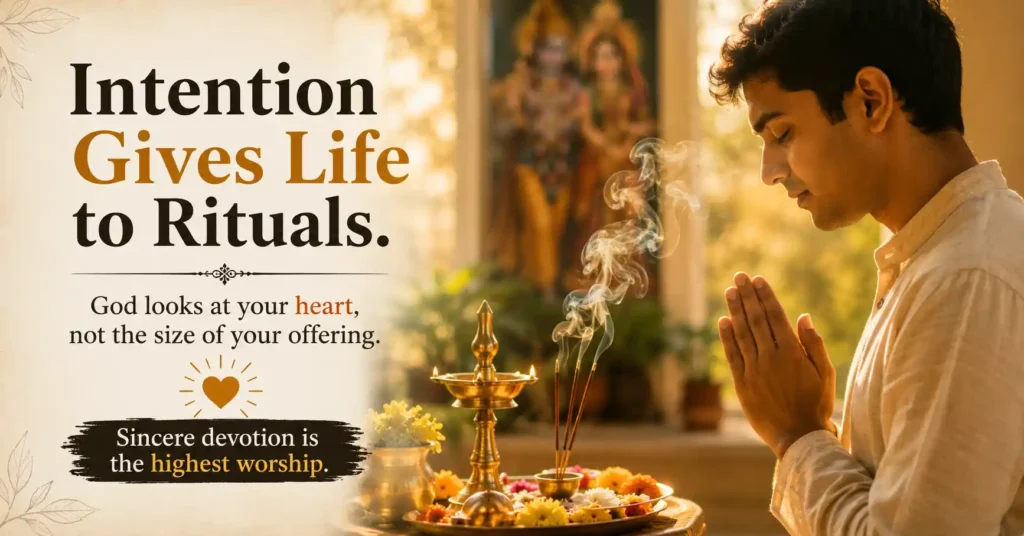
This verse teaches that if a devotee offers even a leaf, a flower, a fruit, or water with devotion, the offering is accepted by the Divine. The emphasis is not on the material value of the offering but on the devotion and sincerity with which it is made.
This teaching beautifully highlights the importance of intention in worship. A simple offering made with faith, gratitude, and love can carry immense spiritual significance because it reflects a genuine connection between the devotee and the Divine.
Another important insight appears in Bhagavad Gita 17.11, where Lord Krishna describes sattvic worship as worship performed according to spiritual principles, with faith, discipline, and without the desire for personal reward. Here again, the inner attitude of the worshipper is presented as an essential part of the spiritual act.
Together, these teachings show that Sanatan Dharma does not measure worship solely by external actions. Rituals certainly have value, but their spiritual power depends greatly on the consciousness behind them. When devotion, faith, and sincerity are present, even a simple act of worship becomes meaningful.
This is why the debate of Intention vs Ritual is not about choosing one over the other. The Bhagavad Gita teaches that rituals become most effective when they are guided by devotion, and devotion finds expression through meaningful spiritual practices.
Shabari's Story: A Lesson in Pure Devotion
One of the most cherished examples of devotion in Sanatan Dharma comes from the story of Shabari, a humble devotee whose faith and patience became a symbol of pure Bhakti.
According to the Ramayana, Shabari spent many years waiting for the arrival of Lord Rama. Guided by her guru’s words, she lived with unwavering faith, believing that one day Rama would visit her humble dwelling.
When Rama finally arrived, Shabari was overwhelmed with joy. Wanting to offer Him the sweetest fruits, she tasted each berry before placing it before Him. According to formal standards of ritual purity, such an offering would normally be considered improper.
Yet Lord Rama accepted the berries with love and gratitude.
Why?
Because He did not see merely the fruit. He saw the devotion behind the offering. He saw Shabari’s faith, love, humility, and selfless intention.
This story beautifully illustrates the deeper meaning behind Intention vs Ritual. From an external perspective, the ritual may not have been performed perfectly. From a spiritual perspective, however, the offering was filled with pure devotion.
For generations, Shabari’s story has reminded devotees that the Divine responds not only to what is offered but also to the sincerity with which it is offered. When the heart is filled with genuine love and remembrance, even the simplest offering can become sacred.
Vidura and Krishna: When Devotion Matters More Than Formality
Another powerful example comes from the relationship between Vidura and Lord Krishna, a story that beautifully highlights the value of sincere devotion.
According to tradition, when Krishna visited Hastinapura, He received invitations from many influential and royal figures. Yet instead of choosing luxury and grandeur, He went to the humble home of Vidura, a devotee known for his wisdom, humility, and unwavering love for the Lord.
Vidura’s hospitality was simple. He could not offer the comforts, wealth, or elaborate arrangements that others could provide. What he offered instead was genuine affection, respect, and devotion.
Krishna gladly accepted his offering because the true value of worship does not lie in outward display alone. It lies in the love and sincerity that accompany it.
This story offers another important perspective on Intention vs Ritual. External forms, ceremonies, and offerings have their place, but they are most meaningful when supported by faith and devotion. Without inner sincerity, even grand acts may remain superficial. With devotion, however, even the simplest offering can become sacred.
For devotees, the story of Vidura serves as a reminder that the Divine is not attracted merely to wealth, status, or perfection. The Divine responds to humility, love, surrender, and a heart that remembers God with sincerity.
Applying Intention and Ritual in Daily Life
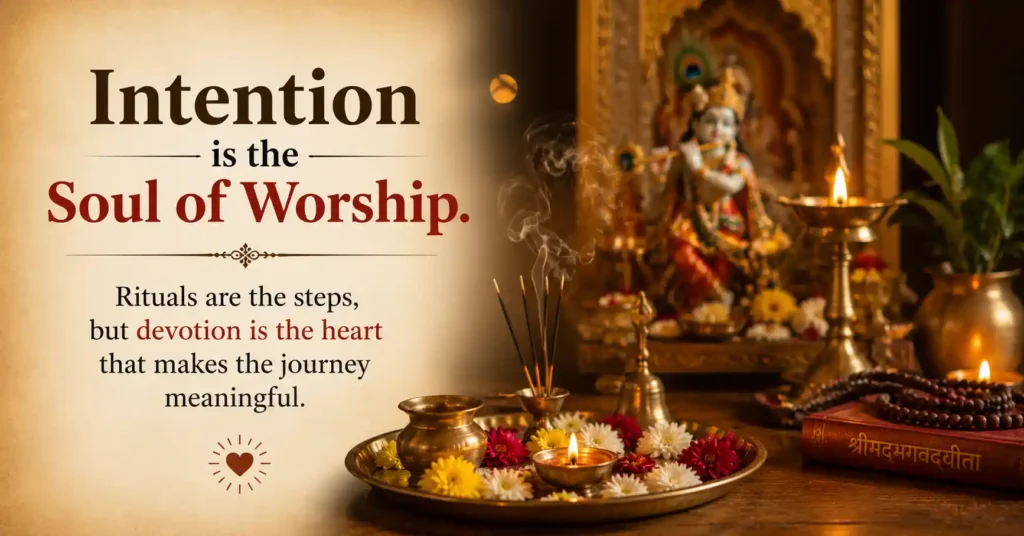
The discussion of Intention vs Ritual becomes most relevant when life does not go according to plan.
Life is not always calm, predictable, or perfectly organized. People travel, fall ill, face personal challenges, manage demanding careers, care for families, and navigate periods of emotional stress. During such times, maintaining every spiritual routine exactly as planned may not always be possible.
However, Sanatan Dharma teaches that devotion is not limited to formal rituals alone. Even when external practices become difficult, inner remembrance can continue.
A mother remembering Krishna while preparing food.
A student silently praying before an examination.
A traveler chanting God’s name inwardly during a journey.
A professional remembering Shiva during a stressful day.
These may appear to be small acts, yet they reflect a living connection with the Divine. They show that devotion can remain present even in the midst of everyday responsibilities.
This understanding helps us appreciate the deeper relationship between devotion and ritual. Rituals provide structure and discipline, while remembrance keeps spirituality alive throughout the day. When circumstances prevent formal worship, sincere remembrance can help preserve that connection until regular practices resume.
This is why Sanatan teachings generally do not encourage fear, guilt, or anxiety over occasional missed rituals. Instead, they encourage continuity of faith, remembrance, and sincere effort. What matters most is not perfection, but maintaining a genuine relationship with the Divine.
When intention remains pur
Does Intention Replace Rituals in Spiritual Life?
A common misunderstanding in discussions about Intention vs Ritual is the belief that if intention is important, rituals must therefore be unnecessary.
Sanatan Dharma does not support this view.
While sincere intention is essential, rituals continue to play a valuable role in spiritual life. They provide structure, discipline, and regular opportunities to connect with the Divine.
Daily prayer creates consistency.
Temple visits strengthen faith and devotion.
Mantra chanting helps calm and focus the mind.
Aarti creates a devotional atmosphere that encourages remembrance and gratitude.
For many people, rituals become the bridge that helps preserve spiritual intention amid the distractions and responsibilities of modern life. They provide a framework that keeps spiritual practice alive even when motivation fluctuates.
This is why the discussion of Intention vs Ritual should not be seen as a competition between the two. Intention gives worship its meaning, while rituals help express and nurture that intention through regular practice.
Without some form of spiritual discipline, even sincere devotion can gradually weaken over time. Similarly, rituals performed without awareness may lose their deeper purpose. Sanatan Dharma therefore encourages a balance where devotion inspires ritual, and ritual strengthens devotion.
The goal is not to choose between intention and ritual. The goal is to allow both to work together in a way that supports spiritual growth and a deeper relationship with the Divine.
What Happens When Ritual and Intention Work Together
The goal of Sanatan Dharma is not ritual without devotion, nor devotion that completely rejects spiritual discipline.
The deepest spiritual growth happens when intention and ritual support one another.
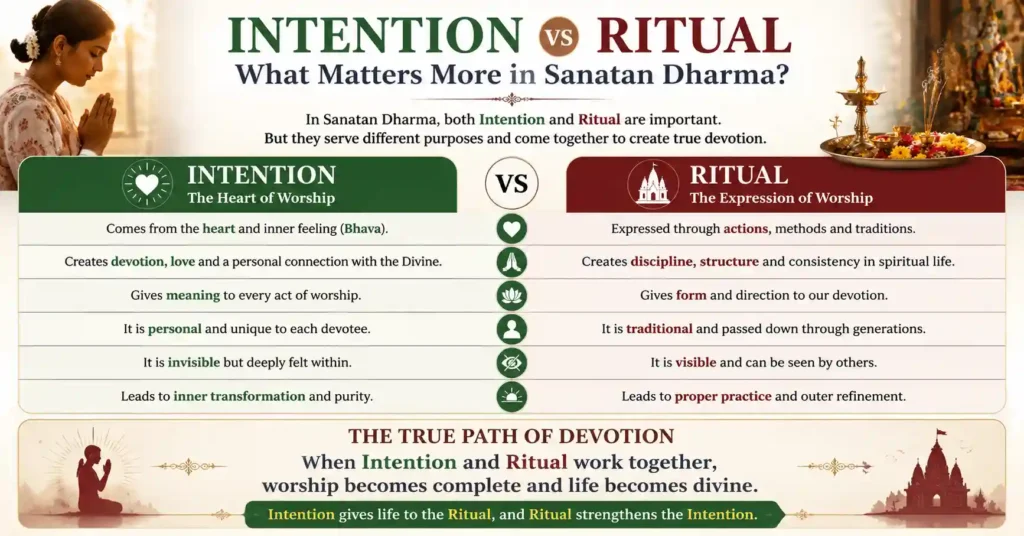
Intention fills worship with sincerity, faith, and love. Rituals provide a structure through which those inner feelings can be expressed consistently. When combined, they help create a balanced spiritual life that is both meaningful and disciplined.
A devotee who has sincere intention but no regular practice may struggle to maintain spiritual focus over time. Likewise, a person who performs rituals mechanically may lose touch with the deeper purpose behind them.
This is why the discussion of Intention vs Ritual should not be viewed as a choice between two opposing paths. Sanatan Dharma teaches that both have an important role to play. Intention gives life to rituals, while rituals help nurture and strengthen devotion.
The relationship can be understood as follows:
[Insert Infographic: Intention vs Ritual in Sanatan Dharma]
Caption: In Sanatan Dharma, intention gives meaning to worship while rituals provide structure. Together they create a balanced and transformative spiritual practice.
When these two work together, spiritual life becomes both grounded and meaningful. Worship moves beyond routine actions and becomes a living expression of faith, remembrance, and devotion.
Common Misunderstandings About Intention and Ritual
Discussions about Intention vs Ritual sometimes create confusion because people assume that one is important only at the expense of the other.
One common misunderstanding is that rituals become unnecessary if intention matters. Sanatan Dharma does not teach this. Rituals remain valuable because they help cultivate remembrance, discipline, devotion, and spiritual awareness. They provide a framework that supports consistent practice and keeps the mind connected to the Divine.
Another misunderstanding is that good intentions alone are enough in every situation. While pure intention is important, spiritual life also requires right action, self-discipline, and alignment with Dharma. Sanatan teachings emphasize that both inner attitude and outward conduct play an important role in personal growth.
Some people also worry that mistakes during worship invalidate their devotion. A forgotten mantra, an imperfect procedure, or an unintentional error may create anxiety for sincere devotees. However, Hindu traditions repeatedly teach that genuine effort, humility, and devotion matter more than flawless performance.
A further misunderstanding is that devotion and ritual belong to different paths. In reality, they are meant to complement one another. Rituals help express devotion, while devotion gives purpose and meaning to rituals.
When properly understood, Intention vs Ritual is not a debate about choosing one over the other. It is about recognizing how both work together to support a balanced and meaningful spiritual life.
What If You Miss a Ritual? Understanding Devotion Beyond Perfection
Many devotees silently struggle with guilt after missing a prayer, ritual, fast, or daily spiritual practice.
They begin asking themselves:
- Did I disappoint God?
- Will something bad happen?
- Have I committed a spiritual mistake?
- Does my devotion still matter?
Much of this anxiety arises from misunderstanding the purpose of rituals. When viewed only as obligations, rituals can create unnecessary fear and pressure. However, Sanatan Dharma teaches responsibility and sincere effort, not constant guilt.
This is another important lesson in understanding Intention vs Ritual. While regular spiritual practices are valuable, a missed ritual does not automatically destroy devotion or break one’s relationship with the Divine.
Life brings circumstances that are sometimes beyond our control. Illness, travel, family responsibilities, emergencies, and emotional struggles can interrupt even the most disciplined routines. What matters most is not occasional imperfection but the sincerity of the heart and the willingness to return to one’s spiritual practice.
The healthier approach is simple:
- Return to practice without guilt.
- Return with sincerity.
- Return with gratitude.
- Return with love.
Sanatan traditions repeatedly describe the Divine as compassionate and understanding. Just as a loving parent understands the limitations of a child, the Divine understands human challenges and imperfections.
Rather than becoming trapped in fear or self-judgment, devotees are encouraged to reconnect with faith and continue their spiritual journey with renewed devotion. Consistency is important, but devotion should inspire growth, not anxiety.
When approached in this spirit, rituals become a source of support and spiritual nourishment rather than a cause of fear.
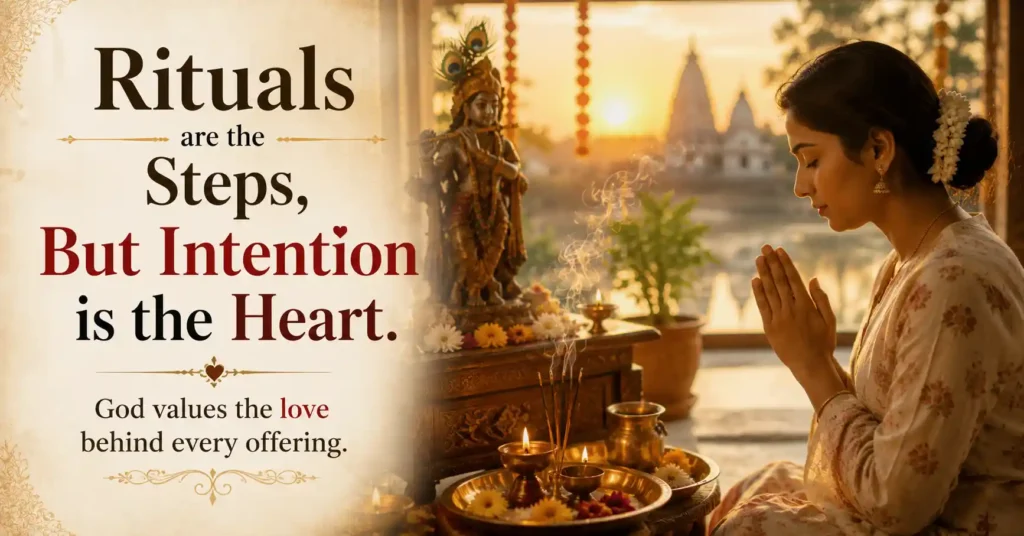
How Different Hindu Traditions View Intention and Ritual
Sanatan Dharma is vast and diverse, encompassing many spiritual paths, philosophies, and methods of worship. As a result, different traditions place varying levels of emphasis on ritual, devotion, knowledge, and inner practice.
However, despite these differences, the discussion of Intention vs Ritual is relevant across all major traditions.
Bhakti Traditions
Bhakti traditions place strong emphasis on love, surrender, remembrance, and devotion toward the Divine. Saints such as Mirabai, Tulsidas, Surdas, Namdev, and Tukaram repeatedly taught that sincere devotion and heartfelt remembrance are central to spiritual life.
In these traditions, Bhava in worship is often considered as important as the ritual itself.
Vedic Traditions
Vedic traditions place greater emphasis on sacred procedures, mantras, offerings, and ritual discipline. Correct performance of rituals is valued because it helps preserve the sanctity and effectiveness of spiritual practices.
At the same time, faith, concentration, and sincerity remain important. Rituals are not intended to be mechanical actions performed without awareness.
Tantra Traditions
Many Tantric traditions involve highly specific rituals, mantras, visualizations, and spiritual disciplines. Accuracy and proper guidance are often considered essential.
Yet even within Tantra, intention, dedication, and inner transformation remain important. Rituals are viewed as tools for awakening higher consciousness rather than ends in themselves.
Vedanta
Vedanta often focuses more deeply on self-inquiry, inner realization, and understanding the true nature of the Self. External rituals may play a smaller role depending on the practitioner and lineage.
However, qualities such as sincerity, faith, humility, and spiritual aspiration continue to be highly valued.
A Common Thread Across Traditions
While different paths may emphasize different methods, one principle remains remarkably consistent: spiritual practices become more meaningful when supported by sincerity and awareness.
This is why Intention vs Ritual should not be seen as a debate with a single winner. Across Bhakti, Vedic, Tantric, and Vedantic traditions, both inner devotion and spiritual discipline are respected. The balance may vary, but sincerity remains valued in every path.
What Bhakti Saints Teach About True Devotion
The teachings of India’s Bhakti saints provide some of the clearest insights into the relationship between Intention vs Ritual.
While these saints came from different regions, languages, and traditions, they consistently emphasized that devotion is ultimately a matter of the heart.
Tulsidas taught devotion through loving remembrance of Lord Rama. His writings encouraged devotees to cultivate faith, humility, and a personal relationship with the Divine rather than becoming attached only to external forms of worship.
Mirabai expressed her devotion through complete surrender to Lord Krishna. Her love for Krishna was so deep that she often ignored social expectations, criticism, and conventional limitations. For her, devotion was a living experience rather than a ritual obligation.
Tukaram reminded devotees that genuine love for God carries greater spiritual power than outward display. His teachings repeatedly emphasized sincerity, humility, and heartfelt remembrance over spiritual pride or showmanship.
Despite their different backgrounds, these saints shared a remarkably similar message. Rituals have value, but their true purpose is to awaken devotion, faith, and remembrance of God.
Their lives demonstrate the importance of intention in worship and show why true devotion in Sanatan Dharma cannot be measured solely by external actions. When the heart is filled with love, surrender, and faith, even simple acts of remembrance become powerful expressions of Bhakti.
For this reason, the teachings of the Bhakti saints continue to inspire seekers today. They remind us that while rituals can guide spiritual practice, it is sincere devotion that ultimately brings a devotee closer to the Divine.
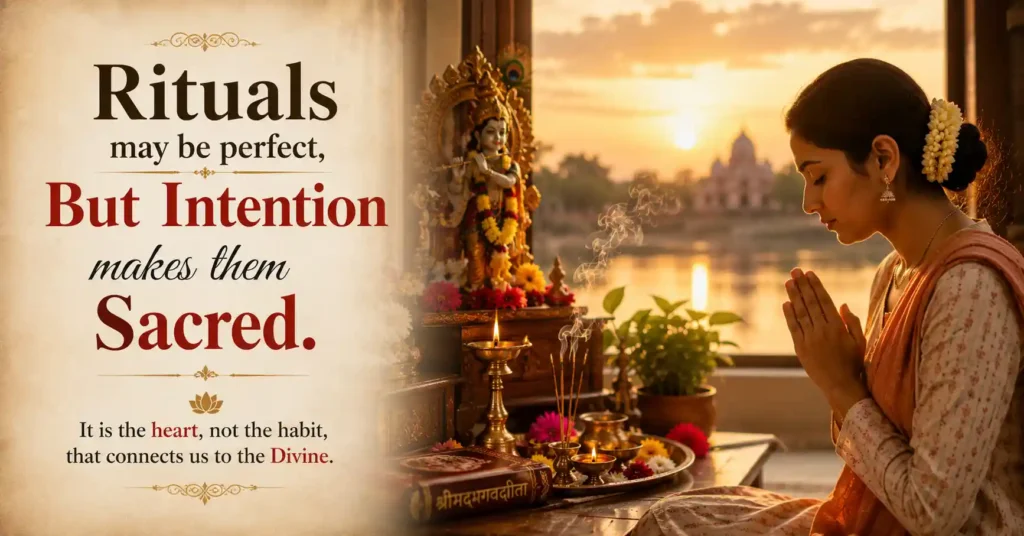
A Modern Example of Intention vs Ritual
The principles behind Intention vs Ritual are not limited to scriptures or ancient stories. They can be seen in everyday life.
Imagine a working mother who wakes up early, prepares meals, cares for her family, manages responsibilities throughout the day, and returns home exhausted.
Some days she may not have time for a complete puja. Yet while cooking, she remembers Krishna. Before serving food, she silently offers gratitude. Before sleeping, she folds her hands and thanks God for the day.
Her worship may not always follow a formal ritual structure, but devotion remains alive. Through remembrance, gratitude, and faith, she continues to nurture her relationship with the Divine.
Now consider another person who performs an elaborate ritual every day but remains distracted throughout the process. The ritual is completed, yet the mind is elsewhere, focused more on finishing the procedure than on connecting with God.
Sanatan wisdom does not encourage us to judge either person. Instead, it invites us to look deeper and understand the purpose of spiritual practice.
This example helps illustrate the deeper meaning of Intention vs Ritual. Rituals are valuable because they create discipline and consistency. At the same time, devotion, gratitude, and remembrance give those rituals their spiritual depth.
The ideal path is not to abandon rituals nor to perform them mechanically. It is to bring sincerity into whatever form of worship we practice.
This is one reason why the question “Is intention more important than ritual in Hinduism?” continues to resonate with modern seekers. In a fast-paced world, many people struggle to maintain perfect routines. Sanatan Dharma reminds them that while spiritual discipline matters, the heart behind the practice matters too.
Why Good Intentions Alone Are Not Enough
This is an important clarification in any discussion about Intention vs Ritual.
Sometimes people hear spiritual teachings about devotion and conclude that good intentions alone are enough. If the heart is pure, they assume that actions no longer matter.
Sanatan Dharma teaches otherwise.
Good intention is essential, but it is not the only requirement for a Dharmic life. Intention guides our actions, but those actions must also be responsible, ethical, and aligned with Dharma.
A person cannot knowingly cause harm, ignore responsibilities, or act carelessly and then justify such behavior by claiming to have good intentions. True spirituality requires both inner sincerity and right conduct.
This principle can be seen throughout Hindu scriptures. Along with faith and devotion, seekers are encouraged to practice self-discipline, compassion, truthfulness, and righteous action. Spiritual growth is not measured only by what we feel, but also by how we live and behave.
This understanding adds an important dimension to the discussion of Intention vs Ritual. Just as rituals become meaningful when supported by sincere devotion, good intentions become meaningful when expressed through right action.
Spiritual maturity therefore requires:
- Pure intention
- Responsible action
- Awareness of Dharma
- Consistent self-improvement
When these qualities work together, spiritual life becomes balanced and authentic. The goal is not merely to think good thoughts or perform rituals mechanically, but to align the heart, mind, and actions with higher values.
How to Bring Devotion Into Everyday Life
One of the most beautiful teachings of Sanatan Dharma is that spiritual growth does not happen only in temples, pilgrimages, or formal rituals. Much of it unfolds quietly through ordinary moments of daily life.
While cooking.
While working.
While traveling.
While caring for loved ones.
While fulfilling one’s responsibilities with gratitude and awareness.
This is where the deeper meaning of Intention vs Ritual becomes visible. Not every moment allows for formal worship, yet every moment offers an opportunity for remembrance.
A short prayer offered with sincerity can carry deep spiritual value.
A daily ritual performed with awareness can strengthen inner peace.
A few moments of gratitude before a meal can become an act of devotion.
Silently remembering God’s name during a difficult day can become a form of worship.
Sanatan Dharma encourages devotees to see spirituality not as something separate from life, but as something woven into life itself. Rituals help create dedicated moments for worship, while intention allows devotion to remain present throughout the day.
The Divine does not measure devotion by complexity, wealth, or outward display. The Divine responds to honesty, humility, faith, surrender, and love.
When intention and ritual support one another, spiritual practice extends beyond the prayer room and begins to influence daily thoughts, actions, and relationships. Over time, every aspect of life can become an expression of devotion and gratitude.
A Simple Spiritual Guideline for Daily Worship
Many seekers wonder how they should apply these teachings in daily life.
A simple guideline is to keep both devotion and discipline together.
If possible, perform your daily prayers, mantra chanting, puja, or other spiritual practices with attention and sincerity. Even a short prayer offered with awareness is often more meaningful than a longer ritual performed mechanically.
When circumstances prevent a complete ritual, do not become discouraged. Remember the Divine with gratitude, chant a mantra mentally, or offer a sincere prayer from the heart.
Over time, try to cultivate both:
- The discipline of regular practice
- The sincerity of genuine devotion
This balanced approach reflects the spirit of Sanatan Dharma. Rituals help maintain connection with the Divine, while intention fills that connection with meaning, faith, and love.
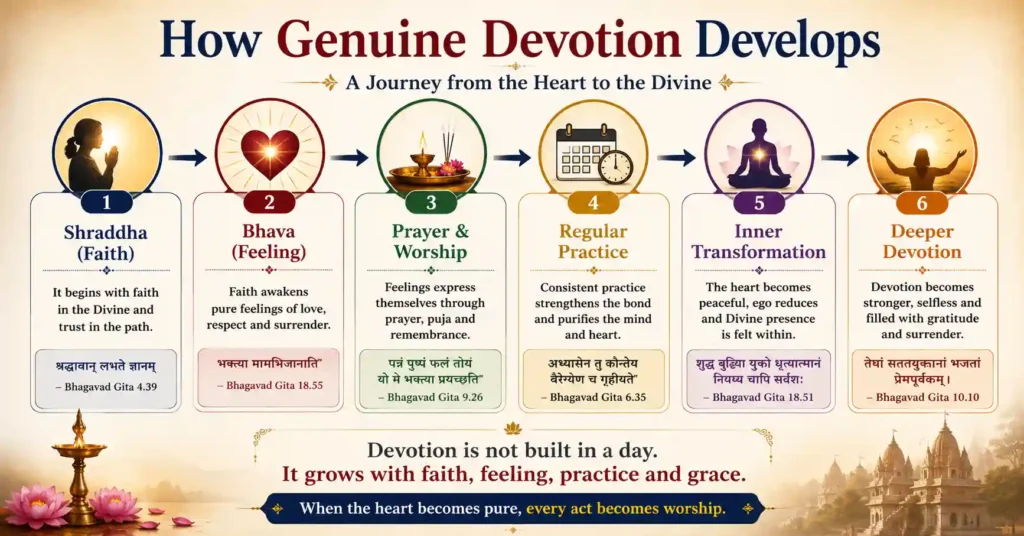
Conclusion
Intention and ritual are not rivals. They are partners on the spiritual path.
Intention brings devotion, faith, and sincerity to worship, while rituals provide a disciplined way to express and nurture those inner qualities.
When rituals are performed without devotion, they can become routine. When devotion lacks regular practice, it can gradually lose strength. This is why Sanatan teachings encourage harmony between the heart and the practice.
The real lesson of Intention vs Ritual is not about choosing one over the other. It is about allowing both to work together in the service of spiritual growth.
Whether through a simple prayer, a daily puja, chanting God’s name, visiting a temple, or remembering the Divine during everyday activities, what matters most is a sincere connection with God.
When intention guides ritual and ritual strengthens devotion, spiritual life becomes deeper, steadier, and more transformative. That balance is the essence of true devotion in Sanatan Dharma.
Key Takeaways
- Intention vs Ritual is not a choice between two opposing paths. Sanatan Dharma teaches that both intention and ritual have an important role in spiritual life.
- Intention gives meaning to worship. Faith, sincerity, devotion, gratitude, and surrender transform ordinary actions into meaningful spiritual practices.
- Rituals provide structure and discipline. Practices such as puja, aarti, mantra chanting, and temple visits help maintain regular remembrance of the Divine.
- Bhava is at the heart of devotion. A ritual performed with genuine love and faith carries greater spiritual value than one performed mechanically.
- The Bhagavad Gita emphasizes devotion over material offerings. Lord Krishna teaches that even the simplest offering is accepted when made with sincere devotion.
- Stories of Shabari and Vidura highlight the power of sincere devotion. Their examples show that God responds to the purity of the heart rather than outward grandeur alone.
- Missing a ritual does not automatically weaken devotion. Sanatan Dharma encourages devotees to return to practice with sincerity rather than becoming trapped in guilt or fear.
- Good intentions alone are not enough. True spiritual growth requires intention, right action, self-discipline, and living according to Dharma.
- Bhakti saints consistently taught that devotion is the soul of worship. Rituals are valuable, but their highest purpose is to deepen one’s relationship with the Divine.
- The ideal spiritual path combines both intention and ritual. Intention inspires worship, while rituals help nurture and strengthen devotion over time.
Suggested Reading
If this reflection on is intention more important than ritual touched your heart, you may enjoy exploring these related articles on thesanatantales.com:
What Is Bhakti and Why It Is Powerful
https://thesanatantales.com/what-is-bhakti/
What Is Maya in Hindu Philosophy
https://thesanatantales.com/what-is-maya-in-hindu-philosophy/
Living in the Present Moment: A Spiritual Practice for Inner Peace
https://thesanatantales.com/living-in-the-present-moment/
Why Spiritual Growth Sometimes Feels Lonely
https://thesanatantales.com/why-spiritual-growth-sometimes-feels-lonely/
Why Bad Things Happen to Good People: A Spiritual View from Sanatan Dharma
https://thesanatantales.com/why-bad-things-happen-to-good-people/
Simple Acts of Devotion That Build Inner Discipline and Faith
https://thesanatantales.com/simple-acts-of-devotion/
Meditation in Daily Life: A Simple Path to Inner Peace and Clarity
https://thesanatantales.com/meditation-in-daily-life/
How to Balance Ambition and Peace in Daily Life
https://thesanatantales.com/balance-between-ambition-and-peace/
Kundalini Shakti: Signs of Awakening and Spiritual Meaning
https://thesanatantales.com/kundalini-shakti-signs-awakening/
Intention (Wikipedia)
https://en.wikipedia.org/wiki/Intention
FAQs
Is Intention vs Ritual really a choice in Sanatan Dharma?
Sanatan Dharma generally does not present Intention vs Ritual as a competition where one must be chosen over the other.
Intention represents the inner devotion, sincerity, faith, and spiritual awareness of a devotee. Rituals provide the structure through which these inner qualities can be expressed consistently. When separated, both can lose some of their effectiveness. Intention without practice may gradually weaken, while rituals without devotion can become mechanical.
This is why Hindu scriptures, Bhakti traditions, and the teachings of saints often encourage a balanced approach. The ideal path is not choosing intention over ritual or ritual over intention. The ideal path is allowing sincere devotion and meaningful spiritual practice to support each other.
Why is Intention vs Ritual an important spiritual question?
The question of Intention vs Ritual is important because many devotees worry about whether God values perfect ritual performance or sincere devotion.
Modern life often makes it difficult to perform every spiritual practice exactly as prescribed. People may miss a puja, forget a mantra, or lack time for elaborate worship. This naturally leads to questions about what truly matters in spiritual life.
Sanatan Dharma teaches that rituals are valuable tools for remembrance and discipline, but their highest purpose is to awaken devotion, faith, humility, and awareness of the Divine. Understanding this balance helps devotees practice spirituality with sincerity rather than fear or guilt.
What does the Bhagavad Gita teach about Intention vs Ritual?
The Bhagavad Gita teaches that devotion and sincerity are essential parts of worship. In Bhagavad Gita 9.26, Lord Krishna explains that even a simple offering such as a leaf, flower, fruit, or water is accepted when offered with devotion.
This teaching highlights that the spiritual value of an offering depends not only on the object being offered but also on the devotion behind it. The Gita also praises worship performed with faith, discipline, and purity of intention.
Rather than rejecting rituals, the Bhagavad Gita teaches that rituals become spiritually meaningful when guided by sincere devotion and awareness.
Can intention be more powerful than ritual?
In many situations, sincere intention can have greater spiritual value than a ritual performed mechanically.
A devotee who offers a simple prayer with genuine faith, gratitude, and love may develop a deeper connection with the Divine than someone who performs an elaborate ritual while remaining distracted or indifferent.
Stories such as Shabari’s offering to Lord Rama and Vidura’s devotion to Lord Krishna are often cited as examples of how the Divine responds to sincerity and devotion rather than outward display alone. However, Sanatan Dharma does not suggest abandoning rituals. Instead, it teaches that intention and ritual should complement each other.
Can I worship God without performing rituals?
Yes. Sanatan Dharma recognizes many forms of worship beyond formal rituals.
Remembering God’s name, chanting mentally, offering gratitude, reading scriptures, practicing meditation, serving others selflessly, and maintaining devotion in daily life are all considered meaningful spiritual practices.
A person who sincerely remembers the Divine while working, traveling, studying, or caring for family members can continue nurturing a spiritual connection even when formal rituals are not possible. Nevertheless, regular rituals can help strengthen consistency and discipline in spiritual life.
Does God punish devotees for missing rituals?
Sanatan Dharma generally does not teach that God becomes angry or punishes devotees for unintentionally missing a ritual.
Life circumstances such as illness, travel, emergencies, work obligations, or family responsibilities can sometimes interrupt spiritual routines. In such situations, sincere devotion, faith, and the desire to reconnect with spiritual practice remain important.
Rather than encouraging fear, guilt, or anxiety, Sanatan teachings emphasize returning to worship with sincerity and gratitude. The focus is on maintaining a genuine relationship with the Divine rather than achieving perfection in every ritual.
Why do rituals exist if intention is more important?
Rituals exist because they help create discipline, focus, and regular remembrance of the Divine.
Practices such as puja, aarti, mantra chanting, temple visits, and vrats help bring sacred awareness into daily life. They provide a structure that supports spiritual growth and encourages consistency.
Without rituals, many people may find it difficult to maintain regular spiritual practice. Rituals therefore act as tools that help express and strengthen the devotion already present in the heart.
What is Bhava and how does it relate to Intention vs Ritual?
Bhava refers to the devotional feeling, emotional sincerity, and inner attitude with which a person approaches God.
It includes qualities such as love, faith, humility, gratitude, surrender, and reverence. In many Bhakti traditions, Bhava is considered one of the most important elements of worship because it reflects the devotee’s genuine connection with the Divine.
The discussion of Intention vs Ritual is closely connected to Bhava because rituals become spiritually powerful when supported by sincere devotional feeling. Without Bhava, worship can become mechanical. With Bhava, even simple acts of remembrance can become sacred.
Can rituals become mechanical without devotion?
Yes. Rituals can gradually become mechanical when they are performed only as habits or obligations without attention, understanding, or devotion.
A person may complete every step of a ritual correctly while remaining mentally distracted throughout the process. In such cases, the outer form of worship remains intact, but its deeper spiritual purpose may be weakened.
This is why saints and spiritual teachers repeatedly emphasize mindfulness, faith, and sincerity during worship. The goal is not merely to complete a ritual but to use it as a means of connecting with the Divine.
Can intention replace rituals completely?
For most devotees, Sanatan Dharma does not recommend replacing rituals completely with intention alone.
While intention is the heart of worship, rituals provide a practical way to express and strengthen devotion. They help create discipline, consistency, and opportunities for regular spiritual remembrance.
Some advanced spiritual paths may place greater emphasis on meditation, self-inquiry, or constant remembrance. However, for most people, a combination of devotion and spiritual practice provides a more balanced and sustainable approach to growth
Why do Bhakti saints emphasize devotion more than rituals?
Many Bhakti saints such as Mirabai, Tulsidas, Tukaram, Surdas, and Namdev emphasized devotion because they wanted seekers to develop a genuine relationship with God rather than becoming attached only to external forms of worship.
Their teachings do not reject rituals. Instead, they remind devotees that rituals achieve their highest purpose when performed with faith, humility, surrender, and love. These saints taught that devotion is the soul of worship, while rituals are one of the ways that devotion can be expressed.
Their lives continue to demonstrate that spiritual growth depends not only on what we do but also on the spirit in which we do it.
How can I balance Intention vs Ritual in daily life?
A practical approach is to maintain simple spiritual practices while focusing on sincerity and awareness.
You can perform a daily prayer, light a diya, chant a mantra, read a few verses from a scripture, or spend a few minutes in silent remembrance. The important thing is to remain mentally present and spiritually engaged rather than rushing through the practice.
At the same time, devotion should not be limited to formal worship. Gratitude, kindness, selfless service, and remembrance of God throughout the day can help extend spirituality into everyday life.
When intention inspires ritual and ritual strengthens devotion, spiritual life becomes balanced, meaningful, and transformative.
Glossary of Important Terms
| Term | Meaning |
|---|---|
| Intention (Bhava) | The inner feeling, sincerity, and devotion behind a spiritual action or act of worship. |
| Ritual (Karma Kanda) | Prescribed spiritual practices such as puja, aarti, mantra chanting, offerings, and other forms of worship. |
| Bhava | The emotional and devotional attitude with which a devotee approaches the Divine. |
| Shraddha | Faith, trust, and sincere belief in spiritual teachings and the Divine. |
| Sankalpa | A conscious spiritual resolve or intention made before beginning a religious or spiritual practice. |
| Samarpan | Complete surrender of the ego and acceptance of the Divine will. |
| Bhakti | The path of devotion that emphasizes love, remembrance, and surrender to God. |
| Puja | A ritual act of worship that may include prayers, offerings, mantras, and devotional practices. |
| Aarti | A devotional ritual in which a lamp is offered before a deity while prayers or hymns are sung. |
| Mantra | A sacred sound, word, or phrase repeated during prayer, meditation, or worship. |
| Dharma | Righteous conduct, moral responsibility, duty, and living in harmony with spiritual principles. |
| Sattvic Worship | Worship performed with purity, faith, discipline, and without selfish expectations or desires. |
| Remembrance (Smarana) | The practice of remembering and contemplating the Divine throughout daily life. |
| Devotion | Love, faith, reverence, and dedication toward God expressed through thoughts, actions, and worship. |
| Vedanta | A philosophical tradition of Sanatan Dharma that focuses on self-realization and understanding the true nature of the Self. |
| Bhakti Tradition | Spiritual traditions that emphasize loving devotion and a personal relationship with the Divine. |
About the Author
Yateendra Chaturvedi is a spiritual writer, researcher, devotee, and the founder of The Sanatan Tales. With over 35 years of professional experience and a lifelong interest in Sanatan Dharma, he writes about Hindu deities, temples, scriptures, festivals, Mahavidyas, sacred stories, rituals, and living traditions that continue to guide and inspire devotees across India.
Drawing from traditional scriptures, regional beliefs, temple traditions, devotional literature, and historical sources, he aims to present authentic, well-researched, and easy-to-understand content for modern readers. His work focuses on preserving spiritual wisdom, explaining sacred traditions, and helping seekers develop a deeper understanding of India’s rich spiritual heritage.
Through The Sanatan Tales, Yateendra strives to make the timeless teachings of Sanatan Dharma simple, meaningful, and relevant for today’s generation while maintaining respect for traditional sources, regional practices, and diverse spiritual perspectives.
Learn More About Yateendra Chaturvedi →
https://thesanatantales.com/about-the-author/
References & Sources
This article is based on teachings and perspectives found within Sanatan Dharma, including insights drawn from the Bhagavad Gita, Ramayana, Bhakti traditions, Hindu spiritual literature, and widely accepted philosophical teachings related to devotion, worship, and spiritual practice. It also reflects traditional understanding preserved through saints, spiritual teachers, family traditions, and the guru-disciple lineage that has helped transmit Sanatan wisdom across generations.
Note: Views on devotion, intention, rituals, and spiritual practice may vary across different traditions, sampradayas, regions, and individual paths within Sanatan Dharma. The purpose of this article is not to present a single interpretation as the absolute truth, but to explain commonly accepted spiritual perspectives in a simple, balanced, and reader-friendly manner. Sanatan Dharma embraces diverse paths of worship, devotion, knowledge, meditation, and self-transformation, each offering its own approach to spiritual growth and connection with the Divine.
Explore More Fascinating Topics from Sanatan Dharma