Modern life rarely slows down. From work responsibilities and family commitments to endless notifications and digital distractions, the mind is constantly occupied. Even during moments of rest, thoughts often continue to race from one concern to another.
This is why daily meditation has become more important than ever. More than a relaxation technique, it is a simple practice that helps bring calmness, clarity, and balance into everyday life. Just a few quiet minutes each day can reduce mental clutter, improve focus, and create a deeper sense of inner peace.
In Sanatan Dharma, daily meditation is known as Dhyana, a sacred practice that helps us turn inward and become more aware of our thoughts, emotions, and true nature. For centuries, sages and seekers have used meditation not to escape life, but to understand it more deeply and live with greater awareness.
In this article, you will learn the meaning of daily meditation, its spiritual significance in Sanatan Dharma, its benefits for the mind and emotions, common challenges beginners face, and practical ways to build a consistent practice. You will also discover how meditation supports self-awareness, mental clarity, emotional balance, and spiritual growth in everyday life.
Whether you are a beginner or someone looking to strengthen your meditation practice, this guide will help you take simple steps toward a calmer mind and a more peaceful life.
Daily Meditation at a Glance
| Aspect | Details |
|---|---|
| Meaning | A regular practice of cultivating awareness, calmness, and inner balance through meditation each day. |
| Sanskrit Term | Dhyana |
| Purpose | To develop mental clarity, self-awareness, inner peace, and spiritual growth. |
| Tradition | Sanatan Dharma, Yoga, Vedanta, and other spiritual traditions. |
| Best Time | Brahma Muhurta (before sunrise) or any quiet time that can be followed consistently. |
| Ideal Duration for Beginners | 5-10 minutes daily. |
| Common Methods | Breath awareness, silent meditation, mantra meditation, and mindfulness. |
| Main Benefits | Improved focus, emotional balance, mental clarity, reduced stress, and inner peace. |
| Suitable For | Beginners, householders, students, professionals, retirees, and spiritual seekers. |
| Required Equipment | None. A quiet and comfortable place is sufficient. |
| Key Principle | Consistency is more important than duration. |
| Common Challenge | A restless or wandering mind during the early stages of practice. |
| Beginner Tip | Do not try to stop thoughts. Simply observe them and gently return your attention to the breath or mantra. |
| Spiritual Significance | Helps deepen self-understanding and supports the journey toward self-realization. |
| Related Practices | Mantra Japa, Pranayama, Yoga, Mindfulness, and Prayer. |
| Long-Term Impact | Greater awareness, patience, emotional stability, and a more peaceful way of living. |
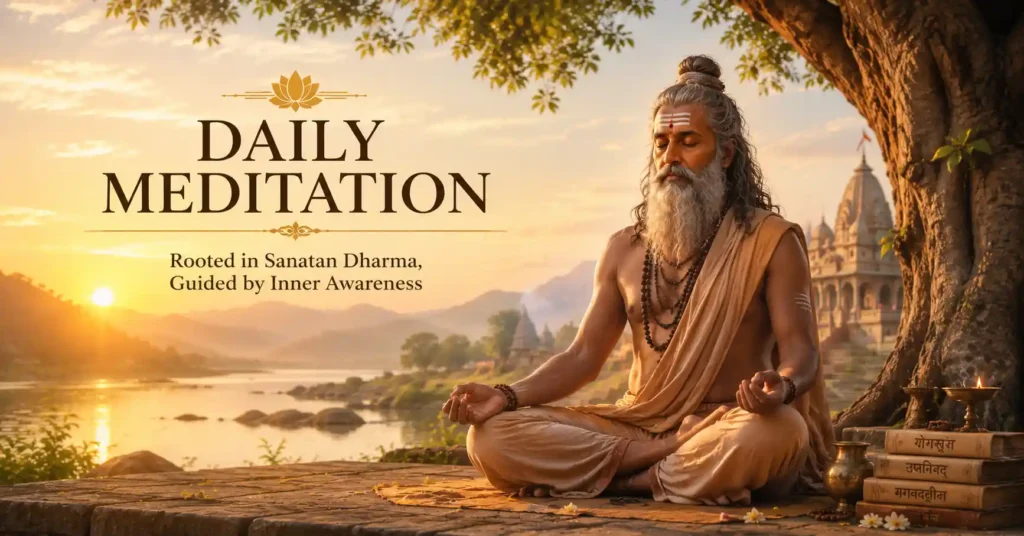
Table of Contents
ToggleWhat Is Daily Meditation in Sanatan Dharma?
In the language of yoga, meditation is called Dhyana. It is one of the most important practices in Sanatan Dharma for developing inner awareness, mental clarity, and spiritual growth.
Ancient sages described Dhyana as a natural state in which the mind becomes steady and awareness remains focused. Rather than chasing thoughts or emotions, a person learns to observe them with calmness and balance.
A common misconception is that meditation means stopping all thoughts. In reality, the mind naturally produces thoughts, just as the heart naturally beats. The purpose of daily meditation is not to suppress thoughts but to become less controlled by them.
With regular practice, a person gradually learns to observe thoughts, emotions, and reactions without becoming completely absorbed in them. This growing awareness helps create a calmer mind and greater emotional balance.
The Bhagavad Gita also highlights the importance of inner steadiness. In Chapter 6, Lord Krishna explains that a disciplined mind becomes calm like a lamp that does not flicker in a windless place. This state of stability is one of the goals of meditation.
For thousands of years, yogis, rishis, and spiritual seekers have practiced daily meditation not merely for relaxation, but to understand the deeper nature of consciousness and the true Self.
As meditation becomes a regular part of life, attention slowly shifts from outer distractions to inner awareness. Over time, this simple practice can bring greater peace, self-awareness, concentration, and a deeper connection with one’s spiritual journey.

Daily Meditation in Ancient Scriptures
Daily meditation is deeply rooted in the spiritual traditions of Sanatan Dharma. For thousands of years, sages and seekers have practiced Dhyana as a path to inner peace, self-awareness, and spiritual growth.
Sacred texts such as the Bhagavad Gita, the Upanishads, and Patanjali’s Yoga Sutras describe meditation as an important discipline for understanding the mind and realizing one’s true nature.
In the Bhagavad Gita, Lord Krishna teaches that a steady and disciplined mind helps a person remain calm amid life’s challenges. Meditation is presented as a means of developing inner balance and spiritual wisdom.
The Upanishads encourage seekers to turn their attention inward and discover the deeper reality that exists beyond thoughts, emotions, and sensory experiences. This inward journey remains one of the central purposes of meditation.
Patanjali’s Yoga Sutras describe Dhyana as an essential stage of the yogic path. Through regular practice, awareness becomes more focused, distractions begin to fade, and the mind gradually becomes calm and concentrated.
Although different traditions within Sanatan Dharma use different methods, they all emphasize discipline, mindfulness, self-observation, and the gradual cultivation of inner stillness. This shared wisdom continues to make daily meditation a valuable practice for modern life.
Why the Mind Feels Restless in Modern Life
The human mind has always been active, but modern life has made it far more restless. Today, we are surrounded by a constant flow of information that competes for our attention every moment of the day.
Social media updates, mobile notifications, work pressures, news feeds, and endless comparisons keep the mind continuously engaged. Even when the body is resting, the mind often remains busy.
As a result, true silence has become rare. Thoughts frequently move between past memories, present concerns, future plans, and unfulfilled expectations without pause.
Over time, this mental overload can lead to stress, emotional exhaustion, reduced concentration, and a feeling of inner fatigue. Many people feel mentally tired even when they are physically rested.
This is one reason why daily meditation has become increasingly valuable in today’s world. It provides an opportunity to step away from constant distractions and reconnect with a calmer state of awareness.
Through regular practice, the mind gradually learns to slow down and become less reactive. Instead of being pulled in many directions at once, attention becomes more focused and balanced.
The benefits of daily meditation are not limited to the meditation session itself. Over time, it can help develop mental clarity, emotional balance, and a deeper sense of inner peace throughout the day.
How Daily Meditation Calms the Mind
Daily meditation works gently and gradually. Unlike many quick-fix solutions, its effects develop through consistent practice and patient effort over time.
In the beginning, when a person sits quietly, the mind may actually seem more restless than before. Thoughts about work, family, responsibilities, memories, and future plans often become more noticeable.
This is completely normal. Meditation does not create a busy mind. It simply helps us become aware of the mental activity that was already present.
As the practice continues, something subtle begins to change. Instead of reacting to every thought, emotion, or distraction, the mind gradually learns to observe them with greater awareness.
With regular daily meditation, awareness slowly becomes stronger than distraction. A person begins to notice thoughts without immediately following them.
Thoughts still come and go, but they gradually lose their power to disturb the inner state. The mind becomes less reactive and more balanced in everyday situations.
Over time, this practice can improve concentration, emotional balance, and self-awareness. Situations that once created stress or frustration may feel easier to handle with patience and clarity.
One of the most valuable benefits of daily meditation is that it helps create a calm mind without forcing anything to happen. The change is often gradual, but it can transform the way a person experiences daily life.
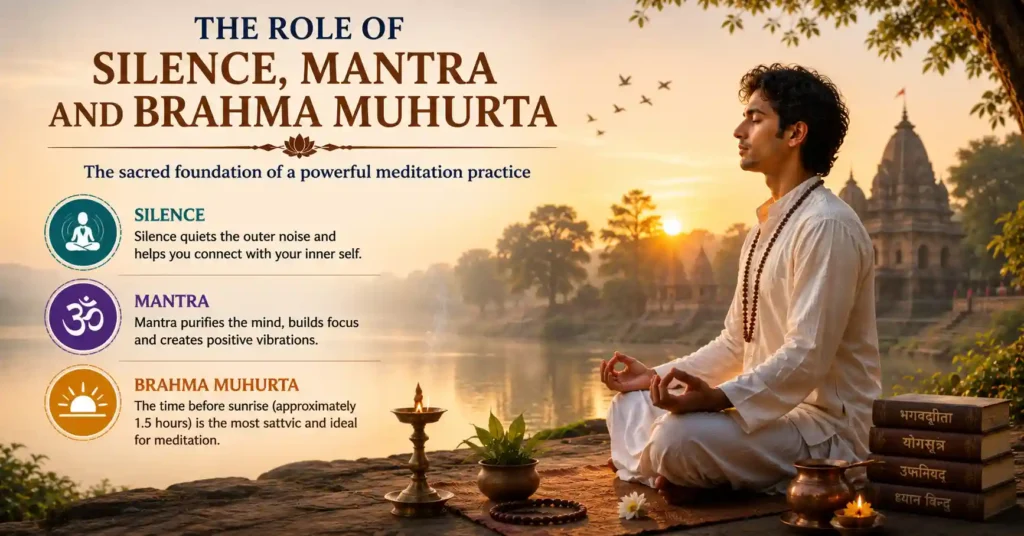
The Role of Silence, Mantra and Brahma Muhurta in Daily Meditation
While daily meditation can be practiced at any time, certain conditions can help the mind settle more naturally and make the practice more effective.
One of the most powerful supports is silence. When external noise and distractions reduce, the mind often becomes calmer and more focused. Even a few minutes of quiet time can help create a deeper sense of inner stillness.
Another widely practiced method in Sanatan Dharma is mantra meditation. Repeating a sacred mantra or divine name gives the mind a gentle point of focus and helps reduce mental wandering.
Many practitioners combine meditation with mantra japa, allowing awareness to become steadier while strengthening their spiritual connection and devotion.
The timing of practice can also make a difference. Many seekers prefer Brahma Muhurta, the sacred period before sunrise that is traditionally considered ideal for prayer, meditation, and spiritual practices.
During Brahma Muhurta, the surroundings are usually quiet, the mind feels fresh, and there are fewer distractions. This peaceful atmosphere can make concentration and self-awareness easier to develop.
However, these are not strict rules. The most important factor is consistency. A person who practices daily meditation regularly at a convenient time will often benefit more than someone waiting for perfect conditions.
Whether practiced in silence, with a mantra, or during Brahma Muhurta, meditation gradually helps cultivate mental clarity, emotional balance, and inner peace.
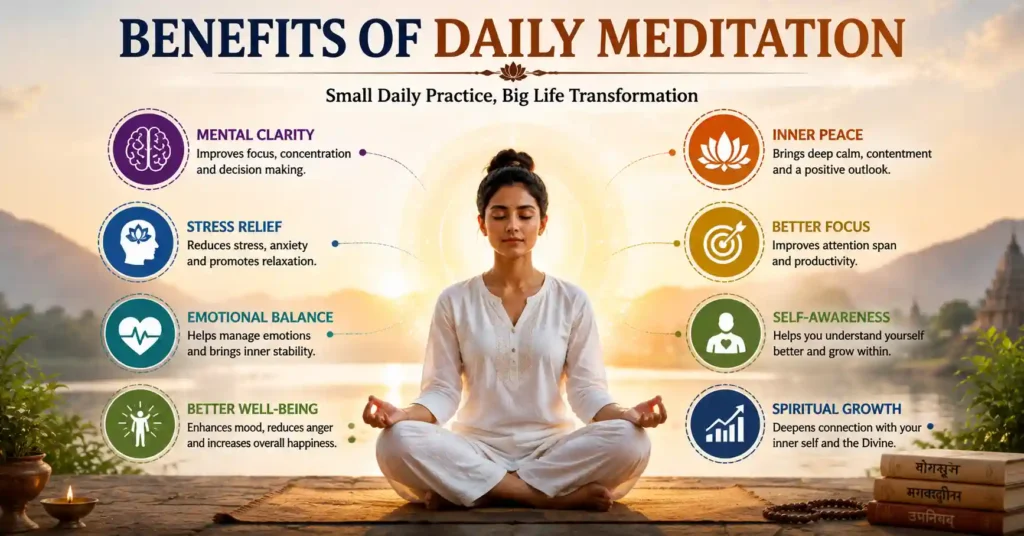
Benefits of Daily Meditation
The benefits of daily meditation often develop gradually through regular and consistent practice. While the changes may be subtle at first, they can have a meaningful impact on both mental well-being and spiritual growth.
With time, meditation may help a person:
- Improve focus and concentration
- Respond more calmly to stress and challenges
- Develop greater emotional balance
- Experience deeper inner peace
- Increase self-awareness and mindfulness
- Reduce mental clutter and distractions
- Make clearer and more thoughtful decisions
- Cultivate patience and a calmer outlook on life
Many people also notice that they become less reactive and more present in their daily interactions. Situations that once caused frustration or anxiety may feel easier to handle with awareness and balance.
One of the most valuable benefits of daily meditation is that it creates lasting inner change through small, consistent efforts. The results usually appear gradually rather than overnight, making patience and regular practice essential.
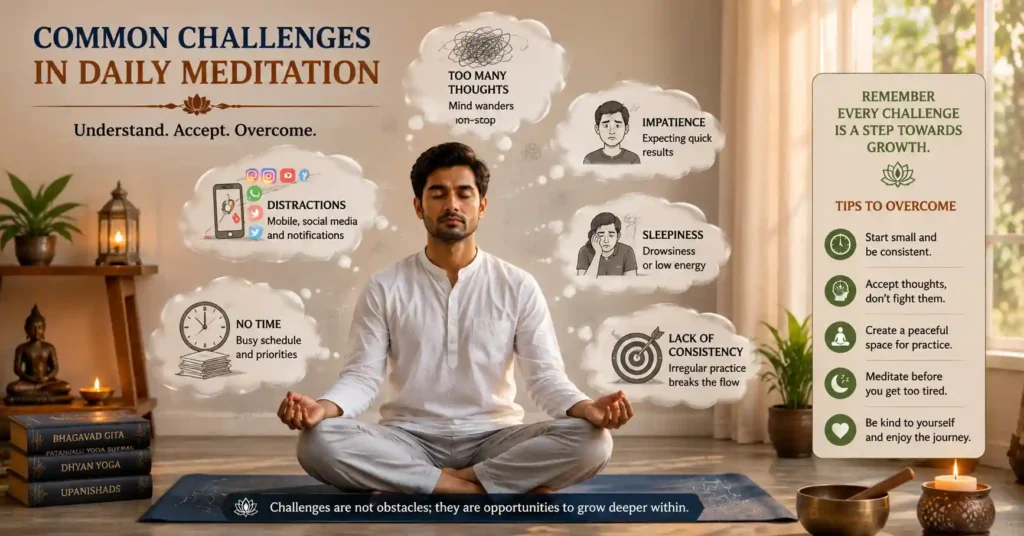
Why Daily Meditation Feels Difficult in the Beginning
Many people find daily meditation challenging when they first begin. This is completely normal and is part of the learning process.
A common expectation is that the mind should become quiet immediately. When thoughts continue to appear, beginners often feel frustrated or assume they are doing something wrong.
In reality, meditation does not create a restless mind. It simply helps us become aware of how active the mind has always been.
During practice, it is natural for various thoughts and emotions to arise, such as:
- Memories from the past
- Plans for the future
- Daily worries and responsibilities
- Random thoughts and distractions
- Unfinished conversations or emotions
There is no need to fight, suppress, or judge these thoughts. The goal is not to stop thinking but to observe thoughts without becoming carried away by them.
With patience and regular daily meditation, the mind gradually learns to settle. What once felt uncomfortable or difficult slowly becomes more natural and familiar.
Over time, meditation becomes less about effort and more about awareness. Instead of constantly reacting to every thought, a person learns to remain present, calm, and balanced.
This is one of the reasons meditation for beginners requires consistency rather than perfection. Even short sessions practiced regularly can help develop concentration, mindfulness, and inner peace over time.
How Small Daily Practice Creates Lasting Change
One common misunderstanding is that daily meditation requires long hours of practice. In reality, even a few quiet minutes each day can begin to create meaningful changes.
The benefits often appear gradually. In the beginning, the changes may be so subtle that they are easy to overlook.
A person may notice they become less reactive to stressful situations. Challenges that once felt overwhelming may seem easier to handle with patience and awareness.
Conversations often become calmer. Decisions become more thoughtful. Emotional ups and downs may feel less intense as inner balance develops over time.
This gradual transformation is one of the unique strengths of daily meditation. Rather than producing instant results, it quietly helps reshape habits of thinking, reacting, and responding.
Meditation works much like a river slowly shaping the landscape. The change is gentle, but with consistency, it can lead to greater mental clarity, emotional balance, self-awareness, and inner peace.
Over time, these small daily efforts can become the foundation for a calmer mind and a more balanced way of living.
Common Misconceptions About Daily Meditation
Many people hesitate to begin daily meditation because of certain misconceptions. These beliefs can make meditation seem more difficult or complicated than it actually is.
The reality is that meditation is a simple practice of developing awareness, and there is no need to be perfect to benefit from it.
| Common Misconception | Reality |
|---|---|
| Meditation means stopping all thoughts. | Meditation teaches awareness of thoughts rather than forcing them to disappear. |
| You must meditate for hours to see results. | Even 5 to 10 minutes of daily meditation can be beneficial when practiced consistently. |
| A restless mind means you are failing. | Restlessness is a normal part of the learning process, especially for beginners. |
| Meditation is only for spiritual people or monks. | People from all walks of life can practice meditation and experience its benefits. |
| You need a perfectly quiet environment. | While silence helps, meditation can be practiced in many everyday settings. |
| Meditation produces instant results. | The benefits usually develop gradually through patience and regular practice. |
Understanding these misconceptions can make it easier to approach daily meditation with realistic expectations. The goal is not perfection but consistent practice, greater awareness, and gradual inner growth.
Daily Meditation Is Not About Perfection
Many people avoid daily meditation because they believe they must completely stop their thoughts or achieve a perfectly calm mind. This misconception often discourages beginners before they even begin.
In reality, meditation is not about perfection. It is about developing awareness and learning to observe what is happening within without judgment.
Thoughts will arise. Emotions may appear. Some sessions may feel peaceful, while others may seem restless. These experiences are a natural part of the practice.
Even a meditation session filled with distractions can be valuable. Each time you notice the mind wandering and gently bring your attention back, you strengthen awareness and concentration.
Over time, daily meditation teaches patience, self-observation, and acceptance. Progress is not measured by having fewer thoughts, but by becoming less controlled by them.
When this understanding develops, meditation becomes a more relaxed and meaningful practice. Instead of striving for perfection, the focus shifts toward presence, mindfulness, and inner growth.
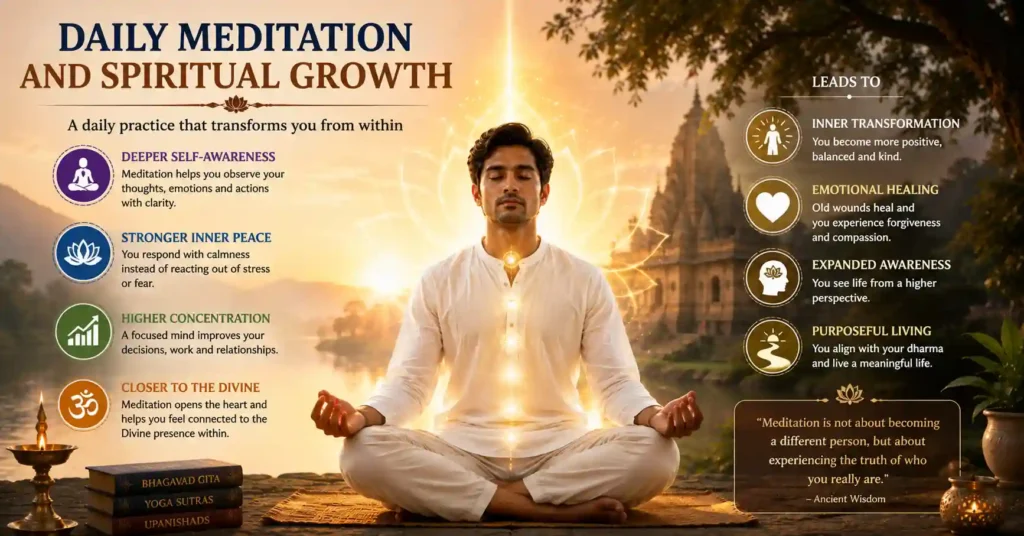
Daily Meditation and Spiritual Growth in Sanatan Dharma
Daily meditation has been an important part of Sanatan Dharma for thousands of years. Long before modern discussions about stress management and mental well-being, rishis and seekers practiced Dhyana to understand the deeper nature of life and consciousness.
Through meditation, they carefully observed the workings of the mind and explored levels of awareness that often remain hidden beneath everyday thoughts, emotions, and distractions.
Their insights became the foundation of many sacred teachings, including the Upanishads, the Bhagavad Gita, and Patanjali’s Yoga Sutras. These texts describe meditation not merely as a practice, but as a path toward self-knowledge and inner transformation.
In Sanatan Dharma, the goal of meditation extends beyond relaxation. It helps cultivate self-awareness, mental clarity, and a deeper understanding of one’s true nature.
With regular daily meditation, a person gradually develops greater inner stillness and a stronger connection with the Self. This journey of inner discovery supports both personal growth and spiritual growth.
These ancient teachings remind us that meditation is not an escape from life. Rather, it is a gentle way of understanding ourselves more deeply and living with greater wisdom, balance, and inner peace.
Meditation in the Bhagavad Gita and Yoga Sutras
Meditation is not a modern wellness trend. It has been an important spiritual practice in Sanatan Dharma for thousands of years and is described in several sacred texts.
One of the most well-known teachings on meditation appears in Chapter 6 of the Bhagavad Gita, known as Dhyana Yoga or the Yoga of Meditation. In this chapter, Lord Krishna explains how a disciplined mind can become steady through regular practice and detachment. He teaches that meditation helps a person develop inner balance and remain calm amidst the ups and downs of life.
The Bhagavad Gita compares the mind of a meditator to a lamp flame that remains steady in a windless place. This beautiful image highlights the state of focus and inner stillness that meditation gradually cultivates.
Meditation also holds a central place in Patanjali’s Yoga Sutras, one of the foundational texts of classical Yoga. Patanjali describes the Eight Limbs of Yoga (Ashtanga Yoga), which guide a seeker toward self-mastery and spiritual growth.
In this system, Dhyana (Meditation) is the seventh limb, coming after ethical living, self-discipline, posture, breath control, and concentration. It represents a state of continuous awareness in which the mind becomes deeply focused and undisturbed.
According to these teachings, the purpose of meditation is not merely relaxation. It is a path toward greater self-awareness, inner clarity, and a deeper understanding of one’s true nature.
For this reason, meditation has remained an essential practice for spiritual seekers throughout the history of Sanatan Dharma. Even today, daily meditation continues to help people cultivate mindfulness, emotional balance, and a stronger connection with their inner self.
💡 Did You Know?
The practice of daily meditation has been part of Sanatan Dharma for thousands of years. Known as Dhyana in Sanskrit, meditation is described in sacred texts such as the Bhagavad Gita, Upanishads, and Yoga Sutras as a powerful way to calm the mind and deepen self-awareness.
Contrary to a common misconception, meditation is not about forcing thoughts to stop. Instead, it teaches a person to observe thoughts with greater awareness and less attachment. Ancient sages believed that when practiced regularly, meditation helps develop mental clarity, emotional balance, and inner peace.
Interestingly, Sanatan Dharma does not view meditation as an activity limited to caves, forests, or monasteries. It encourages people to integrate daily meditation into ordinary life, helping them perform their responsibilities with a calmer mind, clearer judgment, and a deeper connection to their spiritual nature.
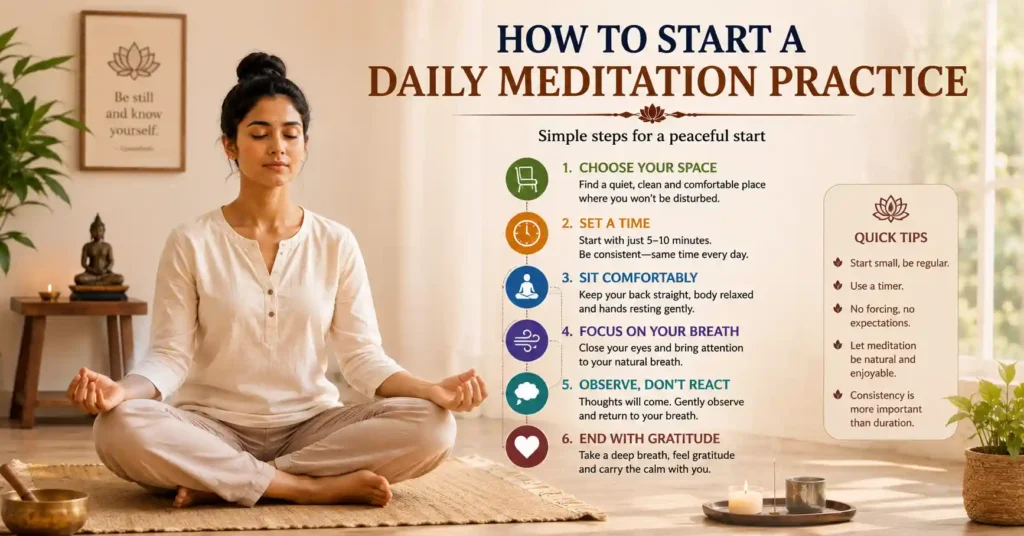
How to Start a Daily Meditation Practice
Starting daily meditation does not require special equipment, complicated techniques, or long hours of practice. The most important step is simply to begin.
Choose a quiet and comfortable place where you are less likely to be disturbed. Sit in a relaxed position with your back comfortably straight and allow your body to settle.
Sit comfortably on a chair, cushion, or the floor with your spine naturally upright and relaxed. A stable and comfortable posture helps the body remain at ease while allowing the mind to stay attentive.
For beginners, observing the natural rhythm of the breath is often the easiest approach. Simply bring your attention to each inhalation and exhalation without trying to control it.
If the mind wanders, gently return your attention to the breath. This is a normal part of meditation and not a mistake.
Some people prefer silent awareness, while others find mantra meditation helpful. Repeating a sacred mantra or divine name can provide a gentle point of focus and help steady the mind.
To make the practice sustainable:
- Start with 5 to 10 minutes a day
- Choose a regular time whenever possible
- Focus on consistency rather than duration
- Be patient with yourself during the learning process
Even a few minutes of daily meditation can become a meaningful beginning. As the habit develops, the practice often feels more natural and rewarding, bringing greater mental clarity, self-awareness, and inner peace into everyday life.
Daily Meditation as a Way of Life
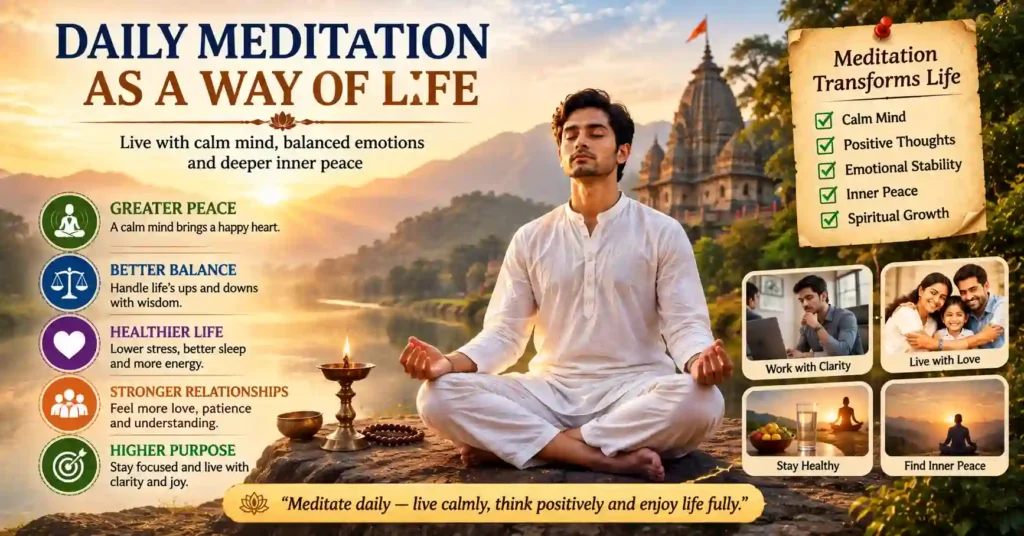
At its deepest level, daily meditation is not limited to the few minutes spent sitting quietly with closed eyes. Its true value begins to reveal itself in the way we think, respond, and live each day.
With regular practice, the qualities developed during meditation gradually extend into everyday life. Awareness becomes stronger, and reactions become more thoughtful rather than automatic.
In Sanatan Dharma, meditation is closely connected with Dharma, Karma, and Bhakti. A calmer and more aware mind helps a person follow Dharma with greater wisdom, perform Karma with less attachment to results, and deepen Bhakti through sincere remembrance of the Divine. In this way, meditation supports both spiritual growth and the practical responsibilities of everyday life.
A person may find themselves listening more carefully, speaking more mindfully, and handling situations with greater patience and emotional balance.
Small moments of stillness begin to appear where there was once only hurry, distraction, and mental noise. This quiet awareness often helps create a greater sense of presence throughout the day.
Thoughts become clearer. Decisions become more thoughtful. The mind feels less scattered and more focused on what truly matters.
One of the greatest benefits of daily meditation is that its influence extends far beyond the meditation session itself. The practice slowly shapes the way a person experiences relationships, work, challenges, and personal growth.
In this way, daily meditation becomes more than a spiritual practice. It becomes a gentle way of living with awareness, balance, mindfulness, and inner peace.
Conclusion: The Lasting Value of Daily Meditation
Daily meditation has been valued in Sanatan Dharma for centuries because it offers a simple yet powerful path to inner balance, self-awareness, and spiritual growth.
In a world filled with constant noise, responsibilities, and distractions, even a few minutes of quiet reflection can make a meaningful difference. The practice helps create space between our thoughts and reactions, allowing us to respond to life with greater clarity and calmness.
Through patience and consistent practice, the mind gradually becomes calmer, clearer, and less reactive. What begins as a few minutes of meditation can slowly influence the way we think, feel, and interact with the world around us.
One of the greatest benefits of daily meditation is that its effects extend beyond the meditation session itself. Greater mindfulness, emotional balance, and inner peace begin to appear in everyday life.
Over time, daily meditation becomes more than a habit or technique. It becomes a gentle companion on the journey toward a calmer mind, a balanced life, and a deeper understanding of oneself.
Meditation is not about escaping life. It is about meeting life with greater awareness, peace, wisdom, and harmony.
Key Takeaways
- Daily meditation is a simple practice that helps develop inner peace, mental clarity, and self-awareness.
- In Sanatan Dharma, meditation is known as Dhyana and has been practiced for thousands of years as a path to self-understanding and spiritual growth.
- Meditation is not about stopping thoughts. It is about observing thoughts with greater awareness and becoming less controlled by them.
- Even 5 to 10 minutes of daily meditation can be a meaningful beginning when practiced consistently.
- Regular practice can improve focus, emotional balance, concentration, patience, and decision-making.
- Mantra meditation, silence, and practicing during Brahma Muhurta can help create supportive conditions for meditation.
- A wandering mind is normal, especially for beginners. Progress comes through patience and regular practice, not perfection.
- The benefits of daily meditation often appear gradually through small but lasting changes in how we think, react, and respond to life.
- Meditation is not limited to spiritual seekers or monks. Householders, students, professionals, and retirees can all benefit from the practice.
- Over time, daily meditation becomes more than a habit. It becomes a way of living with greater awareness, balance, mindfulness, and inner peace.
Suggested Reading
If you enjoyed learning about daily meditation and its role in creating inner peace, mental clarity, and spiritual growth, you may also find these articles helpful. Together, they explore simple Sanatan practices, mindful living, self-awareness, and practical ways to bring balance into everyday life.
Daily Spiritual Habits: 7 Simple Sanatan Practices for Inner Peace
https://thesanatantales.com/daily-spiritual-habits/
Mudras: A Simple Practice for Balance, Awareness and Well-Being
https://thesanatantales.com/mudras-benefits-daily-life/
Daily Sattvik Routine for Working Professionals: Simple Habits for a Peaceful Life
https://thesanatantales.com/daily-sattvik-routine-for-working-professionals/
Digital Detox: How to Find Inner Peace in a Digital World
https://thesanatantales.com/digital-detox-inner-peace/
Sanatan Living: Finding Balance in a Fast-Paced World
https://thesanatantales.com/sanatan-living/
Karma and Life Lessons: What Your Experiences Are Teaching You
https://thesanatantales.com/karma-and-life-lessons-meaning/
Home Mandir: Simple Setup Ideas, Vastu Tips and Daily Rituals
https://thesanatantales.com/home-mandir/
Meditation (Wikipedia)
https://en.wikipedia.org/wiki/Meditation
FAQs
1. What is daily meditation?
Daily meditation is the practice of setting aside a few minutes each day to develop awareness, calm the mind, and cultivate inner peace.
In Sanatan Dharma, meditation is known as Dhyana and is considered an important tool for self-understanding and spiritual growth. Rather than escaping from life, meditation helps us engage with life more consciously and peacefully.
With regular practice, it can improve mental clarity, emotional balance, concentration, and self-awareness.
2. How long should I practice daily meditation?
There is no fixed rule regarding duration. Beginners can start with 5 to 10 minutes a day and gradually increase the time as they become more comfortable.
Consistency is more important than length. A person who meditates for 10 minutes every day is often better served than someone who practices for an hour only occasionally.
The Bhagavad Gita emphasizes balance and regularity rather than extreme effort.
3. Is daily meditation only for spiritual people?
No. Daily meditation can benefit anyone, regardless of age, background, or spiritual beliefs.
While meditation has deep roots in Sanatan Dharma, its benefits extend to everyday life. Students, professionals, homemakers, retirees, and spiritual seekers can all benefit from greater focus, calmness, and self-awareness.
The Bhagavad Gita presents meditation as a practical discipline that supports balanced living, not as a practice reserved only for monks or renunciates.
4. What should I do if my mind keeps wandering during meditation?
A wandering mind is one of the most common challenges beginners face.
Thoughts, memories, worries, and plans naturally arise during meditation. This does not mean you are failing. In fact, noticing that the mind has wandered is part of the practice itself.
Each time you gently bring your attention back to the breath, mantra, or point of focus, you strengthen awareness and concentration. The Bhagavad Gita teaches that the restless mind can gradually be trained through practice (Abhyasa) and detachment (Vairagya).
5. Is it better to meditate in silence or with a mantra?
Both approaches can be effective.
Some people prefer silent observation of the breath because it is simple and natural. Others find that mantra meditation provides a helpful point of focus and reduces mental distractions.
In Sanatan Dharma, repeating sacred mantras such as Om or a divine name has been practiced for centuries. The best method is the one that helps you remain consistent and attentive.
6. What is the best time for daily meditation?
Meditation can be practiced at any time that suits your schedule.
However, many seekers prefer Brahma Muhurta, the quiet period before sunrise, because the environment is peaceful and the mind is often fresh and receptive.
If early morning is not practical, choose a time when you are least likely to be disturbed. Regularity is usually more important than the exact time of day.
7. Can daily meditation help reduce stress and anxiety?
Many people find that regular meditation helps them respond more calmly to stressful situations.
Meditation creates a space between thoughts and reactions, allowing greater awareness and emotional balance. Over time, situations that once felt overwhelming may become easier to handle with patience and clarity.
While meditation is not a replacement for professional medical care when needed, it can be a valuable practice for improving overall mental well-being.
8. Can householders practice daily meditation successfully?
Yes. In fact, meditation has never been limited only to monks or ascetics.
The teachings of the Bhagavad Gita show that spiritual practices can be integrated into everyday life. A householder can meditate before work, after daily responsibilities, or during any quiet period of the day.
Even a few minutes of regular practice can help bring greater balance, patience, and awareness into family life, relationships, and work.
9. What are the benefits of daily meditation?
The benefits usually develop gradually through consistent practice.
Many people report improved concentration, greater emotional balance, better self-awareness, increased patience, and a deeper sense of inner peace.
From a spiritual perspective, meditation also helps cultivate inner stillness and supports the journey toward self-understanding and spiritual growth.
10. Does daily meditation mean stopping all thoughts?
No. This is one of the most common misconceptions about meditation.
The goal is not to force the mind into complete silence. Thoughts will continue to arise naturally.
Meditation teaches us to observe thoughts without becoming completely absorbed in them. Over time, thoughts may become less distracting, but the real transformation comes from developing awareness rather than eliminating thinking altoge
Glossary of Important Terms
| Term | Meaning |
|---|---|
| Dhyana | The Sanskrit word for meditation. In Sanatan Dharma, Dhyana refers to a state of deep awareness, concentration, and inner stillness. |
| Daily Meditation | The regular practice of spending time each day cultivating awareness, calmness, and mental clarity through meditation. |
| Sanatan Dharma | The eternal spiritual tradition of India that emphasizes righteous living, self-realization, and harmony with the universal truth. |
| Awareness | The ability to observe thoughts, emotions, and experiences consciously without immediately reacting to them. |
| Mindfulness | A state of paying attention to the present moment with acceptance and without judgment. |
| Inner Peace | A feeling of calmness, balance, and contentment that arises from within rather than from external circumstances. |
| Mental Clarity | A clear and focused state of mind that helps in understanding situations and making thoughtful decisions. |
| Self-Awareness | The ability to understand one’s thoughts, emotions, habits, and reactions more clearly. |
| Concentration | The ability to keep the mind focused on a single object, thought, breath, or mantra without frequent distractions. |
| Mantra | A sacred sound, word, or phrase repeated during spiritual practice to help focus the mind and deepen awareness. |
| Mantra Japa | The repeated chanting or silent repetition of a mantra as a form of meditation and devotion. |
| Brahma Muhurta | The sacred period approximately 1.5 hours before sunrise, traditionally considered the best time for meditation, prayer, and spiritual practices. |
| Yoga Sutras | A classical text by Sage Patanjali that explains the philosophy and practice of yoga, including meditation and mental discipline. |
| Upanishads | Ancient spiritual scriptures that explore the nature of the Self, consciousness, and ultimate reality. |
| Bhagavad Gita | One of the most respected scriptures of Sanatan Dharma, containing Lord Krishna’s teachings on life, duty, yoga, and spiritual wisdom. |
| Consciousness | The deeper awareness that allows us to experience thoughts, emotions, and existence itself. |
| Inner Stillness | A calm and quiet state of mind in which mental disturbances gradually settle. |
| Spiritual Growth | The process of developing greater wisdom, self-understanding, awareness, and connection with the divine. |
| Emotional Balance | The ability to remain steady and composed during both pleasant and challenging situations. |
| Self-Realization | The spiritual understanding of one’s true nature beyond the body, mind, and ego. |
| Meditation in Daily Life | The practice of carrying awareness, calmness, and mindfulness from meditation into everyday activities and relationships. |
About the Author
Yateendra Chaturvedi is a spiritual writer, researcher, devotee, and the founder of The Sanatan Tales. With over 35 years of professional experience and a lifelong interest in Sanatan Dharma, he writes about Hindu deities, temples, scriptures, festivals, Mahavidyas, sacred stories, rituals, and living traditions that continue to guide and inspire devotees across India.
Drawing from traditional scriptures, regional beliefs, temple traditions, devotional literature, and historical sources, he aims to present authentic, well-researched, and easy-to-understand content for modern readers. His work focuses on preserving spiritual wisdom, explaining sacred traditions, and helping seekers develop a deeper understanding of India’s rich spiritual heritage.
Through The Sanatan Tales, Yateendra strives to make the timeless teachings of Sanatan Dharma simple, meaningful, and relevant for today’s generation while maintaining respect for traditional sources, regional practices, and diverse spiritual perspectives.
Learn More About Yateendra Chaturvedi →
https://thesanatantales.com/about-the-author/
References & Sources
This article is based on the principles, teachings, and practices of Sanatan Dharma, including insights from traditional yogic wisdom, meditation traditions, spiritual philosophy, and widely accepted teachings found in Hindu scriptures such as the Bhagavad Gita, Upanishads, and Yoga Sutras. It also draws upon the understanding of Dhyana (meditation) that has been preserved through spiritual traditions, teachers, seekers, and generations of practitioners.
The article combines traditional spiritual knowledge with practical perspectives on cultivating awareness, inner peace, mental clarity, and balanced living in the modern world.
Note: Meditation is understood and practiced in different ways across various traditions, sampradayas, yogic paths, and spiritual communities within Sanatan Dharma. The purpose of this article is not to present any single method or interpretation as the only path, but to offer a simple, practical, and reader-friendly introduction to daily meditation based on commonly accepted spiritual teachings. Sanatan Dharma embraces diverse approaches to self-discovery, devotion, meditation, knowledge, and inner transformation.
Explore More Fascinating Topics from Sanatan Dharma