Chaitra Navratri is one of the most sacred festivals dedicated to the Divine Mother in Sanatan Dharma. Celebrated over nine nights and ten days during the Chaitra month, it marks a time of spiritual renewal, devotion, and fresh beginnings.
In many Hindu traditions, it also coincides with the start of the Hindu New Year, making it a deeply auspicious period for prayer and self-reflection.
During Chaitra Navratri, devotees across India and around the world worship the nine forms of Goddess Durga, collectively known as Navadurga.
Some observe Navratri Vrat, perform Ghatasthapana (Kalash Sthapana), chant sacred mantras, recite the Durga Saptashati, and visit temples, while others celebrate with simple daily prayers and acts of devotion at home.
Beyond its rituals and traditions, Chaitra Navratri carries a profound spiritual message. These nine sacred days encourage devotees to purify the mind, strengthen faith, and awaken the divine qualities of courage, wisdom, compassion, and inner strength that the Divine Mother represents.
Chaitra Navratri at a Glance
| Quick Facts | Details |
|---|---|
| Festival | Chaitra Navratri |
| Dedicated To | Goddess Durga in her nine forms (Navadurga) |
| Duration | Nine Nights and Ten Days |
| Observed On | Shukla Paksha Pratipada to Navami in the Hindu month of Chaitra |
| Main Ritual | Ghatasthapana (Kalash Sthapana) |
| Main Observances | Navratri Vrat, Durga Puja, Mantra Japa, Durga Saptashati Recitation, Kanya Puja |
| Festival Concludes With | Ram Navami |
| Spiritual Message | Spiritual renewal, self-discipline, devotion, and the awakening of inner strength |
Table of Contents
ToggleWhat is Chaitra Navratri?
Chaitra Navratri is a sacred nine-day Hindu festival dedicated to the worship of the Divine Mother, who is revered in her nine forms collectively known as Navadurga.
It is one of the most important Navratri celebrations in Sanatan Dharma and is observed with devotion, fasting, prayer, and spiritual discipline.
The word Navratri literally means “nine nights.” During these nine nights and ten days, devotees worship different forms of Goddess Durga, each representing divine qualities such as courage, compassion, wisdom, purity, strength, and protection.
The festival encourages devotees to overcome negative tendencies and cultivate spiritual growth through faith and self-discipline.
Chaitra Navratri is celebrated during the Chaitra month of the Hindu lunar calendar, usually falling in March or April. In many traditions, it also marks the beginning of the Hindu New Year, making it a highly auspicious time for new beginnings, prayers, and spiritual renewal.
Across India, this new beginning is celebrated in different ways. In Maharashtra, it coincides with Gudi Padwa; in Andhra Pradesh and Karnataka, it is celebrated as Ugadi; and in Kashmir, it is observed as Navreh.
Although regional customs vary, the spirit of the festival remains the same: seeking the blessings of the Divine Mother for peace, prosperity, wisdom, and protection.
For devotees, Chaitra Navratri is not merely a festival but a sacred journey of devotion, inner purification, and spiritual awakening that prepares the mind and heart for a new beginning.
Why Is Chaitra Navratri Celebrated?
Chaitra Navratri is celebrated to honour the Divine Mother (Shakti) and seek her blessings for strength, wisdom, protection, and spiritual growth.
The festival marks the beginning of a sacred journey in which devotees worship the Navadurga, the nine divine forms of Goddess Durga, over nine days of prayer, fasting, and devotion.
In many Hindu traditions, Chaitra Navratri also marks the beginning of the Hindu New Year, making it a highly auspicious time for new beginnings, self-reflection, and spiritual renewal.
Devotees believe that starting the year with the worship of the Divine Mother brings peace, prosperity, and divine grace.
Another important aspect of Chaitra Navratri is its close connection with Ram Navami, the birth anniversary of Lord Rama, which is celebrated on the ninth day of the festival.
This beautiful connection symbolises the harmony between Shakti, the divine energy that sustains creation, and Dharma, the path of righteousness represented by Lord Rama.
For devotees, Chaitra Navratri is not only a celebration of the Divine Mother but also an opportunity to purify the mind, strengthen faith, overcome negative tendencies, and begin a new chapter in life with devotion, discipline, and hope.
The Story Behind Chaitra Navratri
Several sacred traditions are associated with Chaitra Navratri, each highlighting the victory of divine power over negativity and the importance of devotion in Sanatan Dharma.
One of the most well-known traditions comes from the Devi Mahatmya (Durga Saptashati), where Goddess Durga defeats the buffalo demon Mahishasura after a fierce battle.
This victory symbolises the triumph of dharma over adharma, wisdom over ignorance, and good over evil. It reminds devotees that with faith, courage, and the grace of the Divine Mother, even the greatest challenges can be overcome.
Chaitra Navratri is also closely linked with the beginning of the Hindu New Year in many traditions.
As nature awakens during spring, devotees view these nine sacred days as an ideal time to renew their thoughts, strengthen their faith, and begin the year with spiritual discipline and positive intentions.
The festival concludes with Ram Navami, the birth anniversary of Lord Rama. This connection beautifully reflects the harmony between Shakti, the divine energy represented by the Divine Mother, and Dharma, the righteous path embodied by Lord Rama.
Together, these sacred traditions make Chaitra Navratri not merely a festival of worship but a celebration of renewal, courage, righteousness, and the eternal victory of light over darkness.
Chaitra Navratri Dates, Tithi and Ghatasthapana
Chaitra Navratri is observed every year during the Shukla Paksha (waxing phase of the moon) in the Hindu month of Chaitra, usually falling in March or April according to the Gregorian calendar.
The festival begins on Pratipada (the first lunar day) and continues for nine nights and ten days, concluding with Ram Navami, the birth anniversary of Lord Rama.
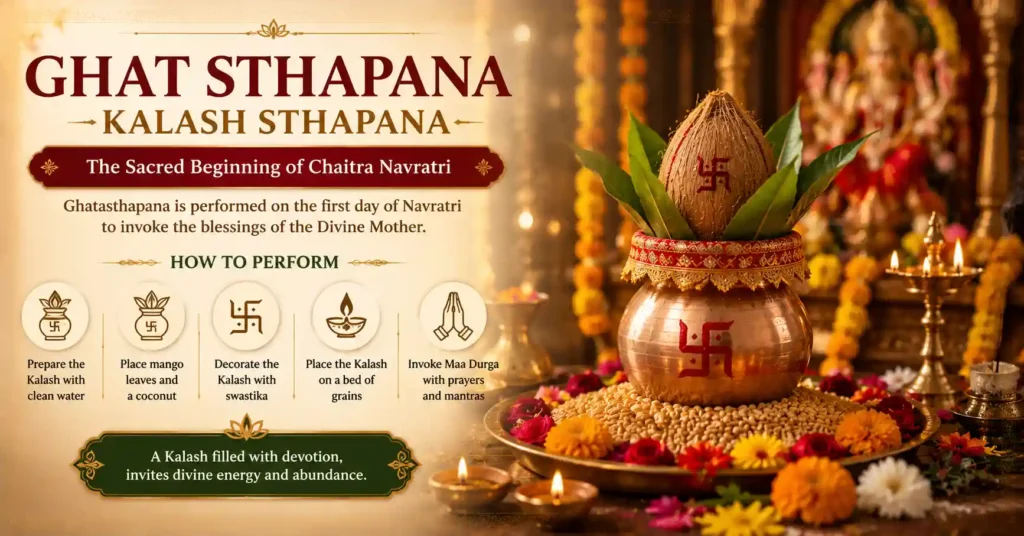
The festival begins with Ghatasthapana, also known as Kalash Sthapana, one of the most important rituals of Navratri.
During this ceremony, devotees establish a sacred Kalash to invoke the presence and blessings of the Divine Mother in their homes or temples. It marks the beginning of nine days of worship, prayer, fasting, and spiritual discipline.
Chaitra Navratri 2027 Dates
| Event | Date |
|---|---|
| Chaitra Navratri Begins (Pratipada & Ghatasthapana) | 8 April 2027 (Thursday) |
| Durga Ashtami | 15 April 2027 (Thursday) |
| Maha Navami | 16 April 2027 (Friday) |
| Ram Navami (Festival Concludes) | 17 April 2027 (Saturday) |
Note: Festival dates and Ghatasthapana Muhurat may vary slightly depending on your location. Always refer to your local Panchang or the nearest temple for the most accurate timings.
The conclusion of Chaitra Navratri with Ram Navami carries profound spiritual significance. While the Divine Mother represents Shakti, the cosmic energy that protects and nurtures creation, Lord Rama symbolises Dharma, righteousness, and ideal conduct.
Their close association reminds devotees that spiritual strength and righteous action together form the foundation of a balanced and meaningful life.
How to Observe Chaitra Navratri
Chaitra Navratri can be observed in different ways according to one’s family traditions, health, and spiritual practice. While customs may vary, the heart of the festival lies in devotion, self-discipline, and remembrance of the Divine Mother.
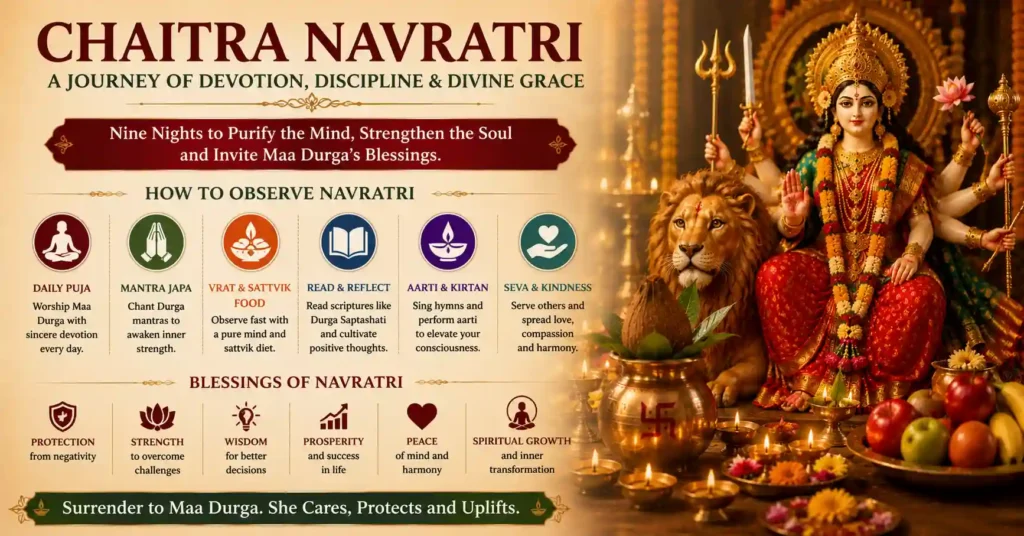
Many devotees follow these simple observances during the nine sacred days:
- Perform Ghatasthapana (Kalash Sthapana) on the first day to invoke the blessings of the Divine Mother.
- Worship the Navadurga, honouring a different form of Goddess Durga each day.
- Observe a Navratri Vrat according to your health and family tradition.
- Chant Durga mantras, recite the Durga Saptashati, Durga Chalisa, or other devotional hymns.
- Light a diya, offer flowers, fruits, and sattvik food during daily puja.
- Spend time in meditation, mantra japa, and self-reflection.
- Perform Kanya Puja (Kumari Puja) on Durga Ashtami or Maha Navami, following local customs.
- Conclude the festival with prayers and celebrate Ram Navami, which marks the birth of Lord Rama.
Daily Worship During the Nine Days
While every family follows its own traditions, many devotees observe a simple daily routine throughout Chaitra Navratri. The following table provides a general overview of the nine sacred days.
| Day | Main Observance |
|---|---|
| Day 1 (Pratipada) | Perform Ghatasthapana (Kalash Sthapana) and worship Maa Shailaputri. |
| Days 2–7 | Offer daily prayers, chant Durga mantras, perform Durga Puja, observe Navratri Vrat, and worship the corresponding form of Navadurga. |
| Day 8 (Durga Ashtami) | Perform Kanya Puja (Kumari Puja) according to family tradition and continue worship of the Divine Mother. |
| Day 9 (Maha Navami) | Offer final Navratri prayers, perform Havan where customary, and seek the blessings of Goddess Durga. |
| Day 10 (Ram Navami) | Celebrate the birth of Lord Rama, complete the festival, and conclude the vrat with Parana according to the local Panchang. |
The exact rituals may vary across regions and family traditions. What remains constant is the spirit of devotion, self-discipline, and gratitude that guides devotees throughout the nine sacred days of Chaitra Navratri.
The purpose of these observances is not merely to follow rituals but to cultivate purity, compassion, discipline, and devotion. Chaitra Navratri reminds devotees that true worship begins with a sincere heart and is reflected in righteous thoughts, words, and actions.
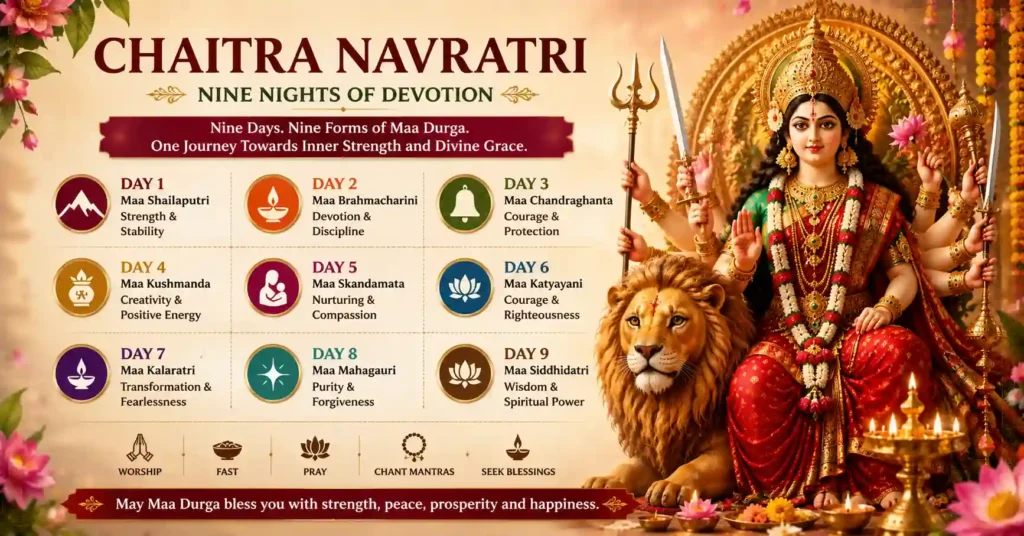
Navadurga Worship During Chaitra Navratri
One of the most important traditions of Chaitra Navratri is the worship of the Navadurga, the nine divine forms of Goddess Durga.
Each day of the festival is dedicated to a different manifestation of the Divine Mother, representing a unique spiritual quality that guides devotees on the path of inner growth and self-realisation.
The worship of the Navadurga symbolises a gradual journey from self-discipline and courage to wisdom, compassion, and ultimate spiritual fulfilment.
| Day | Form of Goddess | Represents |
|---|---|---|
| Day 1 | Maa Shailaputri | Strength, stability, and a strong spiritual foundation |
| Day 2 | Maa Brahmacharini | Devotion, discipline, and perseverance |
| Day 3 | Maa Chandraghanta | Courage, fearlessness, and protection |
| Day 4 | Maa Kushmanda | Creation, energy, and prosperity |
| Day 5 | Maa Skandamata | Motherly love, wisdom, and compassion |
| Day 6 | Maa Katyayani | Determination, courage, and righteousness |
| Day 7 | Maa Kalaratri | Protection from negativity and the destruction of fear |
| Day 8 | Maa Mahagauri | Purity, peace, and spiritual growth |
| Day 9 | Maa Siddhidatri | Divine wisdom, fulfilment, and spiritual perfection |
As devotees progress through these nine days of worship, they are encouraged to cultivate the qualities represented by each form of the Divine Mother.
The journey begins with Maa Shailaputri, symbolising a firm spiritual foundation, and culminates with Maa Siddhidatri, who blesses devotees with wisdom, inner fulfilment, and spiritual awakening.
Related Reading: If you would like to learn about each form in detail, explore our comprehensive guide on Navadurga: The Nine Forms of Goddess Durga.
Chaitra Navratri in Hindu Scriptures
The spiritual foundation of Chaitra Navratri is deeply rooted in Hindu scriptures and the ancient traditions of Shakti worship.
The most important text associated with the festival is the Durga Saptashati, also known as the Devi Mahatmya, which forms part of the Markandeya Purana.
The Devi Mahatmya narrates the divine victories of Goddess Durga over powerful demons such as Mahishasura, Shumbha, and Nishumbha.
These stories symbolise the triumph of good over evil, wisdom over ignorance, and divine consciousness over negative tendencies within the human mind.
During Chaitra Navratri, many devotees recite the Durga Saptashati as a form of spiritual discipline.
Some complete the entire text over the nine days, while others read one chapter or a selected portion each day according to their family tradition and spiritual practice.
Other Hindu scriptures, including the Devi Bhagavata Purana and various Shakta traditions, also emphasise the worship of the Divine Mother and the importance of devotion, self-discipline, and righteous living.
Together, these sacred texts present Navratri as a time for both outer worship and inner transformation.
For devotees, the recitation of these scriptures is more than a ritual. It is a way of strengthening faith, cultivating courage, purifying the mind, and seeking the blessings of the Divine Mother for spiritual growth and protection.
Temple Traditions During Chaitra Navratri
During Chaitra Navratri, Shakti temples across India celebrate the festival with great devotion and grandeur. Thousands of devotees visit these sacred shrines to seek the blessings of the Divine Mother through prayers, fasting, and special rituals performed throughout the nine days.
Some of the prominent temples and their traditions include:
| Temple | Location | Special Tradition During Chaitra Navratri |
|---|---|---|
| Vaishno Devi Temple | Jammu & Kashmir | Large numbers of pilgrims undertake the yatra, participate in special pujas, and seek the blessings of Mata Vaishno Devi. |
| Kamakhya Temple | Assam | Devotees perform Shakti worship, mantra japa, and special prayers dedicated to Goddess Kamakhya. |
| Vindhyavasini Devi Temple | Uttar Pradesh | Continuous chanting of Durga mantras, Durga Saptashati recitation, and special aartis are organised throughout the festival. |
| Jwala Devi Temple | Himachal Pradesh | Devotees offer prayers to the eternal sacred flames that symbolise the Divine Mother’s presence. |
Across these and many other temples, common observances include:
- Ghatasthapana and daily worship of the Divine Mother.
- Durga Saptashati and Devi Mahatmya recitation.
- Yajnas (Havans) and special pujas.
- Devotional singing, bhajans, and aarti.
- Extended darshan hours and special arrangements for pilgrims.
Although each temple follows its own traditions, the essence of Chaitra Navratri remains the same: worshipping the Divine Mother with faith, devotion, and gratitude while seeking her blessings for strength, protection, wisdom, and spiritual well-being.
Regional Traditions of Chaitra Navratri
Although the spiritual essence of Chaitra Navratri remains the same, its celebrations vary across different regions of India and neighbouring countries. Local customs, cultural practices, and family traditions give each region a unique way of honouring the Divine Mother while preserving the shared values of devotion, prayer, and spiritual renewal.
| Region | Traditional Observance |
|---|---|
| North India | Devotees observe Navratri Vrat, perform daily Durga Puja, recite the Durga Saptashati, and celebrate Kanya Puja on Ashtami or Navami. |
| Maharashtra | Chaitra Navratri coincides with Gudi Padwa, marking the beginning of the Hindu New Year. Families perform special prayers to Goddess Durga and celebrate new beginnings. |
| Andhra Pradesh & Karnataka | The festival is observed alongside Ugadi, with devotees visiting temples, offering prayers, and seeking the blessings of the Divine Mother for the new year. |
| Kashmir | Kashmiri Hindus celebrate Navreh, the traditional New Year, with prayers and worship of the Divine Mother as part of the festive observances. |
| South India | Many temples organise Abhishekam, special pujas, devotional processions, and cultural programmes dedicated to Goddess Durga. |
| Nepal | Chaitra Navratri is associated with the worship of Taleju Bhawani, the revered guardian deity of the Kathmandu Valley, along with special temple rituals and devotional ceremonies. |
Despite these regional variations, the heart of Chaitra Navratri remains unchanged. Across homes, temples, and pilgrimage centres, devotees come together to worship the Divine Mother, seek her blessings, and begin a new spiritual journey with faith, gratitude, and hope.
Shakta and Tantric Traditions During Chaitra Navratri
For many followers of the Shakta tradition, Chaitra Navratri is regarded as one of the most spiritually powerful periods for the worship of the Divine Mother (Shakti).
Along with traditional devotional practices, some advanced spiritual disciplines are also observed during these nine sacred days.
Under the guidance of a qualified guru, certain practitioners perform mantra japa, yantra worship, meditation, and specialised forms of Devi Sadhana dedicated to manifestations of the Divine Mother such as Maa Kali, Maa Tara, and Maa Tripura Sundari.
These practices form part of established Shakta and Tantric traditions and are generally undertaken only after proper initiation and guidance.
It is important to understand that these advanced forms of worship are not required to observe Chaitra Navratri.
For most devotees, the festival is celebrated through simple acts of devotion such as Durga Puja, Navratri Vrat, mantra chanting, Durga Saptashati recitation, and sincere prayer.
Ultimately, whether one follows a simple household tradition or a deeper spiritual path, the purpose of Chaitra Navratri remains the same: to honour the Divine Mother, cultivate inner purity, and awaken the qualities of wisdom, compassion, courage, and spiritual strength.
Chaitra Navratri Vrat Rules and Fasting Guidelines
Observing a Navratri Vrat during Chaitra Navratri is a personal act of devotion and self-discipline.
While many devotees observe a fast for all nine days, others keep the vrat only on the first and last day or on Durga Ashtami and Maha Navami, according to their family traditions and health.
There is no single rule that everyone must follow. The purpose of the fast is to cultivate purity of body, mind, and thoughts while focusing on the worship of the Divine Mother.
Common fasting practices include:
- Eating sattvik food prepared without onion and garlic.
- Consuming fruits, milk, nuts, and vrat-approved foods.
- Avoiding alcohol, meat, and tamasic foods.
- Spending time in prayer, mantra chanting, meditation, and scripture reading.
- Speaking truthfully, practising self-control, and maintaining a peaceful attitude.
Foods Commonly Eaten During Chaitra Navratri Vrat
During Chaitra Navratri Vrat, many devotees follow a sattvik diet that is simple, nourishing, and prepared according to family traditions. While fasting practices vary, vrat meals generally avoid onion, garlic, grains, meat, alcohol, and other tamasic foods. Instead, devotees consume foods that are considered pure and suitable for worship.
| Food | Common Examples |
|---|---|
| Fruits | Banana, apple, papaya, pomegranate, orange and seasonal fruits |
| Milk & Dairy | Milk, curd, buttermilk and paneer (as per family tradition) |
| Dry Fruits & Nuts | Almonds, cashews, walnuts, raisins and dates |
| Vrat Flours | Kuttu (buckwheat) flour and Singhara (water chestnut) flour |
| Fasting Grains | Samak rice (barnyard millet) |
| Root Vegetables | Potato, sweet potato and colocasia (arbi) |
| Seasonings | Sendha Namak (rock salt), cumin and black pepper |
| Healthy Drinks | Lemon water, coconut water and fresh fruit juices (without regular salt) |
The purpose of a Navratri Vrat is not simply to change one’s diet but to cultivate purity of body, mind, and speech. Devotees are encouraged to eat in moderation, stay hydrated, and focus on prayer, meditation, and devotion to the Divine Mother throughout the festival.
Important: Elderly people, pregnant women, children, and those with medical conditions should observe the fast according to their health and, if needed, seek advice from a qualified healthcare professional. Devotion is expressed through sincerity, not physical hardship.
The true spirit of Chaitra Navratri Vrat lies in purifying the mind, strengthening self-discipline, and deepening one’s devotion to the Divine Mother rather than simply abstaining from food.
Common Household Practices During Chaitra Navratri
Chaitra Navratri can be observed at home with simple yet meaningful devotional practices. While every family follows its own traditions, the essence of the festival lies in worshipping the Divine Mother with faith, discipline, and gratitude rather than performing elaborate rituals.
The table below highlights some of the most common household observances during Chaitra Navratri.
| Practice | Purpose |
|---|---|
| Ghatasthapana (Kalash Sthapana) | Marks the beginning of Navratri by invoking the presence and blessings of the Divine Mother. |
| Daily Durga Puja | Offers prayers, flowers, incense, and a diya to Goddess Durga each day. |
| Mantra Japa | Chanting Durga mantras to cultivate devotion, peace, and spiritual focus. |
| Durga Saptashati or Durga Chalisa Recitation | Reading sacred texts to strengthen faith and seek the blessings of the Divine Mother. |
| Navratri Vrat | Observing a fast according to one’s health, family tradition, and spiritual practice. |
| Sattvik Diet | Eating pure vegetarian food while avoiding onion, garlic, and tamasic foods, according to family customs. |
| Evening Aarti | Performing aarti with family members to conclude the day’s worship. |
Many devotees also choose to:
- Keep the home and prayer area clean throughout the festival.
- Spend time in meditation and self-reflection.
- Practise kindness, charity, and self-discipline.
- Visit a nearby Durga temple whenever possible.
While customs may vary from one household to another, the true spirit of Chaitra Navratri lies in sincere devotion, purity of thought, and the desire to grow spiritually under the blessings of the Divine Mother.
Kanya Puja During Chaitra Navratri
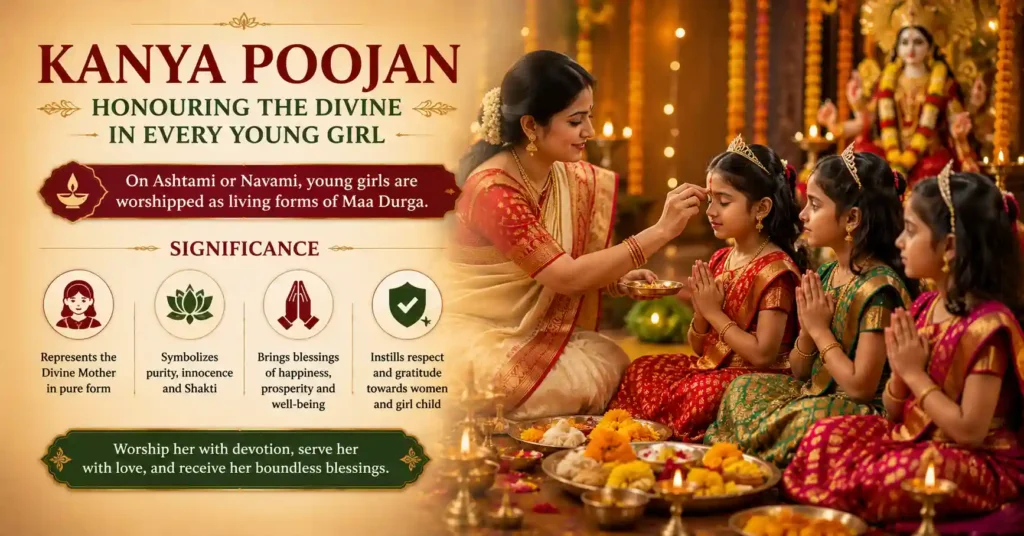
Kanya Puja, also known as Kumari Puja, is one of the most revered rituals observed during Chaitra Navratri. It is usually performed on Durga Ashtami or Maha Navami, when young girls are worshipped as living manifestations of the Divine Mother.
According to Hindu tradition, girls between the ages of 2 and 10 years are honoured as embodiments of Shakti, the divine feminine energy.
Devotees welcome them with respect, wash their feet, offer prayers, serve them a traditional meal, and present fruits, sweets, or small gifts as a mark of gratitude and reverence.
Kanya Puja at a Glance
| Aspect | Details |
|---|---|
| Also Known As | Kumari Puja |
| Usually Performed On | Durga Ashtami or Maha Navami |
| Who Is Worshipped? | Young girls (generally 2 to 10 years of age) as forms of the Divine Mother |
| Common Offerings | Traditional meal, fruits, sweets, gifts, and dakshina |
| Spiritual Meaning | Honouring the divine feminine, purity, innocence, and the nurturing power of Shakti |
Kanya Puja is more than a ritual. It reminds devotees to respect, honour, and protect the dignity of women and recognise the presence of the Divine Mother in every form of life. The ceremony reflects the timeless teaching of Sanatan Dharma that the feminine principle is worthy of the highest reverence and respect.
Spiritual Significance of Chaitra Navratri
At its deepest level, Chaitra Navratri is much more than a nine-day festival of rituals and celebrations. It is a sacred journey of inner transformation, inviting devotees to awaken the divine qualities that already exist within the heart.
Each day of Navratri symbolises a step towards overcoming negative tendencies such as fear, anger, ego, attachment, and ignorance.
Through the worship of the Navadurga, devotees are encouraged to cultivate virtues like courage, compassion, self-discipline, wisdom, purity, and unwavering faith.
The festival also marks the arrival of spring and, in many traditions, the beginning of the Hindu New Year.
ust as nature renews itself, Chaitra Navratri reminds us that every individual has the opportunity to begin again by letting go of negativity and embracing a life guided by righteousness, devotion, and inner peace.
Whether one observes the festival through Navratri Vrat, Durga Puja, mantra japa, meditation, or simple daily prayers, the true purpose remains the same: to strengthen the connection with the Divine Mother and discover the spiritual strength that lies within.
Ultimately, Chaitra Navratri teaches that real victory is not over others but over our own weaknesses.
By surrendering to the grace of the Divine Mother, devotees strive to lead a life filled with compassion, wisdom, courage, and harmony long after the nine sacred days have ended.
Conclusion
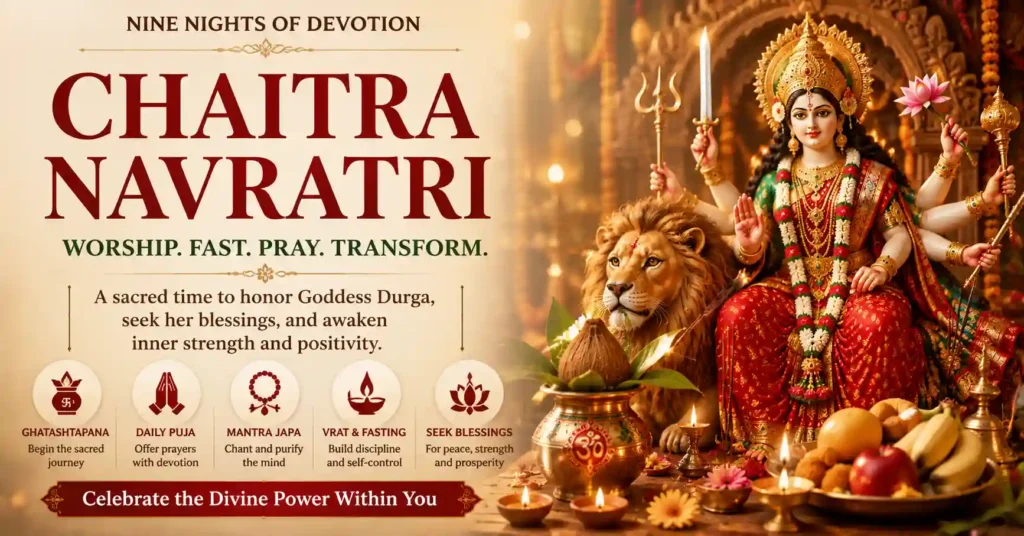
Chaitra Navratri is much more than a festival of rituals and traditions. It is a sacred opportunity to renew faith, strengthen self-discipline, and deepen one’s connection with the Divine Mother.
Through Navratri Vrat, prayer, mantra chanting, meditation, and acts of devotion, devotees seek not only divine blessings but also inner peace, wisdom, and spiritual growth.
These nine sacred days remind us that every new beginning is an invitation to leave behind fear, negativity, and doubt while embracing courage, compassion, and righteousness.
Whether celebrated with elaborate temple rituals or simple prayers at home, the true essence of Chaitra Navratri lies in sincere devotion and the desire for inner transformation.
May the Divine Mother bless your life with strength, wisdom, prosperity, and spiritual fulfilment. May her grace guide you on the path of faith, peace, and righteous living.
Jai Mata Di!
Suggested Reading
If you would like to deepen your understanding of Chaitra Navratri, Shakti worship, and the Divine Mother, explore these carefully curated guides from The Sanatan Tales.
Maa Durga: The Divine Mother and Her Protective Power
https://thesanatantales.com/maa-durga/
Das Mahavidya: Ten Wisdom Forms of the Divine Mother
https://thesanatantales.com/das-mahavidya/
Kumari Puja in Navratri: Meaning, Rituals and Spiritual Significance
https://thesanatantales.com/kumari-puja-in-navratri-guide/
Gupta Navratri: Meaning, Dates, Rituals and Spiritual Significance
https://thesanatantales.com/gupta-navratri/
Navadurga: The Nine Forms of Goddess Durga
https://thesanatantales.com/navadurga/
Durga Saptashati: Meaning, Significance and Benefits
https://thesanatantales.com/durga-saptashati/
Durga Chalisa: Lyrics, Meaning and Benefits
https://thesanatantales.com/durga-chalisa/
Durga Aarti: Lyrics, Meaning and Spiritual Significance
https://thesanatantales.com/durga-aarti/
Navaratri (Wikipedia)
https://en.wikipedia.org/wiki/Navaratri
FAQs
What is Chaitra Navratri?
Chaitra Navratri is a nine-day Hindu festival dedicated to the worship of the Divine Mother in her nine forms, collectively known as Navadurga. Celebrated during the Chaitra month of the Hindu lunar calendar, it marks a period of devotion, fasting, prayer, and spiritual renewal. In many traditions, it also coincides with the beginning of the Hindu New Year, making it an auspicious time for new beginnings and self-reflection.
Why is Chaitra Navratri celebrated?
Chaitra Navratri is celebrated to honour Goddess Durga and seek her blessings for strength, wisdom, protection, and prosperity. The festival also symbolises the victory of good over evil, encourages spiritual discipline, and reminds devotees to overcome negative qualities through faith and devotion. It concludes with Ram Navami, celebrating the birth of Lord Rama.
When is Chaitra Navratri celebrated?
Chaitra Navratri begins on Shukla Paksha Pratipada, the first day of the bright fortnight in the Hindu month of Chaitra, and continues for nine nights and ten days. Since the Hindu calendar follows the lunar cycle, the festival usually falls in March or April, and the dates change every year. Devotees should refer to their local Panchang for the exact dates and Ghatasthapana Muhurat.
What is the significance of Ghatasthapana (Kalash Sthapana)?
Ghatasthapana, also known as Kalash Sthapana, marks the beginning of Chaitra Navratri. During this ritual, devotees establish a sacred Kalash to invoke the presence of the Divine Mother in their homes or temples. It symbolises the beginning of nine days of worship, devotion, and spiritual discipline.
Who are the Navadurga?
The Navadurga are the nine sacred forms of Goddess Durga worshipped during the nine days of Chaitra Navratri. They are Maa Shailaputri, Maa Brahmacharini, Maa Chandraghanta, Maa Kushmanda, Maa Skandamata, Maa Katyayani, Maa Kalaratri, Maa Mahagauri, and Maa Siddhidatri. Each form represents a different divine quality and stage of spiritual growth.
Is fasting compulsory during Chaitra Navratri?
No. Observing a Navratri Vrat is a personal spiritual practice and is not compulsory. Some devotees fast for all nine days, while others observe the fast only on selected days. Those who cannot fast due to age, health, pregnancy, or other reasons can still observe Chaitra Navratri through prayer, mantra chanting, meditation, and sincere devotion.
What foods are allowed during Chaitra Navratri Vrat?
Many devotees follow a sattvik diet during Chaitra Navratri. Common vrat foods include fruits, milk, curd, dry fruits, sabudana, samak rice, kuttu flour, singhara flour, potatoes, sweet potatoes, and foods prepared with Sendha Namak (rock salt). Food traditions may vary according to family customs and regional practices.
Can Chaitra Navratri Puja be performed at home?
Yes. Chaitra Navratri Puja can be performed at home with devotion and simplicity. Devotees usually begin with Ghatasthapana, light a diya, offer flowers and fruits, chant Durga mantras, recite the Durga Saptashati or Durga Chalisa, and perform daily prayers before the Divine Mother.
What is Kanya Puja and why is it performed?
Kanya Puja, also known as Kumari Puja, is usually performed on Durga Ashtami or Maha Navami. Young girls are worshipped as living manifestations of the Divine Mother. Devotees offer them food, fruits, sweets, and gifts as a mark of respect. The ritual symbolises reverence for the divine feminine and reminds devotees to honour the dignity and sacredness of womanhood.
What is the connection between Chaitra Navratri and Ram Navami?
The ninth day of Chaitra Navratri coincides with Ram Navami, the birth anniversary of Lord Rama. This beautiful connection symbolises the harmony between Shakti, represented by the Divine Mother, and Dharma, represented by Lord Rama. Together, they inspire devotees to combine spiritual strength with righteous living.
What is the difference between Chaitra Navratri and Sharadiya Navratri?
Both festivals are dedicated to the worship of Goddess Durga and the Navadurga, but they are observed in different seasons. Chaitra Navratri takes place during spring and, in many traditions, marks the beginning of the Hindu New Year. Sharadiya Navratri, celebrated in the Ashwin month, culminates with Vijayadashami (Dussehra) and is widely associated with the victory of Goddess Durga over Mahishasura.
Can working professionals and students observe Chaitra Navratri?
Yes. Chaitra Navratri can be observed according to one’s daily routine and responsibilities. Even if it is not possible to perform elaborate rituals, devotees can offer simple prayers, chant a Durga mantra, maintain a sattvik lifestyle, and spend a few moments in meditation each day. Sincere devotion is considered more important than the complexity of the rituals.
Which mantra is commonly chanted during Chaitra Navratri?
Many devotees chant “Om Dum Durgayei Namah”, the Durga Gayatri Mantra, or recite the Durga Saptashati and Durga Chalisa during Chaitra Navratri. The choice of mantra often depends on family tradition and personal devotion. Chanting with faith, concentration, and sincerity is considered more important than the number of repetitions.
Is Chaitra Navratri celebrated only in India?
No. Chaitra Navratri is celebrated by Hindu communities across the world, including Nepal, Mauritius, Fiji, Trinidad and Tobago, the United States, Canada, the United Kingdom, Australia, and many other countries. Temples and community organisations organise special pujas, devotional singing, and cultural programmes during the festival.
What is the spiritual message of Chaitra Navratri?
The spiritual message of Chaitra Navratri is one of renewal, self-discipline, and inner transformation. The festival encourages devotees to overcome fear, anger, ego, and ignorance while cultivating compassion, wisdom, courage, and devotion. Through the grace of the Divine Mother, devotees seek to begin a new chapter in life with faith, peace, and righteous living.
Glossary of Important Terms
| Term | Meaning |
|---|---|
| Chaitra Navratri | A nine-day Hindu festival dedicated to the worship of Goddess Durga in her nine forms (Navadurga), celebrated during the Chaitra month of the Hindu lunar calendar. |
| Navratri | Literally meaning “nine nights,” a sacred festival devoted to the worship of the Divine Mother through prayer, fasting, and spiritual practices. |
| Navadurga | The nine divine forms of Goddess Durga worshipped during the nine days of Navratri, each representing a unique spiritual quality. |
| Goddess Durga | The Divine Mother and a principal form of Shakti, revered as the protector of righteousness and the destroyer of evil. |
| Shakti | The divine feminine energy that sustains, creates, and transforms the universe. |
| Chaitra | The first month of the Hindu lunar calendar, usually falling in March or April, during which Chaitra Navratri is observed. |
| Ghatasthapana (Kalash Sthapana) | The sacred ritual performed on the first day of Navratri to invoke the presence and blessings of the Divine Mother. |
| Navratri Vrat | A devotional fast observed during Navratri to cultivate self-discipline, purity, and spiritual focus. |
| Durga Puja | The ritual worship of Goddess Durga through prayers, offerings, mantra chanting, and aarti. |
| Durga Saptashati (Devi Mahatmya) | A revered scripture from the Markandeya Purana describing the victories of Goddess Durga over evil forces and widely recited during Navratri. |
| Markandeya Purana | One of the eighteen major Puranas containing the Devi Mahatmya, an important scripture for the worship of the Divine Mother. |
| Mantra Japa | The repeated chanting of a sacred mantra with concentration and devotion as a spiritual practice. |
| Kanya Puja (Kumari Puja) | A Navratri ritual in which young girls are worshipped as living manifestations of the Divine Mother, usually on Durga Ashtami or Maha Navami. |
| Durga Ashtami | The eighth day of Navratri, considered highly auspicious for the worship of Goddess Durga and the performance of Kanya Puja. |
| Maha Navami | The ninth and final day of Navratri dedicated to the worship of the Divine Mother before the festival concludes. |
| Ram Navami | The birth anniversary of Lord Rama, celebrated on the final day of Chaitra Navratri in many traditions. |
| Sattvik Food | Pure vegetarian food believed to promote physical well-being, mental clarity, and spiritual growth, commonly consumed during Navratri Vrat. |
| Havan (Yajna) | A sacred fire ritual performed with Vedic mantras and offerings, seeking divine blessings and spiritual purification. |
| Aarti | A devotional ritual in which a lit lamp is offered before the deity while singing hymns in praise of the Divine. |
| Shakta Tradition | A major tradition within Sanatan Dharma that worships the Divine Mother (Shakti) as the Supreme Reality. |
| Yantra | A sacred geometric diagram used in certain forms of meditation and Shakta worship under proper guidance. |
| Devi Sadhana | Spiritual practices dedicated to the worship of the Divine Mother, including mantra japa, meditation, and devotional rituals. |
| Mahishasura | The buffalo demon defeated by Goddess Durga, symbolising the victory of good over evil and wisdom over ignorance. |
| Gudi Padwa | The traditional New Year festival celebrated in Maharashtra, often coinciding with Chaitra Navratri. |
| Ugadi | The Hindu New Year festival celebrated in Andhra Pradesh, Telangana, and Karnataka during the Chaitra month. |
| Navreh | The traditional New Year celebrated by Kashmiri Hindus, coinciding with the beginning of Chaitra Navratri. |
About the Author
Yateendra Chaturvedi is a spiritual writer, researcher, devotee, and the founder of The Sanatan Tales. With over 35 years of professional experience and a lifelong interest in Sanatan Dharma, he writes about Hindu deities, temples, scriptures, festivals, Mahavidyas, sacred stories, rituals, and living traditions that continue to guide and inspire devotees across India.
Drawing from traditional scriptures, regional beliefs, temple traditions, devotional literature, and historical sources, he aims to present authentic, well-researched, and easy-to-understand content for modern readers. His work focuses on preserving spiritual wisdom, explaining sacred traditions, and helping seekers develop a deeper understanding of India’s rich spiritual heritage.
Through The Sanatan Tales, Yateendra strives to make the timeless teachings of Sanatan Dharma simple, meaningful, and relevant for today’s generation while maintaining respect for traditional sources, regional practices, and diverse spiritual perspectives.
Learn More About Yateendra Chaturvedi →
https://thesanatantales.com/about-the-author/
References & Sources
This article is based on beliefs and traditions followed within the Shakta traditions of Sanatan Dharma, traditional knowledge associated with the Dashamahavidya tradition, Shakti worship, Devi sadhana, and insights drawn from various spiritual and religious study sources.
Some concepts discussed in this article are also inspired by teachings and interpretations preserved through the guru-disciple tradition.
Note: Beliefs, interpretations, and spiritual practices may vary across different traditions, sects, and paths within Sanatan Dharma. The purpose of this article is not to present any single viewpoint as the absolute truth, but to explain widely accepted religious and spiritual perspectives in a simple and accessible manner.
Explore More Fascinating Topics from Sanatan Dharma