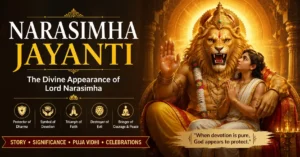
Narasimha Jayanti is a sacred festival in Sanatan Dharma that commemorates the divine appearance of Lord Narasimha, the fourth avatar of Lord Vishnu.
Revered as the fierce protector of righteousness and the devoted guardian of his Bhakta Prahlad, Lord Narasimha symbolizes the triumph of faith over fear and the victory of dharma over adharma.
This auspicious day reminds devotees that sincere devotion, truth, and righteousness are always protected by divine grace.
More than a religious celebration, this sacred occasion inspires courage, inner strength, and unwavering faith during life’s challenges. Devotees observe the festival through puja, vrat, mantra chanting, meditation, and by remembering the inspiring story of Lord Narasimha and Prahlad.
The festival continues to hold deep spiritual significance for those seeking protection, peace, and guidance on the path of righteousness.
In this article, you will learn about the Narasimha Avatar Story, the significance of this festival, its date, tithi and Panchang, Narasimha Jayanti Puja Vidhi, fasting rules, powerful mantras, temple celebrations, spiritual teachings, and simple ways to observe this sacred festival with devotion.
Table of Contents
ToggleNarasimha Jayanti at a Glance
| Aspect | Details |
|---|---|
| Festival Name | Narasimha Jayanti |
| Honours | Lord Narasimha, the fourth avatar of Lord Vishnu |
| Associated Deity | Lord Narasimha (Narasimha Avatar of Lord Vishnu) |
| Significance | Commemorates the divine appearance of Lord Narasimha to protect Prahlad, destroy Hiranyakashipu, and restore dharma. |
| Observed By | Hindus, devotees of Lord Vishnu, Vaishnavas, and spiritual seekers |
| Hindu Month | Vaishakha |
| Tithi | Shukla Paksha Chaturdashi |
| Main Rituals | Puja, vrat (fasting), Narasimha Mantra chanting, Vishnu Sahasranama recitation, abhishek, bhajans, and charity |
| Best Time for Worship | Pradosh Kaal (evening), traditionally believed to be the time of Lord Narasimha’s appearance |
| Sacred Offerings | Panchamrit, tulsi leaves, flowers, fruits, incense, diya, and sattvic prasad |
| Spiritual Benefits | Seeks divine protection, courage, inner strength, removal of fear, and spiritual growth |
| Festival Date | Celebrated annually according to the Hindu lunar calendar. The current year’s date, tithi, and Panchang details are provided below. |
Did You Know?
Lord Narasimha is the fourth avatar (Dashavatara) of Lord Vishnu and is unique because he appeared in a form that was neither fully human nor fully lion.
According to Hindu tradition, this extraordinary form enabled him to overcome the boon granted to Hiranyakashipu and protect his devoted follower, Prahlad, demonstrating that divine wisdom and justice transcend all worldly limitations.
Narasimha Jayanti Date, Tithi and Panchang
In 2027, Narasimha Jayanti will be observed on Tuesday, 18 May 2027. According to the Hindu Panchang, the festival falls on Vaishakha Shukla Chaturdashi, the fourteenth day of the bright fortnight of the month of Vaishakha.
Devotees traditionally observe the festival during Pradosh Kaal (evening), as it is believed that Lord Narasimha appeared at twilight to protect his devotee Prahlad and restore dharma.
Since Narasimha Jayanti is based on the Hindu lunar calendar, its Gregorian date changes every year. The exact tithi and puja timings may also vary slightly depending on your location and the Panchang you follow.
Panchang for 2027
| Occasion | Date & Time |
|---|---|
| Narasimha Jayanti | Tuesday, 18 May 2027 |
| Hindu Month | Vaishakha |
| Paksha | Shukla Paksha |
| Tithi | Chaturdashi |
| Chaturdashi Tithi Begins | 18 May 2027, 4:03 PM |
| Chaturdashi Tithi Ends | 19 May 2027, 4:02 PM |
| Recommended Puja Time | Pradosh Kaal (Evening) |
Note: The exact Pradosh Kaal and other muhurat timings may vary by city. Refer to your local Panchang for location-specific timings.
Who Is Lord Narasimha?
Lord Narasimha is the fourth avatar (Dashavatara) of Lord Vishnu, who appeared to protect his devoted follower Prahlad and restore dharma by defeating the demon king Hiranyakashipu.
His unique form, with the body of a man and the face of a lion, symbolizes the limitless nature of divine power and the triumph of righteousness over evil.
According to Hindu tradition, Lord Narasimha appeared during Vaishakha Shukla Chaturdashi, at Pradosh Kaal (twilight), fulfilling every condition of the boon granted to Hiranyakashipu.
This extraordinary incarnation demonstrates that divine wisdom is beyond human understanding and that God always finds a way to protect sincere devotees.
Devotees worship Lord Narasimha as the embodiment of courage, protection, justice, and compassion. Although his appearance is fierce, his purpose is to remove fear, destroy adharma, and bless devotees with strength, inner peace, and unwavering faith.
These timeless qualities are the reason the festival continues to be celebrated with great devotion throughout India and by devotees of Lord Vishnu around the world.
The Story Behind Narasimha Jayanti
Narasimha Jayanti commemorates the divine appearance of Lord Narasimha, the fourth avatar of Lord Vishnu, who manifested to protect his devoted follower Prahlad and restore righteousness.
According to Hindu tradition, Lord Narasimha appeared on Vaishakha Shukla Chaturdashi during Pradosh Kaal (twilight), fulfilling the divine purpose of ending the tyranny of the demon king Hiranyakashipu.
The festival is deeply connected with the timeless message that unwavering faith is always protected. Despite facing severe hardships, Prahlad never abandoned his devotion to Lord Vishnu.
His steadfast faith became the reason for the divine appearance of Lord Narasimha, who emerged in a unique form that upheld both the cosmic order and the conditions of Hiranyakashipu’s boon.
Every year, devotees celebrate this holy day to remember this extraordinary event and to seek the blessings of Lord Narasimha for courage, protection, and spiritual strength.
The festival continues to inspire people to remain firm in truth, practise righteousness, and trust that divine grace always supports those who walk the path of dharma.
Why Is Narasimha Jayanti Celebrated?
According to Hindu tradition, Narasimha Jayanti commemorates the divine appearance of Lord Narasimha, the fourth avatar of Lord Vishnu, who manifested to protect his devoted follower Prahlad and restore dharma by defeating the tyrant king Hiranyakashipu.
The festival celebrates the triumph of unwavering faith, righteousness, and divine justice over arrogance, cruelty, and adharma.
For devotees, this observance is much more than the remembrance of a divine event. It is a sacred occasion to strengthen faith, seek courage during difficult times, and pray for protection from fear and negative influences.
Many devotees observe the day by performing Narasimha Jayanti Puja, keeping a vrat, chanting the names and mantras of Lord Narasimha, reading the story of Prahlad, and reflecting on the timeless values of devotion, humility, and righteousness.
The festival also reminds us that divine grace often appears in unexpected ways to protect those who remain steadfast in truth and devotion.
This enduring message continues to makethis festival one of the most spiritually significant festivals dedicated to Lord Vishnu in Sanatan Dharma.
Why Lord Narasimha Appeared
According to Hindu tradition, Lord Narasimha appeared to protect his devoted follower Prahlad and restore dharma when the world was threatened by the tyranny of the demon king Hiranyakashipu.
Blessed with a powerful boon, Hiranyakashipu became arrogant and declared himself supreme, demanding that everyone worship him instead of Lord Vishnu.
Prahlad, however, remained unwavering in his devotion to Lord Vishnu. Despite facing repeated attempts to break his faith through threats, punishment, and danger, he continued to chant the Lord’s name with complete trust and fearlessness.
His steadfast devotion became a symbol of unshakable faith in the face of adversity. To protect Prahlad and uphold righteousness, Lord Vishnu manifested as the Narasimha Avatar, a unique form that was neither fully human nor fully lion.
By appearing in this extraordinary form, Lord Narasimha fulfilled the conditions of Hiranyakashipu’s boon while demonstrating that divine wisdom always prevails over arrogance and injustice.
The appearance of Lord Narasimha teaches a timeless lesson: sincere devotion, truth, and righteousness are always protected by divine grace.
Even when challenges seem impossible to overcome, faith can become a source of courage, hope, and inner strength.
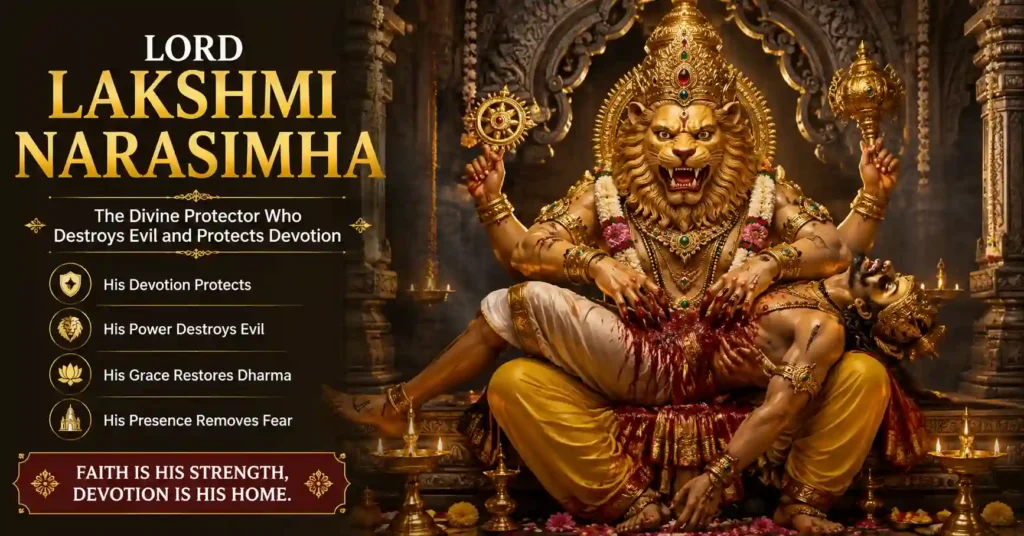
The Story of Lord Narasimha and Prahlad
According to the Bhagavata Purana and other Hindu traditions, the story of Lord Narasimha is one of the most inspiring examples of divine protection in Sanatan Dharma.
It teaches that unwavering devotion and righteousness are always safeguarded by the Divine, even in the face of overwhelming adversity.
Long ago, there lived a mighty demon king named Hiranyakashipu. Through severe penance, he obtained a powerful boon that made him believe he was invincible.
Filled with pride, he declared himself greater than the gods and ordered everyone in his kingdom to worship him alone.
However, his young son Prahlad remained completely devoted to Lord Vishnu. Despite repeated threats, punishments, and attempts on his life, Prahlad never abandoned his faith. He continued to chant the Lord’s name with courage, humility, and complete trust.
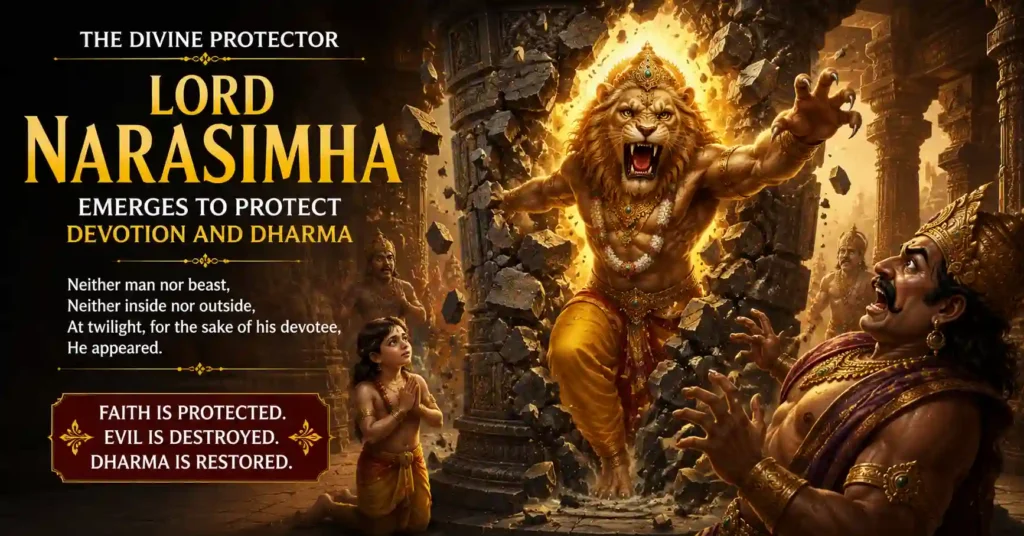
One day, Hiranyakashipu angrily challenged Prahlad and asked, “Where is your Lord Vishnu?” Prahlad calmly replied, “He is everywhere.” Enraged, the king struck a nearby pillar and demanded to know whether Vishnu was present inside it.
At that very moment, the pillar split open, and Lord Vishnu appeared in the extraordinary form of Lord Narasimha, with the body of a man and the face of a lion. This unique form was unlike anything the world had ever seen.
Lord Narasimha defeated Hiranyakashipu and protected Prahlad, demonstrating that no boon, power, or arrogance can stand against divine justice.
The story reminds devotees that sincere faith is never abandoned and that the Divine always finds a way to protect righteousness.
This timeless event is commemorated every year on this festival, inspiring millions of devotees to place their trust in truth, devotion, and the protective grace of Lord Narasimha.
Life Lessons from Prahlad's Devotion
The story of Prahlad is not only about divine protection but also about the strength of unwavering faith and righteous living. His devotion to Lord Vishnu continues to inspire devotees of all ages and offers valuable lessons that remain relevant even today.
| Lesson | Meaning |
|---|---|
| Unwavering Faith | Prahlad never gave up his devotion to Lord Vishnu, even during the most difficult circumstances. |
| Courage Over Fear | He faced danger with calmness and complete trust in the Divine instead of fear. |
| Humility | Despite receiving divine blessings, Prahlad remained humble and compassionate. |
| Standing for Truth | Prahlad chose righteousness over comfort, teaching us to remain true to our values. |
| Trust in Divine Grace | His life reminds devotees that sincere faith and righteous actions are always protected by the Divine. |
The life of Prahlad teaches that true devotion is not tested during peaceful times but during moments of difficulty.
His example continues to inspire devotees to cultivate faith, patience, humility, and trust in Lord Narasimha, making this holi day a festival of both divine protection and spiritual transformation.
Scriptural References to Lord Narasimha
The story of Lord Narasimha is described in several sacred Hindu scriptures, making it one of the most revered narratives in Sanatan Dharma.
The most detailed account appears in the Bhagavata Purana (Shrimad Bhagavatam, Skandha 7), where the devotion of Prahlad and the divine appearance of Lord Narasimha are beautifully narrated.
The Vishnu Purana also recounts the story of the Narasimha Avatar, highlighting how Lord Vishnu protected Prahlad and restored righteousness by defeating Hiranyakashipu.
Other scriptures, including the Agni Purana, Harivamsha, and the Narasimha Purana, further glorify Lord Narasimha and describe his role as the protector of devotees and the upholder of dharma.
These scriptural references show that Narasimha Jayanti is not merely a traditional festival but a celebration rooted in the sacred literature of Sanatan Dharma.
For centuries, devotees have remembered this divine event as a symbol of unwavering faith, divine justice, and the assurance that righteousness ultimately triumphs over evil.
The Deeper Meaning of Hiranyakashipu's Boon
According to Hindu tradition, Hiranyakashipu received a remarkable boon that made him believe he could never be defeated.
Confident that he had outsmarted death itself, he became increasingly arrogant and used his power to spread fear and oppose the worship of Lord Vishnu.
However, the Narasimha Avatar demonstrated that divine wisdom always transcends human pride and cleverness.
Lord Narasimha fulfilled every condition of the boon without violating any of them:
| Condition of the Boon | How Lord Narasimha Fulfilled It |
|---|---|
| Not by a man or an animal | Appeared as half-man, half-lion |
| Not during the day or night | Appeared at twilight (Pradosh Kaal) |
| Not inside or outside | Killed Hiranyakashipu on the threshold |
| Not with any weapon | Used his divine claws instead of a weapon |
| Not on land or in the air | Held him on his lap |
This extraordinary episode is one of the most profound moments in the Narasimha Avatar Story. It teaches that no amount of power, pride, or worldly intelligence can overcome divine justice.
When arrogance crosses its limits and righteousness is threatened, the Divine finds a way to restore balance.
For devotees, this is one of the enduring messages of Narasimha Jayanti. The festival reminds us that while challenges may sometimes appear impossible, faith, righteousness, and divine grace can overcome even the most difficult circumstances.
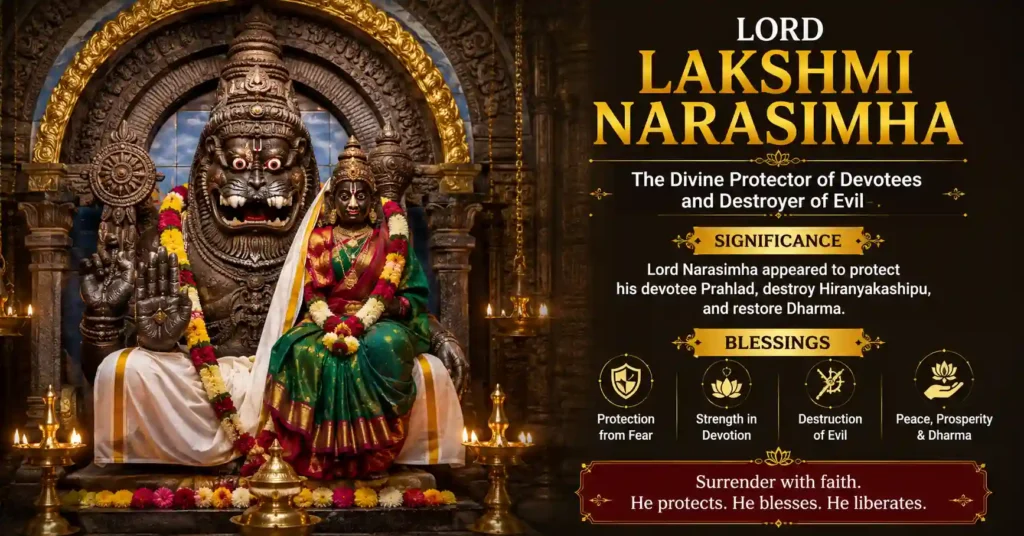
The Symbolism of Lord Narasimha
The unique form of Lord Narasimha carries profound spiritual symbolism in Sanatan Dharma. Every aspect of his divine appearance teaches timeless lessons about courage, righteousness, divine justice, and the protection of devotees.
| Symbol | Spiritual Meaning |
|---|---|
| Lion’s Face | Represents fearlessness, immense strength, and the power to destroy evil and protect righteousness. |
| Human Body | Symbolizes wisdom, compassion, and the Divine’s close connection with humanity. |
| Fierce Appearance | Reflects the determination to remove adharma while protecting sincere devotees from harm. |
| Divine Claws | Demonstrate that God’s power is beyond conventional weapons and human limitations. |
| Twilight Appearance (Pradosh Kaal) | Signifies that divine justice operates beyond the limits of time, logic, and human expectations. |
| Protection of Prahlad | Teaches that unwavering faith, devotion, and righteousness always receive divine grace and protection. |
For devotees, Lord Narasimha is not only the destroyer of evil but also the compassionate protector of truth and dharma.
His divine form reminds us that true strength is expressed through courage guided by wisdom, humility, and the protection of the innocent.
The Spiritual Significance of Narasimha Jayanti
The true significance of Narasimha Jayanti extends far beyond remembering the divine appearance of Lord Narasimha.
It is a celebration of the timeless values of faith, righteousness, courage, and divine protection that continue to inspire devotees in every generation.
In Hindu tradition, Lord Narasimha represents the power that protects dharma and removes fear, arrogance, and injustice. His appearance reminds us that even in the most difficult circumstances, unwavering devotion and truth are never abandoned by the Divine.
Just as Prahlad remained steadfast in his faith despite countless hardships, devotees are encouraged to face life’s challenges with courage, patience, and trust.
The festival also teaches that real strength does not come from physical power or worldly success but from inner conviction and a righteous way of life.
It inspires us to overcome fear, control our ego, and remain committed to truth even when the path is difficult.
In today’s fast-paced world, where uncertainty and stress often affect daily life, this festival serves as a reminder that faith can become a source of inner peace, resilience, and hope.
Its spiritual message remains as relevant today as it was in the time of Prahlad, encouraging every devotee to choose righteousness over fear and compassion over anger.
Lord Narasimha as the Divine Protector
One of the reasons Lord Narasimha is deeply revered in Sanatan Dharma is his role as the Divine Protector.
According to Hindu tradition, he appeared not to seek power or glory, but to safeguard his devoted follower Prahlad and restore righteousness when adharma had reached its limits.
This makes Narasimha Jayanti a festival that celebrates both divine justice and compassionate protection.
Devotees worship Lord Narasimha with the belief that he blesses them with courage, inner strength, and the confidence to face life’s challenges. His worship is traditionally associated with:
Protection from fear and negative influences.
Courage during difficult and uncertain times.
Inner peace and emotional resilience.
Strength to uphold truth and righteousness.
Greater faith in the presence of divine grace.
The protection of Lord Narasimha is understood not only as protection from external dangers but also from inner enemies such as fear, anger, pride, and ignorance.
Just as Prahlad remained fearless through unwavering devotion, devotees are encouraged to develop the same faith and trust in the Divine.
This timeless message is one of the reasons this holi day continues to inspire millions of devotees.
It reminds us that true protection begins with inner courage, righteous living, and unwavering devotion to God.
Narasimha Jayanti Puja Vidhi
The Narasimha Jayanti Puja Vidhi may vary according to family traditions, regional customs, and different Vaishnava sampradayas.
However, many devotees observe the festival with a simple and heartfelt worship at home, offering prayers to Lord Narasimha with faith and devotion.
You can follow these simple steps:
Prepare yourself and the place of worship by taking a bath, wearing clean clothes, and cleaning the puja area.
Place an image or idol of Lord Narasimha on a clean altar and light a diya and incense.
Offer Panchamrit (if available), followed by fresh flowers, Tulsi leaves, fruits, sweets, and other sattvic offerings.
Invoke Lord Narasimha with a sincere prayer and perform a simple abhishek if it is part of your family tradition.
Chant the Narasimha Mantra, Vishnu Sahasranama, or other prayers dedicated to Lord Vishnu according to your capacity.
Perform the main puja during Pradosh Kaal (evening), which is traditionally believed to be the time of Lord Narasimha’s divine appearance.
Conclude the worship with aarti, offer prasad to the deity, and then distribute it among family members.
The true essence of Narasimha Jayanti lies not in elaborate rituals but in sincere devotion, faith, and the remembrance of Lord Narasimha’s protection. Even a simple prayer offered with a pure heart is considered a meaningful act of worship.
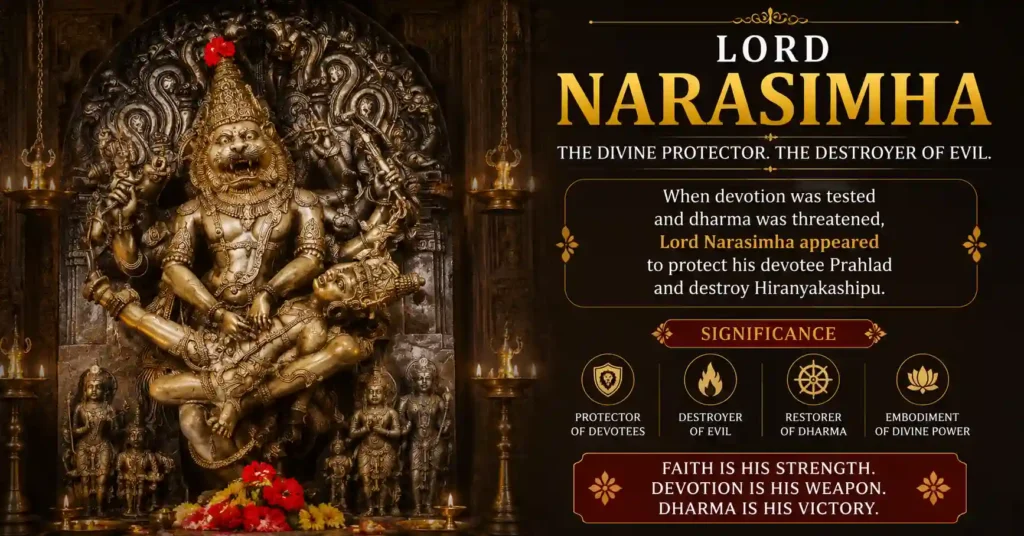
Sacred Offerings for Lord Narasimha
Offering simple and pure items with devotion is an important part of this auspicious day puja. While offerings may vary according to family traditions and regional customs, the following are commonly offered to Lord Narasimha.
| Offering | Significance |
|---|---|
| Tulsi Leaves | Considered especially dear to Lord Vishnu and Lord Narasimha, symbolizing pure devotion. |
| Fresh Flowers | Offered as a mark of respect, love, and gratitude to the Lord. |
| Fruits | Represent purity, simplicity, and the fruits of righteous actions. |
| Panchamrit | A sacred mixture of milk, curd, honey, ghee, and sugar used during abhishek. |
| Sattvic Sweets and Prasad | Prepared with devotion and offered before being shared with family and devotees. |
| Diya and Incense | Symbolize the removal of darkness, ignorance, and negativity through divine light. |
More important than the offerings themselves is the devotion with which they are made. According to Hindu tradition, Lord Narasimha accepts sincere prayers offered with a pure heart, humility, and unwavering faith.
How Narasimha Jayanti Is Celebrated in Temples
On Narasimha Jayanti, temples dedicated to Lord Narasimha and Lord Vishnu are filled with devotion and spiritual fervour.
While the exact rituals may vary across regions and temple traditions, the day is generally marked by special worship, devotional singing, and the remembrance of Lord Narasimha’s divine protection.
Many temples begin the celebrations with abhishek using sacred offerings such as milk, curd, honey, ghee, and holy water, followed by the beautiful decoration (alankaram) of the deity with fresh flowers, ornaments, and traditional attire.
Special pujas, aarti, and the chanting of Narasimha Mantras, Vishnu Sahasranama, and Vedic hymns are performed throughout the day.
In many temples, priests narrate the inspiring story of Prahlad and the appearance of Lord Narasimha, reminding devotees of the triumph of faith over fear and righteousness over evil. Devotional bhajans, kirtans, and spiritual discourses create an atmosphere of devotion and gratitude.
The celebrations usually conclude with the distribution of prasadam and blessings to devotees.
In some regions, temples also organise community feasts, religious processions, or cultural programmes, making this festival a joyful occasion for collective worship and spiritual reflection.
Celebrations of Narasimha Jayanti Across India
Although the spiritual significance of Narasimha Jayanti remains the same, the way it is celebrated varies across different regions of India and among various Vaishnava traditions.
Devotees gather to worship Lord Narasimha, participate in special pujas, chant sacred mantras, and remember the inspiring story of Prahlad.
In Andhra Pradesh and Telangana, where several famous Narasimha temples are located, thousands of devotees participate in elaborate abhishek, alankaram, special aartis, and temple processions. Temples such as Ahobilam and Yadadri witness large gatherings on this auspicious day.
In Karnataka, devotees observe Vrat, visit ancient Vishnu and Narasimha temples, recite the Vishnu Sahasranama, and participate in bhajans and spiritual discourses.
In Odisha, West Bengal, and many parts of North India, devotees celebrate the festival by performing simple pujas at home, listening to the story of Prahlad and Lord Narasimha, chanting the Narasimha Mantra, and distributing prasadam among family and devotees.
Although customs and rituals differ from one region to another, the message of this auspicious day remains universal. The festival inspires devotees to cultivate faith, courage, righteousness, and complete trust in the protective grace of Lord Narasimha.
Famous Narasimha Temples in India
Devotees visit Lord Narasimha temples throughout the year, but these sacred places become especially vibrant during Narasimha Jayanti. Thousands of devotees gather to participate in special pujas, abhisheks, aartis, and devotional celebrations.
| Temple | Location | Significance |
|---|---|---|
| Ahobilam Narasimha Temple | Andhra Pradesh | One of the most sacred Narasimha temples, associated with the divine appearance of Lord Narasimha. |
| Yadadri Lakshmi Narasimha Temple | Telangana | A renowned pilgrimage site dedicated to Lord Lakshmi Narasimha, visited by millions of devotees. |
| Simhachalam Temple | Visakhapatnam, Andhra Pradesh | Famous for its unique deity of Varaha Lakshmi Narasimha and centuries-old traditions. |
| Devarayanadurga Lakshmi Narasimha Temple | Karnataka | An ancient hill temple known for its peaceful surroundings and devotional significance. |
| Shri Lakshmi Narasimha Swamy Temple | Antarvedi, Andhra Pradesh | A revered Vaishnava temple located near the confluence of the Godavari River and the Bay of Bengal. |
These temples preserve the rich spiritual heritage of Lord Narasimha and continue to inspire devotees with their traditions, festivals, and unwavering devotion to the protector of dharma.
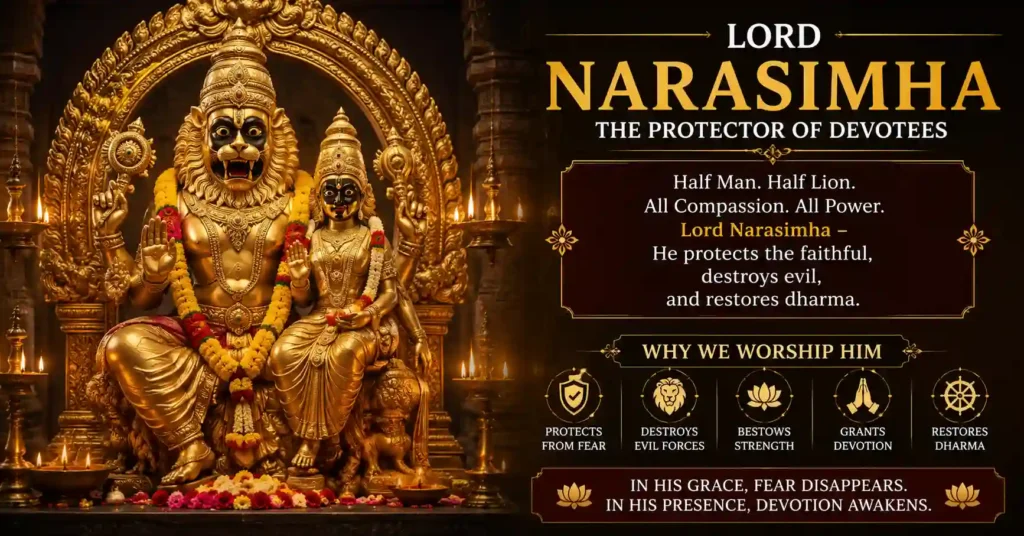
Powerful Mantras of Lord Narasimha
The sacred mantras of Lord Narasimha are traditionally chanted by devotees throughout the year to seek courage, inner peace, divine protection, and spiritual strength.
While these mantras hold special significance during Narasimha Jayanti, they may be recited on any day with faith and devotion.
1. Narasimha Moola Mantra
ॐ नमो भगवते नरसिंहाय
Om Namo Bhagavate Narasimhaya
This simple yet powerful mantra is a prayer seeking the blessings, protection, and grace of Lord Narasimha. It is commonly chanted during daily worship, meditation, and times of difficulty.
2. Ugra Narasimha Mantra
उग्रं वीरं महाविष्णुं ज्वलन्तं सर्वतोमुखम् ।
नृसिंहं भीषणं भद्रं मृत्युमृत्युं नमाम्यहम् ॥
Ugram Viram Maha Vishnum
Jvalantam Sarvato Mukham
Nrisimham Bhishanam Bhadram
Mrityor Mrityum Namamyaham ॥
This ancient mantra praises the fierce yet compassionate form of Lord Narasimha, who protects devotees, destroys fear, and upholds righteousness.
It is widely recited during Narasimha worship and on auspicious occasions dedicated to Lord Vishnu.
Whether you chant these mantras daily or on this auspicious day, the most important aspect is devotion, sincerity, and mindful repetition.
According to Hindu tradition, regular chanting helps cultivate courage, faith, and a deeper connection with the Divine.
Narasimha Jayanti Vrat Rules
Many devotees observe a Narasimha Jayanti Vrat as an expression of devotion to Lord Narasimha and in remembrance of his divine appearance.
The method of fasting may vary according to family traditions, regional customs, and different Vaishnava sampradayas, so there is no single compulsory way to observe the vrat.
Traditionally, devotees may follow one of these practices:
Observe a nirjala vrat (fast without food or water), if physically able.
Keep a phalahar vrat, consuming fruits, milk, and other light sattvic foods.
Eat a simple sattvic meal after completing the evening worship, if a full fast is not possible.
During the day, devotees spend time in prayer, chanting the Narasimha Mantra, reading the story of Prahlad and Lord Narasimha, or listening to devotional discourses.
The main puja is traditionally performed during Pradosh Kaal (evening), after which many devotees conclude their fast with prasad and a simple sattvic meal.
More important than the type of fasting is the spirit in which it is observed. This festival teaches that devotion, purity of thought, self-discipline, and faith in the Divine are the true essence of the vrat.
Benefits of Observing Narasimha Jayanti
According to Hindu tradition, observing Narasimha Jayanti with devotion, vrat, prayer, and the chanting of Lord Narasimha’s sacred mantras is believed to bring spiritual strength and inner peace.
While every devotee’s experience is personal, the festival is widely regarded as an opportunity to deepen faith and strengthen one’s connection with the Divine.
Devotees believe that observing this auspicious day may help:
Develop courage to face life’s challenges with confidence.
Strengthen faith and devotion to Lord Narasimha.
Overcome fear, anxiety, and negative thoughts through prayer and remembrance.
Cultivate patience, self-discipline, and emotional balance.
Inspire righteous living by following the example of Prahlad’s unwavering devotion.
Promote inner peace and spiritual growth through puja, vrat, and mantra chanting.
Beyond these traditional beliefs, this festival reminds us that true strength comes not only from external protection but also from inner faith, wisdom, and steadfast devotion.
The festival encourages every devotee to live with courage, humility, and trust in divine grace.
Charity and Seva on Narasimha Jayanti
Along with puja, vrat, and mantra chanting, daan (charity) and seva (selfless service) are considered meaningful ways to observe Narasimha Jayanti. Hindu tradition teaches that devotion becomes even more meaningful when it is expressed through kindness, compassion, and helping others.
On this sacred day, devotees may choose to donate food, clothes, or essential items to those in need. Offering support to temples, feeding cows, birds, or other animals, serving the poor, or contributing to educational and charitable causes are also regarded as noble acts of service.
The value of charity is not measured by its size but by the sincerity of the intention. Even a small act of kindness performed with humility reflects the spirit of Lord Narasimha, who appeared to protect righteousness and uphold dharma.
By combining worship with compassion and selfless service, devotees celebrate this festival in a way that honours both the teachings and the divine example of Lord Narasimha.
Simple Ways to Celebrate Narasimha Jayanti
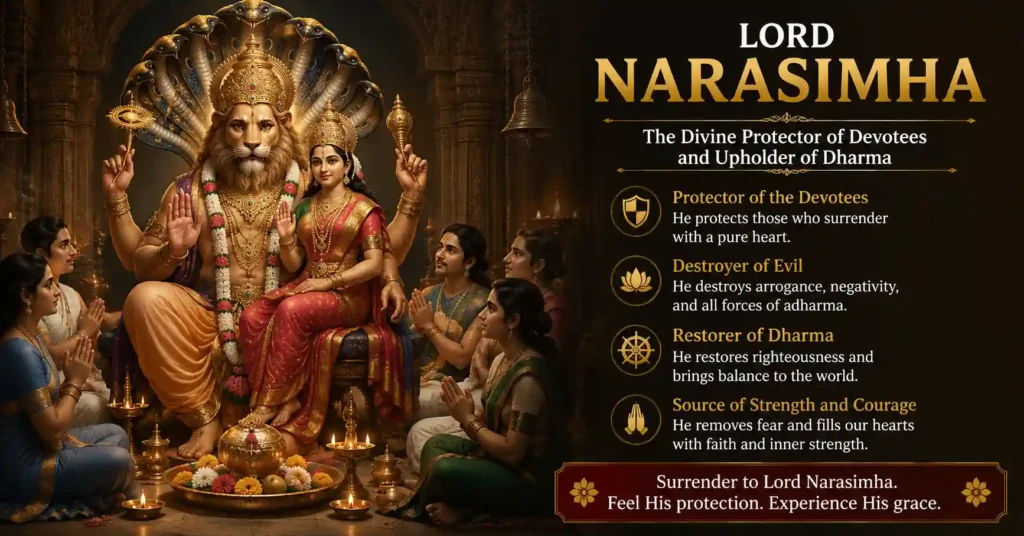
Celebrating Narasimha Jayanti does not require elaborate rituals. The festival is ultimately about expressing devotion to Lord Narasimha with sincerity and a pure heart. Even simple acts of worship performed with faith are considered meaningful.
You can observe this festival in the following ways:
Light a diya and offer simple prayers to Lord Narasimha.
Chant the Narasimha Mantra or recite the names of Lord Vishnu.
Read or listen to the inspiring story of Prahlad and Lord Narasimha.
Visit a nearby Vishnu or Narasimha temple if possible.
Spend a few minutes in meditation and quiet reflection.
Perform daan (charity) or help someone in need as an act of compassion.
Share the story and spiritual message of Narasimha Jayanti with children and family members.
Prepare and offer simple sattvic prasad before sharing it with loved ones.
The true celebration of this auspicious day lies in strengthening faith, practising righteousness, and remembering that sincere devotion is always more important than elaborate rituals.
Common Mistakes to Avoid During Narasimha Jayanti
Observing Narasimha Jayanti is about sincere devotion rather than perfect rituals. However, avoiding a few common mistakes can help devotees celebrate the festival with greater mindfulness and spiritual focus.
- Performing the puja in haste without understanding its purpose.
- Focusing only on rituals while neglecting prayer, humility, and devotion.
- Allowing anger, arguments, or negative thoughts to disturb the peaceful spirit of the day.
- Ignoring the significance of the Vrat by treating it as a mere formality.
- Forgetting to read or reflect on the inspiring story of Prahlad and Lord Narasimha.
- Expecting immediate material rewards instead of approaching worship with faith and surrender.
The essence of this holi day lies in devotion, self-discipline, compassion, and trust in the Divine. A calm mind, a pure heart, and sincere faith are considered far more valuable than elaborate rituals alone.
Do's and Don'ts for Narasimha Jayanti
Observing Narasimha Jayanti is not only about performing rituals but also about cultivating devotion, self-discipline, and righteous conduct. While customs may vary across families and traditions, these simple guidelines can help devotees observe the festival with sincerity and reverence.
Do’s
- Wake up early, take a holy bath, and wear clean clothes before beginning the day’s worship.
- Perform Puja with devotion and a peaceful mind.
- Chant the Narasimha Mantra, recite Vishnu Sahasranama, or read the story of Prahlad and Lord Narasimha.
- Offer fresh flowers, Tulsi leaves, fruits, and sattvic prasad to Lord Narasimha.
- Observe the Vrat according to your health and family tradition.
- Practise daan (charity), seva (selfless service), kindness, and gratitude.
Don’ts
- Avoid anger, harsh speech, arguments, and negative thoughts.
- Refrain from consuming non-vegetarian food, alcohol, or intoxicants during the observance.
- Do not perform the puja in haste or without concentration.
- Avoid hurting others through words or actions and spend time in prayer, meditation, and self-reflection.
The true spirit of this auspicious day lies in living with faith, humility, compassion, and righteousness. More than elaborate rituals, it is a sincere heart and unwavering devotion that are regarded as the greatest offerings to Lord Narasimha.
Why Narasimha Jayanti Matters Today
Although the story of Lord Narasimha belongs to ancient Hindu tradition, its message remains as meaningful today as ever.
In a world filled with uncertainty, stress, injustice, and constant challenges, Narasimha Jayanti reminds us that faith, courage, and righteousness can help us face even the most difficult situations with strength and hope.
The unwavering devotion of Prahlad teaches us to remain true to our values, even when we face pressure, fear, or adversity.
Likewise, the divine appearance of Lord Narasimha reminds us that righteousness is always protected and that arrogance and injustice can never prevail forever.
According to Hindu tradition, the Lord appears whenever it is necessary to uphold dharma and protect sincere devotees.
For devotees, this festival is more than the remembrance of a divine event. It is an opportunity to strengthen faith, overcome fear, practise compassion, and develop inner resilience through prayer, self-discipline, and devotion.
The festival encourages us to replace anger with patience, pride with humility, and doubt with trust in the Divine.
That is why this auspicious day continues to inspire millions of devotees across generations. Its timeless message reminds us that when we walk the path of truth, devotion, and righteousness, we find the courage and inner strength to face life’s challenges with confidence and faith.
Key Takeaways
- Narasimha Jayanti commemorates the divine appearance of Lord Narasimha, the fourth avatar of Lord Vishnu.
- The festival celebrates the victory of faith, righteousness, and divine justice over arrogance and evil.
- Devotees observe the day through puja, vrat, mantra chanting, meditation, and charity.
- The inspiring story of Prahlad teaches unwavering faith and trust in the Divine.
- The timeless message of Narasimha Jayanti continues to inspire courage, devotion, and righteous living.
Conclusion
Narasimha Jayanti is much more than the celebration of the divine appearance of Lord Narasimha. It is a timeless reminder that faith, righteousness, and devotion are always stronger than fear, arrogance, and injustice.
The inspiring story of Prahlad teaches us that unwavering trust in the Divine can become a source of courage, hope, and inner strength, even during life’s greatest challenges.
Whether you observe this auspicious day through puja, vrat, mantra chanting, meditation, or a simple prayer, the true spirit of the festival lies in cultivating devotion, humility, and righteous living. More than elaborate rituals, it is the sincerity of the heart that makes worship meaningful.
May Lord Narasimha bless you with courage to face every challenge, wisdom to walk the path of dharma, and the strength to remain steadfast in faith.
As you celebrate this sacred festival, may the divine protection and compassionate grace of Lord Narasimha inspire peace, confidence, and spiritual growth in your life.
Suggested Reading
If you would like to deepen your understanding of Lord Vishnu, Sanatan Dharma, and the spiritual traditions associated with Narasimha Jayanti, explore these related articles from The Sanatan Tales.
They offer practical insights into Hindu festivals, rituals, and the timeless values of faith, devotion, and righteousness.
Akshaya Tritiya: Date, Muhurat and Meaning
https://thesanatantales.com/akshaya-tritiya/
Hanuman Jayanti: Devotion and Strength
https://thesanatantales.com/hanuman-jayanti/
Ram Navami: Date, Puja Vidhi and the Sacred Birth Story of Lord Ram
https://thesanatantales.com/ram-navami/
Chaitra Navratri: Dates, Meaning, Rituals and Spiritual Significance
https://thesanatantales.com/chaitra-navratri/
Gayatri Jayanti: Story, Meaning and Significance
https://thesanatantales.com/gayatri-jayanti
Holi Festival: Meaning, History and Celebration
https://thesanatantales.com/holi-festival/
Mahashivratri: Meaning, Date, Rituals, Vrat Rules & Puja Vidhi
https://thesanatantales.com/mahashivratri
Gupta Navratri: Meaning, 2026 Dates, Rituals and Spiritual Significance
https://thesanatantales.com/gupta-navratri/
Makar Sankranti: Meaning, Date, Rituals, Puja, Traditions and Spiritual Significance
https://thesanatantales.com/makar-sankranti/
Narasimha Jayanti (Wikipedia)
https://en.wikipedia.org/wiki/Narasimha_Jayanti
FAQs
What is Narasimha Jayanti?
Narasimha Jayanti is a sacred Hindu festival that commemorates the divine appearance of Lord Narasimha, the fourth avatar of Lord Vishnu. It is celebrated to honour his protection of Prahlad and the triumph of righteousness over evil.
Why is Narasimha Jayanti celebrated?
According to Hindu tradition, Narasimha Jayanti marks the day when Lord Narasimha appeared to protect his devoted follower Prahlad and defeat the demon king Hiranyakashipu. The festival symbolizes faith, divine protection, and the victory of dharma over adharma.
Who is Lord Narasimha?
Lord Narasimha is the fourth Dashavatara of Lord Vishnu. He appeared in the unique form of half-man and half-lion to uphold righteousness and protect his devotees.
What is the significance of Narasimha Jayanti?
The festival reminds devotees that sincere faith, truth, and righteousness are always protected by the Divine. It also inspires courage, devotion, and inner strength in the face of life’s challenges.
How should I celebrate Narasimha Jayanti?
You can celebrate Narasimha Jayanti by performing puja, observing a vrat according to your tradition, chanting Narasimha Mantras, reading the story of Prahlad, visiting a temple, practising charity, and spending time in prayer and meditation.
Can anyone observe the Narasimha Jayanti Vrat?
Yes. Anyone may observe the Narasimha Jayanti Vrat according to their health, family customs, and spiritual tradition. The essence of the vrat is sincere devotion rather than strict ritual.
Which mantra is best for Lord Narasimha?
Among the most widely chanted mantras are “Om Namo Bhagavate Narasimhaya” and the Ugra Narasimha Mantra. Both are traditionally recited to seek courage, protection, and divine blessings.
What is the best time to perform Narasimha Jayanti Puja?
The main puja is traditionally performed during Pradosh Kaal (evening), as Hindu tradition associates this time with the divine appearance of Lord Narasimha.
Is Narasimha Jayanti celebrated across India?
Yes. The festival is celebrated across India, especially at famous Narasimha temples in Andhra Pradesh, Telangana, Karnataka, Odisha, and other regions, where devotees participate in special pujas, abhisheks, bhajans, and temple celebrations.
Glossary of Important Terms
| Term | Meaning |
|---|---|
| Abhishek | A sacred ritual of bathing the deity with offerings such as milk, curd, honey, ghee, and holy water as an act of devotion. |
| Adharma | Actions that go against righteousness, truth, morality, and the principles of Sanatan Dharma. |
| Alankaram | The ceremonial decoration of a deity with clothes, ornaments, flowers, and garlands in a temple or home shrine. |
| Aarti | A devotional ritual in which a lit lamp is offered to the deity while singing prayers or hymns. |
| Bhakta | A devotee who worships God with faith, love, and complete devotion. |
| Bhajan | A devotional song sung in praise of God, often during worship or religious gatherings. |
| Chaturdashi | The fourteenth day of a lunar fortnight in the Hindu calendar. Narasimha Jayanti falls on Vaishakha Shukla Chaturdashi. |
| Dashavatara | The ten principal incarnations of Lord Vishnu, with Lord Narasimha being the fourth avatar. |
| Dharma | The eternal principle of righteousness, moral duty, truth, and living according to divine values. |
| Diya | A small oil lamp lit during worship as a symbol of divine light and the removal of ignorance. |
| Mantra | A sacred verse or sound repeated during prayer or meditation to invoke divine blessings and spiritual focus. |
| Panchamrit | A sacred mixture of milk, curd, honey, ghee, and sugar used during abhishek and offered as prasad. |
| Panchang | The traditional Hindu calendar that provides details such as tithi, nakshatra, yoga, and auspicious timings for rituals. |
| Pradosh Kaal | The twilight period after sunset, traditionally believed to be the time when Lord Narasimha appeared. |
| Prasad | Food or offerings first presented to the deity and then distributed to devotees as a sacred blessing. |
| Puja | A Hindu worship ritual involving prayers, offerings, mantra chanting, and devotion to the deity. |
| Sampradaya | A spiritual tradition or lineage that preserves and passes down specific teachings and methods of worship. |
| Sattvic | Pure, wholesome, and spiritually uplifting food or lifestyle that promotes clarity, peace, and devotion. |
| Seva | Selfless service performed with humility as an offering to God and for the welfare of others. |
| Shukla Paksha | The bright fortnight of the lunar month, beginning after the new moon and ending with the full moon. |
| Tulsi | The sacred holy basil plant, revered as especially dear to Lord Vishnu and commonly offered during worship. |
| Vaishakha | The second month of the Hindu lunar calendar in which Narasimha Jayanti is observed. |
| Vaishnava | A follower of Lord Vishnu and his incarnations, including Lord Narasimha. |
| Vrat | A religious fast or spiritual observance undertaken with discipline, prayer, and devotion. |
| Vishnu Sahasranama | A sacred hymn containing one thousand names of Lord Vishnu, traditionally recited for spiritual merit and divine blessings. |
About the Author
Yateendra Chaturvedi is a spiritual writer, researcher, devotee, and the founder of The Sanatan Tales. With over 35 years of professional experience and a lifelong interest in Sanatan Dharma, he writes about Hindu deities, temples, scriptures, festivals, Mahavidyas, sacred stories, rituals, and living traditions that continue to guide and inspire devotees across India.
Drawing from traditional scriptures, regional beliefs, temple traditions, devotional literature, and historical sources, he aims to present authentic, well-researched, and easy-to-understand content for modern readers. His work focuses on preserving spiritual wisdom, explaining sacred traditions, and helping seekers develop a deeper understanding of India’s rich spiritual heritage.
Through The Sanatan Tales, Yateendra strives to make the timeless teachings of Sanatan Dharma simple, meaningful, and relevant for today’s generation while maintaining respect for traditional sources, regional practices, and diverse spiritual perspectives.
Learn More About Yateendra Chaturvedi →
https://thesanatantales.com/about-the-author/
References & Sources
This article is based on the teachings and traditions of Sanatan Dharma related to Lord Narasimha, the fourth avatar of Lord Vishnu. It draws upon narratives and concepts found in revered Hindu scriptures, including the Bhagavata Purana (Shrimad Bhagavatam), Vishnu Purana, Narasimha Purana, Harivamsha, and other traditional Vaishnava texts.
The article also reflects devotional practices, temple traditions, Panchang-based observances, and commonly accepted customs followed by devotees across different regions of India.
Note: Beliefs, rituals, fasting practices, and interpretations may vary among different Vaishnava sampradayas, regional traditions, temples, and family customs.
The purpose of this article is not to establish any one tradition as the only authoritative view, but to present widely accepted religious and spiritual perspectives in a simple, respectful, and accessible manner for readers seeking to understand the significance of Narasimha Jayanti.
Explore More Fascinating Topics from Sanatan Dharma