In every home, there is a quiet wish. Not just for money, but for peace… for stability… for a life that feels settled and graceful. This is where Maa Lakshmi comes into our lives.
Many people think she is only the goddess of wealth. But when you sit with her presence a little deeper, you begin to feel something more. A calmness. A sense that things are flowing as they should.
Understanding Maa Lakshmi is not about rituals alone. It is about recognizing how her presence and blessings quietly shape our daily life, bringing prosperity, balance, and inner contentment.
Table of Contents
ToggleWho is Maa Lakshmi in Simple Words
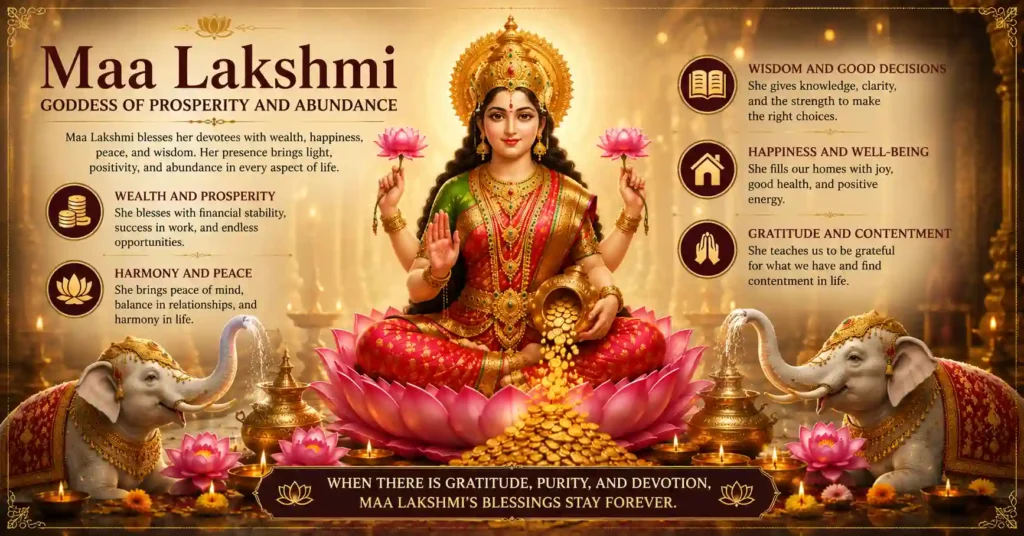
Maa Lakshmi is the goddess of wealth, prosperity, and abundance in Sanatan Dharma. She is also the divine consort of Lord Vishnu, showing that prosperity and balance go together. But in simple words, she is not only about money.
Goddess Lakshmi represents harmony, beauty, comfort, well-being, and the blessings that help life flourish. Wherever there is respect, gratitude, and balance, her presence is believed to be naturally felt.
She is one of the most widely worshipped deities in Hindu tradition and is revered in homes, temples, and festivals across India. Devotees seek her blessings not only for financial prosperity but also for peace, stability, and a fulfilling life.
If your home feels peaceful, your relationships feel stable, and your mind feels calm, that itself is her blessing.
The Deeper Meaning of Maa Lakshmi
We often connect wealth with what we earn. But Maa Lakshmi teaches a deeper truth about prosperity and abundance.
Real wealth is not measured only by money, possessions, or social status. It is also reflected in the quality of our life, our relationships, our peace of mind, and our ability to feel content with what we have.
In Hindu thought, prosperity is meant to support a balanced and meaningful life. This is why Maa Lakshmi is associated not only with financial well-being but also with harmony, beauty, gratitude, and fulfillment. Her blessings help create the conditions in which individuals and families can flourish.
Her presence may be felt as peace in the home, stability in life, respect in relationships, good health, and a calm and content mind. These are the forms of wealth that often endure long after material gains have changed.
This is why a simple life can sometimes feel deeply fulfilling, while a life filled with constant achievement may still feel incomplete. True prosperity is not only about what we possess but also about the sense of balance and gratitude with which we live.
When life feels grounded, meaningful, and fulfilling, many devotees see that as the quiet presence of Maa Lakshmi’s grace.
Maa Lakshmi and Lord Vishnu: Why They Are Worshipped Together
Maa Lakshmi and Lord Vishnu are often worshipped together as Lakshmi Narayan. Their relationship carries a deep spiritual meaning within Sanatan Dharma.
Lord Vishnu is the preserver of the universe. He protects dharma, maintains cosmic order, and sustains creation through different incarnations. Maa Lakshmi represents prosperity, abundance, harmony, and well-being.
Together, they symbolize a simple truth: prosperity flourishes where there is balance, responsibility, and righteousness. Wealth without wisdom can create problems, while wisdom without resources may struggle to serve society. Lakshmi and Vishnu represent the harmony between these two forces.
This is why many devotees worship Lakshmi Narayan together. Their blessings are believed to bring not only material prosperity but also stability, peace, and spiritual growth.
Why Maa Lakshmi Comes and Leaves
Many people wonder why Maa Lakshmi is believed to stay in some homes and leave others.
Traditional teachings suggest that her presence is closely connected to the environment we create through our thoughts, actions, and daily habits.
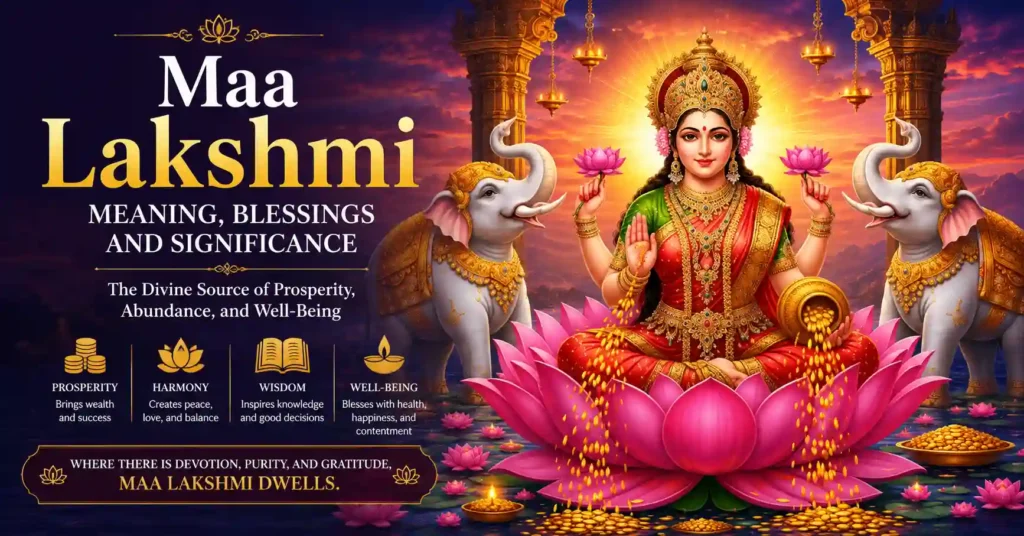
Maa Lakshmi is associated with prosperity, harmony, and well-being. For this reason, she is believed to dwell where there is cleanliness, respect, gratitude, and peaceful relationships. A home where family members support one another, speak kindly, and live responsibly is often described as a place where her blessings naturally flourish.
On the other hand, constant conflict, disrespect, dishonesty, excessive negativity, and a lack of gratitude are traditionally seen as conditions that disturb the harmony she represents. The idea is not that Maa Lakshmi punishes people or suddenly withdraws her blessings, but that prosperity struggles to thrive in an atmosphere of disorder and imbalance.
Many traditions also teach that wealth should be earned ethically and used wisely. Generosity, responsibility, and appreciation for what one already has are considered qualities that help sustain Lakshmi’s grace.
This is not something to fear. Rather, it is a reminder that prosperity is closely connected to the values we cultivate in daily life. Just as Maa Durga is worshipped to restore balance and strength, Maa Lakshmi is believed to remain where balance, gratitude, and harmony are maintained.
How Maa Lakshmi Appeared During Samudra Manthan
One of the most well-known stories associated with Maa Lakshmi comes from the Samudra Manthan, the great churning of the cosmic ocean described in Hindu scriptures.
According to the story, the Devas and Asuras worked together to churn the Ocean of Milk in search of Amrit, the nectar of immortality. During this sacred event, many divine treasures emerged from the ocean.
Among them appeared Maa Lakshmi, radiant and seated upon a lotus. Her arrival symbolized the emergence of prosperity, beauty, abundance, and divine grace.
The gods and sages welcomed her with reverence. After observing all beings, Maa Lakshmi chose Lord Vishnu as her eternal companion because he embodied balance, righteousness, and the preservation of cosmic order.
This sacred story reminds devotees that true prosperity flourishes where dharma, discipline, and harmony are present. For this reason, Maa Lakshmi and Lord Vishnu continue to be worshipped together across Hindu traditions.
Ashta Lakshmi: The 8 Forms of Maa Lakshmi
To understand Maa Lakshmi more deeply, it helps to understand Ashta Lakshmi, the eight forms through which she blesses different areas of life.
These forms remind us that prosperity is not limited to money alone. True abundance includes health, knowledge, courage, family, success, and spiritual fulfillment.
| Form | Blessing |
|---|---|
| Dhana Lakshmi | Wealth, prosperity, and financial stability |
| Dhanya Lakshmi | Food, nourishment, and agricultural abundance |
| Gaja Lakshmi | Strength, dignity, respect, and royal prosperity |
| Santana Lakshmi | Family well-being, children, and growth |
| Veera Lakshmi | Courage, confidence, and inner strength |
| Vidya Lakshmi | Knowledge, wisdom, and learning |
| Vijaya Lakshmi | Success, achievement, and victory over obstacles |
| Adi Lakshmi | Spiritual peace, devotion, and inner balance |
Together, the Ashta Lakshmi forms teach that a truly prosperous life includes both material comfort and spiritual fulfillment.
Symbolism, Vahan and Important Days of Maa Lakshmi
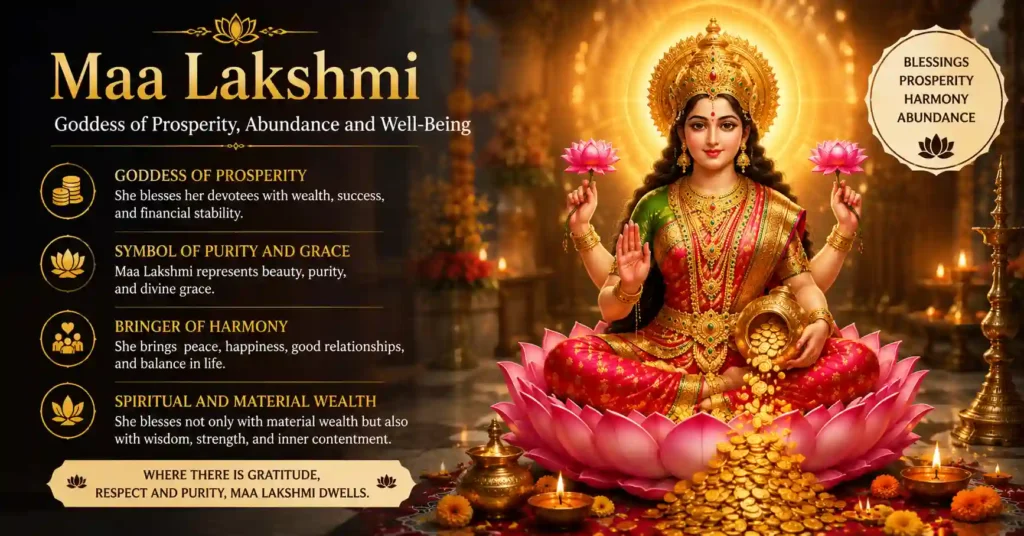
Maa Lakshmi is often shown seated on a lotus, which represents purity and balance even while living in the material world.
She holds lotus flowers and blesses devotees with gold coins, showing that true wealth flows where there is harmony and right living.
Unlike many deities, she does not carry weapons, because her power is gentle and nurturing.
Her vahan, the owl, is seen as a symbol of awareness, reminding us to use wealth wisely and not fall into ignorance.
| Symbol | Meaning |
|---|---|
| Lotus | Purity and spiritual growth while living in the world |
| Gold Coins | Prosperity, generosity, and abundance |
| Four Hands | Dharma, Artha, Kama, and Moksha, the four goals of life |
| Owl (Vahan) | Awareness, wisdom, and careful use of wealth |
Some days are especially connected to her worship, like Fridays, which are considered auspicious for Maa Lakshmi, and festivals like Diwali.
On Diwali, she is welcomed into homes with light, cleanliness, and devotion. Kojagiri Purnima and Varalakshmi Vratam are also observed in many regions, each carrying the same intention of inviting her blessings into life.
Maa Lakshmi and Diwali
Diwali is one of the most important festivals associated with Maa Lakshmi. On this day, millions of devotees across India worship her and seek blessings for prosperity, harmony, and well-being.
Traditionally, homes are cleaned, decorated with lamps, and illuminated to welcome positivity and auspiciousness. The lighting of diyas symbolizes the victory of light over darkness, knowledge over ignorance, and hope over despair.
Lakshmi Puja is performed on the main night of Diwali, when families gather to offer prayers with devotion and gratitude. While many people pray for financial prosperity, the deeper meaning of the festival goes beyond material wealth. It is also a time to invite peace, contentment, good relationships, and positive values into one’s life.
In this way, Diwali reminds us that Maa Lakshmi’s blessings are not limited to money alone. They include the abundance of joy, harmony, gratitude, and spiritual well-being that help create a truly prosperous life.
Maa Lakshmi in Hindu Scriptures
Maa Lakshmi is praised in several Hindu scriptures, where she is described as the embodiment of prosperity, beauty, fortune, and divine grace.
Some important scriptures associated with Maa Lakshmi include:
Vishnu Purana, which describes her relationship with Lord Vishnu and her role in sustaining creation.
Bhagavata Purana, which narrates her appearance during Samudra Manthan and her divine qualities.
Padma Purana, which contains stories and teachings connected to her worship and blessings.
Lakshmi Tantra, an important text that explores her spiritual significance and philosophy in greater depth.
Across these scriptures, Maa Lakshmi is presented as much more than a goddess of wealth. She represents harmony, auspiciousness, devotion, and the prosperity that supports a balanced and meaningful life.
Simple Ways to Attract Maa Lakshmi at Home
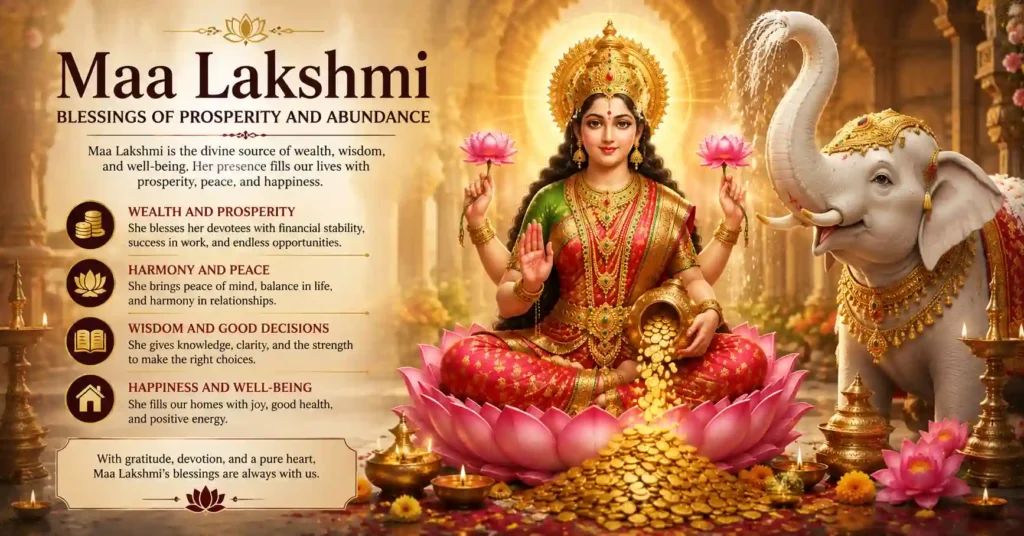
If someone asks how to invite Maa Lakshmi’s blessings into the home, the answer is often simpler than people expect.
Traditional teachings emphasize that her presence is connected not only with worship but also with the way we live each day.
Some commonly followed practices include:
Keeping the home clean and organized
Lighting a diya in the evening
Maintaining a peaceful and welcoming atmosphere
Speaking respectfully with family members
Expressing gratitude for what one already has
Using wealth responsibly and avoiding wastefulness
Helping others through kindness, charity, and service
These practices are not merely rituals. They encourage qualities such as discipline, gratitude, harmony, and awareness, which are closely associated with Maa Lakshmi.
Many traditions also encourage keeping the entrance of the home clean, reducing unnecessary clutter, and maintaining positive relationships within the family. Such habits help create an environment of balance and well-being.
Ultimately, the deeper teaching is that Maa Lakshmi is attracted not simply by external rituals but by the values those rituals are meant to cultivate. A peaceful home, respectful relationships, and a grateful heart are often considered the strongest invitation to her blessings.
Signs Maa Lakshmi is Blessing You
Maa Lakshmi’s blessings are often subtle rather than dramatic. Her presence is usually felt through a sense of balance, stability, and well-being.
Some signs devotees commonly associate with her blessings include:
Greater peace and harmony within the home
Improved financial stability and responsible use of resources
Help and opportunities arriving at the right time
Stronger relationships built on respect and trust
A growing sense of gratitude and contentment
Reduced anxiety about the future
A feeling that life is flowing more smoothly despite challenges
These signs are not always material. Often, her greatest blessings appear as inner stability, peace of mind, and the ability to face life’s difficulties with confidence and faith.
How Maa Lakshmi Connects with Our Daily Life
Maa Lakshmi is not separate from our daily routine. Her presence can be seen in many ordinary moments that are often overlooked.
When a meal is prepared and shared with love, when a home feels clean and welcoming, or when people speak with kindness and respect, her blessings are already present.
She is also reflected in the way we earn, spend, and share our resources. Wealth earned honestly and used responsibly carries the qualities associated with Maa Lakshmi. Generosity, gratitude, and helping others are also considered expressions of her grace.
At the same time, constant dissatisfaction, carelessness, greed, and misuse of resources can disturb that sense of balance.
For this reason, connecting with Maa Lakshmi is not only about prayer or ritual. It is also about cultivating gratitude, responsibility, and harmony in everyday life.
Mistakes That Block Maa Lakshmi’s Blessings
Sometimes people feel that despite their efforts, prosperity, peace, and stability do not seem to flow smoothly in life.
Traditional teachings suggest that certain habits can gradually disturb the harmony associated with Maa Lakshmi’s blessings:
Constant negativity and conflict within the home
Disrespect between family members
Clutter, disorder, and lack of cleanliness
Harsh, dishonest, or careless speech
Wastefulness and irresponsible use of resources
Lack of gratitude and contentment
These may appear to be small everyday habits, but over time they can affect the atmosphere of a home and the quality of relationships within it.
The purpose of these teachings is not to create fear but to encourage awareness. When negativity is replaced with gratitude, conflict with respect, and disorder with balance, the same home often begins to feel lighter, calmer, and more welcoming.
In this sense, Maa Lakshmi’s blessings are closely connected with the values we practice every day.
When and How to Pray Maa Lakshmi
Many people ask about the right way to pray to Maa Lakshmi.
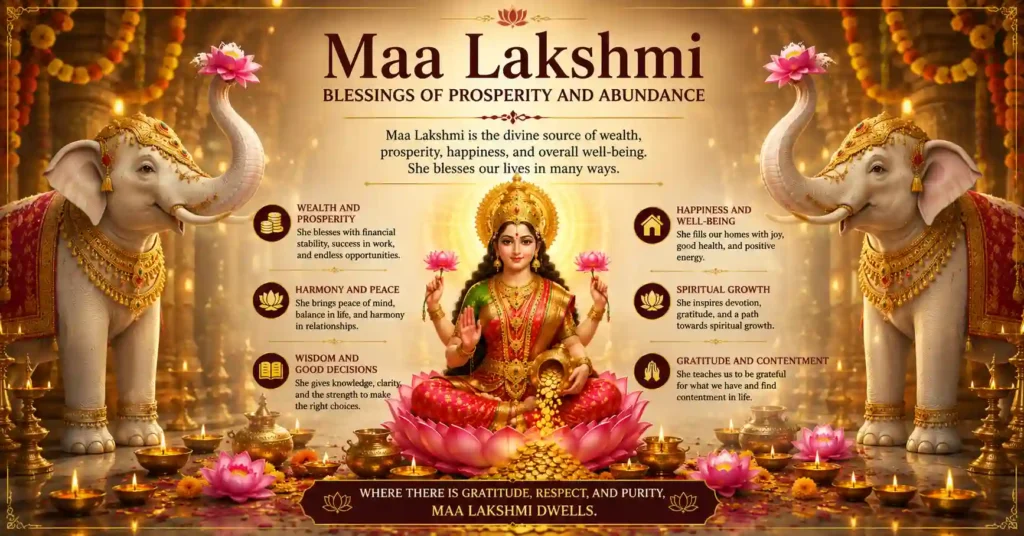
The good news is that her worship does not require complicated rituals. Devotion, gratitude, and sincerity are considered far more important than elaborate ceremonies.
Friday is widely regarded as an auspicious day for Maa Lakshmi worship, and many devotees prefer to pray during the evening after lighting a diya. Festivals such as Diwali, Kojagiri Purnima, and Varalakshmi Vratam are also especially associated with seeking her blessings.
A simple way to worship Maa Lakshmi is to light a lamp, offer flowers, sit quietly for a few moments, and recite a prayer, mantra, or stotra with a focused mind. Many devotees also spend a few moments expressing gratitude for the blessings already present in their lives.
More important than the timing or ritual is the feeling behind it. A sincere prayer offered with faith and gratitude often carries greater meaning than a long ritual performed without attention.
Ultimately, Maa Lakshmi worship is not only about asking for prosperity. It is also about cultivating contentment, humility, gratitude, and a deeper awareness of the abundance already present in life.
A Simple Lakshmi Mantra for Devotees
Many devotees chant simple Lakshmi mantras to express devotion and seek the blessings of prosperity, peace, and well-being. While there are many traditional Lakshmi mantras, one of the most widely recited is:
ॐ श्रीं महालक्ष्म्यै नमः
Om Shreem Mahalakshmyai Namah
This mantra is a respectful salutation to Goddess Mahalakshmi. The sacred seed sound “Shreem” is traditionally associated with abundance, auspiciousness, and divine grace.
Devotees often chant this mantra during daily prayer, on Fridays, during Diwali, or whenever they wish to connect with Maa Lakshmi through devotion and gratitude.
More important than the number of repetitions is the sincerity of the prayer and the positive qualities it inspires in daily life.
The Real Wealth Maa Lakshmi Gives
In the end, what does Maa Lakshmi truly give?
Not just money. Not just comfort.
Her blessings extend far beyond material wealth. She gives stability, contentment, gratitude, and the ability to live with balance and purpose.
Financial prosperity can support a comfortable life, but without peace, wisdom, and meaningful relationships, it rarely brings lasting happiness. Maa Lakshmi reminds us that true abundance includes both outer prosperity and inner fulfillment.
This is why many spiritual traditions teach that generosity, ethical living, gratitude, and devotion are also forms of wealth.
Money may come and go, and circumstances may change. But a peaceful mind, a grateful heart, and a life lived with dignity remain among the greatest blessings of Maa Lakshmi.
That is the deeper meaning of her grace and the highest form of prosperity she offers.
A Soft Closing Thought
Maa Lakshmi does not come through force. She comes quietly, where there is simplicity, respect, gratitude, and balance.
Throughout Hindu tradition, her blessings have never been limited to wealth alone. They are also seen in peaceful homes, meaningful relationships, honest prosperity, and a heart that feels content with life.
When the home feels harmonious and the mind feels grateful, many devotees believe her presence is already there. In this way, Maa Lakshmi reminds us that true abundance is not only about what we possess but also about how we live.
Sometimes, without even realizing it, her grace has already entered our life through the peace, stability, and blessings we often take for granted.
Suggested Reading
The blessings of Maa Lakshmi are connected with prosperity, gratitude, devotion, and spiritual balance. If you would like to deepen your understanding of the Divine Mother and her various forms, the following articles may be helpful.
Maa Kamalatmika: The Lakshmi Form Among the Mahavidyas
https://thesanatantales.com/maa-kamalatmika-tenth-mahavidya/
Das Mahavidya: From Kali to Kamala, The Journey Within
https://thesanatantales.com/das-mahavidya-kali-to-kamala
Navadurga: The Nine Forms of Maa Durga
https://thesanatantales.com/navadurga-nine-forms-of-maa-durga
Why We Worship Maa Durga During Navratri
https://thesanatantales.com/why-we-worship-maa-durga-during-navratri
Mahalaxmi Temple Kolhpur: Complete Pilgrim Guide to Ambabai Shakti Peetha
https://thesanatantales.com/why-we-worship-maa-durga-during-navratri
Maa Laxmi
https://en.wikipedia.org/wiki/Lakshmi
FAQs
Who is Maa Lakshmi?
Maa Lakshmi is the Hindu goddess of prosperity, abundance, beauty, fortune, and well-being. She is the divine consort of Lord Vishnu and is widely worshipped across Hindu traditions. While she is often associated with wealth, her blessings are also believed to include peace, harmony, wisdom, and spiritual fulfillment.
Is Maa Lakshmi only about money?
No. Maa Lakshmi represents many forms of prosperity beyond financial wealth. Her blessings are traditionally associated with health, knowledge, family well-being, success, contentment, and spiritual growth. The concept of Ashta Lakshmi reflects these different dimensions of abundance.
How Can I Invite Maa Lakshmi's Blessings into My Home?
Traditional teachings emphasize cleanliness, gratitude, respectful relationships, honest living, and devotion as ways to cultivate an environment associated with Maa Lakshmi. Many devotees also light a diya, offer prayers, and worship her on Fridays, Diwali, and other auspicious occasions.
Why Is Maa Lakshmi Worshipped with Lord Vishnu?
Maa Lakshmi and Lord Vishnu are often worshipped together as Lakshmi Narayan. Vishnu represents preservation, balance, and righteousness, while Lakshmi represents prosperity and abundance. Their worship symbolizes the idea that prosperity flourishes when supported by wisdom, responsibility, and dharma.
What Are the Ashta Lakshmi Forms?
Ashta Lakshmi refers to the eight forms of Maa Lakshmi, each representing a different type of prosperity. These include wealth, food, knowledge, courage, success, family well-being, dignity, and spiritual fulfillment. Together, they symbolize the many ways abundance can manifest in life.
Why Is Maa Lakshmi Associated with Diwali?
Diwali is one of the most important festivals dedicated to Maa Lakshmi. Devotees clean and decorate their homes, light lamps, and offer prayers seeking prosperity, harmony, and well-being. The festival symbolizes the victory of light over darkness and the welcoming of positive energies into one’s life.
What Does Maa Lakshmi's Owl Symbolize?
The owl, which is traditionally associated with Maa Lakshmi, symbolizes awareness, wisdom, and the careful use of wealth. It serves as a reminder that prosperity should be guided by good judgment and responsibility rather than ignorance or excess.
What Is the Real Meaning of Maa Lakshmi's Blessings?
In Hindu thought, Maa Lakshmi’s blessings extend beyond material wealth. They include peace of mind, gratitude, harmonious relationships, ethical prosperity, and spiritual contentment. True abundance is often understood as a balance between external success and inner fulfillment.
Which Day Is Considered Auspicious for Maa Lakshmi Worship?
Friday is widely regarded as an auspicious day for Maa Lakshmi worship in many Hindu traditions. Devotees often offer prayers, light a diya, and recite Lakshmi stotras or mantras. However, sincere devotion and good conduct are considered more important than any particular day.
How Did Maa Lakshmi Appear According to Hindu Scriptures?
According to the story of Samudra Manthan, Maa Lakshmi emerged from the Ocean of Milk during the great churning performed by the Devas and Asuras. Her appearance symbolizes the emergence of prosperity, beauty, and divine grace, and she later chose Lord Vishnu as her eternal companion.
Glossary of Important Terms
| Term | Meaning |
|---|---|
| Maa Lakshmi | Hindu goddess of prosperity, abundance, and well-being |
| Ashta Lakshmi | The eight forms of Maa Lakshmi representing different types of prosperity |
| Dhana Lakshmi | Form of Lakshmi associated with wealth and financial stability |
| Vishnu | The preserver of the universe and divine consort of Maa Lakshmi |
| Samudra Manthan | The churning of the cosmic ocean from which Maa Lakshmi emerged |
| Diwali | Major Hindu festival associated with the worship of Maa Lakshmi |
| Varalakshmi Vratam | A sacred observance dedicated to seeking Maa Lakshmi’s blessings |
| Prosperity | A state of abundance, well-being, stability, and fulfillment |
About the Author
Yateendra Chaturvedi is a Spiritual Writer, Devotee, and Researcher and the founder of The Sanatan Tales. He writes about Hindu deities, temples, scriptures, festivals, Mahavidyas, sacred stories, rituals, and living traditions of Sanatan Dharma.
Driven by both devotion and curiosity, he studies traditional sources, regional beliefs, temple practices, and spiritual literature to present meaningful and accessible content for modern readers.
Through The Sanatan Tales, his aim is to preserve, explore, and share the wisdom of Sanatan Dharma in a simple, respectful, and authentic way while helping seekers deepen their understanding of India’s spiritual heritage.
Learn More About Yateendra Chaturvedi →
https://thesanatantales.com/about-the-author/
References & Sources
This article is based on beliefs and traditions followed within the Shakta traditions of Sanatan Dharma, traditional knowledge associated with the Dashamahavidya tradition, Shakti worship, Devi sadhana, and insights drawn from various spiritual and religious study sources.
Some concepts discussed in this article are also inspired by teachings and interpretations preserved through the guru-disciple tradition.
Note: Beliefs, interpretations, and spiritual practices may vary across different traditions, sects, and paths within Sanatan Dharma. The purpose of this article is not to present any single viewpoint as the absolute truth, but to explain widely accepted religious and spiritual perspectives in a simple and accessible manner.
Explore More Fascinating Topics from Sanatan Dharma