Makar Sankranti is one of the most important festivals in Sanatan Dharma, marking the Sun’s transition into Makara (Capricorn) and the beginning of Uttarayan, its northward journey.
Unlike most Hindu festivals that follow the lunar calendar, Makar Sankranti is based on the solar calendar, making it one of the few festivals celebrated on nearly the same date every year.
Celebrated across India under different names such as Pongal, Uttarayan, Magh Bihu, and Lohri, the festival brings together devotion, gratitude, harvest traditions, and community celebrations.
Devotees worship Surya Dev, perform charity, take holy baths, prepare traditional foods made from sesame seeds and jaggery, and pray for prosperity, good health, and spiritual progress.
In this guide, you’ll discover the meaning of Makar Sankranti, its date and Panchang, rituals, Puja Vidhi, Vrat, spiritual significance, regional celebrations, and the timeless wisdom that continues to make this festival meaningful in modern life.
Quick Facts About Makar Sankranti
| Aspect | Details |
|---|---|
| Festival Name | Makar Sankranti |
| Dedicated To | Surya Dev (the Sun God) |
| Festival Type | Harvest Festival and Solar Festival in Sanatan Dharma |
| Calendar | Hindu Solar Calendar |
| Usually Celebrated On | 14 January or 15 January (depending on the Sun’s transit) |
| Astronomical Significance | The Sun enters Makara (Capricorn), marking the beginning of Uttarayan |
| Spiritual Significance | Symbolises gratitude, new beginnings, charity, and spiritual growth |
| Main Rituals | Holy bath, Surya Puja, Arghya, Daan, sharing Til-Gur sweets, temple visits, and kite flying |
| Traditional Foods | Til (sesame), Gur (jaggery), Pongal, Khichdi, Tilgul, Pitha, and other seasonal dishes |
| Regional Names | Pongal (Tamil Nadu), Lohri (Punjab), Uttarayan (Gujarat), Magh Bihu (Assam), Sankranti (Andhra Pradesh & Telangana) |
Did You Know?
Makar Sankranti is one of the very few Hindu festivals that follows the solar calendar instead of the lunar calendar.
This is why it is celebrated on nearly the same date every year, usually on 14 January or occasionally 15 January, depending on the Sun’s transition into Makara (Capricorn).
Table of Contents
ToggleWhat Is Makar Sankranti?
Makar Sankranti is one of the most significant festivals in Sanatan Dharma, celebrated when the Sun enters Makara (Capricorn) and begins its northward journey, known as Uttarayan.
Unlike most Hindu festivals that follow the lunar calendar, Makar Sankranti is based on the solar calendar, which is why it is observed on nearly the same date every year.
The festival marks the transition from winter towards longer and brighter days and is widely celebrated as a harvest festival across India.
It is dedicated to Surya Dev (the Sun God), whose light and energy sustain life, agriculture, and the natural world. Devotees express their gratitude through prayers, charity, holy baths, traditional foods, and community celebrations.
Beyond its seasonal and agricultural importance, Makar Sankranti symbolises new beginnings, gratitude, and spiritual progress.
It reminds us to leave behind negativity, embrace righteous living, and live in harmony with nature, making it one of the most meaningful and widely celebrated festivals in Hindu tradition.
Makar Sankranti is celebrated by millions of Hindus across India and Nepal, as well as by Hindu communities around the world.
While the customs and local names vary from region to region, devotees from all walks of life, including families, farmers, spiritual seekers, and temple communities, celebrate the festival with prayers, charity, festive meals, and thanksgiving for nature’s abundance.
Makar Sankranti Date, Tithi, Punya Kaal and Panchang
Makar Sankranti is celebrated every year when the Sun enters Makara (Capricorn), marking the beginning of Uttarayan, its northward journey.
Unlike most Hindu festivals, which are based on the lunar calendar, Makar Sankranti follows the solar calendar. As a result, the festival usually falls on 14 January, although in some years it may be observed on 15 January due to astronomical calculations.
The most auspicious time for worship is observed during the Punya Kaal, when devotees offer Arghya (water) to Surya Dev, take a holy bath, perform charity (daan), and pray for good health, prosperity, and spiritual progress.
Detailed timings for the festival, including the Punya Kaal, Maha Punya Kaal, and the Sun’s transition into Makara, are determined each year according to the Hindu Panchang.
Makar Sankranti Panchang
| Occasion | Date & Time |
|---|---|
| Makar Sankranti Date | Friday, 15 January 2027 |
| Surya Enters Makara (Capricorn) | 14 January 2027, 9:14 PM |
| Punya Kaal | 15 January 2027, 7:15 AM – 5:46 PM |
| Maha Punya Kaal | 15 January 2027, 7:15 AM – 9:00 AM |
Note: The exact date and timings of Makar Sankranti, Punya Kaal, and Maha Punya Kaal may vary slightly depending on your location and the Panchang being followed. Always refer to a reliable local Panchang for the most accurate timings applicable to your city.
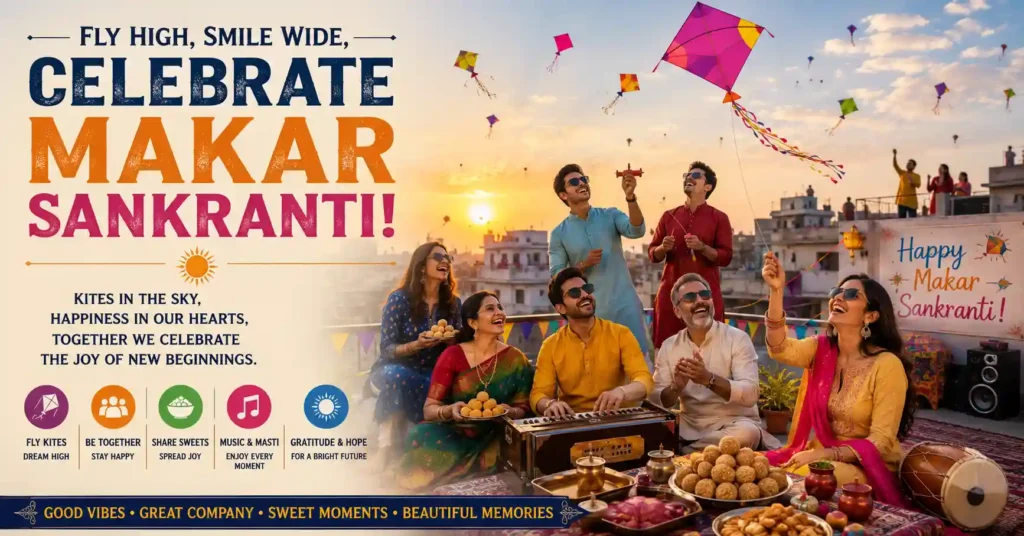
Why Is Makar Sankranti Celebrated?
Makar Sankranti is celebrated to honour the Sun’s transition into Makara (Capricorn) and the beginning of Uttarayan, the Sun’s northward journey.
In Sanatan Dharma, this astronomical event symbolises the arrival of longer days, renewed energy, and an auspicious period for spiritual growth.
The festival is also celebrated as a harvest festival, expressing gratitude to Surya Dev, nature, and all those who contribute to a successful harvest.
Farmers thank the Sun, the Earth, water, and cattle for sustaining life, while families come together to celebrate abundance, share traditional foods, and perform acts of charity.
Spiritually, Makar Sankranti reminds devotees to move from ignorance towards wisdom, from selfishness towards compassion, and from inactivity towards righteous action.
Its traditions encourage people to begin a new phase of life with gratitude, generosity, self-discipline, and faith, making it one of the most meaningful festivals in the Hindu calendar.
Story Behind Makar Sankranti
Unlike many Hindu festivals that are associated with a single mythological event, Makar Sankranti is primarily linked to the Sun’s transition into Makara (Capricorn) and the beginning of Uttarayan.
Over time, several sacred stories and traditional beliefs have become associated with this auspicious day, enriching its spiritual significance.
One of the most well-known traditions comes from the Mahabharata, where Bhishma Pitamah chose to leave his mortal body only after the arrival of Uttarayan.
According to Hindu belief, this sacred period is considered especially auspicious for spiritual progress and is associated with light, wisdom, and liberation.
Makar Sankranti is also closely connected with the worship of Surya Dev, the life-giving Sun God. Since ancient times, devotees have offered prayers, water (Arghya), and gratitude to the Sun for sustaining life, nourishing crops, and supporting the natural cycle that makes all living beings flourish.
In many parts of India, the festival also marks the completion of the harvest season. Communities celebrate nature’s abundance, thank the Earth, water, cattle, and the Sun, and share their blessings through charity, festive meals, and joyful gatherings.
These traditions together make Makar Sankranti a festival of gratitude, renewal, and hope.
Scriptural References to Makar Sankranti
Makar Sankranti is primarily associated with the Sun’s transition into Makara (Capricorn), an astronomical event that has been honoured in Hindu tradition since ancient times.
While the festival itself is not described in one dedicated scripture, its spiritual significance is reflected in several sacred texts and long-standing traditions of Sanatan Dharma.
The Mahabharata narrates that Bhishma Pitamah chose to leave his mortal body only after the arrival of Uttarayan, as this period is traditionally regarded as especially auspicious for spiritual progress. This belief has contributed to the sacred importance of Uttarayan in Hindu tradition.
The Bhagavad Gita (Chapter 8, Verses 23–26) describes the path of light (Shukla Paksha and the northern course of the Sun) as an auspicious path associated with spiritual liberation.
Although these verses do not specifically mention Makar Sankranti, many traditional commentators associate their symbolism with the beginning of Uttarayan.
The worship of Surya Dev is also deeply rooted in the Vedas, especially the Rigveda, where the Sun is praised as the source of light, life, energy, and wisdom.
Over centuries, these scriptural teachings, together with regional customs and devotional traditions, have shaped Makar Sankranti into one of the most spiritually significant festivals in Hindu culture.
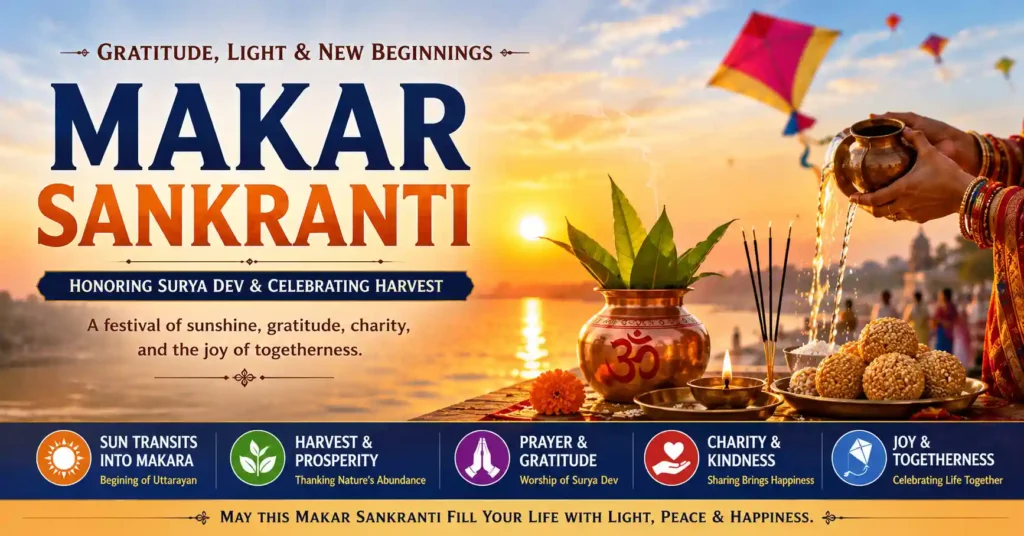
Spiritual Meaning of Makar Sankranti
The spiritual meaning of Makar Sankranti goes far beyond the changing of seasons. It marks the Sun’s transition into Makara (Capricorn) and the beginning of Uttarayan, symbolising a journey from darkness to light, ignorance to wisdom, and attachment to higher awareness.
Just as the Sun begins its northward journey, devotees are inspired to move away from ego, anger, fear, and negative habits while embracing truth, compassion, self-discipline, and dharma.
In Sanatan Dharma, this inner transformation is considered the true essence of Makar Sankranti.
Traditional Hindu scriptures and spiritual teachings regard Uttarayan as an auspicious period for prayer, meditation, charity (daan), self-reflection, and spiritual growth.
The festival reminds us that lasting progress begins not only with external celebrations but also with positive changes in our thoughts, words, and actions.
Spiritual Significance of Makar Sankranti
The spiritual significance of Makar Sankranti lies in its reminder to live in harmony with nature, practise gratitude, and strengthen one’s connection with the Divine.
As the Sun begins its journey into Uttarayan, devotees see this period as an auspicious time to renew their faith and dedicate themselves to righteous living.
On this sacred day, many devotees worship Surya Dev, take a holy bath, perform daan (charity), offer food to those in need, and spend time in prayer or meditation.
These practices are believed to cultivate humility, reduce attachment, encourage compassion, and promote inner peace. Rather than being mere rituals, they are seen as simple ways to express gratitude for the blessings of life and nature.
Makar Sankranti teaches that spirituality is reflected in everyday actions. Sharing food, speaking kindly, helping others, respecting nature, and living according to dharma are all considered meaningful expressions of devotion.
The festival reminds us that true spiritual growth begins with small, sincere acts performed with a pure heart.
Rituals and Traditions of Makar Sankranti
The rituals of Makar Sankranti reflect gratitude, devotion, and harmony with nature. While customs vary across different regions of India, the festival is commonly observed through simple acts of worship, charity, and community celebrations.
Many devotees begin the day with a holy bath, especially in sacred rivers such as the Ganga, Yamuna, or Godavari, symbolising purification and a fresh spiritual beginning.
They then offer Arghya (water) to Surya Dev, thanking the Sun for sustaining life, health, and prosperity.
Some of the most common Makar Sankranti traditions include:
Taking a holy bath at sunrise.
Offering Arghya and prayers to Surya Dev.
Preparing and sharing sweets made from sesame seeds (til) and jaggery (gur).
Performing daan (charity) by donating food, clothes, blankets, or grains to those in need.
Visiting temples, participating in community prayers, and spending time with family.
Flying kites and celebrating the harvest in many parts of India.
Sesame seeds, jaggery, rice, and ghee are commonly used during the festival because they symbolise warmth, nourishment, sweetness, and prosperity.
In Sanatan Dharma, charity performed on Makar Sankranti is considered especially auspicious, reminding devotees that sharing with others is an important expression of compassion and dharma.
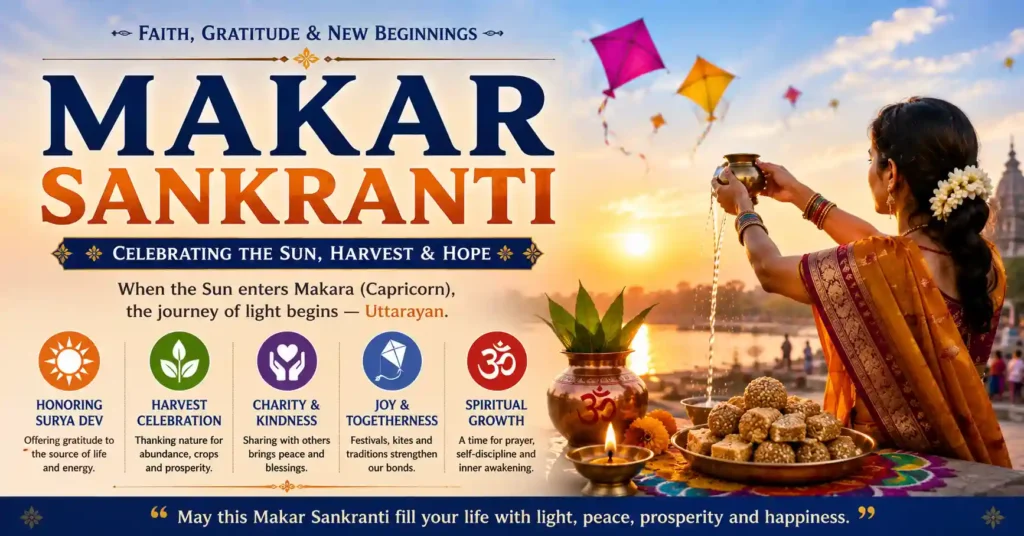
How to Celebrate Makar Sankranti at Home
You do not need elaborate arrangements to celebrate Makar Sankranti with devotion. The festival can be observed at home through simple acts of gratitude, prayer, charity, and togetherness.
Here are a few meaningful ways to celebrate Makar Sankranti at home:
Wake up early and take a bath before sunrise, if possible.
Offer Arghya (water) to Surya Dev while praying for good health, wisdom, and prosperity.
Light a diya and offer flowers, sesame seeds, jaggery, fruits, or other seasonal foods with gratitude.
Prepare traditional dishes such as tilgul, khichdi, or Pongal, and first offer them as bhog before sharing them with family.
Perform daan (charity) by donating food, clothes, blankets, or other useful items to those in need.
Spend time reading sacred texts, chanting prayers, or reflecting on the values of gratitude, kindness, and self-discipline.
Celebrate with family and neighbours by sharing festive sweets and warm wishes.
The true spirit of Makar Sankranti lies not in grand celebrations but in sincere devotion, compassion, and living in harmony with nature and the teachings of Sanatan Dharma.
Common Mistakes to Avoid on Makar Sankranti
While traditions vary across regions and families, these simple reminders can help you celebrate the festival with the right spirit:
- Don’t treat it as just a holiday. Remember its spiritual message of gratitude, charity, and self-improvement.
- Don’t skip charity if possible. Sharing food, clothes, or other essentials with those in need is one of the festival’s most cherished traditions.
- Don’t waste food or natural resources. Makar Sankranti teaches respect for nature and appreciation for every harvest.
- Don’t focus only on rituals. Kindness, humility, and compassion are just as important as external celebrations.
- Don’t forget to thank nature. Offer gratitude to Surya Dev and appreciate the Sun, Earth, water, and all elements that sustain life.
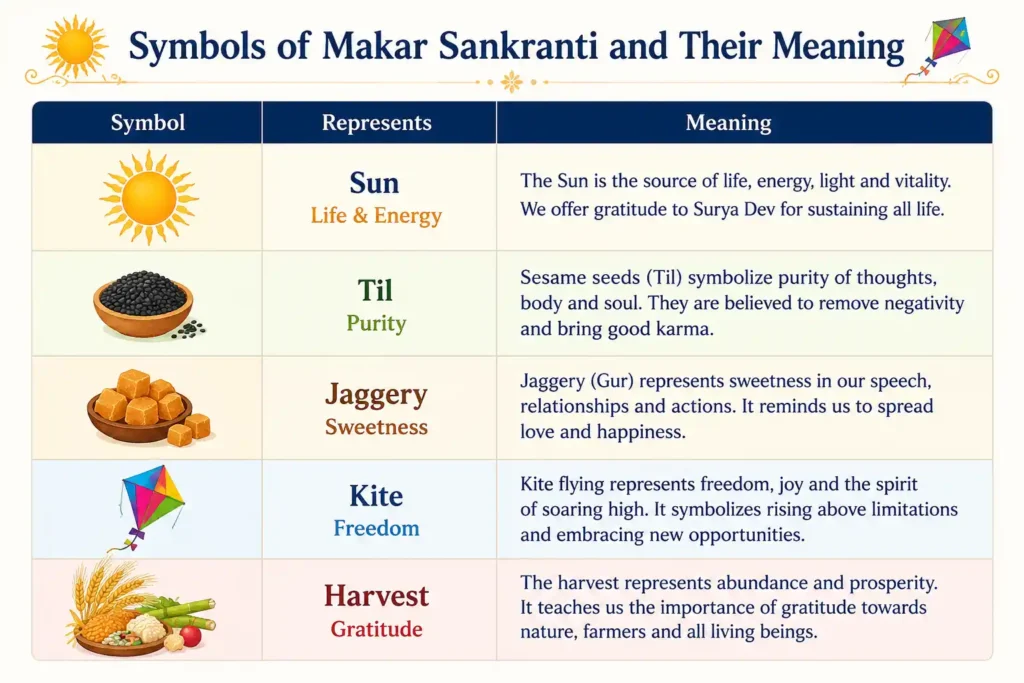
Why Sesame Seeds and Jaggery Are Important on Makar Sankranti
Til (sesame seeds) and jaggery (gur) hold a special place in Makar Sankranti celebrations. Their importance goes beyond tradition, reflecting both practical wisdom and spiritual symbolism.
According to Ayurveda, sesame seeds help keep the body warm during winter, while jaggery provides natural energy and supports digestion. Together, they make an ideal seasonal food that nourishes the body during the colder months.
Spiritually, til symbolises purity and strength, while jaggery represents sweetness and harmony.
By preparing and sharing sweets made from these ingredients, devotees are reminded to cultivate kindness, let go of bitterness, and strengthen relationships with family and society.
A well-known greeting from Maharashtra beautifully reflects this message:
“Tilgul ghya, god god bola.”
“Accept these sesame and jaggery sweets, and speak sweet words.”
This simple tradition reminds us that Makar Sankranti is not only about celebrating the harvest but also about spreading warmth, forgiveness, goodwill, and harmony in our daily lives.
How Makar Sankranti Is Celebrated Across India
One of the most beautiful aspects of Makar Sankranti is that it is celebrated across India in many different ways.
While the names, customs, and local traditions vary from region to region, the festival’s core message of gratitude, harvest, devotion, and new beginnings remains the same.
| Region | Local Name | Popular Traditions |
|---|---|---|
| Tamil Nadu | Pongal | A four-day harvest festival with Surya Puja, cooking Pongal, decorating homes, and honouring cattle. |
| Andhra Pradesh & Telangana | Sankranti | Colourful rangolis (Muggu), family gatherings, kite flying, and festive feasts. |
| Punjab & Haryana | Lohri | Bonfires, folk songs, traditional dances, and prayers celebrating the harvest. |
| Assam | Magh Bihu (Bhogali Bihu) | Community feasts, traditional games, bonfires, and thanksgiving after the harvest. |
| Gujarat & Rajasthan | Uttarayan | Spectacular kite-flying festivals, prayers to Surya Dev, and festive celebrations. |
| Maharashtra | Makar Sankranti | Families exchange tilgul sweets and greet each other with wishes for harmony and goodwill. |
| Karnataka | Sankranti | The traditional Ellu Bella exchange symbolises friendship, unity, and sweetness in relationships. |
| Odisha | Makara Sankranti | Devotees offer Makara Chaula, a traditional mixture of newly harvested rice, fruits, and jaggery, to the deities. |
Although the customs differ, every celebration expresses gratitude to Surya Dev, honours nature’s abundance, and encourages people to begin the new season with generosity, harmony, and hope.
Kite Flying on Makar Sankranti and Its Symbolism
Kite flying has become one of the most recognised traditions of Makar Sankranti, especially in states such as Gujarat and Rajasthan, where colourful skies reflect the festive spirit of the occasion.
Families and communities gather on rooftops to celebrate the arrival of Uttarayan with joy, friendly competitions, and togetherness.
Traditionally, flying kites symbolises rising above limitations, leaving behind negativity, and moving towards higher goals, just as the Sun begins its northward journey. It reminds devotees to embrace hope, freedom, and a positive outlook in life.
Many people also believe that spending time outdoors under the gentle winter sunlight during Makar Sankranti helps the body receive natural sunlight after the colder months.
While this is widely regarded as a practical seasonal benefit, the deeper significance of kite flying lies in celebrating the festival with gratitude, unity, and renewed enthusiasm.
Connection Between Makar Sankranti and Agriculture
Makar Sankranti is deeply connected to India’s agricultural heritage and is widely celebrated as a harvest festival. It marks the time when many farmers gather the season’s crops and express gratitude for nature’s abundance after months of hard work.
On this auspicious day, farmers offer prayers to Surya Dev, the Earth, water, and cattle, recognising their vital role in sustaining life and ensuring a successful harvest. In many regions, newly harvested grains, sugarcane, sesame seeds, and rice are offered to the Divine before being shared with family and the community.
This tradition reflects one of the timeless teachings of Sanatan Dharma: human prosperity depends on living in harmony with nature rather than exploiting it. Makar Sankranti reminds us to receive nature’s gifts with gratitude, use them responsibly, and share our abundance with others through acts of kindness and charity.
Why Makar Sankranti Is Considered Auspicious
Traditional Foods of Makar Sankranti
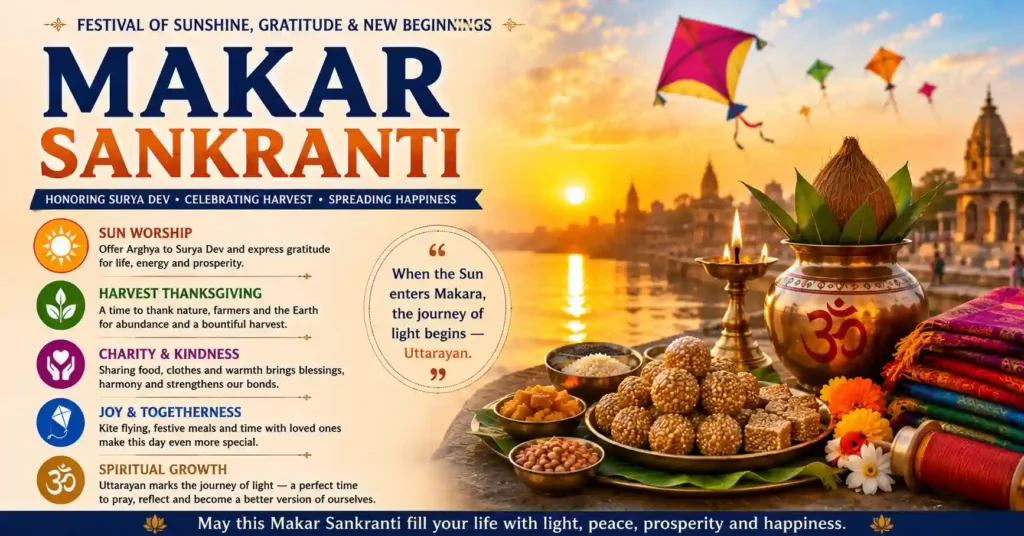
One of the unique aspects of Makar Sankranti is that it is closely linked to astronomy. The festival marks the Sun’s transition into Makara (Capricorn) and the beginning of Uttarayan, the Sun’s northward journey. Unlike most Hindu festivals, which follow the lunar calendar, Makar Sankranti is based on the solar calendar, making it one of the few festivals celebrated on nearly the same date every year.
In Sanatan Dharma, Uttarayan is regarded as an especially auspicious period for spiritual practices. Many devotees choose this time for prayer, meditation, charity (daan), mantra chanting, and self-reflection, believing that sincere efforts made during this period help foster inner growth and spiritual progress.
Beyond its astronomical significance, Makar Sankranti reminds us to align our lives with the rhythms of nature. As the Sun begins its journey toward longer and brighter days, the festival inspires us to move from ignorance to wisdom, negativity to positivity, and selfishness to selfless living.
Food is an important part of Makar Sankranti, reflecting gratitude for a successful harvest and nature’s abundance.
Families prepare dishes using freshly harvested grains and seasonal ingredients such as sesame seeds (til), jaggery (gur), rice, lentils, ghee, and sugarcane, many of which are first offered as bhog before being shared with family and guests.
Different regions celebrate with their own traditional recipes. Tilgul laddoos are popular in Maharashtra, Pongal is prepared in Tamil Nadu, Khichdi is commonly enjoyed in parts of North India, while Pitha and other rice-based delicacies are prepared in Assam and eastern India.
These seasonal foods provide warmth and nourishment during winter while symbolising prosperity, sweetness, and togetherness.
Sharing festive meals with family, neighbours, and those in need reflects the values of generosity, gratitude, and community that lie at the heart of Makar Sankranti.
Dos and Don'ts on Makar Sankranti
While customs may vary across regions and families, the following practices are widely observed during Makar Sankranti.
Dos
Offer Arghya (water) to Surya Dev with gratitude.
Take a holy bath early in the morning, if possible.
Perform daan (charity) by donating food, clothes, blankets, or other essentials.
Prepare and share traditional foods made from sesame seeds (til) and jaggery (gur).
Spend time in prayer, meditation, or reading sacred scriptures.
Celebrate with family, neighbours, and the community while maintaining a spirit of kindness and gratitude.
Don’ts
Avoid unnecessary anger, harsh speech, and conflicts on this sacred day.
Do not waste food or disrespect nature’s gifts.
Avoid selfishness and remember to help those in need.
Refrain from actions that harm animals or the environment during the celebrations.
Do not treat the festival as only a social event; remember its spiritual purpose and message.
The true observance of Makar Sankranti lies in cultivating gratitude, generosity, self-discipline, and compassion. These values reflect the timeless teachings of Sanatan Dharma and give the festival its deeper meaning.
Benefits of Celebrating Makar Sankranti
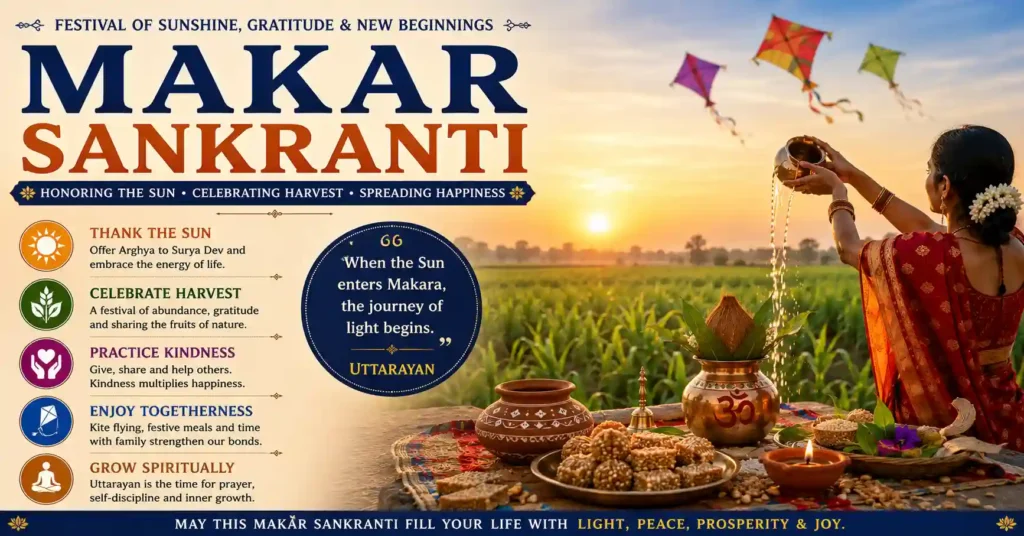
Celebrating Makar Sankranti is more than following a tradition. The festival encourages gratitude, generosity, spiritual growth, and a deeper connection with nature. Its customs continue to inspire meaningful values that remain relevant in everyday life.
| Benefit | Significance |
|---|---|
| Spiritual Growth | Encourages prayer, meditation, charity, and self-reflection during the auspicious period of Uttarayan. |
| Gratitude Towards Nature | Reminds us to thank Surya Dev, the Earth, water, and all elements that sustain life. |
| Strengthening Family Bonds | Families come together to celebrate, share meals, exchange sweets, and renew relationships. |
| Community Harmony | Acts of charity, sharing food, and festive gatherings promote kindness and social unity. |
| Connection with Cultural Heritage | Preserves traditional customs, regional celebrations, and the timeless values of Sanatan Dharma. |
| Seasonal Well-being | Seasonal foods prepared with sesame seeds, jaggery, and freshly harvested crops provide warmth and nourishment during winter. |
The greatest benefit of Makar Sankranti is the opportunity to begin a new phase of life with gratitude, positivity, and a commitment to living according to dharma. It reminds us that true prosperity is measured not only by what we receive, but also by what we share with others.
Makar Sankranti in Modern Life
Even in today’s fast-paced and technology-driven world, Makar Sankranti continues to hold timeless relevance.
Beyond its rituals and celebrations, the festival reminds us to pause, reconnect with nature, strengthen family bonds, express gratitude, and begin each new season with hope and positivity.
The true spirit of Makar Sankranti does not depend on grand celebrations. Whether by offering prayers to Surya Dev, performing a simple act of charity, sharing traditional sweets, or spending meaningful time with loved ones, every sincere gesture reflects the festival’s deeper values of compassion, generosity, and harmony.
As the Sun begins its journey towards Uttarayan, Makar Sankranti inspires us to move forward with renewed purpose, leaving behind negativity and embracing wisdom, kindness, and selfless living.
Conclusion
Makar Sankranti is much more than a seasonal celebration. It is a festival of gratitude, renewal, and spiritual awakening that reminds us to live in harmony with nature, honour the blessings of the Sun, and move forward with faith, compassion, and self-discipline.
Whether through offering prayers to Surya Dev, performing charity, sharing festive meals, or spending time with family, every tradition of Makar Sankranti carries a timeless message of kindness, generosity, and hope.
Its teachings continue to inspire people to embrace positive change and live according to the values of Sanatan Dharma.
If you would like to deepen your understanding of Makar Sankranti, Surya Dev, Sanatan Dharma, and other Hindu festivals and traditions, explore more articles on The Sanatan Tales. Our guides present ancient wisdom in a simple, practical, and heartfelt way for readers of all ages.
Suggested Reading
If you enjoyed learning about Makar Sankranti, you may also like these related festival articles from The Sanatan Tales. They explore the spiritual significance, traditions, rituals, and celebrations of other important Hindu festivals and vrats.
Hindu Festivals Explained: Meaning, Types, Calendar & Spiritual Importance
https://thesanatantales.com/hindu-festivals/Ram Navami: Birth of Lord Ram, Significance, Rituals and Celebrations
https://thesanatantales.com/ram-navami/Holi Festival: Meaning, History, Traditions and Spiritual Significance
https://thesanatantales.com/holi-festival/Hanuman Jayanti: Significance, Rituals and Celebrations
https://thesanatantales.com/hanuman-jayanti/Maha Shivratri: Meaning, Importance, Rituals and Spiritual Significance
https://thesanatantales.com/maha-shivratri/Chaitra Navratri: Meaning, Dates, Rituals, Vrat & Significance
https://thesanatantales.com/chaitra-navratri/Gupta Navratri: Meaning, Dates, Rituals & Spiritual Significance
https://thesanatantales.com/gupta-navratri/Makar Sankranti (Wikipedia)
https://en.wikipedia.org/wiki/Makar_Sankranti
FAQs
What is Makar Sankranti?
Makar Sankranti is one of the most important festivals in Sanatan Dharma. It marks the Sun’s transition into Makara (Capricorn) and the beginning of Uttarayan, the Sun’s northward journey. Unlike most Hindu festivals that follow the lunar calendar, Makar Sankranti is based on the solar calendar and is usually celebrated on 14 January or 15 January. The festival symbolises gratitude, new beginnings, harvest, charity, and spiritual growth.
Why is Makar Sankranti celebrated?
Makar Sankranti is celebrated to honour the Sun’s movement into Makara and to express gratitude to Surya Dev for sustaining life and agriculture. It also marks the harvest season in many parts of India. Spiritually, the festival reminds devotees to leave behind negativity, practise charity, strengthen family bonds, and move towards a life guided by dharma and wisdom.
Why does Makar Sankranti fall on almost the same date every year?
Unlike most Hindu festivals that are based on the lunar calendar, Makar Sankranti follows the solar calendar. It is observed when the Sun enters Makara (Capricorn). Since the Sun’s movement is relatively consistent, the festival usually falls on 14 January and occasionally on 15 January, depending on astronomical calculations.
Which deity is worshipped on Makar Sankranti?
Surya Dev (the Sun God) is the principal deity worshipped on Makar Sankranti. Devotees offer Arghya (water), chant prayers, and express gratitude for the Sun’s light, warmth, and life-giving energy. In many regions, prayers are also offered to nature, rivers, cattle, and the Earth as part of the festival’s harvest traditions.
What are the main rituals of Makar Sankranti?
The festival is traditionally observed by taking a holy bath, offering Arghya to Surya Dev, performing charity (daan), preparing festive foods made from sesame seeds and jaggery, visiting temples, and spending time with family. Many people also fly kites and participate in community celebrations. While customs vary across regions, gratitude, devotion, and generosity remain at the heart of the festival.
Why are sesame seeds and jaggery important during Makar Sankranti?
Til (sesame seeds) and gur (jaggery) are considered ideal winter foods in Ayurveda because they provide warmth and nourishment. Spiritually, sesame symbolises purity and strength, while jaggery represents sweetness and harmony. Sharing sweets made from these ingredients reminds people to strengthen relationships, forgive differences, and speak kindly.
Is Makar Sankranti a harvest festival?
Yes. Makar Sankranti is widely celebrated as a harvest festival across India. Farmers thank Surya Dev, the Earth, water, and cattle for a successful harvest. Different regions celebrate the occasion with unique traditions, such as Pongal in Tamil Nadu, Lohri in Punjab, and Magh Bihu in Assam, while sharing the common spirit of gratitude and abundance.
What is the spiritual significance of Uttarayan?
In Sanatan Dharma, Uttarayan is regarded as an auspicious period that symbolises light, hope, and spiritual progress. It is traditionally believed to be a favourable time for prayer, meditation, charity, and self-discipline. Makar Sankranti marks the beginning of this sacred phase, inspiring devotees to pursue inner growth and righteous living.
Can Makar Sankranti be celebrated at home?
Yes. Makar Sankranti can be observed at home with simple devotion. Many families offer prayers to Surya Dev, light a diya, offer Arghya, prepare traditional foods, perform charity, read sacred texts, and spend time with loved ones. The festival emphasises sincerity and gratitude rather than elaborate rituals.
Why is charity considered important on Makar Sankranti?
Charity, or daan, is one of the most meaningful traditions of Makar Sankranti. Donating food, clothes, blankets, grains, or other essentials reflects compassion and gratitude. According to Hindu tradition, selfless giving on this auspicious day is believed to promote humility, strengthen social harmony, and contribute to spiritual well-being.
Why do people fly kites on Makar Sankranti?
Kite flying is a popular tradition, especially in Gujarat and Rajasthan. It celebrates the arrival of Uttarayan and brings families and communities together. Symbolically, a soaring kite represents hope, freedom, and the aspiration to rise above negativity. Many people also enjoy spending time outdoors under the gentle winter sunlight during the festival.
How is Makar Sankranti celebrated across India?
Although the festival is known by different names in different regions, its essence remains the same. It is celebrated as Pongal in Tamil Nadu, Lohri in Punjab, Uttarayan in Gujarat, Magh Bihu in Assam, and Sankranti in Andhra Pradesh and Telangana. Each region has its own customs, foods, and celebrations, but all honour the Sun, celebrate the harvest, and encourage gratitude, charity, and togetherness.
Glossary of Important Terms
| Term | Meaning |
|---|---|
| Makar Sankranti | A major Hindu festival that marks the Sun’s transition into Makara (Capricorn) and the beginning of Uttarayan. |
| Makara | The Sanskrit name for the zodiac sign Capricorn. |
| Sankranti | The movement or transition of the Sun from one zodiac sign to another. |
| Uttarayan | The Sun’s northward journey, traditionally regarded as an auspicious period for spiritual practices. |
| Surya Dev | The Hindu Sun God, worshipped as the source of life, light, energy, and wisdom. |
| Sanatan Dharma | The eternal spiritual tradition commonly known as Hinduism, based on dharma, karma, and the pursuit of truth. |
| Solar Calendar | A calendar based on the Sun’s movement rather than the phases of the Moon. Makar Sankranti follows the solar calendar. |
| Panchang | The traditional Hindu calendar used to determine festival dates, tithis, muhurats, and other auspicious timings. |
| Punya Kaal | The most auspicious period on Makar Sankranti for performing worship, charity, and holy baths. |
| Maha Punya Kaal | The most sacred part of the Punya Kaal, considered especially beneficial for religious observances. |
| Arghya | The ritual offering of water to Surya Dev as a mark of gratitude and devotion. |
| Surya Puja | Worship of Surya Dev through prayers, offerings, and Arghya on Makar Sankranti. |
| Daan | The act of selfless charity, such as donating food, clothes, grains, or blankets to those in need. |
| Holy Bath (Snan) | A ritual bath taken in sacred rivers or at home, symbolising physical and spiritual purification. |
| Til | Sesame seeds, traditionally used in Makar Sankranti rituals and festive foods, symbolising purity and warmth. |
| Gur (Jaggery) | Unrefined cane sugar used in festive sweets, representing sweetness, harmony, and prosperity. |
| Tilgul | A traditional sweet made from sesame seeds and jaggery, especially popular in Maharashtra during Makar Sankranti. |
| Bhog | Food first offered to the deity before being distributed among family members and devotees. |
| Prasad | Blessed food received after it has been offered to the deity during worship. |
| Harvest Festival | A festival celebrating the successful harvest and expressing gratitude for nature’s abundance. |
| Pongal | The four-day harvest festival celebrated in Tamil Nadu during Makar Sankranti. |
| Lohri | A harvest festival celebrated mainly in Punjab and Haryana on the eve of Makar Sankranti. |
| Magh Bihu (Bhogali Bihu) | Assam’s harvest festival celebrated around the time of Makar Sankranti. |
| Ellu Bella | A traditional mixture of sesame, jaggery, coconut, peanuts, and roasted gram exchanged during Sankranti in Karnataka as a symbol of friendship and harmony. |
| Makara Chaula | A traditional offering prepared in Odisha using newly harvested rice, fruits, jaggery, coconut, and milk during Makar Sankranti. |
| Khichdi | A simple dish made from rice and lentils, traditionally prepared during Makar Sankranti in many parts of North India. |
| Kite Flying | A popular Makar Sankranti tradition, especially in Gujarat and Rajasthan, symbolising joy, freedom, and new beginnings. |
| Bhishma Pitamah | A revered warrior from the Mahabharata who, according to tradition, chose to leave his mortal body during Uttarayan. |
| Rigveda | One of the oldest Hindu scriptures, containing hymns in praise of Surya Dev and other Vedic deities. |
| Bhagavad Gita | A sacred Hindu scripture in which the symbolism of the path of light is traditionally associated with the auspicious period of Uttarayan. |
| Mahabharata | The ancient Hindu epic that contains the story of Bhishma Pitamah and his connection with Uttarayan. |
| Dharma | Righteous living, moral duty, and the ethical principles that guide life in Sanatan Dharma. |
| Charity | Selfless giving performed without expecting anything in return, regarded as a highly virtuous act on Makar Sankranti. |
| Gratitude | A central message of Makar Sankranti, expressed through prayers, charity, and respect for nature’s blessings. |
About the Author
Yateendra Chaturvedi is a spiritual writer, researcher, devotee, and the founder of The Sanatan Tales. With over 35 years of professional experience and a lifelong interest in Sanatan Dharma, he writes about Hindu deities, temples, scriptures, festivals, Mahavidyas, sacred stories, rituals, and living traditions that continue to guide and inspire devotees across India.
Drawing from traditional scriptures, regional beliefs, temple traditions, devotional literature, and historical sources, he aims to present authentic, well-researched, and easy-to-understand content for modern readers. His work focuses on preserving spiritual wisdom, explaining sacred traditions, and helping seekers develop a deeper understanding of India’s rich spiritual heritage.
Through The Sanatan Tales, Yateendra strives to make the timeless teachings of Sanatan Dharma simple, meaningful, and relevant for today’s generation while maintaining respect for traditional sources, regional practices, and diverse spiritual perspectives.
Learn More About Yateendra Chaturvedi →
https://thesanatantales.com/about-the-author/
References & Sources
This article is based on traditional Hindu beliefs associated with Makar Sankranti, Surya Dev, and the broader traditions of Sanatan Dharma. It draws upon Vedic teachings, the Mahabharata, the Bhagavad Gita, traditional Panchang principles, temple traditions, regional customs, harvest celebrations, and devotional practices followed across India.
Note: The customs, rituals, dates, and spiritual interpretations of Makar Sankranti may vary across regions, sampradayas, and Hindu traditions. This article presents widely accepted beliefs and practices in a simple, respectful, and easy-to-understand manner while acknowledging the rich diversity within Sanatan Dharma.
Explore More Fascinating Topics from Sanatan Dharma