Ram Navami is one of the most sacred festivals in Sanatan Dharma, celebrating the birth of Lord Ram, the seventh avatar of Lord Vishnu and the embodiment of truth, dharma, compassion, and ideal living.
Observed on the ninth day of Chaitra Navratri, this auspicious festival is celebrated with devotion by millions of devotees across India and around the world.
More than a celebration of Lord Ram’s birth, Ram Navami reminds us to follow the timeless values of righteousness, self-discipline, humility, and kindness in our daily lives.
Devotees observe the day through prayers, Ram Navami vrat, chanting of Lord Ram’s name, reading the Ramayana, and performing Ram Navami puja with deep faith and devotion.
In this guide, you will learn everything about Ram Navami, including the Ram Navami date, tithi, puja vidhi, vrat rules, spiritual significance, the sacred birth story of Lord Ram, and the traditions associated with this auspicious festival.
Whether you are observing Ram Navami for the first time or wish to deepen your understanding, this article will help you celebrate the festival with greater devotion and awareness.
Table of Contents
ToggleWhat Is Ram Navami?
Ram Navami is one of the most important festivals in Sanatan Dharma, celebrated to mark the birth of Lord Ram, the seventh avatar of Lord Vishnu.
The festival falls on Chaitra Shukla Navami, the ninth day of the bright fortnight in the Hindu month of Chaitra, and is observed with great devotion across India and many parts of the world.
The festival commemorates the divine birth of Maryada Purushottam Shri Ram, whose life symbolizes truth, righteousness, compassion, courage, and unwavering commitment to dharma.
Devotees celebrate Ram Navami by observing Ram Navami vrat, performing Ram Navami puja, chanting Lord Ram’s name, reading the Ramayana, and participating in bhajans and temple celebrations.
More than a religious festival, Ram Navami is a reminder that the ideals of Lord Ram continue to inspire people to lead a life rooted in honesty, humility, and selfless service.
Quick Facts About Ram Navami
The table below provides a quick overview of the most important facts about Ram Navami.
| Aspect | Details |
|---|---|
| Festival Name | Ram Navami |
| Celebrated For | Birth of Lord Ram, the seventh avatar of Lord Vishnu |
| Hindu Month | Chaitra |
| Tithi | Chaitra Shukla Navami |
| Main Deity | Lord Ram |
| Associated Festival | Chaitra Navratri |
| Main Rituals | Ram Navami puja, vrat, Ramayana recitation, bhajans and aarti |
| Auspicious Time | Madhyahna Muhurat (midday) |
| Sacred Scriptures | Valmiki Ramayana, Ramcharitmanas, Vishnu Purana |
| Core Message | Truth, righteousness (dharma), compassion, and ideal living |
Ram Navami Date, Tithi, Muhurat and Panchang
Ram Navami is observed every year on Chaitra Shukla Navami, the ninth day (Navami Tithi) of the bright fortnight (Shukla Paksha) in the Hindu month of Chaitra.
According to the Hindu Panchang, this sacred festival commemorates the birth of Lord Ram, who is believed to have appeared during the Madhyahna Muhurat (midday period).
Since the Hindu calendar follows the lunar cycle, the Ram Navami date changes every year in the Gregorian calendar.
Devotees generally perform Ram Navami puja during the Madhyahna Muhurat, as it is traditionally regarded as the most auspicious time to celebrate the divine birth of Lord Ram.
| Occasion | Date & Time |
|---|---|
| Ram Navami Date | Thursday, 15 April 2027 |
| Navami Tithi Begins | 14 April 2027 – 3:23 PM |
| Navami Tithi Ends | 15 April 2027 – 1:20 PM |
| Madhyahna Muhurat | 11:04 AM to 1:38 PM (Approx.) |
| Madhyahna Moment | Around 12:21 PM |
Note: The exact Ram Navami date, Tithi timings, and Madhyahna Muhurat may vary slightly depending on your city, time zone, and the Panchang being followed. Always refer to a reliable local Panchang for the precise timings applicable to your location.
Why Is Ram Navami Celebrated?
Ram Navami celebrates the birth of Lord Ram, the seventh avatar of Lord Vishnu, who took birth in Ayodhya to uphold dharma (righteousness) and protect the world from evil.
According to the Valmiki Ramayana and other Hindu scriptures, Lord Ram incarnated during the Treta Yuga to defeat the demon king Ravana and establish the ideals of truth, justice, compassion, and righteous living.
The Ram Navami significance goes far beyond celebrating the birth of a divine incarnation. It reminds us that whenever adharma (unrighteousness) rises, the Divine appears to restore balance and guide humanity toward the path of virtue.
Lord Ram’s life as Maryada Purushottam, the ideal human being, continues to inspire millions through his unwavering devotion to duty, humility, courage, and compassion.
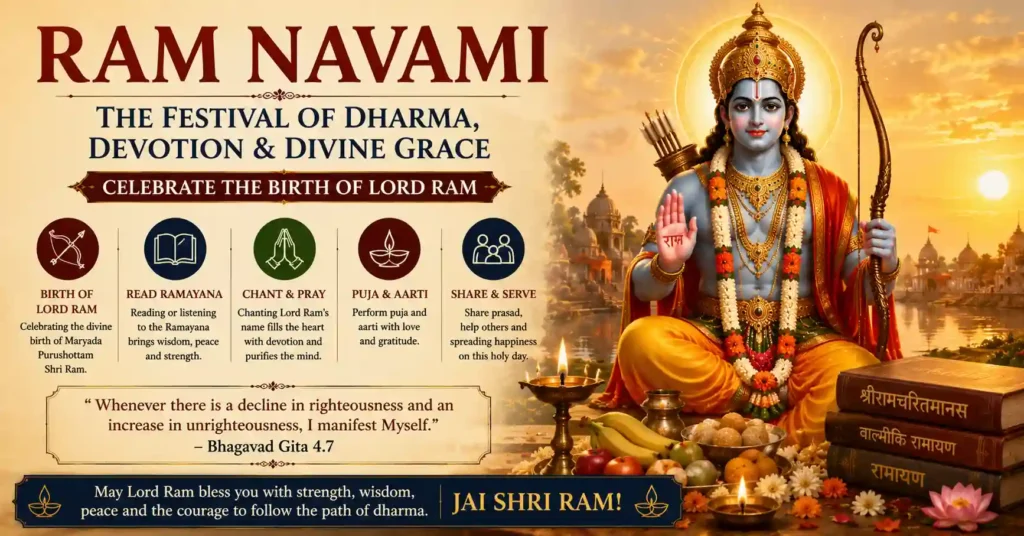
“Whenever there is a decline in righteousness and an increase in unrighteousness, I manifest Myself.”
— Bhagavad Gita 4.7
For devotees, Ram Navami is an opportunity to reflect on Lord Ram’s teachings and bring his timeless values into everyday life.
By observing Ram Navami vrat, performing Ram Navami puja, chanting his holy name, and reading the Ramayana, devotees seek inner peace, spiritual strength, and a deeper connection with dharma.
Connection Between Ram Navami and Chaitra Navratri
Ram Navami is celebrated on the ninth and final day of Chaitra Navratri, making it the spiritual culmination of this sacred nine-day festival.
During Chaitra Navratri, devotees worship the nine divine forms of Maa Durga, seeking strength, purity, wisdom, and divine blessings.
The festival concludes with the celebration of the birth of Lord Ram, symbolizing that true inner strength is fulfilled when it is guided by dharma, compassion, and righteousness.
In this way, Chaitra Navratri and Ram Navami beautifully complement each other, representing the harmony of Shakti (Divine Energy) and Maryada (Righteous Living).
According to the Ramayana, Lord Ram himself worshipped the Divine Mother before his battle with Ravana, highlighting the timeless connection between Shakti and Vishnu’s divine incarnation.
This reminds devotees that spiritual strength and devotion go hand in hand on the path of dharma.
Spiritual Insight:
Chaitra Navratri prepares the heart through the worship of the Divine Mother, while Ram Navami inspires us to express that inner strength through the noble qualities and righteous life of Lord Ram.
How to Prepare for Ram Navami
Preparing for Ram Navami is as much about inner devotion as it is about external rituals. Many devotees begin their preparations a day in advance by cleaning their home, organising the puja space, and gathering the required Ram Navami puja samagri.
On the festival day, devotees wake up early, take a holy bath, wear clean or traditional clothes, and spend time in prayer before beginning the Ram Navami puja. Many also observe Ram Navami vrat, chant Lord Ram’s name, or read the Ramayana to prepare their minds for worship.
The true preparation for Ram Navami is cultivating purity, gratitude, and devotion while remembering the timeless ideals of Lord Ram.
Ram Navami Puja Samagri
Before performing Ram Navami puja, devotees gather the necessary puja samagri (worship materials). While the items may vary according to regional customs and family traditions, the most important offering is a heart filled with devotion.
Here are the commonly used items for Ram Navami puja at home:
| Puja Samagri | Purpose |
|---|---|
| Idol or image of Ram Darbar | Main deity for worship |
| Kalash with water and coconut | Symbol of auspiciousness and divine presence |
| Diya (oil or ghee lamp) | Represents the light of knowledge |
| Incense sticks (Agarbatti) | Creates a sacred atmosphere |
| Fresh flowers and garland | Offered as a mark of devotion |
| Kumkum and Chandan | Applied during the puja |
| Akshata (unbroken rice) | Traditional offering during worship |
| Tulsi leaves | Considered dear to Lord Vishnu and Lord Ram |
| Fruits and dry fruits | Offered as sattvic bhog |
| Kheer, Panjiri or Mishri | Traditional prasad offerings |
| Panchamrit | Used for ceremonial worship, where followed |
| Betel leaves and nuts | Traditional offering in many households |
If a particular item is unavailable, devotees may still perform the Ram Navami puja with sincerity and faith. In Sanatan Dharma, devotion and purity of intention are considered more important than the number of ritual items.
Ram Navami Puja Vidhi at Home
Performing Ram Navami puja at home is a beautiful way to celebrate the birth of Lord Ram with devotion and gratitude. The rituals are simple and can be performed by anyone with a pure heart and sincere faith.
Traditionally, the main puja is performed during the Madhyahna Muhurat, which is believed to be the time of Lord Ram’s birth.
Step-by-Step Ram Navami Puja Vidhi
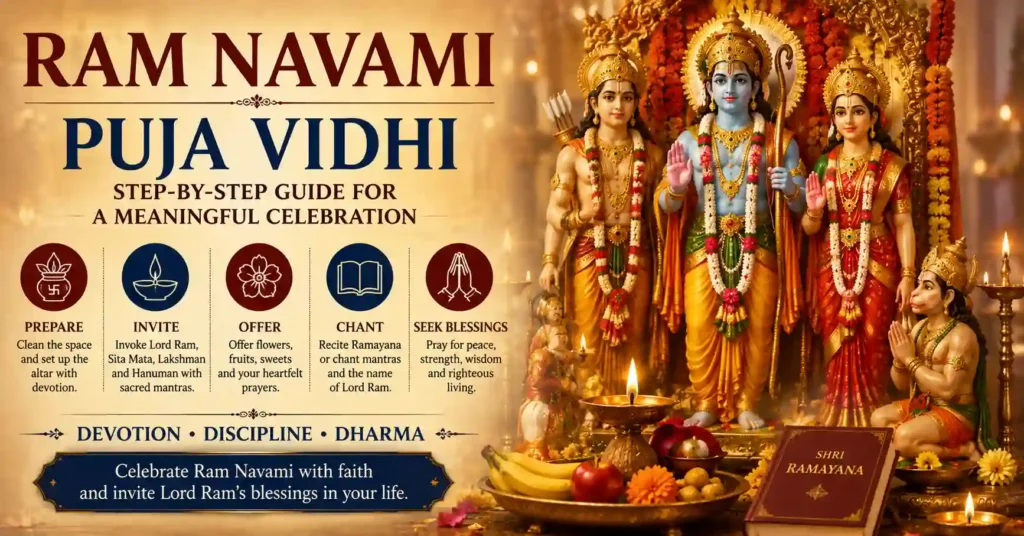
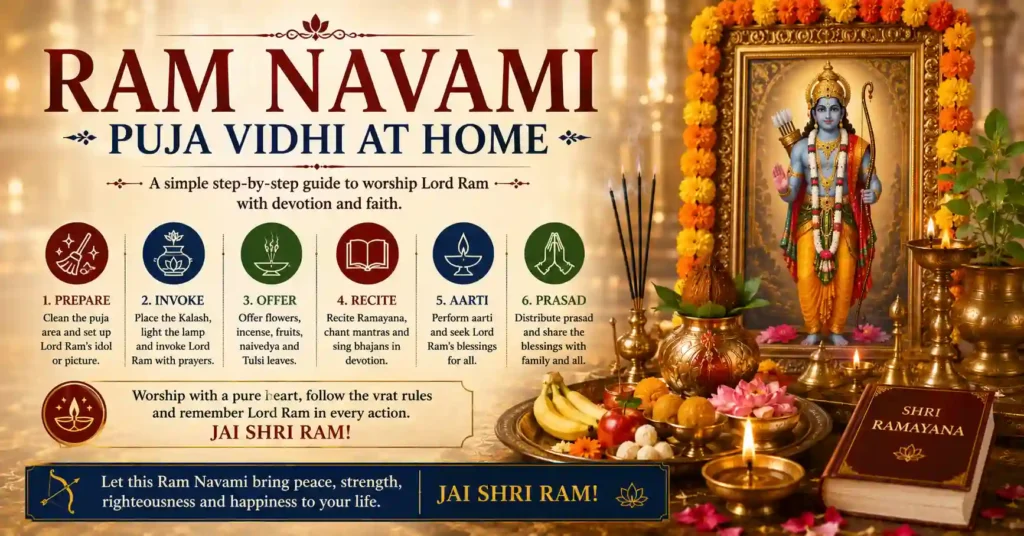
Begin the day with purification. Wake up early, take a bath, wear clean clothes, and clean your home and puja area.
Prepare the altar. Place idols or images of Lord Ram, Maa Sita, Lakshman, and Hanuman (Ram Darbar) on a clean altar. Decorate it with flowers and light a diya.
Establish the Kalash. Place a Kalash filled with water and adorned with mango leaves and a coconut as a symbol of divine presence.
Offer prayers. Apply sandalwood paste, offer flowers, Akshata (unbroken rice), incense, and light the lamp while praying to Lord Ram.
Offer bhog. Present sattvic offerings such as kheer, panjiri, fruits, mishri, and Tulsi leaves with devotion.
Chant mantras and read the Ramayana. Recite “Om Shri Ramaya Namah”, chant Lord Ram’s holy name, or read passages from the Ramayana, especially the Bala Kanda, which describes the birth of Lord Ram.
Perform the Aarti. Conclude the Ram Navami puja vidhi by performing Lord Ram’s Aarti, singing bhajans, and praying for the well-being of your family and the world.
Spend time with family by reading the Ramayana together and discussing Lord Ram’s teachings.
Many devotees also choose to express their devotion through daan (charity) by offering food, clothes, or other assistance to those in need. Such acts of kindness beautifully reflect Lord Ram’s ideals of compassion and selfless service.
Powerful Mantras to Chant on Ram Navami
Chanting the holy name of Lord Ram is one of the simplest and most meaningful ways to celebrate Ram Navami. Devotees believe that sincere chanting fills the heart with peace, strengthens devotion, and helps the mind remain calm and focused.
During Ram Navami puja or Ram Navami vrat, many devotees also recite verses from the Ramayana or sing devotional bhajans in praise of Lord Ram.
Some of the most popular mantras to chant on Ram Navami are:
1. Shri Ram Jai Ram Jai Jai Ram
Shri Ram Jai Ram Jai Jai Ram
This sacred mantra is widely chanted to seek Lord Ram’s blessings, inner peace, and spiritual strength.
2. Om Shri Ramaya Namah
Om Shri Ramaya Namah
This simple yet powerful mantra is a prayer of surrender and devotion to Lord Ram.
Ram Navami vrat rules and food
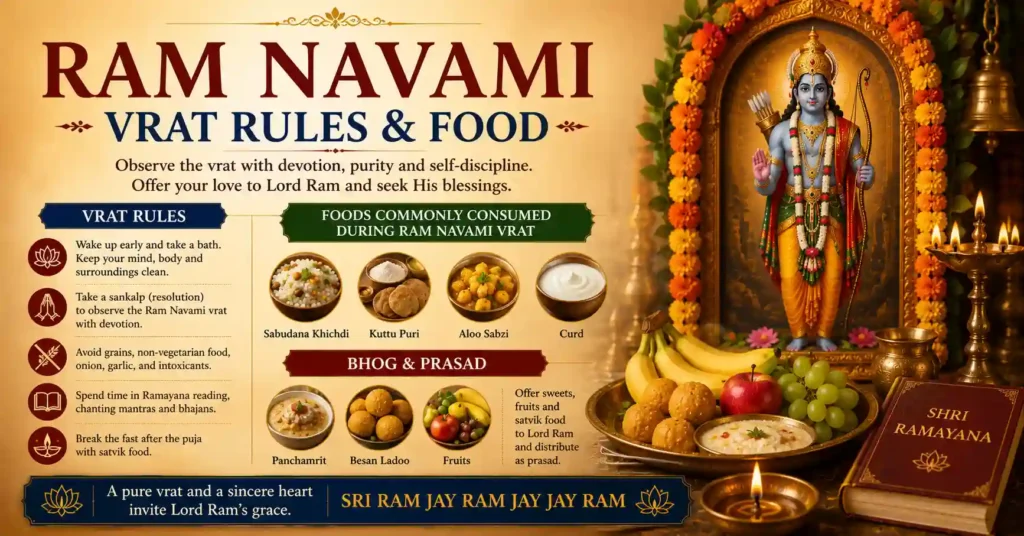
Many devotees observe a Ram Navami vrat as an expression of faith, self-discipline, and devotion to Lord Ram.
The purpose of the fast is not merely to avoid certain foods but to cultivate purity of mind, positive thoughts, and remembrance of the Lord throughout the day.
The type of fast may vary according to family traditions, health, and personal capacity. While some devotees observe a Nirjala Vrat (without food and water), others consume fruits, milk, and sattvic vrat foods.
Those who are elderly, pregnant, unwell, or taking medication may observe the vrat in a way that is suitable for their health.
Foods Commonly Consumed During Ram Navami Vrat
| Recommended Foods | Foods Generally Avoided |
|---|---|
| Fresh fruits | Rice and wheat |
| Milk and curd | Regular grains |
| Sabudana | Onion and garlic |
| Makhana | Non-vegetarian food |
| Singhara or kuttu flour preparations | Alcohol and intoxicants |
Ultimately, Ram Navami vrat is observed with devotion rather than hardship. Sincerity, self-control, and prayer are considered more important than the strictness of the fast itself.
Bhog and Prasad on Ram Navami
Offering bhog to Lord Ram is an important part of Ram Navami puja. Devotees prepare simple, pure, and sattvic food as a symbol of gratitude, devotion, and love. After the offering is made, the bhog is received as prasad and shared with family, friends, and devotees.
Some of the most commonly offered bhog on Ram Navami include:
| Bhog Item | Significance |
|---|---|
| Kheer | Symbol of purity, sweetness, and auspiciousness |
| Panjiri | A traditional offering prepared with devotion |
| Fresh Fruits | Represent purity and nature’s blessings |
| Mishri (Rock Sugar) | Symbolizes sweetness in life |
| Tulsi Leaves | Considered especially dear to Lord Vishnu and Lord Ram |
The offering need not be elaborate. In Sanatan Dharma, it is the devotion and sincerity behind the offering that matter most. Even a simple plate of fruits offered with faith is considered a meaningful expression of worship.
The Sacred Birth Story of Lord Ram
The Ram Navami story begins in the ancient city of Ayodhya, where King Dasharatha, despite being a noble and powerful ruler, had no children to inherit his kingdom.
Following the advice of Sage Vasishtha, he performed the sacred Putra Kameshti Yagya, a Vedic fire sacrifice conducted by Sage Rishyasringa to seek divine blessings for worthy heirs.
At the conclusion of the yajna, the sacred fire deity presented a divine bowl of payasam (kheer) to King Dasharatha.
He distributed this blessed offering among his queens, Maa Kaushalya, Maa Kaikeyi, and Maa Sumitra. In due course, Lord Ram was born to Maa Kaushalya, while Bharata, Lakshmana, and Shatrughna were born to the other queens.
According to tradition, Lord Ram was born on Chaitra Shukla Navami during the auspicious Madhyahna Muhurat.
His birth filled Ayodhya with joy and marked the arrival of the seventh avatar of Lord Vishnu, who descended to uphold dharma and free the world from the tyranny of Ravana.
This sacred account of Lord Ram’s birth is described in the Bala Kanda of the Valmiki Ramayana and is lovingly retold in Goswami Tulsidas’s Ramcharitmanas, inspiring devotees with the ideals of righteousness, compassion, and selfless duty.
Scriptural References to Ram Navami
The celebration of Ram Navami is deeply rooted in Hindu scriptures, where the birth and life of Lord Ram are described as a divine event that restored dharma and inspired righteous living.
These sacred texts continue to guide devotees in understanding the spiritual significance of the festival.
Some of the principal scriptures associated with Ram Navami include:
| Scripture | Significance |
|---|---|
| Valmiki Ramayana (Bala Kanda) | Describes the birth of Lord Ram, the Putra Kameshti Yajna, and his early life in Ayodhya. |
| Ramcharitmanas (Bala Kanda) | Goswami Tulsidas’s devotional retelling of Lord Ram’s birth and divine qualities in Awadhi. |
| Vishnu Purana | Explains the incarnation of Lord Vishnu as Lord Ram to uphold dharma and protect the world from evil. |
| Adhyatma Ramayana | Presents the spiritual and philosophical significance of Lord Ram as the Supreme Reality. |
These scriptures not only narrate the birth story of Lord Ram but also highlight the timeless values of truth, righteousness, compassion, and devotion that Ram Navami celebrates each year.
How Ram Navami Is Celebrated Across India
Ram Navami is celebrated with great devotion across India, although the customs and traditions may vary from region to region.
Temples are beautifully decorated, special Ram Navami puja is performed, devotional bhajans are sung, and passages from the Ramayana are recited to mark the birth of Lord Ram.
Some of the prominent regional celebrations include:
| Region | Popular Traditions |
|---|---|
| Ayodhya, Uttar Pradesh | Grand celebrations at Shri Ram Janmabhoomi, Ram Janm Mahotsav, temple processions, bhajans, and special prayers during Madhyahna Muhurat. |
| North India | Devotees observe Ram Navami vrat, perform puja at home and in temples, recite the Ramayana, and organize devotional processions (Shobha Yatras). |
| South India | Many temples celebrate Sita-Rama Kalyanam, the symbolic divine wedding of Lord Ram and Goddess Sita, along with devotional music and cultural programmes. |
| Maharashtra & Gujarat | Community satsangs, Ram bhajans, kirtans, and the distribution of prasad are common observances. |
While the traditions may differ, the spirit of Ram Navami remains the same everywhere. The festival brings devotees together to celebrate the birth of Lord Ram and reflect on his timeless ideals of truth, compassion, courage, and righteousness.
Apart from regional traditions, many temples across India organise special Ram Navami celebrations, including Ramayana recitations, bhajan and kirtan programmes, devotional processions, community feasts (bhandaras), and the ceremonial celebration of Ram Janm during the auspicious Madhyahna Muhurat. Thousands of devotees visit temples to seek Lord Ram’s blessings on this sacred day.
Spiritual Significance of Ram Navami
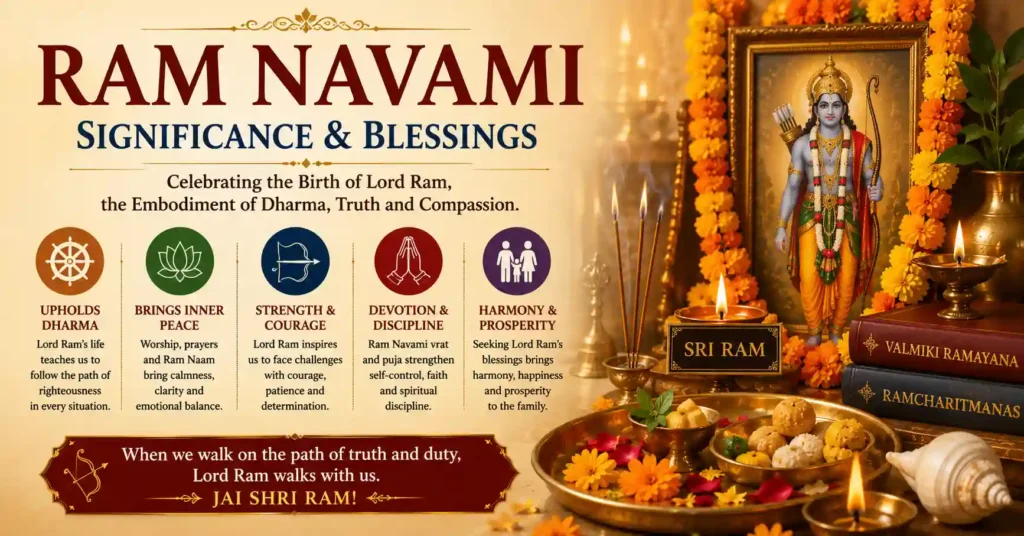
The true Ram Navami significance lies not only in celebrating the birth of Lord Ram but also in reflecting on the values he represents. Revered as Maryada Purushottam, the ideal human being, Lord Ram’s life teaches us to live with truth, righteousness, compassion, humility, and unwavering devotion to duty.
In today’s fast-paced world, Ram Navami reminds us that real strength comes from self-control, patience, and ethical living. Lord Ram faced many challenges with courage and dignity, inspiring us to remain calm during difficult times and to choose the path of dharma even when it is not easy.
For devotees, Ram Navami is an opportunity to look within, strengthen their faith, and cultivate virtues that lead to inner peace and spiritual growth. By following Lord Ram’s ideals in our thoughts, words, and actions, the festival becomes more than a celebration. It becomes a guide for living a balanced and meaningful life.
Benefits of Observing Ram Navami
Observing Ram Navami with devotion is believed to bring both spiritual and personal benefits. While the experience is unique for every devotee, the festival encourages the cultivation of noble qualities inspired by the life of Lord Ram.
Some of the commonly cherished benefits of observing Ram Navami vrat and participating in Ram Navami puja include:
Strengthens faith and devotion to Lord Ram.
Inspires truthfulness, compassion, and righteous living.
Brings a sense of inner peace and emotional balance.
Encourages patience, self-discipline, and positive thinking.
Deepens one’s connection with dharma and spiritual values.
Provides an opportunity for self-reflection through prayer, chanting, and reading the Ramayana.
Brings families and communities together in devotion and celebration.
For many devotees, Ram Navami is not only a festival but also a reminder to practise Lord Ram’s ideals in everyday life and walk the path of righteousness with faith and humility.
Simple Do's and Don'ts on Ram Navami
Observing Ram Navami is not only about performing rituals but also about living the values taught by Lord Ram. Along with Ram Navami puja and Ram Navami vrat, devotees try to maintain purity in their thoughts, words, and actions throughout the day.
| Do’s | Don’ts |
|---|---|
| Wake up early and begin the day with prayer. | Avoid anger, arguments, and harsh speech. |
| Perform Ram Navami puja with devotion and sincerity. | Do not consume non-vegetarian food or intoxicants. |
| Chant Lord Ram’s name or read the Ramayana. | Avoid negative thoughts and unnecessary gossip. |
| Offer sattvic bhog and share prasad with others. | Do not disrespect religious traditions or elders. |
| Practise kindness, truthfulness, and compassion. | Avoid actions that go against the spirit of dharma. |
The essence of Ram Navami lies in following Lord Ram’s ideals of righteousness, humility, and selfless service. Even small acts of kindness and devotion performed with a sincere heart make the festival truly meaningful.
Simple Ways to Celebrate Ram Navami at Home
You do not need elaborate arrangements to celebrate Ram Navami at home. The festival is ultimately about remembering Lord Ram with devotion and striving to follow his ideals in daily life. Even simple acts of worship performed with a sincere heart are considered meaningful.
Here are some easy ways to celebrate Ram Navami at home:
Wake up early, take a holy bath, and wear clean clothes.
Perform Ram Navami puja during the auspicious Madhyahna Muhurat.
Light a diya and offer flowers, fruits, and sattvic bhog to Lord Ram.
Chant “Shri Ram Jai Ram Jai Jai Ram” or “Om Shri Ramaya Namah.”
Read or listen to the Ramayana, especially the Bala Kanda, which narrates the birth of Lord Ram.
Observe Ram Navami vrat according to your health and family tradition.
Sing bhajans or participate in online or temple satsangs.
Share prasad with family, neighbours, or those in need.
Perform an act of kindness or charity in the spirit of Lord Ram’s compassion and righteousness.
Whether celebrated with family or in quiet prayer, Ram Navami becomes truly meaningful when it inspires us to live with truth, humility, compassion, and unwavering faith.
Conclusion
Ram Navami is much more than the celebration of Lord Ram’s birth. It is a reminder to embrace the timeless values of truth, righteousness, compassion, humility, and selfless service that Lord Ram demonstrated throughout his life.
Whether you observe Ram Navami vrat, perform Ram Navami puja, chant his holy name, or simply reflect on the teachings of the Ramayana, every sincere act of devotion brings you closer to the ideals of Maryada Purushottam.
May this sacred festival fill your heart with peace, strengthen your faith, and inspire you to walk the path of dharma with courage and devotion. Jai Shri Ram!
Suggested Reading
If you enjoyed learning about Ram Navami, continue your spiritual journey with these related articles from The Sanatan Tales.
Explore the life and teachings of Lord Ram, discover other important Hindu festivals and vrat traditions, and deepen your understanding of Sanatan Dharma through authentic, easy-to-understand guides.
Hindu Festivals Explained: Meaning, Types, Calendar & Spiritual Importance
https://thesanatantales.com/hindu-festivals/
Jagannath Ratha Yatra: History, Significance, Traditions & Spiritual Meaning
https://thesanatantales.com/jagannath-ratha-yatra/
Hanuman Jayanti: Date, Puja Vidhi, Story, Rituals and Significance
https://thesanatantales.com/hanuman-jayanti/
Chaitra Navratri: Meaning, Dates, Rituals, Vrat & Significance
https://thesanatantales.com/chaitra-navratri/
Holi: Festival of Colors, Date, Holika Dahan, Rituals, Story and Significance
https://thesanatantales.com/holi/
Mahashivratri: Meaning, Date, Rituals, Vrat Rules & Puja Vidhi
https://thesanatantales.com/mahashivratri/
Gupta Navratri: Meaning, 2026 Dates, Rituals and Spiritual Significance
https://thesanatantales.com/gupta-navratri-january-2026/
Hanuman Chalisa Meaning: Beautiful Line-by-Line Translation in Hindi & English
https://thesanatantales.com/hanuman-chalisa-meaning/
Rama Navami (Wikipedia)
https://en.wikipedia.org/wiki/Rama_Navami
FAQs
What is Ram Navami?
Ram Navami is a major Hindu festival that celebrates the birth of Lord Ram, the seventh avatar of Lord Vishnu.
It is observed on Chaitra Shukla Navami, the ninth day of the bright fortnight in the Hindu month of Chaitra. Devotees celebrate the day by performing Ram Navami puja, observing a vrat, chanting Lord Ram’s name, reading the Ramayana, and visiting temples.
The festival reminds us to follow the timeless values of truth, righteousness, compassion, and duty that Lord Ram embodied throughout his life.
Why is Ram Navami celebrated?
Ram Navami is celebrated to commemorate the birth of Lord Ram, who descended to uphold dharma (righteousness) and protect the world from evil.
According to the Valmiki Ramayana, Lord Ram was born in Ayodhya to King Dasharatha and Queen Kaushalya after the Putra Kameshti Yajna. The festival is also an opportunity for devotees to reflect on Lord Ram’s ideals and apply them in everyday life.
When is Ram Navami celebrated?
Ram Navami is celebrated every year on Chaitra Shukla Navami, according to the Hindu lunar calendar. Since the Hindu calendar follows the lunar cycle, the festival falls on different dates in the Gregorian calendar each year.
Devotees traditionally perform the main puja during the Madhyahna Muhurat, which is believed to be the time of Lord Ram’s birth.
How do you perform Ram Navami puja at home?
A simple Ram Navami puja can be performed by cleaning the home and puja area, placing an idol or image of Ram Darbar, lighting a diya, offering flowers, fruits, Tulsi leaves, and sattvic bhog, and chanting Lord Ram’s name or reading the Ramayana. The puja is ideally performed during the Madhyahna Muhurat, but sincere devotion is considered more important than elaborate rituals.
Can anyone observe Ram Navami vrat?
Yes. Anyone can observe Ram Navami vrat according to their health, age, and family traditions. While some devotees observe a strict fast, others consume fruits, milk, and vrat-friendly foods. Elderly people, pregnant women, children, and those with medical conditions may adapt the vrat according to their needs. The spirit of devotion and self-discipline is more important than the strictness of the fast.
What food is eaten during Ram Navami vrat?
During Ram Navami vrat, devotees usually eat sattvic foods such as fresh fruits, milk, curd, sabudana, makhana, and preparations made from singhara or kuttu flour. Onion, garlic, regular grains, non-vegetarian food, alcohol, and other intoxicants are generally avoided. The exact vrat rules may vary according to family traditions and regional customs.
What is the significance of Madhyahna Muhurat on Ram Navami?
The Madhyahna Muhurat is regarded as the most auspicious time for Ram Navami puja because Hindu tradition believes that Lord Ram was born during this midday period. For this reason, many temples and households perform the main worship, devotional singing, and Ram Janm celebrations during this sacred muhurat.
What is offered as bhog on Ram Navami?
Devotees traditionally offer simple and sattvic foods such as kheer, panjiri, fresh fruits, mishri, and Tulsi leaves to Lord Ram. After the offering is made with devotion, it is distributed as prasad among family members and devotees. The sincerity of the offering is considered more important than the variety of dishes prepared.
What is the connection between Ram Navami and Chaitra Navratri?
Ram Navami is celebrated on the ninth and final day of Chaitra Navratri. While the nine days of Navratri are dedicated to the worship of Maa Durga, Ram Navami marks the birth of Lord Ram. Together, these festivals symbolize the harmony of Shakti (Divine Energy) and Dharma (Righteous Living), reminding devotees that inner strength should always be guided by wisdom and virtue.
What can we learn from Ram Navami?
The greatest message of Ram Navami is to follow the ideals of Lord Ram in daily life. His life teaches us to practise truthfulness, compassion, humility, courage, patience, and devotion to duty. By living according to these timeless values, devotees believe they can cultivate inner peace, stronger relationships, and a deeper connection with dharma.
Glossary of Important Terms
| Term | Meaning |
|---|---|
| Ram Navami | A sacred Hindu festival celebrating the birth of Lord Ram, the seventh avatar of Lord Vishnu. |
| Lord Ram | The seventh avatar of Lord Vishnu, revered as Maryada Purushottam and the ideal embodiment of truth, righteousness, and duty. |
| Maryada Purushottam | A title meaning “The Perfect Man of Noble Conduct,” referring to Lord Ram’s exemplary life and adherence to dharma. |
| Chaitra | The first month of the Hindu lunar calendar, during which Ram Navami is celebrated. |
| Chaitra Shukla Navami | The ninth day of the bright fortnight (Shukla Paksha) in the month of Chaitra, observed as Ram Navami. |
| Navami Tithi | The ninth lunar day in the Hindu calendar, considered highly auspicious for the birth of Lord Ram. |
| Shukla Paksha | The waxing phase of the Moon, beginning after the new moon and ending on the full moon. |
| Panchang | The traditional Hindu calendar that provides auspicious dates, tithis, nakshatras, and festival timings. |
| Madhyahna Muhurat | The sacred midday period traditionally believed to be the time when Lord Ram was born. |
| Ram Navami Puja | The worship performed on Ram Navami to honor Lord Ram through prayers, offerings, aarti, and chanting. |
| Puja Vidhi | The step-by-step procedure for performing a Hindu worship ritual. |
| Puja Samagri | The collection of items required for worship, such as flowers, diya, incense, kumkum, fruits, and Tulsi leaves. |
| Ram Navami Vrat | A devotional fast observed by devotees to seek Lord Ram’s blessings and cultivate self-discipline and purity. |
| Bhog | Food lovingly offered to a deity before being distributed to devotees. |
| Prasad | Blessed food received after being offered to the deity during worship. |
| Aarti | A devotional ritual in which a lit lamp is waved before the deity while singing hymns of praise. |
| Diya | A traditional oil or ghee lamp lit during Hindu worship to symbolize the victory of light over darkness. |
| Kalash | A sacred pot filled with water and topped with mango leaves and a coconut, symbolizing prosperity and divine presence. |
| Akshata | Unbroken rice grains offered during Hindu rituals as a symbol of abundance and blessings. |
| Tulsi | Holy basil, considered especially sacred to Lord Vishnu and Lord Ram, and commonly offered during worship. |
| Panchamrit | A sacred mixture of milk, curd, honey, ghee, and sugar used in Hindu rituals and worship. |
| Ram Darbar | A divine representation of Lord Ram with Goddess Sita, Lakshman, and Hanuman together. |
| Ramayana | The ancient Hindu epic written by Sage Valmiki that narrates the life, virtues, and adventures of Lord Ram. |
| Valmiki Ramayana | The original Sanskrit epic composed by Sage Valmiki, regarded as the primary scripture on Lord Ram’s life. |
| Ramcharitmanas | A devotional retelling of Lord Ram’s life in Awadhi by Goswami Tulsidas. |
| Bala Kanda | The first section of the Ramayana describing Lord Ram’s birth and childhood. |
| Putra Kameshti Yagya | The sacred Vedic fire ritual performed by King Dasharatha to seek the blessing of children. |
| Yajna (Yagya) | A sacred Vedic fire ritual performed with offerings and mantras to invoke divine blessings. |
| Ayodhya | The birthplace of Lord Ram and one of the seven sacred cities in Hinduism. |
| Dasharatha | The king of Ayodhya and father of Lord Ram. |
| Kaushalya | The chief queen of King Dasharatha and the mother of Lord Ram. |
| Ravana | The powerful king of Lanka whose defeat by Lord Ram symbolizes the victory of dharma over evil. |
| Dharma | The eternal principle of righteousness, moral duty, and ethical living in Sanatan Dharma. |
| Adharma | Unrighteousness or actions that go against truth, justice, and moral values. |
| Avatar | A divine incarnation of a deity on Earth for the protection of righteousness and the welfare of humanity. |
| Bhajan | A devotional song sung in praise of God. |
| Kirtan | Group devotional singing that involves chanting the names and glories of the Divine. |
| Satsang | A spiritual gathering where devotees engage in prayer, chanting, and discussions on sacred teachings. |
| Shobha Yatra | A religious procession carrying idols or sacred images accompanied by devotional singing and celebrations. |
| Daan | The act of charitable giving performed selflessly as a form of spiritual service. |
| Sattvic Food | Pure vegetarian food prepared without onion, garlic, or intoxicants, believed to promote clarity, peace, and spiritual well-being. |
About the Author
Yateendra Chaturvedi is a spiritual writer, researcher, devotee, and the founder of The Sanatan Tales. With over 35 years of professional experience and a lifelong interest in Sanatan Dharma, he writes about Hindu deities, temples, scriptures, festivals, Mahavidyas, sacred stories, rituals, and living traditions that continue to guide and inspire devotees across India.
Drawing from traditional scriptures, regional beliefs, temple traditions, devotional literature, and historical sources, he aims to present authentic, well-researched, and easy-to-understand content for modern readers. His work focuses on preserving spiritual wisdom, explaining sacred traditions, and helping seekers develop a deeper understanding of India’s rich spiritual heritage.
Through The Sanatan Tales, Yateendra strives to make the timeless teachings of Sanatan Dharma simple, meaningful, and relevant for today’s generation while maintaining respect for traditional sources, regional practices, and diverse spiritual perspectives.
Learn More About Yateendra Chaturvedi →
https://thesanatantales.com/about-the-author/
References & Sources
This article is based on traditional Hindu beliefs associated with Ram Navami, Lord Ram, and the broader traditions of Sanatan Dharma. It draws upon religious narratives, temple traditions, devotional practices, festival customs, and insights from respected Hindu scriptures and spiritual study sources.
Some explanations are also inspired by interpretations found in guru-disciple lineages, various Hindu sampradayas, Puranic literature, the Ramayana tradition, and other devotional texts.
Note: Beliefs, festival customs, methods of worship, and philosophical interpretations related to Ram Navami and Lord Ram may vary across regions, communities, sects, and spiritual lineages.
The purpose of this article is not to present any single tradition as the absolute truth, but to explain widely accepted religious and spiritual perspectives in a simple, respectful, and easy-to-understand manner.
Explore More Fascinating Topics from Sanatan Dharma