
The Hanuman Chalisa is one of the most loved and widely recited devotional hymns in Sanatan Dharma. Composed by Goswami Tulsidas, the Hanuman Chalisa beautifully praises Lord Hanuman’s strength, wisdom, devotion, humility, and unwavering service to Lord Rama. For centuries, devotees have turned to this sacred hymn for inspiration, courage, and spiritual guidance.
More than just a prayer, the Hanuman Chalisa is a guide to living with faith, discipline, and devotion. Each verse highlights a divine quality of Hanuman Ji and offers valuable lessons that remain relevant even in modern life. Whether someone seeks inner strength, peace of mind, or a deeper connection with the Divine, the teachings of this hymn continue to inspire millions around the world.
In this article, you will discover:
- What the Hanuman Chalisa is and why it is important
- Who composed it and its historical background
- Complete Hanuman Chalisa lyrics in Sanskrit and English transliteration
- Line-by-line meaning in Hindi and English
- The deeper spiritual message of the Hanuman Chalisa
- Life lessons and teachings hidden within its verses
- Traditional benefits of chanting the Hanuman Chalisa
- How to chant it correctly as a beginner
- The relevance of the Hanuman Chalisa in daily life
- Interesting facts and frequently asked questions
Whether you are reading the Hanuman Chalisa for the first time or have been chanting it for years, understanding its meaning and significance can help you connect more deeply with Lord Hanuman’s timeless message of devotion, strength, humility, and selfless service.
Hanuman Chalisa at a Glance
Before exploring the deeper meaning of the Hanuman Chalisa, it helps to understand a few key facts about this beloved devotional hymn. The following table provides a quick overview of its origin, purpose, and significance in Hindu tradition.
| Aspect | Details |
|---|---|
| Composer | Goswami Tulsidas |
| Language | Awadhi |
| Total Verses | 40 Chaupais (Chalisa means forty) |
| Opening Verses | 2 Dohas |
| Closing Verse | 1 Doha |
| Dedicated To | Lord Hanuman |
| Main Themes | Devotion, Strength, Wisdom, Humility |
| Scriptural Tradition | Ram Bhakti Tradition |
| Best Time to Chant | Morning, Evening, or During Prayer |
| Common Purpose | Devotion, Spiritual Growth, Inner Strength |
| Popularity | One of the most widely recited Hindu hymns |
The Hanuman Chalisa is much more than a devotional composition. Through forty verses, it describes the virtues, divine qualities, and extraordinary deeds of Lord Hanuman while inspiring devotees to cultivate faith, courage, selfless service, and devotion to Lord Rama. Its simple language and profound spiritual message have helped the Hanuman Chalisa re
Table of Contents
ToggleWhat Is Hanuman Chalisa and Why Is It Important?
The Hanuman Chalisa is a sacred devotional hymn dedicated to Lord Hanuman, one of the most beloved deities in Sanatan Dharma. Composed by Goswami Tulsidas in Awadhi, it consists of forty chaupais that praise Hanuman Ji’s strength, wisdom, devotion, humility, and selfless service to Lord Rama.
The word Chalisa comes from the Hindi word chalis, meaning forty. This is why the hymn is known as the Hanuman Chalisa, as it contains forty verses that describe the divine qualities and heroic deeds of Lord Hanuman.
For millions of devotees, the Hanuman Chalisa is more than a prayer. It is a source of inspiration, courage, and spiritual guidance. Many people recite it daily to strengthen their devotion, calm the mind, and remember the virtues that Hanuman Ji represents.
Why Is the Hanuman Chalisa So Important?
The importance of the Hanuman Chalisa lies in its universal message. While it praises Lord Hanuman’s greatness, it also teaches values that are relevant to everyday life.
These include:
Unwavering devotion to God
Courage in difficult situations
Humility despite strength
Selfless service
Faith during challenges
Dedication to righteousness
Unlike many devotional hymns that focus only on worship, the Hanuman Chalisa also serves as a guide for personal growth. Each verse encourages devotees to develop positive qualities that help them lead a more meaningful and spiritually grounded life.
Why Do People Chant the Hanuman Chalisa?
Devotees chant the Hanuman Chalisa for different reasons. Some recite it as part of their daily prayers, while others turn to it during times of difficulty, uncertainty, or emotional stress.
Traditionally, chanting the Hanuman Chalisa is associated with:
Strengthening devotion to Lord Hanuman
Building inner courage and confidence
Developing mental focus and discipline
Cultivating faith and positive thinking
Deepening connection with Lord Rama
Its simple language, powerful message, and timeless wisdom have helped the Hanuman Chalisa remain one of the most widely recited devotional hymns in Hindu tradition.
Why Does the Hanuman Chalisa Remain Relevant Today?
Although it was composed centuries ago, the message of the Hanuman Chalisa remains highly relevant in modern life.
People today continue to face fear, stress, distractions, and uncertainty. The teachings found within the Hanuman Chalisa remind us to stay devoted, act with integrity, serve others selflessly, and face life’s challenges with courage and faith.
This timeless combination of devotion, wisdom, and practical life lessons is one of the reasons why the Hanuman Chalisa continues to inspire millions of devotees across generations.
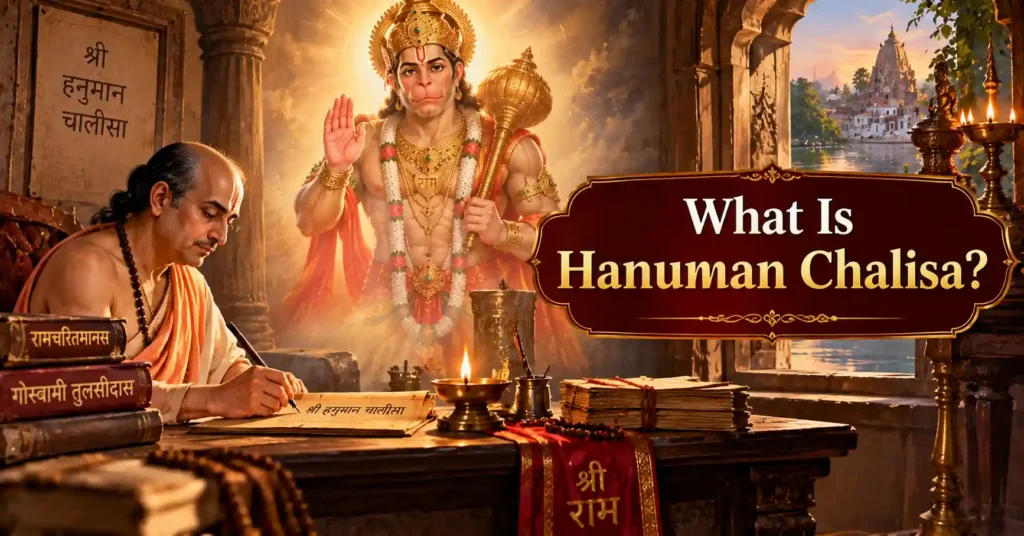
Who Is Lord Hanuman?
To understand the deeper meaning of the Hanuman Chalisa, it is important to first understand who Lord Hanuman is. Every verse of the Hanuman Chalisa celebrates His divine qualities, extraordinary deeds, and unwavering devotion to Lord Rama.
Lord Hanuman is one of the most revered figures in the Ramayana and is widely worshipped as the embodiment of strength, devotion, wisdom, courage, and selfless service. He is often regarded as the ideal devotee because his entire life was dedicated to serving Lord Rama without any desire for personal reward.
Hanuman’s Role in the Ramayana
Hanuman Ji plays a central role in the Ramayana.
He helped Lord Rama search for Mata Sita, crossed the ocean to reach Lanka, delivered Rama’s message to Sita, defeated powerful demons, and played a vital role in Rama’s victory over Ravana.
These heroic acts are remembered and praised throughout the Hanuman Chalisa.
Why Is Hanuman Known as the Ideal Devotee?
What makes Lord Hanuman unique is not just His immense power but His humility.
Despite possessing extraordinary strength and divine abilities, Hanuman Ji never acted out of pride. He considered himself a servant of Lord Rama and dedicated every action to His Lord.
This spirit of devotion is one of the most important themes of the Hanuman Chalisa.
Divine Qualities of Lord Hanuman
The Hanuman Chalisa repeatedly highlights qualities that devotees admire and seek to cultivate in their own lives.
These include:
Unwavering devotion
Fearlessness
Wisdom and intelligence
Humility
Self-discipline
Loyalty
Compassion
Selfless service
These virtues are one reason why Lord Hanuman is respected by devotees of all ages.
Why Do Devotees Worship Lord Hanuman?
Devotees turn to Lord Hanuman not only for blessings but also for inspiration.
He represents the idea that true strength comes from faith, humility, and devotion rather than physical power alone.
Many devotees worship Hanuman Ji because they see Him as:
A protector during difficult times
A symbol of courage and determination
A guide on the path of devotion
An example of selfless service
A source of spiritual strength
Lord Hanuman’s Relevance Today
Even today, Lord Hanuman continues to inspire millions of people around the world.
Students admire His focus and dedication. Spiritual seekers learn from His devotion. Families look to Him as a symbol of protection and faith.
The enduring popularity of the Hanuman Chalisa reflects the timeless appeal of Hanuman Ji’s character. His life teaches that true greatness lies not in power or achievement, but in humility, devotion, and unwavering commitment to righteousness.
Who Composed the Hanuman Chalisa?
The Hanuman Chalisa was composed by Goswami Tulsidas, one of the most respected saints, poets, and devotees in Hindu tradition. He is best known for making the teachings of Lord Rama accessible to ordinary people through devotional literature written in simple language.
Tulsidas Ji lived during the 16th century and dedicated his life to spreading the message of devotion, righteousness, and love for Lord Rama. His writings continue to inspire millions of devotees across India and around the world.
Who Was Goswami Tulsidas?
Goswami Tulsidas is regarded as one of the greatest saints of the Bhakti movement.
He is most famous for composing the Ramcharitmanas, a retelling of the Ramayana in Awadhi that made the story of Lord Rama accessible to people who could not read Sanskrit.
His works focus on devotion (bhakti), moral living, and surrender to God.
Why Did Tulsidas Compose the Hanuman Chalisa?
According to tradition, Tulsidas had deep devotion to both Lord Rama and Lord Hanuman.
The Hanuman Chalisa was composed as a hymn of praise that highlights Hanuman Ji’s divine qualities, heroic deeds, and unwavering devotion to Lord Rama.
Rather than focusing only on miracles or supernatural powers, Tulsidas emphasizes qualities such as humility, courage, wisdom, faith, and selfless service.
These values remain at the heart of the Hanuman Chalisa even today.
Why Was the Hanuman Chalisa Written in Awadhi?
At a time when many religious texts were available only in Sanskrit, Tulsidas chose to write the Hanuman Chalisa in Awadhi, a language commonly spoken by ordinary people.
This made the hymn easy to understand, memorize, and recite.
As a result, devotees from different backgrounds could connect with its message and incorporate it into their daily spiritual practice.
The Lasting Legacy of Tulsidas
The influence of Goswami Tulsidas extends far beyond the Hanuman Chalisa.
His devotional writings helped shape the Bhakti tradition and brought the teachings of Lord Rama and Lord Hanuman closer to countless devotees.
Today, the Hanuman Chalisa remains one of his most beloved compositions. Its simple language, profound wisdom, and devotional spirit continue to guide people on the path of faith, service, and spiritual growth.
History and Origin of Hanuman Chalisa
The Hanuman Chalisa has been cherished by devotees for centuries and remains one of the most widely recited hymns dedicated to Lord Hanuman. Its enduring popularity comes from its simple language, devotional depth, and timeless spiritual message.
Although the Hanuman Chalisa is deeply connected with Lord Hanuman, its composition is also an important part of India’s devotional and literary history.
Historical Background of the Hanuman Chalisa
The Hanuman Chalisa was composed by Goswami Tulsidas during the 16th century, a period when the Bhakti movement was spreading across India.
Many saints of this era sought to make spiritual teachings accessible to ordinary people by writing in regional languages rather than Sanskrit.
Tulsidas followed this approach and composed the Hanuman Chalisa in Awadhi, allowing devotees from different backgrounds to understand and recite it with ease.
Connection with the Bhakti Movement
The Bhakti movement emphasized personal devotion to God over ritual complexity.
Saints encouraged people to develop a direct relationship with the Divine through prayer, devotion, singing, and remembrance.
The Hanuman Chalisa reflects this spirit by presenting Lord Hanuman as the ideal devotee whose life demonstrates complete surrender to Lord Rama.
Its verses inspire readers to cultivate devotion, humility, faith, and selfless service.
Why Did the Hanuman Chalisa Become So Popular?
One reason for the lasting popularity of the Hanuman Chalisa is its simplicity.
Unlike lengthy scriptures that require extensive study, the Hanuman Chalisa can be easily memorized and recited by people of all ages.
Its verses are devotional yet practical, teaching values that remain relevant in everyday life.
Many devotees also appreciate that the hymn focuses on both spiritual growth and personal character development.
The Hanuman Chalisa Across Generations
For centuries, the Hanuman Chalisa has been passed down through families, temples, spiritual traditions, and devotional communities.
It is commonly recited during:
- Daily prayers
- Hanuman Jayanti celebrations
- Tuesday and Saturday worship
- Bhajan gatherings
- Personal spiritual practice
This continuous tradition has helped preserve the Hanuman Chalisa as one of the most beloved devotional compositions in Hinduism.
The Legacy of the Hanuman Chalisa Today
Today, the Hanuman Chalisa is recited not only in India but by devotees around the world.
Its message transcends language, region, and social background. The hymn continues to inspire people with its teachings on devotion, courage, humility, discipline, and unwavering faith in the Divine.
This timeless appeal is one of the reasons why the Hanuman Chalisa remains as meaningful today as it was when Goswami Tulsidas first composed it centuries ago.
Complete Hanuman Chalisa Lyrics in Sanskrit (Hindi)
Before exploring the meaning of each verse, it is helpful to read the Hanuman Chalisa in its complete form. Composed by Goswami Tulsidas in Awadhi, this sacred hymn begins with two introductory dohas, followed by forty chaupais and concludes with a final doha.
Many devotees recite the Hanuman Chalisa daily as part of their prayers, meditation, or devotional practice. Reading the complete text first can help create a deeper connection with its message before studying the line-by-line meaning.
Doha 1
श्रीगुरु चरन सरोज रज, निज मन मुकुर सुधारि।
बरनऊँ रघुबर बिमल जसु, जो दायक फल चारि॥
Doha 2
बुद्धिहीन तनु जानिके, सुमिरौं पवन-कुमार।
बल बुद्धि विद्या देहु मोहिं, हरहु कलेश विकार॥
Chaupais
जय हनुमान ज्ञान गुन सागर।
जय कपीस तिहुँ लोक उजागर॥
राम दूत अतुलित बल धामा।
अंजनि पुत्र पवनसुत नामा॥
महाबीर बिक्रम बजरंगी।
कुमति निवार सुमति के संगी॥
कंचन बरन बिराज सुबेसा।
कानन कुण्डल कुंचित केसा॥
हाथ बज्र औ ध्वजा बिराजै।
काँधे मूँज जनेऊ साजै॥
शंकर सुवन केसरी नंदन।
तेज प्रताप महा जग वंदन॥
विद्यावान गुनी अति चातुर।
राम काज करिबे को आतुर॥
प्रभु चरित्र सुनिबे को रसिया।
राम लखन सीता मन बसिया॥
सूक्ष्म रूप धरि सियहिं दिखावा।
विकट रूप धरि लंक जरावा॥
भीम रूप धरि असुर संहारे।
रामचंद्र के काज सँवारे॥
लाय सजीवन लखन जियाए।
श्रीरघुबीर हरषि उर लाए॥
रघुपति कीन्ही बहुत बड़ाई।
तुम मम प्रिय भरतहि सम भाई॥
सहस बदन तुम्हरो जस गावैं।
अस कहि श्रीपति कंठ लगावैं॥
सनकादिक ब्रह्मादि मुनीसा।
नारद सारद सहित अहीसा॥
यम कुबेर दिगपाल जहाँ ते।
कवि कोविद कहि सके कहाँ ते॥
तुम उपकार सुग्रीवहिं कीन्हा।
राम मिलाय राज पद दीन्हा॥
तुम्हरो मंत्र विभीषण माना।
लंकेश्वर भए सब जग जाना॥
जुग सहस्र योजन पर भानू।
लील्यो ताहि मधुर फल जानू॥
प्रभु मुद्रिका मेलि मुख माहीं।
जलधि लांघि गए अचरज नाहीं॥
दुर्गम काज जगत के जेते।
सुगम अनुग्रह तुम्हरे तेते॥
राम दुआरे तुम रखवारे।
होत न आज्ञा बिनु पैसारे॥
सब सुख लहै तुम्हारी सरना।
तुम रक्षक काहू को डर ना॥
आपन तेज सम्हारो आपै।
तीनों लोक हाँक ते काँपै॥
भूत पिशाच निकट नहिं आवै।
महाबीर जब नाम सुनावै॥
नासै रोग हरै सब पीरा।
जपत निरंतर हनुमत बीरा॥
संकट ते हनुमान छुड़ावै।
मन क्रम वचन ध्यान जो लावै॥
सब पर राम तपस्वी राजा।
तिनके काज सकल तुम साजा॥
और मनोरथ जो कोई लावै।
सोई अमित जीवन फल पावै॥
चारों जुग परताप तुम्हारा।
है परसिद्ध जगत उजियारा॥
साधु संत के तुम रखवारे।
असुर निकंदन राम दुलारे॥
अष्ट सिद्धि नव निधि के दाता।
अस बर दीन जानकी माता॥
राम रसायन तुम्हरे पासा।
सदा रहो रघुपति के दासा॥
तुम्हरे भजन राम को पावै।
जनम जनम के दुख बिसरावै॥
अंतकाल रघुबर पुर जाई।
जहाँ जन्म हरिभक्त कहाई॥
और देवता चित्त न धरई।
हनुमत सेइ सर्व सुख करई॥
संकट कटै मिटै सब पीरा।
जो सुमिरै हनुमत बलबीरा॥
जय जय जय हनुमान गोसाईं।
कृपा करहु गुरुदेव की नाईं॥
जो सत बार पाठ कर कोई।
छूटहि बंदि महा सुख होई॥
जो यह पढ़ै हनुमान चालीसा।
होय सिद्धि साखी गौरीसा॥
तुलसीदास सदा हरि चेरा।
कीजै नाथ हृदय महँ डेरा॥
Closing Doha
पवनतनय संकट हरन, मंगल मूरति रूप।
राम लखन सीता सहित, हृदय बसहु सुर भूप॥
The complete Hanuman Chalisa beautifully combines devotion, praise, prayer, and spiritual wisdom. In the next section, we will look at the Hanuman Chalisa lyrics in English transliteration, making it easier for readers who are not familiar with Devanagari script to chant and understand the hymn.
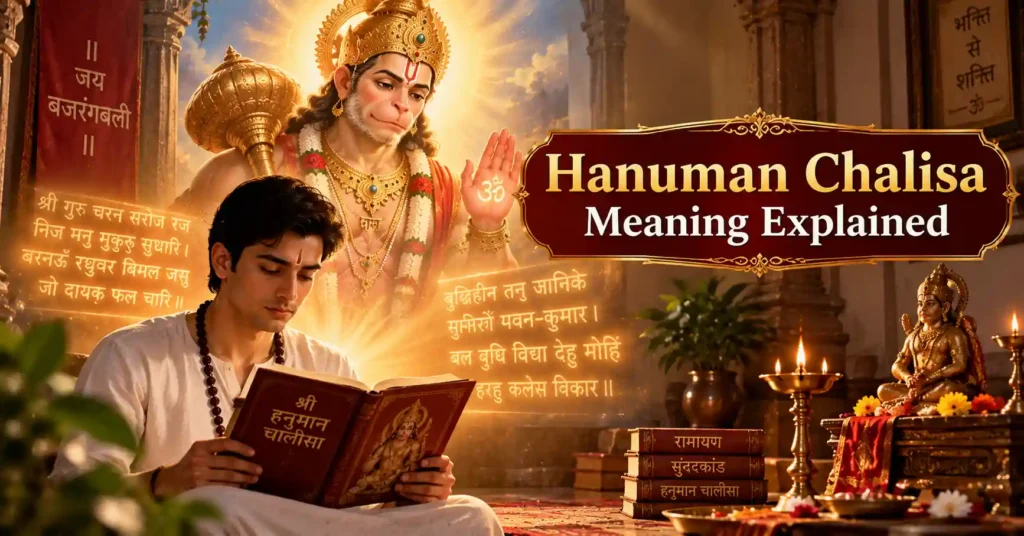
Hanuman Chalisa Meaning: Line-by-Line Translation in Hindi & English
Now that we have read the complete Hanuman Chalisa lyrics, let us explore the meaning behind each verse. While many devotees chant the Hanuman Chalisa regularly, understanding its message can help deepen both devotion and spiritual insight.
Each verse praises a different aspect of Lord Hanuman’s character, including His wisdom, strength, humility, courage, and unwavering devotion to Lord Rama. Together, these verses offer valuable lessons for both spiritual growth and daily life.
Opening Dohas
Doha 1
Original Verse
श्रीगुरु चरन सरोज रज, निज मन मुकुर सुधारि।
बरनऊँ रघुबर बिमल जसु, जो दायक फल चारि॥
Transliteration
Shri Guru Charan Saroj Raj
Nij Man Mukur Sudhari
Baranau Raghuvar Bimal Jasu
Jo Dayaku Phal Chari
Line-by-Line Hindi Meaning
श्रीगुरु चरन सरोज रज, निज मन मुकुर सुधारि
गुरु के चरण कमलों की धूल से मैं अपने मन रूपी दर्पण को शुद्ध करता हूँ।
बरनऊँ रघुबर बिमल जसु, जो दायक फल चारि
फिर मैं श्रीराम के पवित्र यश का वर्णन करता हूँ, जो धर्म, अर्थ, काम और मोक्ष प्रदान करता है।
Line-by-Line English Meaning
Shri Guru Charan Saroj Raj, Nij Man Mukur Sudhari
I cleanse the mirror of my mind with the dust of my Guru’s lotus feet.
Baranau Raghuvar Bimal Jasu, Jo Dayaku Phal Chari
I describe the pure glory of Lord Rama, who grants the four goals of life.
Full Meaning
Tulsidas begins the Hanuman Chalisa by offering respect to the Guru. He reminds us that spiritual wisdom begins with humility and guidance before attempting to understand divine truths.
Spiritual Essence
This verse teaches that learning, devotion, and spiritual growth become possible when ego is replaced by humility and reverence.
Doha 2
Original Verse
बुद्धिहीन तनु जानिके, सुमिरौं पवन-कुमार।
बल बुद्धि विद्या देहु मोहिं, हरहु कलेश विकार॥
Transliteration
Buddhiheen Tanu Janike
Sumirau Pavan Kumar
Bal Buddhi Vidya Dehu Mohi
Harahu Kalesh Vikar
Line-by-Line Hindi Meaning
बुद्धिहीन तनु जानिके, सुमिरौं पवन–कुमार
अपनी सीमित बुद्धि को जानकर मैं पवनपुत्र हनुमान का स्मरण करता हूँ।
बल बुद्धि विद्या देहु मोहिं, हरहु कलेश विकार
मुझे बल, बुद्धि और ज्ञान प्रदान करें तथा मेरे दोषों और दुखों को दूर करें।
Line-by-Line English Meaning
Buddhiheen Tanu Janike, Sumirau Pavan Kumar
Recognizing my limited understanding, I remember Lord Hanuman.
Bal Buddhi Vidya Dehu Mohi, Harahu Kalesh Vikar
Please bless me with strength, wisdom, and knowledge, and remove my faults and suffering.
Full Meaning
Before beginning the hymn, Tulsidas prays to Lord Hanuman for the qualities needed on the spiritual path. Rather than asking for wealth or power, he seeks wisdom, strength, and purity.
Spiritual Essence
The verse reminds us that true growth begins when we acknowledge our limitations and sincerely seek divine guidance.
Chaupai 1
Original Verse
जय हनुमान ज्ञान गुन सागर।
जय कपीस तिहुँ लोक उजागर॥
Transliteration
Jai Hanuman Gyan Gun Sagar
Jai Kapis Tihun Lok Ujagar
Line-by-Line Hindi Meaning
जय हनुमान ज्ञान गुन सागर
हे हनुमान जी! आपको प्रणाम, जो ज्ञान और सद्गुणों के अथाह सागर हैं।
जय कपीस तिहुँ लोक उजागर
वानरों के स्वामी, आपकी महिमा तीनों लोकों में प्रसिद्ध है।
Line-by-Line English Meaning
Jai Hanuman Gyan Gun Sagar
Victory to Lord Hanuman, the ocean of wisdom and noble virtues.
Jai Kapis Tihun Lok Ujagar
Glory to the lord of the Vanaras, whose greatness shines across all three worlds.
Full Meaning
The Hanuman Chalisa begins by praising Lord Hanuman as the embodiment of wisdom, virtue, and spiritual excellence. His fame extends throughout heaven, earth, and the netherworld because of his extraordinary devotion and noble character.
Spiritual Essence
True greatness comes not from power or status, but from wisdom, virtue, and selfless devotion.
Chaupai 2
Original Verse
राम दूत अतुलित बल धामा।
अंजनि पुत्र पवनसुत नामा॥
Transliteration
Ram Doot Atulit Bal Dhama
Anjani Putra Pavan Sut Nama
Line-by-Line Hindi Meaning
राम दूत अतुलित बल धामा
आप भगवान राम के दूत हैं और अतुलनीय शक्ति के भंडार हैं।
अंजनि पुत्र पवनसुत नामा
आप माता अंजनी के पुत्र और पवन देव के पुत्र के रूप में प्रसिद्ध हैं।
Line-by-Line English Meaning
Ram Doot Atulit Bal Dhama
You are the messenger of Lord Rama and the abode of incomparable strength.
Anjani Putra Pavan Sut Nama
You are known as the son of Mother Anjani and the Wind God.
Full Meaning
This verse highlights Hanuman Ji’s identity and divine mission. Despite possessing immense power, He dedicates all His abilities to serving Lord Rama and fulfilling divine purposes.
Spiritual Essence
Strength becomes truly meaningful when it is used in service of righteousness and a higher purpose.
Chaupai 3
Original Verse
महाबीर बिक्रम बजरंगी।
कुमति निवार सुमति के संगी॥
Transliteration
Mahabir Bikram Bajrangi
Kumati Nivar Sumati Ke Sangi
Line-by-Line Hindi Meaning
महाबीर बिक्रम बजरंगी
आप महान वीर, पराक्रमी और वज्र के समान शक्तिशाली हैं।
कुमति निवार सुमति के संगी
आप बुरी बुद्धि को दूर करते हैं और सद्बुद्धि के साथी हैं।
Line-by-Line English Meaning
Mahabir Bikram Bajrangi
You are the great hero, courageous and as powerful as a thunderbolt.
Kumati Nivar Sumati Ke Sangi
You remove negative thinking and encourage wisdom and good judgment.
Full Meaning
Hanuman Ji is praised not only for physical strength but also for His ability to guide devotees away from ignorance and toward wisdom, clarity, and righteous thinking.
Spiritual Essence
Real strength includes the ability to overcome negative thoughts and cultivate a pure, disciplined mind.
Chaupai 4
Original Verse
कंचन बरन बिराज सुबेसा।
कानन कुण्डल कुंचित केसा॥
Transliteration
Kanchan Baran Biraj Subesa
Kanan Kundal Kunchit Kesa
Line-by-Line Hindi Meaning
कंचन बरन बिराज सुबेसा
आपका स्वर्ण के समान तेजस्वी स्वरूप अत्यंत सुंदर है।
कानन कुण्डल कुंचित केसा
आप कानों में कुण्डल धारण करते हैं और आपके घुंघराले केश शोभायमान हैं।
Line-by-Line English Meaning
Kanchan Baran Biraj Subesa
Your golden complexion and noble appearance radiate divine beauty.
Kanan Kundal Kunchit Kesa
You wear earrings, and your curly hair enhances your majestic form.
Full Meaning
This verse describes the divine appearance of Lord Hanuman. His physical form reflects the inner brilliance, purity, and spiritual power that make Him revered by devotees.
Spiritual Essence
Outer beauty becomes meaningful when it reflects inner purity, virtue, and devotion.
Chaupai 5
Original Verse
हाथ बज्र औ ध्वजा बिराजै।
काँधे मूँज जनेऊ साजै॥
Transliteration
Hath Bajra Aur Dhwaja Biraje
Kandhe Moonj Janeu Sajai
Line-by-Line Hindi Meaning
हाथ बज्र औ ध्वजा बिराजै
आपके हाथ में वज्र और ध्वजा सुशोभित हैं।
काँधे मूँज जनेऊ साजै
आपके कंधे पर मूँज का यज्ञोपवीत सुशोभित है।
Line-by-Line English Meaning
Hath Bajra Aur Dhwaja Biraje
You hold the thunderbolt and a flag in your hands.
Kandhe Moonj Janeu Sajai
A sacred thread made of munja grass adorns your shoulder.
Full Meaning
The symbols carried by Lord Hanuman represent both power and spiritual discipline. The thunderbolt signifies strength, the flag symbolizes devotion and victory, and the sacred thread reflects commitment to dharma and sacred knowledge.
Spiritual Essence
The verse teaches that true power should always be guided by discipline, devotion, and adherence to righteous principles.
Chaupai 6
Original Verse
शंकर सुवन केसरी नंदन।
तेज प्रताप महा जग वंदन॥
Transliteration
Shankar Suvan Kesari Nandan
Tej Pratap Maha Jag Vandan
Line-by-Line Hindi Meaning
शंकर सुवन केसरी नंदन
आप भगवान शिव के अंशावतार और केसरी के पुत्र हैं।
तेज प्रताप महा जग वंदन
आपका तेज और प्रताप इतना महान है कि सम्पूर्ण जगत आपकी वंदना करता है।
Line-by-Line English Meaning
Shankar Suvan Kesari Nandan
You are regarded as an incarnation of Lord Shiva and the son of Kesari.
Tej Pratap Maha Jag Vandan
Your divine radiance and glory are revered throughout the world.
Full Meaning
This verse highlights the divine origin and extraordinary spiritual power of Lord Hanuman. While He appears in a humble form, His brilliance, courage, and devotion make Him worthy of universal respect.
Spiritual Essence
True greatness comes from inner character and divine purpose, not from position or recognition.
Chaupai 7
Original Verse
विद्यावान गुनी अति चातुर।
राम काज करिबे को आतुर॥
Transliteration
Vidyavan Guni Ati Chatur
Ram Kaj Karibe Ko Atur
Line-by-Line Hindi Meaning
विद्यावान गुनी अति चातुर
आप अत्यंत विद्वान, गुणवान और बुद्धिमान हैं।
राम काज करिबे को आतुर
आप सदैव भगवान राम के कार्य करने के लिए तत्पर रहते हैं।
Line-by-Line English Meaning
Vidyavan Guni Ati Chatur
You are highly knowledgeable, virtuous, and intelligent.
Ram Kaj Karibe Ko Atur
You are always eager to carry out the work of Lord Rama.
Full Meaning
Hanuman Ji’s wisdom is not used for personal gain. His knowledge, skills, and talents are dedicated entirely to serving Lord Rama and helping others.
Spiritual Essence
Knowledge becomes truly valuable when it is used selflessly for a noble purpose.
Chaupai 8
Original Verse
प्रभु चरित्र सुनिबे को रसिया।
राम लखन सीता मन बसिया॥
Transliteration
Prabhu Charitra Sunibe Ko Rasiya
Ram Lakhan Sita Man Basiya
Line-by-Line Hindi Meaning
प्रभु चरित्र सुनिबे को रसिया
आप भगवान के दिव्य चरित्र और लीलाओं को सुनने में आनंद लेते हैं।
राम लखन सीता मन बसिया
भगवान राम, लक्ष्मण और माता सीता सदैव आपके हृदय में निवास करते हैं।
Line-by-Line English Meaning
Prabhu Charitra Sunibe Ko Rasiya
You delight in listening to the divine stories and glories of the Lord.
Ram Lakhan Sita Man Basiya
Lord Rama, Lakshmana, and Sita always reside in your heart.
Full Meaning
This verse shows Hanuman Ji’s deep love for Lord Rama. His heart is constantly absorbed in devotion, remembrance, and service to the Divine.
Spiritual Essence
What we keep in our hearts shapes our thoughts, actions, and spiritual growth.
Chaupai 9
Original Verse
सूक्ष्म रूप धरि सियहिं दिखावा।
विकट रूप धरि लंक जरावा॥
Transliteration
Sukshma Roop Dhari Siyahi Dikhava
Vikat Roop Dhari Lanka Jarava
Line-by-Line Hindi Meaning
सूक्ष्म रूप धरि सियहिं दिखावा
आपने सूक्ष्म रूप धारण कर माता सीता को दर्शन दिए।
विकट रूप धरि लंक जरावा
फिर आपने विशाल और भयंकर रूप धारण कर लंका को जला दिया।
Line-by-Line English Meaning
Sukshma Roop Dhari Siyahi Dikhava
You assumed a subtle form to appear before Mother Sita.
Vikat Roop Dhari Lanka Jarava
Later, you took a fierce form and burned the city of Lanka.
Full Meaning
Hanuman Ji demonstrated both gentleness and strength according to the situation. He approached Sita with humility and compassion, yet displayed immense power when confronting evil.
Spiritual Essence
Wisdom lies in knowing when to be gentle and when to be strong.
Chaupai 10
Original Verse
भीम रूप धरि असुर संहारे।
रामचंद्र के काज सँवारे॥
Transliteration
Bhim Roop Dhari Asur Sanhare
Ramchandra Ke Kaj Savare
Line-by-Line Hindi Meaning
भीम रूप धरि असुर संहारे
आपने भयंकर रूप धारण कर राक्षसों का संहार किया।
रामचंद्र के काज सँवारे
और भगवान राम के सभी कार्य सफलतापूर्वक पूरे किए।
Line-by-Line English Meaning
Bhim Roop Dhari Asur Sanhare
You assumed a formidable form and defeated the demons.
Ramchandra Ke Kaj Savare
You successfully accomplished the missions of Lord Rama.
Full Meaning
This verse praises Hanuman Ji’s courage and dedication. Every challenge He faced was undertaken in service of Lord Rama and the cause of dharma.
Spiritual Essence
When actions are guided by righteousness and devotion, even the most difficult obstacles can be overcome.
Chaupai 11
Original Verse
लाय सजीवन लखन जियाए।
श्रीरघुबीर हरषि उर लाए॥
Transliteration
Laye Sanjivan Lakhan Jiyaye
Shri Raghuvir Harashi Ur Laye
Line-by-Line Hindi Meaning
लाय सजीवन लखन जियाए
आप संजीवनी बूटी लाकर लक्ष्मण जी को पुनर्जीवित कर सके।
श्रीरघुबीर हरषि उर लाए
इससे प्रसन्न होकर श्रीराम ने आपको हृदय से लगा लिया।
Line-by-Line English Meaning
Laye Sanjivan Lakhan Jiyaye
You brought the Sanjeevani herb and restored Lakshmana’s life.
Shri Raghuvir Harashi Ur Laye
Overjoyed, Lord Rama embraced you with great affection.
Full Meaning
This verse recalls one of Hanuman Ji’s most celebrated deeds in the Ramayana. His determination, devotion, and quick action saved Lakshmana’s life and brought immense joy to Lord Rama.
Spiritual Essence
Selfless service performed with devotion becomes the highest form of worship.
Chaupai 12
Original Verse
रघुपति कीन्ही बहुत बड़ाई।
तुम मम प्रिय भरतहि सम भाई॥
Transliteration
Raghupati Kinhi Bahut Badai
Tum Mam Priya Bharat Sam Bhai
Line-by-Line Hindi Meaning
रघुपति कीन्ही बहुत बड़ाई
भगवान राम ने आपकी बहुत प्रशंसा की।
तुम मम प्रिय भरतहि सम भाई
उन्होंने कहा कि तुम मुझे भरत के समान प्रिय हो।
Line-by-Line English Meaning
Raghupati Kinhi Bahut Badai
Lord Rama greatly praised your virtues and service.
Tum Mam Priya Bharat Sam Bhai
He declared that you are as dear to Him as His brother Bharata.
Full Meaning
Lord Rama recognizes Hanuman Ji’s unwavering devotion and service. This verse demonstrates the special bond between the Lord and a devotee who serves with complete sincerity.
Spiritual Essence
Pure devotion creates a deep spiritual connection that transcends all worldly relationships.
Chaupai 13
Original Verse
सहस बदन तुम्हरो जस गावैं।
अस कहि श्रीपति कंठ लगावैं॥
Transliteration
Sahas Badan Tumharo Jas Gave
As Kahi Shripati Kanth Lagave
Line-by-Line Hindi Meaning
सहस बदन तुम्हरो जस गावैं
हजार मुख भी आपकी महिमा का पूर्ण वर्णन नहीं कर सकते।
अस कहि श्रीपति कंठ लगावैं
ऐसा कहकर भगवान विष्णु स्वरूप राम ने आपको गले लगाया।
Line-by-Line English Meaning
Sahas Badan Tumharo Jas Gave
Even a thousand mouths cannot fully describe your glory.
As Kahi Shripati Kanth Lagave
Saying this, Lord Rama lovingly embraced you.
Full Meaning
The verse emphasizes that Hanuman Ji’s greatness is beyond ordinary description. His devotion, humility, and service are so extraordinary that even divine beings struggle to fully express them.
Spiritual Essence
The highest virtues often speak for themselves and do not require recognition or praise.
Chaupai 14
Original Verse
सनकादिक ब्रह्मादि मुनीसा।
नारद सारद सहित अहीसा॥
Transliteration
Sanakadik Brahmadi Munisa
Narad Sarad Sahit Ahisa
Line-by-Line Hindi Meaning
सनकादिक ब्रह्मादि मुनीसा
सनकादि ऋषि और ब्रह्मा जैसे महान मुनि आपकी महिमा का गुणगान करते हैं।
नारद सारद सहित अहीसा
नारद, सरस्वती और शेषनाग भी आपकी स्तुति करते हैं।
Line-by-Line English Meaning
Sanakadik Brahmadi Munisa
The sages such as Sanaka and even Brahma praise your greatness.
Narad Sarad Sahit Ahisa
Narada, Saraswati, and Sheshanaga also glorify you.
Full Meaning
This verse highlights the universal respect that Hanuman Ji receives from sages, gods, and celestial beings because of His extraordinary devotion and divine virtues.
Spiritual Essence
True spiritual greatness earns respect naturally from the wise and virtuous.
Chaupai 15
Original Verse
यम कुबेर दिगपाल जहाँ ते।
कवि कोविद कहि सके कहाँ ते॥
Transliteration
Yam Kuber Digpal Jahan Te
Kavi Kovid Kahi Sake Kahan Te
Line-by-Line Hindi Meaning
यम कुबेर दिगपाल जहाँ ते
यमराज, कुबेर और दिशाओं के रक्षक देवता भी आपकी महिमा का पूर्ण वर्णन नहीं कर सकते।
कवि कोविद कहि सके कहाँ ते
तो फिर विद्वान कवि भी उसे कैसे पूरी तरह व्यक्त कर सकते हैं?
Line-by-Line English Meaning
Yam Kuber Digpal Jahan Te
Even Yama, Kubera, and the guardians of the directions cannot fully describe your greatness.
Kavi Kovid Kahi Sake Kahan Te
How then can learned poets completely express it?
Full Meaning
The verse conveys that Hanuman Ji’s glory is immeasurable. His devotion, wisdom, and service are so vast that they transcend the limits of human language and understanding.
Spiritual Essence
Some spiritual qualities are so profound that they are experienced more deeply than they can be described.
Chaupai 16
Original Verse
तुम उपकार सुग्रीवहिं कीन्हा।
राम मिलाय राज पद दीन्हा॥
Transliteration
Tum Upkar Sugrivahi Kinha
Ram Milaye Raj Pad Dinha
Line-by-Line Hindi Meaning
तुम उपकार सुग्रीवहिं कीन्हा
आपने सुग्रीव पर महान उपकार किया।
राम मिलाय राज पद दीन्हा
उन्हें भगवान राम से मिलवाया और उनका राज्य वापस दिलाया।
Line-by-Line English Meaning
Tum Upkar Sugrivahi Kinha
You rendered a great service to Sugriva.
Ram Milaye Raj Pad Dinha
You united him with Lord Rama and helped him regain his kingdom.
Full Meaning
Hanuman Ji acted as a bridge between Sugriva and Lord Rama. Through His wisdom and efforts, Sugriva gained both divine friendship and the restoration of his rightful kingdom.
Spiritual Essence
Helping others connect with truth, guidance, and righteousness is one of the highest forms of service.
Chaupai 17
Original Verse
तुम्हरो मंत्र विभीषण माना।
लंकेश्वर भए सब जग जाना॥
Transliteration
Tumharo Mantra Vibhishan Mana
Lankeshwar Bhaye Sab Jag Jana
Line-by-Line Hindi Meaning
तुम्हरो मंत्र विभीषण माना
विभीषण ने आपकी सलाह को स्वीकार किया।
लंकेश्वर भए सब जग जाना
इसके परिणामस्वरूप वे लंका के राजा बने, यह बात पूरे संसार को ज्ञात है।
Line-by-Line English Meaning
Tumharo Mantra Vibhishan Mana
Vibhishana followed your wise counsel.
Lankeshwar Bhaye Sab Jag Jana
As a result, he became the king of Lanka, as known throughout the world.
Full Meaning
This verse highlights Hanuman Ji’s wisdom and discernment. Vibhishana’s decision to follow the path of dharma ultimately brought him success and divine grace.
Spiritual Essence
Wise guidance and righteous choices often lead to lasting success and inner peace.
Chaupai 18
Original Verse
जुग सहस्र योजन पर भानू।
लील्यो ताहि मधुर फल जानू॥
Transliteration
Jug Sahasra Yojan Par Bhanu
Lilyo Tahi Madhur Phal Janu
Line-by-Line Hindi Meaning
जुग सहस्र योजन पर भानू
सूर्य बहुत दूर स्थित था।
लील्यो ताहि मधुर फल जानू
बाल्यावस्था में आपने उसे मीठा फल समझकर निगलने का प्रयास किया।
Line-by-Line English Meaning
Jug Sahasra Yojan Par Bhanu
The Sun was located at a great distance.
Lilyo Tahi Madhur Phal Janu
As a child, you mistook it for a sweet fruit and leapt toward it.
Full Meaning
This famous incident from Hanuman Ji’s childhood demonstrates His extraordinary strength, fearlessness, and divine nature even at a young age.
Spiritual Essence
Great potential often exists within us long before we fully recognize it.
Chaupai 19
Original Verse
प्रभु मुद्रिका मेलि मुख माहीं।
जलधि लांघि गए अचरज नाहीं॥
Transliteration
Prabhu Mudrika Meli Mukh Mahi
Jaladhi Langhi Gaye Acharaj Nahi
Line-by-Line Hindi Meaning
प्रभु मुद्रिका मेलि मुख माहीं
आपने भगवान राम की मुद्रिका अपने मुख में रखी।
जलधि लांघि गए अचरज नाहीं
फिर समुद्र पार कर गए, जो कोई आश्चर्य की बात नहीं थी।
Line-by-Line English Meaning
Prabhu Mudrika Meli Mukh Mahi
You carried Lord Rama’s ring in your mouth.
Jaladhi Langhi Gaye Acharaj Nahi
With it, you crossed the ocean, which was no surprise given your devotion and strength.
Full Meaning
Hanuman Ji’s successful journey to Lanka was made possible through unwavering faith in Lord Rama and complete dedication to His mission.
Spiritual Essence
Faith combined with determination can help overcome even the greatest obstacles.
Chaupai 20
Original Verse
दुर्गम काज जगत के जेते।
सुगम अनुग्रह तुम्हरे तेते॥
Transliteration
Durgam Kaj Jagat Ke Jete
Sugam Anugrah Tumhare Tete
Line-by-Line Hindi Meaning
दुर्गम काज जगत के जेते
संसार के जितने भी कठिन कार्य हैं।
सुगम अनुग्रह तुम्हरे तेते
वे आपकी कृपा से सरल हो जाते हैं।
Line-by-Line English Meaning
Durgam Kaj Jagat Ke Jete
All difficult tasks in the world.
Sugam Anugrah Tumhare Tete
Become easier through your grace and blessings.
Full Meaning
This verse expresses the devotee’s faith that Lord Hanuman provides strength, courage, and guidance during life’s challenges, making difficult situations easier to navigate.
Spiritual Essence
Divine grace does not always remove obstacles, but it gives us the strength and wisdom needed to overcome them.
Chaupai 21
Original Verse
राम दुआरे तुम रखवारे।
होत न आज्ञा बिनु पैसारे॥
Transliteration
Ram Duare Tum Rakhvare
Hot Na Agya Binu Paisare
Line-by-Line Hindi Meaning
राम दुआरे तुम रखवारे
आप भगवान राम के द्वार के रक्षक हैं।
होत न आज्ञा बिनु पैसारे
आपकी अनुमति के बिना कोई प्रवेश नहीं कर सकता।
Line-by-Line English Meaning
Ram Duare Tum Rakhvare
You are the guardian at the doorway of Lord Rama.
Hot Na Agya Binu Paisare
No one can enter without your permission.
Full Meaning
This verse emphasizes Hanuman Ji’s special position as Lord Rama’s most trusted devotee. Through devotion to Hanuman, devotees seek a closer connection with Lord Rama and His grace.
Spiritual Essence
Devotion, humility, and service are the gateway to divine realization.
Chaupai 22
Original Verse
सब सुख लहै तुम्हारी सरना।
तुम रक्षक काहू को डर ना॥
Transliteration
Sab Sukh Lahai Tumhari Sarna
Tum Rakshak Kahu Ko Dar Na
Line-by-Line Hindi Meaning
सब सुख लहै तुम्हारी सरना
जो आपकी शरण में आते हैं, वे सुख और शांति प्राप्त करते हैं।
तुम रक्षक काहू को डर ना
जब आप रक्षक हों, तब किसी भय का कारण नहीं रहता।
Line-by-Line English Meaning
Sab Sukh Lahai Tumhari Sarna
Those who take refuge in you receive happiness and peace.
Tum Rakshak Kahu Ko Dar Na
When you are the protector, there is nothing to fear.
Full Meaning
Hanuman Ji is revered as a compassionate protector who supports devotees through life’s challenges. This verse expresses the confidence and peace that arise from sincere faith.
Spiritual Essence
Faith helps replace fear with courage and trust in divine protection.
Chaupai 23
Original Verse
आपन तेज सम्हारो आपै।
तीनों लोक हाँक ते काँपै॥
Transliteration
Aapan Tej Samharo Aapai
Teenon Lok Hank Te Kanpai
Line-by-Line Hindi Meaning
आपन तेज सम्हारो आपै
आप स्वयं अपने अद्भुत तेज और शक्ति को नियंत्रित रखते हैं।
तीनों लोक हाँक ते काँपै
फिर भी आपके प्रभाव से तीनों लोक कांप उठते हैं।
Line-by-Line English Meaning
Aapan Tej Samharo Aapai
You alone control your immense power and radiance.
Teenon Lok Hank Te Kanpai
Yet your mighty presence can shake all three worlds.
Full Meaning
Despite possessing limitless strength, Hanuman Ji remains humble and disciplined. His power is always guided by wisdom and used only for righteous purposes.
Spiritual Essence
The highest form of strength is self-control.
Chaupai 24
Original Verse
भूत पिशाच निकट नहिं आवै।
महाबीर जब नाम सुनावै॥
Transliteration
Bhoot Pishach Nikat Nahi Aavai
Mahabir Jab Naam Sunavai
Line-by-Line Hindi Meaning
भूत पिशाच निकट नहिं आवै
नकारात्मक और भय उत्पन्न करने वाली शक्तियां पास नहीं आतीं।
महाबीर जब नाम सुनावै
जब महावीर हनुमान का नाम लिया जाता है।
Line-by-Line English Meaning
Bhoot Pishach Nikat Nahi Aavai
Negative and fear-inducing forces do not come near.
Mahabir Jab Naam Sunavai
When the name of the mighty Hanuman is remembered.
Full Meaning
Traditionally, this verse is understood as a reminder that remembrance of Hanuman Ji helps devotees overcome fear, negativity, and mental disturbances.
Spiritual Essence
Faith and positive remembrance strengthen the mind against fear and negativity.
Chaupai 25
Original Verse
नासै रोग हरै सब पीरा।
जपत निरंतर हनुमत बीरा॥
Transliteration
Nasai Rog Harai Sab Peera
Japat Nirantar Hanumat Beera
Line-by-Line Hindi Meaning
नासै रोग हरै सब पीरा
आप रोगों और कष्टों को दूर करने वाले हैं।
जपत निरंतर हनुमत बीरा
जो निरंतर वीर हनुमान का स्मरण करते हैं।
Line-by-Line English Meaning
Nasai Rog Harai Sab Peera
You remove suffering and alleviate afflictions.
Japat Nirantar Hanumat Beera
For those who constantly remember and chant your name.
Full Meaning
This verse reflects the traditional belief that devotion to Hanuman Ji brings strength, resilience, and comfort during difficult times. Many devotees turn to the Hanuman Chalisa seeking courage and inner stability.
Spiritual Essence
Devotion can become a source of emotional strength, hope, and perseverance during life’s challenges.
Chaupai 26
Original Verse
संकट ते हनुमान छुड़ावै।
मन क्रम वचन ध्यान जो लावै॥
Transliteration
Sankat Te Hanuman Chhudavai
Man Kram Vachan Dhyan Jo Lavai
Line-by-Line Hindi Meaning
संकट ते हनुमान छुड़ावै
हनुमान जी भक्तों को संकटों से उबारते हैं।
मन क्रम वचन ध्यान जो लावै
जो मन, कर्म और वचन से उनका ध्यान करते हैं।
Line-by-Line English Meaning
Sankat Te Hanuman Chhudavai
Lord Hanuman helps devotees overcome difficulties and challenges.
Man Kram Vachan Dhyan Jo Lavai
Those who remember Him through thought, action, and speech.
Full Meaning
This verse teaches that sincere devotion should involve the whole personality. When a devotee’s thoughts, actions, and words are aligned with faith and righteousness, divine guidance naturally strengthens them during difficult times.
Spiritual Essence
True devotion is not limited to prayer alone. It is reflected in our thoughts, actions, and daily conduct.
Chaupai 27
Original Verse
सब पर राम तपस्वी राजा।
तिनके काज सकल तुम साजा॥
Transliteration
Sab Par Ram Tapasvi Raja
Tinke Kaj Sakal Tum Saja
Line-by-Line Hindi Meaning
सब पर राम तपस्वी राजा
भगवान राम सभी के श्रेष्ठ और धर्मनिष्ठ राजा हैं।
तिनके काज सकल तुम साजा
आपने उनके सभी कार्य सफलतापूर्वक पूर्ण किए।
Line-by-Line English Meaning
Sab Par Ram Tapasvi Raja
Lord Rama is the supreme and righteous king.
Tinke Kaj Sakal Tum Saja
You successfully carried out all of His missions.
Full Meaning
Hanuman Ji dedicated His entire life to fulfilling Lord Rama’s purpose. Every task He undertook was performed with devotion, dedication, and complete faith.
Spiritual Essence
Success becomes meaningful when it serves a noble purpose greater than personal gain.
Chaupai 28
Original Verse
और मनोरथ जो कोई लावै।
सोई अमित जीवन फल पावै॥
Transliteration
Aur Manorath Jo Koi Lavai
Soi Amit Jeevan Phal Pavai
Line-by-Line Hindi Meaning
और मनोरथ जो कोई लावै
जो कोई अपने शुभ संकल्प और इच्छाएं लेकर आता है।
सोई अमित जीवन फल पावै
वह जीवन में उत्तम और भरपूर फल प्राप्त करता है।
Line-by-Line English Meaning
Aur Manorath Jo Koi Lavai
Whoever approaches with sincere wishes and aspirations.
Soi Amit Jeevan Phal Pavai
Receives abundant blessings and positive results in life.
Full Meaning
This verse reflects the traditional belief that sincere devotion combined with righteous intentions attracts divine grace and support.
Spiritual Essence
Pure intentions, faith, and right action often lead to meaningful and lasting rewards.
Chaupai 29
Original Verse
चारों जुग परताप तुम्हारा।
है परसिद्ध जगत उजियारा॥
Transliteration
Charon Jug Pratap Tumhara
Hai Parasiddha Jagat Ujiyara
Line-by-Line Hindi Meaning
चारों जुग परताप तुम्हारा
आपकी महिमा चारों युगों में प्रसिद्ध है।
है परसिद्ध जगत उजियारा
आपकी कीर्ति पूरे संसार को प्रकाशित करती है।
Line-by-Line English Meaning
Charon Jug Pratap Tumhara
Your glory shines throughout all four ages.
Hai Parasiddha Jagat Ujiyara
Your fame illuminates the entire world.
Full Meaning
Hanuman Ji’s greatness is not limited to a particular era. His virtues and teachings continue to inspire devotees across generations and ages.
Spiritual Essence
Truth, devotion, and righteousness remain relevant regardless of time or circumstance.
Chaupai 30
Original Verse
साधु संत के तुम रखवारे।
असुर निकंदन राम दुलारे॥
Transliteration
Sadhu Sant Ke Tum Rakhvare
Asur Nikandan Ram Dulare
Line-by-Line Hindi Meaning
साधु संत के तुम रखवारे
आप साधुओं और संतों के रक्षक हैं।
असुर निकंदन राम दुलारे
आप दुष्ट शक्तियों का नाश करने वाले और भगवान राम के प्रिय हैं।
Line-by-Line English Meaning
Sadhu Sant Ke Tum Rakhvare
You are the protector of sages and saints.
Asur Nikandan Ram Dulare
You destroy evil forces and are dearly loved by Lord Rama.
Full Meaning
This verse portrays Hanuman Ji as a guardian of righteousness who protects those walking the path of virtue while standing firmly against injustice and negativity.
Spiritual Essence
Compassion and strength must work together to uphold truth and protect what is good.
Chaupai 31
Original Verse
अष्ट सिद्धि नव निधि के दाता।
अस बर दीन जानकी माता॥
Transliteration
Ashta Siddhi Nav Nidhi Ke Data
As Bar Din Janaki Mata
Line-by-Line Hindi Meaning
अष्ट सिद्धि नव निधि के दाता
आप अष्ट सिद्धियों और नौ प्रकार की निधियों को प्रदान करने में समर्थ हैं।
अस बर दीन जानकी माता
ऐसा वरदान आपको माता जानकी ने दिया था।
Line-by-Line English Meaning
Ashta Siddhi Nav Nidhi Ke Data
You are capable of granting the eight spiritual powers and the nine treasures.
As Bar Din Janaki Mata
This boon was bestowed upon you by Mother Sita.
Full Meaning
According to tradition, Mother Sita blessed Hanuman Ji with the ability to bestow spiritual and material blessings upon deserving devotees. The verse highlights His divine grace and compassionate nature.
Spiritual Essence
The highest blessings are not extraordinary powers but devotion, wisdom, and spiritual growth.
Chaupai 32
Original Verse
राम रसायन तुम्हरे पासा।
सदा रहो रघुपति के दासा॥
Transliteration
Ram Rasayan Tumhare Pasa
Sada Raho Raghupati Ke Dasa
Line-by-Line Hindi Meaning
राम रसायन तुम्हरे पासा
आपके पास राम-भक्ति रूपी अमृत है।
सदा रहो रघुपति के दासा
आप सदा भगवान राम के सेवक बने रहते हैं।
Line-by-Line English Meaning
Ram Rasayan Tumhare Pasa
You possess the nectar of devotion to Lord Rama.
Sada Raho Raghupati Ke Dasa
You remain forever the humble servant of Lord Rama.
Full Meaning
Hanuman Ji’s greatest treasure is not strength or power but His unwavering devotion to Lord Rama. His life demonstrates the transformative power of pure bhakti.
Spiritual Essence
Devotion is the greatest wealth a spiritual seeker can possess.
Chaupai 33
Original Verse
तुम्हरे भजन राम को पावै।
जनम जनम के दुख बिसरावै॥
Transliteration
Tumhare Bhajan Ram Ko Pavai
Janam Janam Ke Dukh Bisaravai
Line-by-Line Hindi Meaning
तुम्हरे भजन राम को पावै
आपकी भक्ति के माध्यम से भगवान राम की प्राप्ति होती है।
जनम जनम के दुख बिसरावै
और अनेक जन्मों के दुख दूर हो जाते हैं।
Line-by-Line English Meaning
Tumhare Bhajan Ram Ko Pavai
Through devotion to you, one attains the grace of Lord Rama.
Janam Janam Ke Dukh Bisaravai
And the sorrows accumulated over many lifetimes are forgotten.
Full Meaning
This verse emphasizes Hanuman Ji’s role as a guide to Lord Rama. Through sincere devotion to Hanuman, devotees strengthen their connection with the Divine.
Spiritual Essence
A true spiritual guide always leads the seeker toward God rather than toward himself.
Chaupai 34
Original Verse
अंतकाल रघुबर पुर जाई।
जहाँ जन्म हरिभक्त कहाई॥
Transliteration
Antakal Raghubar Pur Jai
Jahan Janma Haribhakta Kahai
Line-by-Line Hindi Meaning
अंतकाल रघुबर पुर जाई
जीवन के अंत में भक्त भगवान राम के धाम को प्राप्त करता है।
जहाँ जन्म हरिभक्त कहाई
और पुनर्जन्म होने पर भी भगवान का भक्त कहलाता है।
Line-by-Line English Meaning
Antakal Raghubar Pur Jai
At the end of life, the devotee attains the abode of Lord Rama.
Jahan Janma Haribhakta Kahai
And in future births remains devoted to the Lord.
Full Meaning
The verse expresses the traditional belief that sincere devotion shapes both present life and spiritual destiny, bringing the devotee closer to divine grace.
Spiritual Essence
Consistent devotion leaves a lasting impact on the soul’s spiritual journey.
Chaupai 35
Original Verse
और देवता चित्त न धरई।
हनुमत सेइ सर्व सुख करई॥
Transliteration
Aur Devata Chitta Na Dharai
Hanumat Sei Sarva Sukh Karai
Line-by-Line Hindi Meaning
और देवता चित्त न धरई
भक्त का मन अन्य देवताओं में भटकता नहीं।
हनुमत सेइ सर्व सुख करई
हनुमान जी की भक्ति ही उसे संतोष और सुख प्रदान करती है।
Line-by-Line English Meaning
Aur Devata Chitta Na Dharai
The devotee remains focused and undistracted.
Hanumat Sei Sarva Sukh Karai
Through devotion to Hanuman, one finds peace and fulfillment.
Full Meaning
This verse highlights the value of focused devotion. Rather than allowing the mind to wander endlessly, the devotee develops steadiness through sincere remembrance of Hanuman Ji.
Spiritual Essence
Spiritual progress grows when the mind learns to remain focused and dedicated to a higher ideal.
Hanuman Chalisa Meaning: Chaupai 36–40 and Closing Doha
Chaupai 36
Original Verse
संकट कटै मिटै सब पीरा।
जो सुमिरै हनुमत बलबीरा॥
Transliteration
Sankat Katai Mitai Sab Peera
Jo Sumirai Hanumat Balbeera
Line-by-Line Hindi Meaning
संकट कटै मिटै सब पीरा
जो हनुमान जी का स्मरण करता है, उसके संकट और पीड़ाएं दूर होती हैं।
जो सुमिरै हनुमत बलबीरा
जो वीर और शक्तिशाली हनुमान का श्रद्धा से स्मरण करता है।
Line-by-Line English Meaning
Sankat Katai Mitai Sab Peera
Difficulties and suffering are reduced for those who remember Hanuman.
Jo Sumirai Hanumat Balbeera
Who sincerely remembers the mighty and courageous Lord Hanuman.
Full Meaning
This verse reflects the traditional belief that sincere remembrance of Hanuman Ji gives devotees the strength and courage needed to face life’s challenges.
Spiritual Essence
Faith helps transform fear into confidence and despair into hope.
Chaupai 37
Original Verse
जय जय जय हनुमान गोसाईं।
कृपा करहु गुरुदेव की नाईं॥
Transliteration
Jai Jai Jai Hanuman Gosai
Kripa Karahu Gurudev Ki Nai
Line-by-Line Hindi Meaning
जय जय जय हनुमान गोसाईं
हे प्रभु हनुमान! आपकी बार-बार जय हो।
कृपा करहु गुरुदेव की नाईं
कृपया गुरु के समान मुझ पर अपनी कृपा करें।
Line-by-Line English Meaning
Jai Jai Jai Hanuman Gosai
Victory and glory to Lord Hanuman.
Kripa Karahu Gurudev Ki Nai
Please bless me with your grace like a compassionate Guru.
Full Meaning
The devotee offers heartfelt praise and seeks Hanuman Ji’s guidance, protection, and blessings on the spiritual path.
Spiritual Essence
Divine grace and guidance help seekers progress toward wisdom and devotion.
Chaupai 38
Original Verse
जो सत बार पाठ कर कोई।
छूटहि बंदि महा सुख होई॥
Transliteration
Jo Sat Bar Path Kar Koi
Chhutahi Bandi Maha Sukh Hoi
Line-by-Line Hindi Meaning
जो सत बार पाठ कर कोई
जो व्यक्ति श्रद्धा से बार-बार इस चालीसा का पाठ करता है।
छूटहि बंदि महा सुख होई
वह बंधनों से मुक्त होकर सुख प्राप्त करता है।
Line-by-Line English Meaning
Jo Sat Bar Path Kar Koi
Whoever regularly recites this Chalisa with devotion.
Chhutahi Bandi Maha Sukh Hoi
Becomes free from limitations and attains great happiness.
Full Meaning
This verse highlights the transformative effect of regular devotional practice. Consistent recitation helps cultivate inner peace, discipline, and spiritual growth.
Spiritual Essence
Regular spiritual practice gradually frees the mind from negativity and unhealthy attachments.
Chaupai 39
Original Verse
जो यह पढ़ै हनुमान चालीसा।
होय सिद्धि साखी गौरीसा॥
Transliteration
Jo Yah Padhai Hanuman Chalisa
Hoy Siddhi Sakhi Gaurisa
Line-by-Line Hindi Meaning
जो यह पढ़ै हनुमान चालीसा
जो श्रद्धा से हनुमान चालीसा का पाठ करता है।
होय सिद्धि साखी गौरीसा
उसे सफलता और कल्याण प्राप्त होता है, जिसके साक्षी स्वयं भगवान शिव हैं।
Line-by-Line English Meaning
Jo Yah Padhai Hanuman Chalisa
Whoever recites the Hanuman Chalisa with devotion.
Hoy Siddhi Sakhi Gaurisa
Attains fulfillment and blessings, with Lord Shiva as witness.
Full Meaning
Tulsidas emphasizes the spiritual value of sincere recitation and devotion. The verse reflects confidence in the power of faith and the grace of Lord Hanuman.
Spiritual Essence
Faith, devotion, and consistency bring meaningful spiritual progress.
Chaupai 40
Original Verse
तुलसीदास सदा हरि चेरा।
कीजै नाथ हृदय महँ डेरा॥
Transliteration
Tulsi Das Sada Hari Chera
Kijai Nath Hriday Mah Dera
Line-by-Line Hindi Meaning
तुलसीदास सदा हरि चेरा
तुलसीदास स्वयं को भगवान का सेवक मानते हैं।
कीजै नाथ हृदय महँ डेरा
हे प्रभु! कृपया मेरे हृदय में निवास करें।
Line-by-Line English Meaning
Tulsi Das Sada Hari Chera
Tulsidas considers himself an eternal servant of the Lord.
Kijai Nath Hriday Mah Dera
O Lord, please make Your dwelling within my heart.
Full Meaning
The Hanuman Chalisa concludes with a prayer of humility. Tulsidas does not ask for worldly success but simply requests the Divine Presence within his heart.
Spiritual Essence
The ultimate goal of devotion is to keep God at the center of one’s life and heart.
Closing Doha
Original Verse
पवनतनय संकट हरन, मंगल मूरति रूप।
राम लखन सीता सहित, हृदय बसहु सुर भूप॥
Transliteration
Pavan Tanay Sankat Haran
Mangal Murati Roop
Ram Lakhan Sita Sahit
Hriday Basahu Sur Bhoop
Line-by-Line Hindi Meaning
पवनतनय संकट हरन
हे पवनपुत्र हनुमान! आप संकटों को दूर करने वाले हैं।
मंगल मूरति रूप
आप शुभता और कल्याण के स्वरूप हैं।
राम लखन सीता सहित
भगवान राम, लक्ष्मण और माता सीता सहित।
हृदय बसहु सुर भूप
कृपया मेरे हृदय में सदैव निवास करें।
Line-by-Line English Meaning
Pavan Tanay Sankat Haran
O son of the Wind God, remover of difficulties.
Mangal Murati Roop
You are the embodiment of auspiciousness and goodness.
Ram Lakhan Sita Sahit
Along with Lord Rama, Lakshmana, and Sita.
Hriday Basahu Sur Bhoop
Please reside forever within my heart.
Full Meaning
The closing doha is a beautiful prayer asking Hanuman Ji and the divine family of Rama, Sita, and Lakshmana to dwell within the devotee’s heart. It summarizes the central message of the Hanuman Chalisa: devotion, remembrance, and surrender to the Divine.
Spiritual Essence
A heart filled with devotion, humility, and remembrance of God becomes a source of lasting peace and spiritual fulfillment.
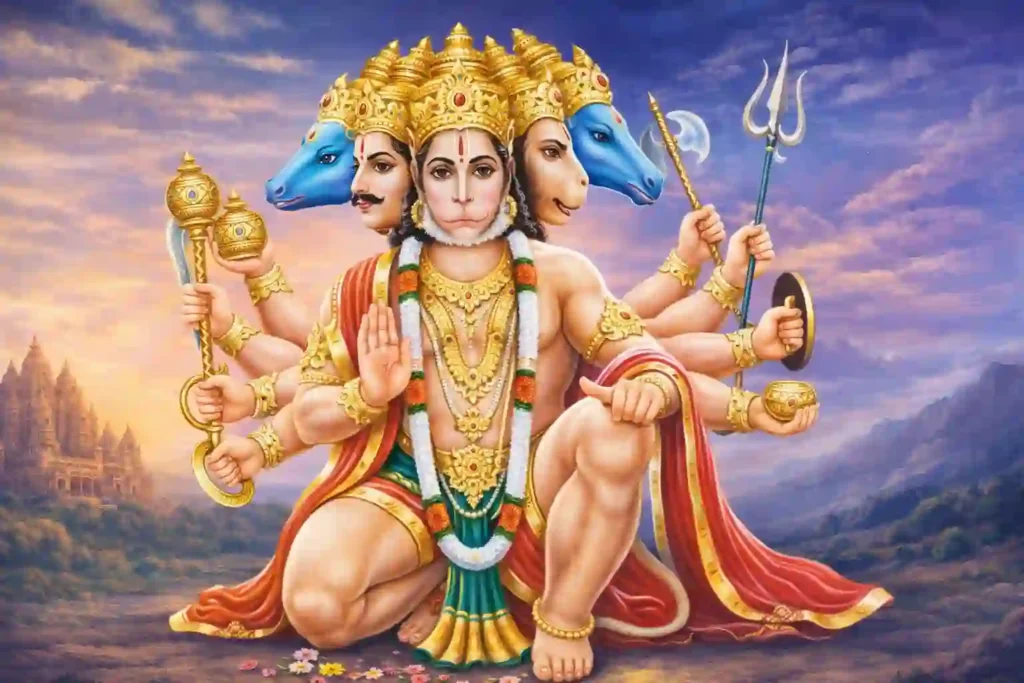
Why Is the Hanuman Chalisa So Powerful?
The Hanuman Chalisa is considered powerful not simply because of its words, but because of the devotion, wisdom, and spiritual energy it carries. Composed by Goswami Tulsidas, every verse praises qualities that Lord Hanuman perfectly embodies, including strength, courage, humility, discipline, wisdom, and unwavering devotion to Lord Rama.
For centuries, devotees have recited the Hanuman Chalisa during both joyful and difficult times. It is often chanted to seek inner strength, mental clarity, protection, and spiritual guidance.
What Makes the Hanuman Chalisa Unique?
| Aspect | Significance |
|---|---|
| Devotion (Bhakti) | Teaches complete surrender to God through Hanuman Ji |
| Courage | Inspires fearlessness during challenges |
| Wisdom | Encourages right thinking and good judgment |
| Discipline | Promotes focus, self-control, and determination |
| Protection | Traditionally recited for strength and spiritual protection |
| Simplicity | Can be understood and chanted by people of all ages |
Spiritual Significance of the Hanuman Chalisa
Unlike many prayers that focus on material desires, the Hanuman Chalisa repeatedly emphasizes character, devotion, and service.
As devotees reflect on its verses, they encounter lessons about:
Humility despite great strength
Service without expecting rewards
Faith during difficult situations
Loyalty to truth and dharma
Control over the mind and senses
Dedication to a higher purpose
These teachings make the Hanuman Chalisa relevant not only as a devotional hymn but also as a practical guide for everyday life.
Why Do Millions Chant the Hanuman Chalisa Daily?
Many devotees make the Hanuman Chalisa a part of their daily spiritual practice because it is simple to recite and rich in meaning.
Regular recitation helps devotees:
Remember the virtues of Hanuman Ji
Develop courage during adversity
Strengthen concentration and discipline
Cultivate devotion toward Lord Rama
Create a sense of inner peace and stability
While experiences differ from person to person, the enduring popularity of the Hanuman Chalisa reflects the deep comfort, inspiration, and spiritual connection that many devotees feel through its recitation.
The Core Message of the Hanuman Chalisa
At its heart, the Hanuman Chalisa teaches that true strength comes from devotion, humility, wisdom, and selfless service.
Hanuman Ji possessed extraordinary power, yet He never acted out of pride. Instead, He used every ability in service of Lord Rama and the welfare of others.
This is why the Hanuman Chalisa continues to inspire devotees across generations. It reminds us that spiritual growth is not measured by what we possess, but by how we think, serve, and live according to dharma.

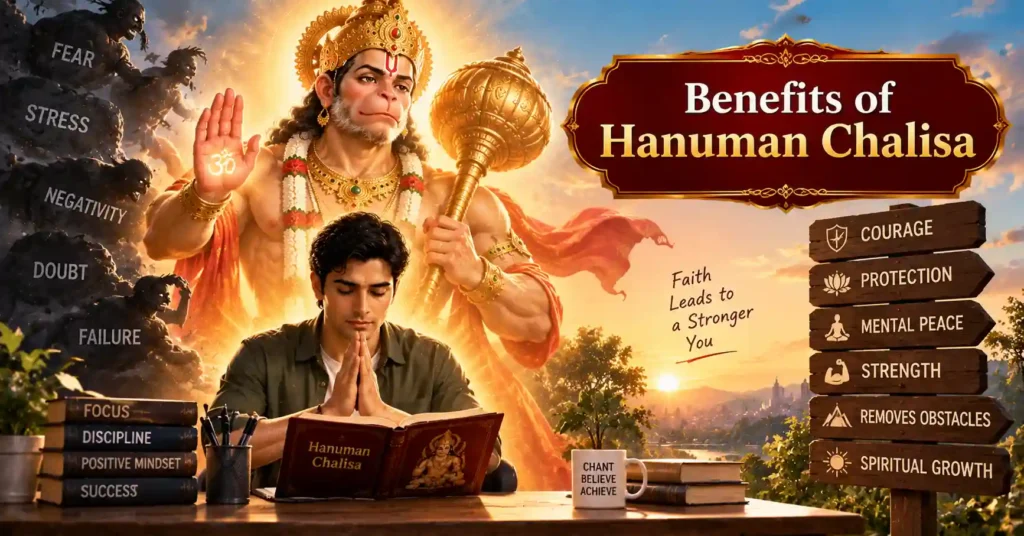
Benefits of Hanuman Chalisa
Many people recite the Hanuman Chalisa every day, but understanding its meaning can make the experience even more meaningful. When devotees reflect on the teachings behind each verse, the Hanuman Chalisa becomes more than a prayer. It becomes a guide for living with courage, discipline, devotion, and wisdom.
The benefits of the Hanuman Chalisa are often described in both spiritual and practical terms.
Spiritual Benefits
The Hanuman Chalisa repeatedly encourages devotion to God, selfless service, and faith during difficult times.
By studying and reciting the Hanuman Chalisa, devotees may develop:
Stronger devotion (Bhakti)
Greater faith in Lord Hanuman and Lord Rama
Better understanding of dharma
Humility and surrender to the Divine
Increased spiritual awareness
A deeper connection with sacred teachings
Many devotees view the Hanuman Chalisa as a daily reminder to place spiritual values above ego and selfish desires.
Mental and Emotional Benefits
The verses of the Hanuman Chalisa focus on courage, determination, and trust in divine guidance.
Regular recitation may help cultivate:
| Quality | How It Helps |
|---|---|
| Courage | Encourages confidence during challenges |
| Focus | Helps direct the mind toward positive thoughts |
| Discipline | Supports consistency in spiritual practice |
| Patience | Inspires calmness during difficult situations |
| Hope | Strengthens faith during uncertain times |
| Resilience | Encourages perseverance and inner strength |
Many devotees find that chanting the Hanuman Chalisa helps create a sense of stability and emotional balance.
Life Lessons Hidden in the Hanuman Chalisa
One of the greatest benefits of studying the Hanuman Chalisa meaning is discovering the life lessons contained within its verses.
The hymn teaches us:
Strength should be guided by humility
Knowledge should be used for service
Success should not create pride
Faith should remain strong during adversity
Devotion should inspire action, not passivity
True leadership comes through service to others
These teachings remain relevant regardless of age, profession, or stage of life.
Why Understanding the Meaning Matters
Many people memorize the Hanuman Chalisa without fully understanding what it says.
Learning the meaning helps devotees:
Connect emotionally with the verses
Appreciate Hanuman Ji’s qualities more deeply
Apply the teachings in daily life
Develop a stronger personal relationship with the prayer
Gain insights beyond simple recitation
This is why many teachers encourage devotees not only to chant the Hanuman Chalisa but also to study its meaning regularly.
The Greatest Benefit of the Hanuman Chalisa
The greatest benefit of the Hanuman Chalisa is the transformation of character.
Throughout the hymn, Lord Hanuman is presented as an ideal devotee who combines strength with humility, wisdom with service, and power with compassion.
By reflecting on these qualities and trying to practice them in daily life, devotees can gradually cultivate the same virtues within themselves. This is one of the deepest and most lasting gifts of the Hanuman Chalisa.
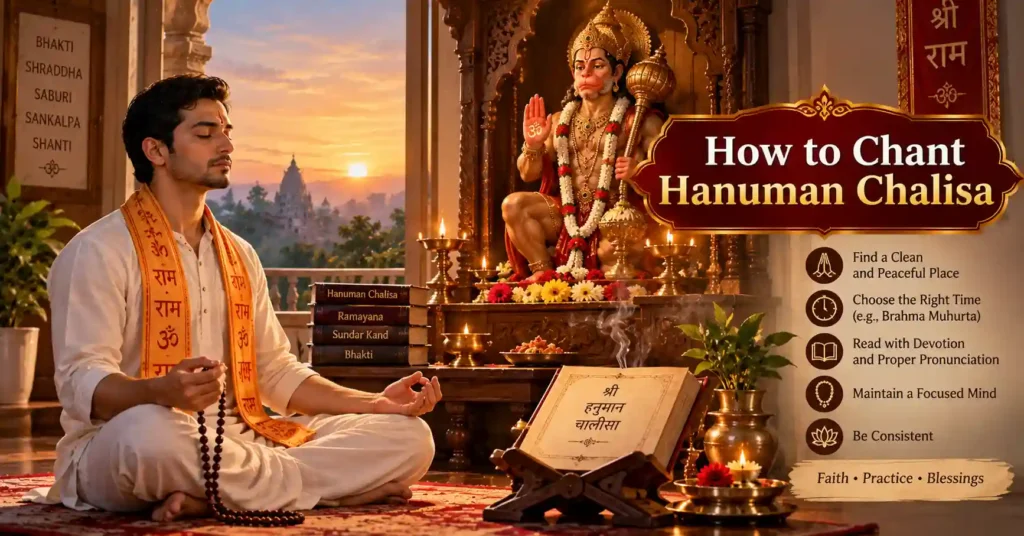
How to Chant Hanuman Chalisa Correctly
One of the reasons the Hanuman Chalisa remains so popular is that it can be chanted by anyone, regardless of age or level of spiritual experience. While there is no single compulsory method, following a few traditional practices can help create a more focused and devotional experience.
The most important element is sincerity. Lord Hanuman is revered for His simplicity, humility, and devotion, so a pure heart matters more than ritual perfection.
Best Time to Chant Hanuman Chalisa
The Hanuman Chalisa can be recited at any time of the day. However, certain times are traditionally considered especially beneficial.
| Time | Why It Is Preferred |
|---|---|
| Brahma Muhurta | Promotes peace, focus, and spiritual reflection |
| Morning | Helps begin the day with positive energy |
| Evening | Creates a sense of calm after daily activities |
| Tuesday | Traditionally associated with Lord Hanuman |
| Saturday | Many devotees offer special prayers to Hanuman Ji |
If a fixed time is not possible, regularity is more important than timing.
Simple Steps for Chanting Hanuman Chalisa
Take a bath or wash your hands and face if possible.
Sit in a clean and quiet place.
Light a diya or incense if you wish.
Offer a simple prayer to Lord Hanuman.
Recite the Hanuman Chalisa slowly and attentively.
Reflect on its meaning after chanting.
Conclude with gratitude and prayer.
Even a short and sincere recitation can be spiritually meaningful.
Should You Understand the Meaning While Chanting?
Many devotees first learn the verses and later explore their meaning.
Understanding the Hanuman Chalisa meaning can help:
Deepen devotion
Improve concentration
Make the verses more personal
Reveal important life lessons
Strengthen spiritual connection
This is why studying the Hanuman Chalisa alongside regular chanting is often recommended.
How Many Times Should You Recite the Hanuman Chalisa?
There is no fixed rule.
Some devotees chant:
Once daily
Three times daily
Seven times on special occasions
Eleven times during spiritual observances
Forty days continuously as a personal vrata or discipline
The value of the Hanuman Chalisa lies in devotion and consistency rather than the number of repetitions.
Common Mistakes to Avoid
When chanting the Hanuman Chalisa, try to avoid:
Rushing through the verses
Treating it as a mechanical task
Focusing only on material desires
Ignoring the meaning of the hymn
Becoming discouraged by pronunciation mistakes
Beginners should remember that sincere effort is more important than perfection.
A Simple Approach for Beginners
If you are new to the Hanuman Chalisa, start with a simple routine.
Read the Hanuman Chalisa once daily.
Learn a few verses at a time.
Study the meaning gradually.
Reflect on one lesson from the hymn each day.
Apply Hanuman Ji’s qualities in daily life.
Over time, the Hanuman Chalisa can become not just a prayer, but a source of strength, wisdom, devotion, and inner transformation.
Hanuman Chalisa in Daily Life: Lessons We Can Apply Every Day
Many people see the Hanuman Chalisa as a devotional hymn, but its teachings also offer practical guidance for everyday life. Each verse highlights qualities that can help us navigate challenges, relationships, responsibilities, and personal growth.
The enduring popularity of the Hanuman Chalisa comes from the fact that its message remains relevant far beyond religious practice.
What Does the Hanuman Chalisa Teach Us?
The life of Lord Hanuman demonstrates several timeless values.
| Hanuman’s Quality | Everyday Life Lesson |
|---|---|
| Devotion | Stay committed to what truly matters |
| Courage | Face difficulties without fear |
| Humility | Remain grounded despite success |
| Wisdom | Make thoughtful decisions |
| Discipline | Stay focused on goals |
| Service | Help others selflessly |
| Loyalty | Stand by truth and righteousness |
These qualities can be practiced by anyone, regardless of age or background.
Lessons for Students
Students can draw inspiration from Hanuman Ji’s dedication, focus, and eagerness to learn.
The Hanuman Chalisa encourages:
Consistent effort
Respect for teachers
Self-discipline
Positive thinking
Confidence during challenges
Hanuman Ji is often regarded as a symbol of both strength and knowledge, making Him a source of inspiration for learning and personal development.
Lessons for Working Professionals
Modern life often brings stress, competition, and uncertainty.
The Hanuman Chalisa reminds us to:
Perform duties sincerely
Avoid arrogance after success
Remain calm during setbacks
Act with integrity
Focus on solutions rather than fear
Hanuman Ji’s example shows that true success comes through dedication, humility, and service.
Lessons for Families and Relationships
Many verses of the Hanuman Chalisa highlight loyalty, respect, and selfless service.
These values can strengthen relationships by encouraging:
Trust
Patience
Compassion
Responsibility
Support during difficult times
Hanuman Ji’s devotion to Lord Rama remains one of the greatest examples of loyalty in Hindu tradition.
Lessons for Spiritual Growth
At its heart, the Hanuman Chalisa teaches that spiritual growth begins with inner transformation.
The hymn encourages devotees to:
Control the ego
Develop faith
Practice humility
Serve others
Remember God regularly
Live according to dharma
These lessons remain as relevant today as they were when Tulsidas composed the Hanuman Chalisa centuries ago.
Why These Teachings Still Matter Today
The world has changed dramatically, but the challenges of fear, distraction, pride, and uncertainty remain the same.
This is why the Hanuman Chalisa continues to resonate with millions of people. It offers not only prayers and praise but also practical wisdom for living a meaningful, balanced, and spiritually grounded life.
By understanding and applying its teachings, devotees can transform the Hanuman Chalisa from a daily recitation into a lifelong guide for character, devotion, and inner strength.
Did You Know? Interesting Facts About the Hanuman Chalisa
The Hanuman Chalisa is one of the most widely recited devotional hymns in Hinduism. While many devotees chant it regularly, there are several fascinating facts about its history, composition, and spiritual significance that are not widely known.
1. The Hanuman Chalisa Was Written by Goswami Tulsidas
The Hanuman Chalisa was composed by the saint-poet Goswami Tulsidas, who is also known for writing the Ramcharitmanas.
He wrote the hymn in Awadhi, a language that made spiritual teachings accessible to ordinary people rather than limiting them to Sanskrit scholars.
2. “Chalisa” Means Forty
The word Chalisa comes from the Hindi word Chalis, meaning forty.
The Hanuman Chalisa contains:
2 Opening Dohas
40 Chaupais
1 Closing Doha
This is why it is known as the Hanuman Chalisa.
3. It Is More Than a Prayer
Many people view the Hanuman Chalisa only as a devotional hymn.
However, it is also a guide to character development, teaching qualities such as:
Courage
Discipline
Humility
Wisdom
Loyalty
Selfless service
These lessons are one reason the Hanuman Chalisa remains relevant across generations.
4. Hanuman Ji Is Praised for Both Strength and Wisdom
Unlike many heroic figures who are remembered mainly for physical power, Hanuman Ji is repeatedly praised in the Hanuman Chalisa for His wisdom, knowledge, and humility.
The very first chaupai calls Him:
“Gyan Gun Sagar”
“The Ocean of Knowledge and Virtues.”
5. The Hanuman Chalisa Is Recited Around the World
Today, the Hanuman Chalisa is recited not only in India but also by devotees across:
Nepal
Mauritius
Fiji
Trinidad and Tobago
Suriname
United States
United Kingdom
Canada
Australia
Its simple language and universal message have helped it reach devotees across cultures and generations.
6. Many Devotees Chant It on Tuesdays and Saturdays
Tuesday and Saturday are traditionally associated with Lord Hanuman.
For this reason, many devotees choose these days for:
Hanuman Chalisa recitation
Temple visits
Hanuman worship
Special prayers and offerings
However, the Hanuman Chalisa can be recited on any day.
7. The Central Message Is Devotion, Not Miracles
While many people recite the Hanuman Chalisa seeking blessings, protection, or strength, its deeper message is devotion.
Throughout the hymn, Hanuman Ji is portrayed as the ideal devotee who:
Places God above himself
Serves without expecting rewards
Uses strength responsibly
Remains humble despite greatness
8. The Hanuman Chalisa Connects Devotees to Lord Rama
One of the unique aspects of the Hanuman Chalisa is that it ultimately points toward Lord Rama.
Hanuman Ji never seeks worship for Himself. Instead, every action, thought, and achievement is dedicated to Lord Rama.
This makes the Hanuman Chalisa not only a hymn to Hanuman but also a pathway to understanding devotion itself.
9. Understanding the Meaning Can Transform the Experience
Many devotees memorize the Hanuman Chalisa from childhood.
However, studying the Hanuman Chalisa meaning often reveals deeper lessons that may otherwise go unnoticed.
When devotees understand the verses, they can:
Connect more deeply with the prayer
Apply its teachings in daily life
Appreciate Hanuman Ji’s qualities more fully
Strengthen their spiritual practice
10. The Hanuman Chalisa Continues to Inspire Millions
Centuries after it was composed, the Hanuman Chalisa remains one of the most loved and recited Hindu prayers.
Its enduring appeal lies in its simple language, powerful message, and timeless lessons about devotion, courage, humility, and service.

Conclusion
The Hanuman Chalisa is far more than a collection of devotional verses. It is a spiritual guide that teaches courage, humility, wisdom, discipline, and unwavering devotion through the life and example of Lord Hanuman.
In this article, we explored the complete Hanuman Chalisa meaning, including its lyrics, line-by-line Hindi and English translation, spiritual significance, benefits, chanting method, and practical lessons for daily life. Understanding these deeper meanings helps transform the Hanuman Chalisa from a simple recitation into a powerful source of inspiration and self-reflection.
Whether you are a beginner learning the Hanuman Chalisa for the first time or a long-time devotee seeking a deeper connection, its message remains timeless. Hanuman Ji reminds us that true strength comes from humility, true wisdom comes from devotion, and true success comes from selfless service.
By regularly chanting and reflecting on the Hanuman Chalisa, devotees can cultivate the qualities that Lord Hanuman represents and gradually bring more faith, courage, and inner peace into their lives.
May Lord Hanuman bless you with strength, wisdom, devotion, and the courage to walk the path of dharma.
Suggested Reading
If you enjoyed learning the Hanuman Chalisa meaning, you may also like exploring other powerful hymns, mantras, and devotional prayers from Sanatan Dharma. Just as the Hanuman Chalisa meaning helps us understand devotion, courage, humility, and service, these sacred compositions offer deeper insights into Lord Shiva, Maa Durga, Gayatri Devi, and other important spiritual traditions.
Rudrashtakam: Lyrics with Meaning in Hindi and English, Benefits and How to Chant
https://thesanatantales.com/rudrashtakam-lyrics-with-meaning-hindi-english/
Shiv Tandav Stotram Meaning, Full Lyrics, Benefits and How to Chant
https://thesanatantales.com/shiv-tandav-stotram-meaning-lyrics-benefits/
Maha Mrityunjaya Mantra: Meaning, Benefits, Lyrics and How to Chant
https://thesanatantales.com/maha-mrityunjaya-mantra/
Durga Chalisa: Lyrics, English Pronunciation, Meaning, Benefits & Significance
https://thesanatantales.com/durga-chalisa-lyrics-meaning/
Navarna Mantra: Meaning, Benefits, Chanting Rules and How to Chant
https://thesanatantales.com/navarna-mantra/
Om Namah Shivaya Mantra: Complete Guide to Meaning, Benefits, and Chanting
https://thesanatantales.com/om-namah-shivaya-mantra/
Gayatri Mantra: Meaning, Benefits, Spiritual Significance and Chanting Guide
https://thesanatantales.com/gayatri-mantra-meaning-benefits/
Kaal Bhairav Ashtakam Meaning for Beginners: Lyrics in English, Benefits & Chanting Guide
https://thesanatantales.com/kaal-bhairav-ashtakam/
Hanuman Chalisa (Wikipedia)
https://en.wikipedia.org/wiki/Hanuman_Chalisa
FAQs
1. What is the Hanuman Chalisa?
The Hanuman Chalisa is a devotional hymn dedicated to Lord Hanuman, composed by the saint-poet Goswami Tulsidas. Written in the Awadhi language, it consists of forty chaupais (verses) along with opening and closing dohas.
The Hanuman Chalisa praises Hanuman Ji’s strength, wisdom, devotion, humility, and service to Lord Rama. Beyond being a prayer, it is also a spiritual guide that teaches important values such as courage, discipline, faith, and selfless action.
Millions of devotees recite the Hanuman Chalisa daily as part of their spiritual practice and devotional life.
2. What is the meaning of the Hanuman Chalisa?
The Hanuman Chalisa meaning goes far beyond praising Lord Hanuman. Each verse highlights qualities that Hanuman Ji represents, including devotion, wisdom, fearlessness, loyalty, and humility.
The hymn teaches that true strength comes from surrendering the ego and dedicating one’s abilities to a higher purpose. It also emphasizes the importance of serving others, remaining faithful during challenges, and staying committed to dharma.
When understood deeply, the Hanuman Chalisa becomes not only a prayer but also a practical guide for personal growth and spiritual development.
3. Who wrote the Hanuman Chalisa and why?
The Hanuman Chalisa was written by Goswami Tulsidas, one of the most respected saints and poets in Hindu tradition. He is also known for composing the Ramcharitmanas, a retelling of the Ramayana in a language accessible to ordinary people.
Tulsidas composed the Hanuman Chalisa to express devotion toward Lord Hanuman and to help devotees connect with His virtues and blessings.
The hymn presents Hanuman Ji as the ideal devotee whose life demonstrates complete faith, service, humility, and dedication to Lord Rama.
4. Why is the Hanuman Chalisa considered so powerful?
The Hanuman Chalisa is considered powerful because it combines devotion, spiritual wisdom, and inspiring life lessons within a simple and accessible composition.
For centuries, devotees have recited it to seek courage during difficulties, strength during adversity, and guidance during uncertain times. The verses remind readers of Hanuman Ji’s extraordinary devotion and unwavering commitment to righteousness.
Many people believe that regular recitation helps cultivate positive qualities such as discipline, confidence, faith, and resilience, making the Hanuman Chalisa both spiritually uplifting and personally transformative.
5. Can beginners read and understand the Hanuman Chalisa?
Yes. The Hanuman Chalisa is suitable for beginners and is often one of the first devotional hymns people learn in Sanatan Dharma.
Even if someone does not initially understand every verse, they can gradually explore its meaning through translations and explanations. Learning the Hanuman Chalisa meaning verse by verse often makes the experience more engaging and spiritually rewarding.
Beginners are encouraged to focus on understanding the qualities of Hanuman Ji rather than worrying about perfect pronunciation. Sincere devotion and a willingness to learn are considered more important than perfection.
6. What are the benefits of reading the Hanuman Chalisa?
Devotees traditionally associate the Hanuman Chalisa with spiritual growth, courage, discipline, and inner strength.
Regular recitation encourages reflection on virtues such as devotion, humility, wisdom, loyalty, and selfless service. Many devotees find that it helps them remain calm during difficult situations and maintain faith during periods of uncertainty.
While experiences vary from person to person, the greatest benefit of the Hanuman Chalisa is often seen as the gradual transformation of character through the cultivation of positive spiritual qualities.
7. When is the best time to chant the Hanuman Chalisa?
The Hanuman Chalisa can be recited at any time of the day. However, many devotees prefer early morning, Brahma Muhurta, or evening hours when the mind is naturally calmer and more focused.
Tuesday and Saturday are also traditionally associated with Lord Hanuman, making them popular days for special prayers and recitation.
That said, consistency matters more than timing. A daily practice performed with sincerity and devotion is generally considered more valuable than waiting for a specific day or hour.
8. Is it necessary to understand the Hanuman Chalisa while chanting it?
While many devotees begin by simply reciting the verses, understanding the Hanuman Chalisa meaning can greatly deepen the experience.
Knowing the meaning helps devotees connect emotionally with the prayer and appreciate the teachings hidden within each verse. It also allows them to apply Hanuman Ji’s qualities in daily life rather than limiting the Chalisa to ritual recitation.
For this reason, many spiritual teachers encourage devotees to study the meaning alongside regular chanting and reflection.
9. What life lessons can we learn from the Hanuman Chalisa?
The Hanuman Chalisa contains timeless lessons that remain relevant in modern life.
It teaches courage in the face of challenges, humility despite success, discipline in action, loyalty in relationships, and devotion to a higher purpose. Hanuman Ji’s life demonstrates how strength should be guided by wisdom and how service should be performed without expecting rewards.
These teachings can benefit students, professionals, householders, and spiritual seekers alike, making the Hanuman Chalisa a practical guide for character development as well as devotion.
10. Why does the Hanuman Chalisa remain popular even today?
The Hanuman Chalisa continues to inspire millions because its message is both simple and universal.
Although it was composed centuries ago, its teachings address challenges that people still face today, including fear, stress, uncertainty, pride, and lack of direction. Through the example of Lord Hanuman, the hymn offers a path based on faith, courage, humility, and service.
Its easy-to-remember verses, profound spiritual insights, and practical life lessons have helped the Hanuman Chalisa remain one of the most beloved devotional compositions in Hindu tradition.
Share Your Experience with Hanuman Chalisa
Has the Hanuman Chalisa played a special role in your spiritual journey? Many devotees recite this sacred hymn during daily prayers, Tuesday and Saturday worship, Hanuman Jayanti, or moments when they seek strength, courage, guidance, and devotion.
We would love to hear about your experience with the Hanuman Chalisa. Do you chant it regularly? Has a particular verse touched your heart or helped you through a difficult time? What lessons, insights, or blessings have you discovered while reflecting on the meaning of this beloved hymn?
Feel free to share your thoughts, experiences, or reflections in the comments below. Your journey may inspire other devotees who are beginning to explore the teachings, devotion, and timeless wisdom of Lord Hanuman.
Let us learn from one another and continue deepening our understanding of Sanatan Dharma with faith, humility, and an open heart.
Reference & Sources
This article on the Hanuman Chalisa meaning is based on the original Hanuman Chalisa composed by Goswami Tulsidas, traditional Hindu teachings, devotional literature, Ramayana-related traditions, and interpretations commonly followed within Sanatan Dharma. The explanations presented here also draw upon insights found in traditional commentaries, bhakti traditions, temple practices, and guru-disciple lineages that have preserved and shared the teachings of the Hanuman Chalisa for generations.
Note: Interpretations of the Hanuman Chalisa may vary across regions, spiritual traditions, sampradayas, and individual teachers. Some devotees may focus on its devotional aspects, while others may emphasize its philosophical, symbolic, or spiritual teachings. The significance, benefits, and methods of recitation discussed in this article are based on widely accepted traditional beliefs and practices.
The purpose of this article is not to present any single interpretation as the absolute truth, but to explain commonly accepted religious, spiritual, and devotional perspectives in a simple, respectful, and accessible manner for readers seeking to understand the meaning, significance, and timeless teachings of the Hanuman Chalisa.
Explore More Topics from The Sanatan Tales