
Have you ever opened social media feeling perfectly fine, only to close it feeling like everyone else is doing better than you?
Someone is travelling. Someone is getting promoted. Someone is buying a new home. Someone seems happier, more successful, or further ahead in life.
Without even noticing it, the mind starts comparing.
Suddenly, your own achievements feel smaller. Your progress feels slower. What was enough a few moments ago no longer feels enough.
This is the hidden effect of social media comparison.
In today’s digital world, we are constantly surrounded by carefully chosen moments from other people’s lives. Through social media comparison, we often end up measuring our everyday reality against someone else’s highlights.
The result can be self-doubt, frustration, and the feeling that we are somehow falling behind in life. But is that comparison really fair?
Most people share their successes, celebrations, and happy moments online. Very few share their struggles, fears, disappointments, or difficult days. Yet social media comparison can make those highlights look like the complete picture.
In this article, you will learn why comparing yourself to others online feels so powerful, how it affects self-worth and mental well-being, and practical ways to break free from the comparison trap. You will also discover what Sanatan wisdom teaches about contentment, inner peace, and trusting your own journey.
Social Media Comparison at a Glance
| Aspect | Overview |
|---|---|
| Meaning | The habit of comparing your life, achievements, appearance, relationships, or success with what you see on social media. |
| Common Cause | Constant exposure to carefully selected highlights from other people’s lives. |
| Why It Happens | The human mind naturally compares experiences, achievements, and social status to understand where it stands. |
| Main Trigger | Seeing posts about success, travel, relationships, wealth, fitness, or lifestyle. |
| Hidden Problem | Most social media posts show only positive moments, not the complete reality behind them. |
| Emotional Effects | Self-doubt, insecurity, frustration, dissatisfaction, envy, and feeling behind in life. |
| Impact on Self-Worth | Can lead people to judge their value based on how they compare with others. |
| Impact on Mental Health | May contribute to stress, anxiety, low self-esteem, and reduced life satisfaction. |
| The Comparison Trap | Comparing your everyday reality with someone else’s carefully curated highlight reel. |
| Warning Signs | Feeling discouraged after scrolling, struggling to enjoy personal achievements, or constantly checking what others are doing. |
| Healthy Alternative | Focus on personal growth, gratitude, self-awareness, and your own journey. |
| Sanatan Perspective | Every person follows a unique path shaped by karma, circumstances, lessons, and experiences. |
| Key Lesson | No two life journeys are the same, making constant comparison neither fair nor meaningful. |
| Practical Solution | Use social media mindfully, limit negative triggers, and remember that online posts rarely show the whole story. |
| Ultimate Goal | Greater contentment, self-acceptance, inner peace, and confidence in your own path. |
Table of Contents
ToggleWhat Is Social Media Comparison?
Social media comparison is the habit of measuring our life against the lives we see online. It can involve comparing success, appearance, relationships, wealth, lifestyle, achievements, or even happiness.
Comparison itself is not a modern problem. Human beings have always looked at others to understand where they stand. People compare themselves with family members, friends, neighbours, classmates, or colleagues. In many situations, comparison can even be helpful because it motivates learning and improvement.
The challenge begins when comparison turns into self-judgment. Instead of learning from others, we start feeling that our own life is somehow less valuable or less successful.
Social media makes this tendency much stronger. Every day we are exposed to hundreds of photographs, videos, achievements, celebrations, and life updates. The mind naturally begins comparing these images with our own experiences.
Over time, what starts as casual scrolling can quietly influence self-worth, confidence, and happiness. This is why social media comparison has become one of the most common emotional challenges of the digital age.
Did You Know?
The human mind naturally compares itself with others as a way of understanding progress, status, and belonging. In earlier times, these comparisons were usually limited to family, friends, neighbours, or colleagues.
Today, social media exposes us to hundreds of carefully selected moments from other people’s lives every day. This constant exposure can make comparison feel more intense and frequent than ever before.
While social media itself is not the problem, repeatedly comparing your everyday life with someone else’s highlights can affect self-worth, confidence, and overall well-being without you even realizing it.
Why Social Media Comparison Feels Different from Traditional Comparison
In the past, comparison usually happened within a small social circle. People compared themselves with relatives, neighbours, friends, classmates, or co-workers. These comparisons were limited because we knew the full reality of those people’s lives.
We saw their successes, but we also saw their struggles, failures, worries, and daily challenges. This made comparison somewhat balanced.
Social media has changed that experience completely.
Today, a person can compare themselves with hundreds of people in a single day. Many of those people are strangers, influencers, celebrities, or individuals living in very different circumstances.
The comparison is also incomplete. We see achievements, vacations, celebrations, and milestones, but rarely see the difficulties behind them. As a result, the mind begins comparing its complete reality with someone else’s carefully selected highlights.
This is one reason social media comparison feels more intense than traditional comparison. It happens more often, involves more people, and is based on far less information.
Why Social Media Comparison Feels So Strong Today
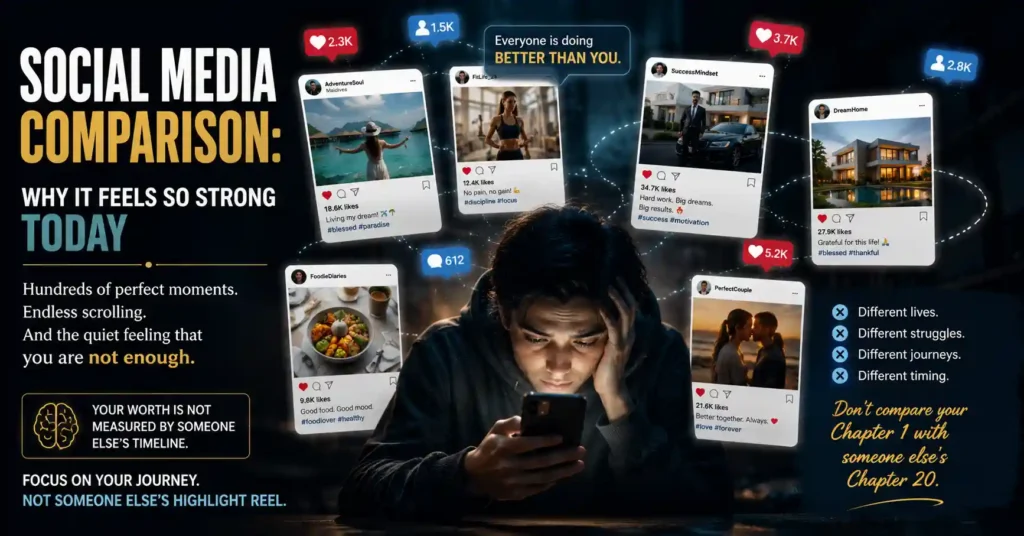
The hardest part is that no one teaches us to compare ourselves with others. It happens quietly and often without us noticing. A few minutes of scrolling can be enough to change how we feel about our own lives.
You see someone’s promotion, dream vacation, happy relationship, or personal achievement. Slowly, the mind begins comparing your journey with the images appearing on the screen.
In the past, comparison was usually limited to family members, friends, neighbours, or colleagues. Today, social media gives us access to hundreds of lives every day, all within a few minutes.
Most of what we see online is carefully selected. People naturally share their happiest moments, biggest achievements, and special experiences. Rarely do we see the struggles, failures, worries, or setbacks behind those moments.
As we continue consuming this content, the mind starts creating unrealistic standards. We begin comparing our everyday life with someone else’s highlight reel.
This is one reason social media comparison feels more intense today than ever before. The comparison is no longer occasional. It follows us throughout the day and can quietly affect our confidence, happiness, and peace of mind.
Why We Compare Ourselves to Others
Comparison is a natural tendency of the human mind. We often look at other people to understand where we stand, what is possible, or what we should work toward in life.
In healthy situations, comparison can inspire learning, growth, and self-improvement. It can motivate us to develop new skills, set goals, and expand our perspective.
The problem begins when comparison turns into self-judgment. Instead of learning from others, we start measuring our worth against their achievements, appearance, lifestyle, or success.
Social media makes this habit much stronger. Every day, we are exposed to carefully selected moments from other people’s lives. What begins as simple curiosity can slowly become dissatisfaction with our own journey.
Over time, we may start focusing more on what others have than on how far we have come ourselves. This shift can create feelings of insecurity, frustration, and the belief that we are somehow falling behind.
The truth is that every person is walking a different path. Comparing your entire life to a few moments from someone else’s life rarely gives a fair or complete picture.
Instagram Life vs Real Life: The Hidden Gap
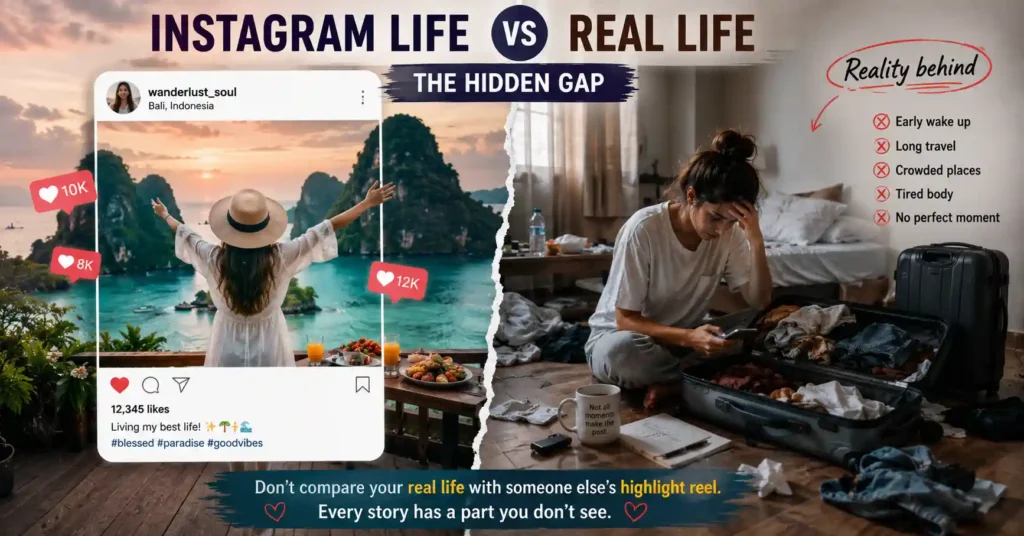
What we see online is not always fake, but it is rarely the complete picture.
Every post captures a single moment. A smile may come after weeks of stress. A promotion may follow years of hard work. A beautiful photograph may hide challenges that never appear on a screen.
Yet when we scroll through social media, the mind often forgets this reality. It starts treating those carefully chosen moments as someone’s everyday life.
This is where the gap between Instagram life and real life begins.
We compare our ordinary days, responsibilities, and uncertainties with someone else’s best moments. We see the result but not the effort. We see the celebration but not the struggle that came before it.
Over time, this can create unrealistic expectations about success, happiness, relationships, and personal growth. We begin to believe that everyone else has life figured out while we are still trying to find our way.
The truth is that every person faces challenges, disappointments, and moments of doubt. Social media simply does not show most of them.
That is why comparing your life to what you see online is rarely fair. You are comparing a complete life with a carefully edited highlight reel.
Many people fall into the comparison trap not because they lack confidence, but because they mistake a small part of someone else’s story for the whole story.
Social Media and the Illusion of Appearances
One of the important concepts in Sanatan Dharma is Maya. Maya does not simply mean illusion or something false. It refers to seeing only the outer appearance of things and mistaking that appearance for the complete reality.
This idea has become especially relevant in the age of social media.
Most online posts are real, but they are also selective. A photograph may capture a happy moment while revealing nothing about the difficulties that came before it. A success story may hide years of hard work, setbacks, and failures.
The problem begins when the mind forgets this. We start believing that what we see online represents a person’s entire life.
This misunderstanding strengthens social media comparison. We compare our full reality, including struggles and uncertainties, with a carefully chosen snapshot of someone else’s life.
Understanding Maya helps create balance. It reminds us that appearances rarely tell the whole story and that reality is often much deeper than what we see on a screen.
Why Social Media Comparison Hurts Your Mental Health
Comparison is not new. People have always compared themselves with others in different ways.
The difference today is that social media brings those comparisons into our lives almost constantly. With a few taps, we can see hundreds of updates, achievements, and life moments from people around the world.
From the moment we wake up until the end of the day, we are surrounded by images and stories that often make other people’s lives appear happier, more successful, or more exciting than our own.
Over time, this can affect much more than our mood. It can influence how we see ourselves, our progress, and our place in the world.
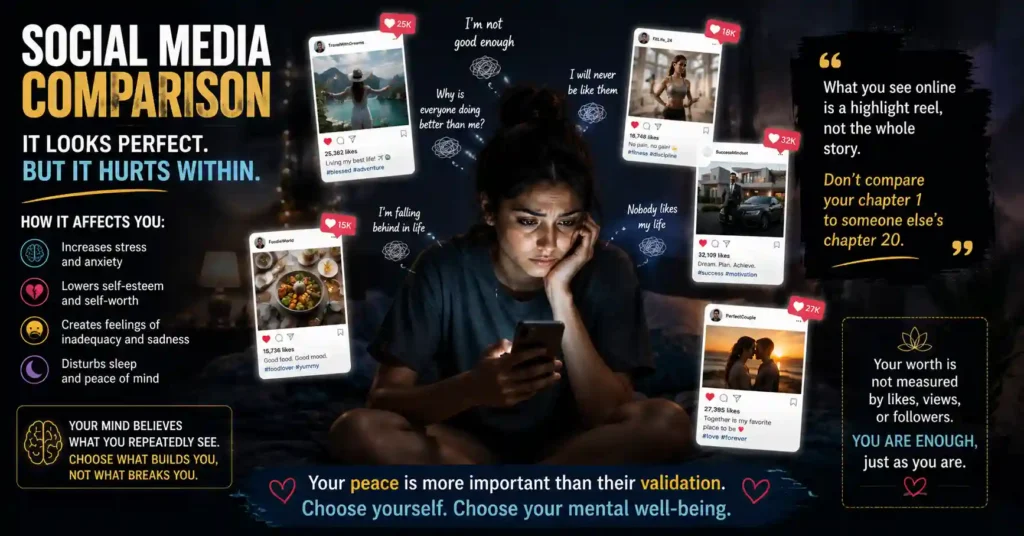
A person may begin to feel they are not doing enough, earning enough, achieving enough, or moving fast enough. Even when life is going reasonably well, a feeling of inadequacy can quietly develop.
This is where social media comparison and mental health become closely connected.
Constant exposure to other people’s highlights can increase self-doubt, lower self-esteem, and create unnecessary pressure to keep up with unrealistic expectations. The mind becomes focused on what is missing instead of appreciating what is already present.
The real impact is not what other people are doing. It is how the comparison trap slowly changes the way we think about our own lives.
When this continues for a long time, it can make it harder to experience contentment, gratitude, and inner peace, even when there is much to be thankful for.
Why Our Minds React This Way
The human mind naturally notices things that appear better, newer, or more successful. This tendency has always existed and once helped people learn, adapt, and improve their lives.
The challenge is that social media places hundreds of these images in front of us every day. The mind has very little time to process them before moving on to the next post, story, or update.
Over time, these constant comparisons can begin shaping how we see ourselves. Even when life is going well, we may start feeling that we are not doing enough or progressing fast enough.
The mind also has a tendency to focus on what is missing rather than what is already present. When we repeatedly see other people’s achievements, it becomes easy to overlook our own growth and blessings.
This is one reason many people feel emotionally drained after spending long periods on social media. The exhaustion often comes not from scrolling itself, but from the constant mental comparisons happening in the background.
Without realizing it, we start measuring our worth against other people’s success, lifestyle, appearance, or accomplishments. The more often this happens, the easier it becomes to fall into the comparison trap.
Understanding this pattern is important because it reminds us that the problem is not always what we see online. Often, it is how the mind interprets and reacts to what it sees.
Why Comparison Creates Suffering
From a Sanatan perspective, suffering often begins when the mind becomes attached to expectations, outcomes, and external measures of success.
Comparison strengthens these attachments.
Instead of appreciating our own journey, we become preoccupied with what others have achieved, earned, or experienced. The mind starts focusing on what appears to be missing rather than what is already present.
This creates dissatisfaction even when life is going reasonably well.
The more we compare, the more difficult it becomes to experience gratitude and contentment. Success may no longer feel enough because someone else always seems to have more. Achievements may feel smaller because another person appears further ahead.
Sanatan wisdom teaches that peace does not come from surpassing others. It comes from understanding ourselves, fulfilling our responsibilities, and growing according to our own path.
When attention constantly moves outward, suffering increases. When attention returns inward, peace gradually becomes possible again.
The Quiet Effect on Self-Worth
The effects of comparison are not always obvious. They often appear slowly and quietly over time.
Life may continue as usual. You go to work, meet people, complete your responsibilities, and carry on with your daily routine. From the outside, everything may seem perfectly normal.
But inside, subtle changes can begin to take place. You may start doubting yourself more often or feeling dissatisfied without fully understanding why.
Small achievements that once made you happy may no longer feel meaningful. Instead of appreciating your own progress, your attention becomes focused on what other people have accomplished.
Over time, this habit can affect how you see yourself. The more you compare your life with others, the easier it becomes to overlook your strengths, efforts, and personal growth.
This is where self-worth and social media become closely connected. Not through one dramatic event, but through hundreds of small comparisons repeated day after day.
A person may begin seeking validation from likes, comments, or approval from others. When that validation is missing, feelings of insecurity and inadequacy can quietly grow.
The result is not just lower confidence. It can also make it harder to experience gratitude, contentment, and satisfaction with your own journey.
This is one of the most overlooked effects of social media comparison. It slowly shifts attention away from who we are and toward who we think we should be.
Signs That Social Media Comparison Is Affecting You
Sometimes the effects of social media comparison become so familiar that we no longer notice them.
The change is usually gradual. There is rarely a single moment when you realize it is happening. Instead, small thoughts and emotions begin appearing more often in daily life.
You may feel that you are falling behind, even when you are making steady progress. You may find it difficult to celebrate your own achievements because your attention is focused on what others have accomplished.
Other people’s success may leave you feeling discouraged instead of inspired. A quick scroll through social media might affect your mood more than you realize.
You may also notice feelings of restlessness, dissatisfaction, or the sense that your life should look different from what it is right now.
Some people begin checking social media more often in search of validation, while others become increasingly critical of themselves and their choices.
Common signs include:
- Feeling behind in life without a clear reason
- Comparing your achievements with others frequently
- Struggling to appreciate your own progress
- Feeling discouraged by other people’s success
- Seeking approval through likes or comments
- Experiencing self-doubt after scrolling online
- Focusing more on what you lack than what you have
Recognizing these patterns is important because awareness is often the first step toward change.
Once you notice the comparison trap, it becomes easier to shift your attention back to your own growth, goals, and well-being.
What Sanatan Wisdom Teaches About Social Media Comparison
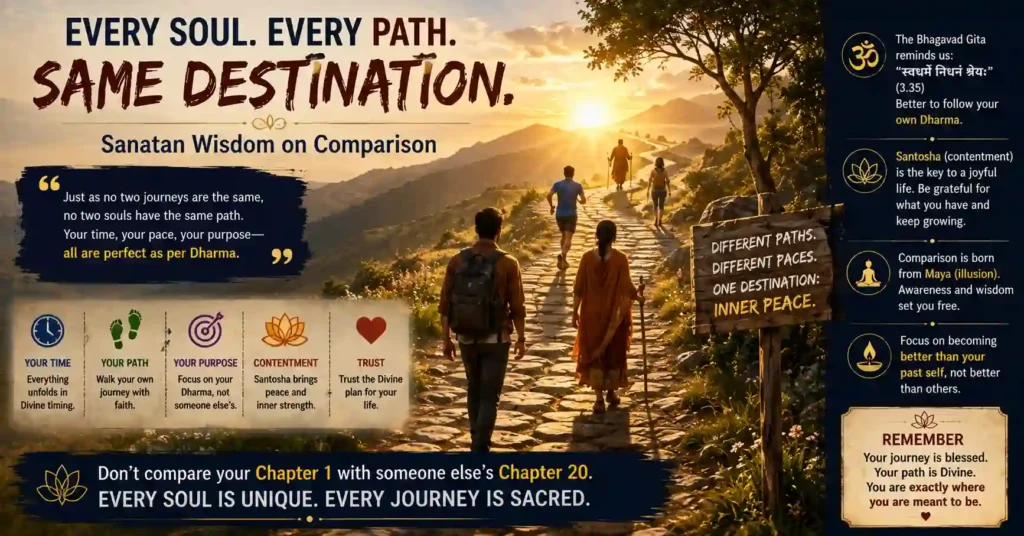
Sanatan Dharma reminds us that every life follows its own unique path.
Not everyone is meant to move at the same pace or experience the same milestones at the same time. What comes easily to one person may take longer for another, and that does not make either journey better or worse.
One of the biggest causes of social media comparison is forgetting this simple truth. We become so focused on other people’s progress that we lose sight of our own growth.
Sanatan wisdom teaches that every individual is shaped by a unique combination of karma, circumstances, abilities, lessons, and opportunities. Because of this, no two life journeys can ever be exactly the same.
When we compare ourselves with others, we often compare different paths, different challenges, and different experiences. Such comparisons rarely lead to peace because they ignore the deeper realities of life.
The Bhagavad Gita also encourages us to focus on our own path rather than becoming distracted by the lives of others. In Bhagavad Gita 3.35, Lord Krishna teaches that it is better to follow one’s own dharma imperfectly than to follow another person’s path perfectly. This teaching reminds us that every individual has a unique purpose and journey.
When comparison takes over, we often lose sight of our own dharma. Our attention shifts away from our responsibilities, growth, and inner development. Instead of focusing on what we are meant to learn and contribute, we become preoccupied with what others are doing.
Sanatan Dharma encourages us to focus on our own actions, responsibilities, and personal growth. Real progress comes from becoming a better version of ourselves, not from competing with someone else’s journey.
The more deeply we understand this perspective, the less power comparison has over us. We begin to appreciate our own efforts, our own timing, and the lessons life is teaching us.
This shift brings greater contentment, gratitude, and inner peace. Rather than feeling behind, we learn to trust that our journey is unfolding in its own way and at its own pace.
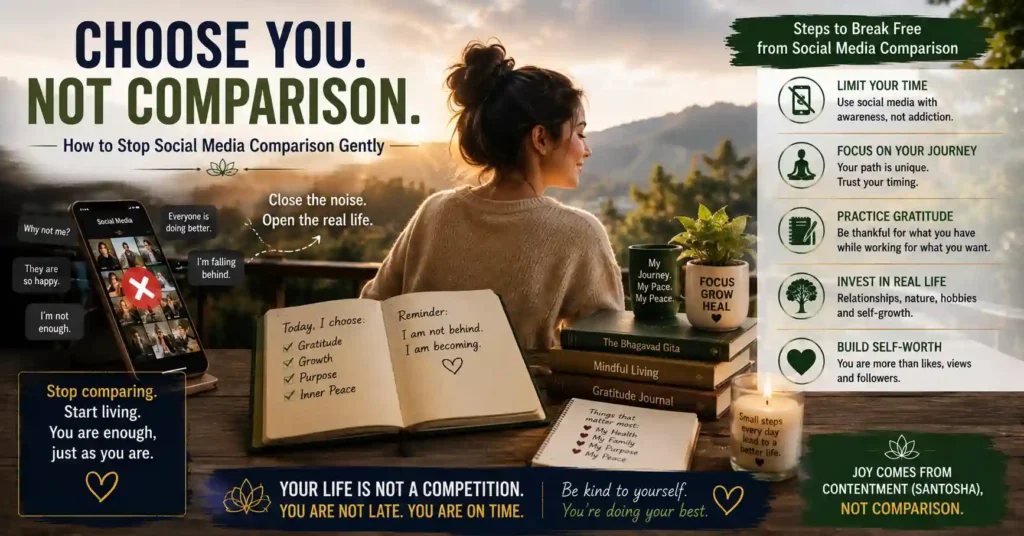
Santosha: Finding Contentment in Your Own Journey
One of the beautiful teachings of Sanatan Dharma is Santosha, often translated as contentment. Santosha does not mean giving up goals, ambition, or self-improvement. Instead, it means learning to appreciate what is already present while continuing to grow.
This teaching offers a powerful response to social media comparison.
Comparison constantly tells us that something is missing. Someone else appears happier, more successful, more attractive, or further ahead in life. Santosha shifts attention in the opposite direction. It encourages us to recognize our blessings, appreciate our progress, and value our own experiences.
When contentment grows, comparison naturally becomes weaker. We stop measuring our worth through other people’s achievements and begin finding peace in our own journey.
In many ways, Santosha is one of the most effective antidotes to the comparison trap because it replaces dissatisfaction with gratitude and inner stability.
How to Stop Social Media Comparison Gently
You do not have to quit social media completely to find greater peace of mind. In many cases, a small shift in perspective can make a meaningful difference.
The next time you are scrolling and feel that familiar discomfort, pause for a moment. Notice what you are feeling without immediately reacting to it.
Remind yourself that what you are seeing is only one part of someone’s story, not the whole story. Every achievement, celebration, or happy photograph exists alongside challenges that may never be shared online.
Behind every success are struggles, setbacks, doubts, and difficult moments that rarely appear on a screen.
When you remember this, it becomes easier to view social media with balance rather than comparison.
It can also help to focus on your own progress instead of measuring it against someone else’s journey. Ask yourself how far you have come, what you have learned, and what positive changes you have made in your own life.
Practicing gratitude is another powerful step. The more attention we give to what is already present, the less control comparison has over our thoughts.
Over time, these small changes can help break the comparison trap and create a healthier relationship with social media.
In that space, social media comparison begins to lose its strength. Self-acceptance grows, contentment becomes easier to experience, and a healthier perspective slowly takes its place.
Living Peacefully in a Digital World
You do not have to fight every thought of comparison when it appears. The goal is not to be perfect. The goal is to become more aware of how your mind responds to what you see online.
Most of the time, it is enough to gently bring your attention back to yourself and your own life.
Start noticing how different types of content make you feel. If certain accounts repeatedly leave you feeling discouraged, anxious, restless, or inadequate, it is perfectly okay to create some distance from them.
Instead, spend more time with content that feels genuine, inspiring, and grounded in reality. The information we consume every day has a powerful influence on our thoughts, emotions, and overall well-being.
Small changes in what you see online can gradually create a healthier relationship with social media.
Most importantly, keep returning to your own journey. Your efforts, your growth, and your achievements deserve attention too.
When you focus on your own path, it becomes easier to appreciate how far you have come rather than worrying about how far someone else has gone.
Whenever comparison begins to creep in, remind yourself that life is not a race and success does not follow the same timeline for everyone.
Over time, this simple shift can weaken the hold of social media comparison. In its place, you may discover greater self-acceptance, contentment, and inner peace.
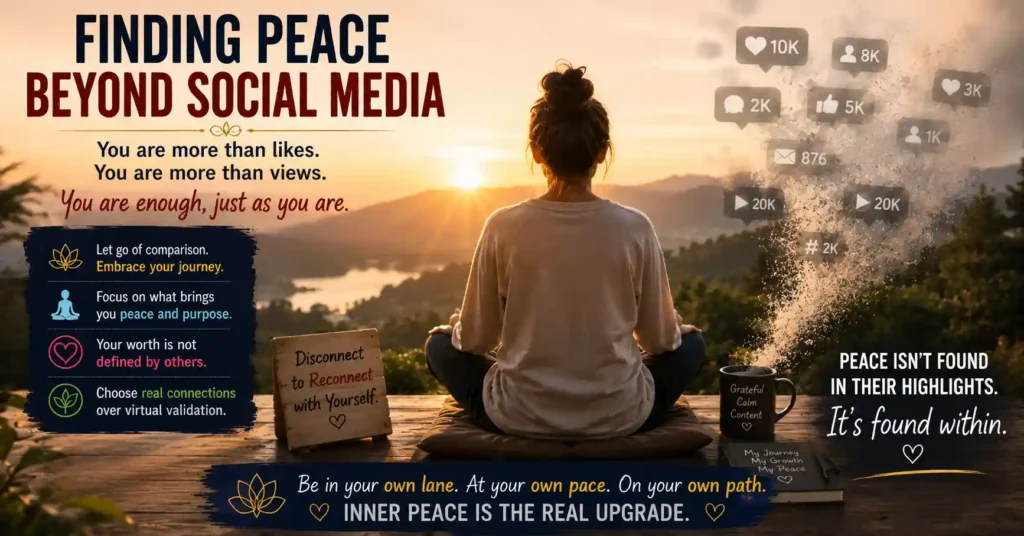
What Happens When You Stop Comparing Yourself to Others
As comparison begins to fade, something peaceful slowly returns.
The pressure to keep up with everyone else starts becoming lighter. You stop measuring your life against other people’s timelines and begin reconnecting with your own journey.
Small achievements that once went unnoticed start to matter again. Progress feels meaningful, even when it comes one step at a time.
Instead of constantly looking at what is missing, you begin appreciating what is already present in your life. Gratitude grows naturally when attention returns to your own path.
Along with this, confidence begins to return. Not the confidence that comes from proving yourself to others, but the quiet confidence that comes from accepting yourself and trusting your own growth.
Decisions also become easier. You feel less pressure to follow what everyone else is doing and more freedom to choose what genuinely feels right for you.
This is one of the most positive outcomes of overcoming social media comparison. The mind becomes calmer, self-worth becomes more stable, and happiness no longer depends on how your life compares with someone else’s.
This kind of happiness is different. It is not loud or dramatic. It is calm, steady, and deeply real. It comes from knowing that your journey is your own and that it does not need to look like anyone else’s to be meaningful.
Key Takeaways
- Social media comparison often happens quietly and can affect how we see ourselves without us realizing it.
- Most social media posts show highlights and achievements, not the complete reality of a person’s life.
- Constant comparison can lead to self-doubt, dissatisfaction, lower self-esteem, and the feeling of falling behind.
- Comparing your everyday life with someone else’s carefully selected moments is rarely fair or accurate.
- The comparison trap becomes stronger when we focus more on other people’s progress than on our own growth.
- Recognizing the signs of unhealthy comparison is the first step toward changing the habit.
- Building self-worth on personal values, effort, and growth is healthier than seeking validation from social media.
- Sanatan wisdom teaches that every person follows a unique journey shaped by different experiences, lessons, and circumstances.
- Practicing gratitude, self-awareness, and contentment can help reduce the influence of comparison.
- Real peace comes not from keeping up with others, but from accepting and trusting your own path.
Conclusion
Social media is not the problem. The problem begins when we allow it to decide how we feel about ourselves.
It is possible to use social media, learn from it, and enjoy it without measuring your worth against what you see online.
The key is to remember that your journey is unique. Your progress does not need to match someone else’s timeline to be meaningful.
No post can tell the complete story of a person’s life. No achievement online can determine your value.
The less you compare, the easier it becomes to appreciate your own growth, efforts, and experiences.
Over time, social media comparison begins to lose its hold. In its place comes greater contentment, confidence, and the peace that comes from accepting your own path.
Suggested Reading
If the topic of social media comparison resonated with you, it may be helpful to explore the deeper thoughts, emotions, and spiritual patterns that often lie behind it. While social media comparison can affect self-worth, confidence, and peace of mind, Sanatan wisdom offers valuable insights into contentment, inner balance, self-awareness, and living according to your own path.
The following articles will help you understand these ideas more deeply and support your journey toward greater clarity, calmness, and inner peace.
Sanatan Dharma: Meaning, Origin, Core Principles and Way of Life
https://thesanatantales.com/sanatan-dharma/
Sattva Rajas Tamas (Triguna): Meaning, Significance and Role in Daily Life
https://thesanatantales.com/sattva-rajas-tamas-triguna/
Inner Emptiness: Why You Feel Empty Inside Even When Life Is Good
https://thesanatantales.com/inner-emptiness/
Loneliness vs Solitude: Understanding the Difference through Sanatan Dharma
https://thesanatantales.com/loneliness-vs-solitude/
Overthinking: Why Your Mind Never Stops and How to Calm a Restless Mind
https://thesanatantales.com/overthinking/
How to Stay Calm During Difficult Times: Spiritual Wisdom from Sanatan Dharma
https://thesanatantales.com/how-to-stay-calm-during-difficult-times/
What Is Inner Peace? A Sanatan Perspective on Calmness and Stability
https://thesanatantales.com/what-is-inner-peace/
Social Media (Wikipedia)
https://en.wikipedia.org/wiki/Social_media
FAQs
What is social media comparison?
Social media comparison is the habit of measuring your life, achievements, appearance, relationships, or success against what you see on social media.
It often happens without conscious effort. While scrolling through posts and updates, the mind naturally starts comparing personal experiences with the lives of others.
The challenge is that social media usually shows only selected moments rather than the complete reality. As a result, people may feel inadequate or dissatisfied even when they are doing well in their own lives.
Why does social media comparison make people feel unhappy?
Social media comparison can create the feeling that everyone else is happier, more successful, or moving ahead faster in life.
When we repeatedly compare our everyday reality with other people’s highlights, our own achievements may begin to feel less meaningful.
Over time, this can affect self-esteem, confidence, and overall well-being. The unhappiness often comes not from what others have, but from the belief that we are somehow falling behind.
How does social media comparison affect mental health?
Constant comparison can increase feelings of self-doubt, insecurity, and dissatisfaction.
Some people may feel anxious after scrolling through social media, while others may struggle with lower self-esteem or a persistent sense of inadequacy.
The effect is usually gradual. Small comparisons repeated over weeks or months can slowly influence how a person views themselves and their progress in life.
Why do we compare ourselves to others online?
Comparison is a natural tendency of the human mind. People often look at others to understand where they stand or what they can achieve.
Social media makes this tendency stronger because it exposes us to a large number of carefully selected images, achievements, and life updates every day.
What begins as curiosity can gradually become a habit of measuring personal worth against the experiences of others.
How can I stop comparing myself to others on social media?
The first step is becoming aware of when comparison is happening.
When you notice feelings of discomfort, remind yourself that social media usually shows only part of a person’s story. Behind every success are challenges and struggles that may never be shared online.
It also helps to focus on your own growth, practice gratitude, and spend more time with content that inspires rather than discourages you.
Small changes in perspective can gradually reduce the comparison trap and create a healthier relationship with social media.
Is social media comparison always harmful?
Not always.
In some situations, seeing another person’s success can inspire learning, growth, or positive change. Healthy comparison can motivate people to improve themselves and pursue meaningful goals.
Problems arise when comparison turns into self-judgment or when personal worth becomes dependent on how one’s life compares with others.
What does Sanatan Dharma teach about comparison?
Sanatan Dharma teaches that every individual follows a unique journey shaped by different circumstances, experiences, and karma.
Because no two lives are exactly the same, comparing one person’s path with another is rarely meaningful or fair.
Sanatan wisdom encourages focusing on personal growth, self-awareness, and one’s own duties rather than constantly measuring life against the achievements of others. This perspective helps cultivate contentment, gratitude, and inner peace.
Can social media comparison affect self-worth?
Yes, it can.
When people repeatedly compare themselves with others, they may begin to overlook their own strengths, achievements, and progress.
Over time, self-worth can become linked to external validation such as likes, comments, appearance, status, or success.
A healthier approach is to build self-worth from personal values, growth, effort, and character rather than from comparisons with other people.
Why do I feel behind in life after using social media?
Many people feel behind because social media creates the impression that everyone else is constantly succeeding, travelling, achieving goals, or living an ideal life.
In reality, social media usually highlights special moments rather than everyday experiences.
When we compare our complete lives with these carefully selected moments, it can create the false belief that we are not progressing fast enough, even when we are moving forward in our own way.
Can social media comparison be reduced without quitting social media?
Yes.
Most people do not need to leave social media completely. The key is to use it more consciously.
Limiting exposure to content that triggers negative feelings, following positive and authentic accounts, and regularly reminding yourself that online posts show only part of reality can make a significant difference.
With awareness and balance, it is possible to use social media without allowing it to control how you feel about yourself.
Glossary of Important Terms
| Term | Meaning |
|---|---|
| Social Media Comparison | The habit of measuring your life, achievements, appearance, or success against what you see on social media platforms. |
| Comparison Trap | A mental pattern where constant comparison with others creates dissatisfaction, self-doubt, or feelings of inadequacy. |
| Self-Worth | The value and respect a person feels for themselves, independent of achievements, status, or external approval. |
| Self-Esteem | A person’s overall sense of confidence and belief in their own abilities and worth. |
| Mental Well-Being | A state of emotional and psychological balance that allows a person to cope with daily life in a healthy way. |
| Online Validation | Seeking approval, acceptance, or a sense of worth through likes, comments, shares, or other social media interactions. |
| Highlight Reel | The collection of positive and carefully selected moments people share online while leaving out most struggles and challenges. |
| Digital Comparison | Comparing your life with people you see online, including friends, influencers, celebrities, or strangers. |
| Contentment | A feeling of satisfaction and gratitude for what one has in the present moment rather than constantly wanting more. |
| Inner Peace | A calm and stable state of mind that remains steady despite external situations and life circumstances. |
| Gratitude | The practice of appreciating the good things already present in life instead of focusing only on what is missing. |
| Self-Acceptance | Recognizing and accepting yourself as you are, including your strengths, weaknesses, and current stage of growth. |
| Personal Growth | The ongoing process of learning, improving, and developing emotionally, mentally, and spiritually. |
| Karma | In Sanatan Dharma, the principle that actions create consequences that influence present and future experiences. |
| Sanatan Dharma | The eternal spiritual tradition of India that teaches righteous living, self-awareness, duty, and the pursuit of truth. |
| Life Journey | The unique path of experiences, challenges, lessons, and growth that each person follows throughout life. |
| Mindfulness | The practice of paying attention to the present moment with awareness rather than reacting automatically to thoughts and emotions. |
| Social Media and Mental Health | The relationship between social media use and emotional well-being, including its effects on self-esteem, stress, anxiety, and happiness. |
About the Author
Yateendra Chaturvedi is a spiritual writer, researcher, devotee, and the founder of The Sanatan Tales. With over 35 years of professional experience and a lifelong interest in Sanatan Dharma, he writes about Hindu deities, temples, scriptures, festivals, Mahavidyas, sacred stories, rituals, and living traditions that continue to guide and inspire devotees across India.
Drawing from traditional scriptures, regional beliefs, temple traditions, devotional literature, and historical sources, he aims to present authentic, well-researched, and easy-to-understand content for modern readers. His work focuses on preserving spiritual wisdom, explaining sacred traditions, and helping seekers develop a deeper understanding of India’s rich spiritual heritage.
Through The Sanatan Tales, Yateendra strives to make the timeless teachings of Sanatan Dharma simple, meaningful, and relevant for today’s generation while maintaining respect for traditional sources, regional practices, and diverse spiritual perspectives.
Learn More About Yateendra Chaturvedi →
https://thesanatantales.com/about-the-author/
References & Sources
This article is based on commonly accepted psychological insights about human behaviour, self-esteem, comparison, and the impact of social media on thoughts, emotions, and overall well-being. It also draws upon widely discussed concepts related to digital habits, online behaviour, personal growth, mindfulness, and emotional awareness.
The article further incorporates perspectives from Sanatan Dharma that encourage self-awareness, contentment, gratitude, inner peace, and focusing on one’s own life journey rather than comparing it with others.
Note: Human experiences with social media, comparison, self-worth, and mental well-being can vary from person to person. The purpose of this article is not to provide medical, psychological, or therapeutic advice, but to offer educational insights and practical reflections in a simple, balanced, and reader-friendly manner. Readers experiencing significant emotional distress or mental health concerns should consider seeking guidance from a qualified mental health professional.
Explore More Fascinating Topics from Sanatan Dharma