The Dhruv Story is one of the most inspiring stories of devotion, determination, and divine grace in Sanatan Dharma. It tells the remarkable journey of a young prince who transformed his pain into unwavering faith and eventually earned an eternal place in the heavens as Dhruv Tara, the Pole Star.
What makes the Dhruv Story so special is that its hero was only a small child. Despite facing rejection and heartbreak, Prince Dhruv chose the path of devotion instead of anger. Through intense tapasya, sincere Vishnu bhakti, and unwavering determination, he achieved what even great sages found difficult to attain.
In this Dhruv Story, you will learn how Prince Dhruv’s life changed after a painful incident in the royal palace, how Sage Narada guided him toward Lord Vishnu, how his extraordinary penance shook the heavens, and how he ultimately became Dhruv Tara, the eternal guiding star.
Beyond being a beautiful spiritual narrative, the Dhruv Story offers timeless lessons about faith, perseverance, devotion, inner strength, and the power of focusing on a higher purpose. Its teachings continue to inspire devotees, children, and spiritual seekers across generations.
Table of Contents
ToggleDhruv Story Snapshot
| Aspect | Details |
|---|---|
| Main Characters | Prince Dhruv, Lord Vishnu, Sage Narada, King Uttanapada, Queen Suniti, Queen Suruchi |
| Source | Bhagavata Purana, Vishnu Purana, Traditional Sanatan Dharma Teachings |
| Theme | Devotion, Determination, Vishnu Bhakti, Spiritual Growth |
| Setting | Ancient Kingdom of King Uttanapada and the Sacred Forest |
| Divine Guide | Sage Narada |
| Sacred Mantra | Om Namo Bhagavate Vasudevaya |
| Divine Blessing | Eternal position as Dhruv Tara (Pole Star) |
| Key Lesson | Unwavering devotion and faith can transform pain into spiritual greatness |
| Symbolism | Dhruv Tara represents steadiness, faith, and spiritual focus |
| Relevance Today | Inspires perseverance, devotion, and commitment to higher goals |
Dhruv Story: How a Young Prince Became Dhruv Tara
Long ago, there ruled a king named Uttanapada. He had two queens, Suniti and Suruchi. Prince Dhruv was the son of Queen Suniti, while his stepbrother Uttama was the son of Queen Suruchi.
Although King Uttanapada loved both his sons, he was greatly influenced by Suruchi. As a result, young Dhruv often felt neglected despite being a prince of the kingdom.
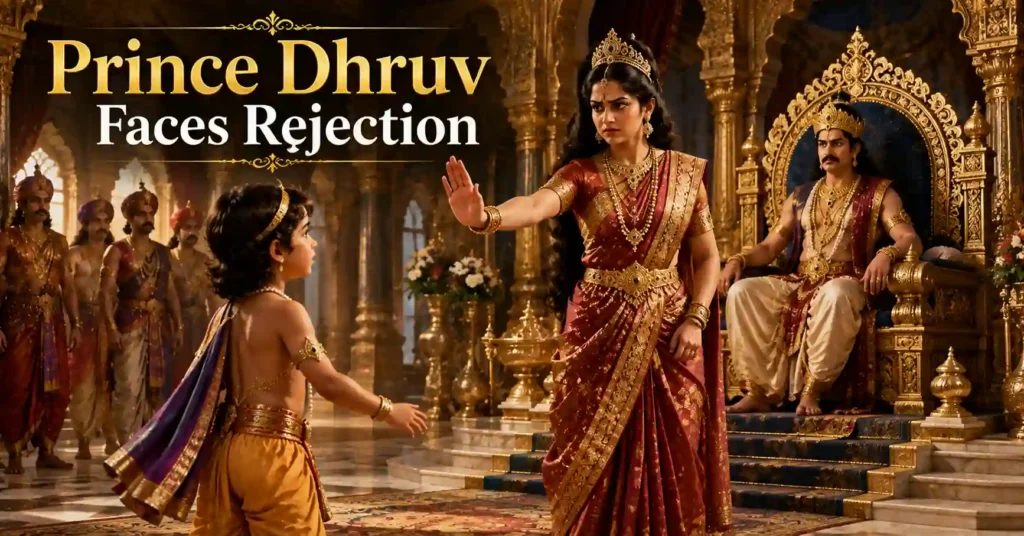
One day, Dhruv saw his stepbrother sitting comfortably on the king’s lap. Filled with love for his father, the young prince walked forward and wished to sit beside him.
Before he could do so, Queen Suruchi stopped him.
With harsh words, she told Dhruv that he had no right to sit on the king’s lap because he was not born from her womb. She further declared that if he desired such a place, he would have to be born again as her son.
These words deeply wounded the heart of the young prince.
Tears filled his eyes as he quietly left the royal court. Though he was only a child, the pain of rejection stayed with him.
Dhruv then went to his mother, Queen Suniti, and shared everything that had happened.
Unlike many parents who might have encouraged anger or revenge, Suniti gently guided her son toward a higher path. She told him that worldly positions and honors are temporary, but the grace of Lord Vishnu is eternal.
She advised him to seek refuge in Bhagwan Vishnu, who never abandons a sincere devotee.
These words transformed the young prince.
Instead of dwelling on his sorrow, Dhruv decided to seek Lord Vishnu and obtain a place that no one could ever take away from him.
With determination far beyond his years, he left the comforts of the palace and entered the forest.
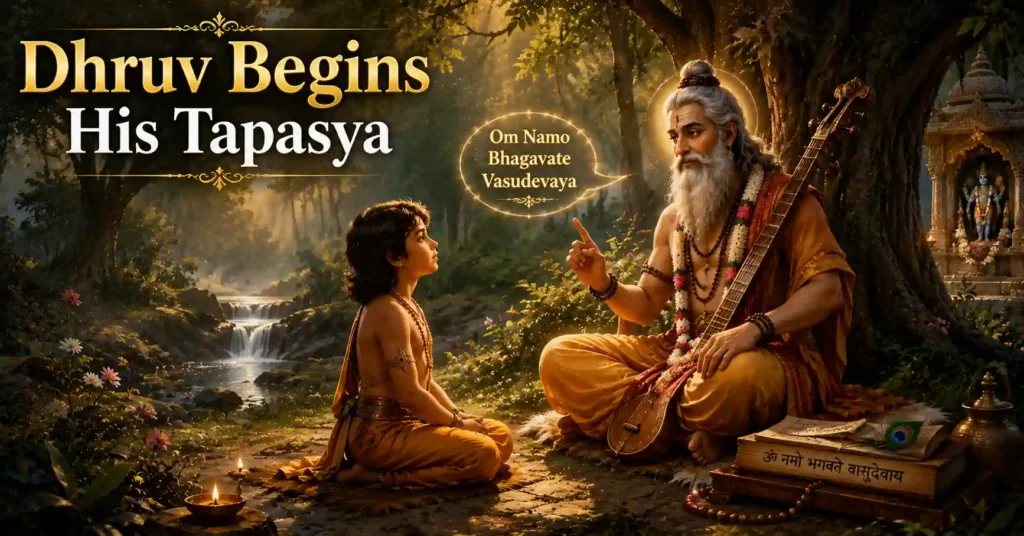
As Dhruv journeyed deeper into the wilderness, he encountered the great sage Narada.
Seeing such a young child alone in the forest, Narada was surprised. He asked Dhruv why he had left home and listened carefully as the prince explained his purpose.
At first, Narada tried to persuade him to return to the palace.
He explained that the path of spiritual discipline and tapasya was extremely difficult, even for experienced sages and ascetics.
However, Dhruv’s resolve remained unshaken.
The young prince declared that he would not return until he had received the blessings of Lord Vishnu.
Recognizing the purity and determination of his heart, Narada became pleased.
The sage blessed Dhruv and taught him the sacred mantra:
“Om Namo Bhagavate Vasudevaya.”
Narada instructed him to meditate upon Lord Vishnu while continuously chanting this divine mantra.
Following the sage’s guidance, Dhruv began his intense tapasya in the forest.
At first, he survived on fruits and berries.
As his meditation deepened, he gradually reduced his dependence on food and focused entirely on the name of Lord Vishnu.
Months passed.
Dhruv’s devotion became so powerful that he stood on one leg, completely absorbed in meditation. His mind remained fixed on Bhagwan Vishnu without distraction.
The intensity of his tapasya astonished even the devas.
Traditional accounts describe how the spiritual power generated by the young prince began to influence the entire universe.
The devas grew concerned and approached Lord Vishnu, asking Him to intervene.
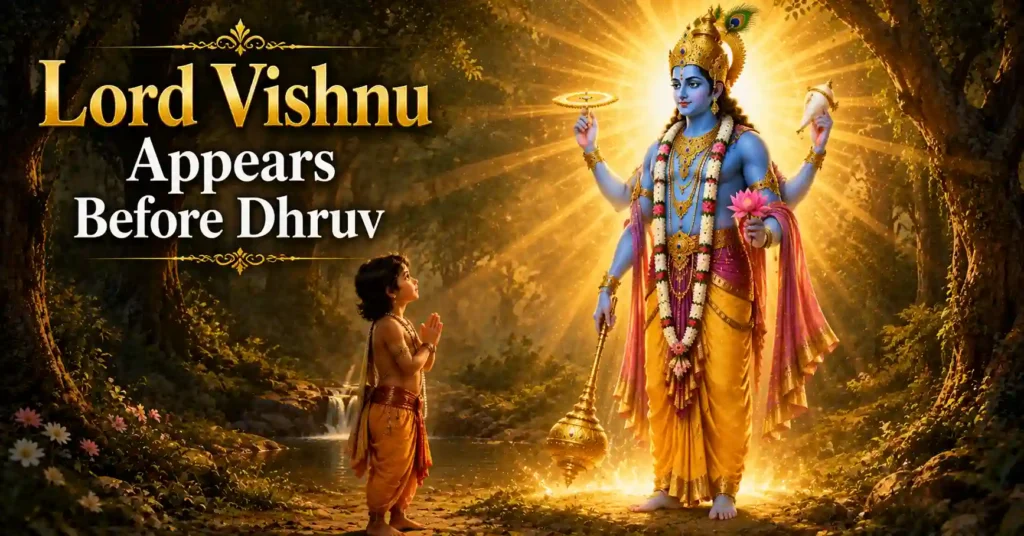
Pleased by the unwavering devotion of the child, Lord Vishnu decided to grant him darshan.
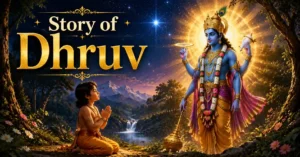
One day, a brilliant divine light appeared before Dhruv.
When he opened his eyes, he beheld the magnificent form of Lord Vishnu, holding the Shankha, Chakra, Gada, and Padma.
Overwhelmed with devotion, Dhruv stood speechless.
The prince who had once entered the forest seeking recognition now found himself standing before the Supreme Lord.
Seeing Dhruv’s devotion, Lord Vishnu gently touched his forehead with His divine conch.
At that moment, Dhruv gained divine wisdom and offered heartfelt prayers to Bhagwan.
Something remarkable had happened.
The desire that had first brought him to the forest had completely disappeared.
The pain, rejection, and longing for status were gone.
Only pure devotion remained in his heart.
Lord Vishnu was deeply pleased with this transformation.
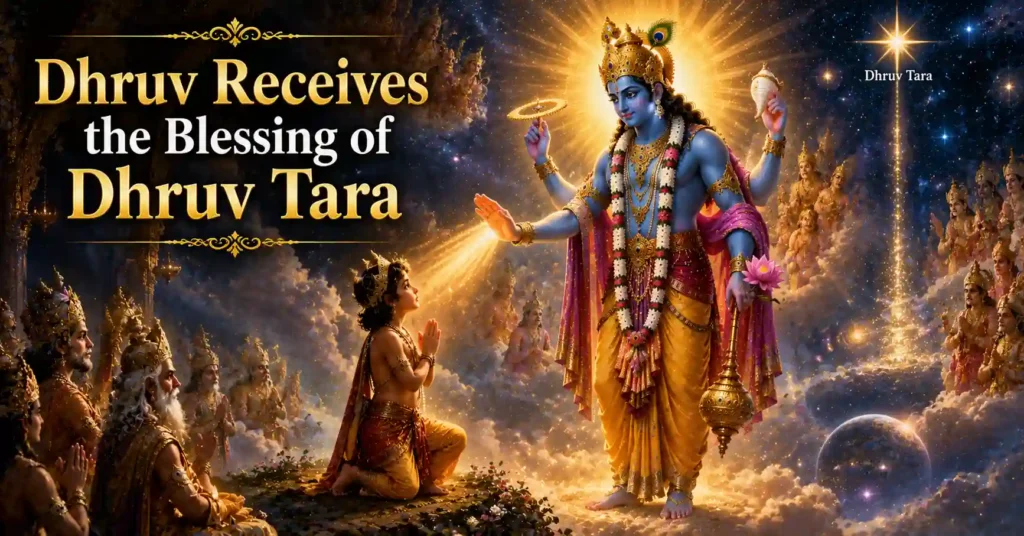
He blessed Dhruv with spiritual wisdom, prosperity, and a glorious future.
Most importantly, He granted the young prince an eternal position that would never fade with time.
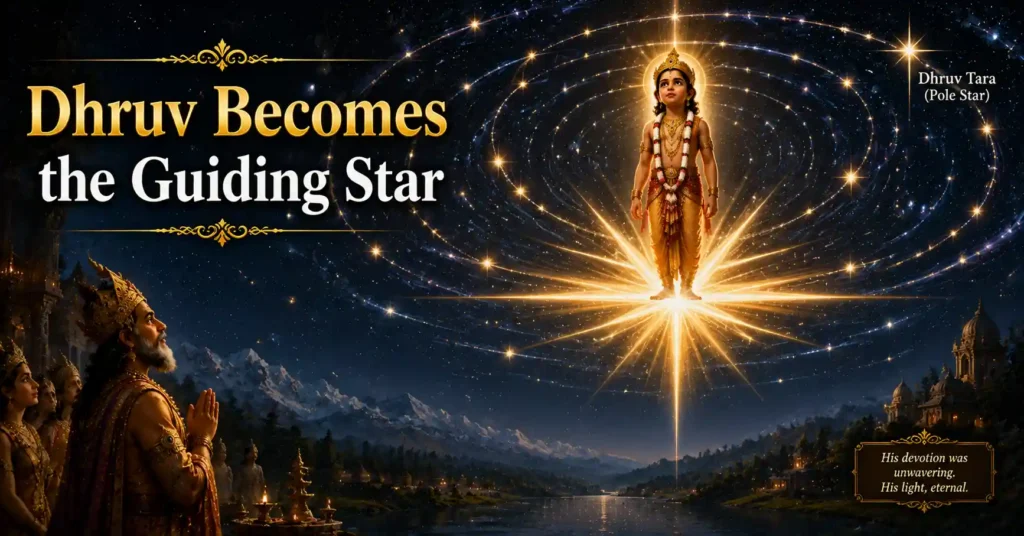
After completing his earthly duties, Dhruv would become Dhruv Tara, the celestial Pole Star.
Unlike other stars that appear to move across the night sky, Dhruv Tara remains steady and fixed, serving as a guide for travelers and seekers.
Thus, the Dhruv Story transformed from a tale of childhood sorrow into one of the greatest examples of Vishnu bhakti, perseverance, and spiritual determination.
From a rejected child seeking comfort from his father, Dhruv became Dhruv Tara, the eternal guiding star whose devotion continues to inspire millions of devotees even today.
What Does the Dhruv Story Teach Us?
The Dhruv Story is much more than the story of a young prince who became Dhruv Tara. It is a timeless lesson about faith, determination, devotion, and the power of spiritual focus.
Even today, the Dhruv Story continues to inspire devotees because its teachings are relevant to people of all ages and walks of life.
1. Pain Can Become a Path to Spiritual Growth
The Dhruv Story begins with a painful experience.
After being rejected and insulted by Queen Suruchi, young Dhruv could have become bitter or angry. Instead, he transformed his pain into a search for divine truth.
The story teaches that difficulties and disappointments can become opportunities for spiritual growth when approached with the right mindset.
2. Good Guidance Can Change a Life
One of the most important moments in the Dhruv Story is the advice given by Dhruv’s mother, Queen Suniti.
Rather than encouraging revenge or resentment, she guided her son toward Lord Vishnu and the path of devotion.
The story reminds us that wise guidance from parents, teachers, and spiritual mentors can shape our destiny.
3. Age Is Not a Barrier to Devotion
Dhruv was only a young child when he began his spiritual journey.
Despite his age, he displayed extraordinary determination, discipline, and faith.
The Prince Dhruv Story teaches that sincere devotion does not depend on age, status, or worldly experience.
4. Determination Leads to Great Achievements
When Sage Narada explained the difficulties of tapasya, Dhruv refused to give up.
His commitment remained firm even when the path became challenging.
The Dhruv Story teaches that perseverance and unwavering focus are essential for achieving meaningful goals in both spiritual and worldly life.
5. True Devotion Purifies the Heart
At first, Dhruv sought a position greater than his father’s throne.
However, through meditation and devotion to Lord Vishnu, his desires gradually changed.
By the time he received darshan of Bhagwan Vishnu, he no longer cared about power or status. Only devotion remained in his heart.
6. Divine Grace Rewards Sincere Effort
The Dhruv and Vishnu Story beautifully illustrates how sincere spiritual effort attracts divine grace.
Lord Vishnu appeared before Dhruv not because of his royal birth, but because of his pure devotion and unwavering faith.
The story reminds us that the Divine responds to sincerity, dedication, and a genuine desire for spiritual growth.
7. Spiritual Success Is Greater Than Worldly Success
Dhruv initially sought recognition and acceptance.
Yet he ultimately gained something far greater than any earthly throne. He received divine wisdom, the blessings of Lord Vishnu, and an eternal place as Dhruv Tara.
The story teaches that spiritual fulfillment brings lasting peace and happiness, while worldly achievements are temporary.
8. Stay Steady Like Dhruv Tara
The most enduring lesson of the Dhruv Tara Story is the importance of remaining steady in faith and values.
Just as Dhruv Tara remains fixed in the night sky while other stars appear to move around it, we should remain grounded in Dharma, truth, and devotion despite life’s changing circumstances.
For this reason, the Dhruv Story continues to inspire devotees as a powerful example of unwavering faith, spiritual determination, and the transformative power of devotion to Lord Vishnu.
Why Is the Dhruv Story Important in Sanatan Dharma?
The Dhruv Story holds a special place in Sanatan Dharma because it demonstrates the transformative power of devotion, faith, and spiritual determination. For centuries, devotees have looked to Prince Dhruv as an example of how sincere devotion can overcome even the greatest challenges.
Beyond being a beautiful story, the Dhruv Story teaches important spiritual principles that remain relevant in modern life.
1. It Is One of the Greatest Examples of Vishnu Bhakti
The Dhruv and Vishnu Story is one of the most celebrated examples of devotion to Lord Vishnu.
Despite being only a child, Dhruv performed intense tapasya and focused his entire mind on Bhagwan Vishnu. His devotion eventually earned him direct darshan of the Lord.
This makes the story an important source of inspiration for Vaishnava devotees.
2. It Shows That Anyone Can Attain Divine Grace
One reason the Dhruv Story remains so important is that it teaches that spiritual success is not limited by age, status, or background.
Dhruv was neither a sage nor a great scholar. He was a young child with a sincere heart and unwavering determination.
His journey reminds devotees that divine grace is available to anyone who approaches God with genuine faith.
3. It Highlights the Power of Tapasya
Tapasya, or disciplined spiritual practice, is a recurring theme in Sanatan Dharma.
The Prince Dhruv Story demonstrates how dedication, self-discipline, and spiritual focus can help a person rise above worldly difficulties and move closer to the Divine.
For this reason, Dhruv is often remembered as an ideal example of spiritual perseverance.
4. It Emphasizes the Role of Wise Guidance
The story highlights the importance of receiving guidance from noble and spiritually advanced individuals.
Both Queen Suniti and Sage Narada played crucial roles in shaping Dhruv’s journey.
Their wisdom helped transform a hurt child into a great devotee and reminds us of the value of seeking guidance from those who walk the path of Dharma.
5. Dhruv Tara Represents Spiritual Steadiness
One of the most powerful symbols in the Dhruv Tara Story is the Pole Star itself.
Dhruv Tara remains fixed while other stars appear to move around it. Because of this, it symbolizes stability, focus, and unwavering commitment to truth.
The symbolism encourages devotees to remain steadfast in their spiritual values regardless of life’s changing circumstances.
6. It Inspires Children and Adults Alike
Unlike many spiritual stories that focus on kings, sages, or warriors, the Dhruv Story centers on a young child.
This makes it especially meaningful for children, who can relate to Dhruv’s experiences and learn from his determination and devotion.
At the same time, adults continue to draw inspiration from his faith, perseverance, and spiritual transformation.
7. It Teaches That Inner Growth Is Greater Than Outer Success
The Dhruv Story begins with a desire for recognition and acceptance.
However, through devotion and meditation, Dhruv discovers that spiritual fulfillment is far greater than worldly achievements.
This message remains deeply relevant in today’s world, where people often seek external success while overlooking inner peace and spiritual growth.
8. Its Lessons Remain Timeless
The enduring importance of the Dhruv Story lies in its universal lessons.
It teaches faith during difficult times, perseverance in the face of obstacles, respect for spiritual guidance, and devotion to a higher purpose.
For these reasons, the Dhruv Story continues to be one of the most beloved and respected stories in Sanatan Dharma, inspiring generations of devotees to remain steadfast on the path of Dharma and devotion.
Did You Know?
The Dhruv Story contains many fascinating details that are often overlooked in shorter retellings. While most people remember Dhruv as the child who became Dhruv Tara, the story also includes important teachings about devotion, tapasya, divine grace, and spiritual transformation.
Here are some interesting facts about the Dhruv Story that continue to inspire devotees today.
1. Dhruv Was Only Five Years Old
One of the most remarkable aspects of the Dhruv Story is Dhruv’s age.
Traditional accounts describe him as being only five years old when he left the palace and began his spiritual journey in search of Lord Vishnu.
2. Queen Suruchi’s Words Changed His Destiny
The turning point in the Prince Dhruv Story came when Queen Suruchi prevented him from sitting on King Uttanapada’s lap.
Although her words caused great pain, they ultimately inspired Dhruv to seek something far greater than worldly recognition.
3. Queen Suniti Guided Dhruv Toward Bhagwan Vishnu
Instead of encouraging anger or revenge, Dhruv’s mother, Queen Suniti, advised him to seek refuge in Lord Vishnu.
Her wisdom played a crucial role in shaping the future of the young prince.
4. Sage Narada Initially Tested Dhruv
When Sage Narada met Dhruv in the forest, he first tried to persuade him to return home.
Narada wanted to test whether the child was truly committed to the difficult path of tapasya and devotion.
5. Dhruv Chanted a Powerful Vishnu Mantra
Narada eventually blessed Dhruv and taught him the sacred mantra:
“Om Namo Bhagavate Vasudevaya.”
This mantra remains one of the most revered mantras dedicated to Lord Vishnu.
6. Dhruv’s Tapasya Amazed the Devas
The Dhruv Story describes how the young prince performed such intense meditation that even the devas became aware of his spiritual power.
His unwavering focus and devotion were extraordinary for someone so young.
7. Lord Vishnu Appeared Personally Before Dhruv
Pleased by his devotion, Lord Vishnu granted Dhruv direct darshan.
This divine encounter is one of the most important moments in the Dhruv and Vishnu Story and symbolizes the reward of sincere spiritual effort.
8. Dhruv’s Desire Changed Completely
When Dhruv first began his journey, he wanted a position greater than his father’s throne.
However, after receiving the darshan of Lord Vishnu, worldly desires disappeared and were replaced by pure devotion.
9. Dhruv Tara Is Associated with the Pole Star
The blessing given to Dhruv was unique.
He was granted the position of Dhruv Tara, which is traditionally associated with the Pole Star and serves as a symbol of steadiness and guidance.
10. The Story Appears in the Bhagavata Purana
The Dhruv Story is most famously narrated in the Bhagavata Purana.
It is regarded as one of the most inspiring examples of devotion and spiritual determination in Hindu literature.
11. Dhruv Became a Symbol of Unwavering Faith
Over time, Dhruv became much more than a historical or spiritual figure.
His name itself became a symbol of steadfastness, determination, and unwavering devotion to the Divine.
12. The Dhruv Story Continues to Inspire Millions
The Dhruv Story remains one of the most beloved stories in Sanatan Dharma because its lessons are timeless.
It teaches perseverance, faith, devotion, humility, and the importance of remaining focused on a higher purpose, making it relevant for every generation.
Conclusion
The Dhruv Story is one of the most inspiring examples of devotion, determination, and divine grace found in Sanatan Dharma. What began as the painful experience of a young prince eventually became a journey that led him to the feet of Lord Vishnu and an eternal place among the stars.
Throughout the Dhruv Story, we witness how faith can transform adversity into spiritual growth. Instead of allowing rejection to fill his heart with anger, Dhruv chose the path of Vishnu bhakti, tapasya, and unwavering devotion.
His journey teaches that true success is not measured by worldly status, wealth, or recognition. The greatest achievement is developing a deep connection with the Divine and remaining steadfast in Dharma.
The Dhruv and Vishnu Story also reminds us that sincere effort never goes unnoticed. Lord Vishnu responded to Dhruv’s pure devotion and blessed him with a position that would remain eternal as Dhruv Tara, the guiding star.
Even today, the Dhruv Tara Story continues to inspire devotees of all ages. It encourages us to remain focused on our spiritual goals, persevere through challenges, and trust in divine guidance during difficult times.
Just as Dhruv Tara remains steady in the night sky, the Dhruv Story reminds us to stay firm in faith, truth, and devotion. Its timeless lessons continue to guide spiritual seekers on the path of inner growth, self-realization, and unwavering devotion to Bhagwan Vishnu.
Suggested Reading
If the Dhruv Story inspired you, you may enjoy exploring other sacred stories that highlight devotion, perseverance, divine grace, and the transformative power of faith. Like the Dhruv Story, these timeless narratives show how sincere devotion can overcome obstacles and lead a devotee closer to the Divine.
Many devotees are drawn to the Dhruv Story because it demonstrates how a young child’s unwavering faith in Lord Vishnu led to spiritual greatness. The journey of Prince Dhruv from rejection and sorrow to becoming Dhruv Tara, the eternal guiding star, continues to inspire seekers to remain steadfast on the path of Dharma and devotion.
Gajendra Moksha Story: How Lord Vishnu Rescued His Devotee
https://thesanatantales.com/gajendra-moksha-story/
Hanuman and the Sun Story: How Young Hanuman Tried to Swallow the Sun
https://thesanatantales.com/hanuman-and-the-sun-story/
Samudra Manthan Story: Why Lord Shiva Drank Halahala and Became Neelkanth
https://thesanatantales.com/samudra-manthan-story/
Markandeya and Shiva Story: How Devotion Conquered Death
https://thesanatantales.com/markandeya-and-shiva-story/
Story of Sati Anasuya: Her Tapasya, the Tridev, and the Birth of Dattatreya
https://thesanatantales.com/story-of-sati-anasuya/
Birth of Lord Ganesha: The Story Behind His Elephant Head
https://thesanatantales.com/birth-of-lord-ganesha/
Spiritual Stories of Sanatan Dharma
https://thesanatantales.com/spiritual-stories-of-sanatan-dharma/
Dhruva (Wikipedia)
https://en.wikipedia.org/wiki/Dhruva
Each of these stories carries unique spiritual teachings, yet all reflect the same truth found in the Dhruv Story: sincere faith, perseverance, devotion, and divine grace can transform a person’s life. Together, these sacred narratives encourage devotees to remain steadfast in Dharma, trust in the Divine, and pursue spiritual growth with the same unwavering determination that made Dhruv an eternal guiding star.
FAQs
1. Who Was Dhruv in Sanatan Dharma?
Dhruv was a young prince and a great devotee of Lord Vishnu whose story is narrated in the Bhagavata Purana. He was the son of King Uttanapada and Queen Suniti.
The Dhruv Story begins when the young prince faced rejection from his stepmother, Queen Suruchi. Instead of allowing this experience to fill him with anger, he chose to seek the blessings of Lord Vishnu.
Through intense tapasya and unwavering devotion, Dhruv attained direct darshan of Bhagwan Vishnu and was eventually blessed with the eternal position of Dhruv Tara, the Pole Star.
Today, Dhruv is remembered as one of the greatest examples of faith, determination, and devotion in Sanatan Dharma.
2. Why Did Prince Dhruv Leave the Palace?
Prince Dhruv left the palace after a painful incident involving his stepmother, Queen Suruchi.
When he tried to sit on the lap of his father, King Uttanapada, Suruchi stopped him and told him that he had no right to that place because he was not her son.
Deeply hurt, Dhruv went to his mother, Queen Suniti. Instead of encouraging resentment, she advised him to seek refuge in Lord Vishnu.
Inspired by her words, the young prince decided to leave the palace and perform tapasya to obtain the blessings of Bhagwan Vishnu. This decision marked the beginning of the Dhruv Story and changed the course of his life forever.
3. Who Guided Dhruv on His Spiritual Journey?
One of the most important figures in the Dhruv and Vishnu Story is Sage Narada.
As Dhruv traveled through the forest in search of Lord Vishnu, he met the great sage. Narada initially tested the young prince by explaining the difficulties of spiritual practice and suggesting that he return home.
However, when Narada saw Dhruv’s unwavering determination, he blessed him and became his spiritual guide.
The sage taught him the sacred mantra:
“Om Namo Bhagavate Vasudevaya.”
Under Narada’s guidance, Dhruv began the tapasya that eventually brought him face-to-face with Lord Vishnu.
4. What Mantra Did Dhruv Chant During His Tapasya?
During his spiritual practice, Dhruv continuously chanted the sacred Vishnu mantra:
“Om Namo Bhagavate Vasudevaya.”
This mantra is one of the most revered mantras dedicated to Lord Vishnu and is widely used by devotees even today.
According to the Dhruv Story, Dhruv repeated this mantra with complete faith, concentration, and devotion while meditating in the forest.
The mantra helped him focus his mind on Bhagwan Vishnu and strengthened his spiritual resolve.
Many devotees consider this mantra a powerful means of cultivating devotion, inner peace, and a deeper connection with the Divine.
5. How Did Lord Vishnu Reward Dhruv's Devotion?
After months of intense tapasya and unwavering devotion, Lord Vishnu appeared before Dhruv in a divine form.
The young prince was overwhelmed by the Lord’s presence and stood silently in devotion. Lord Vishnu then blessed him with divine wisdom and accepted him as a devoted follower.
The most famous blessing in the Dhruv Tara Story was the grant of an eternal position in the heavens.
Lord Vishnu declared that Dhruv would become Dhruv Tara, a celestial star that would remain steady and fixed while serving as a guide to others.
This blessing transformed Dhruv into an eternal symbol of faith and spiritual steadfastness.
6. What Is Dhruv Tara?
Dhruv Tara is traditionally associated with the Pole Star and holds great spiritual significance in Sanatan Dharma.
In the Dhruv Story, Lord Vishnu grants Dhruv an eternal place in the heavens as a reward for his devotion and perseverance.
Because the Pole Star appears fixed while other stars seem to move around it, Dhruv Tara became a symbol of stability, faith, and unwavering focus.
For generations, devotees have viewed Dhruv Tara as a reminder to remain steady in Dharma and devotion despite life’s changing circumstances.
The star continues to symbolize the enduring legacy of Prince Dhruv’s spiritual journey.
7. What Is the Spiritual Meaning of the Dhruv Story?
The Dhruv Story carries deep spiritual symbolism beyond its historical and devotional significance.
Dhruv’s journey represents the transformation of human suffering into spiritual growth. What began as a desire for acceptance gradually evolved into pure devotion to Lord Vishnu.
The story teaches that challenges can become opportunities for self-discovery when approached with faith and determination.
Many spiritual teachers also view Dhruv Tara as a symbol of the steady mind that remains focused on truth and the Divine despite the distractions of the world.
For this reason, the story continues to hold relevance for spiritual seekers today.
8. Why Is the Dhruv Story Important for Children?
The Prince Dhruv Story is especially meaningful for children because its central character is a young boy.
Dhruv demonstrates qualities such as courage, perseverance, discipline, respect for elders, and devotion to God. These values remain important for personal and spiritual development.
Children can easily relate to Dhruv’s emotions, struggles, and determination to overcome difficulties.
At the same time, the story encourages young readers to cultivate patience, focus, and faith while showing that age does not limit one’s ability to achieve greatness.
This is one reason the Dhruv Story has remained a beloved teaching story for generations.
9. In Which Scripture Is the Dhruv Story Found?
The Dhruv Story is most famously narrated in the Bhagavata Purana, one of the most important devotional texts in Sanatan Dharma.
The story is also referenced in other traditional Hindu texts and commentarial traditions that discuss devotion, tapasya, and Vishnu bhakti.
Its inclusion in these sacred scriptures highlights its importance within the broader spiritual tradition.
Because of its profound lessons about faith and devotion, the story continues to be studied, retold, and celebrated by devotees around the world.
10. What Is the Main Lesson of the Dhruv Story?
The central lesson of the Dhruv Story is that unwavering devotion, faith, and perseverance can transform a person’s destiny.
Dhruv faced rejection, hardship, and obstacles, yet he never abandoned his spiritual goal. Instead, he remained focused on Lord Vishnu and continued his tapasya with determination.
His story teaches that true success comes not from worldly recognition but from inner growth and connection with the Divine.
The Dhruv Story reminds us that sincere devotion is always rewarded and that those who remain steadfast in Dharma can achieve spiritual greatness, regardless of age or circumstances.
References & Sources
This article is based on the traditional Dhruv Story as preserved in the sacred literature and devotional traditions of Sanatan Dharma. The narrative of Prince Dhruv’s devotion, tapasya, and divine encounter with Lord Vishnu has been revered for centuries as one of the greatest examples of unwavering faith and spiritual determination.
The primary account of the Dhruv Story is found in the Bhagavata Purana (Srimad Bhagavatam), where the journey of Prince Dhruv is described in detail. The story is also referenced in traditional Vaishnava teachings and commentaries that highlight the importance of Vishnu bhakti, perseverance, and divine grace.
This article also draws upon interpretations preserved through traditional Hindu storytelling, spiritual discourses, and devotional literature that explain the deeper symbolism of Dhruv Tara, the Pole Star, and its connection to steadfast devotion.
The teachings presented in the Dhruv and Vishnu Story emphasize timeless values such as faith during adversity, respect for spiritual guidance, dedication to a higher purpose, and the transformative power of sincere devotion.
Traditional Sources
Bhagavata Purana (Srimad Bhagavatam) – Principal source of the Dhruv Story
Vishnu Purana
Traditional Vaishnava Commentaries
Hindu Devotional Literature and Oral Traditions
Teachings on Vishnu Bhakti and Tapasya in Sanatan Dharma
The content has been presented in a simple, beginner-friendly manner while remaining aligned with the traditional understanding, spiritual teachings, and devotional heritage of Sanatan Dharma.
Explore More Topics from The Sanatan Tales