
Overthinking can turn even the simplest situation into a source of stress. A small decision, an unfinished conversation, or a future uncertainty can keep returning to your mind long after the moment has passed.
You may find yourself replaying events, imagining different outcomes, or worrying about things that have not happened yet. Even when life is relatively calm, the mind can remain active, creating a constant stream of thoughts that feels difficult to switch off.
This mental chatter often leaves people feeling tired, distracted, and emotionally drained. The more they try to force their thoughts away, the stronger those thoughts seem to become.
In this article, you will learn why the mind gets caught in repetitive thought loops, what creates a restless mind, and how simple awareness-based practices can help you calm your thoughts and regain mental clarity. You will also discover what Sanatan wisdom teaches about mental restlessness and how a different relationship with your thoughts can bring greater balance to daily life.
Overthinking At a Glance
| Aspect | Quick Overview |
|---|---|
| Meaning | A pattern of repetitive thinking where the mind keeps analyzing, worrying, or replaying situations without reaching a clear conclusion. |
| Common Signs | Replaying conversations, worrying about the future, difficulty making decisions, mental fatigue, and constant self-analysis. |
| Main Causes | Fear of uncertainty, desire for control, self-doubt, perfectionism, stress, and information overload. |
| How It Feels | A restless mind, mental chatter, emotional exhaustion, difficulty relaxing, and trouble staying present. |
| Effects on Daily Life | Reduced focus, poor sleep, increased stress, decision paralysis, and lower emotional well-being. |
| Difference from Healthy Thinking | Healthy thinking leads to clarity and action, while overthinking keeps the mind stuck in repetitive thought loops. |
| What Makes It Worse | Constant screen time, social media, lack of rest, unresolved worries, and resisting unwanted thoughts. |
| What Helps | Awareness, conscious breathing, meditation, japa, journaling, nature walks, and healthy daily routines. |
| Sanatan Dharma Perspective | The mind is naturally restless but can gradually become steady through practice (abhyasa), detachment (vairagya), and self-awareness. |
| Bhagavad Gita Teaching | Lord Krishna teaches that the restless mind can be trained through regular practice and detachment. |
| Key Lesson | The goal is not to stop every thought but to develop a healthier relationship with thoughts and reactions. |
| Long-Term Solution | Consistent awareness, meditation, spiritual practice, and learning to observe thoughts without becoming absorbed in them. |
Table of Contents
ToggleWhat Is Overthinking?
1. Understanding Overthinking and Mental Restlessness
Overthinking is more than simply thinking too much. It is the habit of becoming trapped in repetitive thought patterns that continue long after they have stopped being useful. Instead of helping us find answers, the mind keeps revisiting the same worries, questions, or possibilities again and again.
Most people experience this at some point in life. A conversation, a decision, a mistake from the past, or uncertainty about the future can occupy the mind for hours. Even when there is no immediate problem to solve, thoughts continue circling without bringing real clarity.
Over time, this mental habit can create stress, emotional fatigue, and a constant sense of inner restlessness. Understanding how this process works is the first step toward developing a healthier relationship with your thoughts and learning how to calm a restless mind.
2. What Happens When Thoughts Begin to Take Over
Thoughts are a natural part of life, but problems arise when they begin to dominate our attention. Instead of using thoughts as a tool, we become absorbed in every worry, fear, or possibility that appears in the mind.
A small concern can quickly grow into a series of imagined scenarios. The mind jumps from one question to another, creating stories about situations that may never happen.
Over time, this habit can make it difficult to focus, relax, or enjoy the present moment. The mind remains occupied even when there is nothing immediate that needs to be solved.
3. The Difference Between Thinking and Overthinking
Thinking is a healthy and necessary part of life. It helps us learn, make decisions, solve problems, and plan for the future.
Overthinking begins when the mind keeps revisiting the same issue without gaining new understanding or taking meaningful action. Instead of creating clarity, it creates more confusion and doubt.
Healthy thinking moves toward a solution. Overthinking keeps moving in circles. One helps us act wisely, while the other often leaves us feeling mentally drained and emotionally exhausted.
4. Why It Feels So Hard to Stop
Many people assume that more thinking will eventually bring the answer they are looking for. The mind keeps searching for certainty, reassurance, or complete control over a situation.
In reality, some questions do not have perfect answers. The harder we try to force certainty, the more mental energy we spend chasing it.
This is why repetitive thought loops can continue for hours, days, or even longer. The mind believes it is solving a problem, but often it is simply repeating the same pattern.

Why a Restless Mind Feels So Exhausting
A restless mind rarely gets a chance to slow down. Even when the body is resting, thoughts may continue analyzing situations, replaying memories, and imagining future outcomes.
This constant mental activity consumes energy. The exhaustion is not always physical, yet it can feel just as real. Many people find themselves mentally drained despite having done very little physical work.
Over time, continuous thought loops can affect concentration, sleep, and emotional balance. The mind remains occupied, making it difficult to feel fully present or relaxed.
Some people experience a lingering sense of tension, while others notice shallow breathing, irritability, or a feeling of mental heaviness that is hard to describe.
The challenge is not that the mind thinks. The challenge is that it rarely pauses. Without moments of mental rest, even ordinary days can leave us feeling tired and overwhelmed.
Why Overthinking Often Comes from the Search for Certainty
If you look a little deeper, repetitive thought patterns are often about more than thoughts alone.
Beneath many mental loops lies an unspoken fear. It may be the fear of making the wrong decision, losing control, being judged by others, or facing an uncertain future.
Human beings naturally prefer predictability. We feel more secure when we know what might happen next and believe we have some control over a situation. When life feels uncertain, the mind often tries to fill the gaps by imagining possibilities and searching for answers.
To feel safe, the mind begins seeking certainty. It analyzes every possibility, replays conversations, and imagines different outcomes in an effort to avoid mistakes or disappointment.
At first, this process can seem helpful. The mind believes it is protecting you by preparing for every situation that might arise.
The problem is that life does not always provide complete certainty. Many questions cannot be answered immediately, and some situations remain beyond our control. When the mind keeps demanding answers that do not yet exist, it becomes trapped in repetitive thinking rather than finding real clarity.
The more we chase certainty, the more mental noise we create. Learning to accept some uncertainty is often one of the first steps toward calming a restless mind. Sometimes peace comes not from having all the answers, but from becoming more comfortable with the unknown.

Why Modern Life Makes Overthinking Worse
Modern life gives the mind very little time to rest. Notifications, social media, breaking news, emails, and endless streams of information compete for our attention throughout the day.
Even when the body slows down, the mind often continues processing everything it has absorbed. Thoughts, opinions, images, and conversations can remain active long after the actual experience has ended.
This constant stimulation makes it harder for the mind to settle naturally. Instead of experiencing moments of quiet reflection, many people move from one distraction to another without pause.
As a result, mental fatigue becomes increasingly common. A person may feel exhausted, distracted, or emotionally drained despite doing very little physical work.
When the mind is constantly consuming information, it has fewer opportunities to process experiences calmly. This can increase mental restlessness and make repetitive thought patterns more difficult to recognize and release.
The habit of constantly checking phones, messages, and updates can train the mind to seek stimulation even during quiet moments.

Why Overthinking Becomes a Habit
The mind naturally learns through repetition. From a young age, we are encouraged to think, analyze, plan, compare, and solve problems. These abilities help us make decisions and navigate daily life.
Over time, the mind becomes accustomed to constant activity. It learns to stay alert, anticipate challenges, and search for solutions, even when there is no immediate problem to solve.
As a result, many people find it difficult to simply be present. The mind continues moving from one thought to another because that pattern has become familiar and automatic.
This does not mean there is something wrong with you. It simply means the mind has developed habits that keep it active throughout the day.
Learning to calm the mind is not about suppressing thoughts or forcing silence. It is about gradually creating moments of awareness, stillness, and balance so that the mind no longer feels the need to be occupied all the time.
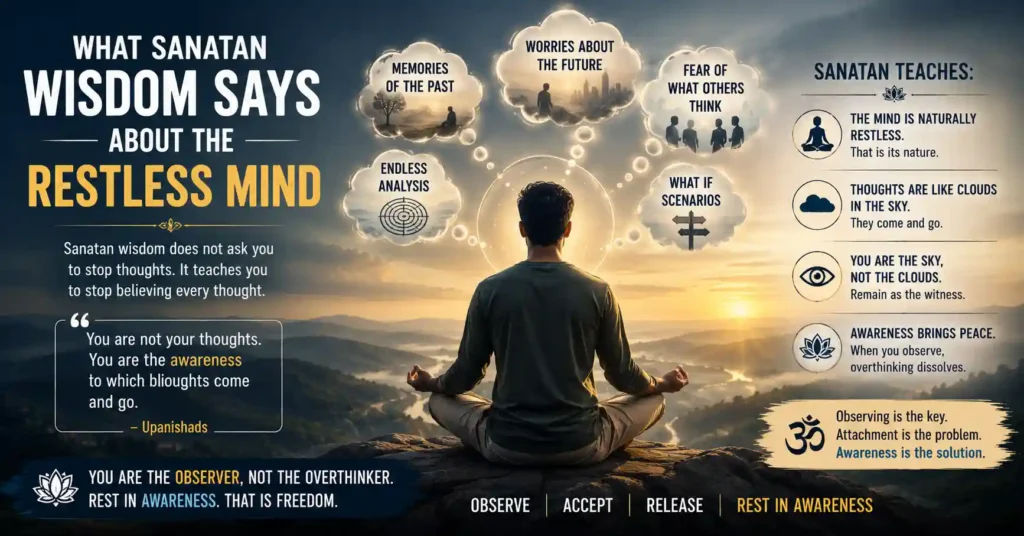
What Sanatan Wisdom Says About the Restless Mind
Sanatan Dharma views the restless mind as a natural part of human experience. The Bhagavad Gita acknowledges that the mind can be difficult to control and often moves from one thought to another.
In Bhagavad Gita 6.34, Arjuna describes the mind as restless, turbulent, strong, and difficult to control. In Bhagavad Gita 6.35, Lord Krishna explains that it can be gradually restrained through practice (abhyasa) and detachment (vairagya).
Abhyasa and Vairagya: The Two Keys to a Steady Mind
In the Bhagavad Gita, Lord Krishna explains that a restless mind can gradually become steadier through abhyasa and vairagya. These two principles work together and remain highly relevant even today.
Abhyasa means consistent practice. It is the effort to repeatedly bring the mind back to awareness, prayer, meditation, japa, or the present moment whenever it begins to wander.
Vairagya means detachment. It does not mean giving up life or responsibilities. Instead, it means learning not to become excessively attached to every thought, fear, desire, or outcome.
When practice and detachment are cultivated together, the mind slowly becomes calmer, more balanced, and less affected by constant mental noise.
This teaching is important because it changes how we view mental restlessness. Instead of fighting every thought, Sanatan wisdom encourages us to observe the mind with awareness and patience.
The goal is not to force the mind into complete silence. Thoughts will continue to arise, just as clouds move across the sky. What matters is learning not to become carried away by every thought that appears.
With regular self-awareness, meditation, prayer, japa, or mindful living, the mind gradually becomes calmer and more balanced. Over time, we learn that peace does not come from controlling every thought but from changing our relationship with them.
Did You Know?
Bhagavad Gita Chapter 6 contains one of the most famous discussions on controlling a restless mind. Lord Krishna teaches that the mind can be gradually steadied through practice (abhyasa) and detachment (vairagya), two principles that remain relevant even today.
Why Trying to Stop Overthinking Can Make It Worse
At some point, most people try to control their thoughts through sheer effort. They tell themselves, “I should stop thinking about this,” or try to push unwanted thoughts out of their minds as quickly as possible.
Yet the harder they resist, the more persistent those thoughts often become. What we constantly fight tends to remain at the center of our attention.
This happens because the mind becomes focused on whatever it is trying to avoid. The effort to suppress thoughts can create additional mental tension, making the mind feel even more restless.
Instead of finding relief, many people become trapped in a cycle of resistance and frustration. The more they struggle against their thoughts, the more energy they give them.
A healthier approach is to observe thoughts without immediately reacting to them. When we stop treating every thought as a problem that must be solved, we create space for greater awareness and mental clarity.
With patience and practice, thoughts gradually lose some of their power over us. The goal is not to control every thought but to develop a calmer and more balanced relationship with the mind.
A Simple Practice to Reduce Overthinking
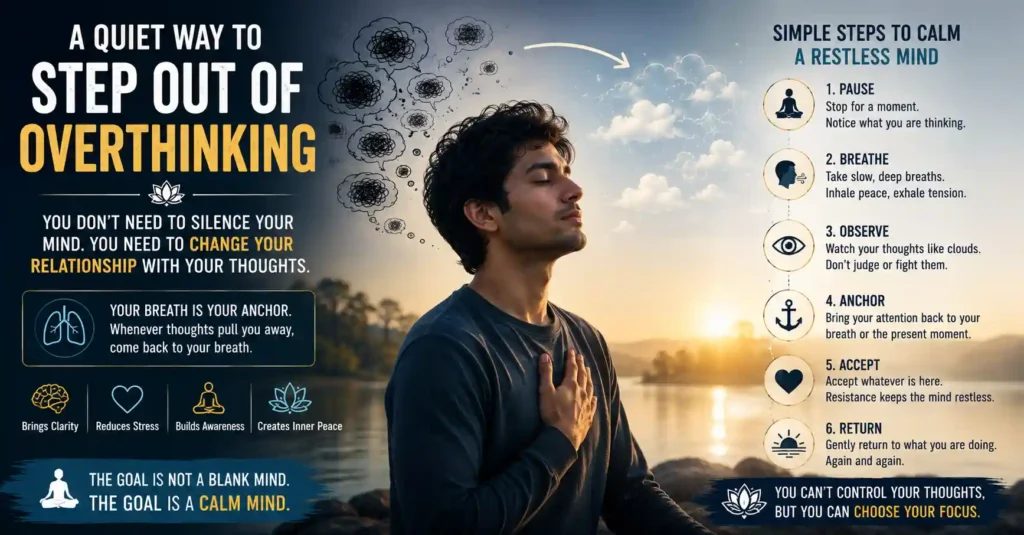
Instead of fighting every thought, try gently stepping back and observing it.
Not through force. Not by trying to control the mind. Simply by becoming aware of what is happening in the present moment.
One simple way to do this is to bring your attention to your breath. Notice the air moving in and out. Notice the sensations in your body. There is no need to change anything or make the mind completely quiet.
As you observe without judgment, a small space begins to appear between you and your thoughts. You start recognizing that thoughts come and go, while your awareness remains present.
This shift is important because repetitive thought patterns grow stronger when we become completely absorbed in them. Awareness helps us step back from the cycle instead of getting pulled deeper into it.
Over time, this simple practice can bring greater mental clarity and emotional balance. The thoughts may still arise, but they no longer carry the same power to control your attention.
If you would like to try this right now, pause for a moment and take one slow breath. Notice the movement of the breath without trying to change anything. Even a brief moment of awareness can create space between you and the constant stream of thoughts. The goal is not to fix the mind instantly but to become less absorbed in every thought that appears.
Can Meditation and Japa Help Reduce Overthinking?
Meditation and japa have been practiced for centuries in Sanatan Dharma as simple yet powerful ways to calm a restless mind. Both practices help bring attention away from endless thought loops and gently anchor it in the present moment.
Meditation encourages us to observe thoughts without becoming caught up in them. Instead of reacting to every worry or mental distraction, we learn to sit quietly and watch thoughts come and go with greater awareness.
Japa works in a similar way. Repeating a sacred mantra such as Om Namah Shivaya, Hare Krishna, or another mantra meaningful to you helps focus the mind on a single point. As attention returns to the mantra again and again, mental chatter gradually begins to lose its intensity.
Neither meditation nor japa is about forcing the mind into complete silence. The real benefit comes from regular practice. With patience and consistency, these practices can bring greater mental clarity, emotional balance, and a deeper sense of inner steadiness, even when life remains busy and uncertain.
You do not need long meditation sessions to begin. Even a few minutes of quiet breathing, prayer, or mantra repetition can be a meaningful start. The mind may not become calm overnight, and that is perfectly natural. What matters is regular practice. Over time, small moments of awareness begin to add up, helping the mind become steadier and more balanced.
How Breathing Helps Calm the Mind
Your breath and your mind are closely connected. When we feel stressed, worried, or overwhelmed, breathing often becomes faster and more shallow. At the same time, the mind tends to become more active and unsettled.
When the breath slows and deepens, the body receives a signal that it is safe to relax. As physical tension begins to ease, the mind often follows, creating a greater sense of calm and stability.
The change may not happen immediately, and it does not need to feel dramatic. Even a few moments of conscious breathing can help interrupt repetitive thought patterns and bring attention back to the present moment.
This is why simple breathing practices have been used for centuries in meditation and mindfulness traditions. They do not force the mind into silence. Instead, they create conditions that make mental clarity, awareness, and calmness more accessible.
Everyday Habits That Help Quiet Mental Noise
Breathing practices can be helpful, but they are not the only way to calm a restless mind.
Simple daily habits can reduce mental overload and create space for greater awareness and balance. For example:
- Take short walks to give the mind a break from constant thinking and reconnect with the present moment.
- Spend time away from screens to reduce information overload and mental stimulation.
- Write down your worries in a journal instead of carrying them throughout the day.
- Get enough rest and quality sleep to support emotional balance and mental clarity.
- Spend time in nature to slow down, relax, and step away from everyday distractions.
- Create quiet moments during the day for reflection, prayer, or simply sitting without constant activity.
These small practices give the mind an opportunity to slow down and process experiences more naturally. They also create healthy breaks from the constant stimulation that often fuels mental restlessness.
The goal is not to eliminate every thought. It is to create a lifestyle that supports greater awareness, balance, and mental clarity in everyday life.

Key Takeaways
- Overthinking is more than thinking too much. It happens when the mind becomes trapped in repetitive thought patterns without reaching a clear conclusion.
- A restless mind often seeks certainty. Fear, self-doubt, perfectionism, and uncertainty can keep thoughts circling long after they have stopped being useful.
- Modern life can increase mental restlessness. Constant information, notifications, and digital distractions leave little time for the mind to slow down naturally.
- Trying to force thoughts away often makes them stronger. The more we resist certain thoughts, the more attention and energy we may unintentionally give them.
- Awareness creates space between you and your thoughts. Observing thoughts without immediately reacting to them can help reduce their influence over time.
- Breathing practices can help calm the mind. Slow, conscious breathing supports relaxation and makes it easier to return to the present moment.
- Simple daily habits matter. Walking, journaling, spending time in nature, limiting screen time, and getting adequate rest can reduce mental overload.
- Meditation and japa support mental balance. Regular spiritual practice can gradually reduce mental chatter and strengthen focus and self-awareness.
- Sanatan Dharma views the mind as naturally restless. The Bhagavad Gita teaches that the mind can become steadier through consistent practice (abhyasa) and detachment (vairagya).
- The goal is not to stop every thought. Real progress comes from developing a healthier relationship with thoughts rather than trying to control them completely.
- Lasting change happens gradually. Small moments of awareness practiced consistently can lead to greater clarity, balance, and emotional resilience over time.
Conclusion
There is no instant solution for a restless mind. The habits of excessive thinking develop over time, and learning a healthier relationship with thoughts is also a gradual process.
The real shift begins when we stop fighting every thought and start observing it with greater awareness. Instead of becoming absorbed in every worry, fear, or possibility, we learn to step back and see thoughts for what they are: temporary mental events that come and go.
With patience, self-awareness, and regular practices such as conscious breathing, meditation, japa, or quiet reflection, the mind gradually becomes steadier and more balanced.
The thoughts may still arise, but they no longer carry the same influence over your attention and emotions.
And often, that is where meaningful change begins. Not when every thought disappears, but when you discover that you do not have to follow every thought that appears.
In the spirit of Sanatan Dharma, true peace does not come from controlling every thought. It comes from cultivating awareness, balance, and a deeper connection with the Self that exists beyond the constant activity of the mind.
Suggested Reading
If the topic of overthinking resonates with you, exploring related teachings from Sanatan Dharma can offer a deeper understanding of the mind, emotions, karma, time, and inner growth. The following articles provide valuable insights that complement the ideas discussed in this article.
Detachment in Hindu Philosophy: Meaning, Vairagya and the Path to Inner Freedom
https://thesanatantales.com/detachment-in-hindu-philosophy/
Karma: Meaning, Types, Philosophy and How It Works in Sanatan Dharma
https://thesanatantales.com/karma/
Kaal in Sanatan Dharma: Meaning, Yugas, Cosmic Time and Kala Chakra
https://thesanatantales.com/kaal-in-sanatan-dharma/
Loneliness vs Solitude: Understanding the Difference through Sanatan Dharma
https://thesanatantales.com/loneliness-vs-solitude/
Inner Emptiness: Why You Feel Empty Inside Even When Life Is Good
https://thesanatantales.com/inner-emptiness/
Spiritual Awakening in Sanatan Dharma: Meaning, Signs and Beginner’s Guide
https://thesanatantales.com/spiritual-awakening/
FAQs
What Is Overthinking?
Overthinking is the habit of repeatedly thinking about the same situation, problem, or possibility without reaching a clear conclusion. Instead of helping us find solutions, the mind becomes trapped in cycles of analysis, worry, and mental replay.
It often involves replaying past events, imagining future outcomes, or searching for certainty where no immediate answer exists. Over time, these repetitive thought patterns can create stress, mental fatigue, and emotional exhaustion.
The difference between healthy thinking and overthinking is that healthy thinking leads to clarity or action, while overthinking tends to keep the mind moving in circles.
Why Do I Overthink Everything?
People often overthink because the mind is trying to protect them from uncertainty, mistakes, disappointment, or future problems. It believes that thinking more will provide greater control and better answers.
In reality, many situations do not have perfect answers. When the mind keeps searching for complete certainty, it can become stuck in repetitive thought loops.
Fear of failure, self-doubt, past experiences, and a constant need for reassurance can also contribute to excessive thinking.
Is Overthinking a Sign of Anxiety?
Overthinking and anxiety are closely related, but they are not exactly the same thing.
Anxiety is a broader emotional response that may include fear, nervousness, physical tension, and worry. Overthinking is one of the ways anxiety can express itself.
However, a person can experience repetitive thought patterns without having an anxiety disorder. Sometimes excessive thinking develops simply as a habit of constantly analyzing situations, decisions, or future possibilities.
If persistent worry begins affecting daily life, sleep, relationships, or overall well-being, seeking professional guidance may be helpful.
Why Does My Mind Keep Replaying the Same Thoughts?
The mind often replays certain thoughts because it feels that something remains unresolved. It may be searching for a better answer, trying to avoid future mistakes, or looking for certainty about a situation.
Unfortunately, repeatedly revisiting the same issue rarely provides new insights. Instead, the mind can become trapped in a cycle of mental replay.
Learning to observe thoughts with awareness rather than constantly engaging with them can help reduce their influence over time.
How Can I Stop Overthinking and Calm My Mind?
The goal is not to force the mind to stop thinking completely. Instead, it is helpful to develop a healthier relationship with thoughts.
Practices such as conscious breathing, meditation, japa, journaling, spending time in nature, and reducing unnecessary distractions can help create greater mental clarity.
The more we learn to observe thoughts without immediately reacting to them, the easier it becomes to step out of repetitive thinking patterns.
What Does Sanatan Dharma Teach About Overthinking?
Sanatan Dharma recognizes that the mind is naturally restless. In the Bhagavad Gita, Arjuna describes the mind as difficult to control, while Lord Krishna teaches that it can gradually become steady through practice (abhyasa) and detachment (vairagya).
Rather than fighting every thought, Sanatan wisdom encourages awareness, patience, self-observation, and regular spiritual practice.
The goal is not to eliminate thoughts but to avoid becoming completely identified with them. As awareness grows, thoughts lose some of their power to disturb inner balance.
Can Meditation and Japa Help Reduce Mental Restlessness?
Yes. Meditation and japa have been used for centuries to help calm the mind and develop greater focus.
Meditation teaches us to observe thoughts without becoming absorbed in them. Japa helps anchor attention through the repetition of a sacred mantra, reducing mental chatter and distractions.
Regular practice can gradually improve concentration, emotional balance, and self-awareness. Even a few minutes each day can be a meaningful beginning.
How Long Does It Take to Overcome Overthinking?
There is no fixed timeline because every person develops mental habits differently.
Some people notice positive changes within a few weeks of practicing mindfulness, meditation, or conscious breathing. For others, the process may take longer.
What matters most is consistency rather than speed. Small moments of awareness practiced regularly often create lasting change over time.
The aim is not perfection. It is to gradually develop a calmer, healthier, and more balanced relationship with the mind.
Glossary of Important Terms
| Term | Meaning |
|---|---|
| Overthinking | The habit of repeatedly analyzing, worrying, or replaying thoughts without reaching a clear conclusion or solution. |
| Restless Mind | A state in which the mind constantly moves from one thought to another, making it difficult to feel calm or focused. |
| Mental Chatter | The continuous flow of thoughts, worries, judgments, and inner conversations that occupy the mind. |
| Thought Loops | Repetitive patterns of thinking where the same concerns, questions, or scenarios keep returning. |
| Mental Restlessness | A condition in which the mind struggles to remain still, often shifting between past memories and future worries. |
| Awareness | The ability to observe thoughts, emotions, and experiences without becoming completely absorbed in them. |
| Mindfulness | The practice of paying attention to the present moment with openness and without judgment. |
| Meditation | A practice that helps develop focus, awareness, and mental calm by observing the mind or concentrating on a chosen object, breath, or mantra. |
| Japa | The repeated chanting or silent repetition of a sacred mantra to focus the mind and deepen spiritual awareness. |
| Mantra | A sacred word, phrase, or sound repeated during prayer, meditation, or japa to steady the mind and focus attention. |
| Abhyasa | A Sanskrit term meaning consistent practice. In the Bhagavad Gita, it refers to regular effort to steady and discipline the mind. |
| Vairagya | A Sanskrit term meaning detachment or freedom from excessive attachment to thoughts, desires, or outcomes. |
| Mental Clarity | A state of clear thinking in which the mind feels focused, balanced, and less affected by confusion or distractions. |
| Present Moment | The experience of being fully aware of what is happening right now rather than dwelling on the past or worrying about the future. |
| Self-Observation | The practice of noticing thoughts, emotions, and behaviors with awareness and without immediate reaction. |
| Emotional Balance | The ability to remain steady and composed despite challenges, worries, or changing circumstances. |
| Inner Peace | A state of mental and emotional calm that arises from acceptance, awareness, and balance rather than external conditions. |
| Bhagavad Gita | One of the most important scriptures of Sanatan Dharma, containing teachings on the mind, duty, self-awareness, and spiritual growth. |
| Sanatan Dharma | The eternal spiritual tradition commonly known as Hinduism, emphasizing self-realization, dharma, karma, and inner growth. |
| Detachment | The ability to engage with life without becoming excessively attached to thoughts, fears, expectations, or outcomes. |
| Mental Fatigue | A feeling of exhaustion caused by prolonged thinking, worrying, decision-making, or emotional stress. |
About the Author
Yateendra Chaturvedi is a spiritual writer, researcher, devotee, and the founder of The Sanatan Tales. With over 35 years of professional experience and a lifelong interest in Sanatan Dharma, he writes about Hindu deities, temples, scriptures, festivals, Mahavidyas, sacred stories, rituals, and living traditions that continue to guide and inspire devotees across India.
Drawing from traditional scriptures, regional beliefs, temple traditions, devotional literature, and historical sources, he aims to present authentic, well-researched, and easy-to-understand content for modern readers. His work focuses on preserving spiritual wisdom, explaining sacred traditions, and helping seekers develop a deeper understanding of India’s rich spiritual heritage.
Through The Sanatan Tales, Yateendra strives to make the timeless teachings of Sanatan Dharma simple, meaningful, and relevant for today’s generation while maintaining respect for traditional sources, regional practices, and diverse spiritual perspectives.
Learn More About Yateendra Chaturvedi →
https://thesanatantales.com/about-the-author/
References & Sources
This article is based on commonly accepted teachings and perspectives from Sanatan Dharma, along with traditional insights related to the nature of the mind, awareness, self-observation, meditation, and inner growth. It draws inspiration from Hindu scriptures such as the Bhagavad Gita, yogic traditions, spiritual practices, and philosophical teachings that explore mental restlessness and the path toward greater balance and clarity.
The article also reflects practical wisdom preserved through spiritual communities, devotional traditions, teachers, practitioners, and generations of lived experience within the broader Sanatan tradition.
Note: The concepts discussed in this article are intended for spiritual understanding, self-reflection, and personal growth. Interpretations, practices, and approaches may vary across different traditions, sampradayas, lineages, regions, and individual spiritual paths within Sanatan Dharma. The purpose of this article is not to present any single viewpoint as the only truth, but to share widely respected teachings in a simple, practical, and reader-friendly manner. Sanatan Dharma recognizes multiple paths to inner growth, including knowledge, devotion, meditation, self-discipline, and mindful living.
Explore More Fascinating Topics from Sanatan Dharma