Purusharthas, also known as the Four Purusharthas, are among the most profound teachings of Sanatan Dharma. They explain the four fundamental goals of human life: Dharma (righteous living), Artha (wealth and prosperity), Kama (desires and fulfillment), and Moksha (liberation). Together, these four goals provide a complete framework for living a balanced, meaningful, and spiritually fulfilling life.
The philosophy of the Purusharthas does not ask us to choose between worldly success and spiritual growth. Instead, it teaches that both have their rightful place. It shows how to earn wealth ethically, fulfil responsibilities with integrity, enjoy life’s blessings with moderation, and gradually progress towards inner freedom.
The order of the Four Purusharthas is equally significant. Dharma comes first because it guides how Artha should be earned and how Kama should be experienced. When life is lived according to Dharma, it gradually prepares the mind for Moksha, the highest goal of human existence.
In this article, you’ll learn the meaning of Purusharthas, understand the role of Dharma, Artha, Kama, and Moksha, explore their connection with the Ashrama System, discover why they remain relevant in modern life, and learn practical ways to apply this timeless wisdom in your daily life.
Quick Facts About the Purusharthas
| Quick Fact | Details |
|---|---|
| Sanskrit Name | Puruṣārtha (पुरुषार्थ) |
| Meaning | The four goals or purposes of human life in Sanatan Dharma |
| Common Name | Four Purusharthas |
| Number of Goals | Four |
| The Four Purusharthas | Dharma, Artha, Kama, and Moksha |
| Foundation | Dharma guides the pursuit of Artha and Kama |
| Highest Goal | Moksha (Liberation and Self-realization) |
| Associated With | The Ashrama System (four stages of life) |
| Explained In | Vedas, Upanishads, Mahabharata, Bhagavad Gita, and Dharmashastras |
| Purpose | To help individuals live an ethical, prosperous, fulfilling, and spiritually meaningful life |
| Relevant Today? | Yes. The Purusharthas provide timeless guidance for balancing worldly responsibilities with spiritual growth. |
Table of Contents
ToggleWhat Are Purusharthas?
The word Purushartha is derived from two Sanskrit words: Purusha, meaning a human being, and Artha, meaning purpose, goal, or objective. The plural term Purusharthas refers to the four fundamental goals of human life that guide an individual towards both worldly well-being and spiritual fulfillment.
According to Sanatan Dharma, life is not meant to be lived by pursuing only wealth, pleasure, or spiritual practices in isolation. Instead, the Purusharthas, also known as the Four Purusharthas, provide a balanced framework that helps a person fulfil responsibilities, enjoy life wisely, and ultimately attain liberation.
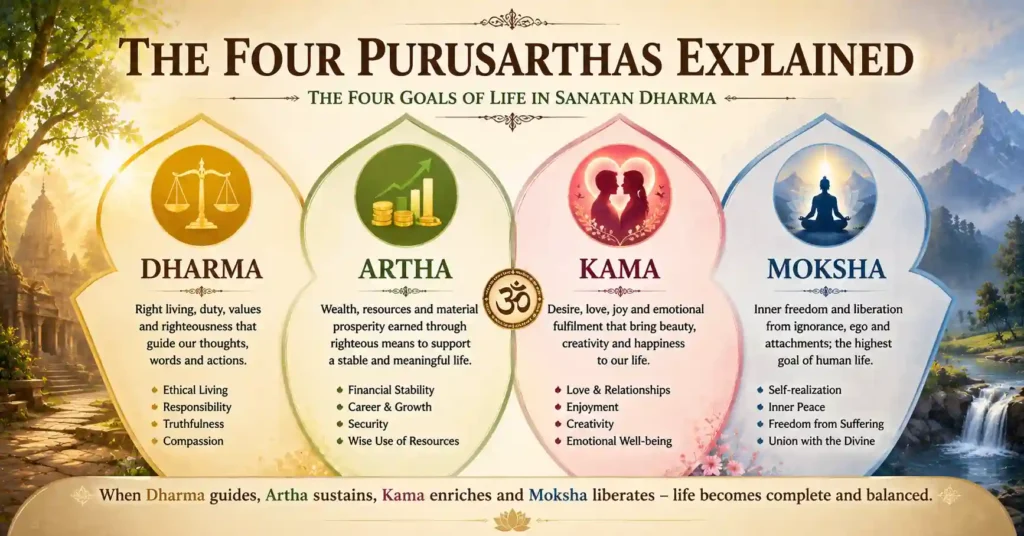
The Purusharthas are:
| Purushartha | Meaning | Purpose |
|---|---|---|
| Dharma | Righteousness and moral living | Guides every action with truth, duty, and ethical values. |
| Artha | Wealth and material prosperity | Provides security and resources to fulfil life’s responsibilities. |
| Kama | Desires, love, and emotional fulfillment | Brings happiness, healthy relationships, creativity, and the joyful experience of life. |
| Moksha | Liberation and Self-realization | Frees the soul from the cycle of birth and rebirth, leading to eternal peace. |
These four goals are not separate or competing pursuits. They complement one another and create a complete philosophy for living a balanced life. Dharma provides the foundation, Artha supports worldly life, Kama brings fulfillment, and Moksha gives the highest spiritual purpose.
The philosophy of the Purusharthas is deeply rooted in ancient scriptures such as the Vedas, Upanishads, Dharmashastras, and the Mahabharata. Together, they present human life as a journey that harmonizes material responsibilities with spiritual evolution.
Although different traditions within Sanatan Dharma may explain the Purusharthas in their own way, they all agree on one central principle: a meaningful life is achieved not by rejecting the world, but by living with balance, wisdom, and Dharma.
Scriptural Basis of the Purusharthas
The philosophy of the Purusharthas is not based on a single scripture. It is a foundational teaching that appears throughout the sacred literature of Sanatan Dharma.
Different texts explain these four goals from different perspectives, but together they present a consistent vision of a balanced and purposeful human life.
| Scripture | Contribution to the Purusharthas |
|---|---|
| Vedas | Introduce the principles of Dharma and the ideal of righteous living. |
| Upanishads | Emphasize Self-realization and Moksha as the ultimate goal of life. |
| Mahabharata | Demonstrates the practical application of Dharma, Artha, Kama, and Moksha through real-life situations. |
| Bhagavad Gita | Teaches how to perform one’s duties without attachment while progressing towards spiritual liberation. |
| Dharmashastras | Explain ethical conduct, social responsibilities, and the proper pursuit of the Purusharthas. |
These scriptures show that the Purusharthas are not merely philosophical ideas. They are practical principles that have guided individuals, families, and society for thousands of years.
Why the Purusharthas Still Matter Today
Although the Purusharthas were taught thousands of years ago, their wisdom remains just as relevant in today’s fast-changing world. People continue to face the same fundamental questions about success, happiness, relationships, and the true purpose of life.
Many of us wonder:
- How important is wealth in life?
- Is it wrong to enjoy worldly pleasures?
- How can I balance my career, family, and spiritual growth?
- What is the ultimate purpose of human life?
The Purusharthas, also known as the Four Purusharthas, provide timeless answers to these questions. Rather than asking us to choose between material success and spiritual progress, they teach us how to balance both with wisdom, responsibility, and self-awareness.
This philosophy reminds us that Dharma, Artha, Kama, and Moksha are not opposing paths. When guided by Dharma, wealth becomes a means of service, desires become a source of healthy fulfillment, and every stage of life becomes an opportunity for inner growth.
That is why the Purusharthas continue to be regarded as one of the most practical and enduring teachings of Sanatan Dharma. They offer a balanced way of living that remains as meaningful today as it was in ancient India.
Understanding Dharma: The Foundation of the Purusharthas
Dharma is often translated as duty or righteousness, but its meaning is much deeper. In Sanatan Dharma, Dharma is the universal principle that guides a person to live with truth, integrity, compassion, and responsibility. It is the foundation upon which the other Purusharthas are built.
Dharma is reflected in everyday life through honest actions, respect for others, fulfilling one’s responsibilities, and making decisions guided by wisdom rather than selfishness. It is not limited to religious rituals but influences every aspect of human conduct.
The ancient scriptures place Dharma first among the Purusharthas because it gives the right direction to Artha (wealth) and Kama (desires). Wealth earned without Dharma can lead to greed, while desires pursued without Dharma may result in attachment and suffering.
When Artha is acquired through righteous means and Kama is experienced with self-control and responsibility, both become instruments of personal growth rather than sources of conflict. In this way, Dharma creates the foundation for a balanced and meaningful life.
Ultimately, Dharma also prepares the mind for Moksha, the highest goal of human life. This is why Sanatan Dharma regards Dharma not merely as one of the Purusharthas, but as the guiding force that brings harmony to all four goals of life.
Understanding Artha: Wealth with Dharma
Artha represents material well-being, prosperity, and the resources needed to live a stable and responsible life. It includes wealth, livelihood, education, skills, security, and everything that supports an individual, family, and society.
Sanatan Dharma does not reject wealth or material success. Instead, it recognizes that Artha is essential for fulfilling responsibilities, supporting loved ones, contributing to society, and pursuing higher goals in life.
However, the philosophy of the Purusharthas teaches that Artha should always be earned and used in accordance with Dharma. Wealth acquired through honesty, hard work, and ethical means becomes a source of stability and service. When pursued without Dharma, the same wealth can lead to greed, attachment, and conflict.
The purpose of Artha is not merely to accumulate possessions but to create a life of security, generosity, and balance. It enables a person to fulfil worldly duties while continuing the journey towards spiritual growth.
Within the Purusharthas, Artha is regarded as a means, not an end. When guided by Dharma, it supports both material prosperity and inner well-being, helping an individual lead a balanced, purposeful, and spiritually fulfilling life.
Understanding Kama: The Role of Desire and Fulfillment
Kama represents desire, joy, love, beauty, creativity, and emotional fulfillment. Although it is often associated only with physical pleasure, its meaning in Sanatan Dharma is much broader. It includes every wholesome desire that enriches human life, such as love, family relationships, art, music, learning, and the appreciation of beauty.
The philosophy of the Purusharthas does not ask us to suppress our desires. Instead, it teaches that desires should be understood, guided, and experienced with wisdom. Healthy desires inspire growth, strengthen relationships, and bring lasting happiness when they remain within the boundaries of Dharma.
When Kama is pursued without self-control or ethical values, it can lead to attachment, dissatisfaction, and suffering. However, when guided by Dharma, it becomes a source of harmony, contentment, and emotional well-being rather than restlessness.
The Purusharthas remind us that happiness is an essential part of human life, but it should never come at the cost of righteousness or inner peace. In this way, Kama complements Dharma and Artha, while gradually preparing the mind for the higher pursuit of Moksha.
Understanding Moksha: The Highest Goal of the Purusharthas
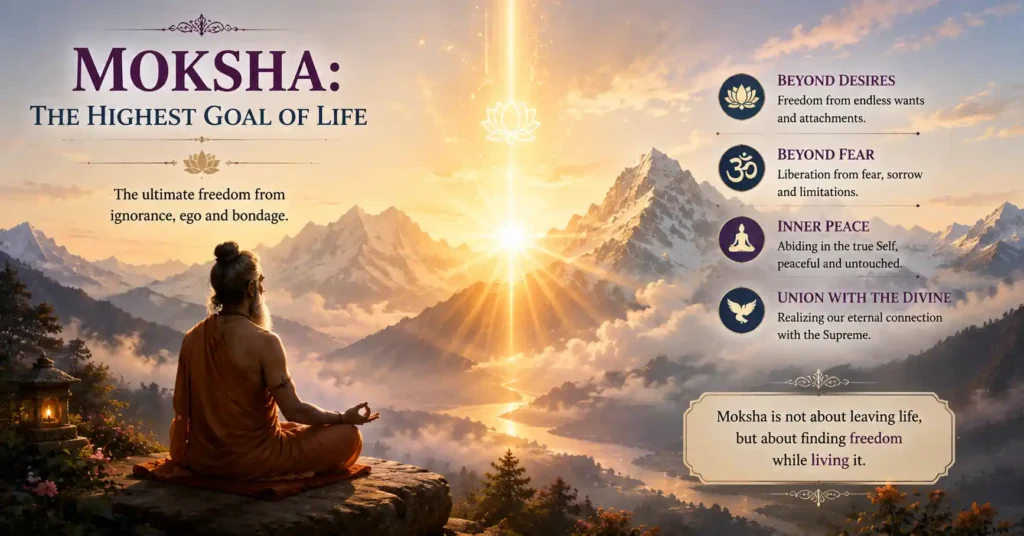
Moksha is the fourth and highest goal of the Purusharthas. It represents liberation from ignorance, ego, attachment, and the endless cycle of birth and death (Samsara). More than a destination, Moksha is a state of complete inner freedom and Self-realization.
In Sanatan Dharma, Moksha does not mean abandoning the world or escaping life’s responsibilities. Instead, it is about living with wisdom, performing one’s duties without attachment, and realizing the eternal nature of the Atman beyond the changing experiences of life.
A person progressing towards Moksha gradually becomes free from excessive desires, fear, anger, and selfishness. Inner peace no longer depends on wealth, success, or external circumstances because true happiness is experienced from within.
The philosophy of the Purusharthas teaches that Moksha is not separate from Dharma, Artha, and Kama. When these three goals are pursued with balance and guided by Dharma, they gradually purify the mind and prepare an individual for spiritual awakening and liberation.
For this reason, Moksha is regarded as the ultimate fulfilment of human life. It is the highest purpose of the Purusharthas, where the soul realizes its true nature and experiences lasting peace beyond all worldly limitations.
How the Purusharthas Work Together
The true beauty of the Purusharthas lies in the fact that these four goals are not meant to be pursued separately. They are interconnected principles that support one another and together create a balanced, meaningful, and spiritually fulfilling life.
Dharma provides the moral foundation for every decision. Artha offers the resources needed to fulfil responsibilities. Kama brings happiness, love, and emotional fulfillment, while Moksha gives the highest spiritual purpose to human life.
None of these goals is complete on its own. Wealth without Dharma can become greed, while desires without Dharma may lead to attachment and suffering. Likewise, pursuing Moksha while neglecting one’s responsibilities can become an escape rather than genuine spiritual growth.
The philosophy of the Purusharthas teaches that material success and spiritual progress are not opposing paths. When Dharma guides Artha and Kama, they naturally prepare the mind for Moksha, creating harmony between worldly life and spiritual realization.
This integrated approach is what makes the Purusharthas one of the most practical and enduring teachings of Sanatan Dharma. They offer timeless guidance for living with responsibility, fulfillment, and inner peace at every stage of life.
The Journey of the Purusharthas
The Purusharthas are not isolated goals to be achieved one after another. They form a continuous journey that guides every stage of human life.
The journey begins with Dharma, which provides the moral foundation for every action. Guided by Dharma, a person earns Artha through honest effort and enjoys Kama with moderation and responsibility. As the mind becomes mature and less attached to worldly pleasures, it naturally turns towards Moksha, the highest goal of spiritual freedom.
Rather than competing with one another, the Purusharthas support a gradual evolution from responsible living to inner realization.
Journey Table
| Step | Life Focus | Outcome |
|---|---|---|
| Dharma | Live with truth, duty, and ethics | Builds character and wisdom |
| Artha | Earn wealth through righteous means | Creates security and stability |
| Kama | Enjoy life with moderation | Brings happiness and emotional fulfillment |
| Moksha | Seek Self-realization | Leads to lasting peace and liberation |
Understanding the Balance of the Purusharthas
The philosophy of the Purusharthas is based on balance rather than choosing one goal over another. Each Purushartha has a unique role, and together they guide a person towards a life that is ethical, prosperous, fulfilling, and spiritually meaningful.
The following table summarizes how the Purusharthas complement one another and together create a balanced approach to life.
| Purushartha | Meaning | Primary Purpose | Guided By |
|---|---|---|---|
| Dharma | Righteous living | Builds character and guides every decision | Truth, duty, and ethical values |
| Artha | Wealth and prosperity | Provides security and resources for life | Dharma |
| Kama | Desires and fulfillment | Brings happiness, healthy relationships, and emotional well-being | Dharma |
| Moksha | Liberation and Self-realization | Leads to freedom from attachment and the cycle of birth and death | Spiritual wisdom and Dharma |
This simple framework shows why the Purusharthas are regarded as the four goals of human life in Sanatan Dharma. Rather than competing with one another, they work together to help a person achieve both worldly success and lasting inner peace.
What Happens When the Purusharthas Become Unbalanced?
The wisdom of the Purusharthas becomes even clearer when we understand what happens if one of the four goals is ignored or given excessive importance. Sanatan Dharma teaches that a meaningful life is achieved by harmonizing Dharma, Artha, Kama, and Moksha, not by pursuing one while neglecting the others.
| Imbalance | Possible Result |
|---|---|
| Artha without Dharma | Wealth may lead to greed, dishonesty, and inner unrest. |
| Kama without Dharma | Desires may become attachment, addiction, or dissatisfaction. |
| Ignoring Dharma | Decisions may become selfish, unethical, and disconnected from higher values. |
| Ignoring Moksha | Life may appear successful outwardly but lack lasting peace and deeper purpose. |
The Purusharthas remind us that no single goal is complete on its own. Material prosperity, personal happiness, ethical living, and spiritual growth are all essential aspects of a fulfilling life.
When these four goals remain in harmony, they bring stability, contentment, and inner fulfillment. This balanced approach is what makes the Purusharthas one of the most practical and timeless teachings of Sanatan Dharma, guiding every stage of human life.
A Simple Example of the Purusharthas in Daily Life
Imagine two people with similar careers, opportunities, and responsibilities.
The first person is focused only on earning more money. Over time, work becomes the centre of life, relationships receive less attention, stress increases, and success no longer brings lasting happiness. Material prosperity grows, but inner peace gradually fades.
The second person also works hard and earns an honest living. However, every decision is guided by Dharma, wealth is earned ethically through Artha, time is devoted to family, relationships, and personal happiness through Kama, and moments are set aside for prayer, self-reflection, or meditation, keeping the mind focused on Moksha.
Both people may achieve professional success, but their experience of life is very different. The second person enjoys material prosperity while also nurturing meaningful relationships, inner contentment, and spiritual growth.
This simple example shows why the Purusharthas are regarded as a complete framework for human life. They teach that lasting happiness comes not from pursuing a single goal, but from living in harmony with Dharma, Artha, Kama, and Moksha.
How the Purusharthas Relate to the Ashrama System
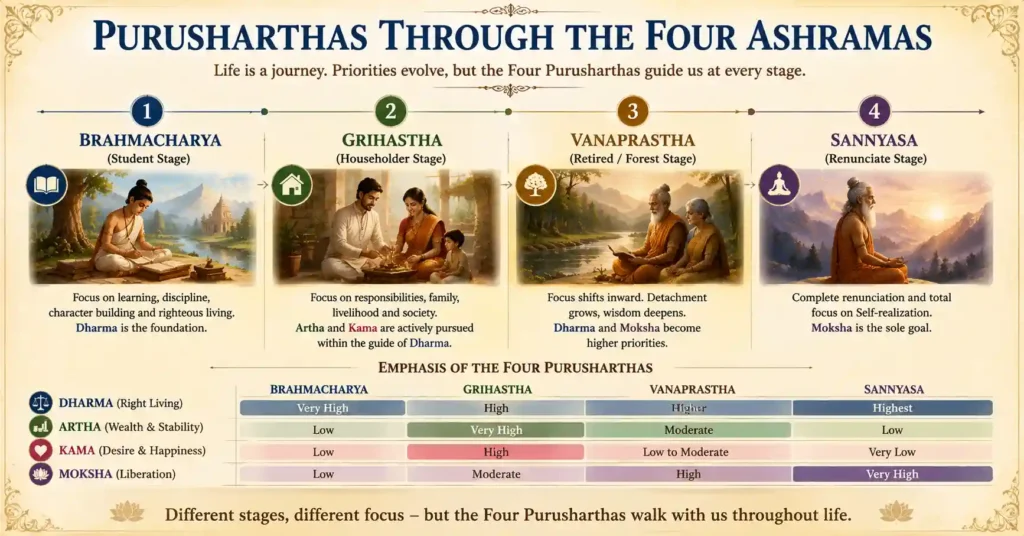
In Sanatan Dharma, the philosophy of the Purusharthas is closely connected with the Ashrama System, which divides human life into four stages. Each stage has its own responsibilities and priorities, while the Purusharthas continue to guide a person’s actions, values, and spiritual growth throughout life.
| Ashrama | Primary Focus | Related Purushartha |
|---|---|---|
| Brahmacharya (Student Life) | Learning, discipline, and character building | Dharma |
| Grihastha (Householder Life) | Family responsibilities, livelihood, and relationships | Artha and Kama, guided by Dharma |
| Vanaprastha (Retired Life) | Gradual detachment, service, and spiritual reflection | Dharma and preparation for Moksha |
| Sannyasa (Renunciation) | Self-realization and liberation | Moksha |
This progression is not meant to be a rigid rule that everyone must follow in exactly the same way. Instead, it illustrates how a person’s priorities naturally evolve through different stages of life while remaining rooted in Dharma.
The Purusharthas remain relevant throughout every stage of life. Although the emphasis may shift over time, Dharma continues to guide every action, while Moksha remains the ultimate goal of human existence.
Purusharthas vs the Four Ashramas: What's the Difference?
Many people confuse the Purusharthas with the Ashrama System, but they describe two different aspects of life in Sanatan Dharma.
The Purusharthas explain what we should strive for throughout life, while the Ashrama System explains when different responsibilities naturally become more prominent. Together, they provide a complete framework for living with purpose and wisdom.
| Purusharthas | Ashrama System |
|---|---|
| Describe the four goals of human life. | Describe the four stages of human life. |
| Focus on life’s purpose and values. | Focus on life’s journey and responsibilities. |
| Apply throughout every stage of life. | Each stage has a different emphasis and duty. |
| Dharma, Artha, Kama, and Moksha. | Brahmacharya, Grihastha, Vanaprastha, and Sannyasa. |
| Guide what to pursue. | Guide when priorities naturally change. |
Although they are different concepts, the Purusharthas and the Ashrama System complement one another. Together, they help individuals fulfil worldly responsibilities while gradually progressing towards Moksha.
Common Misconceptions About the Purusharthas
Many people misunderstand the philosophy of the Purusharthas. Some believe that spirituality requires rejecting wealth, desires, or family life. Others think that only Moksha matters and the other goals have little significance.
However, Sanatan Dharma presents a much broader perspective. It teaches that all four Purusharthas have their rightful place in human life. The goal is not to reject the world but to live in it with wisdom, responsibility, and self-awareness.
| Common Misconception | What Sanatan Dharma Teaches |
|---|---|
| Spirituality means giving up wealth. | Artha is essential when earned and used according to Dharma. |
| Desires are always wrong. | Kama is a natural part of life when guided by Dharma and self-control. |
| Only Moksha is important. | Dharma, Artha, Kama, and Moksha are all essential and support one another. |
| The Purusharthas are meant only for monks. | The Purusharthas are a way of life for every individual, regardless of age, profession, or stage of life. |
The philosophy of the Purusharthas reminds us that true spirituality is not about escaping the world. It is about living with wisdom, fulfilling our responsibilities, enjoying life with moderation, and gradually progressing towards Self-realization and Moksha.
How to Practice the Purusharthas in Daily Life
The wisdom of the Purusharthas is not meant to remain only in the scriptures. It is meant to be lived through small, mindful actions that bring harmony to our thoughts, relationships, work, and spiritual journey.
You do not need to make dramatic changes to follow this timeless teaching. Even simple daily habits can help you apply the Purusharthas in a practical and meaningful way.
| Purushartha | Simple Daily Practice |
|---|---|
| Dharma | Perform your duties honestly, speak truthfully, and treat others with kindness and respect. |
| Artha | Earn wealth ethically, manage your resources wisely, and use them for the well-being of your family and society. |
| Kama | Enjoy life’s blessings with moderation, nurture healthy relationships, and appreciate art, nature, and creativity. |
| Moksha | Spend a few moments each day in prayer, meditation, self-reflection, or the study of spiritual teachings. |
Living the philosophy of the Purusharthas does not require perfection. It is a lifelong journey of making better choices with awareness and wisdom. As Dharma, Artha, Kama, and Moksha work together in daily life, they gradually lead to greater peace, purpose, and inner fulfillment.
Why the Purusharthas Are Still Relevant in the 21st Century
Although the Purusharthas were explained thousands of years ago, their guidance remains remarkably relevant in today’s world. Modern life often brings pressure to achieve success, earn more, and constantly stay connected, yet many people continue to search for peace, purpose, and meaningful relationships.
The Purusharthas offer a timeless solution by encouraging a balanced approach to life. Dharma teaches ethical decision-making, Artha promotes responsible prosperity, Kama reminds us to value healthy relationships and emotional well-being, while Moksha encourages inner growth and lasting peace.
Whether someone is a student, a working professional, a homemaker, or a retiree, the Purusharthas provide practical guidance for making wiser decisions, fulfilling responsibilities, and living with greater awareness. This universal relevance is one of the reasons they continue to be regarded as one of the most enduring teachings of Sanatan Dharma.
Benefits of Balancing the Purusharthas in Life
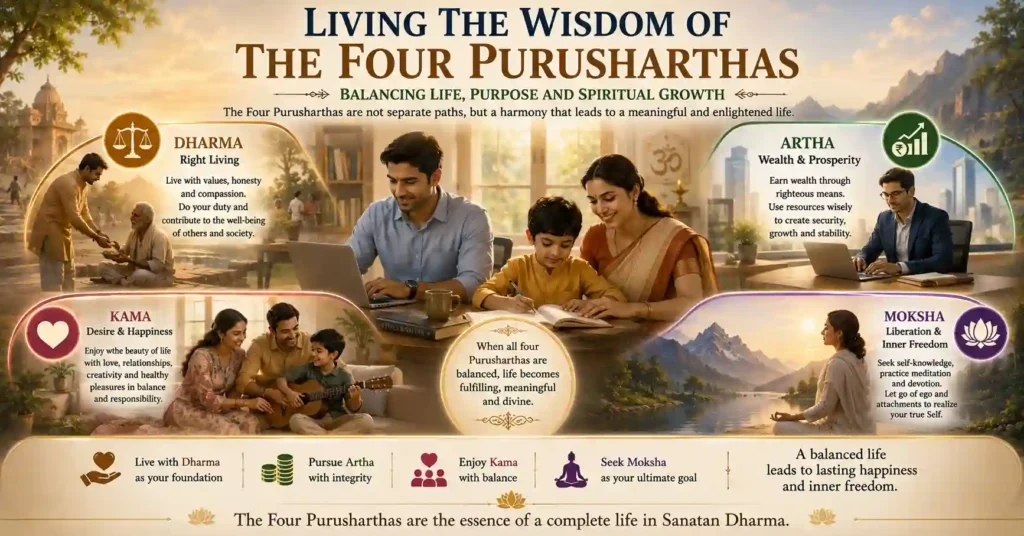
Understanding the Purusharthas is valuable, but their real significance lies in applying them to everyday life. When Dharma, Artha, Kama, and Moksha work together, they help a person grow not only materially but also emotionally, ethically, and spiritually.
Some of the key benefits of living according to the Purusharthas include:
- Clear direction in life through Dharma and righteous decision-making.
- Financial stability by earning and using wealth ethically.
- Healthier relationships built on love, respect, and emotional balance.
- Greater inner peace by reducing excessive attachment and selfish desires.
- Personal and spiritual growth through self-awareness and continuous learning.
- A balanced approach to success, where worldly achievements and spiritual values complement each other.
- Preparation for Moksha, the ultimate goal of Self-realization and lasting freedom.
The Purusharthas remind us that true success is not measured only by wealth or achievements. It is reflected in how wisely we live, how responsibly we fulfil our duties, and how peacefully we progress on our spiritual journey.
Key Takeaways
- Purusharthas are the four goals of human life in Sanatan Dharma: Dharma, Artha, Kama, and Moksha.
- Dharma forms the foundation, guiding how wealth is earned and how desires are fulfilled.
- Artha encourages ethical prosperity that supports personal, family, and social responsibilities.
- Kama teaches that happiness, love, creativity, and enjoyment are valuable when guided by Dharma.
- Moksha is the highest goal, leading to Self-realization and freedom from the cycle of birth and rebirth.
- The Purusharthas are not separate paths. Together, they provide a practical framework for living a balanced, meaningful, and spiritually fulfilling life.
- These timeless principles remain relevant today, helping individuals harmonize worldly responsibilities with spiritual growth.
Conclusion
Purusharthas remind us that life is not about choosing between worldly success and spiritual growth. Instead, they show us how Dharma, Artha, Kama, and Moksha work together to create a life of purpose, prosperity, fulfillment, and inner peace.
This timeless wisdom of Sanatan Dharma teaches that a meaningful life is achieved not by rejecting the world, but by living in it with awareness, responsibility, and wisdom. By understanding and practicing the Purusharthas, we learn to fulfil our duties, enjoy life’s blessings with moderation, pursue ethical prosperity, and gradually progress towards Self-realization and Moksha.
The Purusharthas are more than ancient philosophical ideals. They are a practical guide for everyday living, helping us build a life that is meaningful, harmonious, and spiritually enriching.
Suggested Reading
If you enjoyed learning about the Purusharthas, you may also like exploring these articles from our Sanatan Wisdom & Philosophy section. Together, they explore the timeless principles of Sanatan Dharma, including Dharma, Karma, Self-realization, Moksha, and other spiritual teachings that help us live a purposeful, harmonious, and meaningful life.
Sanatan Dharma: Meaning, Origin, Core Principles and Way of Life
https://thesanatantales.com/sanatan-dharma-meaning/
Does the Soul Choose Its Next Journey? Rebirth, Karma and Consciousness in Sanatan Dharma
https://thesanatantales.com/does-the-soul-choose-its-next-journey/
Karma Yoga Meaning: Action without Attachment
https://thesanatantales.com/karma-yoga/
Spiritual Awakening: Meaning and Signs Beginners Often Experience
https://thesanatantales.com/spiritual-awakening/
Sattva Rajas Tamas: Meaning, Examples and Role in Daily Life
https://thesanatantales.com/sattva-rajas-tamas-meaning/
Sri Vidya: Meaning, Philosophy, Sri Chakra and the Sacred Path of Lalita Tripura Sundari
https://thesanatantales.com/sri-vidya-meaning/
Chausath Yogini (64 Yogini): Story, Names, Temples and Spiritual Significance
https://thesanatantales.com/chausath-yogini/
Puruṣārtha (Wikipedia)
https://en.wikipedia.org/wiki/Puruṣārtha/
FAQs
What are the Purusharthas in Sanatan Dharma?
The Purusharthas are the four fundamental goals of human life described in Sanatan Dharma. They are Dharma (righteous living), Artha (wealth and prosperity), Kama (desires and fulfillment), and Moksha (liberation).
Together, these four goals provide a complete framework for living a balanced and meaningful life. They teach that worldly responsibilities and spiritual growth are not opposing paths but complementary aspects of the same journey.
Why are the Purusharthas important?
The Purusharthas help us understand the true purpose of human life. They show how to fulfil our duties, earn wealth ethically, enjoy life’s blessings responsibly, and gradually progress towards spiritual freedom.
Rather than focusing on only material success or only spiritual practice, they encourage harmony between both. This balanced approach remains relevant even in modern life.
What is the role of Dharma in the Purusharthas?
Dharma is the foundation of the Purusharthas. It represents righteousness, ethical conduct, and living according to truth and responsibility.
Dharma guides how wealth (Artha) should be earned and how desires (Kama) should be fulfilled. When life is guided by Dharma, it naturally prepares the mind for Moksha, the highest goal of human existence.
Can Artha and Kama be pursued without Dharma?
According to Sanatan Dharma, Artha and Kama should always be guided by Dharma.
Wealth earned through dishonest means may lead to greed and conflict, while desires pursued without self-control can create attachment and dissatisfaction. Dharma ensures that both prosperity and happiness contribute to personal and spiritual growth.
Why is Moksha considered the highest Purushartha?
Moksha is regarded as the highest of the Purusharthas because it represents liberation from ignorance, attachment, and the cycle of birth and death (Samsara).
It is the state in which the soul realizes its true nature and experiences lasting peace. While Dharma, Artha, and Kama guide worldly life, Moksha represents the ultimate spiritual fulfilment.
Are the Purusharthas still relevant in modern life?
Yes. Although the concept of the Purusharthas originated in ancient India, its principles remain timeless.
People today continue to seek purpose, financial security, meaningful relationships, and inner peace. The Purusharthas provide practical guidance for balancing all these aspects without neglecting either worldly responsibilities or spiritual growth.
How do the Purusharthas relate to the Ashrama System?
In Sanatan Dharma, the Purusharthas are closely connected with the Ashrama System, which divides life into four stages: Brahmacharya, Grihastha, Vanaprastha, and Sannyasa.
While each stage emphasizes different responsibilities, the Purusharthas continue to guide an individual’s actions and spiritual evolution throughout life. Ultimately, every stage prepares the seeker for Moksha.
Can ordinary people practice the Purusharthas?
Absolutely. The Purusharthas are not meant only for monks or spiritual seekers. They are intended for everyone, regardless of age, profession, or stage of life.
Living honestly, earning ethically, caring for family, enjoying life with moderation, and spending time in prayer, meditation, or self-reflection are all practical ways of following the Purusharthas in daily life.
What happens if one of the Purusharthas is ignored?
Ignoring any one of the Purusharthas can disturb the balance of life.
Focusing only on wealth may lead to stress and greed. Pursuing desires without Dharma can create attachment. Ignoring Moksha may leave a person materially successful but spiritually unfulfilled. The Purusharthas teach that all four goals work best when they are pursued together.
What do the scriptures say about the Purusharthas?
The philosophy of the Purusharthas is explained in several sacred texts of Sanatan Dharma, including the Vedas, Upanishads, Dharmashastras, Mahabharata, and Bhagavad Gita.
Although different traditions may interpret them in slightly different ways, these scriptures consistently present the Purusharthas as the four fundamental goals that guide human life towards both worldly well-being and spiritual liberation.
Glossary of Important Terms
| Term | Meaning |
|---|---|
| Purusharthas | The four fundamental goals of human life in Sanatan Dharma: Dharma, Artha, Kama, and Moksha. |
| Purushartha | A Sanskrit word meaning the purpose or goal of human life. Each of the four Purusharthas represents an essential aspect of a meaningful life. |
| Dharma | Righteousness, moral duty, and ethical living. Dharma guides thoughts, actions, and decisions according to truth and responsibility. |
| Artha | Wealth, prosperity, livelihood, and material well-being acquired through righteous means to support oneself, family, and society. |
| Kama | Desires, love, joy, beauty, creativity, and emotional fulfillment experienced within the guidance of Dharma. |
| Moksha | Liberation from the cycle of birth and death (Samsara) and realization of one’s true spiritual nature. It is the highest goal of life. |
| Sanatan Dharma | The eternal way of life that teaches harmony between righteous living, spiritual growth, and universal truth. |
| Atman | The eternal soul or true Self that is beyond the physical body and remains unchanged through all stages of existence. |
| Samsara | The continuous cycle of birth, death, and rebirth through which the soul evolves until it attains Moksha. |
| Karma | The universal law of cause and effect, where every action, intention, and thought produces corresponding results. |
| Self-realization | The direct realization of one’s true nature as the eternal Atman, beyond the body, mind, and ego. |
| Ashrama System | The traditional four stages of life in Sanatan Dharma: Brahmacharya, Grihastha, Vanaprastha, and Sannyasa, each with its own responsibilities and spiritual focus. |
| Brahmacharya | The student stage of life, dedicated to learning, discipline, character building, and the practice of Dharma. |
| Grihastha | The householder stage, focused on family life, earning wealth ethically, fulfilling responsibilities, and contributing to society. |
| Vanaprastha | The stage of gradual retirement from worldly responsibilities, encouraging service, detachment, and spiritual reflection. |
| Sannyasa | The final stage of life devoted to renunciation, Self-realization, and the pursuit of Moksha. |
| Vedas | The oldest and most authoritative sacred scriptures of Sanatan Dharma, containing spiritual knowledge, rituals, philosophy, and wisdom. |
| Upanishads | Philosophical scriptures that explore the nature of the Atman, Brahman, consciousness, and the path to liberation. |
| Dharmashastras | Ancient texts that explain Dharma, ethics, social responsibilities, and principles for righteous living. |
| Mahabharata | One of the two great epics of India, containing profound teachings on Dharma, duty, and human life, including the Bhagavad Gita. |
| Bhagavad Gita | A sacred dialogue between Lord Krishna and Arjuna that explains Dharma, Karma Yoga, devotion, knowledge, and the path to Moksha. |
About the Author
Yateendra Chaturvedi is a spiritual writer, researcher, devotee, and the founder of The Sanatan Tales. With over 35 years of professional experience and a lifelong interest in Sanatan Dharma, he writes about Hindu deities, temples, scriptures, festivals, Mahavidyas, sacred stories, rituals, and living traditions that continue to guide and inspire devotees across India.
Drawing from traditional scriptures, regional beliefs, temple traditions, devotional literature, and historical sources, he aims to present authentic, well-researched, and easy-to-understand content for modern readers. His work focuses on preserving spiritual wisdom, explaining sacred traditions, and helping seekers develop a deeper understanding of India’s rich spiritual heritage.
Through The Sanatan Tales, Yateendra strives to make the timeless teachings of Sanatan Dharma simple, meaningful, and relevant for today’s generation while maintaining respect for traditional sources, regional practices, and diverse spiritual perspectives.
Learn More About Yateendra Chaturvedi →
https://thesanatantales.com/about-the-author/
References & Sources
This article is based on the teachings of Sanatan Dharma as explained in traditional scriptures such as the Vedas, Upanishads, Bhagavad Gita, Dharmashastras, Mahabharata, and other respected Hindu philosophical texts. It also draws upon traditional commentaries and widely accepted interpretations preserved through the guru-disciple tradition.
Note: Beliefs, interpretations, and spiritual practices may vary across different traditions, sampradayas, and philosophical schools within Sanatan Dharma. The purpose of this article is not to present any single interpretation as the absolute truth, but to explain widely accepted spiritual and philosophical concepts in a simple, balanced, and accessible manner.
Read More Interesting Articles on Sanatan Dharma