
Karma Yoga is one of the most practical and transformative teachings of Sanatan Dharma, yet many people struggle to understand how to apply it in everyday life. We work hard, give our best, and pursue our goals, but our peace often depends on the results we achieve.
Whether it is our career, relationships, studies, or personal ambitions, we become attached to outcomes. When things go our way, we feel happy. When they do not, we experience stress, disappointment, and self-doubt.
Over time, this attachment creates fear of failure, constant comparison, and the need for validation. Without realizing it, we begin measuring our worth by success instead of sincere effort.
Karma Yoga offers a different way of living. It does not ask us to stop working or give up our responsibilities. Instead, it teaches us to perform our duties with dedication while remaining free from attachment to success or failure.
In this article, you will learn the meaning of Karma Yoga, its teachings in the Bhagavad Gita, the difference between Nishkama Karma and Sakama Karma, its core principles, practical ways to practice it in daily life, and the lasting benefits it brings to both spiritual and everyday living.
At a Glance
| Aspect | Details |
|---|---|
| Meaning | The path of selfless action performed without attachment to results. |
| Sanskrit Name | कर्म योग (Karma Yoga) |
| Main Scripture | Bhagavad Gita |
| Teacher | Lord Krishna |
| Student | Arjuna |
| Core Principle | Perform your duty sincerely without attachment to success or failure. |
| Related Concept | Nishkama Karma (selfless action without desire for rewards) |
| Goal | Inner peace, purification of the mind, and spiritual growth |
| Can Anyone Practice It? | Yes. It can be practiced by students, professionals, parents, householders, and spiritual seekers. |
| Ultimate Aim | To perform every action as an offering to the Divine and progress toward self-realization (Moksha). |
Table of Contents
ToggleWhat Is Karma Yoga
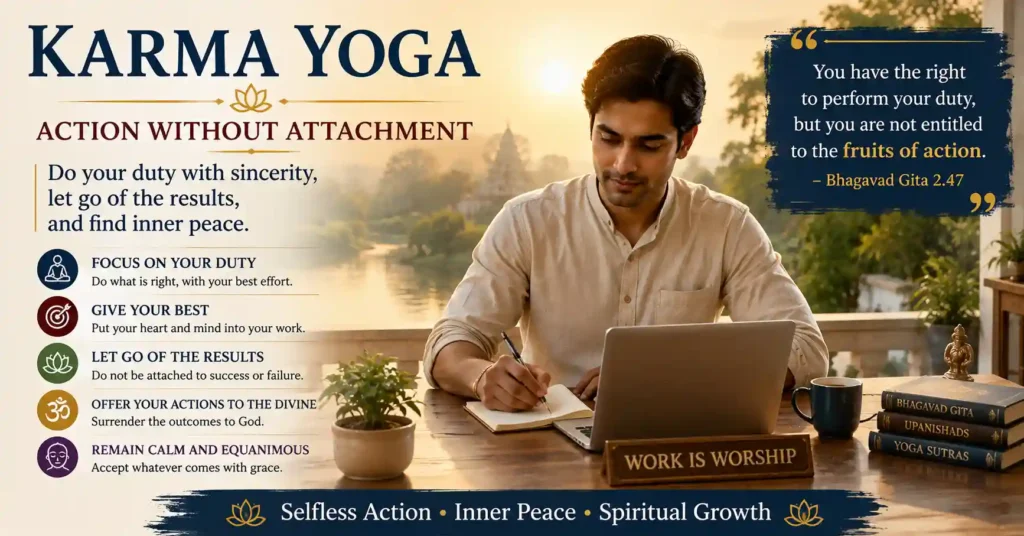
Karma Yoga is the path of selfless action taught in Sanatan Dharma. It encourages us to perform our duties sincerely while remaining free from attachment to success, failure, or personal rewards.
The word Karma means action or duty, while Yoga means union with the Divine or a spiritual path. Together, Karma Yoga is the path of transforming everyday actions into a means of spiritual growth and self-realization.
In the spiritual tradition of Sanatan Dharma, Karma Yoga is regarded as one of the four principal paths to Self-realization, alongside Bhakti Yoga (the path of devotion), Jnana Yoga (the path of knowledge), and Raja Yoga (the path of meditation).
This timeless teaching is explained by Lord Krishna in the Bhagavad Gita, where He guides Arjuna during a moment of deep confusion and emotional conflict on the battlefield of Kurukshetra.
Lord Krishna teaches that every person has a Dharma, or righteous duty, to perform. We should give our best effort with sincerity, but we should not allow the outcome to determine our happiness or inner peace.
This approach is also known as Nishkama Karma Yoga, which means performing actions without selfish desires or attachment to their fruits.
Karma Yoga does not ask us to renounce work or responsibilities. Instead, it teaches us to renounce anxiety, ego, and excessive attachment while performing our duties with complete dedication.
In simple words, Karma Yoga means doing your work wholeheartedly, accepting every outcome with equanimity (Samatva), and offering all your actions to the Divine.
Why Did Lord Krishna Teach This Path?
The teaching of selfless action was not given in a peaceful ashram or during meditation. Lord Krishna revealed it on the battlefield of Kurukshetra, at a time when Arjuna was overwhelmed by grief, fear, and confusion.
Standing between two armies, Arjuna refused to fight because he saw his own relatives, teachers, and friends on the opposing side. He questioned whether performing his duty was right if it caused suffering.
Seeing his inner conflict, Lord Krishna explained that avoiding one’s Dharma out of attachment, fear, or emotional weakness does not lead to lasting peace. True peace comes from performing righteous duties with wisdom and without selfish attachment.
He taught Arjuna that every person has responsibilities according to their role in life. What matters is not avoiding action but performing the right action with sincerity, courage, and inner balance.
This timeless teaching applies far beyond the battlefield of Kurukshetra. Whether we are students, professionals, parents, business owners, or caregivers, we all face situations where duty and personal emotions come into conflict.
The message remains the same today: perform your responsibilities with dedication, let go of excessive attachment to the outcome, and trust that sincere effort, guided by Dharma, is never wasted.
The Deeper Meaning of Action Without Attachment
The central teaching of Karma Yoga is not to stop caring about your work. It is to stop allowing the results of your work to control your inner peace.
Most people believe happiness depends on achieving the outcome they desire. A good result makes us feel successful, while a bad result makes us feel weak, disappointed, or discouraged.
Over time, this attachment creates comparison with others. We begin measuring our progress against their success instead of appreciating our own journey.
Slowly, work loses its joy and becomes a burden. The constant pressure to achieve more creates stress, anxiety, overthinking, and fear of failure.
Karma Yoga offers a different perspective. It shifts our attention from results to right effort. We continue to work sincerely, but we no longer allow success or failure to determine our self-worth.
This does not mean becoming careless or unambitious. In fact, Karma Yoga encourages us to give our very best in every action. The difference is that our peace no longer depends on what happens afterward.
Imagine a gardener planting a tree. He prepares the soil, waters the plant, and cares for it every day. However, he cannot control the rain, the seasons, or how quickly the tree will grow.
His responsibility is sincere effort, not complete control over the outcome.
In the same way, Karma Yoga teaches us to perform our duties with dedication while accepting that the final result depends on many factors beyond our control.
When we stop chasing results all the time, the mind becomes calmer. We become more focused, more productive, and more present in the work itself.
This is the true meaning of action without attachment. It is not indifference or lack of responsibility. It is the freedom to act with sincerity, confidence, and inner balance, regardless of the outcome.
Key Difference
| Attachment to Results | Action Without Attachment |
|---|---|
| Work is driven by fear or desire. | Work is driven by duty and sincerity. |
| Success creates ego. | Success creates gratitude. |
| Failure leads to disappointment. | Failure becomes an opportunity to learn. |
| Peace depends on outcomes. | Peace comes from doing one’s best. |
| Constant comparison with others. | Focus remains on one’s own Dharma and effort. |
Nishkama Karma vs Sakama Karma
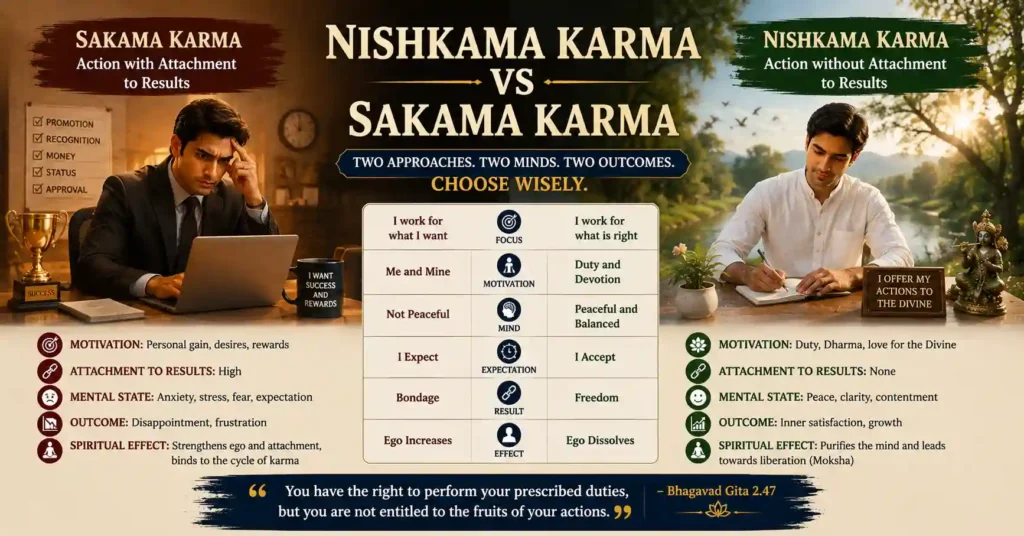
One of the easiest ways to understand this teaching is by comparing Nishkama Karma and Sakama Karma. Both involve performing actions, but the intention behind those actions is very different.
Nishkama Karma means acting without selfish desires or attachment to personal rewards. The focus remains on performing one’s duty sincerely, regardless of the outcome.
Sakama Karma, on the other hand, refers to actions performed with the expectation of achieving a specific result, such as wealth, success, recognition, or personal gain.
Sanatan Dharma does not say that Sakama Karma is wrong. Most people naturally begin their spiritual journey by acting with desires and expectations.
However, Lord Krishna teaches that gradually moving from self-centered action to selfless action brings greater inner peace, freedom, and spiritual growth.
Nishkama Karma vs Sakama Karma
| Aspect | Nishkama Karma | Sakama Karma |
|---|---|---|
| Motivation | Duty and righteousness | Personal desire or reward |
| Expectation | No attachment to the outcome | Strong expectation of results |
| Mental State | Calm and balanced | Often anxious or disappointed |
| Primary Focus | Performing the right action | Achieving a desired result |
| Spiritual Effect | Purifies the mind and supports spiritual growth | Can strengthen attachment and ego |
As spiritual maturity develops, actions gradually become less driven by personal gain and more guided by duty, compassion, and devotion. This transformation is one of the defining characteristics of the path taught in the Bhagavad Gita.
Karma Yoga in the Bhagavad Gita
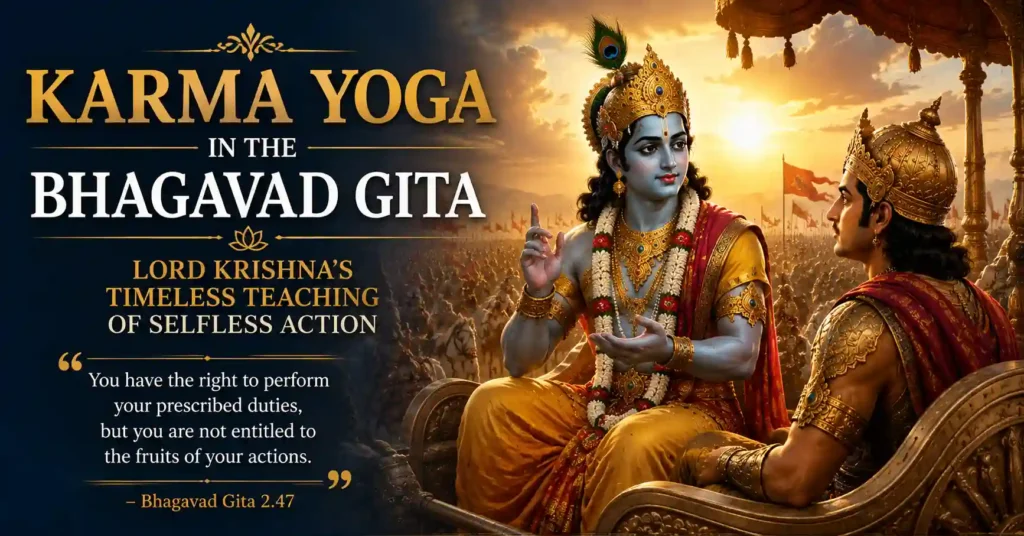
The philosophy of Karma Yoga reaches its highest expression in the Bhagavad Gita, where Lord Krishna teaches Arjuna how to perform his duty with wisdom, courage, and inner balance.
On the battlefield of Kurukshetra, Arjuna becomes overwhelmed with grief and refuses to fight because the opposing army includes his own relatives, teachers, and friends. Seeing his confusion, Lord Krishna explains that avoiding one’s righteous duty is not the path to peace.
Instead, He teaches Arjuna to perform his Dharma without attachment to success or failure. This timeless teaching became one of the central messages of the Bhagavad Gita.
One of the most famous verses explaining Karma Yoga is:
कर्मण्येवाधिकारस्ते मा फलेषु कदाचन।
मा कर्मफलहेतुर्भूर्मा ते संगोऽस्त्वकर्मणि॥
(Bhagavad Gita 2.47)
Meaning:
“You have the right to perform your prescribed duty, but you are not entitled to the fruits of your actions. Never consider yourself the cause of the results, and never become attached to inaction.”
This verse does not mean that results are unimportant. Instead, it teaches that while we should strive to do our best, we should not let success, failure, praise, or criticism disturb our inner peace.
Lord Krishna explains that attachment to results often creates fear, anxiety, disappointment, and ego. These emotions distract us from performing our duties with clarity and sincerity.
When we practice Karma Yoga, our perspective begins to change. Success does not make us arrogant, and failure does not discourage us. We learn from every experience while remaining balanced and focused on our responsibilities.
This inner steadiness is one of the greatest gifts of Karma Yoga. It allows us to work with dedication, face life’s challenges with courage, and continue moving forward without losing peace of mind.
What This Verse Teaches
| Teaching | Meaning |
|---|---|
| Perform your duty | Fulfil your responsibilities sincerely. |
| Do not be attached to results | Let your peace depend on your effort, not the outcome. |
| Do not act out of selfish desire | Perform actions with the right intention. |
| Do not avoid action | Spiritual growth comes through righteous action, not inaction. |
The Core Principles of This Path
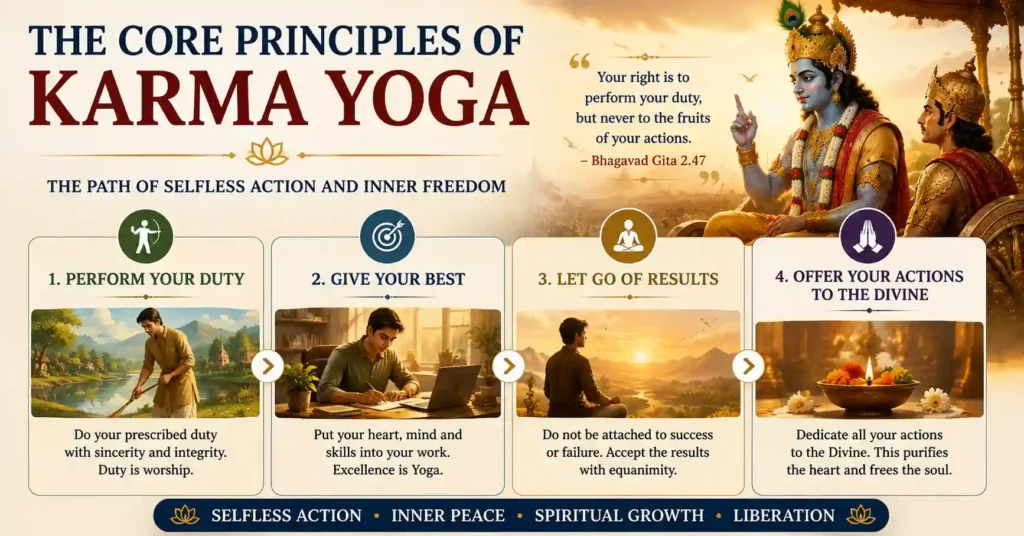
The teachings of Lord Krishna are built on a few timeless principles that help us perform our duties with wisdom, balance, and inner peace. These principles are not limited to spiritual practice. They can be applied in every aspect of life.
1. Perform Your Dharma
Every person has responsibilities based on their role in life. Fulfilling these duties honestly and sincerely is the foundation of spiritual growth.
2. Give Your Best Effort
Work with dedication, discipline, and full attention. Excellence in action is encouraged because sincere effort is always within your control.
3. Let Go of Attachment
Do not allow success, failure, praise, or criticism to determine your peace of mind. Accept every outcome with equanimity while continuing to perform your responsibilities.
4. Act Without Selfish Motives
Whenever possible, let your actions be guided by service, compassion, and righteousness instead of personal gain or recognition.
5. Offer Your Actions to the Divine
When every action is performed as an offering to God, even ordinary work becomes an act of worship. This attitude gradually removes ego and develops humility.
These principles work together to transform ordinary responsibilities into opportunities for personal and spiritual growth.
Common Misunderstandings About Karma Yoga
One of the biggest misconceptions about Karma Yoga is that it teaches people to stop caring about results or become passive. This is not what Lord Krishna teaches in the Bhagavad Gita.
Karma Yoga does not mean giving up ambition, avoiding responsibility, or accepting failure without effort. It never encourages laziness or a careless attitude toward life.
Instead, it teaches us to perform every action with complete sincerity, dedication, and skill. We are encouraged to give our best while remaining free from anxiety about the final outcome.
The real transformation happens within the mind. Rather than allowing success or failure to control our emotions, we learn to remain calm, balanced, and focused on our Dharma.
This inner balance helps us make better decisions because our actions are guided by wisdom instead of fear, greed, or ego.
Practicing Karma Yoga also does not mean suppressing emotions. It means understanding that our happiness should come from performing the right action, not from receiving praise, rewards, or recognition.
When this understanding develops, work becomes a source of growth rather than pressure. We become more peaceful, more confident, and more resilient, even during difficult situations.
Myth vs Reality
| Common Myth | What Karma Yoga Actually Teaches |
|---|---|
| Do not care about results. | Give your best, but do not become attached to the results. |
| Karma Yoga means doing nothing. | Perform your duties with sincerity and dedication. |
| It discourages ambition. | It encourages righteous effort without selfish attachment. |
| Failure should not matter. | Learn from failure without losing inner peace. |
| It is only for monks or saints. | It can be practiced by everyone in daily life. |
Who Can Practice This Path?
One of the greatest strengths of this teaching is that it is meant for everyone. You do not need to become a monk, renounce your family, or leave your profession to follow this path.
Lord Krishna shared this wisdom with Arjuna, who was a warrior with responsibilities, not a renunciant living in isolation. This shows that spiritual growth is possible while actively fulfilling one’s duties in society.
Anyone can follow this path through sincere action and the right attitude.
It can be practiced by
- Students, by studying with dedication instead of worrying constantly about marks.
- Professionals, by working honestly without becoming attached to promotions or recognition.
- Parents, by caring for their families with love rather than expecting appreciation.
- Business owners, by making ethical decisions while accepting that not every outcome is under their control.
- Volunteers and devotees, by serving others without seeking praise or personal gain.
The external role may differ from person to person, but the inner attitude remains the same. When actions are performed with sincerity, guided by Dharma, and free from selfish attachment, everyday life itself becomes a spiritual practice.
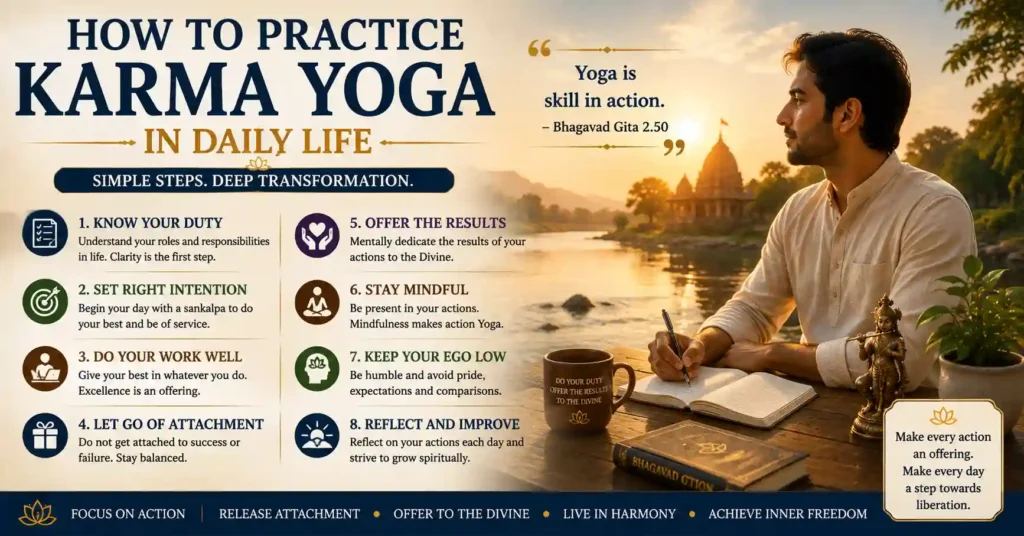
How to Practice Karma Yoga in Daily Life
Karma Yoga is not limited to saints, monks, or spiritual seekers. It is a practical way of living that anyone can follow, whether you are a student, professional, homemaker, entrepreneur, or retiree.
The practice begins with a simple change in attitude. Instead of becoming anxious about results, focus on performing your duties with sincerity, honesty, and full attention.
You do not have to perform extraordinary acts. Every ordinary responsibility can become Karma Yoga when it is done with the right intention and without selfish attachment.
Here are some simple ways to practice Karma Yoga every day:
- Perform your duties sincerely without expecting praise or rewards.
- Give your full attention to the task instead of worrying about the outcome.
- Accept success with humility and failure as an opportunity to learn.
- Avoid comparing your progress with others.
- Help others without expecting recognition or appreciation.
- Offer your actions and their results to God with gratitude and faith.
For example, a student who studies with dedication instead of constantly fearing examination results is practicing Karma Yoga.
A professional who works honestly without becoming consumed by promotions or recognition is also following its principles.
Likewise, caring for your family with love, serving society selflessly, or performing daily responsibilities without expecting appreciation are all expressions of Karma Yoga.
Over time, this practice changes the way you think. Work becomes an act of service rather than a source of stress. The mind becomes calmer, expectations become lighter, and inner peace gradually replaces anxiety.
Karma Yoga in Everyday Life
| Situation | Practicing Karma Yoga |
|---|---|
| Student | Study sincerely without becoming obsessed with marks. |
| Professional | Work honestly without attaching your happiness to promotions. |
| Parent | Care for your family without expecting constant appreciation. |
| Business Owner | Make ethical decisions while accepting that outcomes are not fully in your control. |
| Volunteer | Serve others without seeking recognition or praise. |

Common Mistakes to Avoid While Following This Path
Many people sincerely wish to follow this teaching but unknowingly make a few common mistakes. Recognizing these can help develop the right attitude toward action and spiritual growth.
Avoid these common mistakes
- Expecting immediate results. Inner transformation happens gradually through consistent practice.
- Confusing detachment with carelessness. Detachment means freedom from unhealthy attachment, not neglecting responsibilities.
- Performing duties only for recognition. Selfless action becomes difficult when praise or appreciation is the primary motivation.
- Comparing your journey with others. Every person has a different Dharma, life situation, and spiritual path.
- Believing mistakes mean failure. Every experience offers an opportunity to learn, improve, and grow.
As understanding deepens, actions become more balanced, expectations become lighter, and everyday responsibilities become opportunities for inner development.
Karma Yoga and the Three Types of Karma
To understand Karma Yoga more deeply, it is helpful to understand the three types of karma described in Sanatan Dharma. These explain how our past, present, and future actions are connected.
| Type of Karma | Meaning |
|---|---|
| Sanchita Karma | The accumulated karma from countless past actions that has not yet been experienced. |
| Prarabdha Karma | The portion of Sanchita Karma that has begun to bear fruit in this lifetime and shapes our present circumstances. |
| Kriyamana Karma (Agami Karma) | The karma we create through our present thoughts, words, and actions, which influences the future. |
Among these, Kriyamana Karma is most closely connected with Karma Yoga because it concerns the actions we choose to perform right now.
We cannot change our past actions or immediately alter the circumstances created by Prarabdha Karma. However, we always have the freedom to choose how we think, act, and respond in the present moment.
Lord Krishna teaches that our responsibility is to perform righteous actions (Dharma) with sincerity, while remaining free from attachment to the results. Every selfless action performed today becomes part of the karma that shapes tomorrow.
This understanding is both empowering and liberating. Instead of worrying about the past or fearing the future, Karma Yoga encourages us to focus on performing the right action in the present with wisdom, dedication, and inner balance.
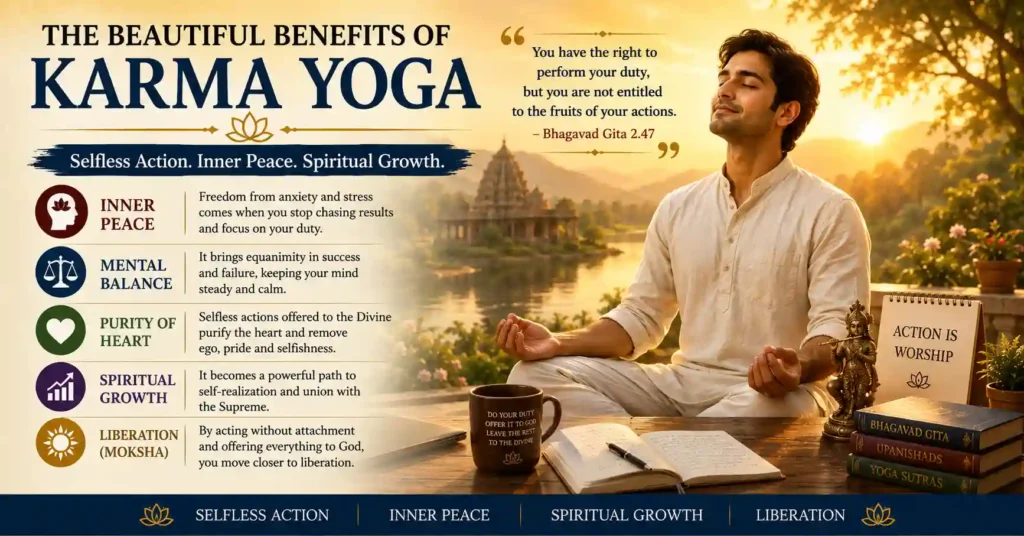
Benefits of Karma Yoga in Modern Life
In today’s fast-paced and demanding world, Karma Yoga is more relevant than ever. Many people live under constant pressure to succeed, meet expectations, and compare themselves with others. This often leads to stress, anxiety, and emotional exhaustion.
Karma Yoga offers a healthier approach. Instead of becoming attached to outcomes, it teaches us to focus on sincere effort and accept results with balance. This simple shift can transform both our work and personal life.
Some of the key benefits of practicing Karma Yoga include:
| Benefit | How It Helps |
|---|---|
| Reduces Stress | Worry decreases because you focus on your actions instead of trying to control every outcome. |
| Improves Emotional Balance | Success and failure no longer disturb your inner peace as deeply as before. |
| Increases Focus | Your attention stays on the present task instead of future expectations. |
| Builds Resilience | Setbacks become opportunities to learn instead of reasons to lose confidence. |
| Reduces Ego | You begin to see yourself as an instrument of the Divine rather than the sole controller of results. |
| Improves Relationships | Fewer expectations lead to greater understanding, patience, and harmony. |
| Supports Spiritual Growth | Selfless actions gradually purify the mind and strengthen devotion to God. |
As these qualities develop, work becomes more meaningful and less stressful. You begin to enjoy the process instead of constantly worrying about the destination.
The greatest gift of Karma Yoga is inner peace. External situations may continue to change, but your mind gradually becomes calmer, steadier, and more content because it is no longer controlled by success or failure.
How This Path Relates to Other Yogas
Sanatan Dharma offers several paths that lead towards the same spiritual goal of Self-realization and Moksha. Each path emphasizes a different approach, but they are not separate or contradictory.
Some people are naturally drawn to selfless service, while others are inspired by devotion, knowledge, or meditation. The Bhagavad Gita teaches that these paths can complement one another.
A person may begin by performing duties with sincerity, develop devotion to the Divine, seek spiritual knowledge, and gradually cultivate meditation. These practices often support one another throughout a person’s spiritual journey.
Comparison of the Four Major Yogas
| Yoga | Primary Focus | Main Practice | Suitable For |
|---|---|---|---|
| Karma Yoga | Selfless action | Performing duties without attachment | People engaged in everyday responsibilities |
| Bhakti Yoga | Devotion | Prayer, worship, chanting, and surrender | Those drawn to love and devotion for God |
| Jnana Yoga | Knowledge | Self-inquiry and study of spiritual wisdom | Seekers of truth and philosophical understanding |
| Raja Yoga | Meditation | Mental discipline, concentration, and meditation | Those seeking mastery over the mind |
No single path is considered superior for everyone. The most suitable path depends on a person’s nature, temperament, and stage of spiritual development.
Many devotees naturally combine selfless action with devotion, knowledge, and meditation, allowing these teachings to enrich one another.
Karma Yoga and Surrender
At a deeper level, Karma Yoga naturally leads to surrender. After performing our duties with complete sincerity, we learn to offer both our actions and their results to the Divine.
This does not mean giving up responsibility or becoming passive. Instead, it means doing our very best while accepting that the final outcome is not entirely within our control.
In the Bhagavad Gita, Lord Krishna teaches that we should perform our Dharma with dedication and then leave the fruits of our actions to God. This attitude frees the mind from constant worry, fear, and disappointment.
When every action is performed as an offering to Lord Krishna or one’s Ishta Devata (chosen deity), even ordinary work becomes an act of worship. Daily responsibilities are no longer seen as burdens but as opportunities to serve the Divine.
True surrender is not a sign of weakness. It is an expression of faith, humility, and trust in the divine order of life. We continue to work sincerely, but we no longer carry the unnecessary burden of trying to control every result.
As this attitude develops, the mind becomes calmer during both success and failure. We gain the strength to face uncertainty with patience, knowing that sincere effort is our responsibility, while the outcome rests in the hands of the Divine.
Surrender in Karma Yoga
| Without Surrender | With Surrender |
|---|---|
| Constant worry about results | Focus on sincere effort |
| Fear of failure | Trust in the Divine |
| Ego and the need for recognition | Humility and gratitude |
| Mental pressure | Inner peace |
| Trying to control everything | Accepting what is beyond one’s control |
Applying Karma Yoga in Work, Relationships, and Personal Growth
Karma Yoga is not just a spiritual philosophy. It is a practical way of living that can transform the way we work, build relationships, and grow as individuals.
At Work
Karma Yoga teaches us to focus on sincere effort rather than constant comparison or recognition. When we work with honesty, dedication, and integrity, we become more productive because our energy is directed toward the task instead of worrying about the outcome.
In Relationships
Many disappointments arise from expectations. Karma Yoga encourages us to love, serve, and support others without constantly expecting appreciation or something in return. This creates healthier relationships built on trust, compassion, and understanding.
In Personal Growth
Progress in life is rarely immediate. Karma Yoga teaches patience and consistency. Instead of becoming discouraged by slow results, we continue improving ourselves one step at a time, knowing that sincere effort will eventually bear fruit.
Whether you are studying, working, caring for your family, or serving society, Karma Yoga reminds us that every action performed with the right intention becomes an opportunity for inner growth.
Life gradually becomes less about proving ourselves to others and more about living with purpose, balance, and peace.
Karma Yoga in Everyday Life
| Area of Life | How Karma Yoga Helps |
|---|---|
| Work | Encourages sincere effort without becoming attached to recognition or success. |
| Relationships | Reduces expectations and strengthens trust, compassion, and understanding. |
| Personal Growth | Builds patience, discipline, and consistency instead of frustration over slow progress. |
| Service to Society | Inspires selfless action for the welfare of others without seeking rewards. |
A Simple Example of Karma Yoga
Imagine a farmer preparing his field for the growing season. He ploughs the land, sows the seeds, waters the crops, and works every day with patience, discipline, and dedication. He does everything that is within his control.
However, he cannot control the rain, the changing weather, or every circumstance that affects the harvest. Those factors remain beyond his efforts.
Even then, the farmer does not stop working. He continues performing his duty with faith, knowing that sincere effort is his responsibility, while the final outcome depends on many factors beyond his control.
This is the essence of Karma Yoga. We should give our best in every action, fulfil our responsibilities with honesty, and accept the results with equanimity, whether they bring success or disappointment.
When we learn to work in this way, our actions become free from unnecessary fear, anxiety, and ego. We remain committed to our duty while offering the fruits of our actions to the Divine.
That is the true spirit of Karma Yoga taught by Lord Krishna in the Bhagavad Gita.
Key Teachings in the Bhagavad Gita
The Bhagavad Gita explains the philosophy of selfless action through several important verses. Together, these verses show that true spiritual progress comes from performing one’s duties with sincerity, equanimity, and devotion.
| Verse | Teaching | Key Message |
|---|---|---|
| Bhagavad Gita 2.47 | Duty without attachment | Perform your duty without becoming attached to the fruits of action. |
| Bhagavad Gita 2.48 | Equanimity | Remain balanced in success and failure. Such equanimity is called Yoga. |
| Bhagavad Gita 2.50 | Excellence in action | A person established in Yoga performs actions skillfully and wisely. |
| Bhagavad Gita 3.19 | Selfless action | Perform your duties without attachment, as this leads to spiritual growth. |
| Bhagavad Gita 3.30 | Offering actions to God | Dedicate all actions to the Divine with faith and without ego. |
These verses together explain that spiritual growth does not require abandoning responsibilities. Instead, it comes from transforming ordinary actions into acts of duty, devotion, and inner discipline.
Conclusion
Karma Yoga is more than a spiritual philosophy. It is a practical way of living that teaches us to perform our duties with sincerity, dedication, and inner balance.
Instead of allowing success or failure to control our happiness, Karma Yoga encourages us to focus on righteous action while accepting every outcome with equanimity. This simple shift brings greater peace, clarity, and resilience in every area of life.
Whether you are a student, professional, homemaker, or spiritual seeker, the principles of Karma Yoga can be practiced through your everyday responsibilities. Every action performed with the right intention becomes an opportunity for personal and spiritual growth.
Life will always bring challenges, but your response to those challenges can change. When you work without selfish attachment, offer your actions to the Divine, and remain faithful to your Dharma, you discover a deeper sense of freedom that no external success or failure can take away.
That is the timeless wisdom of Karma Yoga, a path that transforms ordinary actions into a journey toward inner peace and ultimately, Moksha.
Key Takeaways
- Karma Yoga is the path of selfless action taught by Lord Krishna in the Bhagavad Gita.
- It teaches us to perform our Dharma sincerely without attachment to success or failure.
- Nishkama Karma encourages selfless action, while Sakama Karma is driven by personal desires and rewards.
- Inner peace comes from focusing on sincere effort rather than trying to control every outcome.
- This teaching can be practiced by anyone through everyday responsibilities, whether at work, home, or in society.
- Offering one’s actions to the Divine gradually reduces ego, purifies the mind, and supports spiritual growth.
Suggested Reading
If you found this guide to Sthitpragya helpful, you may also enjoy these articles from our Sanatan Wisdom & Philosophy section. Together, they explore the timeless teachings of Sanatan Dharma, helping you understand Dharma, Karma, consciousness, spiritual growth, inner balance, and the path towards Self-realization and Moksha.
Sthitpragya: Meaning, Qualities, Bhagavad Gita Teachings and Daily Life
https://thesanatantales.com/sthitpragya-meaning/
Sattva Rajas Tamas (Triguna): Meaning, Significance and Role in Daily Life
https://thesanatantales.com/sattva-rajas-tamas-meaning/
Purusharthas: The Four Goals of Life in Sanatan Dharma
https://thesanatantales.com/four-purusharthas/
Does the Soul Choose Its Next Journey? Rebirth, Karma and Consciousness in Sanatan Dharma
https://thesanatantales.com/does-the-soul-choose-its-next-journey/
Chausath Yogini (64 Yogini): Story, Names, Temples and Spiritual Significance
https://thesanatantales.com/chausath-yogini/
Sanatan Dharma: Meaning, Origin, Core Principles and Way of Life
https://thesanatantales.com/sanatan-dharma-meaning/
Kaal in Sanatan Dharma: Meaning, Yugas, Cosmic Time and Kala Chakra
https://thesanatantales.com/kaal-in-sanatan-dharma/
Detachment in Hindu Philosophy: Meaning, Vairagya and the Path to Inner Freedom
https://thesanatantales.com/vairagya-meaning/
Karma Yoga (Wikipedia)
https://en.wikipedia.org/wiki/Karma_yoga
FAQs
What is Karma Yoga in simple words?
Karma Yoga is the path of selfless action taught in the Bhagavad Gita. It means performing your duties with sincerity while remaining free from attachment to success, failure, or personal rewards.
Instead of allowing results to determine your happiness, Karma Yoga teaches you to focus on doing the right action. This helps you develop inner peace, emotional balance, and a stronger sense of purpose.
In everyday life, Karma Yoga can be practiced by working honestly, fulfilling responsibilities, helping others without expecting recognition, and offering your actions to the Divine.
What is the main teaching of Karma Yoga?
The central teaching of Karma Yoga is to perform your Dharma, or righteous duty, without attachment to the fruits of your actions.
Lord Krishna explains in the Bhagavad Gita that while we have control over our efforts, we do not have complete control over the results. Therefore, we should focus on sincere action rather than constant worry about outcomes.
This attitude reduces stress, strengthens character, and allows us to live with greater confidence and inner peace.
What is Nishkama Karma in Karma Yoga?
Nishkama Karma means performing actions without selfish desires or attachment to personal rewards. It is one of the core principles of Karma Yoga.
This does not mean that you stop caring about your work. Instead, it means giving your best effort while accepting the results with equanimity, whether they bring success or disappointment.
By practicing Nishkama Karma, the mind gradually becomes free from fear, ego, and unnecessary expectations, making spiritual growth possible.
What is the difference between Karma Yoga and Nishkama Karma?
Karma Yoga is the complete spiritual path of selfless action described in the Bhagavad Gita. It includes the right attitude, right intention, and dedication to performing one’s duties.
Nishkama Karma is one of the fundamental principles of Karma Yoga. It specifically refers to performing actions without attachment to the fruits or rewards.
In simple words, Nishkama Karma is the practice, while Karma Yoga is the broader path that leads to inner purification and spiritual growth.
How can I practice Karma Yoga in daily life?
You can practice Karma Yoga by performing your daily responsibilities with honesty, dedication, and mindfulness while avoiding excessive attachment to results.
Whether you are studying, working, caring for your family, or serving society, focus on giving your best instead of constantly worrying about success or failure.
Over time, you can also cultivate the habit of offering your actions to God and accepting every outcome with gratitude and faith. This transforms ordinary work into a spiritual practice.
Is Karma Yoga only for spiritual people or monks?
No. Karma Yoga is meant for everyone, not just monks or spiritual seekers.
Lord Krishna taught Karma Yoga to Arjuna, a warrior actively engaged in worldly responsibilities. This shows that the path is intended for people living ordinary lives while fulfilling their duties.
Students, professionals, parents, business owners, homemakers, and retirees can all practice Karma Yoga through their daily actions and responsibilities.
Does Karma Yoga mean not caring about success?
No. Karma Yoga never teaches that success is unimportant or that effort should be reduced.
It encourages you to work with complete dedication, skill, and commitment. The difference is that your peace of mind should not depend entirely on whether you succeed or fail.
When you stop becoming emotionally attached to results, you are able to work with greater clarity, confidence, and consistency.
What are some examples of Karma Yoga in everyday life?
A student preparing sincerely for an examination without becoming obsessed with marks is practicing Karma Yoga.
A professional who works honestly without constantly seeking praise or promotion, a parent caring for the family without expecting appreciation, and a volunteer serving others selflessly are all examples of Karma Yoga.
Any action performed with the right intention, without selfish attachment to the outcome, reflects the spirit of Karma Yoga.
What are the benefits of practicing Karma Yoga?
Regular practice of Karma Yoga helps reduce stress because your attention shifts from worrying about results to performing the right action.
It also improves emotional balance, strengthens patience, reduces ego, and encourages healthier relationships by reducing unrealistic expectations.
From a spiritual perspective, Karma Yoga purifies the mind, deepens devotion, and prepares a person for higher spiritual realization and ultimately Moksha.
What is the relationship between Karma Yoga and the Bhagavad Gita?
The Bhagavad Gita is the primary scripture that explains the philosophy of Karma Yoga in detail.
Lord Krishna teaches Karma Yoga to Arjuna on the battlefield of Kurukshetra, showing that spiritual wisdom is meant to be practiced while fulfilling one’s worldly duties, not by escaping them.
The teachings of Karma Yoga in the Bhagavad Gita continue to guide millions of people in balancing work, responsibility, and inner peace in everyday life.
Glossary of Important Terms
| Term | Meaning |
|---|---|
| Karma Yoga | The path of selfless action that teaches performing one’s duties without attachment to the results. |
| Karma | Action, deed, or duty performed through thoughts, words, or physical actions. |
| Yoga | A spiritual path or discipline that leads to union with the Divine and self-realization. |
| Nishkama Karma | Selfless action performed without desire for personal rewards or attachment to the fruits of action. |
| Sakama Karma | Actions performed with the expectation of specific rewards, success, or personal gain. |
| Dharma | One’s righteous duty, moral responsibility, and way of living according to truth and righteousness. |
| Bhagavad Gita | A sacred scripture of Sanatan Dharma in which Lord Krishna teaches spiritual wisdom, including Karma Yoga, to Arjuna. |
| Lord Krishna | The eighth avatar of Lord Vishnu and the divine teacher who explains Karma Yoga in the Bhagavad Gita. |
| Arjuna | The Pandava prince who receives the teachings of Karma Yoga from Lord Krishna before the Kurukshetra war. |
| Kurukshetra | The battlefield where the Mahabharata war took place and where the Bhagavad Gita was revealed. |
| Samatva | Equanimity or mental balance, remaining steady in both success and failure. Lord Krishna describes this as an essential quality of Karma Yoga. |
| Dharma Yuddha | A righteous war fought to uphold justice, truth, and Dharma. The Kurukshetra war is regarded as a Dharma Yuddha. |
| Sanchita Karma | The accumulated karma from countless past actions that has not yet borne fruit. |
| Prarabdha Karma | The portion of accumulated karma that is responsible for the circumstances of the present life. |
| Kriyamana Karma (Agami Karma) | The karma created through present actions, thoughts, and intentions that influences the future. |
| Moksha | Liberation from the cycle of birth and death (Samsara) and union with the Supreme Reality. |
| Bhakti Yoga | The path of devotion to God through love, prayer, worship, and complete surrender. |
| Jnana Yoga | The path of spiritual knowledge and self-inquiry leading to the realization of the true Self (Atman). |
| Raja Yoga | The path of meditation, self-discipline, and mastery of the mind, often associated with Patanjali’s Yoga Sutras. |
| Self-realization | The direct realization of one’s true nature as the eternal Atman beyond the body and mind. |
| Ishta Devata | A devotee’s chosen form of the Divine, to whom prayers, devotion, and spiritual practices are directed. |
About the Author
Yateendra Chaturvedi is a spiritual writer, researcher, devotee, and the founder of The Sanatan Tales. With over 35 years of professional experience and a lifelong interest in Sanatan Dharma, he writes about Hindu deities, temples, scriptures, festivals, Mahavidyas, sacred stories, rituals, and living traditions that continue to guide and inspire devotees across India.
Drawing from traditional scriptures, regional beliefs, temple traditions, devotional literature, and historical sources, he aims to present authentic, well-researched, and easy-to-understand content for modern readers. His work focuses on preserving spiritual wisdom, explaining sacred traditions, and helping seekers develop a deeper understanding of India’s rich spiritual heritage.
Through The Sanatan Tales, Yateendra strives to make the timeless teachings of Sanatan Dharma simple, meaningful, and relevant for today’s generation while maintaining respect for traditional sources, regional practices, and diverse spiritual perspectives.
Learn More About Yateendra Chaturvedi →
https://thesanatantales.com/about-the-author/
References & Sources
This article is based on the philosophical teachings of Sanatan Dharma, particularly the Bhagavad Gita, along with concepts explained in the Upanishads, Mahabharata, and other traditional Hindu scriptures. It also draws upon classical interpretations, traditional knowledge, and insights preserved through the guru-disciple tradition.
Note: The teachings and interpretations presented in this article reflect widely accepted philosophical perspectives within Sanatan Dharma. Different traditions, schools of philosophy, and spiritual lineages may explain certain concepts in their own way. The purpose of this article is to present these teachings in a simple, practical, and accessible manner for readers seeking to understand the principles of selfless action and spiritual living.
Read More Interesting Articles on Sanatan Dharma