Does the Soul Choose Its Next Journey after death? This profound question has fascinated spiritual seekers, philosophers, and saints for centuries.
At some point, almost everyone wonders what happens after death. Does the soul simply disappear, or does it continue its journey into another life? If rebirth is real, who decides where, when, and how the next birth takes place?
In Sanatan Dharma, death is not viewed as the end of existence. It is a transition in the soul’s eternal journey through karma, rebirth, and the evolution of consciousness. Yet one profound question remains at the heart of this mystery: Does the Soul Choose Its Next Journey, or is the next life shaped entirely by past actions?
The Bhagavad Gita, Upanishads, and other sacred texts offer profound insights into this timeless subject. They explain how the Atman, the subtle body, karma, and divine law work together in the cycle of birth and death.
In this article, you’ll discover what Sanatan Dharma teaches about the soul after death, whether the soul consciously chooses its next birth, how karma influences rebirth, the role of consciousness, and why Moksha is considered the ultimate goal beyond the cycle of reincarnation.
Does the Soul Choose Its Next Journey? At a Glance
| Quick Facts | Details |
|---|---|
| Focus Topic | Does the Soul Choose Its Next Journey? |
| Short Answer | According to Sanatan Dharma, the soul’s next journey is primarily guided by karma, Vasanas, and the subtle body, while spiritually enlightened beings may consciously choose birth for a higher purpose. |
| Primary Scriptures | Bhagavad Gita, Upanishads, Garuda Purana |
| Key Concepts | Atman, Karma, Samsara, Vasanas, Sukshma Sharira, Moksha |
| Ultimate Goal | Attaining Moksha, liberation from the cycle of birth and rebirth |
Table of Contents
ToggleWhat Do the Bhagavad Gita and Sanatan Dharma Teach About the Soul?
The Bhagavad Gita teaches that the Atman (soul) is eternal. It is never born, and it never truly dies. While the physical body changes with time, the inner consciousness continues its journey beyond death.
One of the Gita’s most well-known teachings compares the soul to a person changing clothes. Just as worn-out garments are discarded and replaced with new ones, the soul leaves an old body and takes on another according to the eternal law of life.
This understanding forms the foundation of Sanatan Dharma. Human life is not limited to a single birth but is part of Samsara, the continuous cycle of birth, death, and rebirth governed by karma and divine order.
Key Scriptural References
| Scripture | Teaching Related to the Soul |
|---|---|
| Bhagavad Gita 2.20 | The Atman is eternal, unborn, and never dies. |
| Bhagavad Gita 2.22 | The soul leaves one body and takes another, just as a person changes worn-out clothes. |
| Brihadaranyaka Upanishad 4.4.5 | A person’s deepest desires and actions influence their future state and rebirth. |
| Garuda Purana | Describes the soul’s journey after death, karmic consequences, and the path toward rebirth. |
How Karma Influences the Soul's Next Journey
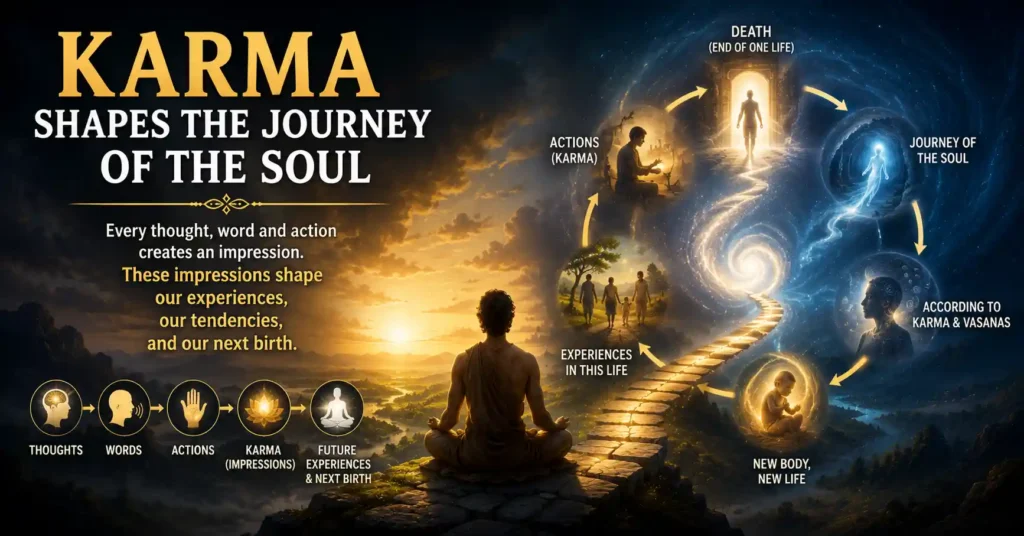
According to Sanatan Dharma, the soul’s next journey is guided by the eternal law of Karma. Karma simply means actions and their consequences. Every thought, word, intention, and action leaves a subtle impression on the mind.
These impressions are known as Samskaras, while the deeper desires and tendencies they create are called Vasanas. Together, they influence a person’s nature, choices, and spiritual growth across many lifetimes.
When the physical body dies, it returns to the five elements. However, the subtle body (Sukshma Sharira) continues its journey with the soul, carrying these accumulated Samskaras, Vasanas, and the results of past karma.
For this reason, the next birth is not considered random. The soul is naturally drawn to circumstances where these karmic impressions can unfold, helping it experience the results of past actions and continue its spiritual evolution.
Adi Shankaracharya explained that the subtle body carries these impressions from one lifetime to another. Until they are exhausted through experience, right action, knowledge, and spiritual practice, they continue influencing the cycle of rebirth.
This naturally raises the deeper question: Does the Soul Choose Its Next Journey, or is every birth determined by karma and divine law? To understand this, we must first understand the subtle body, which carries karmic impressions from one lifetime to the next.
The Subtle Body That Travels with the Soul
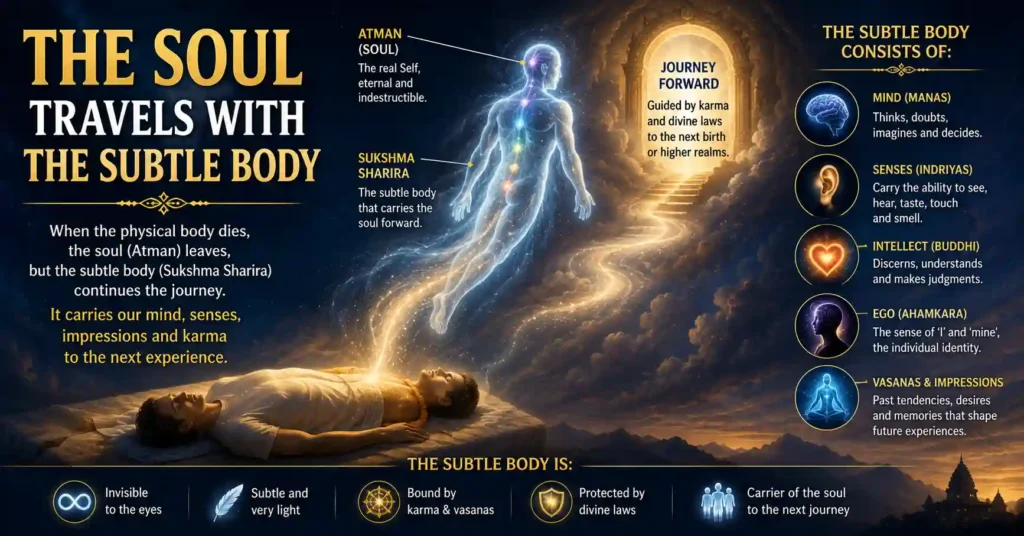
Sanatan philosophy explains that the soul does not travel alone after death. It is accompanied by a subtle energetic structure known as the Sukshma Sharira, or the subtle body, which serves as the link between one life and the next.
Unlike the physical body, which returns to the five elements after death, the subtle body continues its journey with the Atman. It carries the mind (Manas), intellect (Buddhi), ego (Ahamkara), along with accumulated Samskaras, Vasanas, and the effects of past karma.
Because of this, the tendencies, desires, abilities, and unresolved karmic impressions from previous lives continue to influence the circumstances of the next birth. This explains why every individual is born with unique qualities, strengths, and challenges.
In simple terms, the Sukshma Sharira acts as a bridge between lifetimes. It preserves the karmic blueprint that guides the soul’s journey until Self-realization and Moksha bring the cycle of rebirth to an end.
Three Types of Karma That Influence Rebirth
Vedantic philosophy explains that karma is not a single collection of actions. It is traditionally understood in three categories, each playing a different role in the soul’s journey through rebirth.
| Type | Meaning |
|---|---|
| Sanchita Karma | The accumulated karma from countless past lives that has not yet been experienced. |
| Prarabdha Karma | The portion of Sanchita Karma that has become active and shapes the present life. |
| Agami Karma | The new karma created through a person’s present thoughts, words, and actions, which influences future births. |
According to Sanatan Dharma, not all accumulated karma becomes active at once. At the time of death, only the appropriate portion of Sanchita Karma, known as Prarabdha Karma, determines the circumstances of the next birth.
The remaining accumulated karma continues to stay with the subtle body until it bears fruit in future lifetimes. At the same time, every new action creates Agami Karma, adding to the soul’s continuing journey through Samsara.
Understanding these three types of karma helps answer an important question. If karma influences rebirth, does the soul choose its next journey, or do deeper desires and impressions also play a role? To answer that, we must understand the power of Vasanas.
The Powerful Role of Desires (Vasanas)
Apart from karma, Sanatan Dharma teaches that deep inner tendencies also influence the soul’s journey through rebirth. These subtle impressions are known as Vasanas, the desires, attachments, and habitual tendencies stored within the subconscious mind.
Every thought, emotion, and action leaves an impression. Over time, these impressions develop into Vasanas, quietly shaping a person’s likes, dislikes, ambitions, fears, and spiritual inclinations across many lifetimes.
If strong desires remain unfulfilled, the soul is naturally drawn toward another birth where those tendencies can continue to unfold. This is one of the reasons why the cycle of Samsara continues until all attachments are transcended.
The Brihadaranyaka Upanishad expresses this profound idea by teaching that a person ultimately becomes what their deepest desire is. In other words, our inner tendencies influence the direction of our spiritual journey.
In this way, karma determines the circumstances of the next birth, while Vasanas influence the tendencies, desires, and experiences carried into the next life.
| Concept | Meaning | Role in the Soul’s Journey |
|---|---|---|
| Karma | Actions and their consequences. | Determines the circumstances and experiences of present and future lives. |
| Samskaras | Mental impressions created by thoughts, actions, and experiences. | Shape personality, habits, and spiritual tendencies over many lifetimes. |
| Vasanas | Deep-rooted desires, attachments, and subconscious tendencies. | Draw the soul toward experiences and circumstances that fulfil unresolved desires, influencing rebirth. |
This leads to an even deeper question. Does the Soul Choose Its Next Journey through conscious choice, or do karma and Vasanas quietly guide the soul toward its next birth?
Does the Soul Consciously Choose Its Next Life?
The answer depends on the level of spiritual awareness of the soul. According to Sanatan Dharma, not every soul experiences death with the same degree of consciousness.
| Soul’s State | Can It Choose the Next Birth? |
|---|---|
| Ordinary Soul | Generally No. The next birth is guided by karma, Vasanas, and the impressions carried within the subtle body. |
| Spiritually Evolved Soul | Greater spiritual awareness may allow a conscious participation in the soul’s next journey, according to traditional teachings. |
| Enlightened Being | Many traditions within Sanatan Dharma teach that liberated souls may voluntarily take birth to protect Dharma, guide humanity, or fulfil a divine mission. |
For most people, the next birth is not a conscious choice. The soul is guided by its accumulated karma, Vasanas, and the impressions carried within the subtle body. These forces naturally shape the circumstances of the next life according to the universal law of cause and effect.
Imagine a river flowing downhill. The water does not consciously decide its path. Instead, it follows the natural shape of the land. In the same way, accumulated karma and deep-rooted desires quietly guide the soul toward its next birth.
However, the scriptures and spiritual traditions of Sanatan Dharma describe enlightened beings differently. Great sages, saints, and liberated souls are believed to possess a much higher level of awareness. Some are said to take birth voluntarily to guide humanity, protect Dharma, or fulfil a divine mission.
In such cases, birth is not the result of karmic compulsion but an expression of wisdom, compassion, and free will. These rare souls are no longer bound by the ordinary cycle of Samsara.
For most of us, however, the next journey is shaped largely by karma, Vasanas, and the state of our consciousness. This explains why the question, Does the Soul Choose Its Next Journey, does not have a simple yes or no answer. The answer depends on the soul’s level of spiritual evolution.
The Role of Cosmic Order and Yama
Traditional scriptures also describe the role of Yama, the divine regulator of death and karmic balance. In Sanatan Dharma, Yama is not merely the god of death but the guardian of Dharma, justice, and the universal law that governs the consequences of every action.
Texts such as the Garuda Purana portray Yama as the one who ensures that every soul experiences the results of its karma with complete fairness. His role is not to punish or reward out of personal judgment but to uphold the cosmic order established by the Divine.
From a philosophical perspective, Yama represents the universal law of cause and effect. He symbolizes the principle that no action is ever lost and that every soul moves forward according to its own karma and spiritual evolution.
This understanding reminds us that the soul’s next journey is not governed by chance. It unfolds according to the eternal laws of karma, Dharma, and the divine order that sustains the cycle of birth, death, and rebirth.
What Happens Between Death and the Next Birth?
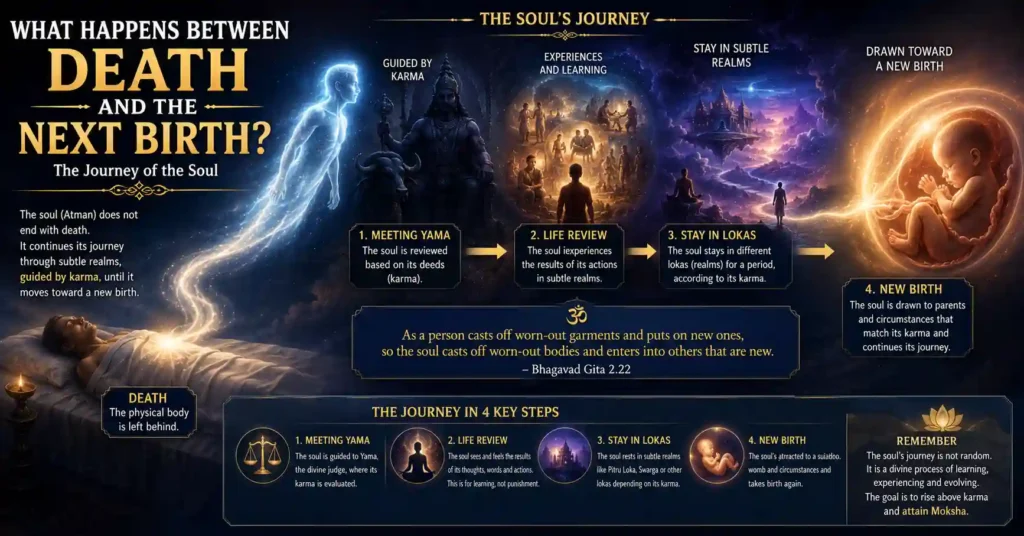
Ancient texts such as the Garuda Purana describe the soul’s journey after death in greater detail. According to Sanatan Dharma, death is not the end of existence but a transition from one stage of the soul’s journey to another.
Stages of the Soul’s Journey After Death
| Stage | What Happens? |
|---|---|
| Death of the Physical Body | The body returns to the five elements, while the Atman continues its journey with the Sukshma Sharira. |
| Karmic Transition | The soul carries its karma, Samskaras, and Vasanas, which continue influencing its spiritual journey. |
| Experience in Subtle Realms | Depending on accumulated karma, the soul may experience different Lokas before rebirth. |
| Preparation for Rebirth | When suitable karmic conditions arise, the soul moves toward its next birth. |
| New Birth | The soul is born into circumstances that support the unfolding of Prarabdha Karma and further spiritual evolution. |
After leaving the physical body, the Atman continues with the Sukshma Sharira (subtle body), carrying the mind, karmic impressions, Vasanas, and the results of past actions. During this transitional phase, the soul gradually detaches from its previous life and moves according to the laws of karma.
The scriptures explain that the experiences during this journey vary according to a person’s actions, spiritual awareness, and accumulated karma. Every soul continues its path until the appropriate conditions for the next birth arise.
When the time is right, the soul takes birth again in circumstances that best support the unfolding of its Prarabdha Karma and spiritual evolution. In this way, rebirth is viewed as a continuation of the soul’s learning rather than the beginning of a completely new existence.
The Soul’s Journey at a Glance
| Stage | What Happens? |
|---|---|
| Life on Earth | The soul performs actions that create karma, Samskaras, and Vasanas. |
| Physical Death | The physical body returns to the five elements, while the Atman continues its journey with the Sukshma Sharira. |
| Transitional Journey | The soul experiences the results of past actions and moves according to karma and spiritual evolution. |
| Next Birth | The soul takes birth in circumstances shaped by Prarabdha Karma and accumulated tendencies. |
| Ultimate Goal | Through spiritual growth and Self-realization, the soul attains Moksha, ending the cycle of Samsara. |
The Idea of Multiple Realms in the Universe
Sanatan Dharma describes many different realms of existence known as Lokas. These are not merely physical places but different planes of existence experienced by souls according to their karma, spiritual evolution, and level of consciousness.
Sacred texts describe several Lokas, each serving a unique purpose within the cosmic order. Some are associated with human life, while others are believed to be realms where ancestors, celestial beings, sages, or spiritually evolved souls reside during different stages of their journey.
| Loka | Traditional Significance |
|---|---|
| Bhuloka | The earthly realm where human beings live, perform karma, and pursue spiritual growth. |
| Pitru Loka | The realm associated with ancestors, where departed souls may reside before continuing their journey. |
| Svarga Loka | A heavenly realm where souls experience the positive results of virtuous karma before rebirth. |
| Mahar Loka | The abode of great sages engaged in higher spiritual contemplation. |
| Jana Loka | The realm of spiritually advanced beings devoted to divine knowledge. |
| Tapa Loka | A plane where enlightened sages perform deep meditation and austerities. |
| Satya Loka (Brahma Loka) | The highest of the material Lokas, associated with Lord Brahma and profound spiritual realization. |
According to the scriptures, a soul may temporarily experience one of these Lokas after death before taking another birth. The duration and nature of that experience depend on the soul’s accumulated karma, spiritual maturity, and stage of spiritual evolution.
These Lokas are not considered the soul’s final destination. In Sanatan Dharma, the ultimate goal is Moksha, where the soul becomes free from the entire cycle of birth, death, and rebirth.
A Glimpse from Modern Research
Although Sanatan Dharma has taught the concepts of rebirth and the continuity of consciousness for thousands of years, some modern researchers have also explored these subjects from a scientific perspective.
One of the best-known researchers was Dr. Ian Stevenson, a psychiatrist at the University of Virginia. He documented thousands of cases in which young children reported memories that appeared to relate to previous lives. Many of these accounts included details that researchers found difficult to explain through ordinary means.
While these studies do not conclusively prove reincarnation, they have encouraged thoughtful discussions about the nature of consciousness and what, if anything, survives after physical death. They remain an area of ongoing research and debate.
For followers of Sanatan Dharma, however, the understanding of rebirth comes primarily from the teachings of the Bhagavad Gita, Upanishads, and other sacred scriptures rather than from modern scientific investigation. These teachings view the soul’s journey as part of an eternal spiritual process guided by karma, consciousness, and divine law.
Did You Know?
The idea of rebirth is found in several ancient traditions, but Sanatan Dharma offers one of the most detailed philosophical explanations.
It teaches that the soul’s journey continues according to karma, Vasanas, and spiritual evolution until it attains Moksha, liberation from the cycle of birth and death.
The Deeper Goal Beyond Rebirth
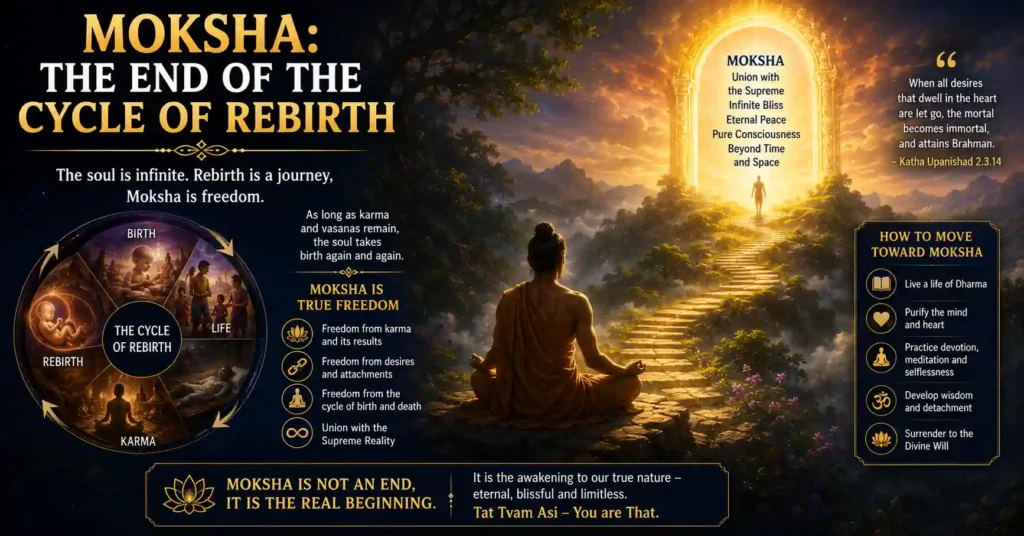
In Sanatan Dharma, rebirth is not the ultimate goal of the soul’s journey. The cycle of birth, death, and rebirth (Samsara) continues only until the soul realizes its true nature.
The highest goal is Moksha, the state of liberation from all karmic bondage and worldly attachments. It is the realization that the Atman is eternal and one with the Supreme Reality.
When ignorance (Avidya), desires (Vasanas), and the effects of karma are completely transcended, the soul is no longer bound to take another birth. The cycle of Samsara comes to an end, bringing lasting peace and freedom.
From this perspective, the purpose of life is not merely to seek a better next birth but to grow in wisdom, perform Dharma, purify the mind, and move steadily toward Self-realization and Moksha.
Rebirth vs Moksha: What’s the Difference?
| Rebirth (Samsara) | Moksha |
|---|---|
| The soul takes another physical birth. | The soul becomes free from the cycle of birth and death. |
| Guided by karma, Vasanas, and past impressions. | Freedom from karma and worldly attachments. |
| Provides opportunities for spiritual growth. | Represents complete Self-realization and liberation. |
| Continues until spiritual ignorance ends. | The highest goal of Sanatan Dharma. |
Common Misconceptions About Rebirth
Many people misunderstand the concept of rebirth in Sanatan Dharma. The scriptures present it as a profound spiritual process rather than a reward or punishment.
| Misconception | Sanatan Perspective |
|---|---|
| Rebirth is a punishment. | Rebirth is an opportunity for the soul to continue its spiritual evolution. |
| Karma is fate that cannot be changed. | Present actions (Agami Karma) can influence the future and support spiritual growth. |
| Everyone consciously chooses their next birth. | For most souls, the next birth is guided by karma, Vasanas, and the subtle body. |
| Moksha means death or non-existence. | Moksha is liberation from the cycle of birth and rebirth through Self-realization. |
Why This Question Matters Today
When people think about death and rebirth, these ideas often seem like distant philosophical concepts. Yet in Sanatan Dharma, they are deeply connected to how we live every day.
Every thought, word, action, and intention creates karma and leaves subtle impressions that influence the soul’s continuing journey. In this way, our present choices help shape not only this life but also the experiences that may unfold in the future.
This understanding encourages us to live with greater awareness, compassion, and responsibility. By following Dharma, performing selfless actions, and pursuing spiritual wisdom, we gradually purify the mind and move closer to Self-realization.
Ultimately, the greatest teaching of Sanatan Dharma is not simply to understand what happens after death. It is to live each moment with wisdom so that the soul moves steadily toward Moksha, the ultimate freedom beyond the cycle of birth and rebirth.
Conclusion
Does the Soul Choose Its Next Journey? According to Sanatan Dharma, the answer is not simply yes or no. For most souls, the next birth is guided by karma, Vasanas, and the impressions carried within the subtle body, while spiritually enlightened beings are believed to possess the freedom to take birth consciously for a higher purpose.
Understanding this teaching reminds us that every thought, word, and action shapes the soul’s continuing journey. Rather than worrying about future lives, Sanatan Dharma encourages us to live with Dharma, cultivate wisdom, perform selfless actions, and move steadily toward Self-realization and Moksha, the ultimate freedom beyond the cycle of birth and rebirth.
Journey of the Soul in Sanatan Dharma
| Stage | What Happens? |
|---|---|
| Human Life | The soul performs actions that create karma, Samskaras, and Vasanas. |
| Physical Death | The body returns to the five elements, while the Atman continues with the Sukshma Sharira. |
| Karmic Journey | The soul experiences the results of past actions according to karma and divine law. |
| Subtle Realms (Lokas) | Depending on karma and spiritual evolution, the soul may temporarily experience different Lokas. |
| Rebirth | The soul takes another birth under the influence of Prarabdha Karma and accumulated tendencies. |
| Moksha | Through Self-realization, the soul becomes free from the cycle of birth and rebirth. |
Key Takeaways
- Does the Soul Choose Its Next Journey? According to Sanatan Dharma, the answer depends on the soul’s level of spiritual awareness, accumulated karma, and Vasanas.
- The Atman (soul) is eternal. It does not die with the physical body but continues its journey through the cycle of birth, death, and rebirth (Samsara).
- Karma, Samskaras, and Vasanas together influence the circumstances and experiences of the next birth.
- The Sukshma Sharira (subtle body) carries the mind, intellect, ego, and karmic impressions from one lifetime to another.
- Scriptures such as the Bhagavad Gita, Upanishads, and Garuda Purana explain that rebirth follows the universal law of karma rather than chance.
- Spiritually enlightened beings are believed to possess greater freedom and may choose to take birth for the welfare of humanity.
- The highest goal of Sanatan Dharma is not merely a better rebirth but Moksha, liberation from the cycle of birth and death through Self-realization.
Suggested Reading
REVISED VERSION
If you found this exploration of the soul, karma, rebirth, and consciousness meaningful, you may also enjoy these articles from our Sanatan Wisdom & Philosophy section.
Together, they explain the timeless teachings of Sanatan Dharma, helping you understand the nature of the Atman, Dharma, Karma, Self-realization, and the ultimate goal of Moksha.
Spiritual Awakening: Meaning and Signs Beginners Often Experience
https://thesanatantales.com/spiritual-awakening/
Sanatan Dharma: Meaning, Origin, Core Principles and Way of Life
https://thesanatantales.com/sanatan-dharma-meaning/
What Are the Four Purusharthas? A Simple Guide to Dharma, Artha, Kama and Moksha
https://thesanatantales.com/purusharthas/
Karma Yoga Meaning: Action without Attachment
https://thesanatantales.com/karma-yoga/
Sattva Rajas Tamas: Meaning, Examples and Role in Daily Life
https://thesanatantales.com/sattva-rajas-tamas-meaning/
Sri Vidya: Meaning, Philosophy, Sri Chakra and the Sacred Path of Lalita Tripura Sundari
https://thesanatantales.com/sri-vidya-meaning/
Chausath Yogini (64 Yogini): Story, Names, Temples and Spiritual Significance
https://thesanatantales.com/chausath-yogini/
Soul (Wikipedia)
https://en.wikipedia.org/wiki/Soul
FAQs
Does the Soul Choose Its Next Journey according to Sanatan Dharma?
According to Sanatan Dharma, the answer depends on the soul’s level of spiritual awareness. For most people, the next birth is not a completely conscious choice.
Instead, the soul’s journey is guided by karma, Vasanas (deep-rooted desires), and the impressions carried within the subtle body (Sukshma Sharira). Enlightened souls, however, are believed to possess the freedom to choose birth for a higher spiritual purpose.
What happens to the soul immediately after death?
Sanatan Dharma teaches that the Atman (soul) does not perish when the physical body dies. It continues its journey along with the subtle body, carrying the mind, karmic impressions, and accumulated tendencies.
According to scriptures such as the Garuda Purana, the soul passes through subtle stages of existence before taking another birth. The nature of this journey depends on one’s karma, spiritual evolution, and inner state of consciousness.
What is the role of karma in rebirth?
Karma is the universal law of cause and effect. Every thought, word, and action creates consequences that influence both the present and future lives.
According to Sanatan Dharma, the circumstances of the next birth are shaped by accumulated karma, while new actions continue creating future karmic results. In this way, karma plays a central role in the cycle of birth, death, and rebirth.
What are Vasanas, and how do they influence the next birth?
Vasanas are subtle desires, attachments, and habitual tendencies stored within the subconscious mind. They develop through repeated thoughts, emotions, and actions over many lifetimes.
If these desires remain unfulfilled, they continue influencing the soul’s journey and attract circumstances where they can be experienced. Together with karma, Vasanas help shape the tendencies and experiences of the next life.
Can a spiritually enlightened person choose their next birth?
Many traditions within Sanatan Dharma teach that highly realized saints and enlightened beings may consciously choose to take birth again for the welfare of humanity.
Unlike ordinary souls, who are guided by karma and desires, such liberated beings are believed to return voluntarily to uphold Dharma, guide seekers, or fulfil a divine purpose.
What is the subtle body in Sanatan Dharma?
The subtle body (Sukshma Sharira) is the non-physical aspect of a person that accompanies the soul after death. It includes the mind (Manas), intellect (Buddhi), ego (Ahamkara), along with karmic impressions and Vasanas.
While the physical body returns to the five elements, the subtle body continues the soul’s journey until another birth or the attainment of Moksha.
Does modern science support the idea of rebirth?
Modern science has not conclusively proven rebirth. However, researchers such as Dr. Ian Stevenson documented thousands of cases in which young children reported memories that appeared to relate to previous lives.
While these studies continue to be discussed and debated, Sanatan Dharma understands rebirth primarily through the teachings of the Bhagavad Gita, Upanishads, and other sacred scriptures rather than scientific research.
What is the ultimate goal beyond rebirth?
According to Sanatan Dharma, the ultimate goal is not simply to obtain a better next birth but to attain Moksha, liberation from the cycle of birth, death, and rebirth (Samsara).
Through righteous living, spiritual knowledge, selfless action, devotion, and Self-realization, the soul gradually becomes free from karma and worldly attachments, attaining lasting peace and spiritual freedom.
Glossary of Important Terms
| Term | Meaning |
|---|---|
| Atman | The eternal soul or true Self that is beyond the physical body and mind. According to Sanatan Dharma, the Atman is unborn, indestructible, and continues its journey through many lifetimes. |
| Karma | The universal law of cause and effect. Every thought, word, and action creates consequences that influence present and future experiences. |
| Samsara | The continuous cycle of birth, death, and rebirth through which the soul evolves until it attains liberation. |
| Rebirth (Punarjanma) | The process by which the soul takes a new body after death according to its karma, desires, and spiritual evolution. |
| Consciousness | The inner awareness that experiences thoughts, emotions, and life. In Sanatan Dharma, pure consciousness is the true nature of the Atman. |
| Sukshma Sharira (Subtle Body) | The non-physical body that accompanies the soul after death. It carries the mind, intellect, ego, karmic impressions, and desires into the next birth. |
| Samskaras | The subtle mental impressions created by past thoughts, actions, and experiences. These impressions influence a person’s nature and future karma. |
| Vasanas | Deep-rooted desires, attachments, and habitual tendencies stored within the subconscious mind. They influence the soul’s future experiences and rebirth. |
| Prarabdha Karma | The portion of accumulated karma that has begun to bear fruit and shapes a person’s present life and circumstances. |
| Sanchita Karma | The total accumulated karma from countless past lives that has not yet been experienced. |
| Agami Karma | The new karma created by present thoughts, words, and actions, which influences future births. |
| Moksha | Liberation from the cycle of birth, death, and rebirth. It is the highest spiritual goal in Sanatan Dharma, attained through Self-realization and freedom from karmic bondage. |
| Dharma | Righteous living, moral duty, and the universal order that sustains harmony in both individual life and the cosmos. |
| Avidya | Spiritual ignorance that causes a person to identify only with the body and mind instead of realizing the true nature of the Atman. |
| Self-realization | The direct realization that one’s true identity is the eternal Atman and not the temporary body, mind, or ego. |
| Yama | The divine guardian of death and justice who symbolizes the universal law of karma and ensures that every soul experiences the results of its actions. |
| Lokas | Different planes or realms of existence described in Sanatan Dharma, where souls may experience the results of their karma before continuing their spiritual journey. |
About the Author
Yateendra Chaturvedi is a spiritual writer, researcher, devotee, and the founder of The Sanatan Tales. With over 35 years of professional experience and a lifelong interest in Sanatan Dharma, he writes about Hindu deities, temples, scriptures, festivals, Mahavidyas, sacred stories, rituals, and living traditions that continue to guide and inspire devotees across India.
Drawing from traditional scriptures, regional beliefs, temple traditions, devotional literature, and historical sources, he aims to present authentic, well-researched, and easy-to-understand content for modern readers. His work focuses on preserving spiritual wisdom, explaining sacred traditions, and helping seekers develop a deeper understanding of India’s rich spiritual heritage.
Through The Sanatan Tales, Yateendra strives to make the timeless teachings of Sanatan Dharma simple, meaningful, and relevant for today’s generation while maintaining respect for traditional sources, regional practices, and diverse spiritual perspectives.
Learn More About Yateendra Chaturvedi →
https://thesanatantales.com/about-the-author/
References & Sources
This article is based on the teachings and philosophical principles of Sanatan Dharma, along with insights drawn from sacred scriptures such as the Bhagavad Gita, Upanishads, Garuda Purana, traditional Vedantic literature, and other respected spiritual study sources. It also reflects interpretations preserved through the guru-disciple tradition and widely accepted philosophical teachings within Sanatan Dharma.
Note: Beliefs, interpretations, and spiritual practices may vary across different traditions, sects, and schools of thought within Sanatan Dharma. The purpose of this article is not to present any single interpretation as the absolute truth, but to explain widely accepted philosophical and spiritual concepts in a simple, balanced, and accessible manner for readers.
Read More Interesting Articles on Sanatan Dharma