
Modern life often pulls our attention in many directions at once. The mind moves between memories of the past and worries about the future, leaving little space to fully experience the present. We replay old conversations, think about unfinished responsibilities, and imagine situations that may never even happen.
This is why many people begin searching for how to live in the present moment and find greater peace in everyday life. The desire is not simply to escape stress, but to understand how awareness can help us experience life more fully and meaningfully.
Many spiritual traditions, including the wisdom of Sanatan Dharma, emphasize awareness, balance, and conscious action. Modern psychology also suggests that present moment awareness can reduce overthinking, improve emotional well-being, and bring greater mental clarity.
In this article, we will explore how to live in the present moment, why staying present often feels difficult, how the mind pulls us away from the now, and the spiritual significance of mindful living. We will also look at simple practices and insights that can help cultivate greater awareness, inner balance, and lasting peace.
How to Live in the Present Moment: At a Glance
| Aspect | Details |
|---|---|
| Topic | How to Live in the Present Moment |
| Meaning | Giving full attention to what is happening right now instead of being trapped in the past or worried about the future. |
| Why It Matters | Helps reduce overthinking, improve mental clarity, and cultivate inner peace. |
| Main Challenge | Distractions, information overload, regrets, fears, and constant mental activity pull attention away from the present. |
| Role of Awareness | Awareness helps us observe thoughts, emotions, and experiences without becoming completely absorbed in them. |
| Spiritual Perspective | Many spiritual traditions teach that reality can only be experienced in the present moment. |
| Common Signs of Disconnection | Overthinking, mental exhaustion, restlessness, constant worry, and difficulty enjoying simple moments. |
| Mind and Thoughts | The goal is not to stop thoughts but to avoid getting lost in endless mental stories. |
| Body and Presence | Awareness of breathing, posture, and physical sensations can help reconnect attention with the present. |
| Relationships | Genuine attention strengthens listening, empathy, trust, and emotional connection. |
| Key Benefits | Reduced stress, less overthinking, greater emotional balance, improved focus, and deeper inner peace. |
| Common Misconception | Living in the present does not mean ignoring the future, abandoning goals, or avoiding responsibilities. |
| Core Message | Peace is often found not by controlling life, but by fully experiencing the moment that is already here. |
Did You Know?
Most people spend a significant part of their day thinking about past events or future concerns rather than fully experiencing what is happening right now.
Many spiritual teachings suggest that lasting peace becomes easier to discover when awareness returns to the present moment, where life is actually unfolding.
Table of Contents
ToggleWhy Is It So Hard to Live in the Present Moment?
Modern life moves at a relentless pace. Notifications never stop, phones constantly demand attention, and an endless stream of information competes for our focus. Social media, work pressures, and daily responsibilities often leave little room for quiet awareness.
Many people begin their day by checking messages before even noticing their own breath. During meals, conversations, or moments of rest, attention often remains trapped in screens, thoughts, or distractions rather than the experience unfolding in front of them.
At the same time, many of us carry emotional burdens from the past. Hurt, disappointment, fear, guilt, and unresolved memories continue to occupy mental space long after the events themselves have passed.
The future can feel equally demanding. Uncertainty encourages the mind to keep planning, imagining possibilities, and worrying about outcomes that may never occur.
Understanding how to live in the present moment becomes difficult because attention is constantly being pulled in different directions. Over time, this state of mental movement begins to feel normal, even though it often leads to stress, restlessness, and disconnection.
Yet presence is not something we need to create from scratch. Many spiritual traditions suggest that awareness is our natural state. The challenge is not learning something new, but gradually reconnecting with what has always been available within us.
Signs You May Be Struggling to Stay Present
Many people assume they are fully engaged with life, yet much of their attention is often occupied by thoughts, worries, or distractions. Before understanding how to live in the present moment, it can be helpful to recognize the signs that awareness has drifted away from the here and now.
You may be losing touch with the present if:
- you frequently replay old conversations or past events
- overthinking continues even during periods of rest
- simple daily experiences no longer feel enjoyable
- your attention constantly jumps toward future possibilities
- silence feels uncomfortable or unsettling
- you feel mentally drained without a clear reason
- you automatically reach for your phone during quiet moments
- your body often feels tense, hurried, or restless
These experiences are common in today’s fast-paced world. They do not mean something is wrong with you. Instead, they can serve as gentle reminders that the mind has become disconnected from immediate experience.
The first step toward greater present moment awareness is simply noticing these patterns without judgment. Awareness itself often becomes the beginning of positive change, helping us reconnect with life as it is unfolding right now.
The Cost of Living Outside the Present Moment
When attention remains trapped in the past or future for long periods, it can affect many areas of life. Constantly replaying old experiences may create regret, guilt, or emotional exhaustion. Likewise, excessive focus on the future can lead to worry, anxiety, and a persistent feeling that something is missing.
Over time, people may begin moving through daily life on autopilot. Meaningful conversations, simple pleasures, and important experiences can pass by without being fully noticed. Life continues, but the ability to experience it deeply becomes weaker.
Many spiritual traditions suggest that suffering increases when the mind remains disconnected from the present. While reflection on the past and planning for the future have their place, balance becomes difficult when they consume most of our attention.
This is one reason why understanding how to live in the present moment is often associated with greater clarity, emotional balance, and inner peace.
What Does It Mean to Live in the Present Moment?
To understand how to live in the present moment, it is important to first understand what present-moment awareness actually means. It does not require stopping thoughts or emptying the mind completely. Thoughts are a natural part of being human and will continue to come and go.
The goal is not to fight the mind or suppress every thought. Instead, it is about becoming aware of what is happening right now without becoming completely absorbed in mental activity.
For example, when you drink water and genuinely notice its taste and sensation, you are fully engaged with the experience. When you listen to someone without mentally preparing your response, your attention remains in the conversation rather than drifting elsewhere.
Similarly, noticing your breathing while walking or becoming aware of your surroundings during a quiet moment are simple examples of being present. These ordinary experiences remind us that awareness is available in everyday life, not only during meditation or spiritual practices.
Living in the now is not a rare spiritual achievement reserved for a few people. It is a natural human capacity that can become stronger through mindful awareness and conscious attention.

Physical Presence vs Mental Presence
Many people assume they are present simply because they are physically somewhere. However, true awareness involves both the body and the mind being engaged in the current experience.
| Physical Presence | Mental Presence |
|---|---|
| Being somewhere physically. | Giving full attention to what is happening right now. |
| Sitting with family while thinking about work. | Listening to family members without mental distractions. |
| Walking outdoors while worrying about future problems. | Noticing the sights, sounds, and sensations around you. |
| Eating a meal while scrolling through a phone. | Fully experiencing the taste, smell, and texture of the food. |
| The body is present, but the mind is elsewhere. | Both the body and attention are engaged in the current experience. |
Understanding this difference is an important step in learning how to live in the present moment. As awareness grows, ordinary experiences often become more meaningful, enjoyable, and fulfilling.
The Spiritual Significance of Living in the Present Moment
Many spiritual traditions describe the past as memory and the future as imagination. While both influence our lives, reality can only be experienced in the present. Every sight, sound, feeling, and experience unfolds in the here and now.
| Focus on the Past | Focus on the Future | Focus on the Present |
|---|---|---|
| Regret, guilt, and painful memories may dominate attention. | Worry, uncertainty, and imagined problems may occupy the mind. | Awareness remains connected to what is actually happening now. |
| Energy is spent reliving what has already happened. | Energy is spent anticipating what may happen. | Energy is directed toward the current experience. |
| Can create emotional heaviness. | Can create anxiety and restlessness. | Can support clarity, balance, and inner peace. |
This is why spiritual teachings often emphasize awareness, silence, meditation, mindfulness, and conscious living. Although the approaches may differ, they all point toward the importance of being fully present rather than becoming lost in constant mental activity.
Understanding how to live in the present moment can gradually change our relationship with life. Instead of resisting every situation internally, we begin to respond with greater awareness and acceptance. This shift often brings a sense of balance that is difficult to find when the mind is trapped in regrets or worries.
Being present does not mean that challenges disappear or that life becomes perfect. Difficult situations, emotions, and uncertainties remain part of the human experience. The difference is that we stop adding unnecessary mental suffering through constant resistance, overthinking, or fear.
Over time, present moment awareness helps us discover that peace is not entirely dependent on external circumstances. It begins to arise from a deeper sense of clarity, acceptance, and connection with life itself.
How the Mind Pulls Us Away from the Present
The human mind is designed to think, analyze, compare, remember, and anticipate. These abilities help us learn from experience and prepare for the future. However, they can also make it difficult to understand how to live in the present moment.
When painful experiences occur, the mind often revisits them in an attempt to prevent future hurt. When pleasant experiences occur, it may keep longing to repeat them. As a result, attention becomes divided between memories of the past and expectations about the future.
Without realizing it, many people spend more time inside their thoughts than in their actual experiences. Daily activities continue, but awareness is often somewhere else.
We eat while scrolling through our phones.
We walk while worrying about tomorrow.
We speak while thinking about something entirely different.
This constant mental activity can gradually increase stress, distraction, and overthinking. It becomes harder to appreciate simple experiences because attention rarely stays where life is actually happening.
The mind itself is not the problem. Spiritual traditions and modern psychology both recognize that thoughts are a natural part of human life. The challenge is learning to observe them without becoming completely controlled by them.
As present moment awareness grows, the mind often becomes calmer and more balanced. Thoughts still arise, but they no longer dominate every moment of experience.
How Overthinking Pulls Us Away from the Present
Overthinking is one of the most common obstacles to living in the now. The mind repeatedly revisits past experiences, imagines future scenarios, and tries to solve problems that may never actually arise.
Many of these thoughts are not based on present reality. Yet they continue consuming mental and emotional energy, making it difficult to focus on what is happening right in front of us.
When overthinking becomes a habit, even meaningful moments can pass unnoticed. A peaceful evening, a heartfelt conversation, or the beauty of a sunrise may be present, but attention remains occupied elsewhere.
This constant mental activity can create stress, anxiety, and a sense of disconnection from everyday life. The more the mind becomes absorbed in imagined situations, the harder it becomes to appreciate the experiences that are already available.
Understanding how to live in the present moment involves recognizing this pattern. As attention gradually returns to immediate experience, many unnecessary mental stories begin to lose their influence.
Over time, present moment awareness helps create greater clarity and emotional balance. The mind still thinks and plans when needed, but it becomes less consumed by unnecessary worries, imagined problems, and repetitive mental stories.
The Connection Between the Body and Present Moment Awareness
The body often notices stress before the mind becomes fully aware of it. While thoughts may seem normal on the surface, physical signs of tension can reveal that the mind is carrying more pressure than we realize.
Many people unconsciously hold stress in different parts of the body, including:
- Shoulders
- Jaw
- Neck
- Chest
- Breathing patterns
When the mind becomes restless, the body often responds in the same way. Tight muscles, shallow breathing, and physical discomfort can sometimes be signs that attention has become caught up in worry, distraction, or overthinking.
This connection between mind and body is one reason why present moment awareness plays an important role in mindfulness practices. Paying attention to physical sensations can gently shift awareness away from mental noise and back to immediate experience.
Simple observations, such as noticing your breathing, relaxing your shoulders, or feeling your feet touching the ground, can help reconnect attention with the present. These small moments of awareness remind us that the body is always rooted in the here and now, even when the mind is elsewhere.
For those exploring how to live in the present moment, body awareness offers a practical reminder that presence is not only a mental state. It is also experienced through the physical sensations of everyday life.
Sometimes inner peace begins with something as simple as a conscious breath, a relaxed posture, or a moment of genuine awareness.
Understanding the Habits That Support Present Moment Awareness
Developing a deeper understanding of how to live in the present moment does not always require dramatic life changes. In many cases, greater awareness grows through small shifts in how we relate to everyday experiences.
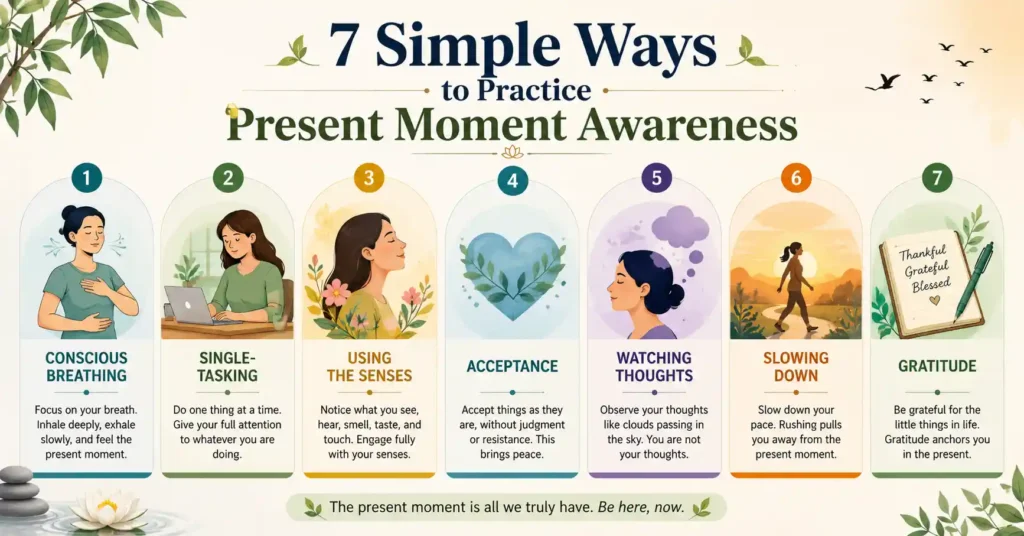
1. Awareness Through Breathing
Across many mindfulness and contemplative traditions, the breath is often seen as a natural anchor to the present. Unlike thoughts that move between the past and future, breathing always takes place in the here and now.
Simply becoming aware of the breath can help people notice when attention has drifted into worry, distraction, or overthinking. This is one reason breathing awareness appears in many practices that encourage mindful living.
2. The Value of Single-Tasking
Modern life often rewards multitasking, yet constantly dividing attention can leave the mind feeling scattered and exhausted.
Giving full attention to one activity at a time, whether eating, walking, or working, allows a person to experience daily life more consciously. This simple shift often strengthens present moment awareness and improves mental clarity.
3. How the Senses Connect Us to Reality
The senses provide a direct connection to the world around us. The warmth of sunlight, the sound of birds, the smell of tea, or the feeling of water on the hands all occur in the present.
Many mindfulness traditions encourage sensory awareness because it helps redirect attention away from constant mental activity and back toward immediate experience.
4. Acceptance and Inner Peace
A significant amount of emotional suffering arises not from events themselves, but from resisting them internally.
Acceptance does not mean approving of every situation or giving up on change. Rather, it involves acknowledging reality as it currently exists. This perspective often reduces inner conflict and creates space for a calmer response.
5. Observing Thoughts Without Attachment
Thoughts naturally arise throughout the day. Spiritual and mindfulness teachings often suggest that well-being improves when thoughts are observed rather than followed automatically.
A common analogy compares thoughts to clouds moving across the sky. The clouds continue to appear and disappear, while the sky itself remains unchanged. This perspective encourages emotional balance and greater self-awareness.
6. The Importance of Slowing Down
Many people move through daily routines so quickly that they rarely notice the experiences themselves.
Simple activities such as drinking tea, folding clothes, washing hands, or opening a door can become opportunities to reconnect with the present. Slowing down occasionally helps transform ordinary moments into experiences of conscious living.
7. Gratitude and Awareness
Gratitude encourages attention toward what is already present rather than what is missing.
Reflecting on a peaceful conversation, a beautiful sunset, or a quiet moment of stillness can deepen appreciation for everyday life. Over time, gratitude supports mindful awareness and helps cultivate a greater sense of inner peace.
A Simple Exercise for Returning to the Present
When the mind becomes overwhelmed by stress, distractions, or overthinking, many mindfulness practices use simple awareness exercises to help restore focus to the present.
One commonly used technique involves briefly shifting attention away from racing thoughts and toward immediate sensory experience. It may include:
- Pause for a moment
- Inhale slowly
- Notice three things you can see
- Notice three sounds around you
- Relax your shoulders
- Feel your feet touching the ground
- Exhale slowly
The purpose of this exercise is not to eliminate thoughts completely. Instead, it helps redirect attention toward what is happening right now rather than becoming absorbed in mental activity.
For people exploring how to live in the present moment, practices like this illustrate an important principle: awareness often begins by noticing simple experiences that are already available in everyday life.
How Presence Strengthens Human Relationships
Many relationships struggle not because love or care is absent, but because genuine attention has become scarce. In a world filled with distractions, people are often physically present while their minds remain occupied elsewhere.
It is common for conversations to take place while checking phones, thinking about work, or mentally preparing the next response. As a result, meaningful connection can become weaker even when people spend time together.
When someone feels truly heard and understood without distraction, they often feel valued, respected, and emotionally supported. This sense of presence creates trust and strengthens human bonds.
Understanding how to live in the present moment is not only beneficial for personal well-being. It can also improve relationships by encouraging deeper listening, greater empathy, and more authentic communication.
Many spiritual traditions emphasize the importance of mindful awareness in human interactions. Being fully present with another person is often seen as an expression of care, compassion, and respect.
Even a few minutes of genuine attention can transform the quality of a conversation. Over time, present moment awareness helps create stronger relationships and more meaningful connections with others.
Living in the Present Moment in Daily Life
Many people assume that present moment awareness is limited to meditation or spiritual practices. However, most spiritual traditions emphasize that awareness is meant to be integrated into everyday life rather than separated from it.
Understanding how to live in the present moment does not require withdrawing from responsibilities or avoiding the challenges of daily living. Instead, it involves bringing greater attention and awareness to ordinary experiences.
Daily activities such as cooking, driving, working, cleaning, or spending time with family can all become opportunities to cultivate mindful living. These moments may appear simple, yet they often provide the most practical opportunities to reconnect with the present.
Awareness also becomes valuable during emotionally challenging situations. When strong emotions arise, taking a moment to notice them before reacting can create greater clarity and self-understanding.
Similarly, during periods of stress, even a brief pause can help interrupt automatic patterns of worry and mental distraction. Such moments remind us that awareness is always available, regardless of external circumstances.
Over time, living in the now can transform the way we experience daily life. Ordinary activities begin to feel more meaningful, relationships become more attentive, and everyday experiences take on a greater sense of presence and inner balance.
Why Present Moment Awareness Is a Gradual Journey
One important aspect of how to live in the present moment is understanding that awareness does not always bring immediate calmness or peace. Many people assume that mindfulness instantly quiets the mind, but the experience is often more gradual.
In the beginning, some individuals become more aware of mental noise rather than less. Thoughts, emotions, worries, and unresolved feelings that were previously running in the background suddenly become easier to notice.
This can feel surprising or even uncomfortable. However, it does not mean that awareness is creating these thoughts. Instead, awareness is simply revealing what was already present beneath the surface.
Many spiritual and mindfulness traditions recognize this as a natural part of personal growth. Greater awareness often begins with seeing the mind more clearly before experiencing deeper calm and balance.
For this reason, present moment awareness should not be viewed as a path to perfection. It is an ongoing process of noticing, understanding, and gently returning attention to the present whenever the mind wanders.
Over time, this patient approach can foster greater self-awareness, emotional resilience, and a deeper sense of inner peace.
Benefits of Living in the Present Moment
Many people search for how to live in the present moment because they are seeking greater peace, clarity, and emotional balance. While awareness does not remove every challenge from life, it can gradually change how we experience those challenges.
Inner peace does not come from controlling every situation or ensuring that life always unfolds as planned. Instead, it often grows from seeing reality more clearly and responding to it with greater awareness.
When people become more present in daily life, they often notice several positive changes:
- The Past gradually loses its emotional grip
- Fear of the Future becomes less overwhelming
- Overthinking begins to decrease
- Emotional Reactions become calmer and more balanced
- Mental Clarity improves
- Daily Life feels lighter and more meaningful
These benefits do not usually appear overnight. Rather, they develop gradually as present moment awareness becomes a more natural part of everyday life.
Over time, many people discover that they are carrying less unnecessary psychological weight. Worries, regrets, and imagined problems no longer dominate attention to the same extent.
As a result, peace becomes less dependent on external circumstances and more rooted in inner awareness, acceptance, and understanding.
Does Living in the Present Mean Ignoring the Future?
One of the most common misconceptions about mindfulness and awareness is that being present means ignoring the future or avoiding responsibilities. In reality, this is not what spiritual traditions or mindfulness practices teach.
Understanding how to live in the present moment does not require abandoning goals, plans, or commitments. Planning for the future remains an important part of life, and responsible action continues to have value.
Living in the present does not mean:
- Ignoring future responsibilities
- Avoiding important decisions
- Giving Up on goals and ambitions
- Refusing to plan ahead
- Escaping from life’s challenges
Instead, it means:
- Goals Can Still Exist
- Responsibilities Can Still Be Fulfilled
- Plans Can Still Be Made
- Actions Become Calmer and More Thoughtful
- Decisions Are Less Driven by Fear and Overthinking
- Awareness Guides Responses Instead of Impulsive Reactions
Many people find that present moment awareness actually supports responsibility rather than reducing it. By paying closer attention to what is happening now, they are often better able to respond thoughtfully instead of reacting impulsively.
In this way, living with awareness is not an escape from life. It is a way of engaging with life more consciously, wisely, and effectively.
Conclusion: The Journey Back to the Present
Learning how to live in the present moment is not about becoming perfectly peaceful every day. The mind will wander, distractions will arise, and challenges will continue to be part of life. What matters is the willingness to return to the present again and again.
Over time, present moment awareness can reduce overthinking, bring greater clarity, and help life feel less rushed and more meaningful. Many spiritual traditions teach that peace is not something we must constantly chase. It often becomes visible when awareness returns to the moment we are already living.
Ultimately, understanding how to live in the present moment is not about escaping life. It is about experiencing life more fully, one moment at a time.
Key Takeaways
- Living in the present moment means giving full attention to what is happening now rather than becoming trapped in the past or future.
- Overthinking, distractions, and constant mental activity are some of the biggest obstacles to present moment awareness.
- The goal is not to stop thoughts, but to avoid becoming completely absorbed in them.
- Awareness helps create mental clarity, emotional balance, and inner peace by bringing attention back to immediate experience.
- Many spiritual traditions teach that reality can only be experienced in the present moment, making awareness an important aspect of conscious living.
- Present moment awareness strengthens relationships by improving listening, empathy, and genuine human connection.
- Living in the present does not mean ignoring the future. Goals, plans, and responsibilities can still exist while being approached with greater clarity and less fear.
- Small moments of awareness practiced consistently can gradually transform the way we experience daily life.
- Inner peace becomes more stable when it is rooted in awareness rather than external circumstances.
- Learning how to live in the present moment is a lifelong journey, not a destination that must be achieved perfectly.
Suggested Reading
If this reflection resonated with you, these articles on thesanatantales.com may also help you explore inner peace, mindfulness, silence, and spiritual balance more deeply.
The Power of Letting Go in Sanatan Dharma
https://thesanatantales.com/the-power-of-letting-go-in-sanatan-dharma/
Why Overthinking Never Stops (A Quite way to Calm your Mind)
https://thesanatantales.com/why-silence-feels-uncomfortable/
Spiritual Awakening and Loneliness: Why Inner Change Feels Isolating
https://thesanatantales.com/spiritual-awakening-and-loneliness/
Digital Noise and the Lost Peace Within
https://thesanatantales.com/digital-noise-and-inner-peace/
Fear of Failure and the Pressure to Figure Life out Early
https://thesanatantales.com/inner-emptiness-in-modern-life/
Why Does the Mind Feel Restless even after Prayer?
https://thesanatantales.com/why-mind-feels-restless-after-prayer/
Home Mandir Setup: A Simple Guide to Create a Peaceful Sacred Space
https://thesanatantales.com/home-mandir-setup-guide/
FAQs
How to Live in the Present Moment?
Living in the present moment means bringing your awareness to what is happening right now instead of becoming completely absorbed in memories of the past or worries about the future.
It does not mean stopping all thoughts or ignoring responsibilities. Rather, it involves experiencing life with greater attention, clarity, and awareness.
Many spiritual traditions describe this as being fully engaged with the reality of the current moment instead of constantly living inside mental stories.
Why is it so difficult to live in the present moment?
Modern life constantly competes for our attention. Smartphones, social media, work pressures, and endless information often keep the mind occupied throughout the day.
At the same time, the mind naturally revisits past experiences and imagines future possibilities. This tendency can make it difficult to stay connected to what is happening right now.
As a result, many people spend more time thinking about life than actually experiencing it.
How does living in the present moment reduce stress?
Stress often increases when the mind repeatedly focuses on future uncertainties or replays painful events from the past.
Present moment awareness helps redirect attention toward what is actually happening now rather than imagined scenarios and mental projections.
While awareness may not remove every challenge, it can reduce unnecessary mental tension and create a greater sense of calm and balance.
Is living in the present moment the same as mindfulness?
The two concepts are closely related but not always identical.
Mindfulness is generally described as the practice of paying attention with awareness and without judgment. Living in the present moment is one of the natural outcomes of that awareness.
In simple terms, mindfulness is the approach, while present moment awareness is often the experience that develops through it.
Does living in the present mean ignoring the future?
No. This is one of the most common misunderstandings about present moment awareness.
Goals can still exist. Responsibilities can still be fulfilled. Plans can still be made.
The difference is that decisions become less driven by fear, anxiety, and overthinking. Instead of constantly worrying about the future, a person learns to respond to life with greater clarity and awareness.
Can present moment awareness improve relationships?
Yes. Many relationship difficulties arise not because affection is missing, but because attention is missing.
When people listen while distracted by phones, work concerns, or internal thoughts, genuine connection becomes more difficult.
Being fully present during conversations often improves understanding, trust, empathy, and emotional connection. Even a few minutes of undivided attention can strengthen relationships.
What are the signs that I am not fully present?
Some common signs include:
- Constantly replaying past conversations
- Frequent overthinking
- Worrying excessively about the future
- Feeling mentally exhausted without a clear reason
- Difficulty enjoying simple moments
- Reaching for your phone during quiet periods
- Feeling restless even when there is nothing urgent to do
Recognizing these patterns is often the first step toward greater awareness.
Can Anyone Learn How to Live in the Present Moment?
Yes. Present moment awareness is not limited to monks, spiritual teachers, or experienced meditators.
It is a natural human capacity that can be developed over time. Small moments of awareness throughout daily life gradually strengthen the ability to remain present.
Like any skill, it grows through understanding, observation, and consistent practice.
What is the spiritual significance of living in the present moment?
Many spiritual traditions teach that reality can only be experienced in the present.
The past exists as memory, while the future exists as possibility. Awareness allows a person to experience life directly instead of being constantly pulled into thoughts about what has already happened or what might happen next.
For this reason, awareness, mindfulness, meditation, and conscious living are often considered important aspects of spiritual growth.
What are the benefits of living in the present moment?
Over time, present moment awareness may help:
- Reduce overthinking
- Improve mental clarity
- Create emotional balance
- Strengthen relationships
- Increase appreciation for everyday life
- Reduce unnecessary psychological stress
- Cultivate greater inner peace
While these changes may develop gradually, many people find that life feels less rushed, less heavy, and more meaningful when they become more present in their daily experiences.
Glossary of Important Terms
| Term | Definition |
|---|---|
| Awareness | The ability to notice thoughts, emotions, sensations, and experiences without becoming completely absorbed in them. It forms the foundation of how to live in the present moment. |
| Present Moment | The reality that is unfolding right now. Understanding the present moment is central to learning how to live in the present moment. |
| Present Moment Awareness | The practice of paying attention to current experiences instead of becoming lost in memories of the past or worries about the future. |
| Mindfulness | The practice of observing thoughts, emotions, and experiences with awareness and without judgment. It is one of the most recognized approaches to how to live in the present moment. |
| Living in the Now | Focusing attention on the current experience rather than dwelling on the past or anticipating the future. |
| Conscious Living | Living with greater awareness, intention, and attention in everyday actions, decisions, and relationships. |
| Overthinking | The habit of repeatedly analyzing situations, replaying past events, or imagining future problems. It is a major obstacle to how to live in the present moment. |
| Mental Clarity | A state of focus and clear thinking that arises when the mind is less distracted by unnecessary worries and mental noise. |
| Acceptance | Acknowledging reality as it is without unnecessary resistance. Acceptance helps reduce inner conflict and emotional suffering. |
| Inner Peace | A state of calmness, balance, and contentment that is not entirely dependent on external circumstances. Many people explore how to live in the present moment to cultivate inner peace. |
| Self-Awareness | The ability to recognize and understand one’s thoughts, emotions, habits, and behaviors. |
| Mindful Living | Applying awareness to everyday activities such as eating, walking, working, and communicating. It is a practical expression of how to live in the present moment. |
| Emotional Balance | The ability to experience emotions without becoming overwhelmed or controlled by them. |
| Gratitude | The practice of appreciating what is already present in life rather than focusing only on what is missing. |
| Meditation | A practice that trains attention and awareness. Meditation can support how to live in the present moment, but awareness can also be cultivated through daily life. |
| Mind-Body Connection | The relationship between mental states and physical sensations. Stress affects the body, while body awareness can help restore presence. |
| Conscious Breathing | Paying attention to the natural flow of the breath. It is one of the simplest ways to reconnect with the present moment. |
| Presence | The state of being fully engaged with the current experience rather than being distracted by thoughts of the past or future. |
| Psychological Weight | The mental burden created by regrets, fears, worries, and unresolved thoughts. Learning how to live in the present moment can help reduce this burden over time. |
About the Author
Yateendra Chaturvedi is a spiritual writer, researcher, devotee, and the founder of The Sanatan Tales. With over 35 years of professional experience and a lifelong interest in Sanatan Dharma, he writes about Hindu deities, temples, scriptures, festivals, Mahavidyas, sacred stories, rituals, and living traditions that continue to guide and inspire devotees across India.
Drawing from traditional scriptures, regional beliefs, temple traditions, devotional literature, and historical sources, he aims to present authentic, well-researched, and easy-to-understand content for modern readers. His work focuses on preserving spiritual wisdom, explaining sacred traditions, and helping seekers develop a deeper understanding of India’s rich spiritual heritage.
Through The Sanatan Tales, Yateendra strives to make the timeless teachings of Sanatan Dharma simple, meaningful, and relevant for today’s generation while maintaining respect for traditional sources, regional practices, and diverse spiritual perspectives.
Learn More About Yateendra Chaturvedi →
https://thesanatantales.com/about-the-author/
References & Sources
This article is based on widely accepted teachings related to mindfulness, present moment awareness, conscious living, and inner well-being. It draws upon insights found in Sanatan Dharma, yogic traditions, meditation practices, spiritual philosophy, and contemporary understanding of mindfulness and mental wellness.
The content also reflects perspectives preserved through traditional wisdom, spiritual communities, personal reflection, and teachings that emphasize awareness, self-understanding, inner balance, and mindful living. These ideas have been explored across cultures and traditions as ways to cultivate greater clarity, peace, and emotional well-being.
Note: Approaches to mindfulness, awareness, meditation, and spiritual growth may vary across different traditions, philosophies, and individual paths. The purpose of this article is not to present any single viewpoint as the only truth, but to offer commonly accepted insights in a simple, practical, and reader-friendly manner. Readers are encouraged to explore these ideas through personal experience, reflection, and their own spiritual or philosophical understanding.
Explore More Fascinating Topics from Sanatan Dharma




Very Nice and relevant to practice
Thank you