
Have you ever felt that everyone else is moving ahead while you are still trying to figure out your future? Social media, career expectations, and constant comparisons can make it seem as if life is a race and you are already falling behind. This pressure often creates a deep fear of failure, making even small decisions feel overwhelming.
Many people believe they must discover their life purpose early, choose the perfect career, and achieve success on a fixed timeline. When life does not go according to plan, self-doubt, career anxiety, and uncertainty about the future can begin to take over. The fear of failure then becomes less about failing and more about feeling lost, judged, or left behind.
Sanatan Dharma offers a different perspective. Through the teachings of the Bhagavad Gita, Swadharma, and Karma Yoga, it reminds us that every person has a unique path and that true success is not measured by comparison. Your journey unfolds according to your nature, efforts, and life lessons.
In this article, you will learn why the fear of failure affects so many people today, how comparison creates unnecessary pressure, what Sanatan wisdom teaches about purpose and life direction, and how to move forward with greater clarity, confidence, and inner peace.
Whether you are struggling with self-doubt, searching for meaning, or trying to find your place in the world, these timeless teachings can help you trust your own path.
Fear of Failure at a Glance
| Aspect | Quick Insight |
|---|---|
| Topic | Fear of Failure and the Pressure to Figure Life Out Early |
| Focus Keyword | Fear of Failure |
| Main Challenge | Anxiety about making mistakes, choosing the wrong path, or falling behind in life |
| Common Causes | Social comparison, self-doubt, fear of judgment, career pressure, uncertainty about the future |
| Who Is Most Affected? | Students, young professionals, job seekers, entrepreneurs, and anyone facing major life decisions |
| Key Emotion | Fear of being unsuccessful, rejected, or judged by others |
| Sanatan Concept | Swadharma (following one’s own path) |
| Bhagavad Gita Teaching | Focus on action, not attachment to results (Bhagavad Gita 2.47) |
| Important Lesson from Arjuna | Doubt and uncertainty are natural; clarity develops through wisdom and action |
| Role of Karma Yoga | Encourages sincere effort without becoming trapped by fear of outcomes |
| Biggest Mistake | Comparing your timeline and achievements with others |
| What Failure Really Is | A temporary experience, not a permanent identity |
| What Success Really Means | Growth, learning, character, purpose, Dharma, and inner peace |
| Practical Solution | Focus on the next meaningful step instead of trying to solve your entire future at once |
| Core Message | You do not need to have everything figured out today to move forward in life |
| Key Takeaway | Trust your journey, follow your Swadharma, and keep moving forward with patience and sincerity |

Table of Contents
ToggleWhy Fear of Failure Feels Stronger in Today's World
The fear of failure is not a new struggle. People have worried about uncertainty, mistakes, and setbacks throughout history. What feels different today is the environment in which we live.
A few decades ago, people compared themselves with a small circle of relatives, friends, or neighbours. Today, comparison follows us almost everywhere through social media, news feeds, and constant online updates.
Within minutes, we can see someone getting promoted, starting a business, travelling the world, buying a home, or celebrating a major milestone. While these achievements can be inspiring, they can also create unrealistic expectations about how life should unfold.
The problem is that we usually see only the highlights of other people’s journeys. We rarely see the failures, disappointments, and years of effort that came before those achievements. This can create the illusion that everyone else has life figured out while we are still trying to find our way.
Many young adults feel pressure to choose the right career, discover their life purpose, earn a stable income, and make the right decisions at every stage of life. When reality unfolds differently, it can lead to self-doubt, career anxiety, and a growing feeling of falling behind.
The truth is that most people are still discovering their own life direction. Some simply hide their uncertainty better than others. Life is rarely as clear or predictable as it appears from the outside.
Sanatan wisdom reminds us that every individual follows a unique path. Comparing your journey with someone else’s can distract you from your own growth, learning, and finding purpose in life.
What matters is not how quickly you move, but whether you are moving in the direction that is right for you. True progress comes from staying committed to your own journey rather than measuring it against someone else’s timeline.
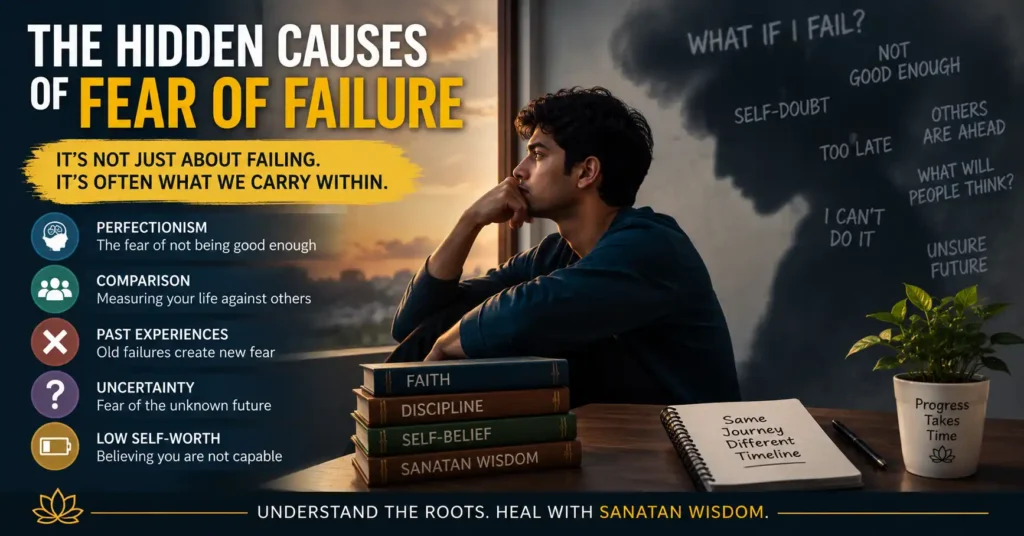
The Real Reason Fear of Failure Hurts So Much
When people struggle with the fear of failure, they are often dealing with something deeper than the possibility of making a mistake. Most people are not afraid of failure itself. They are afraid of being judged, rejected, criticised, or seen as unsuccessful by others.
A student may fear disappointing their family. A professional may worry about losing respect at work, while someone starting a business may fear what others will think if things do not go as planned. The fear often comes from how failure might affect their identity and self-image.
Over time, many people begin connecting their self-worth to their achievements. Success feels like proof that they are doing well in life, while setbacks feel like proof that they are not. This is where much of the unnecessary suffering begins.
There is a big difference between saying, “I failed at something” and “I am a failure.” One describes an experience, while the other turns a temporary setback into a permanent identity.
Sanatan Dharma teaches that our true worth does not come from achievements, status, or recognition. Every person possesses an inner Self that remains unchanged by success or failure, praise or criticism.
A failed exam, a rejected application, or a difficult phase in life does not define who we are. These are experiences we move through, not permanent labels that determine our value or future.
When we stop treating setbacks as personal verdicts, we create space for learning, resilience, and personal growth. Instead of asking, “What does this failure say about me?” we can ask, “What can this experience teach me?”
That simple shift in perspective can reduce self-doubt, strengthen inner confidence, and help us move forward with greater clarity and purpose.
Are You Looking for a Career or a Calling?
One reason many young adults feel lost today is because they believe they should already know exactly what they want to do with their lives. The world often sends a message that by a certain age everything should be planned. Your career should be clear, your goals should be defined, and your future should already be taking shape.
A career and a calling are not always the same thing. A career is the work we do to earn a living, while a calling is often connected to our values, strengths, interests, and the contribution we feel drawn to make. Understanding this difference can help reduce a lot of unnecessary pressure.
Some people discover both early in life. Others spend years exploring different directions before finding work that feels meaningful and fulfilling. Neither journey is wrong, and neither path makes a person more successful than the other.
Many people mistake uncertainty for failure. In reality, uncertainty is often a natural part of self-discovery and personal growth. It does not mean you are lost. It may simply mean you are still learning about yourself, your strengths, and your life purpose.
This is especially important in a world where social media makes it seem as if everyone else already has a clear plan. Comparing your journey with theirs can create unnecessary pressure and career anxiety, even when you are making steady progress in your own life.
Sanatan Dharma offers a more patient perspective. It teaches that every person has a unique nature, unique abilities, and a unique path in life. What is right for one individual may not be right for another, and trying to follow someone else’s path can often create more confusion than clarity.
Purpose is rarely discovered through endless thinking alone. More often, it reveals itself through experience, effort, and learning from life’s challenges. We grow by trying new things, making mistakes, changing direction when needed, and gaining wisdom from each stage of the journey.
Sometimes the next step becomes clear only after we take the current one. Progress often comes from movement, not certainty. When we stop demanding all the answers at once, we give ourselves the freedom to grow into the person we are meant to become.
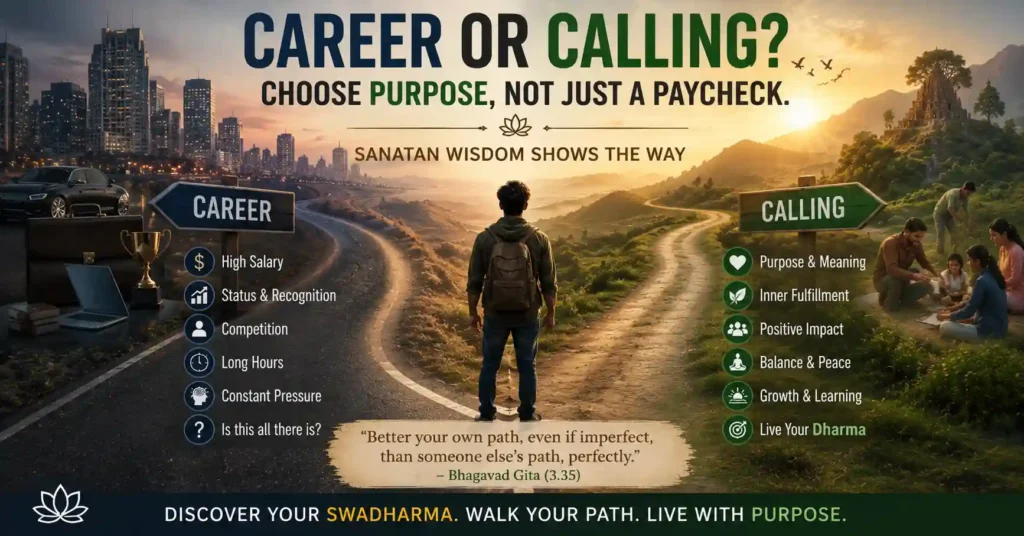
What If You Choose the Wrong Path?
This is one of the biggest fears many young adults carry today. What if I spend years preparing for something and later realise it was not right for me? What if I choose the wrong degree, profession, or career path?
These questions feel overwhelming because major life decisions often seem permanent when we are young. We worry that one wrong decision could affect the rest of our lives.
But life is usually far more flexible than we imagine. If you look closely at the journeys of successful people, very few followed a perfectly straight road. Many changed careers, discovered new interests, or found their purpose later than expected.
What seemed like a wrong turn at one stage often became a valuable lesson later. A difficult job may teach resilience, while a setback may reveal strengths we never knew we had.
Much of the anxiety around career decisions comes from believing that one wrong choice can ruin the future. In reality, growth often comes through experience, learning, and course correction rather than perfect planning.
Life works more like a river than a straight road. It bends, slows down, changes direction, and still finds a way forward. Looking back, many people realise that the twists and turns they once feared became some of the most meaningful parts of their journey.
Instead of asking, “What if I choose the wrong career?” a more helpful question is, “What can I learn from the path I am currently walking?” That shift in thinking creates growth, confidence, and a healthier life direction instead of fear.
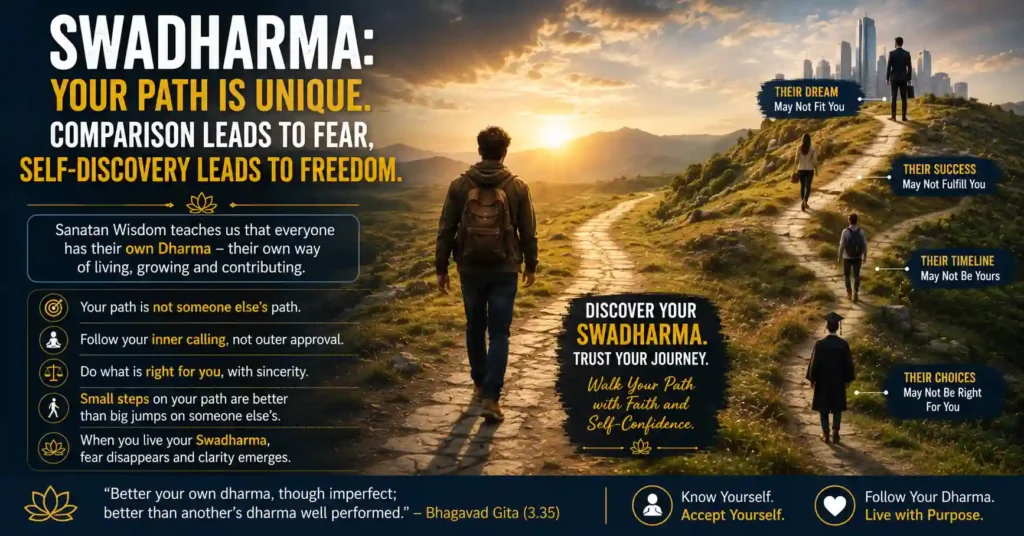
What Swadharma Teaches About Finding Your Own Path
One of the most comforting teachings in Sanatan Dharma is the idea of Swadharma. In simple words, Swadharma means your own path. It is the way of living that is aligned with your nature, strengths, responsibilities, and inner calling.
Many of us spend years looking at other people’s lives and wondering whether we should be doing what they are doing. If someone becomes successful at a young age, we begin questioning our own progress. If a certain career becomes popular, thousands feel pressured to follow the same direction.
Yet life is not meant to be copied. What works for one person may not work for another because each individual has different abilities, experiences, and lessons to learn.
A mango tree and a banyan tree do not grow in the same way. One bears fruit sooner, while the other takes longer to spread its roots and branches. Neither is wrong. Both are simply following their own nature.
Human lives are much the same. Some people discover their purpose early, while others take longer to understand where they truly belong. Some learn through success, while others grow through challenges and unexpected turns.
This is why constant comparison creates suffering. We stop listening to our own journey and start chasing somebody else’s timeline. In the process, we lose sight of our own strengths and opportunities for growth.
Swadharma gently reminds us that our responsibility is not to become someone else. Our responsibility is to discover who we are and walk our path with honesty, patience, and trust.
When we focus on our own journey instead of comparing it with others, we develop greater confidence, clarity, and inner peace. That is often where real life purpose and meaningful life direction begin to emerge.
Did You Know?
According to the Bhagavad Gita (3.35), Lord Krishna teaches that it is better to follow your own path imperfectly than to follow someone else’s path perfectly.
This timeless teaching reminds us that true fulfillment comes from living according to our Swadharma, not from comparing our journey with others or meeting society’s expectations.
What Arjuna's Doubt Can Teach Us Today
Many people think uncertainty is a modern problem. It is easy to imagine that people in earlier times were more confident and certain about their future. The Mahabharata tells a very different story.
Just before the battle of Kurukshetra, Arjuna stood on the battlefield filled with confusion and doubt. He was one of the greatest warriors of his age, yet he questioned his decisions, responsibilities, and the path that had brought him there.
In many ways, Arjuna’s struggle feels surprisingly familiar. The fear of failure often grows when we demand complete certainty before taking action. Like Arjuna, we want to know that our choices will lead to the right outcome before we move forward.
Today, the battlefield may not be Kurukshetra. It may be a career choice, a business decision, a competitive examination, or a major life transition. Yet the emotions are often the same. We worry about making the wrong decision and hesitate because we cannot see the entire road ahead.
What makes Arjuna’s story so comforting is that it reminds us that doubt is not a sign of weakness. Even a great warrior experienced confusion, fear, and uncertainty before taking an important step.
The important question is not whether doubt appears. The important question is how we respond when it does. Arjuna did not run away from his questions. He sought wisdom, listened carefully, reflected deeply, and remained open to guidance.
Through the teachings of the Bhagavad Gita, Krishna helped Arjuna understand his duty and see beyond his fears. His confusion did not disappear instantly, but clarity gradually emerged through wisdom and right action.
Many of us want certainty before taking the next step. Arjuna’s story teaches something different. Clarity often comes while walking the path, not before it. Sometimes the courage to move forward is what allows the next stage of our journey to reveal itself.
What the Bhagavad Gita Teaches About Success and Failure
The conversation between Arjuna and Lord Krishna became the Bhagavad Gita, one of the most profound spiritual texts in the world. Even today, its teachings speak directly to people struggling with fear, uncertainty, self-doubt, and the pressure to succeed.
One of the most well-known verses appears in Bhagavad Gita 2.47:
“Karmanye Vadhikaraste Ma Phaleshu Kadachana.”
In simple words, Krishna reminds Arjuna that he has control over his actions, but not over every result. While we can choose our effort, attitude, and commitment, the outcome is influenced by many factors beyond our control.
This teaching does not ask us to stop caring about results. Instead, it reminds us not to become trapped by them. Many people spend so much time worrying about what might happen tomorrow that they struggle to take meaningful action today.
The fear of failure often grows when we become overly attached to outcomes. We want guarantees before making a decision, starting a new project, changing careers, or pursuing a dream. Life rarely offers such guarantees.
The Gita encourages a different approach. Focus on your effort. Focus on your Dharma. Do what is right and meaningful today, and allow tomorrow to unfold in its own time.
Another powerful teaching appears in Bhagavad Gita 3.35:
“Shreyan Swadharmo Vigunah Paradharmat Swanushthitat.”
This verse teaches that it is better to follow your own path imperfectly than to follow someone else’s path perfectly. In a world filled with comparison and external pressure, this teaching remains deeply relevant.
Many people experience career anxiety because they feel compelled to follow paths chosen by society, family expectations, or popular trends. The Bhagavad Gita reminds us that lasting fulfilment comes from living in alignment with our own nature and responsibilities.
For anyone struggling with comparison, this teaching can be liberating. The world encourages us to compare ourselves with others, but the Gita encourages us to understand ourselves.
Your journey was never meant to look exactly like somebody else’s. True success comes not from copying another person’s path, but from walking your own path with sincerity, courage, and patience.

How Karma Yoga Helps Reduce the Fear of Failure
The teaching of focusing on action rather than becoming obsessed with results forms the foundation of Karma Yoga. One of the reasons this teaching remains so powerful is that it directly addresses the anxiety and uncertainty that many people experience in daily life.
Karma Yoga does not mean becoming careless about outcomes. It means giving your best effort while understanding that not everything is within your control. We are responsible for our actions, but we cannot control every result that follows.
Think about a farmer planting seeds. They prepare the soil, water the plants, and care for them with patience. Yet they cannot force the crop to grow overnight or control every aspect of the weather.
Life works in a similar way. We can control our effort, attitude, preparation, and sincerity. We cannot control every opportunity, circumstance, or outcome that appears along the way.
The fear of failure often becomes overwhelming when our happiness depends entirely on achieving a particular result. We begin believing that one success will prove our worth or that one setback will define our future.
Karma Yoga encourages a healthier mindset. Instead of measuring ourselves only by outcomes, it teaches us to value sincere effort, continuous learning, and steady progress.
This shift does not remove ambition. Rather, it helps us pursue our goals with greater balance and inner peace. We continue working toward success, but we are no longer paralysed by the possibility of failure.
That is why Karma Yoga remains deeply relevant today. It teaches us how to move forward with courage, do our best in the present moment, and trust that every sincere effort contributes to our growth and life direction.
Why Your Worth Is Greater Than Your Achievements
One of the most painful beliefs many people carry is the idea that their worth depends on their achievements. When things go well, they feel confident and valuable. When things go badly, they begin questioning themselves.
Slowly, success and failure stop being experiences and start becoming measures of self-worth. This can make every setback feel much bigger than it really is.
Modern life encourages this mindset more than we realise. People are often judged by their qualifications, income, profession, or achievements. While these things have their place, they do not define the whole person.
You are more than a degree. You are more than a job title. You are more than a salary, and you are certainly more than a single success or failure.
This is an important truth to remember when facing the fear of failure and the pressure to figure life out early. Your value as a person does not rise and fall with every result that life brings.
Sanatan Dharma teaches that our true identity is deeper than external achievements. The Self within us remains unchanged by praise or criticism, success or failure, gain or loss.
Failure is a chapter of life, not the title of your story. A setback may change your plans, but it does not reduce your worth or determine your future.
In fact, many people later realise that the experiences they once called failures taught them some of life’s most important lessons. Difficult moments often reveal strengths, resilience, and wisdom that success alone cannot provide.
Growth often happens quietly. Wisdom often develops through challenges. Character is often shaped during uncertain seasons when we are learning to move forward despite not having all the answers.
When we understand this, failure begins to lose some of its power over us. We stop seeing setbacks as proof that we are not enough and start seeing them as part of the journey toward greater growth, purpose, and inner strength.
Common Misconceptions About Success and Failure
Many people carry hidden beliefs about success and failure that increase stress, self-doubt, and anxiety about the future. These assumptions often feel true, but they rarely reflect how life actually works.
1. You Must Find Your Purpose Early
One of the biggest misconceptions is that everyone should discover their purpose at a young age. This belief creates unnecessary pressure and makes people feel behind if they are still exploring different paths.
In reality, many people discover meaningful work, deeper purpose, and lasting fulfillment much later in life. Purpose often unfolds gradually through experience, learning, and personal growth rather than appearing all at once.
2. One Wrong Decision Can Ruin Your Life
Many people believe that choosing the wrong degree, career, or opportunity will permanently damage their future. This fear can make even simple decisions feel overwhelming.
Life is usually far more flexible than we imagine. Most successful people make mistakes, change direction, and adapt as they learn more about themselves and the world around them. A setback or wrong turn often becomes a valuable lesson rather than a permanent failure.
3. Successful People Never Fail
When we see successful people, we often focus only on their achievements. We rarely see the setbacks, disappointments, and years of effort that came before their success.
Almost every successful person has experienced rejection, uncertainty, and failure at some point. What often separates them is not the absence of failure, but their willingness to learn from it and keep moving forward.
4. Everyone Else Has Life Figured Out
Social media and public success stories can create the impression that everyone else knows exactly what they are doing. This illusion often makes people question their own progress and life direction.
The truth is that most people are still learning, growing, and adapting as life unfolds. Some simply hide their uncertainty better than others. Feeling unsure about the future does not mean you are failing. It means you are human.
5. Failure Means You Are Not Good Enough
Perhaps the most damaging misconception is the belief that failure determines a person’s value. Many people treat setbacks as proof that they are not capable, intelligent, or worthy of success.
Sanatan Dharma teaches a different perspective. Failure is an experience, not an identity. A difficult outcome may teach an important lesson, but it does not define who you are. Your worth is far greater than any single result.

Learning to Trust the Journey
One of the deepest reasons people feel anxious about the future is because they want certainty. They want to know that the path they are choosing is the right one and that their efforts will eventually lead somewhere meaningful.
These desires are completely understandable. Every human being seeks some level of security and reassurance about what lies ahead. The challenge is that life rarely reveals the entire journey at once.
Most of us can only see a few steps ahead. A student does not know exactly where education will lead, and a young professional cannot predict every opportunity that may appear in the future.
Someone beginning a new chapter in life has no way of knowing every lesson, challenge, or blessing waiting around the corner. Growth happens through experience, and understanding develops gradually over time.
This is where trust becomes important. Trust does not mean becoming passive or giving up responsibility. It means continuing to move forward even when the entire picture is not yet visible.
Sanatan Dharma reminds us that life unfolds according to a larger rhythm than our personal timelines. Some lessons require time, some opportunities arrive later than expected, and some answers appear only after we have gained the wisdom to understand them.
Many people who struggle with the fear of failure later discover that they were simply growing in ways they could not yet see. What felt like uncertainty was often preparation for the next stage of their journey.
Sometimes what feels like a delay is preparation. Sometimes what feels like confusion is transformation. And sometimes the path that seems uncertain today becomes the very path that leads us where we were meant to go.
Life Does Not Always Follow the Plan We Create
Almost everyone carries a picture in their mind of how life should unfold. We imagine completing our education, finding the right career, becoming financially stable, and gradually building the life we want. When reality follows a different path, disappointment naturally follows.
Yet if we look closely at the lives of people around us, very few journeys unfold exactly as planned. Someone prepares for one career and later discovers a completely different passion. Someone spends years chasing a goal only to realise that life is guiding them in a new direction.
Others face setbacks that feel devastating at the time but later become the reason they found a better opportunity. What initially appears to be a failure may eventually become an important turning point.
Life has a way of surprising us. Not every unexpected change is a setback, and not every closed door is a sign that we are moving in the wrong direction.
This does not mean every disappointment hides an immediate blessing. It simply means that the meaning of an experience is not always visible when we are living through it. Some lessons become clear only with time and reflection.
Sanatan wisdom encourages patience during these uncertain periods. It reminds us that growth does not always happen according to our preferred timeline. Sometimes life is preparing us for something we cannot yet see.
Many people who struggle with the fear of failure later realise that the path they resisted taught them some of their most valuable lessons. Experiences that once felt like obstacles often become stepping stones to greater clarity and maturity.
What feels like a wrong turn today may eventually become an important part of the road ahead. Sometimes life makes sense not when we look forward, but when we look back.
A Real-Life Example of How Setbacks Can Shape Our Journey
Imagine a young graduate preparing for a highly competitive examination. For several years, they study with dedication, sacrifice weekends, and work toward a single goal. Then the results arrive, and things do not go as expected.
At first, it feels like failure. Questions begin to surface. Was all that effort wasted? Did I make the wrong choice? Have I fallen behind everyone else?
These thoughts are completely natural. When we invest years of effort into something, it is difficult not to feel disappointed when the outcome is different from what we hoped for.
Yet many people later discover that what seemed like an ending was actually the beginning of something else. Some find a career that suits their abilities better, while others discover opportunities they would never have considered otherwise.
Many also gain valuable qualities along the way, such as discipline, patience, resilience, and self-confidence. These strengths often prove useful long after the original goal has changed.
The lesson is not that every setback immediately turns into success. The lesson is that life often reveals its meaning slowly. We rarely understand the purpose of a difficult chapter while we are living through it.
When viewed through the lens of Sanatan wisdom, every experience has something to teach us. Some lessons come through achievement, while others come through challenges and unexpected changes.
What feels like a setback today may eventually become a turning point that guides us toward greater clarity, growth, and life direction. Sometimes the story is still unfolding, and we simply have not reached the chapter where everything begins to make sense.
Practical Ways to Overcome the Fear of Failure
When people feel overwhelmed by uncertainty, they often search for one big solution that will fix everything. In reality, growth usually begins with small and simple steps taken consistently over time.
The first step is to stop trying to solve your entire future in one day. Most of us only need to focus on the next meaningful step. Life becomes much lighter when we stop carrying the weight of the next ten years on our shoulders.
It also helps to reduce comparison. Every person’s journey unfolds under different circumstances, with different challenges and opportunities. Comparing your path with someone else’s rarely creates clarity. More often, it creates unnecessary pressure and self-doubt.
Another helpful practice is changing the way you speak to yourself. Instead of saying, “I am failing,” try saying, “I am learning.” That small shift in language can create a very different inner experience and encourage a healthier mindset.
It is equally important to be patient with your progress. Finding your life purpose and building a meaningful future rarely happens overnight. Most worthwhile goals require time, effort, and persistence.
Most importantly, keep moving forward. Clarity often comes through action rather than endless thinking. Waiting for complete certainty can leave us standing in the same place for years.
Small steps may seem insignificant at first, but they gradually reveal the path ahead. Over time, those small actions build confidence, reduce the fear of failure, and help create a stronger sense of direction and purpose.
Redefining Success Through the Lens of Sanatan Dharma
One reason the fear of failure and the pressure to figure life out early feel so powerful is because many people inherit their definition of success from the world around them. Without realising it, they begin measuring their worth through the standards set by society.
Success is often defined by income, status, recognition, achievements, or social approval. While these things have their place, they are not the only measures of a meaningful and fulfilling life.
Sanatan Dharma encourages a broader perspective. It reminds us that a successful life is not judged only by what we achieve, but also by who we become along the way.
A meaningful life may include living according to Dharma, developing wisdom, serving others, growing in compassion, maintaining integrity, and finding inner peace. These qualities may not always be visible to the world, but they are deeply valuable.
Someone may earn less money than their peers and still live a purposeful and contented life. Another person may achieve great professional success and yet feel restless, dissatisfied, or disconnected from their true self.
This is why it is important to pause and ask a simple question:
“What does success truly mean to me?”
The answer may be very different from what society expects. It may be connected to your values, your relationships, your contribution to others, or the kind of person you want to become.
When success is defined only by external achievements, failure feels terrifying. But when success also includes growth, learning, character, and inner peace, setbacks become easier to understand and navigate.
Life gradually becomes less about proving yourself to others and more about becoming the person you are meant to be. That shift can bring a deeper sense of purpose, freedom, and fulfillment.
A Final Thought for Anyone Feeling Lost
If you are reading this while feeling lost, confused, or uncertain about the future, there is something important to remember. You do not need to have everything figured out right now, and you do not need to know exactly where the next ten years will lead.
You also do not need to compare your timeline with somebody else’s. Every person’s journey unfolds differently, and every path comes with its own lessons, challenges, and opportunities for growth.
Many people who seem confident today once felt exactly the way you do now. Many successful people spent years questioning themselves, and many wise people walked through periods of confusion before finding clarity and direction.
If you are carrying a deep fear of failure, remember that uncertainty is often part of growth rather than proof that something is wrong. Not knowing all the answers does not mean you are falling behind.
Life is not asking you to know everything. It is simply asking you to take the next honest step and keep moving forward with sincerity and courage.
Some days that step may feel small. Some days it may feel uncertain. That is perfectly okay because meaningful progress is often built through small actions repeated over time.
Growth is rarely dramatic. Most of the time, it happens quietly through daily effort, patience, experience, and trust in the journey. One day, you may look back and realise that the path you once doubted was helping you become exactly who you needed to be.
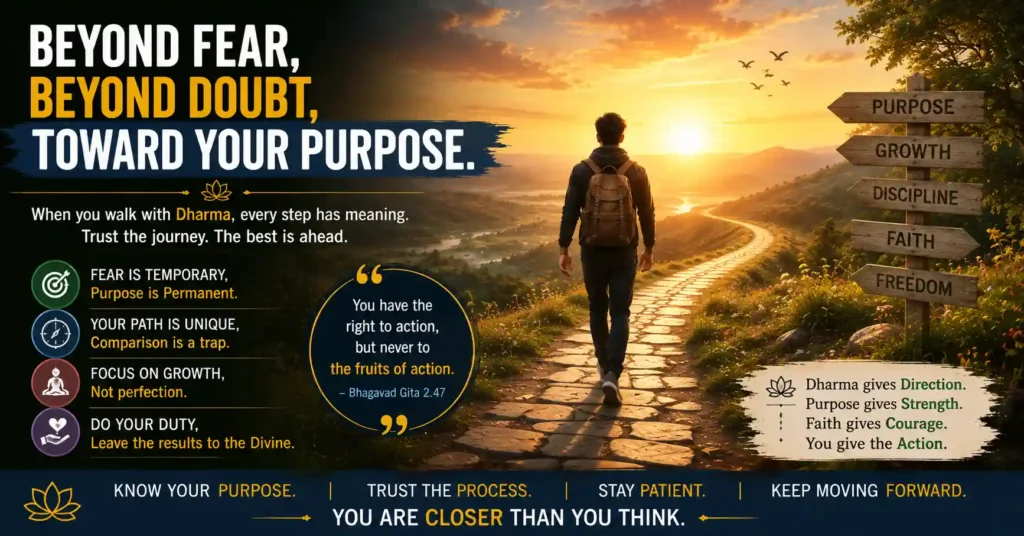
Key Takeaways
- The fear of failure often comes from fear of judgment, rejection, or self-doubt rather than failure itself.
- Social comparison can create unnecessary pressure and make us feel as though we are falling behind in life.
- A career and a calling are not always the same. Purpose often unfolds gradually through experience and growth.
- Sanatan Dharma teaches that every person has a unique path, known as Swadharma.
- Arjuna’s doubts in the Mahabharata remind us that uncertainty is a natural part of every meaningful journey.
- The Bhagavad Gita encourages us to focus on effort and right action rather than becoming attached to results.
- Karma Yoga teaches that sincere effort matters more than complete control over outcomes.
- Success and failure are experiences, not measures of a person’s worth.
- Growth, wisdom, resilience, and inner peace often develop through life’s challenges and setbacks.
- You do not need to have your entire future figured out today. Focus on the next meaningful step and trust the journey.
Conclusion
The fear of failure and the pressure to figure life out early have become common struggles in today’s fast-moving world. Surrounded by comparison, expectations, and constant messages about success, it is easy to feel as though everyone else is moving ahead while we remain uncertain.
Sanatan Dharma offers a calmer and wiser perspective. Through the teachings of Swadharma, the guidance of the Bhagavad Gita, and the example of Arjuna’s own doubts, we are reminded that uncertainty is not a sign of weakness. It is often a natural part of growth and self-discovery.
Life is not meant to unfold according to somebody else’s timeline. Every person carries a unique path, unique lessons, and a unique purpose. Our responsibility is not to control every outcome, but to walk our path with sincerity, patience, and trust.
Failure does not define your worth. Confusion does not mean you are lost. And not having everything figured out today does not mean you are behind in life.
Suggested Reading
If the fear of failure has made you question your path, compare yourself with others, or feel uncertain about the future, remember that personal growth is a journey. The fear of failure often becomes lighter when we develop inner discipline, understand our purpose, and learn to trust the lessons life is teaching us.
These articles can help you deepen your understanding, build confidence, and navigate the fear of failure with greater clarity and peace.
Daily Devotional Practices: How Small Acts Build Inner Discipline and Faith
https://thesanatantales.com/daily-devotional-practices/
Ambition and Peace: How to Balance Both Without Losing Inner Peace in Daily Life
https://thesanatantales.com/ambition-and-peace/
Daily Meditation: Benefits, Meaning and Simple Ways to Start
https://thesanatantales.com/daily-meditation-benefits/
Daily Sattvik Routine for Working Professionals: Simple Habits for a Peaceful Life
https://thesanatantales.com/daily-sattvik-routine-for-working-professionals/
Mudras: A Simple Practice for Balance, Awareness and Well-Being
https://thesanatantales.com/mudras/
Daily Spiritual Habits: 7 Simple Sanatan Practices for Inner Peace
https://thesanatantales.com/daily-spiritual-habits/
Karma and Life Lessons: What Your Experiences Are Teaching You
https://thesanatantales.com/karma-and-life-lessons/
Fear of Negative Evaluation
https://en.wikipedia.org/wiki/Fear_of_negative_evaluation
FAQs
1. What is the fear of failure, and why does it affect so many people?
The fear of failure is the anxiety that arises when we worry about making mistakes, disappointing others, or not meeting our own expectations. In many cases, people are not afraid of failure itself. They are afraid of being judged, rejected, or seen as unsuccessful.
Modern life can make this fear even stronger. Constant comparison, social expectations, and pressure to succeed often create the feeling that every decision must be perfect. Over time, this can lead to self-doubt, stress, and hesitation when making important life choices.
2. What does Sanatan Dharma teach about fear of failure?
Sanatan Dharma teaches that a person’s worth is not determined by success or failure. It encourages individuals to focus on Dharma, sincere effort, and inner growth rather than becoming attached to outcomes.
The Bhagavad Gita reminds us that we have control over our actions but not over every result. This perspective helps reduce anxiety and encourages us to act with courage, patience, and faith instead of being paralysed by fear.
3. How can I overcome the fear of failure according to the Bhagavad Gita?
The Bhagavad Gita teaches Karma Yoga, which means focusing on right action without becoming obsessed with results. Krishna advises Arjuna to perform his duty sincerely while letting go of excessive attachment to success or failure.
This does not mean ignoring goals. It means giving your best effort while understanding that not everything is within your control. When attention shifts from outcomes to effort, fear gradually loses its power.
4. Why do I feel pressured to figure out my entire life early?
Many people grow up believing they should have their career, purpose, and future completely planned by a certain age. Social media often reinforces this belief by showing only the successful moments of other people’s lives.
In reality, most people discover their direction gradually. Life purpose is rarely found through perfect planning. More often, it emerges through experience, learning, mistakes, and personal growth.
5. What is Swadharma, and how does it help with career confusion?
Swadharma means one’s own path, duty, or way of living according to one’s nature and abilities. It teaches that every individual has unique strengths, responsibilities, and lessons in life.
When we constantly compare ourselves with others, we lose sight of our own path. Swadharma reminds us that fulfillment comes from living in alignment with who we truly are rather than trying to imitate someone else’s journey.
6. What if I choose the wrong career or make the wrong life decision?
This is one of the most common fears people face. However, very few successful lives follow a perfectly straight path. Many people change careers, discover new interests, or find their purpose after unexpected setbacks.
A decision that seems wrong today may teach valuable lessons tomorrow. Growth often comes through experience, and many of life’s most important insights emerge only after we take action.
7. Why does comparison make the fear of failure worse?
Comparison creates the illusion that everyone else has life figured out. We often see other people’s achievements but rarely see their struggles, sacrifices, failures, or years of effort.
When we constantly measure our progress against others, we begin feeling inadequate. Sanatan wisdom encourages us to focus on our own growth rather than somebody else’s timeline.
8. What can Arjuna's story teach us about uncertainty and self-doubt?
Before the Battle of Kurukshetra, Arjuna experienced deep confusion and uncertainty. Despite being a great warrior, he questioned his decisions, responsibilities, and future.
His story reminds us that doubt is not a sign of weakness. Through the guidance of Lord Krishna, Arjuna learned that clarity often comes through wisdom and action rather than waiting for complete certainty.
9. Does failure mean I am on the wrong path?
Not necessarily. Failure is often an event, not a verdict on your life. Many setbacks provide lessons, skills, resilience, and self-awareness that later become valuable.
Some experiences only reveal their meaning with time. What feels like a failure today may eventually become an important turning point in your personal and spiritual growth.
10. How can I reduce anxiety about the future?
Start by focusing on the next meaningful step rather than trying to solve your entire future at once. Large uncertainties often become easier to manage when broken into smaller actions.
Practices such as meditation, self-reflection, prayer, gratitude, and studying spiritual teachings can also help develop inner stability. Over time, trust grows when we realise that life unfolds one step at a time.
11. Can I still be ambitious while following Sanatan teachings?
Yes. Sanatan Dharma does not discourage ambition. It encourages balanced ambition guided by Dharma, wisdom, and self-awareness.
The goal is not to give up success but to pursue it without losing inner peace. Ambition becomes healthier when it is driven by growth, contribution, and purpose rather than fear, comparison, or the need for approval.
12. What is the most important lesson about fear of failure?
The most important lesson is that your worth is greater than your achievements. Success and failure are experiences that come and go, but they do not define who you are.
The Bhagavad Gita teaches that growth comes through sincere effort, right action, and trust in the journey. When we stop treating setbacks as permanent labels, we gain the courage to keep moving forward.
Glossary of Important Terms
| Term | Meaning |
|---|---|
| Fear of Failure | The anxiety or worry that comes from the possibility of making mistakes, not succeeding, or being judged by others. |
| Swadharma | One’s own natural path, duty, or way of living according to one’s abilities, nature, and responsibilities. |
| Dharma | The principle of righteous living, moral responsibility, and acting in alignment with truth and duty. |
| Karma Yoga | The path of selfless action taught in the Bhagavad Gita, where one focuses on effort without becoming attached to results. |
| Bhagavad Gita | A sacred Hindu scripture containing the dialogue between Lord Krishna and Arjuna on duty, purpose, action, and spiritual wisdom. |
| Arjuna | The warrior prince of the Mahabharata whose doubts and questions led to the teachings of the Bhagavad Gita. |
| Lord Krishna | The divine guide in the Bhagavad Gita who teaches Arjuna about Dharma, Karma Yoga, and the nature of life. |
| Life Purpose | A sense of meaning, direction, and contribution that gives deeper significance to one’s life and actions. |
| Career Anxiety | Stress or worry related to career choices, professional success, job security, or future opportunities. |
| Self-Doubt | A lack of confidence in one’s abilities, decisions, or potential, often leading to hesitation and fear. |
| Comparison Anxiety | The stress that arises from constantly comparing one’s achievements, progress, or life circumstances with others. |
| Inner Peace | A state of mental and emotional calmness that remains stable despite external challenges or uncertainties. |
| Purpose | The deeper reason or motivation that gives meaning and direction to a person’s life. |
| Resilience | The ability to recover, adapt, and grow stronger after setbacks, failures, or difficult experiences. |
| Self-Worth | The value a person places on themselves, independent of achievements, status, or external approval. |
| Uncertainty | A state of not knowing exactly what the future holds or how events will unfold. |
| Growth Mindset | The belief that abilities, skills, and understanding can develop through effort, learning, and experience. |
| Life Direction | The overall path a person follows based on their values, goals, purpose, and personal growth. |
| Fear of Negative Evaluation | The fear of being judged, criticised, rejected, or viewed negatively by others, often linked to social anxiety and fear of failure. |
| Self-Discovery | The process of understanding one’s strengths, values, interests, and purpose through life experiences. |
About the Author
Yateendra Chaturvedi is a spiritual writer, researcher, devotee, and the founder of The Sanatan Tales. With over 35 years of professional experience and a lifelong interest in Sanatan Dharma, he writes about Hindu deities, temples, scriptures, festivals, Mahavidyas, sacred stories, rituals, and living traditions that continue to guide and inspire devotees across India.
Drawing from traditional scriptures, regional beliefs, temple traditions, devotional literature, and historical sources, he aims to present authentic, well-researched, and easy-to-understand content for modern readers. His work focuses on preserving spiritual wisdom, explaining sacred traditions, and helping seekers develop a deeper understanding of India’s rich spiritual heritage.
Through The Sanatan Tales, Yateendra strives to make the timeless teachings of Sanatan Dharma simple, meaningful, and relevant for today’s generation while maintaining respect for traditional sources, regional practices, and diverse spiritual perspectives.
Learn More About Yateendra Chaturvedi →
https://thesanatantales.com/about-the-author/
References & Sources
This article is based on the principles, teachings, and philosophical concepts found within Sanatan Dharma. It draws upon insights commonly associated with Hindu scriptures, traditional spiritual wisdom, ethical teachings, yogic practices, and devotional traditions that have guided seekers for generations.
The article also reflects broader themes related to personal growth, self-reflection, purpose, inner peace, and spiritual development as understood within the Sanatan tradition. The aim is to present these ideas in a simple, practical, and reader-friendly manner for contemporary readers.
Note: Interpretations, practices, and perspectives may vary across different traditions, sampradayas, teachers, regions, and individual spiritual paths within Sanatan Dharma. This article is intended for educational and spiritual awareness purposes and does not represent any single viewpoint as the only or definitive interpretation. Sanatan Dharma embraces diverse approaches to knowledge, devotion, meditation, selfless action, and self-realisation.
Explore More Fascinating Topics from Sanatan Dharma