
Have you ever finished a sincere prayer and still felt unsettled inside? Instead of experiencing peace, your mind continues to wander, emotions remain heavy, or an unexplained sense of unease lingers. This experience can be confusing, especially when prayer is often associated with comfort, clarity, and inner calm.
In many cases, this feeling is a form of spiritual restlessness. It does not necessarily mean that your prayer was ineffective or that something is wrong with your spiritual practice. Often, spiritual restlessness arises when deeper thoughts, emotions, desires, or unresolved concerns begin to surface in your awareness.
Many seekers experience spiritual restlessness at different stages of their journey. It can appear during periods of self-reflection, emotional healing, inner growth, or when life is calling us to look beyond familiar patterns and beliefs.
In this article, you will learn what causes a restless mind even after prayer, how Sanatan Dharma understands inner restlessness, the role of surrender and self-awareness, and practical ways to find greater peace within. You will also discover why moments of spiritual unease can sometimes become important opportunities for growth, transformation, and a deeper connection with the Divine.
Spiritual Restlessness At a Glance
| Topic | Quick Insight |
|---|---|
| Meaning | A feeling of inner unease, longing, or lack of peace that often arises during spiritual seeking, self-reflection, or personal growth. |
| Common Causes | Overthinking, emotional burdens, hidden desires, expectations, unresolved worries, and a deeper search for meaning. |
| After Prayer | Prayer may bring hidden thoughts and emotions into awareness, making inner restlessness more noticeable. |
| Sanatan Dharma View | A restless mind is a natural part of human experience and can be gradually steadied through practice, awareness, and detachment. |
| Bhagavad Gita Teaching | Lord Krishna teaches that the mind becomes calmer through Abhyasa (steady practice) and Vairagya (detachment). |
| Signs of Spiritual Restlessness | Constant thinking, lack of inner peace, emotional unease, longing for deeper purpose, or feeling disconnected despite spiritual practice. |
| Helpful Practices | Prayer, meditation, mantra chanting, self-reflection, satsang, mindful breathing, and surrender. |
| What Not to Do | Judge yourself harshly, expect instant peace, overanalyze every experience, or compare your journey with others. |
| Can It Be Positive? | Yes. Spiritual restlessness often becomes a catalyst for self-awareness, healing, transformation, and spiritual growth. |
| Key Message | Spiritual restlessness is not always a problem to solve. Sometimes it is an invitation to grow, reflect, and deepen your connection with the Divine. |
Table of Contents
ToggleWhy Does Spiritual Restlessness Continue Even After Prayer?
The mind does not become quiet the moment prayer ends. Prayer may happen through words, but spiritual restlessness often exists much deeper within our thoughts, emotions, habits, and unresolved concerns.
If the mind has been active all day, a few moments of prayer cannot instantly make it still. It is like a lake disturbed by strong winds. Even after the wind slows down, the water needs time to become calm again.
Many people wonder, “Why do I feel restless after prayer?” In most cases, the answer is simple. The prayer has ended, but the mind is still carrying worries, expectations, memories, or emotional burdens that have not yet settled.
This does not mean the prayer was ineffective. In fact, prayer often begins a process of inner awareness. What appears as spiritual restlessness may simply be the mind adjusting to a quieter state after being occupied for so long.
Understanding this can reduce frustration and self-doubt. Instead of expecting instant peace, we can learn to approach prayer with patience, faith, and the willingness to allow inner calm to develop gradually.
What Sanatan Dharma Teaches About Spiritual Restlessness
We often expect peace immediately after prayer. But the mind does not work like a switch. It carries momentum from our thoughts, emotions, habits, and daily experiences.
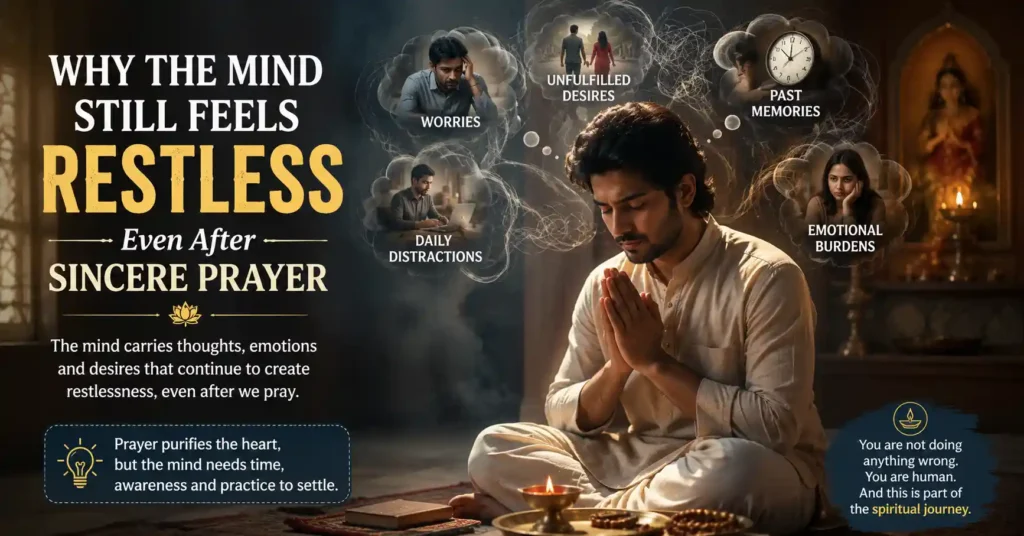
When you sit for prayer, the body becomes still, but the mind may continue moving. Worries, plans, memories, and unresolved feelings often rise to the surface once external distractions fade away.
This is one reason many people experience spiritual restlessness even after sincere prayer. It is not necessarily a sign of failure. In many cases, it is the beginning of greater self-awareness.
This struggle is not unique to modern life. In the Bhagavad Gita, Arjuna tells Lord Krishna that the mind is restless, turbulent, and difficult to control, comparing it to the wind itself.
Lord Krishna acknowledges this challenge and explains that the mind becomes steadier through consistent practice (Abhyasa) and detachment (Vairagya). These teachings remain just as relevant today as they were thousands of years ago.
From the perspective of Sanatan Dharma, spiritual restlessness is often part of the inner journey. It reveals where the mind is still attached, distracted, or seeking fulfillment outside itself.
There is comfort in this teaching. It reminds us that even sincere seekers face periods of inner unrest. A restless mind after prayer is not always a problem to fix. Sometimes it is an invitation to grow in awareness, patience, and spiritual maturity.
Did You Know?
In the Bhagavad Gita (Chapter 6, Verse 34), Arjuna tells Lord Krishna that the mind is restless, turbulent, powerful, and difficult to control, comparing it to the wind itself.
Rather than criticizing Arjuna, Krishna acknowledges this struggle and teaches that the mind can gradually become steadier through Abhyasa (consistent practice) and Vairagya (detachment).
This timeless teaching reminds us that experiencing spiritual restlessness is not a sign of failure. It is a challenge that sincere seekers have faced throughout history.
How Prayer Reveals Your Inner State
We often assume that prayer should remove every thought and bring instant peace. But many times, prayer does something different. It helps us become aware of what is already happening within.
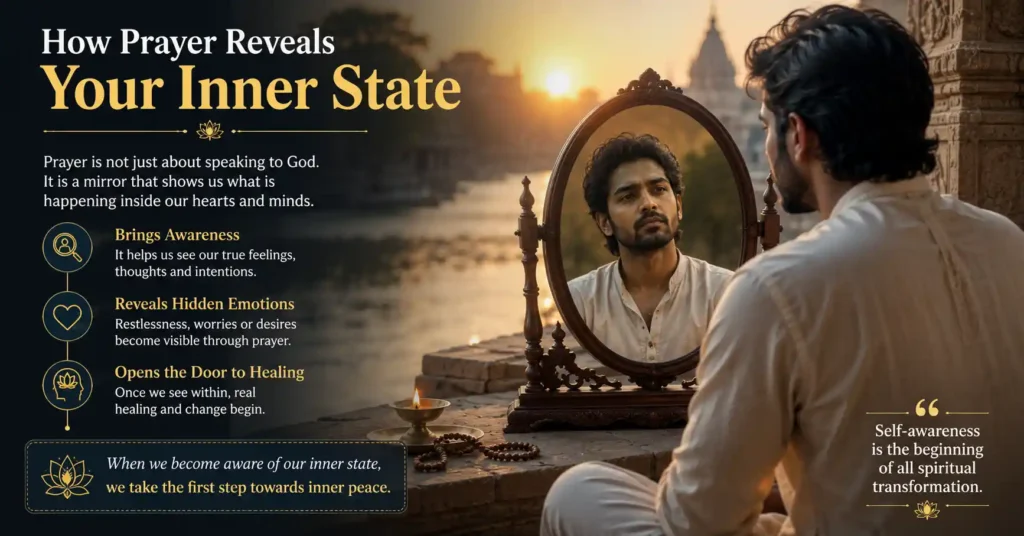
If there is calmness inside, prayer may deepen it. If there is worry, confusion, emotional pain, or spiritual restlessness, prayer can gently bring those feelings into awareness.
This is why some people feel more emotional or experience a restless mind after prayer. In the quietness that prayer creates, thoughts and emotions that were hidden beneath daily activity become easier to notice.
Prayer does not always remove inner turmoil immediately. Sometimes it acts like a mirror, helping us see patterns, attachments, fears, and unresolved feelings that need attention and healing.
This does not mean prayer is failing. In many cases, it is doing exactly what it is meant to do. What feels like spiritual restlessness may simply be a deeper level of self-awareness beginning to emerge.
When viewed this way, inner restlessness becomes less frightening. Instead of resisting it, we can approach it with patience, honesty, and a willingness to understand what it may be trying to teach us.
Different Types of Spiritual Restlessness
Not all spiritual restlessness feels the same, and recognizing the difference can make the experience less confusing.
Sometimes the mind becomes crowded with thoughts that move from one concern to another. At other times, the restlessness feels more emotional, appearing as worry, heaviness, or a lack of inner peace.
There are also moments when the feeling goes deeper. You may experience a sense of longing, emptiness, or distance from the spiritual connection you are seeking. While uncomfortable, this is not necessarily a negative sign.
The table below highlights some common forms of inner restlessness:
| Type of Restlessness | How It Often Feels |
|---|---|
| Mental Restlessness | Constant thinking, overanalyzing, planning, or a wandering mind during prayer. |
| Emotional Restlessness | Worry, sadness, frustration, anxiety, or unresolved emotional tension. |
| Spiritual Restlessness | A deeper longing for meaning, purpose, connection, or inner peace. |
| Restlessness from Expectations | Feeling disappointed because prayer did not bring immediate calm or answers. |
Each form of restlessness reveals something different about the inner journey. Rather than resisting it, it can help to observe it with patience and curiosity.
Understanding the type of restlessness you are experiencing often makes it easier to respond wisely. What feels like a problem may actually be revealing an area that needs awareness, healing, or spiritual growth.
How Hidden Desires Create Spiritual Restlessness
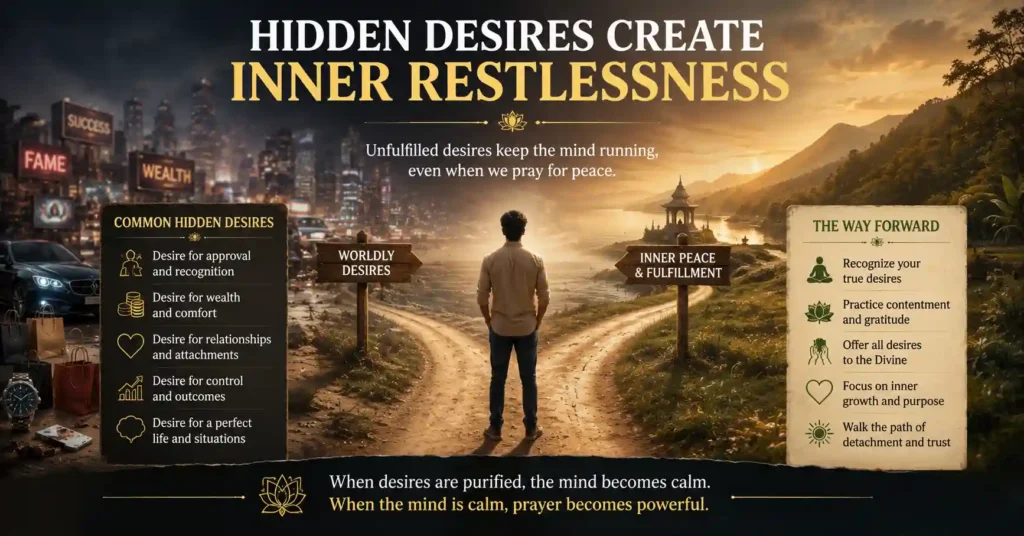
One of the most common causes of spiritual restlessness is attachment to specific outcomes, expectations, or desires.
Even during prayer, part of the mind may still be holding on to worries, fears, hopes, or plans. The prayer may be sincere, yet the mind continues looking ahead, hoping life unfolds in a particular way.
This creates a subtle inner tension. The heart seeks surrender, but the mind continues trying to control what happens next. When these two movements pull in different directions, a sense of inner restlessness often remains.
Some common attachments that can disturb inner peace include:
| Attachment | How It Creates Restlessness |
|---|---|
| Results | Constant worry about whether prayers will be answered. |
| Control | Difficulty accepting uncertainty or unexpected outcomes. |
| Recognition | Seeking approval, appreciation, or validation from others. |
| Fear of Loss | Anxiety about relationships, health, success, or security. |
| Expectations | Disappointment when life does not unfold as planned. |
The Bhagavad Gita repeatedly teaches that peace grows when we focus on sincere effort rather than becoming attached to results. This does not mean giving up our goals. It means learning to do our best while accepting that not everything is within our control.
As trust deepens, the need to hold on begins to soften. With that softening comes greater acceptance, emotional balance, and a quieter mind.
What initially appears as spiritual restlessness may sometimes be showing us where attachment still exists and where surrender is inviting us to grow.
When Prayer Becomes Mechanical Instead of Mindful
Sometimes prayer happens through words, but awareness does not fully accompany them.
The body may be present, yet the mind continues moving from one thought to another. Daily worries, unfinished tasks, and mental distractions can quietly pull attention away from the prayer itself.
When this happens, prayer can begin to feel mechanical rather than heartfelt. The words are spoken, but the mind remains elsewhere.
Some common signs of mechanical prayer include:
| Sign | What It Often Means |
|---|---|
| Reciting prayers automatically | The mind is following habit rather than awareness. |
| Constant wandering thoughts | Attention is being pulled toward worries, plans, or distractions. |
| Feeling disconnected during prayer | The heart is not fully engaged in the moment. |
| Rushing through prayer | The focus shifts to completing the ritual rather than experiencing it. |
When attention is scattered, it becomes harder to experience the deeper stillness that prayer can offer. This can sometimes contribute to a restless mind after prayer and a lingering sense of spiritual restlessness.
The goal is not perfect concentration. Even experienced seekers face distractions from time to time.
The practice is simply to return, again and again, to the present moment and the intention behind the prayer. Over time, this gentle return strengthens awareness and allows prayer to become a more meaningful experience.
Often, a few minutes of sincere and mindful prayer bring greater peace than a longer prayer performed without presence.
Emotional Overload That Prayer Begins to Release
Many people carry emotional burdens without fully realizing it. Stress, sadness, worry, disappointment, and unspoken feelings often remain hidden beneath the busyness of daily life.
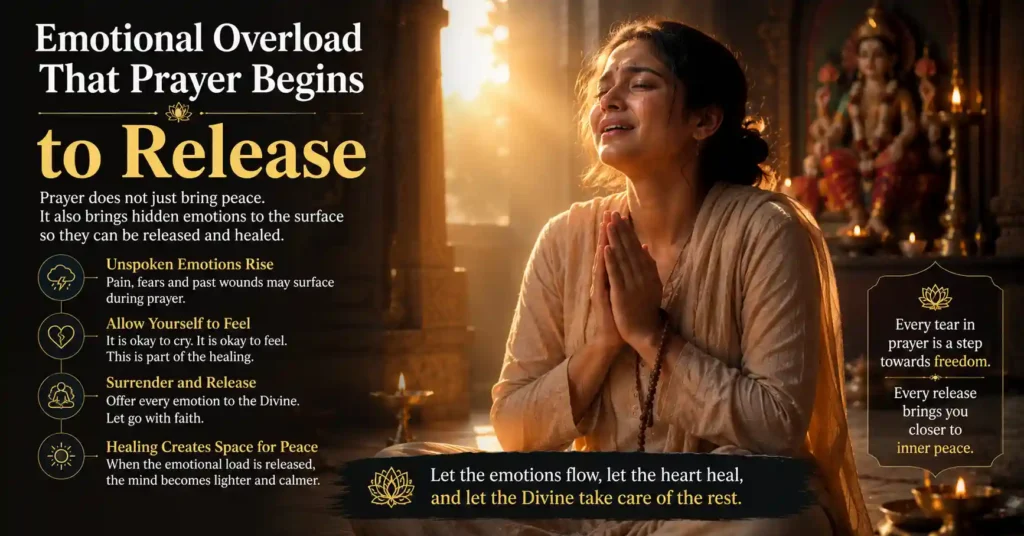
When you sit for prayer, everything begins to slow down. In that quieter space, emotions that were previously ignored may start to rise into awareness.
Think of someone who spends the day managing work pressure, family responsibilities, deadlines, and constant distractions. There is little opportunity to pause and notice what is happening within.
But when they finally sit quietly for prayer, those hidden worries and emotions become easier to see. The prayer did not create the discomfort. It simply created enough stillness for it to be noticed.
This is one reason people sometimes experience a restless mind after prayer. What feels like spiritual restlessness may actually be unresolved emotions seeking attention, understanding, and healing.
Common emotions that may surface during or after prayer include:
| Emotion | What It May Be Revealing |
|---|---|
| Worry | Fear about the future or uncertainty. |
| Sadness | Unprocessed grief, disappointment, or loss. |
| Anger | Hurt feelings, frustration, or unmet expectations. |
| Guilt | Regret about past actions or decisions. |
| Emotional Exhaustion | The weight of ongoing stress and responsibilities. |
Although this experience can feel uncomfortable, it is often part of a healthy inner process. Prayer creates a safe space where suppressed emotions can gradually come into the light.
In many cases, what appears to be spiritual restlessness is not a setback. It may be the beginning of emotional healing, greater self-awareness, and a deeper connection with your inner self.
Why Prayer Is Not Always Meant to Create Instant Peace
A very common reason people feel disappointed after prayer is expectation.
We often hope to feel calm, light, or completely peaceful the moment prayer ends. When that does not happen, the mind quickly begins to question the experience.
Instead of allowing the mind to settle naturally, we start judging it. We wonder whether the prayer was effective, whether we prayed correctly, or whether something is wrong with us.
This reaction can actually increase spiritual restlessness. The mind becomes focused on achieving a particular feeling rather than simply being present with the experience.
It can be helpful to remember that prayer is not always meant to produce instant peace. Sometimes prayer comforts us. Sometimes it strengthens us. And sometimes it reveals thoughts, emotions, and attachments that need attention.
| Expectation | What Often Happens in Reality |
|---|---|
| Prayer should bring immediate peace | Inner calm may develop gradually over time. |
| Prayer should remove all worries | Worries may first become more visible before they begin to ease. |
| Prayer should stop unwanted thoughts | Awareness of thoughts often increases before the mind becomes quieter. |
| Prayer should provide instant answers | Clarity frequently emerges through patience and reflection. |
Peace rarely arrives through force. It tends to appear quietly when expectations soften and we stop demanding a specific result from the experience.
When we approach prayer with patience, trust, and openness, spiritual restlessness often loses much of its power. The mind no longer feels pressured to achieve peace and becomes more willing to allow peace to arise naturally.
The Difference Between Prayer, Meditation, and Chanting
Many people expect prayer to calm everything instantly. But different spiritual practices support the mind in different ways.
Prayer allows us to express what is in the heart. Meditation helps us observe what is happening within. Chanting creates a steady rhythm that can help calm a restless mind and reduce spiritual restlessness.
This is why prayer alone may not always bring immediate calm. Sometimes the mind also benefits from silence, self-observation, or the soothing repetition of a sacred mantra.
The three practices work differently but complement one another:
| Practice | Primary Purpose | How It Helps |
|---|---|---|
| Prayer | Connection with the Divine | Expresses gratitude, faith, hopes, and concerns from the heart. |
| Meditation | Self-awareness | Helps observe thoughts and emotions without becoming overwhelmed by them. |
| Mantra Chanting | Mental steadiness | Gives the mind a positive focus and reduces mental distractions. |
Rather than seeing these practices as separate, it can help to view them as different paths leading toward the same inner stillness.
For someone experiencing spiritual restlessness, combining prayer with meditation or mantra chanting can often be especially helpful. Prayer opens the heart, meditation develops awareness, and chanting helps quiet the mind.
Together, they create a balanced spiritual practice that supports both inner peace and spiritual growth.
How Overthinking Increases Spiritual Restlessness
Sometimes the restlessness is not coming from the prayer itself. It is coming from the mind’s habit of overthinking.
After prayer, you may begin checking whether you feel calmer, more peaceful, or somehow different. Questions such as “Why am I not calm yet?” or “Is my prayer working?” start to appear.
In trying to measure the experience, the mind creates more noise. Attention shifts away from prayer and toward constant self-evaluation.
This pattern is common among people experiencing spiritual restlessness. The desire for immediate results can keep the mind occupied even after the prayer has ended.
Some signs that overthinking may be increasing inner restlessness include:
| Sign | How It Affects the Mind |
|---|---|
| Constant self-analysis | Creates mental exhaustion and confusion. |
| Repeatedly judging the prayer experience | Increases frustration and disappointment. |
| Looking for immediate results | Makes patience and trust more difficult. |
| Comparing your experience with others | Creates unnecessary doubt and insecurity. |
Peace rarely arrives when it is being chased. More often, it appears quietly when the need to analyze every thought and feeling begins to soften.
The mind does not need to understand every experience immediately. Sometimes the greatest progress happens when we stop evaluating and simply allow the process to unfold naturally.
As trust grows, spiritual restlessness often gives way to greater acceptance, inner peace, and a deeper sense of connection with the Divine.
Creating a Space Where the Mind Can Settle
The space around us influences the mind more than we often realize. A calm environment can support a calmer state of mind and reduce unnecessary mental distractions.
There is a reason many people feel naturally drawn to pray during the quiet hours of early morning or evening. When external noise decreases, it often becomes easier to notice what is happening within.
A simple and uncluttered prayer space can also help reduce mental activity. Even small things, such as a diya, incense, a sacred image, or a clean prayer area, can encourage a sense of focus and presence.
Some elements that help create a peaceful prayer environment include:
| Helpful Practice | How It Supports the Mind |
|---|---|
| Praying at a fixed time | Creates consistency and mental readiness. |
| Using the same prayer space | Builds familiarity and a sense of comfort. |
| Keeping the area clean and uncluttered | Reduces visual distractions. |
| Lighting a diya or incense | Helps create a sacred atmosphere. |
| Limiting noise and interruptions | Makes it easier to focus and reflect. |
Over time, the mind begins to associate that space with stillness, prayer, and self-reflection. What once felt like spiritual restlessness may start settling more naturally because the habit of returning has become familiar.
The environment alone cannot create inner peace, but it can support the process. A peaceful space often makes it easier for awareness, devotion, and calmness to develop gradually.
The Role of Satsang and Spiritual Guidance
Prayer becomes easier when we do not walk the spiritual path alone. This is why Sanatan Dharma places great importance on Satsang, the company of spiritually minded people.
When we spend time with people who value prayer, self-reflection, and spiritual growth, their influence naturally supports our own journey. Their experiences can remind us that challenges such as spiritual restlessness are normal and temporary.
Spiritual guidance can also be valuable during periods of confusion. A trusted teacher, mentor, or wise devotee may offer perspectives that help us understand what the mind is experiencing.
Satsang does not remove every difficulty, but it often provides encouragement, clarity, and inspiration. Many seekers discover that a restless mind becomes easier to understand when they learn from those who have walked the path before them.
Why Surrender Matters More Than Words
Prayer is not only about the words we speak. It is also about the willingness to let go, even if only for a few moments.
Sometimes we carry our worries, expectations, fears, and desire for control into prayer. We pray sincerely, yet part of the mind continues holding on to how life should unfold.
This inner conflict often fuels spiritual restlessness. One part of us seeks peace, while another part continues trying to control outcomes.
The Bhagavad Gita repeatedly reminds us that peace grows when we focus on sincere effort and learn to release attachment to results. This does not mean becoming passive. It means trusting that we do not have to carry every burden alone.
Surrender can begin with simple shifts such as:
- Accepting that not everything is within our control
- Doing our best without obsessing over outcomes
- Trusting the Divine process even when answers are unclear
- Releasing the need for immediate results
- Allowing life to unfold one step at a time
When prayer becomes an act of trust rather than control, something begins to soften. The heart feels lighter, and the mind no longer has to carry everything on its own.
Surrender is often misunderstood as weakness. In reality, it is a quiet form of strength rooted in faith and acceptance.
As trust deepens, spiritual restlessness often begins to ease. In its place, we gradually discover greater patience, inner peace, and a deeper connection with the Divine.
What Your Spiritual Restlessness Is Actually Telling You
Instead of resisting restlessness, it can help to become curious about it.
Sometimes spiritual restlessness is showing that the mind is carrying too much stress, worry, or emotional weight. At other times, it may be revealing feelings that have been ignored or a deeper longing for meaning, purpose, and connection.
Rather than asking, “How do I get rid of this feeling?”, it can be helpful to ask, “What is this feeling trying to teach me?”
Often, inner restlessness points toward areas that need greater awareness, healing, or attention.
For example, it may be revealing:
- Unresolved emotions that need to be acknowledged
- Attachments that are creating inner tension
- Excessive worry about the future
- A need for deeper spiritual practice
- A longing for greater inner peace and connection with the Divine
A restless mind after prayer is not always a problem to be fixed. In many cases, it is part of the spiritual journey itself.
What feels uncomfortable today may actually be inviting you to look a little deeper. The awareness created through prayer often reveals what was previously hidden beneath daily distractions.
In that sense, spiritual restlessness is not always a sign that something is wrong. Sometimes it is a sign that something within is beginning to awaken, grow, and move toward a deeper understanding of itself.
How to Calm the Mind After Prayer Naturally
If you are wondering how to calm the mind after prayer, the answer is often simpler than we expect.
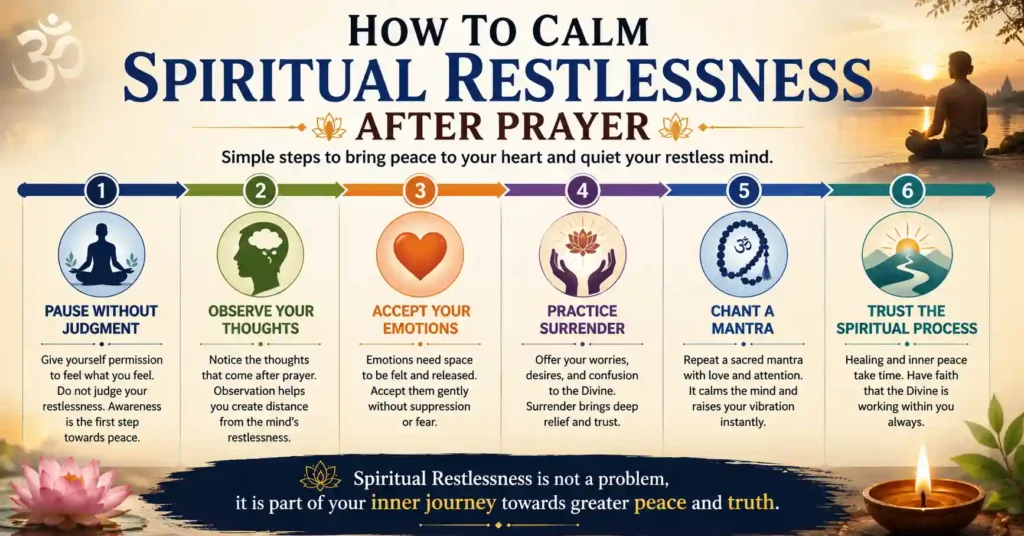
Instead of getting up immediately, try sitting quietly for a few moments. Allow the prayer to settle naturally without rushing to the next task, conversation, or thought.
You may notice your breath, listen to the silence around you, or simply observe your thoughts as they come and go. There is no need to fight them or force the mind to become calm.
Simple practices that can help include:
- Sitting quietly for a few extra minutes after prayer
- Taking a few slow and conscious breaths
- Observing thoughts without judging them
- Repeating a simple mantra such as Om Namah Shivaya or Ram
- Focusing on gratitude rather than worries
- Allowing emotions to be present without resisting them
These small habits can gradually reduce spiritual restlessness and create a deeper sense of inner stability.
Often, it is this pause after prayer that makes the difference. The mind is no longer being pulled in multiple directions and finally receives the opportunity to rest.
Peace does not always arrive instantly. Yet when we create space for silence, awareness, and acceptance, the restless mind often begins to settle on its own.
Over time, this simple practice can help transform spiritual restlessness into greater self-awareness, inner peace, and trust in the spiritual journey.
Why Honest Prayer Brings Greater Peace
Prayer does not need to be perfect to be meaningful. More often, it simply needs to be honest.
There is no need to hide confusion, doubt, fear, or spiritual restlessness. Whatever is genuinely present in the heart can become part of the prayer.
Many people worry about saying the right words or praying in the right way. Yet sincere prayer is less about perfection and more about authenticity.
Honest prayer may include:
- Gratitude for what is going well
- Questions that remain unanswered
- Worries about the future
- Emotional pain that needs healing
- A longing for guidance, peace, or clarity
When we stop trying to pray perfectly and begin speaking from a genuine place within, something changes. The experience feels more real and less like a performance.
This honesty often creates a deeper connection with the Divine. Instead of pretending to be calm, we allow ourselves to be seen as we truly are.
Over time, that openness builds trust. And as trust deepens, spiritual restlessness gradually loses its intensity.
The mind no longer feels pressured to appear peaceful. Instead, it learns to rest in the understanding that sincere prayer is not about perfection. It is about bringing our whole self, exactly as we are, into the presence of the Divine.
Can Spiritual Restlessness Be a Sign of Growth?
Even if the mind feels restless after prayer, your effort is not wasted.
Every sincere prayer leaves a subtle impression within. The change may not be visible immediately, but something is often taking shape beneath the surface.
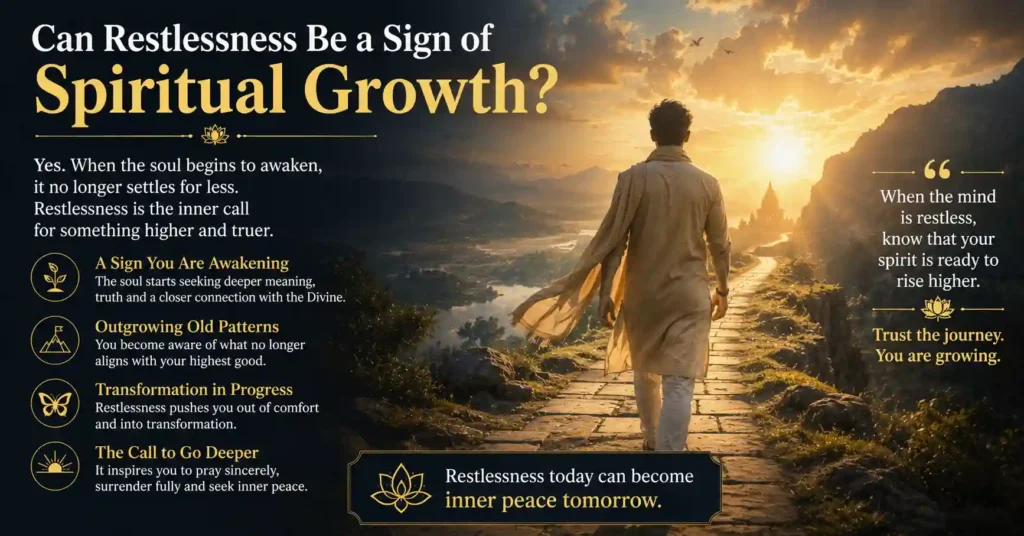
Many people assume that spiritual growth always feels peaceful. In reality, periods of spiritual restlessness are often part of the journey. As awareness grows, we begin noticing thoughts, emotions, attachments, and questions that were previously hidden.
This process can feel uncomfortable, but it is not necessarily negative. In many cases, it is a sign that the inner journey is becoming deeper and more conscious.
Some ways spiritual restlessness can support growth include:
- Encouraging deeper self-reflection
- Revealing hidden fears and attachments
- Inspiring a stronger spiritual practice
- Creating a longing for lasting inner peace
- Helping us seek a more meaningful connection with the Divine
Many seekers discover that peace does not arrive all at once. It develops gradually through prayer, self-awareness, patience, and trust.
What feels restless today may one day become the very experience that strengthens your faith and understanding. The same prayer that once felt unsettled can eventually become a source of comfort, wisdom, and inner stability.
Seen in this light, spiritual restlessness is not always an obstacle. Sometimes it is the doorway through which deeper growth, transformation, and spiritual maturity begin.
Conclusion
If you are wondering why the mind feels restless after prayer, remember this gently.
Nothing is necessarily wrong. The mind is often revealing what it has been carrying, and prayer is helping bring that inner movement into awareness.
What appears as spiritual restlessness is not always a sign of failure or a lack of faith. Sometimes it is simply the natural process of becoming more aware of thoughts, emotions, and inner patterns that were previously hidden beneath daily activity.
Peace does not always arrive the moment prayer ends. For many people, it develops gradually through patience, trust, self-awareness, and a willingness to remain present with the journey.
Over time, the same restlessness that once felt discouraging can become a teacher. It can deepen understanding, strengthen surrender, and encourage a more authentic relationship with the Divine.
Stay with the process. What feels like spiritual restlessness today may slowly transform into greater clarity, acceptance, and inner peace.
Over time, spiritual restlessness itself can become a doorway to deeper faith, self-awareness, and spiritual growth.
Key Takeaways
- Spiritual restlessness is a common part of the spiritual journey and does not necessarily mean something is wrong with your prayer or spiritual practice.
- A restless mind after prayer often arises because prayer brings hidden thoughts, emotions, worries, and attachments into awareness.
- Sanatan Dharma teaches that the mind is naturally restless, but it can gradually become steadier through consistent practice (Abhyasa) and detachment (Vairagya).
- Prayer does not always create instant peace. Sometimes it reveals what needs healing, understanding, or deeper attention.
- Expectations, overthinking, emotional burdens, and attachment to outcomes can all contribute to spiritual restlessness.
- Prayer, meditation, mantra chanting, self-reflection, and satsang can work together to support greater inner calm and spiritual growth.
- Surrender is not weakness. It is the willingness to trust the Divine and let go of the need to control everything.
- Inner restlessness can sometimes be a sign of growth, encouraging greater self-awareness, faith, and a deeper connection with the Divine.
- Peace often develops gradually through patience, trust, and regular spiritual practice rather than appearing all at once.
- What feels like spiritual restlessness today may become the very experience that leads to greater understanding, inner peace, and spiritual maturity.
Suggested Reading
If this article on spiritual restlessness resonated with you, you may also enjoy exploring these reflections on inner peace, self-awareness, devotion, and spiritual growth. Each article offers practical insights to help you better understand spiritual restlessness, develop greater inner calm, and deepen your connection with the Divine.
Through prayer, awareness, surrender, and spiritual wisdom, the journey from spiritual restlessness to inner peace becomes a path of growth, trust, and self-discovery.
Intention vs Ritual: What Matters More in Sanatan Dharma?
https://thesanatantales.com/intention-vs-ritual/
Daily Spiritual Habits: 7 Simple Sanatan Practices for Inner Peace
https://thesanatantales.com/daily-spiritual-habits/
Mudras: A Simple Practice for Balance, Awareness and Well-Being
https://thesanatantales.com/mudras/
Daily Sattvik Routine for Working Professionals: Simple Habits for a Peaceful Life
https://thesanatantales.com/daily-sattvik-routine-for-working-professionals/
How to Live in the Present Moment: A Simple Path to Inner Peace
https://thesanatantales.com/how-to-live-in-the-present-moment/
Letting Go in Sanatan Dharma: Finding Peace Beyond Attachment
https://thesanatantales.com/letting-go-in-sanatan-dharma/
Digital Detox: How to Find Inner Peace in a Digital World
https://thesanatantales.com/digital-detox/
FAQs
Why do I feel restless after prayer?
Feeling restless after prayer is more common than many people realize. Prayer often creates a quiet space where thoughts, emotions, worries, and inner tensions become easier to notice.
What feels like spiritual restlessness may not have been created by the prayer itself. In many cases, prayer simply brings greater awareness to what was already present within.
Instead of seeing this as a problem, it can help to view it as an opportunity for self-reflection, healing, and spiritual growth.
Is spiritual restlessness normal on the spiritual path?
Yes, many seekers experience spiritual restlessness at different stages of their journey. It can arise when we begin questioning old beliefs, seeking deeper meaning, or longing for a stronger connection with the Divine.
Periods of inner restlessness do not necessarily indicate a lack of faith. Sometimes they appear because awareness is expanding and deeper questions are beginning to surface.
With patience, prayer, and self-awareness, these phases often lead to greater clarity and inner peace.
How can I calm the mind after prayer?
One of the simplest approaches is to remain seated quietly for a few minutes after prayer instead of immediately returning to daily activities.
Pay attention to your breath, observe your thoughts without judging them, or repeat a simple mantra softly in your mind. This helps the mind transition gradually from activity to stillness.
Over time, these small moments of silence can help reduce inner restlessness and create a deeper sense of calm.
Why does prayer sometimes make me emotional?
Prayer often allows emotions that have been hidden beneath daily responsibilities and distractions to rise into awareness.
Feelings such as sadness, gratitude, fear, relief, or longing may become more noticeable when the mind becomes quieter. This emotional release can sometimes feel uncomfortable, but it is often a natural part of the healing process.
Rather than resisting these emotions, try observing them with compassion and patience.
Is it normal for the mind to wander during prayer?
Yes, a wandering mind is a common human experience. Even sincere seekers often find their attention moving toward thoughts, plans, memories, or worries during prayer.
The goal is not perfect concentration. The practice is simply to notice when the mind has wandered and gently bring it back to the prayer.
Each return strengthens awareness and gradually helps develop greater focus and presence.
Can spiritual restlessness be a sign of spiritual growth?
In many cases, yes. As awareness deepens, we often begin noticing thoughts, emotions, attachments, and inner patterns that were previously ignored.
This increased awareness can initially feel uncomfortable because it brings hidden aspects of ourselves into view. However, this process often leads to greater understanding and transformation.
What feels like spiritual restlessness today may become an important step toward deeper self-awareness and inner peace.
Why do I not feel immediate peace after prayer?
Many people expect prayer to produce instant calmness, but inner peace usually develops gradually rather than appearing all at once.
Prayer may comfort, guide, strengthen, or reveal areas that need healing. Sometimes its effects unfold quietly over time instead of being felt immediately.
Approaching prayer with patience rather than expectation often makes it easier to recognize its deeper benefits.
What does Sanatan Dharma teach about a restless mind?
Sanatan Dharma recognizes that the mind is naturally active and difficult to control. In the Bhagavad Gita, Arjuna openly describes the mind as restless and difficult to restrain.
Lord Krishna acknowledges this challenge and teaches that the mind becomes steadier through consistent practice (Abhyasa) and detachment (Vairagya).
These teachings remind us that overcoming spiritual restlessness is not about forcing the mind into silence. It is a gradual process of awareness, discipline, faith, and inner growth.
Glossary of Important Terms
| Term | Meaning |
|---|---|
| Spiritual Restlessness | A feeling of inner unease, longing, or lack of peace that often arises during periods of spiritual seeking, self-reflection, or personal growth. |
| Prayer (Prarthana) | A heartfelt communication with the Divine that may include gratitude, devotion, surrender, guidance, or a request for strength and wisdom. |
| Inner Peace | A state of mental and emotional calm that remains steady even during life’s challenges and uncertainties. |
| Restless Mind (Chanchal Man) | A mind that constantly moves between thoughts, worries, desires, memories, and distractions, making it difficult to remain calm and focused. |
| Bhakti | The path of devotion in Sanatan Dharma, centered on love, faith, surrender, and connection with the Divine. |
| Surrender (Samarpan) | The practice of trusting the Divine and letting go of excessive attachment to outcomes, control, and expectations. |
| Meditation (Dhyana) | A spiritual practice that develops awareness, concentration, and inner stillness by observing thoughts without becoming attached to them. |
| Mantra | A sacred word, sound, or phrase repeated during prayer or meditation to focus the mind and deepen spiritual awareness. |
| Awareness | The ability to observe thoughts, emotions, and experiences consciously without immediately reacting to them. |
| Attachment (Asakti) | Strong emotional dependence on people, outcomes, possessions, or expectations that can create inner tension and suffering. |
| Detachment (Vairagya) | The ability to engage with life fully while remaining free from excessive attachment to results and external circumstances. |
| Abhyasa | Consistent spiritual practice and disciplined effort that gradually helps steady the mind and deepen inner growth. |
| Satsang | The company of spiritually minded people, saints, teachers, or seekers that supports learning, reflection, and spiritual development. |
| Self-Awareness | Understanding one’s own thoughts, emotions, habits, motivations, and inner patterns with honesty and clarity. |
| Spiritual Growth | The gradual process of deepening wisdom, devotion, self-understanding, and connection with the Divine. |
About the Author
Yateendra Chaturvedi is a spiritual writer, researcher, devotee, and the founder of The Sanatan Tales. With over 35 years of professional experience and a lifelong interest in Sanatan Dharma, he writes about Hindu deities, temples, scriptures, festivals, Mahavidyas, sacred stories, rituals, and living traditions that continue to guide and inspire devotees across India.
Drawing from traditional scriptures, regional beliefs, temple traditions, devotional literature, and historical sources, he aims to present authentic, well-researched, and easy-to-understand content for modern readers. His work focuses on preserving spiritual wisdom, explaining sacred traditions, and helping seekers develop a deeper understanding of India’s rich spiritual heritage.
Through The Sanatan Tales, Yateendra strives to make the timeless teachings of Sanatan Dharma simple, meaningful, and relevant for today’s generation while maintaining respect for traditional sources, regional practices, and diverse spiritual perspectives.
Learn More About Yateendra Chaturvedi →
https://thesanatantales.com/about-the-author/
References & Sources
This article is based on teachings, concepts, and perspectives commonly found within Sanatan Dharma, including insights drawn from Hindu scriptures, spiritual traditions, devotional practices, yogic teachings, and widely accepted philosophical principles. It also reflects wisdom preserved through spiritual communities, family traditions, and the rich heritage of knowledge passed down across generations.
Note: Spiritual experiences, interpretations, and practices may vary among different traditions, sampradayas, teachers, regions, and individual seekers. The purpose of this article is not to present any single viewpoint as the absolute truth, but to share commonly understood spiritual perspectives in a simple, practical, and reader-friendly manner. Sanatan Dharma recognizes diverse paths of devotion, self-inquiry, meditation, knowledge, service, and inner transformation, allowing each individual to progress according to their own nature and spiritual journey.
Explore More Fascinating Topics from Sanatan Dharma