Every meaningful change in life begins within the mind.
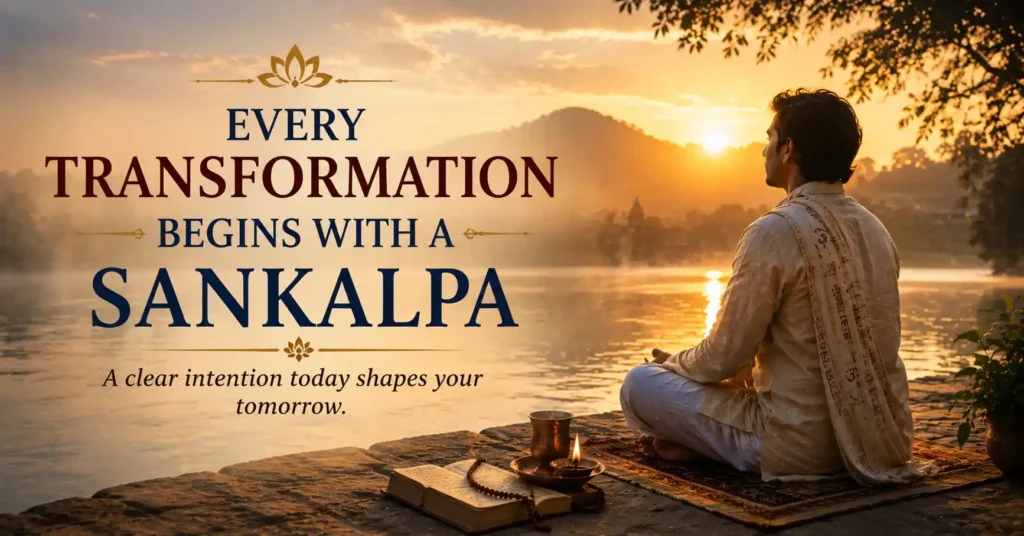
Before a person develops discipline, builds a positive habit, strengthens devotion, or achieves a goal, there is usually an intention guiding that journey. In Sanatan Dharma, this conscious intention is known as Sankalpa.
A Sankalpa is more than a wish, desire, or positive statement. It is a sincere inner resolve that helps direct thoughts, actions, and energy toward a meaningful purpose. It reflects what we choose to cultivate within ourselves and the person we aspire to become.
The wisdom of Sankalpa in Sanatan Dharma teaches that thoughts are not insignificant. What we repeatedly think, believe, and affirm within ourselves gradually influences our mindset, behavior, and life experience. This is why inner discipline has always been valued in spiritual traditions.
In many ways, Sankalpa can be understood as a spiritual form of conscious self-guidance. It is not merely positive thinking. It is right thinking aligned with Dharma, self-improvement, and higher values. Through Sankalpa in Sanatan Dharma, a person learns to replace confusion with clarity, weakness with determination, and distraction with purpose.
For centuries, Sankalpa in Sanatan Dharma has been an important part of prayers, vows, spiritual practices, yajnas, and personal transformation. It reminds us that lasting change begins within before it becomes visible in the outer world.
In this article, you will discover the meaning of Sankalpa, how it differs from modern affirmations, why it holds spiritual significance, and practical ways to apply its wisdom in daily life for greater focus, inner strength, and spiritual growth.
Sankalpa in Sanatan Dharma At a Glance
| Aspect | Details |
|---|---|
| Meaning | A conscious inner resolve or sincere intention that guides thoughts, actions, and personal growth. |
| Purpose | To cultivate clarity, self-discipline, spiritual awareness, and alignment with Dharma. |
| Core Principle | Lasting transformation begins within before it appears in the outer world. |
| Focus | Inner growth rather than controlling external outcomes. |
| Foundation | Awareness, sincerity, consistency, and right intention. |
| Role in Spiritual Life | Supports prayer, meditation, self-improvement, devotion, and mindful living. |
| Difference from Desire | Desire seeks a result; Sankalpa focuses on how you choose to think, act, and live. |
| Difference from Mantra | Mantra is a sacred sound received through tradition; Sankalpa is a personal inner resolve. |
| Importance of Bhava | Feeling and sincerity give strength to a Sankalpa and help it settle deeper into the mind. |
| Daily Practice | Reflect on your intention, repeat it mindfully, and support it through consistent action. |
| Key Benefits | Greater mental clarity, emotional balance, self-awareness, inner strength, and spiritual growth. |
| Best Time to Practice | Brahma Muhurta, before prayer or meditation, or any quiet moment of the day. |
| Common Mistake | Repeating words mechanically without awareness, feeling, or action. |
| Ultimate Goal | To align thoughts, intentions, and actions with higher values and purposeful living. |
| Key Takeaway | A sincere Sankalpa gradually shapes character, influences actions, and transforms life from within. |
Table of Contents
ToggleWhat Is Sankalpa in Sanatan Dharma?
A Sankalpa is a conscious intention that a person chooses to hold with awareness and sincerity. It is a firm inner resolve that helps guide thoughts, actions, and decisions toward a meaningful purpose.
In simple terms, Sankalpa can be understood as a commitment you make to yourself at the level of the mind and heart. It reflects the qualities, values, and direction you wish to cultivate in life.
Unlike random thoughts that come and go, a Sankalpa is repeated with clarity and conviction. Over time, it helps strengthen focus, self-discipline, and inner determination.
The wisdom of Sankalpa in Sanatan Dharma teaches that the mind gradually moves in the direction of the thoughts and intentions it repeatedly nourishes. This is why conscious thinking has always been considered important in spiritual growth.
A true Sankalpa is not merely about achieving external success. It is about aligning oneself with Dharma, personal growth, devotion, and higher ideals.
In this sense, Sankalpa is not just positive thinking. It is right thinking. It is the practice of consciously choosing thoughts and intentions that support a balanced, purposeful, and spiritually meaningful life.
How Sankalpa Shapes Inner Transformation
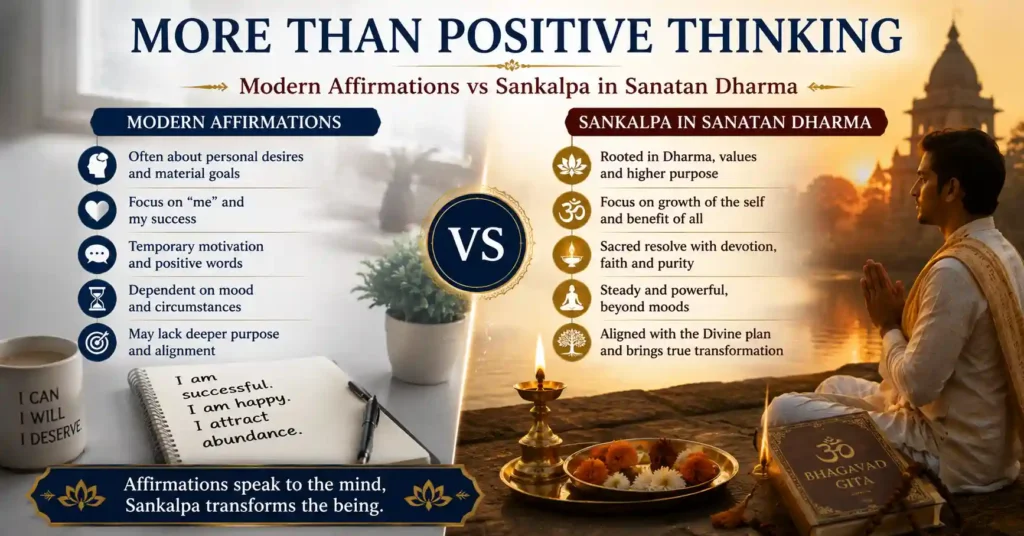
Many modern affirmations focus on achieving something external. They often revolve around success, confidence, wealth, recognition, or specific outcomes.
The approach of Sankalpa in Sanatan Dharma is different. While positive results may come, the primary focus is not on obtaining something from the world. The focus is on transforming oneself from within.
A true Sankalpa helps shape how a person thinks, responds, and lives. Instead of trying to control every external situation, it encourages the development of qualities such as patience, discipline, devotion, courage, and self-awareness.
In many ways, Sankalpa acts as a gentle inner reminder. It helps bring the mind back to the values and intentions a person wishes to live by, especially during challenging moments.
This process is usually gradual. Real transformation rarely happens overnight. Through consistent reflection and conscious intention, small changes begin to appear in daily life.
A person may become less reactive, more thoughtful, and better able to handle difficulties with balance. Decisions become clearer, emotions become steadier, and actions become more aligned with personal values.
The power of Sankalpa in Sanatan Dharma lies not in forcing life to produce certain results, but in helping individuals develop the inner qualities needed to navigate life with wisdom, resilience, and purpose.
The changes may seem small at first, but over time they can create a profound shift in character, mindset, and spiritual growth.
The Meaning of Sankalpa in Sanatan Dharma
At the heart of this practice lies a simple yet profound idea: Sankalpa.
A Sankalpa is not the same as making a wish or hoping for a particular outcome. It is a conscious inner resolve that arises from clarity, awareness, and purpose.
To understand the Sankalpa Meaning, it helps to distinguish it from desire. A desire often says, “I want this to happen.” A Sankalpa says, “I choose how I will think, act, and live, regardless of what happens.”
This difference is important because desires are usually tied to results, while a Sankalpa is rooted in intention. One depends on external circumstances. The other begins within.
The wisdom of Sankalpa in Sanatan Dharma teaches that lasting change starts when a person develops a clear and steady inner direction. Instead of constantly chasing outcomes, the focus shifts toward cultivating the right qualities, actions, and mindset.
There is a calmness in a true Sankalpa. It is not driven by pressure, fear, or restlessness. It is a quiet commitment that guides a person through both success and difficulty.
When this inner resolve is nurtured consistently, thoughts begin to align with it. Actions start reflecting it. Decisions become clearer. Over time, a person’s life naturally moves in the direction of the intention they have chosen to uphold.
This is the enduring Power of Sankalpa. A clear inner resolve gradually shapes character, strengthens self-discipline, and brings greater purpose to everyday life.
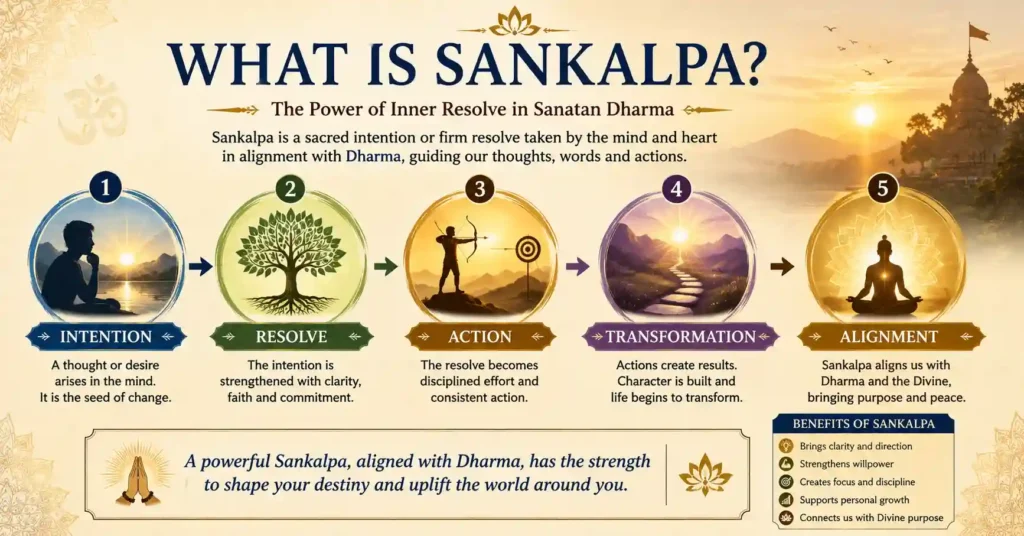
Did You Know?
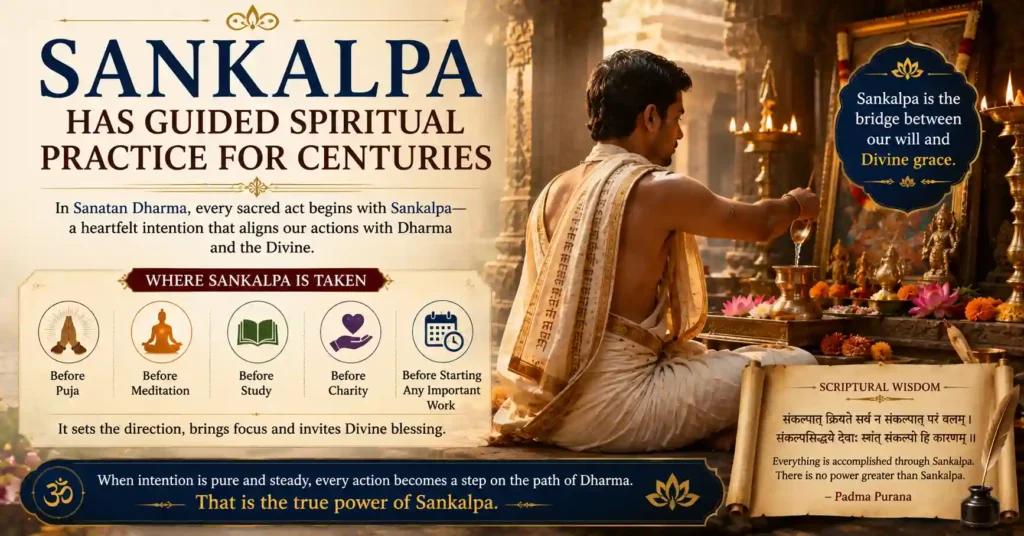
The word Sankalpa is traditionally used before many Hindu rituals, pujas, yajnas, vrats, and sacred ceremonies. During a Sankalpa, a devotee consciously states their intention before beginning the spiritual practice. This reflects the Sanatan belief that clear intention gives direction and purpose to every action.
In daily life, the same principle can be applied through a personal Sankalpa, helping transform thoughts, habits, and character over time.
Sankalpa and Mantra: Understanding the Difference
People sometimes assume that Sankalpa, affirmations, and mantras are the same. While they may support personal and spiritual growth, they serve different purposes.
A mantra is not something we invent ourselves. In the Sanatan tradition, mantras are sacred sounds and phrases that have been preserved through spiritual realization and scriptural wisdom. Their value lies not only in their meaning but also in their vibration and repeated recitation.
A Sankalpa, on the other hand, is a conscious intention chosen by the individual. It reflects a person’s inner resolve, values, and direction in life.
| Aspect | Mantra | Sankalpa |
|---|---|---|
| Origin | Received through scriptures and spiritual traditions | Created as a personal inner resolve |
| Purpose | Purification, concentration, and spiritual elevation | Direction, self-discipline, and personal transformation |
| Nature | Sacred sound or phrase | Conscious intention or commitment |
| Focus | Connecting with higher spiritual energies | Aligning thoughts and actions with a chosen purpose |
| Practice | Repeated through chanting, japa, or meditation | Repeated through reflection, awareness, and daily action |
Understanding this distinction helps clarify the difference between mantra and affirmation as well. A mantra is traditionally received and practiced, while a Sankalpa arises from a person’s conscious intention and commitment.
The teachings of Sankalpa in Sanatan Dharma show that both have an important place in spiritual life. One helps purify and steady the mind, while the other provides direction and purpose.
When mantra and Sankalpa are practiced together, they complement each other beautifully. Mantra supports inner purification and focus, while Sankalpa helps transform that clarity into meaningful action and personal growth.
How Sankalpa Influences Karma and Daily Life
The effects of a Sankalpa are rarely immediate. Real transformation usually happens gradually through consistent thoughts, choices, and actions.
A thought repeated regularly begins to influence the way a person sees themselves and the world. Over time, that thought can develop into a belief, and beliefs often shape behavior.
The relationship between thoughts, actions, and life experiences can be understood through a simple progression:
| Stage | What Happens |
|---|---|
| Thought | A conscious intention arises in the mind |
| Repetition | The intention is reinforced through awareness and practice |
| Belief | The repeated thought becomes part of one’s mindset |
| Action | Beliefs influence decisions and behavior |
| Habit | Repeated actions develop into patterns |
| Result | Those patterns gradually shape life experiences |
This process is closely connected to the principle of Karma. Many people think Karma relates only to physical actions, but Sanatan wisdom teaches that thoughts, intentions, words, and actions all play a role in shaping one’s life.
The teachings of Sankalpa in Sanatan Dharma emphasize that inner life matters. The thoughts and intentions we repeatedly nurture influence our character, choices, and responses to situations.
A positive intention alone does not change destiny overnight. However, when a clear Sankalpa consistently guides thoughts and actions, it gradually creates new habits, strengthens self-discipline, and influences the direction of one’s life.
This is one reason the Power of Sankalpa has been valued in spiritual traditions for centuries. What we repeatedly cultivate within ourselves often becomes reflected in how we live, act, and grow.
Why Bhava Matters More Than Repetition
In Sanatan Dharma, words alone are not considered enough. The intention and feeling behind those words are equally important.
A person can repeat a sentence many times, but if the mind is distracted and the heart is disconnected, the impact often remains limited. The words may be spoken, but they do not reach deeper levels of awareness.
This is where Bhava, or sincere feeling, becomes important.
| Element | Role in Personal Transformation |
|---|---|
| Words | Provide direction and focus |
| Repetition | Reinforces the chosen intention |
| Bhava (Feeling) | Creates emotional connection and sincerity |
| Awareness | Helps the intention remain conscious and meaningful |
| Action | Converts intention into real-life change |
The wisdom of Sankalpa in Sanatan Dharma teaches that a sincere intention supported by awareness and feeling is often more powerful than mechanical repetition.
Bhava does not mean forcing emotions or creating artificial intensity. It simply means bringing honesty, faith, and sincerity to what you are affirming within yourself.
When an intention genuinely resonates with a person, it begins to settle deeper into the mind. Thoughts become more aligned, actions become more consistent, and inner transformation becomes more natural.
This is why the Power of Sankalpa is not measured by how many times words are repeated, but by how deeply they are understood, felt, and lived.
Why a Dharmic Sankalpa Matters More Than Outcomes
One of the most important lessons in Sanatan Dharma is that not every desire needs to be strengthened. A clear intention can support growth, but excessive attachment to results often creates stress, disappointment, and inner restlessness.
Many people use affirmations only to achieve specific outcomes. The focus becomes getting more, achieving more, or becoming something in the future. While goals have their place, constantly chasing results can make the mind anxious and dissatisfied.
The approach of Sankalpa in Sanatan Dharma is different. It places greater importance on intention, character, and right action than on controlling every outcome.
| Outcome-Focused Thinking | Dharmic Sankalpa |
|---|---|
| Focuses mainly on results | Focuses on right intention and effort |
| Creates pressure and expectation | Encourages patience and balance |
| Depends on external circumstances | Begins with inner transformation |
| Seeks control over outcomes | Emphasizes conscious action |
| Can increase restlessness | Cultivates peace and clarity |
A Dharmic Sankalpa often sounds simple: acting with integrity, remaining calm during challenges, performing duties sincerely, or maintaining faith during uncertain times.
This shift may appear small, but it changes the way a person experiences life. Instead of becoming consumed by success or failure, attention moves toward personal growth, self-discipline, and conscious living.
The wisdom of Sankalpa in Sanatan Dharma teaches that while outcomes are never fully under our control, our intentions, efforts, and responses always remain within our hands. That understanding brings both clarity and inner peace.
Practical Examples of Sankalpa for Daily Life
Understanding a spiritual principle becomes easier when it is applied in daily life. The purpose of a Sankalpa is not to create pressure or unrealistic expectations, but to gently guide the mind toward higher thoughts and actions.
You do not need dozens of intentions. Even a single meaningful Sankalpa, practiced with sincerity and consistency, can gradually influence the way you think, respond, and grow.
For Daily Strength and Guidance
| Situation | Example of a Sankalpa |
|---|---|
| Building courage | I walk the path of Dharma with courage and clarity. |
| Seeking Divine support | I am guided and protected by the Divine in every step. |
| Creating mental peace | My mind is calm and my heart is filled with devotion. |
| Accepting life’s experiences | I accept life’s experiences as opportunities for growth. |
| Developing faith | I trust the wisdom and timing of Bhagwan. |
| Letting go of fear | I release fear and strengthen my faith. |
| Feeling supported | I am never alone; the Divine is always with me. |
| Living with integrity | My actions are pure and my intentions are sincere. |
| Practicing patience | I choose patience even during uncertainty. |
| Surrendering control | I surrender what is beyond my control. |
These examples focus less on demanding results and more on cultivating qualities that support a balanced and meaningful life.
For Inner Awareness and Spiritual Growth
| Spiritual Focus | Example of a Sankalpa |
|---|---|
| Self-awareness | I am the Atma, not merely the body and mind. |
| Connection with truth | I remain connected to the eternal truth within. |
| Reducing ego | I move from ego toward humility and surrender. |
| Learning through challenges | Every challenge supports my inner growth. |
| Emotional balance | I remain steady in both joy and difficulty. |
The teachings of Sankalpa in Sanatan Dharma remind us that transformation usually begins with small inner shifts. A thought practiced consistently becomes a belief. A belief influences action. Action shapes character.
Over time, these intentions stop feeling like words repeated by the mind. They begin to become qualities reflected in daily life.
That is where the true Power of Sankalpa reveals itself.
Sanatan affirmations list for daily practice
One of the simplest ways to practice Sankalpa in Sanatan Dharma is by choosing a meaningful intention that reflects the qualities you wish to cultivate in life.
You do not need many Sankalpas. In fact, one sincere intention practiced consistently is often more powerful than repeating many words without reflection.
For Strength and Guidance
| Purpose | Example of a Sankalpa |
|---|---|
| Courage | I walk the path of Dharma with courage and clarity. |
| Divine Trust | I am guided and protected by the Divine in every step. |
| Faith | I trust the wisdom and timing of Bhagwan. |
These intentions help strengthen confidence, resilience, and trust during both favorable and challenging times.
For Peace and Emotional Balance
| Purpose | Example of a Sankalpa |
|---|---|
| Inner Calm | My mind is calm and my heart is filled with devotion. |
| Freedom from Fear | I release fear and strengthen my faith. |
| Acceptance | I accept life as Prasad and grow through every experience. |
Such intentions encourage emotional balance and help the mind respond to situations with greater patience and clarity.
For Inner Awareness and Spiritual Growth
| Purpose | Example of a Sankalpa |
|---|---|
| Self-Realization | I am the Atma, not merely the body and mind. |
| Spiritual Connection | I remain connected to the eternal truth within. |
| Humility and Surrender | I move from ego toward surrender and inner peace. |
The purpose of these examples is not to control life or guarantee specific outcomes. Their role is to gently guide the mind toward higher values, self-awareness, and spiritual growth.
The teachings of Sankalpa in Sanatan Dharma remind us that lasting transformation often begins with a single sincere intention. When practiced with awareness, even one meaningful Sankalpa can gradually influence thoughts, actions, and daily life.
This is the true Power of Sankalpa. It does not force change from the outside. It inspires change from within.
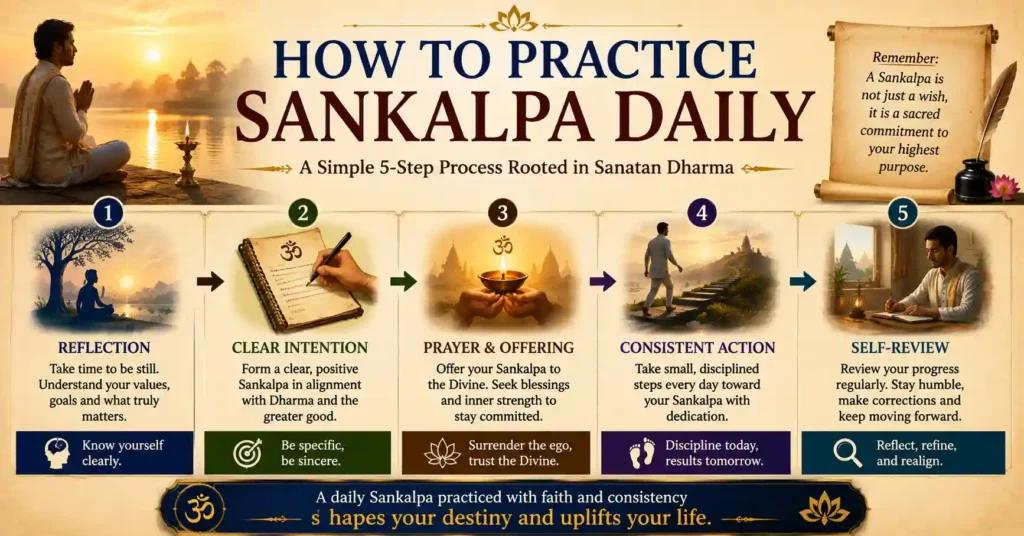
How to Practice Sankalpa in Daily Life
Practicing Sankalpa in Sanatan Dharma does not require a complicated routine. What matters most is sincerity, awareness, and consistency.
A Sankalpa can be practiced during any quiet moment of the day. Many people find the early morning especially helpful because the mind is calmer and less distracted. Others prefer the evening, when they can reflect on the day before resting.
The process itself is simple.
| Step | Practice |
|---|---|
| 1 | Sit quietly and relax your mind. |
| 2 | Take a few slow breaths. |
| 3 | Recall your chosen Sankalpa with awareness. |
| 4 | Repeat it slowly and thoughtfully. |
| 5 | Spend a few moments in silence afterward. |
There is no need to rush or force emotions. In the beginning, the words may feel unfamiliar or mechanical. This is natural and happens to many people.
With regular practice, the intention begins to feel more meaningful. The mind gradually becomes more receptive, and the chosen resolve starts influencing thoughts, attitudes, and daily actions.
Silence can also play an important role. After repeating a Sankalpa, sitting quietly for a minute allows the intention to settle more deeply into awareness.
The teachings of Sankalpa in Sanatan Dharma emphasize steady practice rather than perfection. A few moments of sincere reflection each day are often more effective than occasional bursts of enthusiasm.
The key is not intensity. The key is consistency. Over time, small daily efforts can strengthen inner resolve, support personal growth, and reveal the true Power of Sankalpa in everyday life.
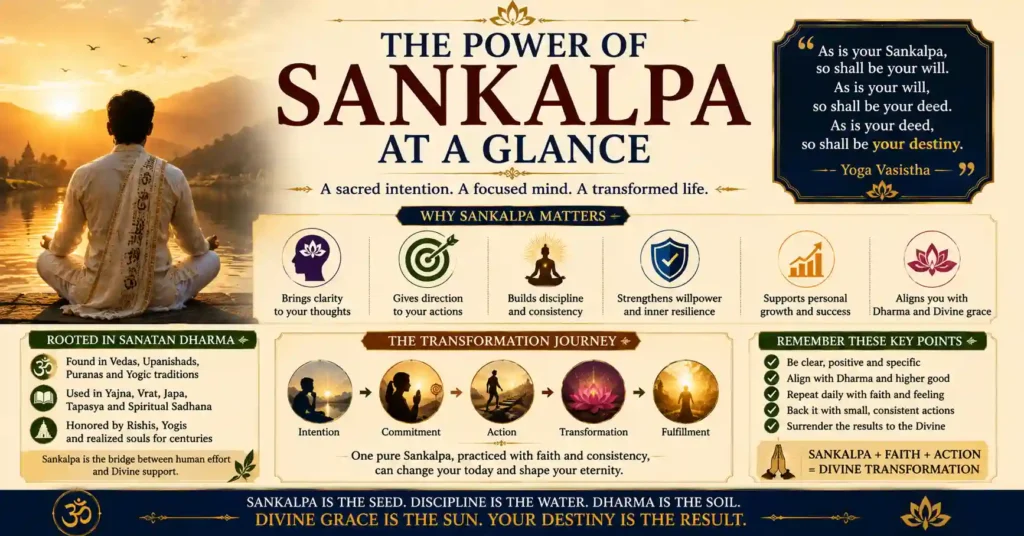
Small Daily Actions That Strengthen a Sankalpa
A Sankalpa becomes stronger when it is supported through small daily actions. Repeating an intention is helpful, but living according to it creates deeper transformation.
Simple habits can keep your resolve active in everyday life and gradually turn it into a natural part of your character.
- Spend a few quiet minutes in silence each day.
- Keep a journal to reflect on your thoughts and progress.
- Practice gratitude for the blessings already present in your life.
- Read a verse from the Bhagavad Gita or another inspiring spiritual text.
- Take one conscious action each day that reflects your Sankalpa.
- Pause and remember your intention before making important decisions.
These actions may seem small, but they help bridge the gap between intention and daily living.
The teachings of Sankalpa in Sanatan Dharma emphasize that lasting change is created through consistent effort. When thoughts, words, and actions begin to align, a Sankalpa gradually becomes a living reality rather than just an idea.
Guidelines for Practicing Sankalpa Effectively
A Sankalpa is not meant to be repeated mechanically. Its purpose is to create awareness, not simply fill the mind with words.
The quality of your intention often matters more than the number of times it is repeated. A sincere resolve practiced with attention can be more powerful than endless repetition without reflection.
To keep your practice meaningful, remember a few simple principles:
| Guideline | Why It Matters |
|---|---|
| Practice with awareness | Conscious repetition helps the intention settle deeper into the mind. |
| Avoid fear-based intentions | Fear creates restlessness, while clarity creates stability. |
| Do not expect instant results | Inner transformation usually happens gradually. |
| Do not force belief | Genuine conviction develops naturally over time. |
| Focus on consistency | Small daily practice is more effective than occasional intensity. |
The teachings of Sankalpa in Sanatan Dharma encourage patience and sincerity. A Sankalpa should feel like a gentle inner commitment, not a burden or obligation.
Some days the intention may feel deeply meaningful. Other days it may feel ordinary. Both experiences are part of the process.
Allow the resolve to grow naturally through reflection, awareness, and daily action. Over time, what begins as a simple intention can gradually become a living part of your character and spiritual journey.
Using Sankalpa During Difficult Times
The true value of a Sankalpa often becomes visible during challenging moments. It is easy to feel positive when life is going well. The real test comes when fear, uncertainty, stress, or confusion appear.
A clear inner resolve helps bring the mind back to a healthier and more balanced perspective.
| Situation | Helpful Sankalpa |
|---|---|
| Fear | I strengthen my faith and trust in the Divine. |
| Confusion | I choose clarity, patience, and right understanding. |
| Stress | I remain calm and focused on what I can do. |
| Uncertainty | I trust the process and perform my duties sincerely. |
| Difficulties | I face challenges with courage and inner strength. |
The purpose of these intentions is not to deny reality or avoid problems. Instead, they help shape how we respond to situations that are beyond our control.
The wisdom of Sankalpa in Sanatan Dharma teaches that inner stability is often more valuable than external certainty. While circumstances may change, a steady mind can help us navigate them with greater clarity and resilience.
This is where the Power of Sankalpa becomes practical. It does not remove every obstacle from life, but it can change the way we stand within those obstacles.
And sometimes, that shift in perspective changes everything.
Benefits of Practicing Sankalpa Regularly
The effects of a Sankalpa are often subtle in the beginning, but they become more noticeable with consistent practice. Real transformation usually happens gradually rather than through dramatic changes.
A clear and sincere intention can influence the way a person thinks, feels, and responds to daily situations.
| Benefit | How It Helps |
|---|---|
| Mental Calmness | Reduces unnecessary mental clutter and overthinking. |
| Emotional Balance | Encourages steadier responses to challenges and setbacks. |
| Greater Faith | Helps replace excessive worry with trust and confidence. |
| Better Clarity | Supports thoughtful decision-making and self-reflection. |
| Self-Awareness | Increases understanding of thoughts, habits, and behavior. |
| Inner Strength | Builds resilience during difficult circumstances. |
The wisdom of Sankalpa in Sanatan Dharma teaches that lasting change begins within. As the mind becomes more focused and intentional, reactions often become calmer and more balanced.
Many people also experience greater inner peace, improved mental clarity, and deeper self-awareness. These qualities support both personal growth and spiritual development.
Life will still bring challenges, uncertainties, and changes. However, a strong inner resolve can help a person face them with greater stability, patience, and confidence.
This is one of the enduring benefits of Sankalpa in Sanatan Dharma. The circumstances of life may not always change immediately, but the way we experience and respond to them gradually begins to transform.
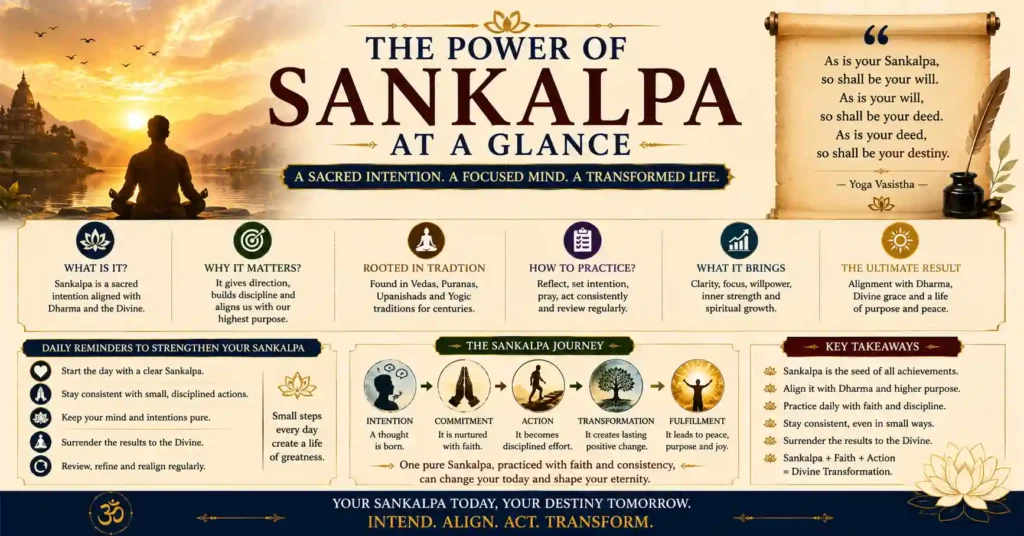
Sankalpa Is About Alignment, Not Control
One of the most important things to understand is that a Sankalpa is not a tool for controlling life. It is a practice of aligning your thoughts, intentions, and actions with the values you wish to live by.
Many people assume that a spiritual intention should guarantee a particular outcome. However, the teachings of Sankalpa in Sanatan Dharma emphasize inner transformation rather than control over external circumstances.
When a person’s inner state becomes more balanced, their actions often become wiser and more purposeful. Decisions are made with greater clarity, emotions become steadier, and responses become more thoughtful.
| Focus on Control | Focus on Alignment |
|---|---|
| Tries to force outcomes | Focuses on right intention and effort |
| Creates pressure and expectation | Encourages patience and trust |
| Depends on external results | Begins with inner transformation |
| Leads to frustration when things go wrong | Builds resilience and acceptance |
| Seeks certainty in every situation | Cultivates clarity and balance |
The wisdom of Sankalpa in Sanatan Dharma teaches that while we cannot control every event in life, we can influence how we think, act, and respond.
When thoughts, intentions, and actions become aligned, life often begins to feel more purposeful and harmonious. This change does not happen because circumstances are forced to follow our wishes. It happens because we learn to live with greater awareness, discipline, and trust.
That is the true Power of Sankalpa. Not controlling life, but aligning ourselves with a higher way of living.
How Sankalpa Creates Lasting Inner Change
The changes created by a sincere Sankalpa are often quiet and gradual. They may not be dramatic, but they can be deeply meaningful over time.
As a person continues practicing Sankalpa in Sanatan Dharma, small shifts often begin to appear in daily life. The mind becomes less reactive, emotions become easier to manage, and challenges feel less overwhelming.
| Change | How It Appears in Daily Life |
|---|---|
| Greater Patience | You pause before reacting impulsively. |
| Reduced Fear | Difficult situations feel less intimidating. |
| Stronger Trust | You worry less about things beyond your control. |
| Better Clarity | Decisions become more thoughtful and balanced. |
| Inner Strength | You handle challenges with greater resilience. |
| Emotional Stability | Ups and downs affect you less intensely. |
These changes do not happen because life suddenly becomes perfect. They happen because your inner response to life begins to change.
The wisdom of Sankalpa in Sanatan Dharma teaches that transformation starts within. When thoughts become clearer and intentions become stronger, actions naturally begin to reflect those changes.
Over time, many people notice a quiet confidence developing within themselves. They become less driven by fear, less controlled by circumstances, and more grounded in their values.
Nothing extraordinary may seem to happen on the surface. Yet something real is changing beneath it all.
That quiet inner transformation is one of the greatest gifts of a sincere Sankalpa.
From Sankalpa to Silence: The Deeper Journey Within
While a Sankalpa begins with words and intention, its deeper purpose is to bring the mind toward greater awareness and stillness.
In the beginning, a person may consciously repeat a chosen resolve to guide thoughts and actions. Over time, that intention becomes more natural, requiring less effort and creating a deeper sense of inner clarity.
The teachings of Sankalpa in Sanatan Dharma suggest that words are not the final destination. They are tools that help steady the mind and direct it toward a higher state of awareness.
| Stage | Purpose |
|---|---|
| Sankalpa | Creates conscious direction and intention |
| Reflection | Deepens understanding and self-awareness |
| Consistent Practice | Strengthens inner resolve and discipline |
| Inner Stillness | Reduces mental restlessness |
| Silence | Allows deeper connection with truth and the self |
There comes a point when the mind feels less scattered and more settled. The need for constant mental repetition decreases because the intention has already become part of one’s thinking and behavior.
This is where silence gains importance. In silence, the mind is no longer pulled in many directions. It becomes easier to observe, reflect, pray, and experience inner peace.
Words can help us reach that state. Silence helps us remain there.
In many ways, the deeper journey of Sankalpa in Sanatan Dharma is not simply about repeating positive intentions. It is about gradually moving from distraction to awareness, from restlessness to stillness, and from confusion to inner clarity.
Conclusion: The Lasting Power of Sankalpa in Sanatan Dharma
In the end, the purpose of Sankalpa in Sanatan Dharma is not to control the world around us. It is to transform the way we think, act, and experience life from within.
Every thought we repeatedly nurture leaves an impression on the mind. Over time, those impressions influence our beliefs, actions, habits, and ultimately the direction of our lives.
When the inner voice is dominated by fear, doubt, and negativity, life often feels heavier than it needs to be. But when that inner voice becomes calmer, clearer, and rooted in higher values, our experience of life begins to change.
The wisdom of Sankalpa in Sanatan Dharma teaches that lasting transformation starts with conscious intention. Small daily efforts, sincere self-reflection, and a steady inner resolve gradually strengthen character, deepen self-awareness, and bring greater emotional balance.
This journey is not about perfection. It is about progress. It is about choosing thoughts that support Dharma, faith, clarity, and inner growth.
As we have seen throughout this article, the true Power of Sankalpa lies not in forcing outcomes but in aligning ourselves with a higher way of living. When thoughts, intentions, and actions move in the same direction, life naturally becomes more purposeful and meaningful.
And perhaps that is the greatest gift of Sankalpa in Sanatan Dharma.
A quiet inner resolve that slowly transforms life from within, one thought, one choice, and one day at a time.
Key Takeaways
- Sankalpa is a conscious inner resolve that helps guide thoughts, actions, and personal growth.
- The practice of Sankalpa in Sanatan Dharma focuses on inner transformation rather than controlling external outcomes.
- Unlike desires, a Sankalpa is rooted in intention, self-discipline, and alignment with Dharma.
- A true Sankalpa is supported by Bhava (sincerity and feeling), not just mechanical repetition.
- Mantra and Sankalpa serve different purposes. Mantra helps purify and focus the mind, while Sankalpa provides direction and purpose.
- Small, consistent efforts often create deeper change than occasional bursts of motivation.
- Practicing a Sankalpa can improve mental clarity, emotional balance, self-awareness, and inner strength.
- During difficult times, a clear inner resolve helps cultivate patience, faith, and resilience.
- The ultimate goal of Sankalpa in Sanatan Dharma is to align thoughts, intentions, and actions with higher values and conscious living.
- Lasting transformation begins within. What we repeatedly nurture in the mind gradually shapes our character, habits, and life.
Suggested Reading
If the idea of Sanatan affirmations has touched you, going a little deeper into these topics can bring more clarity and inner understanding.
Each of these is connected to your inner journey and slowly helps you see life with more awareness and balance.
- How to Seek Forgiveness for Unintentional Sins in Sanatan Dharma (Scriptural View)
https://thesanatantales.com/seek-forgiveness-unintentional-sins - Atma and Parmatma: Understanding the Soul and the Supreme
https://thesanatantales.com/atma-and-paramatma - Why There Are Many Deities in Sanatan Dharma
https://thesanatantales.com/many-deities-in-sanatan-dharma - Detachment in Hindu Philosophy: The Deep Meaning of Vairagya and Inner Freedom
https://thesanatantales.com/vairagya-detachment - Sanatan Dharma Meaning: What Is Sanatan Dharma and Its Core Principles
https://thesanatantales.com/sanatan-dharma-meaning - Kaal in Sanatan Dharma: The Eternal Science of Time, Yugas and Cosmic Cycles
https://thesanatantales.com/kaal-in-sanatan-dharma - Spiritual Awakening: Meaning and Signs Beginners Often Experience
https://thesanatantales.com/spiritual-awakening - Does the Soul Choose Its Next Journey? The Mystery of Rebirth and Consciousness
https://thesanatantales.com/rebirth-and-soul-journey - What is Moksha: Meaning, Path and Spiritual Truth
https://thesanatantales.com/moksha-meaning - Vaitarni Nadi: What Happens After Death and How the Soul Crosses It
https://thesanatantales.com/vaitarni-nadi - Panchbhoota: The 5 Elements of Life and Their Deep Spiritual Meaning
https://thesanatantales.com/panchbhoota What is Sankalpa in Hinduism?
FAQs
What is Sankalpa in Sanatan Dharma?
A Sankalpa is a conscious inner resolve made with clarity, sincerity, and purpose. It is more than a wish or desire. It is a commitment to cultivate a particular quality, attitude, or direction in life.
The tradition of Sankalpa in Sanatan Dharma teaches that thoughts influence actions, and actions shape character. By choosing a meaningful intention and living according to it, a person gradually transforms from within.
What is the difference between Sankalpa and a desire?
A desire is usually focused on obtaining a specific result or experience. It often depends on external circumstances and outcomes.
A Sankalpa, on the other hand, focuses on how you choose to think, act, and live. Rather than saying, “I want this to happen,” a Sankalpa says, “I will cultivate this quality regardless of what happens.”
This is why Sankalpa is often considered a source of inner strength and stability.
Can Sankalpa help with personal growth?
Yes. One of the main purposes of Sankalpa in Sanatan Dharma is personal and spiritual growth.
A clear inner resolve helps a person develop qualities such as discipline, patience, courage, self-awareness, and emotional balance. Over time, these qualities influence daily decisions and behavior.
The change may be gradual, but consistent practice can create meaningful transformation in both personal and spiritual life.
Is Sankalpa the same as positive affirmations?
Not exactly.
Modern affirmations often focus on building confidence, motivation, or achieving specific goals. A Sankalpa may include positive thoughts, but its purpose is deeper.
A Sankalpa is rooted in Dharma, self-improvement, and inner transformation. It focuses on aligning thoughts and actions with higher values rather than simply attracting desired outcomes.
What is the difference between a mantra and a Sankalpa?
A mantra is a sacred sound, word, or phrase received through spiritual traditions and scriptures. It is often used for meditation, devotion, and purification of the mind.
A Sankalpa is a personal inner resolve chosen consciously by an individual. It provides direction and purpose for daily living.
Both can be practiced together. Mantra helps steady the mind, while Sankalpa helps guide thoughts and actions toward a meaningful goal.
How do I create a meaningful Sankalpa?
A meaningful Sankalpa should be simple, positive, and aligned with your values.
Instead of focusing only on external achievements, choose an intention that reflects the qualities you wish to develop. Examples include patience, faith, discipline, compassion, courage, or devotion.
The most effective Sankalpas are those that genuinely resonate with your heart and can be supported through daily action.
When is the best time to practice Sankalpa?
Many people prefer practicing Sankalpa during the early morning, especially during Brahma Muhurta, because the mind is naturally calmer and more receptive.
However, there is no fixed rule. A Sankalpa can also be practiced before prayer, meditation, japa, yoga, or before beginning an important task.
What matters most is regularity and sincerity rather than the specific time of day.
Can I have more than one Sankalpa at a time?
It is possible, but beginners often benefit from focusing on one primary Sankalpa.
Working with a single intention helps create greater clarity and consistency. Once that resolve becomes a natural part of daily life, additional intentions can be introduced if needed.
A focused mind usually progresses more effectively than a mind trying to work on many different goals at once.
How long does it take for a Sankalpa to show results?
There is no fixed timeline because every person is different.
The effects of a Sankalpa often appear gradually through changes in thinking, behavior, emotional responses, and daily habits. Many people notice increased self-awareness and clarity before they notice any external changes.
The teachings of Sankalpa in Sanatan Dharma emphasize patience, consistency, and trust in the process rather than seeking immediate results.
Why is Sankalpa important in spiritual life?
Spiritual growth requires direction as well as effort. Without a clear intention, the mind can easily become distracted by habits, emotions, and external influences.
A Sankalpa provides that direction. It reminds a person of the values, qualities, and spiritual goals they wish to cultivate.
For this reason, Sankalpa in Sanatan Dharma has long been associated with prayer, meditation, vows, self-discipline, and inner transformation. It serves as a bridge between spiritual understanding and daily living.
Glossary of Important Terms
| Term | Meaning |
|---|---|
| Sankalpa | A conscious inner resolve or sincere intention that guides thoughts, actions, and personal growth. |
| Sankalpa in Sanatan Dharma | The traditional practice of making a clear, purposeful inner commitment aligned with Dharma and spiritual values. |
| Dharma | Righteous living, duty, moral responsibility, and living in harmony with truth and higher principles. |
| Bhava | The feeling, sincerity, and emotional connection behind a thought, prayer, mantra, or spiritual practice. |
| Mantra | A sacred sound, word, or phrase received through spiritual traditions and repeated for concentration, devotion, and inner purification. |
| Atma | The eternal Self or soul that exists beyond the physical body and mind. |
| Bhakti | Loving devotion and surrender to the Divine. |
| Karma | The law of action and consequence, where thoughts, words, and deeds influence future experiences. |
| Japa | The repeated chanting or recitation of a mantra, often using a mala for spiritual focus. |
| Brahma Muhurta | The sacred period before sunrise considered highly beneficial for prayer, meditation, and spiritual practices. |
| Self-Awareness | The ability to observe one’s thoughts, emotions, habits, and actions with clarity and honesty. |
| Inner Resolve | A firm commitment to uphold a chosen value, intention, or spiritual goal despite challenges. |
| Spiritual Growth | The process of developing wisdom, self-awareness, devotion, and a deeper connection with the Divine. |
| Inner Peace | A state of mental calmness, emotional balance, and freedom from excessive worry or agitation. |
| Mental Clarity | The ability to think clearly, make balanced decisions, and understand situations without confusion. |
| Surrender | Trusting the Divine and accepting what is beyond one’s control while continuing to perform one’s duties sincerely. |
| Prasad | Literally “grace” or “blessed offering.” Spiritually, it can also refer to accepting life’s experiences with gratitude and trust. |
| Inner Transformation | The gradual change of thoughts, attitudes, habits, and character through conscious effort and spiritual practice. |
| Divine | A term used to describe God, Bhagwan, Ishvara, or the higher spiritual reality in Sanatan Dha |
About the Author
Yateendra Chaturvedi is a spiritual writer, researcher, devotee, and the founder of The Sanatan Tales. With over 35 years of professional experience and a lifelong interest in Sanatan Dharma, he writes about Hindu deities, temples, scriptures, festivals, Mahavidyas, sacred stories, rituals, and living traditions that continue to guide and inspire devotees across India.
Drawing from traditional scriptures, regional beliefs, temple traditions, devotional literature, and historical sources, he aims to present authentic, well-researched, and easy-to-understand content for modern readers. His work focuses on preserving spiritual wisdom, explaining sacred traditions, and helping seekers develop a deeper understanding of India’s rich spiritual heritage.
Through The Sanatan Tales, Yateendra strives to make the timeless teachings of Sanatan Dharma simple, meaningful, and relevant for today’s generation while maintaining respect for traditional sources, regional practices, and diverse spiritual perspectives.
Learn More About Yateendra Chaturvedi →
https://thesanatantales.com/about-the-author/
References & Sources
This article is based on concepts, values, and practices associated with Sanatan Dharma, including traditional teachings related to Sankalpa (inner resolve), self-discipline, spiritual growth, devotion, meditation, and mindful living. It draws upon widely accepted principles found in Hindu philosophy, devotional traditions, yogic teachings, and the spiritual wisdom that has been preserved through scriptures, teachers, communities, and lived practice across generations.
Note: Interpretations, practices, and methods of applying Sankalpa may vary among different sampradayas, spiritual traditions, teachers, and individual practitioners within Sanatan Dharma. The purpose of this article is not to present any single approach as the only valid path, but to explain commonly understood principles in a simple, practical, and reader-friendly manner. Sanatan Dharma embraces diverse paths of self-improvement, devotion, knowledge, meditation, and inner transformation, allowing individuals to progress according to their own nature and spiritual journey.
Explore More Fascinating Topics from Sanatan Dharma