
Detachment in Hindu Philosophy is a timeless teaching of Sanatan Dharma that helps people find peace while living a full and meaningful life. The search for inner freedom often begins when expectations become heavy, emotions feel overwhelming, or the fear of loss starts disturbing the mind.
Many people think detachment means giving up family, work, or worldly responsibilities. In reality, Hindu philosophy teaches something very different. It encourages us to live fully while remaining free from unhealthy attachment, excessive desire, and constant fear.
According to Sanatan Dharma, suffering does not arise from life itself but from clinging to people, possessions, success, identities, and outcomes. The Sanskrit term Vairagya explains this wisdom as the ability to remain inwardly free while performing one’s duties with sincerity.
A detached person still loves, works, earns, plans, and cares for others. The difference lies within. Success does not inflate the ego, failure does not break the spirit, and changing circumstances do not disturb inner balance.
In this article, you will learn the meaning of detachment in Hindu philosophy, the concept of Vairagya, its connection with the Bhagavad Gita and Karma Yoga, common misconceptions, practical ways to practice detachment in daily life, and how it leads to lasting inner peace and spiritual growth.
Table of Contents
ToggleDetachment in Hindu Philosophy at a Glance
| Aspect | Details |
|---|---|
| Sanskrit Term | Vairagya |
| Meaning | Freedom from unhealthy attachment and excessive desire |
| Core Teaching | Perform duties without attachment to the results |
| Primary Scripture | Bhagavad Gita |
| Related Concepts | Dharma, Karma Yoga, Bhakti, Moksha |
| Purpose | Inner peace, emotional balance, and spiritual growth |
| Applies To | Family life, career, relationships, and spiritual practice |
What Is Detachment in Hindu Philosophy?
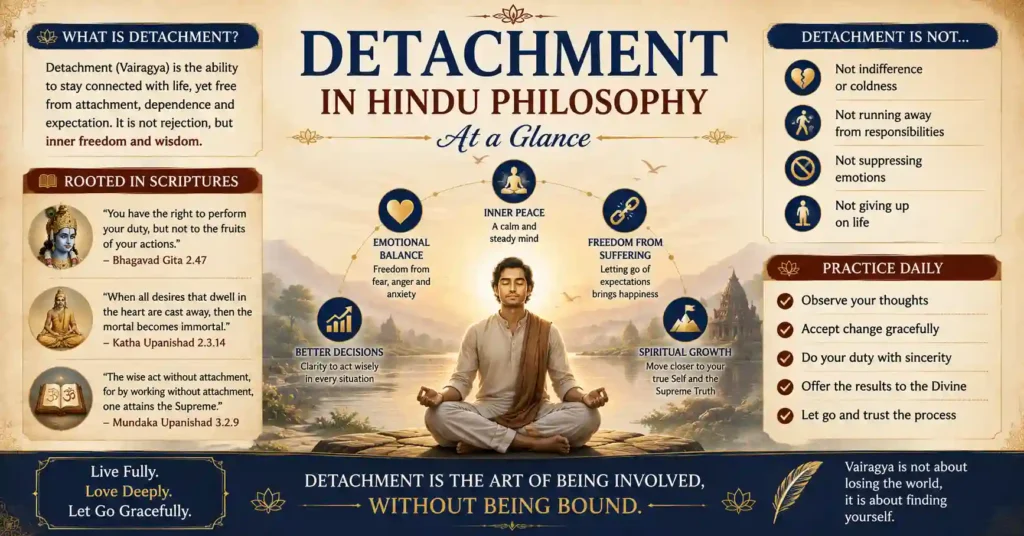
Detachment in Hindu Philosophy does not mean withdrawing from life or avoiding responsibilities. Instead, it is the inner freedom to live fully without becoming controlled by attachment, desire, fear, or the constant need for specific outcomes.
In Sanatan Dharma, this state of inner freedom is known as Vairagya. It teaches that while we should perform our duties with sincerity and compassion, our peace should not depend on success, possessions, praise, or external circumstances.
Attachment binds the mind to expectations and creates anxiety when life does not unfold as planned. Detachment, on the other hand, allows a person to act with clarity, wisdom, and emotional balance while accepting change as a natural part of life.
This does not make a person indifferent or emotionally distant. A detached person continues to love, serve, work, and build relationships, but without possessiveness or fear of loss. Such freedom helps transform ordinary actions into opportunities for personal and spiritual growth.
Key Characteristics of Detachment
- Performing duties without attachment to results.
- Loving others without possessiveness.
- Accepting success and failure with balance.
- Remaining calm during life’s changing circumstances.
- Focusing on right action instead of personal gain.
This is the true meaning of Detachment in Hindu Philosophy. It is not about escaping the world but about living in it with wisdom, balance, and lasting inner peace.
Vairagya: The Foundation of Detachment in Hindu Philosophy
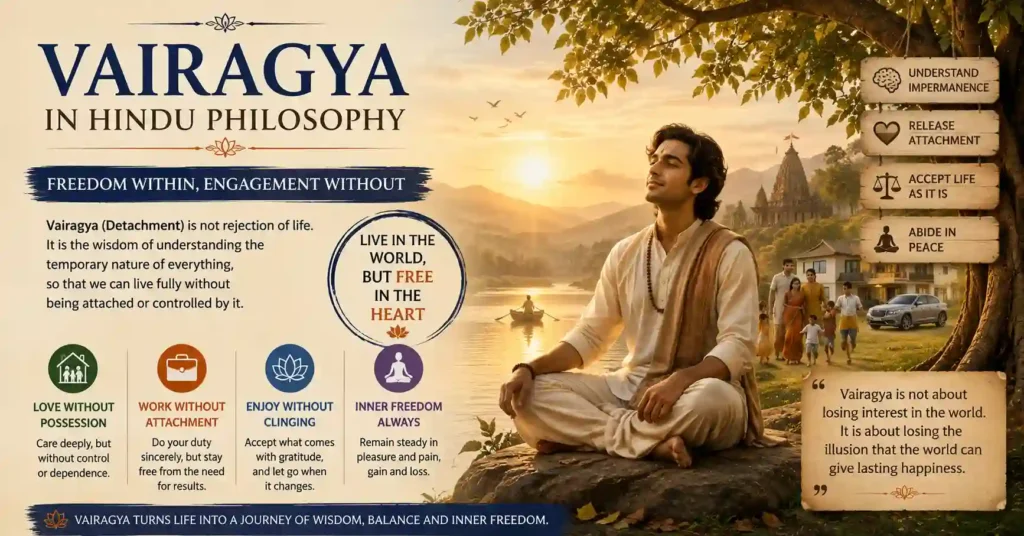
Detachment in Hindu Philosophy is known as Vairagya, a Sanskrit word derived from Vi (without) and Raga (attachment, passion, or excessive attraction). Hindu philosophy also speaks of Dvesha, meaning aversion or dislike. True Vairagya is freedom from both attachment and aversion, allowing the mind to remain calm and balanced in every situation.
It does not mean giving up life or becoming emotionally cold. Instead, it is the wisdom to experience life fully without becoming emotionally dependent on external circumstances for lasting happiness.
Vairagya develops through the understanding that everything in the material world is temporary. Wealth, success, relationships, praise, and even difficulties change with time. Recognizing this impermanence helps a person remain steady instead of being carried away by excitement or despair.
A person practising Vairagya continues to fulfil family, professional, and social responsibilities with sincerity. Joy is appreciated without becoming an obsession, and pain is accepted without allowing it to dominate the mind. This balanced approach brings emotional stability, inner freedom, and greater self-awareness.
In Sanatan Dharma, Vairagya is not about rejecting the world but about transforming one’s relationship with it. Instead of seeking lasting happiness from external circumstances, a person learns to discover lasting peace within while continuing to perform Dharma and selfless actions.
This deeper understanding of Vairagya reveals that Detachment in Hindu Philosophy is not an escape from the world. Instead, it is the wisdom to live with balance, gratitude, and freedom from unhealthy attachment.
Does Detachment Mean Giving Up Family and Worldly Life?
One of the most common misunderstandings about Detachment in Hindu Philosophy is that it requires abandoning family, relationships, or worldly responsibilities. In reality, Sanatan Dharma honours the Grihastha Ashrama (householder stage) and teaches that spiritual growth is possible while living an active family and social life.
Detachment is not about changing your external role. It is about changing your inner attitude towards that role. A person can be a loving parent, a caring spouse, a dedicated professional, or a responsible citizen without becoming emotionally dependent on people or outcomes.
True Vairagya allows love to become purer because it is free from possessiveness, fear, and the desire to control others. Instead of expecting people to fulfil every expectation, a detached person learns to love with compassion, respect, and acceptance.
The Bhagavad Gita teaches that individuals should perform their Dharma with sincerity while remaining unattached to personal rewards or emotional attachment to results. This balance enables a person to fulfil responsibilities wholeheartedly without losing inner peace.
In Sanatan Dharma, detachment is not about leaving the world. It is about living in the world with wisdom, performing one’s duties selflessly, and finding lasting happiness that does not depend on changing circumstances.
Why Is Detachment Important in Hindu Philosophy?
Detachment is important in Hindu Philosophy because it helps reduce mental suffering and brings lasting inner peace. When the mind becomes attached to people, possessions, success, or expectations, it is easily disturbed by change, loss, and disappointment.
Without Vairagya, the mind constantly swings between desire and frustration, pride and guilt, hope and fear. This emotional instability clouds judgment, weakens inner strength, and makes it difficult to experience true happiness.
As detachment develops, a person learns to accept both success and failure with balance. Praise does not inflate the ego, criticism does not destroy confidence, and changing circumstances no longer control one’s state of mind.
Detachment also strengthens decision-making. Instead of reacting emotionally, a person responds with patience, wisdom, and clarity. This balanced outlook improves relationships, reduces stress, and helps one perform duties more effectively.
From a spiritual perspective, Detachment in Hindu Philosophy prepares the mind for self-realization. By gradually reducing attachment to temporary pleasures and outcomes, one moves closer to understanding the true nature of the Self and experiences the lasting benefits of Detachment in Hindu Philosophy.
| Without Detachment | With Detachment |
|---|---|
| Constant anxiety about results | Peace while performing duties |
| Emotional highs and lows | Steady and balanced mind |
| Fear of loss and failure | Acceptance of change |
| Attachment to praise and success | Humility and inner confidence |
| Stress and mental unrest | Clarity, resilience, and lasting peace |
Benefits of Practising Detachment
Practising detachment brings benefits that extend far beyond spiritual life. It improves emotional well-being, strengthens relationships, enhances decision-making, and helps a person remain calm during life’s inevitable ups and downs.
As attachment gradually reduces, the mind becomes less influenced by fear, anger, jealousy, and unrealistic expectations. This creates space for clarity, gratitude, and lasting contentment.
Over time, the practice of Vairagya helps develop a balanced personality that can face both opportunities and challenges with wisdom and confidence.
| Area of Life | Benefits of Detachment |
|---|---|
Mental | Reduces stress, anxiety, and emotional overwhelm. |
| Relationships | Encourages unconditional love, trust, and forgiveness. |
| Career and Work | Improves focus, resilience, and decision-making without fear of failure. |
| Personal Growth | Reduces ego and develops patience, humility, and self-awareness. |
| Spiritual Life | Supports Karma Yoga, meditation, and progress towards self-realization and Moksha. |
Detachment does not remove happiness from life. Instead, it frees a person from unnecessary suffering, allowing them to enjoy success with gratitude, face challenges with courage, and live with lasting inner peace.
Detachment vs. Indifference in Hindu Philosophy
Detachment and indifference are often confused, but they are fundamentally different. Detachment in Hindu Philosophy comes from wisdom and inner balance, whereas indifference arises from emotional withdrawal, apathy, or a lack of concern.
A detached person experiences love, joy, sorrow, and compassion just like everyone else. The difference is that these emotions do not control their thoughts or actions. Instead of reacting impulsively, they respond with patience, understanding, and self-awareness.
Indifference, on the other hand, creates emotional distance. It often leads to neglect, lack of empathy, and unwillingness to support others. Detachment never asks a person to stop caring. It teaches them to care deeply without becoming possessive, fearful, or emotionally dependent.
In Sanatan Dharma, Vairagya makes relationships healthier because love is guided by compassion rather than attachment. A detached person serves others selflessly, accepts change gracefully, and remains calm even during difficult situations.
Simply put, detachment makes the heart steady, while indifference makes it distant.
| Detachment (Vairagya) | Indifference |
|---|---|
| Based on wisdom and self-awareness | Based on emotional withdrawal |
| Cares deeply without attachment | Shows little or no concern |
| Accepts change with balance | Avoids emotional involvement |
| Acts with compassion and responsibility | Often ignores responsibilities |
| Leads to inner peace and spiritual growth | Can weaken relationships and empathy |
The Role of Detachment in Spiritual Growth
Detachment plays a central role in spiritual growth because it prepares the mind for wisdom, self-awareness, and inner peace. In Sanatan Dharma, a restless mind cannot clearly understand the true nature of the Self.
When the mind is filled with attachment, it is constantly pulled outward by desires, fears, expectations, and endless distractions. This leaves little space for reflection, meditation, and spiritual understanding.
As Vairagya gradually develops, awareness becomes clearer, the ego begins to weaken, and the mind naturally grows calmer. Wisdom does not need to be forced. It arises naturally when the mind is no longer crowded by constant cravings and emotional reactions.
Hindu philosophy also explains that the mind is influenced by the three Gunas: Sattva, Rajas, and Tamas. Rajas creates restlessness and endless desires, Tamas leads to ignorance and inertia, while Sattva brings clarity, balance, and wisdom. As Sattva increases through spiritual practice, Vairagya develops naturally, making the mind better prepared for meditation and Self-realization.
A detached mind is better prepared to follow Dharma, practise Karma Yoga, deepen Bhakti, and move towards Moksha, the highest goal of human life.
How Detachment Supports Spiritual Growth
- Brings mental clarity and emotional balance.
- Reduces the influence of ego, attachment, and desire.
- Improves focus during prayer, meditation, and self-reflection.
- Encourages selfless action without attachment to results.
- Cultivates compassion, humility, patience, and inner contentment.
- Gradually prepares the seeker for self-realization and lasting inner freedom.
Ultimately, detachment is not about withdrawing from the world. It is an inner discipline that allows spiritual wisdom to blossom while living a responsible, compassionate, and meaningful life.
What Hindu Scriptures Say About Detachment
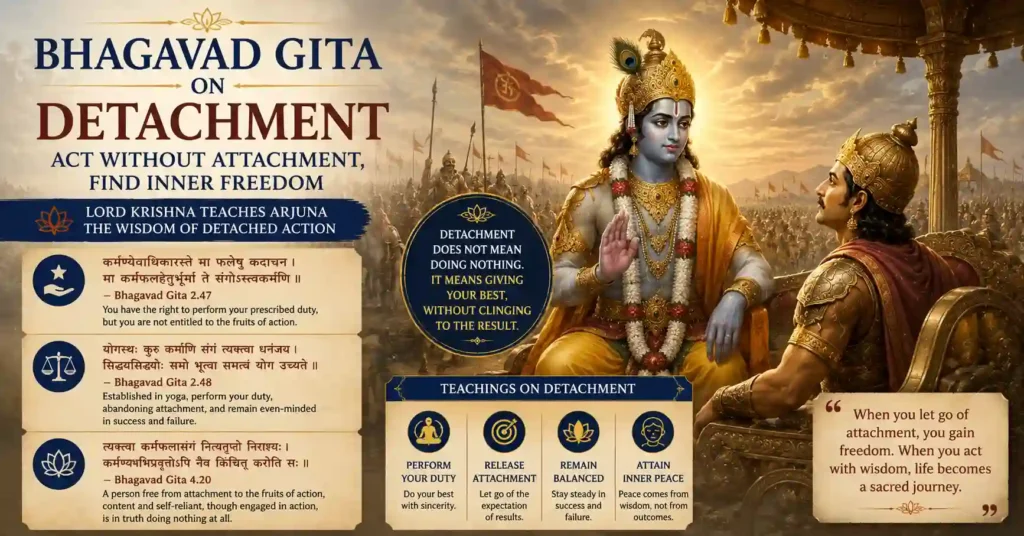
Hindu scriptures consistently describe detachment as an essential quality for a peaceful and spiritually fulfilling life. Rather than encouraging people to abandon the world, they teach how to perform one’s duties with sincerity while remaining free from attachment to results.
The Bhagavad Gita presents one of the clearest teachings on detachment through Karma Yoga. In Bhagavad Gita 2.47, Lord Krishna teaches that every person has the right to perform their duty but should not become attached to the fruits of their actions. This wisdom encourages selfless action while maintaining inner peace regardless of success or failure.
The Upanishads also describe detachment as a sign of spiritual maturity. The Isha Upanishad teaches that everything in the universe belongs to the Divine and should be enjoyed without possessiveness. The Katha Upanishad encourages seekers to choose the path of lasting good over temporary pleasures, while the Mundaka Upanishad explains that true freedom arises when attachment naturally falls away through the realization of the eternal Atman (Self).
Together, these teachings remind us that lasting happiness cannot be found in temporary possessions or worldly achievements. True peace comes from recognizing the eternal nature of the Self and gradually becoming free from excessive attachment to material life.
Across the Hindu tradition, saints and sages have regarded Vairagya as the foundation of wisdom. They explain that detachment does not reduce love or compassion. Instead, it removes fear, ego, and possessiveness, allowing a person to live with greater clarity and inner freedom.
Key Scriptural Teachings on Detachment
| Scripture | Teaching |
|---|---|
| Bhagavad Gita | Perform your duty without attachment to the results (Karma Yoga). |
| Upanishads | True happiness comes from realizing the eternal Self, not temporary possessions. |
| Teachings of Hindu sages | Vairagya frees the mind from ego, fear, and unhealthy attachment, leading to inner peace. |
These teachings show that Detachment in Hindu Philosophy is not about giving up life. It is about performing every action with wisdom, selflessness, and inner balance while remaining focused on spiritual growth.
Different schools of Vedanta also emphasize the importance of detachment. Advaita Vedanta explains that Vairagya arises through the realization of the eternal Self. Vishishtadvaita teaches that detachment grows through loving surrender to the Divine, while Dvaita Vedanta encourages detachment through devotion, humility, and complete faith in God. Although their approaches differ, all agree that Vairagya is essential for spiritual progress.
Can You Be Successful and Detached at the Same Time?
Yes. Detachment in Hindu Philosophy does not reject success, wealth, or material stability. Sanatan Dharma teaches that there is nothing wrong with achieving goals or enjoying the fruits of honest effort. The problem arises only when success becomes the source of one’s identity, happiness, or self-worth.
A detached person works with dedication, accepts responsibility, and gives their best in every situation. They strive for excellence, but their peace of mind does not depend entirely on the outcome.
When success comes, it is accepted with gratitude and humility. When failure occurs, it becomes an opportunity to learn rather than a reason to lose confidence. This balanced mindset allows a person to remain motivated without becoming anxious or consumed by ambition.
The Bhagavad Gita teaches that we should focus on performing our Dharma sincerely while leaving the results to unfold naturally. This approach encourages hard work, resilience, and inner peace at the same time.
| Attachment to Success | Detached Success |
|---|---|
| Self-worth depends on achievements | Self-worth comes from character and values |
| Fear of failure creates stress | Failure is accepted as part of growth |
| Success increases ego | Success brings gratitude and humility |
| Constant anxiety about results | Focus remains on sincere effort |
| Happiness depends on outcomes | Peace remains steady in every situation |
Detachment in Hindu Philosophy does not reduce ambition. Instead, it transforms ambition into purposeful action, allowing a person to achieve success without losing inner balance or peace.
How Detachment Affects Emotions in Daily Life
One of the greatest benefits of Detachment in Hindu Philosophy is emotional balance. It does not ask a person to suppress emotions. Instead, it teaches how to experience joy, sorrow, success, and disappointment without allowing them to control the mind.
A detached person still feels happiness when good things happen and sadness during difficult times. The difference is that these emotions are accepted with awareness instead of becoming overwhelming or lingering for too long.
Over time, Vairagya strengthens emotional resilience. Fear gradually reduces, anger becomes easier to manage, and anxiety gives way to patience, clarity, and self-control. Instead of reacting impulsively, a person learns to respond with wisdom and calmness.
This inner steadiness also improves relationships. When the mind is free from excessive attachment, love becomes more selfless, forgiveness becomes easier, and disagreements are handled with greater understanding and compassion.
How Detachment Improves Emotional Well-being
- Brings calm during stressful situations.
- Reduces fear, anxiety, and emotional dependence.
- Helps maintain balance during success and failure.
- Encourages patience and thoughtful decision-making.
- Builds resilience in the face of life’s challenges.
- Promotes healthier relationships and lasting inner peace.
Detachment does not make a person emotionless. Instead, it helps them experience every emotion with wisdom, allowing the heart to remain compassionate while the mind stays calm, balanced, and free from unnecessary suffering.
Signs of a Truly Detached Person
Understanding the qualities of a detached person makes the concept of Vairagya easier to apply in everyday life. Detachment is reflected not by outward appearance but by the way a person thinks, responds, and lives.
A truly detached person continues to fulfil responsibilities with sincerity while remaining calm during success and failure. Their happiness comes from inner contentment rather than changing circumstances.
Signs of a Detached Person
- Remains calm during both success and failure.
- Performs duties without expecting recognition or rewards.
- Loves others without possessiveness or the desire to control.
- Accepts change without excessive fear or resistance.
- Forgives easily and does not hold on to resentment.
- Makes decisions with wisdom instead of emotional impulses.
- Lives with gratitude rather than constant dissatisfaction.
- Seeks inner peace instead of temporary pleasures.
These qualities do not develop overnight. They grow gradually through self-awareness, Karma Yoga, prayer, meditation, and the regular practice of Vairagya, leading to greater emotional balance and spiritual maturity.
How to Practice Detachment in Everyday Life
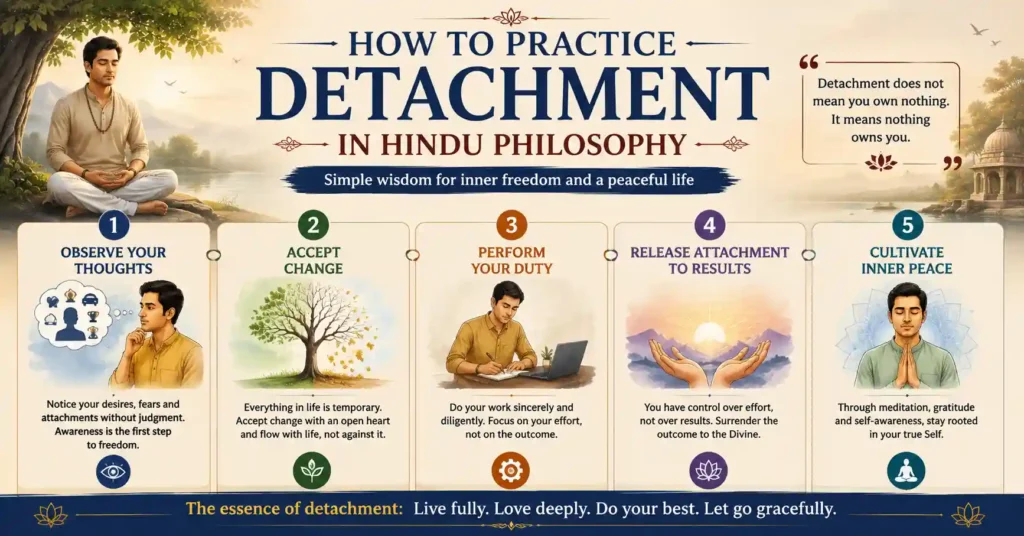
Detachment begins with self-awareness. By observing your thoughts, emotions, and reactions, you gradually recognize where attachment, fear, or unrealistic expectations are influencing your mind. This awareness is the first step towards developing Vairagya.
Accepting that change is a natural part of life also helps reduce resistance and unnecessary suffering. Instead of trying to control every situation, learn to focus on your actions while accepting that results are not always within your control.
Another important practice is performing your duties sincerely without constantly expecting praise, success, or specific outcomes. This reflects the principle of Karma Yoga, where sincere effort is valued more than attachment to results.
Over time, gratitude begins to replace possessiveness, and trust replaces the need to control everything. Through regular self-reflection, prayer, meditation, and mindful living, detachment develops naturally. It is a gradual inner transformation, not something that can be forced overnight.
Simple Ways to Practice Detachment
- Observe your thoughts without judging them.
- Accept change as a natural part of life.
- Perform your duties with sincerity and selflessness.
- Let go of excessive expectations from people and situations.
- Practise gratitude for what you have today.
- Spend time in prayer, meditation, or self-reflection every day.
Practising these habits gradually brings emotional balance, stronger relationships, and lasting inner peace, making Detachment in Hindu Philosophy a practical way of life rather than a distant spiritual ideal.
A Simple Daily Reflection on Detachment
At the end of each day, take a few quiet moments to reflect on your thoughts and actions. Ask yourself whether you acted out of love, wisdom, and duty, or whether fear, ego, or attachment influenced your decisions.
Do not judge yourself harshly. The purpose of this reflection is not to feel guilty but to become more aware. Every moment of awareness is a step towards greater inner freedom.
Ask Yourself
- Did I become upset because things did not go as I expected?
- Was I seeking appreciation or recognition for my actions?
- Did I react with anger, fear, or possessiveness?
- Could I have responded with more patience and understanding?
- What attachment can I gradually let go of tomorrow?
A few minutes of honest self-reflection each day can slowly cultivate Vairagya, bringing greater peace, emotional balance, and spiritual growth over time.
Common Obstacles to Practising Detachment
Although the idea of detachment sounds simple, practising it is often challenging. Human nature naturally forms attachments to people, possessions, achievements, and expectations. Recognizing these obstacles is the first step towards overcoming them.
Many people struggle because they mistake attachment for love or believe that letting go means becoming indifferent. In reality, true detachment strengthens emotional maturity and inner peace.
Common Challenges
- Fear of losing loved ones or material possessions.
- Constant desire for recognition and approval.
- Unrealistic expectations from people and situations.
- Difficulty accepting change or uncertainty.
- Strong identification with success, failure, or social status.
- Attachment to past experiences and painful memories.
These challenges can be gradually overcome through self-awareness, regular meditation, prayer, selfless service, and the practice of Vairagya. Detachment is a lifelong journey that develops with patience and sincere effort.
Detachment and Karma
Detachment is deeply connected to the law of Karma. In Sanatan Dharma, every action creates an impression on the mind, but it is attachment to the results that often strengthens these karmic bonds and leads to further suffering.
The Bhagavad Gita teaches that people should perform their duties sincerely without becoming attached to success, failure, praise, or reward. This principle, known as Karma Yoga, encourages selfless action while maintaining inner peace.
This practice is also known as Nishkama Karma, which means performing one’s duties without selfish attachment to the fruits of action. Rather than avoiding work, it transforms ordinary actions into a form of spiritual practice by replacing ego and expectation with sincerity, surrender, and devotion.
When actions are performed with a selfish motive or a constant desire for specific outcomes, the mind becomes restless and emotionally burdened. In contrast, actions performed with detachment are free from anxiety, allowing a person to fulfil responsibilities with greater clarity and balance.
Detached action does not mean careless action. It means giving your best effort while accepting that the final result is influenced by many factors beyond your control. This mindset reduces stress, strengthens resilience, and promotes spiritual growth.
How Detachment Changes Karma
- Encourages selfless action instead of selfish desire.
- Reduces anxiety about success and failure.
- Helps perform duties with sincerity and responsibility.
- Prevents the ego from becoming attached to achievements.
- Supports inner peace and gradual spiritual progress.
By practising Karma Yoga with the spirit of Vairagya, a person learns to act with dedication while remaining free from unnecessary attachment. This balanced approach reflects the essence of Detachment in Hindu Philosophy and gradually leads to greater inner freedom, wisdom, and spiritual clarity.
Why Detachment Is Often Misunderstood
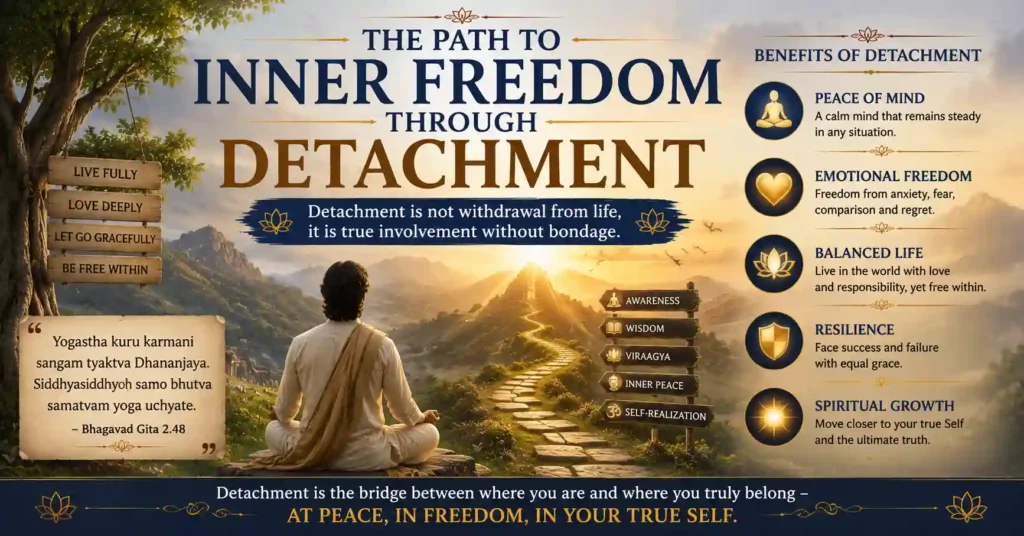
Detachment is often misunderstood because many people confuse it with renunciation, emotional distance, or a lack of responsibility. Popular images of spirituality often portray detached people as withdrawing from family, society, or worldly life, creating unnecessary confusion.
In reality, Detachment in Hindu Philosophy teaches the opposite. It encourages people to live fully, fulfil their Dharma, care for others, and perform their responsibilities with sincerity, while remaining free from unhealthy attachment, fear, and possessiveness.
True Vairagya is an inner discipline, not an outer rejection of life. It transforms the way a person thinks and responds to situations without requiring them to abandon their family, career, or social responsibilities.
Common Misconceptions About Detachment
- Detachment does not mean renouncing family or society.
- Detachment does not mean suppressing emotions.
- Detachment does not mean giving up success or ambition.
- Detachment does not mean becoming cold or indifferent.
- Detachment means living with wisdom, balance, and inner freedom.
When understood correctly, Detachment in Hindu Philosophy strengthens life rather than shrinking it. It helps a person love more deeply, serve more selflessly, and face life’s changes with courage, peace, and emotional balance.
Key Takeaways
Before you leave, here are the most important lessons to remember about Detachment in Hindu Philosophy:
- Detachment means inner freedom, not escaping from life.
- Vairagya teaches freedom from unhealthy attachment, not a lack of love or compassion.
- Sanatan Dharma encourages fulfilling family, work, and social responsibilities with sincerity.
- The Bhagavad Gita teaches performing one’s Dharma without attachment to the results.
- Detachment brings emotional balance, reduces stress, and strengthens relationships.
- Regular self-awareness, Karma Yoga, prayer, and meditation help develop detachment over time.
- True detachment prepares the mind for self-realization and ultimately supports the journey towards Moksha.
These timeless teachings remind us that lasting peace comes not from controlling the world around us but from transforming our relationship with it.
Conclusion
Detachment in Hindu Philosophy is not about rejecting the world or becoming emotionally distant. According to Sanatan Dharma, it is the wisdom to live fully while remaining free from unhealthy attachment, fear, and the constant need to control outcomes.
Through the practice of Vairagya, a person learns to love without possessiveness, perform duties without attachment to results, and accept life’s changes with courage and inner balance. This approach transforms everyday experiences into opportunities for personal and spiritual growth.
As attachment gradually loosens, the mind becomes calmer, the ego weakens, and lasting peace begins to emerge. This inner freedom is the true essence of detachment and one of the timeless teachings of Hindu philosophy.
As this wisdom deepens, it gradually prepares the seeker for Jivanmukti, the state of liberation while living. In this state, a person continues to fulfil worldly responsibilities while remaining inwardly free from attachment, ego, and fear.
Whether you are seeking emotional balance, stronger relationships, or spiritual growth, practising Detachment in Hindu Philosophy can help you live with greater clarity, compassion, and purpose. It is not a path of withdrawal but a path to lasting inner freedom.
Suggested Reading
Understanding Detachment in Hindu Philosophy becomes even more meaningful when explored alongside other core teachings of Sanatan Dharma. These related articles expand your understanding of Detachment in Hindu Philosophy through topics such as Karma, Dharma, Vairagya, Atman, Shakti, and Moksha.
The following articles will help you deepen your understanding of Vairagya, Karma, Dharma, the Self (Atman), Shakti, time, and the spiritual principles that lead to inner freedom and self-realization.
- Karma: Meaning, Types, Philosophy and How It Works in Sanatan Dharma
https://thesanatantales.com/karma-meaning-types-and-how-it-works/ - Atma and Parmatma: Meaning, Relationship and Their Role in Sanatan Dharma
https://thesanatantales.com/atma-and-parmatma/ - Forgiveness for Unintentional Sins in Sanatan Dharma: Meaning, Karma and Scriptural Remedies
https://thesanatantales.com/forgiveness-for-unintentional-sins-in-sanatan-dharma/ - Shakti in Sanatan Dharma: Meaning, Forms, Philosophy and Spiritual Significance
https://thesanatantales.com/shakti-in-sanatan-dharma/ - Kaal in Sanatan Dharma: The Eternal Science of Time, Yugas and Cosmic Cycles
https://thesanatantales.com/kaal-in-sanatan-dharma/ - Sanatan Dharma Meaning: What Is Sanatan Dharma and Its Core Principles
https://thesanatantales.com/sanatan-dharma-meaning/ - Why Do Hindus Have So Many Gods? The Truth Behind Many Deities in Sanatan Dharma
https://thesanatantales.com/why-do-hindus-have-so-many-gods/ Detachment (Wikipedia)
FAQs
What is detachment in Hindu Philosophy?
Detachment in Hindu Philosophy is the practice of living with inner freedom while fulfilling one’s responsibilities. It does not mean rejecting the world, suppressing emotions, or abandoning family and work.
In Sanatan Dharma, detachment is known as Vairagya. It teaches that a person should perform every duty with sincerity but avoid becoming emotionally dependent on success, possessions, relationships, or specific outcomes. This balanced approach helps reduce suffering and leads to greater peace, wisdom, and spiritual growth.
Is detachment the same as renunciation?
No. Detachment and renunciation are not the same.
Renunciation usually refers to giving up worldly possessions or a particular way of life. Detachment, however, is an inner attitude. A person may live with family, pursue a career, earn wealth, and fulfil social responsibilities while remaining detached from excessive attachment and ego.
Sanatan Dharma teaches that true spiritual progress depends more on the state of the mind than on external appearance or lifestyle.
What is Vairagya in Sanatan Dharma?
Vairagya is the Sanskrit term for detachment. It means freedom from unhealthy attachment, selfish desire, and emotional dependence rather than a lack of love or compassion.
A person practising Vairagya continues to enjoy life’s blessings but understands that everything in the material world is temporary. This wisdom allows them to remain calm during success and failure, praise and criticism, gain and loss.
Vairagya is considered one of the essential qualities for spiritual growth and self-realization.
Does the Bhagavad Gita teach detachment?
Yes. The Bhagavad Gita places great emphasis on detachment through the practice of Karma Yoga.
Lord Krishna teaches Arjuna to perform his duty sincerely without becoming attached to the results of his actions. This does not discourage ambition or effort. Instead, it encourages selfless action, inner balance, and trust in the divine order.
The Gita explains that peace comes not from controlling every outcome but from performing righteous actions with sincerity and equanimity.
Can a married person practise detachment?
Absolutely. Sanatan Dharma does not reserve detachment only for monks or ascetics.
The Grihastha Ashrama (householder stage) is considered a sacred part of life where spiritual growth takes place through family, work, and service. A married person can practise detachment by loving deeply without possessiveness, performing responsibilities without selfish expectations, and accepting life’s changes with patience and faith.
Detachment strengthens relationships because it replaces control with understanding and compassion.
How can I practise Detachment in Hindu Philosophy in daily life?
Detachment in Hindu Philosophy develops gradually through regular self-awareness and mindful living. It is not achieved overnight.
Simple daily practices include observing your thoughts without reacting impulsively, accepting change as a natural part of life, performing your duties sincerely, reducing unrealistic expectations, practising gratitude, and spending time in prayer, meditation, or self-reflection.
Over time, these habits cultivate emotional balance, resilience, and lasting inner peace.
Does detachment mean becoming emotionless?
No. This is one of the biggest misconceptions about detachment.
A detached person experiences love, joy, grief, and compassion just like everyone else. The difference is that emotions are experienced with awareness instead of taking complete control of the mind.
Detachment makes a person emotionally stronger, not emotionally distant. It allows compassion without possessiveness and love without fear of loss.
How does detachment help in spiritual growth?
Detachment prepares the mind for spiritual wisdom by reducing the influence of ego, attachment, and constant desire.
As the mind becomes calmer, it is easier to practise meditation, understand the teachings of Sanatan Dharma, and perform selfless actions. This inner transformation supports the path of Dharma, Karma Yoga, Bhakti, and ultimately Moksha.
For this reason, Hindu scriptures describe detachment as an essential step towards self-realization and lasting inner freedom.
Glossary of Important Terms in Detachment in Hindu Philosophy
| Term | Meaning |
|---|---|
| Atman | The eternal Self or soul that exists beyond the physical body and mind. Realizing the Atman is the ultimate goal of spiritual life in Sanatan Dharma. |
| Bhagavad Gita | A sacred Hindu scripture in which Lord Krishna teaches Arjuna about Dharma, Karma Yoga, detachment, devotion, and self-realization. |
| Bhakti | The path of loving devotion to the Divine through prayer, worship, faith, and surrender. |
| Dharma | Righteous duty, moral responsibility, and the way of living in harmony with truth and the universal order. |
| Karma | The universal law of cause and effect, where every thought, word, and action creates future consequences. |
| Karma Yoga | The practice of performing one’s duties selflessly without attachment to the results of actions. |
| Moksha | Liberation from the cycle of birth and death (Samsara) and the realization of one’s true Self. |
| Samsara | The continuous cycle of birth, death, and rebirth through which the soul evolves until attaining Moksha. |
| Self-Realization | The direct experience of one’s true identity as the eternal Atman rather than the body, mind, or ego. |
| Vairagya | A Sanskrit term meaning detachment or freedom from unhealthy attachment and excessive desire. It is the foundation of inner peace and spiritual growth in Hindu philosophy. |
About the Author
Yateendra Chaturvedi is a spiritual writer, researcher, devotee, and the founder of The Sanatan Tales. With over 35 years of professional experience and a lifelong interest in Sanatan Dharma, he writes about Hindu deities, temples, scriptures, festivals, Mahavidyas, sacred stories, rituals, and living traditions that continue to guide and inspire devotees across India.
Drawing from traditional scriptures, regional beliefs, temple traditions, devotional literature, and historical sources, he aims to present authentic, well-researched, and easy-to-understand content for modern readers. His work focuses on preserving spiritual wisdom, explaining sacred traditions, and helping seekers develop a deeper understanding of India’s rich spiritual heritage.
Through The Sanatan Tales, Yateendra strives to make the timeless teachings of Sanatan Dharma simple, meaningful, and relevant for today’s generation while maintaining respect for traditional sources, regional practices, and diverse spiritual perspectives.
Learn More About Yateendra Chaturvedi →
https://thesanatantales.com/about-the-author/
References & Sources
This article is based on the teachings, philosophy, and traditional knowledge found within Sanatan Dharma, along with insights drawn from Hindu scriptures, respected spiritual traditions, and widely accepted religious and philosophical study sources.
Note: Beliefs, interpretations, and practices may vary across different sampradayas (traditions), sects, and philosophical schools within Sanatan Dharma. The purpose of this article is not to present any single interpretation as the absolute truth, but to explain widely accepted spiritual concepts in a simple, respectful, and easy-to-understand manner.
Read More Interesting Articles on Sanatan Dharma